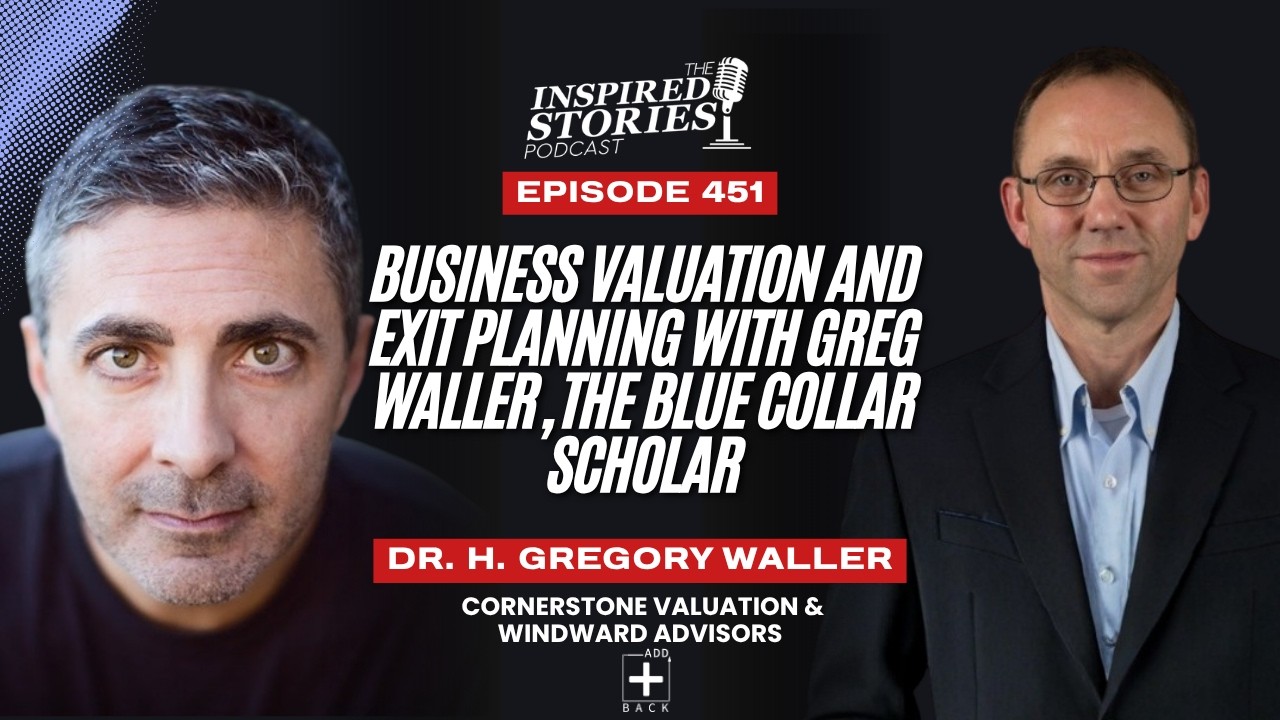
From Painting Bridges to PhD: Greg Waller's Journey as the Blue Collar Scholar of Business Valuation
Greg Waller, Managing Partner of Cornerstone Valuation and Windward Advisors, shares his unlikely path from painting structural steel bridges and going bankrupt at 26 to earning a PhD from Purdue and becoming a trusted advisor for middle market business owners navigating valuations, exit planning, and M&A transactions.
Key Insights You'll Learn:
Dropped out of college to run a structural steel painting company before a mentor on a job site sent him back to school
A bankruptcy at 26 from overspray damage and a called line of credit became the catalyst for his MBA and eventually his PhD
Blue collar roots plus academic rigor create a rare perspective for valuing and selling companies other advisors miss
Business value equals benefit divided by risk, and reducing concentration risk in customers, vendors, and key employees raises value
Three years of clean financial data is the minimum baseline before taking any company to market
Cash basis financial statements often need to be restated on accrual before a professional buyer will engage seriously
1099 employee classification and E-Verify compliance are emerging deal risks that professional buyers scrutinize closely
Taking a company to market without a price and running a structured auction process consistently produces better outcomes
AI may handle rote report writing, but qualitative judgment in valuation still requires trained human eyes
Informed sellers are rare and most business owners are outmatched by well-resourced professional buyers who do this every day
Greg's Key Mentors:
Old-timer on the bridge scaffold: Told a young Greg to go back to school, the moment that changed his entire trajectory
Ohio University faculty: Encouraged him to pursue academics and a doctoral program when he had no such plans
Bill Duellen, Purdue Executive Education: Gave him room to run real estate deals while finishing his PhD
Jim Edge, Cornerstone Founder: Gracious in transitioning the practice and served as an unexpected mentor in Greg's adult career
Entrepreneurs Organization: Ongoing community providing peer education on business development and personal growth
Don't miss this conversation about what business owners don't know that professional buyers already do, why bankruptcy can be a tool rather than a failure, and what it means to bring academic rigor to a blue collar worldview.
Listen to the full episode here
Transcript
Anthony Codispoti (00:00)
Welcome to another edition of the inspired stories podcast where leaders share their experiences so we can learn from their successes and be inspired by how they've overcome adversity. As you listen today, let one idea shape what you do next. My name is Anthony Cotaspodi and today's guest is Dr. H. Gregory Waller, managing partner of Conor Stone Valuation, a 25 plus year firm that helps owners of closely held companies understand, grow,
and ultimately realize the value of their businesses through rigorous business valuation, exit planning, and transaction readiness. In addition to his valuation work, Greg is a partner and managing director at Windward Advisors, a middle market investment banking firm, where he advises founders on sell-side &A and selective buy-side transactions, guiding companies through strategic positioning, confidential marketing, and deal execution.
Greg's work sits at the intersection of financial theory and hands-on deal experience. He has published research in leading journals, including the Journal of Financial and Quantitative Analysis, and regularly speaks to groups such as the Virginia Bar Association, Virginia CEOs, and the Virginia Manufacturers Association. Greg holds a PhD in finance from Purdue University, and until 2025,
served as a finance professor at Virginia Commonwealth University. That combination of academic rigor and real world advisory work has made Greg a trusted voice for owners navigating high-stake business transitions. Now, before we get into all that good stuff, today's episode is brought to you by my company, Ad Back Benefits Agency. Listen, if you run a business, you are likely stuck in the cycle of rising insurance premiums. You're paying more, but your team is getting less.
and many people can't afford coverage at all. We do things differently. We offer a solution that provides your employees with unlimited access to doctors, therapists, and prescriptions that's always free for them to use. But here's where you really need to pay attention. Unlike every other employee benefit out there, our program puts more money into your company's bank account. As an example, we recently helped a client increase net profits by $900 per employee per year.
Gains like that can change how a business is valued. Results vary, but the consultation is free. Imagine being the advisor that becomes a hero by introducing this to your clients. See if they qualify today at addbackbenefits.com. All right, back to our guest today, the managing partner of Cornerstone Valuation, Greg Waller. Thanks for making the time to share your story today.
Greg Waller (02:48)
That's my pleasure. Thanks for having me.
Anthony Codispoti (02:50)
So Greg, you've been a professor at Ohio University and Virginia Commonwealth University. Is it unusual for someone with your experience to have both a foot in the academic world as well as the business world?
Greg Waller (03:06)
Yeah, I always tell people that I'm probably the most unlikely academic that you're ever going to meet. ⁓ I was raised in a blue collar entrepreneur household. My father owned a small business that repaired painting and sandblasting equipment. ⁓ from the time I was in high school, I was ⁓ doing painting and sandblasting work. ⁓ My father used to get these calls ⁓ from customers.
you know, do you sandblast trailers? Do you sandblast lawn furniture? And he always had to say no until I got my driver's license. And it was like, okay, this is your opportunity to go make money. So from the time I was 16 years old, I was out doing painting and sandblasting type work. ⁓ I ended up starting a company that painted structural steel bridges, tanks, towers, and that kind of stuff. And at one time I had a reasonably good size group of folks out doing bridge painting work and other structural steel painting.
and there was a time, ⁓ I remember, working, ⁓ I was working on a bridge and I was underneath of this bridge with this guy. I had to, fill in for a couple of folks that I had to fire. ⁓ and I was working on, ⁓ on a scaffold with this old guy that had been doing this for a long time. He was probably like my age, but you know, he seemed old at the time. And he was like, ⁓ he was like, look at my hands, look at my face. He said, I'm doing this because I don't, you know, I don't have any other options in life.
go back to school, you're a smart boy. So I went back to school. ended up going, because, know, it was like, there, it was a confluence of events, but, ⁓ but that, that summer in particular is when I really committed to like going back to school, because I dropped out of college to run the painting business. And I went back to school, I finished my undergraduate degree and got my MBA. And while I was doing my MBA at Ohio University, some of the faculty said,
Anthony Codispoti (04:37)
because of that conversation.
Greg Waller (05:03)
Hey, did ever think about doing academics as a career? was like, no, I never thought about doing academics as a career. ⁓ And they said, go back and run the family business that my father had. That was the plan. I was going to do my MBA and, you know, go back and run the family business. ⁓ so they were like, you know, you got to think about doing academics. And I was like, why would I like, why would I want to do that? And so they broke down, you know, nice
Anthony Codispoti (05:09)
What was your plan at that point?
Greg Waller (05:29)
predictable lifestyle and all the good things that go along with higher education. And so I ⁓ stuck around Ohio University for a year after my MBA and did some research and did some teaching, built up my academic resume and applied to doctoral programs and then got into the doctoral program. But it was not like, it was not the first thing that came to my mind to do academics.
Anthony Codispoti (05:55)
So how did you eventually transition from academics back into the business world?
Greg Waller (06:00)
Well, I don't think I ever fully transitioned into academics. So when I was at Purdue University, my teaching assistant assignment was in the executive education building at Purdue University. And I had a gentleman there that I was working for, one of the longtime tenured professors, Bill Duellen. And I had a pretty easy job. I I did my classwork and I helped out with the executive education when the executives were in town.
At the same time, I was also doing real estate development outside of Chicago and from Purdue to Chicago was a reasonable commute. And so was doing real estate development deals while I was in my PhD program. And I remember Bill the Welland coming in just looking at me a couple of times and shaking his head. It's like he couldn't believe I was sitting there ⁓ running real estate deals while I was doing my PhD. so I don't know that I ever fully got out of it. And then, you know, when I took the academic position, I finished my PhD and
in 2005. And it was right around the time when the, you know, the big financial crisis was starting to take hold and real estate development was like getting hurt pretty bad. And so I wrote out the ⁓ I wrote out the the recession, the Great Recession as a tenure finance or tenure track finance professor at the time. yeah.
Anthony Codispoti (07:22)
So how did the opportunity to join Cornerstone valuation come about? This is roughly 12 years ago.
Greg Waller (07:28)
Yeah. when I was after my MBA and while I was in my doctorate program, I ⁓ had a couple acquaintances who were accountants and they had businesses that they were representing that needed valuations. I remember the first one I did was for a ⁓ family owned ⁓ restaurant operation. There was a death in the family and they needed a valuation to settle the estate. And so I was doing business valuation work.
kind of ad hoc while I was at Ohio University, some expert witness testimony. ⁓ And when I came to ⁓ VCU in Richmond, ⁓ I met my soon to be partner, Jim Edge, and he had started Cornerstone before I arrived in Richmond. And he was transitioning out and asked me if I'd be interested in buying the practice from him, which I did.
Anthony Codispoti (08:21)
How did the two of you meet?
Greg Waller (08:23)
We had a mutual acquaintance. So I had a colleague at VCU whose husband was a real estate guy and we kind of told war stories together. And he said, hey, you know, I got to introduce you to this friend of mine. And so that's how we got introduced.
Anthony Codispoti (08:40)
And what was it about this opportunity that attracted you to it?
Greg Waller (08:44)
Well, I been doing some business valuation expert witness testimony on my own. ⁓ I like the idea of meeting somebody local to Richmond who could help me network in the community. The company had a great reputation and my former partner, Jim Edge, was just a ⁓ great guy. He became a great friend and ⁓ was a very ⁓ gracious person.
in terms of transitioning of business over to another person. He just did a great job.
Anthony Codispoti (09:17)
So tell us about all the services that you guys offer today.
Greg Waller (09:21)
Yeah, so we do in a nutshell, we value and sell companies. So we do business valuation for lots of reasons. There, you know, I think the average person may not realize when a business valuation is needed. ⁓ Death, right? If there's a death and the decedent owns a fractional interest in a company in order to settle out the the estate, you're going to need a business valuation gift taxes. If you're going to gift
shares of a company to children or to other people. You're going to need to have a valuation put on that gift size. ⁓ We help for internal planning purposes, partnership transitions, internal buyouts and buy-ins, ⁓ litigation support. All partnerships start out well and many of them don't end well. ⁓ When they don't end well and it's a business relationship,
They often end up in court and there are valuation issues that have to be litigated. And so I can get called in as an expert witness. We help with M &A work as well too. So if somebody wants to sell their company and they want to know, you know, what is the company worth? We help in that regard. And we also help with the transaction side. So if a client is looking to exit their business through our win word advisors platform,
we execute that transaction. So we do sell side ⁓ advisory mainly some select buy side advisory as well too.
Anthony Codispoti (10:57)
So Cornerstone is really focused on doing the business valuations. Windward gets more involved in handling the actual transaction, maybe getting the business prepared for sale, ⁓ sort of guiding them through that &A process, helping them find and vet buyers. Am I understanding that correctly?
Greg Waller (11:16)
Yep, yeah, you got that right. ⁓ Just because there are certain professional liability issues associated with business valuation, because when I sign on a business valuation report, it's kind of like an audit. ⁓ So to keep the practices separate and the liability issues separate, we run the business valuation through Cornerstone and we run the &A advisory.
Anthony Codispoti (11:40)
Okay, so Cornerstone has been around for over 25 years. You've been there for about 12. Can you share a specific challenge in the early days that helped to shape how you approach business going forward?
Greg Waller (11:56)
Yeah, so the cornerstone was a pretty smooth transition, honestly, because I had the luxury of having a stable ⁓ paycheck from the university. So I had my full-time ⁓ faculty position and I had the consulting practice outside. So I was able to make the transition from academics back into the private sector pretty easily because I had the stability of
the academic paycheck and then the cornerstone is my side hustle, if you want to call it that. ⁓ Over time, the practice grew and I had to make a choice about what I wanted to do to be fair to everybody. And so I ended up leaving academics and pursuing cornerstone ⁓ and the &A advisory. ⁓ the challenges there, it was actually a pretty smooth transition. I think, ⁓
If anything, it was balancing ⁓ my responsibilities to the university along with the responsibilities to the practice.
Anthony Codispoti (13:05)
Which is why you eventually decided to focus 100 % on the practice. And you talked about how when you sign evaluations, it's kind of like signing an audit. So this is a pretty significant document. This isn't just writing some numbers on the back of a napkin. So what steps do you guys take to ensure that your evaluations will stand up under scrutiny?
Greg Waller (13:32)
Yeah, so all of the valuations that love. Let me backtrack this a moment and talk about valuations. The quote products that we sell. So valuations come in a couple different flavors, ⁓ much like financial statement preparation from accountants, right? So you can get evaluation that is like the audited financial statement version we call and that results in what we call an opinion of value. ⁓ And that has the highest level of.
review and the highest level of professional liability. If a business owner came to me and said, hey, I just want to know what my company's worth. I've got an amicable partnership situation and they want to buy in more equity. We could do what we call a calculation of value that is a little less rigorous. And I tell people that it's a lot like compiled financial statements as opposed to audited financial statements. So when we do the
the opinion of value, the more formal valuation work. ⁓ I draft, if I'm the lead on the project, I will draft the report and then I pass it to one of my partners for review, one of my colleagues for review. So we always have a second set of eyes, in some cases a third set of eyes on the project. Analysts are working on it, mid-level people are working on it, and then the senior project lead is also working.
Anthony Codispoti (14:55)
So is it the case where you need to find what the revenue is, the EBITDA, and then you multiply it by a multiplier that's typical for the industry? That's a pretty straightforward approach.
Greg Waller (15:10)
Yeah, you hit on a topic I talk a lot about and that is the difference between price and value. And so, you know, the market prices assets, right? And I told people, you know, I'm gonna have to come up with a more current example. But if you guys remember the GameStop thing, when GameStop stock was going through the roof, right? So what was happening? The market was bidding up the price of GameStop stock.
But fundamentally nothing really changed about the business, right? And so when the market realized that, nothing really has changed about this business, what happened to the price? came back down, right? And so that's kind of the difference between value and price. So when we take a company of the market, we're trying to price the company as favorably as we can for the client. We want to get the highest price for the client. When we do a valuation, we are trying to determine the
true value with a capital V. ⁓ The problem is that it's an unobservable variable. Like nobody knows the value of a company really. We can estimate the value of a company. so whenever I do valuation work, I always tell my clients that, look, if you want me to tell you what the company is worth, I can't tell you that. I can tell you my opinion of what I think it's worth.
⁓ And the reality is that if anybody ever tells you that, you know, I'm looking at your company and it's worth X, they're not telling you the truth. Their opinion is worth X. It's not an observable variable. So we estimate it.
Anthony Codispoti (16:44)
What do you mean by it's not an observable variable? Are you just saying that, well, it's worth what somebody is willing to pay and we don't know what that number is until we take it to market?
Greg Waller (16:53)
Well, I would say that you can't observe the value until a transaction happens. ⁓ But then, you know, it gets into this gray area between price and value anyway. So when we try, so we have techniques that we use to try to estimate the value of the company. We look at the cash flows that the company is generating, right? Whenever I was teaching finance classes to...
to students at the university, I always said that the value of any asset is the present value of the expected future cash flows that the asset's going to generate, whether that's a company or a piece of equipment or whatever. So that's one approach that we take. We call that the income approach. We look at the cash flows that the company generates. We find an appropriate risk adjusted required rate of return and we find the present value of those cash flows. That's one indication of value.
Anthony Codispoti (17:45)
So basically, just to break that down into kind of layman's terms, I think what you're saying, Greg, is how much money do we think this company can make going forward?
Greg Waller (17:54)
in today's terms. And so a dollar 10 years from today is not worth a dollar today. ⁓ So that's one approach. We call that the income approach. But we also look at multiples. We call that the market approach. look at ⁓ publicly traded companies that might be similar, ⁓ recent transactions that have happened. And we can take multiples from those transactions. ⁓ And then we zero in on some of the
non-quantifiable aspects of the company. Does it have a deep management bench ⁓ in the event that the owner dies? And we add these other qualitative effects into the analysis and we come up with an opinion of value.
Anthony Codispoti (18:40)
So let's pick one of those variables. ⁓ What was the last one that you just mentioned there, Greg? ⁓
Greg Waller (18:46)
If there's a deep management bench. ⁓
Anthony Codispoti (18:48)
Deep management bench. Okay.
So let's say that there is not a deep management bench and we identify this as being a potential risk. Then are you, you know, dividing by, you know, a certain percentage like you take, Hey, we thought this business is to be worth a million, but because the management bench is a risk, like we're going to say it's worth 925 instead.
Greg Waller (19:13)
Yeah. So just to your point about ⁓ risk, ⁓ you know, in very, simple terms of value, you can think of it as benefit divided by risk. Benefit would be the cash flows. Risk are the risk factors. And we use what we call the required rate of return to quantify those risk factors. So ⁓ the deep management bench example ⁓ makes a company more risky.
So if a company is more risky, the required rate of return is gonna go up. So if you think about this fraction benefit divided by risk, if risk goes up, all else equal, value is gonna go down. ⁓ We try ⁓ to estimate ⁓ some of these qualitative factors, but admittedly they're subjective. there's a lot of theory out there about how best to estimate some of these qualitative factors, but I don't know that there's... ⁓
I don't know that anybody has like the silver bullet for how to put a number on these. We look at it and there's always sliding scales of, how much is this going to impact the value? Right. I mean, if, if I've got a business owner who's ⁓ in his mid sixties and has no bench, well, it's obviously more risky than a startup company with somebody in their mid thirties that is building a bench. Right. And so
⁓ So we try to assess that as qualitatively and as accurately as we can.
Anthony Codispoti (20:44)
Okay, why do some folks call you the blue collar scholar?
Greg Waller (20:49)
Yeah, so I told you a little bit about my my early background, ⁓ working painting bridges and doing all that stuff. So ⁓ I come from a blue collar background, probably. My father was a blue collar entrepreneur. And, ⁓ you know, it was a huge influence on my life taught me how to do a lot of things. Taught me the value of hard work and, you know, having been climbing steel and painting bridges and doing like, you know, hard kind of
physical work, I think I'd bring a blue collar mentality to what is really not a blue collar profession, right? When people think about investment banking or business valuation, they think about a very white collar type job. But a lot of the business owners that I deal with are people like my father or companies like I had, industrial painting companies. so having the...
academic background to be able to bring that academic rigor to the engagements that ⁓ I take on, as well as the hard work, blue collar background. It's kind of an interesting blend of ⁓ real world ⁓ hard work and academic theory. I ⁓ kind of came up with the name Blue Collar Scholar.
Anthony Codispoti (22:08)
I like it. Who's an ideal client for cornerstone valuation, whether it's geography, size, industry?
Greg Waller (22:14)
Yeah.
Yeah, ⁓ value ranges, you we like to work with companies where the transaction value for &A activity is going to be in the, you know, call it 15 to 200 million range. ⁓ And, you know, so in terms of what they call EBITDA earnings, know, 2 million in EBITDA and up generally, ⁓ I tend not to put hard, fast rules on that ⁓ because there may be
some early stage companies that are recurring revenue type model companies that would attract the type of buyer audience that we do well with. But generally speaking, I would say, you know, that's 15 to 200 million enterprise value range. Geography, we've done transactions across the country. So there's really no geographic limitation.
In terms of industries, I like ⁓ infrastructure engineering type companies. I've done a lot with that. But I also bring to all my engagements a deep understanding of technology. When I was in academics, I've reviewed and sampled and worked with many, many EdTech providers. ⁓
probably a third of my valuation book of business is tech related in some form or fashion. ⁓ And I think now as we look at what we typically think is ⁓ like traditional blue collar industries, ⁓ technology is everywhere. So I'm active with the Virginia Manufacturers Association and tech enabled manufacturing is huge. I think,
When I was doing academic research, we had to learn programming. We had to learn. mean, we were immersed in all this stuff. So I had the opportunity early on to work with large language models. ⁓ so I saw what's now AI seven years ago when I was doing academic research.
Anthony Codispoti (24:30)
fascinating. What was your opinion back then? Did you have any sense of what we were about to stumble into?
Greg Waller (24:38)
I know it was powerful. we would do things like take annual report filings and scan them for certain keywords to assess sediment of management or the company. ⁓ And so it was out there and it was happening. What I didn't realize was how seamless the interface was going to become. ⁓ And that is the thing that I think is just mind blowing.
Anthony Codispoti (25:04)
Any predictions on where it's going?
Greg Waller (25:08)
Right. If I had that one, I think there are a lot of people who are scared to death about AI. I think that it's going to create a division. I still have relations in academics. My wife is still a finance professor. so my head is still there. And I see the challenges that young people are facing now.
Anthony Codispoti (25:09)
Hahaha.
Greg Waller (25:37)
⁓ by just relying on AI to do a lot of the thinking form. So I think that there's going to be this bifurcation between people who can actually think and then people who rely on AI. And that scares the crap out of me because I would say that, you know, human nature is such that we may take the path of least resistance when it comes to doing the heavy lifting. And unless we really, really ⁓ discipline ourselves to ⁓ structure our educational system and our
work environments so people are actually thinking, I think there's going to be big problems there.
Anthony Codispoti (26:12)
I tend to agree with that. who are your ideal clients for Windward?
Greg Waller (26:18)
Yeah, so I will say that whenever I talk about &A advisory, I always divide the world of buyers of companies into two camps. So on one hand, you have what I call owner-operators. And these would be people who left the corporate job, get an SBA loan, and buy a company. And then the other group are what I call professional buyers, strategics and private equity firms. And it's really important if you're going to sell your company that you know
who you're selling to because the process that you use to appeal to these two audiences is vastly different. So we work with companies who are selling to professional buyers, to strategics and private equity firms. Generally, this breaks on size, by the way. ⁓ Smaller companies are generally ⁓ acquired by owner-operators, not always, ⁓ but generally. ⁓ So the process that
one takes to sell a company to a professional buyer is a much more rigorous process. There's, you know, due diligence, there's cultivating the buyer's list. you know, really importantly, the way that companies are marketed to owner operators is much like the way a house is sold in the market. You put a price on it. When we take a company to the market, we never put a price on it. We let the market decide the price. So we create an auction process among
these private equity firms and strategic buyers for a particular company. And it's a very disciplined process. getting a letter of intent is like the easy part. Now, once you get the letter of intent, you've got to get it from LOI to close. And you have to take the company through the due diligence process, which is pretty rigorous when you're dealing with professional buyers. And so we excel in working with companies that are selling to professional buyers.
Anthony Codispoti (28:11)
And so are there particular industries or I think the geography is probably the same answer as before. You're kind of agnostic there.
Greg Waller (28:19)
Yeah.
Yeah. Industry strengths are tech firms, ⁓ EdTech, PropTech, ⁓ ManufacturingTech, ⁓ engineering and infrastructure firms. ⁓ I would say my partners at WinWord, between us, we have probably ⁓ sold companies in virtually every industry. ⁓ Through my valuation practice, I've been under the hood of companies in virtually every industry.
So I think that the combination of coming from the valuation background into &A has really set me up well to ⁓ understand the value drivers of businesses and understand the activity in those markets. Who are the buyers of companies? And I think when somebody's contemplating selling a company, they want to make sure that the person representing them is going to be able to market the company to ⁓ a group of buyers that are going to be good buyers for the company.
Anthony Codispoti (29:18)
You know, we mentioned before how you speak at a lot of events, Virginia Bar Association, Virginia CEOs, Virginia manufacturers. ⁓ What are the common questions or concerns that you're hearing from business owners and their advisors about exit planning and &A?
Greg Waller (29:35)
Yeah, I hear a lot about, you know, I'm thinking about selling my company. What do I need to do to make it more valuable? And I always tell people like that, you know, the best time to start thinking about when to sell your business was three years ago. So you really want to have three good years of financial data. That's really important. So if it means going back and restating some of the financial data because now you're ready to sell.
then that's what it takes. But you need three good years of clean financial data. And then you want to look at the drivers of value. Does the company have a high degree of customer concentration or vendor concentration or employee concentration? Is it working capital intensive? Is it working capital light? Those are big value drivers.
The company is generating profitable cash flows year after year. Is there a good growth trajectory that we can sell on? So when we take a company to the market, I always want to do a bottoms up forecast of the next year so that I can take to the market, ⁓ whether it's a pipeline of work or backlog or something like that, I can take that to the market and tell buyers, look,
Yeah, the last three years were really good, but it wasn't a fluke because look at the forecast for the coming year. Now I've put some pressure on the owners to be able to make those numbers. So we're very realistic in the forecast that we develop, but we always want to try to sell on a forward run rate. If a company's in a ⁓ growth trajectory, where are they at in that trajectory? Are they getting ready to peak or are they just now hitting the steep part of that trajectory? ⁓ So there's a lot that goes into ⁓ timing. ⁓
timing the exit. But yeah, but those key value drivers never go away. Is it generating cash flows? Is it working capital light? Is it no customer or vendor concentration, those sorts of things.
Anthony Codispoti (31:41)
You mentioned that ⁓ maybe it would be an opportunity or a time for them to restate ⁓ financial data. What would be a call for that? A reason?
Greg Waller (31:50)
Yeah, I've got a company right now that I'm working with very good company. They use cash. I mean, it's a reasonably good sized company and all their financial statements are on a cash basis. And so we are having them go back and state those on an accrual basis so that, you know, accrual basis for, know, for those that aren't very familiar with accounting, accrual basis matches revenues with expenses a little bit better than cash at cash basis. Basically cash comes in and cash goes out. ⁓
So you don't see the accounts receivable and the accounts payable ⁓ on the balance sheet like you would on an accrual basis. And so ⁓ generally professional buyers are gonna wanna see the financial statements on an accrual basis. And ⁓ so we're working with them now. We brought in a third party ⁓ to help them restate the financials.
Anthony Codispoti (32:41)
I know another unique aspect about what you guys do is value building advisory. Can you talk more about that?
Greg Waller (32:48)
Yeah.
Yeah. Looking through ⁓ looking through the company from top to bottom, is there customer concentration? Is there vendor concentration? ⁓ How are you handling your 1099 employees? We had a situation with the deal last year that the company was highly reliant on 1099 employees and there was potential tax liability after the transaction that we had to that we had to work around.
So how are you handling 1099s? Are you ⁓ e-verifying if you're selling into ⁓ a professional buyer and they're going to want to see ⁓ i9s and e-verified? Those are value drivers. ⁓ How are you handling your working capital? How ⁓ are you handling those key employees? Is there a deep management bench? So we work with companies in those regards to...
address all those issues and get them shaped up in advance of going to the market.
Anthony Codispoti (33:53)
Craig, I'm seeing some glitches in your video. Are you noticing the same thing?
Greg Waller (33:57)
Yeah. And I don't know where they're.
know exactly what's driving that.
Anthony Codispoti (34:05)
It's strange. It's like your computer's having a seizure.
Greg Waller (34:10)
Everything is good on my end. ⁓ I apologize for that.
I think I won a win.
Anthony Codispoti (34:20)
Seemed to settled down. Okay. So I'm just going to make a note to cut that out.
Greg Waller (34:22)
Sorry. Yeah, thank you.
Do want go back and do that, part about the value drivers? I think we were getting some video fluctuation there.
Anthony Codispoti (34:35)
Sure.
So Greg, I know another unique aspect of what you guys do is what you call value building advisory. Can you say more about that?
Greg Waller (34:46)
Yeah, sure. So when we are getting ready to take a company to the market, we want to go from top to bottom and look through the ⁓ risk factors and the benefit factors. Remember, I talked about that benefit divided by risk, right? So, you know, on the risk side, there ⁓ customer concentration, vendor concentration, over-reliance on key employees, ⁓ maybe not the deepest management bench?
⁓ Lack of policies and procedures. These are all risk factors that ⁓ bring down the value of a company and we'll work with clients to address those issues. On the top part, on the benefit side, is the working capital being managed efficiently? the margins at least at industry norms? So we'll work with them to try to address those. Are the financial statements properly prepared and formatted? One of the things that
⁓ it has a huge effect on the price that a company will bring in the market are what we call add backs to the financial statements. Are there expenses being run through the financial statements that a third party buyer would not incur? Maybe it's headcount, maybe it's personal expenses. So we'll look through the financial statements to try to get those add backs. those are all value building ⁓ type exercises that we
that we work with clients on.
Anthony Codispoti (36:15)
How do 1099 employees factor into all of this?
Greg Waller (36:19)
Yeah, 1099 is like it's becoming more and more of an issue. We were working with a company last year that was, you know, highly dependent on 1099 employees and it posed a potential tax liability. Luckily, they had they had their their documents in order and in fact made a solid argument that their employees were were in fact 1099 and not not W2 employees. But
Professional buyers are going to look for those. So if there's a company that's heavily reliant on 1099 employees, that's something that we want to look at. E-Verify, that's another big thing that professional buyers are looking at now, are there I-9s and E-Verify for all the employees. So ⁓ those are two other issues with respect to labor that we're seeing a lot of.
Anthony Codispoti (37:10)
And so the potential tax consequence is that somebody were to evaluate this and say, ah, those folks don't really meet the definition of an independent contractor. They shouldn't have been 1099. They should be W-2. You guys owe some payroll tax there.
Greg Waller (37:23)
Correct, that's the potential problem. So you have to be really careful with that.
Anthony Codispoti (37:28)
Yeah. How about sales tax liability? Is this coming into play in any of the transactions that you do?
Greg Waller (37:34)
Yeah, for companies that are selling products across state lines, that's another issue. mean, yeah, the number of issues is as infinite as the number of companies out there. But yeah, that is a potential problem. So if companies are selling goods across state lines, we want to make sure that the sales tax are correct for each state that the company operates in. Is it a point of origin or a point of destination sales tax regime and all those different
factors that go into ⁓ calculating the sales tax liabilities.
Anthony Codispoti (38:08)
I want to go back to the scholar part of the blue collar scholar and talk a little bit about some of the research that you did in your academic days. You were exploring some topics like anti takeover provisions and shareholder wealth. Can you share some key insights from that work that are applicable to what you're doing now?
Greg Waller (38:16)
Yeah.
Yeah, so I think the theme to at least the recent research that I was working on was, ⁓ know, there's very rarely a one size fits all policy for a lot of the things that we hear in the business press. For example, we were working a lot with ⁓ staggered boards or what they call classified boards where the term of the directors ⁓
lapses over. So you may have a board of directors broken into thirds, right? And so one third of the directors is up for election each year. And, you know, there's been some argument that, look, those are value destroying governance structures, because, you know, if an acquiring firm takes over a company with a staggered board, then they have to wait two or three cycles before they have control, full control of the board. ⁓ And then
Others were like, no, it preserves, you know, long-term thinking because you're not getting turnover at every election cycle on the board. And so I think that the mainstream academic literature has come down on the side of the fact that classified boards were, you know, value destroying. And I think in some of our research, we were showing that in fact, in some instances, they may actually be value enhancing. And so I always look for these, I always look for these.
you know, ⁓ one size fits all statements that people make these blanket statements and try to find some sort of, ⁓ you know, a counter argument. I mean, because very rarely are things always that simple, right? It's not so simple to say all classified boards are bad or, you know, pick a topic. so, and so we always tried to find, ⁓ you know, arguments against the, what the mainstream literature was saying.
Anthony Codispoti (40:17)
And so is that the position that you officially hold now? Or is it one of those? It depends kind of answers.
Greg Waller (40:24)
Yeah, I think it kind of depends, honestly. I think it depends on the company and the people who are on the board. ⁓ yeah, so I don't know that they're always value enhancing. I would never say that. But I would say that in some cases, they are, in fact, value enhancing because they may, you know, it may be the case that classified boards ⁓ enable a company to negotiate for a higher takeover premium, for example. yeah.
I think there are instances. I don't think it's that cut and dried, but that was the thing with academic research, right? Once you build a data set and you start working on stuff, you really try to find as many applications for that data set because it's such a grind to get the data together. so research, not just mine, but I think most academics, you're going to see a run of a few articles or a few publications in a particular area.
because of the fact that they put a lot of work into a data set. And so that kind of becomes their, their run for awhile. They try to get as much mileage out of it as they can.
Anthony Codispoti (41:28)
Okay, it's a hey, I've invested a lot of time and energy into ⁓ formulating an opinion on this. And I'm going to stick my flag in the ground and run with it for a bit.
Greg Waller (41:38)
Yeah, I have months or maybe years building a data set. I'm going to get as many articles out of this data set as I possibly can.
Anthony Codispoti (41:47)
In the time that you've been either on the academic side or the corporate side or both, what's a big change that you've seen in the way that business valuation is handled?
Greg Waller (41:58)
⁓ I mean, I think the valuation principles are the same. And so I taught finance in the university, right? And it was like, it's kind of like math, like two and two is always going to be four. The principles that we use to value companies is the same. think where we are starting to see some changes is the effects of AI in writing, actually writing a business report. ⁓
or the reliance on maybe AI generated results to say, you know, what's my company worth? I mean, unless you really do the research, you don't know if ChatGPT is giving you good information or bad. It might sound really impressive, but you really want a trained set of eyes to be able to look at whatever you're getting out of ChatGPT. They might put you in the zip code and you know, after review, they might actually have been right, but I don't know if it's luck or if it's skill.
coming from the AI side, right? ⁓ So, you know, but I do see AI tools helping ⁓ with ⁓ report writing and some of the rote aspects of business valuation, but the principles are always the same. And at the end of the day, there are qualitative factors that have to you know, assessed when you ⁓ put a valuation on a company.
Anthony Codispoti (43:21)
So your approach today, it sounds like Greg, is that you're still doing the valuation components, all the research, mostly manually by hand. Once you've kind of got that data, then you can feed it into an AI tool to help you compose the actual report that goes to the client.
Greg Waller (43:41)
Yeah, or to proof the report, you know, maybe to proof it and, you know, pick up things that, you know, maybe might be another way to think about how to phrase a particular aspect of a report. I don't always, I don't always land on that, by the way. I mean, I'll take their suggestions, but I'm still kind of old school and I like to write my reports myself. So.
Anthony Codispoti (44:07)
Which is surprising coming from a guy who got such an early look at the LLM. She figured.
Greg Waller (44:12)
Yeah, yeah,
no, it's true. you know, if I've got to go defend it, I want to make sure that I know exactly where all this stuff came from. So.
Anthony Codispoti (44:22)
That makes a lot of sense. What's been the best growth lever for you guys? Where do you get most of your new clients from?
Greg Waller (44:29)
Yeah, we do. ⁓ We do a lot talking directly to entrepreneurs and business owners. So, you know, the the &A world is largely divided into, you know, folks who do what they call sponsored sell side. So they're selling companies for private equity firms that are, you know, have had them in their portfolio for a while and now they're going to sell them out of their portfolio. We do some of that, but not much. ⁓ Most of our work is with.
owners of businesses, founders, family members of businesses who are looking to exit. And so we work with attorneys and wealth advisors and accountants and other intermediaries who are in front of businesses and we get in front of businesses ourselves through speaking engagements and through social media and other stuff.
Anthony Codispoti (45:19)
What do you think the future of each of your firms looks like? Cornerstone and when.
Greg Waller (45:24)
Yeah, I think that, ⁓ you know, there's always going to be a need to on the &A side, there's always going to be a need for that advisory work, I think, ⁓ just because of the due diligence and all the other stuff that goes into marketing a company. ⁓ I don't see that getting disintermediated much. I could see over time, people maybe relying more on AI generated reports for
non-reviewed type evaluations. For example, ⁓ know, ⁓ Anthony and I have a business and Anthony wants to buy a little more equity. ⁓ Let's come up with something that makes sense. You put it into AI and you ⁓ come up with a value and you shake hands and okay, yeah, this seems fair to me, good. So I could see getting some of that, know, getting disintermediated in some of that. ⁓
But when it comes to litigation support or when it comes to ⁓ some of the IRS filings that we may have to defend, I still think that there's going to be a need for human touch on that.
Anthony Codispoti (46:33)
Say more about when the IRS might get involved in questioning evaluation.
Greg Waller (46:38)
Yeah, so if there's a large estate and I did evaluation on a fractional interest in a company and that estate tax filing gets challenged by the IRS or gets audited, then I would have to, I'd be called in to defend, possibly be called to defend my valuation.
Anthony Codispoti (46:57)
What does that process look like?
Greg Waller (47:00)
Well, the IRS has some pretty skilled business valuation people working for them as well. In fact, a lot of the, you know, lot of the guiding laws come from the tax courts. So they would review my valuation and see if they have issues with it. And if they did have issues with it, we would have a meeting and discuss it. Normally it starts just as a meeting and talking through the differences or, know, how did you see this? How did you see that? I have to say in
all my years of business valuation, I've never had one formally challenged. got one time I had a question on evaluation and we work, you know, we worked through the issue that we disagreed on and settled it out. So, but I've never really had one challenged.
Anthony Codispoti (47:49)
Hmm. That's comforting. I'm sure your clients like to hear that.
Greg Waller (47:51)
Yeah.
Yeah, yeah. So, I mean, we know the rules. We know the guardrails that we have to stay inside of.
Anthony Codispoti (48:04)
For listeners who are business owners, maybe thinking about selling their business, are there any resources that you can recommend for them to start to educate themselves? A podcast, a book, something along those lines.
Greg Waller (48:20)
Yeah, so ⁓ I have I have a podcast, a YouTube channel that I'm putting together middle market value.com there's information there. There are there are lots of good books about selling companies. You know, I do see I do see more I have to say I see more information out there on how to buy companies, which is like one of the things that I I always tell my audiences and people I work with it's like
There's a lot of stuff out there in social media and ⁓ in press about how to buy businesses. And so what that means is that there's this whole universe of very informed buyers, but how many informed sellers are there really? ⁓ And so if you are a business owner, you probably want to be an informed seller. so I do some speaking on that. ⁓ In terms of just general value building, I like...
I've read a couple books by Alex Formosia. I think that, you if you want to ramp up sales and, and, you know, get your company juiced up, I think he's got some really clever approaches. I am an active member in entrepreneurs organization, I highly recommend it for business owners, great educational opportunities there on all aspects, you know, personal self development as well as, as well as business development.
Anthony Codispoti (49:48)
⁓ Alex Hermosy, big name everybody recognizes. What's one or two of his tips that ⁓ you take some value from?
Greg Waller (49:57)
⁓ Thinking about a model for revenue generation, I think that's his overall theme, right? Like what's your model basically and how does it work? then, like building on that model and ⁓ the willingness and ⁓ ability to be able to ditch what doesn't work and double down on things that do work, I think is like always seemed to be pretty successful for me.
Anthony Codispoti (50:22)
And you said something interesting, that there's a lot of information out there ⁓ for people who want to buy a business, not so much for people who want to sell. Why do you think it's so lopsided?
Greg Waller (50:33)
Yeah, that's a good question. I, you know, I saw it back in like the late 80s with real estate, like buy real estate, you know, there are all these courses on how to buy real estate. And now there's like, all these ⁓ courses or, you know, information things on how to buy businesses. And I just think that, you know, sometimes people want easy answers to complex questions. And, ⁓ you know, it's like, I'm just going to go buy a business. Well, yeah, that's fair. You can go do it. But, you know, you're
you should probably know what you're doing if you're going to go buy a business. I don't know that, I mean, I can't say that I've looked at all of the stuff that I've seen out there. It's like, sometimes it becomes white noise. I've seen so much of it, but I, I think that, you know, there are, ⁓ you know, there are people looking for easy answers to some of these more complex questions.
Anthony Codispoti (51:23)
You want to try fixing your camera there again? What did you do last time that helped?
Greg Waller (51:25)
Yeah, I don't know.
This is
never done this before. I don't know what that...
Anthony Codispoti (51:32)
There's a loose connection.
Greg Waller (51:34)
Maybe, yeah, it's a new loose connection. Sorry about that. Yeah.
Anthony Codispoti (51:37)
That's right.
So it was a 58 minute mark. Okay. Well, and I have a theory why there's so much more information available on the buyer's side, because there's a much bigger pool of people who are potential buyers, right? It's much smaller group of people who have a business that's saleable.
Greg Waller (51:56)
Right. That's fair point. Yeah,
that is a fair point. but it's always interesting. And I think that if, you know, every business owner I know that has a reasonably successful business is getting called multiple times a week by private equity firms or ⁓ investment banks trying to, you know, buy their company. And, you know, I think that business owners need to be armed with some basic understanding of how companies are valued and, you know, how this process works.
what they're getting themselves into.
Anthony Codispoti (52:28)
Let's shift gears, Greg. I'd like to discuss in a little bit of detail a serious challenge that you've overcome in your life, whether it's personal or professional, how you got through that and what you learned going through
Greg Waller (52:42)
Yeah, so I told you that I used to paint structural steel. ⁓ back in 19, it was, I'm going to date myself a little bit here, but back in 1987, I guess it was, ⁓ I was going into a year, ⁓ you know, the painting season is pretty cyclical and in the wintertime things slow down. And so I was
in the dead of winter bidding work, and I wasn't getting any work. So I mean, I was like second bidder, third bidder, and I wasn't getting any work. And, ⁓ and I had my guys who were, you know, generally kind of sit, sit for the winter on, you know, unemployment or, know, whatever. ⁓ They were asking me, hey, what do we got coming up in the spring to, you know, to get going? And I didn't have anything. I was getting really nervous. And so I had a general contractor acquaintance ⁓ that I knew who had a
bridge project that he needed done pretty quickly. And it was going to start in early spring. And I bid it pretty aggressively. And I wanted to make sure I had something to keep my guys going. ⁓ And so I bid this job really aggressively. I got the job. And, you know, as it turns out, there was like another about a month after that, I got a really nice job with really good money. ⁓
on the the good job was in Columbus and the the one that I took aggressively was in is it was in Pittsburgh. So I have to start this job in Pittsburgh and I've got a tight time schedule. And so I had to split up my crews, I put a foreman on the job in Pittsburgh and I was starting the bigger job in Ohio to get that thing going. And I got a call one day from my foreman in Pittsburgh and he said, ⁓ Greg, you have to you have to come to Pittsburgh.
So my first question was, did somebody fall? And he's like, no, but you got to get to Pittsburgh. We have some overspray damage. I was like, okay. So I drove from Columbus, Ohio to Pittsburgh and what had happened? The bridge was pretty high. It was about 70 feet up in the air. And the tarps that they had to ⁓ collect the overspray were whipping in the wind.
because it was kind of like a wind tunnel where this bridge was at. And so they had dropped the tarps to, ⁓ so nobody got killed from these tarps whipping up inside of the steel. And they were painting while the overspray from the spray guns kind of fell down under the bridge and then got carried down this valley. And they did a bunch of, they did a bunch of overspray damage. And that, that instance taught me the difference between per claim and per occurrence insurance.
And so I had to pay a deductible for every claim that got filed against that job. And it just so happened to complicate matters at the time. The same day, there was like a blast furnace explosion or something in Pittsburgh, and there was like dust over all these cars. So there were so many claims that the insurance company actually set up a job trailer to process claims from my overspray damage. ⁓
At the time, I was really young at the time. And ⁓ so I went to the bank and I told the bank that, listen, I'm going to need money to cover these claims and to keep this thing going. Don't worry. I got enough money on my job in Columbus to ⁓ be able to cover this. And I showed them what I had in terms of numbers. ⁓ And they called my line of credit. And ⁓ it bankrupted me. And so, yeah, it put me under. ⁓
And so a few things that I learned first, ⁓ I wasn't very sophisticated at the time in doing financial projections. I think I probably could have made the argument a little bit better ⁓ to the bank why they needed to keep this thing going. ⁓ I didn't have enough moxie at the time to be able to negotiate with other lenders. So, I mean, it just taught me a ton about all that. ⁓ The practical implications of how your insurance is written. Yeah, it was just like an incredible learning experience.
But it was ⁓ also catastrophic in ⁓ terms of the business. And my family life too, for that matter. So it was a really disastrous time all the way around. ⁓ The good news was that I went back to the drawing board and I got educated and I learned a lot of stuff that I didn't know then. And so I always think back to those times and I'm like, if I knew then what I know now, that
I could have saved that situation and it would have been a much, much different situation. And so I guess in some ways I kind of like overdosed on education, right? As a result, I did my MBA and finished up my undergraduate degree and got my PhD. so I'm better for it. You know, there's like the school of hard knocks is sometimes a great place to learn. And it makes me empathize with, you know, businesses that are struggling.
Anthony Codispoti (57:53)
So it's so much easier when we're looking in the rear view mirror and we're kind of through the dark tunnel and say, okay, I learned some stuff that was hard to go through, but I'm better for it now. But how were you actually getting yourself through that dark tunnel on a day-to-day basis? You're bankrupt, you need money for your family to survive, you don't know what's coming next.
Greg Waller (58:00)
Yeah.
Yeah, it was, it was tough. there was no doubt about it. I was, um, you know, um, went back to work for the family business for a little while, um, did, you know, other painting jobs and then finally decided that, look, I'm going to go back to school and go do this stuff. So that's what I did. I, you know, picked up, picked up the pieces and started doing smaller jobs again. I, had, um, a reasonably large amount of equipment at the time of all this that I was able to salvage through the bankruptcy. So I had like,
some of it out on lease that I was ⁓ leasing out some of my equipment. so, I mean, I was able to, you know, I was able to hustle up a buck to keep things going, but the marriage ultimately dissolved and, you know, it's like, you know, but I was young at the time. So, you know, yeah, live and learn. ⁓ you know, made it through.
Anthony Codispoti (59:06)
Yeah. What advice would you have for your clients or for listeners who are in a tough business situation similar to that?
Greg Waller (59:14)
Yeah, I would say that, you know, the one thing that I learned from that experience was that there's always, there's always a workaround. There's always a way to pull this thing together. And sometimes, you know, ⁓ bankruptcy isn't necessarily always a bad thing. ⁓ It's like, maybe it's the smartest move, but you just want to do it on your terms and not, you know, have a forced, forced upon you. ⁓ And so, you know, I think just being creative, thinking through
challenging situations. ⁓ know, generally things are not as bleak as you might think they are at the time. There's generally a way to put, you know, to find a plan or a workaround from this current situation. So I think that that's really important. mean, honestly, when I'm dealing with companies that are going to the market, they're generally not in this shape, right? So we're not selling distressed companies. However, I have had many, many
people that are acquaintances and people that I know through the business community ask my advice on very challenging situations. And I always share that with them that, look, let's come up with a plan and try to find a way through this. it's not really what I do for a living. I don't know that I want to make a living doing it, when somebody's facing serious challenges, I'm always willing to try to help out as best I can.
to the extent that they can learn from my experience, that's great. generally you get some reasonably smart people together in a room that are gonna come up with a good answer for whatever the challenge is.
Anthony Codispoti (1:00:48)
So as you look back at what you went through, Greg, you made the comment, if I only knew then, but I know now, I could have worked through that situation. You didn't have that experience, though. But looking back, would you have coached younger Greg to seek the counsel of some more experienced folks that maybe could have helped talk you through that?
Greg Waller (1:00:55)
Yeah.
Yeah, you know, that's an interesting question. ⁓ My father was a huge influence on my life. He taught me, you know, very, very solid work ethic and, you know, ⁓ how to do all kind of stuff that, you know, a lot of young people today don't know how to do. It's kind of like my blue collar roots, but he wasn't the best mentor, I don't think, in terms of, you know, maybe guiding me on a career path. And so the one thing that
You know, if I could rewind the clock and go back, I probably would have stayed in school and not pursued the painting company. ⁓ And, you know, if, you know, if I were counseling young people today, I would say, like, finish your education first, go work for somebody for a while, make sure this is what you want to do, and then you can get into it and I'll help you however I can. ⁓ My trajectory didn't take that path. ⁓ And, you know,
and should have what it could have, but I think in retrospect, you know, it taught me the value of really good mentors and, and, and good role models. And, you know, that's one thing I, when I acquired cornerstone valuation, I will say that, you know, and I was later in life when I, when I started acquiring cornerstone valuation, but the gentleman that I had the opportunity to buy cornerstone from Jim Edge was, ⁓ you know,
He was a great, in some ways, mean, it's kind of silly for me to say it. was a full grown adult, but he was kind of like a mentor to me in a lot of ways. And, and I think that, you know, if I would have had some counsel like that when I was younger, I probably, my life would have taken a different, maybe a different turn. But, ⁓ but yeah, I, know, I really came to value ⁓ good mentorship and how important that is, especially for young people.
Anthony Codispoti (1:02:56)
I've just got one more question for you today, Greg. But before I ask, I want to do three quick things for the audience. We mentioned this website before earlier in the interview. But if you want to get in touch with Greg Waller, middle market value.com, go to middle market value.com. That'll direct to both cornerstone as well as windward. And there's YouTube video content in there that can
Greg Waller (1:03:12)
Correct. Yep.
Anthony Codispoti (1:03:22)
help guide you and teach you the things that you need to know. middlemarketvalue.com. Anything else that they'll find there, Greg?
Greg Waller (1:03:28)
Little tidbits, information pieces on how companies are valued, how companies are sold. I'm trying to make it as informational as possible.
Anthony Codispoti (1:03:40)
All right, so middle market value calm and for those folks enjoying the show today Please take a moment to subscribe wherever you're listening. It sends a signal that helps others discover our podcast So thank you for taking a quick moment to do that right now And as a reminder you can be the hero advisor that helps clients give their employees access to therapists doctors and prescription meds while paradoxically Increasing their net profits real gains that can change how a business is valued
contact us today at addbackbenefits.com. So last question for you, Greg, what is your superpower?
Greg Waller (1:04:16)
Um, I never quit. Um, you know, I, I've been knocked down. I've, uh, taken a couple of punches to the nose, but, um, but I never quit.
Anthony Codispoti (1:04:26)
It's that blue collar part of the blue collar scholar, huh? Love it. Well, Greg Waller from Cornerstone Valuation and Woodward Advisory. I wanna be the first to thank you for sharing both your time and your story with us today. I really appreciate you being here.
Greg Waller (1:04:27)
That's right. I'm a grinder.
Thank you very much for the opportunity. enjoyed it as well.
Anthony Codispoti (1:04:44)
Folks, that's a wrap on another episode of the Inspired Stories podcast. Thanks for learning with us. And if one thing stood out, put that into action today.
Connect with Greg Waller:
Website: middlemarketvalue.com
LinkedIn: Greg Waller
Company: Cornerstone Valuation / Windward Advisors