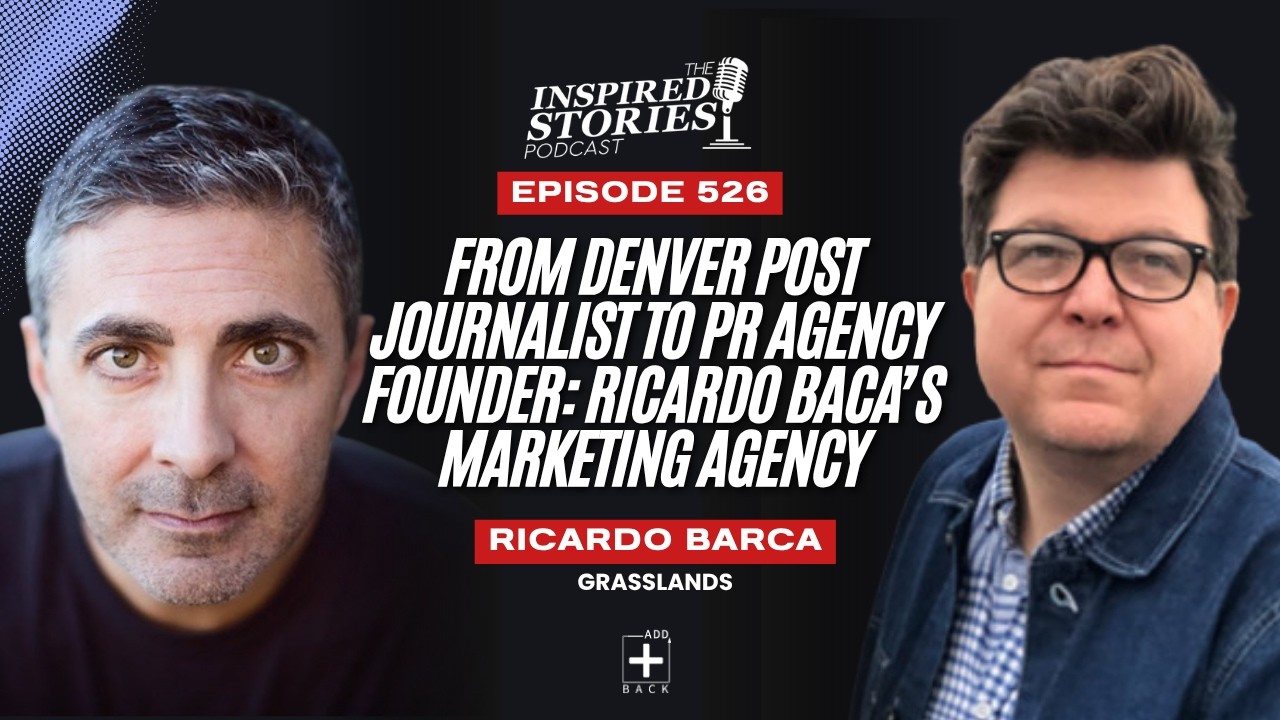
🎙️ Ricardo Baca: From Newsroom to Journalism-Minded Agency Founder
In this episode, Ricardo Baca, founder and CEO of Grasslands, shares how 24 years as a journalist — including a stint as the first cannabis editor at a major American newspaper — shaped a PR agency built on respect for the craft he came from. He opens up about walking away from journalism with just two clients, losing four accounts in one week to tariffs, and why he still says no to prospects who trash the press.
✨ Key Insights You'll Learn:
24 years in journalism, 13 at the Denver Post
Named Denver Post's first cannabis editor in 2013
Left journalism after securing two fractional clients
Grasslands built as a journalism-minded PR agency
Serves B2B and consumer brands across nearly 10 countries
Turns down clients who disrespect journalism
Lost four major clients in one week to tariffs
Navigated layoffs to keep the agency afloat
Expanding into longevity, peptides, and biohacking
Appointed to Colorado's Natural Medicine Advisory Board
🌟 Ricardo's Key Mentors:
EO (Entrepreneurs' Organization): Forum peers who understood his exact struggles
His Wife: Steady support through the hardest business stretch
Denver Post Editors and Colleagues: Shaped his news judgment and reporting standards
First Two Grasslands Clients: Took a chance on him and stayed a decade
John Sinai (Futurist): Workshop that spurred him to bigger business moves
👉 A candid look at building a PR agency on journalism's own standards, and surviving when the business nearly didn't.
Listen to the full episode here
Transcript
Anthony Codispoti (00:04)
Welcome to another edition of the Inspired Stories Podcast, where leaders share their experiences so we can learn from their successes and be inspired by how they've overcome adversity. As you listen today, let one idea shape what you do next. My name is Anthony Coduspodi, and today's guest became the world's first cannabis editor at a major American newspaper. A title that didn't exist until the paper invented it for him.
In the middle of one of the most politically charged cultural shifts of the last generation, he spent twenty five years inside newsrooms before making the leap to entrepreneurship. That transition meant leaving behind the security of an institution and betting that journalism's most demanding standards could become a business model in industries that most agencies still wouldn't touch. His name is Ricardo Baca. He is the founder and CEO of Grasslands.
A journalism minded agency, a Denver based PR and marketing firm he launched in 2016. He's a three time marketer of the year, a Clio Award winner, a two time TEDx speaker, a Colorado governor appointee to the state's Natural Medicine Advisory Board, and the subject of a Netflix documentary. But before we get into all that good stuff, today's episode is brought to you by my company, Ad Back Benefits Agency.
And you'll want to hear this because it's hurting almost every business you know. Health insurance costs go up every single year, and retailers are furious about it. They're paying more, claims are getting denied, employees are opting out because they can't afford it, and it hurts turnover and morale. It's one of the most maddening problems in running a business, and everyone just accepts it. But you don't have to anymore. Now there's a program that gives employees unlimited access to doctors, therapists, and prescriptions.
With no co-pays or deductibles to meet. And here's the part that really shocks most people. Our product actually increases your net profits. We recently helped a client add $900 per employee per year to their bottom line. Results vary, but gains like that change how a business is valued. Get your free consultation today at adbackbenefits.com. All right, back to our guest today, the founder and CEO of Grasslands.
Ricardo Baca, thanks for being here, my friend. So, Ricardo, you started your journalism career at the Rocky Mountain News as an intern in the early 90s, and you spent nearly 15 years at the Denver Post covering pop music, arts, and entertainment. What first drew you into the journalism field? What attracted you? You know, it journalism is is a trip in the way that it attra attracts.
the people who were meant to be there in the first place. But I always knew going back to high school that I liked telling stories. I liked telling people of other people's stories and just really being a part of that news gathering operation. So it just made sense to follow that. I I I think as I got be to become a more serious journalist, the element of holding the powerful accountable is really important. You know, journalism is a significant democracy and
I feel very strongly that we need to preserve democracy. We need to support independent news media. And you know, that kept me in that field for nearly twenty five years. So I'm so I'm so thankful for that work, even though it is kind of faint list work as we're seeing fewer, fewer people want to go that direction career wise. What comments do you have about the way that journalism has unfolded since you first took step in there years ago?
Yeah. And you know, I think journalism still maintains the same goals. However, its ability to actually accomplish those goals has changed dramatically. just primarily the internet. You know, you said it used to be if you were a business or a brand trying to get a hold of your target audience, you had very limited choices. and the journalists empires, they definitely did not see the online situation coming. They didn't know.
how much this was going to impact their businesses. And, you know, just one brief example. Think about the emergence of platforms like Craigslist. Well, people over 40, 45 will remember the classified sections inside newspapers. And that was where you bought little ads per word when you were selling a lawnmower or a house or a car. that was significant re revenue streams for media organizations, print newspapers.
and then of course these online options come along for free for you to sell all the same things. Classifieds are immediately decimated. And next thing you know, we see the rise of social media, which is where most people get their news now, which of course don't even bring up media literacy to me. and you know, that that of course has led to a place where media organizations aren't as well funded as they once were, and so they can't do what they really need to do. The
The holding the powerful accountable part isn't being done as much because the ad revenues aren't there like they used to be. So that's the single biggest shit. And I think it's just even more of a call for all of us, entrepreneurs, members of community. We need to support the media that supports us, that educates us on what's happening in our communities and industries. What is that term media literacy mean to you?
Well, it's not about what it means to me, it's really about what it means. But it is about a c an informed community that is literate when it comes to media. I was talking to a college class at the East Coast the other day on Zoom, and the professor who's a friend of mine, he asked the students, all of whom in their twenty thirties, hey, what do you guys where do you guys get your w where do you get your news? ninety-five percent of the answers were TikTok and Instagram. And then as we dove deeper
They aren't getting their news from traditional news sources, media organizations that report and gather. They're getting their news from these more news influencers that are taking the work of journalists, repurposing it and oftentimes repositioning it with their own political spin or angle or agenda. So
media literacy is understanding that when you're watching or reading a certain news organization, you're getting real journalism. And it's also understanding that when you're reading something else, maybe on Substack or watching TikTok, that you are getting something through somebody else's purview. They are not a trained journalist. you know, they're doing important work by spreading information, but are they spreading good information or are they intentionally trying to misinform?
Then in two thousand thirteen, the Denver Post named you the first ever cannabis editor. This is right as Colorado was legalizing recreational use. you also founded The Cannabis as a standalone publication during that same period. And you were really inside one of the biggest policy and cultural shifts going on in American history at the time. What did covering that beat change how you understood the relationship between media and industry?
and massively changed. You know, I'd reported on other industries before, but I've never reported on a brand new industry. You think about it, how rare is it that journalists or industry have the opportunity to actually create something brand new from scratch or to cover something from scratch? So that was profound. and it was a blast too, because for those early years of cannabis legalization, Colorado was very much ground zero for everything happening.
you're right. This is one of the biggest drug policy shifts in our lifetimes, even for our parents' lifetimes. And so this was this was massive. It was exciting, it was thrilling, and it's been absolutely fascinating to watch this industry, this economy continue to grow and expand. so much so now that it's a major federal level story here, even in the last couple quarters.
And then how does this all fit into the timeline of when you decided to step away from journalism and start grasslands? Yeah, I think well, I I wa after a twenty-four year journalism career and the last three of which was report, was taken up by reporting and editing on cannabis and drug policy coverage, not only in Colorado, but far, far beyond as the word started spreading and legalization and normalization started spreading.
I think I just understood that there was an opportunity here to do something I'd wanted to do for a long time. I had been witnessing, in fact, I had a front row seat to so much of the lazy communications coming from PR agencies, from marketing agencies. they weren't valuing me as a journalist and the role that I played in their world, even though we all know PR agencies need journalists and relationships with journalists to get their clients the coverage.
that their clients desire. And I was just seeing a lot that left to a l something that left a lot to be desired. And it was just time to see if I could do this differently. And that's what as I started thinking about, okay, it's time to really start moving on from journalism. You know, I'm proud that I gave 24 f 24 years of my life to that field. And at the same time, I needed to start family planning for myself, planning for an eventual retirement.
Doing that as a journalist is a very challenging thing. you know, the wages aren't really there. And so I started putting together and doing my due diligence for the agency that I would later launch, which became Grasslands. Before we talk about Grasslands, help me understand how it was that the PR folks weren't valuing you as a journalist. What were they doing wrong or not doing correctly? Yeah, they were treating me and others.
Very transactionally, almost like, hey Ricardo, got a great story. Please write about it. They would follow up ad nauseum. They would forget that I'm a human being. and instead they were treating me lore more like an ATM machine. you know, when I would write about one of their clients, great, now what about this other client? And it's like, well, it doesn't work that way. I'm one person. This is pre-AI. You know, I am writing all these words, I have limited bandwidth. And of course.
They would not pay any attention to the fact of who I was writing for. They'd write one pitch, clearly send it out to journalists all across not only regions and areas, but also industries and media types. You can't send the same pitch to a B2B trade media outlet as you're sending to a mainstream journalist. It just doesn't work there. So I just saw a lot of laziness there. And I thought that it could be differently, and I think
I done differently. And I think we've definitely proved that in the last 10 years of Grasslands. I mean, one note of wisdom to PR professionals, you know, treat journalists like human beings and the incredibly important and valuable partners that they are. Otherwise, that's gonna come back to bite ya. Okay. So, Ricardo, tell us what Grasslands does and who you do it for. Of course, yeah. Pretty straightforward. We do public relations.
Executive thought leadership and most marketing. We do that for B2B brands, consumer brands across the spectrum. And currently we're working with businesses in you know almost 10 countries. So we operate throughout the US, but also Canada, Latin, and Europe. A little bit in Asia too. We're trying to expand there. You know, we have a couple focus industries that we specialize in.
We have a great B2B practice. We have a really solid CPG wellness practice, consumer packaged goods and wellness. And so really proud of that work. But PR is primarily the craft of securing earned media. Executive Thought Leadership is positioning executives in front of their target audiences to make sure that those targets understand, this executive is intelligent and well spoken and clearly. I trust them and the organization that they run.
And then on the marketing side, we really do it all. you know, we do website development and branding, brand development, everything from SEO and GEO to content marketing and more web development. one note I'll include there. Most people know what SEO is. That's at search engine optimization, making sure that you and your business can be found by Google and other search engines. Now we have GEO to worry about, and that's one of our biggest grown sectors right now.
Generative engine optimization makes sure that your business shows up in search results from AI, Chat GPT, Cloud, et cetera. So it's a fast growing field and one that's pretty misunderstood by a lot of entrepreneurs. And it sounds like you guys are really a one-stop shop for marketing PR brand development. Yes. Is there kind of anything that you would say, that's not for us?
We we we do farm out a couple of things to other partners, but no, really we do our best to be that full service agency partner. And that's something that we learned over the years. I think if we went back five years ago, Grasslands exclusively really focused on content marketing, public relations, and thought leadership. and now we recognized we really have to be more three hundred and sixty degrees to fully service our clients and to really manage that entire client experience. Because of course
CEO, CMO, they want one point of contact, one throat to choke to make sure that they're executing and getting what they need, meeting those KPIs and goals. And we're very serious about that work. So I'm really thankful that 10 years later, here we are still doing great work with businesses all over the globe. And it does sound like the foundation started with the understanding that you had of where there was this disconnect between
PR marketing firms and the journalists. And because you were on the other side of that for so long, you knew how to treat them. You knew how you wanted to be treated and you knew how to communicate to them. Can you say more about that? A big part of it for sure. And I think that's an important part of it too. part of it is how to treat them, but also part of it is understanding really what they want. You know, there's something in in our world, our ecosystem called news judgment.
News judgment is only something that can be understood and learned if you really worked on that desk. You know, you're a journalist, you're a programmer, you're an editor, you're getting all the pitches from PR people, plus you're seeing what's happening around in your community and developing your own story ideas. Then you, as that media professional, leverage the news judgment to say, this is right for me to work on today, for my readership, for my listenership, for my viewership.
so you're employing news judgment to make the right decision based on who you're actually writing for. And this goes back to something I just said. you know, you can't take that same pitch, the pay PR pitch, send it to a B2B trade and send it also simultaneously to a consumer publication or a mainstream journalist. they don't speak the same language, they're writing for completely different audience. This B2B trade journalist is doing really important work. They're educating and informing an industry.
However, this mainstream journalist, they're writing for industry, but they're also writing for consumers and parents and families and people really throughout the mainstream paradigm. And so part of it is making sure that we're always treating journalists with the respect, the dignity, the humanity that they deserve. But part of it is also just recognizing we know you don't want this trash. We're not going to waste your time. We're not going to fill up your inbox irresponsibly.
Instead, we're going to give you what we know would be valuable for your readers because we have to be audience first thinkers. That's really strategic in doing what we do. So that's why we're sending this pitch to the B2B journalist. We know that pitch is interesting to them and will provide reader or provide value to their readership. We're sending a different pitch, sometimes slightly different, sometimes radically different to the mainstream and the consumer publications. Their audience is completely.
Completely different and cares about different things. When you started My Grasslands, were you doing this on the side for a little bit while you were still a journalist, still getting a bit of a paycheck? Or did you just cut the cord one day and say, I'm going for it? And and as you talk through kind of how that transition took place, I'd be really interested to hear how you got that first client. Cause starting a new agency right out of the gate can be really tough.
Yeah, so actually the business is just called Grasslands, but our website is mygrasslands dot com. that said to your question, it would have been unethical for me to be practicing PR while still a journalist. So I definitely c made a clean cut, exited journalism, and then started the agency. But to your point, that's not an easy transition. So I quietly behind the scenes was doing interviews with a number of companies at the time.
I knew I was leaving journalism after 24 years, after 13 years at the Denver Post. but I also knew that I needed that first client or two to get started. Sure enough, I ended up doing a couple interviews and I got a couple full-time job opportunities. I went back to both of those folks and said, Listen, I'm not looking for a full-time job opportunity. I'm actually starting an agency. It's called Grasslands. We're gonna do killer work. We're calling ourselves a journalism-minded agency.
We're bringing a different approach to this. And instead of you hiring me full time, why don't you hire me fractionally as I build out this agency and we will grow together? So I did have my first two clients signed up by the time that I resigned from the Denver Post. And I'm so thankful for them. They're still friends, they're still collaborators, even 10 years later. What was behind the name choice, Grasslands?
I like the name grasslands a lot because one, I'm from Colorado and we have a lot of national grasslands here and around here. of course, we're known as the Rocky Mountain state, but Denver is actually the queen city of the plains because where the plains meet the mountains, that's right where Denver is. We get to look at the beautiful Rockies every day, and we have a number of other biomes around this incredible state. wild, wild,
Just biology ecosystems. And one of those is grasslands. So I grew up going to grasslands, and that just always kind of stuck with me. The other reason is one of our early verticals and something that's very near and dear to my heart is the cannabis plant and the cannabis industry. this is medicine, this is adult use and recreation. and my last job in journalism was that of the cannabis editor, as you mentioned earlier. So
I had this expertise, those that's where those first two clients were coming at us from. And so it was an opportunity to make a sly wink and a nod notice to a very in to an industry that's very important to me and to my business, without saying, we're the cannabis agency. You know, we've never been cannabis only. We work across industries, including cannabis, which I very much incorporate into consumer packaged goods.
This is the direction cannabis and hemp are already moving. It is CPG. So when we say we're CPG, that proudly includes our work in plant medicine, in cannabis, in hemp, in psychedelics. And that's where the name came up, came from. I really thought that it was a beautiful meaning of regionality and locality, but also a wink and a nod to this industry that's very important to me.
I want to hear a little bit more about that because you know we also mentioned in the intro that you serve on Colorado's natural medicine advisory board. The governor appointed you. You're actually helping to write psychedelic policy for the state, another area where Colorado's on the front edge of a big shift in policy. where does this appreciation for plants' medicine come from?
And what do you see as the current state of these conversations around psychedelics as medicine in the state? Where's it going? Where's the resistance? Yeah. I guess my appreciation comes from the perspective that I was fortunate enough to be one of the first mainstream journalists who could really speak truth to power as it relates to these medicines. we have been lied to our entire lives about weed, about mushrooms, about everything.
you know, calling cannabis a gateway drug and, you know, referring to it as evil or reefer madness or as something that is ruining untold lives. You know, this is just wildly irresponsible information and not cool. So in my journalism work, when I first got that job as cannabis editor at the Denver Post, I really took it on myself to report on what is known and also report on what is not known.
And report on why we don't know it. the federal government has really hamstrung us and prevented us from understanding these substances, so much so that as communities have used cannabis for decades and recognize that it's not only a lot of fun, but it also can be a profound medicine for healing, for curing, for treating. you know, you just have to be able to turn that around. It's like at the beginning of my first TED talk.
I really ask the whole audience there in that auditorium to push control alt delete on their brain as it relates to what we were told about medical cannabis or about cannabis in general. So to me, it's just about spreading quality information, including the fact that there cannabis is not without its risks and cannabis is not for everybody. you know, you have to kind of start from that position. I always have that journalism positioning rooted inside me. It's not like this is a miracle drug.
But it is an incredible plant that's an efficacious medicine and a very safe and non-toxic alternative to a lot of worse things out there. And so that really resonated with me. And then of course, you follow the plant medicine through line. Next thing you know, you're talking about psychedelic mushrooms. You're talking about Iboga and Ibogaine, which my colleagues and I are working on the natural medicine advisory board on right now. so I just have a very intense passion.
For spreading quality information, educating consumers, educating other stakeholders, physicians, doctors, medical schools. So that's kind of where that came from. And where things are at right now in those ecosystems, you know, we've seen cannabis legalization spread throughout the US, but also I just got back from cannabis conferences in Berlin, Germany, and Bilbao, Spain, and Paris, France.
medical cannabis is spreading like wildfire throughout the world. this is about getting people access to medicine, and it's also about s refusing to criminalize a non-toxic plant that was criminal initially criminalized through incredibly racist means decades ago. So it's thrilling to see our partners in France getting ready to roll out from a years-long pilot program into a very responsible biopharmaceutical system.
That could become the world's largest medical marijuana economy. same thing with Germany. They have by far and away the most progressive system of laws and industry in the EU, anywhere outside of US and Canada. That's thrilling. What they're doing in Uruguay, in South America, where they actually became the first country in the world to legalize federally. That's outstanding. And of course, here we are in the federal ecosystem of today.
And what the Trump administration is doing now is something that no administration before has done. And that is legalizing certain plant medicines and getting us better access to things like Iboga, Ibogang, and simultaneously starting to reschedule certain types of cannabis. And we we've seen this happen just in the last two or three months. So things are moving very quickly right now. A big conversation at the state level.
an a much bigger conversation at the federal level, but also something that is not only in the US anymore. This is very much an international industry and an international policy conversation. Yeah, I appreciate you sharing all that. It's amazing perspective and boga and Ibogain for people who aren't familiar, maybe just add a little bit of color. These are things used to treat addiction, PTSD, can you say just a bit more about that? Yeah.
Powerful plant medicine first discovered by the Gabonese people in Africa. And that is where this tree is native, is in Gabon. And now they discovered that this is a significant medicine, especially helping people completely cure themselves of some of the most significant addictions that we see out there, including opioids. So it's very much the next frontier. You see the government of Texas very much embracing it and dedicating millions of dollars.
Toward research, toward understanding. same is happening in Colorado, Oregon. right now the most significant practitioners are happening, at least in this hemisphere, in the border towns of Mexico, where they can work with this medicine with these patients. and then so it's not totally far for people to travel. They can fly to San Diego, drive to Tijuana for a couple days. And at the same time, I would just add, it's big medicine.
You know, this is very substantial medicine as people talk about the Mount Everest of plant medicine and the risks concerned. You have cannabis and mushrooms down here. This is this is a boga. and that is what one of the things we've learned and are open to the public meetings as a member of the Natural Medicine Advisory Board. It's big medicine. It should be administered in a good feeling room. you know, kind of like how most psychedelic therapy is administered. However, that
That vibe room also needs to be set up as an emergency room just in case something goes wrong out of an overabundance of caution because again it's big medicine and it comes from this tree in Africa. It's just so mind blowing, especially since so many of us have been impacted by addiction. you know, so many of us have lost loved ones to opioids and heroin and beyond. The list goes on, and this is a profound healing tool where
respected researchers and clinicians are coming out and saying this is curing people. So that C word is very scary and used very sparingly, but you see a lot of medical professionals saying, Yeah, we are seeing this curing people from opioid addiction. So we're talking about plant medicine saving lives. Yeah, that's tremendous. and appreciate you dropping in a little bit of education for our listeners on that.
Obviously a lot more research that folks can go and do on their own if you've heard something here today that intrigues you. so clearly, Ricardo, you have you know, no problem working with a wide range of companies. And it's not just in the plant medicine and the cannabis world. You talk about B2B, you know, other consumer packaged goods. but you also, you know, don't have a problem turning down work that maybe other agencies would take without hesitation. Can you give us an example of
Why you would do that and what your why is. In terms of why we might say no to a client. Yeah. Exactly. We do have client criteria that we publish on our website and our marketing materials. We have to hold our clients to a certain standard because as a journalism-minded agency run by a former longtime journalist, you know, one of those things is we respect the work journalists do and the journalism they produce.
and the end result of that journalism. and so if a client comes in through the door and immediately they're talking smack about journalism or where it exists in a modern context, we just know that that is not a going to be a good relationship for us. you know, we're also just really rooted in in culture and mutual respect. And so when that falters, as it has a couple times over the last 10 years.
we just have to say goodbye to a client in that circumstance. but I think the biggest issues that we've seen and the biggest clashes with potential clients that we've seen, the the media environment has become very politically charged around journalism. I mean, it's no secret that the current administration has come out and labeled some of the most respected news organizations in the world as fake news. and you know, that just doesn't fly for us.
The not to say that any media organization is free, clear, perfect. That doesn't exist. But the New York Times and the Washington Post are definitely not fake news. They are outstanding and hyper credible news organizations that are doing things that power po powerful people don't want. if you think about it, journalists are supposed to hold the powerful accountable. Powerful people don't always want to be held accountable. So of course they're making shit up.
And you know, then some of their followers end up end up taking on some of these feelings about the fake news media. And granted, there is a fake news media out there in the world, and happy to talk through that. However, you know, most journalism, when you think about the credible old school you know, newspapers and television stations, including a much of the news school, lots of great substacks, Patreons.
podcasts that are doing responsible and credible journalism. So we just refuse to even have that conversation because we need to be thanking these journalists and supporting them with our sponsorship dollars, with our likes, with our shares and comments. and I I I there's just no wiggle room there for me. And when I have those conversations with a prospect in the early days, it's like, okay, well, we are not the partner for you. Good luck.
so how does that even come up? Like is somebody is they're coming to you, they're saying, Hey, here's our company, here's the help that we need, but we don't want to work with the fake news. I like i are they sort of volunteering that? It's more them seeing that the name of our business is Grasslands, a journalism minded agency. So usually that starts the conversation that sparks it up. This journalism mindedness. And sometimes that goes one direction and it's great.
the and this isn't about politics. This is about media literacy. you know, can't say that enough times. It really has nothing to do with politics. It is something that has been leveraged politically. But media literacy is understanding when there is good journalism happening and when there's bad journalism happening, and then there's non existent journalism where they're just making things up, and then there's the stuff in the middle. It's a lot of news content creators, and they are so important.
In part because they just have the audience, they have the mouthpiece. Aaron Parnas is a good example. He his Instagram TikTok following, it's blowing up. It's fascinating. And yet I don't know that he's actually doing the journalism. He's not gathering the information, he is aggregating it from existing sources. which, you know, nothing wrong with that, so long as you're crediting those existing sources.
For having done the heavy lifting, now you're gonna put it out there into the world. Great. That's important too. So, Ricardo, Grasslands is turning 10 this year. As you think back to the clients and the campaigns that you're most proud of, is there a common thread in that work? Yeah. I of course. There's there's a multitude of common threads, but I think whatever all it all it boils down to is those favorite campaigns of mine.
transformed my clients' businesses, hands down. it's kind of like what you shared earlier about your business. You can come in and create savings and create efficiency inside businesses. That's remarkable. And that's what we focus on. It's the same thing. you know, enshrined in our core values is that we are obsessed with client results. you gotta be. It's not about securing, yeah, we got, we got
You know, I was just in a meeting. We've we got this client, they've been with us for less than four months. We got them 65 media hits. That's an insane amount of media hits, especially considering that some of them are huge. Reuters is a top three wire service in the world. And we got them in Reuters in the first six months, first four months. and so it's not just that we got them in Reuters, but it's that we're hearing from them and they're saying, yeah, you know, because of that Reuters article.
And it was syndicated in all these other publications. We heard from this potential strategic partner. We heard from this distributor. We heard from this potential MA partner. so if I were to go back and outline some of my favorite campaigns, it really revolves around outcomes, not only the published pieces that came from there, not only the marketing work that Prue produced to really support that client in a time of need, but it is when that client comes back to us and said.
You guys rock. Thank you so much for doing that. This helps us move our business forward where we want to go. Any new industries that you're excited to be growing into, Ricardo? Yeah, actually. yeah. So I mentioned we have wellness, a wellness practice. And that wellness practice, you know, that can include our medical cannabis client in Thailand or Germany, or our adult use cannabis clients in the US. and it can also
cover in multiple CPG fields in which we work, like supplements, nutraceuticals. but one area that we're expanding into without that wellness practice is the field of longevity. you know, obviously this is popping. You can't turn on the TV or flip through a magazine without seeing you know, a multitude of ads for this emerging longevity market, which revolves around biohacking and it revolves around people of all ages.
Just making sure that they're doing to their bodies the what they need to to get another year or two or 10 out of their life. And so maybe it comes in the form of biohacking or peptides or other areas, but we just signed a couple new clients that are very active in these spaces, including the American Peptide Association, who we're honored to be working with as their agency of record. And so very thrilled to be in this longevity space and
We're now conducting campaigns to make it clear that we're bringing our signature and copyrighted style of journalism-minded communications to this industry, to these businesses on the B2B and the B2C side. aside from peptides, what else would you kind of put into that umbrella of longevity? You know, it's something that we're learning every day, but but I think the peptides is the big one, right? I th you know, you can't scroll your Instagram feed without GLP ones.
multiple brands coming through there. But it's it's everything from the clinics that administer administer these things. It's test testosterone replacement. It is it also includes these very advanced technological labs that are now doing the kinds of tests on our bodies and our blood that have never been even possible until the last few years. And then they come back and they analyze these results and are able to give you significant
recommendations on what you should be doing and what you should be changing about your diet, your exercise, your intake, your vitamins, everything like that. So I I would also include vitamins, supplements, nutraceuticals in that space, which we've done a lot of work in. So it it's always nice when you have overlap. We've already done some of this. We haven't done other pieces of this, but we're thrilled to be now pretty deep in that space. Ricardo, you know, hats off to you
built a tremendous agency over the span of ten years from nothing. But you know, life is not without its hardships. Can you explain a particularly challenging time that you've gone through and what that taught you? Yeah, of course. You know, we you you can't go without these in entrepreneur w in entrepreneurialism, unfortunately. but I you know what I can say is I I think back to last year.
We were riding a wave and we were strong, but at the same time, I knew we were vulnerable. I felt like we had a pretty varied stack of clients, really tremendous businesses working throughout a multitude of industries. but then when when the tariffs came from the Trump administration, that definitely threw a giant wrench into, of course, our business and many, many others.
it's wild as I tell this story to other entrepreneurs, regardless of the field. Generally the answer is yeah, exactly. Us two, same timing, same result. But when we were going through this, when those tariffs were actually implemented, we lost four significant clients in the same week. And, you know, this client was importing paper from Indonesia and this client was importing chemicals from China. This client was importing a lot of stainless from China.
And so some of these are B2B companies, some of these are consumer brands. And regardless, unfortunately, the adage is true that the first cut is oftentimes marketing. So we got the call from four different brands in one week and had to pivot significantly. We had no choice. if we had continued operating at the level that we were with the staff size that we were, we would have i ceased to exist in three or four months. you know.
You can't do that. That's not responsible operations. We had a layoff. we very have a very close relationship with our team members. Lots of them are here with me in Denver, Colorado. We had colleagues on the east and west coast on in other countries. And it was heartbreaking to have to do that layoff. you know, and at the same time, you get to the other side, you you kind of look back on it and you just recognize that you did what was right for the business at that time, and that's my job.
As the chief executive, you have to do what's right for the business, even though it might crush you internally, even though you will hate that morning that you have to have those tragic meetings and Zooms and let people know that you can no longer keep them employed. you you have to look out for the business. That isn't my number one job. And and I look back on that time and you know.
It's not something that I advertise. It's not something that I wrote about wrote about a lot on LinkedIn. but it is something that I'm very proud of how we handled it. I handled it the best I could. I had colleagues who very much helped and you know, and and yeah, god damn, I hate looking back on it, but at the same time I did what I needed to be do doing at the time, and now here we are in a significantly stronger place.
because of course that was the first of multiple things to come that has made this environment of PR marketing executive thought leadership even more challenging, especially with given the some some of the precarious industries that we work in. Was there anything that helped you to get through that time from an emotional standpoint? Yeah, it w it was community. You know, I think on a personal side
It was having a very solid marriage and being very thankful for my my wife. but community on the professional side ended up being equally helpful. I I'm a member of a couple different professional development organizations, including EO, which you've probably heard of, entrepreneurs organization, you know, it's founders only. and then as a part of EO, you have this forum that you get together with your partners.
your peers once a month for a big four hour meeting where you get vulnerable quick. and then of course, oftentimes there's a dinner afterward, there's a lunch before. You develop this really intimate connection with these other entrepreneurs. They're all founders, they know exactly what you're going through. And it's one of the craziest things about EO, Vistach, Sweet C, so many of these organizations that are out there is that even though you have totally dissimilar businesses,
you all have the same exact problems. And so it was key for me to be able to have that community to go back and forth. And they unquestionably were a major part of helping me through that. and helping me understand. Because, you know, being in journalism, you're especially in Capital J journalism, again, going back to media literacy, real journalism has two columns. If you've ever heard church and state,
Here's church. That's editorial. That's where I was. You're writing, you're holding the powerful accountable. Here's state. They are selling ads, sponsorships. They are keeping the business afloat. It's operations and sales. And here's editorial. Operations and sales is selling the value and the credibility of the editorial product. They can't exist separately. Less credible media organizations do not have that boundary. But if you go back to
Former journalist Ricardo didn't the job for 25 years. It's not like I was on the business operations side. I mean, I didn't see a PL until I started Grasslands. And so having the professional community has really been invaluable. And I remain a member of EO Today four years in and actually just went to a really profound workshop last week with this Persian futurist from South Africa, living in Dubai, who is incredible.
I believe his name was John Sinai, and it was a really powerful workshop that's really spurred me to action to to do some bigger things with my business recently. I think the power of human connection is amazing. And, you know, being able to be part of some of those networking groups where you're around your peers and you can support each other. If folks aren't doing that, I think it's one of the one of the those low-hanging fruits that you really need to find a way to become a part of.
Ricardo, just one more question for you today. But before I ask it, I want to do three quick things for the audience. First of all, if you want to get in touch with Ricardo Baca, mygrasslands.com, as you pointed out earlier, the business name is Grasslands, but the website, mygrasslands.com. We'll have it in the show notes, but really easy to remember, mygrasslands.com. And if you're enjoying the show today, please take a moment to subscribe wherever you're listening.
It also sends a signal that helps others discover our podcast. So thanks for taking a quick moment to do that right now. And as a reminder, you can finally get your retail employees access to therapists, doctors, and prescription meds that counterintuitively actually increases your company's net profits. No co-pays, no deductibles, and net profit increases that change how the business is value. Reach out to us today at adbackbenefits.com.
So last question for you, Ricardo, as you think about the work that you're doing today, what do you most want to be remembered for?
You know, I th I I guess when I think about that, I I I think about the the construct of community building. you know, it's it's not having started a marketing agency or having been a journalist. I think it's more I'd like to be remembered for how I built community throughout my life, both as a journalist and an entrepreneur. You know, one of the things we do at Grasslands extensively is host and curate high level networking events.
we do this all over the globe. We have a big event coming up in Chicago next month. We just produced two large events last month in Berlin and Bilbao was in Paris in February, you know. So I love building community. And of course, there's a selfish element to this going back to my primary role as a chief executive. I have to protect my business. So I am building pipeline through bringing together curated executive-only networking events.
Usually around B2B conferences. But also the secondary element is I get to do what I love. I love introducing people who should know one another and building that community. It's also something I did as a journalist when I started a music festival called the UMS, the Underground Music Showcase. We would host events at South by Southwest Music Festival. We would attend Coachella, and then of course, throwing a four-day music festival.
completely presented by a newspaper that was all independent and local rock and roll, hip hop, comedy, electronic. You know, it w it was so fun. And so I I if I'm remembered as a community builder, I did something right. I love that. Ricardo Baca from Grasslands, I want to be the first to thank you for sharing both your time and your story with us today. I really appreciate you being here. Thank you so much, Anthony.
Folks, that's a wrap on another episode of the Inspired Stories Podcast. Thanks for learning with us. And if one thing stood out, put that into action today.
Connect with Ricardo Baca:
Website: mygrasslands.com