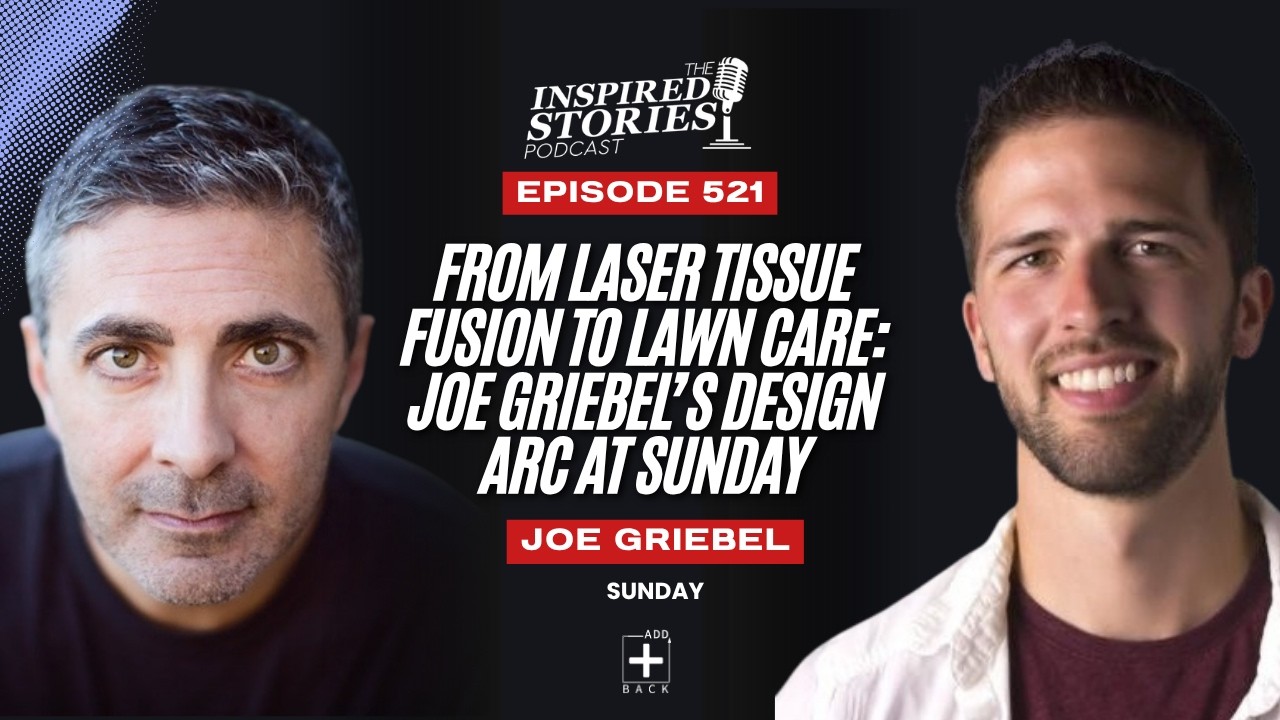
Joe Griebel, Director of Physical Product at Sunday, started his career helping fuse tissue with a laser in a deviated septum surgery and ended up redesigning a fertilizer box system that saved the company $2 million a year. In between, he held patents on orthopedic devices, published research on micro engines, worked at Philips Healthcare, and missed a full ride to architecture school by one ACT point — a moment he calls the best failure he ever had.
✨ Key Insights You’ll Learn:
Tissue fusion lasers and bone tamp patents straight out of college at a startup called Mind Rocket
Why the design process is identical whether the problem is a golf ball dispenser or a femoral artery device
What design validation means in medical devices and why it takes years before anything reaches a patient
How a former colleague’s referral took Joe from Philips Healthcare to a Boulder lawn care startup backed by Sequoia
Sunday’s personalization model: soil sampling, GPS lawn mapping, 20+ SKUs, and region-specific plans from day one
The Sunny AI agent and what it can and can’t do for a customer who just wants green grass
Why Sunday’s soil database is its most valuable asset and why no competitor has anything close
The packaging problem that wasn’t about box size and the cell system that saved $2 million
What Sequoia Capital pressure actually felt like from the inside and why it never compromised the customer
Missing architecture school by one ACT point and why junior year at UCCS was where the pivot finally made sense
🌟 Joe’s Key Mentors:
His Grad School Advisor (Mind Rocket Founder): Invited Joe to co-found the company after his thesis on laser tissue fusion — the first domino in the entire chain
His Colleague at Mind Rocket: Found him again a decade later and brought him to Sunday at exactly the right moment
The Orthopedic Surgeon on the Bone Tamp Project: Took Joe into eight surgeries a day to watch what he struggled with — modeled what it looks like to find a problem worth solving
His Parents: Raised him without much but gave him enough — homemade popsicles included — to know how to create something from nothing
👉 Don’t miss this conversation about what it means to apply the same design process to wildly different problems, why the hardest packaging insight was realizing the box wasn’t the real problem, and how a 32 on the ACT eventually became the best thing that ever happened to Joe Griebel.
Listen to the full episode here
Transcript
Anthony Codispoti (00:00)
Welcome to another edition of the Inspired Stories Podcast, where leaders share their experiences so we can learn from their successes and be inspired by how they've overcome adversity. As you listen today, let one idea shape what you do next. My name is Anthony Cotespodi, and today's guest holds patents on medical devices and was helping develop a laser device designed to clear blockages in the femoral artery before turning his attention to an entirely different challenge.
How we care for our lawn. The path from life-saving medical technology to eco-friendly yard care was not obvious, and the pivots along the way forced him to rebuild his identity as an engineer more than once. Joe Griebel is the director of physical product at Sunday, the boulder-based lawn care startup backed by Sequoia Capital.
He oversees the design and development of more than a hundred SKUs sold directly to consumers and through retailers like Walmart and Home Depot. And he led a packaging redesign that saved the company more than $2 million annually. But before we get into all that good stuff, today's episode is brought to you by my company, Ad Back Benefits Agency. And you'll want to hear this because it's hurting almost every business you know. Health insurance costs go up every single year.
And retail brands are furious about it. They're paying more, claims are getting denied, employees are opting out because they can't afford it, and it hurts turnover and morale. It's one of the most maddening problems in running a business, and everyone just accepts it. But you don't have to anymore. Now there's a program that gives employees unlimited access to doctors, therapists, and prescriptions with no co-pays or deductibles to meet.
You don't change your broker. And here's the part that really shocks most people. Our product actually increases your net profits. We recently helped a client add $900 per employee per year to their bottom line. Results vary, but gains like that change how a business is valued. Get your free consultation today at adbackbenefits.com. All right, back to our guest today, the director of physical product of Sunday, Joe Griebel. Thanks for making the time to share your story today.
Joe Griebel (02:18)
Thanks so much for that, I'm really looking forward to it.
Anthony Codispoti (02:21)
So, Joe, we mentioned in the intro you've got patents on orthopedic medical devices. Give us an example of something you've developed in this space.
Joe Griebel (02:30)
Yeah, you know, I started in medical device almost straight out of college. Started working for a startup that focused on medical devices and other innovations and working with companies like Boston Scientific and others, but
The earliest, we actually had an internal project called tissue fusion. The idea behind that was using lasers to actually fuse tissue together where sutures or staples isn't feasible. So the main use case we looking at was in deviated septum surgery. Up in the nose, it's very tight. You can't get the typical sutures in. And so we developed a
It looks kind of like tweezers. One side has a laser on it and the other has a mirror that helps bounce the energy back and forth and you squeeze the tissue together and kind of do a little almost like spot welding using a laser. It denatures the cells and kind of sticks them together like glue. So that was the very first project I worked on right out of I've worked on a bone tamp.
Anthony Codispoti (03:36)
Sorry, real
quick, I want to stop you there, Joe, because what you're describing to me sounds like a relatively advanced first project. I mean, you're right out of school, you're at a startup, like you I don't know, you figure like design a better trash can or like, you know, like like medical devices and lasers, this seems like a a big jump right out of school.
Joe Griebel (03:45)
Yeah.
you
Yeah, I think that's very fair. guess I got so used to it, I stopped questioning how weird that sentence sounds. At that time, to kind of give you a breadth of what we did at that company, I was working on a device that would disperse golf balls one at a time for driving ranges, while also working on a tissue fusion device. So it was really across the board.
But yeah, it is kind of a crazy sentence to say that I was the first thing I worked on out of college. And one of the many cases where I've gotten very lucky, but in college I was working for a professor and that was actually what my thesis was on was the different.
laser absorption levels of different tissues and materials. And so was working on my thesis while kind of working on this project. And then when I graduated, we decided to spin it out into its own company. it was kind of crazy project to work on, first thing out of college. But I did have some background in it, least, because I had been working on it the last year or so before graduation. Yeah.
Anthony Codispoti (04:56)
Wow.
Okay. That that helps connect the dots a little bit more.
I I'm curious as you're going back and forth between working on a medical laser and a golf ball dispensing thing. Do you feel like you're using different parts of your brain? Or is it the same parts of your brain just being applied to different problems? Like for me, in what I do, if I have to go from something creative to something very like technical or analytical, very
Joe Griebel (05:19)
Hmm.
Yeah.
Anthony Codispoti (05:31)
It it it it's a big shift in brain power. Like it I and I can't do it quickly back and forth. I'm wondering if you find that too, or you're using the same part of your brain.
Joe Griebel (05:41)
Yeah,
certainly throughout the day, I find that, you know, I'll be working in Adobe Illustrator or Photoshop or something, can work on something very fine tuned and creative, but in like the color space and do these things go well together and do the shapes, you know, offset each other well enough. And then I'll jump into the 3D world and solid works. And that shift takes a lot. Moving from one project to another, or even one industry to another in my previous life, I didn't feel that shift as much.
Because I guess the design process is the same. Where you store the knowledge might be different. It might take a little bit longer to remember, yeah, that part number is blah, blah, blah. And that absorption rate is in this table I need to look it up, whereas maybe something like a.
golf ball dispenser might be more fun and just like, no, what if I change the ramp like this or give it a bank? But for me, the design process was always the same. And I think that part is maybe surprising to some and probably why my resume sounds so crazy out of the gate. It's because I've bounced all around. I've done a lot of different industries. But the actual process of what's the problem?
concepting some solutions, and then if you're lucky enough commercializing that solution, a lot of the steps are the same, whether it's a golf ball dispenser or a bone tamper, a device that fuses tissue together, or lawn fertilizer. A lot of the steps are actually very similar.
Anthony Codispoti (07:09)
You don't actually get involved in the commercialization part of it though, vr am I correct?
Joe Griebel (07:12)
Um,
yeah, yeah. So I do a little bit, um, you know, everything from our very first drawings all the way to, you know, I just returned from, um, I was out in Idaho installing a line where we are, um, shrinking a bottle and, um, installing a new head filler. Um, and so, you know, I was there on the line, um, with workers making sure that the label goes on.
just perfect each time and it goes through the tunnel without the bottle falling over. So I really could see it from when it was just a little baby idea all the way to when it's on a Walmart shelf.
Anthony Codispoti (07:49)
that's fun. It must be very rewarding. And I think before I cut you off a moment ago, you were getting ready to tell us another medical device that you worked on ear in your early days.
Joe Griebel (07:57)
Well, yeah, yeah, so,
you know, one of the early patents was a device called a bone tamp, which is, you know, another device that prior to taking on the project I never heard of, certainly didn't have any expertise in. But we worked really closely with a orthopedic surgeon who, you know, did this day in, day out. And that was, again, another opportunity where I was lucky enough to actually go in the procedure room with him. And we would, you know, he would knock out
eight knees or shoulders a day. We were in scrubs and when he comes in, everything's prepped, it's ready to go. He does his job, he cleans up, he goes to the next one and someone else takes care of the suturing and all the things. So, you know, it really back to back. get eight surgeries a day. And so I was watching what he struggled with the most and he had really come up with this idea of, it was for basically catastrophic knee injuries. Anytime, if this is your knee,
It happens a lot in geriatric patients where you fall, you hit your knee, the kneecap crushes and behind the kneecaps, the kneecap's very hard, behind that it's almost like a hard sponge. You can kind of think of like a coral or something called cancerless bone. And it is, it's full of holes, but it's very structurally sound, kind like a matrix. And so that's what really supports behind your kneecap. But when your kneecap,
crushes, it crushes that bone behind it. And so you have to come in through the back of the knee with what's called a bone tamp. It looks very much like a hardware tool. It's just a handle with a hard rod. You come in and put the bone back to where it needs to be. But in that process, you crush all that cancerous bone. Just as you're kind of manipulating, you get the bone right back where it needs to be. And then you need to come back in and fill that void now with
some type of bone cement. So there's lots of different companies that make this bone cement. It works great. Your bone actually regrows back in with the bone cement. So it kind of becomes part of your body and absorbed. It's a really kind of fascinating procedure. But the terrible part of the procedure that no one thought about before this doctor was you pull out this rigid tool and then you try and put in a flexible tube through the hole you've made. And I should mention anytime you feed something through
that you're trying to match up and you have multiple layers of tissue and bone and you're trying to make sure you hit the exact same cannula that you just created. And so that was very difficult. And so what we did instead was we created this bone tamp that you can manipulate, do everything the same. If you have to hit it with a hammer, it's very strong. But then the back of the handle would unscrew and pull out and it would leave in essentially a metal straw that had holes on the side. You have now removed the structural part of it.
And then on the underside, it would have a little lure lock that you could lock on your syringe of bone cement and just squirt the bone cement right where you worked. Instead of pulling out and trying to feed this bone cement system back in, it combined the two. So you took your tool, you left that part in, you squeezed the bone cement in.
Anthony Codispoti (10:55)
wild.
So
let me ask you, Joe, did this doctor come to you with an idea on what the solution should look like? Or did he just come to you with the problem and you guys had to figure out what might be possible?
Joe Griebel (11:18)
Yeah,
in this case is kind of mixture of both. Yeah, he was definitely the SME on the project. spent hours and hours in the surgical realm. sorry. Engineer talk. Subject matter expert. So yeah, he had all the knowledge. And what we were bringing was, like I mentioned before, the design process. That was the unique part we were bringing to the table. And he was bringing all the back end knowledge.
Anthony Codispoti (11:28)
e S E.
Joe Griebel (11:47)
So he kind of had an idea of, you know, the problem is I can't remove this thing, but every bone tamp out there, I have to remove it. So what if we tried to combine the two and what would that look like? So, you know, I think in terms of concept, he was already 80 % there. You know, he had brought a really good problem with the start of really good solution. And what we brought was, you know, the 3D design, the materials, background, and kind of like the...
what we call human factors in medical engineering, how the actual doctor uses it so that the end consumer, the patient, has the best outcomes.
Anthony Codispoti (12:23)
Yeah. I want to talk about another piece of your work. 'cause you published some research on internal combustion micro engines. So, first of all, what is a micro engine exactly? And then secondly, why was this important enough to draw your attention?
Joe Griebel (12:32)
Yeah.
Yeah, so micro engine is very much like a big engine that you'd find in your car, you know, it's using internal combustion.
And the goal is to try and make it as small as possible so that you could use it across a lot of different industries. Some is just micro robotics where it's a lot easier to store a usable fuel over a battery. So if it's out of the field, you're not going to able to charge it, things like that. So it's kind of an interesting niche industry. And I was working.
with one of my professors. He was the one who had the passion around it. And I was the undergrad who needed money. So that was really where it drew my attention. But my job was just to do kind of a vast literature search and see why these things fail, where are they good, where are they bad, what are some opportunities out there for them. And so it really all comes down to I won't get too far into the details because it's
It's probably boring for most of your podcast listeners, but it really comes down to as you shrink things, the surface area to volume don't shrink linearly. They don't shrink at the same rate. And so you have all kinds of issues with heat transfer, basically. An engine works because it can dispel just the right amount of heat to keep working. An internal combustion engine is fascinating for all the...
If we give cars the fact that a car can work three times a minute for years and years and years is really impressive. But to do that, it has to dispel that heat at just the right amount. If it dispels too much, then the whole system stops. And that's what happens to micro engines.
Anthony Codispoti (14:27)
So I if I want an engine that's one tenth the size of this standard engine, I can't just make everything one tenth of its original size.
Joe Griebel (14:35)
Exactly,
right. Yeah, if you can think, if we get into the math, if you have a cube that's 10 by 10, that's a 600 unit surface area. If you shrink it down to one, that becomes six. But the volume shrinks at a different rate. And so that is the pitching point is that you can't just scale length times width times height because your surface area to volume ratio changes. And so it creates all kinds of issues.
Anthony Codispoti (15:01)
So what kinds of I don't know rules are you using in that shrinking process?
Joe Griebel (15:06)
Yeah, some of it was just trial and error, reading through all the different literature. And again, me not being the subject matter expert, I was reading the experts, what are they saying? It really comes down to a functional limit. As you start to decrease, you get a little bit more efficient. The challenge of most ICE engines is removing the heat. When your radiator blows, everything stops. So in a big engine, removing the heat becomes the issue. So you actually get a little bit more efficient as you shrink.
which is why a Fiat is better off than a V8 Corvette in terms of gas mileage. But after a certain level, you you hit that plateau and then you start to dip off where you have trouble keeping the heat to keep the combustion.
Anthony Codispoti (15:51)
Interesting. There's a crossover point there where small becomes too small or where small isn't advantageous anymore. Okay. Okay, so let's move closer to present day and talk to us how the opportunity to join Sunday, your current employer, came up.
Joe Griebel (15:58)
Right, yeah.
Yeah, yeah, so as you mentioned, I was working.
In medical devices, working for a great company, Philips Healthcare. So the same people that make your light bulbs and maybe in the 90s and 2000s, major TV. So same Philips, big company based in Amsterdam, I believe. But they have a huge medical division. So I was in their image guided therapy devices. So basically Philips makes great x-ray and fluoroscopes. And our division was making tools that they could use underneath those fluoroscopes.
And so I worked on a project that worked on it for about two and a half years, got it through DV, design validation. So that's the big hurdle on the R &D side in the medical device. That's kind of when the R &D side is done and it moves over to the sustaining engineers. And so that's what we call the handshake.
Anthony Codispoti (17:02)
And so what does that mean?
What's what's happened by that point in the process? Why why why is that the big hurdle?
Joe Griebel (17:06)
Yeah,
the big hurdle, both from an FDA perspective and from just an engineering perspective, you have the checklist of 40 things we said this device was going to do and how we proved that it did it. So that's when all of your animal testing has been completed. The device has gone through what's called particulate. So.
You build out the entire device, you do a full pilot run, you put it in the box, and then you put that box on a pallet, and then you shake that pallet. You make sure you know no paint chip or any lubricants that are on the device don't slush off. And so in design validation, you're running.
I think we had 12 different test legs and each of them had a few hundred devices at times. And so you have to pass each one of these. And if you don't, you got to start all over again. So if one piece requires a change, then your entire DV has to start all over. And so it's a very stressful time in the medical device industry. And the project that previously to me coming onto the project, it actually had failed a couple of what we call pre-DV tests. So when you're like doing little pieces of the
So yeah, pre-designed validation is saying, you know, I think this part is done. Let's just test this part and see if it fails and you fix it so that you don't go into DVE not knowing the answer.
Anthony Codispoti (18:27)
Got it. So when you get to the end of D V, what's left to do at that point?
Joe Griebel (18:32)
The clinical trial. So that is the big, that's the biggest hurdle. So DV is kind of a little hurdle. And from the R &D side, you're more or less done, let's say. But from the commercialization side, you're still far out. So yeah.
Anthony Codispoti (18:44)
Lots of work left to be done. Okay. Thank you for taking that little tangent with me. Back
back to the story of how you first got to Sunday.
Joe Griebel (18:52)
Yeah, exactly. yeah, sorry for the aside, but it is critical because that is a very natural spot. That's where a lot of engineers will move to a different project. That's where if there are any promotions, it tends to happen around that time just because it's a natural milestone. So just coming up, we had passed our design validation, this huge hurdle. I was kind of thinking about.
what team I was going to move to, what my next project would be. And around that same time, a former colleague of mine, so a guy who I had worked with previously at that company, Mind Rocket, that was where I was doing all the crazy things from golf ball dispensers to tissue fusion. So we had worked together for almost a decade prior to this point and he had worked for Sunday for about a year. He was on the...
tech, the software engineering side. But Sunday was starting to come across the challenges of physical product. And so they were looking to hire someone who kind of guided through. They'd just gotten a contract with Walmart, but needed to make the products shelf ready. So Sunday always started as a direct consumer, but the shift to retail presented new challenges. so
And roll opened up. And yeah, the former colleague was like, you'd be great for this role. Do you have any interest and my wife and others like, are you insane? Just like you going through my resume, like going from medical device to lawn care is not like it's not an obvious lead for most. But, you know, it's really a new set of challenges. And the biggest frustration in medical advice always is
You work really hard on a project.
And you never know if it's ever going to be used. know, that project I was mentioning that we hit this huge milestone. We proved that our product works. It was going to clinical trials. It's still in clinical trials. And now it's been six years since I worked on that project. it's helped lots and lots of patients through clinical trials. But you never know if you're going to get that payoff. Whereas consumer products, you know very immediately if you're going to get that payoff. goes from some of our concepts go from concept to shelf.
in six months at times, we were really moving fast. And so it was kind of a new challenge. was obviously a new space, a new area to make my mind work harder and gain new knowledge. But more than anything, it was a whole new set of problems and a way to really expedite the, can you create a solution and can that solution be implemented for sure? And so that was kind of a nice new challenge.
Anthony Codispoti (21:12)
That's fast. Yeah.
So I want to get into understanding where exactly you came in and applied your skill sets here. But first, let's take a step back and give us the big picture view of what Sunday does.
Joe Griebel (21:48)
Yeah. Yeah, so Sunday is kind of disruptor in the space in two ways. One is the eco-friendly aspect that you touched on. And we're using better ingredients and really
keeping the customer and their kids and pets forefront, even ahead of how well you can really kill that dandelion. We want to make sure that the yard is a place that you want to be and that you can play with and you can live in your yard more than just a green, a putting green of a lawn that you're scared if a dog touches it. And so that was kind of big cultural shift in lawn care. Our CEO always says,
the average American lawn, if they're using, you know, the current incumbents, you can probably guess, we're actually putting more pesticides on our lawns than on even the worst crops in America. And so it's kind of this insane, like, crop dusting that we're doing on our lawns, the same place that, you know, we then send our kids out to play. And so it's, it's kind of this insane thing that, you know, if you think too hard about it, you're how's this still the way?
And that's where Sunday came out of. It shouldn't be the way. You can have a great green, great looking grass, but one that you're confident to go lay down in, that you don't have to wait a week after you fertilize because you're not sure what ingredients are in there. And so that was really the big impetus.
Anthony Codispoti (23:14)
So it's a much more eco-friendly
way to address lawn care. It's got family, it's got kids, it's got pets at the forefront. You know, that that's even more important than, like you said, how well it's gonna kill this weed over here. So so as you show up, a lot of the chemistry for the product has already been figured out, which I'm just thinking about this makes sense because your background isn't chemical engineering.
Joe Griebel (23:29)
Yeah, exactly.
Correct. Yeah. Yeah.
then, yep. Yeah. My background's mechanical engineering. And so, yeah, it was a, it was a nice niche. You know, I report directly to the co-founder and he had already worked with a lot of our kind of trusted partners on the chemistry. So in a lot of ways, you know, it worked out, you know, like I've said before with the bone tamp.
A lot of times when I come in, I'm not the expert in the field at all. You know, that's not my necessarily my niche. You know, I've never, and now as I'm later into my career, never will be the person who's worked on one problem for 25 years. The part that I bring is if you have that one problem you can't solve. That's where I bring the expertise is, know, breaking down a problem saying what are the actual customer needs? What are we really trying to get at? And that piece, you know, I stole directly from.
medical device engineering, because with the FDA, you have to be so clear about what you're trying to solve. But with every other project and all the other spaces, everyone skips that step. And it's a really important step of, let's not just make something cool. What is the customer actually trying to solve? What is the pain point? And can you write it down? And I think that's this of unique part about medical device engineering that should be a best practice for all physical devices.
Anthony Codispoti (24:58)
that's interesting. So what you've
seen happen in other spaces is that people are skipping this step of asking themselves, what problem are we actually trying to solve? And they're just like, Hey, I wanna make a cool product. I you know, I wanna put something out there.
Joe Griebel (25:11)
Yeah,
exactly. And especially with startups, know, happens time and time again, it happens to me, you know, it's not a natural thing. It's a very process oriented thing of stopping your brain and say, wait, wait, wait, wait, that would be cool. Is that what they're asking for? Because I think especially, you know, founder led startups, which I've been a part of or worked with across a lot of industries.
they solve this one solution, they make a great hammer and then they start looking for nails. And sometimes there are screws out there, sometimes there's other things. And so it's really saying, wait, wait, like you have a hammer, but these aren't nails. We need to actually look at what is the customer asking for? Cause this is actually a screw. You've made a great hammer, but we need a screwdriver.
Anthony Codispoti (25:56)
So when they brought you in, Joe, were they looking for help on the chemistry or was it more on, I don't know, getting the packaging and everything else right to be able to take this direct-to-consumer concept into retailers like Wolm?
Joe Griebel (26:10)
Yeah, for the most part, our chemistry was sound. We need help on shelf life, making sure those ingredients worked well together for a long time and how you would test that. So that was another thing that I could bring from the medical device industry of how do you actually test something? What's enough samples to test to make sure you're right? Those types of things. So even though the ingredients were sounds, the formulary process was sounds, the
making sure it can stay on a shelf for four years and how you test it, that part wasn't sound. So yeah, it was a lot of packaging. It was a lot of shelf life stability. was what we call human factors.
How does the customer interact with the products? When they grab the sprayers, their thumb in the right spot is the weight of, we put everything in pouches to help with shipping. So that's another disruption that we have. All of our fertilizers are in these pouches and you attach it to a hose. And once that pouch is on the hose is the weight in the right spot. And so again, all of these things that span many different industries.
If you're doing a golf dispenser, is that pedal that you have to put your foot on in the right spot? Isn't that different than when the doctor grabs this laser and he squeezes, is he using the right part of his hand to is the customer when they grab the sprayer, is there risk torquing? All these are actually the same problem, but it spans a lot of different industries. And so I think that was the piece that I brought was across all these different industries that I've worked in. It's all about understanding the needs of the customer and can we break it down smaller and smaller to solve these issues.
issues.
Anthony Codispoti (27:44)
So as I understand it, you know, when Sunday was in its strict D to C phase of its lifespan, it was really built around this idea of customizing plans for individual customers, right? climate data, soil tests, that kind of thing, and then shipping a very personalized product. Am I understanding that correctly?
Joe Griebel (28:05)
Yeah,
exactly. Yeah. we kind of covered, know, Sunday disrupts in two ways. One is the ingredient choice that we covered previously. The second is the, you know, kind of empowering the customer to make them feel like they know what they're doing. you know, there's this in lawn care, especially for whatever reason, everyone feels like they should have been taught this at some point, you know, or they just do, you know, what their parents did, you know, usually their dad, you know, I think, and
And so very often the answer is no one ever knew what they were doing here. They were just doing what other people told them to do, what the commercials told them to do. And so that was another kind of big piece. And again, another user need is they don't have the confidence. So it's not just, you people want to do the right thing.
People want to have a good looking lawn without putting these harsh chemicals on, but the know-how is low. And so when you don't have confidence coming into something, you will always go for the easiest solution or the most popular, what you can just pull off a shelf at Home Depot and read the back of the bag. And that's where the industry is right now. And so that's where Sunday is really trying to disrupt, making sure that the customer is empowered.
so that they feel more confident to make better decisions. So we take someone, our CEO always says, we want to take someone who goes from I kill houseplants to maybe I could start a pollinator garden. That's what we're trying to get them across. somewhere along the way, they have a green grass that they mow at the right heights and they water on the right days and for the right duration. And then all that guesswork is taken out.
Anthony Codispoti (29:37)
So so how
does that customization, that personalization actually take place? Is the customer somehow testing their own soil?
Joe Griebel (29:45)
Yeah, yeah. So especially, so you know, we have two main channels. One is retail, one is DTC. So you know, the happy path. If someone comes to our website, they look through all of our materials, they say, Sunday might be right for me. They put in their address. We use Google Maps and other sources to pull up your house, do a quick map of your lawn so we know the exact size. We know your zip code. So we know everything about that climate, you know.
Over last 30 years, we know that Westminster was on average this temperature in June, and these are probably the things you struggle with. And then once the customer signs up, we send them a soil test with their first shipment. So your first shipment will have an application. It's typically a, if you're signing up in the spring, it'll be.
kind of a one size fits all pouch, something that does quick green up, gives all the nutrients that any type of grass needs in that first kind of spring bloom. And so we'll send that pouch. So the customer has something to do first day, which always feels great. But then they also get a soil test. you do three different spots in your front yard, three different spots in your backyard.
You'll put it all, take out all the grass clippings and whatnot, put the soil into a bag that we provide. You just roll it up, seal it up, put it in a box that we also provide, put it right in your mailbox. Postage is all included. It ships back to our lab.
Our lab will look at making sure that across, I think we have like 20 different micronutrients and nutrients to look at to say, is your, does your soil have what it needs? In most cases, the answer is yes. know, surprisingly some, you know, everyone thinks they have terrible, terrible soil and some do. But in most cases, your soil is fine. You're just not doing the right things. And so we'll look at your soil. If there's any deficiencies, we automatically build that back into your plan. So we will take a pouch that you were.
going to get, and maybe just add nitrogen and potassium, we'll swap it out for something that if you're low on, let's say if you're low on sulfur, we have a pouch called Super S. So if you're deficient sulfur, we'll swap out that pouch, we'll put a Super S in to make sure that when you spray, your grass at least has enough sulfur in that application to take up. So even if it's not in the soil, we'll help there.
Anthony Codispoti (32:05)
So the customization
that takes place is maybe you're adding in an additional pouch. It's not like every pouch that goes out, somebody had to stop and tinker with and put the exact ratios in. You're just, you're giving them an extra pouch of something else.
Joe Griebel (32:14)
Okay.
Yeah,
yeah, so some optimization is on day one. We know what type of grass you have from your zip code. We know the...
the climate history there, we know local weather, and also because we have so many customers now, we more or less know what your soil is going to be based on the region. So, you know, from subdivision to subdivision, sometimes things change, you know, that subdivision brought in too much sand right before they laid the houses, you know, those things happen. But for the most part, we know what the natural soil is underneath your grass. So even on day one, we have a pretty good guess of this is what the customer needs. And then we have
over 20 different SKUs that we can put into that plan. So if you look on a shelf at Home Depot, you might have 10 options at best as you're looking around. Sunday is working with a much larger portfolio of options, and then we're putting them in the right spot. So.
someone in Texas is not going to get the same plan as someone in Colorado, even before they do their soil test. Your plan is already customized from day one. But we send the soil test just in case there's like a glaring deficiency, then we'll further customize to make sure that we cover that deficiency.
Anthony Codispoti (33:27)
And so
when I buy it from Home Depot or Walmart, am I also doing the soil sample test?
Joe Griebel (33:34)
Yeah, so not right now. That is a thing that we want to move into. We have all these tools that we give to the DTC customer. The challenge has always been, how do we make that work on retail shelves? On the retail shelf, they're much more broad products. There are things that will work on both warm season and cool season. And they'll cover most common deficiencies. If you have something weird, like a sulfur, like a calcium,
the DTC plan is better. But on the shelf, you know, that's 95 % of people, if they use these products in the, you know, in the way that the label says, in a consistent manner, and they mow right and they water right, they're going to get great, great results. And so everything on the retail shelf is really that kind of first piece, you know, better ingredients, you still have access to all of our tools, your sunny AI agent. So
Any question you have about your lawn, you're going to have access to our tools. You've got the best ingredients available in the easiest format. You just spray it on. All you need is a hose. The one piece that's missing between retail and DTC is the soil test and really painting the picture of here's, you're going to apply this on this date. So there's still little more guess and game on the retail side. And every day we're trying to make that process get closer to the ideal.
idealized process that we have on the DTC side.
Anthony Codispoti (35:02)
These soil samples that you guys get and you do the testing, you said you made the point that you've done so many of them, you know, across the country that you've got a pretty good idea of, you know, the soil in this, you know, particular county in this state is likely to be this mix of clay or, you know, whatever it is you guys need to know. I'm curious if there's other use for that data. he smiled a little bit there.
Joe Griebel (35:16)
Yep.
Yeah, that's proprietary. We can't go into that. No, that is like a huge enterprise value of Sunday. We know our customer better than anyone. know, Scott's and others have been in this industry for decades and decades. And on day one, we know you better than they do. And so that's a huge piece of our value prop.
customer, you know, also to our investors, also to know any future IPO we'd ever have is that we truly know the customer better than any other competitor. And we think right now we probably have the largest domestic soil database of any company, just because no one has ever really needed this. So there are lots of universities that have better soil data. not saying that, but it's always been agricultural because that's where it has mattered in the past.
Is this a great place to grow corn? Is this a great place to dig for oil?
All of that has been very commercial, very industrial, very agricultural. know, is this a great place to grow fescue in this suburb? No one's done that before Sunday. And so that is a very unique data piece that we have, and we do use it across the board. So all that data is flowing into our tools. And so when a customer asks a question that's about their lawn, we do know everything about their lawn, but we also know everything about every customer around them that has struggled with this.
So if we can go all the way down to this area has had huge grub issues this year. And even if we don't know why, we know if someone's presenting all those same kind of symptoms, our systems are getting smarter and smarter and saying like, I bet this is the same thing that I dealt with two weeks ago. That is the ultimate dream is that keeping everyone's privacy in a private state, but learning.
what challenges each kind of pocket has so that we can better help each individual customer in there.
Anthony Codispoti (37:27)
Is there a way to leverage the data outside of current lawn care management?
Joe Griebel (37:32)
There certainly is. That's not a revenue stream we've gone after right now. But yeah, it's incredibly valuable data. But yeah, Sunday's stands right now as that is our data and we only use it to benefit our customers. But it's really incredible data and there's lots of difference even just from like an educational side.
you know, from turf grass scientists at universities. You know, we partnered with different universities across the nation to kind of say like, you know, we're seeing this in this region. Did you know about this? Those types of things. So yeah, there's huge implications, I think, and opportunities across the board for the data that we do have.
Anthony Codispoti (38:18)
Tell me more about the Sunny AI agent.
Joe Griebel (38:22)
Yeah. You know, so AI has kind of become this new word, you know, everyone is in AI now. If you have a shoe company, you just fold it and become an AI company. And so we were very, I won't say we weren't hesitant, you know, we always knew that eventually we need to get all of this data in the customer's hands in a way that wasn't overwhelming. You know, we've always tried to, how do we...
kind of skirt that line of we could send you to a website that has everything that you'd ever need to know.
You know, know this percent of potassium in your soil means this, and you could read scholarly articles for days. And so we've always said, we have all this information. How do we get it really, really tight so that just answer the questions that customers have? And so the biggest thing was Sunny. So we just launched our app this year. And the main use of the app is, you know, it has all your applications. So instead of being an email, which, you know, sometimes gets lost. And when you receive your box, you know, you might have six pouches in there, you know, two pouches per application, three
applications, we want to make sure that's never an overwhelming piece to a customer. So that was the main reason of the app. You open it up, can see your applications. You I do Iron Boost today and I don't have to do Mighty Green until June or July. Okay, that's great. But what Sunny kind of opens up everything is all of our CS knowledge, all of those scholarly articles, all of the Sunday way of doing things, know, water three times a day for
and water deep, not often. Those types of mow your grass high, not low, so that the grass crowds out any weeds. All these little pieces that the average consumer wouldn't know is now all baked into Sunny. So if you have any question, a phone's on, do not disturb. if you want to do a demo, I can grab it. But you can ask Sunny anything. And it's not going to just give you an answer that ChatGBT would give you. It's going to give you a
the answer that is all of the world's knowledge through a filter of saying, but Sunday does it this way. And then all of our blogs that we've ever written, all of, you know, how would our lawn advisors answer this question? All of that is kind of tied up. And then it spits out the answer to say, this is how you should solve this problem in a way that you can be confident, but then also confident in the ingredients and everything else.
Anthony Codispoti (40:36)
Does the AI agent also have access to all that soil data sampling?
Joe Griebel (40:41)
It does.
Yeah. Yeah. So it has both access to your data, like your actual soil, your lawn size, your local weather, but also to all the data in the whole US.
Anthony Codispoti (40:55)
Is there something that the Sunny AI agent doesn't do currently that you guys are excited about it doing here soon?
Joe Griebel (41:03)
yeah, hundreds of things. The biggest I would say is always in just further customizing your plan. So, know, when you come through, we're trying to take out all the guesswork. That is the Sunday value prop is that you should feel confident when that box comes, you have everything you need.
But as your skills change, as maybe local weather changes, as drought impacts, your plan does have to change. And so that is always, how do we introduce that without introducing a new confusion point? And so that's what we really struggle with. And that is the ultimate customer need is we always want, when the customer goes out, it's going to be a beneficial project. We're selling work. That's a very weird thing to do as a company. We are selling a chore. And so how do we make it less chore-like? When they go out, they're like, the sprayer's
really great. This is kind of fun. We want to get yard work on the border of fun. And so I think ultimately that's kind of next step with both our app and our Sunny AI. But it's really the platform of kind of a companion, a long companion, if you will, of how do we make that completely seamless. So if you say, you know what, I was using Fescue Rescue here. This area has some shade.
what's going on in the shaded area, should not only say, yeah, you actually need shade select there. This is a better grassland. It should say, you know what, next year in the fall, we're going to give you shade select instead of Fescue Rescue. So that's kind of the next step is being able to change your plan on a whim. If there's this kind of localized issue that you have, or if you say, you know, drought's been a huge issue, water, our water is spiking. I was using Kentucky bluegrass, but now I want to use Fescue for better drought, better drought tolerance. Sunny could do all that.
Um, so we are very close to that piece. Um, you know, we were very careful not to make Sonny a sales agent. didn't want him always pushing more and more products, you know, uh, making it feel cheap. Um, but making sure that when the customer needs that, you can either swap it and keep the price the same, or if they're, you know, truly asking, want more wheat control, more seed, more whatever, um, they can integrate that into the plan without there, um, being all these added steps of the customer needing to research and all those things.
Anthony Codispoti (43:18)
So the question I've been most looking forward to is hearing about your packaging redesign that ended up saving the company over $2 million a year. you know, I've done some physical products myself in the past, and you know, how can we make this a little thinner but still be stronger? And, you know, those kinds of things. But to be able to, you know, turn the dials enough to get $2 million a year in savings is really impressive. I guess first take me through.
Joe Griebel (43:30)
still.
Anthony Codispoti (43:46)
how you even had a sense that there was that much money being left on the table and then walk me through the process of getting to the end solution.
Joe Griebel (43:51)
Yeah.
Yeah, I think you kind of hit on the head. To save $2 million, you had to be doing something pretty poorly to begin with. So that is one of the challenges. So when I came in, know, Sunday was in a kind of drastic transition phase of we had started with just a lawn subscription that was mostly just fertilizers. It was wasn't even those 20 skews at the time. It was probably closer to 12 skews of fertilizers you could get and maybe two weed controls. And we had just launched Seed that year.
And so was a pretty, it was a very tight portfolio. And so our boxes were really built to ship that, know, four to six pouches, maybe a couple of trigger sprayers of weed control. And then when I came on, we had this drastic increase in portfolios, but then also a drastic increase in what the customer could order. And so suddenly our boxes that were built to house a few pouches were also needing to house, you know, a couple of bags of seed.
and a gallon of lead control. And so the boxes were just really, really inefficient all of a sudden. So wasn't necessarily that the box was poorly designed. It was doing exactly what it was designed to do. But a common thing here, the customer need changed. So if you weren't looking at the problem from the customer side, that's probably an issue that would have gone on for a long time. Because the issue we've seen is we need bigger boxes. That was, you know.
that seemed on the surface what the problem was. We were packing things and they weren't fitting in the box. We need bigger boxes. What the problem actually was, was we need boxes that can house a wider variety of skews, which sounds very similar, but is a different problem solve. And so what we did is we laid out all of our portfolio and kind of invented a new measurement system. So instead of using length with height,
We said a pouch is one unit. This is 80 % of our revenue. Sorry, I should have more pouches around. But you can imagine a kid's yogurt pouch, but about 10 times the size, holds 42 ounces. you got one, maybe? But yeah, it's big. And so that became our new standard unit. So we called that one unit we called a cell. And then we built our entire box portfolio based on cells.
So instead of saying that's a 12 inch box or that box holds 20 pounds, we said that is a eight cell box. So it can hold eight pouches. And so that's the first problem is. Now we know if you have four pouches in a order, you need a four cell box. And we worked our way, but we kind of reinvented how we talked about all of our portfolio. So a bear repair jug is no longer.
5 by 7 by 10, it is two cells. That is its new standard unit because it fits in two cells.
Anthony Codispoti (46:44)
Why
though? I mean, it seems to me the precision of knowing the inch by inch by inch measurements would be more accurate than this broader term of a a cell.
Joe Griebel (46:50)
Yeah.
Yeah, so the big one is you're mixing flexible products with inflexible products, rigid products. And so the dimensions sometimes change. A bag of seeds, if you put it on the table, looks like this. Once UPS handles it, it looks like this. And so that was part of the challenge, is that the dimensions change based on the shipment. Whereas the way we did it with cells, it didn't change because we were putting it inside a cell.
a physical cell. the whole redesign was basically we had this box and then we had internal cells within it that kept each pouch very safe. And so we had previously been packaging all of our pouches in a box before we put it into a box. And that's where all the savings came from because a pouch is very hard to ship via UPS. It's always about ready to be crushed.
And so we always had to have this really strong structural piece around the pouches. So we were filling the pouches, sending them to a third party. They were putting them in a box. They were sending them to our fulfillment center. And the fulfillment center was putting that box into a box every time they picked. And so that was a huge inefficiency was A, our box sizes were not meant for our new products. But B is we had this secondary step that didn't need to be there.
So that was the big aha was the customer isn't asking for a pouch in a box. Where do we go? Always back. UPS was asking for a pouch in a box because the pouches would crush otherwise. And so we looked at the problem from the beginning and that's where we kind of came up with these cells because the cell would use a lot less cardboard but add the exact same structural integrity.
Anthony Codispoti (48:32)
So was the cost savings strictly in the packaging cost itself or also because it reduced that, you know, extra step of having to ship to another hand holder in the middle?
Joe Griebel (48:43)
Nope, yeah.
Yeah, so it's three things. It was one, just raw corgit. We were using less raw corgit was saved. Probably the biggest at the time was taking out that step, just logistics of shipping to Ohio before you had to ship to Virginia. And then the third was just more efficient boxes is that you.
We were in a place where if someone added seed, suddenly they had to get this huge Uline box that was just empty in most of it because we didn't have another box to kind of fit that specific request. So by shifting the way we thought about boxes.
Every box now looks fully packed. So when it gets to a customer, that box looks like it was made for you because it more or less was. Our challenge was how do you do that 5,000 times a day? How do you create that moment that every time a customer gets it, that box looks so organized. It wasn't just 20 things thrown in a box. That was, here's my first application. It needs to be here. I need.
this exact amount of applications to make my grass green, this box was packed for me. And that was the true user need. It's when you open it, it shouldn't be overwhelming. If you have any subscriptions for like snacks or ever done, not Instacart, but I don't want to throw anyone under the bus because a lot of companies do it really well. But you've always gotten that box where it's just a bunch of stuff and it's bunch of, know, crap paper, a bunch of dunnage.
And it just feels like you guys picked 30 things and you threw it in a box that matched the dimensions that you thought it should. But it doesn't feel custom. It feels like this was just a bunch of stuff thrown in the box and then you shipped it and you hoped it didn't leak. And so that was always our goal with this redesign was it has to withstand UPS. It has to use less core. It has to save money. But ultimately, when it gets to the customer, it has to feel like someone put effort into this.
Anthony Codispoti (50:35)
Did you guys borrow were there inspirations for this sell approach or was this something that you guys cooked up independently on your own?
Joe Griebel (50:46)
yeah, that's a good question. I like to think that I invent things, but I'm sure I never do. Invention is just borrowing from other people. When we were concepting this, it actually kind of came from the software side of things, where if you have a really challenging code, you will often have blocks of...
code that do certain things, and then you can move those blocks around. And then oddly enough, there was another project, going way back to MindRocket, where we were building walls out of essentially large Lego blocks. And you can build almost any wall if you have a one foot, a two foot, and a three foot, because you can just move them around in these different ways, and you can always overlap. So whether...
Whether I specifically said like, it's just like imagine blocks or it's just like this code that we worked on that one time. All that's somewhere back there. And so, yeah, I like to say, you know, God is the only inventor. The rest of us just to move stuff around. That's what I did. Just move stuff around.
Anthony Codispoti (51:53)
So I wanna talk briefly about the Sequoia Capital Cash Infusion. They invested $19 million in a Series B. And you know, from all the companies I've talked to, traditionally when a company like that gets involved, they're making a significant investment, you know, they wanna scale. they they want the ROI on their capital. Are you feeling that pressure at all in your kind of role?
pushing you to get products out cheaper, faster. t tell me what it's been like in that environment for you.
Joe Griebel (52:30)
Yeah, and I think, you know, I said that pressure is always there for a startup. As a startup, you only have two pressures. You're running out of cash or you have cash and you have expectations. I always liked the last one, the first one. I've been in both. A pressure has always been there because I came on right with the Series B. We've since had a Series C. We have some great partners in Sequoia, Bond, S2G now, Forerunner. have, you know, the
the best public portfolio of investors that you could hope for, and a really great board. They've never given any pressure that wasn't what was already best for the customer and the company. So I don't know if we've just got lucky with our particular board members or the relationship they have with our CEO. There's always been pressure there. We have had to make really difficult decisions. There have been times where we have to make cuts that we didn't want to make. So it's not been a rosy picture all the way through.
Anthony Codispoti (53:15)
Sounds like it.
Joe Griebel (53:28)
But the pressure has never been at odds with the customer. And I think that part is really rare. And I think a really great sign both of great board members, great partners, but also good management on our executives to make sure that challenges are okay, pressure is okay. That's what we look for.
but don't cut corners when it comes to the customer. And so that's, you know, that's always been the challenge. But yeah, moving fast, you know, moving into new retailers when you weren't quite ready, making sure that, you know, you don't go to market with something that's kind of half-baked. Those pressures are real and yeah, definitely felt on the physical side. And the physical side is not immune to the financial pressures either. You know, we bring up challenges. That's why I was in Idaho, you know,
filling bottles myself in this pilot run to make sure that every bottle that we fill, if I can get it from taking 20 seconds a bottle to 10 seconds a bottle, that's money that we can use somewhere else. So, yeah, that pressure is definitely there and our team is very...
Anthony Codispoti (54:33)
Are these are
these your own production lines or are you using third party contractors?
Joe Griebel (54:38)
We use third party contractors. I will say it's definitely more entrenched than most third parties. It is a true partnership. We've grown together. We get to work with some great businesses and we've kind of done everything. Sometimes our co-man has the whole line and it is a, what we call turnkey in the business. You pay a price, you get to finish good out and you're done. Others, maybe we.
buy the raws and we own the raws, it's stored at their facility because they will only use that ingredient for us. That's fairly common. For instance, on the fertilizer side, they will house 90 % of our ingredients because they're using it for other product lines. But then there's a couple of ingredients that only Sunday is crazy enough to use. It's so expensive, but so good, no one else would use it. We have some surfactants that can save 30 % on your water costs.
They're so expensive, no one else is going to use that product. So we need to own that product so that they aren't taking the cash hit. So yeah, it's kind of crass. In this particular case, we own the machinery, but it's housed in their facility. And then they give us a turnkey price on the finished good with a discount because we own the machinery. But that's not true.
Anthony Codispoti (55:54)
That example that
you use there, the surfactant saving thirty percent on watering costs, explain to us in layman's term how a surfactant plays a role in that.
Joe Griebel (56:03)
Yeah, yeah, so your main issue when you're watering, especially in drought conditions, is if you... So in Colorado, lot of places right now, you can only water twice a week. Sometimes it's so hot, it's going to be 90 something today in Colorado, very dry heat. You don't get that much in Ohio, I imagine, we have... Yeah, yeah, so we get a very dry heat, great on the skin, terrible on lawns. So it's...
Anthony Codispoti (56:23)
We get very humid heats
Joe Griebel (56:31)
So oftentimes, if you can only water once or twice a week, the soil, especially you have clay, which is very common here in Denver Boulder, it'll get so hard that when you water, it's just gonna run off. So you can only water once a week. In a perfect world, you're gonna water as much as you can to get as deep into the root system as you can. But the roots are, they're hiding underneath the clay now. They're barely surviving, they're doing what they can. Your lawn's...
probably thinking about going dormant because it's in such like a stressful state. And so what the surfactant does is two things. One, it coats all the leaves. So when you do water, the water is not sticking to the leaves of the plant, the grass blades that we see. Grass blades don't need water. The roots need the water. So the first is kind of creates coating across that. So when the water hits, it drips right off down into the soil. So that's one reason why surfactant works so well. The second is it helps disperse moisture.
within the soils.
It's almost like a liquid aeration. I won't go as far to call it a liquid aerator, but if you get it before, especially before the drought comes, if you're doing this kind of late spring, the soil won't get as compacted. The dry spots are going to steal excess moisture from other areas because you have this surfactant within the soil now. So a few applications of this throughout the year can give huge benefits so that when you do hit that drought, your soil is able to still accept water.
And so then when you give it lots of water, it's going deep into the roots. below where all the weed roots are going to be and below where it can evaporate off the next day. So that's where this surfactant really comes into play.
a challenge because it's really expensive and it requires so much education. know a company like Scott's Miracle Grow can never sell a product like this because it's so much education. But Sunday can because you know we have Sunday and we have your my plan and we have email alerts and so we can say you know what you really need this product. Are you willing to add this to your plan because if you put this on in spring
then in the summer you're going to get much better results. And so it's kind of this niche product that no one else would even try to sell, but Sunday can.
Anthony Codispoti (58:41)
Really cool.
Yeah.
I want to shift gears on you now, Joe, as we head into the home stretch here. What's the hardest thing you've ever had to overcome personally and what did it teach you?
Joe Griebel (58:49)
Okay.
Yeah, you know, I lived a very blessed life. So I never get too, too down or in self pity of like, that thing was so hard. I grew up pretty poor, but I never knew it. Really won the lottery on parents, I would say. They taught me the things I needed to know. And you know, there were things that
We didn't have, you know, I was never hungry, but, I didn't know you could not make your own popsicle until I was like 12. I saw a bomb pop at a sleepover. It was the first time I'd ever seen a popsicle out of a box. And it was mind blowing to me that you didn't have to, we had these little, you would pour the orange juice in and then you would put the lid on and the lid had a pull tube. And every time you pulled it out, you'd get the pull tube and then the orange juice would still be in the mold. And so definitely, you know, there was some,
trial there. would say, you know, the biggest, I disappointment, I went to school to, you know, I thought I was going to be an architect. That was my dream from, you know, probably nine years old on. You know, would always be drawing schools and houses and, anything to, you know, little blueprints of, you know, I just had papers all over our house of like, oh no, that's the, that's the community center I'm working on when I was very young.
And so I was convinced that I was going to go to Montana State University because they had a MSBS in architectural design. So you could get your master's in six years, which is actually a very unique program for architects. It usually takes a lot of schooling to be an architect, almost as much as a doctor. You got to four years and then another four year master. So most programs are eight years. Montana State has a very rare program that will get to you in six years. But if you're out of state,
and you score a 33 on your ACT, you get a full ride. And so that was my plan. You just got to do that. I scored a 32, which meant I didn't get a full ride. And so I had to shift very, very quickly. And so I ended up going to, you know, my backup school, University of Colorado, Colorado Springs. It was a local school. You know, I thought I was going to go out of state.
It ended up being the best thing that ever happened to me. I got accepted into a leadership class, met some great friends, got what I'd call a poor man's full ride of 10 different scholarships to try and piece it together. But that experience was so valuable and I met so many great people. And then...
you know, things just really snowballed. So in this thing that, you know, felt like a failure at the time, and I've had so many failures since, but always the things that feel like failure are so often, you know, just kind of hidden opportunities. And so, you know, in that, I started a job at what at the time was called Mind Studios, which we've touched on, you know, I started my thesis on laser tissue fusion and
My grad school advisor spun out a company and then I was part of that company for seven years. And I worked with great colleagues who one of those colleagues found my, you we worked on a project that led to a device at Phillips. And then I moved to Phillips later and I said, you know, that device you guys use, we were the first concept. And so I got that job. And then, you I got the job at Sunday from my colleague that I met in college and, you know, things just snowball like that. And so I went from.
I have to be an architect to be successful. Actually, I just like design, whether it's a golf ball dispenser or a lawn fertilizer or a better hose-end sprayer or a bone tamp device. I just like design. That's where I found the success. Is there a problem? Is there something I can make that wasn't there before that's going to make someone's life just a little bit better?
Anthony Codispoti (1:03:12)
I wonder as you look back on getting that thirty-two and the ACT, 'cause that seems to be the the pivot point, right? One extra point and you would have been in the full ride out of state in architecture. How long before you stopped viewing that as a failure?
Joe Griebel (1:03:20)
Yeah.
boy. Probably junior year, I would say. It took a while.
Anthony Codispoti (1:03:37)
And what happened in junior year that allowed you to see it differently?
Joe Griebel (1:03:41)
Yeah. So after said failure, the new plan was I would get my prereqs at UCCS. Then I would transfer to CU Boulder for architectural engineering. And then I would get my master's in architecture. So then I would be a architectural engineer and an architect. You can approve your own plans. So that the new, like, I'm going to take this failure. I'm going to turn it into more school, a stronger portfolio of, of degrees. And then yeah, around sophomore, junior year.
I had done all my prereqs and so now was the time. I had gone through two years, sophomore year. Now I had to make this new decision. And I realized in that moment that CU Boulder was never for me. It's a great institution. It's great school. I work five miles from it now. Love the environment. But you were a number. It's a huge university. It's a party university. is a
At times really great football program at times not UCCS, you know has no football team. So it's very different time, you know, it's the same system but very different campuses But I realized I had fallen in love with campus I had fallen love with the process of design with taking really hard math courses that really hurt my brain and like forced me to do something new And so it was really around that sophomore year when I realized I've created this new this new success and
you know, as able to be closer to family and at the time my grandparents were aging. And so it was just this like, you know, I've actually created this unique opportunity through failure. And so that was, I guess, a real changing point of, and even at that time, I probably didn't think of it as like, oh, you've created this new success. It was just like, actually, we've, we've made lemonade out of this. Yeah. I think when I truly said, wait, this was actually a success was probably around
Anthony Codispoti (1:05:30)
You just kind of moved on.
Joe Griebel (1:05:38)
the time when we started Mind Rocket right after grad school where we had kind of created this business for nothing. And it just gave such a new confidence level of, know, if you can create your own new business, then you're never out of a job. And so, yeah, was just this, I think that's where I, and, you know, being 22, I got like a paid for new iPhone. That was the moment. It was like, I've made it. That was a success.
So that was a new laptop and new iPhone for my flip phone. And that was the, that was the success moment. From going from homemade obstacles to free iPhones. That was the American dream.
Anthony Codispoti (1:06:15)
Okay. All right. I love that.
Joe, I've just got one more question for you today. But before I ask it, I want to do three quick things for the audience. first of all, if you want to learn more about what Joe is doing at Sunday, go to their website. It's getSunday.com. GetSunday.com. It'll be in the show notes, but you can go check it out right now, getSunday.com. And if you're enjoying the show today, please take a moment to subscribe wherever you're listening. It also sends a signal that helps others discover our show. So
Thank you for taking a quick moment to do that now. And as a reminder, you can finally get your retail employees access to therapists, doctors, and prescription medications that counterintuitively actually increases your company's net profits. There's no co-pays, there's no deductibles to meet, and you get to keep your broker. So happier employees, stronger bottom line, sound good? Reach out to us at adbackbenefits.com.
Last question for you, Joe, a year from now, what is one very specific thing that you hope to be celebrating?
Joe Griebel (1:07:29)
That's a good one
I think I'm allowed to talk about this. We have been in Costco for three years now, part of their roadshow program. So, you know, if you walk down the main aisle in Costco, the cutco knives and the Traeger grills and sundae have been there. And it's kind of like this battleground of can you get inline placement? And so
It's last year we did a no man road show, which means you don't have to have the person manning it. was a great success. So I think that would be kind of next big. I hope in a year we're celebrating that we've added a new retailer because that retailer specifically is such a great customer match for us. And if, you know, I always measure.
measure your total impact by the small delta, what you can change per customer times number of customers. And that particular product is a full year lawn care plan. And to get someone from something that was doing active damage to both the environment, but even potentially to their pets and worse to their kids, and getting those types of customers to try something new and maybe changing.
how long Carrie's done in their family for generations and generations would just be a huge success. So I think that's what I'll go with. I'm hoping, I am celebrating that, we have changed that many more lives.
Anthony Codispoti (1:09:04)
Love it. Joe Griebel from Sunday. I want to be the first to thank you for sharing both your time and your story with us today. I really appreciate you being here.
Joe Griebel (1:09:12)
Thank you. Thanks, Anthony. This has been great.
Anthony Codispoti (1:09:14)
Folks, that's a wrap on another episode of the Inspired Stories Podcast. Thanks for learning with us. And if one thing stood out, put that into action today.
Connect with Joe Griebel:
Website: getsunday.com
Social Media: https://www.instagram.com/getsunday/
https://www.facebook.com/getsunday/
https://www.youtube.com/@getsunday