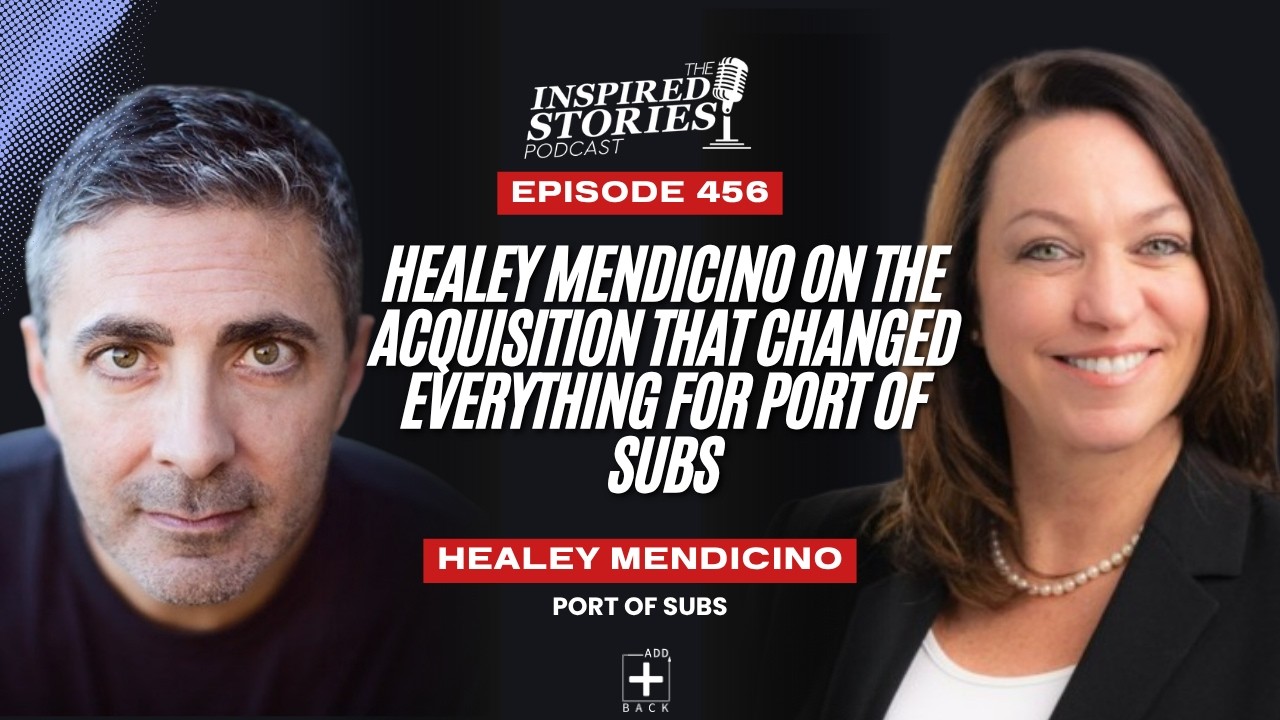
From Franchisee to CEO: Healey Mendicino on Betting on Port of Subs, Losing It All, and Coming Back Stronger
Healey Mendicino, president and CEO of Port of Subs, shares her journey from writing a check at 26 to open the brand's 100th location with virtually every dollar in her savings account, through the 2008 financial collapse that wiped out her real estate empire and left her pulling the covers over her head, to rebuilding, getting the call from founder John Larson, rejoining a brand she loved, navigating its acquisition by the founders of Remax, and now steering Port of Subs toward 500 locations nationwide including its first military base at Guantanamo Bay, Cuba.
Key Insights You'll Learn:
Met Port of Subs founder John Larson at a White House conference on small business policy at 26 and turned that friendship into a franchise partnership that opened the brand's 100th location
Invested virtually every dollar she had in her savings account into the franchise, signing personally on the SBA loan and the lease with the belief she was going to make it work no matter what
Built multiple businesses simultaneously in the 2000s including commercial real estate development, a national diner franchise, and a ballroom dance franchise, only to watch them unravel in 2008 when her primary tenants were mortgage companies
The biggest lesson from the collapse was not having advisors or mentors outside her own sphere during a period of high growth when everyone around her was telling her things were great
Recovery was not a single magical moment but a slow deliberate decision to focus on what she was good at rather than what she had lost, then waiting for the right opportunity
John Larson's phone call led to setting up the real estate and construction department, then inserting herself into franchise development and company strategy within six months because she simply could not help herself
Area 15 Ventures, led by the founders of Remax, acquired Port of Subs in 2023 through a private sale structured to protect the team, franchisees, and 50-year legacy of the brand
The regional developer model requires a minimum of 10 units per territory over five years and has already signed 19 regional developers with commitments for over 300 future locations
Going slow on infrastructure and platform decisions before growth accelerates is not optional because every operational gap amplifies to the hundredth power at scale
The first Port of Subs location at a Navy base in Guantanamo Bay is set to open in summer 2026, with a third of current regional developers being veterans
Healey's Key Mentors:
John Larson, Port of Subs Founder: Gave Healey her first franchise opportunity at 26, waited for her while she rebuilt after 2008, called her back when the timing was right, and trusted her to lead the brand through its biggest transition
Dave Linegar and Adam Contos, Area 15 Ventures: Brought the franchising expertise of building Remax to 9,000 franchisees in 120 countries and the capital and long-term family office mentality that removed fundraising from Healey's plate entirely
The 2008 Financial Crisis: Forced the kind of humility, self-reflection, and systems thinking that she credits as the foundation for how she now leads organizations through complexity
Her Own Franchisee Experience: Understanding what it feels like to sign personally on a loan and open a restaurant with your last dollar gives her a lens no executive who came up only on the franchisor side can replicate
Port of Subs Long-Term Team
Don't miss this conversation about what it actually takes to rebuild after losing everything, why going slow in growth is sometimes the only way to go fast, and what it means to fuel up the men and women of the US military from a little sandwich shop that started in Reno in 1972.
Listen to the full episode here
Transcript
Anthony Codispoti: Welcome to another edition of the inspired stories podcast where leaders share their experiences so we can learn from their successes and be inspired by how they've overcome adversity. As you listen today, let one idea shape what you do next. My name is Anthony Codispoti and today's guest started her relationship with Port of Subs not as an employee, but as a franchisee. She wrote a check, bet on a brand she believed in, and helped open its 100th location. Then the 2008 financial crisis hit and her world fell apart. What happened next is a story about rebuilding, about walking back into a company you love when the timing is right, about steering a 52-year-old regional brand through an acquisition, a culture reset, and the kind of national expansion most sandwich chains only dream about. Healy Mendicino is the president and newly appointed CEO of Port of Subs, the Reno-born chain that has been slicing fresh subs since 1972. Under her leadership, the brand has signed regional developer deals for over 300 future locations, putting Port of Subs on a path to 500 units nationwide. And somehow she managed to land their first Navy-based location at a little place called Guantanamo Bay, Cuba. This is one of those stories that reminds you what's possible when you bet on yourself early, get knocked down hard, and fight your way back. But before we get into all that good stuff, today's episode is brought to you by my company, AddBack Benefits Agency. Listen, if you run a business, you are likely stuck in the cycle of rising insurance premiums. You're paying more, but your team is getting less. And many people can't afford coverage at all. We do things differently. We provide your QSR employees with unlimited access to doctors, therapists, and prescriptions that's always free for them to use. And here's where you really need to pay attention. Unlike every other employee benefit out there, our program puts more money into your company's bank account. As an example, we recently helped a client increase net profits by $900 per employee per year. Gains like that can change how a business is valued. Results vary, but the consultation is free. See if you qualify today at addbackbenefits.com. All right, back to our guest today, CEO and President of Porta Subs, Healy Mendicino. Thanks for making the time to share your story today.
Healey Mendicino: Thank you so much for having me. I'm so excited to be on your program today.
Anthony Codispoti: So Healy, you were 26 years old, working in commercial real estate, and you attended a White House conference on small business policy. What were you doing there? And what was it like to be one of the youngest delegates in the room?
Healey Mendicino: Yes, it was incredible. And it was. huge national conference and we had an entire Nevada delegation and John Larson, who is the founder of Port of Subs, was our chairman of the Nevada delegation. I was there because of my background in finance related to SBA programs for my clients and that was my focus and I was actually appointed by our then governor and that was very exciting as well. And so off we went to the White House conference and it was just incredible. a really huge view into how our political system works. And at that moment in time, I thought I wanted to go into politics and that was great. Well, when I was there, I realized how amazing it is, but I also realized that politics was not going to necessarily be for me. And you have to trade out a little bit of the things that are a passion point for you for things that people want to progress. So it was really just a great experience, but also a learning experience about that maybe I didn't want to be in politics.
Anthony Codispoti: You know, and I think in life, oftentimes you need to wear a lot of hats, not only to see what fits, but what doesn't fit. So what was it about the politics hat that you quickly discovered was not going to fit for
Healey Mendicino: Yes, very specifically it functioned just as our political system does. And when we were charged with putting forward the top 100 legislative and policy issues for facing small business, I was really passionate about that. But what ended up happening is you've got all these caucuses and other things and people saying, OK, great, listen, I'm going to vote for the thing that you're very passionate about. But then you need to vote for some of my things as well. And that was a real hard thing for me to go, I don't believe in that. And so, and that's a tough line to walk for the politicians, but that wasn't for me. I'd rather be full in charge of the things that feel like they have integrity for me, that I'm passionate about, that I can champion and not have to try to, you know, lessen my value in regard to what was important.
Anthony Codispoti: No. So you mentioned that this was the time where you met John Larson, the founder of Porta Subs. And he floated the idea of partnering on a franchise and you're all 26. And what were you thinking? What was your experience in the franchise food business up to that point?
Healey Mendicino: Yes, zero other than eating there. I was a fan favorite. Everybody loves port of subs. Our food is absolutely delicious. And because we were originally Reno based and then Las Vegas, where I lived at the time. I had been a customer for a long time and a very passionate customer. So it was kind of fun when you go, my gosh, the founder of Port of Subs, like I've eaten there for years. This is amazing. And we just became fast friends. We just hit it off right away and became great friends. And so when we returned from the conference, we continued our friendship and that's how that evolved into, hey, do you want to do some real estate with us? And then, hey, why don't you partner with me? And I said, that would be amazing. And it was so fortuitous because that is where. I learned about franchising and absolutely fell in love with the franchise business model. I loved being a franchisee. I loved the relationship. I love that the whole team helps you because I didn't know anything about food other than eating it. And so it was, it was really a turning point when I look back on just the amazing aspects to franchising. It was very fun. It was very cool. And I was doing the construction and I did the site selection and all of those things that obviously now future forward. allow me to have a very unique lens in regard to the decision making I make now. But it was a wonderful time.
Anthony Codispoti: So walk us through the timeline a little bit. You met John at this White House conference. You guys hit it off. You stay in touch. How long until Sweet Talks, you end up opening up the 100th location as a franchisee?
Healey Mendicino: Yeah, it was about a year. It was over a period of a little over a year. And part of that was floating the idea as you said, I love how you put that because that's really how it happened, know, hey, what do you think about this? And part of the drive for him was, it's a family run business. And for all the wonderful and difficult things that that means to be a family business. And he wanted to have a bit of cashflow outside of the family money that was just his that didn't affect the corporation. And so that was his drive. And he's a very generous person and he wanted to do things for others. And that included me very luckily. So he said, what do you think about this? I said, heck, why not? I've got a high risk tolerance. Let's do it. Let's roll it.
Anthony Codispoti: So let's roll the dice. So what was the state of the company at that time? You were opening the 100th location. What was the balance at that time between company owned and franchisee locations?
Healey Mendicino: Yeah, great question. And obviously, a hundredth restaurant is a huge milestone in a franchise. Things that are very elusive for many. And again, that big marker of one hundred and third digit. was about 25. It bounced between 25 and 30 percent corporate, which was very unusual. Most restaurants, especially QSR, went one way or the other. Corporate store primarily or franchise primarily. But the way that Port of Subs grew, the family built the first 10 restaurants. out of sheer hard work and used the cashflow to build those first two, sorry, 10 restaurants before they began franchising. And people said, why don't you franchise Port of Subs? They said, what is franchising? So they came from that corporate environment and loved the corporate restaurants. It builds a nice big asset base that allows you to grow in different ways. So for them and the way they did it, it was really just perfect and allows you to experiment within the environment. and make decisions in those corporate units before you voice them upon the franchisees, making sure that they work and you have proof of concept. So it really worked well.
Anthony Codispoti: they've eaten their own dog food, so to speak up to that point. Not that Porta subs is dog food. You understand the expression? Yeah, but so I'm curious, you're going to open the 100th location, this big milestone number, where were you getting the financing for that?
Healey Mendicino: Abs. Absolutely. We did take an SBA loan, but for me personally, I was having success in my real estate business, but I was still very new in that environment. literally when we had our partnership shares that we were investing, it was literally virtually every single dollar I had in my savings account. And I said, okay, yeah, he's the founder of the organization. I felt like there was some level of safety there, but you know, I just said, okay, I'm either going to do this or I'm not going to do this and I'm going to figure it out later. So I wrote the check and when you write the check and you sign on the loan and you sign on the lease and you do those things, it's, it's a moment where you're like, okay, you know, we are going to make this work. And that's a big driver as well. And I think other franchisees could relate to that. You're going to make it work. It's your money. It's your last dollar. It's all of those things and it's worth the adventure for sure.
Anthony Codispoti: So opening day comes, what are you feeling inside?
Healey Mendicino: my gosh. First of all, food is wild, right? I come from an office where things are not quite as wild. They're much slower. So it's fun. It's exhilarating. It's really, it's like putting a shirt on an octopus. know, there's so many things happening and you're trying to keep it all contained, but the excitement and the exhilaration is amazing. And that's what makes restaurants so cool. They're so fun. you've got, you become part of the community very purposefully. You make so many differences. in so many people's lives. The customers that come through the door, you don't know what kind of day they're having. Your team members providing leadership opportunities and growth opportunities. But perhaps that's a look back of where I am today at that moment in time. It's just fun. Restaurants are fun. Let's do this. And they move very quickly. I had to adapt to that. And because I'm such a fast person anyway, that adventure was really great. It was a great kickoff for me.
Anthony Codispoti: So you had been a fan of Port of Subs for years as you talked about, right? You'd been a loyal customer for a long time. For folks who haven't had the pleasure of visiting a Port of Subs, explain what the customer experience is like.
Healey Mendicino: Yes. Well, it's our food is delicious. And I know I'm biased, but people do people never say, yeah, I like port of subs. It's okay. They say, I love port of subs. We slice all of our meats and cheeses fresh. Everything is made to order right in front of your eyes. You can have it exactly the way you want it. It's a very interactive experience. And again, because we bake our bread fresh daily and all of our food really is delicious. And dare I say, better than any sandwich you've ever had. And our brownies are great. We have a two foot brownie and a two foot brookie. So our food is delicious and it's fun to be able to interact with our guests. It's wonderful.
Anthony Codispoti: Yeah. How many locations are we at today?
Healey Mendicino: We're at 125 today.
Anthony Codispoti: Okay, so and explain to us, you touched on this a little bit, explain to us why that 100 milestone, why that marker is so important in the world of restaurants.
Healey Mendicino: Yes, it's often your growth trajectory and the teams that you need to make yourself successful in scaling, which we're dealing with now in a different kind of way. But many, many brands when you're first starting, you really need that royalty revenue and that franchise revenue and all of those things. But it often trails because of the way, especially where brick and mortar service businesses might be a little bit different. But for brick and mortar. We've got a timetable there. There's a gestation period. so it's depending on your resources and how you come about doing that, it brings a lot of challenges to bring your dream to life to get to that 100th location. It takes a lot of discipline. takes a lot of planning. And it takes a lot of resources, financial and human capital. So those inflection points that you hit along the way can challenge you a lot. And a lot of people, I think, Foundationally, people skip the part about foundation because it's not really fun. It's not sexy. It's not fun. It's, know, I want to sell franchises and bringing in franchisees. That's the fun part. We train and open our stores and, you know, whatever that looks like in anybody's particular business. But being able to have the discipline to have the foundation to ensure that you can build upon that to that hundredth restaurant is fantastic. And again, it's elusive because of all the ups and downs people will have along the way.
Anthony Codispoti: And remind me, what was the year that you opened this location? 1997. Very early days of the internet and lots of other texts. So I usually reserve this question for a little bit later in the interview, but I think it's appropriate to go here now. You were on a run through construction projects, real estate market, 2008, 2009 hit. Things are in free fall.
Healey Mendicino: 1997 in the Stone Ages.
Anthony Codispoti: Walk me back to the moment when you realized how serious this time period was.
Healey Mendicino: Yes, and to provide a little context for that, because it wasn't just in commercial real estate, I went on to develop for myself. I always wanted to do that. this was at the same time that I had port of subs. And I was the franchisee. I did not have daily, we had managers that ran the daily operation. I did not run it as a manager. So I had my own company running in tandem at the same time and I was doing commercial real estate development. I also became a multi-unit franchisee of a national diner brand and that's open 24 hours. was, woo, that's a thing. so I was, yeah, so I was doing some ground ups at that time and.
Anthony Codispoti: Okay, we skipped right over that part.
Healey Mendicino: There are so many lessons I learned from this period because zero grass growing under my feet. Every single moment was like, oh, let's build this and grow that and do this and be all in all the time, which is fun. And Mach 27 with your hair on fire is fantastic. But when those moments came in 07 and 08, I had an office complex that I had built early on and my primary tenants were mortgage companies. That was not very fortunate. And so that was really the start for me. in late 07, I was a little bit earlier than when the markets truly tumbled because of that. And had to deal with, you know, tenants not being able to pay their rent and trying to work with my lenders and our restaurants, you know, we didn't know what that was going to look like for the restaurant business. Certainly we had a reversal there. So I had immense reversal. I had three construction projects at the time for retail. And also, okay, here's something I'm going to insert that'll be fun for you. At that time, I was competing in ballroom dancing and the largest ballroom dance competition in the countries in Columbus, Ohio, the Ohio star ball where you're from. And so it was really incredible. I actually became a Max and Hermes franchisee at that time, and we were just getting going with that. So million irons in the fire. And then this happens. And it was so difficult to know what to do.
Anthony Codispoti: All right.
Healey Mendicino: And I think it's great to learn things along the way, but our failures, if you want to call them that, and they certainly feel like that at the time. Those are really dark moments for me because of all the irons in the fire. And one of the biggest lessons that I learned, because I had a complete financial reversal, you know, my buildings and all of the things that you have to try to correct. and it's hard to know what to do. There's no playbook for that. Can someone give me a playbook for what I'm supposed to be doing here? And taking a lot of head punches at that time. one of the things that I learned, and I bought this little leather notebook and I said, I gotta get these lessons, because they are dramatic. To lose quote unquote everything that you have is really a... eye opening and it brings a lot of humility and a lot of self-reflection and what am I doing and what did I do right and what did I do wrong and I made a lot of mistakes along the way and one of the biggest mistakes I made after this reflection period was I didn't have people around me not only to go hello what are you doing you know you can't have all your chips on the table and be all in all the time well it felt really fun when you're doing it but then you look back and say Yes, perhaps I could have had a little more of a modest approach, but also not having a really solid network of people or advisors or mentors or anybody outside of the sphere at that time, because when you're in a high growth mode, and by the way, when you think back to 2005 and six and seven and leading up to that, man, everyone was on fire. Financing was easy. mean, things were just, yeah, for everybody in all trades. And it was really fun. And so in looking back at that, that would be the one thing. And actually what I've made corrections for now today is saying you need others. You need people's perspective. Whether that's a family member, my partner, I had a great business partner at the time, but it really, the business outgrew him. So we didn't.
Anthony Codispoti: Money was free, business was flowing.
Healey Mendicino: It wasn't really great for us when we had this reversal. Anyway, the greatest lessons we can learn are from our challenges and our difficulties. And there were moments where I would just stay in bed, you know, pull the covers up and go, okay, today is not the day that I am gonna be able to deal with this. And then here's what I would say that has shaped my life so much at this time, because at some point you have to decide, and that sounds very simple. But it's a really powerful tool to just simply decide that you're going to move forward. Because it doesn't matter how that looks at when you first start. Just start. You have to start and you have to decide. there was that moment, I remember it very clearly, where I said, OK, got to clean this up, got to move forward. I'm going to decide. And by the way, I kept my health. I was really appreciative of that. And I had great awareness. And so I said, OK, well, what the heck? I got kicked around a lot, but I'm still here. and I still have a great brain and I'm gonna try to find my way to a new successful future because it doesn't matter if I lost those things. I built those things. I did those things. I built my team. I loved my team. I had 150 of my own employees and we did great things together and I really focused on the positives of what happened instead of. choosing to focus only on the negatives, which is really easy to do. just shifting my mind to say, all right, I did those things. I have those skills. I can do this again. I just might do it with more people around me.
Anthony Codispoti: So here's the part that I want to explore a little bit Healy is how did you get to that point because I hear you and thank you for admitting there were times where you just didn't want to get out of bed, pull the covers over your head. Because those are the unsexy times, the unstrong times where we don't want to talk about that, right? We just want to talk about I had all this success. Yeah, it was a rough spot. But I picked myself up. But it's that in between time that doesn't get enough air time where you just feel completely crumbled and broken.
Healey Mendicino: Yes. No, we don't. Yeah.
Anthony Codispoti: How did you get from that point of not wanting to get out of bed with the covers over your head to making, what's that? And lots of tears to that point where, okay, I am gonna take an action today. Was there a catalyst for you in that time?
Healey Mendicino: And lots of tears. And lots of tears. Believe me. Yeah, for sure. I feel that. Well, at some point, you can't just stay in bed either. I mean, you could. I suppose you could. But at some point, you have to have some stillness. think stillness brings about a lot of clarity when there's a lot of chaos, just like regular life, right? We could go into a whole big conversation about how I feel about the importance of mornings to your life and to your brain. But back at those moments, I didn't have that type of exposure. when those moments are still and you suffer for a while, at least this was my experience. You go through this, you built this, whatever you're building with your blood, sweat, and tears, and heart, and soul, and here you are going, holy moly, what just happened? And it took me a long time, much longer than I thought to be in a great place, but I believe that catalyst, that inflection point was, okay, I had enough stillness. and enough reflection to be able to say, all right, I got this, I can do this. I once again, focus on the things that I focused on the things that did work. And I really worked on my mind to not pay attention to. those very difficult things that happened. And I was not willing to say to myself, gosh, why me? Or I was never really that type of a person, luckily. I'm inherently a positive person. So I think that was very helpful also. I'm built for positivity. And so I just purposefully said, okay, I am not gonna look at all those ugly things and take those on and attach my ego to those difficulties. Instead, I'm going to focus on what I did the best. And what does that mean for me moving forward? How can I take, what did I do the best? Because when you have a big, you know, a big challenge and you ride the big wave and then it crashes on the ocean, you take a look and say, God, what am I good at? Am I good at anything? And so it was really, I think, a slower ride. It wasn't like this magical moment. It was a slow lead up going, a minute, I am good at things. I am capable. I can do this and let me focus on one great thing I'm good at, which is people, one of my superpowers, and what can I do with my life? And even though it wasn't this magical moment of some big shift, it was just a mindset of I'm gonna decide I'm moving forward because I have great talents and I have great passion for life and great passion for things and multiple skills and how can I use those? And then the phone call came.
Anthony Codispoti: Before we get to the phone call, I wanna highlight why I love what you just shared with folks, because I think so many times folks are waiting for that sunshine moment, God parting the clouds, like here is the answer, here is the easy button, like everything is okay. And it almost never happens that way. It is just the confusing and the sloppy and the...
Healey Mendicino: Ha ha ha.
Anthony Codispoti: I am just going to put one foot in front of the other without knowing exactly what's going to happen, but I'm going to take some motion today that starts to get that momentum going and get you there.
Healey Mendicino: Yes, absolutely. It's really important because as you mentioned, you never know people's variables. We want to look fabulous on the outside and be strong and successful and everything's going perfectly and that just is not part of life. Learning and progress are part of life. And then you start saying that to yourself too. Well, what's the purpose of life? Well, what if it's progress and joy? Okay, well, I've had... I've had progress and then I would tease myself. And you know when you're teasing yourself, you're getting healthier mentally. I said, well, you gotta be clear with whatever powers you believe that are higher than us. I said, I want my life to be dynamic. it was dynamic all right. I forgot to be clear about what I meant about that. So I've reframed that in my own mind about I wanna have a dynamic life in a very successful positive way.
Anthony Codispoti: you That is a good qualifier there. All right, so now Healy, tell us about the phone call that came.
Healey Mendicino: you So I get the phone call from John Larson and you know, everybody suffered during that time to very well, not everybody. Some people did quite well, but many, many were suffering the same challenges. so we called including port of subs and you know, port of subs had just signed 11 leases or something and then the capital changed and the franchisees didn't move forward. So that period of time was very difficult also, but recovered very quickly. Our brand's amazing. We have fierce brand loyalty and amazing franchisees and that's what helps lift your brand when you go through times of trouble. So a lot of gratitude for that. Anyway, he calls me and says, hey, what have you been doing? I've been waiting for you to try to do something and you're kind of not doing anything. What the heck are you doing? I said, well, I've been cleaning up my big mess. Thank you very much. And he said, how about if you come over and set up the real estate and construction department for me? I said, you know, that'd be great. I was talking to another friend about taking on a restaurant chain. with him as a partner. And frankly, it was full service 24 hour restaurants. I didn't have the energy for that. That takes a lot. And I said, know, so when John called, it was cool. A brand that I love, that I've always loved. My dear friend. really, he needed that desperately, but he knew that he was trying to help me as well. So it was a win-win in that regard. So I got in and set up the real estate and construction department. Having had my own organization for so long. with a growth mindset. I couldn't even help myself. I'm like, after about six months, I got everything set. And I went, wait a minute. We need to, let's correct this and let's grow this and we can do this. And I just can't help myself. I'm completely out of my lane because of operating my own company for so long. And he finally said, gosh, fine. And he made me the executive vice president and put me in charge of the franchise development side. And then of course, company strategy and growth and wanted to really grow again and put. for something meaningful. it was really great for both of us and the brand and a lot of people that I had known for a long time. So it was a little bit like coming back home.
Anthony Codispoti: It sounds like this was just like, this was the easy button. This was the clouds kind of parting for you. Was there any hesitation on your side in taking this role? Because you had been kind of your own boss for a while, and this was a different kind of a role.
Healey Mendicino: Yeah, it's a great question, especially to your point. You know, I hadn't had an employer since I was 22 years old. Yeah, so it was very different, but I was OK with that because I thought I could bring great value to the brand and to the franchisees and to the team. And it was a soft place to land because it wasn't my organization. I didn't have to think about all those other departments at that time, of course, until I, you know, inserted myself. But at the moment, it was a great, great way to start. deliver value, be part of something that I've always believed in, be back in franchising again, which I absolutely loved. I loved being a franchisee. I loved being a franchisor. Yeah, it's such a unique relationship. It's so incredible, frankly, that you can be an independent business owner. And especially when you're first starting, but even as you become seasoned, you need each other to be successful.
Anthony Codispoti: Why? Why? What's the big attraction for you?
Healey Mendicino: franchisor, franchisee, you can't succeed without one another, which is really interesting in a business relationship, but you also have the resources that you need and you don't have the pressure, you know, you're not creating menus and marketing programs, well we are now as the franchisor, but as the franchisee, all you have to do is follow the system. Which is kind of what drives franchisors crazy when the franchisees sign up and then they don't follow the system. Like you signed up so you could follow a system to be successful. You know, we've got 15 years of proven system, 50 years of proven system. So anyway, I love that piece of it because now all you have to do is go execute. And what does that mean? You get to, if you do it properly, that means you get to spend a lot of time with people and making a difference in your community and doing those things that make life, at least from my perspective, very meaningful instead of, you know, it's not just. operating a restaurant, it's being part of something and creating opportunities for other people through your skills. And it's really unique. That's unlike having your own organization or doing different types of venues, basically.
Anthony Codispoti: So in those early days of stepping into this new role, pick out one project that you were particularly excited about, that you wrapped your hands around and really moved forward.
Healey Mendicino: Yeah, there are two actually. was kind of foisted on me actually, where John said, hey, listen, we've got a couple stores over there that are not going to renew, so we'll take those on as a corporate store. But I want you to do a new redesign. And I'm like, OK, I don't remember on my, you know, I've got a good design eye, but I'm not a professional designer. And he said, you know, do it anyway. I said, OK, well, I just want to have the caveat that it's going to be amazing and it's going to look good, but it's still an amateur designing a restaurant. And then we did end up bringing in some other folks who specialize in that, but that was really fun because it was really the first big brand refresh. And because I'd had so much real estate development under my belt, that visualization was very easy for me and it was very fun because it was like, but it wasn't just the decor, which was awesome, but it was how do we make it more efficient? How do we get our? our customers through the line faster? How can we give them a great experience? How can it be fun? And these types of things. So was really a fun opportunity to understand all of the operational background of why we do things. you you can't have, you know, for us slicing fresh and the way that we do our heated foods and hot subs and everything, you can't have it five feet that way or six feet that way. It ruins the flow. So that part was really fun. And that prototyping. Then John said, hey, I want us to grow like crazy. I'd like you to put together a framework for that growth, which we did. And ironically, at that time, it was for essentially the regional developer model. But we did not end up moving forward with it in that way because the girls, his two daughters who were partners, they didn't want to do that. They said, that sounds terrible. It sounds like a lot of work and a lot of risk. And he's like, right, let's go. Because he was that guy.
Anthony Codispoti: What is the regional developer model and why didn't you go forward with it at the time?
Healey Mendicino: Yes, we have the regional developer model now. I know we'll probably talk about the acquisition because that was a huge, huge transformation of the entire brand that I'm lucky enough to be a part of and leading. But back to the question, it's essentially an updated version of what most people would call an area development agreement, that type of thing. Learning from others and making some of those changes. But essentially where you've got a regional developer who can acquire a territory that they have exclusive control over. the goal and the program is for them to build their own franchise network. They have to build a flagship unit, not only for training, but we are a community focused organization and we always want to be that brand. And so having a flagship and being part of the fabric of that community as you build franchisees and offer opportunities to other is the heart of the program. And also, obviously, a very aggressive high growth program. Because even if you have, say for example, we now have, we just signed our 19th regional developer. And I know we're very excited, but let's call it 10 or 20 for easy math. I say this to the team a lot. This kind of a scaling growth platform is not for the faint of heart. Because even if you had 10 regional developers and they each did two, you're already at 20 restaurants and you haven't, you've barely even scratched the surface or done anything. And so when we have our regions, it's 10 units per region minimum development. And so if you have committed to building 10 or 20 or 30 restaurants in a particular area over a five year period, that's the program. especially when you have to, in our brand, in brick and mortar, you have to find a piece of real estate to build. So it takes a little bit of time. And the first one's the hard one and this type of a conversation. But it really... the framework was put together, but you cannot have a high growth organization when all the partners are not in agreement of that capital allocation and even conceptually that you wanna put together the team. This was, previously it was slower growth. John loved knowing all the franchisees and the locations and really he was kind of the dad of all the restaurants. so for him, pardon me, for him it was... a change of, okay, I'm gonna give up a little bit of control, which can be very difficult, especially as founders. Founders are like, he's not John Larson, he's John Port of Subs, right? Yeah, it's my baby, it's what I've done my whole life. But the girls, they were always very, really good with their money, but they've been part of Port of Subs since the first restaurant.
Anthony Codispoti: This is my baby.
Healey Mendicino: And there are stories about, I'm sure they broke every child labor law in the world at the time, but you could do that back in the 70s, right? And 80s, but the girls, they would be in the restaurants and they're kind of short and they were young. So they had like milk crates and they were doing the cash register and all of that. So they come by it honestly, but they've been doing it their entire lives. And here it is 50 years later and they're like, gosh, obviously it's part of our DNA, but we wanna go do something different. And moving into a high growth mode comes with a lot of challenges and they wanted to spread their wings in a different way after all this time. And so I said, look, you can't have partners who are true partners that aren't going the same direction. And so we just backed off and said, then let's just have nice steady growth. That's okay. There's nothing wrong with that. What we choose in our lives is how we think and what's important for us. It was the right way for them to grow. Even for John, he wanted to have this big environment. And he said, gosh, know, some of our competitors really have eclipsed our growth. And I said, you know, that's OK, because that's what he chose for his life. And I think it was a better fit for him. Only later do you look back and go, my gosh, well, darn it, I wish I'd grown to a thousand restaurants and that it was easy, easy. But that's just not how growth works.
Anthony Codispoti: So something changed after that, right? Because in 2023, there was an acquisition that took place. And this really helped to set you guys up for the growth that you're excited about now.
Healey Mendicino: Yes, huge inflection point. And really that whole conversation I just had was a big part of that, where the girls were like, we'd like to go do something else. Do you want to, you know, the growth was really at a moderate pace. It was really kind of stagnating. And, know, in any organization, if you don't evolve, if you're not evolving, you're stagnating. And when you're stagnating, it's not a good thing for a business or the team and all of that. I... I really felt like I was instrumental in saying, these are decisions you must make. Whatever you guys want to do doesn't matter to me. I can put together any framework you want and we can do that. And the decision was made to sell the company. Now, it's not a normal company. The teams, it's not like buy and sell and part of PE and all of that. This is a 50 year legacy brand, family and founder run. with most of the team members. think at the time our shortest term team member was the receptionist and she had been there five years. Everybody's 10 years, 15 years, 18 years, 25 years and so on. And John was very caring and said, gosh, I really want this to be great for my brand and great for the team. And I really want it to move. Obviously you want your life's work and your baby to be successful moving forward, but it was a hard, I did not envy him. the challenge of going, okay, I think I need to sell it. like chopping off your arm, you know? But it was the right decision for him and the family. And I think in retrospect, he looks back and says, yes, now he probably says, gosh, I should have done it sooner and been on some beach with my beautiful wife. in any event, the decision was made and he wanted it to be a private sale. So I contacted one of my people in the franchising world who has far reach and I said, hey, And he knows John and all of that. And I said, do know anybody that would be interested in a very quiet private sale? Because if you go to PE, you can make one phone call and get it purchased. then it's on the street. And the word's on the street. And even though you sign NDAs, but it's hard for people to keep it under wraps. And then.
Anthony Codispoti: And why did you want it under wraps?
Healey Mendicino: Actually, that was John because he didn't want the team to be harmed and he didn't want his brand to be harmed and he didn't want to shop it on the street. He didn't want to have that bidding war. And a lot of that was just protection of the people. Interestingly, when we went through the acquisition, the only people that now Area 15 Ventures is our acquirer, the only people they got to talk to were the four of us partners, John, Lisa, Shana, and me. So the girls, John and I, and no other team members, which they're like, that's so weird. We need to talk to the people. We need to know what's going on in this brand. I'm like, I'm sorry, if you would like to do this, this is how it's going to be because he was very, he cared so deeply about the team and what he had built in the community and the franchisees. He was very, very concerned about the franchisees and wanted the type of buyer who would not only carry on his legacy, but also have great care for the franchisees because we're in the franchising business, but these were friends, you know? that grew together for a long time. So his heart was absolutely in the right place. that's when our consultant said, yeah, I've got a great, great buyer. And I said, okay, well, where are they located? And he said, well, if I tell you, you'll know. He said, they're located in Denver. So now I'm looking up every food franchise in Denver and I'm thinking, it's Chipotle, you know. Anyway, then it gets disclosed that it's the founders of Remax and I'm like, real estate? How would I have even guessed that? So here we are. Obviously they are masters of franchising. They have 9,000 franchisees in 120 countries, but they've never done the food business. And so we met for the first time and they, under Area 15 Ventures, that's Dave and Gail Linegar and Adam Contos, who was the previous CEO of Remax. and Dan Predovich is the other partner. And their goal with Area 15 is to buy brands they can scale because they know franchising very well and obviously have immense resources. And which is, you know, a big shift because we're kind of a newly emerging brand going with national expansion, but with the resources unlike most startups. And that's been very helpful. In any event, we meet for the first time and Dave Linegar and John Larson get along extremely well. and the magic happens and the deal gets made.
Anthony Codispoti: So what is it like for you internally managing that transition and the communication with the employees and the franchisees?
Healey Mendicino: Yes, well, and communication is the perfect word. There was a lot of fear, especially because of the private nature of the company and the longevity of the team members. And it was really an unusual situation because how often do you get the opportunity? First of all, in &A, how often does the entire team come along? Very, very seldomly. And had it been a food business that acquired us, it probably would have had a different result because a lot of those brands already have their people in their infrastructure. so Area 15 team looked at me and said, do we need everybody? I said, are you kidding me? We went from kind of a maintenance slow growth to now we're going to embark on a regional developer, high aggressive growth program with national expansion. Then of course, and then Dave says, yeah, international. I say, can we just start with the country first? Let's start with America first. before we get into other countries because that's how he thinks, right? He's a very focused visionary, but in any event. So I said, yes, we need the entire team and then we need to start building from there and building this infrastructure. really, this was the beginning of Q2 of 2023 when the acquisition happened. And that year really was constant communication with the team and the franchisees. to just quell the fear because if you let them have their own narrative, then you keep your eye off of things and that's when stories and big monsters show up in your peripheral vision. it was really quite something to be able to work through that. And when everybody got comfortable, how often do you have this other opportunity where you say to the team members, listen, if this isn't for you, because this is not a bus. This is not about being on a bus. This is about being on a rocket ship. And that's a very different mode than what we had had in the past. So if you're not up for it, then that's okay. All we ask is that if you wanna go do something different, let's just be honest about it and open about it and work through it together so that it's a comfortable transition for everybody. And that's a really unique place to be. Most of the time you don't have the opportunity to have that level of transparency. And then of course meeting Dave and Adam, Adam Contos and Dave. They're just great human beings and one could argue that at the success levels that they have, and I'm sure we've all met some of them, know, no offense to Wall Street guys, but a lot of the Wall Street guys, you're like, wow, no heart or soul in there, huh? Tink, tink, tink, you know? And they certainly could be those people at that high level and they're not. just, they care about people. They care about their franchisees and they just have strong values. And it's really not P.E. It's a family office.
Anthony Codispoti: Explain the difference for folks. Why is that an important distinction?
Healey Mendicino: Yes, you know, P.E. And again, I don't I'm not I think P.E. is great. P.E. has a wonderful place. But private equity firms traditionally are really, you know, am I going to cast them in a very kind of cold business tone? Yes, probably, because I think they can be that. And, you know, their focus is we're going to deploy resources and we are, you know, usually with the notion that they're going to handle it in one way or the other to sell. And in some instances, PE will build, but in many instances, PE loves to just get down to what can we strip away, what those efficiencies are and sell it. And by the way, I say to PE,
Anthony Codispoti: They're just looking for the efficiencies, right? What can they strip away?
Healey Mendicino: You know, you guys always hide like you're not gonna do that. Well, talk about it. You might as well be transparent about it and go, look, guys, listen, we're gonna build this brand because we're gonna add huge resources. We're gonna grow like crazy and then we're gonna sell it and let's all work on that together. I think it would be a better result for them. But regardless, that's just my public service announcement to the PE firms. But the family office mentality really is yes, we wanna buy something, but it's a building mode. It's the idea of building. It's the idea of creating something. It's the idea of more than just the vehicle for the dollars. It's also, you know, for Dave, he said, I want to do with Port of Subs what I did with Remax. But instead of 50 years of Remax, we can do this in five years. Well, it used to be started out as six years, and then it got down to five years. Then Dave said three or four. I said, wait a minute, what happened to five years? So we jokingly argue about the time horizon. But this is a long term. kind of an opportunity for a family office. And we're very close, the decisions get made very quickly because the group is small and it's really a gift to be able to have that in this environment. And in most environments, in my role, a big percentage of my time would be toward raising capital. Most people have to continuously raise capital. And what a gift that we don't have to do that, I don't have to do that, so I can focus 100%. of my energy on the team, our network, and growing our brand. And so that's probably a 30 to 40 % of time allocation for me that I don't have to utilize.
Anthony Codispoti: Such an interesting point. So then you're able to spend a lot more of your time looking for and developing relationships with these regional developers, because now that you've got the capital and you've got the huge expertise of the franchising from the folks behind Remax, you guys can go back to that regional developer model and really start to throw gas on the fire.
Healey Mendicino: Very much so, very much so. But then we start treading into the infrastructure conversation because real estate's very different than food. So it's been a bit of an education process along the way with the team at Area 15 because they're like, well, why can't we open 27 of them in the next three months?
Anthony Codispoti: And the reason, the explanation is...
Healey Mendicino: The explanation is because luckily, as I say, as we build infrastructure, luckily we have to find the location, build the location, train the location, open the location, and stabilize and make it successful. And you just can't force that timeline. You can be more efficient. You can get it down to x period of time, but it's not one month or two months, and you just can't force that process. you know, again, part of our goal are those efficiencies. But for me personally, and our team, it gave me the runway. And I would say to the team, hey, these are golden runway moments because what's going to happen as this hockey stick type of growth happens that that we we only have a certain period of time to build the infrastructure that's required to be able to truly scale because it's super easy to say scale. yeah, let's grow. I remember conversations that would go a little bit something like, my gosh, let's do 100 restaurants. And I'd go, OK, that's That's cool. That's totally possible. Now we're going to take a step back and plan for it, but let's, let's talk about this. That's opening to a week, right? And then everybody goes, everybody goes, Oh, Oh. And so even if you say, okay, wait a minute, let's just do 25. You say that's still, that's still one every, you know, so on and so forth and the realities of those types of things. So it's given me a great opportunity. So if I could cast kind of a framework, you know, the 2023 was stabilizing the team and then beginning to build the next team of growth. 2024 was continuing to build that team and the infrastructure. And 2025, we start having great traction with our regional developers, yet still finishing all those end-to-end tools because we ran into some bumps along the way. This is not an easy thing, but I'm a planner person and I can't express enough. A lot of people love to skip over that. And even within our own organization and the Area 15 team, they're like, you know, why does this take so long? I said, because we're talking about having 500 restaurants by 2030 and the realities of that framework. You know, it's okay if one wheel falls, flies off, but you can't have all four wheels flying off. You gotta keep those, you have to be that systems thinking and that systems person while making your franchisees and new markets successful. So it's really adventurous.
Anthony Codispoti: What is one of those bumps that you've run into in the last couple of years?
Healey Mendicino: Yes, I think a lot of that is platform related. Once again, systems, you have to have a system. it's, I think a lot of the quote unquote bumps and train wrecks happen in the transitions, know, especially for us because we're doing construction and there's elements to that are esoteric to our work that others may not have like service businesses, you've got to get your web presence here, digital presence down. But I think a lot of it was the platforms that we had, a couple of the platforms we had early on were great for those moments. And we made a couple of decisions on things that we thought were going to be awesome. And then when the reality hit of these types of workflow programs and so on that you need to rely on at scale, they started breaking down, you know, at 10 or 20 units or something, or even 30, you can remember 10. You know, you start getting into 20 and 30, it's another level. But when you're really talking about at various stages of the life cycle from, you know, a franchisee inquiry through approvals and financing and real estate and construction and all these things that are germane to us, training, opening and so on, for us, it's if you have 50 to 100 people in your pipeline at any given time that you need to give superb tools and superb service to, it's a different level. It's a different thing. And so it's taken us a little bit longer, a lot longer than I expected to be able to get it right. But, you know, I inherently knew you have to be disciplined sometimes, depending on where you are in your business life cycle and what you have going on. Sometimes you have to go slow so that you can go quickly because otherwise, man, you could have big train wrecks really quickly. And, you know, in a high growth model like we have, believe me, it amplifies. every challenge that you have to the hundredth power, you know.
Anthony Codispoti: And I've seen this so many times, the tools, the tech, the staff, the infrastructure, the vendor relationships that you had that got you from point A to point B aren't always going to be the ones that get you from point B to point C. And I want to talk about one of those vendor relationships in particular. You've had the same bread vendor for nearly 50 years. And as you started planning locations for East Coast, South, Southeast parts of the country, Virginia, Maryland, Florida, Texas. You had to go back to that vendor and have a conversation that some people might dread having. Walk me through how that went.
Healey Mendicino: Yeah, you know, it's kind of funny how it rolled out. It wasn't really a dread conversation for me because we have vendor partners. They really are amazing partners. But something interesting happened for us, you know, that 50 years of bread relationship on a handshake, by the way, which is cool. It was a 72 year company, family operated, multi-generational, and they called a meeting when the acquisition was happening. They had called a meeting with us because we are a huge portion of their percentage of their revenue and business. And they said, we have something to tell you. And we're thinking, gosh, we have something to tell you too. They were also being acquired. And so we're being acquired. Wow, so are we. And it was the bread company was acquired by a husband and wife team, Colin and Mary Beth Smith, whom we've all known for 20 years. They didn't come from the bread industry, but they came from the culinary industry and so on. And so it was kind of fun. actually Colin is a wild man and he's like, I don't care what it takes. We're going to make everything work. He's that guy, know, super high energy, you know, everybody loves him. And so I think it was a really unique transition. I mean, the family was amazing, but just with the more avant-garde type of attitude and we're gonna make anything work and I'm here to grow and I acquired this to grow was really a great time to have this level of transition. And he said, hey, listen, I don't care if I have to buy my own trucks, I'm gonna make it work and we're gonna partner on this together. So it's been a great relationship.
Anthony Codispoti: That's fantastic. So you've been able to continue to work with the same bread vendor, even as you guys have expanded into completely different geographies that couldn't have been supported by just the original location.
Healey Mendicino: Yes. And you know, and I think as we move forward, know, we end up either doing our own bakery or we'll definitely end up with some regional bakeries because what happens is you get caught up in the freight game and then it costs your franchisees just because you have a location on the West Coast. So I think over time we will have a solution for the East Coast. But meanwhile, we plan for that. we put numbers to that and said, no, we can make this work. It's going to be great. And again, I know that that will evolve over time just because it's more practical. If you have a bakery right there and your franchisees are right there, it's going to be far less cost for them. So we'll put plans in place for that because we all focus so much on the unit economics and the profitability. And that's a big component of that. But that's a planned and it's a measured thing that we have that will work with our bread vendor on doing that. You know, just like any relationship, it's all about communication and transparency. I'm a very direct, straightforward, put it on the table sort of a person. I think it clarifies and makes things easier. And that's really helped us respectfully, of course. But when you have transparency with your vendors and your team and the things that are happening in your franchise network, you're going to be in a better place. And if you're going to have challenges, let's get them out of the way early on and remove them.
Anthony Codispoti: I have to fit this one in because we mentioned it in the intro and it's just kind of fun to talk about. So Area 15 Ventures has ties to the military community and that has opened an unexpected door. Your first Navy base location is going to be at Guantanamo Bay, Cuba. What was your reaction when that opportunity first landed on your desk?
Healey Mendicino: Yes, I remember it vividly. So Dave Linegar, Air Force, four tours in Vietnam, Adam Contos, Marine, previous SWAT commander, Dan Predovich, law enforcement. And we've got so many of our franchisees that were, some of them combat veterans and all of that. And I'm just deeply patriotic, so I fit right in. so we go to the multi-unit franchise conference in Las Vegas in the spring, which is coming up for us now. And the Navy's there. And we have port of subs, they have port of subs, they get excited, they call a meeting. And I'm like, this is amazing. They have 109 locations that they need sandwich shops. And we are a sandwich shop and our food's amazing. And we also have a full line of prepackaged convenience foods that we make fresh daily from our restaurants for some of our non-traditional units. So it ties right in with the Navy base. In any event, we get We go out to Norfolk, Virginia to meet with them at their headquarters and they start expressing that they're excited about our brand. They want to partner with us, but they have a challenge. They've got a location that's a challenge for them. And it's Guantanamo Bay. said, holy moly. Okay, that's cool. All right. This is wild. And I shared this back with, you know, Dave and Adam and they smile so big. And I go, why are you smiling? They said, yeah. I'm like, do we really wanna do this? They are so excited about doing this. And anyway, it was just very, it's kind of, again, it's wild, but I'll tell you, beyond the fact that it's Guantanamo Bay, what a true, sincere honor to be able to service the men and women of our military. And I'm like, we're gonna fuel them up. especially, know, times are a little bit interesting right now across the globe, but. to have the opportunity to serve our servicemen and women is really something special and it's a real honor and we just cannot wait to get out there. As a matter of fact, we're gonna be opening up toward the end of July, beginning of August. So we're just right around the corner from opening, yeah.
Anthony Codispoti: This is right around the corner. We're recording here in March of 26, so just a few months away. And the way you're talking, it sounds like you're hoping this will be the first of many Porta subs at Naval bases around the
Healey Mendicino: Yep. Yes, indeed. And for us, it's kind of really amazing because of our regional developer program, and many of which, let's see, a third of our regional developers are veterans. And particularly those, we've got two regional developers, we've got them near our naval bases. And so what a nice tie in to have veteran regional developers, veteran franchisees that can be part of those communities and part of those bases as we grow. So yes, we're focused on creating, continuing the partnership and being on the other bases. And then of course, some of them are mixed bases as well. And, know, Dave and Adam and everybody going, then we can move, do Air Force and Army. And I'm like, how about if we start one branch first and then we can talk about those things? We need to master that. And then we can, then we'll be able to do that. But we're all very excited and it creates a lot of buzz for the whole team. And they said, this one's really hard. I said, yes. That's what makes it so meaningful when you're successful. And then the rest of them, said, the rest of them, domestically, that's going to be easy.
Anthony Codispoti: It's hard and we can do hard things. It's advice I give to my kids all the time.
Healey Mendicino: That's great advice. I love that. I'm putting that in my quiver too.
Anthony Codispoti: Healy, I've just got one more question for you today. But before I ask it, I want to do three quick things for the audience. First of all, anybody who wants to get in touch with Healy directly, she's given us permission to give out her email address. It's Healy and I'm going to spell that but Healy at port of subs.com. Healy is H E A L E Y H E L H E A L E Y at port of subs.com H E A L E Y at port of subs.com. And don't worry, folks, that'll be in the show notes. And then anybody who's interested either in the brand as a customer or the regional developer model that we've spoken about at great length, portofsubs.com, really easy. Go there, there's lots of information, lots of opportunities to contact folks there. And if you're enjoying our show today, please take just a moment to subscribe wherever you're listening. It sends a signal that helps others discover our show as well. So thank you for taking a quick moment to do that right now. And as a reminder, you can get your QSR employees access to therapists, doctors, and prescription meds that as paradoxical as it seems, actually increases your company's net profits. Real gains that can change how a business is valued. So contact us today at addbackbenefits.com. And one more time, since I butchered her email address once, healey at portofsubs.com. Healy at portofsubs.com. So last question for you Healy, a year from now, what is one very specific thing that you hope to be selling?
Healey Mendicino: Well, I hope to be celebrating successful launches in our new markets where people can thrive and we can create opportunities across the country to be part of those communities in a very successful national way while still maintaining the soul of our organization. And I really, we will be celebrating our 150th location and beyond a year from now while. providing those opportunities to so many.
Anthony Codispoti: I love it. Healy Mendicino from Port of Subs. I want to be the first to thank you for sharing both your time and your story with us today. I really appreciate you being here.
Healey Mendicino: I love being with you. Thank you for having me. Thank you so much.
Anthony Codispoti: Folks, that's a wrap on another episode of the Inspired Stories podcast. Thanks for learning with us. And if one thing stood out, put that into action today.