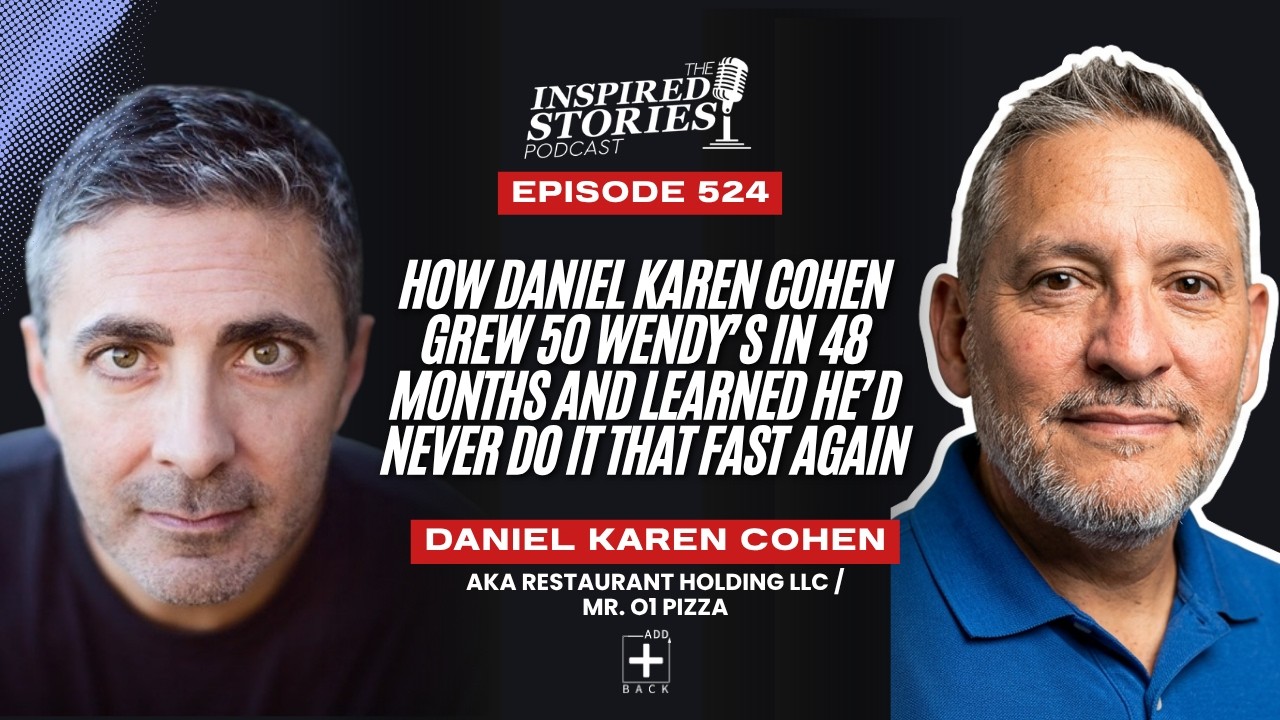
Daniel Karen Cohen, CEO of AKA Restaurant Holding LLC, got his start when McDonald’s came to Venezuela in 1985 and recruited from universities because part-time work didn’t exist in the country. He became a general manager before he finished his degree, went to Hamburger University twice, joined Andres Garcia’s group to help build Wendy’s across Venezuela, grew 50 restaurants in 48 months, won a US residency lottery, moved to Miami in 2008, and eventually found an artisanal pizza brand that rests its dough for 72 hours — and has 4.9 stars across 30 locations.
✨ Key Insights You’ll Learn:
How McDonald’s introduced part-time work to Venezuela in 1985 and changed who could enter the workforce
Being promoted to general manager before finishing his university degree and what Hamburger University taught him that school couldn’t
Joining Andres Garcia’s group at 25 to lead a 20-restaurant pizza concept and learning what happens when you push change too fast
Choosing Wendy’s over a McDonald’s franchisee offer by doing a two-chair exercise with his mother
Growing 50 Wendy’s locations in 48 months and what he’d do differently now
Moving to Miami in 2008 after winning the US residency lottery and starting over in a country where he had to relearn how to do business
Converting Latin food concepts to Francisca Chicken during COVID and using the analysis to find Mr. O1
Why manager partners outperform managers by three to five degrees — and how the equity structure works
The divorce, the Kabbalah study, and the remarriage — and what three years apart taught him about appreciation
Two sons now working in the business, one of whom just opened his first Mr. O1 location in Sarasota
🌟 Daniel’s Key Mentors:
Lorenzo Bustillos (McDonald’s Venezuela Owner): His first reference for what it means to lead with people — a man who inspired everyone around him to be extraordinary
Andres Garcia (Business Partner): The entrepreneur who saw Daniel’s talent at 21, called him back for Wendy’s, and has been his partner across every major chapter since
His Mother: Put two chairs back to back and asked him questions from both seats when he couldn’t choose between McDonald’s and Wendy’s — that conversation changed his life
His Wife: A Kabbalistic astrologer and teacher who found the spiritual path first and brought Daniel along — and who came back after three years apart
👉 Don’t miss this conversation about what culture actually looks like inside a restaurant with 2,500 employees, why slowing down growth is sometimes the fastest way to build something that lasts, and how a man who opened McDonald’s in Venezuela as a university student ended up building a franchise around 72-hour dough and Italian-imported flour.
Listen to the full episode here
Transcript
Anthony Codispoti (00:00)
Welcome to another edition of the Inspired Stories Podcast, where leaders share their experiences so we can learn from their successes and be inspired by how they've overcome adversity. As you listen today, let one idea shape what you do next. My name is Anthony Kotuspodi, and today's guest spent four decades in the restaurant industry working his way from global fast food giants to an artisanal pizza brand.
That lets its dough rest for 72 hours before it ever sees an oven. It's a career that stretches from McDonald's to Wendy's, Venezuela, to co founding a Latin flavors concept, with each chapter pulling him closer to a very different kind of table. Along the way, he earned the American Dreamer Award and built a consulting firm helping other businesses find their footing. His name is Daniel Karen Cohen.
And he's the CEO of AKA Restaurant Holding LLC. It's the parent company behind Mr. O One Extraordinary Pizza Franchise, and it operates multiple locations across Florida and Texas using ingredients imported directly from Italy. He's also the co-founder of Focus on Five, a strategic consulting firm focused on market expansion and positioning.
So, this is story about what happens when someone who has operated at the highest levels of scale decides that extraordinary means something smaller, slower, and more intentional. But before we get into all that good stuff, today's episode is brought to you by my company, Ad Back Benefits Agency. And you'll want to hear this because it's hurting almost every business you know. Health insurance costs go up every single year, and restaurants are furious about it.
They're paying more, claims are getting denied, employees are opting out because they can't afford it, and it hurts turnover and morale. It's one of the most maddening problems in running a business, and everyone just seems to accept it. But you don't have to anymore. Now there's a program that gives employees unlimited access to doctors, therapists, and prescriptions with no copays or deductibles to meet. You don't change your broker and
Here's the part that really shocks most people. Our product actually increases your net profits. We recently helped a client add $900 per employee per year to their bottom line. Results vary, but imagine what can be done with the extra cash flow. Get your free consultation today at adbackbenefits.com. All right, back to our guest today, the CEO of aka Restaurant Holding, Daniel Karen Cohen. Thanks for making the time to share your story today.
Daniel (02:52)
Well, thank you, Anthony. It's a pleasure and an honor to be here with you. I know that you are doing this for a few time and it's amazing to see your work and how you have those beautiful stories out for the people.
Anthony Codispoti (03:11)
I appreciate those kind words, Daniel. Now let's do the same for you and your story. So you grew up and studied in Venezuela. Take me back to those early years. What was the world you were growing up in like and how did food or business first get on your radar?
Daniel (03:29)
Well mm back in nineteen eighty five when McDonald went to open to in Venezuela the first restaurant ever, I was a student in the in the university and they was doing some kind of recruitment and at that time in Venezuela doesn't exist part time. I mean just full time. It's not that kind that people work
Anthony Codispoti (03:57)
There's no part time
work. You get a job, you work there full time.
Daniel (04:01)
Right, full time. McDonald introduced that into the market. And that was a big thing f I mean, most of the people that started working in McDonald's was people that don't work, that was in the university, they they their their recruitment process was in the universities.
a high schools and was a diverse very great great people actually as we speak today I have like 100 friends from that time that we have 40 years friendship a bunch of them are here in US and others in other countries and and we continue being friends after forty five years forty years
Anthony Codispoti (04:56)
So this is a really novel concept in Venezuela at the time. You if you worked, you had a full time job. So that precluded people that were in high school or, you know, college university from having any kind of employment. McDonald's comes in, new concept, and they're recruiting in high school and col and were you in high school or were you in university when they recruited you?
Daniel (05:15)
I
started in high school and then went to the university. well I started as a I mean, I can't name that my job because it was fun, was a lot of fun with friends and we worked, but we also had fun. And w one of the mentors of my mentors in in in life was
the owner of McDonald's at that time, Lorenzo Bustillos. He started the business there and he was a great great with people. He was amazing with people. And that was my my first reference. Then I had the opportunity to take more responsibility. They promote me to a chief
chief manager first and then to assistant manager and I started to grow in the company and the same time I was in the university to the point that I I was general manager of the first restaurant those restaurants do like I mean five million dollars a year at that time when yeah back in Aries. I mean
Anthony Codispoti (06:33)
Back in the eighties.
Daniel (06:37)
Started in in number of transactions, was super busy, was crazy busy at that time. I was working I become I grew up in the organization to become general manager of one restaurant and then continue growing. and and that was my first experience. I I fell in love
With the culture of the company, I fall in love with the structure of the company. That was a bless for me to be involved with the company that have that kind of development process for the people. Because McDonald's is one of the biggest business schools in the world for me. Because and the main th reason for that is that you have the opportunity to grow, go.
To the school, let's say all the development program that you have. I went to Hamburger University in Chicago at that time. everything that you learn in the in the school, when you go back to the work, you are able to apply. The difference is when you go to the university, you go to the university, you get the knowledge, but when the times come that you can are able to apply that.
past maybe five years, 10 years, you never know. And you already forgot that. In this case, you was you received the class of how to delegate, for example. And then you go back to the restaurant and you apply all the knowledge and you see the results in your face. That was that was out of the box for me. And and people that take advantage of that grow exponentially because
I mean you you was able able to get results at this at at this moment that you applied the knowledge.
Anthony Codispoti (08:38)
Yeah, that's great. I remember when I was in university, that was actually something that was really frustrating for me. I was learning things that were theoretical, and I wanted to go out into the real world and see, okay, how do I actually put this into practice? That's exactly what you're describing. So when you were doing both, right? You're in university, you're at McDonald's, what were you studying in university?
Daniel (09:02)
I was studying administration and I went to my fourth year when they promote me to general manager and at that time I quit the university and continued with my career, my career with with McDonald's. Then I grew from general manager to
District manager, Khan, they called supervisor, and then to director of operations. And during that process, I received a lot of training. I went to Hamburger University twice. I went to different countries to do openings. I mean, I was exposed to a lot of development. And that was like the seed that put me in this business until now.
Anthony Codispoti (09:58)
Yeah.
Well, and one of the early seeds you mentioned was the owner of the McDonald's there in Venezuela. And you talked about how he was so good with people. Can you say more about that? What does that mean? What what were the qualities that he had that made him so good with?
Daniel (10:18)
Well, he was like an inspiration because he he take care of the people in the whole sense. I mean he he was working with people. He wasn't as good as a as an administrator because he was giving too much and sometimes he wanted to do everything great, amazing for the people. I mean he do like he did like
Great parties for their teens and was a little bit on balance at that time. I learned that after all. But he inspired a lot of people to be their best. He was really making everything about, you know. Good is not enough. Need to be about, need to be excellent, need to be extraordinary.
Anthony Codispoti (11:14)
Above. You gotta go,
yeah, you gotta keep improving, find ways to get better. Yeah. So you went to Hamburger University twice in Chicago, where you were learning a lot, really practical things that you could bring back to your job. You're getting a great foundation in how to operate and be successful in this kind of business. And then at some point you ended up at Wendy's in Venezuela.
Daniel (11:18)
Right. Yeah.
Mm-hmm.
Anthony Codispoti (11:43)
How did that take place? The transition there from McDonald's to Wendy's?
Daniel (11:47)
Yeah, that that was a a funny story because Andres Garcia, that is one of my mentors, at that time was with a group called Tropiburger in Venezuela. He bought that company and he was partnership with David Appelman. I met David once or twice. David was a veteran of the industry, he was out of the box. I mean
And he saw me sometimes and he said these these kids have talent, he can be growing here. And basically, when Andres took over the company as a CEO, that company that was Groupotropy Burger, that then we convert to Wendy's. At that time.
I I had the responsibility to lead one of the concepts of the group. They have that company have 200 restaurants, I mean like eight brands, and I was in charge of one of the brands. One of the segments that was the Pixar segment that I have two concepts and have like, I don't know, at that time, maybe 20 restaurants. And I was leading that. That was a great opportunity because I see I saw the work in a different perspective, you know, because
I w I come accustomed to working, I structure. McDonald's is very structured and is basically whatever we say. I I was here leading a company that have another structure that I report to the board directors. It's a different kind of business. It's not that you are in a franchise work only. Here you have more capability to make decisions, to do things.
out of the box and that was like blowing out to me. I mean was a great opportunity and I mean I I don't know I have 25 years old something like that and I have that big responsibility. I was young I was very young
Anthony Codispoti (13:59)
you're really young still. Yeah. Okay, so so I want to
recap this so far. So Andres, who we've had on the show, wonderful person, you're st your business partners with today. We'll get we'll get to that. but he is with his larger restaurant group. And they see you, they say, This guy's got some talent. We want to, you know, bring him over to be with us. They've got over 200 restaurants, they're not all the same concept, they've got multiple concepts.
they ask you to come over and run one of the concepts was has 20 locations. It's a pizza restaurant, yeah. And you feel free, right? Because you don't have the same confines of operating that you did under the McDonald's franchise model. You've got a little room to kind of play and experiment here. And so what happened then in terms of working in that pizza space? Actually.
Daniel (14:35)
Yeah, correct.
Anthony Codispoti (14:54)
Before we talk about the transition from pizza to Wendy's, give me an example of something you were able to do there with the pizza group that was a lot of fun for you, just really, you know, helped you grow that you wouldn't have been able to do at McDonald's.
Daniel (15:08)
Well, I mean the first thing is that I report to the to the president of the company and I I was directing one of the business units. basically the company have a vice president of supply chain different kind. The first thing that I have to do is I mean that
Restaurant company have, I don't know, like I will say 15 or 20 years operating. you know, people was there for for life. the culture was very, you know, and and the standard was very low at that time. Because the idea when when Andres bought that company, the idea was to convert in Wendy's. But because we have
situation in Venezuela with one of the bank that was in that process, that process delayed a little bit. And Andres had to stay more time there. But when I was in the company, the first thing was to change the culture of the people because people was accustomed to do things, you know, in a slow pace, the standard was low and inspired that people and become okay guys, let's do this.
It's a different that was the first thing. The the other challenge that we have at that moment is that the structure, the vice president or logistics, the development, the maintenance, all was as low. I mean it's they have a lot of a structure that is not nobody challenging and this young guy
that comes here will be challenging us to do things in a different way. I was okay, the cost of this product was too high, we need to find another option. And the vice president of supply chain says, no no no, that has all life here and da da da and I say, okay, I understand that, but we need to do something better. I think that we can look for better suppliers. And that was that disruption
Anthony Codispoti (17:27)
So there was some friction.
Yeah.
Daniel (17:29)
That disruption was a challenge at that point at that point. But you know, I I was so young. I went with a lot a lot of drive to try to get better results. And at the beginning was a challenge for some of the establishment, you know. I think that that was one of my biggest learning in that process, you know, how to handle that, how to go in a big structure that you have.
you know, to deal with, to negotiate with people, to try to make them
Anthony Codispoti (18:01)
So you came,
you came in strong, right? You've you're a young guy, you've had some success, you've got some ideas, you've got, you know, some momentum. You come in strong, and that runs into some friction. And so what did you learn about changing your approach going forward?
Daniel (18:19)
Well the the first thing that I learned and I learned that during the process no because b I was blessed that have the opportunity to get big responsibilities done. I understand that my drive sometimes I mean we take people through that process you know.
basically I need to slow down and work with people and learn how to inspire them, convince them, and not to go over people. That that was one of my my first challenge because you know I want to get results and and basically you need to the in order to get results you need to be working with the team and with the people.
and and everybody need to see in the same direction and move in the same direction and and that that's something that you learn and evolve with the ta with time and experience.
Anthony Codispoti (19:31)
So this might be an example of a time where you have to go slow first, get people's buy in, get them on the bus, and once they've bought in, then you can speed up that change process.
Daniel (19:43)
Right. Yeah.
Anthony Codispoti (19:45)
So how did the transition from the pizza concept to Wendy's come about for you?
Daniel (19:52)
Well at that point when when under when the the group that Andrés put together have the issue with the bank, basically a bank institution in Venezuela where they have the money went to Charter Eleven. Basically at that time mm I had McDonald's call me back and and asked me to go back to McDonald's.
I went to to Andres and I told Andres I have this opportunity. I was very pleased working with Andres because I learned a lot in short period of time.
and in that point in life I was looking for to learn, I mean to continue growing. in the company Andres wasn't ready to grow at that point because was just going out of the process. He told me, Okay, go there, but you will you will come back with me. When I when I bring Wendy's here, I will call you. And basically that
That was what happened. I I went to McDonald's, worked with a franchisee as a director of operation. I had the opportunity to travel a lot, up restaurants. I mean, I I was basically in charge of the company at that point because this was a new franchisee, new McDonald's franchisee that have no experience in the business. And basically I helped him to move on and grow with the company.
And provide and and on my side I had the opportunity to run the the whole company, the the whole franchise company and grow with the company. And basically that's what happened. When my when Andres was ready for Wendy's, he called me back and offered me to be the vice president of operations of the company. he offered me that he will develop me to be.
the president of the company sometimes. And basically that that was what happened. At that point, on the other side, McDonald's offered me to be a franchisee with a program that they have for employees. That was a that was the first inflection point in my life that I have to make a decision
The first time I don't know what to do because the opportunity with McDonald was outstanding. I mean, b franchisee of McDonald's that was super successful company established in Venezuela with at that time I think that we have McDonald have like twenty something restaurants already. Was very well established. And then on the other side we have
Wendy that is a new company. We don't know what we don't know at that time. We don't know if we'll be successful or not. My only reference was that Andres though that time that I worked with him and I was I have a lot of respect and and I know that he he was a very successful entrepreneur.
Anthony Codispoti (23:20)
So how did you make this
hard choice?
Daniel (23:23)
Well, it's very interesting. mm, I was I did this with my mom. Mm as I say I have I don't know twenty something years. the exercise that we did is my mom put me in one seat, she put two seats back to back, okay, together.
We went through, she asked me a lot of questions. I sit in one seat. This is McDonald's. And she asked me a lot of questions about okay, how you feel with this, what you wanna do, how you want to grow. And then I sit sit down in the seat of Wendy's. Okay, and here, what you like, what do you like, what do you don't like, what you want to do, blah blah blah blah, the pros and contras of each one.
And basically the key that made me take the decision was that at that time the director, the country manager of McDonald's Indies in Venezuela at that time was a Canadian guy that was very smart, was a good operator.
but wasn't good with people. And basically when I was in the in the in the interview with him to do what I supposed to do, they offered me to become corporate director of operation for six month and then become a a a franchisee on the the program that they have for the for the employees.
But he told me he know that I that that Wendy's offered me an opportunity. And he told me, You know what is McDonald's. if you wanna be here, it's good. If not, it's good too. basically th those words make me make the the the best decision on my life because that was a great decision to to go to to Wendy's
Anthony Codispoti (25:29)
Yeah.
He wasn't trying to sweet talk you.
Daniel (25:47)
and develop me co my career with with that that people.
Anthony Codispoti (25:50)
Yeah.
So you end up going with Andres, you end up going with Wendy's there in Venezuela, but at some point you made the move to the United States. Walk me through how that transition took place. What brought you here and what did those first years look like?
Daniel (26:08)
Well in when this was was was a was great we grow fifty restaurants in forty eight months that was a aggressive growing path. I mean in one year we opened twenty one restaurants that's that's huge in a in a in a country like Venezuela that you have to import everything, the coordination, the development of the people. I mean that was
very very challenged but was a lot of of satisfaction and a lot of growth. We had the opportunity to grow a company of twenty five hundred employees, create a great culture. I think that sometimes I I tend to think that we grow s so fast that keep up the culture of the company was challenged.
that holding back a little bit. We if I have to do it again, that is what we are doing. I will do it a little bit slower to make sure that the culture of the company is strong enough to keep it and maintain.
Anthony Codispoti (27:20)
Do you think it's possible
to grow a company that quickly and maintain the culture? Or are those two things that are sort of pulling against each other?
Daniel (27:29)
No, I think that it's it's possible to do it, but you need to think out of the box. You cannot keep the culture if you don't do things to keep the culture. It's not as as we go in, we no, we need to do things. We need to do and to have meeting with the people, to invest on that because it's an investment. You need to invest. Probably some years you will bring more new people than the people that you have established in the company. Meaning that you need to
to be strong enough and do enough to make sure that you develop that culture on the new people that is coming and making sure that the people that is receiving that peep that new people will be working with them and and develop the culture with them.
Anthony Codispoti (28:16)
So I wanna pause for a moment and I wanna explore this idea of culture a bit more because this is a word that gets thrown around a lot. You know, it's something people put on, you know, placards in the break room and that kind of thing. But what does it actually mean? How do you build a culture? How can you tell the difference between a good culture and a bad culture? Is this just singing happy birthday to people and giving them jelly beans on special occasions or
What does it actually look like for you when you think about building the culture in one your restaurants?
Daniel (28:52)
Well the first thing started with the leadership, understanding what means leadership. And for me, leadership and for the company that we work with is a leader has the responsibility to inspire people to be their best version.
And what that means is that
You need to make sure that you find out in the people that you are leading what they are inspired with. And meaning everybody in the world has talent, have gifts, and have areas to develop or opportunities to develop. We coming to this world to become our best version. That's that's that's a spiritual principle.
And we as a leader need to identify what is your talent and what is your opportunities to develop. And inspire mean making sure that you we are doing something that you you are doing something that you are happy. And sometimes people don't know that I don't want to do this. That's the reason you need to make sure that the willing is there, the attitude is there.
in order to develop the aptitude.
Because
Anthony Codispoti (30:26)
So you
want you want to help people become the best version of themselves. Go ahead.
Daniel (30:30)
Right.
In any step of the process. Meaning that the only way that you will be doing something good for you and for the company is that you are happy doing what you are doing. No matter if this is not my end result. You can say, Okay, I wanna be a doctor, but I need to pay my bills and work at this point. I want you to make sure that you will be enjoying what you're doing in this process and you will be inspired.
And you will be, I mean, making hap people happy. But in order to do that, you need to be convinced and have the willingness to do it. Because if not, you will not do it. When I go to a restaurant, I see people like, okay, is something wrong? We need to make sure to first make people inspired on what I'm doing.
And this working the other sense with the leadership because Anthony, I cannot inspire you s talking not in a in a good way. you know just leading without the make example. You want people to be inspired and that changed the the thinking process. When you ask a leader, are you inspired, Anthony?
Anthony Codispoti (31:55)
Yes, I am.
Daniel (31:58)
I mean a different approach, a different kind of communication.
Anthony Codispoti (32:01)
I
so I'm inspired, you know, this is my business. I get to drive it. But I don't know, if I were in your shoes and I'm trying to inspire 2,500 Wendy's employees to get excited about their work, I think that's where I might struggle. What is it that you bring to the table? How do you get those people excited about what they're doing?
Daniel (32:27)
Well, first people need to be feel part of, participate, you know? Meaning, let me put it an example. We do a monthly meeting with the with the team to say what we are doing, what we are doing great, where we have opportunity to improve. And we give opportunity to people to talk about. my l I have leadership meetings with all my team.
leadership team. We talk about the results, made them to present the results. All the meetings in this company started with recognition, with the good things that we are doing.
That's part of the culture. You you build based on the strength, not on the opportunities, not on the on the witness. And basically it started with the with the leaders inspiring others, and then you have the way that we communicate, the way we are not here to make any judgment. It's not people that is good or bad.
is people that is doing what they their talent their gift provide them or it's not and and this is our responsibility as a leader to inspire them and those small changes and and and it's a bunch of activities that you can do that have to be with training that have to be with team interaction that have to be with
One of the things that works the best for us, we do something that we call as program. That is, we meet with the teens every six months to talk about what we are doing good, where we have opportunities, and and we go with that and we show them how to evaluate themselves. Instead of I say how you are doing.
I asked you, you evaluate yourself and you do your inner revision. And what happened with that is that the mentality changed totally because instead of being a no no no, it's Anthony telling me what I'm doing right or where I have opportunities, it's myself doing an inner review of what I'm doing right, what I'm great with.
Anthony Codispoti (35:10)
Do you find that people
are able to do that objectively?
Daniel (35:15)
First, the first round, no, but over the time in the second, on the third, people start to say, no, no, no, I'm doing this great. And and always reinforce what you do great. Because people forget to get recognition. And get recognition from within. I mean, you need to, you know, let me let me give me a hut because I'm doing great. And when you help people to
go through that process, people become star. And the level of appreciation grow and grow and grow. And that's the fundamentals for for build a strong culture.
Anthony Codispoti (35:49)
Mm. I like that. Yeah.
And I can see how that would be tough to build in a company that's growing so quickly, right? 48 stores in 48 months or something crazy like that. Because you can't obviously deliver that level of inspiration and coaching to each individual employee. You have to empower the leaders in each region, in e inside of each store to be able to carry through that philosophy. And that takes some coaching and some training.
So you guys are growing really fast. One of the things that you learned in that process, you know, growing Wendy's inside of Venezuela is if I'm gonna do this is something like this again, I'm gonna take it a little slower, right?
Daniel (36:41)
Yes, one hundred percent because as you say, take time and we need to invest that time to develop those skills on our people because that will that will be what made the difference in the long term.
Anthony Codispoti (36:56)
Yeah.
So what happened then inside Venezuela? What happened with Wendy's that ultimately led to you coming to the States?
Daniel (37:07)
Well the country was going through a a lot of processes political and economical that affect the economics of the of the country. at that time I was I was blessed that we won the the resident of the United States. that was back in twenty twenty six, two thousand and six.
basically in two thousand eight I I moved to the state because we want that and I I decide we decide me and my wife decided.
Anthony Codispoti (37:46)
You you won a lottery
that allowed for you to get you received permission to come to the States. Okay.
Daniel (37:49)
to to come to the state
as a resident. And basically we made the decision to come to the state because it was a big opportunity for my sons. That was the main reason that we made that decision. But on the other hand, the country was going through a a very difficult process at that time. That ended in what what we have right now.
And basically we came to the stake at the beginning I started to do consulting. My first the the first consulting that I did was for Wendy's because the transition I did a transition in back in Venezuela, but I mean the the CEO that the borgheir was out of the industry, was a a Kellot guy.
Was a CEO of Kellot and came to be leading this company and is food, but it's a different kind of business. when he came, he had a few challenges at the beginning, and I was doing consulting like for a year. and then here we had the opportunity to get the rights to develop corner bakery in Florida, corner bakery.
a café that that is a franchisee and that was the first business that I was involved here. Andrés already in this business I was with Andrés. I mean we all
Anthony Codispoti (39:23)
You so you and Andres
were also involved in Corner Bakery Cafe together. And how was this business different from what you'd done before with Wendy's, with the pizza, with the with McDonald's?
Daniel (39:26)
In Balcon, yeah, at that time.
Well this is a breakfast lunch day part. We learn a lot from from that that business and that gave me the opportunity I mean to introduce to this country because you know people believed no I know because I have a lot of experience in the restaurant business. But that's not true when you come to to
when you go to another country, another culture and another way to do business. I have I had the the bless that I grew up in American companies like McDonald's, Wendy's, I know the culture, I know the law because I learned a lot about that. But in any case when I came here, I was open to learn because it's as I say,
And I had the opportunity to be involved in the franchise work and develop business here. I I started with this franchise. I did construction, I mean permits, everything from ground zero. And that was a very, very good opportunity to me to learn about the system. we bec I become part of the franchise council advisor of the company that was
like a group that of from the franchisees that meet with the leadership of the of the franchise or to make all the decisions that will be implemented in the in the business. That was a big opportunity, you know, to see the whole picture, to be involved with the senior leadership of the company. That rest that company had at that time, I don't know, three hundred and fifty restaurants, maybe.
Anthony Codispoti (41:29)
Well, it's good size.
Daniel (41:29)
And
and we was, you know, learning that that was a very good school for me and I start to be to have relationship with suppliers, vendors, etc. And prepare me for the next step that we take here in the in the US.
Anthony Codispoti (41:49)
So before we get there, tell me about one of the big cultural challenges that you ran into. I mean, it helped that you'd been working with American based companies and Wendy's and McDonald's. You got to see some of that culture, but now you're living here, you're working here in the States. What what did you run into?
Daniel (42:11)
Well, doing business in Florida you have a lot of diversity. I mean it's I don't know how many I always say ha having fun that I mean Miami is not United States because you have so many cultures converse that I mean you need to learn about how you treat different cultures, how you work with, and that was a
But the beauty of that is that every human being in the work have gifts and challenge. And when you are able to work with them knowing that without judgment, just making sure that people is doing what they are inspired to do, that works for every nationality, diversity, culture. I mean
And that's I validate that working here because I was able to create a strong culture and and and put things to work together and this is what it's all about. I mean in this business this is a people driving business that you need to be making sure that the people love what they do and in that way the guests will love what you do.
Anthony Codispoti (43:38)
So Corner Bakery Cafe, you and Andres is a great learning opportunity for you, cutting your teeth on some different areas of the business, especially here in the USA. How did the opportunity for Mr. O One Pizza come about? How did you discover this?
Daniel (43:59)
Well after after Corner Bakery we developed our own concept here. that is a maze. Was a Latin concept that we developed from scratch. We went to mm we we partnership with the big the the biggest food company in Venezuela and we decided to develop that concept here. It was an Arepa concept that is
Anthony Codispoti (44:26)
What's it called?
Daniel (44:27)
Latin food arepa is like a pocket that you fill it in with different kinds of food inside, chicken, beef. it it's delicious. We opened the first location back in 2014, I guess. we open we end in f opening five locations.
And back in 2020, when the pandemic hit, the pandemic hit, I was doing consulting at that time, but I was continue being involved in in that business. My partners called me and and told me, okay, can you help a little bit? that company wasn't doing well at that time. And I go back and I say, okay, I will do it, but I continue doing my my
a consulting. And basically that was in 2019, in 2020, when the pandemic hit, I decided this concept will not be moving forward because the the product doesn't travel well. And at that time I I I was do I was doing consulting for Francisca that is the concept that I convert Amaze
Two of those restaurants I converted to Francisca, the chicken concept. And what happened at that point is I I did an analysis of the industry and the trends and what was happening in the industry, in the restaurant business industry. And I realized that chicken and pizza was the two concepts that was growing the most. Basically because delivery to go was the the growing of the business at that time.
Anthony Codispoti (46:25)
And both of those products travel.
Daniel (46:28)
And those both of those product travel well. And basically, what what I did is I was doing consulting to Francisca and I asked them, okay, let's convert this restaurant to Francisca. They don't don't have a franchise at that point. They give me like a licensee contract at that point. And we convert these two restaurants. The other two, one I close it and another I sell it. On the other hand,
I was doing consulting for Mr. O1 because somebody hired me. Right. And cons and basically doing that consulting process, I get with the founders. I met the founders of Mr. O One. And basically they asked me to do consulting. And I I told him, okay, if Alejandro that was who hired me.
Anthony Codispoti (47:02)
They were consulting client. Okay.
Daniel (47:27)
have no problem i i will do it and basically alejandro told me yes that that's better for for me and i just they want to to help them to put together the business plan and the growing process at that point because at that point they have i mean corporate have four restaurants one franchisee and this was will be the second franchisee
Anthony Codispoti (47:36)
And what did they want you to do?
Daniel (47:56)
this one that I was doing consulting for. And basically when I start to see the company inside and the processes and the how they put everything together, the culture, and interact with the funders, I say, wow, I love this consultant. And when the when I tried the product, I was my goodness, this is good. This is different. That was my first thing, you know.
Anthony Codispoti (48:25)
It just tasted different.
Daniel (48:27)
taste different and basically I I I'm not a pizza guy but when I try that I I crave for and I say okay this is something and the way that the founder thinks and put together the concept I fall in love with. I I I I like what what he was doing. I go back to my partner with Alberto and Alberto went with Andres
And I told Alberto, I like this concept. I want I want to be involved here. when we talk with Andres, Andres say, Pixar, are you crazy?
I mean it's because it's it's it's a crowded space, a lot of competition, too many players. I mean, it's maybe it's he say could be another opportunities. But we talk, okay, you need to try, let's make the founders, and basically that long story short, that's what we did, and he falls in love too. when we started.
Anthony Codispoti (49:08)
And and why did he say that? Just because he thinks it's a crowded space?
Daniel (49:37)
We was looking for Florida territory. I mean North Florida territory.
Anthony Codispoti (49:42)
Sorry, before we get into how you guys actually got involved, paint a picture for those of us who have never been to Mr. O One Pizza. Help us fall in love with it the same way that you and Andres did.
Daniel (49:54)
Well the the first thing is the ingredients are great. We I mean we bring the flour from Italy, the tomato from Italy. I mean the main ingredient come from Italy. The dough doesn't have sugar. What he put together
is a an an amazing combination of flavor on the dough and we let the dough rest for 72 hours before we use it that is a main is a big difference on the flavor you don't you don't feel the heaviness of the of the flour is thin crush
The sauce is made with tomato, salt, olive oil, that's it, nothing else, no sugar. well it's very healthy. The quality of the ingredient the burrata that is the cheese that we use on the burrata bar is made for a third generation Italian family and they do it one by one by hand.
and then Chef Renato that is a very recognized pizza chef, and basically the concept name is Mr. O1 because he won the Visa O1 for special talent as a chef.
He he developed a different kind of flavor. We have a ginger pizza with ginger. We have a coffee paolo with grain of coffee. And the combination of flavor is different. It's out of the box.
Anthony Codispoti (52:06)
And what is the guest dining experience like? Is this sit down? Is this takeout? Is it a combination of the two? Do you have liquor licenses? Kind of give us the full picture.
Daniel (52:19)
Yeah, the restaurant is casual dining. we have server, we receive people, the level of service the of service of Mr. One is out of the box. I mean just to to say something, we have 30 restaurants now open in the in the whole company. All of them have four point nine stars in Google, and we have restaurants that have more than five thousand reviews.
six thousand review. I mean the the level of service of hospitality that we believe is is outstanding and this is part of the experience that you have we have wine and beer we have night kind of one italian wines one beer two versions of one one kind of beer the Italian beer that is very very good
that's it. The concept is very well developed. the combination of ingredients are amazing and that that is part of our success.
Anthony Codispoti (53:35)
Okay, so you guys decide that you wanna get involved with this and so what were the first steps that you took?
Daniel (53:41)
Well, we take the ride for Florida first, North Florida, the whole territory, from Palm Beach up, okay, West Coast, East Coast, the whole territory. after we had the opportunity to take the Texas estate, okay, we have our partner now
that we we know from corner bakery cafe. He used to be vice president of Cornell Bakery Cafe. And we present the opportunity to him and he get involved and we we get the rights for Texas, the whole estate. He started
Anthony Codispoti (54:29)
And what is that what
is that partner's name?
Daniel (54:32)
John Lavarge. John Lavarge was the vice pres the senior vice president of franchise of Corner Bakery Cafe. When he decided to go to left the company, Andres know it. And Andres told us, okay, John could be an option to get the rice for Texas. And basically we talked with him, he talked with him, and when he talked with him, he said Pizza,
Anthony Codispoti (54:34)
Okay.
John Labarge.
Daniel (55:02)
That's I don't know. But he came to Florida, visit the restaurants, get the peering, and he said, Okay, I'm willing to do this. And basically, he takes the opportunity. this is one of the blessings that we have, Anthony. We we have the best partners that we can have. I mean, we are a group of partners that work together great and and we are all aligned on.
where we want to go and be with this company.
Anthony Codispoti (55:35)
And so how many locations do you have now?
Daniel (55:38)
Well we open our first location on March twenty twenty-two. two weeks ago we opened number thirteen and we have three more to go this year. I mean two that started construction one this week, today actually, and another one will be started construction in one week.
Yeah, there we are.
Anthony Codispoti (56:09)
It's exciting. And it's a pretty good growth clip. It's not the kind of growth that you had with Wendy's in Venezuela. And I'm gonna guess that's really intentional based on what we've talked about.
Daniel (56:21)
Yeah, 100%. We want to make sure that we develop the team, develop the the partner for each location. One thing that is important you to know is that one of the purposes of this company, when we put together this company after the experience that we have with different concepts, different brands, one of the biggest fulfillment that we had, Anthony is is that
see people growing. Okay. And be able to see people that started with us as a crew member and become general manager, manager partners is one of the biggest fulfillment that we have. And basically when we put together this company, one of the purpose of the company, how we can create a circuitry, is
to develop a network of entrepreneurship. Because we saw that we had the blessed to be a successful entrepreneurship and a way to give back if to develop our team to become entrepreneurship. And we developed this company with that idea. And basically what we are doing is we have a development plan
to make people first managers and then become entrepreneurship, to become manager partners. And this is in the whole thing. It's not a profit change share only. We want people to have equity on the business. And we develop them to be there.
Anthony Codispoti (58:06)
interesting. Okay. So I start out maybe, I don't start out as a manager, right? I work my way up to a manager at one your locations. I'm getting training. You're helping me to develop as a leader, as a manager, as a business person. And then at some point, if it feels right, you invite me to be an equity partner. I I will get ownership. And I am, am I offering sweat equity for that? Am I am I actually
Daniel (58:29)
I do it.
Anthony Codispoti (58:35)
Paying for my portion of the equity has
Daniel (58:38)
Is
Swag equity the way that works is you have the opportunity to become to grow up to general manager and then become manager partner. And after five years with the company, that equity that they started as a profit sharing becomes an equity. And when you leave the company, we pay for that to you, meaning that you are taking.
the profit during the time that you work with us. And if you decide that you want to move to another country, we pay you for your equity in a pre.
Anthony Codispoti (59:19)
For the value of my equity.
Interesting. And so I've got my own ideas on why you did this, but explain to me. I understand there's there is the selfless part of it where you want to help to develop people, right? You want to help them become their best version of themselves. But there's a benefit also for the company in this approach, too. Talk me through that.
Daniel (59:25)
Yes.
Well the benefit is basically in my experience, Anthony, you can develop great managers. Great managers. We we have great, great managers. But the difference between a manager and an owner is three to five degrees. It's not too much. But it's that tending loving care that you develop when you become owner.
basically we believe that that makes a difference. And one of my of of the findings that I have in my career developing different companies is you have a frame. A structure companies like this need to be a structure, need to be policies, need to be system in place. But when you grow too much, those companies lose the magic, what I call the magic, the essence, the soul
of the business that is that tending loving care that that manager approaching and what do you need don't worry about we will take care of you I mean that go above and beyond sometimes you lose it because because the frame I mean the leadership is trying to follow this the frame and when you follow the frame you lose the the soul sometimes
Sometimes. Okay. And basically what this makes is that different because that manager partner, that ownership and care will go above and beyond for the for the team first and then for the guest.
Anthony Codispoti (1:01:34)
An owner's gonna put just a little bit more effort into it. They're gonna spend a little bit more time thinking about the business at night, on the weekend, in the shower in the morning. Yeah. It makes a lot of sense. I think it's a smart approach. I want to shift gears on you now, Daniel. What's the hardest thing you've had to overcome personally and what did it teach you?
Daniel (1:01:58)
Well I think that the hardest thing that I have to personally overcome was when I divorced. I told you before that I have thirty five years with my wife. But we have a break of three years.
what happened was that at that time when we moved here we have some struggle at the beginning and was at a difficult time we come with a kind of life when we was living back in Venezuela and we we we came to the state. And basically we need to to learn each one.
in their own way and to grow because we met too young we get together when she was twenty one and i was twenty three we have three kids during that process and the life life was so fast when we came here we have time to realize that I mean we lose a lot of sins and and we wasn't
grow enough personally in order to be together. And during that time we have the opportunity to grow and then we came back and we remarried again. It's one of that stories that people don't believe, but I think that the the universe put us a great opportunity to grow internally, to grow spiritually. At that time we started to
Anthony Codispoti (1:03:29)
Wow.
Daniel (1:03:46)
to study Kabbalah and basically grow spiritually, help us to grow as a persons, and then we we we had the opportunity to get together again and continue our journey together.
Anthony Codispoti (1:04:04)
This is such an unusual story with a happy ending, right? I mean, did you ever think when you first split up with your way, was the thought even in your mind that you could possibly get back together?
Daniel (1:04:08)
Yeah.
Well when that happened, no. I mean we we spent like ten time six months working with somebody else to help us to go through the process. And when we finish that process and we decide to break up, I mean we we divorce all the way, you know, papers, everything. And then we have opportunity to I mean, it it's painful to go through that process.
I but was a bless for me. I mean I had the opportunity to be a better father, for example, for my kids. I to expend more time with them. at that time I work like crazy. I don't spend enough time but he in when that happened I was forced to do it because well my time with my kids is my time. If I don't take advantage I will lose it, you know?
And all all of that give me the opportunity to have more appreciation for what my wife was, for what my kids was and they changed everything. At the end of the day mm you need to have appreciation in order to value the important thing of life.
Anthony Codispoti (1:05:41)
You mentioned that during this time you had the opportunity to study Kabbalah. This is something I'm only somewhat familiar with. Can you give us an education on what this is?
Daniel (1:05:54)
Well Kabbalah for me was changed life. I mean I changed my life through Kabbalah. And basically how I define that is spirituality applied to your life. Because you learn how the system works, how the universe works, and you use it based on what your soul needs.
Because some of the religion encapsulate you that you have to do, you should do, and spirituality don't work in that way. Spirituality you cannot obligate spirituality. Spirituality comes from within. And every one of us need have different needed, depend on their soul journey. That's basically what Kabbalah talk about.
Anthony Codispoti (1:06:50)
This is the foundation on the Jewish faith.
Daniel (1:06:53)
is the foundation of the US faith. But basically the way that we see the Kabbalah see it is cosmic events that happen, you believe or not believe you but that that is happening. I mean when when the energy is heavy is heavy for everybody. You can know that it's because it's a cosmic event or or not but you feel it.
Anthony Codispoti (1:07:22)
Were you and your wife studying this together or independently, or you first, and then when you guys started to get back together, you introduced it? How did that all take place?
Daniel (1:07:33)
She started first. As as you know, women are more elevated spiritually. And then I follow her. and basically she's she she's Kabbalah teacher. She's she do she continue and me too. I was certified also, but I take a a different path with the business. And she's astrologer.
also. She's Kabbalistic astrologer. she she does charts and astrology mm workshops and and she is with the Kavala Center as a as a teacher.
Anthony Codispoti (1:08:17)
Daniel, as you think about the work that you're doing today, what is it that you most want to be remembered for?
Daniel (1:08:28)
I will say that I would like to be remembered as a as a channel as a as a channel for for people to grow.
as a mentor I think that this is this is what I would like to be remembered for. I mean this guy was a a a good example to follow a as a channel
Anthony Codispoti (1:09:00)
I love that. just one more question for you today, Daniel. But before I ask it, I want to do three quick things for the audience. First of all, anybody who wants to get in touch with Daniel Karen Cohen, I've got his email address here. It'll be in the show notes, but I'll spell it out for you now. It's kac at aka03.com. Again, k a c at aka zero three.com. If you missed it, it's okay. It'll be in the show notes. But once again, k a c at aka03.com.
And if you're enjoying the show, please take a moment to subscribe wherever you're listening. It also sends a signal that helps others discover our podcast. So thank you for taking a quick moment to do that right now. And as a reminder, you can finally get your restaurant employees access to therapists, doctors, and prescription medications that counterintuitively actually increases your company's net profits, starting in the very first month. There's no copays, there's no deductibles.
A lot of part-timers qualify and you can keep your broker. Learn more about how to have happier employees and a stronger bottom line at adbackbenefits.com. So last question for you, Daniel. A year from now, what is one very specific thing that you hope to be celebrating?
Daniel (1:10:20)
Well,
I would like to be celebrating it it's more than one, if you allow me. one will be that my wife continued their success as a Kabbalistic astrologer. She she put a lot of effort and time to develop herself in that path. she studied
like crazy with different schools and she's doing amazing that's one thing that i would like continue celebrating other that we don't talk about but i'm very very blessed anthony that my two sons work with me two of my sons work with me one is a a manager partner he he took that route and and he's
He opened actually he opened his restaurant in UTC in in Sarasota last week. His first restaurant there. I would like to continue celebrating their success and continue supporting me and the company in the growing.
my youngest son that is not working with with with me but he developed an entrepreneurship entrepreneurship journey in the insurance. He he get have his licensee and put a broker together and he's doing out of the box.
I I would like to continue celebrating their success and and be there for them.
Anthony Codispoti (1:12:22)
That's terrific. Daniel Karen Cohen from AKA Restaurant Holdings, Mr. O One Pizza. I want to be the first to thank you for sharing both your time and your story with us today. Really appreciate you being here.
Daniel (1:12:35)
N me too. I want to to say, Anthony, that you did amazing. It's is great. You you told me that this will be fun and was very fun and I appreciate the opportunity to share with your others and with you.
Anthony Codispoti (1:12:49)
I
I appreciate those kind words. Folks, that's a wrap on another episode of the Inspired Stories podcast. Thanks for learning with us. And if one thing stood out, put that into action today.
Connect with Daniel Karen Cohen:
Email: kac@aka03.com