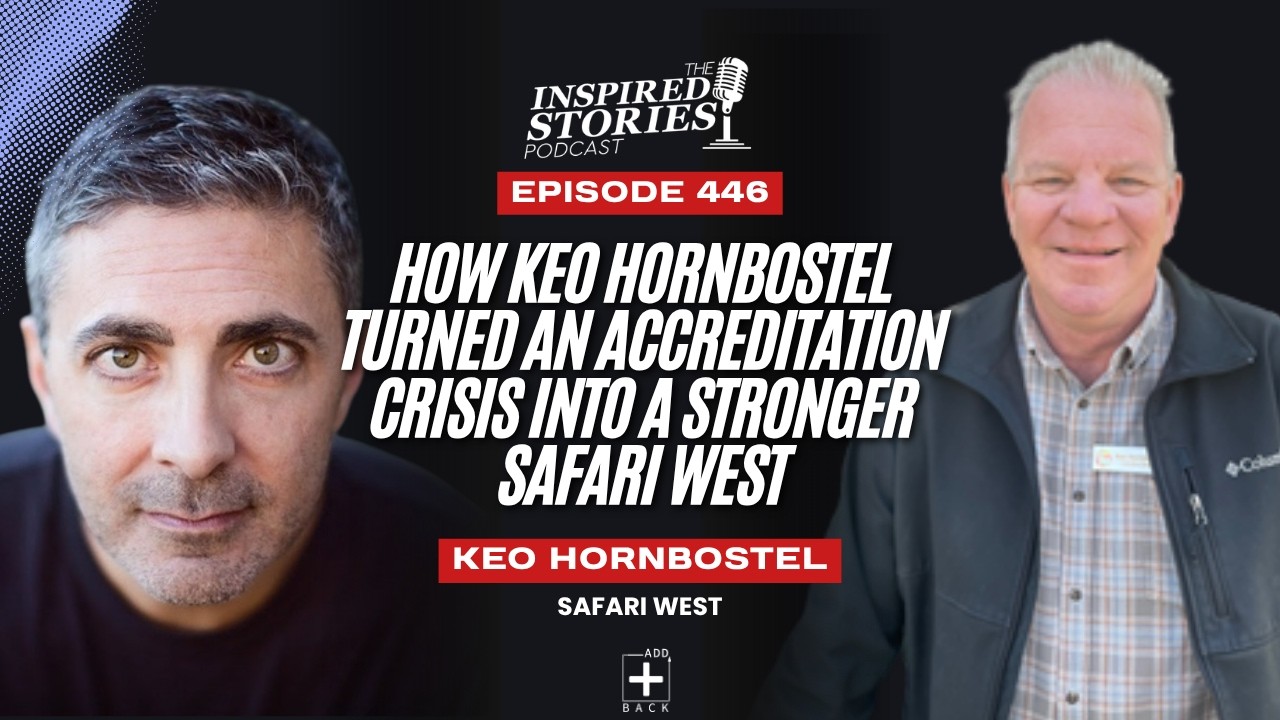
Listen to the full episode here
Transcript
Anthony Codispoti (00:00)
Welcome to another edition of the inspired stories podcast, where leaders share their experiences so we can learn from their successes and be inspired by how they've overcome adversity. As you listen today, let one idea shape what you do next. My name is Anthony Cotaspodi, and today's guest walked away from one of the most prestigious hotel brands in the world to run a wildlife preserve
where giraffes wander past your tent at sunrise. He had spent 30 years mastering the art of five-star hospitality across Puerto Rico and Maui, and by any measure, he had made it. Then Safari West called and everything changed. What followed was not a smooth transition. There were animals to learn, a conservation mission to absorb, and eventually a very public challenge to the organization's accreditation.
that forced him to lead transparently through real uncertainty. He chose openness over spin and the organization came out stronger. His name is Kao Hornbostel and he is the general manager of Safari West, a 400 acre wildlife preserve and resort in the heart of Sonoma wine country. Under his leadership, Safari West has grown to nearly 1,000 animals, draws 70,000 visitors a year,
and has become one of the most unexpected travel destinations in California. Cale also chairs the Sonoma County Tourism Board and is a leading voice for accessible travel across the region. His story is a reminder that the most interesting second acts rarely look like anything you planned for. But before we get into all that good stuff, today's episode is brought to you by my company, Ad Back Benefits Agency.
Listen, if you run a business, you're likely stuck in the cycle of rising insurance premiums. You're paying more, but your team is getting less. And many people can't afford coverage at all. We do things differently. We provide your hospitality employees with unlimited access to doctors, therapists, and prescriptions that's always free for them to use. Here's the part that surprises most people though. Unlike every other employee benefit out there, our program puts more money into your company's bank account.
As an example, we recently helped a client increase net profits by $900 per employee per year. Results vary, but gains like that can change how a business is valued. And the consultation is free. So see if you qualify today at addbackbenefits.com. All right, back to our guest today, the executive director of Safari West, K.O. Harmbostel. Thanks for making the time to share your story today.
Keo Hornbostel (02:43)
Thanks for having me on. look forward to it.
Anthony Codispoti (02:46)
So, Keo, you spent nearly 30 years inside the Hyatt system, Puerto Rico, Maui, running some of the brand's most celebrated resort properties. What was it about that career that kept you there so long? What did you love about it?
Keo Hornbostel (03:01)
Well, number one, like hospitality. ⁓ And number two, I like to travel. ⁓ And in the Hyatt world, the hotel world, promotions come with moving and seeing different experiences, different marketplaces, different, just different cultures. You learn so much as you go along the way. And I was just very fortunate to continue to say I was very open. Move me when you're opening a new hotel, send me, I'll go.
which was great when I was single, a little bit more complicated when I was married. But we, you know, I got to have a lot of fun. I met my wife and Grant came in at the Hyatt there. So just all sorts of cool destinations from Chicago to Denver to Kentucky. You mentioned Maui and Kauai and it's been a fun run. It was a fun run. I, it was tough to leave, but it was a good run and I got to see and live in a lot of great places.
Anthony Codispoti (03:58)
And so you said you met your wife at one of these locations. Was she working there? Was she a guest?
Keo Hornbostel (04:02)
She was, she's actually from Ireland and ⁓ we hired seasonal employees from Ireland. They would, the high season in Grand Cayman was the low season in Ireland. And basically it was winter in Ireland and summer, you know, anybody likes to go to the Caribbean during the middle of this winter. So, ⁓ so she came down as a seasonal employee. We both ended up staying there for three years and I asked her to marry me on the beach in Grand Cayman. Yeah.
Anthony Codispoti (04:28)
That's fun. ⁓
Any particular mentors for you during the time with Hyatt that you want to call back to?
Keo Hornbostel (04:36)
there's a lot of them. I don't want to name off because I'm afraid I would miss somebody along the way. ⁓ I remember my very first interview was downtown Denver and I was applying for a front desk clerk job. And so the front office manager interviewed me a couple of times. I think it was like my fourth or fifth interview, believe it or not, just to be a front desk clerk. And sits me down in what rooms executive is the title that oversees all the rooms areas.
These two were arguing and I'm not talking at all. And I finally looked at him and I said, which one is going to get me to management quicker? Because the rooms exec wanted me to be a doorman and the front office guy wanted me to front office guy. And I ended up becoming a front office guy. And I think the rooms exec wasn't really happy, but I ended up having a career out of it.
Anthony Codispoti (05:23)
So there
was an assertiveness to you from a young age, right? You're like, hey, listen, what's going to be best for my career here?
Keo Hornbostel (05:28)
Very
Yeah, when you looked at what front desk clerks made back in those days, it's a far cry from what minimum wage is today. So it was, how do you make more money in life? How do you become a leader? You I went to a military school, so it was all about becoming a leader and I ended up becoming a battalion commander when I was in military school. So my objectives for my whole life is always, how do I get to the top and be successful?
Anthony Codispoti (05:57)
How did you go from military to hospitality?
Keo Hornbostel (06:01)
⁓ I, well, I went to a military high school. I wasn't the best behaved child in high school. And so my parents thought military school would be a good change for me. And it a hundred percent was. ⁓ and then I ended up going to college to start a pre-med degree, ended up with a biology degree and a minor in math. And that was the days when HMOs were coming out and HMOs are good and they're bad. And I got scared away from the medical field at that time and needed a job. And I.
walked into a hotel and never looked back.
Anthony Codispoti (06:33)
All right. OK, so how did the opportunity to join Safari West come?
Keo Hornbostel (06:39)
So the public relations manager that we have here, Aphrodite, wonderful lady, she and I sat on a couple of different boards when I was working at the Hyatt here. And the Langs were getting up there in age and needed somebody to take over operations for them. And she threw my name in the hat and I interviewed with Peter and Nancy and they ended up hiring me and here we are almost 11 years later.
Anthony Codispoti (07:05)
Okay, but why make this change? mean, yes, it's kind of still hospitality. You're still entertaining people, you know, creating these experiences for them, but you don't have a background in animals and wildlife.
Keo Hornbostel (07:20)
So a couple of key points in there. One, one of the reasons why was I was ⁓ literally on my way to work at the height in Calgary and it would have been my son's fourth move and he was only five. And my wife and I were like, we need to slow down a little bit. And so we said, let's see if we can stay here and make a career out of it. And so that was how the transition happened from that perspective.
The transition to running Safari West versus a mega resort like the ones in Maui and Kauai and Puerto Rico isn't all that different. Yes, we have a thousand animals, ⁓ but managing people and managing things is, you don't have to know everything. I use the example of, I'm not a veterinarian, but we have two veterinarians on staff. If I can manage them to manage what they do best and keep them going in the right direction.
then the animals are taken care of. And then we've got all the animal caretakers that some of them are just people who love animals and started working here and they become animal keepers. ⁓ And then there's other areas of the place that are similar to resorts. We have front desk people, have housekeeping, we have restaurants, we have culinary teams. ⁓ You have maintenance workers, you have landscapers. All those same things exist both at Safari West and in the resorts.
So it wasn't that tough of a transition. There's still a lot of birds names that I don't know, but we've got like 98 different species. I know a lot of them now, on day one, I didn't know very many. Maybe giraffe and rhino and zebra were about it.
Anthony Codispoti (08:59)
So there's a lot more similarities between the work you were doing before and the work at Safari West. And their skills of being able to manage the staff and manage the people, give them the tools and resources they need to be successful, we're all very similar.
Keo Hornbostel (09:14)
100%. That's exactly true. And I'm a firm believer, my management style is one very, very much give people the opportunity and let them run with it. ⁓ And if they make a mistake and fall down, which employees do, that's going to happen. You just help them think of a different way to do whatever tasks they were doing and guide them. that happens in a lot of businesses, not just hospitality businesses. It happens all across the... ⁓
Everybody, we're human, people make mistakes. You just have to lift people up and guide them in a new direction so that they become successful.
Anthony Codispoti (09:51)
So there were a lot more similarities than what I was thinking, but what was one unique aspect that was something you had to learn coming in?
Keo Hornbostel (09:59)
⁓ I think the regulations was a big portion of it. ⁓ to run a hotel, need maybe a half dozen permits, you know, health department for the restaurant or whatever. ⁓ we have 35, 35 different permits to run Safari West. ⁓ three of which are federally regulated. All the rest are at the state or local level. ⁓ I had no idea. I used to think that USDA was oversaw food when I started here.
They oversee so much more than just food. they are, having a USDA license is the key reason we can be open. But it's a process and it's complicated and you have to learn the regulations of what, you know, that goes into animal welfare and how you run the enrichments that you do for the animals. It's pretty complicated. So that was probably the biggest learning curve for me for the first couple of years.
Anthony Codispoti (10:58)
for people from the outside of your universe that don't know what it's like on the inside, what do you think would surprise them the most about the involvement of the USDA?
Keo Hornbostel (11:08)
Well, number one, don't think most people know what USDA does. I certainly didn't. ⁓ Number two is just how, you know, there's a lot of people out there. There's a lot of bad players out there that we hear about in the news ⁓ as it regards to animal welfare and animal care. ⁓ The USDA book is probably a thousand pages long and goes into specifics on just about every species there is and what environment they can be in, what
what you have to do during different times, what kind of feeding you should be doing, ⁓ what kind of diets you should be making. It gets pretty complex and that's okay. It's just something that I had to learn.
Anthony Codispoti (11:49)
Okay. I'm trying to think what order I want to do this in. Let's take a step back and actually talk about what Safari West actually is. Because I think a lot of people, they'll picture something different when they hear wildlife preserve in California. So take me through what's it look like for a guest who's coming.
Keo Hornbostel (12:08)
So Safari West is a, we're multiple things. We're a preserve, we're a zoo, we're an attraction, we're all those things combined. Basically 400 acres, as you said earlier, we have about a thousand different animals. In our lower area, we have 31 tents, so you can spend the night. Then the typical guests, what they're gonna do is go on a three hour tour. And for anybody my age that's watching this, it's not a Gila Gila Island tour, you're gonna actually come back from it.
But you spend about 45 minutes to an hour walking the lower area where you go through a giant aviary where birds are flying around. You'll see our cheetahs, our hyenas, porcupines, different primates. And then you jump in these 1950s power wagons that we've rebuilt, which is your tour truck. And then you go out into the 400 acres and that's where you start to see herds of animals, whether it's herds of giraffe or zebras or wildebeest or Cape buffalo or get to see our rhino and.
We did have a baby rhino this last year, so it's pretty cool. ⁓ But then at the end of the three hours, you can stay for lunch or stay for dinner and then be on your way.
Anthony Codispoti (13:17)
And how is the weather, the climate for these animals?
Keo Hornbostel (13:22)
So, a couple of things there. All the hooged animals that we have are representative from Africa, African species like zebras, like giraffes. ⁓ So they're pretty good, but our giraffes as an example, they don't do good with the cold winter nights in Northern Sonoma County. It's not like winter, it's cool. It gets down in the 30s and 40s. So they're housed into a barn that is pumping in heat.
Same thing with our cheetahs. birds have acts, you know, some of the birds, our birds are representative from all over the world. Some are more susceptible to the cold. So we have night houses for them that are heated. Same thing with all the primates. They have night houses with heating. But then the rest of the year in Sonoma County is, it's beautiful. I mean, we're having really weird weather this week because it's 90 degrees and it's March. I have misters at my restaurant in our deli and they...
kick on, I think, at 90 degrees. I've never seen them kick on like they did yesterday because it was 91 degrees up here. So for that saying, in the heart of summer, if we have a really hot summer, we also do misting machines and spray them down, especially some of the birds, just to cool them off. So you kind of have to go with the flow of the weather.
Anthony Codispoti (14:41)
And so as I'm there as a guest and I'm, you know, taking this three hour tour that I come back from, ⁓ which animals am I going to see kind of roaming more freely where they could actually come right up to the truck?
Keo Hornbostel (14:55)
when I was talking about the hooved animals, every one of them, they could. Our giraffes tend to be a little bit more curious. We do have a rule in the truck that giraffes can pet you, but you can't pet them. ⁓ Some of the older giraffes, they just stay away because they've seen somebody tour trucks come through. But yeah, they'll come pretty close. It's not like you're going to be petting animals all the time, but standing 10, 15, or sitting in a truck 10, 15 feet away from an animal is still pretty cool.
Anthony Codispoti (15:22)
Yeah. And so if I'm staying in one of these tents, ⁓ is there a chance that I'm going to get a visit from one of the hooved animals?
Keo Hornbostel (15:31)
No, you're not. You're gonna be able to see them. ⁓ Again, USDA regulations, you can't be up close and personal with some of these animals, ⁓ but you can see them. About a third of our tents look right out onto what we call our savanna, and that's where animals are roaming freely and doing their thing.
Anthony Codispoti (15:34)
Okay.
⁓ Okay, you mentioned that there are a lot of bad players in the industry, which is why the USDA is involved in the first place. What is it that these folks are doing? And are we talking about zoos? Describe what we mean.
Keo Hornbostel (16:05)
No,
typically not zoos. It's typically private owners. ⁓ People who I'm trying to think of the guy's name that was in the Midwest, the lion guy. Can't remember his name, but you know, he was abusing animals and not taking care of them, not feeding them correctly. You hear about it all over the place where there was animal shelter up here just recently that got shut down because they were getting animals and they weren't feeding them and malnutrition.
fleas and all sorts of bad things were happening to those animals and it's sad when you see something like
Anthony Codispoti (16:42)
And so is just anybody like a random person allowed to own a lion?
Keo Hornbostel (16:47)
No, you have to have the same regulations that I do. ⁓ And most of those players that acquire them, they acquire them illegally ⁓ from bad players throughout the world and poaching and stuff like that. And they'll end up getting them. Somehow they get shipped to their house and they put them in their house. That's not allowed.
Anthony Codispoti (16:56)
Okay.
Got it. Okay. So when you first came into Safari West, what were some of the big changes that you saw you wanted to implement?
Keo Hornbostel (17:19)
⁓ I think a couple of things come to mind. One, I think a lot of the departments worked in what I called silos. ⁓ meaning that one department wouldn't be working with the other one. They would just do what they did regardless of how it affected the outcome of that other department. ⁓ and so that really needed to be, you know, I think any business, but I think, especially in resort worlds and Safari West, I always use the analogy of a symphony.
You you can't just have the percussionist playing whatever he wants to play. You know, the violinist can't play whatever they want to play. It all has to be in harmony. And just like a symphony, you have a conductor. And I kind of look at my role as the conductor to bring all these things together so that people work together and they understand how they affect each other.
Anthony Codispoti (18:07)
Okay. With these animals roaming around, there a fair bit of breeding that takes place?
Keo Hornbostel (18:15)
Very much so. Matter of fact, Safari West started out as a breeding facility. ⁓ Peter Lang, the owner, that was his ⁓ business model, if you will, is to buy, sell, and trade animals. And it was somewhat of a lucrative business for him. It was more of a passion, but it paid his bills, and it paid his electric bill, if you will. ⁓ We continue that today.
We still are a breeding facility and we still buy, and trade animals to other facilities. ⁓ We do some of that for genetics. You know, you don't can't have the same herd breeding the same animals over and over and over and over. is the inbreeding is not a good thing. ⁓ So we ship out animals to other facilities and bring in other animals, whether that's males or females, and control the genetic diversity of our herds. And that helps other facilities control the genetic. ⁓
make up of their facilities.
Anthony Codispoti (19:12)
And when you say facilities, you mean zoos, for the most part.
Keo Hornbostel (19:15)
Zoos, yeah,
anybody that's a zoo or there are some private places that ⁓ we deal with as well. Those are people who are just passionate about animals and they have the land and they get the permits and they can have these animals on their properties. ⁓ We don't deal with some of the facilities that take in animals just for hunting. We don't do any of that, but ⁓ we want to just help different facilities be able to provide to their guests a variety and different animals.
Anthony Codispoti (19:44)
So what are some of the other ways that you're different from a typical zoo?
Keo Hornbostel (19:49)
So I talked about the breeding and I think that's probably the biggest area. know, most zoo facilities when you go, you're going to see, let's say two zebras in the same habitat. ⁓ they are probably both male or both female. So there is no breeding there. ⁓ and there's a phrase out there that, you know, captivity till death. And that's kind of what that is in some facilities because they'll get a zebra that's, I don't know, three years old and ⁓ then at 20 something years old, it's going to pass away and they're going to have to get another one. ⁓
We believe in breeding and procreating and having diversity with our herds and our animals.
Anthony Codispoti (20:26)
And it strikes me that in your environment, it's probably a lot healthier for most of the animals. They've got more space to roam. It's kind of little bit more of a natural environment for them.
Keo Hornbostel (20:36)
Yeah, if you look, when you're on the property, if you've ever been to Africa, it's not a desert up here, but it is not all of Africa is desert. And I think that's a misconception by a lot of people. There are beautiful mountainsides and tree regions and all sorts of things in Africa that is very representative of here.
Anthony Codispoti (20:56)
You know, I had the opportunity to do a safari in Africa several years ago, and I was interested in going. I think I was really surprised at how awesome it actually ended up being because I had been to so many zoos before it was going to see the same kinds of animals. But I discounted the difference in seeing them in a natural habitat instead of just
behind a cage and it strikes me that that's what your environment is like.
Keo Hornbostel (21:29)
Very much so, yeah. mean, these ant, our herds, you know, it is not uncommon to be on tour and all of a sudden you'll see our 12, 12 or 13, don't remember, have wildebeest on a dead run running someplace, just because that's what they do, you know? And we have the space provided for them to be able to do that.
Anthony Codispoti (21:49)
Yeah, it's incredible. ⁓ For people who are listening, they're like, ⁓ zoo, you know, reserve, you know, Safari West, like, what's the difference? It really is. It's a difference. And it's hard to put into words why until you actually get a chance to experience it. There's just something thrilling about getting so close to the animals in a more natural environment.
Keo Hornbostel (22:11)
Well, and think the other thing, one of the big differences between a zoo and us as well is that we have trained professional tour guides, some of whom are both trained by us and they go to Africa and get their credentials. Where in a zoo you walk around and you see the animal and then you look at a placard that says, this is what the animal is, this is where it's from, that sort of thing. There's nobody talking to you about it. you know, especially the kids, they have unbelievable amount of questions they want to ask.
I know from my own son, when I took him to a zoo years and years and years ago, while he is a good reader, he got bored with reading the signs. He wanted to ask questions. And here, that's the big difference is that you go out on a truck with 12 people and the tour guide, and you can ask whatever ridiculous question you want to about an animal. You know, why do zebras have stripes? Why do hyenas have stripes? Why is this animal red and this one's beige and this one's white? You can ask those kinds of questions that you don't get at a typical zoo.
And kids are the best. They have the best questions.
Anthony Codispoti (23:14)
Tell me some of the good ones you remember.
Keo Hornbostel (23:16)
I just named off a couple of those. ⁓ There's so many kids stories. think people ask me what one of the best things about working here is, and I always tell them the same thing. It's watching the kids. ⁓ Because it's so different and so unique, I always say that there's the old phrase, a deer in a headlights scenario, where the deer looks at you and his eyes are bright, wide open. A lot of kids that come here, that's what they do.
And you see them on a tour truck or walking up to a flock of flamingos, it's 100 individuals big, and their eyes just light up and they're like, mom, dad. And that's what makes this real, it makes it fun. And then every now and then you see an adult do the same thing and that's kind of.
Anthony Codispoti (24:04)
⁓ Do you find that Safari West is competing with the wineries for the same visitor tourism dollars or are people coming and maybe doing both things?
Keo Hornbostel (24:16)
I think there's a combination. ⁓ Napa and Sonoma, between the two of them, probably have a thousand wineries. All of them are unique unto themselves, ⁓ but still you're going wine tasting. Not everybody can say they're going on a safari, and that's fairly unique to us. There's only about four or five facilities across the United States that are similar to us. ⁓ So we're competing in the sense that if you're going to Napa and you're doing wine tasting, it's not inexpensive.
⁓ and you come to visit us, we're not inexpensive. So people who have discretionary dollars are definitely making a choice on what they want to do. ⁓ The niche that we try to find is say, great, come see us in the morning and then go wine tasting at one of your favorite wineries in the afternoon. A lot of, I was one of them, novice people to wine country and experiencing wine tasting. You know, when we first got here, we'd take a Sunday and we'd go to three different wineries. That was a mistake.
⁓ going to one winery is great. And then, but you've got to fill up the rest of your day. And if you're flying in or driving in, you don't want to sit in your hotel. Maybe you do, but most people don't want to sit by a pool all afternoon. And so come visit us for three hours. That's kind of the niche that we're looking for. And that's kind of how we position our marketing and our, we talk about. ⁓ we're in the heart of wine country. There's no doubt about that. We live in the Calistoga mountains. The Napa border is about.
two miles east of us and we're sitting in Sonoma. So there is competition. I just don't think it's as direct.
Anthony Codispoti (25:54)
Makes a lot of sense. Let's talk about KO, you know, a big challenge that we mentioned that, you know, we mentioned this in the intro that took place because Safari West went through a public moment when the Association of Zoos and Aquariums denied accreditation. This is the organization that sets the standards for animal care and conservation across the country. That denial was pretty shocking and it had to be, you know, devastating, I imagine.
Take me back to the moment where you got that news. What was your first instinct about how to handle it?
Keo Hornbostel (26:30)
⁓ well, yes, it was shocking and it was devastating. ⁓ I think the very first thing in my mind was obviously what do we do next? and in the, in the hours that after that, became very apparent, you know, Spartan West has been around for a little over 30 years in this community and Sonoma, know, Sonoma County has 500,000 residents. we're, we're very well known. think we have a very good reputation.
And we needed to get ahead of the AZA's press release. ⁓ They provided it to us at the time that they denied our accreditation. ⁓ And it was not a very favorable press release by any means. So we had to come out and be very transparent about what we were doing, what we were fixing, talking out loud to people, not hiding behind it. I believe that our reputation needed to have transparency. ⁓
The community needed to know what it meant. You know, there's, there's a lot of misunderstanding about the word accreditation. If you're a school and you lose your accreditation, you have to close accreditation for us is a, is a badge of honor, if you will, ⁓ and how you treat your animals. It affects, it does not affect our daily work in any way. ⁓ we are so regulated by USDA that I talked about earlier. ⁓ AZA just kind of reinforces all those things.
And so we wanted to get out and talk about how we do it. One of the biggest things was veterinarian care. We had four or five different vets that we used on a regular basis, but we didn't have one on staff. AZA felt we needed one on staff. Well, now I've got two on staff. And then very shortly after we went after accreditation with another facility or another organization called ZAA. And within a few months we were accredited by them. Their animal wellness standards are identical to each other.
So from an animal welfare and an animal care standpoint, we had to talk about that and get that message out that our animals are getting some of the best care that you can get. And we wanted to be accredited to prove that to the public and let the public know.
Anthony Codispoti (28:43)
Was there any thought about as this is starting to come out of, I don't know, being defensive and saying, hey, this was undeserved or trying to just stick your head in the sand and ignore it?
Keo Hornbostel (28:58)
No, I do not attack life that way at all. I am not a defensive person. I'm more of an optimist. I look at, I truly look at the glass half full and when presented with an opportunity, you have to go after it and deal with it. If you stick your head in the sand, you're not gonna be in business very long.
Anthony Codispoti (29:21)
that doesn't get any closer to addressing what the issues are. And so aside from bringing ⁓ veterinarians on staff, were there other changes that you made, other opportunities for improvements here that you saw?
Keo Hornbostel (29:24)
Correct.
That was probably the biggest issue that AZA had with us. The other stuff was so minor that it didn't need addressing, to be honest with you. ⁓ We just had to be out in front talking about what we were doing ⁓ because there were a couple of, you know, when you're in the public for one reason or the other, there are some people out there that want to take jabs at you. There are reporters that want to do that. And you, in my opinion, you have to be honest. You have to talk. You have to...
let them hear your side of the story and hopefully they print that whole side of the story and not just what they wanted.
Anthony Codispoti (30:12)
So correct me if I'm wrong, I'm an outsider, I'm hearing this story and I'm thinking, wait, you guys had four vets that you used on a regular basis, but their beef was that you didn't have a vet on staff. To me, that seems like a ridiculous thing to lose an accreditation.
Keo Hornbostel (30:32)
wouldn't use the word ridiculous, but I would say that I disagreed with them. ⁓ We were providing veterinarian care to our animals. that took, if we had to make a phone call, two of them are in Santa Rosa, which is 10, 15 minutes away. A couple of them are a little bit farther removed because they specialize in certain things. ⁓ But it just, there are a lot of...
There are a lot of big, big zoos that have a lot of public funding that can afford massive amounts of things. We are a private business. Bringing on two veterinarians on staff is a very expensive thing to do. And it was a step we had to take. ⁓ But being a private business, that affects us in different ways. Most zoos, we talked a little bit about what's the difference in zoos. Most zoos are publicly funded or nonprofits. Excuse me. ⁓
We are not, we're Peter and Nancy are it. And so you gotta run a business in a smart way that provides the care to the animals that is needed and you gotta watch your expenses. It's just like people running their household. Don't leave the lights on all day if you don't need to, right?
Anthony Codispoti (31:48)
And so how
have you guys been able to grow? How do you attract more visitors?
Keo Hornbostel (31:52)
I think reaching out to, ⁓ one of the things that we've done for a lot of years was, ⁓ we really didn't spend marketing dollars. It was all about public relations and that still is true today. ⁓ it's a little bit easier for a company like us than say any other company, because when we have the birth of a giraffe, reporters want to report on that. Right. So it helps us tell the story. And then we crack, we help those.
the editors and the authors of those and the reporters, we help them craft their story to make it even better than just the birth of a giraffe or a birth of a baby white rhino. It's getting out there and talking to them. I have done more interviews since joining Safari West than I can tell you. But it's all good and it's all positive because we're talking about good things that happen in the world. After 15 years or so, we finally had the birth of a
Southern White Rhino three years ago. We'd been trying for 15 years and never success. All of a sudden, we have success. Now there are other facilities in the country that have had success in the past, but it was the first time Safari West in the harder wine country had success with that. And that's a good, feel good story that reporters want to talk about.
Anthony Codispoti (33:10)
How many giraffes have been born there?
Keo Hornbostel (33:12)
Over 200 in the 30 plus years, yeah.
Anthony Codispoti (33:14)
my gosh.
So that's not a rare event.
Keo Hornbostel (33:19)
No, we've got a very active herd, yes.
Anthony Codispoti (33:23)
Active. It's a good word for it. And so when these animals are born at Safari West, is it sort of completely natural or are the veterinarians getting involved to help ensure that it's a safe birth process or that the animals are getting care?
Keo Hornbostel (33:41)
Each birth is unique unto itself. Since a lot of our animals are in herds and they're out in 400 acres, they could be having a baby at two in the morning. We're not going to know about it. And so almost all the births are natural. There are times when our veterinarian staff has to step in and help because something goes awry. A few years ago, we had a giraffe born that needed a lot of almost...
extensive, almost intensive care type care for the first couple of weeks. So we had staff sitting with that baby giraffe for 24 hours a day for about two weeks, getting it bottle fed. It was too anemic to be able to milk from mom. You know, there was a lot of lot that went into that. And we actually called in experts in giraffes to come help from veterinarians that would help our veterinarians. Um, but each birth is unique and almost all of them are natural, very
We try not to intervene very much at all.
Anthony Codispoti (34:43)
And so, especially with these larger herds, there are many times where they're pregnant and you don't know.
Keo Hornbostel (34:50)
Our animal keepers know that they're pregnant. You know, it's just like a human. All of a sudden you have a bubble on your stomach, right? So that's very similar with animals. We usually know when they're pregnant. What we don't know is when they're gonna be born. You know, in our human world, know, it's date, October 12th is my due date, right? We talk about that. That doesn't exist in our world. We might be able to narrow the gap to a couple of months, but inside that couple of months, we don't necessarily know.
Anthony Codispoti (35:20)
Talk to us about the work you do chairing the Sonoma County Tourism Board.
Keo Hornbostel (35:26)
I've been involved with the organization for 20 years. I'm currently the board chair. ⁓ We've been about seven years ago, we changed from a typical business model of a tourism bureau, which was ⁓ coined as the destination marketing organization. While it is still that, we actually changed it to destination sustainable. ⁓ Because we were getting a lot of feedback, you know, like every tourist place I've ever been.
The word over tourism sometimes comes into play and we had a reputation that we needed to fix about tourism. Tourism is a huge financial benefit to the county. ⁓ Pays for a lot of general fund money for different, for the county. ⁓ And that general fund pays for police and fire departments and lots of those kinds of things. Without it, the county would be in more financial trouble.
But you have to manage your reputation and perceptions. ⁓ So we started doing things like we joined, ⁓ just recently we just joined Wheel of the World. We had over 70 different venues that ⁓ got accredited, if you will, it's not a true term, ⁓ but by Wheel of the World. And Wheel of the World is an organization that reaches out to or provides a...
a resource for people with disabilities so that when they go someplace, they know exactly what they're getting into. We all know about ADA laws and we all know about ADA lawsuits that take place all the time and that's more punitive than what wheels the world is. ⁓ We want our disabled guests, whatever their disability, whatever level of disability, to know what they're going to get to ⁓ and what it's like to go someplace.
And I think that's amazing thing. Um, and we've got 72 that have already been, been, we're on their website already. Um, and there'll be even more of this next year and just opening the door. There's some astronomical number. don't remember what the percentages of people that travel with disabilities. it's, it was a shocking number to me how high it is. you know, a disability can be anything from needing to use a walker to needing to use a cane to having a prosthetic leg to being bound to a wheelchair.
not being able to stand for a long time, visually impaired, know, the list just goes on and on and on. And so this helps people with disabilities know what they're getting into when they come to Sonoma County and they want to come to Safari West or stay at a particular hotel or go to a particular winery.
Anthony Codispoti (38:05)
So Wheels
of the World is an organization, a website that I can go to and I can say, oh, I'm gonna be in Sonoma, I'm gonna go to Safari West. What is going to be accessible to me? Where might I not be able to go? Just so I can plan in advance. Am I understanding that right?
Keo Hornbostel (38:23)
Yes,
exactly. ⁓ know, ADA laws put very strict things that companies have to do. And I think of one of them is there's a bed height requirement. ⁓ But that requirement doesn't fit all. We had a gentleman here two, three months ago that the bed was too high for him to get into. Even though we were ADA compliant, he couldn't get into the bed.
We fixed it, we took the box spring out and lowered it down and did all these things and he had a great stay. But had he gone on to Wheel of the World, we'd been on at that time, he would have known exactly what our bed height was and he could have asked the question, can it be lowered? That's a great thing for that person. And that's just one example probably of thousands that Wheel of the World has done for these people.
Anthony Codispoti (39:14)
I have to imagine if you have a disability, know that you have difficulty getting around, but you still want to get out and see the world. There's a stress involved where I'm going to a new place. I don't know what it's going to be like for me. And to know that in advance and to be able to communicate, right, like you said, and ask that question. Well, it helps Safari West too, right? You guys, okay, hey, we've got to fix for that. We can plan in advance. We'll take care of you. Well, now that puts that person's mind at ease. Great. I can go. can have fun. ⁓
I'm going to have a bet I can get into, et cetera.
Keo Hornbostel (39:46)
Yeah, I look at my own personal life. My mom lost her lower part of her leg 20 years before she passed away and she wore a prosthetic. ⁓ Obviously the house got modified so she could take a bath and do different things. But one of her passions was to travel. Matter of fact, in her younger years, she was a stewardess for Pan American Airlines, which doesn't exist anymore. So only those people who have been around for a while will know that name.
You know, for her to travel was difficult and trying to navigate not only a destination she wanted to go to or a hotel she wanted to stay, you know, how far down the hallway does she have to walk before she could get to her room? Because that makes a difference. And so I think Will the World and what they're doing is making it possible for people like her to know what they're getting into and make arrangements in advance to make it a successful trip.
Anthony Codispoti (40:42)
So as you look out five or 10 years, where do you think Safari West goes from here to?
Keo Hornbostel (40:48)
So we've just announced a couple of weeks ago that we are transitioning from a for-profit business to a nonprofit business. We have our nonprofit status with the state of California. It's the Safari West Zoological Society. We're in the process of filing for our federal ⁓ 501c3 status so people can donate and get a tax write-off. Transition's going to take a little bit this year, but we're in the process of
developing what our capital campaign will be with the new board of directors and So in five to ten years, I want to see all that stuff happen, you know We want to build a vet clinic and that cost millions of dollars We want to we need an L another animal welfare building We we have a number of things that we're gonna put on this capital campaign and I would love to see it come to fruition whether that's ten years. I hope it's not ten years I hope it's more like a three to five year plan But you just never know in that in the nonprofit world how it's gonna work
Anthony Codispoti (41:45)
And so what's really driving this decision? Is it just a different ability to find funding sources that allow you to expand what it is that you're doing, care for more animals?
Keo Hornbostel (41:54)
I think it's a combination of that, but I think the biggest driving force behind this is both Peter and Nancy are at a retirement age. they, ⁓ this will enable Safari West to continue into perpetuity, if you will, and keep what they developed and they built here going on for potentially generations. And they can, their stamp of what they did and what they made will continue on for a very, very long time.
And I think that's probably the biggest driving force behind it. is the money, change of money creates a different thing, you know, becoming a nonprofit versus having to be private funding for building things. ⁓ But I think carrying on their reputation for the next 30, 60, whatever years is really the driving force behind it.
Anthony Codispoti (42:45)
You're still early in the process, but anything about what you've gone through so far that's really surprised you in this transition?
Keo Hornbostel (42:53)
You know, I've been involved with nonprofits as a board member for probably 30 years. So not really. ⁓ A little bit more cumbersome from a legal standpoint, having to deal with so many different documents, but nothing has been earth shattering. Let's put it that way.
Anthony Codispoti (43:10)
Kale, we talked about one difficulty you dealt with there at Safari West and the accreditation issue. What's another serious professional challenge that you've had to work through in the past and what did you learn going through?
Keo Hornbostel (43:25)
So I think that probably the most, I guess I would call it devastating day of my career ⁓ was going through COVID. We had to lay off probably 80 % of our staff with the virtual unknown of how is the world going to change? What's the world going to look like two, three, six months a year from that? I have never liked terminating any employee. ⁓ It's just a part of being a manager that you have to do that.
in the business environment. ⁓ But having to lay off over 100 employees in one morning was not a fun day. ⁓
Went home, cried, got up the next day and said, how are we going to manage COVID? And like so many businesses, we ended up coming out of it and got to hire all those people back, or a couple, because they went on to different ideas and different careers. literally that day was horrible. I went home, slept on it, said the next morning, we're going to fix it. We're coming back. And we went through a lot of steps to make Safari West a COVID safe facility, if you will.
Um, and that we kind of benefited a little bit from that because we're an outdoor activity, you know, but we did all the stuff. put up plexiglass, we did the spacing, we everything that everybody did. One of the funny stories in that was that I had heard that, you know, you needed more hand sanitizers. We have like 10 that are scattered throughout the lower area down here. So I bought 50 more.
Only like two were used, you know, but you didn't know back in those days, but I guess similar to my whole life. You run into something, you wake up the next morning and you go fix it. Go figure out a way to make it work, whether that's personal or professional or whatever it is. I'm one of those people that just says, let's go fix it. And that's what we started doing the next day.
Anthony Codispoti (45:20)
Yeah, for listeners who have never been in a position where you had to let somebody go. It is probably one of the most difficult things that you experience as a human being like the closest thing might be like if you, you know, had to break up with somebody, you know, you were in a serious relationship with. ⁓ But you know, there's something about this that feels worse because you're affecting their livelihood, right? And there's nothing that you know, especially in the case of COVID, there was nothing that these people did.
to warrant this. was just the enormity of the entire situation. So for you to not, for you to have to do that 100 times in a single day, it just, you know, each time I have to, it just tears out a piece of your soul.
Keo Hornbostel (46:02)
⁓ 100%. That was, I don't think I ate that day just because I was so bothered by it. But there was nothing I could do. We couldn't pay them, we were closed. I knew financially, Sonoma County is not an inexpensive place to live. And these folks aren't, they're not living in mansions by any means. And they're sharing bedrooms with a lot of people to be able to afford rent. And all of a sudden I'm not giving them any money to be able to pay rent.
I know what that's going to do to them. unemployment doesn't kick in for at least 10 days. So yeah, that was a hard day. One I'll never forget.
Anthony Codispoti (46:42)
how long before you were able to start bringing them back?
Keo Hornbostel (46:46)
⁓ we had to bring them back in phases, ⁓ primarily because we kind of opened in phases. ⁓ I would say the worst case scenario was almost a year before I brought the last employee back. Yeah. It was, it was a not, it was a position that was non, I don't want to say, I can't think of a better term to say, but it was, it was non-vital to running the operation on a daily basis. ⁓ it was kind of more of a feel good position for Safari West.
And it definitely benefits Safari West, it wasn't during those times, you only brought back essential employees. And, you know, if I needed a tour guide, I'm bringing them back. before, when we finally opened the restaurant, okay, now I got to bring back my cooks. got to bring back my servers, dishwashers, maintenance. We kept, we kept most of our maintenance guys around because you can't have fences falling down when you've got lots of wild animals.
But yeah, was a phased approach. would say within three months of reopening, took it. So was probably four or five months before we had a good share of them back.
Anthony Codispoti (47:54)
So we talked about how difficult that day was, letting all those folks go. Obviously, very difficult for those folks to receive the news. You go home, you cry. Was there any sense of just, again, I know the answer to this question, but I have to ask it because this is human nature for so many folks. Was there any thought of, I'm just going to stay in bed today. I'm going to pull the covers up over my head, and I am just going to sit here and lick my wounds for a minute because
My guts just been ripped out.
Keo Hornbostel (48:26)
No. Again, I don't operate that way. I've never been one to just say, there's a problem down that doorway. I'm going to go this doorway. Literally, I think it was probably around midnight that night that I finally said, tomorrow we have to go figure out how we're going to open so I can bring them back. I don't know if I can use this word on podcasts, but it sucked that day.
My responsibility as a general manager, executive director, whatever my title was at the time, is to those employees. I have a responsibility to them. And so I have to do whatever I can to bring them back, help them make their month, their rent payment next month.
Anthony Codispoti (49:13)
K.O., in this role, what do you most want to be remembered for?
Keo Hornbostel (49:21)
Whoo, ⁓
Hopefully be recognized or remembered for how I've led the organization through so many ups and downs. We had massive fires in 2017 that we had to deal with. had COVID, we had fires the next two years. We had COVID, ⁓ economic downturns. ⁓ Tourism right now isn't the best in one country. ⁓ But how you lead an organization and manage it through those times, I...
I hope I'm remembered that I did well through all those.
Anthony Codispoti (49:58)
Okay, now I have to ask about your name. The combination is a little unusual, KO, K-E-O, and hornbostle. Tell me about this.
Keo Hornbostel (50:00)
Yes.
So as my dad used to call it, the Reader's Digest version of that, again, aging myself a little bit. ⁓ Reader's Digest version of story is that, believe it not, my blood is half Hawaiian and half Scottish. I think the Scottish shows through, I'm very pale. ⁓ I was adopted at 10 years old. ⁓ And since my blood was half Hawaiian, my parents who adopted me into a German family, thus the last name Hornbostel, ⁓ my dad had lived in the state of Hawaii before it was a state.
And so he thought it was appropriate to give me a Hawaiian name. And since I was only half Hawaiian, much like somebody with the name of Joe or John, that's the only portion of the real name, Joseph or Jonathan, I got Keone, which in the full name is actually, it's longer than that, but that's my version of it. So yeah, it's a little bit of a different story.
Anthony Codispoti (50:57)
Okay.
Well, that's fun. Thanks for sharing that. Okay. I've just got one more question for you today, but before I ask it, I want to do three quick things for the audience. First of all, if you want to learn more about Safari West, this is super easy. Their website could not be easier to remember folks. It's safariwest.com. safariwest.com. Go and learn about it. Learn about the tours, the different excursions, the things that are available to do there. Lots of fun if you're heading to Northern California.
Also, if you're enjoying the show today, please take a moment to subscribe wherever you're listening. It sends a signal that helps others discover our podcast. So thanks for taking a quick moment to do that now. And as a reminder, you can get your park employees access to therapists, doctors, and prescription meds that as paradoxical as it seems, actually increases your company's net profits. Real gains that can change how a business is valued. Contact us today at addbackbenefits.com.
So last question for you, Ken, a year from now, what is one very specific thing that you hope to be celebrated?
Keo Hornbostel (52:03)
I'm gonna go back to the success of the nonprofit being launched this year. ⁓ I think that will do so much for the legacy of Safari West for the long term. It's gonna take a year for it all to really happen. Not necessarily about raising the money, that will come, but it's a successful transition to be able to have people know that we're gonna be around for a very, very long time. And those who are close to us know that Peter basically retired four or five years ago.
⁓ Nancy's getting up in age and she wants to retire. so people around in our neighborhoods know that, but they want to see Safari West continue because they love us in their backyard.
Anthony Codispoti (52:46)
So do you think you're gonna be taking on some of these fundraising roles or are gonna bring in some folks that have expertise in this to assist?
Keo Hornbostel (52:54)
Well,
you just found my biggest weakness. I am not a fundraiser. I do not ask for money well. No, they already have a, the new board is already starting to talk to people about who would become the business development person and who would be out there. I'll run, if they have a fundraiser at Safari West, I'll make sure it's organized to the T and where you have a great party and a great meal and great drinks and whatever else it might be. ⁓ But let's let the true fundraisers go do their thing.
Anthony Codispoti (53:21)
Love it. Kao Harnbostel from Safari West. I want to be the first to thank you for sharing both your time and your story with us today. I really appreciate you being here.
Keo Hornbostel (53:29)
Perfect, thank you for having me. It was fun.
Anthony Codispoti (53:32)
Folks, that's a wrap on another episode of the Inspired Stories podcast. Thanks for learning with us. And if one thing stood out, put that into action today.
Connect with Keo Hornbostel:
Website: safariwest.com