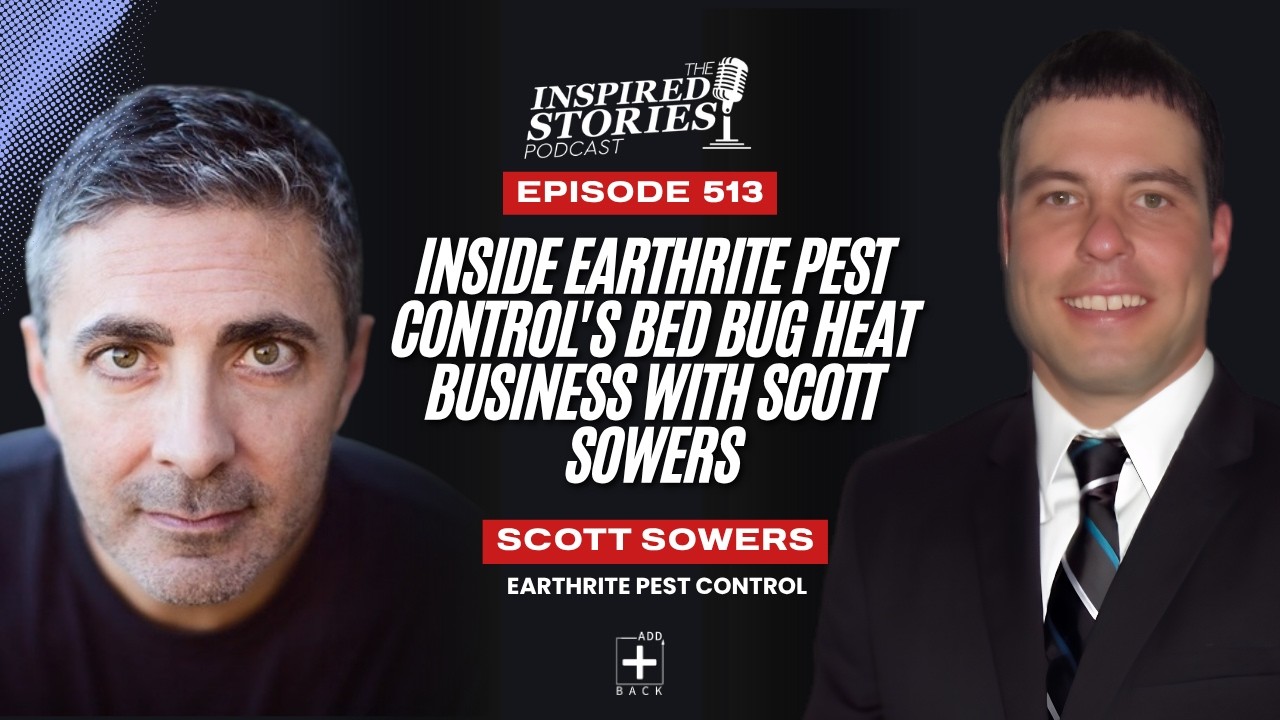
🎙️ Scott Sowers: From Textile Executive to Ohio Pest Control Founder
In this episode, Scott Sowers, founder of Earthrite Pest Control, shares how a tearful conversation with his wife pulled him out of a 16-year global textile career and into building a family-owned, people and pet safe pest control company in central Ohio. He opens up about scrapping his business plan two weeks after launch, building one of the state's top bed bug heat eradication companies, and the letter his eight-year-old wrote at school that changed how he spends his time.
✨ Key Insights You'll Learn:
16 years in textiles before pivoting to pest control
Left a global career after his wife's tearful request
Threw out his business plan two weeks after launch
Built one of Ohio's top bed bug heat eradication companies
People, pet, and plant safe treatment philosophy
Worked seven days a week for over a decade
Daughter's school letter sparked a major life reset
Spent a year and thousands solving one unique infestation
Expanding into Dublin and Polaris for efficiency
Shifting the company to run on data, not gut feel
🌟 Scott's Key Mentors:
His Father: Serial entrepreneur who modeled relentless work ethic
His Wife: Former ICU cardiac nurse who pushed him toward something real
His Uncle: Ran the family's side pest control truck, sparked his interest
His Daughter: Her school letter reshaped how he spends his time
Nationwide Pest Control Peers: Helped him crack one of his toughest cases
👉 A candid look at what it costs to build something from nothing, and what it takes to notice before the cost gets too high.
Listen to the full episode here
Transcript
Anthony Codispoti (00:00)
Welcome to another edition of the Inspired Stories Podcast, where leaders share their experiences so we can learn from their successes and be inspired by how they've overcome adversity. As you listen today, let one idea shape what you do next. My name is Anthony Codus Bodie, and today's guest spent 16 years traveling the world for the textile industry, helping build offices in California and Shanghai, earning a comfortable salary and a title that looked impressive from the outside.
Then his wife came home one Sunday night in tears. He moved back to Ohio, started an eco-friendly pest control company on a business plan he had to throw out two weeks later after launch, and then spent the next decade building something real. He worked seven days a week for over a decade. And the moment that stopped him cold was not a financial crisis or a bad business quarter. It was reading his eight-year-old daughter letter that she had wrote at school.
Scott Sowers is the founder and principal of Earthright Pest Control, a family-owned pest control company serving the central Ohio area with a people, pet, and plant-safe approach. At its peak, Earthrite was among the top three largest bed bug heat eradication companies in the state of Ohio. The company now operates across multiple locations with a team of 11. His story is about what it actually costs to build something from nothing.
And what you do when you finally look up and realize that cost was higher than what you planned for. But before we get into all that good stuff, today's episode is brought to you by my company, Adback Benefits Agency. And you'll want to hear this because it's hurting almost every business you know. Health insurance costs go up every single year, and service companies are furious about it. They're paying more, claims are getting denied, employees are opting out because they can't afford it, and it hurts employee turnover and morale.
It's one of the most maddening problems in running a business, and everyone just accepts it, but you don't have to anymore. Now there's a program that gives employees unlimited access to doctors, therapists, and prescriptions with no co-pays or deductibles to meet. You don't change your broker. And here's the part that really shocks most people. Our product actually increases your net profits. We recently helped a client add $900 per employee per year to their bottom line.
Results vary, but gains like that change how a business is valued. Get your consultation for free today at adbackbenefits.com. All right, back to our guest today, owner and founder of Earthright Pest Control, Scott Sowers. Thanks for making the time to share your story today.
Scott Sowers (02:38)
Absolutely, Anthony, thank you for having me.
Anthony Codispoti (02:41)
So, Scott, your father had a pest control company as part of a larger tree and landscape operation back in the seventies and eighties. What do you remember about watching him build and run all of that? What what what did you learn at a young age from that?
Scott Sowers (02:57)
I was a little guy, so I'm 50 and and so in the eighties, you know, he had fifty employees, sixty employees. I never knew, I just saw a lot of people around, right? And in my later years I I then learned that he had a very formidable business. And and then I used to wonder why he was in this business and that business. Well, he was a serial entrepreneur, and at one point he had over a hundred employees and and he had seven different businesses, and so
I remember, you know, just having a very strong work ethic. And I remember you know, there was this little side thing that he was doing, and it was it was called Bill Sauer's Pest Con or Bill Sauer's Extermination is what it was. He had it on the side of a truck. It was just one truck. And and my uncle ha helped him run that, and I absolutely got along famously with my uncle. And so so maybe that was my calling and why I liked.
the pest control portion so well but really truly his business was tree and landscape they they carved their niche out and doing very large trees and did a lot of you know hardscapes and then as hardscapes became more popular they did a lot of those but i still never got rid of the bug no pun intended for for pest solutions and and so here i am that's what i remembered about it and and i love what i do
Anthony Codispoti (04:26)
So was there any thought when you were a little kid watching your dad, watching your uncle, that you wanted to be an entrepreneur? No. Okay.
Scott Sowers (04:32)
No, no, not a single
one. I just knew that everyone I kinda had, you know, something to prove. You know, everyone always always thought I had a silver spoon in my mouth, but I was always the first to show up and the last to leave because of that. And and so, you know, I I just made sure to kind of keep that work ethic. I haven't been perfect, right, in my life, none of us are, but I've always had a really hard, strong work ethic.
And that's really truly what got me where we're at today. It's not that I'm smarter than anyone else. I can just work harder. And and sometimes you you can puff your chest out and say, I can work harder, but at the end of the day, you really do have to work smarter.
Anthony Codispoti (05:18)
It needs to be a combination of the two. So you spent sixteen years in the textile industry, traveling the world, opening offices in California, Shanghai, had a good title, had a good salary. But then your wife pushed a little bit for you to leave that career. Walk me through that conversation.
Scott Sowers (05:20)
Absolutely.
Yeah,
well, here we go with the with the work ethic ethic, right? So, you know, I anything I I did, you know, I want to be successful at. The the big thing for me was leaving college. I I almost felt this inner
Voice that was telling me, you know, go out there and prove to the world, because I had a chip on my shoulder, you know, no silver spoon here. I had a chip on my shoulder and and said, you know, I need to prove to the world that I can be successful without the umbrella of my father's company. And so that's what I set out on a mission to do, and that's what I did. And then fast forward 16 years later, I come home and and she's sitting there and she's actually asked when is a
Yeah.
I looked at her like she was Medusa, like she had ten heads and jumped in the shower and I was like, Whoa, what a is she crazy? I don't know. And and she's definitely not and and and then I I don't know if it was that night or the next day or whatever, and I said, I think I understood what you're saying. And I hadn't been happy with what I was doing throughout the last five or six years in that industry. However, the money was great and
And I didn't know what to do and I maybe was a little bit fearful. I know I was fearful of of just diving in head first into my own company and got to thinking, what do I want to do? So then I said I I know exactly what I want to do. And and I came up with this plan for Earthright, which I didn't know the name of the company literally until after I started it.
Anthony Codispoti (07:22)
So wait
a minute, but where did the idea come from? Like had you just kept thinking about what you had seen your father and your uncle doing?
Scott Sowers (07:29)
Yeah, so so I I knew that they were successful, right? and they were helping people. So to get to the root of why I started this company, I wanted to do something where I could help people.
it that's kind of like my dopamine hit, you know. I don't drink a lot and I'll do other bad stuff, but I I love to see it like one of the most rewarding things I've ever done is you know volunteer for a cancer patient society when I was in high school. Then another rewarding thing was coaching eight to ten year olds in ice hockey. brings so much joy. And and the a most recent thing that I've done that just really makes me feel amazing is you know when you
can go into someone's house and you can solve their issue and do it safely and effectively that's what makes me feel good. So I was like what what is it that that I can get that feeling from and and do? And and I felt okay well I'm going to start a people pet and plant friendly pest control company and I'm gonna change the lives of the world. At that at that point I said I'm gonna change the lives of the world
And and that's how we're yeah. yeah. And and so we're still trying to do that, right? just on a smaller scale and and we'll we'll do what the market will allow us to do. but I like to push the envelope and really keep it rocking. So I think there's a lot of opportunity yet.
Anthony Codispoti (08:42)
Every entrepreneur's got big eyes, big goals, big ambitions. It's great. Yeah.
So to do this, you decided to move back to Ohio from Cal Colorado. And pretty quickly in those first couple of weeks, you decided you needed to make a big pivot in the business plan. Can you talk a little bit about that?
Scott Sowers (09:11)
Mm-hmm.
Yeah.
Yeah. I was literally sitting at my at my desk. I purposely bought a very uncomfortable chair, a very cheap plastic desk, and a nice computer. And so there I was. I was like, my gosh, have this amazing business plan, but I need clients. So
About two weeks in I ended up throwing that whole business plan out the door and made a shift. And I ended up doing I got into you know, I I wanted to do structural pest control, but just wasn't taking off like as fast as what I wanted. So I ended up getting into the bed bug heat business.
I never really wanted to be in bed bugs. it just, God blessed me with being really amazing at them. And so I was building the structural pest control business, you know, spiders, ants, you know, all the general insects. and then got into some termites, but I was really honed in on the bed bug heat business, and that's really what launched us. you know, we were we were also you the formal name of my company used to be Earthright Pest and Weed Control.
And so we used to do a lot of lawns. we would do
We would do like some commercial vegetation control, things of that nature. I got out of that because there were too many variables within that that were outside of my control with mother nature. And and I enjoyed personally, I just enjoyed structural so much better. And I could have such an impact on people's lives. You know, when you go into a house, for example, when you go into a house and you you can you can kill all of someone's bed bugs in one day.
And you walk away from that and you do it time and time and time and time again. And we've done tens of thousands of these things. So we know that it works. And and that's I mean, I've had people crying. not that I want anyone to cry, but I've had people crying, give me hugs. yes, they they happy tears, they give my my staff hugs. it just, I mean, when you go to sleep at night, you can lay your head on your pillow and say, we changed the lives of someone today.
Anthony Codispoti (11:25)
Happy tears.
Scott Sowers (11:37)
positive way. And that's that's what does it
Anthony Codispoti (11:41)
So Scott, explain for us the heat approach to killing bed bugs, why it works better and what the alternative is.
Scott Sowers (11:50)
Sure.
So so you can kill them chemically, sure. You can kill them with heat, sure. Yeah, absolutely. There's just different timelines associated with each one. So chemically, it's it's one to three months and heat. So a bed bug dies at 113 degrees, its egg dies at 119 degrees within 60 minutes. And so you can go in, and and it's I'm not gonna say that heat's the perfect application for every home or structure, because some of them you want to do chemical, some of them you don't want to do chemical, and you just want to do heat. Heat.
is probably the most widely
It's the most widely utilized for one-day eradication for sure, without question. there are other options like fumigation, but again, that doesn't go along with what we are standing for as being people plant pet friendly as earthrite pest control. you know, heat, you can do it with no chemicals. So at about 140, the bed bugs and their eggs die in one one thousand that quick, literally one second. So so that's what really makes it you know.
know so advantageous especially for folks who just don't mentally want to go through that one to three month waiting period because when you spray it's not like all the bugs are dead immediately. Heat, hot air searches out the bugs and searches out their eggs. So so it just made sense for what we do and it allowed me to continue to build the the structural pest division of my company at the same time. So
Anthony Codispoti (13:24)
And so
structural is like the bugs, the spiders, the ants.
Scott Sowers (13:27)
Businesses,
yeah, homes and businesses. I mean, we treat semi trucks, we treat cars. I mean, you know, it's amazing. You'd never think that ants could be in your car or whatever, but they can, in some cases. it's rare, but that can happen. so we treat all sorts of things, and when you you think you've seen it all, you never have. so something new will come along. So yes, structural is is your spiders, ants, centipedes, millipedes, you know, you've got stinging ants.
Insects,
mosquitoes, you've got so that's around your structure, right? then you've got maybe like hornets, wasps, yellow jackets, they can set up on your structure and they can be really dangerous for folks. And so we take care of those. We take care of termites inside of people's homes and outside of people's homes for that matter, and business structures.
roaches and fleas you know with all the rain that we've had this year ticks ticks is a big one so we're doing tick yard control so you can do it with a granulation and you can also do it with a spray application as well
Anthony Codispoti (14:32)
How do you do that?
My son got a tick at one of the local parks in Grandview, actually a couple years ago. Found it burrowed into the back of his head, pulling it out. It was it was awful. He's got a a giant bug phobia to this day. Could can you do like a large application at at a public park like that? Okay.
Scott Sowers (14:49)
Yeah.
yeah. Yeah, absolutely. Yep.
Yep. And mainly, you know, i not all
Not all public parks are going to you know have ticks. you know, it's just the ones where the you see like maybe like a lot of high weeds, it might be next to like some creeks that just aren't maintained in some areas. and and you know you want to stay away from bodies of water, obviously, when you're you're treating for ticks, even though things that we apply are people plant and pet safe, it doesn't mean they're aquatics rated. So there's a difference there. So typically speaking though, you know, ticks aren't in the water.
They come out of like ditch lines where the high weeds and things like that are, woods lines, any higher grass, like when people don't cut them, the grass around their fence posts, trees, landscape areas around their house. That could be it as well. So those are all areas that we concentrate on with tick control.
Anthony Codispoti (15:55)
So Scott, break it down for me. Earthright Pest Control. What do you guys do? Who do you do it for best?
Scott Sowers (16:02)
Yeah. So we are we are residential and commercial.
we offer programs like annual programs for folks for preventative services. that's our core focus, interior and exterior. so so mostly we're not a big proponent of supplying a lot of interior treatments on folks' homes because I'm not a big proponent of putting chemicals in folks' homes unless it's absolutely needed. the reason for that is because I'm hypersensitive to everything. I don't care if it's organic or not organic.
I'm just hypersensitive to it and there's no reason to put chemicals somewhere where they aren't needed. Now we can keep the chemicals out of people's homes and structures and businesses by treating the exterior on a program type style of a basis. And that's what we really concentrate on.
Anthony Codispoti (16:55)
Because
that's where the pests are originating from in the first place. So if you can get it at the source, maybe if there's a small amount of the insects inside the house, they're gonna naturally die off anyways without having to apply the chemicals.
Scott Sowers (16:59)
Yeah. Yeah, so
Yeah.
Absolutely. Yep. And and so could I make money doing that? Yeah, I could. but I've always been people over money, not money over people. And and so y the biggest thing in business is you have got to do the right thing for the right reason. Otherwise there's this little thing called karma. And I like good karma.
Anthony Codispoti (17:33)
I wonder if you
can think of a time with a particular client where you chose the person over the money, ended up costing you some cash out of pocket. g give us a story, give us an example of that.
Scott Sowers (17:41)
True. Yeah.
Yeah, I mean it it happens you know, more often what you than what you'd like it to. But you you become smarter over time and and can mitigate the risk. one of the biggest ones would be if you go into like a multi-year infestation of any sort.
And you sometimes people can pull on your heartstrings, you know, a little too much to the point to where it's not actually financially right for you to do the job. And so I have donated a job or two here or there. I usually will donate one or two jobs a year, like big ones.
than some of the other ones where you know you can get into a pickle if you tell somebody, hey, I'm gonna solve this issue for you, and I'm gonna give you a price cap. Well then you just stick with it. And because at that point you you've got to be a man of your word or a person of your word, man, woman, I don't care what you are, you've got to be a person of your word.
And so yeah, I mean those things happen, but you just you just keep on grinding and you learn. I have had situations, I'll give you a perfect example actually, because there's so many I didn't really know what which one to go for. I had I had a party of people, it was actually just husband and wife, they lived in a very unique build. and it was
It was like a barn dough. And they had had a bed bug infestation in there. And the entire thing was shiplap. That means tongue and groove wood, all the way up the walls, all the way through the ceiling. It all matched with like a concrete floor.
And it was unique. It looked nice, but it was unique. And they had when they called me, they had bugs in there for I'm gonna say six to eight months and didn't know it because they were hiding behind the tongue and groove.
And I went there and I said, Okay, we're we're you know, we'll we'll go ahead and we'll get all these out of here for you. What I didn't know is how deep they actually were. So I decided and I had a conversation with them. I said, I decided this is what I'm gonna do for you. I have this has not happened to me before where I'm in a barn dough and have yeah.
Anthony Codispoti (20:16)
A barn dough. You you gotta
explain that term real quick.
Scott Sowers (20:19)
So
it's a new thing. so people are building like a home that looks like a barn and inside they have like their garage, right? And then they have maybe like living quarters up above the garage, or if it's large enough, they actually will split it just in half. So it's just a big pole barn essentially. So it's supposedly less expensive to build a pole barn and then build inside of it.
I would imagine that zoning would probably prohibit that in some of the areas, you know, obviously within cities, of course. but but basically that's what these folks. I know, right?
Anthony Codispoti (20:58)
Barndo, folks, go look it up. But let's let's
let's get back to the let's get back to the the pest control situation, what what you decided to do for them.
Scott Sowers (21:05)
So so
so I told them, I said, I'm gonna stick with this until we get this figured out. What they didn't know was what type of insulation was behind the shiplap. So we ended up we ended up figuring that out. And then I just stuck with it because I specifically wanted to learn how.
we needed or what we needed to do to get the bugs out of all that tongue and groove. And so that went on for way longer than I ever anticipated. It's the longest project I had ever worked on. It went on for almost a year.
And and I said, I'm not charging for it because this is just something that, you know, I've treated with shiplap here or there, but never an entire house. Think of it, is going from the floor concrete to the ceiling, like up the wall to the ceiling, right? And then you have your support beams that are also shiplap.
So it was a unique situation. And I had spoke I've got friends in the pest control industry, literally across the nation. I was talking to them at length. And we were coming up with ideas. I'd try it, say it didn't work, didn't work, didn't work. And and so yeah, we ended up developing some methods that that worked for them and and I learned and were a lot smarter for that. And
I believe that they appreciate the relationship as well. they're they were great clients of mine, you know, and they're good cheerleaders of ours, you know, online. but they also knew that they had a very unique situation. I mean, when you take someone like me who's literally done tens of thousands of of bed bug treatments, right, and then you stick them into a situation that's as unique as that particular one is or was, you know, they knew that I knew what I was doing. I mean, the reviews are
They're online to show that, you know, those are all like blood, sweat, and tears are in those reviews. And and and I and I was very open with them. I mean, I had even sent, I thought we were dealing with just a different type of a different strand of a bed bug. I even sent bugs into the OSU extension. didn't tell them the background of anything, but I was like, is is this you know a common bed bug or is this some different strand or what is this thing, right?
Anthony Codispoti (23:30)
'Cause you would do the
treatments and they would still keep coming back. Yeah. So you really took a bath on this financially.
Scott Sowers (23:33)
Yeah. Yeah.
my goodness, yeah. I mean I know they they might have had a couple of thousand dollars into it, I bet ya I had ten or twelve thousand in it. Yeah. But
Anthony Codispoti (23:48)
What
can you tell us about the techniques that you learned from that experience?
Scott Sowers (23:56)
Well they're ob obviously the proprietary, right? but 'cause I I spent a lot of money developing those. but you know I do share.
Anthony Codispoti (24:05)
So these were ideas that you developed that weren't ideas maybe
that came directly from talking with some of your peers in the industry.
Scott Sowers (24:11)
Right,
right. It was a combination of of of things that that we did. and so you know, the last thing that I tried finally worked and it was a combination because you know, I tried heating, I tried spraying, I tried the combination, finally I had the right combination of heat and spray and drilling and dusting and doing a lot of other things that actually got us there. Yeah.
Anthony Codispoti (24:39)
Wow.
Scott Sowers (24:41)
It was my dear lord. Yeah.
Anthony Codispoti (24:41)
Amazing. Who knew it was so complex? I figured you just go to Home Depot and get some spray and you know, boom, boom, boom, you take care. I just saw your eyes get real big. He's like, You're so naive, Anthony.
Scott Sowers (24:52)
Yeah. Yeah.
yeah. So within pest control, I think it was a couple of years ago, there was a study done, I forget where I I where it came from, I'd have to look it up again. it was what insects are the most challenging to treat and bedbugs were the number one rated amongst pest control professionals specifically. Yeah, the other one was wildlife.
Anthony Codispoti (25:18)
Okay.
Do you do wildlife?
Scott Sowers (25:23)
We don't know. We actually so we're all structural pest control. We don't do actual vertebrae wildlife. We do mice and rats, moles and voles, but we don't do vertebrae pests. So like talking like things like squirrels and chipmunks, raccoons, bats, bird control, those sorts of things. I have friends that I will, you know, depending on where the the folks are located, I have different friends in different areas that service different areas that I could that I trust that will do a good
Anthony Codispoti (25:54)
So Scott, you've got two locations now, eleven people. Tell us a little bit more about what the business looks like today and then where you're trying to take it.
Scott Sowers (26:05)
Yeah, so started with one location in Finley. then we moved to another location. Yeah, northwest Ohio.
Anthony Codispoti (26:09)
Just northwest Ohio. Mm-hmm.
Scott Sowers (26:12)
And then started my second unmanned location up at Lakeside Marblehead because we were doing some work up on Putin Bay, Catawba, you know, just general pest control, things like that. And then when I started our division down here in central Ohio, we I I it wasn't really planned. I had lost both of my parents and my wife said, you know, she'd like to be closer to her parents and
I said, well let's let's start another location. We'll we'll move down there. How about that? She said, okay, cool. So we did. And then quickly, yes.
Anthony Codispoti (26:51)
Moved down to Columbus, Central Ohio.
Scott Sowers (26:54)
Yep. And then quickly things be can began to really take off for us. I think it was a combination of us being more mature in the industry, number one, and number two, we had more population that we could deal with and we were also hit it at a time where
I think there were quite a few pests companies that were there were some good ones, but there was also some that were faltering. Everybody knows they got the door knockers, right? Your doors probably been knocked on. The people who are listening to this podcast, their doors have probably been knocked on by these giant door knocking type companies. And and so where we found our niche was being small, family owned, and we have our finger on the pulse of what's going on.
And and so that's what that's what kind of brought us down here and that's where I think you know our success has been with the growth.
Anthony Codispoti (27:53)
You said you had an unmanned location in Northern Ohio up by the lake. What does it mean to have an unmanned location?
Scott Sowers (27:58)
So we had an unmanned location where we kept equipment and then we kept some materials there as well. And so that was just easier for us, like we didn't have to travel all the way back to Finley. And I initially was I was searching like where else did I let me rewind a second.
When I first started the company, the idea that I had was I'm gonna build Earthright Pass Control and we're gonna franchise it. In fact, a lot of people still ask me if it's gonna be franchised or if it is a franchise. And we tell them, No, you know, you're speaking to the owner or else, you know, some one of the the girls are answering the phones, they can s they'll say, Well, the owner's right here, I can go get them if you want. You know, so we're definitely not pr franchised. And now today some people are saying, Are you a real person or are you AI?
But but we so we I I kinda lost my place where I was going with that.
Anthony Codispoti (29:01)
We're talking about the unmanned location. I'm just curious like what that actually looks like, yeah.
Scott Sowers (29:03)
yeah, okay, yes. So so
the the unmanned location, thank you. So we we started that and it was just truly it was so I didn't have to go back and forth to Finley, right? and also having that extra location.
Anthony Codispoti (29:19)
But you would still go back
and forth, it just you didn't have to lug the materials with you, is that the idea?
Scott Sowers (29:23)
Yeah.
Well, and if you run out of material, right, then and you can't possibly carry everything you always need on your truck. So then I had that location where I could keep that since I I have since closed it down because you know, Columbus, Ohio has just taken over. you know, we we've got Dublin and Polaris now that we're working on building and so we've got a lot of other things in the works now, which I'll get to later. I'm sure we'll get to that. But but basically,
We I just needed to run efficiently. We could not possibly drive an hour from Finlay back to back to Port Clinton and then go back and forth just because you might have ran out of, you know, a little bit of spray here or there or whatever the case might be, just knocks your efficiencies down completely. And when I first started my company, I thought my time was free and then I learned it wasn't.
Anthony Codispoti (30:17)
Speaking of time, so I understood it, you know, start anybody who started a new business, they'll they'll just nod along when they hear this. But for the first 10 or 11 years, you're working seven days a week. What do you have to tell yourself during that stretch of time that makes it feel okay to put that kind of time into it?
Scott Sowers (30:28)
Absolutely.
Well, first, you know, when you start out, there's it's not a problem, you know, because like failure is not a lot not an option. The only option is to succeed. And so you do what it takes to succeed. And that came with some trials and tribulations and some hardships and then
As you experience more of that ebb and flow of those trials and tribulations and hardships, and then you have your ups where things is things are actually just really moving, and it's like nothing could be better than you know what we're doing now. Then you you know go down into another valley, and over a while you become a little bit jaded. And then you you realize, my goodness, I have literally stepped away from my friends. I stepped away from the most important thing, my family, my wife, my children.
You know, we had both of my kids came along after I started my business. I have a 10-year-old and an eight-year-old. And and so you know, you hit on something in the in the beginning when you're introducing me, you know, my my eight-year-old wrote a letter and it was all about me, and I wasn't in it. I was
Anthony Codispoti (31:52)
The title of the letter
was all about me and you you weren't there.
Scott Sowers (31:54)
Yeah. Yeah. It was all about
me and I wasn't in it. I broke my heart, went out to my truck, cried for like five minutes. And as a man, right? And I was like, my gosh, what am I doing? So you know, so you go from I'm gonna I'm gonna solve all the world's issues to sitting alone in a parking lot, right? And like lone wolf, you know.
And but I will say through my experience, I do not believe that anyone has gone anywhere and has just been that easy. It however it is your outlook, and you can you can either make life fun or you can make life not fun and make it all seem like a job because I did that at one point, and and
Anthony Codispoti (32:49)
How do you make
it fun, Scott?
Scott Sowers (32:51)
So
it's it's really just like your your energy, you know, how do you how do you for example, if something goes wrong today, you know, am I gonna say, no, something went wrong, or do you take it on the chin, it bounces off, and you keep moving forward. And you say, you know what, God meant that to happen, and we're gonna keep moving forward because that's what we do. And you keep a smile on your face and at the end of like if that happens through the day, all you can say at the end of the day is I finished today really strong.
And so the other part of that is you have to make all of your time that's available to you absolutely intentional.
If you don't do that, then people will not be impacted in the way that you want them to be impacted. And for me, that's positively and joy and happiness. And and I have been guilty of alienating those around me and most important to me because I was too focused on on business. And then when I got home, I thought I needed a break because, well, maybe I was self-entitled. No. No, that I I I'm blessed to be able to come home and and have a wife and children.
I'm blessed to be able to go work and be able to be busy. I'm blessed to have an amazing customer base, an amazing staff. Like my staff is like I wouldn't be anywhere near where I'm at today without my staff. I can't say sing enough praises about them. I mean, even the ones that aren't with me today, you know,
They were like, you know, everybody's bought in and invested in the success of themselves, obviously, and the business. And so you just have to be intent with your time.
Anthony Codispoti (34:36)
So I want to go back to the letter, the you know, all about me, the dot y yep. 'Cause that sounds like this is, you know, one of those like pivotal moments in life. What what kind of changes were you able to make after that experience?
Scott Sowers (34:41)
You're gonna make me cry.
Yes.
After that experience, you know, it was a it was a very short-lived. I'm gonna spend time with my family. I didn't really understand how I was gonna get there. You know, was I gonna alienate my business doing that? was I you know, and and so like I started going that route, and then then of course, you know, you get sucked back into the regular demands of your daily workflow. And so I really had to concentrate on
building stronger standard operating procedures within my company, standard SOPs within my company, and and seeing those through and then empowering the staff so that they could be able to handle those sorts of things. Let me turn my watch on on silent here. I'm so sorry. so empowering people to to
You know, stretch their legs a little bit, because what you'll find is people they can swim in deep water just as well as they can swim in shallow water.
And and so and it makes them feel better too. And what I found is I was really micromanaging everything. And and that's not conducive to a very happy environment for myself or others because you know you're a product of your own environment. And and so if you're putting out that type of energy where you're micromanaging and non-trusting, then that's what you're gonna have as far as a staff. And that's what you're all that's always a world that you're gonna live in. So you have got to have strong SOPs in place, you have to be able to trust people, and then you just need to follow up with people.
people because people like generally speaking are successful just generally speaking. if if they're going
Anthony Codispoti (36:36)
People wanna feel fulfilled with their work. They wanna feel like
they're accomplishing things.
Scott Sowers (36:40)
Well, yeah,
work, life, you know, whatever the case might be for them. And you know, part of that obviously, yeah, it's making the right hires, you know, always become better at hiring. but it's just being respectful of of of you know the situation and having really high situational awareness, truly. and not feeling like, you know, all glum and dim and no, I don't I might be out of energy or I just need to decompress for ten or fifteen minutes with
Before I talk to my wife and my children, you know, no, just get it going. And it's not difficult to do that. I truly believe that human beings, we operate at about 10 or 15% of our actual capacity. Truly. So, you know, if we, I mean, I don't want to mention names out there because, you know, there's people on both sides of the aisle that I think are very successful, but they've mastered the art of time management.
And and being so effective with their time management.
billionaires, you know, who have lots of businesses and they still have these families and spending time with their families and they're able to do all that. And it's not it's not because they were feeling upset about it. It's because they were feeling like they were blessed and they have the opportunity to be able to do all these sorts of things. And you create those opportunities for yourself.
Anthony Codispoti (38:12)
So Scott, you hinted at things to come. What is in the works for Earthrite Pest Control?
Scott Sowers (38:19)
Yeah,
so so we're a scaling business. and and I am and I will always be people over money.
so we might not scale as fast as maybe some other people, some other businesses that might look at things a little bit differently. I enjoy still having a c happy clientele base. we have a very high customer experience, so we grow more methodically, and we're opening up a location in Dublin, it's actually open, and then we're opening up another location in Polaris. and
Anthony Codispoti (38:59)
Now for people that
don't know Central Ohio, these locations cause is your ri you're currently in Grandview?
Scott Sowers (39:06)
So we are currently just right north of Dublin. So it's we're in between Delaware and Marysville. It's a town called Ostrander. We're not in Ostrander proper. We are.
Anthony Codispoti (39:13)
okay. So you're you're further outside the city. So
the new locations that you're opening in Dublin and Polaris, this is just to get closer to the the city core.
Scott Sowers (39:22)
Yeah, yeah, it is. And and those are the areas where we really, you know, it's like where our customer base is right now. And when we operate out of those loc th those locations, it just cuts our efficiency. Like fuel costs are obviously, you know, something that's huge right now. so we're looking at routing efficiencies. We're looking at at because you know, if if you're going from one side of town to the other side of town, then back to the one side of town you started on, that doesn't make very good sense when you're looking at your fuel tank or your time management. So
So we're looking at our routing efficiencies. We're looking at things to just help us be more efficient. And also that in the end of the day, that allows us to remain competitive price-wise with our clientele. So that's why we're opening up the locations that are a lot closer. Or down in Cincinnati, which is clear at the southern, you know, southwest Ohio.
We're not doing that. There's a lot of opportunity here and we can still really I think graduate to the next tier with driving the expit the efficiencies here and expanding here.
Anthony Codispoti (40:36)
That's pretty exciting. Scott, as you think about the work that you're doing, founder of EarthRight, what do you most want to be remembered for?
Scott Sowers (40:49)
boy. that's an interesting question. joyful, happy person, right? and and you know, someone who I I I when I started Earthright, I I said I want the company to be bigger than Scott's hours.
that that has always been my goal from day one. because then I know I have a self-sustaining business. Otherwise I wouldn't be able to go spend time with my family if it's just me and have the type of lifestyle that that you know I want to have. And it's not that I want to be driving Ferro's and all that other stuff. I just want to be able to you know take the time when I want to take the time and spend it with my my loved ones. And and so that's really what I want to be remembered by because I I can tell you up
until that letter that my daughter wrote, most people would have probably been, you know, you picture yourself in a grave, right, or in the in the casket and say, what are people gonna remember me for?
Well, he ran a hell of a business, but we didn't really know him since he started it. He was a great guy, you know. We he's fun to hang out with and things like that. We you know, smart guy, whatever. And but I want people to remember me for for what I've done for others. and if they remember me for Earthrite, that's fine. You know, it doesn't really like that's not my my major factor. I just want them to remember me for what I've done for others.
Anthony Codispoti (42:22)
I like that. Scott, just one more question for you today. But before I ask it, I want to do three quick things for the audience. First of all, if you want to get in touch with Scott and his company, their website's really easy, earthrightpestcontrol.com. Right is spelled R-I-T-E. So earthright pestcontrol.com. We'll have it in the show notes, but again, it's really easy to get to EarthRight R I T E, Earthright Pest Control dot com.
And if you're enjoying the show today, please take a moment to subscribe wherever you're listening. It sends a signal that also helps others discover our show. So thanks for taking a quick moment to do that.
Scott Sowers (43:02)
Yeah, and and you can call our phone number as well. Our office number is six one four nine eight zero four one two three. That's really easy to remember. So six one four nine eight zero four one two three. I love saying the four one two three, it's so fun. Six one four nine eight zero four one two three. yeah, I love it.
Anthony Codispoti (43:17)
Give it to us one more time.
We got to make a little jingle out of that. Also,
as a reminder, you can get your employees access to therapists, doctors, and prescription meds that counterintuitively increases your company's net profits. No co-pays, no deductibles, plus net profit increases that change how your business is valued. You keep your broker, happier employees, stronger bottom line. Reach out to us at backbenefits.com. All right, so last question for you today, Scott. A year from now, what is one very specific thing that you hope to be celebrating?
Scott Sowers (43:55)
Well, I don't hope to be. I know that I'm going to be, right? I will have a vacation. I'm going to have a vacation where I spend it with my family instead of working. I have always worked my vacations. I work from the hotel room or wherever we're at. And and so what I'm gonna be celebrating in one year from now is I have spent
an entire vacation solely focused on them and I'm able to do breakfast and lunch and dinner with them and that's what I'm gonna celebrate because we're making the right moves to make that happen.
Anthony Codispoti (44:36)
What are what is the one biggest move that you need to make between now and then to make that happen?
Scott Sowers (44:43)
empowering our staff. So so we we really changed how we're running the company. we are not running the company based on what's in the checking account. We're running the company based off of actual data now.
So so that is the main driving factor. And we just have so many great, wonderful things that we've done just with the our SOPs and and organization within the company. We're really just right on the verge of of of having all of the alignment and the stars for for that to happen. You know, the other thing that I want is is I will say that I want
This and it and it is going to happen is during our busy times. So we are busy, very busy here in Ohio from say like April 1st. I mean it could be plus or minus two weeks, April 1st right up through Thanksgiving. And and and I I also not just for myself, I want and I'm going to have all of our staff.
be able to take those times with their families just like I can with mine. So that's yeah, it's it's a great goal and it's gonna happen.
Anthony Codispoti (46:00)
Wow, that is a great goal to have.
Scott Sowers from Earthright Pest Control, I want to be the first to thank you for sharing both your time and your story with us today. I really appreciate you being here.
Scott Sowers (46:13)
Thank you, Anthony. Thanks for having me. It's been fun.
Anthony Codispoti (46:16)
Folks, that's a wrap on another episode of the Inspired Stories Podcast. Thanks for learning with us. And if one thing stood out, put that into action today.
🔗 Connect with Scott Sowers:
Website: Earthritepestcontrol.com