Listen to the full episode here
Transcript
Anthony Codispoti (00:00)
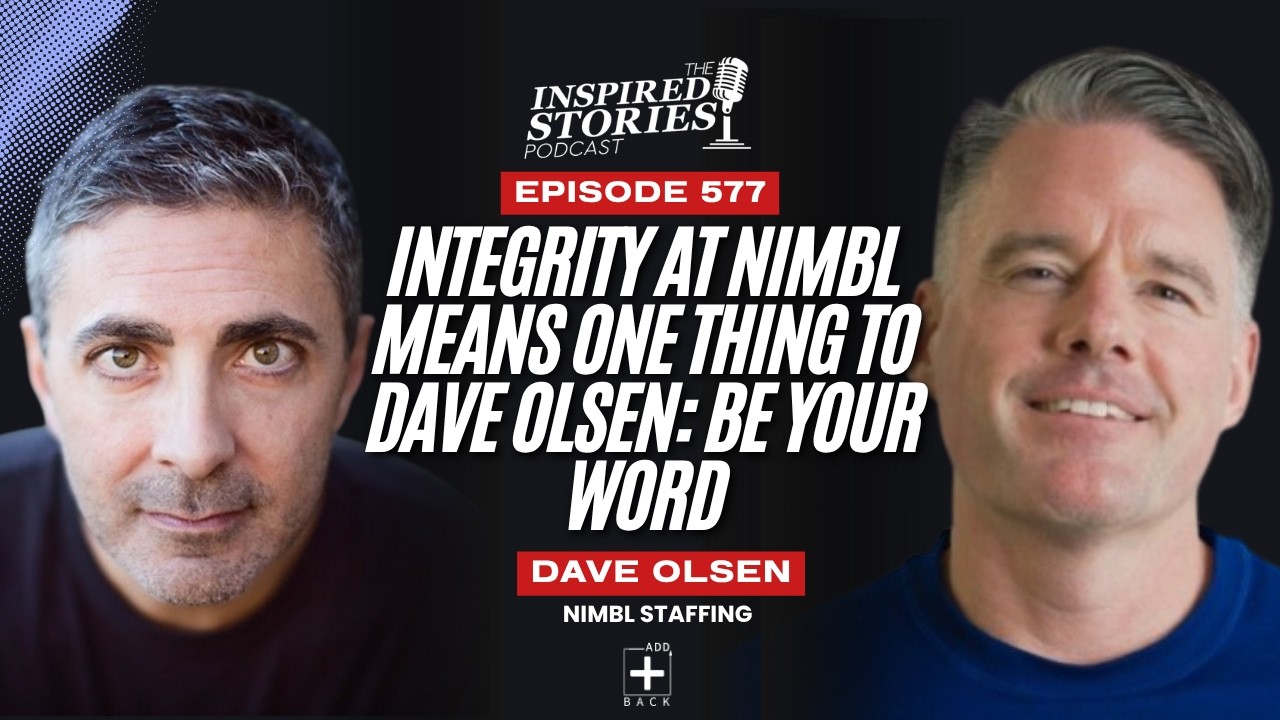
Welcome to another edition of the Inspired Stories Podcast, where leaders share their experiences so we can learn from their successes and be inspired by how they've overcome adversity. As you listen today, let one idea shape what you do next. My name is Anthony Kotus Bodi, and today's guest was hired twice as a full-time CFO, and both times he did the job so efficiently that it stopped needing to be full-time.
Within a few years, he was serving as CFO for several separate companies at once, including a Venture Capital Fund. His fractional CFO work eventually became Venture CFO. And in 2018, he formed a joint venture with a regional accounting firm to provide outsourced accounting services called Tanalytics. In 2019, he bought out that joint venture, merged it with Venture CFO, and rebranded to Nimble.
It's NIMBL NIMBL, for those who are wondering. No E at the end. The new company built its entire model around remote Teams and cloud-based software at a time when most accounting firms still ran on paper and desktop systems. His name is Dave Olson, co-founder and CEO of NIBL, a Salt Lake City-based accounting and back office solutions company that now supports more than 100 team members across the US and the Philippines.
Dave is a CPA who spent two years auditing an Ernst Young before building his fractional service. And today, Nimble also offers offshore staffing and managed IT services through Nimble Staffing and Nimble Tech. But before we get into all that good stuff, today's episode is brought to you by my company, Adback Benefits Agency. And you'll want to hear this because it's hurting almost every business owner you know. See, health insurance costs go up every single year, and businesses are furious about it.
They're
paying more, claims are getting denied, employees are opting out because they can't afford it, and it hurts turnover and morale. It's one of the most maddening problems in running a business, and everyone just seems to accept it. But you don't have to anymore. Now there's a program from Bain Capital Insurance that gives employees unlimited access to doctors, therapists, and prescriptions with no copays or deductibles to meet. And here's the part that really shocks most people.
Unlike every other employee benefit out there, our program increases your net profits. We recently helped a client add, that's add $900 per employee per year to their bottom line. Results vary, but gains like that change how a business is valued. You can be the hero advisor that introduces this to your clients today. They'll be so happy they refer their friends to you. Add backbenefits.com. All right.
Back to our guest today, Dave Olson, CEO, co founder of Nimble. Thanks for making the time to share your story today.
Dave Olsen (02:51)
Yeah, it's great to be here. Thanks, Anthony.
Anthony Codispoti (02:54)
So grew up in a small town where you probably saw a limited set of career options, right? There's an accountant, there's teacher, lawyer, doctor. And you initially started on the accountant track when you went to BYU. What made you switch from accounting into information systems?
Dave Olsen (03:14)
Yeah, I grew up in the nineties and like you mentioned in that small town, my view was limited as to what the possibilities were. I knew I was a nerd and so I thought accounting, engineering, those are two of the leading candidates for where I'd go. I chose accounting and went to BYU because it's one of the top accounting schools in the country and still is. soon after I got there, I discovered technology. The dot-com boom was in full swing at the time. seemed to bypass our small town, but
I got a front row view to it there at BYU and fell in love with technology and programming and that direction. I turned that way. It was in the similar, it in the same school in the Marriott School of Business as accounting, but a whole different major. And I thought I was leaving accounting behind for good and going the technology route.
Anthony Codispoti (04:06)
Yeah, that didn't exactly play out that way, which we'll get to. But what was it that you were seeing at BYU? What was the exposure you got to the what was going on in the dot com space?
Dave Olsen (04:16)
Yeah, I was just had my mind opened up to what was going on in the world as a whole, outside our little bubble of a small town. And just the hype around the internet was the main thing. I'd had exposure to the internet, I knew what it was, but I didn't really have an appreciation for the opportunities it was creating for business, for technology careers, for e-commerce coming up. And it really captured my imagination to get just a...
A quick taste of that early in my time there.
Anthony Codispoti (04:48)
Okay.
So after BYU, you're recruited by Ernst and Young under their IT audit team, which became the bridge back into accounting, right? And and and along the way you decide you you're gonna earn your CPA. So talk to us about this bridge and and how you came back to what you left.
Dave Olsen (05:07)
Yeah, I was really fortunate with the job opportunity I took. It was during the time of the Sarbanes-Oxley, Big Four were hiring like crazy and I had offers from all four of the Big Four. And what drew me to EY is they have a program is if you go into one of their audit practices and you don't have an accounting degree, you can get a master's of accounting while you're working at the same time. And so I went into this program, got my master's in accounting at University of Virginia, rotated into the financial audit department to get my audit hours and
I got my hours from my CPA just about a week before I had the opportunity to jump off as a CFO of a startup company. So the timing was very fortuitous and it drew me back kind of full circle back into accounting.
Anthony Codispoti (05:51)
So you got your degree, which EY helped to pay for, yes. And then this
Dave Olsen (05:55)
Yep.
Anthony Codispoti (05:56)
opportunity to join Aqua Therm in your first CFO role comes up immediately afterwards.
Dave Olsen (06:01)
Yeah. Yeah. I had actually worked for the founder of AquaTherm back in high school when I was, he was an engineer and I was exploring the engineering route and he remembered me. He knew that I, he thought I was going into accounting. didn't, he didn't know that I'd pivoted a little bit, but he called me up and he had started a, startup called AquaTherm and it was taken off. It was only a few months old and it was more than he could handle and he needed help. So it gave me the chance to, to jump into the deep end out of public accounting into, into the startup land.
Anthony Codispoti (06:31)
And as a CFO no less. This wasn't like a junior level finance role. You're like like you said, jumping into the deep end right away.
Dave Olsen (06:38)
Yeah, it was really as a startup covering the full finance function. had the CFO title and the role, but I was the bookkeeper and admin and kind of doing everything to start with until I was able to begin to build a team.
Anthony Codispoti (06:52)
Gotcha. And so was there a point there when you're building the systems out at Aquatherm that you decided maybe a CFO isn't necessarily a full time role for a company of this size, or did this kind of realization come later?
Dave Olsen (07:09)
Yeah, was fairly just a few months in and I put a lot of work into getting systems in place and getting processes. And even though it was fast growing, the actual CFO level role was pretty, pretty limited. I was doing a lot of bookkeeping and if I wanted to continue to justify a full-time position, I would have to take on additional roles, office admin and sales rep and customer service and all these things. And that direction didn't really appeal to me. I really wanted to develop my skills as a CFO.
And so that led me to take on another, to leave AquaTherm and take on another full-time CFO role as well. And in a kind of similar story, a new startup, somebody I'd known for quite a while recruited me to join them. And lot of that similar story played out again within
that company.
Anthony Codispoti (07:55)
This is Kodiak. Is this the next stop?
Dave Olsen (07:57)
That's correct, yeah.
Anthony Codispoti (07:58)
Yeah. And so when you're there, right, you're seeing the same pattern play out again. you are getting pulled into like accounting and bookkeeping and like non-CFO types of tasks, like lower level stuff that's important, but not really at the level of what you want to do.
Dave Olsen (08:17)
Yeah, that was a big part of it. And also we were in the 2007, 2008 housing crisis in the construction industry. so a promising startup with a lot of potential opportunity that was fast growing all of a hit a wall in that time. it was not only, you know, I was able to get systems in place and really streamline it, but the other businesses helped slow down and really could justify the salary of a full-time CFO.
And so when I had a friend of mine looking for CFO level help, he also didn't need full time. It was an opportunity to help him part-time, go down to part-time with Kodiak and still be able to continue to build my career and build my experience at a lower cost for both these companies.
Anthony Codispoti (09:03)
And that other group that you're talking about, this was Renewable Tech Ventures? Hmm.
Dave Olsen (09:07)
I wasn't them quite yet. There was another
one in between. It was more of a shorter term project, but it's really what flipped the light bulb on to see, realize that I could, you know, first I just thought as multiple jobs that I could leverage myself as a CFO of multiple companies. So there was this friend that came along and then Renewable Tech Ventures was the next one with the fund itself and then some of their portfolio companies.
Anthony Codispoti (09:32)
Okay. And at this time w where are we talking about? This is like like you said, this is two thousand eight, two thousand nine. Was the term fractional CFO? Was that a thing that people were using at the time?
Dave Olsen (09:43)
Not that I, I don't know what the terms were. There's some infractional CFO type companies out there, but I really didn't know about them. I thought I was just making it up. I saw the opportunity and thought this makes a lot of sense and kind of ran with it. And it wasn't until actually years later that I really discovered others were doing a similar thing. But yeah, I just thought I was making it up as I went.
Anthony Codispoti (10:07)
And what did that feel like making it up as you went along? And were were the opportunities just falling into your lap? Were you doing some biz dev to try to fill up the funnel? Were you hiring other CFOs, or is this just all Dave providing the service?
Dave Olsen (10:19)
Yeah, it just all me, especially from about 2009 to 2015. It's really just me. A lot of it was the ecosystem of Renewable Tech Ventures. I didn't really have a lot of outside clients, so I wasn't doing necessarily business development. I was really getting to a point where I was maxing out my own time of what I could accomplish. And all these were startup fund, funding, startup companies. so I was basically the whole accounting department for all these companies.
I was doing the CFO work, also the bookkeeping and admin and all that, which led me in that mid 2010s of looking at how do I leverage my time? How do I kind of grow beyond where I am now?
Anthony Codispoti (11:02)
And
so tell me how that unfolded. What was the next idea? Because you're you're doing the full breadth of things, accounting, bookkeeping, CFO work. And so you've got the idea to do what to leverage your time better.
Dave Olsen (11:15)
Yeah, in about actually 2012, I started hearing about offshore teams and started dabbling a little bit. I discovered Upwork and found a small CPA firm based in India and I hired them just hourly to get some of the work done. And it was more of, I saw it as an experiment. Is this a way that I can, you without going all in on building a business, still was kind of early in my vision of what was possible. I was just seeing it as again, multiple jobs and
Could I hire someone in India to just help me get some of the work done? I wasn't thinking about building a business system. But that experience allowed me to, in a kind low cost, low risk way, experiment with building a team and working remotely. And this was really early in the, especially for a small company, early in the remote work, offshore type model. I think I was pretty early in that stage. 2012 was when I started
Anthony Codispoti (12:11)
This was two thousand twelve. Okay.
Dave Olsen (12:14)
with that.
Yeah, so 2012 to 2015, I dabbled a little bit, offloaded some work. And then in 2015, I discovered the Philippines. And I found a job board that allowed me to put out a job description, get hundreds of applications, sort through them, hire people. Sometimes they'd work for a little bit and then ghost me. And so it was a bit of a painful process. I had about three stable people at the time, kind of mid 2015.
and I was looking for more people. And the third person that I'd hired, I asked all my people for referrals for any friends they have to see if I could shortcut that painful process of hiring. And that third person actually had access to an office space and was interested in building a business. So she asked if she could just start hiring people for me. And so that's led to
Anthony Codispoti (13:05)
Wow, you had a nice find.
Dave Olsen (13:07)
a 10 plus year relationship of building up that office in the Philippines.
Anthony Codispoti (13:13)
So I wanna rewind for a moment 'cause back in I think it was two thousand seven, Tim Ferriss wrote The Four Hour Work Week. I don't know if that was a book that you ever came across. This was something that certainly for me and a lot of a lot of other people have popularized this idea of offshore work being accessible to small businesses.
Dave Olsen (13:32)
Yeah, that book was definitely an influence. I don't remember exactly what year I read it, but it was probably in that 2011, 2012 timeframe that sparked that idea.
Anthony Codispoti (13:40)
Okay, so you go through upwork, which was called something else at the time, but I forget. Doesn't
n not important. Yeah.
Dave Olsen (13:46)
Yeah, I don't remember now either, but.
Anthony Codispoti (13:48)
So it's one of these online platforms where, you know, people are available for hire. You can, you know, hire them on an ongoing basis for project work, and you start doing that, but like you pointed out, painful process, right? You get a whole bunch of applications, people aren't qualified, aren't serious. And so you end up finding a few folks in the Philippines.
And one of those ends up being a conduit for you opening up an office and building your own team there. And this is somebody you you still work with today?
Dave Olsen (14:16)
Yeah, yeah, 11 years later, we're still working together.
Anthony Codispoti (14:18)
that's fantastic. And so as that's happening and you're finding a way to take care of some of this lower level work, the you know, a lot of the accounting and the bookkeeping work, how are you or what are you doing on the business development side? How are you getting more clients in?
Dave Olsen (14:34)
Yeah, the catalyst for looking for more people at that time was I had some of the work with renewable tech ventures had slowed down and I got referred to a client that was not part of that network. And it was my really my first foray outside of outside of that ecosystem. I got mid 2015, I got one referral, good sized. And then end of 2015, got another one. And I wasn't doing a lot of intentional outreach and business development. just every few months would get a referral for a big, you know, good sized client.
and onboarding new clients every three or four months. And by 2017, I was more than probably double or maybe even triple the revenue of where I was just mostly solo. And it was the option team that really unlocked that capacity so that I could focus on the CFO work and create a system and processes for delegating the bookkeeping and other admin work to my team in the Philippines.
Anthony Codispoti (15:31)
And when you're talking to a new client and you're explaining to them what your process is, and that, you know, some of the team isn't working in the same physical office as you. They're they're offshore, and that your process is going to be exchanging files through the cloud. You know, this was not that long ago, but still we're talking, you know, eight, nine years ago. What were people's reactions? Were they receptive to it? Were they a little put off by the idea because it was so different?
Dave Olsen (16:01)
Yeah, I was actually afraid they'd be put off a little bit. Like you said, it wasn't that long ago, but it was pretty early in the concept of global remote work, especially for small companies. It's long established in bigger companies, call centers and customer service, but yeah, small company accounting really wasn't being done much that I was aware of. But I had almost no resistance, probably no resistance. I can't remember any objections. Sometimes people would ask,
Like they see a foreign name on an email and ask, you where they're from and I tell them they're in the Philippines and Really usually just ended there some people would ask maybe one follow-up question Like is it you know, it's data secure and I yeah fully trust them. They're great team and we have controls and protocols to keep data secure and Usually ended there had never lost a client never as far as I'm aware Lost a prospect because of the concept
Anthony Codispoti (17:00)
You
know, and I think probably a lot of that comes down to their comfort level with you, right? That's where the relationship is. They trust you, they know you, they like you. If you have set up this system and vouch for the fact that it works and it's secure and the data is locked down, like, okay, let's go.
Dave Olsen (17:16)
Yeah, exactly. Through 2017, I was still the solo face. I handled all the client relationships and all the work was done in the background. My clients really didn't care how their work got done as long as it got done timely with accuracy.
Anthony Codispoti (17:31)
What were some things that you had to learn early on about how to manage an offshore team that was different from working with folks face to face?
Dave Olsen (17:40)
Yeah, I mean, I've been with a CFO practice working virtually more or less for the few years before that. So I was used to communicating asynchronously. was used to a very process oriented, naturally, just how I think. And so even for myself, if I was doing processes for a client, I would document it for myself so that the next month or the next quarter, I wouldn't have to try to remember what I did the last time. So I already had processes. I was already thinking that way.
And so when I plugged in other people, it was a fairly seamless process. think the biggest thing was quality control. I swung too far both ways of micromanaging and taking more time and not letting them free and run and learn and grow. And I also then at times stepped back too much and wasn't watching closely and mistakes were made and I'd have to go and clean things up or work with the client if they were unhappy with a mistake.
But it took some time to figure out the right balance of that delegation. I wouldn't say it's any offshore is much different than delegation remotely or even a person. It's just that the same process of setting up documentation, creating clear agreements, and following up on the work.
Anthony Codispoti (19:04)
Yeah, you still have to delegate. You still have to give them the right level of training. You still don't want to sit on top of their shoulder. All the same kinds of things that you're dealing with, whether you're in person or remote. So at this point,
Dave Olsen (19:16)
Yeah, exactly.
Anthony Codispoti (19:17)
the business is called Venture CFO, is that right? Okay. And then at some point the offshore office grew into its own company, if I understand this correctly, Nimble Staffing. Tell us what this offshoot was doing.
Dave Olsen (19:32)
Yeah, it was around 2017, maybe into 2018, where, again, this was a new concept of having an offshore team and peers of mine in the accounting industry started hearing about that I had infrastructure there. Some of them had dabbled in job boards like I did and were having a poor experience with it. And they asked if I could just hire people for them and let the people sit in our office. And so I did it as a favor for a couple of friends and...
within, I don't know how long it was, but started to realize this actually could be a great business. And so we leaned into that and focused on the accounting industry. peers who, relationships I had, we were already recruiting accounting people, so we could use that same infrastructure, the same process to recruit for other accounting companies as well.
Anthony Codispoti (20:21)
And so what did the model there look like? You're probably charging them an upfront fee to go and find the person and then some kind of an ongoing fee on top of whatever that person's hourly rate is.
Dave Olsen (20:36)
Yeah, exactly. We charge upfront recruiting and onboarding and technology fee. And then we discharge a flat fee ongoing that gives us a markup for the infrastructure and the management. we provide like the cultural liaison and the training of how to work with an offshore team, how to document, just taking some of those learnings that I'd taken several years to learn and kind of shortcut it for our clients.
But for the most part, it's pretty hands off. They become just like a full-time employee. They have full access to their time and they train them on their own systems and oversee their work. And we're just there to provide the infrastructure and support the process.
Anthony Codispoti (21:21)
And so nimble staffing, this services this entity, this offshoot, this arm, whatever the the right term is, this still exists today. People are still
Dave Olsen (21:28)
It does, yeah.
Anthony Codispoti (21:29)
using the service in the same way that you just described.
Dave Olsen (21:32)
Yeah, for a few years, it was more or less a side business, pretty low maintenance. We just, we weren't doing any business development, just word of mouth. And we kind of plug people into the same, plug clients into the same process we had for our main accounting business. About three years ago, we hired a leader and really got attention about growing that business. actually acquired another office last year, and which gave us more capability beyond accounting, call centers and customer service, other.
other admin roles. we've really expanded that part of the business.
Anthony Codispoti (22:04)
Okay, so what's the state of the the staffing arm now? It's accounting, it's call centers, what else did you say?
Dave Olsen (22:10)
Pretty much anything administrative that can be delegated as a back office role. So we have even some IT help desk and developers, marketing, sales, admin, pretty much any back office admin role.
Anthony Codispoti (22:27)
Okay. And then in 2019, you merged Venture CFO and Tanalytics and then rebranded the entire company as Nimble. What was Tanalytics at the time and what did you believe that bringing these two businesses together was the right
Dave Olsen (22:44)
Yeah, so what happened is 2017, I was still solo as it pertains to client relationships and US presence. I just had my offshore team leveraging my time. And I started to realize that it could be an amazing business to provide this full outsource accounting department to other companies. And this was really early in that industry. There was a few others doing it, but really early. So there's an opportunity to really scale. about the time I was exploring, like I said, I hadn't...
really done any business development other than working from referrals. And I started exploring opportunities for partnerships to, how could I expand this? And came across a friend who was a partner in a regional accounting firm and they were exploring launching a service within their firm. And as we got talking, realized that what I had already created is what they envisioned creating. And so we kept venture CFO separate and created a new joint venture called Tanalytics within this firm. And
The systems I created, I just ported over and duplicated for this joint venture. They used their name and their relationships to kind of supercharge the business development. And we grew really fast in the first year, just over a year, year and a half. And what happened was they were kind of a mid-market firm and we were targeting startup to 10 million in revenue roughly. And so there weren't quite the synergies we thought there might be in the client base.
And so I ended up buying out that partnership and bringing on a operating partner and rebranding to Nimble in 2019 to continue to grow from there.
Anthony Codispoti (24:25)
And so are you still targeting sort of that zero to ten million? Is is that why there wasn't the fit like they were ten million and up and that just didn't seem like the right fit for what you guys were offering?
Dave Olsen (24:36)
Yeah, they're more mid-market 10 to 100 million plus. Most of these companies already had their own in-house accounting team. There are outsource providers that supplement internal teams, but we operated best when we are the team. The company is small enough, they don't need a CFO or other full-time accounting staff. so, start up to 10 is usually that sweet spot of what makes sense. It depends on the industry. Construction companies often in the 20 to $30 million range still make sense for.
for our model. But yeah, basically smaller companies who don't need full-time accounting stuff.
Anthony Codispoti (25:15)
So why that friction with the middle market groups? Why do you operate better when you are the team?
Dave Olsen (25:22)
It's just the strategic choice we made. When we are the team, we usually work directly with the owner or senior management. can implement our best practices in our systems and we don't need to plug into an existing system or coordinate with a team. That model can work fine, it's just where we chose not to play.
Anthony Codispoti (25:45)
It seems like there's a lot of benefit in being able to standardize what you do. And it's hard to standardize if you're having to plug into parts of an existing team which is going to be different with every single
Dave Olsen (25:56)
Yeah, you're exactly right. It's more of a consulting model where you go in and adapt to the way the company's doing it. We're kind of in between the, there's the high volume automated bookkeeping services that don't charge very much, but you have to conform exactly to their processes. We're in between where we can provide a level of customization and a white glove service, but we're not, can...
lower prices because we're not fully customized in each project.
Anthony Codispoti (26:30)
So you guys eventually I think you guys are over a hundred employees now.
Dave Olsen (26:34)
We are.
Anthony Codispoti (26:36)
That's a combination of domestic and overseas.
Dave Olsen (26:40)
Yeah, it's roughly half and half, little higher weighted in our Philippines team.
Anthony Codispoti (26:46)
And the folks that are in the US, are they more like Bisdev or what what's the roles here?
Dave Olsen (26:51)
Yeah, BizDev and client facing accounting work primarily. Almost all of our client managers who manage the relationship are in the US and we still have our Philippines team doing most of the bookkeeping and admin work more or less behind the scenes.
Anthony Codispoti (27:10)
What were you guys doing really well that allowed you to grow so quickly during that time? Is it just putting somebody on biz dev for the first time?
Dave Olsen (27:21)
think big part of it was being systematized. Being that's the kind of leaning I have, the brain I have is to, we already had that system and documentation. So I really was intentional from the beginning about standardizing what we're doing to the extent possible and building a leadership team and delegating that. think a lot of it had to do with investing in a structure and a team that could take on the work. A lot of
technicians, especially in the accounting industry, have trouble letting go of the work. And I enjoy the work, but I was more committed to building a system and building a team than I was staying as a technician. I was less concerned about keeping my skills up. So I think that was a big part of how we able to scale.
Anthony Codispoti (28:13)
Well, and as we're going through this story, I think it's pretty clear to the listeners now how you brought these two skill sets together, right? The information systems, the accounting, in a way that was incredibly powerful. And like you couldn't have done it if you didn't have such a a strong foothold in both of these worlds.
Dave Olsen (28:31)
Yeah, and I'd like to say that was strategic and intentional, but it's funny
Anthony Codispoti (28:34)
Ha ha ha.
Dave Olsen (28:35)
how we often look back at our path and look at the fortuitous forks in the road, but yeah, it ended up being a great combination.
Anthony Codispoti (28:44)
So there's a lot of folks listening that are like, wow, going from a small startup that had some success to now over 100 employees. Like, I want to know how to enable that growth in my own company, both from the marketing perspective, like the business development side, but then also in terms of like, how do you manage that hiring? Let's do one at a time. Tell me what it is you think you guys are doing really well on the biz dev side that's allowed for this.
Dave Olsen (29:13)
Yeah, in the services industry, it's common that a lot of growth is driven by referrals and word of mouth. With a high trust type of engagement, it's hard to do digital marketing and gain that trust in a digital, no contact type process. So we put a lot of intention into providing, know, starts with providing a great service for existing clients so that they talk about us, they refer their friends, and then we build high trust.
partnerships as well. So some of our best referral partners are executive coaches, for example. They get to know us, they trust us and our system, and then they have such a high trust relationship with their clients that if they recommend us, then it's usually no competition. We were able to jump right in. there's several partnerships we have, both coaches and just people who have high trust networks that they're able to refer us in once they gain.
their own trust first.
Anthony Codispoti (30:15)
So it sounds like, like you said, digital marketing, that's not really a thing. You're not cold calling, you're not knocking on doors. It's more about servicing the existing customers that you have because you know referrals are going to come through there. And then developing relationships with the right kinds of referral partners. And so the folks that you have working on business development, is that what they're tasked with doing is
Reaching out to the right kinds of referral partners and developing those relationships.
Dave Olsen (30:46)
Yeah, exactly. They develop those relationships. They take the leads that come in and take good care of those that come in. They do the scoping and the pricing process for that. We do have a digital marketing team. We don't put a huge investment into digital advertising, it's still important for us to have a credible brand presence so that when we get a referral, first thing they're going to do is go to our website, go to our social media, and make sure we look like we're a real company. And so we do put quite a bit of investment into that.
We just don't count on putting a certain number of dollars into Google Ads and then getting a certain number of leads. That's just, we and many of my peers just haven't found a lot of success in that growth formula.
Anthony Codispoti (31:26)
So it's more about just establishing your own online presence so that when somebody does refer you, yep, I'm gonna go Google, I'm gonna go type into AI, you know, who is trustnimble dot com and they're gonna find lots of social media posts, they're gonna find your website. is there a let's see, is there a blog section on here? They're gonna see articles that you've written.
Dave Olsen (31:47)
Yeah, we do lots of SEO, lots of articles, things like
Anthony Codispoti (31:50)
Okay.
Dave Olsen (31:50)
that.
Anthony Codispoti (31:50)
Right. And then the folks that are tasked with building those referral partner relationships, what does that look like? What what's their process? You're you're a a process guy, you've got a a system for this. What what is it that they're tasked with doing?
Dave Olsen (32:08)
Yeah, I'd say relationships aren't quite as easily systemizable as the actual accounting work. So it's a bit different in that way, but same principles apply. A lot of it is just keeping it in front of mind for people. It doesn't take a lot of complex effort or a lot of time. It's just simply reminding them that we exist so that when they do come across the contact, they think about us. A lot of appreciation, sending out small gifts.
We don't want to be high maintenance. We don't want to say, get on a call and let's check in very often. I think most people are too busy to just talk for the sake of talking. yeah, sending gifts, sending messages, just staying on their front of mind. then again, it comes back to the biggest thing of if we take care of the referrals that come to us, we do a good job. They report back to their friends that they're grateful that they got referred to us.
That's the best thing that can feed that engine much more than any of our process can do.
Anthony Codispoti (33:15)
What
can you say about what it's taken to scale the team to that size? Advice you'd have for other folks listening that would like to learn from the master?
Dave Olsen (33:25)
Yeah, don't know if master is the right word, but we've learned a lot along the way. I think a big part of it is investing in a leadership team. That's something I really gave up a lot of, like I said, a of client work myself and gave up margin early on to invest in capable people that could then compound the leadership and compound the effort. We were...
Let's see, we rebranded to Nibble in 2019. I think it was 2021 that we'd basically completed a leadership team. And our leadership team was almost as big as the rest of the team combined. that's what, with each function having a strong leader, we were able to scale at each function much better than if it was just me hiring people and doing all that. We also treated it, which is unique in professional services, especially accounting. We created more of a corporate structure.
where we hired IAC as a CEO and we have specialists as, you know, in director roles over each function. A lot of accounting firms have a partnership model where the partner has a book of business and they do their own business development and build their own teams. But, you know, I think we found that corporate structure to be more scalable, more agile, more nimble.
Anthony Codispoti (34:48)
So you're a process guy, you're a self-labeled nerd, you know, you've been really good at, you know, building the the infrastructure here. How, if at all, does culture play into what you guys are doing?
Dave Olsen (35:05)
Yeah, it's huge. think that's been one of the keys of growing so fast is having a strong culture from the beginning. There's a lot of factors I could point to. That could be its own discussion, but one of the roles we invested in early on is we had an HR leader who was actually our second hire, which he wasn't necessarily hired.
Anthony Codispoti (35:25)
Wow. That usually doesn't
come until much further down the road.
Dave Olsen (35:30)
Yeah, yeah, there's more to it. He, was actually an accounting, accounting grad. we had him doing accounting work at first and HR kind of part-time. he realized he didn't like accounting work and he loved people. And so gradually as, as it made sense for the business, we transitioned off accounting and more into HR. but we were fortunate to have that role from the beginning and he was great at, promoting culture and, and really creating great relationships across the team. And.
So that was one factor. Another factor is leadership training. do a lot of, part of what started me off was getting leadership training and having a of spark division of what's possible when we, by building a great team. And I had executive coaching that helped me kind of create a culture of leadership and accountability and integrity. we have...
a number of core virtues that have underlined what we do from almost the beginning. So all that's been helpful in keeping that culture consistent as we've grown.
Anthony Codispoti (36:37)
How would you define that culture? Like what are the values that are important to you, Dick?
Dave Olsen (36:42)
Yeah, integrity's at the top. And we define integrity as maybe not in a way that everybody else, the common definition, where it's not about honesty or doing the right thing, which is very important. I wouldn't discount that at all. That's critical. But we simply define integrity as being your word, doing what you say you're gonna do. And that underlies a lot of what we do. We work through...
creating agreements with each other and being able to count on each other to do what we say we're gonna do, to have our clients be able to count on us. That's I'd say probably the number one underlying principle or value or virtue that we strive for.
Anthony Codispoti (37:26)
How do family and flexibility factor into what you do?
Dave Olsen (37:31)
That's everything. It's the reason I built a remote company before remote companies were cool. My kids in 2018, if I do the math, they were 14, 12 and 10. And one thing that really held me back until 2017 from growing any bigger was I had the paradigm in my mind that I couldn't build a bigger business and still take care of my family and have flexibility, take care of my health, travel, those kinds of things.
And it was actually the executive coach that has been with me since then. He helped me see that, yeah, what can I have both? What can I build a bigger business with more impact and still maintain that flexibility, that family focus? And I would say throughout the building process, I've had an increasingly better family life, increasingly better health, increasingly better just quality of life overall, even through the building process. And that's been...
to what I was doing. If I had to sacrifice any of that, I would have stopped. It just wouldn't have been worth it.
Anthony Codispoti (38:36)
And
so how do you filter that down to your staff? Are you trying to impress upon them the importance of taking time away?
Dave Olsen (38:43)
Yeah, that's definitely part of it. We have a clearly defined people experience and part of that experience is always aligning the needs of the person with the needs of the company. And so we never want to have it overrated too much. We want the role to fulfill on with the life that they want to create for themselves. And if that's not possible, if there's not a role that matches, then they're probably not a good fit for the company. And it's not a harsh thing, it's more just an alignment thing.
We want people to be aligned. And if we can fulfill on both, then that's the team we want to build.
Anthony Codispoti (39:20)
Okay. Was there ever a specific decision deal you had to walk away from, some an employee you had to walk away from, where, you know, because it was in conflict with these values?
Dave Olsen (39:34)
Yeah, fortunately, haven't, I wouldn't say we've had any employees that were, you know, significant mismatches or things like that. Of course, we've had performance and alignment discussions all along and we've had some, you know, painful discussions and some painful separations, but I wouldn't say anything, you know, significant other than just keeping those values in mind in general and using that as a basis for any decisions. I would say maybe...
The flip side of that is the hard decision that I've made often is investing ahead of what might make sense financially. I've intentionally accepted a lower profit or a lower margin to be able to have the leadership team in place that allows that flexibility and lifestyle and virtues values for me and for our team. And I can't say we've always been perfect. There's crunch times and times we're behind on capacity, but that's our...
intention is to put those values ahead of maximizing the profit.
Anthony Codispoti (40:41)
So I'm going to give you a chance to share a little of your expertise with the audience. you've worked with countless firms, you've seen all kinds of patterns over the years. What's one thing a business owner who's still doing their own books should be looking for or trying to fix this week? What's a common thing that you see when companies come to you that they're doing wrong?
Dave Olsen (41:09)
Yeah, there's a lot I could say here.
I think a big one is having projections. Really understand your business model and how decisions you make today affect your performance in the future. And a lot of business owners kind of run by the cash in the bank. And if they're doing well, they're looking at financials to see what happened in the past. But they're not always looking ahead to see, if I...
e-commerce companies, example, they could, financials could look great, but they need to order a bunch of inventory. They don't take into account the cash drain that's going to be to order inventory ahead of the sales. And so to really model out and whether it be if they're capable of doing it themselves using a spreadsheet to model out what that's going to look like or hiring us or have someone like us to take the historical financials and build projections so they can see the future a little more clearly, I think is a
is a huge unlock for a lot of our clients.
Anthony Codispoti (42:16)
Who should call you? Who's a good fit for you, Dave?
Dave Olsen (42:19)
Yeah, the starting point typically is anywhere between one to 10 million in revenue is our sweet spot. We can pretty much take on any industry that's not highly specialized. We don't do defense contractors or utilities, things like that, but pretty much any Main Street normal business we can take on. From a team structure and marketing perspective, we do focus on construction, e-commerce, SaaS, and professional services.
So those are especially good fits, but most businesses look pretty similar under the hood. And so we can apply our system to almost any business in that range.
Anthony Codispoti (43:00)
How you guys using AI right now, Dave?
Dave Olsen (43:03)
Yeah, that's a funny topic. The reality that I'm seeing in the accounting industry and a lot of industries is there's way more hype than actual application in workflow, in actual day-to-day consistent processes. Using accounting as the example, there are no workflow systems that are widely adopted that are automating a significant amount of work. There's a lot of upstarts, a lot of...
money being raised, but nothing I'm seeing yet that's really moving the needle in automation. What we're doing as a company is instead of taking it to the company-wide workflow, we're taking it to the individual. So we have both a Cloud and a ChatGBT Teams account. Everybody on our team, including all of our offshore team has their own account. Part of that is for security to make sure that they're using a paid account for client data. So we're not taking security data, data security risks in that way.
But part of that is to let each person explore how they can become more efficient. And then we share those learnings across the team. there's, we challenge everyone to think about everything they do. How can I brainstorm with AI? How can I automate this, generating this journal entry or this report? How can I use AI to do that? And then we share prompts, we collaborate, but we're not implementing like a company-wide workflow, at least at this point.
Anthony Codispoti (44:31)
I'm curious. that actually surprises me. Why is that? I mean, you're a tech guy, you're an account you'd like you've been at the the leading edge. What do you think's missing or what would need to happen for you to be implementing things company?
Dave Olsen (44:47)
Yeah, think being a tech guy is an advantage because I can look under the hood and be skeptical about the surface promises versus what's really going on underneath. And the reality is there's not enough accuracy and consistency in AI in technical workflows like accounting. It can do a lot. It's pretty impressive at the surface. But you take into account the cost of the technology itself.
the cost of monitoring, the cost of fixing what goes wrong. It's just easier to, cheaper and easier to do it through through processes, standardization, of non quote unquote non AI software. I don't, we're watching closely. I'm not, don't have my head in the sand and I would like to think that that's going to change in the near future. But yeah, just right now that I don't believe the hype is matching the reality.
Anthony Codispoti (45:41)
Mm,
that's really interesting to hear. And I'm curious, why does everybody have a Claude and a GPT account? Why both of them?
Dave Olsen (45:50)
It's for most of the team is either or. So we have both accounts and people choose what they sometimes it's by individual preference. Sometimes it's by team. They have strengths and weaknesses and some of our team, like a leadership team has the option of having both if they prefer.
Anthony Codispoti (46:08)
So it's interesting, the tech isn't there yet. It's more hype than it is reality. It's more efficient for you guys to follow the bulletproof systems that you've created and have real people do it. But like you said, you're not sticking your head in the sand. you're expecting them to get better. Could you envision a future in which AI actually becomes a threat to you guys and what you're doing? Do you think there's a point where me as a business owner, I
Can just have the AI do everything that you guys are doing for
Dave Olsen (46:40)
I would say there's a some level of possibility that I'm watching for and preparing for. I'd say it's highly unlikely. It could be a biased perspective, but the patterns we're seeing, one thing is history repeats itself. And I don't see, I see AI as a, it is game changing. It's an accelerant over what we've seen in the past for technology, but ultimately I don't think it's much different than the spreadsheet or
internet or online software. Each of these new technologies came with the threat of wiping out entire industries. Spreadsheets in particular had the threat of wiping out the accounting industry. If you can put everything in a spreadsheet and automate things, then why would you need an accountant? And all it did is create more accounting work. And we're already seeing this in AI. I think there's two main reasons. I'm sure there's lots we could talk about, but two main reasons I'm seeing. One is that if business owners think they can do it themselves,
they're using AI and that may work up to a point, but they're actually often creating more of a mess than it's helping. And then we come in and it takes us even more work and more cost to clean it up than it would be just to do in the first place. So it's creating more work in that way. And I don't see that slowing down. I see that being continuing. And I think it can be an advantage for the business owner if they can go a little further using AI before they need to.
you know, use their cash on an accounting service. There's nothing wrong with that. But it does create more work for us when the time comes. I think the other factor is AI is enabling so many more businesses to be started more quickly and grown more quickly. And the more businesses that are started, the more work we have to do to help them. And so I think the idea of the rising tide or whatever the phrase is, raises all ships.
Anthony Codispoti (48:31)
Lifts all ships. Yeah.
Dave Olsen (48:32)
Yeah, I see that in the accounting industry. I see that just overall in the economy. see a
There's the do-mers out there. much more on the optimistic side that it's going to be a productivity boom that benefits many.
Anthony Codispoti (48:47)
Like that. It's good to hear that perspective. Now, another perspective I want to hear is, you know, life comes with challenges. we all have to overcome them. And going through them can be painful, but they teach us lessons. I'd be curious to hear about a particularly difficult thing that you've had to overcome, Dave, and what going through that taught you.
Dave Olsen (49:09)
Yeah, one of the very formative times in my life was that period from 2007 to 2015 when I was essentially had to put essentially looked like a business, but I was the CFO of multiple startup companies. It was during the economic crisis, the downturn roughly, 2007 to 2011 or 13, however you define that. And so it was hard times for startups. And I went,
those seven years, give or take, almost every two weeks wondering where payroll is gonna come from. And as a CFO, even though was a contractor, I would get paid last. And so it was not only finding the money to pay the rest of the team, but also wondering where my checks gonna come from. And it was a challenging time. And it wasn't until I started branching out and growing my business in 2015 that I was able to
kind of get past that cycle. But just seeing firsthand how challenging it is to build a business and the risks that can come from downturns or as an economy as a whole or just individual businesses. And so I think it's given me a lot of conservatism in how I've built my business, taking care my own cashflow, making sure that I have the funds to never worry about payroll.
And then also being empathetic and a just more capable advisor to business owners who are going through their own challenges of growing. can, with authenticity, say that I know what they're going through.
Anthony Codispoti (50:55)
Who are you leaning on during those times? I mean, seven you say seven years? Seven years is is a long time to be stressing about paying your team, paying yourself, being able to pay your own bills, anybody you could go to for support?
Dave Olsen (51:12)
You know, it was fairly lonely. I could go to each one of the, each company had their own CEOs and investors and I had good relationships with all of them. So I think that was probably the main support network within that experience. We were kind of all in it together and in the trenches looking to figure it out. think family was a big thing. I have a very supportive wife who trusts me and
We were always fortunately able to pay our personal bills, not without some stress, but she always trusted me and trusted that things would work out. So she was always a rock to be patient through that. She could have pressured me to get a full-time job and go the more traditional route, but I was always convinced that this was better for us, even if it was painful in the short term.
Anthony Codispoti (52:03)
You know, you pointed out something that's so common amongst entrepreneurs is it's lonely at the top, right? you know, your small team, they expect you to have the answer. who do you go to? You know, where where's your support network? Who everybody comes to you for the answers, who do you go to for the answers? Have you found any peer groups that have been helpful, whether they're within the industry or outside that y you can kind of use as a sounding board?
Dave Olsen (52:34)
Yeah, for sure. sure. Peer groups have been a big thing. I found my first peer group and I've been in the accounting industry specifically in 2019 and I'm still part of that group and it's still some of my best friends are in that group. I've had none that long lasting, but a few other peer groups have been helpful. Mostly within the industry, I've started getting involved in more broad outside the industry, other CEOs as well, which has been helpful.
But I'd say overall the biggest thing has been having an executive coach through this whole time. I meet with event with him weekly for the last, guess it's been seven years and that's been a huge key to keeping me grounded, keeping me on track, keeping me kind of out of that or minimizing at least that lonely, lonely at the top state.
Anthony Codispoti (53:27)
I'm curious with your executive coach, what percentage of it would you put into mental health coaching and what percentage of it is like strategic business, here's the next step kind of a thing you should take?
Dave Olsen (53:42)
Yeah, I I'd frame it a little more broadly than mental health, just mindset, confidence, all that wrapped into that. But I would probably say 80, 90%. I think when you're in the right head space, the strategy is relatively easy. My biggest barrier is just my own confidence, myself, my own belief, and when I can get access to that faith or belief or mindset, then everything else seems to fall into place a lot easier.
Anthony Codispoti (54:11)
As you think about the work that you're doing now, Dave, what is it that you most want to be remembered for?
Dave Olsen (54:18)
I would say building people. Coming from a technical nerd background, I first thought building a team was just part of what I needed to scale and create a bigger system and more impact. But what I didn't realize that the biggest impact would be on those individuals that were on my team. I've seen just transformations in some of their whole lives just because they...
a vision of who they could be as a leader in the business, which then cascades to their marriages, their parenthood, their health. seeing that, having a small part in that catalyst for change has been hugely rewarding. And that's, I'd love to be remembered for those who I've impacted in that way, or at least had a small part in impacting. And that's a big motivation for continuing to build, is to continue to provide those growth opportunities for my team.
Anthony Codispoti (55:17)
What's next for Nimble? What where do you have your eyes set on growth?
Dave Olsen (55:23)
Yeah, it's continued growth. We don't necessarily have ambitions to, for example, take on a lot of money and become a billion dollar company. But what's important to me is that impact for our team, growing fast enough that we're providing opportunities for growth and career development for our team, and then having the scale that allows us to provide that full back office service for our clients. And so I wouldn't put a lot of stock into any given number, just
healthy level of continued growth is what's important to me.
Anthony Codispoti (55:56)
Any additional services that you're thinking about adding on?
Dave Olsen (56:00)
We want to be the whole back office provider. So I think one of the next low hanging fruit is HR services. We do the offshore staffing, but we don't do more of the HR compliance recruiting part of it. So I see that as a possibility for that's kind of the only missing piece of the back office that we don't fully have right now.
Anthony Codispoti (56:22)
What's the run rule that you would never break in business, no matter what it costs you?
Dave Olsen (56:32)
I would say breaking my word in any way. And not that I profess to be perfect in that, but I would never intentionally go back on my word or break my word if at all possible in any way.
Anthony Codispoti (56:51)
I mean it goes back when I asked the core value question, the first thing you said was integrity.
Dave Olsen (56:55)
Yeah, I want people to see me as someone they know they can count on, no matter what.
Anthony Codispoti (57:02)
What's something fun you like to do outside of work?
Dave Olsen (57:06)
I biking. I do a lot of mountain biking, road biking. Part of that's just, I live in Utah, so being in the mountains and anything to get out in nature, I really enjoy.
Anthony Codispoti (57:21)
Dave, before I ask my last question here, I want to do three quick things for the audience. So anybody wants to get in touch with Dave, there's two options here. One is his website, and we'll have the link in the show notes, but it's just trustnimble.com. And there's no E at the end of Nimble. So trustn-imbl dot com. Also, you can go to his LinkedIn page, which we'll link in the show notes. Just look for Dave Olson, Nimble, and you'll find him.
Also, if you're enjoying the show today, please take a moment to subscribe wherever you're listening. It also sends a signal that helps others discover our podcast. So thank you for taking a quick moment to do that. And as a reminder to all business advisors out there, your clients are bleeding money on health insurance. Do them a favor so big they'll tell their friends about it. Show them how to give their employees access to therapists, doctors, and prescription medications that counterintuitively
increases, it increases their company's net profits. These are real gains that can change how a business is valued. So learn more about this product from Bain Capital Insurance at adbackbenefits.com. So last question for you Dave, a year from now, what is one very specific thing that you hope to be celebrating?
Dave Olsen (58:41)
I would like to be celebrating a consistent growth engine. I think the biggest opportunity we have for continued growth stability in the business is having that consistent growth. So the referrals, those partnerships, just having a more consistent growth would be the big thing we're focused on.
Anthony Codispoti (59:04)
Well, we'll check back in a year and see how that's coming along.
Dave Olsen (59:07)
OK, sounds great.
Anthony Codispoti (59:08)
Dave Olson from Nimble, I want to be the first to thank you for sharing both your time and your story with us today. Really appreciate you being here.
Dave Olsen (59:15)
I appreciate the opportunity. It's been great to chat.
Anthony Codispoti (59:18)
Hey folks, that's a wrap on another episode of the Inspired Stories Podcast. Thanks for learning with us. And if one thing stood out, put that into action today.
Connect with Dave Olsen:
Website: https://trustnimbl.com/staffing/