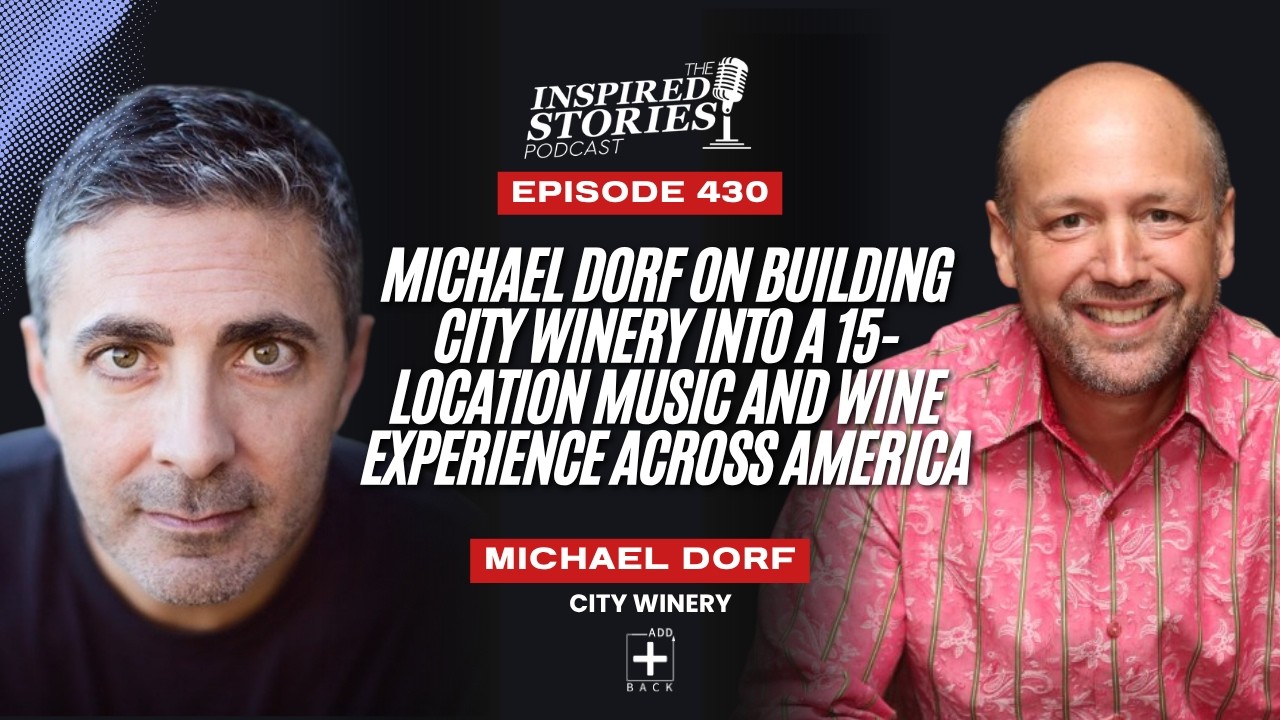
🎙️ From the Knitting Factory to City Winery: Michael Dorf's 40-Year Journey Scaling Intimacy in Live Music
Michael Dorf, Founder and CEO of City Winery, shares his journey from dropping out of law school in Wisconsin and sleeping on a futon under his desk at an East Village performance space in 1987, through the painful dilution and exit from the Knitting Factory after 15 years of building one of New York's most important music venues, to founding City Winery in 2008, accidentally inventing wine on tap during the financial crisis, and surviving COVID by laying off 1,490 people in a single day before eventually clawing back to profitability and planning an institutional raise to fund locations in Columbus, Detroit, and Scottsdale.
✨ Key Insights You'll Learn:
Started the Knitting Factory with no money at 23 by renting an Avon office on Houston Street, sleeping under his desk, showering at a nearby gym for $29.99 a month, and offering a 75-25 door deal that spread by word of mouth through the New York art community
Defined success without financials by pointing out that the Knitting Factory was famous worldwide and transformative to thousands of artists and fans despite never making him a dollar
Left the Knitting Factory after diluting himself out through five consecutive investor rounds in the dot-com era, eventually losing control to investors who created a wedge that ended his tenure
Founded City Winery by mashing together three 2004 experiences: making a barrel of wine at Ridge Winery, starting a Hebrew school in Tribeca, and producing a Carnegie Hall benefit concert
Launched City Winery the same week Lehman Brothers collapsed, watched the barrel-sharing revenue model evaporate overnight, and responded by putting wine in stainless steel kegs on tap to generate cash flow
Wine on tap reduced cost of goods from 25% to 15%, eliminated sulfite additions, generated better glass preservation, and accidentally became a signature differentiator that now drives 70% of sales
Laid off 1,490 people in a single day in March 2020 with less than two weeks of payroll in the bank, later selling air rights, historic tax credits, and a building through a sale-leaseback to survive
Survived COVID partly through the Shuttered Venue Operators Grant secured by the National Independent Venue Association, a coalition of 3,000 independent venues that had never organized before
Believes live music, live taste, and live human connection represent the final sensory frontier that AI cannot replicate
🌟 Michael's Key Mentors:
George Wien (Newport Jazz and Folk Festival Founder): Taught Michael what it means to be the decision maker, how to absorb public criticism, and why being talked about negatively is often the first sign you have real power
David Lecompte (Founding Winemaker): Suggested putting wine in kegs when bottling was months away, accidentally creating the signature differentiator that now drives most of City Winery's revenue
Shlomo (Programming Director)
The Knitting Factory Team and Community
👉 Don't miss this conversation about building two iconic music businesses from nothing, why sleeping under your desk is sometimes the right move, and how a financial crisis accidentally created the innovation that defines City Winery today.
Listen to the full episode here
Transcript
Anthony Codispoti (00:00)
Welcome to another edition of the inspired stories podcast where leaders share their experiences so we can learn from their successes and be inspired by how they've overcome adversity. As you listen today, let one idea shape what you do next. My name is Anthony Cotaspodi and today's guest is Michael Dorff, founder and CEO of City Winery. They are a unique hospitality company that combines onsite wine making, a full service restaurant,
and an intimate performance space to bring people together for great food, wine, and music. Under Michael's guidance, City Winery has expanded to multiple cities since its start in 2008 and has earned praise for concerts, creative wine offerings, and charitable initiatives. Before founding City Winery, Michael started the Knitting Factory, producing hundreds of recordings and organizing benefit concerts that showcased his passion for philanthropy.
Michael is also known for his willingness to experiment with new ideas, whether that's opening new locations or collaborating with artists from around the world. He has also published a book called Indulge Your Senses, Scaling Intimacy in a Digital World. And he speaks at conferences worldwide, sharing his insights on music, business, and community building. Now, before we get into all that fun stuff, today's episode is brought to you by my company, Ad Back Benefits Agency.
Listen, if you run a business, you're likely stuck in the cycle of rising insurance premiums. You're paying more, but your team is getting less and many people can't afford coverage at all. We do things differently. We provide your restaurant employees with unlimited access to doctors, therapists, and prescriptions that is always free for them to use. But here's where you really need to pay attention. Unlike every other employee benefit out there, our program puts more money into your company's bank account.
As one example, we recently helped the client increase net profits by $900 per employee per year. Gains like that can change how a business is valued. Results vary, but the consultation is free. See if you qualify today at addbackbenefits.com. All right, back to our guest today, founder and CEO of City Winery, Michael Dorff. Thank you for making the time to share your story today.
Michael Dorf (02:22)
Thank you. And I gotta say, we gotta talk about that health program. I'd like to save $900 an employee. If my math is correct, with 1,500 employees, that would be a lot of money.
Anthony Codispoti (02:37)
Your math is potentially correct, Michael. We will set aside some time afterwards, but let's focus on you for the moment. So I do appreciate it very much. Hats off to you. You founded the Knitting Factory back in 1987. You were 23 at the time. And we alluded to this in the intro, but this, you know, despite what the name sounds like, this wasn't a textile company. Can you tell us what this company was and the inspiration behind starting it?
Michael Dorf (02:43)
Alright, I just thought the extra plug was nice.
It was a avant-garde jazz and rock club on Houston Street between Mott and Mulberry in the East Village during a pretty exciting, vivacious time. We're about three blocks from CBGBs. ⁓ It was ⁓ an incredible opportunity. I was managing a band ⁓ right before opening the knitting factory. We were struggling.
to have any success and rather than go back to Wisconsin with my tail between my legs as an unsuccessful music manager guy, I found an old Avon office and opened up a performing arts space selling coffee and tea and biscuits and muffins. ⁓ And ⁓ my parents actually came to visit after we finished a
rough construction and they wanted to know how much we were paying in rent. And I said it was $1,800 a month. And my parents being from Milwaukee, my mom started crying because she thought I had lost my mind. She's like, $1,800. That is ridiculous. And I'm like, what are you talking about? Look at this beautiful 1,500 square feet, you know, right on Houston Street, you know, and they're like, our son, you know.
dropped out of law school and this is what he's doing, you know, they were really concerned. And luckily, you know, it turned into a very important part of the music community at the time very quickly. Simply having a fair door deal with the talent coming in really helped spread the word more than anything else. mean, 87, you have to remember there was no internet.
⁓ We collected mailing addresses to send out bulk mailing to reach people. You you'd put posters on the street with a phone number and we would get phone calls, you know, and have to answer the phone one person at a time. I mean, the marketing was different but the same as we're doing today. ⁓ We, you know, it's always word of mouth.
whether it's digital word of mouth and now you can really reach a lot of miles with one post one tweet however you want to reach people but at the you know it's it's the same but just digital today and and anyways yeah it was a great fun start
Anthony Codispoti (05:50)
So you started out trying to manage a band and not going so great. So you kind of pivot to this cafe performance ⁓ kind of setup, run out in old space and.
Michael Dorf (06:01)
Yeah,
we got a beer and wine license at first when we started making so much noise at the restaurant below us, ⁓ complained and they had a full liquor license. And in New York, the laws were you could only have one full liquor license per address. ⁓ That was good news for us on one hand. ⁓ But the landlord, of course, said you're going to take over that rent.
now that you've kicked, you know, made that restaurant really inoperable with your noise. So we doubled our space, tripled our rent, but we got a liquor license. And that was the first big piece of growth. Then the next one was the tenant above us was a family. They quickly handed their keys back to the landlord and we were forced to take that space.
which became office and dressing room. ⁓ And before you knew it, the only ⁓ four story building, the only tenant left besides us was the landlord on the roof. ⁓ We kind of were forced into taking all the space in the building.
Anthony Codispoti (07:13)
Tell me about the fair door deal that also helped you to take off.
Michael Dorf (07:17)
Well, maybe because I was from Wisconsin and I was managing a band and trying to get them work at all the venues in New York and Philly and Boston, very familiar with the different kinds of deals. And there was a lot of pay to play going on. I had a very simple formula, was 75-25, 75 % to the artist, 25 % to the house. So if it was a $10 ticket,
And there was no such thing as service fees and digital. was all like, you know, either pay it to door. Eventually we did some tickets that you had to buy in-house, but it was 75 % of $10. And if a hundred people showed up, which was about our capacity in the beginning, be a thousand dollars, the band would get 750 and we would get 250. And I didn't steal one ticket. You know, it was truly, you know, and the artists were
we're going, wow, this guy is a fool because he's completely honest and we're actually getting all the money he said. That hasn't happened in New York for a long time. And that word of mouth spread amongst a lot of different artists communities. So it went from going to some independent rockers to some bigger rockers to some of the blue chip avant-garde players to
people like Philip Glass and Laurie Anderson and John Zorn and we had Beck's first concert and the Indigo Girls and so the world actually started, it was like a black hole, everything started coming our way but it started because we had this disintegrate around a very fair and simple door deal and the word spread.
Anthony Codispoti (09:05)
what were other people doing at the time? They would promise one thing, but then take more of the money.
Michael Dorf (09:10)
Well, there's
yeah, and there was complicated deals. was stuff that would say, you know, let's say we have 100 capacity or 200 capacity venue. The first 50 people goes to cover the house's expenses, the sound person, the marketing they did. And then the net 50 to 100 paid, we're taking 50 50 and you know, that could be one deal or it could be a like a.
hundred dollar guarantee. So a band takes the gig, but then the next 60 % will go to the house. And so they'd only make a hundred dollars. Whereas if it was a straight 75, 25, they would have done better. you know, it's there, there are many deals in the business. I just went with the simplest one and it was, you know, that it does rely on trust and, thank goodness at the level we were then.
That was all that was needed as we built relationships with some of the bigger best agents, some of which I still have today. ⁓ guy named Frank Riley who runs one of the biggest talent agencies in the US ⁓ and some of the greatest acts from the Violin Femmes to Husker Dew at the time to ⁓ Sonic Youth. He trusted because of
empirical evidence that we were honest ⁓ and we got great talent to come our way.
Anthony Codispoti (10:45)
So the question that's rattling around in my head is when you guys went from one floor to two floors, when you've got live performances, people want to be on the floor with the artist, right?
Michael Dorf (10:55)
Yeah, so let's be clear. We still had music only on the one floor. The floor above was offices and the dressing room ⁓ and where a bunch of us moved into. Because before that I was living with my futon under the desk on the one floor. ⁓ And I highly recommend this if you have no family and no responsibilities.
If you can find a local gym that's near where you work and you want to put your futon under the desk, every morning I would go to Pineapple Fitness and it was only $29.99 a month and I would go there and shower, brush my teeth and there was always a clean fresh towel. Occasionally I did a Schvitz or a sauna, never lifted weights and I would be in and out of there and you know always had a clean towel. And it was
quite a life for about a year like that.
Anthony Codispoti (11:55)
I love it. Okay, so you became a very important place, you know, like a black hole, like everything was just sort of getting sucked into you, because of the way that you're running the business became such a big attraction. Were there any bumps in the road along the way where you thought ⁓ this this might all just completely fall
Michael Dorf (12:17)
Well, let's see about four or five months in, ⁓ somebody busted a hole into the wall, literally through the exterior wall into our place and stole the sound system. ⁓ The fourth month, fifth month, ⁓ and we were without a sound system and you know, by the show time. ⁓
Within a week, we held a huge fundraiser at the building next door, which was the Puck Building, which is today the REI store on Housen Street. And the lounge lizards played and John Zorn and a few others. And we raised enough money to buy a better sound system ⁓ and actually found a sponsor.
as well who wanted to help us out. we in the end, the adversity of losing a sound system gained us a much higher quality sound system. ⁓ So that worked out, you know, actually fairly well. It actually got us ⁓ our first blurb ⁓ in the New York Times ⁓ around that benefit for our sound system. So it actually also got us some incredible positive
So we were able to, you know, spin it, you know, in a positive way. But I would say every four months was something. know, there were just challenges, you know, continuously. And, you know, you had to I kind of look back at that whole first seven, eight years of going down the rapids very quickly, fully dressed.
and but going feet first and just bouncing off the rocks and just trying not to have your head hit, you know, a rock and and and go with the flow and enjoy it. ⁓ And I wish I could remember more of it. ⁓ It was quite a time. I mean, I was young and and ⁓ but it was so exciting and it's hard to explain how vivacious the community was, the artistic community then.
That was a time when real estate prices in New York ⁓ weren't so, weren't going crazy like they did in the nineties during sort of the irrational exuberance in the internet dot com boom. And so you had a music scene in lower Manhattan and you had a burgeoning one starting in Brooklyn. so in, in, you know, within a walking distance of
of where the artists were living were 50, 60 locations to manifest the creativity that was happening in the area. mean, true, you know, ⁓ if you will, synergy ⁓ of real estate and the expression of art happening. it was, you know, fine art and dance and performance. And the knitting factory was trying hard to be that
platform or stage for a lot of it to come out. So we were doing a lot of really cool pre-rap poetry and just some extremely experimental film. And it was just this time where everything was meeting. As real estate started to take over and price, it priced out live music and the smaller experimental kind of theaters and studios and stuff moved to Brooklyn and
out to Bronx and then now that has been priced out as well and it's gotten so dissipated. The internet has helped on some level create communities that you don't have to physically necessarily be living with your neighbor, but it's a different kind of vivaciousness than it was when you were truly connected by a neighbor.
Anthony Codispoti (16:37)
Why did you get out of the business in 2003?
Michael Dorf (16:44)
Post 9-11, which we were a few blocks away from the trade towers at that point, we had moved to Tribeca in 94. so, you know, 9-11 happened. I was losing my hair. had my first children in 98 and I had taken on investors.
⁓ first time I had outside money was in 96. So 10 years really after starting and I did five rounds consecutively of basically.com money. ⁓ some people call them VCs venture capital. I call them Vulture Capital. and I didn't really know what I was doing. I formed Knit Media, which was the parent of the knitting factory. And, you know, this was a very heady time.
One of my interns ⁓ took a concept and went to San Francisco and went public with it and became my first intern, turned billionaire. And a lot of my peers and friends were doing lots of stuff in the dot com. We were very experimental with the internet and trying to expand and go beyond the walls of my small venue with what we were doing with media.
I basically diluted myself out. So between maturing and 9-11 and really losing my company from an equity standpoint, I made a decision to leave, know, ⁓ mutual, I should say. the last round of investors weren't thrilled with the founder at this point and had some, and since I didn't have the control, they were able to really create a wedge.
and ultimately I left. ⁓ And you know, one of them said something to me that ⁓ he didn't mean it in the same way, but he's like, you know, this is going to be the best decision you've ever made. You know, and I'm like, well, can you swear on your show?
Anthony Codispoti (18:56)
Go for it, I want you to be yourself.
Michael Dorf (18:56)
So I said, fuck
you, motherfucker. What are you talking about? You're basically trying to kick me out of the company I started here. ⁓ But in the end, he was right. Not that he knew what I was going to do, but ⁓ being able to start fresh and start a new company, think about everything I want to do right with the next
business, how to build a team, how to create an org chart that really is functional, ⁓ how to treat everybody right, employees, staff, ⁓ and really think of it as a true business ⁓ allowed me to create City Winery and I think a much healthier, more functional ⁓ organization.
Anthony Codispoti (19:55)
So I mean, you had a ton of success with Knitting Factory. ⁓
Michael Dorf (19:59)
See,
you know, this is, I want to hone in on the word success a little bit. Some people, you know, define success as financial. And if you go that route, which are, that's a fair definition. I had no success with The Knitting Factory. I never made, I never made money. I left with no nothing. Now would I change the 12 years?
Anthony Codispoti (20:19)
Okay.
Michael Dorf (20:29)
or 15 years I had, absolutely not. It was incredible. Again, I wish I could remember more, but ⁓ it was an incredible learning opportunity and relationship building. It was famous worldwide. I did a trip with my family to Poland a few years ago and met a guy in a very small part near Lithuania, north of Bialystok.
he thought I was a god because he knew the knitting factory. He'd never traveled outside of, you know, gone past Germany, but he knew of the knitting factory. He thought it was the most important music place in the 80s and 90s in all of New York. I mean, what an incredible honor to hear. So that was successful, but I didn't make a dime.
Anthony Codispoti (21:22)
Yeah. You know what? Thank you for ⁓ pausing and redirecting for a moment, because I think this is something really valuable for so many folks to hear. I've been in this position before, started a business. There were some things non-financial that went really well and learned a ton, had an impact in its own corner of the world. And I look back on it and I'm like, you know, the financial side of it, though, wasn't successful.
And I hang that sort of guilt or that shame around that experience. And here you are shining a light and saying, hey, there are different ways to measure success, right?
Michael Dorf (21:57)
Yes,
precisely. And, you know, when a young person, I've enjoyed going to some universities of late and talking and, you know, on the same philosophy just applies to just what you're doing in life. you know, are you working just to make money or can you be working and really trying to be happy?
and satisfied with how you're spending time on this planet? you, you you go to your grave, you know, who cares what your net worth is or, you know, but what did you do? What did you accomplish? What did you get done? ⁓ And were you happy? Did you enjoy what you what you do? And, you know, I want nothing more than people to be happy with what they do.
Anthony Codispoti (22:53)
I love that. So in 2004, you made a barrel of wine in California. Tell us about that experience and how this led to the idea for City Wine.
Michael Dorf (23:00)
Yeah.
Well, I wanted to be happy, so I needed a lot of wine. sorry, I to segue. I couldn't help it. I did three things in 2004 that were really kind of small inflection points for me. I always had a hankering and a love of wine. It never made any. My brother, who was living in San Francisco, was friends with a winemaker.
at Ridge Winery and they do this famous ⁓ brand of wine called Montebello, really great Cabernet. ⁓ And they had a glut that year and extra grapes and a guy named David Tate called my brother and says, hey, do you want to go in on a barrel? You I'll make it. You just pay for the grapes. And ⁓ my brother was like,
I don't know. mean, not for me, but my brother would love that. And he called me and I was like, a hundred percent I'm in this sounds great. And it was really, really a, a, an eyeopening experience to, to see the progress of, of the grape from the moment it was crushed, aging in a barrel, going into a bottle, seeing how it's still alive in the bottle and changing over time. Um, and it just,
opened my eyes to wine in a different way than just being a lush and drinking it. ⁓ That same year I started a Hebrew school in New York called Tribeca Hebrew. ⁓ I did it really because I'm not religious, but I wanted my kids to have some sort of secular connection and cultural connection to their upbringing and heritage. ⁓ And somehow the
It connected with many other families in Tribeca. And so I took a risk and I rented a space. Again, you sort of see a running theme here. I rent a space, put a sign up and people come. So I was promoting like this after school Hebrew thing for young kids and made a cool logo called Tribeca Hebrew. The next thing you knew, Jews and non-Jews wanted to attend this after school program because they were all having so much fun.
and it grew. So year one was like 35 kids, year two was about 100, year three was 170. And I was not going to be a principal of a Hebrew school, so very, you know, found another way to to move that into something else. And then I started a concert series at Carnegie Hall same year as a fundraiser for music education programs. ⁓ And all three things became kind of important for me.
and interconnected. I felt a part of the community in Tribeca. I love the craft of winemaking. And I really enjoyed the idea of using the skills I had accumulated in the Rolodex that I have accumulated in the promotional chops and put on a show to raise good money for a great cause and feel like a big deal even though I'm just a catalyst.
putting the parts together. So every year it raises $100,000 net for a bunch of nonprofits. people think of me as a philanthropist. I'm not really writing the checks, and I don't make enough money still to this day to just write, oh, here's $100,000. But I put on a show and raise money and count the nickels correctly.
and do it right so that it actually makes money for a good cause. And I've been doing that for 21 years now and it's remarkable. But that all happened in 2004 and by 2006 I realized how do I mash it all up into a new business plan and it created City Winery.
Anthony Codispoti (27:16)
And so how did the first location come to be?
Michael Dorf (27:20)
I convinced ⁓ Trinity Church, who are the third largest land ⁓ owners in Manhattan after NYU and Columbia, ⁓ and that's a long story. You got to read about the Queen's allocation of land to the church in 1650 in Manhattan and the trades they did. But yes, ⁓
their big landowner downtown in particular. And ⁓ they had an old printing building right basically on the Holland Tunnel area, bad traffic. And I'm thinking to myself, this is a beautiful, you know, old building and perfect for a music venue. It has no neighbors, no one to disturb. And ⁓ I thought a lot about the
more adult customer. I thought about how are we going to make wine? We needed more factory type of setting, you know, industrial. So I had all the components to be a combination winery, music-ery and restauranter-y, ⁓ you know, all in one building.
Anthony Codispoti (28:40)
And so just so I'm clear, who's making the wine on site? Can I come there and make my own wine? Or is this you guys making your own wine, bottling your own?
Michael Dorf (28:50)
Well, it depends how clean your feet are. ⁓ But ⁓ we do have programs for customers if they want to make a barrel of wine ⁓ to work with our wine team and actually go through the whole process from fermentation all the way through bottling. And ⁓ it's not the most popular of our
ways of moving wine today. ⁓ But the whole original premise started with that. you talk about mistakes that lead to success on some level. The original business plan was Anthony and 250 people like you can can you come in and make a barrel of wine for $15,000 and we'll we'll put your own label on it and you'll have the whole experience.
And it's an interesting concept. We launched City Winery and that idea, which was going to be our winemaking, the same week we got our first grapes was the same week that Lehman Brothers went out of business in 2008. And it was a financial crisis. And it was not appropriate for those with wealth to put their name on a barrel of wine.
in lower Manhattan in the fall of 2008. So that program evaporated. And it was scary business for me because that was, you know, multiply. had capacity for 300 barrels at $15,000. It was a lot of money. And we had invested in high quality grapes, high quality winemaking by a great French winemaker who's still our founding winemaker today, David Lecompte. And
By the spring of 2009, we had millions of dollars of wine, know, subterranean on on Varick Street, right by the Holland Tunnel, where some expert winemakers were saying, you know, the vibration of the subway might actually be an interesting formula for the barrels that are supposed to be resting, you know, in dark quiet in a cellar. And, you know, it
lot of theories about wine and vibration and even some of the greatest wines like Petruse in from Bordeaux, you know, sells for a thousand dollars a bottle. The winemaker plays classical music pretty loud so sound waves create vibration in the barrels. So there's a degree of truth to that story but ⁓ it was a very challenging spring of 09 and ⁓ you know
when you've started a new business, cashflow is very, very important. And we had none coming from the wine. And I talked to David Lecompte, the winemaker, and I was like, David, we got to do something with these barrels. We got to start.
bottling and selling. And he's like, Michael, you know, the TTB approval on the label, it's going to be six months till we can do this. And I'm like, David, got it. Can't we just tap these barrels and let's go? And he's like, ⁓ Michael, you stupid American. If you put gas on the barrel, it'll blow up. But if you put the wine, which is getting some of the wine is starting to show and be ready.
If we put it in a stainless steel kegs like beer, then we could put it on a tap and we could start moving it. And we still have to, we'll expedite to TTB, but we don't have to bottle, we don't have to go through the process of those labels. And so we started putting wine on tap in spring of 09, really out of necessity.
Anthony Codispoti (32:52)
Is that something people were doing at the time?
Michael Dorf (32:53)
People
were not doing it.
Anthony Codispoti (32:56)
you did it to cut through the red tape that was involved in bottling it or
Michael Dorf (32:59)
Some
red tape, some cost savings, but speed, cash flow. I'm like, we got to start moving some wine. And we started, so we hooked up some traditional keg taps and started pouring wine. And you know, when you use argon gas, you actually can preserve wine by the glass that way very nicely. So instead of opening a bottle and serving two glasses and then maybe pumping air, doing all kinds of things.
this is a really good way to preserve wine by the glass, a great way to count and our cost of goods was less. So all of a sudden, instead of spending 25 % on our wine costs, our wine costs were now 15, 16%. So smart idea. The beauty of what we started doing was I was like, wait a second, we're actually saving a lot of bottles. Wow. On a nightly basis, we're
And this is one location early on, early days. I'm like, well, you know, we last week with the wine from Argentina and Australia and stuff, we, we, on a good Saturday, we went through like close to a hundred bottles. Wow. We're saving a hundred bottles a day. Whoa. And then as we started putting the taps behind barrel heads so that it had a little more authenticity in terms of look, not like a beer.
from the bar, now it's behind a barrel head. And all of a sudden our sales started to go up. And I was like, whoa, we might have something here. So when we opened our second location in Chicago in 2012, we built a beautiful bar with all barrel heads and a whole real tap system and realized that, wow, 70 % of our sales now
is wine by the glass through this tap system that looks really authentic and tastes really good because it's fresh and we have better cost of goods and it's super authentic and real. And actually you don't have to add sulfites when you're basically going from the barrel straight to a keg because it's not being shipped in glasses and having a chance of environmental infection.
which is why you would add sulfites generally. And so all of sudden we had this like natural wine, better cost of goods, and we're saving the planet, you one bottle at a time. And realize that, wow, we've got an environmental friendly program that's better for business. You know, it was a wonderful sort of, you know, epiphany, if you will, or solution to what was a terrible situation.
Anthony Codispoti (35:49)
You are the guy that makes lemonade out of lemons, right? Like I'm thinking back to the story in the first four months of the knitting factory. Somebody breaks in through the wall, steals your sound system. What comes out of it in the end? Better sound system, better publicity. ⁓ You know, you raise some money. And same thing here. You're facing, you know, the financial crisis of 0809. What are we going to do? We've got all this wine.
and you come up with a solution that again, just like really sweet lemonade coming out of it. Is there something you think in your internal makeup? Because there are some people that as I think back to the knitting factory, when somebody busts through their wall, steals their sound system, four months in may have just been like, well, this wasn't meant to be like, let's move on to something else. I should go get a job.
Michael Dorf (36:37)
Yeah.
I there is there, you know, something called internal makeup, you know? Yeah, I think there's some some survival DNA. Business man sales ego thing in there that my grandparents and whether that's from, you know, surviving, you know, Europe and, you know, but there's there's something there. I think there's also in my own.
world wanting ⁓ to not fail, to want to achieve success, whatever that might look like. Certainly, ⁓ if it's not financial, surviving is the first step towards success. so not giving in. So yeah, there's a built-in tenacity that I have that I don't want to fail. ⁓
You know, I feel very lucky to have a support system around me, family and friends, ⁓ you know, ⁓ that has always been part of just a reliance system to go to. I feel very ⁓ blessed. I really like a board of directors. Some people go like, ooh, you know, board, like, no, I like the discipline of reporting of
of getting my ducks in a row, thinking through things. ⁓ I like getting counsel from friends and wise elders. I wish I had more mentors out there ⁓ over the years, because it is easy to throw in the towel. ⁓
You know, I do wordle. I don't get every wordle. I'm like at 98 % or something. But, you know, I'm not going to give up. I'd rather just make the worst guesses and lose than quit.
Anthony Codispoti (38:53)
Yeah, I love that. So we've talked about the wine, talk to us about the food, and let's hear more about the music performances that take place.
Michael Dorf (39:05)
Sure, well, those are a bunch of subjects. mean, food is on one hand easy and very hard. We ⁓ all love to eat. We all have our favorite foods. We're trying to make food that goes well with wine. ⁓ The labor costs and the food costs are high. The profits are in liquor.
You know, and in our case, you know, majority of the liquor we sells wine. ⁓ And so we're you know, our model is what's going to make you drink more basically. ⁓ You know, I wish I wasn't as crass as that. But, know, so we're trying, you know, we want you to enjoy your two hours with us. You know, different than a true culinary hospitality ⁓ experience. We've got the magic.
sauce I like to think to our food, is not something that's done in the kitchen, but it's done on the stage. When we're delivering the best experience we can, it's everything that's happening in our venues. And that starts with the stage, it's on the table, it's in the glass, and it's on the plate.
you know, we would try and look at all of these details, the service, obviously, and hospitality behind it. And if that is all working together in perfect synchronicity or some our alchemy, you know, we've created a two hour, two and a half hour magical positive memory for people and they go home. And, you know, people give in, give a little bit on on any one of those ingredients a little bit like if you can have
all them working and server could be really in a bad mood and it kills it all. know, the food doesn't have to be, you know, the best, you know, three star Michelin. We'll get a little leniency, you know, if everything's working really well. ⁓ It tastes better, you know, when the sound is better, right? The sound is better and the show is better.
when the food was delivered hot and on time and to your temperature. ⁓ The food tastes better if it's paired well with the right wine and wine served in a real glass, not a plastic cup. So all of these things together are what we're trying to go for in terms of our culinary, our overall experience. ⁓ so it's a lot of ingredients. It's not just what's in the kitchen.
⁓ to that's part of our delivery, our product, if you will. Yeah, go ahead.
Anthony Codispoti (41:57)
Do you have, sorry,
do you have some partners in this? I know you said you didn't come out of a knitting factory with a lot of money in your pocket. How did you fund this?
Michael Dorf (42:08)
⁓ so I have a lot of, ⁓ silent and not so silent, but you know, investors. but, ⁓ no, I have no partners. I, ⁓ some of them call partners. I'm not a fan of the word partner. Partner to me really means you are sharing the responsibilities, both financial.
and liability. ⁓ If we get sued, I'm the only one who's named in the lawsuit besides the corporation. ⁓ If this, God forbid, goes bankrupt, I'm holding the bag, not any of my 74 limited investors. ⁓ None of them are institutional right now. I've been very lucky with incredible
partner like investors who are wonderful and they're helpful and want to help me think through things beyond money, you know, as capital, true human capital. ⁓ But in the end, you know, it's not me and Joe or somebody, it's me. And I feel responsibility to have them get ROI on their investment. ⁓ But I'm holding the back. Then there's, you know,
a strong team of people and I think of all of them again in a partnership type of way. I want them to share a sense of ownership ⁓ with the entire executive team. want our every general manager to feel a sense of ownership, right? Like feel a sense that you should pick up the the you know, the toothpick that fell on the ground and you know the way I feel compelled to do and let's you know. So how do get to a sense of ownership of being a partner?
⁓ without literally having a financial stake in the business. And so there's a psychology of partnership and there's the liability of partnership. And ⁓ so you wanna create a little bit of the feeling and sense around connecting people, both all stakeholders, employee stakeholders and the financial stakeholders.
Anthony Codispoti (44:34)
I want to talk about the employee stakeholders because it strikes me, Michael, that you certainly learn a fair bit about leadership at your time at Knitting Factory. you're very hands on, right? You're there, you're there all the time, you're there every day. And same thing when you open the first location of City Winery in New York. You're there, you're trying to iron out the wrinkles, figure out how do we make this work. But now as you've grown to, we're at 12 locations now, correct?
Michael Dorf (45:02)
Yeah, we actually have 15 kitchens, ⁓ we have three at the end of this pier, so it's 12.
Anthony Codispoti (45:12)
15 kitchens, but three of them are sort of combined together. We'll get to that in a second. But what I want to hone in on is for you to go from like super hands-on one location to now 12 to 15 locations, however we want to define that. Like your style of leadership has to adjust to allow for that kind of growth. I'm curious how you made those adjustments, what you learned.
Michael Dorf (45:39)
You know, there's that, yeah.
Anthony Codispoti (45:42)
Who mentored you? How did this happen?
Michael Dorf (45:44)
Yeah,
⁓ You know, there's there's that African Proverb if you want to go fast go alone if you want to go far you got to go as a team You know without knowing that proverb when starting City Winery I knew that For this to work. I needed a killer team There's no way I can do this alone. ⁓ I needed
a really partner-like chef. So how do I both compensate and build in options and an important role on the culinary side? As I said, David Lecompte, who's our winemaker, I didn't know how to make wine. Having participated in a barrel, but not being the winemaker, just the financier of buying grapes.
does not qualify me to be, you know, making world-class wine. So I needed a great winemaker. How do I partner with that side of what we do? I knew programming and I mentored a guy named Shlomo who is still with the company to this day. He started as an intern. He does the programming and oversees a team of programmers in all of our locations. So knowing
that if we wanted to go far, I needed a killer team of experts in each of the areas and make the team as cohesive as possible. One of the first things I did as an organization was doing an offsite. ⁓ And most of the names you hear about offsites, looking online and trying to
what makes good team building and an offset. Everyone calls them retreats. I don't like the name retreat. It's the wrong direction. You know, if we're trying to grow this business, you know, we want to go forward, not backward. ⁓ And while you want to have a little self reflection, you still want to go forward. ⁓ So I call this offsite base camp, which to me is a much more appropriate term. You're looking at the P.
and the summit that you want to get to in a safe place and you talk about your plan with the team. Maybe you have to get rid of some of the weak links because they're going to, they're going to straggle the rope team on your way up. But you you, you plan your, your ascent with the team in that safe place and, and then try and get over the mountain. ⁓ and so we've been doing base camp every year from day one.
and help develop our mission, our mantra, our core values, go over our SOPs and have developed our best practices in each of the departments. it's, again, to me, making the investment in building a great team was the only way to get to scale. And it continues to be the only way we're going to be able to get from 15 to 30 or 40 or 50 locations.
is having a killer team that all rose in the same direction and has accompanied DNA that needs to come from ⁓ a nucleus.
Anthony Codispoti (49:23)
Did you arrive at these strategies, these ideas mostly on your own in terms of leadership and how to build the team or did you have some guidance along the
Michael Dorf (49:36)
Um, you know, the, the, the team thing simply was a, I mean, first of all, that, that, that, don't need to be that smart to, to know that, you know, it's good to have a strong team around you. Um, you know, I think you nailed it first by saying, you know, I, I, I was not a very good leader of the, of the knitting factory. You know, I.
I wasn't really empathetic to a lot of the people around me. ⁓ I wasn't a good leader. I wasn't building an organizational structure that could really scale. ⁓ And so that was learning by trial and error, no question about it. ⁓ I read a lot of books.
you know, ⁓ to, because you don't learn this in business school, you know, they're not teaching really how to build a company. ⁓ I have friends who are CEOs and, and others that, you know, learn from, but there was, and then the one mentor I had on the music side of my life was a guy named George Wien who started the Newport Jazz and Folk Festivals. And, but he gave me counsel not on
building a company, because he didn't really do a very good job himself. He was an empresario and an incredible promoter of these festivals. ⁓ But he didn't build a great organization necessarily around him. ⁓ He gave me a lot of life lessons on how to deal not just with artists, but being a decision maker.
and ultimately the person responsible for having to say no, what it's like when you then get deeply criticized by a lot of people and or even say not just negative things, but false things because you're the man. You know, when you're the man, he used to say when you're the man, you know, you're the man when people are talking down about you and you don't know what
or even thinking, you you're then the man, you know, and it took me a long time to understand what he was really talking about because people will just say shit about, you know, sometimes it's valid. The current leader of the United States. Yeah, we got some issues there. You know, politics, and we're not going to go into politics, know, there's a lot of binariness to that world of
and everyone's complaining about the other. But in an organization where it's not binary, it's one leader or one company, one organization, you're going to have a lot of people who are going to be frustrated because they heard no. No, you can't do this. No, you're not going to get a raise. No, that's a bad idea. And so it's hard to say no. Steve Jobs, I've...
read, thought that was one the most important words in his vocabulary. So yeah, I don't know where all this comes from. When you get to be my age,
you pick up a few things, you don't forget everything. I don't think there's a high IQ up here, but I've developed a pretty good EQ and developed some wisdom over the years, mostly from the school of hard knocks, but like from being around and experiencing things. so yeah, I would say the base camp, the importance of base camp.
We're the only music venue I've ever heard of that does a company offsite like this. I don't even know a lot of small companies that will earmark real money to fly 150 people to another city in order to inspire them. But if you think about turning everybody's volume switch from seven or eight to 10 or 11,
what effect that has for the next few months at least. If a landlord puts in a really hot amenity in their basement ground floor, they can increase the rent or the prices of 400 units above by some factor and it's a really good investment because they built this thing that makes the rest of it appealing. So if we can take a few days and get
everyone on the same page and get them to feel better about what they do in their job, maybe they work a little bit more. Maybe they work a little more efficiently. Maybe they're just a little more zen about their decision making. And you multiply that by 120 people in the room and all of sudden we're a better, more efficient organization.
Anthony Codispoti (55:06)
of it. Let's shift gears into that school of hard knocks though, Michael, I want to dive into a particularly serious challenge that you've overcome in
Michael Dorf (55:18)
besides the pandemic and the financial crisis and global warming and hurricanes and tornadoes and earthquakes and floods.
Anthony Codispoti (55:32)
There's lots to choose from, I know.
Michael Dorf (55:34)
What you trying to talk about?
Anthony Codispoti (55:38)
whichever one comes to your mind and your heart right now.
Michael Dorf (55:42)
There's no question the single hardest moment came the third week of March of 2020. I'm opening the kimono too much here, but our payroll at that moment, not too dissimilar to today, is about a million a week.
I mean, we are a job creator.
We had whatever that second or third week of March was, ⁓ well, $1.7 million in the bank account. You know, we don't, we don't keep a lot of money in the bank. You know, it's we're, we're hand to mouth like most. ⁓ no, hopefully more than the payroll comes in every week by a smidgen cause we've got other bills as well. But like, you know,
But there we were, faced with you're mandated. Now we didn't have a place in Florida or Texas where there wasn't such a thing as the global pandemic. But in the rest of this nation, we were kind of forced with complete closure. Concert venues, places of assembly were the first to close and then they were the last to reopen.
So we were mandated to be shut.
Therefore no money was coming in. This is before PPP loans is before and, and there I was going like,
⁓ If the machine is turned off, I've got one week of payroll in the bank and then the next week I don't make payroll. I gotta let everyone know they don't have a job anymore ⁓ for the definite future. I maybe this is only gonna last for a few weeks, but it doesn't seem like it. This looks pretty bad. And so letting...
you know, 1,490 people go in one day was by far the hardest, hardest thing I've ever had to do. But I didn't, there was no choice. mean, it was, it was clear as day. There was no choice. Did not know that there eventually in a month or two would be some PPP loans or SBA opportunity. It took me three months.
to very quickly sell some air rights we had in Chicago. It took me six months to sell historic tax credits for our upstate property. ⁓ Took me two years to sell our Nashville building, go into a sale lease back. But these were all the things that we had to do to survive. From 2020, 2021, 2022, 2023,
we lost money. ⁓ We lost a lot of money. And if it wasn't for the NEVA organization and what became the Shuttered Venue Operating Grant, SVOG grant, ⁓ we would probably not be here today. ⁓
Anthony Codispoti (59:16)
What are those organizations?
What are those things?
Michael Dorf (59:19)
So very quickly there was an assembly of independent venues called NEVA, National Independent Venue Association, formed. 3,000 live music venues ⁓ got together for the first time. I mean, you have an industry which is controlled by Live Nation and AEG basically. Two 900-pound gorillas, a duopoly.
and they control 90 % of the concert business. And they got hurt just like we got hurt, but they had more money in the bank than we did. And we being the other 3,000 independent venues. Luckily this organization came together. It was some absolute miraculous hard work by a bunch of people.
⁓ I was not involved in that. was too freaked out and frankly, you know, in an existential crisis myself. ⁓ But this organization formed, they got a couple of important senators to take the bill to Congress and literally got grant money ⁓ for live music venues. If you weren't public or had a certain capital structure,
⁓ and was a lifeline ⁓ to these organizations. In addition to that, there was the federal PPP loans, the Payment Protection Plan, ⁓ which was a loan that most, about 90 % got waived in terms of paying back. ⁓ Music venues, unfortunately, since we couldn't reopen,
whereas a small business could reopen and pay. We couldn't because we were mandated to stay closed. We weren't eligible to get those forgiven. So we're still paying our PPP loans every month back. Low interest, but you know, we're paying it back. So yeah, it was, and then in 23, I would say, you know, we might be out of the pandemic and social distancing might be a thing of the past.
and mask wearing not there and were vaccinated, but employees in the hospitality world, ⁓ we had our own employment crisis and this was across all of hospitality. We lost a lot of people who, when they lost their jobs, decided to go work in tech, go work in ⁓ other industries, hospitality became not where they wanted to be.
in this customer facing public scenario, which is hard work, pain in the ass. And so we, lost a lot of life lifers in the hospitality space. And that on top of a mentality of, ⁓ you know, working from home where some people, I had an experience in 24 hour share. I'll, I won't say his name. Let's call him Frank. I'm walking through one of our venues.
and a young young Frank comes up to me goes, Mr. Dorff. I'm like, yeah, hi. He's like, I'm I'm like, how are doing? You know, how can I help you? He goes, listen, I wanted to talk to somebody. I was hoping to I could start working from home on Fridays. And I'm like, well, I'm not the person to talk to. You should talk to Nicole and blah, blah, blah. But Frank, what do you what do you do?
here at City Wannery, you know, mean, great to meet you, but what's your job? Because I'm a bartender. And I'm like, oh, okay. And I'm remaining calm. And I'm like, so Frank, you're a bartender.
what exactly do you want to do from home, you know, bartending for us? He's like, well, you know, I know, you you're really into wine and, you know, and I've been wanting to study mixology. And so I thought I could, you know, do some study at home. And I'm like, yeah, but, ⁓ you think it's appropriate that, you know, we're paying you to do that, you know, on Fridays?
I'm like, and why Fridays? why are you? He's like, well, I have a bunch of friends that are able to work from home on Friday, you know, and they get to do things together. So I'm like, oh, they're, they're, they're actually not working on Fridays. He's like, oh, no, no, I think they're working. Like he caught himself. And I go, where do these friends of yours work? And he goes, well, one's at JP Morgan, the other's at Bloomberg. And I'm like, so they're not bartenders. They're in the financial industry.
those two friends years. I like, I'm like, man, listen, a bit of advice here, you know, I don't ask Nicole to work from home on Fridays, please. I don't think it'll go over very well. Think about if, and if you want to work from home on Fridays, maybe you should consider a different, you know, Frank. So there was a, there was a mentality, long story to just on top of this, trying to find a pool of, of,
culinary workers again, back house and front of house. You also had this mentality of, know, how do I, how do I do what I was doing? But three days a week or four days a week, that's, you know, come back a little bit, you know, but I'm in a Google building here, right out this window, 400,000 square feet of supposed to be 1500 Googlers. ⁓ And they're not all back. You know, I
I think Jamie Dimon has said he doesn't ever expect, you know, the world of, of white collar work to go back to five days a week, five and a half days a week in an office, you know, while the work might be five or six days a week and intense and hard, it's probably not all going to take place in the office. Um, and, and so work from home is a legitimate, you know, part of the world we're in. Technology is a part of it. And so like,
you know, we need to deal with that. And that was a tough part coming back. ⁓
Anthony Codispoti (1:06:00)
Yeah.
You're doing great, Michael. So talk to us about where City Winery is going. We went through some really hard times. You know, 23 things started to come back to normal, you guys are still paying off some of the loans. Here we are in early 2026. What does the future look like? Where are you guys going?
Michael Dorf (1:06:17)
Yeah.
So look, I'm a huge believer in the value of live entertainment. In fact, I've got a new tagline we're starting to work on called live, live or live, live or live, live. It's the same word. L I V E. Live and live. And the idea is you want to live your life live. Do you want to?
live your life, you know, on a screen? Do you want to only order DoorDash at home or do you want to go out and be with people, be with friends, take a yoga class with people? You know, do you want to only look at art, you know, in a book or do you want to go to a museum? ⁓ Do you only want to, you know, listen to Spotify or do you want to, you know, see your favorite
artists and if possible up close, not through a mega screen at a giant festival. And so the human connection and the value of intimacy is something that cannot be replicated with technology. We're getting closer and you know, it's amazing what's going on in AI. And my next book is going to be called 10,000 Bottles.
And it's the same premise on some level, which was indulge your senses, the importance of this human connection. But as AI is getting really smart about large language models and you can take the words that I'm giving you and it can go into this computer to get to you, but it could be soon more articulate so that your listeners are hearing me, but with more precision.
in my words because AI can enhance that. That's interesting. That's maybe a positive step. AI simultaneously is going to put more hair on my head for the visual and you know, there'll be some young ladies out there. think not only am I really, you know, clever, but I'm really handsome too. they're going to, like those things that our AI enhances are really great.
but AI has not gotten to the senses. so it's gotten sound, it's gotten language, it's gotten sight. It hasn't gotten feel, smell or taste. And so I believe those sensory components are still why you're going to have a real sommelier need to explain because of wisdom what the right wine is for you at that moment. And at the AI,
with the deepest of knowledge of history of wine given to you by a robotic person who could spit it out is not going to be as good. And that the need for that human connection and in particular live entertainment, live sports ⁓ is never going to go away. The problem with the film industry is that ⁓ film as a technology, as a moving picture,
on a screen was already a technology. wasn't while you're with an audience experiencing the technology. It's not the same as Bruce Springsteen on a stage 10 feet away from you. And that can't that the value of that can never be replicated. So in that sense, I feel very optimistic about what I do.
Anthony Codispoti (1:10:07)
You know, and it makes me think of what my wife calls the single best night of her life. I wasn't there by the way, but she got to meet her favorite band and talk to them and take pictures with them. And she'll still single greatest night of her life. So that's exactly what you're talking about. I love
Michael Dorf (1:10:14)
Hahaha
Yeah, and so you got to live life.
Anthony Codispoti (1:10:28)
So one more question for you today, Michael. But before I ask it, I want to knock out a few quick things. First of all, to get in touch with Michael Dorff, two options here, citywinerie.com, super easy to remember. And his email address, we've got permission to hand out, michael at citywinerie.com. If you forget that, we're going to have it in the show notes. Don't worry. And if, yeah, go ahead.
Michael Dorf (1:10:49)
I also just don't,
work hard. Every couple of weeks I put some thought into a short essay and I've been pretty good about my sub stack. If you look at it, it's just called, ⁓ what is it called? Michael Dorff ⁓ Uncorked or something like that. And ⁓ I write on a lot of subjects and ⁓ I'm pretty proud of most of the writing. Some of it is really bad, but ⁓ yeah, check that out.
Anthony Codispoti (1:11:18)
And where can folks find your book, your senses, scaling intimacy in a digital world as well as the new one that you're talking about?
Michael Dorf (1:11:22)
Yeah, indulge
your senses. Well, the new one I got to write. ⁓ So ⁓ I have notes. I have a lot of notes. Michael Dorff dot com and then I can but it's on Amazon. Although, you know, the publisher owes me money, man. I got to I got to reach out to them.
Anthony Codispoti (1:11:26)
Okay.
So where can they find indulger senses? Okay.
All right. So if you're listening to the show today, you're enjoying this, you're having fun, please take a quick moment to subscribe wherever you're listening. It sends a signal that helps others find our show too. So thanks for taking a quick moment to do that. And as a reminder, and I know Michael is going to appreciate this, he got so excited hearing that in the beginning, you can get more hospitality employees access to therapists, doctors and prescription meds that as paradoxical as it seems, actually increases the company's net profits. So reach out to us today at addbackbenefits.com.
So last question for you, Michael, a year from now, what's one specific thing that you hope to be celebrated?
Michael Dorf (1:12:24)
⁓ a year from now, I hope we have shovels in the ground, metaphorically speaking, because a lot of our new buildings are adaptive reusable buildings, but ⁓ we'll have a few more locations getting close to ⁓ opening our doors and booking. I really do get off on the thought of every night
we can have in 10, 11, 12, hopefully someday 20, 25 locations, 300 people meeting their favorite band like your wife while consuming wine on tap, eating some good food, and having this great memory created. And so you multiply 300 people in one room times 20 rooms, you start to realize you're affecting a lot of people.
And ⁓ so I love the idea of keep building, keep building this thing and scaling city winery.
Anthony Codispoti (1:13:28)
Can you give voice to where those new locations are coming?
Michael Dorf (1:13:32)
Yeah, would, we own some property in Columbus, Ohio that we are developing. ⁓ Yeah. We also have some property now in Detroit that we're very excited about near the old train station, which is now the Ford Innovation Center in Corktown. ⁓ And we have recently signed a ground lease in Scottsdale. ⁓
Anthony Codispoti (1:13:38)
What? Right here in my backyard.
Michael Dorf (1:14:00)
Arizona, which is our furthest western ⁓ place, but I think that's a pretty vibrant community that's really starved for some live entertainment. And they love their live entertainment and they live live, but they need more music rooms.
Anthony Codispoti (1:14:21)
Michael Dorr from City Winery, I to be the first to thank you for sharing both your time and your story with us today. I really appreciate you being here.
Michael Dorf (1:14:29)
My pleasure. Thank you. I'm glad we could get this together even with the whole Indonesia craziness. Yeah. ⁓
Anthony Codispoti (1:14:33)
That'll be a mystery to our listeners, folks. That's a wrap
on another episode of the Inspired Stories podcast. Thanks for learning with us. And if one thing stood out, put that into action today.
REFERENCES
Linkedin: Michael Dorf
Company: City Winery
Website: citywinery.com
Substack: Michael Dorf Uncorked
Book: Indulge Your Senses: Scaling Intimacy in a Digital World