
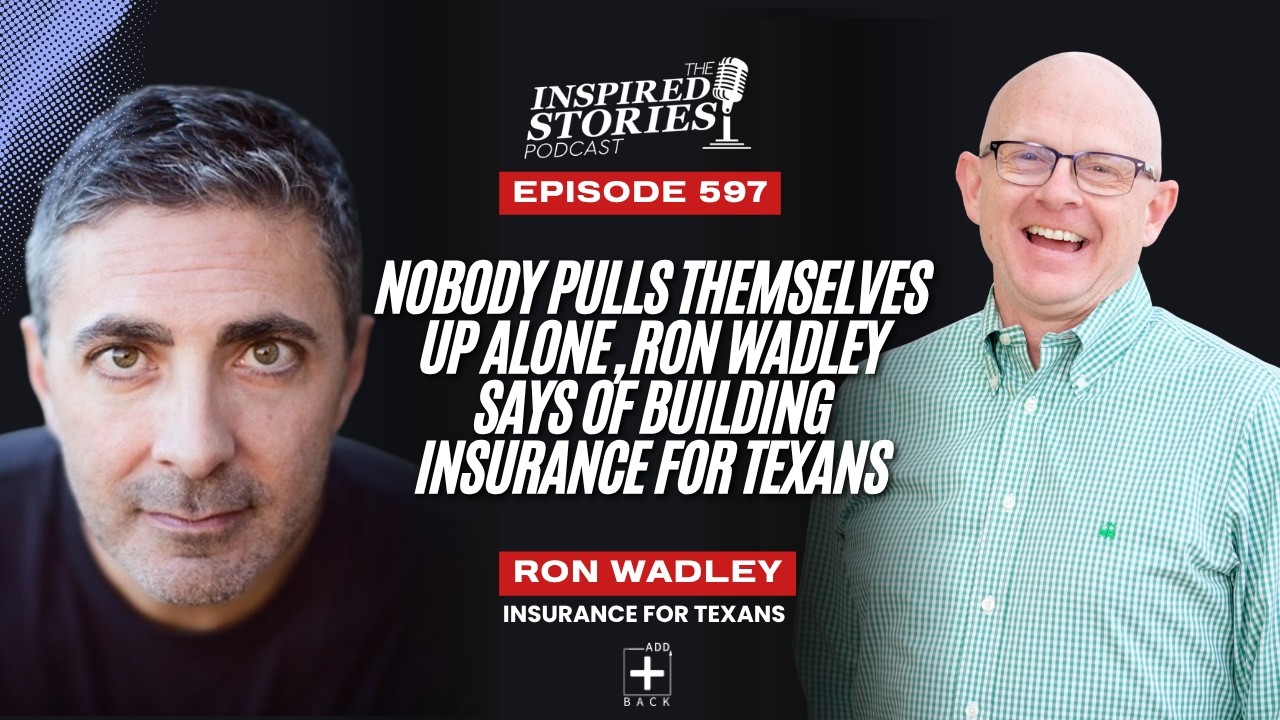
🎙️ From Cold Texting to True Texas Church Insurance: Ron Wadley's Path to Insurance for Texans
In this episode, Ron Wadley, owner and general solver of problems at Insurance for Texans, shares how a childhood spent in small Texas and Missouri towns, a broken marriage, and a captive insurance career too limited to solve his clients' real problems led him to build one of the state's most creative independent agencies. Ron opens up about the divorce that nearly broke him, the friends who put him back together, and how his agency built a specialty church insurance program that stepped in when a major Texas insurer abandoned the market.
✨ Key Insights You'll Learn:
Grew up in small Texas and Missouri towns as a preacher's son, sometimes unsure where the next meal would come from
Attended Baylor University on a scholarship funded by a stranger with no connection to his hometown
Opened a captive Farmers insurance agency in 2013 after leaving corporate life behind
Received a cease and desist after hyper-targeting employees of a specific company in his digital ads
Launched Insurance for Texans as a separate, initially anonymous brand to escape his captive agency's brand bias
Sold his Farmers agency and converted Insurance for Texans into a full independent brokerage in 2017
Grew the business 30% in the final nine months of 2020 by already operating fully through video and digital tools
Built a specialty church insurance program after a major Texas insurer non-renewed roughly 30% of the state's churches
Wrote “The Promise of Certainty,” outlining 14 types of coverage churches often overlook
Hosts a podcast using an AI voice clone built from his own writing, one his wife and mother can barely distinguish from him
🌟 Ron's Key Mentors:
His First Corporate Boss: Took a chance hiring him with zero experience, then years later helped him find a better-paying job when he'd outgrown the role
Patsy Hollingsworth: A stranger from East Texas whose scholarship fund unexpectedly paid for Ron's education at Baylor
Two Friends From Church: Walked alongside him through his darkest months after his divorce, becoming lifelong friends he could still call today
A Baylor Network Connection: Reached out with a hedge fund job opportunity right as Ron was reeling from the 2008 financial crisis
👉 Hear how a preacher's son from small-town Texas built an insurance agency around digital-first solutions, then created a specialty church coverage program that stepped in when a major insurer walked away.
Listen to the full episode here
Transcript
Anthony Codispoti (00:00)
Welcome to another edition of the Inspired Stories Podcast, where leaders share their experiences so we can learn from their successes and be inspired by how they've overcome adversity. As you listen today, let one idea shape what you do next. My name is Anthony Codispodi, and today's guest hosts a podcast where he has never once recorded his own voice. It's an AI clone built from his own writing.
And it's so good that only his wife and his mother can tell it isn't actually him talking. He spent his first years out of college teaching math and coaching basketball. Then in 2000, he took an actuarial job. He built one insurance agency, sold it, then started over from nothing to launch an independent brokerage in 2017. When a major Texas insurer non-renewed about 30% of the state's churches, he built a program to fill that gap.
Ron Wadley is the owner and general solver of problems at Insurance Protections, a Fort Worth-based independent agency. His team covers homes, autos, commercial risk, life, health, and specialty lines from churches to liquor liability, and he wrote the book, The Promise of Certainty on Protecting Congregations from Disaster.
Now, before we get into all that good stuff.
Today's episode is brought to you by my company, AdBack Benefits Agency. And this solves a problem that's been plaguing your health insurance clients for years. You already know the story. Health premiums go up and your client panics. Maybe they shop around or start cutting benefits. Either way, you're the one explaining a price hike you didn't create and your relationship takes the hit. But there's a program backed by Bang Capital Insurance that you can bring into that same meeting that flips the script and frees up cash.
It doesn't replace their group health plan. It fills in the first dollar gaps, and it can even cover part-timers who don't qualify for major medical. Employees get unlimited access to doctors, therapists, and prescriptions with no copays or deductibles to meet. And here's the part that changes the conversation entirely. This program actually increases your client's net profits. We recently helped a client add.
Let's add $900 per employee per year to their bottom line. Results vary, but gains like that don't just help their bottom line. They free up budget your clients can reinvest into the coverages you're already discussing with them. Your client gets real relief, and you get to be the broker who delivered it, and the one they tell their friends about. Addbackbenefits.com.
All right, back to our guest today, the owner and principal agent of Insurance for Texans, Ron Wadley.
Thanks for making the time to share your story today.
Ron Wadley (02:49)
Happy to do it, Anthony.
Anthony Codispoti (02:51)
So, Ron, you left the teaching profession because you were building a family and it didn't pay very well. You didn't love corporate life that came after that. So in late 2013, you opened a captive farmers insurance agency. Why did you decide on this track specifically? Why was it appealing to you?
Ron Wadley (03:12)
As I contemplated life in that corporate structure and and knew that I needed to make a change, I had a discussion with my wife about what I was gonna do. Was I gonna stay where I was at? Was I going to take another job? Or was I gonna do something for myself? And I knew that just taking another job was a terrible idea for me. I I was done with corporate life. I knew I needed to do something. And I looked back
At the things that I had done in the corporate world because I had worked on the corporate side of insurance. I had worked for a hedge fund doing data analytics in a trading unit. I I had worked with health doctors, groups, and health insurance companies to to better manage patient outcomes and also help them make more money. And I had this education experience.
And going back and forth with my wife, we came to the conclusion that the things that I knew were insurance and teaching. And I could be an educative consultant to people to help them mitigate risk and protect their financial future. And so I jumped in head first. My my parents had been farmers' customers for decades. So why would I not do that? And that's where.
I spawned into that farmers agency, started from scratch, and built a decent book of business in the first couple of three years.
Anthony Codispoti (04:47)
How'd you get your first couple of customers, right? Because you come in, you a lot of people fall in love with the idea of owning their own business and then they hit the ground with it and things are not what they seem. So how did you first get the ball rolled?
Ron Wadley (05:00)
So that's a great question because most people think if you put up a sign and you say, I sell insurance, that everyone in town is going to flock to you. I was smack dab in the middle of Dallas 4, Texas. People would drive by at 50 miles an hour and never know that that sign was there. the first few customers, the one of the first ones was actually
The person that I was working for in that last job, he was one of the first five customers because he believed in me and knew that I was doing something for myself and wanted to support it. I had some other friends that said, Hey, I've got to do this anyway. Can you take care of it? And after you get through that first, we'll call it five people, you sit down at the kitchen table and you go,
my gosh, who am I going to talk to next? And I did a lot of the traditional things that you know people jumping into the agency world do, networking meetings, chamber of commerce. I would cold call some people. And I realized very quickly that all of that was, while interesting, not the most fun thing in the world. but I I set a goal for myself that every single day,
Before I could go home and have dinner with my family, I had to talk to 25 people. Didn't matter if they told me say that again. Every day.
Anthony Codispoti (06:29)
Every day. Every day. Every day. Twenty five twenty-five people.
Ron Wadley (06:35)
25 people, because I knew if I talked to 25 people, I could probably find a quote or two to do, which I could then eventually sell. And part of that 25 was
People telling me I was a moron, people telling me to go away. You know, you especially if you're cold calling, you get lots of unique and creative answers from people, right? but there is a persistence that has to be there. And eventually over time, I shifted into other things like direct mail and eventually into digital marketing, which allows you to speak to a lot of people at once.
Anthony Codispoti (07:16)
Talk to me about the code calling then, because a lot of people have tried this, this guy here included, and one of the most brutal experiences of trying to get sales in my experience. Did you find any success
Ron Wadley (07:30)
Some
Anthony Codispoti (07:31)
with?
Ron Wadley (07:31)
no. Not not on a business to consumer level. The business to business world, it still works. But calling households, especially with the way phones are today, because spam control is there on your mobile phone, right? what I actually found more and you can't, laws are different now, but back then we could
Instead of cold call, we could cold text. And we knew that if we sent a hundred texts out in a day, we would get approximately seven to twelve quotes to do, and that we would sell three or four.
Anthony Codispoti (08:12)
That's an incredible hit rate.
Ron Wadley (08:15)
Again, this was ten, twelve years ago when we were doing that.
Anthony Codispoti (08:19)
The laws now around text messaging is are different. You're not supposed
Ron Wadley (08:22)
The
Anthony Codispoti (08:22)
to be able to do that.
Ron Wadley (08:24)
Yeah, the TCPA laws are very different now in using an o what they refer to as the auto dialer, the auto sender, on text messages. That's how you get fined and shut down very quickly now. but back then it was still a new thing. And so we would get that kind of response rate. We knew that if we sent a thousand envelopes, we get, you know, to to homeowners.
We would get somewhere again, seven to twelve quotes. We would sell three to four of them. and we could make that math work.
Anthony Codispoti (08:59)
So it's interesting. The text messaging at the time versus the direct mail, you had to send ten times as much direct mail to get the same kind of reply rate.
Ron Wadley (09:08)
That's correct. Yeah. A one percent r response rate versus a ten percent response rate.
Anthony Codispoti (09:14)
Yeah. huge differences. so co-calling direct to consumers didn't work. Co-calling for businesses still works to some degree if you can get to the decision maker. What kind of lines were you selling when you first hung up your shingles?
Ron Wadley (09:30)
I was very much home and auto. we would do a little bit of commercial, but it was a lot of home and auto. We also did some early ACA health policies because of my time in the actuarial world in the health insurance. I understood the levers and the mechanisms. And so it gave me a leg up on explaining things to people. but we were very much driven by home insurance. And the reason we did that is because it paid the largest commissions to be.
fully transparent, but I also knew that if I got your home, I could get your auto, I could get your boat, your travel trailer, your umbrella, and then we could also cross sell life insurance.
Anthony Codispoti (10:11)
Okay, so home's a good place to start. What was some of the messaging that you found early on, whether it was direct mail or text messages that got the best reply rates?
Ron Wadley (10:22)
The the best repl reply rates were around price and and I've always tried to sell on the educative aspect and the value of what insurance provides because ultimately if you're buying insurance, you can't see it, you can't touch it, you can't feel it, you can't smell it, you can't taste it. So what do you have?
Ultimately we try to sell on value, but what we found in the messaging back then that the would you like to save some money that everyone has used on TV commercials forever, right? We found that that resonated with people and that that that was our best response mechanism back then.
Anthony Codispoti (11:08)
So cold calling, text, were you doing emails, cold email at the time?
Ron Wadley (11:13)
We
we did do some cold email. Again, that that's more effective with a B to B play rather than a B
Anthony Codispoti (11:21)
Okay.
Ron Wadley (11:21)
to C.
Anthony Codispoti (11:22)
And then tell me about the digital stuff that you did get into, the SEO, the pay-per-click.
Ron Wadley (11:28)
So we were heavy Facebook ads prior to the 2016 election. and the reason I say I I give that time delineator, Facebook was involved with the Cambridge Analytica scandal that occurred that spawned out of the 2016 election. And that's not a political statement about any candidate. It's it's just a fact.
And what happened with the Cambridge Analytica scandal, they were routing in consumer data that allowed hyper targeting that people were uncomfortable with. And so they completely changed their platform. So prior to that moment, Facebook ads, I could construct an ad, especially around, say, an employer. So Burlington, Northern Santa Fe, really large.
radio railroad operation that's based there in the Fort Worth area. Thousands of employees. We figured out how to hyper target employees of of BNSF using Facebook ads. We also would target it down to ones that we knew were likely homeowners and we knew that had
some amount of income so that they were going to be more of a value play than a price play. And we would we could generate leads out of that mechanism at about twenty five cents apiece.
Anthony Codispoti (13:04)
And when you say leads, this is somebody who has expressed interest in what you're selling, or just somebody that you
Ron Wadley (13:10)
So this is someone
Anthony Codispoti (13:11)
can target?
Ron Wadley (13:12)
so this is someone that would respond to our targeting and give us their name, their phone number, their email. And then we had an at a an
Anthony Codispoti (13:20)
It's cheap.
Ron Wadley (13:22)
add-on process that we were using that would capture additional data that would make it easier for us to sell.
Anthony Codispoti (13:28)
And what was the purpose or the advantage of targeting people who worked for a specific company? Was there something in the messaging of the ad that referenced that company?
Ron Wadley (13:36)
The cre
that's exactly right. The creative and the messaging. So the the image, the creative that we would use, or the we would even use videos. And this was back in 2015, before you know, f social media videos were a huge deal. I could go record a video in front of an employer's building that those employees would recognize and I would speak directly to them and they would see the visual.
They would hear the message and we talked about what we would provide and we would then subsequently sell policies for them.
Anthony Codispoti (14:15)
It's clever stuff. Was were these ideas you were coming up with on your own, or did you have a coach? I where were these ideas coming from?
Ron Wadley (14:23)
They were coming from a marketing mastermind. So we there were there were a couple of coaches that were in the charge of the group. And then they would disseminate that information and the cohort would work together to try to improve this. I ended up actually teaching inside of that that group eventually because we took it I actually
Received a cease and assist from an employer because we used a picture of their building and they were mad that we were hyper-targeting their employees.
Anthony Codispoti (15:01)
How'd you respond to that?
Ron Wadley (15:02)
I I quit. You know, I t I took the ads down. I'm I'm I'm brazen, but I'm not dumb.
Anthony Codispoti (15:08)
Yeah. Yeah.
Push the push the boundaries a little bit, but
Ron Wadley (15:12)
Sure.
Anthony Codispoti (15:12)
n know where the limits are.
So you were building the your farmers insurance agency for a few years and then you got to a point where you decided your clients needed more than one carrier that you could offer, right? With State Farm, it's a captive, you can only offer their products. And so you decided to sell that agency and start over from
Complete scratch. That's when you launched Insurance for Texans back in April 2017. Walk us through that decision and what it was that you intended to do with this new agency.
Ron Wadley (15:46)
So
There's overlap here between the farmers and the insurance for Texans. And the reason that there's overlap, people have brand bias. And what I discovered with doing these digital ads and doing the direct mail is that people, some people would not respond at all if they knew I was a farmer's agent because they'd had a bad experience at some time.
I also knew that there were people that were current farmers customers that would love to do business with me, but but it wasn't worth moving them over because I had to pay to acquire that policy. And that just didn't make sense to me. And so to remove some of those brand biases, insurance for Texans as a Facebook page was spawned. It was what we referred to as dark.
You couldn't see that it was me. You didn't completely know where it was, other than it was in Hearst, Texas. And that's what we were using to actually run a lot of these ads. And I knew that people would respond to it. They would resonate it. Texans are a proud lot. But I also knew that there were a lot of policies we couldn't write because we only had one option. And
If you if you think about a a carpenter, you know, there's an old saying that when you're a hammer, everything looks like a nail. Doesn't matter if it's a screw, a bolt, you're gonna try to hammer it in if all you have is a a hammer, right? And that's what I felt like was going on with the farmers. And you were captive not only to sell their product, but you were captive to price fluctuations.
So if they had a bad year and took a 40% price increase, there went part of your customer base. And there was nothing you could do about it. I knew I needed to have a full toolbox, not just a hammer. And so we went down the path of starting the independent agency as a result of that mindset. I want to be a master craftsman that has an entire toolbox to take care of whatever you need.
Not just a guy with a hammer swinging at everything.
Anthony Codispoti (18:13)
Were you kind of coloring outside the lines of the the rule book? Like were you not supposed to have another agency alongside of the the farmers?
Ron Wadley (18:24)
I was definitely coloring outside the lines. and that's ultimately part of why there was a bit of overlap there. We we were getting things started because I I had listed the business for sale and was exiting and eventually sold it. And we kept the insurance for Texans name, converted it into a full blown corporation, used it to obtain agency licenses and all of the things that went.
With it in that transition. I had a minority stake business partner that had the agency license in his name for a while, so that we could do that. I don't recommend it. It's too much to keep up with. It's a terrible idea, but we survived it. and so that's how the agency was born. And as we did that, we began to be able to sell to six or seven people out of 10 rather than three to four.
Anthony Codispoti (19:23)
I see huge increase. And so you're able to offer products from more insurance companies. did you start offering additional lines as well?
Ron Wadley (19:36)
At the very beginning, we stayed focused on the home aspect, but the not all homes are created equal. And the risk appetite of the various companies allowed us to have more conversations with more people. Maybe you had a couple of claims. When I was in a captive space, that there was no way I was going to be able to write that policy.
But now I have carriers that could do it. So it wasn't necessarily adding additional lines immediately. It was opening up the risk appetite to be able to help more people. And then as we moved through that first year, we added a new person into the mix who specialized in commercial. He came to us having been involved only in commercial insurance.
And he helped us begin to expand that side of the business in a meaningful way.
Anthony Codispoti (20:38)
And on the commercial side, you're still talking about property and casualty, you're covering like general liability, people's the business's physical assets, et cetera.
Ron Wadley (20:49)
That that's correct. Yeah, we we focused solely at that point on the property and casualty side. So what we found with Brad is that he would attract the weird, the wacky, and the wonderful. So as you as you move through businesses in Main Street America, you know, you've got a dentist office, you've got a chiropractor, you've got a restaurant, maybe a coffee shop.
Many of those places can be serviced even by the captive carriers, the the simple risk. But as you move beyond those simple risks into the more complicated, you move away from farmers all-state state farm being able to help them. And so that's where we were attracting a lot of prospects. And having been in that captive world.
We had deep relationships with captive agents who either couldn't do commercial or just didn't want to do commercial. And we were receiving referrals from those people because we'd established relationships with them and they knew we weren't going to poach the rest of their the rest of the client's suite of needs. And we had that you know, cohabitational.
attitude with them. And it benefited both of us because we were helping them retain clients, and we were also gaining commercial business in.
Anthony Codispoti (22:19)
Really smart that when you get those word of mouth referrals, you're coming in from a trusted source. It bypasses a lot of the get to know you, who are you guys? Can I trust you? Kind of a thing.
And you also made the decision from day one to build this as a digital business, right? Given some of the expertise that you had already been building up. And so did you were continuing to work with this marketing mastermind during this time period? Is that correct?
Ron Wadley (22:49)
That's correct. Yes. So we were we've never had a file cabinet. I do we we do have a printer, but I think we're since twenty seventeen, we're on our third ream of paper. And most of that printing has been for my my daughter's homework that she has to do. we had I put a CRM in place from day one.
We were doing things to digitally advertise both pay-per-click and search engine optimization. what what I found was at that point in time, we were a little unique. we didn't expect people to come into our office. We would actually record a video presentation of whatever proposal we were sending out, and we would send that to them sometimes over a Facebook Messenger or text message.
Because it was just a link. And what we found is people would watch it multiple times. Maybe they'd watch it by themselves where they were sitting at their desk at work. And then they'd watch it a couple more times at home because they'd bring their spouse in or, you know, whatever. And we've we were seeing incredible returns on that because people are busy, especially living in the middle of the city. They don't want to drive to your office.
They want to do things over email. They want to do things over text. They want to do things over direct messages on whatever social platform they came from. And we met those people where they were. Now we candidly, we're not for everyone. If you're if you're still wanting to walk into our office and sit down across the desk and shake our hands, we can arrange it, but it's going to be on our terms.
We're not just gonna let you walk in. I we we don't have walk-in traffic at all. and so you gotta
Anthony Codispoti (24:47)
You gotta schedule it in advance. Yep.
Ron Wadley (24:49)
schedule it. We gotta make sure that ever somebody's gonna be there because our office is mostly empty most of the time. And so what we found is we were headed towards the year 2020 that nobody wants to talk about. These are the things that we were doing. So when the world shut down in March of 2020.
We just kept working. And we just kept doing all these things we'd been doing all along. So that my my competitors who were doing everything on paper, they had never done a a a Zoom call with a prospect or a customer, or they had never delivered a video proposal, or they had never tried to sell something over text. They were lost. We actually grew the business.
business thirty percent in the last nine months of twenty twenty.
Anthony Codispoti (25:44)
You guys were already set up to operate in that kind of world. You'd already been doing all the digital things.
Ron Wadley (25:47)
We were and
we we put our heads down and just went to work.
Anthony Codispoti (25:52)
So the world has changed a lot. Certainly the world of digital marketing has changed a lot even since you know twenty twenty when when you're talking about. What are some things that you're finding still finding success with today in the digital marketing space?
Ron Wadley (26:09)
We we still focus on content creation. So going back to the very beginning of all of the digital marketing, creating content is the key to it all. Because if you don't create content, you have nothing to present digitally. Right. Now, how we deploy that content is is a little bit different now. But I spent an hour yesterday recording videos.
editing editing videos is much easier than it used to be. the AI editing tools are magnificent compared to what we used 10 years ago. we're still writing. I have found that long form written education has been the the cornerstone of everything we do, and I find it to still be wildly effective.
And the reason that I say that it's wildly effective, if I sit down and write, and yes, I do use AI tools to help with that, but it is me writing. We can take that long form written content and we can turn it into five different things. It becomes a web page, you can turn it into social media posts, it turns into a video script. So you can record video.
Or you can use avatars if you really want to. You can turn that into podcasts, like you mentioned in the opening that I've done. And it turns into email and it turns into LinkedIn newsletters.
So the the return on that one piece of content is distribution everywhere. And that's really the name of the game. So that's that that's what we're still doing. We're still producing that educative content.
But now we're distributing it in ways I never would have envisioned five, ten years ago.
Anthony Codispoti (28:17)
So I'd like to explore this a little bit more because I know a lot of people who feel like they're chasing their tail when it comes to content creation, keeping up with the social media Joneses, et cetera. And they're generating this content, they're getting it out there, maybe they get a few likes, maybe there's a comment or two. But by and large, most people I talk to are saying this is a giant consumption of my time, and it isn't leading to anything measurable.
What are you th doing differently that allows you to take that content and actually turn it into paying clients?
Ron Wadley (28:57)
So four years ago, I joined a different marketing mastermind that that meets
Two to three times a month for two and a half hours. And mostly comprised of direct response marketers around the world. And then there are also small business owners in there like myself who rely on direct response marketing. And the thing that we do different with direct response marketing.
is we are going after the emotions of a person so that we can create a sense of euphoria that they found a solution to their problem and we give them a direct call to action that makes them engage with us.
And it's very different than the marketing most people see on their TV or hear in their radio.
When you think about TV advertisements, a lot of it is brand marketing. And people want you to know that they're aware of you, right? think about Coca-Cola, global presence. They'd like to teach the world to sing if you're a certain age, right? There was no risk direct response, no call to action in those kinds of commercials. If you think about
What you're seeing from I'll I'll I'll call out Geico and Progressive, two companies we represent that spend a billion dollars a year on advertising a piece. But when you think about flow or you think about the gecko, and you the guy, I'll pick on the gecko specifically, all he ever says is save 15% in 15 minutes. Call Geico.
They make you laugh. I mean, I laugh at the commercials. They're hilarious, right? But there's no, there's no emotional buy-in outside of the laughter. So what we're doing, we're using story to rope a person in, help them feel the weight of the problem. So if they are looking for a solution because they don't understand why their roof didn't get replaced on their house after a hailstorm, I'm using a story of one of our clients.
And the pain that goes with that.
And I show them how we solved that pain. So it elicits endorphins. And that's as we pre as we do that, that's where we present. Click this button to solve your hail problem. We get very hyper specific. And what that does is it it elicits a response from them. And not only does it elicit a response.
You can do it in multiple mediums.
Anthony Codispoti (32:12)
So you've got very specific call to action that's pulling on some sort of an emotional heartstring, an experience that they've likely experienced, they've gone through.
Ron Wadley (32:21)
that
is d that is directly tied and correlated to whatever it is we're trying to educate about.
Anthony Codispoti (32:26)
And then how are you putting the content in front of them?
Ron Wadley (32:30)
So the the content always goes to our website first. That is rule number one because that is you want the Google machine, if you will, or the chat GPT machine to know that that information came from you and your website. We're
Anthony Codispoti (32:46)
You're the originator, right?
Ron Wadley (32:48)
the originator. We are the subject matter authority. We are the expert. And then from there, we use AI to proliferate it.
around all of the other channels.
Anthony Codispoti (33:02)
So you're putting it into your LinkedIn, you're putting it on Facebook, your whatever social channels that you're connected to.
Ron Wadley (33:08)
Social channels, we're converting
it into the podcast that is on YouTube and other channels. We do have a YouTube channel. the the best thing about this sort of strategy. So I generally start with writing, but you can also start with video because what you do is you take that video transcript and you have the AI convert it into copy for your website. So you can go either direction.
Anthony Codispoti (33:33)
And then how are people f
how are people finding you then? Is are you are you banking on the SEO, GEO machine to to surface you guys when somebody is searching for what it is that you do?
Ron Wadley (33:46)
We also do pay-per-click. the book that we wrote, we send that out as direct mail to bring them back to our way. Everything is pointed to bring them back to our website. Whether it's social, whether it's and YouTube is a social channel, really, whether it is the direct mail that we still send out, you know, we we package up those books and send them out to to churches. We do rely heavily on the SEO, the GEO.
We also re rely on the the Google paper click as well.
Anthony Codispoti (34:20)
Okay. And this is all B to C. This isn't a B to B strategy.
Ron Wadley (34:24)
We do a we're actually more heavily B2B than we are B2C at this point. About two thirds of our business is B2C.
Anthony Codispoti (34:35)
B to C or B to B? Which one are you heavier in? Okay.
Ron Wadley (34:36)
Or B to B, I'm sorry. Yeah, B to B.
Anthony Codispoti (34:38)
Got it. Okay. So and this strategy works for both, whether you're trying to go direct
Ron Wadley (34:42)
It does.
Anthony Codispoti (34:42)
to consumer or or or to the business.
Ron Wadley (34:45)
Especially with the way Google and the other AI chatbots work now, people are going and looking for hyper specific answers to questions. They're not just going and looking for, you know, church insurance near me. They're going and looking for what are the three best property insurance companies for my rural Texas church? So when you start developing content for what they refer to as long-tail phrases.
Those very specific questions, that's how you get found.
Anthony Codispoti (35:22)
So let's talk about the podcast for a moment, because we we've made reference to it in the intro about it's not you, it's an AI clone of you. Y you're well spoken. Like why do that? Is this just like a throughput thing when you take that written content that you've generated and it's easier for AI to put together the podcast than it is for you to sit down and do it yourself?
Ron Wadley (35:46)
It's absolutely throughput. So I have I've had another podcast prior to this one called Uncle Ron's Porch, where I taught other insurance agencies how to actually do the marketing we do. I used it to support the marketing agency that I ran for a while. And, you know, we've shut that down and and I'm just focusing only on the agency at this point because it's large enough, it takes my all my time. And I I want to do it well because I have
People who depend upon me. So the virtual podcast, if you will, is simply a function of throughput. We've created, we have a thousand pages on our website. I have more content than we can work through. And so what we did is we took the content that we'd created specifically for the churches, we turned it into a book that we used to help churches understand how to.
ensure properly their church and protect themselves and their congregation from financial ruin. We then took the same content that fed the book and the book itself, and we went about turning that into five-minute podcast episodes. So one of the web page articles will feed a four to six minute audio podcast. And we would use
Some some very specific AI tools that we had developed to turn that written content into the script. And my wife would take the script, she would clean it up because it's not perfect. You have to edit. If you never edit things that come out of your AI, you're crazy. Right. Because it's it's not an actual, it's not truly intelligence. Now we're getting closer to it, but it's a predictive machine. but she would take that script.
And she would feed it into the voice clone. She would do some very light editing on the voice clone because ultimately, voice clones, when you have words in the English language that are spelled the same way, but are said differently depending upon context. Sometimes you have to manipulate that output, right? Like the word read, it can also be read. You have to be able to fix things like that. So she would do that. She would cue up.
Five of them around a holistic topic. So if we're talking about general liability, you know, day one can be what does it cover? What is bodily injury? What is the med pay component? damn damage to premises rented to you, you know, the different components of general liability. And she would can construct that into five episodes and it would drop Monday to Friday. Now, you've already put this on your website, you've already pushed it to social media.
It's it's in the book, but now you've got an audio podcast. Some people will never look at your website, but they will listen to that audio podcast, right? It's touching a different section of the demographic. The other thing is when the podcast episode drops, it's another easy way to push it to social again. So you're recycling this multiple times. So the hamster wheel is not so overwhelming.
as far as time goes when you can begin to develop these mechanisms.
Anthony Codispoti (39:13)
It's a really smart strategy. I want to talk about how it is that you got to servicing so many churches. So you grew up as a preacher's kid, preacher's grandkid. You've got a former pastor on your team. And we made reference to this in the intro, but at one point, the largest property insurers in the state of Texas decided not to renew about 30% of the state's churches. What was going on?
Ron Wadley (39:39)
So coming out of COVID, it was a perfect storm of terrible circumstances in Texas where property insurance is is concerned. there was a three year stretch where nationally there were, I believe it was twenty five billion dollar weather events that occurred in the US.
And a third of those by themselves were in the state of Texas. And the property insurers were just taking it in the shorts. They kept rate increasing 30, 40, 50, 60%. And they couldn't keep up and stay profitable. Part of that was because of the hyperinflation that came post-COVID, where the price of everything shot to the moon.
Anthony Codispoti (40:35)
Sure, when you need to repair a property and the price of lumber is doubled, then the math changes fast.
Ron Wadley (40:40)
The
math changes dramatically, right? And so what we saw in that the the technical term inside the industry is the property market hardened, meaning underwriting got really tight. You couldn't just slide something through like you might have two or three years before that. The app the risk appetite of the insurance companies.
Got really constrictive. They didn't want insure to insure property because they knew the next storm was coming. Churches are typically large buildings. They have really large roof lines, which means they have a high propensity to be acclaimed when those big storms roll in. And you had, especially in the north part of Dallas Fort Worth, up towards the Oklahoma state line.
You had a population explosion up there over the last seven years. Part of that population explosion was the construction of a lot of churches. And it's a high, high frequency area for hail. And people were getting roofs replaced once a year, if not more than once a year for part of that stretch. And the particular insurance company that
That non-renewed and basically left the state for a few years had not gotten aggressive enough with their rate increases. And they knew that they were going to have to take 100 to 150% rate increases. And they decided, they made a business decision to non-renew and exit the state rather than take that hit and put those increases on the churches.
From their paper. Now, the churches ended up paying it anyway because they had to go someplace else, and that's where the market was. But this particular insurance company was simply trying to get their house in order. And because of our relationships and connections with people in state leadership in the church denominations, we were approached to help them solve what was really a crisis for these churches.
And so we stepped in and we put together a plan and a program to effectively take care of these churches. You know, when you think about the rural church or the small town church, post COVID, a lot of those congregations have been cut in half or more. It's just a it's a demographic thing. We could talk about all of the reasons why, but it's a demographic thing.
So you have these churches that have these large buildings. And if you're doing coverage at replacement cost, it's wildly expensive. They can't afford it because their receipts have been cut as well, right? They don't have the money that they once did. If it's destroyed, they're not going to rebuild back to the whole thing that they had. They're okay rebuilding to a smaller part. So we educated them on this part, on this, this ability to.
Hey, if we do this at actual cash value, are you okay rebuilding two-thirds of your space rather than the whole thing? Well, yeah, we'd do that in a heartbeat, especially if we can afford the premium. So we creatively did things like that to help them overcome their own internal hurdles besides this external hurdle that was created when the church insurance company left the market.
Anthony Codispoti (44:25)
So let me see if I understood what you were saying there, because these other insurance companies, they're all butting up against the same problem, right? And so you guys coming and and they're having to jack up their premiums because of all these weather events and they're underwater, they're struggling to survive. So you guys come in, you say, okay, let's get a little creative with this. And rather than say the church was worth a million dollars, rather than ensuring for the full million dollars you're coming in and saying,
We can reduce your premium to more affordable amount if we are insuring for three quarters of that, seven hundred and fifty thousand, so that in the event that this building gets wiped out by a tornado or some other weather event, then you're gonna be able to rebuild, but at a smaller footprint than before.
Ron Wadley (45:11)
That that's exactly right. So we were in a sense, we were right sizing their future if a catastrophic event happened and that right sizing allowed them to be able to afford the property and liability coverage that they really needed. Because if they were
Anthony Codispoti (45:30)
Were there?
Ron Wadley (45:30)
doing trying to do this at the full scale and replace everything back to where it was, they were never going to be able to afford it. And what do they choose then?
Anthony Codispoti (45:40)
Were the why were the other insurance companies not thinking about this strategy?
Ron Wadley (45:46)
I the it it was the companies I think were okay with it. It was the other agents that were selling didn't have this mindset.
And and so we were ahead of the curve on that front, and it allowed us to create new clients and relationships, and people saw us as a solution rather than a quote. And one of the things I always tell the people who sell for me, we don't provide quotes. Everybody in town will give you a free quote. We provide proposals and solutions to your problems.
Anthony Codispoti (46:28)
Say more about that. And and more specifically, were there other creative elements that you were able to wrap into this program, which I think you you ended up calling True Texas church insurance, right?
Ron Wadley (46:40)
That that is what we call it. We actually have a federal trademark on that now. and and we there were other creative elements. So part of it was being able to leverage some unique dynamics in the property market where we could go actual cash value rather than replacement cost. And we also worked with some smaller regional carriers who were much more adept in the rural space.
Than maybe some of your other competitors. And we figured out how to use them for property and use somebody else for the liability side. So we were, we were finding puzzle pieces in some weird places so that we could craft a solution rather than just provide you a quote that you have to take or leave.
Anthony Codispoti (47:31)
Hmm.
And I think around all of this, you wrote the book that you were referencing before called The Promise of Certainty. Tell me more about what's in this book and who actually should read it.
Ron Wadley (47:46)
So the the book is a story of or compilation of stories of how and why to ensure your your church, your ministry. there's actually stories about me in there. when I was three years old, the small Texas panhandle town that my dad was the pastor in, we had a tornado blow through.
My parents pulled me out of my bed in the middle of the night, just before the window i imploded into my bed.
That story's in there. and we use those kinds of stories to help you understand why you need to consider these 14 different types of coverage for your church.
Anthony Codispoti (48:41)
Fourteen.
Ron Wadley (48:42)
Yes, fourteen. Now there's some others that
Anthony Codispoti (48:45)
That's a lot to choose from.
Ron Wadley (48:46)
we can talk about, but but the there's the fourteen that are in there. Everybody thinks about property. Everybody thinks about general liability. We don't like to talk about abuse and molestation. We don't like to talk about employment practices liability because it's a church. We don't have problems, right? We don't talk about directors and officers insurance.
You know, there was there was a large megachurch in the the Fort Worth area a couple of years ago that had to fire a pastor because there was an act of impropriety decades earlier that came to light. The trustees of that church tried to shuffle it under the carpet.
Receipts declined, membership left over the whole thing. Remaining members could have actually sued those trustees.
So you can use a story like that to understand why you need directors and officers insurance, right? so the book, it's not extremely long. It's it you can read it in an hour, hour and a half. But what it does is it uses these real life examples to help you understand that we need to know where you are today. So there's a three step process. Where are you today? Where is your church?
Your geography matters in Texas, but also what are you doing? What what ministries do you have? A coke closet? Do you run a Mother's Day out? It changes the liability coverage that you need. From there, we talk about where are you going? Churches always are are looking for a vision for the future. Some may just be remain, you know, keeping status quo, but there's there's a desire to grow and and do different things. And then the third step is what do you need to get there? And that's where the 14 coverages come in.
So anybody who's involved in church leadership, or if you're a pastor or a financial decision maker inside that church, that's who the book is for. And it's to help them understand. Is it Texas centric? Yes, because we're insurance for Texans, right? But it's also applicable no matter where you are in the US.
Anthony Codispoti (51:04)
And how can people find this book?
Ron Wadley (51:06)
The Promise of Certainty dot com. You can actually
Anthony Codispoti (51:09)
All right, it's got its own website.
Ron Wadley (51:11)
yeah, you can actually download an EPUB copy of the book for free. It's also available on Amazon at a very nominal price.
Anthony Codispoti (51:22)
Give us the URL again.
Ron Wadley (51:23)
The promise of certainty dot com
Anthony Codispoti (51:26)
The Promise of Certainty.com. I
Ron Wadley (51:29)
Yes.
Anthony Codispoti (51:29)
want to shift gears on you now, Ron, and because I think a lot of lessons are learned from really hard experiences. And I'd be interested to explore with you one of the hardest things that you've gone through and what that process taught you.
Ron Wadley (51:49)
So most people when when they think about doing hard things as an entrepreneur, starting something from scratch is always the first thing they default to. But but I'm gonna go back 10, 15 years prior to that. I have two absolutely beautiful doll daughters. the 13 year old is is down the hallway, but she has a 26-year-old sister. And
That that older sister is a result of of a first marriage that didn't last a really long time. She was Jacqueline was two when I got divorced from her mom. And
That's the hardest thing I've done.
The
The there are choices and decisions and actions that lead to something, and no matter how much the divorce may or may not have been warranted, it it rips at your fabric.
Because you you never get married thinking, I'm gonna divorce this person.
And if you come from the spiritual background that I do, divorce is never considered an option. And I felt like a total failure.
As I went to the courthouse the day everything was final and came home, you would expect a sense of relief that it was over.
And it was a complete sense of loss.
And you have to figure out, sitting in your tiny apartment, what do I do next?
And there was a dark window of several months. So the divorce was final in November, which leads us into lack of daylight, short days, cold. And I was in Texas, so cold is a relative term. But I felt like I was stuck inside. I felt trapped.
I played a lot of video games. I drank way too much beer. I gained a bunch of weight. I was miserable.
And as we moved closer to springtime,
Friends were reaching out. people I worked with were reaching out. They were trying to help me move past some of these things. And fortunately for me, I had a boss. Part of the process of divorce was a failed attempt to move to Europe. I spent three months in the UK working for Halifax Bank of Scotland.
My boss from the job that I left to make that failed attempt at at keeping things together had not replaced me and rehired me on the spot. He had taken a chance on me when I left teaching and coaching and allowed me to work, even though I had no experience. The only credential I had was a bachelor's degree in mathematics. And he
Put me to work and and let me flourish, but he always knew that at home it was not great. Fast forward to this moment, he's giving me more and more responsibility to encourage me to expand and explore what I was doing.
I walked into a church on a Sunday morning with my not quite three year old and two guys who had
Two guys who who had walked a mile in my shoes, but their arms.
I got on a mountain bike because I knew I needed to be outside. And I met some other friends. And I could pick up the phone right now after we get done and call any one of those guys if I needed something. Some of them I haven't seen in several years, but I could make that call and it would be fine.
It took an army of people to put Humpty Dumpty back together again, if you will. And the thing that has stuck with me since that moment is really one of the things that is embraced in our our society and our culture is this idea of pulling yourself up by your bootstraps. And while
The idea is is very romantic. I'm of the opinion nobody does that.
We all have people that are reaching out their hand to help pull us up to someplace we're not at right now.
Sometimes we don't see the hand that's being extended. But we also need to realize we need to extend the hand and bring somebody with us.
Anthony Codispoti (58:05)
You mentioned the two guys that put their arms around you and you got particularly emotional in that moment. Why is that specific part of the memory, you think, more triggering for you?
Ron Wadley (58:20)
Probably saved my life.
Anthony Codispoti (58:28)
As you think back to growing up, Ron, you're talking about people reaching out, people giving a hand, helping out in times of need. Talk to me about how this is a a theme that was there even when you were very young.
Ron Wadley (58:47)
So growing up very poor. I mean, the old joke is we were so poor we could only afford 1-0, right? we I grew up in small towns. The the town, I referenced the tornado a little bit ago. That town in the Texas panhandle had a population of 725. The town that we moved to in Missouri when I was six years old had about
1,300 people in it. The next town we lived in that we moved to when I was nine had approximately three thousand people in it. The next town that we moved to when I was a junior in high school had about five thousand people in it. I never lived in a large town. and one of the things about pastures in these small towns, they're not paid very well. There's not a lot of money.
I was back the town that I was in from fourth to eleventh or almost finishing eleventh grade for a high school reunion this year.
And we got to joking and laughing. We were all poor. But we didn't completely realize it because we were all poor. Right. But it was not unheard of for you to share your lunch if your buddy showed up and you didn't really have anything that day. or the the lunch ladies, if you went through the line, if you didn't have the like 85 cents or whatever it was, you still got to eat.
Because they knew that that's just what needed to happen that day. there were there were times when people would bring my parents food. Maybe they had slaughtered a cow and they brought beef to my to my parents so that we could eat. the way that I got a college scholarship to go to Baylor back in the 90s, I'm a kid from Missouri.
My grandfather, who lived in northeast Oklahoma, had a connection to a lady in East Texas who was the benefactor of a lot of oil money and created scholarships for students at Baylor. I was on this scholarship, even though I wasn't from East Texas, who it was supposed to be for. Patsy Hollinsworth paid for my education.
That boss who gave me my job back, who took that chance on a kid that didn't have any experience, he had no idea what I was gonna do. He just knew I wasn't that expensive, so he could take a chance. I eventually worked myself to a spot where he looked at me and said, This is all I can ever do for you. I'm gonna help you find another job because you're more valuable than what you are being paid here.
That job that he helped me get helped me get the next job, which was working for a hedge fund. There was no reason I should have had that job.
When I was a cr a casualty of the the eight financial crisis, a friend from the Baylor Network said, Hey, I work for this company in in Dallas. We have a need for somebody like you. Will you come interview?
We don't always understand those hands that are extended.
But we all get them. And it's our job to extend them back to someone else.
Anthony Codispoti (1:02:37)
So as you think about the work that you're doing now, Ron, what is it that you most want to be remembered?
Ron Wadley (1:02:46)
Treating people well.
And allowing them and enabling them and helping them to flourish and thrive.
Anthony Codispoti (1:02:59)
Ron, before I ask my last question here for the day, I want to do three quick things for the audience. First of all, anybody who's touched by what Ron is doing, his stories, his work, the easiest way to find him is his website, insurancefortexans.com. He's all over social media too. If you want to search for Ron Wadley and Insurance for Texans, but that website's pretty easy to remember. Insurance4Texans.com. And if you're enjoying the show,
Please take a moment to subscribe wherever you're listening. It also sends a signal that helps others discover our podcast. So thank you for taking a quick moment to do that. And as a reminder for insurance brokers, you can walk into your next client meeting with something better than a rate increase, a program that gives more of their employees access to doctors, therapists, and prescriptions, this is part-timers included, and it adds thousands of dollars to the company's bottom line every month.
It's backed by Bain Capital Insurance, so you know it's built to last. Bring your clients that kind of win and they'll refer their friends to you at backbenefits.com. So last question for you, Ron. A year from now, what is one very specific thing that you hope to be celebrating?
Ron Wadley (1:04:19)
Well, another trip around the sun.
We we never I I never know what what the future's gonna hold. my dad passed away twenty-five years ago at the age of fifty-six. And being a guy in his middle fifties, the closer you get to that number, the more you think about
How important it is to spend time with the people you care about.
And I would love to be celebrating a year from now the fact that I have been able to spend meaningful time with important people that I care about.
Anthony Codispoti (1:05:13)
I love that. Ron Wadley from Insurance for Texans. I want to be the first to thank you for sharing both your time and your story with us today. I really appreciate you being here.
Ron Wadley (1:05:24)
Well I thank you. it's been an absolute pleasure. and I've enjoyed the conversation.
Anthony Codispoti (1:05:30)
Folks, that's a wrap on another episode of the Inspired Stories Podcast. Thanks for learning with us. And if one thing stood out, put that into action today.
Connect with Ron Wadley:
Website: insurancefortexans.com
Book: thepromiseofcertainty.com