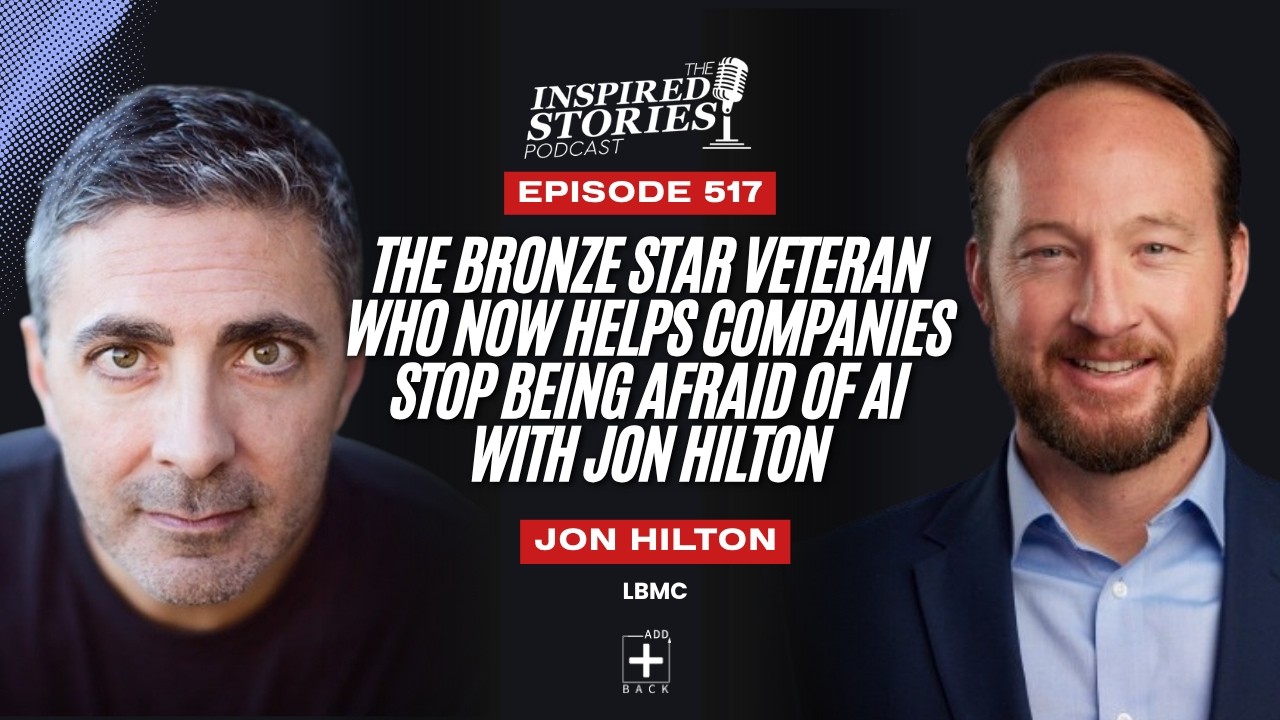
🎙️ From West Point to ExxonMobil to AI Practice Leader: Jon Hilton’s Unconventional Path
Jon Hilton, shareholder and AI practice leader at LBMC, earned a Bronze Star in Iraq, spent over a decade at ExxonMobil managing capital projects across the globe, then walked away from that security to earn a master’s in data science at Berkeley — all while raising four kids. What looks like a series of bold pivots is actually one continuous story about doing hard things, building the right team, and leading through uncertainty. Now he helps middle market companies stop experimenting with AI and start getting results.
✨ Key Insights You’ll Learn:
West Point and two tours in Iraq: training, grit, and the next right step
11 years at ExxonMobil’s global projects organization — $40B+ capital programs
Pursuing a Berkeley data science master’s while working full-time at ExxonMobil
Why AI transformation is a leadership problem, not a technology problem
BCG study: 75% of CEOs at large companies are the primary AI decision-maker
AI use case ROI stacks — the real value starts at use case three, four, and five
Sales call coaching agent: AI listening to every rep and generating coaching reports
Patient care coordination agent: identifying fall risk from unstructured conversation
Audit agent: comparing narrative reports against financial data for discrepancies
Why hallucinations are declining — and why a human in the loop still matters
🌟 Jon’s Key Mentors:
Thermodynamics Professor (West Point): Recognized Jon’s aptitude for math and redirected him from political science to engineering
Zacher Hussein and Fazl (EY): Taught Jon how enterprises actually approach AI strategy and change management at scale
Dr. Charlie Pegian (LBMC Colleague, former Belmont/MTSU Professor): Co-developer of Jon’s problem-first AI framework for client engagements
His Wife: Held the family together through two Iraq deployments, expat assignments in Norway, France, and England, and a Berkeley master’s program — the unsung hero
His Combat Brothers and Sisters: The community that made the hardest years survivable
👉 Don’t miss this conversation about what leading through fear actually looks like, why the middle market is falling behind on AI, and what a West Point education and two combat tours have to do with building an AI practice in Nashville.
Listen to the full episode here
Transcript
Anthony Codispoti (00:00)
Welcome to another edition of the inspired stories podcast where leaders share their experiences so we can learn from their successes and be inspired by how they've overcome adversity. As you listen today, let one idea shape what you do next. My name is Anthony Cotaspoti and today's guest is a West Point graduate and earned a bronze star in Iraq, then spent over a decade at one of the world's largest energy companies before deciding that was not the destination.
It was the training ground. He walked away from his senior role at ExxonMobil, went back to school for a master's in data science at Berkeley, and started over in consulting at a moment when most people would have been consolidating what they already built. Now, that pivot didn't come without cost. Moving from the security of a global energy giant into a field that barely existed in its current form took a particular kind of conviction, and not everyone around him understood it at the time.
He is John Hilton, shareholder and AI practice leader at LBMC, a Nashville based professional services firm ranked number 35 on the 2025 accounting today top 100 list. Serving more than 11,000 clients across accounting, tax, technology and human resources.
John leads the firm's AI and data analytics practice, helping middle market companies move past AI enthusiasm and into real operational results. He also serves on the boards of the Greater Nashville Technology Council and the Tennessee Chamber of Commerce. His story is ultimately about what happens when someone trades certainty for purpose and building something more meaningful on the other side. But before we get into all that good stuff,
Today's episode is brought to you by my company, Adback Benefits Agency. Listen, if you run a business, you are likely stuck in the cycle of rising insurance premiums. You're paying more, but your team is getting less, and many people can't afford coverage at all. We do things differently. We offer a solution that provides your employees with unlimited access to doctors, therapists, and prescriptions that's always free for them to use. Here's the part that surprises most people, though.
Unlike every other employee benefit out there, our program puts more money into your company's bank account. As an example, we recently helped a client increase net profits by $900 per employee per year. Results vary, but gains like that can change how a business is valued. And the consultation is free. Imagine being the advisor that delivers incredible value by introducing this to your clients. See if they qualify today at addbackbenefits.com. All right.
Back to our guest today, shareholder and AI practice leader of LBMC, John Hilton. Thanks for making the time to share your story today.
Jon Hilton (02:55)
Thanks, Anthony. It's been a privilege to join you and happy to share my story and hopefully others will resonate with some parts of it and at least walk away great to know you and some of your audience out there as well.
Anthony Codispoti (03:07)
Yeah, looking forward to it, John. So before West Point, before Iraq, before kind of any of the career stuff, what did the younger version of you think life was going to look like?
Jon Hilton (03:19)
The young version of me always wanted to go to West Point because of my love for history. That's really where it started much of learning about the Civil War and hearing about all these generals, these large battles and looking at World War II and looking at all the names of the leaders that were leading our nation in the fight against.
know, Nazi Germany and landing on D-Day and doing all these great amazing things. And I'm sitting here saying, you know, I really want to serve as well. And my dad was a veteran in the Navy. My grandfather was a veteran in the U.S. Navy during the Second World War. And so I felt like this call to service in the base case as well as, you know, I wanted to be able to do something and be part of something that had so much tradition in our nation. And so I really had my eyes set on going to West Point
and becoming an officer and becoming a leader within our nation's military. And that's really what the calling was on my life to do and was excited for the opportunity. And that's really where the inspiration started for what obviously became a very long journey, as well as a commitment to lifelong service to my country.
Anthony Codispoti (04:34)
Okay, so West Point Academy, right? Graduated from there. You served in Iraq from 2004, 2009, long step, came home with a Bronze Star. What did those years do to your understanding of pressure and decision making under really uncertain circumstances?
Jon Hilton (04:54)
Yeah, it's a great question. Really from that 2004 to 2009, I was an active duty US Army officer. I was in the field artillery. And so, you know, that cycle was not all in Iraq. There were just two tours. And so, you know, it's the cycle of training as the becoming officer, you know, training with my unit, deploying, coming home, deploying again, and then kind of for me was transitioning then out of the military after those five years.
It taught me a number of things. First was on the training side. When you deploy, when you go into combat operations, how you're going to perform there is going to be very similar to how you trained. And so taking that training and taking the crawl, walk, run, even today in business, I use that term.
is how do get this people, this group of people that may or may not know each other and really kind of combine them into a team. And you do that very methodically and you don't try to do the most complex thing first. You really start to do the things that you know how to train on and then you increment up your training as you go. So then obviously when you're in a combat operation that you can operate effectively. first and foremost, how do you, to answer your question, how do you operate under chaos and pressure is you rely on your training.
what's going to come naturally. It's going to be the actions and the decisions that you make are going to automatically go back to that. The second part of it is learning to filter out your emotions versus having a clarity of thought. so you know you are going back to your training you want to put yourself in a pressure cooker. You want to put yourself into some very intense situations so that when that happens to you you know
what part of that is reacting versus what part of you is just saying, I'm going to go make a decision here. And so that's really what that taught me is to train well to how to keep your mind and your body in control in those tough situations. I really, the last part of it was just to think through what is the, you and I use this just generally in life is what's the next right step. If I start thinking about hypotheticals upon hypotheticals, I want to think through what's going to happen. want to plan.
what potentially could happen and then when I start executing, I'm going to start executing on that mission but I'm also going to be making sure that I'm taking incremental steps in the right steps in the right direction that I want to go to achieve my objective.
Anthony Codispoti (07:27)
So you need to sort of think about the big picture, what the next 10 steps could look like. But ultimately, the big decision that you're making in the moment is what is the next step? What is the best next step?
Jon Hilton (07:37)
Right.
That's right. And that's one lesson as always, when something happens, what are the first things I want to do? I want to make sure, are my people safe?
and what are we going to do or what's the imminent threat around us? What are we going to do about that? And those are just very initial reactions. And then maybe getting on the radio saying, here's what's happening, communicating quickly and not getting lost in too many thoughts about eight different scenarios that may envelop you. It's knowing what you know and trying to make the right action. And that moment is very pivotal.
Anthony Codispoti (08:12)
So here's the thing that I want to better understand as somebody who has not been in the military, who has not seen, you know, live service action is I know that you go through a great deal of training and you're trying to replicate those pressure cooker situations, but how does that actually play out? You know, like you can only do so much in training to try to replicate the live fire action of being in battle. Like when you actually step into the
battle zone for the first time. Do you feel like you're ready for that?
Jon Hilton (08:47)
I don't think anybody feels necessarily ready. It's just a matter of saying, this is what I've been asked to do. This is what I've been, this is my duty. I need to step in here and then I need to be a leader. So when I'm in charge, I'm going to take charge and I'm going to make the best decisions based again on my training and on the leadership training that I've had for years. And I don't think anybody's quite ready for any intense moments that you're going to have or just.
Anthony Codispoti (08:50)
Okay.
Jon Hilton (09:17)
overcoming fear, overcoming adversity and in those moments where it is very, very intense, it does become reactive and you're just doing what you've always again trained yourself to do because that is what is going to allow you to be to just quickly make decisions but no one's ready for that moment other than just trying to do your best to prepare yourself for those moments.
Anthony Codispoti (09:47)
What is the pin that I see on your lapel today?
Jon Hilton (09:50)
so that's my West Point pin. I wore this to an event recently and so I didn't do this intentionally for a podcast, but I ended up wearing it. was just a jacket I picked out today. I'm going to a veteran event tonight as well. So that was part of the reason why I wore it.
Anthony Codispoti (10:05)
Great. I think we'll probably come back to your military service at some point, but just in case we don't, I want to say thank you for your service before we move on.
Jon Hilton (10:12)
I
always say it's an honor to serve and I still encourage young men and women to, that's part of their...
mission or something that's on their heart to pursue it. I always say, regardless of politics, I think everybody can look at our country and say, is it still worth defending? And I think there's always a resonating yes. My wife came up with that question and with other parents of high schoolers and when people are asking, should my son or daughter serve? a lot people have a lot of extraneous reasons or politics or whatever. We always come back to that question. Is our country still worth defending? And so again,
I thank you for that and for those that are considering it, I was still encouraged today to serve.
Anthony Codispoti (10:57)
I appreciate that. Thank you, John. So moving forward in time, you join ExxonMobil, stay there for over 11 years. It's a pretty lengthy stop. What was the work that really had you engaged there?
Jon Hilton (11:11)
That's really how I got into this data and AI space. We were initially put into the ExxonMobil Development Company, which eventually became the global projects organization. And that's doing major capital projects around the world. These are not small projects. They're 500 million, 800 million plus. And the largest one I was on was...
think you know $40 billion plus type of capital investments usually in foreign countries, remote locations, the difficulties around logistics, the technology is you know people think of oil and gas sometimes I think they are can be misinformed on the level of technologies required to install and build these types of facilities and so it takes a large team to really run these projects so I was part of one of those
teams and really where I got into the side of was project control was lot of analysis over cost, schedule, productivity.
change management, estimating impacts. And so you really had to think through a lot of those parameters. And so I started to do that and be in that part of the organization. And it was fascinating because I got to live around the world at different places. I lived in Norway, I've lived in France, lived in England. I did, I would say to be fair, I said yes to a lot of different assignments. I said yes to Kazakhstan. I said yes to Saucon Island,
various reasons they didn't work out and I got some really good assignments but we were able see a lot of the world and I was able to travel to different parts of the world as well and so it was a fascinating experience. It really taught me a lot about how a discipline organization runs major projects and how they do it with a lot of execution discipline and again really that's how I got into data and AI.
Anthony Codispoti (13:04)
And so at some point when you're at ExxonMobil, you decide that you're going to go back to school for a master's in data science at Berkeley. So the data science work at ExxonMobil preceded the pursuit of the master's degree at Berkeley. Is that right?
Jon Hilton (13:11)
That's right.
Well, little, so I did it simultaneously. So there was an opportunity, Berkeley had a program where you could do a lot of it asynchronously or really through an online program. But it was still quite a rigorous program. My wife would tell you that as well. know, four kids in a very, ExxonMobil's not a...
Anthony Codispoti (13:25)
Okay.
Jon Hilton (13:42)
I say by the works they would say, it's not a place where you put up your feet and it's a very demanding organization in a good way, I would say, looking back, a very good way of really asking their people to do a lot. And so it was a very trying time from that angle. But really what drove my decision was it was about the time where I was deciding maybe I should get an MBA, maybe I think about a graduate degree. My background was in engineering.
the field of study in nuclear engineering. I loved math, I loved some of these more advanced things. And so it was about time for me to think about that. The kids were in an age where I thought I could pursue something. And the short story is I was sitting here working through, going back to all this project controls work and this cost and schedule data, starting to learn about data visualizations and how...
They see Excel spreadsheet that I put together had all these formulas and all these tabs and visual little graphs and charts and it was taking forever for it to really you know Compute everything and I was starting to think to myself wouldn't be great if I just learned to code all this in Python wouldn't be great if I could actually build a forecast based on some kind of machine learning model and that's really what drove my decision to say you know maybe it's maybe an MBA or some other degree is not best for me
Maybe it's going back and learning how to do some coding and do some forecasting on data that I already have. And that was the impetus for really what changed my life from that point forward as I explored that. And I'll just conclude with this is, you know, then I got accepted into these programs. UC Berkeley had a program. Cornell had a program. I eventually showed UC Berkeley is a little bit more hands on with the AI piece, especially. But at the same time, I was able to go back to
into the ExxonMobil home office and work on digital transformation from a business side. I was an IT guy. I was actually in the business. And so here I am talking to consultants, talking to, learning about cloud technology, learning about where AI is going and helping drive the organization in that direction at the same time getting my masters. And so it was this really nice point in life where those two items.
were at intersection for me. was learning and doing at the same time and so it really accelerated my career from there.
Anthony Codispoti (16:06)
So going back to West Point then, were you studying math and data science there? I'm trying to, like, how did you like land into this kind of role in ExxonMobil in the first place?
Jon Hilton (16:14)
Yeah.
Yeah. So I mean, I landed ExxonMobil because of my engineering background. a big, you know, they hire many, many, engineers. And so again, you know, I had a field of study in
nuclear engineering. So a lot of math, a lot of math. And so luckily I had a professor. I was thinking about doing political science at one point. I had a great professor one time in thermodynamics. I was sitting here getting, you know, really great grade in thermodynamics. I really understood it. you know, math wasn't what didn't bother me. And I was liking it quite a lot and quite a bit. And I go to this, like, you know, political science class and I was like reading a book and I was doing an essay on it. You know, they were kind of reading.
grading my writing and they're like, know, it's kind of B work. And I'm sitting here going, I probably could read this book on my own and have a discussion with someone. can't, I'm not going to do that with, they're not going get a club of thermo, for thermodynamics where I sit around and like learn thermodynamics. And so he was a good, he kind of identified, know, sometimes in life you'll have people come alongside of you that identify some talent in you and say, you know, I really think you need to consider this. And I'm thankful that, you know, to God that that person was put in my life.
and was great mentor. really, most people understand with AI and data science, it has a lot of math. Like in the background, it's a lot of statistics. so that first, after years of not touching calculus, I had to touch calculus again in my master's program. that was a good thing, to understand that. And then you understand really when people talk about transformer models, they talk about how deep neural nets work.
at the base of it is a lot of calculus and a lot of math. And that's where it was very helpful for me to have that background. it was actually very natural in a lot of ways to get into the data science part of it because of the engineering background that I brought into my grad program.
Anthony Codispoti (18:14)
Okay, so you just partially answered a question I've had rattling around in my head since my own college days, which is who actually uses calculus? You know, for me, when math, there was no numbers anymore and it was all letters and symbols, that was the point where I'm like, I'm out, I'm out. So these are the types of areas, yep.
Jon Hilton (18:28)
You're
Yeah,
there is. mean, and then obviously, if you're in engineering, you know, obviously with engineering, I wasn't a really a hardcore engineer at Exxon. There were people that are mechanical engineers that were doing the engineering for these projects. But you do start to see it and you start to understand a lot of those concepts. That's where it's actually being placed. know, like how what's the pressure intake? What's the pressure out, you know, at the exit of this pump and those types of things. But then as you move into the data science part, you're right. It starts to become in statistics. It starts to become
very mathematical. And so even, you know, everyone uses words in my profession like, would it be great to have these predictive analytics? And I'm like, well, you know, in the background, what you're saying is I need a time series forecasting model, which are built on, you know, regression models. And I tell people this all the time that when they say machine learning, what they're talking about is a lot of math. And most people miss
maybe don't realize that linear regression is machine learning. So all those years of R squared and everything like that, there's a lot of those principles just vastly more expanded upon for some of the machine learning, not the deep neural nets. But that's all a lot of math in the background. so some of the best researchers on AI are these really, really, really super smart math people as well and researchers.
Anthony Codispoti (19:59)
So John, eventually you decided to make the switch to LBMC. Why? What were you looking for in your career at that time?
Jon Hilton (20:05)
Yeah, so I made a stop in between with EY and so I came from ExxonMobil, made some connections there, to EY, was a senior manager and the manager became a senior manager. I had a great mentor there and great leaders, Zacher Hussein and Fazl and others that just kind of, that I learned the business of, you how do companies across the board utilize data? How are they actually going to use this from a strategic standpoint? And really was formulated.
formulaic in my approach. And then I had this organization here in Nashville reach out and say, hey, we have a day to practice. We would like for you to, would you be willing to come on immediately as a partner and help lead it and grow it? And it was just an opportunity space for me to come to, I told my wife, Nashville, Brentwood, Franklin, and she knew about these places already. And she's like, I'm sold. She had never even been to some of these places, especially in Franklin.
But when she heard about it, she'd already knew other people. And a lot of people moved to Tennessee and we were happy to come and we've really, really enjoyed being here. And so it's been a great place for us.
Anthony Codispoti (21:13)
So tell us what is LNBC? What goes on there? Who do you guys serve? What do do?
Jon Hilton (21:17)
Yeah,
so at LBMC, it's a short for lot of more black Morgan and Kane, but they as much like you why they combine the name. It's it's, you know, large tax audit, cybersecurity, advisory, AI data litigation, valuation and all types of other reports. have lot of tentacles. We have also technology solutions. We have some employment partners, some
Anthony Codispoti (21:39)
Lots of tentacles there.
Jon Hilton (21:46)
staffing solutions, really service and really, you know, lot of with, uh, they had some entrepreneurs that really started the firm, um, coming out of, uh, you know, the tax and audit world and they were just entrepreneurs. And they said, Hey, well, every time they would talk to a client and the client would, know, outside of their audit and tax would say, you know, having this problem with, uh, staffing and they would say, well, maybe we can help with that. And so they kept.
You know, as the story goes, just, every time they would meet with clients and clients would say, I really wish I would have this service. They've tried to find a way to meet their clients and service them very much, you know, growing up here in Nashville. and then they expanded to other offices in Tennessee. Now we're in Louisville, you know, Memphis as well. And so really it's just a story of, of, you know, true American entrepreneurship, which was, you know, we're going to help our clients and help the people around us for what we do. then.
We want to have a bigger view of how to help people. And that's what we do still. So from my perspective, help. There's a lot of companies that are struggling with AI and data and trying to understand and make sense of the world that's coming. they don't have necessarily a data scientist on staff or an AI expert on staff or a data expert on staff. And so how do we come alongside of them, partner with them, help them to implement those things and set their vision, set their strategy?
and help them approach this future that's in many ways accelerating extremely fast. And how do you make sense of it all? And that's really our goal and our ambition is I'm not here to sell a product and be here one day and gone tomorrow. It's really about building relationships and partnering people to be winners and adopt into this new era of AI that we're
Anthony Codispoti (23:37)
So I think for most people, their first real big introduction to AI was what was the model? Chat GPT, like 3.0 or 3.53. And then that was like, my gosh, this is the thing I can talk to, I can communicate, like it knows so much, it can direct me. But for folks who weren't in AI, okay, that's the first sort of like AI coming to the real world, but you've been involved with it for years and
Jon Hilton (23:45)
DPT-3, that's right, and 335.
Anthony Codispoti (24:06)
certainly on a deeper level. And so I don't know, can you paint a picture for folks like what AI looks like beyond just sort of the chat GPT or the cloud or the Gemini interface?
Jon Hilton (24:21)
Yeah, that's a great question, Anthony. I think a lot of that's what a lot of companies are trying to realize is what am I going to actually do with this? Most people understand it as like you said, storms onto the scene in November of 2022.
funny, I can write a poem about my dog, can get it to create a rap song with a pirate theme and so it's funny and it starts to this thing where it creates pictures and has some videos. Eventually where a lot of people settle on is search. I can just ask it questions and it's going to give me stuff back and then, by the way, it hallucinates some so maybe I can't trust it on certain things.
And so it really kind of stays in that mode for a lot of people. When they tested in their business, they're about, know, especially right now as of, you know, March of 2026, a lot of people have anchored their view of AI based from a business perspective on what they tried in probably summer or maybe early fall of 2025. And they're still stuck in Q &A, search, et cetera.
What fundamentally has happened is the models that were released in December of 2025 and then the advancements of some of those models here in the early first quarter of 2026, Claude Opus 4.6, the Open AIs, GPT 5.3 Codex.
have made a fundamental shift in their ability to code and code with high, high quality. And so their ability to reason and their ability to actually build code has been a step change difference. And so now you're finding that what people are able to do
actually take an Excel spreadsheet or take something that they thought about as a way that they have to do every day with an app idea that they may have had and they're able to create it and they're able to create it with high quality. And so what's happening now is if you don't understand that context you're kind of lost to why are all these people in tech
getting saying it's really transformational. Why is the stock market freaking out over all of the SaaS products that are out there? And why is everybody talking about all these know potential job losses? And so there's a natural response. A lot of people are in a lot of fear right now. But they still don't understand what it's doing because they can't make the context of why is this thing going to be so transformational?
I would say that the things that if I'm a business leader, to answer your question very clearly, kind of providing that context is this. If you are looking at your day-to-day tasks and they're in Excel, Word, PowerPoint,
Those things are getting highly automated. A lot of business processes are highly predicated on some type of, get an item in my inbox, I need to do X and Y with it, I need to go to this screen and do A, B, and C with it. That world is able to do all that. Or...
I go into this Excel spreadsheet and I got all these things I've built through times and formulas and things that match to this and all of that is you can feed that to a model now and it essentially can say, I completely understand what you're doing in here and I can go replicate that. That world, that's a shift in the world. So there's a lot of this automation that is the potential and the idea is how do you really start to find where you can actually go employ
these AI and AI agents to really streamline that process end to end and potentially kind of return a lot of time back to your people to do other things that they really want to do.
Anthony Codispoti (28:26)
How do we overcome the hallucination problem, right? Because if I'm giving it access to my data, my inbox, like, hey, look for these emails coming in and then perform that repetitive process I used to do. I want to know that it's getting done correctly.
Jon Hilton (28:42)
No, absolutely. number one, hallucinations have gone significantly down.
The early models did hallucinate. Number two is context because the context windows are increasing, getting bigger and bigger and bigger. Context windows is how much information you can feed an AI model on one prop. So when we're talking about a million tokens, we're talking about several thousands of pages of a book that you can potentially just say, here it is, tell me. And so if it has more context, that means it doesn't hallucinate because it knows what it's focused on. So those two things have really, so model improvement and then the context windows expanding.
helped improve hallucinations. The third which I would always represent is that there needs to be a human in the loop. So if you go through an automation process, let's say it's invoice processing, I don't know, or some process that needs to go through.
have a person at the end, let AI do all of the grunt work, know, pulling, extracting information, putting it in these fields of whatever, but have a person go and say click a box, yes, that's correct, yes, that's correct. So if I look at that and let's say a person was doing that every day of their life and they took them three hours to go read something, put it in box A, B, and C, and then move it and then go and put it into system X where they need to put A, B, and C in X.
Well, you can let the AI agent do the vast majority of that and just look at the boxes and go look at the email again and say, yeah, no, this is right. Move it along. Move it along. And so I think that is where the world we're going in is where, where do you have the human loop to validate that it's correct at the most business critical point, check, validate and verify and move it on. That's probably where I think in near term, you're going to continue to see people doing that until these models get so good that there's a trust factor that just says it need to be moved through or there's a
What I'm also saying is...
Where people are using other agents to validate what other agents have done so they kind of keep them independent of each other and they do that but again I would still recommend where we're at with AI today as you're thinking about an end-to-end process is having some kind of validation or if you are doing a lot of that completely automated is doing a sampling every day of if there are any errors and Keeping track of those so you actually can make sure that you're you're keeping a high quality control over that process
Anthony Codispoti (31:03)
Do you think it's possible, John, that we get to a point where there's no more hallucinations? If it doesn't know or it can't give the correct answer, it just tells you rather than making it up?
Jon Hilton (31:12)
Yeah,
I we find that in some of the things we can build, That's exactly what you can do is that you can get a ranking. You can get another agent to rank it and say, hey, look, if you don't think this is accurate, you need to highlight that. Do I think we're going to be there? Yeah, I mean, again, if you really, really look at it, hallucinations have gone down significantly.
Anthony Codispoti (31:37)
Can you give us numbers? Any idea? Okay. Fair enough.
Jon Hilton (31:39)
I'd have to go do some... I need
to make sure I come with that in my back pocket for future talks. But that's always... every new model that gets released, they'll talk about...
hallucinations but it does depend on the context of it as well. How much you've given it and you say only do it based on this. that you know and that you feed it you know ten pages of something. that's you hallucinations are becoming something that's less and less common and then people say well yes but what if it's the biggest business process I have and it hallucinates. I would again say well if you're really that concerned about it then
then you need to probably just have a person look over. And again, I would challenge someone to say, why, you if the process takes that long, just let it do the process, but have the human check it at the end. Surely you'll have immense amount of time savings by just doing that alone. So you have some level of confidence to automate it perhaps fully.
Anthony Codispoti (32:36)
That makes a lot of sense.
Yeah. So John, you came to LBMC in 2022 specifically to build out the AI and data practice from the ground up. Tell me about what the like an engagement with LBMC looks like now. What kind of results are clients seeing?
Jon Hilton (32:58)
Yeah, we see great results. my mantra to a lot of people, especially you mentioned in healthcare, so I'll use healthcare for instance. A lot of times the issue that I find is that business stakeholders and leaders don't get out of data and AI what they want.
And what that means is the CIO or the IT department may have hired people or built things, but they just aren't answering the questions. So the finance team looks at it and says, no, you don't understand what I'm doing. And they just give up on it and they go and keep in their Excel spreadsheets because they'll say,
you don't understand what I'm doing. And then, you know, the tech people are pretty good at building tech and they'll build and build and build and sit around for 40 hours a week for 52 weeks a year doing things that the CFO is going to look at and go, you still guys, you still don't understand what we're trying to get out here. And so we try to come in and fill that gap. So what we try to do is say, you know, let's get out of the Excel, let's get out of all of this data munging and kind of working through multiple data systems and let's find a way to automate
this end-to-end, integrate data across multiple disparate systems, and actually produce metrics and reports that matter to the business stakeholders, whether that's the CFO or operations or wherever sales, wherever it may be that's actually useful. And so that's what an engagement looks like for me is where do you have data? You're just not getting the answers you need from it, but know that you could get that and where is your team spending a lot of time where you know you can just automate this. So finance teams usually
enjoy our work because we can step in and we understand health care data, we understand other utility data, whatever it might be, we're able to bring that picture to life for those teams that allow them to literally save hours.
out of their week and most of your teams, again, they want to do things that are higher level thinking. They want to do strategic thinking. They want to see where the errors are or the issues are in their business and go tackle them. They don't want to spend their time just pulling together the picture. And so that's what we try to focus on and build out. And so for us, it's a lot of data bricks, if you're familiar with that. So data warehouses, data lake houses, that's what we build day in and day out. And then now in the AI era,
we're building out AI agents as well to build some of the automation and the actual process itself.
Anthony Codispoti (35:26)
Can you go through one or two specific examples of an AI agent that you've built for a client and the problem that it's solved?
Jon Hilton (35:33)
Yeah, I'll give two. The first one was we have a bunch of sales agents. Where is that agents? Here's the literal sales people that were on calls. And let me rephrase that. They were more like customer service representatives. And so when someone was calling in for a new line of service, they wanted to make sure that everyone was asking them about this other line of service that they have.
Anthony Codispoti (35:42)
Humans or the AI?
Jon Hilton (36:02)
And they just weren't quite sure. so there was a manager that could listen to every phone call or maybe sample them. And then they would go back to that person and say, well, listen to these phone calls. And this is where you're.
you didn't mention this other service line. yeah, know, shucks. And some were performing well at selling and some weren't. And so they were trying to get a picture and understanding of how they could actually coach their salespeople or these customer service representatives based on all their calls in a week of what they were or were not doing or what they could be improving on. So it was a bit of a, I don't want say report card, but it was really about coaching. It wasn't meant to tear anybody down. It wasn't about eliminating anybody. was just, how can we get better?
And so AI can listen to all the calls and can get transcripts of all the calls. Did the person ever talk about...
this particular service line offering that we have and yes or no, know, how many sales did they get percentage wise because you can listen to a call and say it knows whether there's been a sale or not a sale and then did they use this playbook for a sale, etc. So they would kind of take that take it to a time period. Now the manager doesn't have to listen every call. They can if they still want to. But at same time they can take that and hey here's some of the feedback we saw this week. And so that helps coach people and really put some accountability on
We really do want you to sell this other service line. We just need to make sure you're doing it. And so it allows that. And the other one very similar and I'll add a third on here. Another very similar was patient care coordination.
We have people that are calling people that just came out of the hospital. The biggest problem we have in healthcare a lot of times is that people come out of the hospital and they have issues and they don't follow the care they're to or do the right follow-ups and they end up back in the hospital. If they're in Medicare or Medicaid, that really costs taxpayers and a lot of money goes into that. a $15,000 to $30,000 hospital visit or
someone just needs to go see their doctor or get this preventative medication and that's, know, $200. So the idea is sometimes hospitals will hire patient care coordinators to call people and say, hey, are you following your medication? How is your health doing? Have you scheduled your appointments? It's a simple thing that you call someone in a week and it saves all this money. And so essentially what we did is similar, you know, what was the call about? It keeps a history of the call. At one point we were able to start to say, based on the call alone,
and you could actually put them in a risk bracket. For instance, falls is a big issue. Did you know that some of the biggest risk for a fall is a rug and a pet?
And so the person might doesn't need to go off of a checklist to say, know, Bill Smith, do you have a dog? Do you have rugs in your house? You're just listening to a call and people are giving you context about what's going on without asking the direct questions. And those kind of that context gets captured in a way and routed through a machine learning model that now says that the person's a high risk. Next time you're on a call, ask them about some of these other preventative safety things it could do.
And so that's the age we're in, right? Where a lot of what we're saying, a lot of what we're reading or have is context to help us understand what could happen. And the third one I'll do, and I don't want to get too long-winded, is we're trying to build an audit agent where...
A company may be reporting in written form, all of these great things they're doing, but their structured data and their financial data may be not saying the same thing. And so you're trying to compare what's been reported in written form in a kind of a narrative format versus what's been actually in their...
and structured kind of in a financial system. Now again, most companies would say, well, that doesn't make sense because I know we're all just one big company, but there are companies out there, especially in private equity, that may own a number of companies. And so they're trying to gain an understanding very quickly. so, you you can audit these things or, you know, you could be in a situation where you're testing what's in one data set versus another data set and really letting an agent kind of look between the two of them and identify
you know, where you may have issues.
Anthony Codispoti (40:28)
How often do clients come to you and they say, John, here's what we want built, go build it versus, John, here's the mess that we have, what ideas can you propose?
Jon Hilton (40:41)
Yeah, usually it's messy. But companies usually come and say, I have a problem. Or they know about AI and most companies intuitively, if you ask kind of a leader or anything like that, what they believe is a core pain point in the organization, they'll immediately come with like three. They'll say, oh, know, this is a problem, this is a problem, this is a problem.
So usually I focus on that and I work a lot with my colleague Dr. Charlie Pegian, is a former professor at Belmont, MTSU, Middle Tennessee State University. And we start off exactly like that saying, AI needs to solve problems. Don't just do AI to do AI. Really you need to think about what are the problems my organization has and what do need to do to fix it? And so a lot of times people come in and they have an understanding of what...
what they want to go do. Now sometimes it takes some coaching and if they need to step back you'll do an AI strategy. That's another way to do it to elicit a lot of stakeholders feeding back what may be the pain point. But intuitively leaders know where their people are spending a lot of money a lot of time and you in a lot of pain. So that's usually good places to start.
Anthony Codispoti (41:54)
So you've said publicly before that AI transformation is not a technology problem. What do you mean by that?
Jon Hilton (42:01)
Yeah, it isn't. It's a leadership challenge is what I say. It's not a technology problem. so it's leadership challenge. What I mean by that is even just that comment, that little segment we just had there, there are problems and pain points in an organization. AI, the technology is proven. We know what it can do. It's just a matter of applying that to the problems and having the courage to...
formulate out a strategy by which you are going to say, we're going to apply AI into these problems. And we're going learn by doing. And in fact, what we're going to see is if we don't sit around and we actually start moving on AI.
that our highest value is not going to be in our first use case. It's unlikely even to come on the second use case. We started out about three, four, five, and six use cases. What the reporting is showing is that is the ROI starts to take off as soon as you start to stack AI use cases. So it's a leadership challenge because a leader has to look at it and say,
I know I need to start moving on this. I know I need to identify where I need to start moving on this and I need to get moving on it in terms of getting these first, second, and third. The cautious leader will sit back and wait and say, I'm not ready for it. They'll listen too much to hallucinations. They'll come up with a thousand reasons not to do it. But the leader says, I know I need to do it.
They can do it, they can do it safely, they can do it securely. There's ways to do this without exposing your data, without your data going to get trained on other models. But it takes that leadership and that courage to do it because it's going to be transformational. every time that there is...
need for transformation you have to have courage in your leadership to go make that transformation because you can't look back you're not going to be able to look forward in the next two to three years and believe that your organization is going to be exactly the way it is.
it is going to change and a leader that's a hard decision for a leader and so those are some of the premises I make for why this is a leadership challenge and in fact that data is getting backed up. BCG did a major study they did a radar study and I think it was 4q of 25.
And there was two really fundamental statistics that stuck out to me. And these are larger companies. these are, you know, they're 2400 executives that they polled at very large companies. And two things stuck out. Number one is that three quarters of those companies, the CEO is the primary decision maker on AI. So you step back and you say, okay, why is that?
because it's one of their top three transformational strategic objectives for the year. And so again, if you're in a company, you're like, well, I wasn't surveyed in that or I'm middle market or I'm upper middle market. You need to be thinking really hard as a CEO of why are these companies that are significantly larger than me? Why are they so involved? I I know no CEO has all kinds of time in the world, but if those CEOs find it that transformational and they're running that larger organization, why?
it that I'm not personally involved in the AI strategy and mission of my organization. That should be a wake-up call. That should be an alarm bell going off in your head saying, why? What world would the CEO of a large Fortune 500 company find it necessary to be involved in this, but I'm not? So number one, that's it. And the second one is that, you know, they are not looking at this and saying, I'm gonna pull back spending.
Those companies said they're going to double their spending in 2016. Double their spending in 2016.
Again, that takes courage, it takes leadership because what's the most precious resource you have in your company is your people, your time, and your budget, your dollars that you have. And so you are going to have to start laying this out and start investing in this as part of that. So that's why I view it as a leadership challenge because leaders are going to set budget, they're going to set priority, and they're going to take their time, energy, and effort to lead this transformation.
Anthony Codispoti (46:14)
Interesting.
So the very first company I started back in the mid 90s, we were doing web development and a lot of our conversations were around explaining what the internet was and why people should care about it. And it sounds like we're in a similar stage, maybe a little bit further along with AI today. So somebody who's listening, they're in a position of leadership and they're saying, I kind of get it. Like we should probably be thinking about AI, but I don't even.
Jon Hilton (46:28)
Yeah.
Anthony Codispoti (46:49)
have a concept of what it could do for us. What do you tell?
Jon Hilton (46:55)
Anthony, you're spot on. What you're saying about early web development and what is the internet and how does it operate is the world we're in. And that's not to be trivial on someone who's a leader saying, I got a lot of things on my plate today and understanding AI.
is key, but I don't, I'm with you, I don't really understand it. And that's okay. First is, it's time to probably really dive in as a CEO or C-suite and start thinking about what is this technology from a business application standpoint, not what I use it at home for. So A, number one, would be getting educated, finding the right partner that's going to come in and help you form your strategy. I say that selfishly, I am a consultant, I do AI strategy. But I do think it's a
I mean, it's unlikely if you don't have someone in your organization that knows a lot about AI, that you're just going to pick them, pick a person in your organization. Like, please don't go grab the 25-year-old in your organization that played around with chat GPT at home or open claw and is like, you're our AI strategy lead now. They haven't really done a lot. Seeing how enterprises change, how change management works, how you strategically approach AI, you might be making a mistake. Yes, they might have some personal AI skills.
but it's unlikely that's going to be your best bet to truly perform a strategy vision and go execute it at an enterprise level with safe, secure architecture behind it. So that's first, is find your partner. And then really for those leaders is starting to implement it in the organization where you can see early gains. And so we're seeing is, you need to pick your horse. that for your individual productivity?
AI. So I tell every organization you need to pick Copilot, Gemini, Claude, Chachapiti. By the business version, use X amount of licenses out there in your organization for people that are going use it and start seeing, know, give them the training needed and say this is your remit to do to really start to improve in your area. And so those are some ways that a leader can do that. And then it's now time to start thinking about
What use cases are we going to implement that are high value that aren't just you know I can go to go build a little you know I'm going to do something in my own chat to you. What are some some automation processes that we could go do much like we talked about earlier?
Anthony Codispoti (49:22)
trying to think of how I want to ask this next question, John, because I talked with a lot of business owners and a lot of folks are excited. Some are afraid. Some want to try it. They want to kick the tires. But they're still having a hard time wrapping their head around, what can it do for me? Or can it do anything for me is what some people are asking. I don't know. Is there some kind of a mental checklist where it's like, if your business checks
any of these boxes, then yes, there's something worthwhile with an ROI that it can do for you.
Jon Hilton (49:58)
Yeah, that's a great question.
I would start with this. I would look, I would do an audit. If I was CEO, I would go to one or two of my functions that I really, I think are important in my business. And I would just look inside of the computers that either I use personally or my key direct reports or my teams are using. And look at that and look at how much Excel, how much PowerPoint is being done now.
how much email back and forth is being done on a business process that I need to run my business. If you can do that audit, I would say the vast majority of that work likely can be done with an AI agent now.
Anthony Codispoti (50:43)
Excel, PowerPoint, and lots of back and forth email internally.
Jon Hilton (50:47)
even work. Every single organization should have contracts. You likely have your own standard NDA, you have your own standard MSA, you get contracts that come in the door. Who's reviewing those contracts?
I do this all the time. I have a standard MSA. I get a contract. I say, here's my MSA. Here's the contract that someone wants me to sign. Compare and contrast the two and tell me where I have high criticality of clauses that aren't aligned to my typical MSA. And tell me where on this contract it doesn't meet industry standard. And tell me any other clause you think is out of the norm in general.
it will come line by line and say this clause doesn't have you lie you have caps on limited liability this one does not this is high-criticality indemnification is not mutual it is and so I just that's a use case of when people say how's it gonna help me
Well, I mean, there's all that. I mean, and again, I had an Excel spreadsheet. I would do a lot of revenue tracking and doing some other things. I simply put it into Claude. I was able to make that same spreadsheet in a much more neat way with Claude. And then I said, well, let's build an app for it. And it built a very nice app that actually can go in and edit things. And so that's what other thing I think about is what are small things that people are doing that are
you know, business critical that don't necessarily need to have all this like nasty Excel with it. How about we actually go and do some of that? And so those are just a few. They're all over the place and I'm probably a smaller company. Now if you're a bigger company, I think you need to give a hard look to a process. lot of invoice processing still is highly manual. Someone gets an email, they log information, they put it over here, they put it over there. A lot of that can be
quickly kind of maneuvered through.
Anthony Codispoti (52:53)
John, I'm gonna shift gears on you now. I'd like to explore one of the hardest things that you've ever had to overcome personally and what it taught you.
Jon Hilton (53:02)
Yeah, I I pointed to two things. First one was obviously, you know, my time at West Point, you know, learning how to run marathons and not sprints. I'm talking about mentally, emotionally, physically. There is, it taught me a lot of grit of.
There's going to be people that are smarter than you. There's going to be people that are stronger than you. There's going to be people that are better at all kinds of things than you. And a lot of times you're put in a mix with all of them. And sometimes they're all of those things. They're smarter than you. They're stronger than you. They're faster than you. And learning that it takes a team and people working together to overcome obstacles. You can get through
more mentally and physically than you ever think you can. Those are some of things that I learned in that.
You can just wake up every day and take another challenge on every day. And you will not, you cannot look, if you are a plebe at West Point, you cannot look at your life and say,
I have four years of this every single day. You will start to crack, you'll start to break and you won't be able to finish. So you have to say to yourself, what's the next mile marker? What's the next step? What's the next mile on my march? Because that's all you have in front of you. So that's number one. And some of that too, and I'll transition a little bit, the second one was my second tour in Iraq. Where I was, had...
You know, just got back from Iraq in November of 2007. And I, during that, so I'd just spent a year there and got back. I was married at the time. My daughter was born in April of 2007. And I'm sorry, I got back in November of 2006. So my daughter was born in November, April of 2007. And then I was back off to Iraq.
in November of 2007. So November 2006, November of 2007, I had a year home back again for this time I was 15 months. And I remember being and sitting down for Christmas in Iraq in December of 2007 and knowing and this is my daughter's first Christmas.
knowing at a full year ahead of me and that stuff.
leaving your wife and your daughter. But it taught me that you have to do hard things and sometimes those hard things take a lot of you and you have to do your duty because other people are relying on you and you made a commitment and you have to honor those commitments.
and have to lead when you're asked to lead, even though you don't want to, even if you don't want to get on that plane. Sometimes you don't have a choice and that's because yes, you could have a choice and just say no, but doing hard things is part of life. And sometimes the greatest challenge you have is that. then, you know, obviously through that experience, you know, watching the wounds of war, people and classmates, that's hard and learning at the end that people are still surrounding you and that even if you go through a hard thing, there's always
people there to help you if you build community and if you don't find community find people to help you and
And just, you for me, it was trusting God, that God had a plan and a purpose, you know, through all that. And I apologize for getting emotional. I told you this earlier, Anthony, when you said this, you know, this is, this is a hard part of my life. And I do it just to say, not to look at me and play a victim card by no means, just to say, you know, other people are going to face hard things in life. And this is what I tell my teams is really, it's a lot of life is about gritting, you know, having grit to overcome and putting one foot in front of the other. And, you know, even my daughter, you know,
when I coach her is these things are what are going to make you. Being in pressure situations are going to make you into the person you are and the leader you are. And don't discount that going and doing intentionally doing hard things is how you really grow in life. And so those are probably the two.
things that I would point to and it's another reason my wife and I continue to support veteran issues and veteran causes. A lot of veterans still have wounds of a war that are physical, are hidden.
Those are things that if people need help, there's a lot of resources, like try to find that help. Don't have to be a hero and hold that all inside. And that goes for anybody as well. so always being careful with your mental and your physical health is key. However, I think the lesson learned there is again going back to...
doing hard things is hard, but a lot of times it really does make you into a stronger person and a better leader, usually.
Anthony Codispoti (58:46)
Any specific veteran causes you want to give voice to today, John?
Jon Hilton (58:50)
Yeah, think, you know, operate here in Nashville, like where I live, Operation Stand Down does an amazing job of connecting veterans to job opportunities. If there's homeless vets out there, it'll help that mental health as well, helping get through some of VA programs. So I have a lot of respect for what Operation Stand Down does.
And that probably is the biggest one obviously here in the Nashville community and trying to think of any others that are around but obviously the VA offers a lot of help to veterans as well and so that's another great organization to be able to connect to. Sometimes it's difficult but there's a lot of organizations too that can help you manage through that some of that process but that's probably one that comes to mind right off the bat Anthony.
Anthony Codispoti (59:37)
So your daughter's born, right? You leave to go back to Iraq, her first Christmas, you're sitting there, away from her, away from your wife, your newborn child. It's really hard, and we could see you get emotional just thinking about that time. What helped you get through that time and the next year that you had in front of you?
Jon Hilton (59:38)
Mm-hmm. Yeah.
Yeah.
Yeah,
yeah, that's a great question. Number one was my faith, believing that God had a purpose in playing for my life. it's what I chose, you it's a path he put me on and a path that I could get through. Number two is my wife and my family. Obviously, you know, she was a strong supporter. She never wavered in her commitment to.
to supporting me and in so many ways, I think so many spouses, it's oftentimes that veterans stand up and people applaud them. Oftentimes, people perhaps don't know that there was a spouse that was there taking care of kids.
taking, know, keeping life going while their, you know, loved one was away. And it even right now, and we're sitting here in March of 2026, we have, you know, men and women.
you know, sailors and airmen and soldiers that are doing very dangerous things in Iran. And there are wives and husbands and kids that are back here in the US not knowing what's going on, not knowing how long this is going to be. And in many ways, they're the real, they're heroes as well for the sacrifice they're making for our country.
And so those are the two biggest things. And then obviously my friends that were with me and around me were really instrumental in keeping me going because you're all going through it. so you know, it can't be the person that's like, know, woe is me. Other people are, you they're struggling through. when you know company has been, know, misery has company. You do have your brothers and sisters that are there with you in arms that are also going through the same hardship. And that's a blessing. And so those are the
the three things that would say is that helped me through that time. Again, like I said, I was in that Christmas, I was staring down, I like, I'm not even going to see my family next Christmas. But luckily,
You take one day at a time, one step at a time, and step back in every day, bring yourself in to be a leader and do what you've been asked to do. Is any advice I can give to anybody going through a difficult situation? And then at the end of the day, know, one thing I've learned is
You know, your feelings don't control you. What you feel isn't what's true and what you feel isn't what you have to think. And so a lot of times it's a matter of understanding that and still going in every day and performing your best because you've been, it's who you are. You're a leader. You're asked to perform a duty and you do it to the best of your ability.
Anthony Codispoti (1:02:46)
What do you mean by that? What you feel isn't necessarily true or it's not who you are.
Jon Hilton (1:02:52)
Yeah, what I mean by that is...
Just because I'm feeling anxious. Just because I have these thoughts of what if, if I have thoughts of, you know, oh, how long is this going to be? Those, you know, those thoughts and those, they can make feelings inside of you, but they're not necessarily, you know, truths, which is, you know, I can make it through. I'll be able to make this through. I'll be able to do what I have to do today. I'll...
That's what I mean is trying to put some of that, feelings, those feelings are gonna come and go, just being, thinking through those and try to focus on what is actually true is I think that's what I mean by that. But that makes sense if that's too ambiguous too. I'm happy to unpack that a little bit.
Anthony Codispoti (1:03:37)
Makes a lot of sense.
I'm
with you. John, I've just got one more question for you today, but before I ask it, I want to do three quick things for the audience. First of all, if you want to get in touch with John, what's the best way?
Jon Hilton (1:03:45)
Yeah.
Yeah, best way to get in touch with me is connect me on LinkedIn. That's probably my best way. It's, you know, obviously you might find my name, John Hilton. LBMC is where I'm at here. And so you can go ahead and look me up and, you know, everything. You got my whole history from this podcast. So you can just validate that. I don't think there's many others out there that spelled this this way, but you know my history. So you should be able to quickly identify in my face.
Anthony Codispoti (1:04:09)
And we'll have a look.
J-O-N Hilton L-B-M-C, search for that on LinkedIn and you'll find him, but we'll also have a link to his profile in the show notes for folks. Speaking of the show, if you're enjoying it today, please take a moment to subscribe wherever you're listening. It will also send a signal that helps others discover our podcast. So thanks for taking a quick moment to do that right now. And as a reminder, you can be the hero advisor that helps clients give their employees access to therapists, doctors, and prescription meds while...
paradoxically increasing their net profits, real gains that can change how businesses value. Contact us today at adbackbenefits.com. So last question for you, John, a year from now, what is one very specific thing that you hope to be selling?
Jon Hilton (1:05:09)
year from now, would say almost like one and
few months from now, probably gonna be my son graduating high school is another one that we have another that's about to graduate next year. So I hope to be celebrating him and excited for where he wants to go. He wants to go to West Point or be in the military. which way I'll be excited for whatever path he chooses or what's opened up to him. I hope to in May of 2027, but also a little sad, obviously every time one of them leaves the nest, you always remember.
what the past 18 years has been like. But we will be celebrating that and obviously another year, not at this point, but another year of marriage to my wife and just keeping our family going.
Anthony Codispoti (1:05:58)
Yeah, I actually do have a follow up question because I really resonated with something you said before about, know, trying to teach your kids and understanding that you can do hard things and growth comes from doing those hard things. Obviously, you you learn that by going through something very, very difficult yourself. How do you teach that to your own children?
Jon Hilton (1:06:25)
Well, number one, we tried to live it. We tried to live it by example with a lot of those expat assignments that we went on. Those weren't easy, especially on my wife. My youngest son was born in France, but we made those intentional decisions. We had a little motto that we kind of keep is, Hilton's do hard things. And we tell that to our kids, so they're thinking, obviously you can use your own last name, all means, steal it and take it for your family.
What we try to use that theme is we're going to these places. We're going to go to expat assignments. We're going to be saying yes to things that are scary sometimes or uncomfortable, but we're going to do it. And so even now when my kids go and do things, I always say just, you know, but do it like completed, you know, when calculus comes and it's really, really difficult. It's like, yeah, do it.
Don't be scared of it. It's gonna be a lot of work. It's gonna be tough. There's gonna be some things you don't understand. But do it. Go to wrestling and go through these practices.
Make them tell you that all you do is do your best and trust the results to God just dress the results to Be what they are, but all you can do is just put your best foot forward and and so You talking about that. Yeah, you're gonna get on that wrestling mat. You're probably gonna get beat you You are gonna get beat But you got to do it go through it. You're gonna be a better person on the other end of it
So always encouraging kids to do things that there's a likely outcome they're going to fail at any point and they will fail and allowing them to fail and allowing them to go through a difficult thing and not necessarily having to always be there to.
scoop them up and pick them up. That's been some of the philosophy we've had. We're not still very kind parents. I'll still give my kids a hug and even if they get off wrestling mat, I'm not berating them for losing. I'm just proud of you for getting out there. I think that's the approach that we take to it.
Anthony Codispoti (1:08:26)
Love it. John Hilton from LBMC. I want to be the first to thank you for sharing both your time and your story with us today. I really appreciate you being here.
Jon Hilton (1:08:37)
appreciate Anthony and the joy of the time together and just the opportunity to share my story.
Anthony Codispoti (1:08:42)
Awesome. Folks, that's a wrap on another episode of the inspired stories podcast. Thanks for learning with us. And if one thing stood out, put that into action today.
Connect with Jon Hilton:
LinkedIn: Jon Hilton — LBMC
Website: lbmc.com