
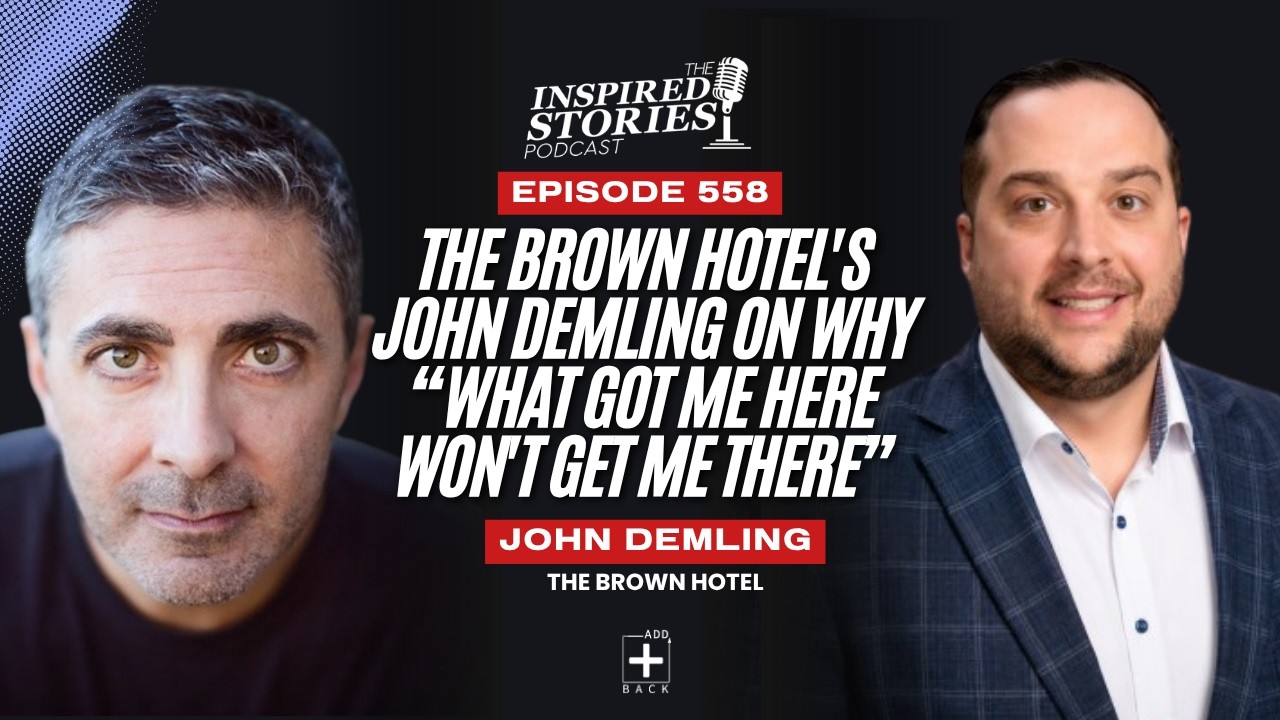
🎙️ From Teenage Dishwasher to Running a 100-Year-Old Louisville Landmark: John Demling's Journey at the Brown Hotel
In this episode, John Demling, General Manager of the historic Brown Hotel in Louisville, shares a career that started as a 14-year-old dishwasher and has spanned nearly every role a hotel has to offer. John opens up about a nine-day job loss that turned him into a stay-at-home dad, the mentors who shaped how he treats his staff, and what it takes to run one of the largest convention hotels in the country.
✨ Key Insights You'll Learn:
Started as a dishwasher at 14, never really left hospitality
Talked his way into a hotel job before he was old enough to work full time
Won Hotel of the Year turning around an aging property with no renovation
Lost a managing director role after just nine days
Became a stay-at-home dad while his wife returned to nursing
Took a revenue management role covering over 2,000 hotel rooms to rebuild his resume
Named GM of the Brown Hotel within his sixth day on the job
Believes “what got me here won't get me there” as hotels scale up
Prioritizes being approachable over standing on ceremony as a leader
Aims to make the Brown Louisville's most desired destination again
🌟 John's Key Mentors:
His Father: Modeled a relentless work ethic and putting people before profit
Richard Pennyman: Taught him to take ownership of every standard in the building
Michelle Stephens: Regional leader who invested in him early and pushed his career forward
Jonathan: Culture-focused manager who showed him how to organize a business intelligently
👉 Hear how a teenage dishwasher became the general manager tasked with reviving one of the South's most storied hotels.
Listen to the full episode here
Transcript
Anthony Codispoti (00:00)
Welcome to another edition of the Inspired Stories Podcast, where leaders share their experiences so we can learn from their successes and be inspired by how they've overcome adversity. As you listen today, let one idea shape what you do next. My name is Anthony Codospodi, and today's guest has spent nearly his entire working life inside hotels, starting as a dishwasher at 14 years old.
The only two stretches he stepped away, one in banking and one behind a jewelry counter at Tiffany and Company, both ended with him finding his way back within a couple of years. He moved to Louieville just before the pandemic to help turn around a struggling property. Along the way, he picked up a discipline he never studied in school and used it to help run one of the largest convention hotels in the country.
John Demling is now general manager of the Brown Hotel in Louisville, a historic property. He spent six years climbing through general manager roles at White Lodging Services, later served as corporate director of revenue optimization for
AJS Hotels overseeing the 1,310-room Galt House Hotel and held regional operations roles at Theralton Hospitality Management. He has also earned honors, including the President's Council Award and the Living Vision Award. But before we get into all that stuff today, today's episode is brought to you by my company, Adback Benefits Agency. And you'll want to hear this because it's hurting almost every business you know.
See, health insurance costs go up every single year, and hotel operators are furious about it. They're paying more, claims are getting denied, employees are opting out because they can't afford it, and it hurts turnover and morale. It's one of the most maddening problems in running a business, and everyone just seems to accept it. But you don't have to anymore. Now there's a program from Bain Capital Insurance that gives employees unlimited access to doctors, therapists, and prescriptions.
With no co-pays or deductibles to meet. It works for your part-timers and you don't need to change your broker. But here's the part that really shocks most people: our product actually increases your net profits. We recently helped a client add $900 per employee per year to their bottom line. Results vary, but imagine what could be done with the extra cash flow. Get your free consultation today at adbackbenefits.com.
All right, back to our guest today, the general manager of the Brown Hotel, John Demley. Thanks for making the time to share your story today.
John Demling (02:32)
Anthony, it's a pleasure to be with you here today. just so everyone understands, we're sitting in room four fifteen of the beautiful Brown Hotel. This is the Muhammad Ali suite. the history of the building shows you that Muhammad Ali, this was his favorite hotel, and he named this suite after himself, and we obliged because you do whatever the greatest tells you to do. But you can see his boxing gloves are behind me. It it's just a
Brown's been around since nineteen twenty three and the history in this building could write books on top of books. So blessed to be able to be the manager.
Anthony Codispoti (03:08)
That's really cool. And so this is a suite that you can actually book. Anyone can go online or give a call and this is a room that's available.
John Demling (03:15)
As long as the room's available, anyone can be the greatest when they come and visit the Brown.
Anthony Codispoti (03:20)
I love it. All right. So tell us how things got started for you in hospitality. You began working in t hotels at the age of 14. You're a dishwasher. And more or less never left the industry since. When you first took that job, was there any sense that this was going to be a lifelong career, or was it just, hey, I'm 14, I need a job, I want to make
John Demling (03:46)
I I am blessed. I have two very, very good parents. And my dad has always been, you know, my idol, my hero. And he worked from a very young age, all the time. So he kind of romanticized work for me, which was weird. You know, when I turned fourteen, I could get a job. I thought that's there was no other option, you have to do it. You know, he would tell stories about work in the laundry truck with his dad.
So when I turned 14, you could work 20 hours a week in this in the state of Massachusetts, where I was born and raised. So I worked at a grocery store as a bagger and a cashier, and whatever else they wanted to do. And when I got to summer vacation that year, I was over 14 and a half, and then you could work a full-time job if you didn't have school. So I literally just looked at the newspaper. I saw that the courtyard Marriott was hiring, so I rode my bike over. And, you know, I walked in.
To the lobby, and a woman who I'm still very close to to this day came out and she interviewed me and she I think she was blown away that a 15-year-old was trying to become a front desk worker at the hotel. And she kind of said, like, you're too young for this job. And I remember looking at her and I said, All that guy does is smile and answer the phone. Like, I can do that. And her face just like tilted at me. And they went and they they realized they needed a dishwasher.
So I was like, yeah, I can do that. I'll wash dishes, whatever. And I don't actually really know, but for the next seven and a half years, as far as I was concerned from my worldview, that was my hotel. I did everything as a young man. I did maintenance. I ran housekeeping on the weekends. Like the general manager at the time wouldn't even call me. He'd call my parents every time someone called in sick. And I lived
Maybe three minutes from it. So my dad would just come get me and say, Hey, you got to go to the hotel. And I put my clothes on and go in. I was so young at the time and naive, there was got to be a charm about it. You know, there's people that are hearing this podcast right now and they travel all the time and they miss their family. So I think checking into a hotel where you have this wide-eyed, naive 15-year-old.
That is just super friendly. And you know, like our family's not travelers. They're not vacation people. so like I I'll never forget at the time there was this company and they had a lot of people coming in from Dallas. And the first guy I ever checked in when they let me work the front desk, I asked him if he ever went to a Cowboys game because I was a Boston sports fan. And you see their face and they're looking at you and they're like, Why are you asking me this? And I was like, Yeah, I was like, I love the Cowboys, I love this, I love that.
But I just never left. I i the business makes sense to me. You're you it's literally a business of professional, nice people. My job is to point you in the direction of good places to eat, tell you the fun things to see in my city, you're a tourism ambassador. But the day to day at the hotel, especially at that level, is you're helping people so you feel good about yourself. You know, if you need a towel, yeah, go.
Anthony Codispoti (07:00)
So I want to go back to I want to go back a little
bit to the beginning, even before you started working, because you said something really interesting. You said that your dad romanticized work. And as a father of two boys, 10 and 12, who are opposed to anything that smells like work, I want to know how he did it.
John Demling (07:20)
Thank you.
My dad worked for a local it was like a regional water company in Massachusetts, and they ended up getting bought out by a bunch of people, and he ended up working for Nestle Waters North America when it was all said and done. But that was his nine to five, and then he was a bricklayer by trade. So there's a city in in Massachusetts, Belmont Mass, and it's a very affluent, beautiful city. And
I remember going to work with him when I was like twelve or thirteen years old and going down this street where he showed me, I made all of these people's walkways. And he didn't advertise it, you know, they just came up in word of mouth. And and my dad is he was a force when he was younger. You know, I I still to this day, now that I'm a father, don't know how he did it because he would work. He'd leave the house at, you know, five o'clock in the morning to go to the
the warehouse that he went and then he would do steps afterwards. So he'd get out of three, go do a person's steps till six, still come home, still play catch with me, still still shoot hoops. You know, when I was a little rap scallion that loved the WWF, he'd let me be Hulk Hogan and he was the, you know what mean? He never missed a game of mine, but he worked all the time. and he would bring me on the jobs when I was a little kid and you know go into the
Going to the bottled water factory and watching a forklift go around. You know, I was I was always like, I want to be like him. I want to, you know, have this whole building rely on me. And I never thought it was gonna be a hotel building, but you know, I I've kind of achieved my dreams and goals a little bit as I've cr grabbed my career. But I I don't know. Work was always a positive. His work ethic and to to this day with me.
If you tell me the number one thing I work look for to person that works me, work ethic is it. You know, being available, showing up, good attitude. That was how my father was and you know, God love him, I I hope I can be like a third of the man that he is 'cause he's he was amazing.
Anthony Codispoti (09:31)
Sounds like you had
a great role model. Yeah. And then once you've got your opportunity to work inside the hotel, you started at the bottom, you worked your way up, you held all kinds of different roles because you were just willing to roll up your sleeves and jump in any time you were needed.
John Demling (09:47)
His whole thing was like if someone's giving you a paycheck, you gotta do whatever's best for the building, you know?
Anthony Codispoti (09:51)
Mm.
John Demling (09:53)
And that was kind of like that's the mentality in hotels that makes you you have to be a Swiss Army knife because there's a ton of different things going on. So for me, you know, you wanna you wanna be the dishwasher? Great, the cook called and said, Can you cook? You know, I was fifteen and a half the first time they put me behind the the stove and it was like, sure. I remember I remember a person ordered poached eggs and they never had heard of that.
So I I literally walked out to the server and I was like, who ordered that? And they point me in the direction. So, you know, I'm 15 and a half. And I was like, What's a poached egg? And they like, it's the egg and water. So then I go back and make hard boiled eggs because I don't know the difference. And then they had to call me back out and they're like, You break the egg in the water. And I was like, What are talking about? So I you know what I mean? It was just I was willing to do anything. You know, when the maintenance people came, I would go and do that. I'd shampoo carpets, I would
run housekeeping, I'd be the janitor. It to me it was just, you know, okay, how can I help?
Anthony Codispoti (10:52)
So we mentioned in the intro there were a couple of times you got pulled away from hospitality. You were worked as a portfolio accountant at a bank, you were behind the counter at Tiffany's, you know, the world famous jewelry retailer. And with that work ethic, I could have seen you, you know, falling in love and developing a career either one of those places, but you felt pulled back to hospitality. Why was that?
John Demling (11:21)
Anthony, the hotel industry is one of the weirdest things I can explain to people because you either are a lifer or you come and do this world and you're like, this is way too many hours and these people are crazy. I love people. I I love meeting new people. I really love
I fell in love with hotels as a kid when I would work the front desks in the morning and you'd see grandparents and their grandkids eat breakfast. And you would just kind of sit back and like, you know what I mean? Like I had worked at that time at a in a grocery store. I had actually I had three jobs at at that young age. I used to work for a car company as a I was the I don't even know the right term, but I would go around to the guys' bays and clean them up at the end of the day and dump the oil and dump the, you know.
anti-freeze into the machines they needed and there was just some level of actual satisfaction of watching a family moment. You know what I mean? Like
Anthony Codispoti (12:27)
Even when you were that
young, huh? It was something you could appreciate.
John Demling (12:29)
Yeah, I I
I I I come from an old school Italian family. Like my grandparents are at my house every single day of my life. family's very important in
I don't know. It was it was just very rewarding. It was nice to see. You know what I mean? Like the business travelers during the week, it was cool. Like you'd have people that were were your regulars and they'd come in and say, Hey Johnny working, there's me and you know, you know, you're fifteen, you have a friend.
Anthony Codispoti (12:58)
Uh-huh.
John Demling (12:59)
But it was something on the weekends. I just used to sit there and like whether I was the dishwasher and I would be peering out through the window, waiting till everyone was done so I could clean up and get home, or if I was to cook
We had a see-through to the restaurant so I could just sit there and watch something I cooked, make them happy. it's just grandparents and their grandkids. I mean, it's one of the things that has really struck me about my current job because the ground's a a wedding destination, really. We have a unbelievably beautiful crystal ballroom. And the idea that I get to allow families to start here, or I have the responsibility for ensuring a great event like that.
It it's really something that to me is a little bit more rewarding than just punching a clock, you know what I mean?
Anthony Codispoti (13:47)
Yeah. I want to hear more about the brown, but let's talk about a couple of the stops that you've had along the way. You know, one of them was with white lodging services. They manage hotels and restaurants across the country. Was this the struggling location we mentioned in the intro that you were brought in to help turn around?
John Demling (14:08)
Struggling's not the right term. the they they opened up and they were doing f good, but they weren't at the area they wanted to be. So I was coming in at that time. I had just one hotel of the year for that company. I had run a suburban homewood suites out in Wallingford, Connecticut. And that hotel when I was there was when I took it over.
Struggling is not
It was not reaching its potential. Struggling would make you think it's bad, right? But
Anthony Codispoti (14:45)
It was doing fine, but ik ik there was room for improvement.
John Demling (14:47)
Yeah. It it it was it was me it
it was doing C plus and I was able to bring it to an A plus when I was there in Connecticut. The one that I we took over in Louisville, it was doing fine. I mean we got it to where we needed to go the month that COVID happened, but I
Anthony Codispoti (15:04)
So let's go back to the
one in in Massachusetts then that you were able to take to Hotel the Year. What were the big levers that you
John Demling (15:17)
I had come in after a general manager had been there for a very long time. And to say our styles were polar opposite would be an understatement.
For better or worse, with me, I love to take things apart and put them back together. And even when things are doing well, I take them apart and put them back together. And I keep doing it till life is perfect. I I love to develop people that work for me. Like I want, if someone explained, if if someone asks me what my true goal in the hotel industry is.
It would be at the end of it to have the largest management tree of people who can say, like, thank God I worked for that guy. He helped me get where I am today. so as soon as I perfect something, I delegate it. And that was definitely not something that was normal there. The previous general manager really held everything close to the vest where I started empowering people.
And then that building itself at the time it was
Five or six years past the need the time that a renovation was mandated by the brand. And for whatever the reason behind the scenes was, they kept the the ownership kept getting it pushed off. And it it wasn't a white lodging-owned property. It was owned by another company. we were just the they were just the manager of it. so I mean it it was the fact
Anthony Codispoti (16:52)
So you came in, you did the
you got the renovations going, you you got more involved
John Demling (16:56)
No, no, no, no, no.
Anthony Codispoti (16:57)
no, okay.
John Demling (16:58)
We won hotel we won hotel of the year at that place with the old building.
See, my whole thing is when I struggle a lot with motivation. Because like if you sat there and said to me, What gets you up every day? I personally want to do better than I did yesterday. I I personally just want to fix what's broken in front of me. I want to be the best. I always when I became a general manager, I struggled because I'm like, how the how do I motivate someone, right? Like I don't need any motivation. Just John, this is broke, fix it. Done, check. Like, I'm your I'm your man.
So at that place, I I really kind of played in looking at my my team. And I said to them, like, let's prove everyone wrong. We're not supposed to be good. We're old. We have all the excuses in the world and let's prove them wrong. And it ended up really resonating with the team. And, you know, we started having really good.
you know, scores start coming in and once that snowball starts going down the hill, you know,
The once you get momentum going and
Anthony Codispoti (18:12)
You got some momentum, yeah.
John Demling (18:14)
yeah, you're good. And that that building was one of the coolest parts of what I did there. I basically kept the same team. Trained them up, new message. Just hey, you you have you have the authority at the front desk if the guest is upset to just make it right. And then come and tell me what you did.
And we can tweak it, right? Because I'd rather I'd rather have a thoroughbred that runs than one that you gotta get going, right? I'd rather pull the reins back to slow you down. And once we started doing that, and the people were empowered at the desk to fix problems and say, Hey, John, this guest had this issue, I did this. And I go, Don't do that next time. Good for doing. Let's do this. This is why. And I'm big on training on the why. And then
We just started going and I mean that hotel was in the top 10% of all Hilton products for guest satisfaction scores. The first floor carpet had completely separated from the underlayment called the jute on the first floor. So when someone would take their luggage cart and go down the hall, it would wave.
And it didn't matter because it was clean, it was friendly, and we solved problems as soon as they came up. And
Anthony Codispoti (19:43)
So that
Hotel of the Year award distinction is based primarily on guest scores, their satisfaction, how happy they are.
John Demling (19:52)
No, it's on profit sales associate engagement in GSS. And when I had gotten there, sales was good. I had a great sales manager I inherited. She was amazing. I'm still friends with her to this day. She's the best I've ever seen do it. best human one of the best human beings I've ever worked with in my life. the associate engagement piece was not good. Guest satisfaction was acceptable.
It wasn't great, it wasn't awful, it was acceptable. And the prior GM had really focused on pulling the purse strings. So the profit was good, but it wasn't because we were running great numbers, it was deferring maintenance and doing the things
Anthony Codispoti (20:36)
Understood. Okay.
John Demling (20:38)
that
Anthony Codispoti (20:41)
You you said
John Demling (20:41)
So so I
mean, we we won that award with a building that had no business being in involved in that.
That was
Anthony Codispoti (20:47)
Which makes
makes it even more impressive. Yeah.
John Demling (20:51)
Yeah.
Anthony Codispoti (20:52)
So I want to talk about mentors for a moment because you you said that you want to be remembered at you know, people would say, thank God I worked for that guy who helped, you know, set me up and taught me what I needed to know for my career. Was there, as you look back on the stretch of your career, was there somebody in your past that you feel the same way about?
John Demling (21:17)
I I worked for my father for three summers in the factory of the million I when when I was in high school I legitimately worked sixteen hours a day every summer. Like I would get up with him at five o'clock in the morning, go to the factory till two, get back, I'd be at the hotel at three PM to work. On the weekends I would work I I I sometimes I look back at the lifestyle I had in in high school and thank thank God for youth because I don't know how I actually did it. but I liked to work so much so I just kept going.
Working with him in the factory was amazing. He I I've never worked with an individual and it has nothing to do with the fact that he's my father. It was just watching how he did work. He his people were all that mattered. And there's a Bill Marriott quote that's take care of your people and they'll take care of you and they'll take care of your guests. Like it's a big circle. And I mean it's very fundamental, it makes sense, but you know the
My dad would be the one who would pick the different trucking companies that would pull the water all throughout the route from New England through New York. And it was a very lucrative route for whoever could get it. And those guys would always want to take my dad out to like a fancy restaurant. My dad would decline it every time. And he would tell them, Bring the Capitol Grill to me and let my guys and he would give the guys the menu and they would pick the steaks they wanted. And me and my dad brown bagged lunch.
We did not take part in it. And my dad let the guy buy these guys. So that we'd be sitting in the room, I'd be eating a peanut butter and jelly. My dad's eating whatever he's eating. You know, the guys next to me, there was four of They're running forklifts and doing really hard, hard labor because those five gallon water bottles, they'll make you strong.
Anthony Codispoti (23:04)
So the whole point
of this was your dad wanted to reward the guys that were doing this hard physical life.
John Demling (23:09)
There was nothing that the he needed to use all the trucking companies, so there was no way they could buy anything else. They he needed You're running to New York and Philadelphia and all these other places, but if you if you wanna you wanna do something for me, just buy my guys Filet Mignon, and you'd watch these group of guys and it they weren't the highest paid individuals in the world. And you know, I would probably in retrospect wonder if maybe that was their only hot meal of the day.
But those were my dad's guys and he took care of them. Like there were there were five of us in the warehouse, so we would all clean the bathroom. And you know, truck driver bathrooms, not the cleanest thing you've ever seen in the world, but we would have to do it. And my dad would make an absolute example of me if I cut a corner. This is unacceptable. This is and and when you were in his factory, everything was pristine. We did our job right, and the loyalty I saw.
from the people towards him was amazing. I worked for this man when I got back into hotels in Connecticut named Richard, Mr. Pennyman. he taught me standards. I was his housekeeping manager when every day when the housekeepers had already gone home, that's when he would go check rooms. And he would look at me and go, you allowed this so you can fix it.
And it's an interesting way to put out put on it because most people when they go in a hotel and if something's not the way you want, you sit there and say, they don't have good it's not the housekeeper's fault. I allowed it. I inspected the room and said it was good enough. That was his purpose. I I worked for another manager named Jonathan.
His culture was one of the best I've ever seen in my life. He cared about his people. He was another one that I really took that. Analytically speaking, he was probably one of the most intelligent people when it came to organizing his business. I worked my first regional with that company is a woman named Michelle Stephens. She's a she's pretty high up at the Sinesta organization.
She took time as a regional to spend with me when I was just a measly housekeeping manager. And that's something that always stuck with me. She believed in me. She helped me become she helped me do the transition from operations to sales, which is a hard transition in the hotel world.
You know, and
and
Anthony Codispoti (25:41)
Talk to me about
that transition. What makes that so hard? And how did you navigate
John Demling (25:45)
It's just
Anthony Codispoti (25:46)
it?
John Demling (25:50)
When when I worked for White at that time, I had worked for them for six years. I left to become a general manager and came back and worked for them six years as a GM. But I had worked for them as a housekeeping manager and AGM and then director of sales. I had this stint with them where they had three very seasoned general managers in the state of Connecticut. And my wife didn't want to move. My wife was a a vi my wife's a very good nurse. She was at Yale New Haven Hospital and moving wasn't the deal for her.
So I was kind of stuck in.
We had one hotel of the year at a different hotel prior to the one that I got for being the GM, but we had done one at a different property. And
Very personable. I thought I would be good at sales. I had a mentor at the time who said to me, like, your skill set in any job, but in hotels is like, you know, when a kid has like a triangle and they put the triangle in the triangle hole. The sales is just another tool in the toolbox. So, you know, go give it a shot. If you're good at it, great. If you're not, at least you understand the cadence of what that's like and it'll make you a better general manager at the end.
It it's just a different
Anthony Codispoti (27:12)
Did you find that you had an aptitude for
John Demling (27:16)
was really good at it.
Anthony Codispoti (27:17)
Yeah.
John Demling (27:19)
I was really good I was really good at sales, but honestly, like it it's more of a personal thing. I'd rather be
the the GM than sales. Now as the GM I get to go do the sales calls if I feel like it and if I want to be there for closing and I want to make that stuff happen. You get to be part of it. And you should be if you're a good GM, but yeah, sales itself, like relationship building I'm very good at. I was a hunter. Like I was, you know, I think the line the you know, I was a dog chasing the car. You know, you catch it, you didn't know what you were gonna do, but like
I love the hunt. I love that. and I I've been relatively creative my whole life. So the big contract I got doing that job, I was trying to get with a there was a pr there was a chief financial officer for a hospital system and they were doing this big HR changeover and they had a bunch of people they had traveling in for it. And I knew if I could get in front of this guy, I could save him money. So it would be a win-win for both parties involved. But I couldn't figure out a way to get him.
And then I went to the steakhouse across the street from the hospital, sat there, f saw him go, you know, get a drink, looked at the bartender, said, What is he drinking? You know, it was Johnny Walker. I was here, put this underneath. And I gave him a card and said, Hey, the first drink's on me. Maybe Monday let's talk. And that's how I got my meeting with them.
Anthony Codispoti (28:44)
Ha ha ha.
John Demling (28:46)
and I was able to sign this contract where we had like 50 people in the hotel of a 90 room hotel for about three years. So at that point the game's over.
There's nothing to really sell. but
Anthony Codispoti (28:57)
Yeah. I love that.
John Demling (28:59)
yeah, I I loved I loved being in sales. Sales is a sales is fun, the relationship building piece of it is fun. but my passion is really optimizing an operation and there's
Anthony Codispoti (29:12)
You wanna you wanna be the
GM, that's the right seat for you.
John Demling (29:17)
There there's a complexity about being the GM where you're attempting to stand in the middle and hold all of these different
Goals in unison and some of them aren't like you your associates want one thing, owners want a different thing, the management company wants something, the brand wants something. And every once in a blue moon you can stand there and you hold it and it's all in perfect harmony. And it it's not often, but when it's there, I mean, it's pretty cool.
Anthony Codispoti (29:47)
It's like a symphony, huh? So
I
John Demling (29:48)
Mm-hmm.
Anthony Codispoti (29:49)
want to talk about this position you took as a managing director at a residence inn. The position only lasted nine days. Tell us what happened there.
John Demling (30:03)
I I had a job as a regional director of operations with a company I loved. And I that job was awesome. It was I had about sixteen hotels that reported to me and for a person that likes to multitask, and it was the most mentally stimulating job, you know, 16 problems, 16 strategies. But my wife tells me she's pregnant and we have our first son on the way, and we've moved to Louisville and we don't have any help. And I was like, you know, as I've talked about my father.
Being a positive role in my life, you know, being on the road is not going to be very conducive to being a good dad if that's what I was doing all the time. So at that point, I made a decision. I was like, why don't I take a step back and let's see if I can find something local in Louisville? You know, this job opened up, I applied for it. And what I was gonna do is I had a hotel that I was gonna general manager out of. And I had four other assets that I was gonna support from a strategy perspective, development.
So it was like a mini RDO role, but I didn't have to travel. I sleep in the same bed every night.
Anthony Codispoti (31:05)
RDO.
John Demling (31:06)
Five days into the gym. Huh?
Anthony Codispoti (31:08)
What is RDO?
John Demling (31:09)
Say that again. Regional director of operations.
Anthony Codispoti (31:13)
Great. Thank you.
John Demling (31:14)
So I I was gonna have more of a a regional role. So it wasn't just worried about one building. I was gonna be part of the strategy development and all the other things I liked while still being able to stay home at night. five days in, they told me they were gonna.
sell the hotels and the portfolio was going up and it was like this unbelievable moment because my wife was on maternity leave. She hadn't given her notice yet. As long as everything was going to go well with me, she was going to decide to go stay home and, you know, blessed we could afford to, you know, have her be a stay-at-home mom and do all the right things for our son at the time.
So, like I had to go home that night and I said to my wife, I said, you know, I don't know what you want me to do, but I think there's too much risk in me staying here because if they sell one of the properties, this job no longer makes sense. And they would probably just eliminate my position. And at the time in talking to that company, you know, I think they were a little blindsided by what was happening too. So they didn't have a good answer on what would happen to me if just one of the five properties sold. So I mean.
It's no fault to them and they're unbelievable company reputation-wise. But you know, I just decided at that point I was gonna take a step back and do daddy daycare and my wife was gonna head back to work.
Anthony Codispoti (32:39)
Now, was there any thought of staying on as long as you could until something actually unfolded? Or was it this was the time where your wife had to decide whether she was going back or not? And since she's going back, that means you're you get to stay home with your son.
John Demling (32:58)
I mean, we could have put our child in daycare. I we had made the decision because we had the ability to afford it that in a best case scenario with just our being first time parents and we you know, we have no family out here in Louisville. You know, if we could make it work, let's do this. And you know, at the time when my wife went back to work, you know, we could still make everything work. And in my head, I just said to her, you know, hospital insurance is great.
I'll find another place to land.
You just go. And you know, when I took that job, I only lasted there for the nine days because I had given my notice and they just said, you know, we got a task force person coming in, you can take off. You know, she literally that following Monday had to either go back to work and give notice or so Yeah.
Anthony Codispoti (33:51)
Mm. This happened fast.
John Demling (33:56)
Man man plans and God laughs is a great line my grandmother used to say all the time. So
Yeah. I mean I could have stayed on, but I I didn't I also didn't think it was
Anthony Codispoti (34:07)
So what was this like for you?
Yeah after nine days you leave this job, now you're looking for something new, you're in this uncomfortable, unknown transition. What's going on for you?
John Demling (34:19)
I I think I think one of the things in life that sometimes people you know i the saying everything happens for a reason is real. You know, I it was more of a shame on me moment because you know, n new new fathers, first time dads, they don't get that chance to be with their newborn that long. Like I I literally spent about three months, I think.
And it was just me and him. We'd give mom a kiss and she'd head off to save the world, literally as a nurse. And you know, I at first I appre I I just approached everything like, you know, what do I I'd said to my wife, what do I gotta do to keep everything on the up and up? Here's the schedule. Okay, this is simple. And then he started crawling and then there goes the schedule, right? But you know, at the time I was in such a panic because you know, you feel like as the
provider of the family. Like I'm failing my my wife and my kid. And I I really and truthfully didn't even take a minute to actually enjoy the fact that I get to be home and have that moment. I was always just trying to figure out what was going on or and the hotel industry is kind of funny because it's really a cyclical business. Like a lot of businesses, there's jobs always available. But you can only become the GM somewhere if another GM leaves. So you're really in a holding pattern.
And we weren't in a position where we really wanted to travel. A lot of people who do my industry, if you ever look at their resumes, they've been in Seattle and Houston and you know, they're all over the place because you go to where the opportunity goes. And that's never been what my wife has wanted for our family. You know, she she doesn't want to be a nomad. So
I was kinda in a weird spot where it's like, do you go back to the northeast? But we were post COVID and nothing was affordable anymore.
We have a great situation where we are in Louisville and we love it here. So let's just wait out whatever the next opportunity is.
Anthony Codispoti (36:25)
How long did that take?
John Demling (36:33)
I didn't hear much for about two and a half weeks because there wasn't really anything that was out there in the open. You know, I I've been a very good networker in my career, so I was talking to people and about 45 days in, that's when the folks over at AJS had circled back to me. they had wanted to make a change in their revenue leadership, the person who manages that strategy after their Kentucky Derby.
In 2024 or 23, I can't remember. Twenty-four is when my son was born. Twenty-four. so they had called me in and just kind of said to me, like, you know, you're really smart, you have good references of the people who and they've said that you're very analytical. What would you do? And they just gave me a bunch of the sales reports and asked me to make a plan. And I went and I dissected them and ripped them apart and you know that.
That one stint in my life where I worked for State Street Bank and Trust as a portfolio accountant really helps me because I'm unbelievable dicing numbers around. and I went in and made a presentation to them. And I'm not I'm not a revenue manager by trait, but I know what I want to do to create it. And they liked what I had to say and they brought me in. And, you know, same thing. It's news new tool for the toolbox and you know.
When you build that resume.
Anthony Codispoti (37:59)
Great new set of experiences
under your belt. Yeah.
John Demling (38:02)
Yeah, and I mean the crazy part was that one hotel was bigger than portfolios I managed before. So it was it wasn't just a new skill set, it was a completely new concept for what you were dealing with.
Anthony Codispoti (38:18)
So when that role became available, did your wife continue to work?
John Demling (38:23)
No, as soon as I got as soon as I got on with them and got up myself situated, she took she's been a stay-at-home mom and God bless her. She's our son's awesome and he's very advanced because she's been super dedicated. But yeah, she's been home. We have a we have another child that we do we're waiting for the birth to find out the gender as a surprise, but we got one coming in November. So Yeah, she's
Anthony Codispoti (38:46)
congratulations. That's amazing.
John Demling (38:49)
she stayed home with him and
I kind of dou dove in and I always perform best with my back's against the wall. So that's as risky as it is, like you're taking on this whole new thing, for me, that's where I'm the most comfortable. If you give me if you give me
Anthony Codispoti (39:04)
You're like, put me in, coach, I'll figure it out.
John Demling (39:08)
if failure is not an option, then you can't fail. So let's just figure it out.
Anthony Codispoti (39:14)
But what were those six weeks of confusion, lack of plan, disorientation, like how were you managing through that? I mean, it's great that you're able to be home with your son, but you're a professional guy, you're a career-driven guy. And like you said, you you know, you're the the provider, you're the the breadwinner. you you felt like you'd been sidelined here. How are you working through that mentally and emotionally?
John Demling (39:45)
Well part part of it because you were occupied with something, like if I took my eyes off the ball, you know what I mean? It and you know, I I was in charge of keeping my son alive at that point because he was baby baby, he couldn't do anything. And y part of it too wasn't bad. two naps a day. That our son's an arm baby, so you couldn't put him down. So I mean two naps a day weren't bad and you know
A lot of it I was busy. It it the nights were long. It was hard to have conversations because we didn't have anyone to help us and you really didn't have any, you know, more disposable cash at that time to like get a babysitter so you could have a interview that might result in nothing.
I I mean
You're obviously in a point where you're trying to
You're trying to stay positive, but it's just really hard, right? You know, and the job market nowadays is different. Like I always think back to when I got my first job, it was literally a newspaper ad. I'm still I'm I'm only forty years old, but I I went to go work at a courtyard because the newspaper said they needed help. You know, nowadays you go and you send applications and everything out and AI doesn't respond back and really tell you thanks but no thanks. Like that whole piece has kind of gone by the wayside.
so I mean it wasn't it wasn't great but
I just, you know, my dad's always said it to me. He's he's always told me, I'm the one person he's never gotta worry about because I'll figure it out. So I just, you know, I I just kept applying and applying and talking and talking and looking. And, you know, I was doing a lot of retrospect at that point in my career. I had really needed to get into full service. In hotels, they really have two distinctions of a hotel. You have
select service, which are, you know, the hotel room, the complimentary breakfast type deal. And then you have the full service hotels where you go for conventions and all that type of jazz. And I had become a specialist in the select service world, but I had this whole full service component missed. So part of me was like, do you take a step back, pay for the daycare, the job can just pay for the daycare and I can get this skill set.
And I had a drop dead date in my head of if I got through summer, if I had gotten to September and I couldn't figure something out, then yeah, I'm gonna go down that route. But you know.
Anthony Codispoti (42:21)
And just take it
like a lower level role, not go in as the GEM. Is that what you're saying? Yeah.
John Demling (42:27)
Yeah,
if I could if I could if I could acquire another skill to make me better in the future, it was a step backwards for a step forward. And a lot of times I think that's stuff in people's lives that they don't think about. You know, I want to get here. Well, where's the gap on your resume, right? And how do you approve it?
Anthony Codispoti (42:46)
You didn't have that full service
hotel experience. So maybe take a lower level role, get that experience and that'll help build your resume for the next thing.
John Demling (42:56)
Go be a director of housekeeping in a full service hotel, understand what the cadence is in a in a a hotel of that size. Well, now you've been in a you've been an executive, you have the P and L knowledge, you know the sales effort, now you've been in a big hotel, maybe someone's more apt to take that chance.
Anthony Codispoti (43:12)
Yeah. So today you're the general manager at the Brown Hotel, historic Louisville property. How did this opportunity come about for you, John?
John Demling (43:23)
The the management company that is in charge of this, I had interviewed with for a couple jobs throughout my time in Louisville. so I was always part of their Rolodex and they acquired this hotel about a month ago. And the general manager who had been here, he retired. He had been here for 30 years in various capacities. And I think the timing just worked out.
I had always kept a good relationship with the recruiter. I had always, you know, let them know I'm not looking to leave Louisville and I'm looking for you know, a really nice long-term hotel here for the future. and, you know, having the revenue background is something that's really going to benefit this hotel long term. And that's really the differentiator. And same story. I I went to that AJS.
And they own three full service assets, not just the Galt, but being able to manage it was 2,200 rooms in the city of Louisville on a nightly basis, all from a full service environment and understanding all the different revenue generators in those hotels, that will help me as I move forward in this journey here.
Anthony Codispoti (44:40)
Okay. So that that full service or the the revenue management role, that was exactly what you were describing. It was an opportunity to build that resume, build an additional skill set so that you were even more attractive when this opportunity.
John Demling (44:57)
Yeah, I mean
When I took the job in revenue, and I realized like as a general manager in my career, I had consistently run hotels that were between, you know, mid-90s to mid-mid just under 175 room hotels. And in the revenue management job, one of the hotels they gave me was 588 rooms, one was 304, and the other was 1310. So now you're sitting there and you're like, wow, what is this?
Everything that I know about running the little guy, it's transferable, but the parameters you use and when do you raise rates and when do you shut this off and when do you not allow this in, it's much different when you have such a big property and the strategies are different. So yeah, I I I think it's important to get as much exposure. You know, being a subject matter expert, you know.
What what's the saying? A master of a master of some is a master of none. Like you you want to have as much exposure. You want to be a person that people can come have a conversation with about a plethora of topics and know that you're going to give them good advice. That's that's a huge area of leadership. So yeah, doing that revenue management job in that environment, it will definitely benefit me.
Anthony Codispoti (46:25)
So from an outsider perspective, y I hear you say, okay, I worked at these hotels that had roughly a hundred rooms. Now I'm overseeing a hotel with five hundred rooms. Okay, I get that it's more work. but it probably just means, you know, you've got to up the staff, but it's the same rough policies, procedures, processes, but this is coming from an outsider. What's the part that I'm missing where this doesn't just get
incrementally harder, but it gets logarithmically harder if that's the case.
John Demling (47:01)
The saying that always sticks in my head with every job I've ever taken in my life is what got me here won't get me there. So everything that I would do on a normal basis will help me be successful in this position. But if I try to run this hotel like I did a you know a residence in in in Connecticut, I'll fall on my face. The communication piece, just because the the operations are more complex, you have breakfast, you have dinner, you have banquets.
You have events. the marketing campaigns in a hotel like this are so much more important. You can't just rely on the websites and the city to be the ones that are dragging people to, you know, this is an independent boutique hotel. So we really have to be the buzz that brings people in. your staff is probably tripled from what you're used to. And then
In smaller hotels as the general manager, I'm really hands-on in everything. I'm checking I'm personally in checking rooms every day. If a housekeeper calls out, I might go clean those rooms. If you're running a full service asset, you do need to be in your rooms or you're gonna lose your job, right? But if I'm cleaning the rooms, then I'm definitely gonna lose my job. Like it's just a different skill set.
Than what you're used to in the smaller hotels. You're adding probably five to six different departments that you may or may not have ever had normal day-to-day management with. And
Anthony Codispoti (48:41)
Gotcha.
John Demling (48:42)
and the other piece too is F and B is a is a is a hard issue because the margins are so tight. When when you run a rooms,
Anthony Codispoti (48:50)
Beverage.
John Demling (48:51)
when you run a rooms-only hotel, the thought process is somewhere between
60 to 70 cents of every dollar can get to the bottom line if you do your job right. You know, food, best case scenario, you're looking somewhere between 35 and 45 percent, and that's a success, right? So if you take your eyes off the ball on the F and B side, it can get bad really, really quick.
Anthony Codispoti (49:15)
So for those who have never been to the Brown Hotel there in Louisville, Kentucky, tell us a bit about its history and what the guest experience looks like today.
John Demling (49:27)
Coming from, I was born and raised in Boston. I am an unbelievable lover of history. So the Brown Hotel, it's it was created in 1923. The owner the owner tried to go into one of its competitor hotels one night, and the hotel said no. He was out and he was having a fun night in Louisville doing Louisville things. A little too much bourbon, a little too much bam gambling at the time.
And his response to that was he built his own hotel and opened the Brown Hotel.
It is a bespoke experience. The lobby is two-tiered. The woodwork, the ornamental marble, it is a sight to be seen. It is so beautiful. The storied traditions that everyone has been bombarding me with today is my sixth day in this role right now, just to
Anthony Codispoti (50:25)
brand new.
John Demling (50:27)
yeah, yeah, brand brand new.
But so far as I've been connecting with the staff, we have so many staff members that have been here for 10, 15, 20 years, and they're just telling me the stories of the hotel. You know, Prince Pl Prince came to Louisville and played a concert. And then when he came back to the Brown that night, he kept the concert going all night in the lobby. we've had U.S. presidents, Muhammad Ali, as I pointed out in the beginning, he would come only here when he would come back frequently. I shouldn't say only. He came back to this hotel frequently, and this was his suite when he came back.
There's so much history in this building, and it's such a blank slate canvas. It is just so much fun to get my hands on. And I I'm still pinching myself that I get to be the general manager of this place. It it's it it is known for weddings. We have a crystal ballroom that is to die for. The chandelier is original to the building, and it is awe-striking when you see it lit up and set up.
Anthony Codispoti (51:29)
And tell me how old the property is again.
John Demling (51:33)
Nineteen twenty three till now, so a hundred and three years old, right?
Anthony Codispoti (51:37)
Okay.
John Demling (51:39)
This year, this
year the Brown is celebrating in October the hundredth anniversary of the hot brown, which is everyone, it's a Kentucky staple. this hotel created it. It was a the chef who was here a hundred years ago got sick of making everyone eggs after they went out to the track and had too much fun. So he made a hearty dish to make everybody cure their night of having too much fun. So it
Anthony Codispoti (52:06)
What is the hot brown?
John Demling (52:09)
It's an open face turkey sandwich under a bed of various cheeses. It's a mon mon I'm gonna say it wrong, so get me right. It's a Monet sauce. But it is a delicious meal. You'll have to take a nap after when you eat it. But it was created here and it's celebrating its hundredth anniversary this year. So it's a staple of the state of Kentucky.
Anthony Codispoti (52:32)
So with this being your sixth day on the job, obviously everything is really new to you. Maybe too early to ask this question, but I'll give it a shot anyways. Is there any big project or projects that you're excited to undertake as you get your feet under you here?
John Demling (52:55)
The the one thing that I have really been captured by in my first week is how important this building is to the city. It used to host the prom for so many different people. Muhammad Ali's prom was at this hotel. The number of weddings that we've had for local Louvreans.
I think for me right now, especially I I my my pastry chef is chomping at the bit.
I wanna reintroduce this hotel to the mark to the local market.
COVID hurt almost every industry that you know of really, really bad, but it did the hotel business very badly. And I feel like this hotel, since COVID happened, almost has forgot to invite Louisville back.
so like it's known for doing high tease. Like that's it it's an elegant, elegant, elegant hotel. It's a it's a trip to an age that we've all lost, right? And you can come in here and have these father-daughter moments, and we have to get back to showing off that we are the brown and we are the history of the city. And you know, I think that's kind of where my
focus is on from a marketing perspective at the hotel. You know, that
Anthony Codispoti (54:35)
I'm checking out your website
as we're talking, BrownHotel.com, by the way. And people just, you know, whether you go stay there or not, like just go to their website and check out these pictures. Like the lobby, the restaurants, like the the the the architecture, the the interior design of the place. It's just it's spectacular.
John Demling (55:00)
sitting in it at nighttime and watching it when you know, we have a we have a very good restaurant in the building called the Lobby Bar. The i it when you sit up on we have a two tiered lobby and when you sit on the balcony overlooking and seeing the place hum, you really kind of can get an idea of what it was like when it was back to life back in the day. We have live piano music every night.
We just have such a unique property. It's such a one-of-a-kind experience. And for anyone who's coming to Louisville, you know, horse farm tours, bourbon tours, if you're gonna get married, wedding showers, birthday birthday party this is a place where, you know, you would be blessed to have that. And I think we need to really lean in. We still do an amazing job. We we do a lot of weddings every year. We have a lot of weddings on the books here. We had one this weekend.
Our food program is top notch. The food here is amazing. Our pastry chef is so skilled. We just have to do a much better job letting people know who we are, what we have to offer, and wishing them.
Anthony Codispoti (56:08)
So more weddings, more proms, more of these local events.
John Demling (56:15)
It's not necessarily the proms, but like the perfect thing is they do a Mother's Day tea every year and it's a hit. Everyone brings their moms for high tea here at the Brown. And the pastry chef looked at me and goes, Why don't we do it every every month? And I'm like, Let's do it. See if it works. And, you know, I went home and then I usually my troop north, I asked my wife and I said, you know, you're part of all these Facebook groups online. Is this something they want? And she looks at me with her eyes this big and goes, like, yeah.
They asked for this in our Louisville girls group. So let's do it. You know, that experience, come down and get dinner again. You know what I mean? We we do amazing when people come and visit the city of Louisville. They look up the history, they look up the hot brown, they're coming in. But there's an entire tap potential where we can go and reinvite our local citizens to come back. And, you know.
I I think the I I I forget the gentleman's position with Starwood, but he gave a TED talk about it and he literally said going into the 20th century, any independent hotel with their good t with a good social media program can go play with the big boys because that's how everyone travels nowadays. So I mean, for me, I feel like that's where this hotel constantly telling the story of the brown, putting pictures of all of these, you know, delicious.
cocktails and desserts out there and if we engage with the public they will come.
Anthony Codispoti (57:48)
After twenty-five years of managing a lot of individual properties, sometimes entire regions, and now this landmark hotel, the brown, tell me about a leadership habit you've picked up along the way that's been really helpful for you.
John Demling (58:13)
I try for my staff to be very approachable. And I know this sounds really weird, but in hotels, the GM sometimes in the regionals, you know, they almost get put on a pedestal where you don't want to bother them. And to me, I've always been of the guys when you like the people you work for, you will work harder. You know, I could just see it coming in this building. There's so many people that have so much pride about being an associate of the Brown.
This is, you know, very important to them to do a good job when they come to work. But you know
If I'm willing to take five seconds talk to you, how are your kids? How you know how how's everything at home? How is your weekend? How's it going? If if I'm disarmed and I'm approachable and I'm willing to take five minutes to listen to your idea, train you, how can I help? That has been something I've done my whole career. And it's it's resulted in a really, really, really high or low turnover rate. Because if
Someone needs something in my building, they know they can come get me and I'll try and give a hint.
And I know that doesn't sound it's not a really it's more of the people thing, but to me that's where most businesses miss the boat nowadays. You know, you're looking at the analytics, you're looking at AI, you're looking at these numbers, what does this spreadsheet do? I can't run this hotel without people showing up to work every day. And, you know, the hotel industry is not always the most highly paid industry in the world. So there's no reason you have to stick with me.
So for me, I I've always tried to be very connectable with the people that work for me. It's a privilege to manage them, it's a privilege to lead them. And if you think about leadership in its own right, when you're a leader, people turn to you when things are at their worst, right? That's when they're coming to you. What what a privilege that is that you're trusted.
When things are the worst possible that you'll have the answer.
I I know that is not.
mind breaking, but honestly, that is where I have been even as a regional. When I was a when I was a regional, that woman Michelle that I told you about, she always stuck with me because I worked for different regionals. They would come in the hotel and they would not speak to me because I was not the GM.
As as a as a as a regional, when I did it, I would look at my GM sometimes and say, hey, are you are you up to date on your work? No, I'm really behind on invoices. Cool. Stay here. I'm going to go spend the day with your housekeeping manager and I'm going to teach them everything I know about housekeeping. I'm going to build rapport with them. I'm going to level them up, make your life just a little bit easier. And then we'll connect in a five, four or five hours. So get caught up. I got it.
I got the day on the floor. And that's because I started as a dishwasher and I can do all these jobs. You know, and post-COVID, especially when I went and did that as a regional, I can't tell you how many times you'd walk with the housekeeping manager and no one taught them how to be a housekeeping manager. There's a there's a science to it. It's called walking the room. You walk the walls. What what process do you have to make notes on what needs to be fixed? You know, you know from going to your own house, there's chips in the furniture, there's this, there's that. We have a
We we got two hundred rooms of it and what's not acceptable if our stuff is chipped. So how do you how do you communicate that up? You know, what does that process look like for you?
It was little stuff like that. And then it's amazing when you invest time in people, how they get so excited to show you, hey, that thing you showed me, I implemented. And then you it that's where the snowball and the momentum comes. And it's all from just being available and being approachable.
Anthony Codispoti (1:02:21)
So I I you know I'm sort of putting the pieces of the the history of John Demling puzzle together here, and I'm seeing a lot of these things come together, right? You working with your dad, you're seeing him send those steak dinners to the forklift drivers rather than taking it for himself. Now you as a 14-year-old, you start at the bot, you're a dishwasher, you do housekeeping, you do maintenance, like you did all of these quote unquote dirty roles.
So now when you're the general manager, you're like those are your people, right? From from the top down, you've done all of these roles, you've got familiarity with it, you know what it's like to be in that role. And so for you, there's not this barrier between you and any of the employees. And you go out of your way to let them know that. That you can approach me, you can ask me questions, you can bring me your problems. I'm here to help, I'm here to support.
John Demling (1:03:21)
My first five days here, I've tried to be intentional about going to where my people are working. No laptop. I haven't connected my phone to the internet yet. I did this morning, so I'm lying, but up until this morning I had not gotten my internet on my email on my cell phone. So that I can just be present in that moment. You know, I'm new, I'm making people nervous. Let's all calm down, deep breath. We're still going in the same direction together.
And what do you need from me? What do you want to know about me? Ask me any question you want. I'll tell you about my wife. I'll tell you about my son, my family. You know, I've always been able to connect. I I have a pretty good sense of humor. I'm very self-deprecating, so I usually make fun of myself first, which really like lightens a room. So, you know, it it allows me, because I'm willing to poke fun at myself, to hold people accountable without making them nervous.
'Cause I will walk up to you if you make a mistake and I'll be like, Hey, you know you weren't supposed to do that. Like you're like Anthony, you're better than that. Okay, like we good. You don't need to hold everyone accountable with a written form. You do eventually, 'cause that's the rules. But if you're willing to call people on balls and strikes and get their attention where they go, man, John's Hotel, we're not allowed to do this. And they know they can make fun of me and, you know, poke fun and laugh and smile and
You know, for the people that do this for a full time, you're here more than you are at home. The hotel industry, we work very long hours. you know, I need you to enjoy work. I need you to wanna come here. I need you to wanna make the next person's wedding the best wedding that that their family will talk about for generations. But I also need the place clean, I need friendly and I need problems fixed and you know that's kind of where my head's at, but I I don't
I've worked I've I've worked for two I there's two general managers, names will be omitted to history that I worked for that I remember you couldn't even as even as a line level manager, I could not walk in their office.
Anthony Codispoti (1:05:28)
Just wouldn't receive you.
John Demling (1:05:28)
They would
nope.
And sometimes that's the way it is. And that's I understand it. Now that I do that role and in a complex asset like this, I get it. Time is very valuable. So when someone wants to, you know, chop it up with you and and talk and throw an idea off you, well, I got a PL call and I got this and I got that.
You cannot do this job. This is the people business. We are professional, nice people. You are you need everyone to be an extension of your vision. So you have to be available to
Anthony Codispoti (1:06:04)
Yeah. Well it sounds like you had some really good mentors who taught you what to do along the way, and then you also had some mentors that gave you examples of what you didn't want to do, what you didn't.
John Demling (1:06:16)
I used to tell as a regional, whenever I would get a first-time general manager, and that is a very tough job, no matter what size the hotel is, because that is the first time in your life where you look around and realize all the problems fall on me. Like as you move up in the industry, something goes wrong and you get to look to the right and say, Hey, Mr. General Manager, what should we do? And then the day you become a GM, you look to the right and realize it's a reflection and it's just you. And it's it's I
I'm sure in other industries there's a moment like that, but it's very stark. It's a very, very memorable moment. The first time the hot water heaters go down and you don't have anyone to help you. You know what I mean? I tell I used to tell them all, don't tell me what you want to be as a GM. Take five minutes and remember what you don't want to be. Cause that might be more important going forward for you getting to where you want to go.
And I think it's a really good lesson when you look at like what were the parts of your life as you came up through the ranks that you really didn't like? And let's avoid those. Let's be very intentional about avoiding those.
Anthony Codispoti (1:07:25)
Fascinating. just one more question for you today, John. But before I ask it, I want to do three quick things for the audience. First of all, anybody that wants to get in touch with John Demling from the Brown Hotel, LinkedIn, great option. You can search his name, John Demling, Brown Hotel, you'll find him. We'll also have a link to it in the show notes. And just before we went on the recording here, John talked about getting us a special scheduling link for the show. So anybody who's interested, gonna be traveling to Louisville.
Maybe now you want to travel to Louisville after everything you've heard. look in the show notes. There'll be a special link where you can go and schedule there. Also, if you're enjoying the show today, please take a moment to subscribe wherever you're listening. It also sends a signal that helps others discover our podcast. So thank you for taking a quick moment to do that right now. And as a reminder, you can finally get your hotel employees access to therapists, doctors, and prescription meds.
That counterintuitively actually increases your company's net profit starting in the very first month. There's no co-pays, no deductibles, a lot of part-timers qualify too, and you can keep your broker. Learn more about how to have happier employees and a stronger bottom line with this Bain Capital Insurance product at adbackbenefits.com. So, last question for you, John. As you think about the work that you're doing now, what is it that you most want to be remembering?
John Demling (1:08:53)
This will be cheesy, but it's where my head's been at because I've been thinking about this. there's a there's a song that Jay-Z wrote, and at the beginning of the song, there's a guy talking, and then all of a sudden Jay-Z comes out and goes, Allow me to reintroduce myself. It would be really cool in 20 years to be the GM that brings the brown to its next level. It would just be really cool. Cause being here in a building that's been around for a hundred years and
If I could get it to that next level, like my goal is to make this a
probably the most desired leisure leisure destination in the city of Louisville is what I think the path forward for our success is. You know, as people talk to their AI assistants and say, I'm traveling to Louisville, where to stay, I need to figure out how AI says you gotta go to the Brown. So if I can be part of the the solution to bridge us forward, that would really, really, really be a neat thing. and selfishly the the management and development
People that when I retire one day will say, Thank God for him. That's I really mean that. I I've won a bunch of awards doing this business. I I when I moved to Louisville, I had this young woman that was working for me and she's she was my breakfast attendant. And she stuck with me all through COVID. I think the coolest day that ever happened to me, I I helped her gain the position of front office manager, AGM, general manager.
She became a revenue analyst. She worked for me when I worked moved to AJS. The day she told me she bought a house, man, that was like the coolest thing I've ever heard in my life. To go from a you know $12 an hour job to buying a home, thanks to me helping her along the way. Like those are the stories that are really, really rewarding. So I'd like to have a whole lot more of them.
Anthony Codispoti (1:10:50)
I love that. John Demling from Brown Hotel, I want to be the first to thank you for sharing both your time and your story with us today. I really appreciate you being here.
John Demling (1:11:00)
Appreciate it. And anyone, come on down. We welcome everyone. Come see what Louisville has to offer.
Anthony Codispoti (1:11:06)
Brown hotel dot com. Folks, that's a wrap on another episode of the Inspired Stories Podcast. Thanks for learning with us. And if one thing stood out, put that into action today.
Connect with John Demling:
Website: brownhotel.com