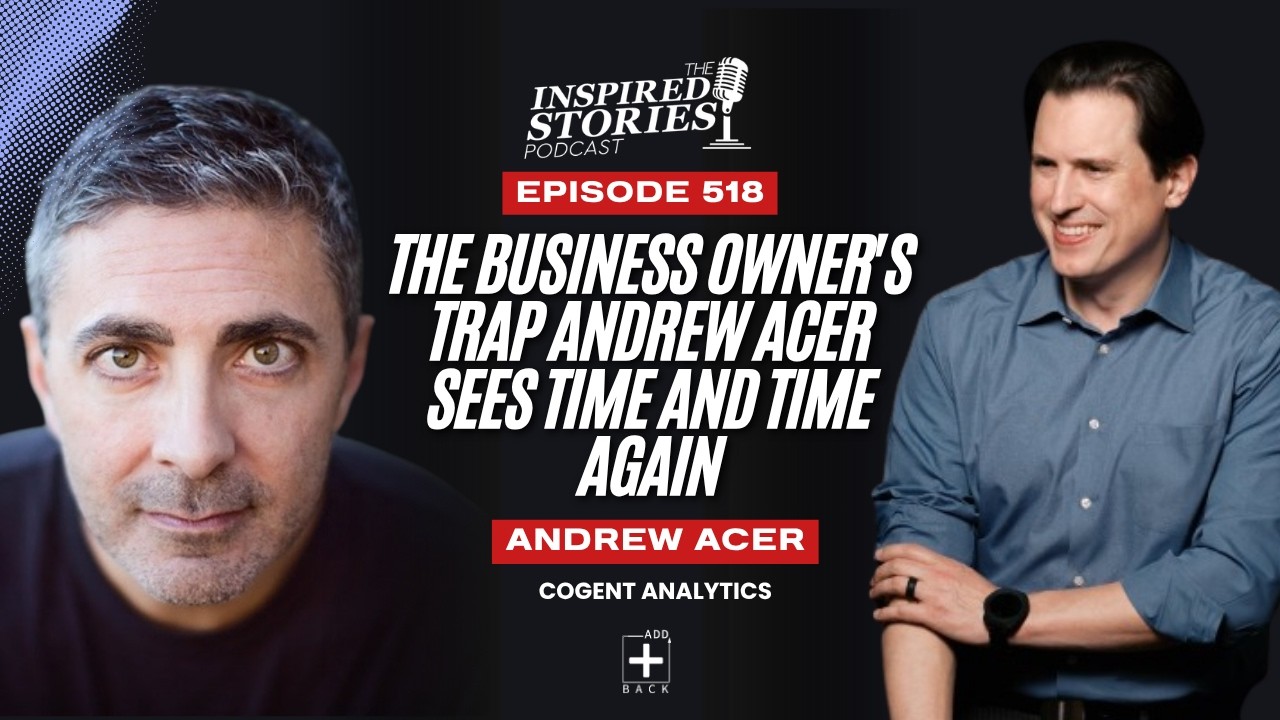
Andrew Acer, Senior Business Analyst at Cogent Analytics, grew up on a ranch in Idaho raised by a Depression-era West Point grandfather before navigating family businesses, serial startups, graduate test prep, and a leadership burnout that cost him his heartbeat. He came back to consulting with a clearer philosophy: stewardship over shortcuts, and truth over comfort.
✨ Key Insights You'll Learn:
Ranch upbringing: responsibility, seasonality, and work before self
Family serial entrepreneurship: route accounting at 14, managing rental business through college
Georgia State scholarship, LSAT tutoring, and building Atlanta operations from scratch
Joining Cogent Analytics in 2016 as regional VP at 28, selling to owners older than his career
Managing director of business development through COVID with zero travel and near heart failure
Left for a deliberate reset: design consultant at bathroom remodeling company to decompress
Returned to Cogent as Director of Portfolio Development and now Senior Business Analyst
AI as a hyper-literal intern: multiplier, not replacement, with real management implications
The owner's trap: what got you here will not get you there
Stewardship model: trust-based leadership built on accountability, not just service
🌟 Andrew's Key Mentors:
His Grandfather: West Point graduate and stockbroker who modeled hard work, directness, and lifelong professional ambition
His Mother: Serial entrepreneur and business analyst who modeled resourcefulness and introduced him to consulting
Rob Raymond (Cogent Founder): Mentored Andrew through leadership transitions and growth at the firm
His Team at Cogent: Gave direct feedback that reshaped his communication and delegation approach
Business Owners He Has Served: Continue teaching him what high-stakes decision-making looks like from the inside
👉 Don't miss Andrew's candid account of burning out at 33, stepping away deliberately, and what returning to the work he loves actually taught him about sustainable leadership.
Listen to the full episode here
Transcript
Anthony Codispoti (00:04)
Welcome to another edition of the Inspired Stories Podcast, where leaders share their experiences so we can learn from their successes and be inspired by how they've overcome adversity. As you listen today, let one idea shape what you do next. My name is Anthony Codisbodi, and today's guest grew up on a ranch where the day started before the sun came up, and accountability wasn't something you were taught, it was something you live. That foundation didn't make the path easy.
There was a chapter where he walked away from a director level role at a fast growing advisory firm to go sell bathroom remodels. Most people would call that a step backward. He'd call it necessary. He has Andrew Acer, senior business analyst at Cogent Analytics, a professional advisory firm based in Greensboro, North Carolina that works with small and mid-sized business owners across thirty-six states. Andrew has been part of the Cogent story since two thousand sixteen.
working his way through multiple leadership roles, including most recently director of portfolio development before transitioning to the analyst team. He was named a Triad Business Journal 40 under 40 honoree in 2026. And over the last 15 years, Andrew has worked with more than 2,500 business owners across construction, manufacturing, distribution, transportation, and professional services, helping them see what's actually happening in their businesses and what to do about it.
He led the rebuild of Cogent's business development methodology and has driven AI projects for Kogent that change how the firm trains and operates. But before we get into all that good stuff, today's episode is brought to you by my company, Ad Back Benefits Agency. I said if you run a business, you're likely stuck in the cycle of rising insurance premiums. You're paying more, but your team is getting less, and many people can't afford coverage at all. We do things differently.
We offer a solution that provides your employees with unlimited access to doctors, therapists, and prescriptions that's always free for them to use. But here's the part that surprises most people. Unlike every other employee benefit out there, our program puts more money into your company's bank account. As an example, we recently helped a client increase net profits by $900 per employee per year. Games like that can change how a business is valued.
Results vary, but the consultation is free. Imagine being the advisor that becomes a hero by introducing this to your clients. See if they qualify today at adbackbenefits.com. All right, back to our guest today, senior business analyst with Cogent Analytics, Andrew Acer. Thanks for making the time to share your story today. So, Andrew, you grew up on a ranch. What did a typical day actually look like when you were a kid? And what did growing up in that environment teach you?
So, Anthony, my my parents went through a nasty divorce when I was basically a baby. So I grew up with my grandfather on a ranch in Idaho. And my grandfather was a child of the Great Depression. He was a West Point graduate who went to West Point and graduated during World War Two. so my upbringing was a a little bit different than most people of my generation. And
On a on a ranch, there's a lot of responsibility. Okay. And so your your days would depend on the weather a lot, right? So in the winter, you get up, you make sure to set the fire in the house. You had a w old wood stove there to make sure that that started warming up the house and you go out and you take care of the animals. You you don't take care of yourself until you've made sure all the animals are fed, everybody's safe, you then come back in, and that's winter. And summer, it's growing season, right? So you had the the
We had the family garden, you had the side acre where we were growing stuff for the farmers market. And there was a lot of work that went into that as well, because Southern Idaho is part of the Great Basin Desert. So it grows a lot of stuff, but there's no rain. It all grows through irrigation. So you dig a lot of ditches, you lay a lot of irrigation pipe, fix a lot of fences. And and what I think it it taught me is a a few things. One
Hard work obviously yields to the results. Okay. But I think it also it allowed me, and I and I learned this reflecting on things later in life, that there is a seasonality to things. And you have to be willing to accept the rewards of of those hard work of that hard work. So taking care of others, the responsibility to the animals, but then also the rewards of growing things and seeing the fruits of your labor, it's it's really stuck with me along with my grandfather's.
guidance who, you know, my father was never a part of my life, but my grandfather was that father figure for me. And that really helped me become who I am today. So you learned a great work ethic from a very young age. Was the idea of higher education always in your future? Or was that something that came about a little bit later on? So I I
I think higher education was always in my future because yeah, my grandfather was there on a ranch, but he was also a stockbroker. So isn't that wild, right? So he out of West Point, he went and worked for an investment firm and he was a financial broker for a number of years. Get up in the morning, he'd read the Wall Street Journal and go into the office every day. And and the man was one of those force of nature guys. He'd worked till he was eighty nine. He could do a fingertip push up in his seventies. So
I if if you wanna have an understanding as to who who my grandfather was, it was that individual. So there there was always this sense of if you can, you should. Right? Those who can create opportunities for others should, and that there's a a level of responsibility and always to be forthright. Right. That he was very big on there's no quibbling, there's no talking around it. You know, you you get through it and you speak directly. So from
Southern Idaho, how did you end up at Georgia State University? So my mom got her feet under her. Okay. And so I grew up with my grandfather up until high school age. And then my mom and moved my brothers and I, and she was a business analyst in the late nineties. So then in the early two thousands, I moved out there with her and I homeschooled. And during homeschooling, we we also were serial entrepreneurs.
So we had a beverage distribution company and we had a party and event rental business and we had a collision repair shop and we there was pretty much always some form of investment real estate. We were either fixing something up to flip it or we were renting something out or doing things. So alongside school, I also did that. So I was homeschooled, but then I took the SAT and got a scholarship. And Georgia State was the one that that gave me the scholarship. So I had then moved down to Atlanta to go to college.
This is in i incredible. Like I I want to better understand sort of this mix of homeschooling and these side businesses. Was your mother involved with these businesses? With this you and your siblings? And sometimes we would fix them up and sell them. Sometimes, you know, entrepreneurship is hard. So y sometimes businesses didn't make it, right? But there was always a this all hands on deck, right? And it it's really what inspired me, I think, to
represent American small business owners and and where I've come through in my career is I mean, I was I was that growing up in the family business. And you I was our route accountant when I was fourteen. I managed the party and event rental business throughout college while going to college. So there was a lot that went into the 'cause there was it was always the way it was. I guess I didn't know any different. And coming from
The ranch, I th I thought this is easy work, man. I'm in an office. I'm not outside. Like this is great. I I don't have to grab a shovel and dig. Piece of cake. You grew up as a doer. You were a doer on the ranch. You had to. There was no choice, right? The animals needed it. The the farm needed tending too. Then, you know, you relocate to be with your mom and you've got these businesses and you didn't back away from it, shy away from it, 'cause like you said, this this seemed easier than what you were doing before. So you rolled up your sleeves and got into it.
Well, and and you have that that sense and and we'll probably talk about it later, but until you've owned a company or been in that situation, you just have no understanding as to what goes into running a business. And I always grew up around it because my grandfather ran his own business like he was a stockbroker, but it was his business. And it was kind of normal and natural for me to to see that and do that, but the plenty of
Long days and long nights. So you graduate from Georgia State in 2009, right in the middle of the financial crisis. What was it like coming out of school at that time looking for a job? So obviously I already found like two or three, right? But I was continuing to work with the family businesses. So coming out of college, I was responsible for our party and event rental business. My brothers managed the tool.
rental business that where we rented like construction tools, Ditch Witch, Bobcat, that sort of thing. And then I was also managing our fully furnished rental units in terms of property rentals before Airbnb was a thing. We were, you know, advertising on Craig's list and we had fully furnished units and some corporate accounts that we would work with some of the colleges in Atlanta and that sort of thing. But it was on my family's businesses.
Right. So I wanted to start doing my own thing now that I had all this free time. I was I was only working those jobs and I was done with college. So I had all the free time that college had. So in the midst of chaos is opportunity, right? So you're going into the financial crisis and you're into a recession. So I looked at, well, what does well in a recession? Well, people tend to go back to school in a recession. I just left school. I didn't want to go back to school, but I knew what
went into going back to school, you've got standardized testing. People need to take their tests. And luckily I've always tested well. So I tutored graduate school entrance exams. I I looked for jobs tutoring and I found a company based out of New York that was looking to open Atlanta representation. And I was their Atlanta area program manager and I coordinated with some of the colleges in the area. They would give us classroom space.
And we'd give them a couple spaces in the class, and then we'd sell out the rest of the spaces in the class. And so I tutored GMAT, LSAT, GRE. LSAT was my favorite. It was the most fun of the the graduate school entrance exams. But it was that was what I did kind of right out of college into my mid-20s. And were you the one providing all the coaching? Yes. So I tutored all the I took the LSAT. No, I so
I had multiple ninety-ninth percentile scores on the LSAT, but when I actually sat for the official in terms of the practice exams, when I sat for the official exam, I only got 97th percentile, so I was a little annoyed with myself. What a disappointment. What a disappointment. Okay, so how did the opportunity to join Cogent Analytics come about? So I was doing that, but I didn't it was fun, but it wasn't fulfilling in the same way.
Right. I I I wanted to branch off and do more in terms of representing other business owners. And so I talked with my mom, who was an analyst in in the nineties. That was kind of how she made some of her money to start where we then started doing and running our own businesses. and she gave me some advice and I just started looking for a job in the consulting industry. And I managed to find a
Place with a firm where I was selling educational seminars. So, you know, they'd rent out the Marriott and they would do an educational seminar for business owners on how birth order and personality impacts the way they run their business. And I'd go around and talk to business owners doing that. And that was good, but I was still looking for something a little more concrete than just the educational seminar. So I managed to find myself with a firm that was specialized in
turnarounds and and workouts for very d heavily distressed companies. And you know, the bank said, you need someone to help you. So I was working with that company and they were looking to open more of a broad general professional advisory consulting division of that firm. And it didn't necessarily work out. And some people there knew Rob Brayman, the owner at Cogent, and was like, hey, we've got some people here. Are you interested? You they were scaling and growing. They'd only been around a couple of years at that point.
But they were going places and had a conversation and decided to join the firm in in 2016. And what role did you come in with? So I I came in as a regional vice president. I was responsible for a few different metro areas. I worked Atlanta, Birmingham, Chattanooga, Knoxville, and would kind of rotate around those and and my job was really to have a conversation with business owners. Where are they at? Where are they looking to go? You know, what what's
What are the challenges that that they're facing and see if there is a fit for the the discovery process, which is what the business analyst does, which is that real fulsome understanding and deep dive, that empowerment exercise to take an objective look at the business. And I did that for about two years before they continued to just start promoting me up through the firm. I mean, it sounds like a relatively senior level role for you to begin with, given that this
You know, you didn't have a ton of experience in in the industry. It was. And I would say that I I interviewed pretty well and my background helped me because I I had that level of broad experience with business owners. And then the little bit of experience that I had had selling educational seminars. So by that point I'd already been talking to hundreds, if not thousands, of business owners. And
I was able to leverage that, but you you're you're not wrong. I mean, I was in my late 20s, and every week I would have to sit across the the desk from somebody who had literally owned and run their business longer than I'd been alive and talk to them about the challenges that were going on in their organization and why they may want to take an objective look at it. so I sometimes it's not all just personal excellence. Sometimes there's a level of luck.
And the opportunity that gets given to people, it's it's one of those things where, yeah, it it was a senior level role. I was blessed to be able to try it. I kind of lucked into it, but then I was able to keep it through a lot of hard work. Now, yeah, you stepped into the role pretty quickly, it sounds like, obviously as they continue to promote you. So for those folks listening who aren't familiar with cogent analytics, what does the firm do and who do you do it for?
Okay. So COGE and Analytics, we are a professional advisory firm that has both an in house analytics division, which is the division I work for, and then a full project integration and implementation team. And we do work primarily in the trade, so a lot in construction, manufacturing, trucking and logistics, and then some of those related industries, architects, engineers, some of that that supporting on improving profitability and quality of life. If you had to
put it down to one sentence, right? I've yet to meet the business owner that doesn't want better profitability or better quality of life for either themselves or their people as long as it's real. Right. But it's got it's got to be real. So Cogent empowers those owners with n information embedded options to make those better business decisions.
what's the size of the business that you typically work with? The bulk of our clients are probably between the two million and seventy-five million dollar range. We have more clients in the, you know, one to two hundred million range. Once you get above five hundred million, you're typically looking at more the the Deloitte and Accenture and and that sort of thing. But the bulk of our clients are are in that two million to seventy five million where
Owners are looking how to duplicate themselves, how how do you, you know, put a level of of organizational structure, refine some of those processes and procedures that that they're looking to tackle and and get a a better level of control over not just their business, but their life. So better quality of life, better profitability. Give us an example, maybe leaving out, you know, the names of the innocent, just to like help us wrap our heads around.
What a specific engagement looks like and what you can do for a company. Yeah. So everything we do always begins with our discovery process before we're looking at any form of ongoing representation, which is that two to three day holistic diagnostic of the business, which is very empowering in and of itself. It it encompasses anonymous employee surveys, operational reviews, financial reviews, and then uncovers where the biggest focal points would be.
for them to tackle things to improve that profitability. Now that might be reducing rework in a manufacturing company. It might be better job costing and project management on on a construction site. It might be refining their business development process to be able to continue to scale and grow because they've hit some form of of ceiling. Sometimes it is strategic recruiting. the Cogent is a full service firm. So we're active in about 30 to 35 states now.
if it has to do with business, they pretty much have functionality depending upon the the needs of the client, but it it's always going to be so specific to that individual client. positioning for sale, succession, transition, leadership training, all of those are things that we tend to help our clients with when it makes sense. What role is AI playing in the work that you do today, Andrew? So I
I love this question because obviously AI is the big buzzword here, right? And Cogent has a whole internal team that is working on AI. I've helped with some of our internal usage of AI. But but conceptually, I think it's important for clients to think about
It's not just using AI. Okay. A lot of people think of using AI like it's using a tool like a calculator or something along those lines. I think far more accurate would be working with AI. So if if you think of AI as more of like a a really smart, really energetic, hyper dedicated intern. Okay? Like a collaboration tool. And and hyperliteral. So if you give them something, they will pitter patter right off and
Go do a whole bunch of work and bring it back to you. Well, are you just going to take that at face value coming from the intern? Are you going to have to review it? Are you going to have to look at it? Are you going to have to make sure that you have some level of screening to it to make sure you got the good input back from it? And it's never going to set the correct frame. So if you have the incorrect frame going into the system, right? If if if you
Aren't even thinking about the challenge in the correct way, or if you don't even know what question to ask. It can give you really good answers, but if you ask the wrong question, where's where's that going to lead you? Let me give you an example. Okay. So let's say I had a client that came to me and said, Andrew, I'm I'm struggling with sales. I need help with sales. I really need this business development team. My my sales team, they're they're just they're not getting it done. Okay. Well,
If they were to go to AI, they could ask a whole bunch of stuff and get into a lot of information about great best practices and sales. But what happens if we were to go in there and do an analysis and it turns out that their lead time is eight weeks or ten weeks and their competitors' lead times three weeks? Is that a it is is it a sales problem? Is it an operations problem? Are we are we actually solving the correct thing? And that's where the human factor I think still plays a a key role.
Okay. where do I want to go with this? Because I I I feel like there's a lot more to dig into around the topic of AI. and the way that you're describing it, Andrew, it feels like the best use cases are still more of like a collaboration tool. Right? This is this is a a no? Okay, go go ahead, clarify it. No, so I I guess so it is a collaboration tool.
It's a multiplier. So a lot of people I think are looking at it from the standpoint of how are we c saving costs? Do we replace headcount versus how do you multiply your team? And and I think that management is also going to have to adapt to the way that they manage that multiplied team. Because you're not just managing the individual these days, you're managing the individual and their AI stack.
Right? What tools are they using? If you don't have an understanding as to where they're getting their information or how they're working with the technology, I promise you, your employees are working with technology like that these days. Everybody is. Okay. It's becoming ubiquitous. So you could allow it to continue to reinforce the wrong way, or you could potentially take a step further, have the conversation, figure out how do we manage not only the employee, but the technology that is supporting that employee. Because again, you could coach the AI, you could give it.
better framework or parameters so that then the employee doesn't need to come to you. It can go to that AI to generate better results going forward. Does that does that make sense? It does. I'm you you said that you also helped to spearhead some of the internal implementation of AI at Cogent. Can you say more about the work that you did there? Yeah, so, you know, in terms of
Sales and business development or some of the coaching that we've done on behalf of clients. I mean, you can use AI as a pretty dedicated role play partner that that wouldn't take up human resource time. But I think it's about how do you consolidate tasks, what is c good to to outsource and and fully know that AI is gonna make mistakes. The challenge that you run into with AI is something that is hype today, might be real tomorrow. It is it is developing
so quickly. So for anybody that's listening to this in the future, please understand the the world could be completely different by the time you listen to to this this podcast. But that's that's the challenge with it. So the internal things we're looking at how do you you know have better note taking, how do you have better control or flow of information? How do you ex you know it
Create some efficiencies for repetitive tasks. It's really good at doing those repetitive things that are time consuming but not necessarily strategic in nature or require some level of critical thinking. So we were talking before about how you came in as regional vice president. You worked your way up over several years to managing director of business development. Now you are in the role of senior business analyst. As you think about kind of each of those transitions for you.
Which one of those was the most challenging for you and why? So I think the the first transition from regional vice president to managing director of business development was the most challenging. Okay, because I was coming from like a regular production role, operation role, to a management role. And like you called out earlier, it was a senior role that I was brought into. My whole team was probably 20 years older than.
Right. I don't think I had anybody that was you know what you would consider a a peer age wise at that at that time because I was what thirty-two when I started doing it. And you you learn to adjust your management style, adjust your communication style.
But then you also learn that that management is not just the assignment of the task, right? Anybody can assign a task. Anyone can be like, great, go do this. Okay. Good management is follow-up on that, the follow-up on that task in a good way that is not oppressive to your team, that is, but that is still making sure that the task is done on time and to standard. Without that, it's just sending things out into the ether. And then it's the development of your team to help them be the best version of them that they can be.
Where were you learning those skills? Did you have somebody mentoring you? It's kind of just the school of hard knocks, making mistakes along the way. Some column A, a little bit of column B. So obviously Rob Raymond was a was a mentor to me. my my family was a mentor to me. And then I also learned from my team. And and the good thing about that is we had built such a strong team, and it was one that I'd came up with.
And I had performed so well in that that you know I had some level of respect because I had already outperformed them in the role that they were doing. So they knew something was was different. Okay. But it if you if you want a good team, be good teammates, is what I always tell anybody I'm working with from a standpoint. There should be an expectation that you give of yourself and that you're willing to take from others so that you everybody can be better. We have a saying at Cogent which is raise others up and you will rise.
Right. So that that culture that we had, it didn't go away just because I changed roles. So I had not only the help from some of the mentors, I had the help from the team that I was managing. And they were able to work with me in terms of my communication style, how I approach things, all of that. So in 2021, Andrew, you left Kojent, firm you've been building with for five years.
To go work for EasyPro Baths Express, a bathroom modeling company, first as a design consultant, then a sales manager. What was going on there? What were you looking for in making that transition? I was looking for relief. I burned myself out. Right. So think about the time frame there. We went through I got I took the role of managing director of business development in twenty nineteen. So I had luckily a year in the role before COVID hit. Well, this firm, I mean, we weren't virtual.
We we were in person. You know, I had regional vice presidents that on purpose were people walking indoors to talk to the business owners face to face. Our project directors that helped with the implementation, they were there on site, embedded in the businesses, helping, you know, conduct that change management. And overnight, travel's done. How are you gonna pivot? What are you gonna do?
And then think about, I mean, Cogent was probably only like a $20, $30 million firm at that point, but I viewed all of that as my job because at the time I was in a sales management role. If I don't get my job done, if I don't do my job, everybody's out of work. Right. So I put myself, poured myself into the role in a way that probably was not healthy and current currently it obviously wasn't sustainable.
I mean, I I still remember sitting at my desk having my heart rate monitor on my phone kept beeping because it was going at a hundred and twenty, hundred and thirty, just sitting at the desk while on meds to reduce my heart rate, and I'm in my thirties. And so we we got on the other side of it and I just I was done. I needed to walk away. I needed a reset. And so I wanted to learn, like most of my things. I like learning, I like getting exposed to new things and and
I wanted to have a better understanding more on the remodeling, the construction side, getting a better feel for that. And I wanted none of the real pressure obligations of of management when I first came in. I wasn't sure that I wanted to do that. So, you know, the the owner of the company knew my my past experience and he thought that I could probably do it. And I said, please, you know, l let me just start out as as a peon, right? I I don't know anything. Let me learn. I'll go from there. And
It was nice, right? It it was good. It was it was the reset that I needed that I just had to do for myself because I had I was breaking down. It w it just I hit my breaking point and that had nothing to do with coging, everything to do with me and and how I were just pushing too much adversity. Yeah. That's it's it's kinda who I am. So this was kind of a a little sidestep for you, kind of, you know, catch your breath again, which you did for a couple of years.
And then in two thousand twenty three, you decide to come back to Cog Analytics, this time as director of portfolio development. What was different about coming back in the second time? So coming back was really good because I I'm I missed I missed the work. I missed the the conversations with the clients. I missed the impact that we had. but I didn't want to come back and do what I had been doing.
And so the the owners of Cogent kind of approached me and said, Look, we're we're looking at doing private equity stuff. We're looking at doing some more strategic initiatives, and we think you'd be a really good fit for the role. And after having some internal conversations, I was able to rejoin the firm in a completely different role that wasn't even really related to sales, right? It it was more on the strategic side, it was more on the
The development of internal processes. It was working more closely with some of our project directors and our clients. And that was enticing to me. Because again, I got to learn. I I got to go experience and find something else to do. And it I'm so happy I did. Right? I'm I'm so happy I did because I I I and I loved Easy Pro Bat. It was I loved the company, loved the people there.
But but I wanted to continue to to grow. I wanted to continue to to learn and see. And this gave me a vehicle to do it to where I wasn't going to be interacting with the firm in the same way because I I I don't know I don't I have I have trouble putting on the brakes, right? So I I didn't and I didn't want to repeat. So talk to us about the work that you're doing now as a senior business analyst.
So now as as a business analyst, I get to go in and talk with clients about their business in one of those ways that very few people get to have the opportunity to do. Right? It's it can be lonely to be a business owner. It it's so stressful. And who do you talk to?
You you can't talk to your employees. You're the person that's supposed to have all the answers. Right? Quit. Go do something else. Why are you even bothering me with it? Right. So it's a chance to have the honest conversation and really take a look at, you know, what do they want? What do they want out of the business? What do they want out of life? And and it's
Been a real blessing.
So
Tell us about your leadership philosophy then, Andrew. You're built around this word stewardship, taking responsibility first, keeping your word, never asking someone to carry a standard you wouldn't hold yourself to. Where did that framing come from? And and how does it actually show up in the work that you do?
So y you hear a lot about servant leadership and and I liked servant leadership and and y a lot of people l gravitate towards that, but I felt that it was kind of incomplete. And I'm I'm very big on the specifics and and the details. So so the servant leadership implies, you know, you're there for your team and you're supposed to be removing obstacles and doing things and and in service to the team. And there's an aspect of that in leadership for sh for sure.
But the stewardship, I think, speaks more to the trust. Cause you don't just get to lead people in an effective way because of a title or because you're like, I'm your boss, right? Like how that's not effective on a on an ongoing basis. People need to trust you and and you are then their steward because they're entrusting you to do what is right on their behalf. So there's a level of trust that they have placed in you. And so you have to take that that responsibility first of, okay, how do I
Use this trust in the best way to help them. And then never gonna I'm never gonna ask somebody to do something that I wouldn't be willing to do myself. I d I just feel like that that's if I had the skill set, now I may ask you to do something that I don't have the skill set for, but if I had the skill set, I would be willing to do that level of work. And I think that when you look at it from the standpoint of stewardship, where where you are guiding people.
That sometimes implies some of the more difficult conversations that you need to have as a leader and the accountability that you need to have as a leader that I feel the servant leaders can sometimes miss out on. Where it's not always in service. You're you're sometimes there to be serious dad, for l for lack of a better word, right? You're you're there to talk about what the challenges are and where it needs to be and what the expectations are and how it's going to help and benefit them and
That I think gets encompassed in stewardship. That sometimes gets l left out in the servant leadership. Is there a specific example of this that you can share with us?
So
I think it's where you're you're always willing to step in. I've had any number of occasions where there's been a personal tragedy or a personal something that has happened just to a member of my team and you just gotta be like, not a problem. Don't worry about it. I got it. Right? I got the ball from here. I'm gonna be able to to go and and take it. You take care of what's important for you. Okay. And I I don't wanna
be talking 'cause I didn't ask their permission in terms of talking about some of the the specific stuff and and people maybe be able to put things together that are in cogent watching this. So but it it it's
A combination of that being willing to step up. And then it is where you are willing to have the tough conversation with somebody about where their performance is, where it needs to be, what you want to see from them, and and getting to know them personally and finding out what their goals and objectives are. But my my goal was always to help people be the best version of them, not necessarily the best employee.
Right. It if it it's n it's not about do they work at Cogent or work for Cogent or work under me. It's can I make them the best version of themselves? So challenging them with continuing education and talking to them and being available and all of those things I think are what lend to my leadership style. And I I think that that's what's allowed me
If it comes from a genuine place, it's what allows me the level of direct communication that I sometimes have to have with my team or with with clients, but it comes from someplace genuine. What's the trap that you see a lot of owners fall into?
So I I talk to clients all over the country and y you'll you'll get to some place where you have a real moment with them and you've hit on whatever is truly bothering them or whatever's, you know, been a challenge in their business or something that's not quite going right. And the instinct is to do what they've always done, which is put their head down and work through it. It's worked so far.
Right. They they want to get back into it and just handle it themselves. And the the challenge and the trap that I feel owners fall into is is what got them to where they're at isn't necessarily is what's going to get them to that next level. Okay. Just because putting your head down and working through it has worked in the past does not mean that that is always the solution.
But it's we default the humans are creatures of habit. We like to default to what is comfortable or what we think will work. Right? And and so they they will go into if if it's gonna be it's up to me mode. And and they'll put on the Superman cape and they're gonna try to fly around and solve all of the company's problems themselves because doggone it, that's how this company was built and that's how it it made it. And
It's it's a trap because then it traps them in the business. They they weren't able to find a different solution that didn't include them. So then what's gonna are what's gonna happen if they can't or if a problem comes up that they don't have the skill set for? How do you develop the others around you to be able to take that business to the next level?
Yeah, it's you know, you're dealing with a lot of small business owners who they got to where they were because they were the ones who would work harder. They were the ones who knew the industry, they figured it out, they put the elbow grease in. but and I've seen this so many times, and this is what you're talking about, Andrew, is that, you know, a a business reaches a certain point where it needs more. And oftentimes that that more that it needs is delegation.
and and a better, you know, leadership team that has higher degrees of expertise in their particular areas. I think this is what you're talking about. You're absolutely correct. And and there's even a visual that we will sometimes take our clients through. We call it progression of a profitable business. And it's it's, you know, it's a little bar graph on one axis, it's it's number of employees on the other, it's the amount of revenue. And really all it's saying is that as the number of employees increase and and as the amount of revenue increases, the complexity of the business increases.
And you're gonna hit organizational structural breakpoints, and that can manifest in a variety of ways. One is that human resource bottleneck, where maybe the owner is the bottleneck, everything's running through them, they don't have a way to delegate down. Sometimes it's top line revenue continued to grow, but the systems and the processes and the the structure wasn't there, and profit doesn't grow in the same way. So top line grew, profit didn't really grow because now you're having more mistakes. You've got to make concessions to your own customers or clients, you've got to find a way to make things right.
you ship things late, all of the various things, or sometimes it is that that business development ceiling where they're unable to push past it. But you you're absolutely correct. And and what tends to happen, most clients either if you've been in in business for a while, you've probably either experienced this or you've heard somebody talk about it where, man, I grew my company and then I got to six million dollars and
Man, I made more money at $3 million than I made at $6 million. How the hell does that make any sense? Why was I doing more work for less money? So you've got two options. You're at that inflection point where either you need to change and adapt those organizational structure to support the growth, or you can retreat and retrench. You can always go back to what you're comfortable with, but that's that track where it comes back to them being the solution.
Do you find that when an organization gets to this inflection point or this bottleneck, that the problem is that the owner doesn't know how to change or is the bigger problem that they don't want to let go because their identity is so attached to being the guy or the gal that's at the center of everything?
So I would say it depends on the owner, right? And it's tough to make broad general generalizations when we're dealing with people like that, but it is it is both. Sometimes it's genuinely they want to change, but they don't even begin to know how to go about doing that. Okay.
Entrepreneurs don't really start businesses. Technicians do. Technicians that are hit by an entrepreneurial seizure. So you'll have those people that who in the moment, they're really good at, you know, being an HVAC tech or they're really good at building something or doing remodeling. And then they're like, well, I'm gonna go start my own business. So they they hit this moment, and I'm gonna be my own boss. And they have the technical aspect and they can do the work, but the business of the business.
They didn't go to school for that. They didn't necessarily know how to do that. And and but then all of a sudden, what do you know? They're they're a two, three, four, five, six million dollar company. And now they're scared and embarrassed, maybe, which then goes and speaks to the identity portion because that they're supposed to be the boss. They're supposed to be the ones that know everything. And how embarrassing would it be for them to truly admit, I don't know how to read my financials. Not really. I
I go to my profit and loss, right? I got my top line and then I look through a bunch of stuff and I go really to that bottom line and I have that woo-hoo boo hoo moment. Did I make money? Did I lose money? I in in the middle, there be magic. I don't necessarily know what happened in the rest of it, but let's see what the report says that if I made or lost money versus truly understanding how to manage cash that they can
you know, predetermine or engineer for a level of profitability and put operating budgets in place and control to a level of outcome and manage to the type of business that they want, but they don't know how. Okay. And but then that that's it's combination of not knowing how and it is that identity that they don't want to risk people understanding that, you know, it's the it's the wizard of oz.
Can you walk us through, Andrew, maybe a a a really challenging client engagement? Things didn't go exactly as planned, but looking back on how you navigated that, what you learned going through it, carry a pretty powerful lesson with you today.
Yeah, so
you'll run into situations where th there's always the risk that this level of work becomes deliverable delivery people, right? Where you do a whole bunch of work, create resources on behalf of clients and you have a lot of really good stuff and you train people on it, but if they don't understand the reason why, is that going to change behavior?
Well, they just invested a whole bunch of money into systems and structure and the way to do it and all of it. But if the if it doesn't land, if it doesn't make sense, then they're not necessarily gonna keep up with it. And the moment you leave, they're gonna go fall back to old bad habits. Now, Cogent has a lot of things that they do to help prevent that, but ultimately at the end of the day, I can't make somebody make changes in their business.
Right. And and they can kick us out at any t point that they want. It's their business. So if we're not good at at communicating, we we've had times where work was done and then you follow up with them in a year from now and they're like, yeah, I don't use any of that. Our business is worse off now because we spent all this money with you. And then you have to figure out, okay, well, what do we do about that? Because nobody would ever want to hear that. The good thing I why I represent this firm is I've I've never seen us.
Do the do the wrong thing by a client. I've always seen us do the right thing. We're we're people just like anybody else, but I've always seen us do the right thing by our client. So in that situation, firm went back in. We did another discovery. We had an analyst go in, really look at what was working, what wasn't, where's the business at. And then we came up with a game plan on them with them on how to make it work this time. How to train the people better, how to communicate differently.
How to utilize the resources that were there. And it was a wildly successful engagement. You know, it's that's what I live for is is is the impact that you can have. Cause every business owner, you know, you've got your employees, right? So if you've got 15, 20, 30 employees, think about the
spouses, the kids, there's usually two to three times the number of lives as the number of employees that rely on the success of that business. And so there's nothing like it when you can have that connection and make that impact and then s see that business owner that that's been so stuck in their business, they've never even been able to take a vacation for, you know, five, ten years, all of a sudden have their time back and everybody else thriving around them. It it there's nothing
Nothing else like it. So you guys aren't just about like dropping off a report and hey, here's you know the one hundred point action plan that you guys should go do. See you later. Is is much more about like being embedded, like getting the results, making sure that they're set up for success when eventually you do roll off that engagement. Absolutely, which is why we're so cautious about who we even choose to take on as a client.
W what what's interesting is is we we intentionally segment our business from ongoing representation to getting access to information. We we believe everybody is a fit for getting actionable information within their business, right? If you've got that that information, you're gonna make better decisions for you and your people. And sometimes that's it. That's where it ends, because it's always gonna be on the owner to do something with that information. And even if it's it's the the lip service of, yeah, this is great.
Again, I can't push a rope up a hill. Like it this has to be something where you're taking ownership of it. We can provide skill sets and we can provide training and all sorts of resources for our clients, but the yaunt to, we want to get into the south here, the yaunt to's got to come from them. Right? It it always has to send from the business owner itself. So much of our process is designed.
To ensure we're not just the person dropping something off. From the the the standpoint that the the discovery, the analyst has to choose whether or not even to take the client. And we and we truly sometimes are just like, you're you're not a fit. Maybe in a partnership situation, you might have one partner that is head over heels, like, absolutely, we need this. And it's like, well, you got to talk to your partner because it they're not there yet. And they're saying, Yeah, yeah, but they're saying yes for you, and they need to say yes for them. And until they say yes for them,
All that's gonna happen is you're gonna waste our time and your money. And and that's that's where Cogin has been able to make the change. And then when it does make sense, when you do have that that partnership, that buy-in on behalf of the client, that's where the magic happens because it it it's transformative and it and it's fast and it and it's
Fun to see what a change catalyst can do on an organization that's ready for change. But then it's about you have that high intensity where you're creating and building and making the changes, but then you have to have what we call life cycle, where it is that support of the work after the fact, where you're having the check-ins, you're making sure that the habits are being built, you're doing the continuing education. And then we typically are at that one year mark having the analysts.
Go back in there to see what we did. Because the analysts, they're they're separate. They are they are their own thing and they are there to get to the truth. They are diagnostic in nature and they are there to get to the fundamental truth of what is going on in the business. And that allows not only a check on us, but a check on the client in terms of what the level of success was. It's it's pretty impressive what's been able to be built here over the past, and I'm just excited to have been part of it.
Andrew, what's the hardest thing you've ever had to overcome personally? And what did it teach you? So
I think the the the hardest thing that I had to overcome personally was being willing to accept that things will be okay. And being willing to
enjoy some of the successes versus always striving for the next thing. Because you when when you go through it sounds all sexy and flashy. all the businesses and growing up, but I told you some of them didn't work out well. Right? I moved a lot growing up. I not not after, you know, not with my grandfather, but after that. I mean, there was there was times where I was in a lot of different places pretty often because we were trying to make something fit.
When I met my my girlfriend, now my wife, I didn't hang anything on the wall.
Didn't hang anything on a wall. She's Why aren't you? I said, the mo I learned the moment I hang something on the wall, I move within a month. Now the funny thing, and we were we we started living together and we hung something on the wall, and I got promoted and I had to move to Greensboro that week. So I was right, but then she pointed out it was for something better.
Change isn't always negative. Okay. And so being willing to enjoy some of the things, not have that fear that the other shoe is gonna drop. And I'm I'm not even fully there yet sometimes. Sometimes I'm always like, Great, we did it. Let's on to the next thing. Let's find a way to go do the bigger, better, what's next, because i if you don't, who knows what'll what'll happen. But that's been probably the
The hardest challenge that I've had to overcome is
being w willing to to sit in the success a little bit.
And realize that change is not always going to be negative. Because you experienced a lot of that growing up. A lot of bouncing around, a lot of instability. Yeah. Usually if change happened, it was for the worst, not the better. Okay. And that's still kind of ingrained in your central nervous system. And so
You can't allow yourself, it sounds like it's a challenge for you to really allow yourself to enjoy those successes. It's always like, okay, I I gotta keep moving because something's chasing me. And if it catches me, then we're gonna have to move again or we're you know, we're gonna lose an opportunity or or we're gonna have to close a business or or or or something along those lines that's that's got this negative umbrella to it. Yeah, and and which is why I was grateful for the reset.
Right, because j that'll burn you out over time. Like that's it's gonna burn you out. If if you're never going to be satisfied, you're never going to be satisfied. But it it's
My wife's way wiser than me. She's like, best way to have a a good adulthood is just to have a really terrible childhood, right? Like if if you have adversity and struggle, it makes you so much more appreciative of those things. So you know, that's where when when we were talking about, you know, lessons that are learned from the ranch and and there's a seasonality. There's the season of work, and then there's the season of rest and harvest. And then there's the season of work.
And then there's the season of enjoying the fruits of your labor. And and building to that balance, I think, is important in life. As you think about the work that you're doing now as a senior business analyst at COGE and Analytics, what is it that you most want to be remembered for in that way?
that I was able to get to the truth with the client. Okay, that I was able to
help them think about things in a way that they'd never considered before.
Put forth the options in front of them and then allow them to make a fully informed decision about what they want from their life. It it's I want to be remembered for being willing to go to the uncomfortable conversation. Because that's where change happens. That's where development happens. You know, you you can talk about relationships never develop without conflict.
If think about it that way, re relationships never are going to develop without conflict. You don't move from an acquaintance to a friend until there's been some form of conflict and conflict resolution. And then you're like, that they're safe. Okay. And so if I can surface that conflict, if for lack of a better word, on behalf of the client, work through it with them, get to the truth.
That's so free. That that's empowering to to enable somebody to to make a decision with a fresh set of eyes, I can't think of anything better. So the conflict that you're seeking out, this isn't necessarily like you and the client butting heads. This is more of, hey, there's something specifically and genuinely wrong in the operations of your business, and we need to address that.
You're you're correct, 'cause in and maybe conflict's the wrong word, but it but it th there is a level of it there because the clients also they have the narrative, right? So much of their identity sometimes gets tied up in the business. For any business owners here listening, I promise you, the business is not you, right? You are your own person. The business should exist to to serve your life. So you know, Coge and Analytics talks about
Profit platform and all the things that go into it, but we also talk about the portrait of life. Okay, everyone thinks they want a well-run business. No, they do not. They want what a well-run business does for them. They want the opportunity it creates. They want to be able to impact their communities in the way that they want. They want to be able to have the space to take care of their health. They want to have the space to be able to pursue the interests or the things that give them passion in life. They want to have the finances to be able to be safe.
To not be stressing about those things. And good business leads to that that level of opportunity.
But that's not easy to get to on a surface level of conversation.
It it it requires being willing to go deeper. It it requires being willing to to talk to an owner about how they genuinely view themselves, how they view their families, how they view their employees, what do they really want from this thing that has started to consume their life.
And there's gonna be a little bit of conflict there because everybody likes to make excuses. it's not me, it's the market. it's not me, it was COVID. it's not me, it was ABC one, two, three. A lot of people are dealing with those things, right? So then there's gonna be winners and losers in all of those. And what matters is how do you how do you adapt to it? Right? Are you willing to make excuses for yourself? Okay, or are you willing to take a good, hard, honest look at what it means to
hopefully achieve the life that you dared for when you chose to start a business. It's terrifying to to run a business. There's so much risk that they take on. It should be for something that is is greater than just a paycheck. So how do you like to get to that deeper level of conversation?
It it varies from client to client. It it it and they have to be willing to do it. Sometimes they're not gonna be willing, which means they're not gonna be a fit for cogent representing them on an ongoing basis. If somebody just wants a financial report, great, we can crunch the numbers. Fine. If if somebody just wants to, hey, look at the you know, this this one machine and the utilization, let's Joe look at it. Okay. Right? And and some
sometimes clients the the walls will be up to where it's there. But if if they're willing to engage, it's it's the combination of of being willing to ask the question and then also being willing to ask the second and third question that that truly gets to it so that hopefully I can understand. Okay. I in in my role, I am allowed empathy, I'm a never allowed sympathy. Okay. And empathy is incredibly important. it it's
It's what makes us human, our feelings, our ability to connect with others. I think it's it's critically important to have an understanding of what somebody else is potentially going through. But at the end of the word at the end of the day you can't feel bad for them. You can't have sympathy. You wanna know why? 'Cause the business doesn't care.
Payroll still do. You've still got to pay the bills. So that's where you run into that that dichotomy because you will sometimes go into a situation where they just had a tragic death in the family and the business has no space for them to be able to grieve through that properly. None.
And they're ді they just lost their parents.
And so how do you sit across from somebody and and guide them through that?
Carefully. Yeah. With a lot of empathy, but they also have to be willing to go on the journey with you. Andrew, I've just got one more question for you today, but before I ask it, I want to do three quick things for the audience. First of all, anybody that's looking to get in touch with Cogent Analytics, go to their website, cogentanalytics dot com. We can find Andrew Acer on LinkedIn. We'll have, you know, the link in the show notes, but Andrew Acer, Cogent Analytics, and you'll find him on LinkedIn.
Can't wait for the show notes. And if you're enjoying the show today, please take a moment to subscribe wherever you're listening. It also sends a signal that helps others discover our podcast. So thank you for taking a quick moment to do that right now. And as a reminder, you can be the hero advisor that helps clients give their employees access to therapists, doctors, and prescription medications while paradoxically increasing their net profits.
Real gains that can change how a business is valued. Contact us today at adbackbenefits.com. So, Andrew, last question for you. A year from now, what is one very specific thing that you hope to be celebrating? So it's it's funny. I I I won 40 under 40 and it was really impressive because I had no idea it was coming. My wife had nominated me.
My my best friend helped a lot of people put some stuff in and it was it was a great honor and all I could think about was how neat it's going to be when my wife wins it. Because she's started her own company. She's now got an innovative elder care company and I'm so proud of her and she's doing so much and I'm I'm gonna do the same thing there. And and I and I bet she wins it 'cause you think I'm impressive, wait till you meet her.
What is her name? What's the name of her business? Rebecca Acer. And it is Apex Care Solutions. And what does they do? What is this business? So re it it is in home care. It is so where they will have CNAs and stuff in their home. It it's also they're utilizing new AI tools where it's able to watch things way more than like a life alert. It's it's looking for any number of signs, you know, shuffling of feet, coughs, falls.
Are they, you know, using the bathroom too much? All all sorts of things that is able to provide some level of alert. I remember one of her clients had a went to the doctor and the doctor called her, like, how did you know that they had a UTI? And it's like, Well, it didn't like i they did, but it caught it way before anything else. So that sort of stuff is is wildly impressive. And I'm
So proud of her for all that she's doing. And it it's going to be fun to be celebrating her a year from now. I love that. we'll have to keep track of that. You keep us updated on it. Absolutely. Andrew Acer from Cogent Analytics, I want to be the first to thank you for sharing both your time and your story with us today. I really appreciate you being here. You're very welcome. It was a lot of fun. Folks, that's a wrap on another episode of the Inspired Stories Podcast. Thanks for learning with us. And if one thing stood out.
Connect with Andrew Acer:
LinkedIn: Andrew Acer
Website: cogentanalytics.com