
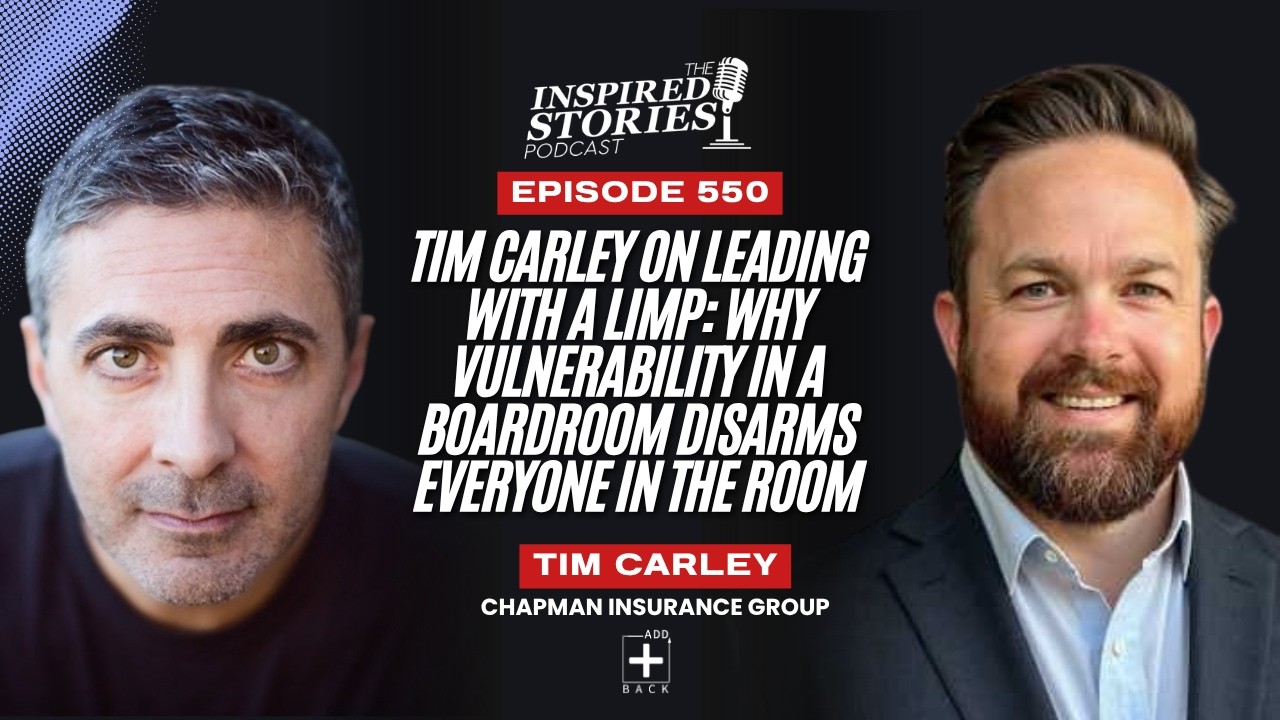
Listen to the full episode here
Transcript
Anthony Codispoti (00:00)
Welcome to another edition of the Inspired Stories Podcast, where leaders share their experiences so we can learn from their successes and be inspired by how they've overcome adversity. As you listen today, let one idea shape what you do next. My name is Anthony Codisbodi, and today's guest spent almost a decade walking alongside teenagers as a youth mentor with no plans of ever working in insurance.
Then, in under three years, he moved from an entry-level business development role to leading culture and recruitment for an entire company and eventually became a managing partner running his own book of business. Today, Tim Carley is the managing partner at Chapman Insurance Group, leading the firm's North Palm Beach office. Chapman Insurance Group serves homeowners, drivers, and business owners across Florida with more than 1,000 five star reviews and
And access to over 35 home insurance carriers. Before stepping into ownership, Tim spent nearly a decade as an area director for Young Life, a national organization that mentors teenagers. Some of the best leaders come from rooms you would never expect to find them in. But before we get into all that good stuff, today's episode is brought to you by my company, Adback Benefits Agency. And if you're in the insurance business, this solves a problem that's been plaguing your clients for years.
You already know the story, right? Health premiums go up and your client panics. Maybe they shop around or start cutting benefits. Either way, you're the one explaining a price hike you didn't create and your relationship takes the hit. But there's a program you can bring into that same meeting that flips the script and frees up cash. It doesn't replace their group health plan. It fills in the first dollar gaps and it can even cover part-timers who don't qualify for major medical.
Employees get unlimited access to doctors, therapists, and prescriptions with no copays or deductibles to meet. And here's the part that changes the conversation entirely. This program actually increases your clients' net profits. We recently helped one add $900 per employee per year to their bottom line. Results vary, but gains like that don't just help their bottom line, they free up budget your clients can reinvest in the coverages you're already discussing with them.
Your client gets real relief and you get to be the broker who delivered it and the one they tell their friends about. Adbackbenefits dot com. All right, back to our guest today, the managing partner of Chapman Insurance Group, Tim Carley. Thanks for making the time to share your story today.
Tim Carley (02:37)
Absolutely. Thanks for having me. Excited to be here.
Anthony Codispoti (02:40)
So, Tim, you spent close to a decade as an area director for Young Life, mentoring teenagers across Palm Beach County. First of all, tell us what Young Life is for those who aren't familiar.
And then secondly, what drew you to this work?
Tim Carley (02:55)
Sure, actually, all in all, I was on staff with Young Life for twenty-two years, if you count when I started back in college. and I served as an area director for a short time for four years in Georgia and then ten years down here in Palm Beach County, Georgia is where I'm from originally. But Young Life is a relationship-based Christian outreach organization. and the way that we
Go after the furthest kid out, essentially, is what that is. So who's the furthest kid out at your high school? Is it the is it the is it the kids that are hanging out on the fringe of the lunchroom? Is it the kids who are hosting the parties at their house on the weekend? those are the kids that Young Life, Young Life sees themselves as missionaries from the local church out to those kids. So if you treat the high school like it's a foreign country, because they've got their own language, they've got their own customs, they've got their own their own way of being, right? And so
Young Life enters into that world as missionaries to those kids. And we do that through showing up on campus when and where we're allowed to. We we pick a sport and we coach it. We'll have weekly meetings where we gather kids together, but it's really through winning the r the earning the right to be heard with those kids by showing up and being a a presence in their life and then getting to share the gospel with them. So the gospel always holds more weight or anything holds more weight with someone that you know.
Right, that someone that you trust. And so we try to build those relationships with
Anthony Codispoti (04:24)
Can you give us an example? maybe even think about
Tim Carley (04:28)
Sure.
Anthony Codispoti (04:28)
somebody specific without mentioning their name, how you connected with them, how you were able to
Tim Carley (04:34)
Yeah, so I would say a great example that I have is is a guy here in town in Palm Beach, who's now twenty-six years old and he's married and he actually just became an ordained minister in the Presbyterian church. when I first met him, he was fourteen years old, a freshman in high school. he came from a a broken home, divorced parents, one of his parents struggling with addiction.
and he was the oldest of three. And so he was actually, he kind of witnessed all the bad stuff as a kid, as a young, young kid. and so when I met him, he was pretty young and impressionable, but he was as a lot of kids in situations like that are, he grew up really quick. so we connected on like a lot of levels. He had a really quick wit, he was very smart, he was really good with people.
and so he and I connected, but it wasn't immediate. I I had to sh I show up. He was a lacrosse player. I I volunteered as a lacrosse coach. So I would show up to practice. the high school that I did Young Life at allowed me to come and serve on lunch duty to help with the assistant principals. And so I would go to the high school cafeteria at lunch and kind of just walk around and be present. And so it when you do that, that's kind of the first level we call it just being seen.
So then a kid would be like, Yeah, I've seen you at the lunchroom. I've seen you at my lacrosse practice. Like, who are you? You know what I mean? And so those types of things being present in someone's life eventually gives you the earns the right to be heard, right? And so eventually with this, with this kid, he eventually let me in. Yeah, go ahead.
Anthony Codispoti (06:20)
So
just 'cause I wanna when he asked you that question, who are you? How do you answer that?
Tim Carley (06:26)
Well that's a tough one. So I I I don't what I don't want to do, because I think so often in ministry we just want people to show up to our thing, right? Like we get numbers driven just like anybody else. And so what I say is it's just like, hey, I'm Tim. I'm I'm volunteering here at the school. I'm gonna help Coach Lacrosse. I don't even mention Young Life to him. because kids can sniff that out. You know, if you're there and you're just trying to get them to show up, you might as well just have like
a t-shirt on that says young life and you're handed them a piece of candy that says, Hey, come hang out with me. You know, so like that that really pushes pushes kids away. So as much as I can, I'm trying to get them get to know them in a genuine way. And genuinely, don't if they don't want to show up to the thing, I don't I don't I don't want them to because then they're showing up for obligation or showing up for a reason that they they don't want to be there. that weekly meeting that we would call I know you had some experience in high school, we'd call it Club. So Club was on
Monday nights here in Palm Beach. And so I eventually just kind of won him over over time. He had kind of a serious gap in his life. He and his father were estranged. so he was it was kind of a good time for an older guy to come in in a mentoring role with him. I was the JV coach for the lacrosse team, had never played lacrosse before in my life, but somehow got put in that position.
So there were some days I'd show up to JB practice and I'd bring Spike Ball with me, and that's what we would do for practice because I didn't know I didn't know anything about lacrosse. So we we only won we only won one game that year. Here's a fun story for you. We only won one game that year, but at the last game we were getting creamed and I called a timeout, I called everybody over and I said, When the game's over, we're all gonna rush and go dogpile our goalie like we just won the game.
And so and we were getting by beat by like 15 goals. And the kids like, you just saw their demeanor change of just like going from dejected to being like, that'd be funny, right? You know, and so game ends and we just clear the bench and we go and dogpile on our goalie and are celebrating. The other team's like you know, like that. And I actually I said, Hey, you know what? We're we're JV State champs. I was like, 'cause there is no JV playoffs, so it's just whoever calls it first. And so I said that we were JV State champs. And
I still get kids coming around that see in town to be like, Hey, JV State champs, you know, twenty twenty sixteen or whatever. So so anyway, so Ryan was on that team. We got to know each other really well, and kind of entered into his life. And it took time. I mean, took time me showing up repeatedly over and over again, as r as any relationship does, whether it's a business relationship, whether it's a personal relationship, you have to show up over and over and over again. And oftentimes he
dealing with rejection, you know, from that. After about a year, year and a half, I I got him to agree to kind of come to camp with me that summer, a bunch of his friends. I got a bunch of his little group of friends to come. And at he had an encounter with Christ that that week at camp. and and things started to change in his life, not immediately. It was
a l over time, I'll say now that his he and his dad are not estranged anymore. That that relationship got repaired kind of early in his college days. I actually got to perform his wedding with he and his wife's, which was awesome. So we're still very, very close today. And so I would say that's one of the ways where it's like it started with me showing up, saying hello, dealing with the rejection, and just kind of repeated. But for some reason, God laid this kid on my heart and there was a connection there.
And then over time I would say and now I don't even think of him as someone I mentor. Now I just think of him as a friend. You know, we've got twenty years difference between us, but we've got a really close friendship now. And now he's he's planting a church here in town. So it's exciting. Yeah.
Anthony Codispoti (10:24)
That's incredible. And so
the weekly sessions that you call them club, right? And so how do you get somebody like Ryan to come to club for the first time? What's that ask sound like?
Tim Carley (10:37)
Well, so so high school kids are interesting, right? So I like to play the game where high school kids love to play the too cool game, so I like to play that game too. So like if you if you were if I was sitting at a table with some kids that I knew or I approached them and we were talking about young life that Monday night, and you, Anthony, were a kid that I would love to show up, but you were kind of keeping me at arm's length and you were too cool for it. If you were like, Hey man, what are you guys talking about? I'd be like, man, don't worry about it. You wouldn't like it.
And then I just kinda I just kinda brush you off like I'm too cool for you. So I don't I really don't play that like clamoring after them game because that's how you get a cool kid to push you further away. He doesn't he so I play the same game that they do with with their friends or the girls they're trying to pursue. I'm like, you know, it's not for you. Don't worry about it. And then I go back to them and I just completely ignore the kid. Well, that kid's gonna show up on Monday because he wants to he wants to find out what it is. And he's actually more intrigued by me because I don't
feel this sense of urgency that I really, really want him there. and so that's how it works sometimes with certain kids. With other kids, it's just like, hey, come check it out. Some kids are just clamoring to be, to be invited to something. and then there's always the hey, there's going to be girls there. You know, that's a great way to get any, any guy to show up anywhere is like, hey, there's, there's girls there. And so and that was camp, you know, I would get kids to shine for camp. I'd be like, it's usually like two to one girls the guys at camp.
So you should probably, I mean, what else are you doing this summer?
Anthony Codispoti (12:09)
Mm-hmm.
Tim Carley (12:10)
and so, and and it's I'm not lying, you know, it's true. Yeah. Well,
Anthony Codispoti (12:12)
Well, these are skills that clearly came in handy later on when you find your way to the insurance world. You're a good salesman. This is great.
Tim Carley (12:20)
that that too cool thing has really served me well. because I would see peers, whether it was a youth pastor or a or another young life person, just struggling through this, like, man, because you you'd come and you'd target this kid like.
Like the best kid to have come to your young life is the kid who's actually hosting the keg parties at his house that weekend. Because that kid is already a leader. He's just leading people in the wrong direction, right? So if you can win that kid over, you're gonna get everybody else that's already following him, right? So you go after these kind of strategic relationships. But a kid like that is way too cool for you, right? And so if you go at him with just like a, hey buddy, you know, why don't you come check out
This thing, it's all about Jesus. He's gonna be like, nah, I'm not no, get get away. You know, you've ruined it. You might as well not ever approach that kid again. But so you have to be kind of strategic in the way that you win over a kid like that. so yeah.
Anthony Codispoti (13:15)
So
you were doing young life, you said a couple decades, in various roles, various capacities.
How on earth did you find your way to the insurance world?
Tim Carley (13:25)
Well, so around twenty twenty two, I it was time for me to kind of step away from young life. I and that was that was that was really hard for me. Young life was something that I fell in love with when I was seventeen years old in high school and then went on staff when I was nineteen years old, my freshman year in college, and never looked back. I thought that I was gonna be
retiring from young life in my seventies. You know, I thought that I would be one of the people that was able to be there for a long, long time, which is a very large, great organization. there are some guys like that who've been in it forever. And I kind of idolized some of those guys and wanted to be just like that. And so, but it was became fairly very obvious that it was time for me to step away. That some of the things that used to bring me joy didn't really bring me much joy anymore. I'd kind of
some of the ambition that I think God puts within us, which I think oftentimes we get we feel guilty for the ambition that we have, even though I think it's God given to to have ambition to try to build something. And some of that ambition that I had was a little bit outgrowing what young life was able to offer. and so when it was time to step away, I stepped away cleanly. There was I I didn't get asked to let go. There wasn't some big knockdown drag out where I got in an argument with my boss or anything like that. It was just a
It was an easy kind of leave out the back door, step away kind of thing. Every everything's good. All the relationships still intact. And I actually stepped away not knowing at all what I was going to do. and so I had I had about three months maybe of financial you know survival, right? So where I could make it, yeah, a
Anthony Codispoti (15:06)
Little runway for you. Mm-hmm.
Tim Carley (15:08)
little runway. So and
So I I met with one person. There was a guy in town who was kind of a connector. He does personal finance in town. He does wealth management. He's a young guy. he was in his he when he was like twenty-seven at the time, but he had a really good portfolio built up. He had connections with other nonprofits in town. his dad was one of the ones that helped start one of the very large churches here in town. And so
I knew I wanted to step away from ministry, but he he had three conversations that he set up for me. Two of them were with other nonprofits. and then one was with his friend Taylor, who had just bought a book of business for insurance, right? He had he had started harvest insurance. And so I kind of met with all three of those guys, had conversations with them. The nonprofit thing, I was kind of ready to stop fundraising, and both of those jobs were full-time fundraising, not very much.
life on life ministry, but more like operational, developmental type jobs. And those are great. and I certainly could do that, had all the experience, but just was kind of ready to step away from the fundraising and wanted to try my hand in the business world. And so what Taylor was offering me was the way Harvest was set up is they did all search engine optimization leads. They did all their ad, they did that's how they got all their leads was ad spend.
Taylor wanted me to come in and be the hands and feet of that here locally, to do local business development, to see what it felt like to go out there and really try to get organic leads. because, you know, he very smartly knew that like, you know, the ad spend could go away. Google could decide for whatever reason just to shut down our ad spend with no explanation. you know, and and it could could turn it off. And so he kind of charged me with the idea of using the relationships I already had.
using my relational skills to try to do business development. and so I that that attracted me. Here was a guy who was gonna kind of pay me money to go out and talk to people and promote a product and make connections. And and so yeah, that's that was that transition. It was a conversation with him and it was a couple months of or not a couple months, it was about a month of back and forth. but I I left Young Life staff, I think October first of twenty twenty two and I started with harvest insurance November fifteenth.
of that year. So yeah,
Anthony Codispoti (17:29)
that happened fast. Yeah.
Tim Carley (17:30)
so it happened happened pretty quickly. and and yeah, so the yeah, th that's kind of that transition.
Anthony Codispoti (17:36)
Is there more that you wanna say about what led to you transitioning away? You said there was some ambition there. You just like did you feel like you needed to try something different?
Tim Carley (17:46)
Well, I felt like I was I felt like I had more to offer Young Life at the time, other than the the area director role is a is a fantastic role in Young Life and it's kind of the heartbeat of the whole mission. But at some point you kind of you kind of outgrow it. You know, Young Life usually hires people. A lot of ministry jobs do this, a lot of other jobs do this. They hire people in leadership positions that they're not necessarily ready for, but they have the raw talent to do it, or they hire somebody who's
really good with kids, but then the job, you actually eventually turn into like a CEO, right? And so I had kind of weathered that storm of 10 to 15 years of turning into more of a leadership CEO or what I wanted to be anyway. And so I wanted to grow. I wanted to manage maybe a larger area, kind of get away from doing the the day to day in, day out with high school kids and help
help a staff person. They had just hired a staff person in the county north of me. and so I was like, hey, I could help manage her. and then I I've trained up my own replacement here in Palm Beach. I could manage both of these areas, give them, you know, because our the way it's it was organized, our boss was up in Orlando, which is about three and a half hours away. And so you're kind of on an island when you're on Young Life staff. And so I thought, you know, I could be a source, a resource for them. I could help them fundraise. I could help them train up their local
board and then I could I could be a I could help manage them, help take care of them and then grow those areas to open up the next school, you know, because we're in northern Palm Beach County. If you want to go to like Boca Raton, that's like a whole nother community, right? So how do you open that up and how do you start that? And so I felt like I had more to offer, but Young Life didn't really have a place to fit me
Anthony Codispoti (19:36)
Got
Tim Carley (19:36)
in with that. Unless I was willing to move, you know, Young Life
has openings, has needs all over the country. And so if I was willing to pack up and move, you know, I could have done that. But at this point, we'd been here 10 years. This was kind of our home. You know, one of our
Anthony Codispoti (19:53)
Yeah.
Tim Carley (19:54)
kids was born here. The other two were four and two when we moved here. So this was this was home for us. and my wife had just gotten a job that she was really starting to enjoy. And so I didn't feel like it was the right time to pack
up and move.
Anthony Codispoti (20:07)
So get this
opportunity to join Harvest. Taylor is focusing on the online aspect of the business. Hey Tim, you've got some great relationships. You've got the personality for it. Why don't you come in and try this the old school way? Right? Go out into
Tim Carley (20:20)
Yeah.
Anthony Codispoti (20:21)
the community. What kind of insurance were you guys selling?
Tim Carley (20:25)
Personal lines insurance mostly. so home, auto, flood. we we didn't do really we didn't dabble into life insurance very much. We didn't do any health insurance. we eventually started doing some commercial insurance policies, but the main the main of it was was personal lines, was home and auto. Yeah.
Anthony Codispoti (20:46)
Got it. So
you moved from that business development role into over time more of a leadership role, overseeing culture, recruitment, strategic relationships. Talk to me about that transition, what changed for you.
Tim Carley (21:02)
Well, so I went out there and I did the business development thing. and with with and Taylor to his credit, he he didn't really know insurance very well either. He wa he's in the construction business and he decided to get into the insurance business as like another revenue stream for him. So he didn't necessarily understand the insurance business very much either. he just knew it was something that everybody needed. It's a great product to sell, right? And so
I didn't have a ton of direction to go out there and start doing it. So I was like, okay, who do I need to see? I need to see realtors and mortgage brokers. Those are the people who deal with clients when they're buying a new home that absolutely need an insurance policy in order to buy and purchase that home. and so I went out and started doing that. And I did it for probably eight months. and my report back to Taylor, which he and I would meet.
probably at least once a week just to check in and then maybe once a month with like a larger strategic conversation. It was like, hey, this works. This works because this is how everybody else does it, but it takes time. Just like I said, relationship building takes time. So especially in something where the market's already saturated. So if you're a realtor, you already have an insurance person that you send your people to. So now I'm coming in and I'm trying to take that market share away from somebody else.
And so what am I offering that that person's not offering? It's gotta be a relationship, right? And so a relationship takes time to build. And so that was my report was this works, but it's gonna take me three to five years to build up a decent book of business this way. and he agreed with me on that assessment and then decided too that there was more, a lot more needs internally than there was externally. And, you know.
I think my best week was like I I got like fifteen leads in one week. And you know, with our with our SEO, we were getting fifteen leads in a in thirty minutes. So it's
Anthony Codispoti (22:59)
my gosh.
Tim Carley (22:59)
you know, yeah. So we were really doing a lot of big ad spend there. We were we were using a really smart marketing firm to help us with that that we actually owned internally.
and so the so it was like there's more needs internally. So I came in, there were some leadership needs. we were restructuring our customer service team. the guy who was the head of sales had kind of he didn't understand insur he understood insurance, but he actually cut his teeth doing door-to-door sales and running door-to-door sales teams. So he was he was a lot of momentum and energy and that sort of thing. But you know, it's a product that sometimes doesn't sell quite like that.
And then there was, we're a brokerage. So then we have these, you know, 40 carriers or so that we all have a relationship with that they all want someone to be their point point person. And so I became that, the carrier relations person to so I was the face of the agency to all those other companies. You know, so if progressive progressive would come to the office like every six weeks, like clockwork, their representative and show me a report of all the progressive.
you know, things we sold and all the mistakes we were making and all that fun stuff, right? They just wanted someone that they could talk to that was, you know, somewhat in charge. And so that transition actually I I was excited about that transition because and I'm trying to maintain some of those outside relationships as much as I could, but you know, it's a grind. Business development is a grind and it can be it can be a lot over time. And so being able to transition in and learn more of the business internally. because actually before I started all that, I did three months
working in customer service. I got my 440 license and I worked as a customer service rep. and I just dealt with all the junk that you deal with. So I I rewrote some bad policies. I dealt with angry customers. I kind of learned how the internal phone system works, you know, how we our use of virtual assistants, all that fun stuff. And so I did that for three months before I transitioned right into the more operational leadership type job.
Anthony Codispoti (25:09)
So with Taylor not having a real foundation in the insurance industry either, who were you learning from?
Tim Carley (25:18)
So there was there's there were some really talented salespeople there. when he when he first started, he bought up a few all state books. And then when he bought up those books of business, he also bought up their top salespeople and got them to come over. So he had some subject matter experts in in house that were selling policies, but they were so crucial to our policy sale, like to be salesmen that they didn't really have the bandwidth to be leaders, right? and that's those are two different
Skill sets, right? as salesman and and and leadership. And also the principal agent that he bought the original book of business from was there for a time, but he was transitioning out. He kind of wanted to sell the book and then and then exit. And so he did about a year between one of those books of business and kind of kind of bridged that gap. And so he was the one that I kind of he handed all the relationships off to me with the carriers. And so I learned some from him.
And it was really just trial by fire. I would show up, these carriers would come to the office, I'd get an alert that, you know, this carrier was stopping by tomorrow. And I was like, I have no idea what I'm walking into. So I'd go into the meeting and I'd be like, All right, so tell me about our book of business. And you know, it's it's all just like tax out of so I'd always be like, Hey man, what can we do for you? Like you've told me, you told me where we're where we're not hitting it, you've told me where we're doing well. What do you need from us? How can we be a good
agency partnership for you. And then I became that kind of point of contact for them. And so then that to me, that just became another relationship to manage, that representative of that carrier who usually lived locally, right? So they split it up by territory. So I would contact that person more often, maybe with just an email or a text message, just to check in, right? Or I would, you know, if we had something going on, I'd be like, hey, are you in town? Do you want to
Do you want grab lunch? Do you want to grab a drink? Like just try to just try to maintain the relationship so that when we did need something, if it was time to reneg renegotiate our commission structure, if it was time to sell a new product for them, the relationship is what would it was already there. It wasn't I had to go get to know somebody brand new. and so that that felt very natural to me, that that connection point. And so I just kind of
It was maybe a little bit smoke and mirrors, but you know, it was just through my relationship building ability with carriers and with with those representatives that I did that.
Anthony Codispoti (27:48)
Yeah. You're you just use your personality traits, right? You're very curious
Tim Carley (27:52)
Yeah.
Anthony Codispoti (27:52)
and you've got the personality that you want to connect with people and form that relationship. So like you said, when something comes up, whatever it is, you've got a client situation, maybe you've got to renegotiate
your rates. Now you've got a good bond with that person. So you did this, you were at Harvest for close to three years, and then about a year ago the opportunity came about to join Chapman Insurance Group. Tell us how that unfolds.
Tim Carley (28:16)
Yeah.
Well, so through some of the things I did at Harvest and and Harvest was actually a part of what you call a like a like a larger group of agencies. there was about nineteen different agencies across the state of Florida. and as a group, we would renegotiate contracts with carriers. So you always hold more weight as a group, right? So it's like it'd be no different than a like a franchise model. I'm not sure.
What you guys have there in Ohio, but like there's a there's a one based out of Texas called Goosehead. Goosehead insurance opens up franchise stores all over the place. Well, they have one guy in Florida that does all their carrier relationships for all the Goosehead agents, but when he's renegotiating contracts, he's renegotiating on behalf of a hundred agencies, right? So us as those 19 agencies.
would all band together and we had a leader. her name was Erin. She's been in the business for a long time. And she would renegotiate for higher commission structures as a group. And so then we would, so I got to know Chapman Insurance Group was part of that group. So we would do biweekly Zoom calls with this group. And then we would do every other, you know, month maybe there'd be not every month, like once a
Once a quarter, maybe there'd be a gathering. And so I'd see him there. There would be a large yearly conference that we would all go to in Orlando and we would be there as a group. And so I was the representative for all those things. Taylor was very busy with his construction business. He was entrusting that part of this agency to me. And so I was the one who was in those meetings. I was the one who would we'd get invited. You know, I I found myself sitting at a boardroom table of a
billion dollar insurance company in Tampa with seven other agencies represented it represented and Chapman was one of them. And we're going around the table and everyone's asking how long you've been in the business. And you know, it comes to me and I'm like, about a year, you know, like and and what I found too was like you you brought it up earlier, my curiosity and my vulnerability was disarming and and and it invited people in. And so
I wouldn't I wouldn't try to sugarcoat anything. When if they said something that I didn't understand, I would stop them and I'd ask a question. I'd be like, what does that word mean? You know, and so so I met Brian Chapman through those types of things. And so he and I struck up a friendship. he was the largest agency represented in our group with five locations on Southwest Florida, large book business, about 17 years in the industry.
And then his dad was a state farm guy. So he also grew up in the industry as well. and so he and I struck up a friendship, similar value system. we both have multiple kids. He's got five kids. I've got three kids. You know, we just talked and we would call each other for things. We just kind of became friends. And so when it came time, I I kind of decided like, hey, I think my time at harvest might be coming to an end.
my thought was to open up my own agency completely by myself, be an independent agent. and so I called Brian for advice more than anything. Called him for advice and just said, hey, could I do this on my own? And he said, absolutely you can do it on your own. The hardest thing for you is going to be getting carrier appointments because they don't like to appoint new they like to see a book of business before they appoint a new book of business. So I'd either have to go buy a book of business and hope I get those appointments.
Or I'd have to start from scratch and, you know, rely on my wit and charm. and then he said, and then during that conversation, I ended up pitching him on the idea of would he ever think about opening up on the East Coast? and unbeknownst to me, it was part of their 10-year vision to eventually open up an office on the East Coast. and so we kind of
Anthony Codispoti (32:17)
And sorry, all
of his locations up to that point had been where?
Tim Carley (32:20)
on the west coast of Florida. So like Naples, Fort Myers area, Cape Coral, Port Charlotte. and I'm on the east coast in in Palm Beach County, Greater West Palm Beach is where I'm at, which is just north of Miami. And so so over here too, there's there's a different opportunity over here, just just so you know, the the real estate is worth more over here. So then the policies are worth more over here, right? So the
population is 10 times more saturated over here than it is on the West Coast. And so the opportunity is here for sure. So he's always wanted to grow to the West Coast. He was just waiting for the right opportunity to come along. And so that's when that started from there. What does it look like to be in a partnership together? and for me also if I'd gone out independently, I'd probably would have had to gone about a year, maybe 18 months without making any money. and I couldn't
I couldn't do that. I couldn't float that. And so Brian offered structure. He offered, you know, financial backing. He offered to do all the upfront costs. and for him, you know, he gets he gets in a new market for the first time in their lifetime. Cause I would say it's a very similar market over there. Not similar, but they're all within about thirty minute proximity of each other. Naples being the furthest south market that they're in over there. and so and he has aspirations to to grow more.
And so this was kind of the first time then they've been able to do a partnership like this.
Anthony Codispoti (33:49)
I want to go back to something that you said that your curiosity and your vulnerability were disarming in some of these, you know, meetings with with these more experienced insurance professionals. Speak to me about the vulnerability piece, how that shows up and why you think that was important forming some of these relationships.
Tim Carley (34:09)
Well look, I I think that, you know, I I've been told I'd I'd been told for a long time that I had good emotional intelligence, you know, a high EQ. And so, I never really understood what that meant until I would get in these situations where it would be, you know, here's the CEO of a billion dollar insurance agency and we're talking about his grandkids and my kids and their similarities, or we're talking about
my former ministry job and you know, Young Life would open a lot of doors for me, just like it did with you. You had experience with Young Life. Young Life is a international organization. Sometimes you can just say Young Life and people be like, yeah, I had that at my high school. I went to camp, you know, in nineteen ninety-two or whatever. So it just it would open doors. And so when I would not try to overstep or like try to pretend like I knew what I was talking about.
When I would pull somebody aside and ask a specific question, they were all eager to share. And what I found too, because it's I'm guilty of it as well, if you go to an older man and you genuinely want to learn something from them, there's nothing more disarming for that older man, right? So it's like, hey, can you teach me something? They're dying for somebody to ask them to teach them something. Cause I'm the same way. When a twenty year old comes to me and says, Hey man, I'm about to get married, like
I'm worried, can we meet? Can we talk? I'm like, absolutely. I'm, you know, my wisdom I get to impart on you, right? You know, so it's very flattering, right? And so, but it's also genuine. I really did want to learn from these guys. I was, I was, you know, very, very curious about this business, very curious about how they ended up where they were. And also, you start to realize too, you sit in enough of those boardrooms and you're like, man, you know, nobody really knows what they're talking about. They're all, they're
Anthony Codispoti (36:01)
Ha ha ha.
Tim Carley (36:01)
all kind of figuring it out as they go.
They know a little bit, right? But they all just decided years further ago than I did that, hey, this is a pretty great product to sell, and we just need to figure out who needs it and how to sell it. And so that's how they got to where they got to. but man, everybody just wants to everyone wants to belong and everyone wants to to connect with somebody. And everyone really deep down everyone wants to be known whether they realize it or not. And so if I show up vulnerable and say,
This is my first time at one of these things. I really don't know what I'm doing. Complete disarm immediately. You know, no one's back on their heels. There's no competition in this in this conversation. We're not we're not striking up a deal, you know. and then but then when it does come time to strike a deal, we've gotten to know each other so well that there's a there's a real trust that's been built there.
Anthony Codispoti (36:56)
I love that. So tell us what it was like opening up this new office on the east coast of or yeah, east coast, because they were west coast. Now
you're opening up on the
Tim Carley (37:06)
Yes.
Anthony Codispoti (37:07)
east coast for the first time. What was that process like?
Tim Carley (37:10)
Well, so it's pretty quick. So in the sense of like Brian is a very dynamic leader. he has built something really phenomenal in Chapman Insurance Group with about a hundred employees, those five locations. and he's built up a fantastic kind of leadership team, what I'll call like the C-suite team is you know, over sales, over operations, over people.
over marketing. and so he he's been really, he's built something great. And so it was him and I kind of spitballing the idea. And then he brought in his COO to the conversation, who I had met before and was actually his sister in law when they first started the business. It was just him and her. and so he gave me the playbook. He said, here's how we're gonna do it. He was I was he's like, you're gonna hire one or two salespeople. He was like, and then you're just gonna do business development.
the whole time and you're gonna send all the policies, everything everything you kill, you're gonna send back to them to harvest, right? And so so that's how that was the formula. he recognized my relationship relational ability in me. He wasn't asking me to do something that was outside of my skill set. He was asking me to to to to start something but not start from scratch. And so it happened pretty quickly. Our our our you know first day with him was like September first of last year.
and then by January first, we had a physical office here. about that whole time September through to December, I would drive over to Fort Myers probably once a week. I probably did about eight trips over to Fort Myers through that whole fall, getting to know different members of the leadership, spending time in all the departments, getting to know the salespeople, sitting in on what they call traction meetings. I would meet with different leaders, I would go to the Naples office, get to know their best salesman there.
Just to immerse myself in Chapman Insurance Group, because I'm I'm for them, I'm carrying the brand to a different market and they have to trust me to carry that brand forward. You know, and so I spent all that time just immersing myself and then hired my first salesperson in December. and then we we opened up our office January first. and then we wrote our first policy, I think, in February, because he was still getting trained by salesperson. And so
But that whole time I I already started doing business development here locally. I would go to I joined real estate associations and all that stuff because I kind of knew that formula, I knew how to run that play. but it happened quickly, and everybody got on board and everyone was excited about it because they're all they were all part of setting that 10-year vision. So it wasn't like a shock to anybody. it was a surprise, I think, to some of them, but everyone was excited about it.
Anthony Codispoti (40:04)
So what kind of insurance products do you offer now?
Tim Carley (40:08)
So very similar to Harvest. We do personal lines insurance, home auto, flood. we do we do business insurance for sure as well. We have a whole team of people that we have a team that just concentrates on like condo and homeowners associations, which are which is huge in Florida. we have middle market, we have small business. so we offer a lot of that. We do some life, not not a whole lot, but very similar, similar the same industry I was in at with Harvest.
Anthony Codispoti (40:37)
Okay. So now you're borrowing from a similar playbook that you were trying before at Harvest, right? Getting to know the realtors, the mortgage lenders. But when you were at Harvest, you came to the conclusion that it's gonna work, but it's gonna take three to five years. So now that you're at Chapman, does that timeline look the same? And and if it does, does that concern you?
Tim Carley (41:00)
Would say it looks the same in the sense of like what how are we measuring a successful book of business that can stand on its own, right? And so, and that's the runway that Brian Brian was really upfront about that, because we we do a little bit of ad spend for online web leads, not a lot. We want our bread and butter to be relationally driven lead sources. And so he gave me the runway.
of three to five years of saying like that's how long it's gonna take for you to really and he's like and threes on the on the low end that and he's like it really depends on how much hustling you do on on your end. And so I would say already like some of the some of the things that are giving me hope is like like I said the the real estate is worth more over here. So the policies are worth more. So like our policy, you know, a policy for a similar home on the West Coast might be
$2,000 a year, where a policy that home here in Palm Beach County might be $5,000 a year. So we're we're able to get that bottom line up higher with with less products. And so I'm not concerned about that timeline because because Brian's not concerned about it. So he's given me that confidence to say, hey, it's gonna be a grind for three to five years before you really feel like you're
your branch, your office is really starting to make some decent money. and so I I'm good with that with that grind because he's done it before and he's opened up five other locations. and so so he knows what he's talking about.
Anthony Codispoti (42:43)
Any thoughts to borrow from the playbook that was working really well at Harvest and do a lot more of the online?
Tim Carley (42:52)
yeah. So I would say that I think that we'll eventually come to a place where we have to kind of do both and like I don't think we're we're certainly not at Chapman Insurance Group, we're not trying to ignore the role that technology plays in everything that we do. we ha we're actually developing our own
internal radar system, our own internal CRM, which will work hand in hand with with AI. And so we're we're really excited about those types of things. And so I think that along with that, on the lead source side, lead generation side, I think it has to be a both end. Actually I just had a conversation with my marketing VP this week where I said, hey, whatever we're spending in web leads, I would like to double it. I know that that's coming out of my pocket, you know, in the ledger that we're keeping. I was like, but I think it's worth it.
just to get the momentum going. Like let's, and we're talking about maybe it's supposed to maybe 10 to 15 leads a week. And I'm talking about like let's double that to about 20 to 30 leads a week and then allow me to fill in those gaps with my local lead sources. I also, I also have both of my salespeople are in networking groups as well. So I've I've encouraged them to create their own networks. And kind of the way I view that too is if I hand them you as a client,
And they write the policy. Now they you have the relationship with them more than you have it with me because they wrote your policy. So it's up to them to turn your policy into multi-line, you know, get your get your auto as well, maybe get a flood policy for you, but then also do such a good job with you that you're referring business back to them, right? So I am I do think that there's something where we can borrow from that playbook, but I also think too that a web lead
is not as sticky as a as an in person lead, as as a as an organic lead. A web lead, it came as easily as a dollar spent on Google. It's gonna leave just as easily, right? Unless
Anthony Codispoti (44:55)
So when it comes time
for renewal, maybe they're out the door again because they could save eighteen dollars.
Tim Carley (44:58)
Maybe maybe they're out the door again.
Right. Yeah. So unless we build that relationship in the in the meantime, which we have we have the formula to do it, but you know, unless we build that relationship, it it's easily out the door. Whereas an in-person built lead, it's built on a relationship. You know, you usually end up keeping those leads at a much higher percentage.
and so I don't want the web leads to be the base of what we do, but I would like for it to complement what we do.
Anthony Codispoti (45:28)
Since we're on the technology topic here, you know, spending more on the web leads, et cetera, you're building your CRM. It's gonna have, you know, AI integrated into it. Do you have any concerns about down the road that AI could replace insurance agents on some level?
Tim Carley (45:50)
I mean, I think we'd be naive to not have that concern. I don't know that it'll replace it ever ever replace it completely. I think that we we actually there was a conversation this morning. I was on a sales call with all the salespeople in the whole company and someone brought up that sometimes sometimes customers will come to you having run everything that they have through Chat GPT and then they'll come to you with these lists of questions and demands.
And oftentimes they're inaccurate because ChatGPT doesn't know everything. But they are that customer is firm that you are breaking the law if you don't do this thing for them. So now we're, I think they call it AI hallucination, right? So now we're we're having to talk a customer out of their AI hallucination and into actual facts. And so that's a challenge for sure. I would say though that here here my thought thought is this. As long as the
real estate transaction is a personal one. I think that all the other all the other things that happen based off of that transaction, the mortgage, the closing, the insurance, will always have the opportunity to be a relationship building thing. So until we start which some of this happens, sometimes people are buying homes sight unseen across states because they're making a cross country move or across countries, you know, like
side unseen, but there's still a realtor that has to show up. They still have to show up, even if the closing is virtual, they're still doing it virtually like this, right? So typically there's always going to be a relationship involved with that real estate transaction. So that gives me a lot of hope that there's a relationship there for us to maintain as well. And I also think too that there's so much to understand about an insurance policy that you really do want someone with some expertise that you trust to walk you through it. Just like
you know, writing your own will. You know, you can go on legal Zoom and you can write a will, but you might not understand what it says. But if you sit with a an attorney that you trust and they walk you through point by point, there's there's a relationship there. So it's a concern for sure, but I I don't think it'll ever completely replace the salesperson.
Anthony Codispoti (48:06)
Yeah, I think we're far from the point, at least what we're seeing with current technology. And I'm guilty of doing something very similar to your clients are to you. I do it with my doctors. And and
Tim Carley (48:16)
Yeah. yeah. Yeah. Yeah. Yeah.
Anthony Codispoti (48:18)
but I go in with the mindset that I acknowledge that these questions that I'm asking may not be correct. But it's given me, it's a brainstorming tool for me. It's given me an idea of some questions to ask. Rather than assuming that the AI has got it right, it's giving me
Tim Carley (48:33)
Yeah.
Anthony Codispoti (48:34)
some areas to probe.
And I think that's kind of a smart way
Tim Carley (48:36)
Well that yeah,
Anthony Codispoti (48:36)
to use it.
Tim Carley (48:37)
and I would say that you're then you're a very responsible AI user, which I would say it's hard to assume that of everybody, right? and I think that I I would be much more concerned about my job being replaced if I was in unfortunately in one of like in the creative space, if I was a writer, right? Like, you know, you could just give AI some prompts and it's gonna spit out a novel and you don't know.
You don't know if it's written by the person or not. You know, so it's like there's there's some some industries where it's very scary. I think that health insurance, and and that's the industry that you're in. I know that like Amazon, like you can that it's kind of is an Amazon selling health insurance in India, right? And they're kind of testing those markets. And you know, health insurance feels like I well, all insurance and and you can relate to this, it's like, we only hear the horror stories of insurance, right? We don't necessarily hear all the good stories.
and unfortunately with with health insurance, it's always like, yeah, I went to the hospital and I ended up paying ten thousand dollars and they didn't even fix the thing. Well, my dad went to the hospital, stayed there for three weeks, and his insurance did such a good job. He only came out of pocket $2,000. So it's like you hear about right, that's
Anthony Codispoti (49:50)
That's the story that doesn't get told. Yeah.
Tim Carley (49:53)
the story that doesn't get told, right? So so people have people come into an insurance transaction typically on their heels and with their guard up.
Whether it's health insurance, home insurance, auto insurance, life insurance, whatever it is, they y y the insurance guy is usually the bad guy in the situation before he's the good guy. So you have to spend some time proving yourself innocent, unfortunately, in a lot of those situations.
Anthony Codispoti (50:20)
Yeah.
Well, and I suspect that's something that you're probably pretty good at, Tim, given your personality and the different experiences that you've had and ministry work. And I'm curious if you know you you left young life, but you know, that part of you hasn't left.
Like the things that made
Tim Carley (50:39)
Torn.
Anthony Codispoti (50:39)
all of that work so important to you are still foundational. Does that still show up in any way in the way that you conduct yourself in the insurance world?
Tim Carley (50:50)
Yeah, I would say, you know, all in all, I was in full time ministry for over two decades. And so that transition out of that was was pretty jarring. And then, you know, there was you enter into a into that job and I enter into a transaction with another coworker. It's kind of like there's all this baseline of like, hey, we all have the same shared faith. And so that's the that's the place we're coming from, right?
In this world, in this marketplace and in this job I have now, there isn't an assumption of that. You can't assume that everybody has the same baseline morals and faith and all that. So it's really hard to to to find out how to conduct yourself in that way, still putting your best foot forward, still trying to get the deal done, but all the time maintaining your integrity as a follower of Christ. And so I would say that.
What's come through, what's been able to shine through for me is that I brought it up earlier, but but you know, being vulnerable, not having it all figured out, not having it all together, because that's who we are in Jesus. Like any Christian who says they've got it all figured out is just lying to them and they're li lying to themselves and they're lying to you. And so I don't try to be perfect in front of everybody. I try to be vulnerable and approachable. and I don't
I and and then the questions will come to me of like, Hey, you know, like, do you go to church anywhere around here? Or like, hey, what's, you know, there's something different about you? Like, what's going on with that? So it's like, it's really conducting yourself as if you're you're just trying to ri live your life in front of somebody. One my my favorite phrases is from Saint Francis of Assisi who says, Preach the gospel at all times and when necessary, use words. And so
that's just how I try to live my life. Like I people like to be around me. I I and kinda I'm kind of done making excuses for myself in this sense. People like to be around me, they like to interact with me, and they just generally have a good feeling when they leave me, you know, and so that's the gospel being preached there in that situation. It's not me, it's Christ through me that is creating that kind of attractiveness and that environment. And so
I'm leaning hard into those gifts that God's given me to build a business, build a team, build up clientele, create relationships with realtors. I very rarely let any sort of competitiveness enter into my space. If there's another insurance agent at a function, I usually go right to them and make friends with them. And then, you know, we have all this shared experience of like bad clients, you know, realtors that never call you back, all this stuff, because that's gonna be much
That's going pay more dividends in this relationship than it's ever going to be me just being competitive because literally everybody is a client. Anyone who owns a home or drives a car is a potential client for a personal lines insurance agent. So there is no need to feel competitive with each other. And so I try to, I try to go right at those situations when I see other insurance agents in my space and just make friends with them because what are we competing for, you know?
Anthony Codispoti (54:06)
Well, and it's such a it it feels so much better to move through the world like that, right? Right.
Tim Carley (54:12)
Yeah.
Anthony Codispoti (54:12)
Now you've connected with this person. This invisible wall that could have been there is broken down. There's a warmth between you, there's a warmth in the room rather than being stando standoffish and cold and side eyeing each other, you know, it's just a better way to be.
Tim Carley (54:27)
Well,
and who knows what that relationship will be in the future. There could come a time where he's ready to get out of the business and he wants to sell his book and he calls me first and maybe I'm in a position to buy that book of business, right? Or or vice versa. Maybe I'm ready to get out and now I've got a relationship, a great relationship with a bunch of re insurance people in town and I'm able to sell my book of business to them. So the the whole competitive thing to me is just not productive.
You know, especially in such a large industry, in an industry where you really I mean, I'm surrounded by, you know, there's five thousand houses within a mile radius of me right now. So it's like that's five thousand opportunities to write a policy. And I haven't even walked a mile. So it's like, what are we what are we fighting over?
Anthony Codispoti (55:16)
You know, I hear from some brokers that they're having to contend with their carriers reducing commissions. Is that something that's affecting your agency? And if so, how do you deal with
Tim Carley (55:28)
that's not necessarily affecting us because of the reputation and the book of business that Brian has built up. So Brian has positioned himself within our industry to be kind of a mouthpiece for the Florida independent agent. I mentioned that we go to a conference every year. It's called FAIA, the Florida Association of Insurance Agents. Well, Brian was just inducted on the board, which is only a four-person board, all independent agents within the state.
And he'll serve on that board for a tenure of four years total. And so he is he's in position in our industry to have those conversations. We're also still a part of that larger group that I talked about that does contract negotiations together. And so it's very rare that we'll get reduced our commissions, mostly because of the production that we represent. Now I will say that.
The attractiveness of being that independent agent all on your own is is great. But I also think that insurance carriers are much more comfortable with small agencies because they can control them more. Once an agency gets pretty big and starts producing at a very high level, that agency starts to feel like they can ask for things as opposed to just getting told what to do. And I think that that can make carriers uncomfortable. And so that was another reason for me to join in with a larger group.
was the you kind of have a little bit more power, a little bit more say so when it comes to that carrier relationship. and Brian put it like this, he said, you could do it on your own. He said, but would you and you would you rather own a hundred percent of the grape or would you rather own a slice of the watermelon? Right. So by joining in with him, my valuation's through the roof, because it's just connected to his book of business, right? As opposed to, yes, I would own it 100% myself. I wouldn't be
splitting profits with anybody, I wouldn't be doing any of that, but a hundred percent of the grape or a slice of the watermelon. So we don't we don't see that issue a whole lot, but Brian is the one who's going to bat for us when it comes to that. Yeah.
Anthony Codispoti (57:36)
That's great. Let
me shift gears on you now, Tim. What's one of the hardest things you've had to overcome? And what did going through that teach you?
Tim Carley (57:47)
So I would say one of the hardest things I had overcome is what I would call kind of an identity crisis when I was l deciding to leave Young Life
staff. Young Life was something and youth ministry in general, I felt a calling from the time I was fifteen years old. I was involved in my youth group. I had a heart for the kids in my class in school, but none of them would come to church with me because they felt like they were
judged there. And so when I stumbled, I got invited to Young Life. When I was in high school, I got invited to Young Life by a kid in my class who was one of the biggest stoners that I knew. And he invited me to Young Life. And I got there and I had kind of the typical judgy church reaction. I got there and it was like it was at somebody's house just like you described where it was in Canton it was at this kid's house. There's kids in the driveway smoking cigarettes, you know?
And like they're cussing, and I'm like, what is going on here? And then I go in there and it's like some of the wildest kids from my high school are in this living room, and they're like, I mean, it's like a barrel of monkeys in there. They're just everywhere all the time. And then it starts from up front and they're they're not singing Jesus songs. They're singing like Sweet Home Alabama and they're singing all and like these kids are singing at the top of their lungs, and I have no idea what's happening. and then at the end of the
Club, this guy got up and he shared the gospel, and you could have heard a pin drop in that room. All these wild and out kids are just on the edge of their seat listening to every word that he has to say. And it was kind of like scales falling off my eyes of like, this is the only place for these kids to go. This is where they feel welcome. This is where they feel loved. This is where they feel not judged. And so I fell in love with that ministry right then and there. And the idea of being able to invite somebody in from any walk of life.
without judgment, and they get to hear the gospel in that way. And so it was a pretty strong calling I felt on my life. And then I I did nothing but pursue that. Even through college, you know, I felt like college was a waste of time. I was there for six years. I only took two classes here and there because I was basically working full time for Young Life. but I eventually got out of college and then went on full-time Young Life staff. And so then when God started to kind of change my heart a little bit.
when it was time to walk away from young life, I had this huge identity crisis. And I would have told you the whole time that my identity was not found in what I did. It was found in who I was in Christ. But then when that what I did thing started to come into question, I started to question everything. I started to question, was my calling even real back when I was 15 years old? Did I, did I waste 20 years of my life?
You know, you're not getting paid a whole lot of money when you're a nonprofit. So I could have done something else and set my family up so much in a much better place financially. Now here we are living in one of the richest zip codes in the country in Jupiter, Florida, and I make forty five thousand dollars a year. Like, how is this gonna work? You know, and like and so the all this guilt of wasting time, of dragging what I felt like dragging my wife, you know, there was three or four different cities we moved to there at the beginning. and and
So this whole identity crisis of who I was was wrapped up in what I did. And so then transitioning into insurance, I was like, man, well, how lame is this? Like, who sells insurance? You know, like I thought I was such a a sellout, right? And and then so there was about a year there when I transitioned away from Young Life Staff, where I don't think I opened my Bible once because I just carried so much guilt and shame of
Feeling like I failed, you know, what God had called me to do, feeling like I didn't have what it took to to make it work and to make it happen, feeling like I left work undone, right, for the kingdom as if as if I'm this important person to God's God's work, right? Like, you know, this the whole ego thing that we all deal with, right? And I think the when you have ministry as a veil over your ego, you don't notice your ego as much, or you write it off as I'm doing this for.
for God or for the kingdom. And so it took a it took two years probably. after that first year, I decided to start seeing a counselor. So I'd go see a counselor every other week and just kind of work through this identity crisis of of who I was. and it took a long time for me to embrace stepping away from that transition to put put away
who I was in young life and also not have hurt feelings over it. because I didn't have anyone I could point the finger at. So, but I've still had these hurt feelings of it didn't work out, right? and so that was one of the hardest transitions. I I also found out in that time that my wife was relieved to have me out of ministry. she was playing the the wonderful, dutiful wife who was letting me, you know, pursue my dreams for the Lord, but she struggled that whole time watching me go through
ministry. and so 'cause it was a hard it was a very hard life, hard existence.
Anthony Codispoti (1:03:10)
You know, this is interesting because I've gone through a similar identity crisis when I've exited a business and started a new one and yep, my foundation of my identity was rooted in this thing I used to do. Now I'm figuring out this new thing and I'm not good at it yet. And I've talked to so many other people in business where there's a career
Tim Carley (1:03:30)
Yeah.
Anthony Codispoti (1:03:31)
change, there's a business exit that takes place, and you don't realize just how much your identity is tied to the thing that you were doing before until now it's gone.
Your your situation's a little bit more nuanced and complicated because there's this spiritual element that's interwoven through all of this, right? I I think that's part of what was tearing you apart inside is not only was the work that you're doing now different, but you're caught it's it almost sounds like you're calling into question parts of your faith or the work that you had been doing, and if it were meaningful at all. Am I
Am I reading between the lines
Tim Carley (1:04:11)
Sure. Yeah.
Anthony Codispoti (1:04:12)
right here?
Tim Carley (1:04:13)
No, I I I yeah, I think you are in in a good way. It's it was very much like because I'd been doing outreach ministry for so long, it kind of felt like if I wasn't doing that, then I wasn't part of God's family.
Anthony Codispoti (1:04:30)
You weren't doing something meaningful.
Tim Carley (1:04:31)
Yeah. I wasn't doing something meaningful, right? And there's a I I've spoken to many, many, many men my age.
you know, in that boom of the the nineties church growth in America and all coming out of the mega church youth group model. And all of us thought we were gonna go change the world and almost none of us did. You know what I mean? Like we all got told when we were 16, 17 years old by our youth pastors in our youth groups that were a thousand kids strong, that we were all gonna go be world changers. And then it only worked out for like, you know, four or five of us, but all of us went into that.
Thinking, I'm gonna change the world. I am gonna change the world. And the problem was is that what we what we defined as changing the world was was ego-driven, was large-scale ministry, was writing books, was was speaking to masses, right? But what actually changes the world is being a good husband, is being a good father, is you know, owning and operating a business with integrity, like that stuff actually does change the world and
And moves the engine of the world forward. But we all took it as it means we're going to be these great men that the focus is on, which is just not, just not true. Like God hasn't called us all to that. I actually had a mentor one time. I was really, really struggling with, like, I was like, man, what am I uniquely made for? Like, what did God uniquely make me to do? And he was like, he said, let me think on that for a little
Anthony Codispoti (1:06:05)
Ha ha ha.
Tim Carley (1:06:06)
bit.
And said,
Anthony Codispoti (1:06:08)
Ha ha ha.
Tim Carley (1:06:09)
let me think on that for a little bit. And he came back to me and he said, said, here's what I've come up with. He was like, you are uniquely created to be a husband to Kristen. Nobody else is. It's just you. That's the only, you're the only one who can fill that role. That's your only you no one else has been uniquely created to do it. You're uniquely created to be a father to Caleb, Brooklyn, and Eli. No one else has. you've been uniquely created to take care of yourself. No one else is going to do it.
You're uniquely created to do that. And right now you've been uniquely created to be young life area director in Paul Beach County. Nobody else has been uniquely created to do that job. And I was hoping for some like revelation of like, you know, God gave me a word and you're uniquely created to, you know, move to, you know, London and open up a church and, you know, whatever. Like I was hoping for something that was gonna
elevate me, right? And what he did was he grounded me in these in these roles, in these things that was like, it absolutely is true. No one else has been uniquely called or created to do those things except for me. And so if I don't do them, they won't get done. If I don't answer that calling, then it's not going happen.
Anthony Codispoti (1:07:21)
one more question for you, but before I ask it, I want to do three quick things for the audience. First of all, anybody that wants to get in touch with Tim Carly. By the way, his last name is spelled C-A-R-L-E-Y. There's an E in there. C-A-R-L-E-Y, Tim Carly, Chapman Insurance Group. Two things, two options here. Go to their website, cigflorida.com. We'll have that in the show notes. Also his Instagram.
Handle, which is Tim J. Carly. Remember the E in there, Tim J. Carly on Instagram. We'll have those links in the show notes for you. And if you're enjoying the show today, please take a moment to subscribe wherever you're listening. See, it also sends a signal that helps others discover our podcast. So thank you for taking a quick moment to do that right now. And for insurance brokers, if you're interested in
other ways to support your business clients, their business, their employees, their bottom line, reach out to us at adbackbenefits.com and learn more.
about how we can work together. So last question for you. As you think about the work that you're doing now, Tim, what is it that you most want to be remembered for?
Tim Carley (1:08:29)
Well, so the work I'm doing now, I I most wanna be remembered for being reliable in lots of different ways. I really I'm excited about building a business and being out there with clients and I think that I'm gifted to do that, but I'm more excited about building a team internally. so the legacy that I wanna leave, my first hire is actually his name's Trevor. He was a guy, he was one of my young life guys.
him and him and the other guy I was talking about are best friends. and so we all still get to hang out. I hired Trevor, and Trevor's twenty-eight years old. He's got a kid and he's got another one on the way. He'd been doing life insurance for about four years, working for somebody else, someone else's Northwest Mutual book and business. and so I brought him over with the charge of like, hey, come build this thing with me. Come alongside me.
and build it because this will impact his future more. If I'm able to build this and he's my second in command, if we fill up this office and then open up another one on the East Coast and another one on the East Coast, Trevor's gonna be right there with me. He'll grow out of being just a salesman to, you know, overseeing multiple salesmen or the head of sales. And so that excites me more than necessarily building a big book of business and and
And creating a large bottom line for myself. It excites me more to impact somebody else's future and being able to bring them alongside and build that thing together. And so I think I want my legacy to be that, to be someone who casts a wide net and and brings people along with me.
Anthony Codispoti (1:10:14)
I love that. Tim Carly from Chapman Insurance Group. I wanna be the first to thank you for sharing both your time and your story with us today. I really appreciate you being
Tim Carley (1:10:24)
Absolutely. Thank you.
Anthony Codispoti (1:10:26)
Folks, that's a wrap on another episode of the Inspired Stories Podcast. Thanks for learning with us. And if one thing stood out, put that into action today.
🔗 Connect with Tim Carley:
Website: cigflorida.com
Instagram: @TimJCarley