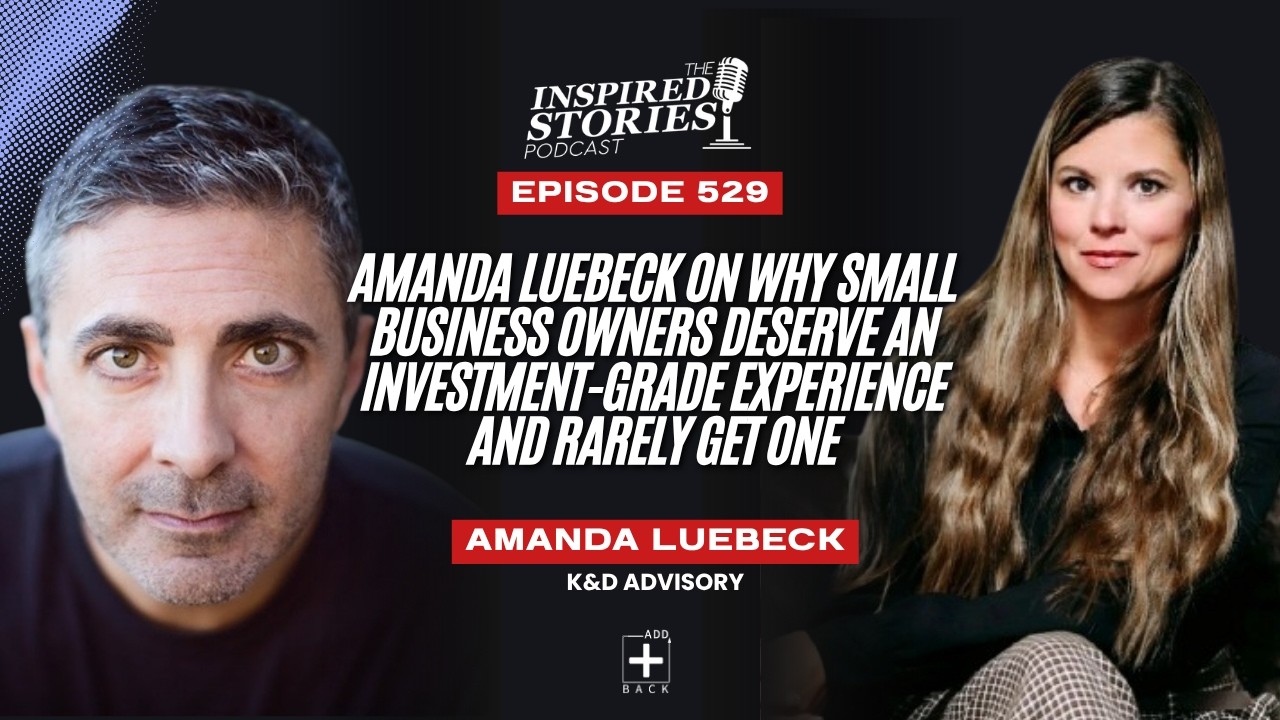
Amanda Luebeck, founding broker at K&D Advisory, came to mergers and acquisitions not through investment banking but through watching a broker prioritize his commission over his clients’ best interests — and deciding she could do better. Her path ran through retail management, wealth management alongside her husband, and two years of training at a boutique firm before she launched her own practice in 2026, named after her two kids, dedicated to the business owners most larger brokerages won’t serve well.
✨ Key Insights You’ll Learn:
What managing a jewelry sales floor taught her about identifying what motivates people
How working at her husband’s wealth management firm led to her first M&A experience with dental practice clients
Why she left Fidelis Advisors and what those two years taught her that no course could
Why she never posts deals on BizBuySell and what she does instead
How she thinks about the $500K to $1M EBITDA business owner who gets left behind by bigger brokerages
What networking capital is and why sellers routinely leave money on the table by ignoring it
The three components of every deal: price, terms, and allocation
A current deal structure involving a trust, retained equity, and private equity that serves the owner’s growth goals
Why she sees herself as a matchmaker and would pull a deal rather than close a bad one
How being told she was bad at math almost stopped her from starting her firm
🌟 Amanda’s Key Mentors:
Kyle Luebeck (Husband and Wealth Advisor): Encouraged Amanda to bet on herself when every instinct said wait, and gave her the first look at M&A through his financial planning clients
Mike (Fidelis Advisors): Took a chance on her, trained her for two years, and gave her a white-glove view of deal work she still draws on
Women Entrepreneur Community in Minneapolis: The happy hour she almost didn’t attend where she realized even multi-million dollar business builders share the same self-doubt
👉 Don’t miss this conversation about what it actually looks like to build a client-first M&A practice from scratch, why the math that almost scared her off turned out to be something she was already good at, and how naming a company after your kids changes the way you work.
Listen to the full episode here
Transcript
Anthony Codispoti (00:00)
Welcome to another edition of the Inspired Stories Podcast, where leaders share their experiences so we can learn from their successes and be inspired by how they've overcome adversity. As you listen today, let one idea shape what you do next. My name is Anthony Codispoti, and today's guest spent years helping families plan for retirement before she made a move into one of the most high-stakes moments a business owner will ever face: selling the company they built.
She came to MA not through investment banking or private equity, but through a decade of sitting across the table from small business owners, learning how they think and what they actually need from an advisor. That path took her from jewelry retail management to wealth management to a boutique MA firm and most recently to founding her own advisory practice from the ground up. She is Amanda Lubick, founding broker at KD Advisory.
A Minneapolis-based MA firm she launched in 2026 after two years as a partner at Fidelis Advisors. She has guided lower middle market deals across manufacturing, healthcare, distribution, and more. And her writing on deal preparation has built a following among business owners preparing for an exit. For anyone who has ever wondered what it actually takes to bet on yourself, this episode is worth your full attention.
But before we get into all that good stuff, today's episode is brought to you by my company, AddBack Benefits Agency. And you'll want to hear this because it's hurting almost every business owner you know. See, health insurance costs go up every single year, and businesses are furious about it. They're paying more, claims are getting denied, employees are opting out because they can't afford it, and it hurts turnover and morale. It's one of the most maddening problems in running a business, and everyone just accepts it. But you don't have to anymore.
Now there's a program that gives your employees unlimited access to doctors, therapists, and prescriptions with no co-pays or deductibles to meet. And here's the part that really shocks people. Unlike every other employee benefit out there, our program increases your net profits. We recently helped a client add $900 per employee per year to their bottom line. Results vary, but gains like that change how a business is valued.
Introduce this to your clients and watch them thank you with referrals at BeckBenefits.com. Okay, back to our guest today. Founding member of KD Advisory, Amanda Lubick. Thanks for making the time to share your story today.
Amanda Luebeck (02:38)
Thanks for having me. This is exciting.
Anthony Codispoti (02:41)
All right, let's go have some fun. You grew up in Chippewa Falls, studied at Winona
Amanda Luebeck (02:46)
I sure did.
Anthony Codispoti (02:47)
State, and your first real professional chapter was in retail management at Shane Company, a jewelry retailer. Tell me about the
Amanda Luebeck (02:57)
That's right.
Anthony Codispoti (02:58)
work you were doing there and what managing a sales floor taught you about working with people that you still put in practice today.
Amanda Luebeck (03:06)
Yeah, it was quite the leap from, you know, we moved up to the Twin Cities, my husband and I, and it was it wasn't the very first job out of college. It was the big first big girl job, I'd like to say. And I'm always I've always been self motivated. So I always wanna be the top of something. I don't
That's just my personality. I don't know if it's because I'm the youngest of four, but I always wanted to come out swinging. So I quickly moved my way up in the retail space. And what it really taught me is how what motivates people. You know, you have the employees who just need a high five or a data boy. You have some employees who just want money. And you have some employees who they want the lunch, they want the bonus, they want the recognition.
And being able to figure that out and see who is what and what is what just gave me this new perspective of humans in general. It's almost like the love languages, you know, they tell you to read the book, The Five Love Languages, when you're in a relationship. But it was the five love languages of employees, really. And it got trial by fire. I got thrown into it on what it was like, and it just opened my eyes to something bigger than myself.
Anthony Codispoti (04:23)
Was there a framework, a book, a course, a mentor that kind of coached you on what these different love languages for employees look like? Or was this just you, like you said, trial by fire, just learning from your own experience?
Amanda Luebeck (04:37)
So part of it is I have a master's of education sports marketing, and my thesis was actually what makes a good coach a good coach, not based on win-loss records. And so really I put my thesis into play and see what made people good, what made them bad at sales. I just put it in a different perspective from what my thesis was. And so I got to dig deep and really look into that. And of course, you read The Servant Leader and all these other really great leadership books.
But it was the actual practicality of it and seeing what people tick, what makes them tick, what makes them go, that was able to get me in that door and grow.
Anthony Codispoti (05:21)
If you could summarize what you think makes somebody good at sales, what would you say?
Amanda Luebeck (05:31)
I just there isn't one one simple thing, especially when it's hu like a a consumer product, right? When you're going business to consumer, every consumer is different. So I would say it from a management perspective, it's putting the right people in front of the right customer. Shane Company does a really great job of knowing if a salesperson doesn't connect with the client or the customer to switch out people who might have a better personality fit. And I think that's really important to do.
in general with anybody. I know even in my current position that I'm not everybody's cup of tea and that's totally great. But I have other brokers in the area, other business brokers, that if the personality doesn't fit me, I still want to take care of that person and find them the correct broker for their needs. And I have no problem doing that. And I think a lot of salespeople especially, they're all about holding on because it's their commission. But in reality, not everybody is everybody's cup of tea. And so really knowing
Who goes with what for personality, I think, is key.
Anthony Codispoti (06:33)
I like that. Let's continue through your career progression because we want to get to present day and what you're doing at K
Amanda Luebeck (06:39)
Yeah.
Anthony Codispoti (06:39)
and D. but at some point you move out of retail, right? You leave Shane, you go into the financial services world, joined what would become Lubick, Geisler, and Ham wealth management. This has got the family name in it. What's the connection
Amanda Luebeck (06:55)
Yeah.
Anthony Codispoti (06:55)
here?
Amanda Luebeck (06:56)
It's my husband's firm. So LGH Wealth. He as we I was getting through retail, my husband at the same time was growing his financial practice. And he grew to a point where he started needing a practice manager and needed someone to come on. So we had the discussion of retail hours versus quote unquote normal business hours, what makes sense for our marriage to make it grow. And we took the leap of faith that hopefully we could get stronger through working together even.
And it worked out really well. So I was able to join him. And from that it grew to him and two other partners. And now they have a booming practice here in in the Twin Cities and they continue to grow. And I'm just so thankful that he got to s show me that side of things because it was never a dream of mine to go into financial anything.
I grew up the daughter of a teacher and a travel agent, and so it was very much a different world than I was even expecting.
Anthony Codispoti (07:56)
So tell us about the work that you were doing there.
Amanda Luebeck (08:00)
Yeah, so I started out as a practice manager, filling out paperwork to turning into cold calling for four one Ks, to working on four one Ks, to marketing, client relationships, discussing with clients, starting to do sitting in on meetings, case prep, coming up with ideas how to help clients. And that turned all the way into really what I do now, I guess.
we had children and I'm not sure about where you live or any of the of your listeners live, but here daycare's really expensive. And so being married to a financial advisor, you figure out the break-even point of stay at home versus continuing full-time. And I got the privilege of staying home, but still working part-time as I was staying at home with the kids and it turned more into a marketing role, which turned into
now business brokerage because I got to work on a ca a case for three of his clients who sold and I just loved it. I absolutely loved the process and I loved helping small businesses. Yeah.
Anthony Codispoti (09:07)
so that was your first introduction to that world. Okay. So
you're working with your husband at his firm and you got to be a part of a deal. Talk us through that.
Amanda Luebeck (09:15)
Mm-hmm.
Anthony Codispoti (09:16)
What did what was the experience like? What did you like about it?
Amanda Luebeck (09:21)
I loved the fact that somebody has built something from the ground up and now they're ready to pass on that legacy. Maybe it's because of retirement, maybe it's because they're just they're big and they just don't want to handle the business anymore. In this case, it was some it was three dental clients. One, he had just grown very large and he knew he could get a great multiplier, especially since he was willing to stay on for a long period of time. And two of them.
They wanted to retire in the next five years. And how dental works is if you sell to a DSO especially, they want you for at least five years to get the best payout. And I got to run the marketing aspect of those three clients. So I got to build teasers and simbooks and watch the process. And what I quickly found out is not all brokers have the best interests of clients. And after I watched this broker.
help these three clients, I told my husband that he needed to find somebody else to do these deals who cared more for the client than his paycheck. And my husband, bless his heart, went, become that person or find me that person. And I went, All right, let's see what this is. And I dug in and here I am.
Anthony Codispoti (10:40)
Okay. let's
Amanda Luebeck (10:41)
I know.
Anthony Codispoti (10:41)
take a step back though, because I want to hear a little bit more about the experience of working with your husband.
Amanda Luebeck (10:47)
Okay.
Anthony Codispoti (10:48)
sometimes this goes well, sometimes it goes badly. There was a time early on for me where I was kind of encouraging my wife to do a little bit of work with me, and I got some great advice from a friend who said that does not fit her and her personality, what you're, you know, and so we quickly got away from that. But I want to hear about your experience.
Amanda Luebeck (11:10)
I loved it. I loved seeing my husband. It took us a little bit to figure out that it was his show at work and I my show at the house. So that can be difficult for a lot of couples, right? Is to figure out where your lane is. We always have said we've done a lot of work with each other, a lot of communicating, and we figured out our lanes. And we know our lanes and we stick to our lanes. So when I was at his office, that was his lane.
And that meant that I was his helper in his lane, but it wasn't my lane to own completely. And then when we got home, that was my lane that I ran completely. And when I needed him to do a task, I could just say, Hey, Kyle, take out the trash for me by the end of tonight, you know? But at work, it was definitely his lane. And I could bring ideas to his lane, but he got the final say. And I think a lot of people struggle with that.
Of being like, well, I want to own something. I want it to be my show too. It wasn't my show. I was definitely the supportive one there. And I loved it. I loved being able to see my husband every day. I loved being able to communicate with him and joke with him and support him and help him grow to what he is today. I mean, it's it was a beautiful gift that he gave me by offering me to come with him on it, on his journey.
Anthony Codispoti (12:31)
Here's what surprises me about that though, is that, you know, it's clear that you've got an entrepreneurial gene in you, right? Because you've gone
Amanda Luebeck (12:39)
Yeah.
Anthony Codispoti (12:40)
off and started your own firm now. So usually people who are wired that way have a hard time taking sort of the sidecar role. But
Amanda Luebeck (12:49)
Yeah.
Anthony Codispoti (12:50)
that wasn't the case here. You you were happy to step into that very supportive role at the time. And I'm curious though.
Did you have a sense that at some point you wanted to do your own thing, or were you still kind of, I don't know, finding your way and just seeing what was next?
Amanda Luebeck (13:06)
I think it was more of a finding my way. I loved being the sidecar, but again, at work he gave me certain things and certain tasks that I owned. So, at the time where he was at, four one Ks were really big and and getting them from businesses. So I would cold call, I would go to networking, I would talk to the decision makers, but I owned that completely.
And that was how I took ownership and that entrepreneurial spirit was by having my silos under his umbrella, so to speak. And so
now that I
Anthony Codispoti (13:40)
That makes a lot of sense.
Amanda Luebeck (13:41)
yeah, and and he actually even stepping into KND and starting my own advisory services, he was the one he was the biggest encourager of it because I was really worried. I you know, I interviewed many brokerages before I decided to make this big leap. And he was like, Nobody wants to do it like you. If you
you know, if you wanna really build this thing where it just actually can you know, working and collaborative with other brokers, no other broker is gonna support that. So it's might be time to take that leap fully, pray on it and think about it and let's talk about it and what that looks like for our family. And it's been such a blessing because now he's stepping into that sidecar role because I'm having ha to have him
help more around the house or with tasks around my business and helping me do some marketing material that way.
And so we've almost like flip flopped now and that's just a whole new ball game.
Anthony Codispoti (14:31)
Interesting.
Okay, I want to explore that dynamic a bit more, but I want to talk about what happened in between, right? So you left LGH and you joined Fidelist Advisors for a couple of years. What was behind that move?
Amanda Luebeck (14:47)
So when I decided to get into MA, I asked a banker friend of mine on who he recommends in the MA space, and he gave me two names. And one of them was who I worked with at Fidelis, Mike. It was, I'm so grateful that Mike took a chance for me and taught me so much in two years. It was really like a fire hose of information. It's something that they would never teach you.
It doesn't matter what courses you take, it doesn't matter how much you learn. On the job, training to me will always be far support far superior. And in this case, that's Mike's intellect and his in his knowledge of MA is fantastic. And I will forever be thankful that he said yes to to taking two years and training me on what he knows. yeah.
I have nothing bad to say about it. It was a great experience. It gave me a look at the industry that a lot of people at even bigger brokerage firms just don't get because it was a white glove service. It was very hands-on, very intricate, very detailed.
Anthony Codispoti (16:01)
And so where did the idea first start to percolate to start your own firm?
Amanda Luebeck (16:08)
You know, honestly, it was all about location. Mike is about an hour and a half from me and he wanted to get an office and that just wouldn't work. I I still am primary taxi cab for my children and so picking up, dropping off to all the things and and working an hour and a half from my home just didn't make sense and I just didn't think it was needed. So
We just decided to split ways. I still send him all the deals that I have and he still sends me his teasers. So we're still referring business back and forth and hopefully it works out that we can work together again on some sort of business, but there are no hard feelings there at all.
Anthony Codispoti (16:47)
That's great. So
Amanda Luebeck (16:48)
Yeah.
Anthony Codispoti (16:49)
you say you send him all the deals that you have. What does that mean?
Amanda Luebeck (16:52)
So I have teasers, so I never put anything online. That's the biggest difference between me and a bigger MA boutique or brokerage. I don't put anything on BizBySell. You won't see my deals on there. It's all networking for me and it's all about who I know, who may know somebody who might be interested. I talk to a lot of bankers, a lot of CPAs, financial advisors, lawyers, and I just go, who do you know who may want X? Because those are gonna be.
Ninety percent of the time that's where people find the deals.
Anthony Codispoti (17:27)
So you don't feel like you or your clients are missing out by not posting on all the online platforms like Biz by sell.
Amanda Luebeck (17:33)
Not even a little bit. Not even
Anthony Codispoti (17:35)
Okay.
Amanda Luebeck (17:36)
kind of. I think if I got where a client hadn't sold for six to eight months, maybe I would do it. I would think about it. I just I know there's a lot of tire kickers on there, a lot of people who are just kind of checking things out, not necessarily ready to dig deep. I like qualified buyers. I like qualified people. And I look at my business more of a matchmaker than just offload it.
And if you're matchmaking, you need to meet everybody that are have a potential. And with that, that doesn't come from online tire kickers.
Anthony Codispoti (18:13)
Got it. The online stuff is more noise than it is signal. Yeah. So
Amanda Luebeck (18:16)
Yeah. I I agree.
Anthony Codispoti (18:19)
distill it down for us. KD advisory. What does it do and who do you do it best for?
Amanda Luebeck (18:26)
Yeah, KD Advisory. I like to say that I'm helping people with their legacy. So as people are ready to exit a business or grow their business or buy a business, I'm able to help with every single one of those aspects. I really, really have a soft spot for those smaller businesses. And I say it in quotations because I don't think they're necessarily small. Those 500,000 to a million EBITDA, those businesses to me are so underrepresented on the market, it's unbelievable.
Most of the bigger brokerages will just take those and post them online and hope for the best on what they want. I want to give them almost like an investment banker sim book with every single one of them. So I'm digging in, I'm look figuring out EBITDA adjusted, I'm figuring out what they're actually getting on the market. I'm creating a a huge sim book for them. I'm creating teasers, I'm getting people excited about it and I'm matchmaking for them versus just throwing it out to the masses, like I've said.
I really want to spend time knowing about their business. I want to learn about what Susie at the secretary's desk actually do. I want to know who their right-hand man is. I want to know what they want with their legacy. Do they want the biggest paycheck, or do they really want to find somebody to take over and continue the culture and continue what they have going? Or is it really just, I wanna get out because I wanna retire and go spend time with grandkids? And so it's really
Anthony Codispoti (19:48)
Yeah.
Amanda Luebeck (19:48)
digging deep into those and like their stories and helping with that.
That transition.
Anthony Codispoti (19:56)
So package it up for us. Who's the best fit for you? Geography, size, industry, any other qualifiers?
Amanda Luebeck (20:04)
I'm gonna laugh when I say this, but this is my small town coming out. It's I wanna work with nice people who will probably have an old fashioned or beer with me. Like, I really is that the like
Anthony Codispoti (20:18)
I love
that that's the first filter that you mention.
Amanda Luebeck (20:21)
Yeah, that's
that's my filter is I wanna work with kind people because if I'm gonna dedicate, I mean some deals take 18 months, right? It just depends. If I'm gonna dedicate that time away from my kids and away from my husband, I wanna make sure that I'm not hating every single second of it. I wanna I wanna enjoy being around you and I hope you enjoy being around me. And that's what I care most about. I don't the money is the bonus for me.
And I know that's so weird and so many people don't say that, but it truly is. It's that's a bonus for me. I wanna enjoy my time here on this earth and I wanna enjoy my time with other people. And if if you're hard to be around, I probably won't enjoy you. So I probably will pass you on to somebody who will.
Anthony Codispoti (21:08)
Okay, so aside from it being a nice
Amanda Luebeck (21:10)
Yeah.
Anthony Codispoti (21:11)
person that you want to share a beer with, what else are you looking for? What's a good fit
Amanda Luebeck (21:14)
I guess.
Anthony Codispoti (21:15)
for a mandolin?
Amanda Luebeck (21:16)
I love blue collar industries. My dad was a wood shop teacher. We would spend every single summer roofing or painting or building decks or paver doing pavers or whatever odds and ends, handyman jobs there were. And so I really love blue collar jobs. I think that they're definitely getting gobbled up by private equity, but I still think there's a very big
Pride that goes into every single thing that they do because most of them have built them from their garage up. And now they're these larger companies, you know, that could go for two, three, five, ten million dollars. And it's I love exploring what they could be doing to potentially even grow over the next year to two years so that they can either pass down to a family member or pass down to an employee or really find that legacy there to pass on to a strategic.
That could continue that on for them.
Anthony Codispoti (22:12)
Okay, I want to go back now to the dynamic of you and your husband because you said the roles have flipped a little bit. Like now he's
Amanda Luebeck (22:19)
Little bit.
Anthony Codispoti (22:19)
able to help out more at home as you're starting your business and he's helping out in some ways with what you're doing at K and D. What is his involvement there like? And how has kind of having the tables turned a little bit affected both of you?
Amanda Luebeck (22:36)
It has been super interesting because I am so used to supporting him and boosting him up to have the roles reversed where he's owning more of taxi cabbing the children or more stuff around the house and around our farm and things of that nature. I'm realizing that I need it is okay to ask for more help. And that has been like the biggest challenge for me is asking for help because I am so independent and I am just a go-getter.
I ask for help in marketing. Does this look okay? Does this sound okay? From a guy who's not in the industry, I know he knows financials. But if you read over this, does this make sense or is it too much jargon? Is it a little bit more too simple? What do you think about it as a pr outside source? And so he's able to input data for me. I I have a spreadsheet that I use and I go.
find all these things and I've kind of taught him a little bit and I double check numbers and that takes some stuff off my plate. So just these little tasks,
Anthony Codispoti (23:40)
Nice.
Amanda Luebeck (23:41)
yeah, these little tasks has but just been beautiful that he's been able to support with.
Anthony Codispoti (23:48)
So I wanna understand the name, K and D advisory. What are they K and D? What do these represent?
Amanda Luebeck (23:56)
Kira and Declan, my kids.
Anthony Codispoti (24:00)
nice. I like that.
Amanda Luebeck (24:00)
Yeah, yeah. It w
me too.
Anthony Codispoti (24:05)
So anybody who's been through this, you know, recognize that when you're starting a company, in your case, you're starting a firm from scratch, means you're doing everything yourself, right? You're building the process, you're building your reputation, your client base, like you're wearing all of the hats. And it's nice that you've got your husband there to be able to support you with some of these things. But what's been the hardest part of that so far that maybe you didn't fully anticipate going?
Amanda Luebeck (24:33)
The doubt. Like truly doubting myself, doubting my abilities. I I'm I'm a very faithful person that that's just part of my value system. And so I I prayed a lot about it. And I still pray every day before I get out of bed, before my feet hit the ground. Is this what you still want me to do? Because it can be very overwhelming to wear every single hat all the time. It's a joy.
It's a gift, it's a blessing, but it can be very, very hard and very overwhelming, especially if you don't know how to turn it off. And I think as entrepreneurs, especially, we don't know how to put down the phone and walk away for an hour very well. And we don't know how to say, you know what, I'm only gonna take a I'm gonna take a half a day so I can enjoy the summer with my kids. And so I'm really having to learn that, no, I'm not gonna lose my biggest client because I didn't answer his phone call.
The minute he called. And it's okay to pick up the phone and say, hey, I'm seeing your calling. I'm gonna call you back in two minutes because I'm in the middle of something, even if that something is just talking to my kid. And I I know as moms trying to wear all the hats already and then adding in a business can be so overwhelming. And I'm really learning quickly that it's okay to say no to things, and it's okay to have those doubts, and it's okay to ask for help.
Anthony Codispoti (26:01)
Yeah. I mean you hit on a lot of big things right there. I th you know, the first one you brought up was the doubt, right?
Amanda Luebeck (26:06)
Yeah.
Anthony Codispoti (26:07)
And as somebody who's been through starting a business multiple times, some of which have been very successful, some of which were not, I'd like to say that that doubt goes away. And may maybe there are people who are wired differently that will say that, but you know, I think they're even, you know, once you attain a certain level of success, there's still this idea of imposter syndrome.
that myself and a lot of people I know struggle with. You know, in spite of having a great body of evidence that you know proves that you're very capable at what you do, you know, you continue to question yourself.
Amanda Luebeck (26:46)
Yeah, I actually had this same experience where I got invited to this very nice women entrepreneur happy hour really. And it was some of the strongest women in the Twin Cities that I have met in my career.
I don't even know why I got the invite. Honestly, I was I w almost didn't go. I doubted going, but I still came and everybody was so warm and so welcoming. And we started sharing around and I realized some of these women who I mean they've built multi-million dollar I mean, you know, 25, 40 million, 50 million dollar companies who were like, Yeah, we almost didn't I didn't almost didn't come because I didn't think I was worthy. And I'm like, if you're not worthy, you know, and it's
It was so reassuring to go and still feel so welcomed by these women who I thought were, you know, top tier, top of the cake kind of women. And they're still just like, Mm, but am I? I I think you hit it where you said, We all have this imposter syndrome. And it's like overcoming that, you make that leap, that big jump, and it can be so beautiful after you do it, and you can just feel that grind. And it's just
I don't know, make the leap. Just make the leap, people. It it's worth it. It's worth it to try.
Anthony Codispoti (28:06)
It it's interesting that you mentioned that because I I can think back to a specific guest right now, Tana Green.
Amanda Luebeck (28:12)
Mm-hmm.
Anthony Codispoti (28:12)
and she's built many successful staffing companies, hundreds of employees, maybe thousands. And she's got an amazing story to tell, and she's told it from stage many times. And she admitted in the interview that she had the exact feeling that you're describing coming into that interview with me that day. It's like, why does anybody want to hear my story? What am I doing? Like, this is ridiculous.
And so we're all like that. Like that is sort of like a thread in, I don't know, what makes us human beings. And I had one guest who actually did a really nice job of kind of reframing this idea of imposter syndrome for me. And I wonder if maybe any of this will be helpful or ring true to you in any way. So he told me, I actually view imposter syndrome as my superpower. I'm like, what do you mean? He says.
It's the thing that gets me out of bed every morning, kicks me in the rear, and says, You've got to go and prove yourself again. He says, So
Amanda Luebeck (29:14)
Mm-hmm.
Anthony Codispoti (29:15)
rather than being sort of weighted down by this feeling of not being enough, he says, I just see that as fuel for the fire. It is my motivation to get up and do better than I did the day before. And so when he's able to reframe that relationship with the imposter syndrome.
He finds that it's just a good way to keep himself on his toes. I don't know. What do you think about that? Does that seem like something where you could recalibrate your brain to believe or or or to approach it that way? Yeah.
Amanda Luebeck (29:44)
I mean it's worth a try. It
it is. I just I keep saying to myself that God wouldn't have put it on my heart to do what I'm doing if it wasn't meant to be. And that's it's I guess it's the same kind of framework just from a Christian perspective of just like reframing yourself and and saying it's it's supposed to be happening. Like it I I truly believe that people don't ha get these ideas out of the blue just for kicks and giggles. It's like
Grow it, see if it's gonna happen, see if it's gonna, if it's worth it, because I think a lot of people don't take those big leaps because it is scary and we do doubt ourselves and we don't think we're worthy. But then we get that, that wheel starts to kind of roll a little bit or that rock starts to go down that hill and all of a sudden you're like, yeah, yep, I can do this, let's go. And then you get to the next big level, right? You gotta you're gonna level up your next one. And it can get scary, but just keep going because it could be just this beautiful gift.
Anthony Codispoti (30:43)
Is there any part of you that thinks the path should be hard?
Amanda Luebeck (30:48)
I mean, yeah. There's a my husband and I, we started out when we moved to the Twin Cities. I mean, we were so I poor is very I know it's different in around the world. I'm not immune to that, but we were calling our parents to ask for grocery money so we could buy a gallon of milk, you know, so we can make the mac and cheese box last three meals for the two of us. And my husband is not a small man, he is six five, so he is tall and solid and
One box of mac and cheese would last three meals for us because we just had to budget, right? And it's that that grit, that gumption together, I think, that really has had us overcome a lot and just not give up when things aren't easy. It's the I can do this and let's go, and what can we build and how can we do it and how can we accomplish it. And I think a lot of people, if they they're given it, they don't get that. They don't get that grit, that gumption that let's let's go, let's.
figure this out because we can and we can overcome. So yes, I do believe that things should be hard sometimes because if you don't have challenges, how do you know if you can overcome them?
Anthony Codispoti (31:57)
I agree with you 100%. And it's one of the things that I get reminded about constantly having the privilege to host this show. You know, done over 500 interviews, so I've got to hear a lot of different stories. And what keeps getting brought up over and over again is that that process of going through the hard thing and overcoming it, that's where growth happens. That's what allows you to level up, is having overcome that challenge.
And I think I maybe I was pre-wired, and maybe just humans are in general to think, the hard things should be avoided. Let's look for the yeah, and of course you you know, if there's an easier path, you take it. but now I realize more and more that the hard things, they can't always be avoided. And sometimes, who is it? Ryan Holliday says the obstacle is the way.
Amanda Luebeck (32:48)
Yes, absolutely. I absolutely believe that. Now I'm not saying I want to take every single obstacle, but but some are great. Yeah.
Anthony Codispoti (32:58)
If if there's a shortcut around it, that's a better path. But yeah, the the growth comes through
overcoming hardship. So something else I want to explore here, Amanda. You've written about something called networking capital. It's a
Amanda Luebeck (33:14)
Mm-hmm.
Anthony Codispoti (33:15)
topic that business owners typically overlook. Tell me what it is, why it matters in a deal, and what happens when a seller doesn't understand that it's going
Amanda Luebeck (33:27)
Yeah, so networking capital is what it costs to run your business. and especially in the products. So if you're manufacturing, it may take you a million dollars to run your business for the year. If you over-deliver on that when you sell your business, that's cash back in your pocket. So if your networking capital is a million dollars, but you're delivering on sale of the business $1.5 million, that's $500,000 back in your pocket.
Same if you're under that, if you're a million dollars, but you're only at eight hundred thousand dollars on delivery, that means you owe them an extra two hundred thousand dollars. So figuring that out a lot of the times, especially if you're doing this a year to five years in advance, getting that number lower than over delivering just as extra cash in your pocket at the end of the day, at the end of the deal.
Anthony Codispoti (34:16)
That's helpful. Thank you.
Amanda Luebeck (34:18)
I mean extra money
is always happy for a client, right? Yeah.
Anthony Codispoti (34:21)
Of course, of course, that's a big part of the goal, not the only
goal. And actually that would be interesting to explore. I mean, outside of looking at what that bottom line number is going to be, you know, what
Amanda Luebeck (34:32)
Mm-hmm.
Anthony Codispoti (34:33)
what is the offer on the table in terms of hard dollars? What are some of the other factors in a deal that sellers should be aware of and value that maybe they're not really thinking about going in?
Amanda Luebeck (34:50)
Excuse me. so every deal is price, term, and allocation. So price is what you're gonna get for it. Terms is a lot of the times now private equity wants you to roll over some capital. So they may want to buy a hundred percent, but they want you to roll over twenty percent over the next five years to prove that the business can function and that it proves that you get it on the upswing. Sorry. Tickle, who knew?
Anthony Codispoti (35:18)
good. We all
need to hydrate.
Amanda Luebeck (35:21)
With coffee, like most entrepreneurs.
Anthony Codispoti (35:24)
Mm-hmm.
Amanda Luebeck (35:25)
caffeine, let's go. so price terms and then
Anthony Codispoti (35:27)
Hydrate and energize.
Amanda Luebeck (35:29)
right, and then allocation is how you're getting paid on it. So, you know, how much is going towards real estate, how much is going towards the business entity itself, and then there's a tax play. So I always say when we're building your deal team, it's really important to have a great MA attorney, a great financial advisor who knows what trust we can
potentially use and then a great CPA who knows all the tax and potentially even a tax lawyer so that we can play that game as well.
Anthony Codispoti (36:01)
I wonder how you're finding your clients, Amanda. Is your firm is, you know, still in its early stages? I you did sales, you know, on the floor of the the jewelry store. You helped your husband, you know, shake down the trees and cold call and go to the the networking meetings to find four or one K clients. How are you doing it now that it's your own?
Amanda Luebeck (36:23)
networking and finding trusted advisors. So I've spent since beginning with Fidelis and even before with my husband, I was always going to these women networking events. And I think really the key is to find your, for lack of better term, your Rolodex of people you trust and talking with them and seeing what their needs are.
And building these trusted advisors so that they can trust you as much as you trust them. And so I'm really leaning into that. I'm really wanting to find my three favorite financial advisors to refer to a few people and giving the reason why. My three favorite CPAs and giving the reason why. My three favorite Lemon A attorneys, the reason why. And everything outside of that. It's it's just it's a
It's a trust process. I mean, somebody is trusting you with one of their largest entities and potentially their future retirement and really one of their babies. And so that's a very trusted process. And so I work on finding trusted advisors that I can bring in because I'm not an MA attorney. I'm not a CPA. I'm not a tax attorney. And so I want to make sure that I'm bringing in those specialty people that I can trust so that my client can trust them as well.
Anthony Codispoti (37:40)
We mentioned in the intro how your writing on deal prep has built a following among business owners that are preparing for an exit. where is that following? Where can your writing be found? How can other people subscribe to this?
Amanda Luebeck (37:55)
Yeah, I mean I'm I all of those are really just independent when I'm talking I'm writing and I'm putting it on LinkedIn mostly. or I just send out an email to different clients just helping them. I like to know what the business owners need. And I really like to do that through going to like business summits or or things like that so I can hear the panel of businesses and
And you really hear what the struggles are. Unless you're talking to business owners. I don't know how other brokers are doing it, but I like to talk to business owners. I like to find out what the struggles are before they exit. And that way I can try to figure out already a solution to those problems before I even talk to the next business owner because I hear it's already a problem. So I'm I'm doing that. I'm figuring out how to do lunch and learns at little local independent banks down here in the south of the Twin Cities. And again, it's just talking, networking, communicating.
Anthony Codispoti (38:54)
You know, in having talked with some other advisors before, I realize, and you touched on this yourself, that there are different ways to structure deals. What's maybe a creative solution that you came up with for a client that just helped to make the outcome better for them that the average business owner, the lay person wouldn't have thought of or even know was an option?
Amanda Luebeck (39:17)
Yeah, so one I'm actually working on right now is a larger company. family-owned company. He needs some capital for expansion. He's young, he's in his mid-40s, so he still wants to continue to run it. So we're trying to get some capital in there so that he can expand to another state. That's the goal of of why he's even entertaining a sort of sale. So what I'm doing is we're gonna sell a hundred percent of the company.
He's holding on to 40%. Out of that 40%, there's another entity that's gonna hold the real estate so that eventually the trust, a trust will come in, own the real estate, he'll own the 40%, and then the private equity will own 60%. So it's just having the discussions of what the goal is. I've talked to another business owner about putting the business in a trust and then selling only 80%, so keeping 20% in a trust.
So future generations can h still own part of the company and then they can get the payout on that. I like being creative. I like just seeing what the goals are and really just pouring into those goals and trying to achieve those goals. Not everybody wants to sell a hundred percent. Some people really like the idea of holding on and watching the upswing from what a really great private equity company can do or a really great strategic partner can do. And then capitalizing on that at the end.
Anthony Codispoti (40:42)
Yeah, being able to bring in that infusion and capital is gonna allow him to realize some of those growth ambitions that he has. And if it's a firm that's gonna get it all involved in some of the management and support, there can be a lot value there and that expertise that they bring to the table.
Amanda Luebeck (41:01)
Right. Again, I consider myself a matchmaker. I like to find the right people, you know, to go with the right it's I mean, it's a marriage at the end of the day, right? You're you're marrying someone when you have a business and you're selling them a portion. That's a marriage and it's a legal entity. And so it's just making sure those people actually can get together and achieve the same goal. I think that's really important. And so it's a lot of a lot of talking, a lot of communication, and I love being a part of that.
Anthony Codispoti (41:32)
Amanda, as you think about the kind of firm that you want K and D advisory to be five years from now, what does that look like? What do you what do you feel like you're building towards?
Amanda Luebeck (41:46)
I wanna be known as the brokerage that is truly client first. I know a lot of brokerages will say that, but I want my clients to know or anybody who comes that we will pull a deal last minute if the terms are no longer great for my client. You know, if you are a business who you employ a whole small town and a private equity changes the contract and says they're gonna move that business out of town and that's a deal breaker.
Let's pull it. Let's find you a different buyer. I want people to know that it doesn't matter the size of the business, that it's still beautiful what you've built. And I want to do my best to try to help you pass that legacy on. And it it doesn't matter that you're not the biggest, that you still deserve respect and kindness and somebody who's gonna handhold you the whole way.
Anthony Codispoti (42:43)
Mandy, I want to shift gears on you now. Can you tell me one of the hardest things you've ever had to overcome personally and what going through that taught you?
Amanda Luebeck (42:57)
again I I just think
Everybody has trials and tribulations. Some big, some small. you know, my my biggest one right now would just be the the self-doubt. And I've I've always doubted a lot of things in my life, my my abilities. I've been told, you know, you're not great at this or whatever, and it's just overcoming those thoughts and those those feelings.
That can feel like a weight on your chest all the time. And when you get told for years that you're bad at something, you're gonna believe it eventually. Even if you can prove them that person wrong, you still believe it. And so overcoming the doubt and looking in the mirror and just actually believing that you can do something, I think, is really powerful. And it's something that I struggle with every single day. Every day I I doubt my abilities.
and I don't know why, and I don't know if everybody else does in the world too, and this is just to totally normal, but overcoming that and just having the strength to just keep walking in that path has been something to really hard to overcome.
Anthony Codispoti (44:17)
I wonder if we could do a quick little exercise here. Tell me if you're open to this. I'd be
Amanda Luebeck (44:21)
Okay.
Anthony Codispoti (44:22)
curious, one thing that you were told you weren't good at, that you have some direct evidence to the contrary. And then maybe explore how you still feel today about that thing.
Amanda Luebeck (44:40)
Yeah. math. I've been told I've been really bad at math my entire life. and this is really like one of those big doubts. And and in even prior professional, I've been told I'm just I'm terrible at math. Just bad at it. And so even going into my new adventure, I my husband asked what was my like number one stopper from even just jumping in before I even did. And it I told him it was because I was bad at math.
I'm really worried. mean, financials are huge. You need to know how to do financials if you're gonna be a business broker. You just do. And being told over and over again that you're bad at something and that you can't figure it out, you just start doubting it. I overcame it by doing the math the way it's supposed to be done, having a completely separate entity who's also a business broker to do the math and comparing and knowing that I was right.
It keeps you going. It keeps it it pl it tries to rewire your brain at least to be like, nope, I actually do know what I'm doing. Yep, I've got this. I've got this unlock. Yep, you did figure out networking capital correctly. Yes, your EBITDA is right. Yep, your EBITDA adjusted is right. No, you didn't miss any bottom lines. And just that in itself has already boosted me. And that just was even like two weeks ago. Where I'm just like, yep, I got this.
Anthony Codispoti (46:08)
Isn't that crazy how this narrative that got somewhere got started along the line got, you know, penetrated your brain in a way that it just lives there rent-free, despite the fact that you've got lots of evidence to the contrary. Right? You worked at another boutique firm before where you had a lot of success. You ran the sales floor for the jewelry company. There's lots of math involved in both of those.
You're now doing it for your own clients at your own company. And because you understand and appreciate how important it is for the math to always be right, you've got checks and balances in place to make sure that all that stuff goes through multiple sets of eyes before it gets somewhere important.
Amanda Luebeck (46:59)
Yep. And you still can't help it.
Anthony Codispoti (47:01)
Like I s I
Yep. It's it's still it still needles away in your brain there. Yeah.
Amanda Luebeck (47:07)
It does. And it's so interesting 'cause
I don't I go ahead, sorry.
Anthony Codispoti (47:12)
No, please, Amanda. Continue.
Amanda Luebeck (47:14)
I
just it's so interesting because you don't know I don't know if it'll ever fully go away. I mean, truly. but now my goal is to make sure I don't instill those same bad habits into my kids. So not saying that they're bad at something or that they need improvement or something, it's just being very supportive and trying to lift up more than put down. And I think that's the only way through this, is to make sure that my kids don't have the same questions about their self-worth through.
activities, right?
Anthony Codispoti (47:46)
Hmm. I like that a lot. As you think about the work that you're doing now, Amanda, what is it that you most want to be remembered for?
Amanda Luebeck (48:01)
Kindness. and particularly with the work that I didn't let anybody down by putting money in front of their worth as a person. So when I look at a company, it's not just PLs, it's not just what they're making, what their revenue is, what their bottom line is, but actually what they've built. Because we all know a business.
can look good as P and L's, but if their systems and processes in place are terrible, it's not a good business. And so I really love to look at the whole entity of a business and that includes the owner down and looking at everything they have to offer and really look at the human side of a business more than just the number side.
Anthony Codispoti (48:51)
What's your favorite hobby or thing to do outside of work?
Amanda Luebeck (48:54)
goodness. I have chickens and goats and I sourdough and we live on 20 acres of wood. So most weekends we are cutting wood and having fires and my children are running around like feral animals and I absolutely love it. I love I love just being just out and enjoying everything in God's beauty of the earth.
Like just being out is so peaceful. And so I would say just I mean, I do a lot of family time right now and I hang out with my goats and chickens probably way too much.
Anthony Codispoti (49:35)
Do you have all of them named?
Amanda Luebeck (49:37)
My daughter does. The goats are. We only have four goats. Those are easy to remember, but chickens just keep popping up because in 4 H you have to buy new chickens every year. And so I can't I mean we have like 30 chickens. I can't remember all of their names anymore. I just can't. Good luck, everybody who can.
Anthony Codispoti (49:57)
Amanda, I've just got one more question for you today. But before I ask it, I want to do three quick things for the audience. First of all, if you want to get in touch with Amanda Lubick and find out more what she's doing at KD Advisory, their website's super easy to remember. K and D advisory.com, all spelled out, K and D advisory.com. It'll be in the show notes, but it's the letter K, the word and letter D and advisory.com.
You can go there right now. If you're enjoying the show today, please take a moment to subscribe wherever you're listening. It also sends a signal that helps others discover our show. So thanks for taking a quick moment to do that right now. And then as a reminder to all business advisors out there, your clients are bleeding money on health insurance. Do them a favor so big they'll tell their friends about it. Show them how to give their employees access to therapists, doctors,
And prescription medications that counterintuitively actually increases the company's net profits. These are real gains that can change how a business is valued. Contact us today at AddBackBenefits.com. So, Amanda, last question for you. A year from now, what is one very specific thing that you hope to be celebrating?
Amanda Luebeck (51:18)
I would like to have helped five business owners complete the process from start to finish. That would be the goal. Originally, even just two months ago, my goal was to get two. but I've already increased it because I see the momentum of people looking for help for those small business needs. And I just I see it as a very, very, very obtainable goal.
Anthony Codispoti (51:43)
I love that. And I hope that when you get to two, you still stop and take a moment to celebrate.
Amanda Luebeck (51:49)
yeah, there's gonna be a good old fashioned there waiting for me.
Anthony Codispoti (51:54)
I love it. Amanda Lubick from KND Advisory. I want to be the first to thank you for sharing both your time and your story with us today. I really appreciate you being here.
Amanda Luebeck (52:03)
Thank you so much for having me. I really appreciated it.
Anthony Codispoti (52:08)
Folks, that's a wrap on another episode of the Inspired Stories Podcast. Thanks for learning with us. And if one thing stood out, put that into action today.
Connect with Amanda Luebeck:
Website: kandadvisory.com