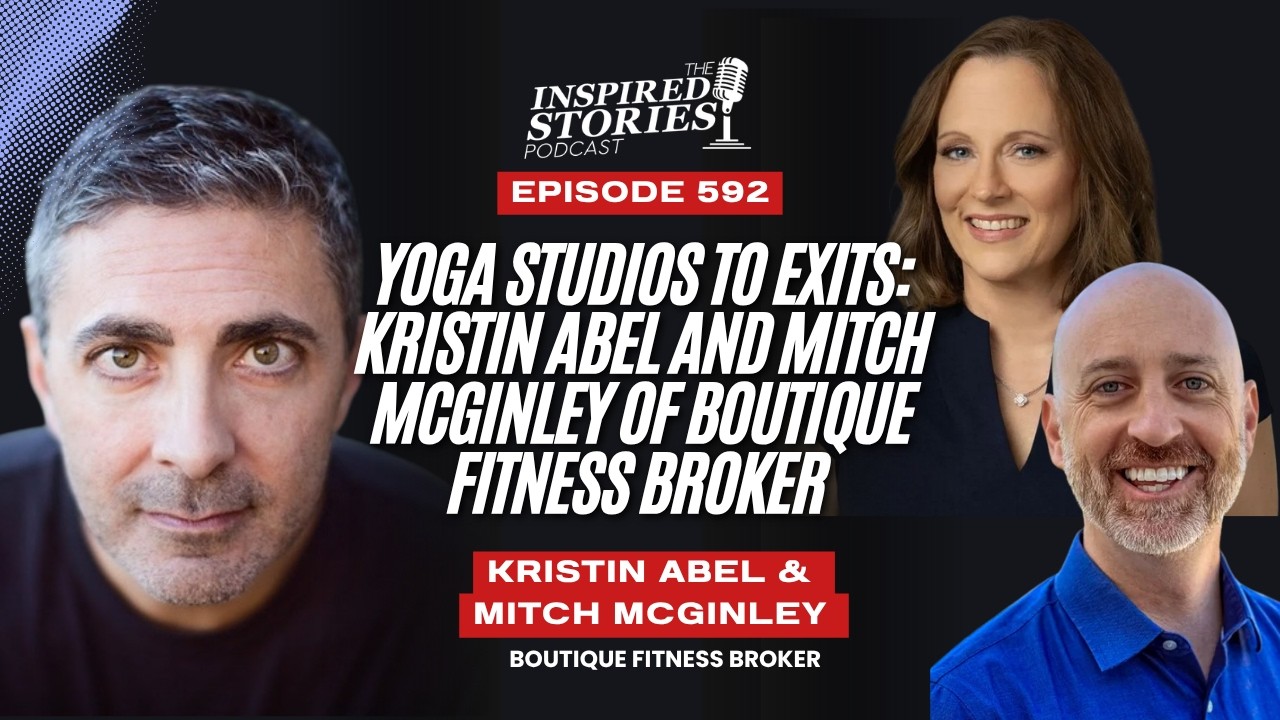
🎙️ From Broker and Client to Business Partners, Mitch McGinley and Kristin Abel Built Boutique Fitness Broker Together
Mitch McGinley, founder and CEO of Boutique Fitness Broker, and Kristin Abel, its president, both left corporate finance careers to own yoga studios before becoming broker and client, then partners. Mitch shares how a failed first sale taught him what buyers need, and why he told Kristin to wait a year before listing her studio. Kristin talks about letting go of a business that had become her identity, and together they explain how honest advice drives an 80% success rate.
✨ Key Insights You'll Learn:
From corporate finance to yoga studio ownership
Getting the right people in the right seats
A failed sale and the fixes that led to a 5x exit
Showing true profit on your tax returns
Telling a seller to wait for a better price
Selling a studio through COVID
Why clients shouldn't know who pays the rent
Contractors versus W-2 employees in a sale
Three kinds of buyers for boutique studios
Separating your identity from your business
🌟 Mitch and Kristin's Key Mentors:
Mitch's mother-in-law: 40-year studio owner and his model for entrepreneurship
Mitch's in-laws: the support that let him build the firm through COVID
Mitch's older brother: his rock after losing their father
Kristin's life coach: helped her process the loss of her studio
Each other: a client relationship that became a partnership
👉 Don't miss this conversation about honest advice, letting go, and helping studio owners exit on their terms.
Listen to the full episode here
Transcript
Anthony Codispoti (00:00)
Welcome to another edition of the Inspired Stories Podcast, where leaders share their experiences so we can learn from their successes and be inspired by how they've overcome adversity. As you listen today, let one idea shape what you do next. My name is Anthony Codusbodi, and today's guests started out as a broker and a client. In 2022, Kristen Abel.
Hired Mitch McGinley to handle her exit from the yoga studio she had owned for 17 years. A year later, they were partners. Previously, Kristen was an assurance manager at KPMG and a controller at Nuevo Energy before opening Yoga West in Katy, Texas in 2005. Mitch rose to assistant director of finance at Omni Hotels.
And worked in boutique hotel mergers and acquisitions before buying a yoga studio in San Diego. Their first attempt to sell the yoga studio fell apart, and the second attempt closed in 2019 at five times what they paid. So Mitch McGinley is the founder and CEO of Boutique Fitness Broker, a firm that brokers the sale of Boutique Fitness and Wellness Studios. Kristen Abel is its president. The firm has closed more than 70 transactions worth over $30 million.
With an 80% success rate. Mitch is also the author of The Number Nobody Talks About. But before we get into all that good stuff, today's episode is brought to you by my company, Ad Back Benefits Agency. And if you advise business owners heading towards an exit, this is a lever most of your clients don't know they have. See, here's the problem your business owner clients are overspending on health insurance every year. Money that could be funding the very strategies you're building with.
Now there's a program you can put in front of them from Bain Capital Insurance to change all of that. It doesn't replace their group health plan, it fills in the first dollar gaps and it can even cover part-timers. Employees get unlimited access to doctors, therapists, and prescriptions with no co-pays or deductibles to meet. And here's why it matters for your practice. This program actually increases your client's net profits. We recently helped a client add.
$900 per employee per year to their bottom line. Results vary, but gains like that increase the value of a business and fuel higher sales multiples. Your client gets stronger and more valuable. You become the advisor who found the money and the one they tell their friends about. Learn more about
this program at adbackbenefits.com. All right, back to our guests today. The founders, the president, the CEO, the whole team, the Kit Kat and the Caboodle of
Boutique fitness broker. We got Mitch McGinley and Kristen Abel here today. Welcome, guys.
Mitch (02:48)
Thank you so much.
Kristin (02:48)
Thank you. Glad
to be here.
Anthony Codispoti (02:51)
So, Kristen, let's start with you. You were an assurance manager at KPMG, an accounting firm, then controller at Nuevo Energy, an oil and gas company. Then by 2005, you
were opening Yoga West in Texas. How did that move come about? You were at a controller's desk, now you're owning a yoga studio.
Kristin (03:13)
It seems like a strange transition, doesn't it? but the you know, the the the original trigger was a baby, right, as as a is a trigger for a lot of life changes. But my my second child was born while I was at Nuevo and there were a lot of systemic changes happening at the company. We were being acquired by another company, everybody's job seemed a little bit
you know, at risk or certainly likely to change. And so I made a decision then that when this second child was born, I'm not gonna go back here. I can find another job if I want to, but certainly for a while I'm not gonna go back. And in the during the time that I was working, I had discovered one random yoga class at an executive health club in downtown Houston and nobody knew what yoga was at the time. This was gosh
1997, maybe there wasn't a lot of yoga here.
Anthony Codispoti (04:14)
very early.
Kristin (04:15)
nobody knew what it was. I found this random class and fell in love with the practice. So fast forward to being at home with my with my newborn, and there was a yoga studio maybe five miles from the house, and it was one of the very first ones in Houston. I started practicing and teaching there.
And and ultimately, like I we do kind of say that I f founded Yoga West, but but really I purchased it from this lady who'd been running it. She wasn't interested in running a business. She was kind of getting a little spooked about yoga and suddenly felt like she shouldn't be doing that anymore. So it was an opportunity for me to kind of merge my my business mind and my entrepreneurial spirit with this practice that I had come to love. And so that's kind of how it came.
came about and I thought it would
Anthony Codispoti (05:07)
Okay.
Kristin (05:08)
just be a fun little hobby for a while.
Anthony Codispoti (05:10)
Yeah.
what what spooks somebody about yoga?
Kristin (05:16)
that's probably it could be a whole separate podcast,
Anthony Codispoti (05:18)
Okay.
Kristin (05:19)
but but let's just say it's you know nineteen ninety seven in Texas when there isn't much yoga. So
Anthony Codispoti (05:28)
New age, hippie. Yeah. Okay. Okay. okay. Got it. Yeah.
Kristin (05:29)
n new age, weird stuff, worshiping gods that aren't your own whatever. And I don't I didn't agree with her perception
of it, but it was enough that she was like, I need to get away from this business. Do you think you want it? And I was like, heck yeah. I see some opportunities here. Yeah.
Anthony Codispoti (05:42)
Yeah. I love this.
Okay. And so ultimately, how successful was the business? So talk talk to us about sort of early days. We'll we'll get to that to kind of the exit, you know, later on, but just d like kind of out of the gate, how were you doing with it?
Kristin (05:59)
feel like in retrospect, like in in the moments I didn't I always felt like I could be more successful than I was. Looking back at the whole 17 year period, I think it was very successful, mostly in that it gave me exactly what I wanted. It gave me a a way to contribute, make a little bit of a living. It gave me a way to be creative. It let me, you know, meet amazing people. And
And ultimately it did grow. Like I took that first little location and moved it somewhere else and then added a second location and then moved the first one somewhere else. Like it was continuing to grow membership wise, revenue wise, staff. So it it really turned into it turned into a business, right? It was it was a dinky little hobby to start and it turned into a real thriving business that in my opinion,
was very successful for what it gave me and what it gave the community.
Anthony Codispoti (06:56)
That's awesome. Now, Mitch, your path, a little bit different, but you still end up in yoga studios. You ran through the hotel industry. You spent six years at Omni Hotels, working from food and beverage to assistant director of finance. Then you ran Hotel Vivant, a boutique hotel in in San Diego.
In 2012, you and your wife Carson signed a letter of intent to buy your favorite yoga yoga studio. There's a sort of a trend here, right? You guys were already clients there. You you enjoyed going. And and this was Happy You Yoga Center in Ocean Beach. So walk me through how the decision to buy your favorite yoga studio came about.
Mitch (07:38)
Well, it I think it's you you pointed out as the common thread between all of us is this this transition from a corporate career to wanting to be an
Bring your experience in the corporate world into this particular sector where we get to work with people in our community to help them feel better. I was very fortunate. My wife is an amazing yoga teacher, among many other things. And so she had been teaching at this studio for a long time. Her mom was always in the industry. Her mom owned a boutique fitness studio in Montclair, New Jersey for 40 years. And so Carson grew up in that community.
And her mom, who we're both very close to, has been our mentor in in that way. She's the only person that I've I've ever had as a parent who who was an entrepreneur. And it's just been so inspiring for us. And so we had a dream of owning a yoga studio. It was something that we talked about a lot. And so we had actually told the owner of the studio three years prior that if she ever thought about selling, to to please let us know.
And sure enough, three years later, she called us out of the blue and said, I'd love to sell to you. And it was the right timing. We also wanted to start a family. Like the that's another trend. having babies and starting businesses is very real. and and we did, and you know, it was we owned it for six years. I I wasn't able to last as long as Kristen did. but there's so many parallels and and I
But I think we could probably speak to a time bomb.
Anthony Codispoti (09:20)
you said you weren't able to last as long as Kristen did. Why was that?
Mitch (09:26)
there were a number of reasons. I was 10 years later than she was also. And so I think in that sense, like we were on a similar timeline with our exits. And that probably had more to do with the industry at large, the saturation that had hit the market. I was we were in California and and A B five was a big deal when when it passed, and California was saying you have to convert all your teachers to to
W-2 employees instead of independent contractors. You know, that's that's a huge payroll hit for these businesses. And so we sort of saw the writing on the wall with, you know, we're a little burned out from this. We've we've done really well with it. you know, we've been through the the blood, sweat, and tears
of growing it from not being profitable to to being quite profitable. And we had this experience where we tried to sell it and it it didn't go well. And
It was a painful process and we learned a lot from it. And so when we fixed all of the reasons that that process didn't go well, we were then ready to sell, you know, and and get what we wanted to get out.
Anthony Codispoti (10:37)
Say a little bit more about that, Mitch. What didn't go well? What did you learn from the first time around?
Mitch (10:43)
man. it was a private conversation with one group that approached us and and said that they'd be really interested in acquiring us. And like-minded individuals, you know, we shared, they were competitors, they had a similar studio across town, shared a lot of the same ethos and and teachers probably a couple of teachers overlapped, and and so there was a lot to like about this conversation. The problem was we were going through a difficult
Personal time because my wife was pregnant with our second child. She was very sick and in the hospital. And at that time, my father-in-law had fallen and broken his back. And so I've got father-in-law that I'm taking care of, pregnant wife who's in the hospital, a two-year-old at home. And the numbers at the business were starting to show that. And so while we're going through this conversation about selling.
Every month the new numbers come in and they're a little bit lower. And it it really spooked our buyers. And after six months of having this conversation, the original number had gone down and down and down and was finally at a point where we really weren't willing to accept it. And and we had this impasse and they walked away. And so there was just nothing to show for the conversation.
six months of pain, now we've got a second child, you know, all that. But it was worth it in the end.
Anthony Codispoti (12:18)
And
so what did you fix for the second time around? Because you guys end up ultimately selling for five X what you had bought it for.
Mitch (12:25)
Yeah, the main thing was showing our profit on our tax returns. I think people in these businesses get really good at hiding their profit so that they don't have to pay taxes on it. And that hurts you in a sale. The the buyer needs to be able to see profitability in the tax returns so that they can get a loan to buy the business. And and a lot of owners shoot themselves in the foot with that.
another important part was extracting ourselves a little bit more from the business. My wife was the lead teacher, I was the quote unquote manager. We needed to have some other people in place to fill those roles so that it wasn't as scary when we stepped away. And those were the two main things that we fixed over the next two years. I'll say too, when we bought the studio, it was actually a different brand. It was called Namaste Yoga Studio. We changed it to Happy You at that point.
That was a big part of what we did. It was, you know, the previous owner's brand. It was sort of this heavy, dark colors. and we that wasn't us. Like we were br positive psychology is my wife's favorite thing. And so that's what happy you stands for is a holistic approach to positive psychology in yoga. And so we repainted and made it all bright and pretty. And then, you know, that buzz created some good new energy in the community and and attracted more like-minded people.
Anthony Codispoti (13:48)
Kristen, when we were talking before about how, you know, your yoga studio was successful seventeen years. What do you think you were doing right? Why do you think it was successful?
Kristin (13:59)
I think from a ver from very early on, I realized that it wasn't about me. And I could see like I had come from a business background and I see the world in numbers and math. I don't I mean I I learned how to teach yoga and I was learning the practice, but it I it was hard for me to embody yoga. Like I I saw math and numbers and reports. And so it was really easy for me to
See right away that if you've got other people who are better at other things, let them do it. Let them do it, pay them to do it, give them the autonomy to teach great classes, sell memberships, clean the studio, whatever it is. So I think from very early on, I could see that the more you could let other people do things that they were good at, or get get the right butts in the right seats, the more freedom it gives you to strategize the next move of the business, whether it's
you know, making some pricing changes or adding a new location or I don't know, hiring somebody else to take even more work off of your plate. so I think that was probably the biggest thing is finding those places where you could get I could get my own time and my own ego out of the way and let other people do things that they were really good at. I mean there certainly are plenty of of times where that wasn't always my best choice. Like I didn't make the right move or put the right person in place, but
I also feel like I was relatively quick to notice when I had done that and then course correct without getting too caught up in the emotion of d what have I done? How long is it going to take to fix? And just fix it.
Anthony Codispoti (15:38)
So, Mitch, a few years into owning Happy You, you started consulting for Mind Body. this is a software that a lot of the studios were using to run their bookings and payments on. Once your sale closed, friends and peers in the industry started calling you for help to sell theirs. What were the common problems that you were seeing folks run into?
Mitch (16:00)
Honestly, at that time it was COVID. we sold our business at the beginning of 2019 and and I started Boutique Fitness Broker. I had my first first sale in October of 2019. And so, you know, the first real friend that I was helping was was due to her deal was set to close in March of 2020. And and she was a fellow consultant and same like she had been in the industry and just
was ready to move on and and focus on consulting. And she's still one of my best friends to this day. Got two emails from her this week. But COVID wrecked everything. And so, you know, all these businesses were shut down and my name just got out there like wildfire because everyone was suddenly forced into having a conversation about exiting their business. And so I did everything I could to help people during that time.
You know, just hearing them out, advising them on having conversations with their landlords, with their attorneys, lenders, you know, what can you do to to make the bleeding stop during this incredibly insane time? and then coming out of it, it was how well have you recovered in the wake of this? You know, and depending on which modality it is, Pilates took off and and all of a sudden like
Everybody's into Pilates and yoga studios and cycle studios and bar studios really started to hurt. And so there was an industry divide at that point about the people who who rose up in the wake of it versus those who weren't able to.
Anthony Codispoti (17:46)
So COVID forced the changes on people that they didn't want. they're having to have these hard conversations. And are you at this point acting as a business broker? Are you just sort of advising people on some options? here's a bank you could talk to, here's some, you know, ideas for financing. Like, what exactly was the role that you were playing in the early days?
Mitch (18:11)
Honestly both. And it's it's remained as both. I love educating people and and giving them advice way in advance. I'd always rather help somebody plan a couple years out, point out some of the things that they could change, you know, with their structure, maybe hiring, or they might need to change their entities to get their bookkeeping cleaned up. I love that stuff. But a lot of times people reach out to me and and say, you know, I need to be done with this now.
And so, you know, during that time, it was a lot more of the I need to be done with this now compared to today. But you know, for the folks that needed to be out, I was I was doing everything I could to help them sell. I was creating ads, putting them up on websites, talking to any buyers that would express interest, negotiating deals, all all those parts of being a broker. but then there's the more intangible part is probably being more of a
Therapist.
Anthony Codispoti (19:11)
A human being, a friend in a time of, you know, great stress. So at this point had you undergone any kind of special training or certification to be a business broker, or were you mostly just taking the lessons you had learned from being through the process yourself and applying those for your clients?
Mitch (19:28)
I mostly the lessons. the training for business brokerage is a joke. There are it I'm serious. It's there are seventeen states that require licensing for for business brokers, and it's almost always a re a real estate license. Which doesn't have anything to do with selling businesses. Nothing. And so I'm resentful of that and I'm I'm resentful of you know their not being a little bit more.
guidance and compliance in this industry or education around, you know, what advice business brokers should be giving. And, you know, so many of these people, they go and get a real estate license and they call themselves a business broker and they start calling business owners and saying, I can sell your business for millions of dollars, trust me. And, you know, I I never wanted to be that person. And so I have always drawn on my experience in the industry, you know, and and that's so much of my value too is
being able to speak to the difference between the the machines and Pilates. Like if you're talking to a classical Pilates studio owner, you don't want to say anything about reformers or Solid Core. Like they will cringe in every way and and think that you're not their person. And so when you're conveying that stuff to a buyer, it's really important to be able to coach them in that way.
you know, to help them feel comfortable and confident stepping into this new role as as a prospective buyer and then ultimately an owner.
Anthony Codispoti (20:59)
Hmm. It certainly helps that you know the lingo, right? You've been in the industry and it helps that you've been in their exact shoes, right? Not only were you a business owner, you were a business owner in that industry, you know what it's like. and you've been through the exit process now many times. How how many exits now to your credit between the two of you?
Mitch (21:20)
I think we're a little over seventy five
Anthony Codispoti (21:23)
Okay.
Mitch (21:23)
currently.
Anthony Codispoti (21:24)
So let's tell a little bit more about the story of how you two ultimately get connected because Kristen, then in April of twenty twenty, studios are shut down because of the pandemic. You launch Kristen Abel Consulting. And what were you doing? Who who were you helping with this?
Kristin (21:42)
I I was trying to help studio owners who were in the same boat that that I was in. And to add a little bit of flavor to that, I it was probably 2018 when I started thinking about an exit because I knew that my, you know, my the babies again were going to be out of the house at that point. And what am I gonna do? And I I think I wanna exit the studio. In the meantime, I'm gonna build this consulting business so that when I'm ready to exit the studio, I've got
I've got something else to call my own. Right. And so I kind of started that business and then I used a lot of the time during COVID to work with owners to try to keep them calm as as best I could. And it was interesting because depending on where you were in the country, your experience may have been very different. but there was a lot of panic about capacity and pricing and what do I need to do to stay relevant and to stay in front of customers and
I think a lot of what I did was probably therapy, just kind of helping helping and it still is, right? But but helping owners understand that yes, we're all going through this and yes, this is terrible, and everybody's experience is maybe a little different, but also the same. But these are strategic things you need to do. Again, back to the math. These are strategic things you need to do if you want to still be standing in, you know, two weeks or whatever it was we thought was going to be the
you know, amount of time the pandemic was going to affect us. But that's what I was helping owners with was specific strategies to help them stay relevant for as long as they
Anthony Codispoti (23:18)
And
Kristin (23:18)
could.
Anthony Codispoti (23:20)
sorry, Kristen, you were in Texas. Mitch, you were in California, if I'm remembering correctly, states that had very different approaches to the pandemic. Texas, very much open for business. California very much not so. and so I'm guessing you guys were kind of seeing different things in Texas. We can still operate, but maybe at a reduced capacity. California for a long time, just no operations at all.
Mitch (23:49)
Yeah, it's wild to and when you look at the data, you you see how devastating it was for the blue states, the the business owners and in the blue states that their recoveries took much longer because of of the shutdowns. And so truthfully, there there are some pockets of California that completely, you know, it's like it's not necessarily the states. It tends to be a little bit more like city versus rural urban divide.
because there were a lot of places in California that said to hell with California and and did whatever they want. but those differences between the states, I think over the years have have become more and more similar. And so when we're talking about something like the independent contractors versus employees, there are still several states that that allow for independent contractors, but more and more of them are implementing similar policies or tests.
So that they can get more of that tax revenue from classifying people as employees. And so, you know, the recovery over the last couple of years has been fascinating to watch in in so many different ways. But I think at this point, you know, we we both work with people all over the country and in the last year or two, increasingly more in in other countries. And what we find is that everyone's facing the same problems. Managing people is the hardest thing to do.
And you know, saturation in the market is real and and Pilates is going through something that's very similar to what yoga went through in the 2010s. And so, you know, having that sort of long perspective really helps us advise people regardless of where they are.
Anthony Codispoti (25:32)
And so you're seeing a a dip in the popularity of Pilates and yoga has been coming back. They're sort of like on these opposite swings. Is that what I'm picking up?
Mitch (25:42)
There is there's a hint of that. It's really new in the data, but it's been the opposite for the last five years. Since since COVID, Pilates has boomed, yoga has really suffered. And I think for the first time, I'm starting to see some hints of Pilates getting really saturated, and the yoga studios that has have survived this period are getting a couple people back.
Anthony Codispoti (26:11)
So Kristen, back to your story. you start the consulting business, you wanted to have something in place because COVID's rough. You you're thinking at some point I wanna, you know, transition out of the yoga studio business. And in twenty twenty two, you're like, Okay, this is the time. How did you end up actually working with Mitch? How did you guys get connected?
Kristin (26:34)
So it in previously Mitch mentioned the the software company Mind Body Online. We were both Mind Body Online consultants. So we went through a training program that you know gave us skills and connections to to kind of do this work. and so that's how I met him initially was in this online program. And there were, I don't remember, you know, 10 or 12 of us in my cohort, and there were
10 or 12 instructors, I guess. And everybody got to know everybody really well because there would be office hours and online meetings and whatever. So that's how I got to to know him and realize that there were people who could help with an exit, help broker an exit. I mentioned that I had been trying, had was considering exiting in 2018, and all I knew to do was make phone calls and send emails to larger yoga businesses. Like there were some companies that owned
studios all over the the country at the time. And I would email them, like, hey, I'm in Houston. I see you buying studios here. Do you want mine? What would it look like if you took my studio? And so I had some early conversations. so anyway, fast forward, that's how I met Mitch originally. And in gosh, I don't know. I think even in 2020, I was like, you know what, I'm sick of this and it's been on my radar for a while. And now I know you and I like you. So help me do this.
And Mitch actually told me no. He was like, no, you've got a great studio, your numbers are strong, your membership base is pretty steady, you're taking a beating over COVID. I need you to wait a year or so for the dust to settle, and then we can try. And I was like, well, darn it, but okay, you're the expert. I'll I'll wait a minute.
Anthony Codispoti (28:18)
Wait, so Mitch, you were you were turning away a
a hot customer, ready to go, ready to sign an engagement letter and pay you a a success fee. That's unusual.
Mitch (28:31)
Do you know what I've learned about saying no to women?
Kristin (28:37)
It just makes them more determined, right? Also a separate podcast, I think.
Anthony Codispoti (28:45)
Was that the answer, Mitch? What did you learn from
Mitch (28:47)
Yeah, I also I also
Anthony Codispoti (28:49)
you know saying no to women? Tell tell us the second part of that.
Mitch (28:51)
I I it's a story
with my wife because it was she I'll spare the whole thing, but I basically it was like, No pressure, like date whoever you want. I really like you, I don't wanna put too much pressure on this. And she came back a week later and was like, I don't wanna date anybody else. And then then we got married and had kids and bought a studio.
Anthony Codispoti (29:12)
So you told
her n you told Kristen no that and that made her more determined to sell her business.
Kristin (29:17)
Well
Mitch (29:18)
Yeah, and and to Kristen's credit, I because I I think when I tell this story, it's probably a little bit different than than the way that she tells it. Kristen's business was absolutely phenomenal. And it had been hurt very badly by COVID. And I wanted her to get the value that she deserved from before COVID. You know, when when you're looking at it and you see the difference in the numbers.
And you care about the person, it's it's not about me getting a sale and me getting a commission. It's it's about giving the best advice to say, I think if you can wait a year and fix X, Y, and Z, you'll make hundreds of thousands of dollars more. And I I want to help you do that then. And so it's it's a very authentic thing. The problem is, is that it doesn't always work out that way.
And and there's other people involved who can impact this. And I'll turn it over to Kristen to tell the rest of the story.
Kristin (30:21)
Yeah. And so you know, to to Mitch's credit, right? And we and we say all the time, we're playing the long game. Like sometimes it just isn't the right time. And that wasn't the right time. And I understood that. I was disappointed, but I understood. we also thought, you know, COVID would last another three weeks or whatever. but but at the end of twenty twenty, we had a personal crisis in our in our household that changed my priorities. And I knew that my we we very suddenly
lost my father in law in a really tragic random accident. And there was this moment for me of I'm so obsessed every day with what my business is doing and how to save it and how to pivot and what to create and all the things and all the the people, you know, the clients and the teachers, and it was so much. And I had this moment of I can't do this anymore. My my efforts and my awareness and my attention need to be somewhere else. I my family and my husband need my focus for, you know, at least the next
couple of months, probably more than that. I gotta let this thing go. And I understand I'm not gonna get as much for it, but this is what I want to do. And when I had that honest conversation with Mitch, she was like, hey, let's do this thing. And we got it listed. And then, you know, th that whole dramatic story started. But but that's how it came to him helping me attempt to sell the studio was he told me no, it made sense for me to wait and then
what was going on in my life was just like I I didn't have the bandwidth to do what the studio needed to grow it back to where it was before. I was ready to was really ready to walk away, but I was willing to stick around to see it to the to a sale.
Anthony Codispoti (32:02)
And so you decide
to list with Mitch, and that's where the dramatic story begins.
Kristin (32:08)
Well i yeah, I mean it
Anthony Codispoti (32:08)
We didn't get to the drama part of it with your father in law passing.
Kristin (32:12)
yeah, the I mean the the shorter version really it it still was a was a studio that was for sale during COVID and so there were you know the variants would keep coming out and some people were spooked and some weren't and we had I had a landlord who wasn't that interested in negotiating in good faith with buyers.
And so, you know, there were highs and lows in roller coasters for probably a year, maybe longer. I think a year. and so I got to know Mitch really well and I got to understand this entire process inside and out. And we kind of joke, like I saw the whole process all the way through, except for the part at the end where you get a big check. Right. and it got to January of twenty twenty-two, and I was fed up with the landlord. He and I didn't see eye to eye. my
my best option was to move my studio somewhere else, grow it back, try to sell it in two or three years. And I didn't have it in me to do that. And at that point, my kids had already, you know, gone off to college. I had had one foot out the door since 2018 anyway. I was like, I'm just I'm shutting this down. Even the money that I was making wasn't anything close to what it had been pre-COVID. It just I don't know. I just felt like it was,
Anthony Codispoti (33:28)
It wasn't worth it anymore.
Kristin (33:29)
yeah. I mean
It wasn't worth it anymore because I knew that I had more in me to do something different, whether it was consulting. I mean I had I didn't have brokerage on my radar, but there's something else that I can do that is going to feel better and hopefully be financially lucrative too. But I just needed something to feel better and continuing to push the yoga studio uphill wasn't it.
Anthony Codispoti (33:53)
You know, and I think people who have owned businesses, multiple businesses in the past, like they can relate to this very well. It's like sometimes you or or a job even, you know, it's like you you had a job that you were in love with that, you know, really you know, identified who you were, but it gets to a point where you're just burned out and you just can't do it anymore. And like there's no like there's only so many times you can hit a reset button. And it sounds
Kristin (34:17)
Right. Exactly.
Anthony Codispoti (34:18)
like you hit the reset button over and over and over again and you just wore that thing out.
And so yeah, now it's time for something new. So how
Kristin (34:24)
Exactly.
Anthony Codispoti (34:24)
did the the partnership with Mitch ultimately unfold? You got to see his process, you know, very detailed, you know, from the inside out. maybe Mitch, first from your side, what were you seeing in Kristen that was like, Hey, you should come join me?
Mitch (34:41)
man, it's the the organization, the speed of response, the efficiency, the diligence, the directness, the work ethic. you know, it's I working with all these entrepreneurs and owners, it's I'm constantly requesting things and asking them to explain things. And when when somebody takes a long time to respond or they don't do a good job of explaining or they get defensive, it it makes it harder for me to sell their business. And
Kristen was just, and I had known her, you know, for several years at this point and seen some of the work that she had done with her peers and other colleagues in the industry. And I loved working with her. And I loved how she communicated with me and how she worked with me. And so it just so happened that right about the time that she made that decision, I was slightly overwhelmed with this business growing.
It was for the first time it was really getting to the point where I couldn't handle the the workload anymore. And so I was like, Hey, now that you're free, if you want to come work with me, let me know. Like, no pressure. and I think she took a couple months to think about it, if I remember correctly, and then asked some really smart questions, and then she got licensed as a business broker too with a
California real estate license and and then we started working together.
Anthony Codispoti (36:14)
And so, Kristen, what was that couple of months thought process for you like? He approaches
Kristin (36:20)
And
Anthony Codispoti (36:20)
you and you thought about it for a couple of months. What's going through your mind?
Kristin (36:25)
That is this Texas girl really gonna get a California real estate license? That was
Mitch (36:30)
Yeah.
Kristin (36:30)
that was a lot of it. I think it and I don't know that it was a couple months, maybe. I mean, what I do remember clear as day is that during during the sale process, regardless of how it ends up, this is the Mitch would say the same thing with his clients, y you communicate with your client a lot, and sometimes
the the conversations are emotional and you really get to see kind of all sides of your client and then hopefully you still like them at the end of the process. having seen all of that. And so even once those business wasn't for sale anymore and I closed, we didn't really know what I was gonna do. But we sort of had these like standing Friday afternoon phone calls during the sale process and that continued. And it may not have been every Friday, but like even three or four months later, Friday afternoon, let's talk for an hour and see what's going on. It's
I felt like it came up kind of casually in conversation, like, hey, do you want to work with me? in my mind, I knew that I wanted something else to do and that I had seen the work and it let me stay involved with the people that I love and the business that I love, but from a different side of it. I think the couple of months, if it was that long, I don't really remember, was more about there was
There was some organization on on top of Mitch's business. Like he was with another brokerage and was leaving that one to join another. And so part of what I knew I would be a part of was a larger company, if you will, of other people that there might then be some accountability to and meetings. And I wanted to make sure I wasn't stepping into a corporate kind of thing. I think that was any hesitation that I had, that's what it was about is.
But am I gonna have to go to meetings and am I gonna have to take tests and is someone gonna be checking my work? Because I've lived my life for twenty years with nobody checking anything that I did. So I think that's what a lot of my my questions were about. And I actually worked with my own business coach at the time and I remember my business coach telling me, don't do that. You're not gonna like it. You're not gonna like anybody telling telling you what to do. You're not gonna do well with a boss. And I tease Mitch all the time about being my boss and he teases back that he's not. So
it's worked it's worked out wonderfully. Absolutely.
Anthony Codispoti (38:54)
Are you
part of a bigger brokerage?
Kristin (38:56)
Not anymore.
Mitch (38:57)
Not
anymore.
Anthony Codispoti (38:58)
Okay. So previously. But today, Boutique Fitness Broker, it's its own standalone. When folks work with you, they get Mitch, they get Kristen. You guys are the ones who are working the deal.
Mitch (39:10)
That's correct. Yeah. And that happened when we moved to Spain. And so that was January 1st of 2025. I left San Diego and left that firm that I had I had started with.
Great group, great people, nothing but the nicest things to say about them. But we had our own brand. We were we were allowed to have our own brand. And positioning
myself and ourselves as specialists in boutique fitness was serving us better in in what we wanted to do. And so, you know, letting go of a San Diego brand to to go with our boutique fitness brand and make it a national and ultimately international brand that's now based in Texas, which doesn't require any compliance, in terms of unnecessary real estate licenses.
And it just makes a lot more sense.
Anthony Codispoti (40:09)
So give me present day, what does fitness boutique fitness broker do and who do you do it best for?
Mitch (40:18)
We help entrepreneurs with exit planning and business sales, specifically within boutique fitness, health and wellness. So you think yoga Pilates, Spa, Beauty, you know, brands like Club Pilates and Orange Theory, but also independent brands are are a huge part of what we do. And you know, it's it's always our goal to help educate the industry first.
We really want people to learn what we've learned years before they're looking to exit because they'll make more money, they'll have a more efficient business, they'll be more successful, and they'll get a bigger number at their exit.
Anthony Codispoti (41:00)
So what are some of those things that you're helping them with in that exit planning process before they're ready to actually go to market?
Kristin (41:09)
the things that that we've hinted on throughout this throughout this call. We have convers and sometimes it's a very specific plan, sometimes it's just a handful of conversations over a period of a year or so. Again, we we're playing the long game, but we we want to drive home this idea that you if if your identity is your business, you need to start making moves to change that. It's it's cute to say your business is your baby, but
your baby needs to grow up and separate from you. So we we have a lot of conversations around extricating yourself from the business as much as possible. We talk a lot about the numbers and what do you have buried in your profit and loss that is personal and maybe shouldn't be there. Get that stuff out. Whatever you're saving in taxes is tiny compared to what you can make later on if you're showing your true profitability. We hammer home a lot, get you know, getting off the floor and I know you teach yoga and Pilates because you love it, but
You can't be the primary teacher. Your clients can't be attached to you. You need to let other people do that. it's it's better if your clients don't know who you are, right? And that's sometimes that's a hard lesson for business owners to hear, but it's the truth. Right. It's it's much easier to exit if half the people showing up every day don't know who pays the rent, you know, because then they don't care when somebody different.
pays the rent. So things like that. And and I think what we like to tell people is that it's it's just good business strategy anyway. Like the things that you need to do to grow your business, to make as much money as possible and to have as much freedom as possible, do those things anyway to grow and have freedom. And then it makes it easier to sell. And you can't do that in six weeks. You need to be preparing for that a year or two ahead at least.
Anthony Codispoti (42:57)
So give me an idea of the range of business sizes that you typically work with. Are most of them single location, I don't know, under a million dollars a year in in revenue?
Mitch (43:08)
Yeah, we've
we've done deals from one dollar to five million. And and it's crazy to think, but you know, on average it's three to five hundred thousand per per business location per unit. you know, a lot of times that's a hundred to two hundred in discretionary earnings per year for the business. And so, you know, with the twenty percent margin, healthy margins, that's you know, maybe
five
to six hundred thousand in in gross revenue as sort of like a a middle point. but we've always wanted to help everyone. And and you know, there's no judgment from us in these numbers. You know, you could have a thriving small studio that sells very successfully for $250,000. You know, that that's a lot of money. And you know, you might have a multi-unit franchise that's that's selling for millions and millions.
process is largely the same. The support that's needed is largely the same. The the more expensive ones tend to have more help. And so you know a lot of times we end up wearing a lot more hats when we're working with some of the smaller deals that we do just to be as helpful as we can you know for people who don't have as many resources.
Anthony Codispoti (44:31)
Give me an idea the profile of the buyers. Are these typically folks who kind of like you guys fell into it? Like they love yoga, they love Pilates. this is an opportunity to have my hobby and my business kind of become the same thing, or do they tend to be more experienced people who already own multiple fitness studios?
Mitch (44:54)
I'd say probably break them into three categories. I think there's there's aspiring entrepreneurs who want to be owner operators. I think there's competitors who, you know, might be a another local business that's complementary. It might be an actual competitor. And and then there's these sort of family office private equity type shops that are looking for for some of the bigger deals that we do that are that are looking for that that cash flow. And I can unequivocally say,
That that buyer categories one and two usually end up working out a lot better in this industry. There's not a lot of investor private equity money that that wants these little independent studios. you know, they're passionate about return and and they're driven by money. And I think this industry is largely driven by passion and and people who want to offer a service. And so
it usually works out a lot better for those people who want to be owner operators or for a complimentary business owner or competitor who who's passionate about the business itself.
Anthony Codispoti (46:03)
You kind of touched on this a little bit earlier, but what's the current state of are the folks working at these studios typically ten ninety nine independent contractors? Are they W twos?
Mitch (46:15)
W twos across the board now.
Anthony Codispoti (46:18)
this is nationwide, wherever we're talking about. Okay.
Kristin (46:19)
They should they should be. They should be.
Mitch (46:20)
Yeah, when I they should be.
Anthony Codispoti (46:24)
Okay, so that shift has taken place.
Mitch (46:24)
Yeah, when we see when
we see independent contractors, it's a
red flag for us. Because and and there's, believe me, for everybody that hears me say this and starts to panic, don't worry. It doesn't mean you're going to get in trouble for having it this way. The difference is your state might not care, but buyers will. And that's the so, like you might be in Tennessee, where Tennessee doesn't really care if you have everybody classified as 1099s. But
A buyer buying a business in Tennessee is still going to be skeptical that that's the right approach. And they're going to see it as a liability. And so they're going to account for that in their offer.
Anthony Codispoti (47:04)
Sometimes it's fun to talk specifics, do little case studies here. And my notes show me that you guys had a recent seller of a Club Pilates franchise who was just four days away from accepting an offer that was a million dollars below what you ended up delivering. Can you walk me through the specifics of how you were able to get them such a better deal?
Mitch (47:27)
Yeah, this is I mean, this is the best story. And and you know, this put the the small text at the bottom that says results not normal or whatever that
Anthony Codispoti (47:35)
Ha ha.
Mitch (47:36)
is when you watch it TV. but I was introduced to this guy by a a leader of a big consulting firm and and he said, I've got this friend, he's been beat up for a year with this one buyer about his Club Pilates deals and and he could really use some help. And so I get on the phone with this guy. It's December twentieth.
Of 2024. My family is moving from San Diego to Madrid on December 31st. So it's five days to Christmas, 11 days to moving across the world. And I get on the phone with this guy and he says, I've got this LOI in my hands. It makes me so sad, but I'm gonna sign it because I'm I can't I can't deal with this anymore. And I was I was just begging him. I was like, please don't sign this. Give me two months.
I I promise I will I will make this happen for you. I can get you a million dollars more. And and you could tell he's just broken. And and I understand, you know, that feeling. but he he ultimately he's like, I'll give you four days.
And so it's like, all right, well, I'm I'm gonna take my four days. And so I called every buyer I knew in the the Club Pilates Network. And there are a bunch of them who are, you know, big, they they try and buy every location that they can get. And I've worked with a number of them before. And so I have good relationships. And I was able to text them and say, you know, it's urgent, need you to respond right now. And and one of them got back to me and was like, I will do this, we'll figure it out. I'll call you tomorrow.
And and it's one honestly my favorite
buyer of all time, not just because of this deal, but I think he's bought more businesses from me than anybody else. And he's one of those people who went from being a corporate, like a middle management corporate executive to buying a boutique yoga studio back in 2020. And now he's got like 12 or 13 of them, and he's making 10 times more than he ever made as a corporate exec.
And it's just the best story. And and I want to share
Anthony Codispoti (49:41)
That's awesome. I love that story.
Mitch (49:43)
these because it's always a win-win win. Like everyone wins when this is done right.
Anthony Codispoti (49:49)
We got to have that guy on the show too. Want to hear that story. Let's talk just for
Mitch (49:54)
I'm happy.
Anthony Codispoti (49:55)
a second about your book, Mitch. The number nobody talks about came out in May of this year, 2026. It is an exit planning guide written specifically for boutique fitness owners. So tell us what is the number that nobody talks about and why don't they talk about
Mitch (50:13)
This is the sale price of your business. And nobody talks about it before, during, or after. It's this taboo conversation. And especially I find in service businesses, you know, there's there's an altruism that people think that they're not supposed to be making money because it's it's supposed to be a service.
And this is meant to poke a hole at in all of that, to not make it a taboo conversation.
To remind them that they do deserve to get paid. And that if people do talk about their plans to exit and try to normalize business transactions, we all get burned out. Nobody stays in the same job forever anymore. Like that's not a thing. Why would you own the same business forever anymore? And so if we can just normalize this a little bit, it'll help sellers sell, it'll help more buyers buy. We'll find out about more of these opportunities where
local businesses around us, their great businesses, are for sale and give more people the opportunity to be entrepreneurs and invest in themselves instead of working for the man and having somebody else tell you what to do all the time.
Anthony Codispoti (51:27)
So one of the incredible stats I think we mentioned in the intro that I've got to pick away at here is your success rate is eighty percent, which is incredible. Industry average is twenty percent. What's the difference in your approach that accounts for most of that gap?
Let's hear it, Kristen.
Kristin (51:48)
I I think the the honest conversations that we have with folks that we're we're not looking at everybody that we talk to as a potential commission. we're we're very judicious about b because we're a you know small but mighty team of two, we can't take every listing. We can't take all of it on.
And it's important to have those honest conversations with owners when we're talking to them about like maybe you can sell, but maybe not yet, or this probably isn't the right exit strategy for you. Maybe we should try this instead. So I think it's two things. It's we're we're really cautious and specific on the front end about who we take as a listing.
And it d it again, it doesn't mean that we wouldn't take you ever, but sometimes you know we're playing the long game and we this it may need to be nurtured a little bit before we're ready to list. And then so we know we have good, strong, solid listings that we'll sell when we list them. So we're we're certain we can sell it before we take it on. and then during that process, they get such personal one on one attention.
From us, whether it's the buyer or the seller, that we're really good at keeping deals alive. And I mean, we kind of joke sometimes all deals die three times. Like things go sideways a lot, and we're both really good at keeping everybody
calm, bringing them back to the table, coming up with some creative solutions to keep the deal from going sideways so that we can get to the end and it can be that win win.
For everybody. And and I hear all the time from the sellers, of course, write glowing reviews of us and the way that they're treated through the process. but we hear it from buyers too, that we're we're very responsive to the buyers. Our sales collateral is beautiful and well thought out. Like we're not just churning out listings to try to make another buck. We we really care about our clients and putting them in front of the right people and treating everybody as
fairly as possible so that everybody wins.
Anthony Codispoti (54:10)
You know, one of the ways that we learn in life are through really hard experiences. And so, Kristen, first for you, I'd like to hear about one of the hardest things that you've had to overcome and what going through that taught you.
Kristin (54:32)
Professionally, I guess.
I mean, honestly, I I think about th the COVID experience. Like it was just it was so hard. It was so hard. And you can you know, Mitch mentioned the data of what was happening in Texas versus California. And and and the reality is, you know, the the people don't necessarily respond the way the state has told them that they need to respond, right? So
there's you know, pockets in Texas who were like, you should be shut down forever and you're killing people. And and that's hard. That's hard to be a business that is all about helping people feel better, move better, breathe better, being told, you need to shut down, everybody's gonna die. I'm like, that I how can that be true? You know? so it it it was very challenging to try to move a business through something like that, not knowing what really was happening, not knowing
Whether what you're hearing is true or what the end game is. And for me, and I think this is some of the lessons that I learned through the process. I don't think I will ever say I'm grateful for COVID because I'm not, but there definitely were a lot of lessons. And it's it's this idea that you there are some things that you just can't control. And if you're grasping and desperate and trying to make things be the way you want them to be.
you know, sometimes you just can't. And I think most of my life I th that was the way it was. Like this is what I want and I'm gonna go get it. This is the path I need to take to get there. And it didn't work. And it was very humbling. And when your identity is wrapped up in your business and what you do is run a yoga studio, business, coffee shop, whatever it is, then having that kind of taken away from you makes you question who you are and what you're doing. And that's
part and there's a lot of work to do on the backside of that to understand wait, that that actually wasn't me. It's what I did. And there's the lessons that I learned. And this is how those lessons make me better at what I'm doing now. but I still will fall back into that. Like, this is what I did. It's not, it's not who I was, or not who I am. so anyway, I guess that's
probably professionally the hardest thing I ever did because I I didn't have control and I didn't know what the end game was and other people had more power than I did and that didn't feel good.
Anthony Codispoti (57:06)
You know, I think a lot of business owners can relate to this idea of business is their their business is their identity. Or as you put it earlier, the business is your baby. And part of what you try to do is help folks extricate themselves from that kind of thought process or that relationship. You talk, Kristen, about how you had a lot of work to do on yourself and it sounds like you made a lot of progress, though you still fall back sometimes. I want to hear about what that work looked like.
What is it that you did to help yourself sort of say, okay, that's not who I am, it's what I did. And then how do you take those lessons and help your clients kind of go through the same process today?
Kristin (57:52)
I I visited with a life coach once an hour for six weeks or so and I was like, why am I so mad? She's like, Because you're just mad at everybody. You need to stop.
Yeah, so i you know, life coach, a lot of conversations with people. I think a lot of conversations with myself, saying it out loud, talking to mentors and colleagues and friends, people like Mitch, other consultants, other studio owners, like you just you sort of you have to hear it and say it and then I mean, almost play act it, right? You have to just keep kind of living your life that way until you can
Believe it. And again, sometimes I'll, you know, think back to those days and I feel really sad. I'm like, I can't believe that happened to me. I'm like, yeah, I mean it wasn't who I it's it wasn't my identity. but it's it's challenging. and I think the the work is kind of ongoing, but it makes me really passionate to talk to owners who maybe can't sell and to say, and you may not be able to sell, and this is why it's okay, and this is why you're gonna survive.
on the other end. And then on the other end of it, when I realized that I knew it was my identity, but nobody else seemed to care what had just happened to me. I was like, wait a minute. Like maybe that wasn't me. They like me for other reasons. And the people who only were my friends or colleagues because of the studio, like you get to see all of that. And in a way it's sort of refreshing. Like, okay, these were
Anthony Codispoti (59:27)
Yeah.
Kristin (59:28)
work
colleagues, these aren't necessarily you know, heart friends that I'm gonna keep in my circle. And and that actually helps you grow. You know, you can see these are the people who really like who I am. They didn't like me because of what I did.
Anthony Codispoti (59:44)
Yeah. Mitch, your turn. What's one of the hardest things you've had to overcome and what did going through that teach you?
Mitch (59:53)
well she did the the professional one, so I'll I'll do the personal one. when when I was fifteen, my parents got divorced and and my dad had something of like a leaving Las Vegas exit from this world. if you haven't seen that movie, he basically like drank himself to death. and and he died on my 16th birthday. And you know, it was
I spent the rest of my life trying to be a grown-up and and not having that dad in place who's supposed to help you with stuff. And, you know, he was brilliant. He was top shelf attorney and and you know, super smart, do all kinds of stuff. And he he just couldn't handle his own demons. And so, you know, it was it was the hardest thing I've ever gone through, but.
It also showed me from a really young age what real success looked like to me, which was that I wanted to be a father, I wanted to be a husband, I wanted to be present. And it's driven the the direction of my whole life. Like my life my life would never be what it is if that hadn't happened. And so in the weirdest way, I'm grateful for it now. Because it
I wouldn't have the life that I have if it hadn't happened the way that I did. And I think, you know, with all of our trauma, whether it's personal or professional, I I hope that that ends up being true. That that what the growth that comes out of going through that experience is so important and and so significant that you wouldn't change it or or have it any other way. And so, you know, I've been very fortunate that.
when I got married, my wife's parents are are incredible people. I've probably brought them up in three different ways on this one conversation. you know, and and they've really stepped in, you know, the rest of my adult life as as my parents. And I'm really lucky to have that relationship and and I'm I'm grateful. And, you know, they're the ones who support me and encourage me, and and in the moments of real professional anxiety, like.
During COVID, am I going to make enough money to support this new business? Like we sold our our business and now it's all on my shoulders. And nobody's buying studios because they're shut down. And it was my my in-laws who were like, don't worry. Like keep you keep doing this, you keep after it, we'll figure it out. And and no one had ever given me that space before. And you know, now it's they're my biggest fans.
You know, and so it's like my mother-in-law tries to keep up with all of our deals, you know, and it's it's funny because like I can't keep up with all of our deals sometimes. And so luckily now I I have my new best friend Claude really helps me keep up with everything. but that's that's the best. And so
Anthony Codispoti (1:03:09)
Kristen talked about how getting through her hard spot,
she talked with the life coach. She, you know, talked to herself. She had conversations with peers, friends, and family, just sort of processing everything. Mitch, before you met your wife, before your in laws came into the picture, how did you deal with your parents splitting up and the passing of your father? What was helping you get through it?
Mitch (1:03:32)
A
lot of therapy. I mean, I've I've been in therapy a bunch of different times in my life. my older brother has always been a rock for me. You know, he was 18 when all that happened and and it made him grow up way too fast. I think, you know, he he missed his twenties and and had to to be an adult and a father and play a father role very quickly. but he's always been
He's always been the one that was looking out for me.
Anthony Codispoti (1:04:06)
Kristen, as you think about the work that you're doing now, what is it that you most want to be remembered for?
Kristin (1:04:13)
want to be remembered for. gosh.
I think
being honest with people that I try I try really hard. sometimes I don't have to try hard because it's kind of my nature, but I I don't I don't sugarcoat things. I I call things like I see it. And this sometimes the recipient would rather I not have said what I said, but I try to be as honest as possible and as kind as possible.
about the reality of the situation, whether it's good or bad, list today, can't list today. d so I think all of that sort of culminates in in being helpful. I want I want to be able to help and I want to be as as honest and truthful as possible when I'm when I'm helping. And if I get paid for it, great. And if I don't, that's fine too, right? I want I want to help owners like me. Like I always say, I want to help the studios like mine. I want to help those owners
See what is possible, and understand what's possible good or bad and what a the best path is to get to where you get the freedom that you're looking for.
Anthony Codispoti (1:05:36)
Mitch, as you think about the work that you're doing now, what is it that you most want to be remembered for?
Mitch (1:05:42)
I mean, she nailed that. It's it's kindness and and honesty and helping everyone that we can. I think we probably take on one out of 20 listings of people that we t talk to. And and a big part of that is them not being ready, you know, not a good fit, number of different things. but all of that work that we do it's wonderful. I love this so much.
We don't have to charge anyone. And so it's just, you know, I wake up in the morning and I sit down and look at my calendar and I talk to all the people that I'm gonna talk to. And I don't have to think about billing any of them. And and that to me is it just feels so good. You know, and and then we do have these listings that that we're able to add a lot of value and and get paid and and that sustains us. and so we're very much in alignment about that. I think.
You know, when I was growing up, there was a magnet on our fridge that said, Success is not what your bank account says, it's how wonderful a human being your child is. And that's always really stuck with me. And so, you know, I I put just as much emphasis on on making sure that my kids are kind and honest and and direct and that they communicate clearly and they're able to speak up and and have a voice, you know.
especially my daughter, I would say there's there's extra meaning there, you know, to raise kids that I want to have the entrepreneurial spirit, you know, to be able to face these challenges that entrepreneurs face. It's a lonely place, and and we usually don't have people to talk to. And a lot of times, even our spouses and our partners don't make good good people to talk to about this stuff. And so it's just very lonely. And and I I love being able to help people.
talk through things that otherwise they normally can't talk through.
Anthony Codispoti (1:07:41)
Before I ask my last question of each of you, I want to do three quick things for the audience here. First of all, if you want to get in touch with Mitch or Kristen, go to their website, boutiquefitnessbroker.com. We will have that link in the show notes, but this is an easy one. You can remember it. Boutiquefitnessbroker.com. And if you're enjoying the show, please take a moment to subscribe wherever you're listening.
See, it also sends a signal that helps others discover our podcast. So thanks for taking a quick moment to help spread the word. And if you advise business owners heading toward an exit, here's a lever most of your clients don't know they have a program that counterintuitively turns their healthcare plan into higher net profits, increasing the value of a business and fueling higher sales multiples, backed by Bain Capital Insurance, so you can know it's solid.
Bring your clients that kind of win and they'll pass your name along. Adbackbenefits.com. So last question for you, Mitch, a year from now, what is one very specific thing that you hope to be celebrating?
Mitch (1:08:47)
one year from now I hope to be celebrating geez. Let me just do this math in my head. I've got so many. I hope to be celebrating my my kids being fluent in another language.
Anthony Codispoti (1:09:08)
I love that. Kristen, how about you? A year from now, what's one very specific thing you want to be celebrating?
Kristin (1:09:14)
gosh.
That's hard. That's hard. it's hard because I I feel like I've been very deliberate since closing the studio to to build a life that suits what I want. Like I feel like I'm constantly focused on the not working on things that I don't want to work on, working with top-notch clients, creating freedom to travel.
work on new things, learn new things. gosh, so is there a specific goal? I don't know. I mean I I kinda I kinda love my setup right now. I'd I I really do. I love my setup. I think I want more of the same. Yeah, I want
Anthony Codispoti (1:10:03)
So your goal a year from now is I want I want more of what I have. I love that.
Kristin (1:10:08)
I want more of this, you know? yeah, I mean
I want more of this. Maybe
Anthony Codispoti (1:10:14)
Best answer ever.
Kristin (1:10:15)
nothing to be broken in my house. That's kind of a joke with Mitch and I. There's always something broken, that we're dealing with. But, you know, yeah, more of the more of the same.
Anthony Codispoti (1:10:25)
All right. Well, Mitch,
Mitch McGinley, Kristen Abel, I want to be the first to thank you for sharing both your time and your stories with us today. Really appreciate you guys being here.
Kristin (1:10:35)
Absolutely.
Mitch (1:10:35)
Thank you so much,
Anthony. Honestly, it's a pleasure. You're so good at this, and your voice is so calming and soothing and rhythmic. It's magnificent. I feel like I could listen to you talk all day long.
Kristin (1:10:46)
Yes, same, same.
Anthony Codispoti (1:10:47)
Thank you for the compliments. I appreciate that.
Folks, that's a wrap on another episode of the Inspired Stories Podcast. Thanks for learning with us. And if one thing stood out, put that into action today.
Connect with Mitch McGinley and Kristin Abel:
Website: boutiquefitnessbroker.com