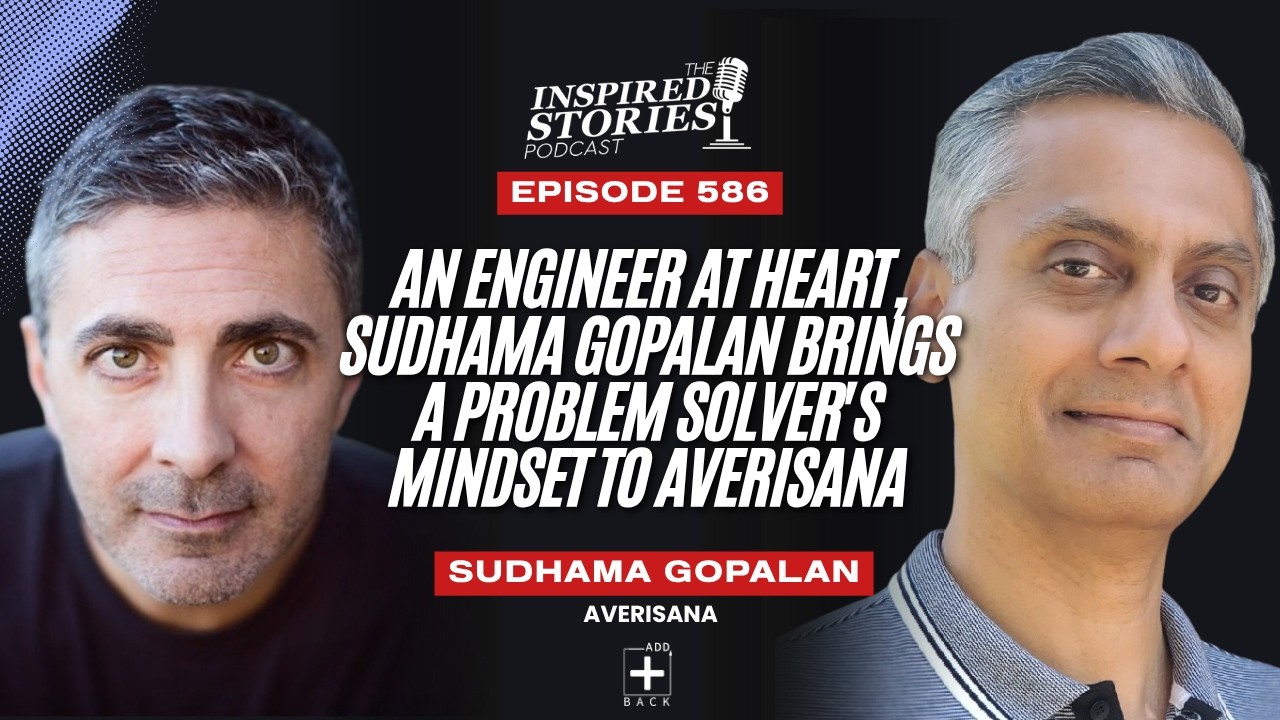
🎙️ From Automotive Paint Chemistry to Life Insurance AI, Sudhama Gopalan Solves Problems at Averisana
Sudhama Gopalan, founder and CEO of Averisana, trained as a chemical engineer and has solved problems in automotive paint at Sherwin-Williams, credit cards at HSBC, and now life insurance. He shares what a Volvo truck plant taught him about troubleshooting, why online credit applicants carry more risk, and how Averisana's Easy Life AI helps independent agents deliver accurate quotes from multiple carriers in about 15 minutes. He also explains why he believes life insurance will always need a human touch.
✨ Key Insights You'll Learn:
Low-solvent automotive paint under an EPA mandate
A Volvo truck plant and a temperamental waterborne coating
Scaling chemistry from the lab bench to a pilot plant
Finance, marketing, and credit risk as one team
Why direct mail beats the internet on credit risk
Online applications as a signal of need
An underinsured middle market in life insurance
Lead scoring that lifts return on ad spend
Easy Life AI and the 15-minute quote
The lasting role of the human advisor
🌟 Sudhama's Key Influences:
Chemical engineering training: the troubleshooting habit behind every role
Sherwin-Williams: hands-on problem solving in the lab and pilot plant
Volvo: the client mandate that forced a solution
HSBC: lessons in risk, marketing, and consumer behavior
A life insurance carrier: where he saw the industry's analytics gap
👉 Don't miss this conversation about an engineer's approach to problems in paint, banking, and insurance, and why trust still closes the sale.
Listen to the full episode here
Transcript
Anthony Codispoti (00:00)
Welcome to another edition of the Inspired Stories podcast, where leaders share their experiences so we can learn from their successes and be inspired by how they've overcome adversity.
As you listen today, let one idea shape what you do next. My name is Anthony Cotespodi, and today's guest was once asked to figure out where in the world Pyrex class kitchenware should be produced to offset high U.S. labor costs. He returned to the corporate board with a surprising answer. Nowhere in the world could they match the scale, cycle time, and product complexity of the U.S. production plant. That plant stayed open for the next 20 years.
That kind of insight and impact runs through everything that he has done. A PhD in chemical engineering led to four years developing Sherwin Williams' new line of automotive codings. An MBA at Chicago Booth led him into management consulting at Booz Allen Hamilton, then to turning around profitability for an $8 billion card portfolio at HSBC during the 2008 financial crisis. Then to managing development.
Of Aetna's new health insurance products, and finally to pioneering analytics to improve customer acquisition at a life insurance carrier. Sudama Gopalan is the founder and CEO of Averasana, an Illinois insure tech whose Easy Life AI platform guides life insurance agents to build a detailed client portfolio and enable an informed choice between 10 carriers based on real-time quotes.
All within 15 minutes. Averasana has scored more than 60 million life and health leads with its predictive intelligence models, improving return on ad spend by over 30%. He holds a BTEC from IIT Bombay, a PhD in chemical engineering, and an MBA from Chicago Booth. But before we get into all that good stuff, today's episode is brought to you by my company, Ad Back Benefits Agency. And if you're in the insurance business,
This solves a problem that's been plaguing your clients for years. So you already know the story. Health premiums go up and your client panics Maybe they shop around or start cutting benefits. Either way, you're the one explaining a price hike you didn't create and your relationship takes the hit. But there's a program backed by Bain Capital Insurance that you can bring into that same meeting that flips the script and frees up cash. It doesn't replace their group health plan, it fills in the first dollar gaps.
And
it can even cover part-timers who don't qualify for major medical. Employees get unlimited access to doctors, therapists, and prescriptions with no co-pays or deductibles to meet. And here's the part that changes the conversation entirely. This program actually increases your company's net profits. See, we recently helped a client add, that's add $900 per employee per year to their bottom line.
Games like that free up budget your clients can reinvest into the coverages you're already discussing with them. Your client gets real relief, and you get to be the broker who delivered it. Addbackbenefits.com. All right, back to our guest today, the founder and CEO of Averasana, Sudama Gopalan. Thanks for making the time to share your story today.
Sudhama Gopalan (03:19)
My pleasure. I'm looking forward to this conversation.
Anthony Codispoti (03:22)
So, Saddama, Sherwin Williams was under pressure to cut solvent emissions across its whole automated paint line. And you were brought in to help with that project. What did that mean in terms of the product? What is it that you were trying to specifically do? And what did the whole big project look like the moment you walked in the door?
Sudhama Gopalan (03:46)
So some context here. The solvent emission mandate came from the EPA, and it was for every firm in the industry. And effectively, the European competitors were already there. The American competitors, the three large ones, had about three or four years to get there. The idea was to essentially have lower solvent emissions.
from paints into the atmosphere. Now automotive paints, as most people would know, have like, there three levels to it. You've got a primer that goes on the, straight on the metal, a base coat, which has the color, and a clear coat, has the look and feel, the gloss. And they are solvents in each of these. Now at the time,
primers were actually water-based and water-based coatings have a little solvent. So this really was removing the solvent from the base coat and the clear coat. What you really wanted to do was to keep as much solvent in the allowable limit in the clear coat because it allowed the clear coat to essentially lay out in a very attractive manner.
get that finish and that gloss. So it really boiled down to getting as much solvent out of the base coat. And there was a couple of ways to go about this from terms of product options. Option one was use a water base coat. I'll get to that shortly. And option two was.
Anthony Codispoti (05:37)
And and just to clarify here, a water-based base coat is different from something with a solvent in it. Is the solvent
Sudhama Gopalan (05:45)
Correct.
Anthony Codispoti (05:46)
what is the solvent exactly? What is that material?
Sudhama Gopalan (05:50)
So that would be any kind of an organic solvent like acetone or things of that sort. Pardon me, I don't remember the exact solvent. yeah, yeah.
Anthony Codispoti (06:07)
Acetone's a good example. Yep. Okay. So I've got some frame of reference there. Okay, go ahead.
Sudhama Gopalan (06:11)
So it's volatile and evaporates. two options, right?
It's either water-based or it's solvent-based. I'll get to that was the first thing. What is it that you want to do? You want to remove as much solvent as possible from the base coat and leave the remainder for the clear coat. So that was the problem. That was the product that needed to be completely redone. Now let's get to what's in the base coat or in any paint. It's pigment.
it's the resin, the underlying resin, the matrix in which the pigment gets essentially ground and then what lays out on the primer and then gets adheres to the primer. There's additives. Additives are the kinds of things that fulfill many purposes, such as the addition to the primer, such as things like UV resistance.
Okay, and then.
Anthony Codispoti (07:18)
This is what makes it stick
to the primer coat. This is what makes it UV resistant. These different additives
Sudhama Gopalan (07:23)
Yeah.
Anthony Codispoti (07:24)
add these desirable qualities, okay?
Sudhama Gopalan (07:26)
add these qualities to it. And then there's a solvent. Obviously, the more the solvent, the easier for the paint to lay out as you spray it. So the idea was to say, OK, this was going to be a whole new ground-up rebuild of the product because it was a new resin. The resin had to change. The resin would be essentially a polymer.
Polymer is an organic compound with multiple repeating chains. You either have long chains and a large amount of solvent. And that will get you the right kind of, I'd say, density or viscosity of that paint. You don't want it to be too sludgy.
had this constraint of not having too much solvent in it, you have to redo the polymer such that you make it based off shorter chains. So it's not as dense.
Anthony Codispoti (08:37)
So it's getting into
a lot of really nerdy chemistry here. Obviously you've got
Sudhama Gopalan (08:40)
No, he's not. Yeah, absolutely.
Anthony Codispoti (08:41)
some of that background because of your education, but what's it take
Sudhama Gopalan (08:43)
Yeah, absolutely. That's right.
Anthony Codispoti (08:46)
to manage such a big process like this across so many different paint colors and just this this whole huge product?
Sudhama Gopalan (08:53)
Yeah. So this is
what was entailed, right? On day one, this is what the project, and I didn't even join the project on day one. I was doing something else. Right. And it actually links to what ended up happening. A project manager had a program director had been appointed and then a large team of scientists and development people in multiple areas.
was appointed. Essentially, this team may have been about 15 people to begin with and at its peak, it was about 25 and others brought in as time came along. And then they were in different areas. They were doing the basic chemistry with different formulations. And the way the project laid out was you had to do the resin first and get it to a point of saying,
This is the resin chemistry. These are the ins and outs of it. And this is what the product would look like because the paint gets made with the resin as its base. So there was a resin area. There was a paint formulation area. And then everything that was made had to be tested in application and for various physical properties. In that formulation area came the
dozen or two dozen different pigments and how all of that would get done. Right? So it was a pretty, you know, complex project. At that point, I was doing something different but related. I was not on the team. I was doing a project with one of our clients that was a truck plant, Volvo truck.
And we had a waterborne base coat that had been developed. that was, I think at that point Volvo had a new production plant. And as they started it up, we sort of started up our paint line as well. And we found that it wasn't laying out as expected when we built it.
And literally I was like parachuted into trying to figure out what was going on.
Anthony Codispoti (11:18)
And when you say it doesn't
lay out the way that you expect it, does it mean it's peeling and cracking or
Sudhama Gopalan (11:23)
It was
like orange peel, that orange peel sort of view. it was a little like, yeah. Yeah, yeah. And
Anthony Codispoti (11:28)
like a little bubbly like little little pocket. Okay.
Sudhama Gopalan (11:34)
then the clear code lays on top of it and you don't see it as a well laid out base code. The color's a little blotchy. So that then.
We had to figure things out very quickly. And I did a bunch of interesting sort of things. I tried to mimic what would happen to that paint as it went through a pumping system, akin to what was in that Volvo plant, a scaled down version of it. I actually built that in one of our spray painting facilities.
like a boot where a car would be sort of driven in and painted. And kind of around that, I mimic the kind of the pressure from the pump and the head of like...
Anthony Codispoti (12:30)
'Cause
you wanna simulate
the same environment that this is going to be applied.
Sudhama Gopalan (12:34)
Exactly. And I also wanted to simulate how the robotic sprayer would spray. So that then went down to actually measuring spray patterns with laser diffraction. So the answer there was, well, the development teams were furiously trying to adjust their formulation and trying to see if it worked.
What I ended up showing was, yeah, it does work, but under some very tightly controlled conditions in terms of how it gets pumped and how it sprays that the particle size distribution of the spray droplets should be in a particular range. Therefore, this tweak on the formulation among the various ones handed to me, this one works best. So it was...
Anthony Codispoti (13:29)
So it was a matter of not
only dialing in the chemistry, but dialing in the the the sprayer, like the mechanism in which it was coming out of the hose.
Sudhama Gopalan (13:37)
Absolutely. The
robotic spray, exactly. So it is temperamental. So that was the takeaway. It was temperamental. And now, remember I said that let's go to the new line of paint with low solvent. The first design choice out there was, do we want to make a water-based, a water-borne base coat, or do you want to make it solvent-borne?
And the answer was you couldn't do water bone anymore because it worked only in a very tight range of spraying conditions. And the intended use of those paints was both for like original OEMs, meaning in the production line. There was a big market. The bigger market really was in the refinish market.
So that was sort of the connection between the two. that's one of
Anthony Codispoti (14:36)
So what did the solution end up being?
Sudhama Gopalan (14:38)
the... So we ended up making a Solvent-Born base code. Yeah.
Anthony Codispoti (14:43)
Base. Okay,
so you got away from the idea of the water based base coat because it was just too temperamental.
Sudhama Gopalan (14:47)
Yeah, yeah.
Yeah, just to talk temperamental. As I learned, this was being fed into sort of this project, which I was not on. I joined the project maybe six to nine months in, pretty much as part of a kind of a group consolidation. And I ended up working for the director who ran the resin program. And I ran the pilot plant.
which I'll get to in a bit. But that was the basic setup in there, right? Large teams, multiple areas. You had some necessary things to be done upfront to design choices, solvent borne or water borne. That drove everything. And getting an answer quickly, and just by accident, by, you know, that I had been pulled on to it.
in the context of another project and we got the answer that fed this particular new development project.
Anthony Codispoti (15:56)
The the way you accidentally got it was because you were working on this other truck project and you
Sudhama Gopalan (16:01)
Yeah. Yes.
Anthony Codispoti (16:03)
you already saw that the water based base coat does not work well. You already had that experience that you were bringing.
Sudhama Gopalan (16:08)
Yeah, we
had that. We had that and we were on a mandate there. Volvo being Swedish, environmentally conscious, they basically mandated, we're going to have waterborne coatings, end of story. If Sherwin Williams doesn't do it, we'll just go to your competitor. So we had to make it work to retain the account.
Anthony Codispoti (16:34)
But
Sudhama Gopalan (16:36)
And so, no, no, no, The stuff in the water base in...
Anthony Codispoti (16:37)
So so you so you end up losing that account or they stuck with the water based base coat. And Sherwin
Williams came up with this better approach that stayed with a solvent based base coat. Okay. Two different products. Got it.
Sudhama Gopalan (16:46)
Yeah, so for OEM applications, Waterborne
works. For refinish applications, it would not. But that's the difference
Anthony Codispoti (16:55)
Got it. Okay. There's a difference there. Okay.
Sudhama Gopalan (16:58)
there, because the spraying conditions cannot be tightly controlled. It's bit of an art, right? Humans spraying. So that was what was behind it. So that was the genesis.
Anthony Codispoti (17:08)
So y you you
Sudhama Gopalan (17:10)
That's how it all got started. And it was a long project with
It started with then moving on to the resin area. then since I had done a lot of experimental work, I got initially pulled into the development of the lab bench scale work on the resin. And then very quickly, because I owned the pilot plant effectively, taking it from a bench scale to like a hundred gallon sort of reactor where
It wasn't taken from bench scale straight to production scale. Production scale was maybe like a few thousand gallons at one go.
Anthony Codispoti (17:53)
Tell us the differences, right? You're on the bench. Okay, I've got something that seems to be working. What tends to break most? Like when you go to that hundred-gallon scale or to the production scale, and and if it breaks, why does it?
Sudhama Gopalan (18:07)
So there are things you can't control. So let's say there's heat involved. The time to get the contents of a smaller reactor, a glass-blazed reactor with a little burner, a Bunsen burner or whatever, under a hood, it'll come up to temperature very quickly. It gets stirred very easily. So you have to account for all of these things. A little more inertia.
as you go up in size, takes a little more time. You have like heat exchange going on to maintain the temperature really constant or to heat and cool it down very quickly. Because heat is what one of the triggers besides a catalyst to get that reaction going to polymerize the chemicals and create that resin.
you have to control the reaction conditions very tightly. you know, once the reaction has come to the point that you have a sense that, yeah, the product is done, you can't let it cool like slowly because there'll be some residual heat in there and you know, that becomes a little unpredictable. So then you get sort of get cold water around the reactor to take the temperature down to room temperature as quickly as possible.
All of those things, it works differently. It's a lot more inertia involved. And that's like classic chemical engineering. This is what chemical engineers do, figure it out and come up with their thumb rules on how to make adjustments.
Anthony Codispoti (19:58)
So, and I think this is interesting because most people wouldn't connect the dots from the work you're doing there with Sherwin Williams
Sudhama Gopalan (20:04)
There, yeah.
Anthony Codispoti (20:05)
to what you're doing now, because
Sudhama Gopalan (20:07)
Yeah.
Anthony Codispoti (20:07)
there's no chemistry involved, but there's very much a a process of troubleshooting, identifying the problem,
Sudhama Gopalan (20:11)
Yes.
Anthony Codispoti (20:14)
and y what are the next things that we can try and we can test. And so let's kind of see how your mind works as we get into the story about you at HSBC. Because you're running strategic marketing for an eight
billion dollar credit card portfolio at HBC, HSBC in 2008, like right as the financial crisis hits. So talk to me about that. What is it like being the PL leader on a book of that size during that stretch of time?
Sudhama Gopalan (20:43)
Yeah. So there too, it's a multifunctional approach. The, people jokingly call it, there was a Holy Trinity that managed the book. It was finance, marketing, and credit risk. they have the marketing's function primarily is to make sure that the volume, the top line, and the overall bottom line shows up. That's, and that's the bottom line is largely myself.
Credit risk is all about who is it that we extend credit to and what are the losses on that, the credit losses on those, on that population, essentially defaults.
Anthony Codispoti (21:24)
And so part of
what you're trying to decide is who gets a credit card and who doesn't. Or is it beyond that other credit
Sudhama Gopalan (21:29)
You have to make that decision.
It's beyond that. It's beyond that. There's two elements to it. You have the ability to... I guess what determines the credit risk of the people that you extend credit to? It all depends on the channel whereby you get them in the door. So the credit card was on behalf of a major electronics retailer.
And there were some multiple aspects to it. There was the private label store card, essentially, your 18 months, same as cash, buy a big screen TV, right? Those sorts of things. And then there was the master card. so in the store, you have to be really careful because the retailer can't take too many declines.
that won't fly well.
And it's okay with the private label card because you're using that credit only within the store. And there's a long same as cash period. So it's a little more forgiving.
It's the MasterCard
Anthony Codispoti (22:52)
Let me see if I understand this.
So when it's, for example, I'm just gonna make up a company here, Best Buy is the one that has this deal, you know, 18 months, same as cash, sign up
Sudhama Gopalan (23:00)
Hmm? Hmm?
Anthony Codispoti (23:03)
for this credit card, buy your new TV. And so you're saying like there's a little bit more flexibility there because if they don't if the customer ultimately doesn't pay, complete the sentence here for me, who's on the hook for that? Is it
Best Buy that eats it or is it HSBC since they extended the credit?
Sudhama Gopalan (23:23)
So it is still HSBC. That's on the hook for it, for that amount. Best Buy gets the sale, but then there is some alignment in there, right? So because the asset belongs to Best Buy. So the other part, the more important part is the card can be used only at Best Buy.
can be used outside.
Anthony Codispoti (23:55)
so maybe the the limiting factor here is you're only gonna put a fifteen hundred dollar T V on this credit card. You're not gonna go and use it and rack up other debts all over town. Whereas MasterCard, you could have thousands and thousands of dollars of debt. And so that's where the bigger
Sudhama Gopalan (24:10)
Exactly, exactly.
Anthony Codispoti (24:12)
risk is. Okay.
Sudhama Gopalan (24:13)
That's a bigger risk. then, you know, if, you know, the retailer in this case would be for the big screen TV to move the TV, offering that 18 months, same as cash, that's worth something, right? That subsidy is, you know, there's a transfer to the bank from the retailer to enable that.
Anthony Codispoti (24:38)
And so let's say that that takes place, I'm just a little bit curious on how this works. I'm Best Buy, I get somebody to sign up for this credit card, get the fifteen hundred dollar TV, and then as Best Buy, I'm getting that full fifteen hundred dollars. Or there's some sort of a service fee between you and Best Buy. How does that work?
Sudhama Gopalan (24:57)
Yeah, there is a fee that's determined. It's a little different from the credit card, where the credit card like a master or visa, every transaction, let's say to whatever, 1.5 % fee gets paid by the retailer to visa or master card, then visa or master card pays back the issuer. Exactly. That's
Anthony Codispoti (25:17)
It's just that standard merchant transaction. Okay. Okay.
Sudhama Gopalan (25:22)
the master card.
The private label card is more of a closed system between the bank and the retailer. So that can be managed contractually.
Anthony Codispoti (25:34)
Lots of different ways to do that. But let's talk about how it is that you determine the risk. Or or did you have something else you wanted to say
Sudhama Gopalan (25:36)
Lots of different ways. So how do you do exactly?
Anthony Codispoti (25:41)
there?
Sudhama Gopalan (25:41)
Yeah. So now channel determines risk in many ways and product obviously does. So let's talk about the MasterCard. That's the more difficult one because it has that contingent liability in that once you've given a certain credit limit, all of that can be used pretty much anywhere MasterCard is accepted.
So that onus is on me as the bank P &L owner. So how we acquire that customer makes a big difference. There's three channels. There's a store, there's direct mail, and there's the internet. Now, direct mail is the most preferred channel for the bank because you can essentially pre-screen them, which effectively means as follows.
You may have certain risk models that determine that Anthony is A-OK and good for a credit line of, I don't know, $5,000. And that really boils down to the credit bureaus have Anthony's file and then essentially says, OK, Anthony has so many different lines of credit. He has so much outstanding credit. He has been
never been delinquent ever, he's paid off all his balances. And that alone is the best signal about Anthony's credit worthiness. And then there are always degrees of less good. So what you do at the outset is without even pulling the credit report, you are allowed to do a soft pull.
upfront. So when you get that credit card offer in the mail, which you get less and less these days, but remember the time when you used to get a lot of these, essentially you will be pre-screened at the credit bureaus and the same models or versions of the same models will be used to say, yeah, you know, this is the population that Anthony fits in that has these criteria, which would mean, you know, maybe less than one delinquency in the last year, whatever those criteria are.
And then an entire pool of population would be essentially taken from the bureau and that becomes the mailing population. Everybody that gets...
Anthony Codispoti (28:12)
So
so I I can go to not I, but you know, if I'm a credit card provider like master card like HSBC, I can go to the credit bureau and I can I can give them the criteria that I'm looking for and they'll essentially for a fee provide me with this giant list of okay, here's
Sudhama Gopalan (28:29)
Sorry.
Anthony Codispoti (28:29)
everybody that fits that criteria. And so like, okay, now I know that those are the folks that I'm gonna send this mass mailing.
Sudhama Gopalan (28:37)
Correct. So in return for this service that, again, the oversight of all of this is actually the Federal Reserve. In return for this service that the Federal Reserve allows us this en masse access to credit reports or history, not at the individual level. The bank never sees individual credit details of entity at that point of time.
They just say, okay, Anthony qualifies. So Anthony can be sent a piece of mail. Now in return for this, the bank has to assure that that entire population, if they choose to apply, the bank has to approve at least 95 % of them.
Anthony Codispoti (29:25)
This is some sort of a a legal stipulation.
Sudhama Gopalan (29:30)
Yeah, that's what allows it to be called a pre-approved offer of credit.
Anthony Codispoti (29:37)
interesting. Okay. So the rule says
Sudhama Gopalan (29:38)
Right. So that's.
Anthony Codispoti (29:39)
if you're gonna if you're gonna do it in this way, if you're gonna pull this list from the credit bureaus and and then you're gonna send this offer and it says pre-approved, then you have to by law and all the the pool of people that apply, ninety-five to ninety-nine percent of those feet pull have to actually be approved in the
Sudhama Gopalan (29:59)
Basically, that's what it boils down to. Direct mail has always worked out to be the best channel from a risk perspective.
Anthony Codispoti (30:10)
because you're pre-selecting who it is that you're going to approach. And so the other channels that are riskier are what?
Sudhama Gopalan (30:13)
Yes, it's
actually more than that. More importantly, it's because not only are you preselected, somehow, someway, you know that you have been preselected.
Because the third channel, which is the internet channel, that's the most amazing one. The internet channel has what you call adverse selection. If I took an individual who got the pre-approved offer, I had the same credit criteria, and that person came to me via the internet.
with the same, you know, credit history. The person coming through the internet is going to perform worse, the person who came in through the direct mail channel.
Anthony Codispoti (31:13)
And when you say perform worse, they're more likely to default on that credit that's been extended to them. Why is that?
Sudhama Gopalan (31:20)
This is now human behavior. When you approach through the internet, through an arms-length channel, turns out it is a signal of need. And need can often come, at least in some shape or form, factors that suggest that your credit worthiness is deteriorating.
Anthony Codispoti (31:49)
Got it. It's the difference of who's initiating the outreach. If it's if I'm getting something in the mail that came to
Sudhama Gopalan (31:55)
Mm-hmm.
Anthony Codispoti (31:56)
me passively, I didn't necessarily ask for that or request it, but if I'm the one who's actively seeking it out on the internet, I've got something going on in my life where I've got a cash deficit that there is a there
Sudhama Gopalan (32:01)
Yeah. Yes. Yes.
Anthony Codispoti (32:06)
is a financial stressor there.
Sudhama Gopalan (32:08)
Yes. So the big takeaway is the reason that you have a marketing group and a credit risk group and a finance group working a credit card portfolio together. These are the finance people kind of know how to do the numbers through now, through time, through the expected duration of that card member's life with
the product. The credit risk folks know how to look back on similar populations and determine the various expected delinquency performance and then look forward with the actual performance and see how it compares against what they had predicted. And if it's off in some way and alarm bells start to ring,
then you have very few levers available.
The only lever available at that point of time may be to turn down, reduce the credit line to control the exposure.
Right, so once you've extended credit, most of the risk control has been taken away from your heads as the bank. And marketing at the middle of all this essentially is responsible for making sure that the financial risk-based reward criteria of the bank are being met where, you know,
The downside risk, I have a risk group protecting it. The overall look at is this thing going to make money or not. Finance is saying that, but I'm so responsible for making sure that in the retailer example, since I am talking to the retailer, the retailer is on me saying, I need these TVs to sell. I need you to be approving more people for the card, right? So like I have all of these.
pressures to balance on the volume side, on the profitability side, and on the risk side.
Anthony Codispoti (34:27)
So as I think about
Sudhama Gopalan (34:28)
And the models.
Anthony Codispoti (34:30)
as I yeah, there's like a tug of war, there's like opposing priorities here. and I'm trying to think, you know, there's some things that occur to me that are obvious about what you're looking for. And you mentioned one, like, you know, how many delinquencies have they had on their bills in the past year, right?
Sudhama Gopalan (34:45)
Yeah.
Anthony Codispoti (34:47)
But I wonder if there are some non-obvious things that you look at that would be intriguing to explore.
Sudhama Gopalan (34:55)
That's happened more in recent times as far as credit risk is concerned. There's alternative sources of data. And that's why you have a whole lot of these new fintechs. In more recent times, you have these buy now, pay later type firms. They all use alternative data. Not everybody has a well-developed credit history, especially the ones who are younger and don't necessarily use credit cards.
There are those alternative sources of data that try and get at how they are paying their debts or their...
or the other borrowings in various forms. So that's where the innovation comes
Anthony Codispoti (35:37)
Like what would some of that alternative data be?
Sudhama Gopalan (35:40)
in. Utilities, there could be other data that's been tracked. I know that Binopay later now doesn't actually go to the credit bureau, but I know that the BNPL firms were in some ways sort of collaborating on performance of.
of their client base. And then there's correlations with other things, like how you perform in your auto loans, for instance. There's a bunch of things. You can also do what's more like a big data thing, which is just scraping data from any and all sources, including maybe if you got a good match on that particular individual and kind of saw.
And this is the life insurance example. What do you not want when you sell life insurance? You don't want the insurer to now go like bungee jumping or skydiving. Right? Yeah. Yeah.
Anthony Codispoti (36:44)
So that's a great lead in because this is where you are today. You started a Verasana,
but what was the idea behind this? What were you what was the gap you were trying to fill? What what were you trying to accomplish?
Sudhama Gopalan (36:55)
So I got into life insurance with a life insurer that I worked for about 10 years ago. And at the time, I felt that the use of analytics there was probably the lowest among all consumer financial services. And I saw a huge opportunity there. The opportunity really came from how underinsured the population was. By some,
measures, especially in the middle income market. So call that the middle 50 percentile, 25 percentile to the 75th percentile of the country, that half, call that the middle market. I think the penetration of life insurance was like high single digits. And in fact, is a big demand for life insurance among this population if it were available at
affordable premiums, and that might mean lower coverage. And that's something that the industry is not able to manage. So the use of the analytic, and the reason they're not able to manage is that their costs to acquire a customer are quite, I would say they would be about,
two or three times the costs that we paid for, let's say, acquiring a credit card customer. Even more. And it's a long process.
Anthony Codispoti (38:27)
Sudama, how did you come to be
how did you come to be familiar with this gap? How were you aware that this was an issue in the life insurance?
Sudhama Gopalan (38:35)
So this was known, I think the life insurer I joined actually had a front end agency, a brokerage that it bought. So they were acquiring customers through their brokerage and then transferring those, the products that were being sold were basically the life insurers product. So they kind of knew.
what the cost of acquisition of the average customer was. And then, the one thing you would like to know always is, let's say everything is online now. You pretty much know how much a Google search ad or a Facebook ad costs. So now it really boils down to what's the conversion of somebody you target for an ad all the way to a product.
In life insurance, from an ad to a product, it's very low. It's like 1 % or less. Credit cards is also that much, but they find ways to get it higher. So the problem with life insurance was you had way too many people at the top of the funnel that did not get approved for their product. And then there was two aspects to it. One was...
just the digital marketing and that marketing funnel, who were you targeting? They weren't doing the sophisticated things that let's say HSBC was doing with understanding this adverse selection across different channels or coming up with models to target the right customers. Remember that pre-screen direct mail example.
Now the risk that you're trying to measure in life insurance is actually mortality. It's like in real fact, it's not mortality because mortality is, it takes a long time to measure, decades and decades. So you try and go with something that's measurable in a shorter amount of time. And that would really be something called morbidity.
which really boils down to the presence of some chronic health conditions.
So that's what drives underwriting in a life insurance situation. They're asking you a lot of these health questions, trying to figure out what kind of health you are in, what kind of chronic conditions you have, because the odds of having an adverse mortality event, to use words that...
Anthony Codispoti (41:34)
So ex
explain to us specifically though what Averasana is trying to do here. Are you trying to reduce the cost of customer acquisition? Are you trying
to Okay, that's that's the cuck the that's the crux of it.
Sudhama Gopalan (41:42)
Yes, we're trying to do,
yeah, the crux of what we're trying to do is we are trying to make for a more productive, sharper experience from the time they realize that they want life insurance till the time they get a policy. Number one, we're trying to make it more efficient for the agency and the carrier.
We're taking their entire system of the shopper, the agency, and the life insurance carrier and saying, there's a massive sales and marketing process that goes on in there. All along, there's a determination of the risk of that individual. Risk and intent or risk and marketing are tied at the hip, just like it was in the banking example that I was citing.
What we were trying to do is to figure out what are the key levers that we have. Where is it that money gets spent in trying to acquire the customer? That's a point of, that's kind of a moment of truth. So we are all about, as we like, we would like to call it decision intelligence. There's a decision being made. When, let's say I decide to,
spend ad money on a pay-per-click ad. I'm paying something. I have a certain marketing budget I'm allocating in there. It then comes through the door to me, to my agent. From that point, at that point, it's a live lead. It has a certain value. I'd better work it fast enough because the value of that lead goes down with time because that shopper has expressed intent.
If I don't get back to him right away, she's not going to wait. She's going to go somewhere else.
So then I have to make sure that the sales arm goes through its process with the products that it has as swiftly as possible within the attention span of the shopper because she expects speed. You're asking a lot of uncomfortable questions of her around health.
Anthony Codispoti (44:13)
Let me ask this. Does it have to go to an agent, or can some sort of an AI predictive model give a price and allow for the entire checkout process to happen online? Or is there something that needs to exist that doesn't right now for that?
Sudhama Gopalan (44:30)
So the reason that the straight through digital process does not occur today is that a lot of validation of health conditions has to occur. So the application can come through. And what we do is today we can do what we would call the shop, quote, and apply. A significant part of it, we can do it on our app, on our platform.
and AI comes into play in a few key places in there. But then that takes you to the insurance application. It still has to go, and there's a key decision made there, especially if you go to a multi-carrier independent agent. The key decision made is within the attention span of the shopper, they have to get quotes from multiple carriers, providing some, not all the information.
around the insurance application. For a quote, the quote needs to be accurate. And that's the little balance here. You can't ask every question that gets asked in underwriting, but you have to ask the key ones to be sure that you got a good handle on the risk of that shopper so that the price of the quote could be presented.
Anthony Codispoti (45:59)
So after you launched a Verasana, I know that you spent a few months building the predictive intelligence models that would eventually score more than sixty million life and health leads. What were you looking
Sudhama Gopalan (46:10)
Yes.
Anthony Codispoti (46:10)
for in those early models?
Sudhama Gopalan (46:12)
In those early models, we were trying to figure out who for our clients, on behalf of our clients, who should they target their ads to.
And here's some context. Our clients, typically agencies, had large marketing budgets, a few million. let's say, imagine a process where, let's say, you're out looking for life insurance. You go through Google. You find my client. And then you get into their site, and you say, fine, I will express interest here. And I'll.
talk to my name, my phone number, my email address, my state, maybe a few things, and then I become a lead, and I hit submit.
The first bit of marketing won't have you provide a whole lot of information because your attention span is not that much. The moment you submit that, that's when some of these pay-per-click ads show up. These are, so you've become a lead for the entity whose lead form you filled.
But same entity serves up a pay-per-click ad. The reason it serves up this pay-per-click ad is the cost of acquisition on Google or Facebook is really high, and not everybody is going to convert. So they offset the cost with these pay-per-click ads.
Anthony Codispoti (47:59)
So you're getting hired
to basically run the ad campaigns to funnel the appropriate folks into your clients who are insurance companies.
Sudhama Gopalan (48:08)
All we do,
we just do the analytics behind who should receive that pay-per-click ad.
Anthony Codispoti (48:19)
So you help them you help
Sudhama Gopalan (48:19)
All we know,
Anthony Codispoti (48:20)
them know who to target.
Sudhama Gopalan (48:22)
who to target, all we know is once you hit submit, maybe a name and a zip code comes to us, maybe just a zip code. In the case of health insurance or Medicare, just a zip code.
Anthony Codispoti (48:37)
And what does the zip code tell you?
Sudhama Gopalan (48:40)
Zip code can tell you a lot in health insurance or Medicare. So a zip code in Medicare can tell you, OK, I am in this particular Medicare rating area. The health plans on offer are these. My client has offers among what's available. They offer this particular subset.
I can now, what my models then get into is, does my client get their needs met better via the available carriers in this zip code versus some other zip code?
Therefore, my client better positioned in this zip code versus some other zip code? Do they?
Anthony Codispoti (49:40)
What's the
ultimate metric that your clients are measuring you on? Is it return on ad spend? And what kind
Sudhama Gopalan (49:44)
return on ad spend. So what I do.
Anthony Codispoti (49:48)
of improvement do they typically see?
Sudhama Gopalan (49:50)
So depending on the product was life insurance or it was Medicare or it was anywhere between, for Medicare we had the lowest closer to I'd say 20%. For life and health insurance, that's Obamacare, we were 30 to 35 % incremental return on ad spend. So we were measuring it on our test versus control because this is all online sort of real time production.
Essentially, we would tell our clients to score, run the campaign in an A-B mode, like 50-50. 50 % would get the treatment with the Averisana scoring, and which would basically say, here's our score around insurability. Here's your sweet spot. It's a bidding system, as with any sort of a pay-per-click type ad situation, as in Google or whatever.
Google Search thing. And essentially we'd say, yeah, allocate your budget in this particular way. If you already had a certain allocation, we just ask you to move it up or down in these zip codes based on what we tell you, based on our models.
So that was
Anthony Codispoti (51:09)
That's pretty okay.
Sudhama Gopalan (51:12)
essentially what we would do. It's taking whatever signal is available at the point where our client is spending money to have them use that money efficiently. In practice, what we were doing is saying, let's say with life insurance, what we were trying to figure out is, is this customer
better suited for a term life policy, which tends to be higher coverage amount, lower premium, so the better health risks, or something called simplified issue, which then boiled down to, yeah, they'll send you through a faster process, but your rate is going to be a little higher. You may expect lower coverage.
but you could expect speed in there. So all we were doing was to say, this range of scoring suggests term life, this range of scoring suggests simplified issue, this range of scoring suggests, I don't think it's going to be either of these.
And accordingly, based on what the clients want to focus on, we again have them, you know, bid up or down accordingly based on that individual.
Anthony Codispoti (52:36)
Are there other things you're looking at besides zip code? What are some of those factors?
Sudhama Gopalan (52:41)
So in the case of the life insurance products, since we were doing health risk, we had an elaborate process where we needed the name of the individual and the zip code as well. We had an elaborate process where we are bumping up against some health databases to get certain.
fields. And again, just like the pre-screen situation, we don't get the actual information, we get a certain proxy to say, okay, these qualify for the criteria and that comes back to you. And then we have certain other demographic type fields that you may get and a model, which basically be used to say, based on what we've been able to model against our objective.
Here's how we would score them. So we need something to model to, which means our clients' performance, which is key. So.
Anthony Codispoti (53:44)
So they have
to be reporting data back to you to let you know how successful this has been. Okay.
Sudhama Gopalan (53:47)
Yes, yes,
yes. That's how it kind of started off. Especially when we create a new model, we ask them for a retro. Give us a look back of how much data, one year, two years or so. And then we use that information to build the model. We have the performance. We split that sample into a development sample on which the model was built. And then
There is a testing sample which says, okay, now I'm gonna apply the model to the test of the validation sample and see how it performs. And that's your classic modeling approach, machine learning as they
Anthony Codispoti (54:32)
What is easy life AI? How does this fit into what you're doing?
Sudhama Gopalan (54:36)
Easy Life AI is nothing to do with the lead scoring. Lead scoring is just our predictive intelligence products. We had separate products. Easy Life now is after that customer comes to a sales agent. The problem it's trying to solve is that there's a very short amount of time that's available when a
sharper is with an independent agent to figure out what's the right product fit for them among different carriers. And what makes it difficult is there's a lot of complexity in the amount of information you have to gather and the skill of the agent to serve up that information relatively quickly.
If the entire questionnaire were used, it would take a long time. So at my life insurance carrier, actually I watched this happen in a call center live, if they were able to get everything done within 45 minutes, that was like, they got really lucky. And that wasn't even for term life. It was for that simplified issue, sort of the lesser product, with a slightly higher rate and the lower coverage.
What we're trying to do is to compress the process for the best product for the most stringent underwriting, the most amount of information gathered, term life. The reason is that it is the best product out there. The nation is underinsured. Just the amount of coverage, the consumer, for
Anthony Codispoti (56:19)
Is the best product for the the consumer or for the insurance company, or who's it the best for?
Sudhama Gopalan (56:26)
the consumer, the consumer, it gets them the best coverage for the lowest rate. But then,
You have to be sure that you get a good case built for the consumer.
Anthony Codispoti (56:42)
So are you trying to eliminate or reduce the number of questions that you're asking to get a shortcut there and just make sure you're asking the
Sudhama Gopalan (56:50)
No, this is
Anthony Codispoti (56:50)
most high value ones?
Sudhama Gopalan (56:52)
exactly. We are adapting to what occurs in the conversation. As the pieces of information arrive, first things first, we have 10 plus carriers whose criteria we have already loaded. Our AI engine takes into account what's in those underwriting criteria that are documented.
And we have a certain model behind how the case will be developed, how the questions will be asked. They are asked literally in order of importance. Whatever is going to drive the rate class the most gets asked first.
So there are certain things that you can't do anything about, like the fact that your male, your age, your age, your gender, your height, your weight, your coverage that you want in terms of dollar amount, the term that you want, and then whether you're a smoker or a nonsmoker and the state you live in. You need these. These are essentials. There's nothing you can do to even start figuring out whether you qualify before you have these. So those are the essentials.
those, you gather those first. The trouble comes in the medical history because there's so much. So.
Anthony Codispoti (58:18)
And is that medical
history only being populated into the system by what the the patient, the the client, the user gives you, or are you also pulling from okay.
Sudhama Gopalan (58:28)
Mm-hmm. We're not pulling.
We're not pulling because that activity already occurs right after the app. Our job is to find the right carrier, make the best decision on the carrier, get the best quote for the customer, and transmit as much information about that case in the insurance application.
Because the decision is ultimately made by the carrier that's chosen, that says Prudential. The underwriters at Prudential will make that decision. My job is to make sure that they get as accurate a code, that the consumer gets as accurate a code as possible. That comes from getting as detailed a profile as possible. Within that 15 minute attention span of the consumer,
We are an agent or a producer who isn't an expert because it takes a long time to develop that expertise.
Anthony Codispoti (59:38)
So who should go to your website right now? Who is your client? Is it these big giant insurance companies? Are they indi individual independent agents? Is it the the range?
Sudhama Gopalan (59:50)
It's whoever is the independent agent. I've got a combination of brokers and agencies. The agencies are the ones who have the producers, the actual insurance agents who are talking with the shop. They are the users. They are the ones who are speaking. Literally, you can talk into our app and...
it will populate the case and both the shopper and the agent can see it at the same time. And then.
Anthony Codispoti (1:00:26)
And so how does that
actually work? Like is somebody calling me like through VoIP and like it's through your VoIP system or like h h help me kind of visualize what actually takes place.
Sudhama Gopalan (1:00:38)
So it can be any of these. the example I can give you is, let's say it's a financial advisor. A lot of life insurance is sold by financial advisors. And often they are on Zoom calls. Literally you can fire up our ad on that Zoom call. I mean, you can be my client. I can be the agent right now. We go through the EasyLife AI guided experience. And you can see.
Anthony Codispoti (1:01:05)
And so it's an agent that
is connected into that Zoom call. And so it hears what you as the life insurance agent is saying. It hears what me as the client, the patient is saying.
Sudhama Gopalan (1:01:15)
second.
Anthony Codispoti (1:01:16)
And based on the answers that I give, then that agent is saying, okay, we can skip over this chunk of questions and we can go to these instead.
Sudhama Gopalan (1:01:25)
there's no
chunk. There's no chunk. There's an actual question that pops up. So let's say Anthony says, OK, we got through your essential information. Let's go through your medical history. Let's say two questions come up and third question is really, hey, any history of diabetes? And Anthony says, yeah, I've got controlled diabetes. And immediately he knows, all right, I need to probe a little here. And I'll do that.
Now you may say the same thing about, let's say Anthony has asthma. It may not care as much about asthma. So that's where it has the intelligence to figure out what matters more and what matters less. And how much to ask inside that 15 minute budget that I've given it, a time budget. That
Anthony Codispoti (1:02:12)
Mm. Okay.
Sudhama Gopalan (1:02:14)
is the attention span as I can best gather off the shopper.
Anthony Codispoti (1:02:22)
Okay, and so I've got this fifteen minutes. Versana is helping me, Easy Life AI is helping me direct to the most important questions. I've got the data collected now. Now do I step outside of your system to take the next steps?
Sudhama Gopalan (1:02:38)
No, no. So within the system, you have this little application strength indicator. How strong is the application? So as the agent, now know my persona is that of the insurance agent. I can actually see, all right, it's set at 80%. And I think this is good. I think my client's getting a little antsy here. Let me just, you know, she's given me a lot. I haven't given her anything back as yet of value. I'm going to say, hey, you know what? I'm going to get my first set of
rate class assessments. I want to pick three carriers out of these 12. And I'm going to do that. I'm going to say, let's see what comes out. Boom. 75 seconds later, it's gone through the detailed criteria of each of these. And then it says, all right, Anthony, you've got for your coverage amount, et cetera, cetera, et cetera. Carrier one's going to give you a rate class of.
Preferred plus, the best rate class. Second one's going to be like a preferred one below. Third one's also going to be a preferred plus. They can simply hover over those determinations and they'll say, OK, it's a preferred plus. You had diabetes, but that was like three years ago. You got it treated with ozempic, et cetera, et cetera. And you've had no relapse.
Everything else is a-okay in terms of your height, weight, build, etc., etc., etc. A-okay. The second carrier might say, we know you had diabetes until three years ago, but we'd like to see you have clean bill of health for five years. Those are our criteria. Therefore, sorry, Anthony, we can't put you in preferred class. It's got to be preferred. You know right then and there. It's every whatever has...
Anthony Codispoti (1:04:29)
So this is all happening
live on the call. This isn't like I'll call you back, I'll get some information. You want to do this while they're hot, while they're ready, while they're interested. No.
Sudhama Gopalan (1:04:32)
live on the call. There's no, call you back. Yeah. There's no, call you back. It's like, exactly. Exactly.
That's not what happens today. There's very little that happens in the first call today. So that's the issue. That's, yes. This is...
Anthony Codispoti (1:04:49)
This is huge. And so
is the idea that you should be able to close the sale on that call? Is that possible? Okay.
Sudhama Gopalan (1:04:58)
No,
The idea is that you make informed choice. There is a real advisory relationship that I, insurance agent, and you, Anthony, the consumer has. We walked through this. I've asked you to reveal some pretty distasteful things about your medical history, because this is about immortality after all. Nobody wants to be confronted with that. And then
you've given that to me and I've actually given you something back within your attention span that's useful to you, right? Which you expect because the way you buy your products when you disclose information is you want something back.
And the more distasteful information that you disclose, you don't want this to go around in multiple cycles and take days and weeks. You want it to happen right there, right then, right there. You want to be able to see, OK, I've got you three carriers. Hey, why don't you look at all 12? And then you can pick what you want.
then and there, you can start moving around, changing what you want. Hey, how about if I did a 20 year policy? I like the rates here. I'm 36 today. This will take me till I'm 46. The kids may still be in high school by that point in time. How about I do this as a 20 year by the time they're out of the house and we're empty nesters? Can I afford that? Right? then, then and there, you speak to Easy Life AI and say, hey, let's change that to 20 years.
Anthony Codispoti (1:06:35)
I don't think I would want this, but can you evi envision a future in which the insurance agent isn't necessary for that call? It's just an AI agent that's engaging with them.
Sudhama Gopalan (1:06:48)
I have a perspective just based on everything that I did in banking and in that there are certain sales which will never go 100 % straight through processing fully digital because the consumer does not want it. The consumer wants a relationship sale. They want to ask questions. They want to build trust.
And one of the first things that I did when I came to HSBC, when I worked in mortgage, was to figure out how people like to shop for their mortgage loan. And essentially, some people wanted to do it, and this was a long time ago, half the population wanted to do it face to face then. So literally, had done a nationwide study, and it told us there is a high touch segment.
and there is a price sensitive straight through processing segment. They are different people.
That holds in all kinds of consumer financial services. It's just shifting over time. As people become more tech savvy, they trust the arms length channel online a lot more. When even there, they might want to do this on a call like this. So
Anthony Codispoti (1:08:08)
No. Very interesting.
Sudhama Gopalan (1:08:11)
I do not believe that life insurance will be sold 100%.
kind of off-line.
Anthony Codispoti (1:08:17)
You think that human touch needs to stay there? Yeah.
Sudhama Gopalan (1:08:20)
A lot of people require that human touch because they need to make up their minds on exactly what it is that they want. There's too many like choice points in the product. That example I gave you, 10 years versus 20 years, that's when the relationship with the advisory comes. It's like, may have sold like a whole bunch of these, how has it worked out for others?
Anthony Codispoti (1:08:47)
Sudama, before I ask my last question for you here, I want to do three quick things for the audience. First of all, anybody who wants to get in touch with Sudama and know more about what he's doing, go to their website. This is really fascinating stuff. So Aberasana is spelled A-V-E-R-I-S-A-N-A, a barasana.com. It'll be in the show notes in case you missed it, aberasana.com. And if you're enjoying the show today, go ahead. Take a moment to subscribe wherever you're listening. See, it sends a signal that helps others discover the show too. So
I appreciate you taking a quick moment to do that. And a note for insurance brokers: you can walk into your next client meeting with something better than a rate increase, a program that gives more of their employees access to doctors, therapists, prescriptions, part-timers included. And it adds thousands of dollars to the company's bottom line every month. It's backed by Bain Capital Insurance, so it's built to last. Bring your clients that kind of win and they'll refer their friends to you. Add backbenefits.com.
So last question for you, Saddam, as you think about the work that you're doing now, what is it that you most want to be remembering?
Sudhama Gopalan (1:09:53)
want to be remembered for solving some big problem for whoever. At heart, I'm an engineer. An engineer solves problems.
That's basically it. Solve problems for people, whatever that works out to be.
Anthony Codispoti (1:10:13)
You just want to be known as a problem solver.
Sudhama Gopalan (1:10:15)
Yeah.
Anthony Codispoti (1:10:17)
I love it. Siddhangma Gopalan, I want to be the first to thank you for sharing both your time and your story with us today. I appreciate you being here.
Sudhama Gopalan (1:10:25)
My pleasure.
Anthony Codispoti (1:10:27)
Folks, that's a wrap on another episode of the Inspired Stories Podcast. Thanks for learning with us. And if one thing stood out, put that into action today.
Connect with Sudhama Gopalan:
Website: averisana.com