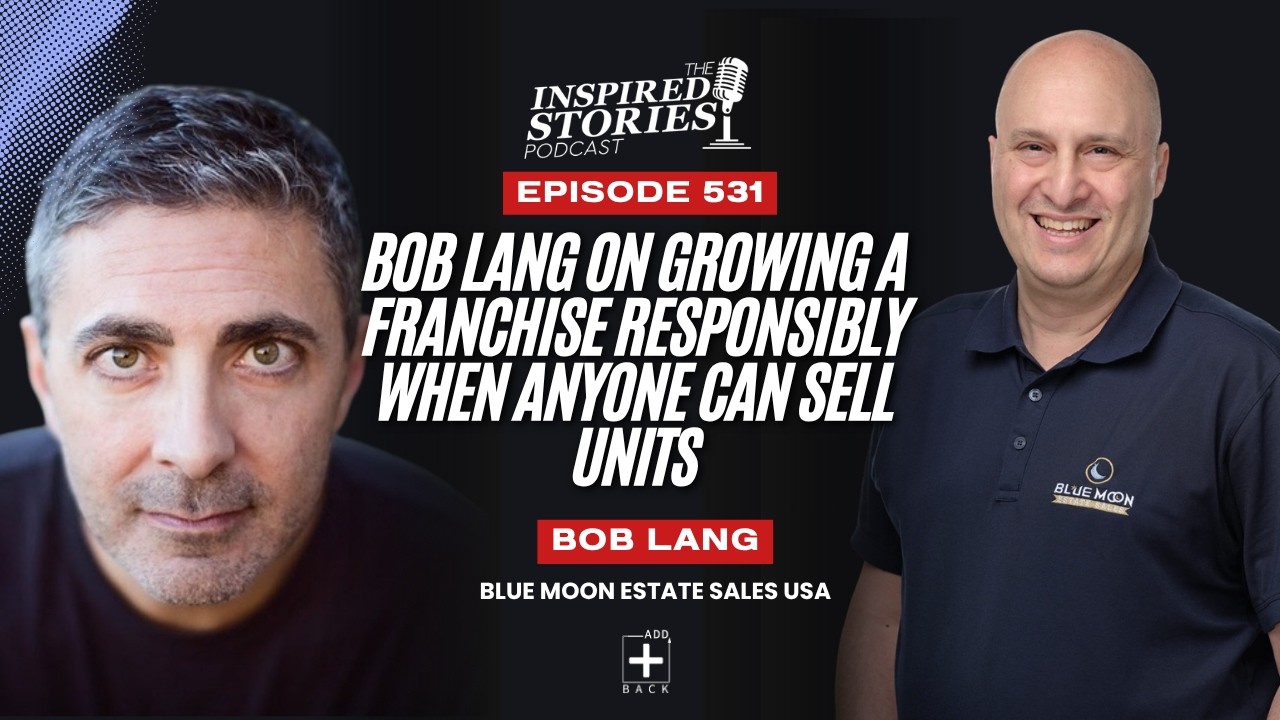
Bob Lang, president of Blue Moon Estate Sales USA, started his career assessing commercial loan risk at a hundred-and-fifty-million-dollar portfolio in Lima, Ohio, and spent the next 30 years discovering that the same skills that made him a good credit analyst — reading what drives a business, understanding where risk lives, knowing how to look at numbers and make them real — were exactly what franchise owners needed someone to do for them. Today he leads the largest estate sale franchise in the country: 156 locations across 30 states, more than 2,000 events a year, and a model built around some of the most emotional moments families ever face.
✨ Key Insights You’ll Learn:
What commercial lending at Bank One taught him about risk, capital structure, and what really drives a business
How the Pearl Vision acquisition put him in front of franchisees who needed a credit analyst who could explain their numbers in plain English
Why he started traveling with field coaches and what happened when the numbers became real
The franchise advisory council and what he learned about leading change instead of mandating it
Building business intelligence from scratch at Bright Star Care: pricing, labor, and the two metrics that moved the needle
Why he laughed when the recruiter pitched Blue Moon and what changed his mind inside of one conversation
How Blue Moon transformed training from in-person sessions at the founder’s house to a scalable LMS with 3D walkthroughs
What actually happens when a family calls Blue Moon and what the monetize process looks like from consultation to check
Why anyone can sell franchise units and why that’s exactly the wrong thing to optimize for
The AI pricing tool Blue Moon just introduced and what it can and can’t do
🌟 Bob’s Key Mentors:
His Lender at the Savings and Loan: The person who told him directly he was a pain in the you-know-what — and gave him the feedback that reshaped how he leads
VP of Operations at Pearl Vision: Described Bob as the finance guy with a personality and moved him into the field, where everything changed
Shelley’s Son (Bright Star CEO): Hired Bob for the capital access challenge during the housing crisis and gave him the platform to build BI from scratch
The Best Life Brands Infrastructure: A private equity-backed operating philosophy that aligned with Bob’s belief that responsible growth requires building support before selling units
👉 Don’t miss this conversation about what it actually looks like to help a family through one of the hardest transitions they’ll ever face, why the franchise model lives or dies on whether you can bring people along rather than drag them, and the feedback that a young credit analyst received that he still credits as his best life lesson.
Listen to the full episode here
Transcript
Anthony Codispoti (00:01)
Welcome to another edition of the Inspired Stories Podcast, where leaders share their experiences so we can learn from their successes and be inspired by how they've overcome adversity. As you listen today, let one idea shape what you do next. My name is Anthony Cotispodti, and today's guest spent the early part of his career assessing credit risk for bank portfolios worth hundreds of millions of dollars. Now he leads a company that helps families let go of a lifetime of belongings.
His path from banking to franchising wound through nearly three decades in four industries before landing him at a company operating inside of some of the most emotional moments that families ever face. He is Bob Lang, president of Blue Moon Estate Sales USA, the largest estate sale franchise in the country. Blue Moon runs 156 locations across 30 states and has re-homed more than one million items.
Bob is a certified franchise executive with roughly 30 years in the franchise world. His story is about what it looks like when someone with a genuine gift for systems and data finds work that is deeply personal. But before we get into all that good stuff, today's episode is brought to you by my company, Adback Benefits Agency. And you'll want to hear this because it's hurting almost every business you know. Health insurance costs go up every single year.
And franchisees are furious about it. They're paying more, claims are getting denied, employees are opting out because they can't afford it, and it hurts turnover and morale. It's one of the most maddening problems in running a business, and everyone just accepts it. But you don't have to anymore. Now there's a program that gives employees unlimited access to doctors, therapists, and prescriptions with no co-pays or deductibles to meet.
You don't change your broker. And here's the part that really shocks most people. Our product actually increases your net profits. We recently helped a client add $900 per employee per year to their bottom line. Results vary, but gains like that change how a business is valued. Get your free consultation today at adbackbenefits.com. All right, back to our guest today, the president of Blue Moon Estate Sales, Bob Lang. Thanks for making the time to share your story today.
Bob Lang (02:25)
Anthony, it's a pleasure. Welcome. Great great to have a chance to meet you.
Anthony Codispoti (02:29)
Likewise. All right. So you started your career as a credit analyst at the Old Bank One, now folded up under JP Morgan Chase, back in Lima, Ohio. You were managing a hundred and fifty dollar, $150 million commercial loan portfolio. And you took on a couple different roles in banking before you found your way into the world of franchising. But as we think about the time that you spent in banking, what skills were you picking up that
you would later find transferable into the franchising
Bob Lang (03:03)
Yeah, Anthony, it was, you know, I always say along the way, you meet a lot of people that influence you. When I started off, I was fortunate to be actually with the Metropolitan Bank, which was acquired by Bank One. So part of the Bank One acquisition
Anthony Codispoti (03:13)
Okay.
Bob Lang (03:14)
thing. And so I had a chance to reworking with a lending team. And along the way, I think the skills that I learned that were most impactful were around risk management.
not risk mitigation, but really how to go ahead and manage risk to keep from losing money on the po loan portfolio at the same time to be able to make loans, to be able to say yes. And so those credit skills, cash management, understanding what the drivers are of the business.
were skills that I got drilled into my head at the very beginning. And I also got to see it from the deal side. And then when we were eventually purchased by Bank One with even more sophisticated credit processes, I was able to hone those skills. And so today, having those credit skills, being able to size up a company, to look at what makes it drive what drives it, and then also to understand where the risks are and what are the real drivers of value in a business, those are skills I would tell anyone if you're in banking and you're on the commercial side, you'll take those wherever you go.
Anthony Codispoti (04:09)
Can you give us examples of some of the things that drive the risk, drive the value of the company?
Bob Lang (04:15)
Yeah, capital structure is one thing. So in terms of risk, looking at managing having a responsible capital structure. And so looking at a company that's over leveraged, for example, and has the wrong kind of cat long wrong kind of financing in place. And so having matching up financing sources and uses and being able to have the balance the business balanced is something important. Risk also would be looking at sizing like external risks, supplier risk, you know, vendors,
market risk, what you know, if you're in commercial real estate like I was, understanding things that could impact that. And so being able to look at those kind of risks and you can't necessarily stop it but anticipate it and when's the time to grow and when's the time to perhaps, you know, but button down a little bit, make sure that we're secure.
And I also, when I was in the the lending side, was on the in the S and L's. You remember the savings and loans from the early 90s? And so I eventually left Bank One and I was in a savings and loan at that time. And so doing underwriting for housing and also commercial loans. And so that was a very interesting experience for me.
Anthony Codispoti (05:23)
What made it so interesting?
Bob Lang (05:26)
The when I came into that.
I had started in the business and I had my bank experience, you know, at Bank One, a large bank. And so I went to a a s relatively smaller savings and loan that had a large commercial portfolio, a lot of subdivisions. And so going into it at that time, I was brought on board to help put in place a credit function to help get into compliance with the you know the state and to make sure that they had the right underwriting and had to go ahead and learn about the different types of risks, and at the same time putting in a credit program into a place.
That was a relative, you was a relatively smaller savings and loan, didn't have a really tight credit structure, was an interesting experience.
Anthony Codispoti (06:06)
And explain that for the folks who are outside the industry. What does it mean to put a credit program in place for
Bob Lang (06:10)
program.
Anthony Codispoti (06:11)
a a bank?
Bob Lang (06:12)
Right. So you have the lending standards. On the lending side, you're making loans that, you know, to your customers and the goal is to grow the loan portfolio. But on the risk management side, you also have to look at how you're underwriting the loans. And so having really rigorous underwriting, making sure that
the deal structure, for example, that the the your person you're lending to has enough cash flow that they're able to pay the loans back responsibly, really looking at the security and the collateral and stress testing that portfolio, which was something that all savings and loans were being tasked with doing, the bank didn't really have that kind of discipline. And so that's why I was brought in to help put in those kind of programs. And so going ahead and and kind of transitioning from a more
Established commercial bank where this is kind of standard, these kind of things, to a smaller savings and loan, I had to go ahead and be able to make that transition.
Anthony Codispoti (07:07)
So let's talk about another transition that you made into the franchising world. I think your first stop was on the financial services side at Perlvision, which is a name most people are going to recognize, right? An optical retail franchise.
Bob Lang (07:20)
Yeah.
Anthony Codispoti (07:22)
And while you were there, you were managing franchisee financial risk, including collections, lease renewals, distressed owner workouts. Tell us a little bit more about how the work that you'd been doing in the banks.
was helpful in now this franchisee world. and then what you were learning in the process about what it took to be successful in the franchise business.
Bob Lang (07:49)
Yeah.
So my journey had taken me back to Cleveland, you know, a buckeye. And so I'd moved back to, and I was working on my master's degree in Cleveland, and I was hired by Cole National, and Cole National was the things remembered and Sears Optical at that time. They had just acquired Pearl Vision. Pearl Vision was owned by Grand Met, and who's getting rid of the business. And Pearl Vision was interesting. They had both the optical side, which was corporate, and they also had franchisees. Most of the business is franchisees.
So the manager team at Cold National had no experience in working with these franchisees. They come with opinions, they come with ideas, they come with their own sets of issues. my goodness. And they come with all sorts of financial challenges that they'd never experienced. So I was hired to come in and I spent my first half a year going back and forth between Dallas and Cleveland.
to build out the the credit the finance program that we were gonna migrate back from Dallas. And one of the things I started realizing immediately was how owners were capitalized made a big difference.
Many of the owners, because of how they come into the system, had been over leveraged. And so I immediately started working on finding opportunities to help deleverage those franchisees to find financing options for them and get them set that way. The other thing that we kind of really looked at was understanding the the risk in terms of franchisees being able to pay credit and collections. Basic kind of work there. And so working closely with the franchisees and instead of just saying, hey, you
owe us twenty thousand dollars, we need to check tomorrow. going ahead and trying to make sure that the franchisees were able to cash flow properly. And so by doing that and coming up, looking at every situation and working with the owners, I was able to start building trust.
And then one of the things that I realized was that as I was looking at the numbers and we started benchmarking and trying to get an idea of how our units are doing. We had two different types of models. For example, owners that could go ahead and could make the entire glasses within the location. They could surface and they could finish the product. Then you had owners that couldn't. And understanding these kind of dynamics, I wanted to learn more. So I started traveling. I invited myself to go travel with the field field coaches. I found I really enjoyed it.
As a matter of fact, I started learning and I just tried soaking in everything I took. And so what eventually happened was not only was I doing the finance piece, but I was traveling and went out with the owner with the field coaches and started to go visit the locations and meeting the owners and talking to them and learning a ton so that everything I would see in terms of the numbers and I was looking at back in Cleveland became real. And that eventually leads me to my next phase in my life.
Anthony Codispoti (10:38)
So this is interesting because, you know, I've talked with a lot of folks in the franchising space and what I hear off air, you know, whether the the franchise or the franchisee is a lot of times there's this friction that exists, right? Where there's the impression by the franchisee that the franchise or is just trying to suck as much out of them as they can.
And the franchise or thinks maybe the franchisee isn't doing everything that they can to really be, you know, driving business. And what I'm hearing you say is that even in the first time of this parent company coming in and not really understanding the franchisee space, quickly, at least on your level, there was this recognition that you could do a lot to help both of you at the same time. Rather than just pounding on their door, you owe us money.
understanding that maybe they got into the wrong lending products. Maybe they don't know how to manage their payables, their receivables, et cetera. And and you're nodding your head, yes. Let's hear more about
Bob Lang (11:46)
Absolutely. That was what when I started to talk to owners, my that was the first aha moment that wait a minute, a lot these people, the basic financial, some of the business stuff that you just assume. you know, again, when I was on the lending side banking, I was dealing with mostly people that are looking for credit products. Here, it's understanding how the actions that they're taking impact their numbers. And so
What I was able to do is, you know, for example, we would I would go out and I would just we would we would call it spreading the financials. So you look at several years and you would go ahead and look at how the owner's doing. And so what I was able to do is I could put that information together and sit down with an owner and the field coach and then a non threatening way explain what the numbers were saying. And so I was able to go ahead then and to take that and having initially having the coach there to help me, and then eventually I could do it on my own, understanding that hey, if we can invest.
improve
this metric, here's what the difference would be. Now let's talk about how we make that possible in your business, right? And so by doing that, I was able to help a lot of owners just find the couple of key points in driving the value in the business. And if you can make these small changes, it can have a huge impact on cash flow. That's where I really became, you know, big on, hey, wait a minute. All small owners, they need to understand their financials. And it's a journey for some. But if you understand that, you can understand the actions you need to take.
Anthony Codispoti (13:06)
So when you were in that that next role in field c consulting, you're supporting fifty seven franchise locations. You mentioned that, you know, hey, if you just make a couple of these small changes that can really affect cash flow for your business. What were some of those small changes? Do you remember?
Bob Lang (13:25)
Yeah, a lot of it was, you know, so I moved into the field role.
Okay. And so I when I moved into the field position, I was invited by vice president of operations. She said I was the finance guy with a personality. And so they had asked me, because of the impact I'd been having with owners, to move into the field role. And so things I began to look at were the pricing and merchandising strategies owners were having. And so the biggest thing that I took going into the field was taking the numbers, now making them real. How you go ahead and
supply or how you merchandise your store, how you lay it out, the look of the store, how you price your items, how you go ahead and plan a gram.
Right, understanding planograms and things like that. N had never seen this. And so being able to understand that, that, wait a minute, here's how you can go ahead and increase revenue. Here's how buying and using private label product in some cases here, right? And selling it, you can improve profitability. I learned a ton about cross-selling. Who knew? Pair of eyeglasses that you have, you know. But when you take a look at when you do the add-ons and that a warranty, the anti-reflective coding, the scratch card, all those different things like that, you can
Definitely improve profitability. The other thing I really took from this was I gained a good understanding of how a quasi-medical retail environment worked because what really you needed to buy glasses, you needed a script. You need an RX from a doctor of optometry or an ophthalmologist. And so our locations all had doctors of optometry. Some were leased, some were they had they owned at the space. And understanding that dynamic.
And who really controls the sale here? When someone comes in, having a dynamic, really good doctor of optometry is amazing. You get the patient started off with a really good understanding of what their needs are. And then
The Doctor of Optometry understands what are the right products to help get that person in. So the kind of lenses that they need, right? The specifics about the frame. Do they need one or two pairs? You know, doing BOGOs or multiple offers, those kind of things. Those selling skills I've never had before. And so I got fully immersed in, you know, understanding how that dynamic worked and those kind of skills about how to, you know, really present merchandise the right way, how to promote it and all.
was a tremendous experience. And then when you combine and package all that up with the numbers and what you can do there, that's where seeing an owner improve their profitability by changing their pricing, changing how they their merchandise mix, their inventory turnovers, being able to turn inventory faster, those kind of things had huge impacts on cash flow.
Anthony Codispoti (16:07)
So as a numbers guy, are you coming in and actually helping them with their sales techniques or more about just the higher level strategy of, hey, when you're already talking to somebody about a frame, you know, offer them the French fries, offer them the antireflective coating.
Bob Lang (16:24)
Both. Actually, it was it was everything from the general financial and we're looking at it. What are the opportunities and looking at the numbers and looking at how many French fries you're selling, right? To actually let's talk about what are the advantages of having the second pair of glasses, you know, that you're gonna need it when you're boating and having the anti glare and the polarization for those things, but then you also need the glasses for when you're working. And so how do you talk about that? And so working and training the owners on how to do the different kinds of selling.
Even though I wasn't an optician, I played one on TV and I did stay at a ham at a holiday in. And so the owners understood what I was saying. And so being able to go ahead and explain how you're not just selling something, you're actually selling something of value to the customer. They can't understand if you don't offer them something, what they're missing on, right? And so being able to explain that kind of value is something that,
I got very good at doing. I I I didn't have that naturally alongside, but I learned very quickly and going through training on at Pearl how to go ahead and explain those. So those kind of concepts, warranties, warranties on products, those kind of things were things that I learned and it's helped me all the way in my career.
Anthony Codispoti (17:39)
And I like this part of your story, especially because you made the point that the selling didn't come naturally to you, right? That wasn't something that you had been exposed to before.
Bob Lang (17:47)
Mm-mm.
Anthony Codispoti (17:48)
But through the training that was involved and through practice, you were able to get really good and comfortable with the sales aspect.
Bob Lang (17:55)
Absolutely. And it's something that I say perfect practice makes perfect performance. And so really understanding and I was we're fortunate. We had, as I mentioned, there was a corporate and franchise side. And so there was a dynamic there too, that the corporate stores usually if you're if you're rolling out an idea, you wanted to try a BOGO promotion, you would go ahead and you know buy one, get one.
And so a lot of times corporate would be going one way, but then franchisees will have lots of opinions on the promotions. And so understanding those and being able to tease out fact versus fiction, what really works, but then also getting some best practices. Like I said, selling add-ons, for example, for the glasses was something that corporate stores did very well.
Our franchisees didn't really have much experience. Who needs a screwdriver or adjuster for the frame and who needs the the lens cleaner and all those kind of things, right? Mm-mm. People need those things. And how do you go ahead and present it and talk about those in packaging and bundling items, those kind of things there were things that we learned from the corporate side. So it was very beneficial.
Anthony Codispoti (18:59)
Nice. So you end up taking a role at a wholesaling company for a few
years before then spending more than 10
Bob Lang (19:05)
Mm-hmm. I did. Bright story.
Anthony Codispoti (19:08)
years at brighter Bright Star Care, which
Bob Lang (19:10)
Break star. Yeah.
Anthony Codispoti (19:12)
was a home care in senior care franchise. The first half of your tenure there was also in field operations, where you had spent some time with Pearl Vision. And then tell us about that kind of work that you were doing there, how how it compared to
the field work that you were doing before.
Bob Lang (19:29)
Sure. So as you mentioned, I had left provision and I went to help. We were setting up
CCA Global was Pro Source. Pro Source is the name of the company. CCA Global is probably the largest foreign company in the world. It's actually a conglomerate. They have when I left, like 17 different locations or business entities. And it's located in St. Louis. And Pro Source was to the trade. It was wholesale to the trade. It was a warehouse concept where you could buy a membership and you and you were able to go there. So I was brought in. We were setting up, they were setting up a field program. They wanted to validate and make sure that it provided value and then roll.
if it what did roll it to their other businesses. Okay, I'm on board with this. And what I really liked was CCA, their the Pro Source owners are very sophisticated, many of them. They also owned other businesses like maybe a Carpet One or a flooring decor or something like that. They would own other concepts. And I was able to learn a lot coming in there about how to buying power because CCA is set up as they also have a co-op.
And so I learned about how co-ops function and how you can use that to leverage buying a power across a company. also learned a lot about how wholesale and retail and the differences and finding that value spot, coaching owners on making sure that you had compelling value to offer the contractors, the installers, the designers.
trade professionals who were coming in looking to buy, and also about the loyalty of the program that we had. You know, becoming a member at ProSource allowed you to have access to the warehouse or to the the showroom. The other thing I also learned was about the dynamics of working with a franchise advisory council. I had my first exposure and so I was able to sit in and and observe and watch and learn a lot about how to effectively work with a franchise advisory council. And that was very valuable because the FAC
helping to shape policy and doing it collaboratively and working to, you know, take not only what the franchiser is doing, but what the franchisee community needs. I learned a lot from just observing those things. And on the whole, CCA is just a very well run company. They have very disciplined. And so those were skills that I took away from my time there.
Anthony Codispoti (21:47)
So, franchise advisory council, let's talk about this one just for a moment because
Bob Lang (21:51)
Mm-hmm.
Anthony Codispoti (21:53)
in in theory, this sounds great, right? You're getting sort of minds together, everybody gets to share, but there's gonna be points of disagreement there. And how did you see the best way to move through those disagreements when the franchisees are saying we need this, and the franchise or is saying something very different? How do you how do you navigate that and get everybody on the same page?
Bob Lang (22:19)
Well, in some cases bringing in another outside party, if it gets to the point where you need to where there's dis truly disagreement and you can't move forward, trying to find where we're in agreement. things that we would be looking at, the company had just launched a couple of years earlier, the hard surfaces. So tile and wood and laminate and programs like that. And most of the owners have backgrounds on the soft surface side with carpet.
And so how to promote that, how to grow that kind of business, there would be those kind of disagreements. I learned that that's healthy. Actually, having that, as long as it doesn't become personal, it doesn't become, you know, finger pointing like that. I think as the franchiseur, what I learned is that you have to step back and listen to your owners, the people that are closest to it. It doesn't mean necessarily that the concept that you're doing is wrong.
But the issue that I've learned the most in franchising is you have to bring people along with you. You can have the best idea in the world, but when you're trying to deal with hundreds of franchisees who all have different opinions, you have to be able to persuade them on the value of your programs. You have to sell it. Testing programs to show an ROI on it. How are you going to promote it? How are you going to market it? How are they going to handle training it with their people? All those kind of things.
you ha they have to see the vision and understand it. You can't just mandate stuff. And that's been I one of my biggest takeaways is that you have to lead people and bring them along and and franchising in particular. And it's not always easy.
Anthony Codispoti (23:44)
And I want to get to Blue Moon Estate sales here in just a moment.
Bob Lang (23:47)
Sure.
Anthony Codispoti (23:48)
but let's talk real briefly about the time at Bright Star Care then. Because you were first half of the tenure in in field operations, second half of your time there was building a business intelligence function from scratch. talk to us about that
Bob Lang (24:02)
Yep. Well.
Anthony Codispoti (24:04)
dynamic and making the switch there, why you wanted to make that pivot.
Bob Lang (24:08)
Yeah. So when I started off, I originally started off in in finance. I was hired the CEO Shelley's son at the time, who's very influential in franchising circles. And the pain point was I started with them during the great housing crisis.
And so our franchisees, the biggest thing was access to money, capital. And so coming in, I was able to go ahead and help to secure the largest credit facility at the time for our owners to ensure they could get capital to, you know, either new owners or owners looking to expand. I was promoted to vice president of operations, and directing directly with the franchisees and had the field support team. during that time, my because of my numbers background and my other
my interests around two thousand fifteen, sixteen,
The internally we'd made some changes. there was some reorganizing going on. And so we had a nascent data warehouse system. Or we had an internal technology team, our POS system, all of our technology was internal. And our franchisees, for example, were required to submit their financial information through Great Plains, an accounting system. So we have all these different data points. And our CEO loved love, blah, blah, blah, blah, data. Totally loved it and was really, really, really good at it. And so the opportunity.
was with this data warehouse was to begin gaining insights from the data. And so I was not a programmer, not a technology person like that, but
Understanding how the data ties together and being able to understand some of the quirks in like SQL or a programming language, how you could use that, I was able to work with the business intelligence team. And so what we did was to identify like the key drivers in the clinical area, marketing, operations, the financial piece, and then working with them to use a data visualization tool, kind of like a tableau, except a different tool. And so being able to use that to gain insights to the
Business. And the other advantage was that having the backing of the management team, you have to have certain criteria if you're going to do something like this. And having a sponsorship or buy-in from the executive team was critical. We had that backing. So what we were able to do is to build out these platforms, these day, you know, and to begin to visualize to show our clinical team where we had risk.
Right. And to identify those gaps. Marketing, where are leads coming from? Where is it coming from? To identify the different sources of data and to pull it together.
Anthony Codispoti (26:42)
Maybe let's pick out one specific example of insight that data gave you that was then actionable by the franchisees.
Bob Lang (26:55)
Hmm. I would say the biggest thing right there was pricing and being able to look at the pricing, to be able to stratify and look at how owners price their services to their clients. And so being able to stratify and look at the data and slice and dice it and look at different ways gave us some insights into where owners had opportunity, maybe compared to the other owners in the area, to move pricing, right?
And so being able to do that, we were able to identify kind of those gaps. Same on labor. An owner would stand out, you know, if you're looking at them like this, and you could look at how does the owner stand out in terms of the hours that they are providing, how they're charging for the labor and where they could try and optimize it. So PL and really looking at those two things were big impacts for us.
Anthony Codispoti (27:48)
How did the opportunity to join Blue Moon Estate Sales come about?
Bob Lang (27:52)
Yeah. So when I was recruited for the position, I'd left Bright Star and this was already at the height of COVID. And so I was called, the recruiter called and said, we have this opportunity and brand president for an estate sale company. And you I start to chuckle and it's like estate company? Really? Estate sales? And I was trying to rack my brain, it's like estate sales.
And I I've been in franchising a long time. It's like, okay. And so what I immediately learned when I started learning about the company was a few things drove me to it. Number one was that, okay, it's in the senior space. And we're helping people on their journey, on their continuum of care, right? Our sister companies were part of Best Light brands and we're also private equity owned. And
Our sister company is a Comfort Care and Care Patrol. I understood how they operated. Comfort Care was a competitor of where I'd been in care patrols doing placements into assisted living. So I understood that why Riverside, the private equity firm, had acquired Blue Moon and how it fit in. And so we're helping people in their transition, their journey. And I got that from where I had been at Brightstar and working with seniors for 10 years in that capacity. I understood this dynamic, and we're helping people in this transition.
Transition.
That was the number one thing. The second thing was what really appealed to me was my background, wholesale and retail, what you need to move secondhand goods. We operate in a secondhand market here. And so being able to do that, I had those concepts in my head. And then the thing that really kind of sealed it was well, my grandmother, when she was growing up, I always used to go out to Amish Country in Northeast Ohio. Every Saturday she'd go with her friend and they'd go antiquing. Didn't have any idea what that was. But she'd always come back with stuff that I still had and it was.
like, I get why people like doing this. Now I've seen this before. Okay. And then I learned more about the company. I joined it and you know I learned a lot of great stuff about why Blue Moon and Best Light brands was good for me. The rest was history.
Anthony Codispoti (29:53)
So you stepped in as president in August of twenty twenty. It's already
Bob Lang (29:57)
Yeah.
Anthony Codispoti (29:58)
the largest estate sale franchise in the country. What was your first impression of what was going on there and where did you want to put your attention first?
Bob Lang (30:09)
We were when I came in, we had the company was growing. And so the the mandate from above was we want to grow the footprint. We wanna be able to help more people across the country. Mandate from both private equity and escape brands. We wanna be able to help more people. And so as I looked at it and I thought back, reflected on my experience, I chose, right or wrong,
to start at the beginning and look at our training and what we were doing to support our owners. the first the first obstacle I had to deal with was COVID and actually functioning. So I had to step in in the middle of COVID. And this is also I was stepping into the role for the founder of the business. And so I chose that well one, we have to be able to operate safely. And so understanding and making sure that our owners were able to operate. And so within a couple of months we were up and running.
We had to temporarily shut down for about a month during right, you know, but then once everything became clear on the guidelines, helping our owners to be able to function.
Next thing I did was to be able to scale the business looking at operational procedures and stuff, but I wanted to look at what we're telling people coming in the training. So getting myself trained. And then we had to make a pivot in terms of how we were doing our training because the training had been in person. And we would send franchisees who would come for training to go work at the founder's house and the where they were doing tip for their in-person kind of training. Yeah, that's scale. Well, not really, you know, also because of COVID. So we
To pivot to going to online training. And so I knew that I was lucky to have a really great trainer that we could do this and by using a good learning management system, which we invested in, we could pivot and be able to take our training online. And then we were able to use a 3D program. Like, you know, when you walk around a house and you can do a virtual walk around in the house, the technology and see what it is. We were able to take that concept and use it for our training. We were able to take it embed
things that you would need for an estate sale and be able to embed that into the training. And because of that, we were able very quickly to be up in selling locations and then bringing through people training using that experience. And actually what's great is that it's proven to be really good because it's scalable. As we grow, not only can we train, but we have owners can have continued access to it and their teams. And so that actually was a blessing in disguise because we've been now able to add other parts to that LMS
system. And then once I had the good foundation, then I chose to look at the other aspects of the business.
Anthony Codispoti (32:47)
So for folks who are unfamiliar, give our listeners a clear picture of what Blue Moon actually does and what the experience looks like for a family that hires one of your franchise teams.
Bob Lang (32:59)
Sure. So what we do at the heart of it is helping people, estate sale is the sale liquidation of personal property, the stuff, for lack of a better word, we don't call it stuff, but the stuff around a house usually associated with the sale of that house. Think of, you know, when you're selling and you got all the things there, that represents a huge obstacle. And so what we do is through our process, we'll usually get a call.
Someone will call and they say that, hey, there's been a death in the family. There is dad now has to go into an assisted living facility, or dad is moving to Florida and mom has died, and we need help. And I live in New York and my brother lives in Chicago and mom is in upstate New York. And how are we going to do this? So, what we'll do is we want to understand what is how we can help in this situation. What do they want to accomplish by downsizing? We'll do a consultation.
So the first thing is we'll do a free consultation, go into the home and understand what is what does the person want to accomplish? What are their goals by doing this? Some people it's I don't care. Get rid of all the stuff. Just get rid of it.
Other people is no, I want to take some stuff with me and I want also anything that's left that doesn't sell, I want to give it to charity. Right. And so some people it's you you have to look because we also train around red flags. Someone who's, this is going to pay for my retirement, and it actually has to get the maximum value in all those hummels that we had, that actually has to this has to get me the most value. We look for things like that because we want to go in where we can be successful and have the most value.
Once we decide that this is a good fit for us, we'll deploy a team. The free our owners are very good at understanding what needs to happen in the house. And we will go in and and what we try and we call it monetize. It's our process that we have. the funny story. Monetize is really, it's it's not just a word, it's the process for how we meticulously look at all the contents of the house. And we want to do it with like certainty, clarity, and consistency.
Anthony Codispoti (35:01)
Yeah, I want to hear more about this because I'm thinking I'm remembering when my grandmother
passed away that there was so much stuff that like, how do you even begin to assign a value to it or if there is any value to it?
Bob Lang (35:12)
Well, so the funny thing was, I was talking about this last year. This was before our annual conference. And my wife, blessed, it just had some surgery, some oral surgery. And she was miserable. And she was listening to talk about this con these things, like, my God, we do all these things to help people. I have to find a way to tie it together. We help people with transparency and how we price things. We help them with our process. We help them on the compassion we show. And she goes, just be quiet. You monetize stuff. You take all these things, you put it together, and your processes, you help to take those.
Assets and to meet their needs. It taken me a week's strength to get some mumatize. Okay. And so the actual process itself is the owner will go in and at a high level basically work with the client to come up with a game plan to get into the house. We'll turn that into a professional boutique-like environment.
a pop-up retail experience. What we'll do is transform that housing the house. We'll bring in, you know, tables and our signage and all the other stuff about us that makes us unique. What we'll do then is through staging.
And then going through on those items and doing the research and on the pricing on those to understand what the value is because we have experience doing it as well as using some new technology we put in place, try and make sure that we're coming up with the right value for those items. And keep in mind we have two different people we're really thinking about here. We've got the client who we're trying to go ahead and liquidate the value and to get them the most value. On the other hand, we have to be a compelling value for the customer who's coming in, right?
So shoppers are very astute. And so we want to strike the right balance. So we'll go ahead and through this process, and we're very efficient. Our locations can typically stage and price a house in a couple of days. We can go very quickly because of our processes internally. So what we're able to do then is once you staged in price, conduct the events. Most estate sale events are two days.
Anthony Codispoti (37:15)
And how do you get people
to come to the events?
Bob Lang (37:18)
thank you. So one of the ways that we really drive value is
With our referral sources is promoting the events. So what we do is when I talk to realtors, that we are additional advertising because we will bring literally thousands of eyeballs on that sale and we'll have, you know, hundreds of people typically come to an event. All right. Well, we're also promoting the sale of the house and the realtor's name, right? Their business cards. And so we add value to the realtor, helping them to remove a problem that they have, which is I got to get this house sold. And
All this stuff is blocking me. So we're able to go ahead and provide compelling value there.
So that's that's really the front end. And then the event itself is once it's been marketed through different channels, including our website, we will bring, you know, literally hundreds of people will come to the event. We have a way that we conduct each sale. Our goal is to try and in many cases get the house cleaned or get it cleared out as much as we can. So we're trying to balance getting the maximum for the client and also to meet their objective, getting the house cleaned out. At the end of the sale, we'll get a client a check within five to seven.
business days and we will get oftentimes we survey our clients as well as our customers. We get a net promoter score. We get a net promoter score from our clients and we're off looking for the next opportunity.
Anthony Codispoti (38:45)
What's the highest amount that you've ever gotten from an estate sale?
Bob Lang (38:50)
We've gotten over a hundred thousand and like a couple. Very rare. Very rare.
Anthony Codispoti (38:55)
What's more typical?
Bob Lang (38:57)
I would say probably in the twelve to fifteen range, generally. Thousand dollars, right. Yeah.
Anthony Codispoti (39:01)
Fi thousand, twelve to fifteen thousand. Yeah.
Bob Lang (39:05)
And so interestingly, you know, one of the things is as you scale in this business.
A lot of people think that you have to have Beverly Hills and my God, they got all the amazing stuff and I have to have a place like Beverly Hills to be successful. No, no, no, no, no, no. I I would disagree. I think what really makes for us for success is one, a client that we can work with.
a really good mix of merchandise, things that you can sell. You have smalls, we would call you would have like jewelry and precious metals, things like that. But we sell cars. We'll sell clothing. We'll sell pretty much everything in the house. You want to have a good mix to bring out a lot of people.
And so really kind of doing that. And for us, having the efficient systems and processes in the back end is what enables our our owners to really focus on their clients. Because if you're spending all your time on all the back end stuff and all those things, it can slow you down. Really, where the value is is understanding the needs of the client, having great communication with the client, the referral source, those things. And that's what we focus on with our owners.
I think that's really where we drive the most value actually.
Anthony Codispoti (40:15)
Yeah, you mentioned looking for red flags and, you know, looking for
Bob Lang (40:18)
Mm-hmm.
Anthony Codispoti (40:18)
where you can add the most value. Like what is a good fit for you? How would you describe that?
Bob Lang (40:24)
Good
Yeah. they are not dependent on it for their if this doesn't happen, we're not gonna be able to put grandma into the assisted living facility. It's just that's not good. A good fit is, well, I wanna go every single item that I have for sale here and walk through every single one on the pricing. You're bringing us in and
I think one of the biggest challenges that we deal with is that it's a very emotional process. And so that was something I was fortunate for my time both at Bright Star and earlier, understanding this dynamic.
You know, you've got you're trying to go ahead and dispose of people's items. And for us, it's more than just stuff. These are personal, this is personal. It's memories, it's their treasures. And so getting in and working through that dynamic and helping people understand what's happening, and then being able to navigate this, oftentimes with family members who may have different opinions. And then our job is to provide a service here. Our job is to help you in this transition. The best way we can do it is if you're not there on
top of us hovering. And you have to do that. We we try and train this because it's delicate. And people like to, everybody's an expert and everybody knows on the prices. And it's like, then why do you need us? We're here to help you with this, right? And so let us do our jobs. We do, you know, we're do well over 2,000 events this year. A lot of experience doing these sales.
Anthony Codispoti (41:52)
So how do you determine the price tag for something?
Bob Lang (41:55)
Yeah. Different ways. You're really looking at fair market value. So what we'll do is a couple things. there's different techniques. You're you're researching items, you're looking for comparables, you're looking for condition, you're looking for where the item is sold, scarcity, okay. finding, you know, here in North Carolina, there's heavy furniture industry. The furniture in here may not do that well in Florida, New England. And so understanding the regional the the local market dynamics is one thing.
and then we also know that by working with across the system so many different families, basic household items, what they go for. One of the tools that we just introduced that we put into place was bringing AI into our model. when I started
I could tell this was a major thing for many owners was just getting comfortable with this pricing out of price items. And so we spend a lot of time training on this and working. But the AI and the technology has evolved so much that we were able to find we we're found a a local company here.
that has built out an AI function that is specialized for what we do. And so we're it we've been able to customize that. And so the AI is helping us from identifying not only comparables, but
giving descriptions and titles, things that are helping us with our SEO and being able to help us with our web presence. It's also helping our owners because very quickly they're able to get help with pricing. Ultimately the pricing is still the human. It's still the person. I don't care how good
Anthony Codispoti (43:31)
really? The
Bob Lang (43:32)
the
Anthony Codispoti (43:32)
the AI is not providing a recommended price here?
Bob Lang (43:35)
It does. It does. Ultimately, though, the AI technology that you have doesn't replace the knowledge of the person there. But what it does give you is a really good list of a good reason for why it thinks on a certain price, right? Ultimately, though, you're making the pricing decision on it. And you have to look at it. And so as the AI evolves, one of the things is that we're building out our data capacity. We're we're capturing more and more items. And eventually that having this
fountain of information here is helping us in terms of pricing, right? More accuracy. And it's new. We just introduced the technology at the beginning of the year, but it's I believe starting to already bear fruit for us.
Anthony Codispoti (44:18)
I just say it sounds pretty exciting. Here's what I'm envisioning. Tell me if there's gaps in it. I I pull out my phone. I've got a hundred items here for this estate sale. I'm just taking pictures of them, one by one by one. And the AI is doing its thing in the background and it comes back with a whole spew of results here that says, you know, this was a bracelet and I think that's worth twenty-five dollars. Not only is it doing that, but it's putting it up on your website so people can shop and see what's coming and
You're nodding your head to all of this, yes.
Bob Lang (44:48)
That's
exactly it. You you that was the image. that that's that's really the vision. That's what's really fun is that to see what it can do and then you know, I've played with it and just around here at the house and putting things in and to look at the descriptions. The AI learns. So when you look at it, you have to remember it's not a a genie. It's not a pricing genie. It can't tell you, but it looks at stuff.
And over time, as it sees more items and images and what we sell, and it also you can prompt the AI based on conditions, you know, where you're located and others things. So teaching the AI and helping do it is a learning thing. The other takeaway that I also learned, you know, from franchising is that it's process. I always look at people process technology, and you've got nothing if you don't have the people part. The process is a big deal. And so I knew going into this that
how owners operate their processes and being able to absorb and take in the technology, right? And to absorb that was a big thing. So we spent a lot of time training, best practice calls, our field support coaches looking at this, and we're still focusing on it. What is the way to become more efficient doing our events? How can we save time? And then on the other end, hopefully improve value for the client really.
Anthony Codispoti (46:04)
So your directive when you first came in to Blue Moon Estate sales was grow the footprint. Talk to me, Bob, about how you think about growing a franchise responsibly.
Bob Lang (46:16)
Yeah. What I've taken away and from some of the best minds, not only I've worked with, but just in you know the International Franchise Association, it's about the support. I I personally believe it's about the infrastructure to grow responsibly. Anybody can sell units. It's very easy to do that. Fortunately, the company with the Best Light brands and our our parent comp of the investors at Riverside.
have built in the infrastructure, the training, the field support, those things to allow you to scale. Because when you bring in a lot of owners and you're growing quickly,
it's very easy for them to get lost on the wayside and to fall apart. You have to build the infrastructure. And once you do that then, if you do that the right way and you focus on the right value drivers, you can scale the business. And I've unfortunately seen other, you know, franchise systems where they don't do that. There are you sell the units very quickly, you don't put the support in, you don't invest in the marketing.
And the owners are left holding the bag. That's just not something fundamentally that I agreed with. And that's one of the reasons that I joined the company at Best Light Brands is their philosophy on this.
Anthony Codispoti (47:21)
So let's talk about what the franchisee opportunity looks like. What are the geographies
Bob Lang (47:26)
Yeah.
Anthony Codispoti (47:26)
you're looking for? What's the kind of person that's a good fit for this? What can they expect in terms of their interactions and their experience?
Bob Lang (47:35)
Yeah. I would say the best boy, the the model itself, for starters, people that have a passion for wanting to help people in understanding this dynamic of this transition and what it looks like is a good thing.
People that want that are fixated on I like stuff. I love going to estate sales, just like I like frozen custard. I want to buy a frozen custard franchise. It doesn't necessarily work that way. Understanding where people are at in their journey and then having some empathy and being able to show that working with you maybe you've gone through that situation yourself or you know someone who did, and wanting to help people, in my mind, it's always about the the people in their journey.
And then you have you have to have a passion for learning. Well, our core values very quickly are you know, we look at, you know, growth mindset, grit, accountability.
integrity and communication. And when I first heard those from the owners of the business, I was like, wow, this is amazing. I love growth mindset and crit because that's exactly what we do. I want people that are interested in learning. They're always seeing new things. They're always learning. They look different experiences. So we're looking for people with that.
I want people who have ideally business knowledge and we want people that have the ability to understand at least some of the basics around running a business. We can help with that, but it helps to have that and really
I think if I had if I had to put my finger on it, you know, I always like to say we're not an estate sale company. We're a company that's in the business of selling and marketing estate sale services. We do that by building great teams and by having great events. And so it comes down to looking at people's ability to be involved in the community. We call it making friends. It's all about developing relationships and trust in the community with referral sources, networking groups, et cetera. And then second thing.
That you have to have is that you have to be able to scale. To scale this, you have to be able to build teams and people. It's a really, really, really hard business to do if it's just you trying to do it. And then you have to have the capacity to understand and to learn the dynamics of doing the events themselves and following our model. And we can help with the last, we can help with all these, but they're not our people. And ultimately, with the owner, you're in business for yourself, but not by yourself.
We provide the support, the resources. That's my job to try and do that. But ultimately the developing the trust in the market and educating on people on what an estate sale is, it's not something people just know. It's like, yeah, let's have an estate sale. And so we find even with referral sources that we have to educate them on what it is that we do and how we can add value. And that's something that you have to do as an owner in any small business, you have to be out in the community.
And being involved. The good news is that if you do this and you follow what we're talking about, there's a demand. But in like case, you just have to educate referral sources. Like realtors, you know, when I've talked to them, I didn't even know there was such a service that you could do that. We just tell people to take the stuff and throw it in the dumpster. Which unfortunately is what and so it's like, no, no, there's a better way for your client. We can help your client.
Anthony Codispoti (50:56)
So do you find that the alternative that you're fighting is another estate sale company, or people saying I think it's just easier to put it in the dumpster?
Bob Lang (51:07)
Well, a lot of cases the real part of it is a lack of knowledge. The biggest challenge we have, we still have, is the lack of knowledge about what we do. people know, they think, you know, the perception is that if you're an estate sale, you you're you have to be Warren Buffett to have a big estate, right? Or when someone dies, they have to have an estate sale. No.
Understanding for the realtor, like for example, how it is that we can help them. They want to get the household, how we can add value, right? We'll we'll gladly we love to compete and we you know, I we have a very, very compelling proposition, but we have to educate people on what we do. Same thing with estate planning attorneys, assisted living facilities, who we are. And ultimately, I think it comes down to I've learned is it's about trust and building personal relationships. People like to work with people that they trust.
And so if you want a realtor to refer to you, they have to trust you because you pose a risk. You potentially you could screw up this million dollar house sale by screwing up this selling the stuff, right? They want to know that you can make the client happy, you can help them add value, and then the client's happy, they like the process, and you're able to help the realtor in that process sell it. In some cases, actually literally sell it by promoting the house internally.
Anthony Codispoti (52:23)
Gonna shift gears on you now, Bob. What's the hardest thing you've ever had to overcome personally and what did that teach you?
Bob Lang (52:30)
believe. Humility. starting out young, the joys of learning. Yeah. So after my experience when I had been at Bank One, I was a cat's meow. Senior I've been promoted, senior credit analyst, done all this great stuff. And here I am, you know, working at a master's degree. And I moved to a thrift in the in the Cleveland area. Really good thrift, excellent fundamental basics in terms of relationships. But they needed
the infrastructure in terms of on the credit side. So I'd been hired into the position. Lots of ideas. Good stuff. Everything I was thinking of being like, yep, they need this, they need this. Let's, here's what we need to do. Not taking into account really that, especially a small organization like that, that they had been successful doing a lot of things. And so this is what we need to do. So being sat down one day on the lenders, like you Bob, but
you are a pain in the, you know what? And so, that that kind of took me by aback because I had to really think about what it was. And he said, Yeah, really listening. Great, you have a lot of ideas. You really can help us and all. But it doesn't matter if people won't listen or it can't come along. So I took that, I really had to listen to that. And fortunately, I took that to heart.
I changed how I was doing things like that. I was able to immediately, once I changed I was doing stuff, I was able to do it.
Anthony Codispoti (53:56)
What did you change specifically?
Bob Lang (53:58)
My communication method, educating, it's not, hey, this is what we need to do. It's let's talk about, you know, understanding where other people, where the resistance, the friction was coming in. And so getting getting understanding that and then helping educate.
And show people the benefit and realizing that you don't just snap your fingers and make change overnight that it takes time. And that's something that I've seen at every point in franchising. And even here is that in a fran in the franchising world, you know, owners are coming from different perspectives. It's hard even in a corporate environment to implement change. But in franchising, you're trying to you have to get buy-in from different stakeholders. And so I only have to make change that I can get buy-in from above, but then
the best play the le best ideas that I have or that the company has don't matter if the owners don't buy into it, if I can't get the owners to do it. And so part of being a field coach is getting buy-in. And so I've taken that skill set and I always try and make sure that change it doesn't happen overnight. Things take longer than you expect. And getting people to buy in is the best way to do it. And that was what I took away from that situation is that you can't go ahead and try and ram change through people. They do not like it.
Anthony Codispoti (55:15)
So that painful experience taught you some humility and a different approach that you've been able to successfully use in the years since. Nice.
Bob Lang (55:21)
Yes. Yes, that
was one of my best life lessons I ever got. Yep.
Anthony Codispoti (55:27)
So as you think about the work that you're doing now, Bob, what is it that you most want to be remembered for?
Bob Lang (55:33)
You know, I think really three things. Number one is all the families we help, thousands of families we've helped so far. And that every time we were the help able to help people when they're most vulnerable in their transition, their journey. And that means more to me than anything. You know, when we hear we get reviews from our clients that they love their service, I it's that says it all to me. The second thing is our my owners, the the franchisees, everywhere I've been.
People are getting into this for a reason. They have different purposes, but that I've helped them to achieve their goals, personal, really the financial and their business goals of what they want to accomplish. Not always successfully. Not everybody succeeds. But to have given everybody the opportunity and the tools and the support that they need, and then to be able to see many owners who have succeeded is really satisfying. And be there, I can't do that for them, but to be there providing the support and the help and all the things in a franchise.
Or can do is great. And then the final thing is really that I was there for my team and internally for my colleagues at Best Life Brands that, you know, was a good partner, was there, gave of myself just like I was fortunate to have so many people in my journey. you know, gave me help and all. Try and make myself available to my franchisees that can reach me at any time and there to support whoever needs help, whatever I can do to support them.
Anthony Codispoti (56:59)
So from what you've seen over the years, distill it down into the single most important thing that differentiates those franchisees that end up being successful to those who
Bob Lang (57:12)
The ability to go out and develop trust and relationships in the community, bottom line, is that it comes down to fr what we do on our side to the franchisee is a it's franchising is about people. It's about relationships with our franchisees. It is all about establishing trust with families and credibility.
There's a lot of things you can teach, but if you can't establish the trust and why someone should use you. And so our most successful franchisees are passionate advocates of that. They're actively engaged. You get word of mouth and it starts with that. And if I can add one other thing onto that, the other one is you can't do this alone. And so at every business, there's you have to in order to scale your business. You know, they talk about you.
it financially what you have to do to scale. There's a people side to it too, that you can't scale your business if it's relies on you. And so in order to scale the business, you really have to go ahead and be able to build teams and develop them and lead them and train them. And you have to have that and driving the sales. You do those two things. The other stuff, we can work, but I can't fix if you don't have enough people and you don't have people that know about you or that don't trust you or don't want to work with you, that's something we can help with.
And so it's the same, I think, in any model or in any business really. It's always the people and it's the networking and it's the relationship building. I would put those two are the absolute most critical things.
Anthony Codispoti (58:40)
Bob, just one more question for you today. But before I ask it, I want to do three quick things for the audience. First of all, if you want to get in touch with Bob Lang, go to their website, bluemoonestatesales.com. We'll have it in the show notes, but very easy to spell, easy to remember, Bluemoonestatesales.com. Also, if you're enjoying the show today, please take a moment to subscribe wherever you're listening. It also sends a signal that helps others discover our podcast. So thanks for taking a quick moment to do that right now.
And as a reminder, you can finally get your employees access to therapists, doctors, and prescription meds that counterintuitively actually increases your company's net profits. No co-pays, no deductibles. A lot of part-timers qualify. Net profit increases that change how a business is valued, and you keep your broker. Who doesn't want happier employees and a stronger bottom line? Add backbenefits.com. So
Last question for you, Bob, a year from now, what is one very specific thing that you hope to be celebrating?
Bob Lang (59:44)
huge increase in the number of families we've been able to help make a difference in their lives. And then for my franchisees and all again the benefits of that, you know, for for their businesses and the systems and the things we're putting in place, what those mean. That would be very gratifying.
Anthony Codispoti (1:00:00)
Bob Lang from Blue Moon Estate Sales. I want to be the first to thank you for sharing both your time and your story with us today. Really appreciate you
Bob Lang (1:00:06)
That's
Anthony Codispoti (1:00:06)
being here.
Bob Lang (1:00:07)
Athena, it's been a pleasure. Thank you.
Anthony Codispoti (1:00:10)
Folks, that's a wrap on another episode of the Inspired Stories podcast. Thanks for learning with us. And if one thing stood out, put that into action today.
Connect with Bob Lang:
Website: https://bluemoonestatesales.com
Social Media: LI: https://www.linkedin.com/in/boblang/