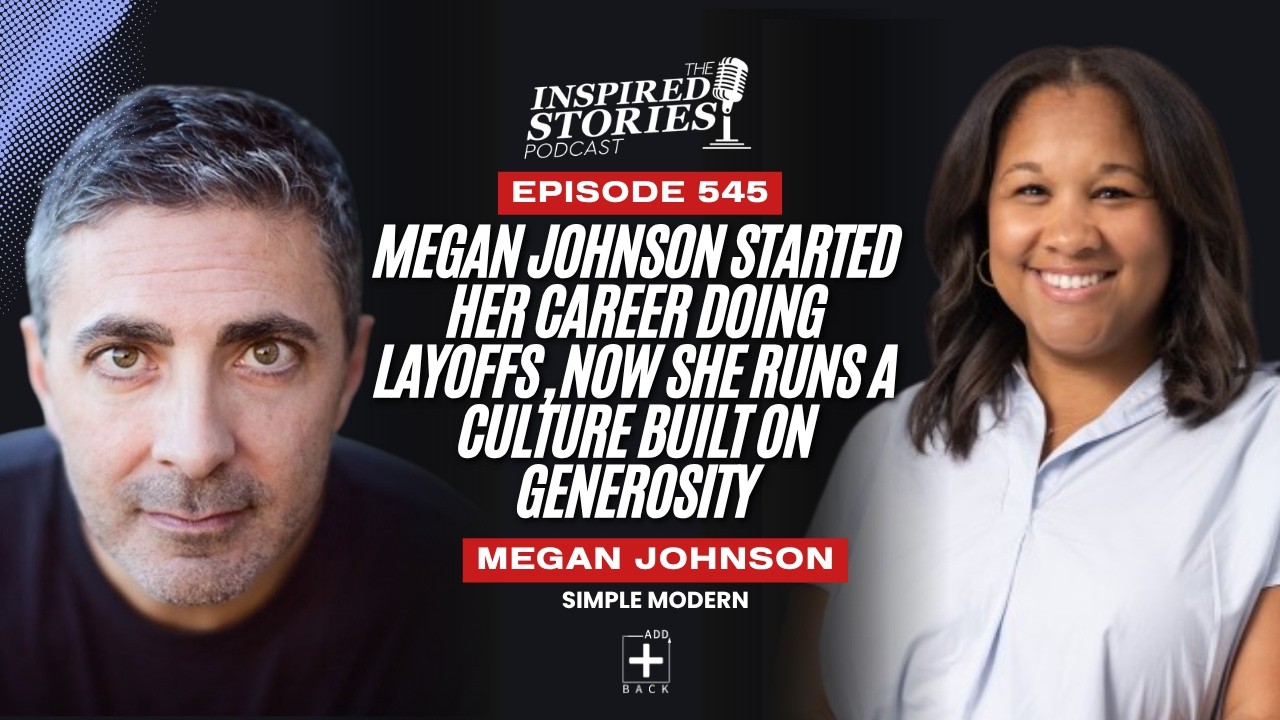
Megan Johnson, Director of People and Culture at Simple Modern, entered HR by conducting layoffs she never saw coming on fresh-out-of-college money, almost left the field entirely, rebuilt her conviction through a consulting firm that showed her what HR could actually look like, and spent five years in oil and gas learning to be disruptive from a mentor who told her to go figure it out and come back with the results. When a LinkedIn job posting caught her eye at a drinkware brand she’d never heard of, she took a leap from a stable insurance company to become Simple Modern’s first in-house HR director — and she’s been building ever since.
✨ Key Insights You’ll Learn:
Conducting mass layoffs at Chesapeake Energy fresh out of college and what that did to her view of HR
The consulting firm that showed her HR could be fun and how two women there saved her career
Five years at a second oil and gas company and the mentor who taught her to take the meeting without the boss and fail forward
Four years building sales compensation expertise at American Fidelity and why it turned out to be exactly what Simple Modern needed
Why Simple Modern exists to give and what that mission does to the energy inside a company of under 100 people
The giving summit: how employees vote to allocate charitable dollars and why every staff member donates to their own cause each year
Moving from a PEO model to full in-house HR and what the level of service actually changed
What Rippling gave them that the PEO couldn’t — and why birthday lunches were an immediate win
Hybrid schedule, catered lunches twice a week, 12 weeks paid maternity leave, and a childcare stipend — and why none of it compromises profitability
JumpScore: the cheer competition software platform Megan has been building since maternity leave
🌟 Megan’s Key Mentors:
Two Women at the HR Consulting Firm: Showed her that layoffs can lead to growth and that HR done right can be fun — she’s still having lunch with one of them
Kelsey (Leader at Second Oil and Gas Company): Gave her full permission to be disruptive, fail forward, and build relationships with executives without a chaperone
John Coulman (Hiring Manager, Simple Modern): The LinkedIn post that caught her eye and the leader who brought her into a company she now can’t imagine leaving
Mike Beckham (CEO, Simple Modern): Built a company around generosity from day one and creates the cultural permission for everyone else to follow
👉 Don’t miss this conversation about what it looks like to build an HR function from scratch inside a company where the mission is giving, why loose culture and serious profitability are not opposites, and how a people-first approach to water bottle sales ends up changing how every employee shows up on Tuesday morning.
Listen to the full episode here
Transcript
Anthony Codispoti (00:01)
Welcome to another edition of the Inspired Stories Podcast, where leaders share their experiences so we can learn from their successes and be inspired by how they've overcome adversity. As you listen today, let one idea shape what you do next. My name is Anthony Codispodi, and today's guest began her career in human resources by helping conduct company-wide layoffs before she had even settled into her first job out of college. She almost walked away from the field entirely.
But from there, she moved through oil and gas, HR consulting and insurance, building expertise in recruiting, compliance, and compensation along the way. Years later, a job posting for a small drinkware company would change the direction of her career. Today, Megan Johnson is the director of people and culture at Simple Modern, an Oklahoma City-based drinkware and lifestyle brand that has sold more than 50 million products.
And partnered with brands including Disney, the NFL, Target, and Costco. Since joining in 2024, she had led the company's shift from an outsourced HR model to a fully independent HR function and rolled out a new HR information system. Simple Modern has given more than $10 million to nonprofits through its Good Everywhere initiative and recently earned Great Place to Work certification.
Megan herself holds an MBA in human resources management and is a certified change management professional. But before we get into all that good stuff, today's episode is brought to you by my company, Ad Back Benefits Agency. And you'll want to hear this because it's hurting almost every business you know. Health insurance costs go up every single year, and retail brands are furious about it. They're paying more, claims are getting denied.
Employees are opting out because they can't afford it, and it hurts turnover and morale. It's one of the most maddening problems in running a business, and everyone just seems to accept it. But you don't have to anymore. Now there's a program that gives employees unlimited access to doctors, therapists, and prescriptions with no copays or deductibles to meet. It even works for most of your part-timers. And you don't change your broker. But here's the part that really shocks most people.
Our product actually increases your net profits. We recently helped a client add $900 per employee per year to their bottom line. Results vary, but imagine what could be done with the extra cash flow. Get your free consultation today at adbackbenefits.com. All right, back to our guest today, the Director of People and Culture at Simple Modern, Megan Johnson. Thanks for making the time to share your story today.
Megan Johnson (02:48)
Yeah, thanks for having me.
Anthony Codispoti (02:51)
So Megan, you started your HR career at Chesapeake Energy, an oil and gas company. And within a few months you were part of a round of layoffs. Tell me what was going on there.
Megan Johnson (03:02)
Yeah, definitely. so right out of college, I was excited, fresh, eager to learn all about HR. And I was quickly, excuse me, quickly smacked with layoffs and the idea that I would be talking to these grown men and women, that I would have to let them know that their job was no longer gonna be a part of the company. And so we had to go through days and days of being down in the basement getting the documents ready, and it was something that I had never even come
To my radar, honestly. I I just was completely shocked that I was a part of this. And so they taught us what to say and how to handle it with professionalism. And although it wasn't fun, it was definitely something that was a point in my career that I was like, okay, this is what HR is like. And it it was startling for sure.
Anthony Codispoti (03:51)
It's gotta be the worst part of H one
of the worst parts of HR. I mean, as you know, an employer, as you know, a business owner, an entrepreneur, I've had to let, you know, several people go in my time. And it's one of the worst, most painful experiences. I mean, here you are fresh out of college, not realizing that was gonna be a part of your job description, just getting thrown right into the fire.
Megan Johnson (04:11)
yeah, I had no idea. I mean, I'm young, single, no kids, and I'm having to go to these adults that have kids in college or, you know, all these things and I I it was it was terrible.
Anthony Codispoti (04:23)
W how did you manage those con So I mean they're telling you what to say? Okay, great. You give me sort of the initial script, but then you get the reac you get these, you know, very emotional human reactions from people. How are you dealing with that? What what do you say when somebody starts to break down or get really upset?
Megan Johnson (04:41)
Yeah, thankfully they
really educated us on things not to say. And so I was really focused on the things that I didn't want to say that it made it nice whenever they were kind of talking through it. And, you know, the company that I worked for, they were very, very open about, you know, we need to let people have those feelings during that time. And so I really just kind of sat and listened. I didn't try to provide a lot of back and forth of okay, try and fix it or anything like that. I just wanted to be a sounding board for them during that time. I mean, it's shocking, you know, it kind of comes out of the blue. And so
We had multiple meetings throughout that day of letting people go. And so as it got further and further through the day, I was less and less nervous whenever I was having those conversations.
Anthony Codispoti (05:23)
And I'm guessing word started to get around so people probably had an idea of what was happening as they got called in. Yeah.
Megan Johnson (05:29)
Yeah.
So whenever they came in, they they, you know, by the end of the day they already knew that it was it was their time to go.
Anthony Codispoti (05:35)
Yeah,
it's tough stuff. But like you said, it's a part of HR, right? Just it's it's one of the harder parts. We'll get to some of the fun stuff that you get to do now with Simple Modern, but let's let's go, you know, through a little bit more of your path here. Cause I think from there you moved to an HR consulting firm where you were consulting across multiple companies at once. I'm wondering if anything changed in your perspective and how you thought about HR.
once you were not inside the company but you were more of an outside consultant looking in.
Megan Johnson (06:08)
Sure. This was kind of like my my last stitch effort to see if HR was really what I wanted to do. And I'm so glad that I took the opportunity because I was able to see how other HR departments really treat their employees and you know, knowing that okay, HR is not just about letting people go and hiring people. There's so many more things that you can be doing. I mean, there's benefits. Benefits can be life changing. Like if you're able to offer something to someone that, you know, for their children or just to ease their mind.
That was something that I learned. a lot of different pieces from government contracts, you know, there's there's a lot of regulations that come with that, a lot of compliance things. and so I was fortunate to be with that HR consulting firm and they took a lot of time to teach me that HR can be fun, you know, it can be different based on how the organization views the position. And so we really just dug in on all of that. And I liked HR again, so I stayed.
Anthony Codispoti (07:05)
Was there a really strong mentor there that you got to learn from?
Megan Johnson (07:08)
Yeah, there were two really strong women that I led or that led me during that time. So I still I'm actually having lunch with one of this weekend. but they they were
in my life during a really pivotal time, I think because I was really confused about what HR was you know, I just went to all the schooling, I did everything for HR and kind of put all my eggs in one basket and then ultimately thought that I didn't like it. And so they did a really great job of showing me the different side of HR and how you can handle those situations and how a lot of times people are better on the other side whenever they do go through, you know, a layoff scenario because it helps them grow. It helps them kind of change and reroute.
Sometimes that's necessary. So I'm grateful for that those two women that really poured into me during that time.
Anthony Codispoti (07:56)
So we were talking about at your first job, you get thrown into the fire where you're having to let people go, you know, very quickly early on in your career. Were there other things that you were seeing and experiencing there in the HR space that contributed to this? Like I don't know if this is for me kind of a thought process?
Megan Johnson (08:14)
Yeah, so for any time an organization goes through a layoff, a mass layoff of that size, you find a lot of dog eat dog type scenarios. So then everyone starts feeling like they need to watch their back. They start feeling like they need to impress other people. And so that was kind of something that was unique that I saw was that, you know.
people kind of felt like, gosh, am I next? You know, and so HR has to kind of always be the last people so that they can, you know, get it across the finish line. So people were really trying to prove their worth during that time. And so things got a little bit challenging and we ended up selling off a part of the company that was kind of our field asset. So it was more of our
oil production workers. And so that was it it was a an eye-opening experience from a corporate perspective, like true seeing that corporate narrative that you hear so much about where it can be a little bit toxic and people are trying to save their jobs and do whatever it takes to prove their their worth.
Anthony Codispoti (09:15)
So okay, so you had a not a great experience first time around at HR. Then you go to this consulting firm, completely turned your opinion around, and then I think you go and spend five years as a generalist at another oil and gas company. Tell us about that experience and if there was, you know, something big you pulled away from working there.
Megan Johnson (09:36)
Yeah, my time at that oil and gas is definitely where I grew the most. I had a leader there who has become one of my really good friends and mentor. And again, just continuing to open doors for me and open my eyes into ways that you can lead people, ways that you can stay in that HR space, but also have that relational aspect. I think a lot of times people see HR professionals as very transactional, like you're just doing the, you know, policies and procedures and telling, you know, payroll and all the
Things, but HR can be so much more than that. It's it's the relationship building, it's understanding where people are so you can meet their needs. it really she started my love for benefits there. Kelsey is who was my leader at the time, and so she was very, very encouraging on being disruptive.
in if in the best way possible. And so I appreciated that because I could be myself and be the friendly person that I am and bubbly and get to know people. And there's just something about that. There's something about having an HR leader that you trust and that, you know, you don't have to worry if you're gonna tell them something, they're just gonna go and it's gonna turn around on you and you know, potentially affect you in a negative way.
Anthony Codispoti (10:48)
So what was she showing you in terms of being a disruptor?
Megan Johnson (10:53)
She was showing me that it's okay to fail. And she's like, you know, you go out there, you try it, you get creative, and you know, you you miss all the shots that you don't take, but you have to be willing to take them. And so I loved that because she would give me a project and she's like, go do it. And it wasn't like, okay, you know, I get to ask a thousand questions. It's like, no, figure it out. And, you know, we'll talk through the opportunities of improvement.
Afterwards, but I want you to go get it. I want you to go learn. I want you to meet with this executive. Like you don't need me to be there. I want you to go build that relationship and be, you know, willing to make a mistake. And so that was something that was incredible. I was so scared because I just, you know, coming from a previous oil and gas company.
There are a lot of men, a lot of very intelligent, intelligent engineers, you know, and so they kind of speak a different language. And I didn't have that language at the time, but I spent a lot of time getting to know them. And so I was able to learn the language, learn how they like to be spoken to, learn how they like to, you know, get X, Y, and Z done. And so that was that was incredible time in my career.
Anthony Codispoti (12:03)
Okay. All right. So from there you moved to American Fidelity, an insurance company.
Megan Johnson (12:09)
Yeah.
Anthony Codispoti (12:10)
and you were focusing on I think more specifically on sales compensation for four
Megan Johnson (12:14)
Mm-hmm.
Anthony Codispoti (12:15)
years.
Megan Johnson (12:16)
Yeah. So sales compensation was one of the last things that I hadn't done. Compensation in general was something that I hadn't done. And so this opportunity popped up and it was definitely a unique opportunity. There's there's so many complexities when it comes to insurance and sales compensation. So that was that was probably the most that I've grown in four years is learning all of the ins and outs of sales compensation.
Anthony Codispoti (12:42)
Why are those two sort of intertwined in a complicated way?
Megan Johnson (12:47)
Yeah, because there are so many different ways that you can pay people. And trying to figure out the best ways that make the most sense that are sustainable for a company was what we really wanted to determine. You know, you're setting quotas for people, you're doing sales contests, you're setting up these incentive trips. And so you wanted to make sure that it was some a carrot that was worth dangling, but not a carrot that was unobtainable.
a carat that people felt like, okay, everyone's getting the same carrot. You know, you you have people that are coming into the industry, they don't know much and they have to learn. They have a ramp up period. How can we make it where they can still be compensated and and make a fair living during that time? And so there's just a lot of complexities. You know, you have to have a really intense compensation document that you have to maintain. Any changes require a lot of legal review. And so there there was just a lot in that position.
Anthony Codispoti (13:40)
So for the layperson, tell me if I'm what I'm missing as I explain this. So it's you know, figuring out what their base compensation package is, figuring out, you know, what metrics maybe they have to hit to earn certain bonuses. But not only are you figuring that out for individual people, but making sure that the the different compensation structures between different positions, between different people are also somewhat fairly aligned.
Am I grasping
Megan Johnson (14:10)
That's correct.
Anthony Codispoti (14:11)
the most of it?
Megan Johnson (14:12)
Yes, definitely. Yeah. And I mean, it's not always the salesperson that are getting the commissions. There's, you know, the managers that are getting the overrides, the people that are in the support positions that are supporting the salespeople. So trying to make it where it makes the most sense for the team to be compensated on a sale was definitely our biggest focus.
Anthony Codispoti (14:31)
No. How did the opportunity
to join Simple Modern come about?
Megan Johnson (14:35)
Yeah. So I saw a LinkedIn post pop up. Someone had liked it of John Coulman, who was my boss that hired me. And his post was just something that really stuck out stuck out to me. It was refreshing. It was encouraging. It was exactly what I knew I really enjoyed doing in HR. I really enjoyed the people aspect of things. I enjoyed getting to do like
the events and and then also getting served people from like a benefits perspective. That was something that I didn't get to do at my previous job. And so I saw it on LinkedIn. I reached out to a couple people that I knew worked there and kind of asked their opinion on how, you know, I would fit in this role, if this is something I should pursue. American Fidelity is just such an incredible company in Oklahoma City. It it's I mean it's on all 50 states, but it's so stable. And
the idea of leaving something that was really stable for a company that is pretty small. I mean it's completely different, was scary. And so I wanted to make sure I did a lot of research and understanding if this would be the right next move for me.
Anthony Codispoti (15:40)
So the post that you saw was a job posting, or was it just something general that he had posted about the company? Okay.
Megan Johnson (15:46)
No, it was a job posting that he was looking
for a person to join his team.
Anthony Codispoti (15:51)
And you thought this was a good opportunity to kind of spread your wings and get to put everything that you've learned into practice for a a smaller company.
Megan Johnson (15:59)
Yeah, a smaller company, but Simple Modern has such a reputation around Oklahoma City just because of the generosity that we extend. And I knew, you know, the people that worked here that I knew were really incredible people. And so I was kind of just curious on, you know, what exactly it was that they were doing there. And so more than anything, you know, I was just like, I just maybe I'll just see what they have to say. Yeah.
Anthony Codispoti (16:22)
Just kick the tires a little bit, huh?
Okay, so for those people you say in Oklahoma City, great reputation, you know, people really love the company. But for those who aren't familiar with the brand, Simple Modern, tell us about the company. What is it that you guys sell? What's kind of the bigger story behind?
Megan Johnson (16:39)
Yeah, so we're a lifestyle brand. We sell stainless steel water bottles. we're in Target, Walmart.
Whole foods, all a lot of different places. We just landed in Dick's Sporting Goods. We're really excited about that. But our mission is we exist to give generously. And one of the things that our CEO said early on whenever I started here was hey guys, if we're in the business to sell more water bottles to make more money, then we're in the wrong business. Like we're in the business to sell more water bottles so that we can give more money away to our community and to partners that we serve. And so being a part of an organization.
that has such a bigger mission just is different when you come to work. I mean, what you're working towards just feels, you know, more rewarding. Now we are a for-profit company. We're not a nonprofit, but getting to be so generous with different nonprofits is is easily the most rewarding thing I've ever done.
Anthony Codispoti (17:35)
Tell me more about that. What are you guys doing? Which non profits? How does this look?
Megan Johnson (17:39)
Yeah,
so we have some core pillars that we like to stay within, human trafficking, clean water education. and we want to make sure that we are excuse me, homelessness is one other one, but we want to make sure that we're partners. And so what we do is we shut down the office once a year and we have what's called a giving summit and we have some of those core partners that have signed up saying, Hey, we want to we want to be a partner with Simple Modern. We want to be able to receive those funds from you. they come and kind of
state their case and they say exactly what it is that they're needing, how we can support them in that way. And the employees are actually the ones who lead that giving. So they say, okay, yes, we want to give it to this person. No, we want to give it, we want to move these funds to this person. And so it's all driven through the employees. And so in addition to that giving summit, we also get to donate, every employee gets to donate an amount to a charity of their choice. So this year it was
over a thousand dollars that I got to donate to an organization that's special to my family specifically. And so every single employee gets to do that. And I think that so many people, so many organizations do an amazing job being generous and you know, giving a couple thousand dollars here and there. But what Simple Modern and what I want most people to know is like every decision that we make kind of goes back to the bottom line of okay, you know, how is this going to affect our partners who are really depending on us? You know, if we
If we do X, Y, and Z, like is that gonna, you know, affect our giving? And so we want to make sure as a company that we are longstanding partners with our organizations that we support and we want to continue to do good in the organization in in the the realm of things. And we bring our interns in every summer and they're out volunteering with our partners several times in the summer. I mean it's such a short time, but it's so important to us that they understand that part of our culture that we take several days
away from their projects that they have here in the office so that they can go and serve others and and really get to be a part of that culture.
Anthony Codispoti (19:42)
Where does this come from? Is this from the founder, the CEO?
Megan Johnson (19:45)
Yeah, so I believe so our our CEO, Mike Beckham, and our he's a co-founder, he founded it with two other men. He came from the ministry area, and so he's just always had the most incredible heart. I mean, it it his generosity is is something that is very unusual. He if he could give all his money away, he would. And sometimes we're like, Okay, slow your roll, Mike, like just save a little for your kids, you know, and so
He's just that's just how his mind works. Like everything is just, you know, we want to be generous. Like, okay, you know, this person calls and they need this. And he's like, Okay, well generosity doesn't always look like money. So maybe it's resources, maybe it's time, maybe it's helping hand, you know, physically helping someone. And so y a lot of times people will reach out and say, like, Hey, can you do X, Y, and Z? And it's it's almost always a yes. You know, sometimes our partners they just need bodies and so they need us to put together
pamphlets or they need us to do whatever it might be. And so we it starts at the top for us because Mike is so passionate about being generous that the rest of us have no other room to be anything but generous.
Anthony Codispoti (20:54)
And so how do they determine how much money is available in this pool to give away?
Megan Johnson (20:58)
So it's a portion of our proceeds. I mean, our excuse me, a pro portion of our revenue every year is is how we determine. And so we put it into a DAFT. and that's how it's determined. We we parcel it out every single year. A part of our giving committee is is in charge of saying, Okay, we're gonna give we have this much money from our profits this year. And sorry, I said that incorrectly, it's a portion of our profits every year, but we have this portion.
that we have to give and so we do our giving summit and everyone asks on their different grants that they want to do. And so ultimately our employees say yay or nay and then the committee takes all of that together and then we send out checks.
Anthony Codispoti (21:41)
So what we're talking about, is this the Good Everywhere Initiative? Is that the name of it?
Megan Johnson (21:45)
Yes, yes, yeah.
Anthony Codispoti (21:48)
Okay.
let's talk a little bit more about the the nuts and bolts of what you do there. I know, you know, when you came in, one of the projects that you spearheaded is this move from a PEO, a professional employment organization, to your own independent in-house HR function. What was driving that? Why make the change?
Megan Johnson (22:11)
Sure. So we had a really great PEO and a really great relationship with them as I came in. But what I noticed whenever we first came in was that the level of service that we could provide when we're on a PEO is not at the caliber that we knew that we wanted to have. Whenever you're on a PEO, you have very few options from a benefits plan and how much you can pay, you know, all of that. And then as far as payroll, there there's just a lot of different aspects that you're essentially working through an another person in order to get that. And so
The level of care that we wanted to provide was not at the caliber that we needed to. And so we I sold that to John. I said, John, listen, you know, I think that there's a lot of room for growth here. I know that we really care about this partner and and we value them and all that they've done to get us to where we are today. But we've got some table stakes that we can really pick up and and be really spectacular as a people and culture department. And so we we just started the research there and and figuring out how we could stand up our own benefits, payroll, you know.
know our HRIS system and then we did you know some comparison to see if that made sense financially for us as a company because you know the PEO whenever you're on the benefits plan it does go with anyone who's on that PEO and so the more people on the plan the more affordable it can be and so we found some really great partners locally the Kempton group and they have been amazing in helping us and that's kind of how we got there.
Anthony Codispoti (23:37)
I wonder if this also gave you an opportunity to utilize some of the creative compensation strategies that you learned through your time at Fidelity.
Megan Johnson (23:47)
For sure.
American Fidelity was great because they had to serve several different types of people. And so at Simple Modern, we have our manufacturing workers and we also have our corporate staff. And so the manufacturing workers' needs are a little bit different than what our corporate staff is. And so when we were looking at the benefits specifically, we realized that our benefits plans were pretty expensive and maybe causing some behaviors that we didn't necessarily want. Whether that's, you know, people feeling like they
to go to the emergency room in order to avoid a really expensive bill, you know, whatever that looked like, we were not driving the behaviors that we really wanted people to have. And so that definitely helped with with the assessment of benefits.
Anthony Codispoti (24:34)
What
were some of the other things that you wanted to be able to do to make the employee experience better by switching to in-house HR?
Megan Johnson (24:42)
Sure. So for example, you know, payroll times. if there was a situation where we needed a fix, like maybe it would not be as quickly as we would want to, you know, an off-cycle payroll, they would have to go and set up through their payroll team and have to set all of that up. you know, there are some times where we make mistakes, like maybe the wrong hours were submitted and getting it out in a timely manner was challenging just because there's a lot more approvals that have to go in place. some other things that were
considered was the you know, when the way that we do our learning management system, being able to have real time data that talks about how people, you know, have changed in their career. We can see it, it's all tied together. We don't have to try and take a spreadsheet and mix it together with, okay, what position is someone in today? Where were they at last year? We we have it all in one area and we don't have to worry about piecing it all together.
Anthony Codispoti (25:38)
You know, change is hard for folks. I'm guessing you ran into some resistance as you're trying to make all these big changes. Talk us through some of that.
Megan Johnson (25:47)
Sure.
There was definitely a lot of resistance because what we had was working. You know, it's like we weren't it wasn't the service wasn't bad. It just wasn't at the level that I felt like we could do. And so the leaders were just a little bit hesitant in understanding, you know, why we needed to do this. But ultimately they trusted me and and we had lots of different discussions about what this would look like for our organization, how this could model generosity, how this could, you know, continue to to hold on to that theme. And ultimately, whenever we ran the numbers and we realized
okay, this is this is worth doing it. This is going to be life changing for our employees. we felt ready to pull the trigger.
Anthony Codispoti (26:27)
And part of this transition involved rolling out Rippling, your your new HR information system. what did you have to customize or rework to make that fit how Simple Modern operates?
Megan Johnson (26:43)
Yeah, fortunately we are extremely we didn't have any system. We were only using the PEO system. So we didn't have to do a lot of customization for what we needed here at Simple Modern because we're pretty low key. And so we just started with just the backend data that we had pulled from our previous PEO and we started fresh. We didn't want to pull a lot of information over previous pay statements. We have files with that kind of
information, but we wanted it to be a clean start. And so as far as the tailoring, we were able to do a lot more as far as, you know, reminders and building out something that's really important to us is like celebrating anniversaries and birth dates. And so that was something that was great. I mean, it it was an immediate value add because we knew exactly when everyone's birthday was and how we could celebrate them in that way. And that's something that's really important to us.
Anthony Codispoti (27:32)
How do you celebrate the birthdays there?
Megan Johnson (27:34)
So we we do birthday shout outs and then we let them pick what the catered lunch is on their birthday, which is just a big deal. So one of the things that we do at Simple Modern is a catered lunch and we do that twice a week. So we're only in office three days a week and then twice a week we do a catered lunch. And so they get to pick their lunch and that's always a fun, fun time.
Anthony Codispoti (27:57)
Wow. You guys have got a lot of really cool benefits. The catered lunches, beanbags, tick tocks. It you know, and it kind of strikes me, it reminds me a lot of the Silicon Valley startups that, you know, people imagine, you know, these immature companies, not really focused on being profitable yet, but that's not the simple modern profile, right? You're very successful company, well established. What is it you think that people get wrong about the relationship between a culture that's loose and a company that's actually profitable?
And how those can actually be the same thing.
Megan Johnson (28:30)
Yeah, I think that is definitely something that I'm really passionate about because it just doesn't have to be that serious. You know, I think that one thing I've learned from coming at Simple Modern, you know, you could be dressed in your t shirt and and jean shorts and still be a really incredible salesperson or really incredible marketing person. And so being able to come to work as you are is is something that is a big deal at our organization because we want people to feel like they have the freedom to be as expressive as they.
want to and you know if they come and they've got their hair in a bun and they don't have any customer service or customer facing meetings, who cares? You know, it's like if you want to take your meeting on the beanbag, but something that's you know
really telling is the success that we've had as an organization. I mean, it's something that we've started 10 years ago and we've had success with being able to be generous with our employees. We've had success with being able to be ultra flexible with the moms in our organization. And one other thing that we do as a benefit is that we do full 12-week paid vacation, not vacation by any means, but full 12 weeks paid maternity leave. And then we also do a childcare stipend every single month for any employee who wants to use it.
It for daycares, you know, Mother's Day outs, taxpaying nannies, whatever that might look like for them, we put our money where our mouth is because we care so deeply about the work-life balance and being able to, you know, understand that there's life outside of work. and that's okay. And we encourage it. We want people to be having families. We want people to be, you know, whatever it might be that is what excites them, we want that for them.
Anthony Codispoti (30:10)
Tell
me about how this kind of hybrid work approaches functioning and working well for you guys, you know, in office three days a week, out of office two days a week. This you know, and I I think this kind of dovetails into what you were just talking about, you know, also this like really flexible like work environment, you know, wanting this work life balance. Cause there's a lot of discussion right now about, you know, should everybody be back in office, you know.
making the transition from COVID back into post COVID. How how do you guys think about this? What what have you seen as
Megan Johnson (30:45)
Yeah, so we do the hybrid schedule. So Mondays and Fridays, we are working from home. And for me, that's really nice because it's the perfect balance. If you want to start your weekend a little bit earlier, you know, maybe your trains like you're flying out on Friday morning, you get in eight o'clock, you're in Florida, you know, you can still work. You know, you're you're remote, you can still work, you don't need to take a PTO day, just as long as you're working. But the idea is is that
you got you get your work done. And you don't have to be at the office to get your work done. You know, we have laptops. Technology has come so far and you're able to do, you know, a ton of different things on the road. You could be driving and and still working. There's been some times that I've been driving down the road to Nebraska and my husband's driving and I'm working the whole time. And so I'm getting my job done. And that's all that we care about at Simple Modern is that you're getting your job done. You're the you know you're
You're present when you're need to be present, which is that Tuesday, Wednesday, Thursday. But since we're so relational, those Tuesday, Wednesday, Thursdays are a lot of talking. It's a lot of catching up and, you know, having meetings and and just but in our meetings, it's like, okay, well, how is, you know, how is sis doing? Like did you know, how was the weekend? I know that you had the birthday party. And so you you kind of miss that aspect if you're fully remote. not completely, but that's something that we take time for. And that's another reason why we do that lunch is because
We believe that breaking bread with people is so important and getting to have that time to just talk about anything but work is is so refreshing. I mean, almost a hundred percent of the time we're not talking about work. Sometimes we have our remote guys come in and they like sit at the table and they start talking about work and we're like, We don't talk about work. We're we're talking it, you know, we and it's just really funny to see because that time is sacred that we all get to spend together and and just get to know each other.
Anthony Codispoti (32:36)
So
let me let me put on my devil's advocate hat here. Cause what you're saying and the picture you're painting sounds really nice, like great from a social perspective, great from like a building relationships with my coworkers. But convince me that this is actually working in terms of getting the work done. because this is something that as a business owner that I've kind of struggled with sometimes is I've got some you know employees hurt out of office.
And for some of them, like it's easy to like know when their work is getting done, right? We've got to publish so many podcasts per week, you know? Okay, like that's that's like a quantifiable metric. But there's some positions where it feels like it's a little bit harder to know when the job is getting done. Am I making sense in that?
D
Megan Johnson (33:21)
Sure.
Yeah. So, you know, we have a lot of check-ins and we do have a high trust organization. and so just with the check-ins, it's like, you know, asking those legit questions. There are some positions that, you know, the customer service group or or whatever that might be, that their work and their KPIs look a little bit different. And so just making sure those leaders are equipped with answering those questions and being able to say, okay, you know.
Are they actually working? Are they being productive? Are we getting the output that we need from them? and you know, it's if you pop in and kind of see, you know, okay, hey, what are some projects you're working on and you know, how long you've been working on that, without trying to be a little micromanager, but it it's just a high trust environment. And if you're giving them a task, it's trusting that they're gonna get it done and seeing it through the end.
Anthony Codispoti (34:10)
then it it really matters the kind of person that you're bringing in, right? You bring in the wrong kinds of people, they're gonna abuse this high trust system. When you guys are interviewing people, trying to determine, okay, this is the f the person that we want to bring in, are they a good fit? What what have you found to be effective in that hiring process?
Megan Johnson (34:31)
Yeah, so we always make sure we have very different people interviewing them. So if you're coming in for a marketing role, you're almost never gonna only interview with marketing people because we have a high caliber of employee that we want to hire. We are not always focused on the position. We're more focused on the fit. So if they can come in and fit culturally and be, you know, like minded in that way, that's gonna be a a landslide because maybe, you know, you're not
fit for this role in marketing, but maybe you're smart enough where we can teach you. Or maybe you know what, we want to actually utilize you in a different way. So we're gonna we know that we came to bring you on for a people in culture role, but I think you'd be really incredible at our product development role, just talking through your your skill set. And so we want to bring in people that fit the culture mold. And if they don't fit the culture mold after a couple interviews, it's a hard stop. We don't try to force it. We don't get offended, even if someone's like ready to move on with the the
offer, we just make sure that they are a part of our culture and they will fit in.
Anthony Codispoti (35:35)
Is that more of like a gut level feel, or are there specific like yes no gateway questions that you're asking?
Megan Johnson (35:44)
Yeah, I mean I think it's a lot of it's gut level, but you can learn so much about people about asking, you know, their interests, like their you know, where they want to be in, you know, five years and what they
what they like to do in their free time, what they what their life is in what's important to them in life, like what what their values look like, you know. and so that's something that we really lean into whenever we're talking about it. A lot of times we're not focused on the position whenever we're asking those first few questions in a phone screen, we're really talking about like, hey, who are you as a person? Like how, how do you think that you would adjust to an organization like this where, you know, you have a lot of high trust and you, you know, not a lot of looking over your shoulders, you know,
Do you think that you would like that type of environment or do you need someone who's kind of checking in? You you need lots of direction, whatever that might be.
Anthony Codispoti (36:36)
Okay,
that makes a lot of sense. Are there any current projects in process or future projects in the HR space that you're excited to introduce and roll out?
Megan Johnson (36:47)
Yeah, so something that we're gonna be looking at is our
annual review process. It's something that it today we do a 360 every year and it takes a lot of time. And so we're trying to figure out the best way to do that. For me, I've done a lot of research and I I like real time feedback. You know, waiting to the end of the year to hear that you need to make this adjustment can be hard because maybe you've partially made that adjustment or you've digested that you've moved on and you've you thought that you were doing better, but then it pops up on a
performance review and it kind of opens up old wounds. And so that's something that we're looking at refining for this year end and also determining when the best time to do it would be. So we are a retail business obviously, so you know the end of the year gets a little crazy and getting everything reset for the new year. And so that is a process that we're working on. We're also doing little little things here and there, just trying to make sure that we can continue to keep this culture where it needs to be.
Anthony Codispoti (37:48)
How are you using AI in your work, Megan?
Megan Johnson (37:51)
all the time. I'm using it all the time. You know, one thing that I used recently was trying to figure out, okay, who's the best trainer for an organization that's, you know, demographic is mostly 30 year olds fresh out of college.
Who's the best trainer that would resonate with my staff? You know, just asking questions like that and kind of doing a deep dive into it, also looking at my numbers, being able to determine, okay, you know, turnovers this, what can I project? And how can I prepare the executive leadership team for this? or just looking at different opportunities, like, you know, this is our structure right now for compensation.
What do you suggest on the changes that we should make as as time evolves? Also looking at job titles. Okay, what does the market say? This is their job description. What does the market say that their title should actually be? because that c also ebbs and flows as time goes on.
Anthony Codispoti (38:46)
Are there ways that you want to use AI but maybe haven't started to yet?
Megan Johnson (38:54)
not yet. I I I kinda go pretty crazy with AI. So so far
Anthony Codispoti (38:55)
Yeah, okay. Okay. You're you're right
on the you're right on the edge of where you want to be right now. Yeah.
Megan Johnson (39:02)
Yes, definitely.
Anthony Codispoti (39:03)
And I understand outside of your work with Simple Modern, you're building a software platform for cheer and dance competitions,
Megan Johnson (39:11)
Yeah.
Anthony Codispoti (39:11)
covering everything from registration to live judging. Tell me about this product. Where's the idea come from? Why are you doing this?
Megan Johnson (39:20)
Yeah, so Mike, our CEO, always just encourages that entrepreneurial spirit. And so, when I was on maternity leave, I
One night was nursing and and just had this idea that I wanted to kind of elevate our space for cheerleading. and so I kind of met with a couple developers and just kind of got it going. And so cheer is kind of one of my passion projects. I cheered my entire life. I judge cheerleading competitions on the weekend. And so wanting to do something that I can give back to the industry, ultimately the technology is just not where it needs to be. Now with AI, there's a lot of people who are trying to
spin up some one-off things that are still maybe not what we need, maybe a little bit more confusing, but we just needed to get our industry to up to speed for that. And so I'm really excited that some of the the staff here has helped me and provided some feedback on some things and our attorney's been really great in helping me get, you know, some some connections of who I should be meeting with. And so it just it's all encouraged here and I I really do appreciate that.
Anthony Codispoti (40:29)
So you had a lot of experience in this industry. You cheered, you you judged competitions, and
Megan Johnson (40:35)
Yes.
Anthony Codispoti (40:35)
so you saw that there was a gap. There was this technology that was lacking in the space.
Megan Johnson (40:40)
For sure. Yeah. I mean, Trilading is a billion dollar industry that's growing at an insane rate. And so if it's gonna continue to grow where it needs to grow, it it the technology has to be there. And so my business partner and myself, we've just gone wild. Almost it's almost been a year that we've been building this, and so we're excited for it to launch at the end of the summer and just hopefully those weekends are busy and fun. So yeah.
Anthony Codispoti (41:05)
And so where
can people find it?
Megan Johnson (41:08)
So right now it's not in the market, but it'll be in the market at the end of the summer. And so it's called jump score. so that's where they can find it by looking up jumpscoreofficial.com. That's correct.
Anthony Codispoti (41:19)
Jump scoreofficial dot com. Okay.
That's where it will be by the end of the summer. We're recording in excuse me, kind of the middle part of July twenty twenty six here. So by the time this comes out, maybe it'll be accessible. And so who's the target market? Like who would be a user of this? Is it like a coach for a cheer team?
Megan Johnson (41:40)
Yeah, that's a great question. So the target user would be event producers. So those are
the target person that we sell to are the event producers and then they have it for their customers. So they would be able to host their events there, do ticket sales, and then the gym owners, they sign their teams up for the events and pay all through the platform. And then the spectators can watch the event on the app. they can buy tickets, they can do all sorts of things. So the our primary customer is the EP, which is the event producer, and their customer is the gyms.
Anthony Codispoti (42:12)
Okay. And what would be like a one year and three year goal for this company?
Megan Johnson (42:18)
Yeah,
a one year goal would be to have two to three customers and then a three year goal would be just booming and having every weekend booked of just lots of really incredible EPs that are hungry to grow in what they're doing today. the idea for the the the platform is that you can work smarter, not harder. You don't need to hire a bunch of people to do all these tasks because ultimately the technology will do it for you.
Anthony Codispoti (42:41)
Okay. Love it. Let's shift gears, Megan. like to discuss one of the hardest things you've had to overcome personally and what it taught you.
Megan Johnson (42:51)
Yeah, that's a really great question. I think one of the hardest things that I've had to overcome is being okay with not everyone liking me. and that's something really hard because I am a people pleaser. I mean, I I'm around people all the time. I want people to be happy, I want people to be excited, I want people to be just on fire for what they're doing. And
It's just not realistic, you know, everyone's not going to be excited for for who I am as a person. And so I think that's something that I've learned throughout my career is that I will not be best friends with everyone. And that's okay. You know, maybe they'll come around in a couple of years and and realize, like, okay, you know, I understand what you were doing. Like a lot of my MO is just the relational side of things where, you know, try to break people, like try to get into their feelings and understand them. And so that, you know, whenever they do have these behaviors at work, I kind of understand.
understand okay, well this is why it's happening. You know, like just just give them some grace because they have X, Y, and Z. And so sometimes people don't like to open up at work. And I understand that. I mean, maybe they've been burned by other HR departments or whatever that might be. But I think that's been the hardest thing for me is that not everyone's gonna like me.
Anthony Codispoti (44:05)
And that that gap there between you know, for those folks who don't like you, do you suspect that's because you just sort of had this, you know, you just don't mesh as people, or is it more the role that you have and people's distrust of what HR means?
Megan Johnson (44:23)
I think it's a lot of the distrust. It it doesn't sometimes come off as genuine because they they have a thought for whatever reason. They're they're thinking like, okay, she's asking this question for there's a loaded question here, something like why are you asking this? Why do you care? You know, and so it's not me being nosy, it's me just like genuinely wanting to know, you know, what's happening in your life? Like, I are you okay? You know, are you you know, is there any way that I can support you?
One example of that is I I noticed that one of our employees recently wasn't at work and she's just someone who's such a light and just so kind. And so I text her, I'm like, hey, you know, I noticed you weren't at the office, is everything okay? And she actually had a really traumatic experience happen with her little daughter and she's okay, but it it was traumatic as a mom. Like I'm a mom of two and she's a mom and and so she was like, I just appreciate you for reaching out. And it's like if I didn't feel comfortable to just like reach out and ask those questions and you know, people
trust to be like, okay, you know, this is where I'm at. Not thinking like I'm gonna be putting in PTO or, you know, just like weird things like that. It's just like I genuinely care about you. You know, I I want to make sure you're okay. And you know, following up and saying like, hey, is you know, is she doing okay? Like I know. So it's it's just little things like that. And and I I have found that more often than not it works out for the best whenever you have that relational equity with people. And
it just takes some people longer than others to realize that it's a safe space. You know, at the end of the day, we are running a business. You know, if you tell me that you killed someone, I probably should, you know, report that. But for the most part, like I'm here, I'm in your corner. Like I want I want this to be a place that people feel safe and and understand that, you know, I'm on their team.
Anthony Codispoti (46:07)
Well, this is one of the big lessons that you took from your early mentors, right? As you moved out of that first oil and gas company and got to see that HR could be fun, you know, and it could be relational and that there was a whole different way to approach it. And now that's something you get to put into play every day at at some point.
Megan Johnson (46:23)
Yeah.
It's definitely it's a huge honor. I mean, sometimes I pinch myself because I'm like, I cannot believe that I get to work here. I mean, we just have such incredible people that are on fire for what they're doing. And gosh, what a gift it is to just, you know, be be around happy people. And I think one of the things that's my job is to keep these people happy. And I take that job really seriously. And I think my team takes that job really seriously because, you know, we understand that you're away from your family. Like you could be at home, you could be working.
Some of these other bigger companies, but you've chosen to spend your time here. And I'm I'm just overjoyed that I get to do it.
Anthony Codispoti (47:01)
Tell me a little bit about the product. We've been talking about the people, the culture, et cetera. But and you guys are in a lot of the big stores, so you're you're doing a lot of things right. But why why would somebody buy one of your stainless steel water bottles versus another? What's
so great about that?
Megan Johnson (47:14)
Yeah, so
I have one right here. First of all, they're really, really cute. and so we we take a lot of time. We have some really incredible
designers that spend a lot of time just looking and seeing the trends and trying to figure out what it is that our customer wants. But our products are just really affordable as well. That's something that our our CEO is passionate about. Like, you know, we could probably charge a lot more and sell water bottles, but we want to be affordable for people. We want to be so a company that's just meeting people where they are. And so I think a lot of people like to buy our product because of who we are as a company that we're pro we're
We're charitable. We really care about the community that we're in and also that we have really cute products. So I mean there's, you know, in Target, there's just so many different designs. And I know that every time I take my daughter in there, she's like, I want another cup. And my husband's like, please, no more cups, no more cups. So it's just,
Anthony Codispoti (48:10)
You're at your limit.
Megan Johnson (48:11)
it's a it's a good combination for sure to have.
Anthony Codispoti (48:13)
Yeah, I'm checking out your website here, Simple Modern dot com. And yeah, a lot of cool colors and designs. It makes me realize I'm gonna hold up the one that I've got here in my office now that maybe I need a little bit of an upgrade. I it's very functional, but it's you know, it's just I don't know. Okay.
Megan Johnson (48:30)
I for sure need to send you. I'll send you some products
after we're off off of this call because you'll be impressed. I mean, the quality, the customer service that we have, it's you know, it's a lifetime guarantee. If if you if you have something that breaks, you know, just reach out. Like and we we try to figure out how we can help out.
Anthony Codispoti (48:47)
Okay, now you've got my attention because I have a 10-year-old that I think we've probably bought seven water bottles for him in the last year. Now, half of those we lose, but the other half sometimes somehow he he breaks them. So if you've got ones that are like, you know, indestructo, like highlight those for me. Those are the ones I want to check out.
Megan Johnson (49:08)
Yeah,
definitely. Yeah. So we have our our summit that's our tried and true. And then we have this Mesa loop that everyone really loves, especially for kids, because the idea is that you can kind of just hook it on, you know, you're you're going on the go. But we we just we always are trying to make sure from a functionality perspective that it makes sense for our customers. Like we do a lot of focus groups and we're saying, Okay, what is it that you like about this? What is it that you don't like? And so taking the feedback from our customers, I think it's gotten us to be where we are successful today too. It's like, okay.
You know, you need a right for a long time it was all the cups with the handles and the lid that was exposed or the the straw, but now after COVID, people are a little freaked out, so they don't want an exposed lid or exposed straw. And so just
Anthony Codispoti (49:50)
strong. Okay.
Megan Johnson (49:53)
ever changing and trying to meet people where they are. And so our people really enjoy our kids' products and you'll see you'll see them on TV all the time, which is really fun for us. We kind of fangirl whenever that happens.
Anthony Codispoti (50:06)
Okay, I'm gonna give you another product feature idea that's gonna sound crazy on the surface, but stay with me for just
Megan Johnson (50:11)
I'm ready.
Anthony Codispoti (50:12)
a second. I I need it to have like some sort of an Apple tag like ID tracker. And
Megan Johnson (50:17)
Okay.
Anthony Codispoti (50:18)
and I know that that's gonna more than double the cost of the water bottle, but I'm okay with that so that I don't have to keep replacing the ones that my son leaves behind and who knows where these places. Yeah.
Megan Johnson (50:30)
That's fair. Or we could just
start you we could just send you a bunch and you can just kind of work through some. But yeah, well I'll give that
Anthony Codispoti (50:34)
Okay. All right.
Megan Johnson (50:37)
to the product development team. Let know that they need some type of tracking device for these vessels. But that's the best part
Anthony Codispoti (50:43)
Please.
Megan Johnson (50:43)
about our product is that it's it's affordable and it doesn't feel like it's hurting the bank if you have to replace y you know, your favorite one that you left at the on the bus stop or whatever that looks like.
Anthony Codispoti (50:54)
Yeah, I'm on your website here. I'm actually really surprised by the prices. You know, when I'm hearing about like what a great culture you guys have and you know, all the flexibility that I'm like, wow, their products have gotta be super spendy. No, they're like twenty five dollars. This is what I would normally spend on a on a water bottle. Like these are great.
Megan Johnson (51:10)
Yeah. Yeah, that's definitely
something that's it's all a part of the plan of just making sure that, you know, we're we're not just generous in in giving our money, but we're generous for the people who want the opportunity. We want everyone to be able to have our product in their hands. and we don't want financial barriers to be something that happens. Now we know that, you know, it is a it's a luxury to have a water bottle of that caliber, but we want to make sure that it's affordable and it it you know, obtainable.
Anthony Codispoti (51:35)
As somebody who has bought lots and lots of water bottles for my kids, I I can tell you that this is not a luxury price point.
that's
Megan Johnson (51:42)
Yeah.
Anthony Codispoti (51:43)
yeah. Anyways, I'll I'll step down off off my soapbox there. What's something fun that you like to do outside of work, Megan?
Megan Johnson (51:50)
Yeah, something fun. I love to travel. we just got back from Hawaii two weeks ago and so I just love getting to share those experiences with my two girls and my husband. it just we're more of an experiences family and I just feel like you just grow so much whenever you're being able to see the world in different ways and it's just incredible.
Anthony Codispoti (52:12)
That's great. As you think about the work that you're doing now, what is it you most want to be remembered for, Megan?
Megan Johnson (52:17)
I think and I kind of get emotional, but I think I I I most wanna be remembered as someone who people felt safe and they felt like I was on their team. And, you know, when people come to me with suggestions or things that they want better because of their family, like I wanna be known as that person that was like Megan really made a difference in my family, you know, w during that time. And so it's not always roses and glamorous in this position, but there is a lot of opportunity to serve people and I I don't take that.
For granted at all.
Anthony Codispoti (52:49)
Why does that bring up emotion for you?
Megan Johnson (52:52)
I think because there's been some really incredible people in my life and so I've just made it just a I'm I've been really passionate about
being, you know, a good person to people. Like I I want to be, you know, the I saw this quote that talked about be the person you want people to see you as. Like, you know, you you want people to see you as this, but you have to actually live that out. You know, you can't just say like, I want people to see me as really kind and relational. It's like, no, you have to be kind and relational if you want people to see that. You can't just be a hard shale and want people to come talk to you but you leave your door closed, you know. So it takes a lot of extra work, but gosh, it's always worth it.
Anthony Codispoti (53:29)
That. Megan, I've just got one more question for you today, but before I ask it, I want to do three quick things for the audience. First of all, if you want to learn more about what Megan's doing, go to simplemodern.com. Very easy. It'll be in the show notes, but simplemodern.com. And Megan, give us the website address for your upcoming cheer platform that's coming out.
Megan Johnson (53:50)
Yeah, it's www dot jumpscoreofficial dot com.
Anthony Codispoti (53:54)
We'll make sure that's in the show notes too. Jumpscoreofficial.com. Also,
Megan Johnson (53:58)
Thank you.
Anthony Codispoti (53:59)
if you're enjoying the show today, please take a moment to subscribe wherever you're listening. See, it also sends a signal that helps others discover our podcast. So thank you for taking a quick moment to do that right now. And as a reminder, you can finally get your retail brand employees access to therapists, doctors, and prescription medications that counterintuitively actually increases your company's net profit starting in the very first month.
There's no copies, no deductibles, a lot of part-timers qualify and you can keep your broker. Learn more about how to have happier employees and a stronger bottom line at adbackbenefits.com. So last question for you, Megan, a year from now, what is one very specific thing that you hope to be celebrating?
Megan Johnson (54:43)
One very specific year from now I wanna be celebrating hm.
Man, does it have to be specific to Simple Modern?
Anthony Codispoti (54:54)
No.
Megan Johnson (54:55)
I wanna be celebrating another championship for the Oklahoma City Thunder. I am like the biggest fan and it just killed me that we didn't win again this year. But yeah, I think that's something that I wanna see. I wanna see us win again. That would be amazing.
Anthony Codispoti (55:11)
Are there been any off season moves? I mean you know, the season just recently wrapped up, but it's such a great squad to begin with. I I don't know if you want a monkey with it at all.
Megan Johnson (55:20)
Yeah, so gosh, there's been so much. I mean, they just said that
Anthony Codispoti (55:24)
Okay.
Megan Johnson (55:24)
Lou Dort is actually gonna be going to Atlanta, which is devastating because Lou has just been a near and dear player for us. he's just been, you know, the best part of our culture too. And so we've gotten rid of a lot of key players. not key players, but when I say key players, like cultural key players.
Anthony Codispoti (55:43)
Mm.
Megan Johnson (55:43)
And so that's a bummer.
We're gonna miss Lou
Anthony Codispoti (55:46)
Okay.
Megan Johnson (55:46)
for sure. But Lou and let's see, Andrew Wiggins, I di Isaiah Joe, they're all going on to different places. Mm-hmm. Yeah. I know.
Anthony Codispoti (55:55)
They're they're they're gone as well? Okay. You get some holes to fill. Well
Megan Johnson (55:59)
I'm devastated. I'm just I'm devastated. But they seem to be excited about our draft picks and who we got this year. So I in in Presty we trust.
Anthony Codispoti (56:10)
Okay. I love it. I said I'm a Cleveland Cavs fan and so we're
Megan Johnson (56:14)
Okay.
Anthony Codispoti (56:15)
we're crossing our fingers that LeBron has yet to make his decision known. We're hoping he comes back home yet again.
Megan Johnson (56:21)
I mean, it's the only spot
for him. I I can't imagine he goes anywhere other than Cleveland.
Anthony Codispoti (56:27)
that's what I think too, but we've been surprised before. So hey, maybe best case scenario we get to meet each other in the finals next year.
Megan Johnson (56:35)
There you go. Yeah, we'll host. We'll host for
sure.
Anthony Codispoti (56:40)
I love it. Megan Johnson from Simple Modern, I want to be the first to thank you for sharing both your time and your story with us today. Really appreciate you being here.
Megan Johnson (56:48)
Yes, thank you for having me on.
Anthony Codispoti (56:51)
Folks, that's a wrap on another episode of the Inspired Stories Podcast. Thanks for learning with us. And if one thing stood out, put that into action today.
Connect with Megan Johnson:
Website: simplemodern.com
Website: jumpscoreofficial.com