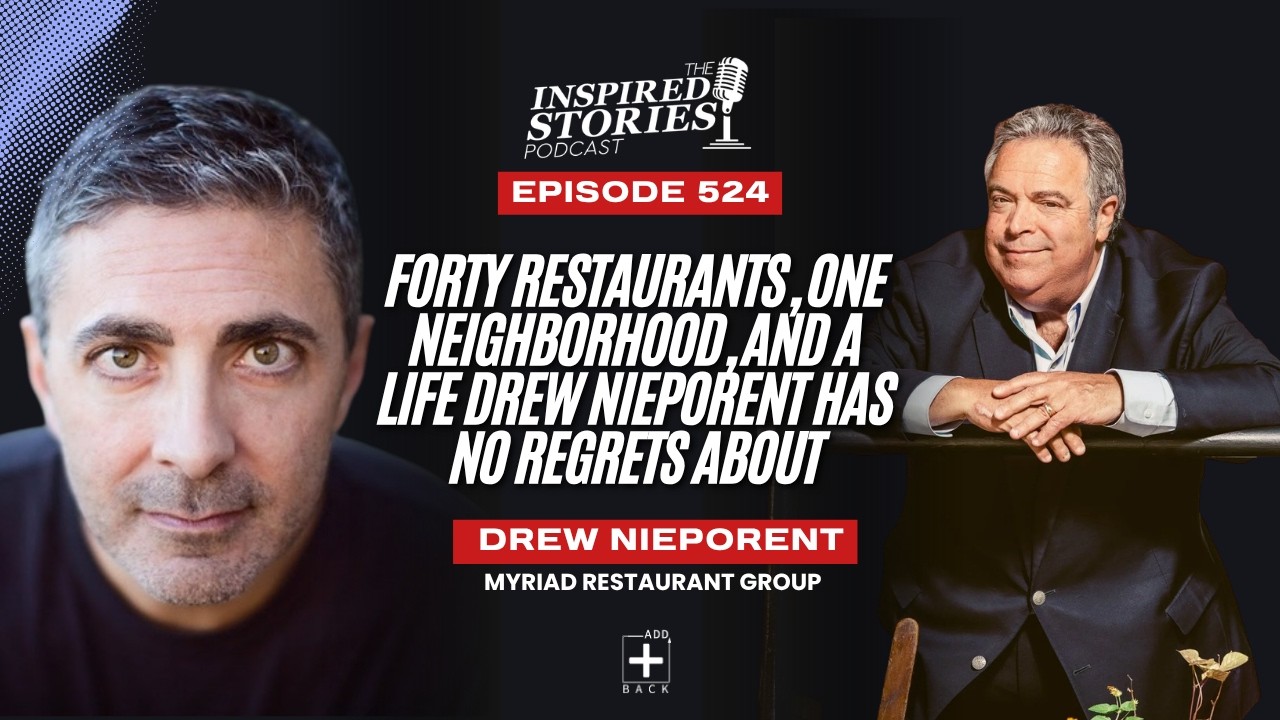
🎙️ From McDonald's Griddle to Nobu: The Rise of Drew Nieporent
In this episode, Drew Nieporent, founder of Myriad Restaurant Group, traces a path from a McDonald's grill at 17 to co-founding Nobu with Robert De Niro and Nobu Matsuhisa. He walks through opening Montrachet with a $16 menu that earned three stars, building six restaurants on one Tribeca block, and facing a stroke, kidney cancer, and leukemia within the same year.
✨ Key Insights You'll Learn:
Started at McDonald's at 17 as the quarter-pound grill man
Opened Montrachet in 1985, three stars on a sixteen dollar menu
Recruited by Robert De Niro to open Tribeca Grill
Nobu turned him down twice before saying yes
Nobu is now worth roughly $300 million
First restaurateur to put a chef's name on the menu
Ran the Madison Square Garden burger concession for 12 years
Wrote the memoir "I'm Not Trying to Be Difficult"
Survived a stroke, kidney cancer, and is now battling leukemia
Three restaurants at one Tribeca address held three stars for decades
🌟 Drew's Key Mentors:
Robert De Niro: Recruited him for Tribeca Grill and backed Nobu from day one
Warner LeRoy: Employer at Maxwell's Plum and Tavern on the Green, modeled scale and spectacle
George Lang: Fellow restaurateur who pushed him toward treatment at the Mayo Clinic
His Father: State Liquor Authority official who exposed him to New York's best restaurants as a child
Nobu Matsuhisa: Creative partner in building one of the industry's most recognized brands
👉 A candid look at four decades of restaurants, and what it means to keep showing up while your health keeps testing you.
Listen to the full episode here
Transcript
Anthony Codispoti (00:04)
Welcome to another edition of the Inspired Stories Podcast, where leaders share their experiences so we can learn from their successes and be inspired by how they've overcome adversity. As you listen today, let one idea shape what you do next. My name is Anthony Cotus Spodi, and today's guest started his career at McDonald's at the age of 17. But by the time he was 30, he had opened a fine dining restaurant in a neighborhood most New Yorkers considered an outpost.
And earned a four-star New York Times review in the process. He went on to co-found Nobu with Robert De Niro and Chef Nobu Matsuhisa and helped transform an entire city neighborhood into one of the most desirable addresses on the planet. Now Nobu boasts 57 locations worldwide. Along the way, he opened restaurants that soared, restaurants that closed, and many awards. His name is Drew Nieporent
And he is the founder of Myriad Restaurant Group, which has produced landmarks including Montrachet, Trebeka Grill, Nobu, and Bittard. He is a James Beard Outstanding Restaurant Tour of the Year and the first person in the industry's history to put a chef's name on the menu. And he's written a book called I'm Not Trying to Be Difficult, which we're going to talk about. He's 70 years old and he's still at it. But before we talk about all that good stuff.
Today's episode is brought to you by my company, Ad Back Benefits Agency, and you'll want to hear this because it's hurting almost every business you know. Health insurance costs go up every single year, and restaurants are furious about it. They're paying more, claims are getting denied, employees are opting out because they can't afford it, and it hurts turnover and morale. It's one of the most maddening problems in running a business, and everyone just accepts it. But you don't have to anymore.
Now there's a program that gives employees unlimited access to doctors, therapists, and prescription medications. You keep your broker, and here's the part that shocks most people. Our product actually increases your net profits. We recently helped a client add $900 per employee per year to their bottom line. Results vary, but gains like that change how the business is valued. Get your free consultation today at adbackbenefits.com.
All right, back to our guest today, the owner of Myriad Restaurant Group, Drew Nipperen. Thanks for making the time to share your story today.
Drew Nieporent (02:34)
Thank you for having me, my friend.
Anthony Codispoti (02:36)
So Drew, you grew up in New York. Your father worked for the State Liquor Authority. He was licensing restaurants at the time. Tell us about that experience and the little side perk that came along with it.
Drew Nieporent (02:48)
Well, the State Liquor Authority in New York in the sixties was very powerful because the people these these were immigrants right off the boat trying to open a restaurant, not having a clue how that worked. And in order to get a license to operate with alcohol and wine, they had to go through the liquor authority and the liquor authority was kind of
a semi corrupt place as a lot of government agencies tend to be. Now I grew up in New York City. My mother was an actress, very successful child actress on radio before television. But my father a this the the job at at the State Liberatory was a civil service job. He probably paid twelve thousand dollars. I mean it was and he kinda hated it, but he was very good at it and
He had a way of taking the application from the bottom of the pile, putting it on the top of the pile for you know, these immigrants were like overjoyed. So they say, Andy, bring your kids in. You know, I have one brother, Tracy, and it it's just four of us in the family. So at a very early age, in the sixties, we're eating at some of the greatest restaurants in New York City. French restaurants like Pavillon, Cafe Chambord, Argentoy, Italian restaurants, San Marino, San Marco, German restaurants Jansen's and Cafeterias Dubrow's and
You know, and I just loved food. My mother couldn't cook very well. And you know, we go to these restaurants. It was like theater. It was just amazing. So, you know, my thing was at a very early age, probably, you know, even before I was ten, this is what I was gonna do for a living. I was gonna be in the restaurant business.
Anthony Codispoti (04:34)
So you had an appreciation for the quality of restaurants that you were going to even at a young age? Or do you just think that this was what everybody did?
Drew Nieporent (04:44)
No, w I always made sure whatever restaurant I was at, I would steal a menu. Back then you r really sort of had to steal the menu. And the menus were sometimes were enormous. So, you know, you go to the bathroom or something. the point being that when I got home I said, Dad, you know, I just added it up. We we spent a hundred dollars tonight on dinner. You know, like all this money we were saving because we were eating for free, by the way. I I don't know if I there's that
Anthony Codispoti (05:08)
Perk.
Drew Nieporent (05:09)
was the perk. And
But no, I I recognized in fact, you know, my mother would say, you know, sauce is not a soup. You don't eat sauce with a spoon, which is kind of a stupid thing anyway, but I I I I was trying to figure this out when my mother's telling me that. But, you know, they would teach me, like at certain restaurants, like I'd have to be on my best behavior. And of course my brother and I, my brother's two years older than I, we would kick each other under the table 'cause we'd be fighting over something. But the fo and and my brother
He he didn't get into the food the way I did. Like my brother to this day won't eat a piece of steak or, you know, I don't think he eats fried chicken or whatever it is. But I d I just love food. Chinese food. my God, Chinese food. So you know, and my father loved to take us around, even when we weren't going to the restaurants to eat. He would sort of like do the rounds and you know, we'd walk in and the restaurateurs he'd say to the restaurateurs, he said,
My son wants to be in the restaurant business and they go they look at me and they go, Are you crazy? This is the worst business and they they bitch and moan. They
Anthony Codispoti (06:16)
Trying to talk you out of it, huh?
Drew Nieporent (06:18)
tried to talk me out of it and and that actually strengthened my resolve.
Anthony Codispoti (06:22)
And and that's the thing that's so interesting to me. I mean, ten year olds, they want to be all kinds of crazy things, right? Back you know, now they wanna be YouTubers. I got a ten year old. But, you know, back then it was probably mostly like, I don't know, athletes, famous actors, et cetera. You wanted to not only did you want to be in the restaurant business, but you stuck with it. And that's the other interesting thing is we've got crazy ideas what we want to do as kids, but most people don't stick with it.
Drew Nieporent (06:47)
Very direct, very directly like I would read about McDonald's, 'cause, you know, it was such a successful thing even at that time. And the McDonald brothers and Ray Croc, you know, how he bought the real estate. And then, like amazingly, I grew up on twenty third street and the East River in New York. a McDonald's is gonna open on twenty third street and first avenue, literally up the blah. And I got a job there. I was still in high school.
And you know, I remember it like it we had no it was in the winter, so we had no heat and they were training us and everything was Q S C quality service cleanliness. And they beat it into you a mantra of how they do things and their systems and and I g guess what? It were they were tremendous. They were g it was great. And most of the kids working in McDonald's, even back then, were not white.
I was white. They were Hispanic, couple of black kids, you know. So that was a new thing for me to be like interacting with, you know, other people. and then I was the quarter pound grill man and they introduced the quarter pounder at this store in New York City. So it was a big deal. And you do like a thousand dollar hour on the quarter pound grill and then they'd say, you know, Drew, come over here and they put a a ladder in the dining room and you have to clean the the ceiling
an air conditioning event because and this is another great thing that McDonalds does. Nobody is a specialist. In other words, nobody's like, I'm the best grill man there is. No. The minute you you finish working the grill, they put you into some menial task, whatever it would be.
Anthony Codispoti (08:30)
Was that just to check your ego or what was the thinking?
Drew Nieporent (08:33)
there.
No, because you're you look, you I think we were making a buck ninety five an hour minimum wage. And it was just it basically showed you who had the power. They they ran managers for that place and those managers beat us to a pulp almost. I mean not not physically obviously but they like I said, McDonald's, you know, it it's an amazing thing. It's foo it's food, right? It's a hamburger that they wrap in a piece of paper. You cook it in advance. It it sits in a holding bin
Which was unheard of, really. And and you know, people come in by the masses and they don't have to wait. That's the trade off. That that and and and that would serve me later in life. you know, literally, I'm seventy one now. I just had my birthday and I've been doing the hamburgers in Madison Square Garden for twelve years. They just signed me to another seven years. with the what's happening with the Knicks, you know, we just won the championship. I mean, next to the Knicks my hamburgers were like
The reason to go to Madison Square Garden, I'm telling you. You have no idea how the people grab it. I to be in in the stadium for twelve years, usually the food in stadiums is terrible. Yankee Stadium. I had a restaurant actually at the Mets for eleven years. But this hamburger, next time when you come from Columbus and you go see Mumford and Sons or somebody at Madison Square Garden, you're gonna have to have my hamburger. So it's
Anthony Codispoti (09:57)
I'll come watch my Cleveland Cavaliers play your New York next. Wow.
Drew Nieporent (10:00)
Yeah, that's true. The Cleveland Cat I used to I used to like the Cleveland Catholics when LeBron was playing.
Anthony Codispoti (10:05)
Yeah. It would be fun to have him back. Okay, so you're working at one of these early McDonald's, you're enamored with all the systems and the processes that they're teaching you. Some of what you learned there is going to come back to help you, you know, when you end up doing the burgers for MSG that you've been doing now for twelve years. Right. and then you went to sch school at Cornell and you walked past this job posting for looking for waiters on a cruise ship.
Drew Nieporent (10:33)
Right. Well but you L let me just tell you, it was not easy to get into Cornell because in New York I was a student at Stuyvesant High School, which is a specialized high school. You have to take an exam to get in. In a class of seven hundred students, I was five hundred in academics. My grades sucked. I was I'm you know, I'm I'm street smart. I'm not I'm not really smart, I'm street smart. So
One day my mother comes and she says, Willie Weisberg's mother says there's a hotel school at Cornell. And, you know, I wanted to be a chef. I wanted to go to a hotel school in Europe, Lausanne or something. And I go, Mom, Cornell is a an Ivy League school. I I don't have the grades. You know, I well, we we should apply. My father got all pissed off because the application literally was twenty dollars. State universities in New York are five dollars. And he was angry about the twenty dollar application. I get in.
Anthony Codispoti (11:28)
Why why do you think you got in?
Drew Nieporent (11:30)
you know, I think Cornell and especially the school of hotel administration that that was its moniker back then. Now it's it's a business school now. It's called a business school, no one business school. But I I think I get in because of geographic distribution. Believe it or not, I was like the only freshman my year to to be from New York City. I I I go to an event the first two days and that guy's from the Bahamas, that guy's from Savannah, Georgia, that one's from Rochester, that one's from Greece.
Anthony Codispoti (11:59)
Needed
a local kid.
Drew Nieporent (12:00)
They
needed somebody from New York, I guess. All right, Hutzburg, I don't know. But so now, fast forward, I'm a student there, a freshman, and I'm walking through the halls of the school and somebody had posted a sign that said, looking for six students experienced in Russian service to sail to the following ports Leningrad, Dublin, Oslo, Copenhagen, Stockholm. And I'm like, Holy macro, you know, like
I just missed the draft. You know, the draft was a couple of years before me, never obviously serving in the military or traveled, but this was like a opportunity of lifetime. Just one just one problem, man. I never worked as a waiter. Just one problem. Russian service? Well, I had to research I don't even know
Anthony Codispoti (12:44)
I didn't even
Drew Nieporent (12:45)
what that was. But I called a guy up, Uva Christensen, German classmate student, if you will, and do you have experience? Yes.
I you know, I worked in the Catskills bullshit. You know, total crap. And he hired me. And in nineteen seventy four, I get on the MS Visa Fjord and listen to this. There's sixty waiters in the dining room of about six hundred passengers. Six hundred. I got a football field and sixty waiters and I'm the only waiter with a blue shirt on. Because everyone knows a a waiter wears a white shirt.
And I had three nine waiters like totally outing me. Like I was totally exposed. The other thing was, you know, you hold a tray, the waiters hold the tray like this above their head. I was holding a tray like this, like in a cafeteria. So, you know, but it's like learning how to ride a bike, you know, once you once you get up on the bike. So I went I I went back on this cruise ship, actually two different cruise ships, for a period of almost five years. Throughout college, Christmas cruises and summer vacations and
I cannot begin to tell you it was an experience of a lifetime, not just to travel, you know, go to the Ermitage Hotel in in Leningrad or, you know, see the little mermaid in Copenhagen or whatever. But in my business, it was you work seven days a week, breakfast, lunch, and dinner, and you work like a horse. And but you learned so much because the food was extraordinary, all in culinary terms. You had to
What
Anthony Codispoti (14:23)
learning there.
Drew Nieporent (14:26)
cream soup dewberry, you know, was made with cauliflower. Dewberry was the term for cauliflower, but you had to research that. Consumer Celestine, that was a Julienne of crepe. You had to research that. That was, you know, i on the menu. I mean, the passengers weren't sophisticated. These were all old people who'd save their money to go on a cruise. And so you had to decipher this menu for them.
And I didn't know anything from anything. And by the way, the kitchen was downstairs by Escalator. And I dropped trays like you have no idea how many trays I dropped. So I learned everything about they had no system, by the way, for ordering. Like if you wanted to order for your table, they had a handwritten dude. But no, no, I'm sorry. They you verbally order. You go to the kitchen, you go, I want six steaks, I want three carrots, I want you not
Anthony Codispoti (15:19)
Writing it down or handing it to them.
Drew Nieporent (15:21)
No computer, no not handing to him. So now I realized like if you want to eat something, like if I wanted to bring something to my cabin, I'd order a steak every night for myself. I order caviar. I w you ate I
Anthony Codispoti (15:34)
Here's street smarts coming up.
Drew Nieporent (15:36)
ate like a king. I mean it was like unbelievable. And it was all first class, you know, it's like incredible food.
Anthony Codispoti (15:43)
Did you have a a mentor there that was kinda helping you show you the ropes? 'Cause you know like you say, you show up in the wrong colored shirt, you're holding the tray wrong, you're dropping stuff. Well mm-hmm. Or did you just figure it out on your own? No.
Drew Nieporent (15:54)
No,
no, I no, I had the th mentor is the wrong term because a mentor would be somebody who, you know, like really, you know, is
Anthony Codispoti (16:03)
Show it an interest.
Drew Nieporent (16:04)
Yeah, showed an interest and and there were, you know, the fr I I remember their names still today and it's like over it's nineteen seventy four, so that's like fifty four years ago, whatever it is. So Francesco Antonucci, we used to call him Professori 'cause you know, he he he they he he he knew everything. But then you had Herman the German
Who was like, you know, I'm the Hanseatic and the ship was going to sink and you know, so they they were more storytellers and you know, you learn their you know, their shipworthy stories. Some of what which was about food, but well, like I'll give you example. Okay. Old people well, they want their toast they want their toast a certain way and they want the bacon crisp. So you're in a kitchen, you're serving six hundred people to breakfast.
And there's no way you're gonna get crisp bacon. So so like you bring the bacon to the table and the people get pissed off at you and you watch some of these waiters trying to figure out if there was anything they could do to crisp the vacant, you know. Stuff like this. I mean, there was like there's all sorts of shenanigans, but it was it was tremendous.
Anthony Codispoti (17:11)
So y you went there many times over the course of several years. lots of other experience I'm sure that we're gonna skip over, but in nineteen eighty five you opened Montrachet in Trebeca.
Drew Nieporent (17:24)
Well which every I w what I was gonna explain to you is when I graduated, all my classmates were like, Drew, what are you gonna do? I'm gonna open my own restaurant. And then on graduation, nineteen seventy seven, nobody offered me a job. So I I was jobless, that's number one. And this was a very important part of my career. I went to work at a place called Maxwell's Plum, which was on sixty fourth Street, First Avenue. It was a singles bar with
Four star food. And it was packed. Even Donald Trump I think he met a Ivana Trump there at the bar, and which is important because later in life they had an auction to closed and I bought the bar and I put it in the middle of my own restaurant, Tribeca Grill. But the point is, you know, I went to work for this guy named Warner LeRoy, whose father was the director of of the Wizard of Oz, Mervyn LeRoy. So this restaurant was spectacular. And then
He opened the Tavern on the Green in the middle of Central Park, 1976. So and listen to this. We would serve 1, 200 people for dinner and then wake up in the morning and serve 1,600 people for brunch. That's how busy Tavern on the Green is still there. It's still in the middle of Central Park, but it's it's a shadow of its former self. But all this was proving grounds for me because
Drew, what are you going to do when you graduate? I'm going to open my restaurant. I'm going to open my own restaurant. Now it's 1985. It's eight years since college. And I'm jogging. I ran the New York Marathon and I'm jogging. And I see this street in Lower Manhattan, Tribeca, is a for rent. 1,500 square feet. $1,500 a month. I could afford that. $18,000. And I signed the
Anthony Codispoti (19:23)
You
had you had that money saved up?
Drew Nieporent (19:25)
No,
no, I had no money. I had no money. Yeah,
Anthony Codispoti (19:28)
What do you mean you could afford it then?
Drew Nieporent (19:29)
I I I well I had fifty thousand dollars of my life savings, which can't open, you know, coffee even at any point, even back then you couldn't offer open anything for fifty thousand. But but basically in order I signed the lease and I cobbled together fifty thousand dollars of my own money, fifty thousand dollars of classmates savings, and then I went to the small business administration
Back then, Ronald Reagan was the president. They they gave out small business administration loans. And with $150,000, I started building Montrachet, which was my first restaurant. But originally I was so inspired and turned on by the wine country of California, the Napa Valley Sonoma, that I was gonna open a restaurant called Silverado Trail. Because the Silverado Trail is a a road that runs through many of the great vineyards in Napa.
But I was working at French restaurants, La Grenouille, La La Reserve, Le Paragorde, because nobody would offer me a job out of college. And one night I'm working at La Grenouille. It was a four star French restaurant, fifty-second street, right off Fifth Avenue. Tremendous. And somebody orders a bottle of Le Morachet, which is the most expensive wine in the world. And as I'm pouring this wine, it's like it's i it's giving me a signal. Why am I trying to reinvent the wheel? Trying to do something American. By the way, American
Cuisine didn't exist back then. It was a dirty word. Now today everything's American. But back then it was a dirty word. French French restaurants rule. So I was like, that's it. Maurache, Maurache. So nineteen eighty five, with a hundred and fifty thousand, which was not enough, I opened Morache with this great chef by the name of David Boulet. He went on to open his own restaurants after I fired him. But we got three stars in the New York Times in
April of nineteen eighty five, which is with a sixteen dollar three course menu. My I charge sixteen dollars. To put that in perspective, at La Grandui where I was working was seventy five dollars.
Anthony Codispoti (21:33)
So I wanna pick a couple of things apart. Yeah,
Drew Nieporent (21:35)
Yeah.
Anthony Codispoti (21:36)
we're gonna talk about the neighborhood that you chose because this is important. But I wanna first understand how you got three stars right out of the gate. I mean, you'd had a long history of working in restaurants up to that point, but this is the first time you're opening and running one yourself.
Drew Nieporent (21:52)
That's that's very intuitive because nobody and I mean nobody gets three stars out of the gate. getting three stars out of the gate was a plus and a minus. On one hand it was like, my god, we have this tremendous accolade. The food was great, that's why we got three stars. And the service, which I was obviously a part of, was great as well. And the wine list, even though it was small, was great. And it was so revolutionary that
It was like Storm the Bastille. I mean you couldn't i the phone first of all, there were no cell phones. So the phone, phone, phone, phone the phone never stopped ringing. We would put the phone on an answering machine after five o'clock so we could go to work and i i you have no idea how crazy it was. I could have filled Chase Stadium with what was going on. When you
Anthony Codispoti (22:41)
say
it was revolutionary. Was it because this combination of a very accessible price point plus the quality of food? Is that the Okay.
Drew Nieporent (22:49)
You're in New York we had a guy on commercials called Crazy Eddy. And Crazy Eddie would scream like this. He his hands were going like this, and he'd scream into the thing. He sold electronics. He goes, Crazy Eddie, we will not be undersold. And so I said, I'm gonna do the Crazy Eddy thing. I'm gonna I'm gonna keep my prices so low in this restaurant, anybody can eat there. So yeah, little did I know that that I was the stupidest guy on the planet because like
Rich people can afford to spend some money, but you c
Anthony Codispoti (23:21)
Right.
Drew Nieporent (23:21)
so there it was it was a combination of the most ridiculous low price and three stars. it's like we gotta go everybody it everybody had to go there. And and we this restaurant maintained that three star rating for twenty two years. It's amazing. And then I morphed it into Batard.
which also got three stars. I actually I'm sorry. From Maurache became Cortone, which they made a movie about that shit called A Matter of Taste on HBO and that got three stars and two Michelin stars. Two. Not one. Two. And but that guy was British and very kind of it's in my book obviously, but very difficult. And then that restaurant became Betard. So in one location over a forty year period, I had three restaurants that all got three stars.
One lo one location.
Anthony Codispoti (24:21)
So let's talk about the location. Yeah. Because now Tribeca, great place, right? Very desirable. Yeah, then it is it was a dump. Why why did you go there?
Drew Nieporent (24:30)
It was never a dump, it was sort of un charted waters. You know, it was like i i i first of all the artists would live down there because it was a lot of commercial spaces converted into residential. The streets are very wide, cobblestones. it was a market years and years ago. And why did I go? I could afford the rent. I could afford the rent. My my original rent eighteen thousand dollars a month. Today
Rent of
you know, warrant the the price of the rent. But, you know, I opened six restaurants in Tribeca. Why? 'Cause I
to be, you know, a way in order to do that. I the bees came through the honey.
Anthony Codispoti (25:24)
We we broke up a little bit there, Drew. I'm gonna ask you to repeat what you said. so you started out there 'cause your rent was how much per month?
Drew Nieporent (25:34)
You know, you're breaking up a little bit, Daphne. Yeah. I'm sorry. It's good now. It's good now. It's
Anthony Codispoti (25:38)
Good.
Okay. Drew, you were saying before that, you know, a big reason you chose that spot in Tribeca is because the rent was so affordable. Right. Do you think how big of a part do you think you played in that area becoming what it eventually would?
Drew Nieporent (25:54)
well we were huge there. Yeah, you from Montrachet we opened Tribeca Grill with Robert De Niro. That's a seminal moment in my career. From there I opened Layla, a Middle Eastern restaurant down the block. I opened a bakery called the Tri Bakery, I opened a Vietnamese restaurant called My House. They were all in Tribeca. I I even opened a place called City Wine and Cigar. cigar, you know, oriented food. So at one point I think I had six restaurants in Tribeca.
Anthony Codispoti (26:23)
Okay. So you guys were a driving force behind that renaissance if you want to quote it.
Drew Nieporent (26:28)
There were other good restaurants, obviously. Chanterrell was down there and Boulet opened his own restaurant, David Boulet who he was only with my chef for thirteen months, but he went on to get four stars from the New York Times and it was the Zagat rated number one restaurant. He he died a couple of years ago and he was the healthiest guy on the planet, but he died of a massive heart attack, so that's what happened to him. Tell us
Anthony Codispoti (26:53)
Tell
about how you met Robert De Niro and the work that you guys ended up doing together.
Drew Nieporent (26:58)
Well, Robert De Niro lived in Tribeca and one night he comes into Morache and he had a really vivacious model girlfriend named Tuckie Smith. And Bob would sit with his back to the room. Tookie's looking at me, she goes, Bob wants to know if you'd like to open another restaurant in Tribeca and I'm like, Are you talking to me? Because there's nobody else here And
The next thing we walk up the block, we look at the space, and it's like, you know, Bob, what's your idea in the humida humana humida? like la coupole in Paris. yeah, yeah, yeah, like La Coupole in Paris. You know, anyway, that was the origins of the Tribeca grill, which in fact he recruited Sean Penn, Bill Murray, Mikhail Barishnikov, Christopher Walken, Peter Max, Lou Diamond Phillips.
Ed Harris, I mean, have I dropped enough names? all to be our investors. And that restaurant ran for close to thirty five years. Thirty five years. Which is a lifetime I have a lifetime of mine, but
Anthony Codispoti (28:09)
Why do you think movie stars wanted to be involved in restaurants?
Drew Nieporent (28:15)
Well, they have to figure out where they're gonna put their money. And De Niro specifically was about to buy this building, which is now known as the Tribeca Film Center, and he wanted a restaurant on the on the main floor where the creative people could come down and collaborate and have lunch or whatever it was. That was his vision. And he actualized it. He ac he i i i he made it happen. And we made it happen, obviously, and it was a great place.
many, many years. and you know, like we opened right around the time of Planet Hollywood. And Planet Well Hollywood had Willis, Schwarzenegger, and Sylvester Stallone. We had Robert De Niro. And the food critics in New York said, you know, this restaurant is about the food, meaning Tribeca's real. It's not about all the star
the the celebrity appeal. Celebrities slap their names onto restaurants. Some of the restaurants are really lousy. So, you know, some of the s some celebrities obviously know good food or whatever, and some don't have a clue. but some are lucky enough to get Drew Nepor. How about that?
Anthony Codispoti (29:32)
Let's talk a little bit more about Drew Neparik, because y you've clearly got a touch, right? You figured many things out. You I you understand the service side of it, right? That's what you were bringing in the early days. Right. You seem to understand or be able to spot the chef talent, right? That's
Drew Nieporent (29:55)
Hey.
Anthony Codispoti (29:56)
is yeah. That's the most important thing.
Go ahead. I 'cause I 'cause I wanna understand this checklist of what Drew does so much better that has allowed so many of your locations to achieve the level of success that they've had. Okay. Okay. When you watch
Drew Nieporent (30:09)
A hundred yard dash, right? The guy who wins beats the guy who finishes last by a fraction of a second sometimes. You know, it's crazy. You know, it's like he gets 10 seconds and everything, the other guy's 9.1, or whatever it is. In my field, if you have experience, you know, keep in mind I'm a kid exposed to all of this food. I work on a cruise ship exposed to all of this food.
Some people they when they eat on restaurants, they're exposed to food and they think, I'm gonna open a restaurant. my mother made a great whatever, I'm gonna open a restaurant. Well, that's exposure to food of a certain sort. But professional professionalism in the restaurant business is entirely different. It's like it's like that d difference between the the hundred yard dash runner, the first guy and the last guy. Now, my mother went from being an actress in radio and some theater.
To becoming a casting director in later life. A casting director does what? They cast commercials, they cast shows. They have to find the actor who fits the part. That's what I I don't know if she gave me her talent, but that's exactly what I did. I found the chefs. And some of them are a pain in the butt to try to work with. Ergo, I'm not trying to be difficult, as the title of my book, because
I wasn't trying to be difficult. They were difficult. They thought I was being difficult, but I wasn't trying to be difficult by telling them certain things. And by the way, I just let you know. Like I I interact with a lot of people, a lot of respirateurs and I you know, some of the respirateurs are like they've come up from the bottom like I did. In other words, they got their fingernails dirty. They worked hard in the industry. They worked at
places and they they see the mentality, they see it. And others have money. That's all that they're restorators. Why? Because they put money in the restaurant. And there's a b huge difference there. And and by the way, some people with money get lucky. They can have a big hit on their hands. you know the whole Nobu story, okay, Nobu, is when we're opening the Tribeca Grill in nineteen
De Niro goes, I know a chef in California, Nobu Matsuisa. And I'm like, I say to myself, you know, we're not opening a Japanese restaurant. He flies Nobu in. Nobu sees the enormity, 200 seats of Tribeca Grill. He bows and he goes, Maybe one day I open small sushi bar with you. Okay. Three years later, I find a space, literally.
Up the block from the Tribeca Grill was an Italian restaurant. I'd buy it at a bankruptcy proceeding for a hundred thousand dollars. I call Nobu on the phone. Nobu, I found the place. I didn't tell you. I made another deal.
well, I'll be in New York tomorrow. I'll come by, I'll speak to you. And he proceeds, he comes to New York, he proceeds to tell me he's gonna be opening a restaurant in the Parker Meridian Hotel called Shin. And like I'm like, No, this is three years later. Tribeca Grill is a huge success. Mauroche is a huge success. And De Niro comes down, and De Niro is pissed off. I thought Japanese people
Took their time, you know, and and we beat up on Nobu to the point where when he leaves, it's like, maybe I never open restaurant in New York City. And he leaves. To his credit, the next day he called me up and he said, I stick with you. So guess what? He said no to the first one. He said no to the second one. He said no to doing Nobu in London. And today, Anthony, Nobu's worth about three.
hundred miljan dollars
Anthony Codispoti (34:26)
So take me back, I wanna understand why you guys were so upset with them. It had been three years
Drew Nieporent (34:32)
De Niro was like, this is my boy, you know. This is like you know, and and and and what you have to understand is I don't copy anybody. So Matsuisa was his restaurant. It was called Matsu, that's his last name. Matsuisa in California, I'm not opening Matsuisa. I'm opening Nobu. My other partner says to me, Matsuisa.
I said, Matsuisa sounds like an electronics company. Nobu's easy. We're gonna call it Nobu. And I'm just trying to point out to you, there are things that I did in my professional life, subtle, whether it's naming a restaurant or choosing a chef or whatever, that make all the difference. It makes all the difference. Not everyone sees it. The curving of a banquet so somebody could sit right next to somebody versus
opposite somebody, the way you lay out a dining room, the tables and the chairs. They're all these different things.
Anthony Codispoti (35:38)
So I think I'm putting my finger on at least part of what's made Drew so successful. Okay. And it's that not only were you experiencing the food, I go to a restaurant, I experienced the food, but you were studying it.
Drew Nieporent (35:51)
That's correct. A hundred percent. Yeah.
Anthony Codispoti (35:54)
You were paying attention to the details. Every
Drew Nieporent (35:57)
Yeah.
Anthony Codispoti (35:57)
and you were you were looking into the folds and the crevices to understand what are the ingredients here? How did they do this? Why did that make a difference? Whereas I'm just going and saying, that tasted good.
Drew Nieporent (36:08)
Yeah, because everybody when they see somebody successful, they want to know how how they did it. Look, the Knicks just won the championship. W the the guy who was our star is six foot one. And and everybody in basketball, all these, you know, brilliant geniuses, they put that guy down. And that guy carried the team on his back. So the point is w we look at these guys and we how do they do it? Where did they come from?
Who was their mother? Who was their father? All this stuff means a lot. You know, it it it doesn't happen out of thin air. I mean, look, the reason I wrote the book in the first place was you know, as you can see, I mean I ha I love what I do, but I have great stories. And the stories are in the book, but the stories and the irony of life, like I'm successful, but I'm not worth three hundred million. Nobu's worth three hundred million.
You understand what I'm trying to say? It's like, you know, he said, no. I'm I'm you know, i there and by the way, just to finish the whole thing, Shin opened. And guess what? It opened with the exact menu of Matsuisa. The guy who opened Shin was his chef at Matsuisa. And he stole everything. And they opened Matsuisa. I'm sorry, they opened Shin.
In the Park Meridian, and guess what? It got the worst review in the history of the New York Times. The worst review.
Anthony Codispoti (37:43)
Why did you call the times? What's that? Did you call the times and tell them? No no no no no.
Drew Nieporent (37:49)
Ruth Ruth Reichel, who's the was the food quitting, is in the restaurant. She says, I'm in the restaurant for one hour, got no food, and the manager comes over to me and says, we're really sorry, your waiter quit. Can I take your order? I mean, like stuff like that. You understand? Now, just to bust my you know what's, years later, and Nobu is an enormous success, enormous success. and has been for thirty two years. We're all been thirty two years, enormous success.
Years later, know what Noble said to me? Maybe if I had done Parker Meridian Hotel, it would have been a big success. And now this is for me, is like I just saved this guy. This is like somebody walking into the street to get hit by a truck. And I grabbed him and I saved his life. That's what Shin was. I saved your life. And I we created something together. Not myself. We did it all together.
Anthony Codispoti (38:43)
Did it together. But you're you had the operational expertise to understand what was necessary.
Drew Nieporent (38:48)
They don't
get that. They don't get that. R you know, Robert De Niro, God bless his soul, he's great one of the greatest living actors of our, you know, of a lifetime. they just did a Nobu documentary. You should watch it. It's on Amazon Prime. It's called Nobu. And he said, It was a no brainer. You know, now yeah, it w Nobu's food was a no brainer. But somebody doing a restaurant? Opening a restaurant after the guy said no.
In i in New York City, he his restaurant was where? Beverly Hills? It was a no brainer. You know, so that that that just that gets you nuts. But you know, it the I I am surrounded by good vibes. I mean, I've lived this wonderful life and all the restaurants I've never opened something to make money. I opened restaurants to be creative.
to actualize my dreams of doing the cuisine, whether it was Centrico with Mexican food, Layla with Middle Eastern food. I did all these restaurants. And you know, guess what? They all they all weren't financial successes, but they damn well were creative successes. They were.
Anthony Codispoti (40:02)
So I want to hear more about the book. We've been talking kind of around it. I'm not trying to be difficult. Right. when did the book come out? Where can people find it? And then let's get into a little bit more of the details of what they'll find inside. Okay.
Drew Nieporent (40:15)
So the book Grand Central Publishing, if you go on Amazon, it's I think it's thirty dollars, but you probably can get it for less. And I also read my own book. So if you want if you don't want to read a book, you can listen to a book now. it came out at the very end of September. And I've been all over the place. You know, I've I've spoken at some festivals and podcasts and things like that, and I've had a a great time with it.
It it's it's it's been terrific. But you know what's in the most interesting thing? People tell me, yeah, I read your book. You know, I I I read your book. And then I'll be at maybe a maybe I'm at a restaurant with them. And I'm telling a story that's in the book. And I can tell that they had no clue what I'm talking about. Even some of my closest friends. yeah, I read the first ten pages or you know, like some BS like this. what are the
Anthony Codispoti (41:16)
I mean
Drew Nieporent (41:17)
It d this I even I even dealt with Donald Trump in nineteen ninety seven. There's a great, there's an amazing story about Donald Trump in nineteen ninety-seven. But basically, it's it's a it's a rags to riches story, not necessarily rags. My parents were middle class in nature, but we had no money. And I out of nothing, I created something. I c and I employed thousands of people. And
the food I created was beautiful. It added to the the culture and the fabric of New York City. Harvey Weinstein I didn't mention was also a partner at the Tribecker Grill and all this Michigas and and and you you get to watch, you know, the the rise and fall of some of the the most powerful people, you know, 'cause either they're your partners or they're customers in the restaurant. So the book chronicles stuff like that. But I don't speak
poorly of anybody. I don't slag anybody. Al although you know, part of the problem was that I I kinda got voted off the island. You you have to read that part of it, but you know, not everybody
Anthony Codispoti (42:25)
Little
peek behind the curtain? What do you mean you got voted off the island?
Drew Nieporent (42:28)
Well, the whole Nobu expansion the whole Nobu expansion, I'm part of I'm spiritually part of the whole thing. I'm still a member. I mean still a partner in New York and London, but I'm not part of the hotels. There are no Well, you have to read the book.
Anthony Codispoti (42:44)
okay.
Drew Nieporent (42:45)
No, and there it is. It you know, it it it's explainable. And you know, that's why, you know, the whole look I'll I'll say this.
If somebody is magnanimous in life and they treat you as an equal and you're successful and they're successful and everyone's making money, at some point they're gonna prove it. How are they gonna prove it? They're gonna reach in their pocket and they're gonna say, Look, you know, we're we're sixty forty partners. I own sixty percent, you own forty percent, but I'm gonna give you five more percent or ten more percent, and now we're equal partners. You understand what I'm trying to say? Which is like you prove that
you could make money for me and I'm going to, you know, prove to you that I'm I'm I'm I'm on board with you. That's not what happened. They were always trying to figure out how to figure out to get rid of me. I mean, because I you know, I hope you're not picking it up during this conversation. But, you know, like big for your britches, you know, outspoken. it is what it is.
Anthony Codispoti (43:56)
You're very charismatic. I hope. And sometimes that rubs people
Drew Nieporent (44:00)
Right. And and you know what? At the end of the day, the proof is in the pudding. You cannot w th y it's like i it you know, I've referenced it a number of times, but the Knicks, we did not win anything for fifty-three years. Why did we win this time? You know why we won? Because we got winners. We got Jalen and Mikhail and Josh Josh Hart. They had played together at Villanova and won.
They had they knew how to they knew what it tasted like. It wasn't a bunch of ungar patch. It wasn't the ego of a general manager of a sports team patching people together. It wasn't the ego of a of of of a investor to a restaurant saying, I have money, you know. Do you know how many wealthy people in New York City own sports teams? Like Steve Cohen. He's the wealthiest guy on the planet. He owns the Mets. You we're gonna have a winner in five years.
i d money doesn't it takes more takes money. No how, no how.
Anthony Codispoti (45:09)
So tell us more about what you're doing present day in the restaurant space.
Drew Nieporent (45:14)
Well, I'm seventy one, so the pandemic kicked us in the butt very hard, by the way, in the twenties, nineteen twenty twenty twenty. We got back up on our horse. I know I wasn't gonna let that knock us out. By the way, nine eleven also was a seminal moment, but we rose above that. But that was only a week that we were closed down physically. you know, the restaurants d they didn't let any traffic
during 911 below Canal Street. But the pandemic really was difficult because they opened and closed and opened and closed. And when certain restaurateurs stole from other restaurateurs, meaning their their personnel, their chefs, their waiters. So I didn't want to close my businesses. I didn't want to blame it on the pandemic. But at one point, I literally looked at one restaurant and had one guy left.
Everyone had he had headed to the hills. And not because they didn't like you, but because they could make more money. They were offered more money. They went with more money. So it's very hard. I own a wine store called Prush on fifty seventh street for the last twenty years. It does tremendous business. I opened that with somebody I grew up with, Bobby Shagwan. I love wine, Tribeca Grill, Morachet, and Rubicon in San Francisco.
Which we didn't talk about, but I was partners with Robin Williams there, Francis Ford Coppola there, this is nineteen ninety four. all these restaurants are very wine centric, named after wine regions. I do the hamburgers, like I said, for twelve years in Madison Square Garden. They just signed me for another seven years. So that keeps me busy.
Anthony Codispoti (47:04)
Okay, you gotta hear about the hamburgers. You mentioned it earlier too. Like what is so special about these hamburgers? What are you doing differently?
Drew Nieporent (47:11)
Okay, I'm gonna tell the quick story. So I I I'd been with a Madison Square Garden, their charity called Garden of Dreams for quite some time. close to twenty years. And the garden was gonna spend about billion dollars to redo the entire garden and they're gonna redo the food. And they called me up and they said, Listen, you're not a chef, but w would you be interested in a concession? I said, Yeah, yeah.
What do you want to do? I said, I'll do a chicken parmesan sandwich. Said, Great. Called me the next day. Said, You got the hamburger. I go, whoa, whoa, whoa, whoa, whoa, whoa, whoa. I don't want to do a hamburger. First of all, they had the worst hamburger. I don't want to do a hamburger. Well, that's all that's left. If you don't do the hamburger, you you got nothing. So I studied for a day. I said, All right, the bun, the meat, the condiments, I can make special.
But when I worked at McDonald's, you cook on a flat griddle. Frozen meat soaks up the grease. Horrible. What how am I gonna cook this? And also we're kids cooking the meat. How am I gonna cook this meat? And I find a conveyor belt. Cooks eighteen hamburgers in four minutes, grills up and down, toast the buns on the bottom.
Anthony Codispoti (48:36)
So it takes a lot of the I don't know, the manual guesswork out of it. The kid having to figure out no
Drew Nieporent (48:41)
Nobody's
talking. No way. You're feeding. You're feeding. And it's perfect. And McDonald's has a system, which is too long to explain, but they call things a run. That's 12 and you cheese on a run and you garnish a certain way. But anyway, the point is I I use the McDonald's experience and this conveyor belt. And we have a wrapper, this most cool wrapper which keeps the heat in, and then a hot plate where the the burgers sit.
We serve two thousand burgers a game. Two thousand. It's called the Daily Burger. We have a a jalapeno relish, a bacon onion jam, obviously a cheeseburger. You know, I mean it's i the pr the Bruce and the pudding, when something's good, they've gotten rid of Jean George Von Garic and they've gotten rid of other chefs. I'm the I'm the only one that's with with
Anthony Codispoti (49:33)
The
burger with the lowly burger.
Drew Nieporent (49:35)
You made it And I gotta tell you something, like the owner of I think it was the Florida Marlins Luria, I see him the other day, he sold his thing for a billion dollars or something like that. He's like, You know, we we used to go out for dinner before the Knicks games, now we come for your burger.
Anthony Codispoti (49:49)
You know.
Drew Nieporent (49:51)
I
I cannot tell you the number of people like that's and and on the rapper. this is a good story. So at the beginning y you signed your name. It's called the Signature Series. And the signage, you know it said the Daily Burger by Drew Naporin, but it had my signature, which when I was signing it, they didn't say make it legible, you know, because it's we're gonna blow it up and put it up there. So it was for some reason they wanted all the chefs to sign their names. So now on the wrapper is my signature.
But you can't make it out. It's like it it's literally indecipherable. So one day, and and this is the way I think. I go, all the guy the rapper guy, tell my I want my name bigger. And so they print up a couple of samples and I chose one. Can I tell you something? The first week it was available, guy calls me up, he goes, Man, I had your hamburger at Madison Square Garden. I go, Well, how'd you know it was my hamburger? He goes, Your name's right on it.
So it's like, you know, there's cause and effect. My name is very difficult. Like Niporn. Nobody knows what that means. You know, it's Polish, I guess, or something. I don't know where it's from. But you know, it's not an easy easy name to remember, but and it's always misspelled, so but you know, that that's my latest well, latest twelve years. you know, I just I opened forty different restaurants. We were in Boca Ratong at the Boca Resort.
We were in Louisville. Why did I go to Louisville? I wanted to see the Kentucky Derby. Mohammed Ali, he was from Louisville. He was my biggest inspiration. It that's in the book, obviously. I did things in places that I was curious about. and and you know, I even opened in Pittsburgh. Just Mario Lemieux played for the Pittsburgh Penguins. I wanted to see a penguin game. I opened in Pittsburgh. Why you
Anthony Codispoti (51:46)
Probably
could have seen a Penguins game without opening up a restaurant in the city.
Drew Nieporent (51:50)
Yeah.
I I went I one time we went to see the Steelers. It's the only time no, I've I've been to two Steelers games. One was a Jet I'm a I'm an insane Jet fan, by the way. But one was what do you call it? Steelers. Fantastic. It froze my bun buns off at at Pittsburgh. I mean, unbelievable.
Anthony Codispoti (52:09)
So Drew, you've got a fascinating life, all these wonderful experiences, opened forty restaurants, worked with, you know, some of the most famous people in the world. You've written this book that sounds like it's packed with a lot of these great stories. Right. Any thought about turning one or more of these stories or just your general life arc into some kind of a movie?
Drew Nieporent (52:30)
Yeah, I want to do that. I I haven't been Robert De Niro's partner for thirty five years, not to get that done. And one thing I always said is like if I do a movie, the De Niro character, whoever plays the De Niro character, every scene will have a different haircut. Every scene they'll their hair will be like so almost like unrecognizable. Because th that's the guy who I've been partners with for thirty five years. Every time you see him, it's like
It's a different human being because of the hair differential. But you know, there was a woman, her name is Melba Wilson, she owns a restaurant in Harlem called Melba's, 1997. This is not in the book, by the way. 1997, I tapped her, I was gonna open a restaurant with her. They gave me so much difficulty opening a restaurant in Harlem, Al Sharpton and all these people, that I just decided I'm not gonna do it. She they just tapped Danielle Brooks to play her in a series, I think it's gonna be on Netflix.
produced by Oprah Winfrey.
Anthony Codispoti (53:31)
So who plays you?
Drew Nieporent (53:33)
And I think there there there've been a couple over the years, like you know, I like Jack Black but he's gotten too fat and he's older now. He he looks ridiculous. I think currently I I want it to be a like a great actor or I want somebody who who is an actor and a foodie. So I think Andrew Garfield 'cause he can he he's when you see him you think, you know, he can't play you. But if you see his movies, he plays anybody. Yeah. You know he
Anthony Codispoti (54:00)
He's got a lot of range.
Drew Nieporent (54:01)
Yeah, and he's never won an Academy Award.
Anthony Codispoti (54:04)
this will be this will be his chance.
Drew Nieporent (54:06)
Yeah. Dinner is a little too old these days.
Anthony Codispoti (54:10)
one other thing I wanted to touch on, we mentioned in the intro, you were the first person in the industry to put a chef's name on the menu. Yeah. What was behind that thinking? Because you've talked about like picking the chef is a big deal and you've done well at that, but man, these some of them are just a pain in the neck to work with. So why why did you have that idea to give them a little bit of press?
Drew Nieporent (54:30)
It was nineteen eighty two, it was a restaurant in the village that I lived very close by and the wo and it was a woman chef. And women in the kitchen were a novelty. It's hard to believe that now, but they were. Her name was Leslie Revson. And I put her name on the menu and the owner comes to me and goes, What the hell is her name in the on the menu? You know, not the fact that he's paying her eighteen hundred dollars in nineteen eighty two, you know, that that's part of it. I said, It's like a movie poster.
You know, you put the actors' names up there 'cause they they're they're the attraction. She's cooking the food. Put her name up there. So many people followed suit. I never I you know, i I d I I didn't do it to do something, I just did it. You know, it was wasn't like, you know it was just to give credit. And she she was terrific. She cooked terrifically, but she hated my guts for whatever reason. I thought she was very difficult.
Very, very difficult. But But not
Anthony Codispoti (55:31)
You you're not trying to be difficult.
Drew Nieporent (55:33)
I you know, I swear to you when I say this, you there's no way you can open forty restaurants and be difficult. I'm very I've never, ever, ever I know this would be hard to believe, I've never told the chef once, Cook this please. Please. I never told I I'll I'll use psychology. It's like, have you ever had a stuffed cabbage? you know, you know, like I'll try maybe
try to put it in their mind, you know, you know, and and normally it's like I'll never see stuffed cabbage from the chef ever ever because I've suggested. But no, I look, I think when an owner of a restaurant and a chef, their relationship should be like playing music. And you have to listen when you play music. You can't just play your music. You have to listen to the other person's music. That's
It's the to the to the totality of the combination of the music that that counts.
Anthony Codispoti (56:36)
Drew, what's the hardest thing you've had to overcome in your life and what did it teach you?
Drew Nieporent (56:42)
well I've been fortunate in many ways, but one way is not the way I took care of myself. And I ballooned up to about three hundred and thirty pounds in two thousand. And a r a restaurateur by the name of George Lang, he owned Cafe Des Artists, beautiful restaurant, said, I have a friend at the Mail Clinic in Rochester, Minnesota, you gotta go there.
And I went to the Rochester I went there and I they they diagnosed me with hypertrophic cardiobiopathy, which is
extraordinary. And I lost a hundred pounds in
Anthony Codispoti (57:26)
Sorry, Drew. We we had another we had another hiccup there, yeah.
Drew Nieporent (57:31)
I'm sorry.
Anthony Codispoti (57:33)
so we'll we'll try it again. So I'll I'll ask the question, just go back to the answer. Okay. Okay.
Drew Nieporent (57:40)
Okay, sure.
Anthony Codispoti (57:42)
Drew, what's one of the hardest things you've ever had to overcome personally and what did that teach you?
Drew Nieporent (57:49)
Well, I I think when I look back on my life, I never really understood how to take care of myself in a proper way and I ate myself into oblivion. At one point I weighed three hundred and thirty pounds. And I don't I see pictures of myself now, it's like I it's obscene. But a fellow restaurateur by the name of George Lang said I have a f
doctor friend at the May Clinic, you should go to Rochester, Minnesota. And I did. I went to and I got religion really from the the tests they gave me. They diagnosed me with hypertrophic cardiomyopathy, which is sudden death syndrome. And you know, I I came from that experience. I lost a hundred pounds. And then unfortunately that was two thousand in two thousand eighteen I had a stroke 'cause I I my weight gain
I I was up again. had a bad stroke. but I recovered. I was very fortunate to recover because other people with strokes die or they become paralyzed. Same year, ependectomy and they give me a MRI and they see a tumor on my kidney, I had kidney cancer. So the same year I had the stroke I had kidney cancer, so I have one kidney. and then
I guess within the month I've just been diagnosed with leukemia. So as we speak, I'm I just had my sixth bat of chemotherapy. So I mean, look look, I've lived a great life, but health goes without saying, you know, like, you know, if I had it to do all again, there was nothing in business that I did wrong. I didn't fire somebody improperly, I didn't fight with somebody. I've never been sued. I've never sued anybody. Nothing like that.
Yeah, I've never I'm not on drugs, I'm not an alcoholic, I've never had personal issues. I've never been divorced that I know of no. I'm s it's it's the health issues, you know, trying to take care of yourself, which is that's sort of eluded me.
Anthony Codispoti (1:00:01)
What would you have done differently?
Drew Nieporent (1:00:05)
well I tried. I actually when I went from the mail clinic, I opened a restaurant called Heartbeat. And the reason I opened Heartbeat was because the W Hotel was just gonna open in New York, and that was cool and hip. I saw Michael Eisner, Disney, I guess had just had a triple bypass or something, and all they were talking about it was a Charlie Rose show.
And he was with a bunch of people and they were talking about heart healthy food. And I was like, this is this is a no brainer. I mean, when you go to a restaurant, it's like eating in a minefield. Everything is breaded and fried and buttered and slacquered and I'm it over the place, you know, good food, simple, grilled oysters, whatever. And I I opened Heartbeat in the W Hotel, I guess it was ninety seven.
And actually it's before I had my before I had my before I went to the Mayo Clinic. So see I was thinking about this. And I had a chef who was very talented, but he fussy. Later went on to become Paul Newman's chef at the dressing room. But too fussy and nobody care nobody cared. People when they go out, they you know, like
Anthony Codispoti (1:01:18)
They
want to indulge. They didn't want the healthy stuff.
Drew Nieporent (1:01:21)
Well, I and now it's obscene. I mean you know, I say this to you, like I would have watched my health and my weight. You go on Instagram. It's like the sloppiest, you know, food tacos and pizza and hamburgers and you know, wha what what what connotes a a hundred dollar hamburger? Putting more junk into the hamburger. Yeah, it's like so look, it's a big fish bowl. We all live in it.
You look very fit, so you probably haven't had this issue. But I smell food and I gain weight, so I would have I would have I I over over the period of a lifetime when I discovered that I liked women, I lost a lot of weight actually, right before I went to college. And then when I couldn't get any girlfriends, I gained the weight back. So it's like, you know, it was a little give and take all the time, you know?
Anthony Codispoti (1:02:14)
Drew, I've just got one more question for you today. But before I ask it, I want to do three quick things for the audience. First of all, how do people get in touch with you or learn more about what it is that you're doing today? Or maybe the best thing is let's point them towards the book.
Drew Nieporent (1:02:28)
Well, the book definitely. there's no question about it, they would enjoy the book. number one. Number two, I'm on Instagram as Drunaporn. That's my name. I I g I get in touch with people on Instagram through messages. So I have a message thing and just send me a message. Most of the time, like I was on MSNBC, which is now MS Now, and a woman called in and she said, How do I get a reservation at Noble? And I go, you call me.
I didn't get my phone number, but said you call me. Well that was a mistake, obviously. Because like she messaged me right away, you know, and she wanted to go to Malibu, which is the hardest reservation of all the no boosts to get. But look, I I'm I'm very accessible. I don't I don't turn away people. I'm you know, so messaging me on Instagram is probably the best way. Or, you know, my my email is my last name name at gmail dot com. Yeah. All right.
Anthony Codispoti (1:03:23)
We'll put both of those in the show notes for folks. And if you're enjoying the show today, please take a moment to subscribe wherever you're listening. It also sends a signal that helps others discover our podcast. So thank you for taking a quick moment to do that right now. And as a reminder, you can finally get your restaurant employees access to therapists, doctors, and prescription medications that counterintuitively actually increases your company's net profits. Listen, there's no copies, there's no deductibles.
You get net profit increases that change how your business is valued, and you get to keep your current broker. So go ahead and contact us today at adbackbenefits.com.
Drew Nieporent (1:04:01)
Yeah.
Anthony Codispoti (1:04:01)
So last question for you, Drew. As you think about the work that you've done that you're doing now, what is it that you most want to be remembered for?
Drew Nieporent (1:04:12)
I think the body of work, certainly Nobu. I mean w i Nobu is you know, everyone says, What's your favorite restaurant? I don't have a favorite because when you show favoritism amongst the restaurants, the restaurant you don't show favoritism to is pissed off, you know. but just as somebody who added you know, just tremendous contributions to the food scene in New York City. it's indelible.
My restaurants stood the test of time. They weren't fly by night. I mean, you know, Montrachet and Corton and Batard, forty years, Tribeca Grill, thirty two years. Even Rubicon in San Francisco, which is veritably communist country, you know, California is like, you know, that was sixteen years. And Nobu now is thirty two years. So I mean, I just the longevity, the it shows that my my things lasted. But guess what?
When you're done, you're done. You know, and they're not gonna build a they're not gonna name a street after me or build a statue for me, but it's okay. And my kids, luckily, I I convinced that the restaurant business was not their calling. So, you know, it's it's not like I'm gonna hand off a legacy to anybody. So I just I would like somebody to one day, you know, say, you know, he treated us fairly. That's it. That's about it.
Anthony Codispoti (1:05:36)
Drew Naporant, I want to be the first to thank you for sharing both your time and your story with us today.
Drew Nieporent (1:05:41)
Telling
you something, if you show up in New York and you don't call me 'cause we're gonna we're gonna break bread at me, so yeah, no.
Anthony Codispoti (1:05:49)
I'm looking forward to it. I think I've got a trip planned in December, so we'll carve out some time.
Drew Nieporent (1:05:55)
Okay, I'll be all right.
Anthony Codispoti (1:05:57)
Folks, that's a wrap on another episode of the Inspired Stories Podcast. Thanks for learning with us. And if one thing stood out, put that into action today.
Connect with Drew Nieporent:
Instagram: Drew Nieporent