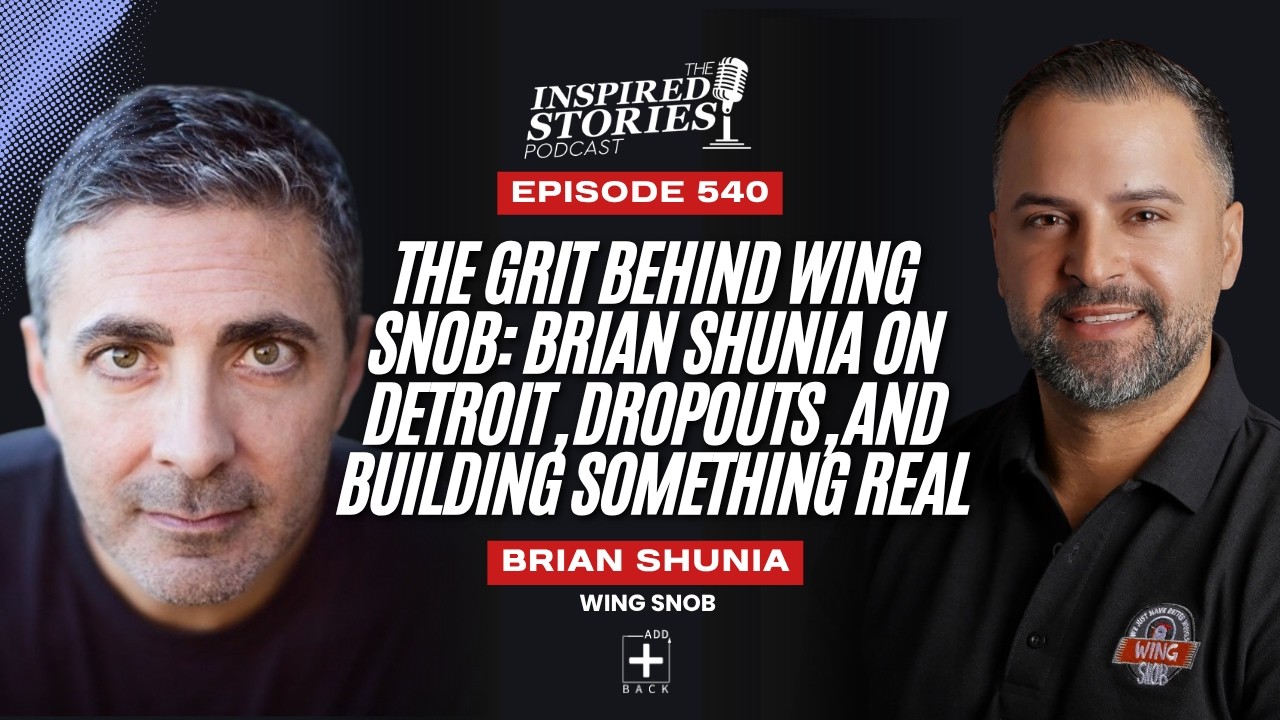
🎧 From High School Dropout to 70+ Franchise Locations: Brian Shunia’s Wing Snob Story
Brian Shunia, co-founder and CEO of Wing Snob, built one of QSR’s fastest-growing wing brands starting from a shuttered 880-square-foot pizzeria in Lavonia, Michigan. What began as a single concept with a tiny menu and a $200 factory order has grown to 70+ open locations across multiple states, with hundreds more in the pipeline — driven by simplicity, culture, and relentless operations discipline.
✨ Key Insights You’ll Learn:
High school dropout to GED to first job at 14 as a barista
Early career spanning restaurants, call centers, sales, and a marketing agency
Front Page Deli: from $50 days to $5,000 days through canvassing and factory catering
Lessons from scaling the deli too fast without the right systems
Real estate pivot that led to meeting future Wing Snob co-founder Jack Maschini
Choosing wings for simplicity: fast to prep, fast to execute, infinite flavor options
Selling the first location to fund three more and prove the franchise model
Snob Central: proprietary app centralizing training, auditing, ordering, and communication
Supply chain strategy: staying east of the Mississippi while filling geographic gaps
AI deployment: automated review response and AI phone lines across locations
🌟 Brian’s Key Mentors:
His Brother: got him into the restaurant industry after high school; taught early ops fundamentals
Jack Maschini (Co-Founder): business school background and franchise expertise that complemented Brian’s ops instincts
Dallas Powerhouses: senior operators and VPs of thousand-unit chains who shaped Brian’s leadership approach
MUFC Network: fellow franchise entrepreneurs met over four-plus years of industry shows
His Sister: pushed him to get his first job at 14 and instilled early work ethic
👉 Don’t miss this raw and energetic conversation about grit, franchising from scratch, and why simplicity might be the most underrated strategy in the restaurant business.
Listen to the full episode here
Transcript
Anthony Codispoti (00:00)
Welcome to another edition of the inspired stories podcast where leaders share their experiences so we can learn from their successes and be inspired by how they've overcome adversity. As you listen today, let one idea shape what you do next. My name is Anthony Cotaspodi and today's guest is Brian Shania, co-founder and chief executive officer of Wings knob, a fast growing quick service brand that started in 2017 in Warren, Michigan.
Wing Snob serves made-to-order chicken wings, tenders, fries, and other sides in more than 20 signature flavors. Their team follows a simple mission, deliver fresh, bold wings at a fair price. Now, we're gonna hear how Brian went from a high school dropout to founding a brand with 88 locations open or under construction and another hundred on the way. Franchise Times lists an average unit volume near $1 million.
And Crane's Detroit business placed Brian on its 2023 40 under 40 list. Before launching Wings knob, Brian spent nearly 20 years in the restaurant world and even ran his own deli, an experience that taught him the power of great service and tight operations. But before we get into all that good stuff, today's episode is brought to you by my company, Adback Benefits Agency.
So listen, if you run a business, you're likely stuck in the cycle of rising insurance premiums. You're paying more, but your team is getting less. And many people can't afford coverage at all. We do things differently. We offer a solution that provides your restaurant employees with unlimited access to doctors, therapists, and prescriptions that's always free for them to use. But here's the part that surprises most people. Unlike every other employee benefit out there, our program
puts more money into your company's bank account. As an example, we recently helped a client increase net profits by $900 per employee per year. Results vary, but the consultation is free. See if you qualify today at addbackbenefits.com. All right, back to our guest today, founder of WingStyle, Brian Shinia. Thanks for making the time to share your story today.
Brian Shunia (02:12)
Thanks for having me, Anthony.
Anthony Codispoti (02:14)
How'd I do on the pronunciation of your last name, Brian? All right.
Brian Shunia (02:17)
Quite well, Trunia. Yep, you got it.
Anthony Codispoti (02:21)
So how'd you get your start in the restaurant space?
Brian Shunia (02:26)
How did I get my start? would say it started with my brother. He had a pizzeria after I dropped out of high school, helped him after school. And then after I dropped out, I started helping full time and it kind of domino effected. Moved to Florida and started working. I think I was actually a pizza maker initially. And then
deliver went to deliver and pizza and then went to serving tables and played that whole role in the hospitality industry. And, you know, I was able to play all the roles in the restaurant space except for upper management. But I think that just kind of came natural over time. And, and as you grow and you develop you and you learn to inspect what you expect from yourself and from your operations. So
That's kind how I was able to grow into my own restaurant, my own deli, which also mind you had a whole bunch of trials and tribulations, but that's neither here nor there. It was all through personal development. There's no manual to this thing called growth. There's no manual to how to treat people. There's no manual to how to make a sandwich properly. It comes from the heart. It comes from, you know, as you said earlier, prior to launching comes from the hip, you know, see that you got it or you don't.
Anthony Codispoti (03:51)
So let's talk about that process of how you develop getting it or having it or knowing that you have it. Let's go back to the decision to drop out of high school. What was going on there? What can you tell us?
Brian Shunia (04:02)
You know, it just, I wasn't a patient person. You know, I just couldn't see myself sitting around all day. I'm not going to sit here and say it was the right or wrong decision. do I wish I can go back and just say I finished it? Yes, I would. but unfortunately I can't, you know, go back in time and change things. but I just wasn't a patient person. just, I think I grew up a little too young, too fast.
And
it could have been the environments I was in as someone in my youth. But that's just how the story ended right there. It just wasn't for me. So I just had to get on. I was anxious to get in the real world.
Anthony Codispoti (04:48)
So yeah, when you said you weren't patient, was you didn't like sitting in class, reading the books. You wanted to get out there. You wanted to make some money. You wanted to be doing your thing your way.
Brian Shunia (04:55)
I love working too.
I loved working. Actually, if I go back even further, my sister made me get a job in ninth grade. I wanted something. And my very first job was at Caribou Coffee. And I went and got a job there as a barista. I was working like 12 or 15 hours, whatever they would allow you at 14 years old.
And I made enough money off my first paycheck, walked across the street, grabbed what I wanted to buy. And I think at that moment in time in my life, that's when you learn that you got to earn it. So it's not something that can really be explained, you know.
It's not a wise decision to drop out of high school. It's something you feel or you don't have the patience for sitting through class all day and doing a 830 to 330 and so forth when I'm surrounded by a lot of older people. Again, it was my environment that kind of, I became a product of my environment, I should say.
Anthony Codispoti (06:01)
And your environment was you were hanging out with older people, kids older than you, grownups.
Brian Shunia (06:05)
Well, it wasn't
really just kids, it was more family. know, we have
Anthony Codispoti (06:08)
Okay, got it.
Brian Shunia (06:10)
a strong work ethic of a bloodline and just being out in the real world, you and then coming home and hearing what's going on throughout the day. You know, you just want to be a part of it.
Anthony Codispoti (06:22)
Yeah. Okay, but you did get your GED and
Brian Shunia (06:25)
Yeah.
Anthony Codispoti (06:26)
you got into the workforce and you're working different jobs and restaurants and hospitality. You're working your way up lots of different roles kind of hit the ceiling to get up to management. But at some point, you had the idea to start your own deli. Tell us about that.
Brian Shunia (06:40)
Yeah. So prior to that though, I was assistant loan officer. I did title, you know, I did sales. I did call centers for a good year and a half where I started off as a sales rep agent, recruiting online universities. And beyond that, as I grew within that organization, I started recruiting.
Offshore call centers across the world, you know all over the world to start lead generations for the online universities such as DeVry etc and I think a lot of those sales skills that I developed through the years Developed my internal hospitality and it taught me how to treat people sincerely
And
it really taught me, you know, the whole expression, treat people how you want to be treated, right? And then food and that experience together, I think really molded my recipe personally. And then the opportunity came about where...
there was a place, there was a subway, a sub-mart, it was called Sub-Mart. It like a generic subway, I found it on Craigslist. And it was for sale, real cheap. It was like 18,000 bucks. The guy let me put a couple grand down on it and made him payments. And my girl, my wife now, my girlfriend at the time, opened it with me. And she was a beautician, she was in beauty school. And...
that actually had a really rough beginning too, because you're talking to somebody who's never taken the initiative to own something on this level. mind you, let me go back a little further actually, before I jump to this, my cousin and I actually started a marketing agency. We tried to launch a marketing agency. It was called Wild Media. And what we did was we strategically placed 50 inch screens in high traffic locations.
At the time it was not a thing. Now they're everywhere. Now they're at gas pumps. Now they're in gyms, you know, but we were placing them in grocery stores and in gyms. And I would say that we, don't know if we pioneered it, but we were damn near close to that stage. And we didn't have the money, resources and experience to really blow that up. Now had we, we would likely have still been in that space.
So that's where my marketing background came in because I was canvassing, was pitching, we were designing, were concept creating, we were all the above gaining.
Anthony Codispoti (09:22)
You're developing a lot
of valuable skill sets and these different things that you're doing.
Brian Shunia (09:25)
Sure. Yeah,
yeah. mean, granted, we saw some success in some areas and we saw some failures in others. But you got to roll with the punches, right? So anyways, going back to the deli, took this deli. We were in there, we shut it down. It was over Christmas. We were in there breaking tiles, sorts of stuff. And we made it. It was a little mom and pop spot, you know, and we got it to where I wanted it to be. We opened up. We're doing like 50 bucks a day.
for about three months. And I had no idea how the hell I'm gonna make this place, you know? And then I just, I hit the streets. I take my menus, I hit the streets, I go around the community, I'm hitting neighborhoods, I'm door knocking, I'm introducing myself. And so be it, the canvassing paid off. I actually hit one of the local factories and this guy comes in and he says, hey, we need a delivery tomorrow for 11.30 and gave me, I don't know, 15, 20 sandwiches, whatever it was. It was a nice $200 order.
and biggest I mean I don't even do $100 in a day let alone I got an order for $200 you know so yeah
Anthony Codispoti (10:29)
He just made your week right there.
Brian Shunia (10:31)
so you know took it ran with it and that once that order hit the factory I called the factory a couple hours later just to follow up to see how we did and they loved it and next thing you know
It
started spreading throughout the factory and then it started spreading to the factories next door and here in Detroit. We have the big three, right? We're an automotive state with the motor motor city. And next thing you know, we're in GM. We're in Ford. We're in the local Magna RCO engineering, all these big major factories within our community. And we're rolling. I got that thing up to almost $5000 a day and we were there for a good six years and.
I made my wife quit her job to help me full time. And now she's a stay at home mom. And we're very blessed to be in that position. But we decided to sell the store because I was having my daughter, my first child.
Anthony Codispoti (11:31)
Okay, okay.
Brian Shunia (11:32)
And she was like my rock, right? She handled the service counter, I handled the kitchen. And the day she wasn't there, I'd have to handle both, right? And I was the guy that was every morning go to restaurant depot.
shoot over the store, do my prep, get everybody clocked in, get everybody up to par, do my huddles. You I had a little routine daily where, as I said previously, I inspected what I expect from my teams every day. And I was just able to take that with me into the franchising world. So if you fast forward a little bit, got out,
Anthony Codispoti (12:10)
Well, yeah,
let's let's let's kind of, you know, put a bow on the the deli here. What was
Brian Shunia (12:15)
Yeah.
Anthony Codispoti (12:16)
the exit? Did you guys sell it? Did you just close it down?
Brian Shunia (12:19)
No,
actually I was able to scale it to a couple locations, actually three locations. Lost one, closed, I'm sorry, I partnered with one, shut one down and my original one I sold. The one I partnered with, we went different ways. Unfortunately, one of them didn't work out and then, you know.
you ever hear that expression, you bite off more than you could chew. And at that time I didn't have the skill set or knowledge that I have today to scale, right? And it all comes down to systems and I didn't have the proper systems and knowledge to scale when I thought I did. So it's not really a door count thing. And as I grew, it's not a door count thing. It's a quality thing, right? It's, I'd rather have one store doing X than 10 stores doing the same as X.
Anthony Codispoti (13:12)
So what it sounds like maybe what was going on is you were great at being the director of your single store. And then you had trouble spreading yourself out over three stores
Brian Shunia (13:19)
Sure. Yeah. Yeah. Yeah.
Anthony Codispoti (13:24)
to be able to have that same level of control. A lesson
Brian Shunia (13:27)
Exactly.
Anthony Codispoti (13:28)
that seems like it stuck with you and you corrected as you move forward into your next thing.
Brian Shunia (13:32)
Yeah. Yeah.
Anthony Codispoti (13:34)
Okay.
So tell us how the idea for Wingsknob came about then. Was that why you were still doing the deli? Did that come later? Was there something in between
the two?
Brian Shunia (13:42)
no, so the deli after the deli, I got into real estate. So I took, you know, got a business per usual, right? Life goes on. So I had to make my next move. And that was taking the money I got from the deli and dibble dabbling real estate. And I did just that. And that's how I met my now partner, Jack Maschini. And he was a broker on a property that I had interest in. And I purchased a property.
utilizing him, I sold it utilizing him and we did it, you know, maybe like eight or nine more times. And over that year and a half, we built a relationship and it was, we always stood on business and, know, worked out really, really well. And then once that started dying down for me,
as my opportunities started to dilute because it becomes fierce, right? Real estate's a hard thing to do, especially if you don't have the right resources and enough money to play that game. So, and what I was doing was commercial. I wasn't doing real estate, so it was a little different. You need more money to play. And at the time, I didn't have that much. So I just said, the heck with it. I'm going to get back into food. It's what I did best. And I went to Vegas.
It was 2000.
15, 16, somewhere in there. And I saw this, I saw this concept and I said, it was a breakfast concept. And I said, you know, it'd be really cool if this type of layout were a wing concept and completely opposite. It was kind of like an off the wall idea. Anyways, came back home.
Anthony Codispoti (15:31)
What was
the layout? What was special about that breakfast place layout?
Brian Shunia (15:34)
It
was,
it was the, it was the workflow. It was a workflow transition of how everything was laid out. And at the time it was really just wing stop B dubs. They were like the big players. There wasn't too many in between, right? I came back and said, you know what, I'm going to do a wing concept. So I called, a resource of mine who is big into designing and he laid out a bunch of names for me.
And I picked Wing Snob out of his bunch. And I can't discredit him because it turned out to be such an amazing name and great color scheme, great layout and menu design was great. I gave him a menu. He laid it out and it really just it took off. So I took this store in Lavonia, Michigan and correction. It started out of Lavonia, not Warren. We're headquartered in.
Anthony Codispoti (16:27)
Okay.
Brian Shunia (16:29)
And it was a shutdown pizzeria that I actually saw a couple of years prior and I decided to turn it down. Turns out the opportunity arose again. So once it arose again, I said, you know what, let me just take it and run with it. So I took
it.
Anthony Codispoti (16:43)
Sorry,
Brian, let me pause real quick. Why did you pick wings? Why was that your choice?
Brian Shunia (16:47)
Simplicity. So I used to own a company called Mr. B's Broasted Chicken within my wing snob. I'm sorry, Front Page Deli, which was the name of my deli. And wings were my biggest seller and they were the easiest to prepare and fastest to expedite and get out the door. The only difference is that was broasted and now I'm doing fried, right? So a little different element, but same concept.
And the reason I went this route is this is not breaded what we're doing now, whereas before it was breaded. And I'm able to offer more flavor profiles with flavors. I just, you know, at the time I felt like it's fun, it's trendy and wings were the new hot dog, you know? And they're still, they're never going anywhere. Let's be real, wings are just hot, period. Although the chicken market is fierce, lots of competition, it just comes down to...
hospitality and quality and turn times. If we can master those three, which we've done quite well with, we can capture market share.
Anthony Codispoti (17:51)
So for folks who have never had the opportunity to visit a Wing Snob, walk us through the customer experience.
Brian Shunia (17:58)
When you walk in, it's very inviting. You're greeted, welcome to Wing Snug. You will be educated at the counter. You'll be prompted to download our app. You'll be asked to leave a review on your experience with us. We expect an eight to 12 minute wait time on your order. And yeah, I you're more than welcome to dine in on.
half the locations, the other half I'd say are just quick carry out. We're available on all third party applications, well should say majority of them. Upon downloading our app you get a free order of fries as a perk of becoming a rewards member and we've got one heck of a reward system as well. So
It's a good experience. It's a quality experience. We're a fresh, never frozen product. We use a colossal crisp coated fry, which is an A rated fry amongst the industry. don't really, you know, they're not greasy. They're not soggy. hold their crispiness upon travel. Now majority of the time we're.
Anthony Codispoti (19:05)
So I can take it out, can bring it back
to my house for game day or whatever, and I'm not gonna lose that quality fry experience.
Brian Shunia (19:12)
Exactly, exactly. And the same thing goes for our chicken. So we have a technique of how we prepare our chicken to where it is not soggy upon arrival at home. So.
Anthony Codispoti (19:25)
And you say they're breaded now or they used to be breaded or? No.
Brian Shunia (19:28)
Not breaded, no. The boneless
wings and tenders are breaded, of course, but the wings are not breaded, yes.
Anthony Codispoti (19:35)
Can you say anything about your process? What makes these different or special?
Brian Shunia (19:39)
Yeah,
absolutely. So we marinate our chicken overnight. So most places don't actually do a marinade, right? Especially with the volume.
Anthony Codispoti (19:48)
That's an extra step. It's time consuming.
Brian Shunia (19:50)
It is an extra step. It's very time consuming, but that's where you got to put the love in your product, you know? So you put the love in your product at that point. It's where you prepare it. It becomes most significant, right?
If I just take it out the box or in the fryer, people think, hey, it's just the sauce, it's the flavor, it's not. Because we have a proprietary marinade that contains onion powder, that contains garlic, that contains sugar, that contains four other ingredients. And it's fabulous thing. And that's what makes wing snob snobbs. That's what makes us snobbs.
Anthony Codispoti (20:28)
because you invest so much effort and energy into making sure that that wing experience is just the premium that it can be for people who really appreciate good wings.
Brian Shunia (20:36)
Exactly. Exactly.
And also, our boneless wing, would rate it probably amongst the top in the industry. We probably have the greatest boneless wing on the planet. You're going to get a, you you go get a six piece, it could probably feed two people. You know, our boneless wings are quite big. They're plump, they're juicy, they're crunchy, they're hand battered.
along with our tenders hand battered and great product. I personally, I don't sauce my boneless and tenders. I'm a dipping guy. When it comes to my boneless and tenders, most people obviously get a toss in a sauce, which they have those options, but I like to eat it for what it is. And I like to get different flavors. So I have different.
different flavor profiles in each bite. It just depends on, you know, like going to get tacos, right? When you go to a taco place, I don't like to get one flavor, one, I don't want a beef taco. I want a beef, I want a birria, I want a al pastor. Give me a variety of them. Same thing goes with sauces. And that's what made our menu so interesting. And it also helped my decision-making process along creating the concept of going unbreaded as opposed to breaded with the wings that is.
so that we can have different flavor options. It expands the options list.
Anthony Codispoti (21:57)
Because if they were breaded, you would have to pre-season them, pre-flavor them? Or how did not going breaded give you more flavoring options?
Brian Shunia (22:04)
No, because most of the time,
if you take a breaded wing, most of the time, I I don't even know if I've ever seen a sauce breaded wing in my life. You know, I don't think it's a thing.
Anthony Codispoti (22:14)
Okay, that's just not a thing. Yeah.
Brian Shunia (22:18)
And if it is, it's news to me.
Anthony Codispoti (22:19)
Yeah.
Brian Shunia (22:20)
Again, nothing's off the table. We're in 2026.
Anthony Codispoti (22:23)
So what are your favorite sauces and what are the most popular ones across the restaurant chain?
Brian Shunia (22:30)
I'm most popular, I'd say garlic parm, buffalo, lemon pepper and honey barbecue, right? I'm a spice guy, so my favorites right now.
Jamaican Jerk is probably my number one. My awesome sauce is, there's no heat to it. It's a honey mustard based barbecue sauce, like a Carolina gold, if you may. And I would say my hot honey barbecue. Those
Anthony Codispoti (23:03)
Okay.
Brian Shunia (23:04)
are my top three.
Anthony Codispoti (23:05)
What's your hottest one?
Brian Shunia (23:07)
Hot AF.
Anthony Codispoti (23:08)
You
Brian Shunia (23:09)
Get your mind out the gutter, it's hot as fire, right?
Anthony Codispoti (23:13)
Thanks for the correction there. So tell me about the Sandoz. What is this?
Brian Shunia (23:17)
Yeah,
same thing, man. It's a fresh, never frozen, hand-battered breast, nice big old breast,
Anthony Codispoti (23:25)
Okay.
Brian Shunia (23:25)
like a brioche, butter-grilled brioche bun. We brought in flat tops, flat top griddles into our locations solely to grill our buns. And it makes the world of a difference. So it's one heck of a product. It most definitely separates us from the rest. It is a...
It is a tailor-made product.
Anthony Codispoti (23:49)
In getting that first door open, Brian, talk us through one of the big challenges that you had to overcome.
Brian Shunia (23:57)
You know.
I don't think I had a big challenge opening the store. I really, I just had it all mapped out. I had it all mapped out. It was very organized. You know what, there was a challenge. was designing the interior. I'm talking 18 foot width by seven foot depth was my lobby.
We just came up with a cool wallpaper wrap that I had my designer create. We just have better wings. I think at the time I put on the counter, it said, everything tastes better fried. I think that's what the slogan I put under the counter at the time was. I had these flames coming off the walls and had a rustic wood plank feel behind the counter at the time.
And it was a real warm, inviting space. We utilize some hunger colors.
Anthony Codispoti (25:06)
What's a hunger color?
Brian Shunia (25:08)
Colors that just kind of strike a little bit of hunger, right? Like these oranges, these reds, these yellows, they're not cold
Anthony Codispoti (25:17)
Okay.
Brian Shunia (25:18)
colors. It's not like you're walking into a day spa. It's warm and inviting
Anthony Codispoti (25:23)
warm and biting colors. Yeah.
Brian Shunia (25:26)
colors.
You want to walk into a place and like who you are when you're in a facility, you know?
Anthony Codispoti (25:35)
So what was it like when you first opened your doors? People rushing in, lying around the corner. Did you have to pull on some of those old marketing and sales tactics to put butts in the seats there?
Brian Shunia (25:47)
No, actually. So when I first opened it, I had all the windows wrapped. Wings knob coming soon. I had a lot of people commenting on our Facebook at the time. A lot of people were just like, hey, what's this? You have a menu. We just posted it. Can't wait to get open. It didn't take me long to open the store because it was pretty much done. It was a second gen location.
But with that being said, when we opened, opened pretty, at a pretty decent volume pace. I think it was anticipated. Our opening was anticipated. And then once I started going out canvassing, like hidden in the neighborhood, we kind of just like took off. And once we took off, there was a sense of virility online where people started traveling.
They were coming from up North Michigan, from Toledo, Ohio, surrounding
Anthony Codispoti (26:46)
Really?
Brian Shunia (26:47)
cities. And you're talking this little 880 square foot spot and people started inquiring, hey, how do I, you know, I, I people loving our ops, our environment, our work culture, cause I'm a big cult, you know, big people person, especially when it comes to work culture. And I had people calling, how do I buy into this or how do I open one?
because it was real small, it real simple, it real fast. The menu at the time was real, real small. It still is small, just we have options now of different flavor profiles, which makes it look expanded. And I didn't know how to expand at that time, right? I was an ops guy, you know? So that's when I called on my now partner, Jack Maschini, who I was doing real estate with. And I said, Jack, I said, listen, I got a good thing going over here. I said, why don't you come over here and help me out and let's expand this thing.
He comes in and he actually ended up helping me because I needed some help. And he was like, yeah, no, I'm not a restaurant guy. He came from the cell phone world, you know? And he's like, no, this isn't for me. And then one day I think it just struck him where someone called the store and he had to hear it with his own ears. Like, Hey, where do I go to inquire on opening a location? And then he's like, yo B, you know, he's got another call. You know, I'm like, dude, I'm telling you, we got to do something here.
And it's history from there.
Anthony Codispoti (28:18)
And so you
were getting the calls, you were getting the inquiries, they were coming to you
Brian Shunia (28:23)
Yeah.
Anthony Codispoti (28:23)
when you still just had a single location.
Brian Shunia (28:25)
Yeah, yeah. So I knew nothing about franchise. I knew nothing about, you know, the legalities behind it. Whereas my partner, he went to business school Walsh, full background, graduated high level. Very grateful for his knowledge and his experience and what he's brought to the table and the teams that we've built together.
It's
been one heck of a ride. know, we've got almost, actually, no, we have about 70 some locations open today. We've got, we're in Canada, we're in Ohio, we're in Florida, we're in Illinois, we're in Michigan, we're in Texas, we're opening, we just opened up NKU, North Kentucky University, we're inside of U of M, we're opening West Virginia.
We're expanding. a matter of supply chain and real estate now. That's the game, supply chain, real estate. We've buttoned down everything over the years and training is at our forefront. Culture is at our forefront. Identifying and understanding the inquirers who are coming in and making sure that we're very selective with the visions being aligned.
with whom we pray.
Anthony Codispoti (29:51)
What are you looking
for in a franchisee?
Brian Shunia (29:56)
You know, aside from just the willingness to do the work, there's a lot more to it. You know, there's a psychological aspect of things that play a role. Culture is big. Like I said, I'm big on culture. I love people, people, persons, right? You got to be able to relate to your community. You have to be able to run teams and embed a culture within your environment.
to not only where your staff want to work for you, but where your community wants to support you, right? And you got to be...
Anthony Codispoti (30:31)
How do you
achieve that? How do you achieve that? Get the employees who want to work for you, get the community who want to support you.
Brian Shunia (30:37)
It's
not something that you achieve. I think it's a part of the vetting process, right? I think you can read someone in the first five, 10 minutes of conversating with somebody. But it can take you by surprise where you may have a conversation and they may come off as the ideal candidate. But then when the tires hit the pavement, it can go both ways. But for the most part, I'd say we're very blessed to have
the brand partners we have, the efforts that they put in and we're rolling.
Anthony Codispoti (31:15)
So
the people who choose to open a Wings knob location, they want to be a franchisee, clearly they've considered other options. Ultimately, why do you think they decide to open a Wings knob instead of something else?
Brian Shunia (31:30)
Simplicity. Yep, simplicity. We're not.
Anthony Codispoti (31:35)
Simple menu, simple layout.
Brian Shunia (31:37)
Exactly. It's simple menu, simple layout. you don't need eight people on per shift. I mean, it'd a good problem to have if every store was eight people per shift, but we're not, we're not a brand that needs, that has eight different stations. You know, we have a.
We've got a cook line, we have an expo station, and we have a service counter. And, you know, it goes in rotation. Order comes into the back and the food flows to the front. So, all the way to the end.
Anthony Codispoti (32:10)
And you talked about supply
chain being one of the really important things that you guys have buttoned up. Are you doing are you using kind of like a hub and spoke system? So as you look to expand your franchisee network, you're doing sort of like geographical regional hubs or do you not have that issue? And so you could open up in California or Oregon today.
Brian Shunia (32:34)
No, you see, it's a loaded, we can open anywhere, but it just comes down to the movement, right? And you gotta really understand supply chain to speak that language. As you bring in proprietary SKUs, number one, you look for uniformity across your brand, right? You want the same chicken, the same sauce, the same packaging going out of every door.
I'd say the biggest challenge of the supply chain is when you go to open a new market and you only have one door and your supply chain director says, hey, we need a minimum of a SKU that we're only moving five units a month out of, but I need five units a week being moved, right? And it could be wax paper. For example, I could take a wax paper that comes 20,000 to a case and they need five of those units moved in a week.
in order to bring that skew in. But luckily for us, we've turned the corner now to where our purchasing power and our volumes have granted us to work with purchasing companies.
which now take the reins to deal with our distributors to handle those situations and deficiencies or that criteria if you may. So it's always a work in progress. There's always something coming about. There's always a company being acquired by another company with a new set of policies or procedures. It just, doesn't stop, but it just, it always keeps you on your toes, right?
Anthony Codispoti (34:07)
When did you guys open the first location? What year was that?
Brian Shunia (34:14)
2017,
Lavonia opened. But I didn't become a franchise until 20, October, I believe. I believe it was October, don't quote me on that. October maybe of 18, it's called a year later. I opened in Lavonia.
Anthony Codispoti (34:29)
That's still fast.
That's really fast to go from initial concept to now franchising it.
Brian Shunia (34:34)
What we did was I sold the first location. I took the funds from that. We built the first, the next three locations. We built it in a tight timeframe and we launched them. And when we launched them, we catapulted them. And when the catapult, when I said catapulted them, we came out the gates swinging with them. Marketing, we overspent on everything to get the brand awareness out there.
to build that virility in the communities. And it really just picked up steam in a very big, big way in a fast fashion. And it really allowed us to spread our wings and get the exposure needed to showcase that there's a brand out there such as ours and our doors are welcoming and open to potential franchisees. And now fast forward, know, eight years later, now we're a player.
You know, we're striving to become the Burger King to call it Wing Stops McDonald's or
Anthony Codispoti (35:35)
Yeah.
Brian Shunia (35:36)
another big competitor.
Anthony Codispoti (35:37)
So it sounds like this was a very strategic approach that once you guys made the decision that you were going to get into the franchising space, you're like, hey, we need a little bit of a bigger footprint so that we can prove that this is replicatable. Right. So you sold that first location, give you some funds, help capitalize those next three locations so you can show, hey, this can work at a scale. And we've got the systems and the operations.
now figured out not just in a single location, one, two, three, four. And so you can feel comfortable as a franchisee coming in and having that playbook.
Brian Shunia (36:14)
Correct.
Anthony Codispoti (36:15)
Okay. And.
Brian Shunia (36:17)
Well, also
we had to prove concept too, right? Can't just come out the gate, just, know, selling doors, it had to make sense. had to generate revenue.
Anthony Codispoti (36:28)
So how long did it take to get those next three open? And then how long after that before you're actually starting to sell franchises?
Brian Shunia (36:39)
I think it took us like a year and a half or two years to build the next three stores. And then following is when we started really just taking off.
Anthony Codispoti (36:50)
And so in terms of geographies that you guys are looking to expand into, we're talking across the continental US.
Brian Shunia (36:57)
You know, I get that question asked a lot. No, I like to stay east of the Mississippi right now, just to control supply chain. Right. And as we fill in gaps, primarily Midwest, and as we start to fill in gaps, we expand outwards.
Now, initially, when we first opened, we were spotty, right? And then we learned a thing or two about supply chain. But luckily for us now, we've got that under control for those spotty scenarios that actually allows us to, for example, we're in Houston, in Katy, Texas, Location down there. Now, since that's just about figured out, we can start growing out from there too.
So luckily for us, we don't have a commissary where we're not manufacturing the products, but our relationships are with the manufacturers. So they're willing to take it anywhere we need to go. So in the event that a U S foods cannot support, McAllen, Texas, I can call on a Benny Keith and just say, here are my, contracts with these manufacturers, throw them in with Benny Keith off to the races. Now we have distribution down there in South, South Texas by South.
Anthony Codispoti (38:08)
So knowing what
you know now, probably would have grown a little bit differently, you know, in terms of like choosing your geographies that you're not as spread out.
Brian Shunia (38:16)
I would
have grown out. I would have grown out. Sure.
Anthony Codispoti (38:19)
Got it. Like concentric circle kind of a thing. Yeah.
Brian Shunia (38:22)
But you know what? I really don't have any regrets. I think it's all working out just fine.
Anthony Codispoti (38:27)
Because now you're poised for growth in those different areas, like you're saying the Houston area. You've got a single location,
Brian Shunia (38:31)
Yeah.
Anthony Codispoti (38:33)
but it's working, it's figured out. So now it's easier for you guys to grow down south there.
Brian Shunia (38:38)
Yeah,
I'm not saying it was a mistake. I'm saying it could have been easier.
And again, there's no manual to this thing.
Anthony Codispoti (38:49)
So how'd you figure it out? Just try, make a mistake, and
Brian Shunia (38:52)
You know, no,
Anthony Codispoti (38:54)
pivot from it.
Brian Shunia (38:55)
well, I don't call them mistakes. I call them challenges, you know, we. And I've also I've got quite a few different mentors. I've also learned a lot from from people in the same space that operate at a very, very high level.
There are some VPs that I communicate with of, you know, thousand unit chains. Sometimes they'll just give me a pulse check or give me a bump and say, Hey, Brian, how you doing? Need to buy a cup of sugar. What's going on with you? And I'm, you know what? I've been.
at the MUFC shows in Vegas for last four or five years. I've met a lot of great people, a lot of great entrepreneurs, and even small guys too, you know. And we've just stayed in touch over the years. And when I do shows or when we go to visit other shows and we bump into each other, it's nothing but love and it's just support.
I've always stood on that whole collaborative aspect of things as opposed to competitive aspect of things. I feel like we're stronger together and you can even be in the same space, just not next to me.
Anthony Codispoti (40:06)
So you're
still friendly with other wing shops out there. As long as they're
Brian Shunia (40:09)
Yes, I am. Yeah.
Anthony Codispoti (40:12)
not right next door. Then it's getting a little too close to home.
Brian Shunia (40:18)
No, but at
the end of the day, it's just a system. It's an ecosystem.
Anthony Codispoti (40:23)
So you touched on this a little bit before about the importance of being able to train the new franchisees, having that playbook to hand over to them and being able to help set them up for success. Tell us about the learning management system that you use as part of this process.
Brian Shunia (40:42)
Yeah,
so we've been with a company for quite some time, the LMS platform that we built out years ago. And it was all digital, interactive. And just until recently, about two weeks ago, we just launched Snob Central.
So Snob Central is an infrastructural app that we launched. It allows us to communicate with our franchisees and it also allows franchisees to opt in their crew for them to communicate with them. And it plays a role of a central station if you may, like a hub. And in there we have...
coming soon. Well, actually, like this week, next week, we'll have it launched. You have your chat features, you have your announcement boards, like us to our franchisees and the franchisees have their announcement feature to their crew. have shared calendars from us to franchisees and then franchisees have their shared calendar with their crew. So we keep that completely separate.
We don't really get involved with their staff. Our communication is direct with brand partners. Then we have shared files. We have a marketplace now and there where they can purchase their uniforms, their menus, their banners, their tents, their whatnot. We used to have something called SnobShop.
where franchisees were able to purchase all that from, which we re-labeled to Marketplace. And they could go in there and they could purchase anything they need. We have our LMS platform, which is Wing Snob University, that we just got done building out completely. We're just in the final designing stages of it. It's very interactive. It's got a very social media feel. It really keeps...
crew engaged and it keeps a sense of familiarity where most people are on social media all day. We've designed it to feel and look like social media to them. So as they go through the learning curves of
the different zones and stages through the LMS, it provides a sense of easier acknowledgement of the material that they're reading, viewing, listening to.
Anthony Codispoti (43:12)
There's like little checkpoints there. Yeah.
Brian Shunia (43:14)
Yeah, I mean, there's
going to be games in there too. you know, training is a very extensive topic to touch on because so many people, everyone absorbs knowledge differently. Right. And there's nothing like throwing someone in the kitchen and learning with their hands. So.
It's going to be a mixture of both. Our new approach is a mixture of both and, and also identifies culture and who we are as a brand and our brand identity and what they can expect from their staff and what their staff should expect from them and what they should expect from ownership and what ownership should expect from them and vice versa. and then also within that app, there's, our auditing tools where our field ops teams can go out and
Everything is just in one central station. And we've recently gotten very technologically inclined where the resource presented itself to now we're building so much proprietary internally to where every little thing is done on the phone and within one app. So as a franchisee, you get access to this app. Boom, you can hit your POS.
your sling or seven shifts. You can order your food through your distributor through it. You can communicate with your staff. You can do your rewards. You can do your meeting to your staff. You can reward your staff. As they do good, you can do your write-ups. You can put in requests to corporate. You can put in support tickets to corporate. Everything is now in this app.
Anthony Codispoti (44:55)
So given how tech savvy you guys are and investing so much time and energy there, what, if any ways, are you using AI in your business now?
or is it on the roadmap?
Brian Shunia (45:17)
We do use AI. We use, trying to think of all the channels. So we did partner with a company where we do use AI to help with faster response times with reviews on either Yelp or Google and so forth.
So
if 24 hours goes by and someone leaves a review, whether positive or negative, the AI will come in and kick in and give a response. And then it'll nudge the franchisee or brand partner to dial in on it. And then we are also launching, well, we leave this to the stores actually. I shouldn't say we're launching. We leave this solely to the stores to do or to utilize for.
AI driven phones, right? So what happens is we're getting away from the whole, well, not again. I don't want to say we're getting away. It's up to them to do it or not. But the whole rollover lines and you to pay for two lines and manning a phone where AI is now so intelligent and it sounds so real and can hold conversations with guests when they call in.
Those are the two channels really that we utilize AI is phone lines for some stores and all stores for Just review management reputation management Yeah
Anthony Codispoti (46:46)
Got it. I
want to talk about some of the personal recognition that you've received. We mentioned the cranes 40 under 40 just a few years ago. What do you think led to that?
Brian Shunia (46:55)
That
was cool, man. That was fun. know, dude, we keep our heads down, we work our asses off. And when something like that just happens, we're just grateful for it. It's cool. It's fun. That's really all it is. It's not.
Anthony Codispoti (47:12)
So wasn't something
that you went out and sought. They knew about you from the community, from the work that you'd been doing, and they came to you.
Brian Shunia (47:19)
I'll be honest, I don't even know how it came about. It just, I think we got an email saying, we're nominated. And then next thing you know, said, Hey, you made 40 under 40. And it was a, it's a, a, it's a really cool thing to accomplish. but it's nothing that I really went out and said, Hey, this is my goal to go do, you know, kind of just happened. Right. So it's fun.
This one. It's cool for the resume.
Anthony Codispoti (47:53)
Yeah,
any other awards, recognitions like that we should give voice to here?
Brian Shunia (48:01)
I don't know.
Anthony Codispoti (48:02)
Probably
a lot of them, but you seem like a humble guy that wouldn't even have mentioned
Brian Shunia (48:05)
So.
Anthony Codispoti (48:05)
the Funder 40 under 40 if we hadn't found it.
Brian Shunia (48:08)
You know, yeah, I don't know. I think we
Anthony Codispoti (48:11)
Alright.
Brian Shunia (48:11)
made a top 100 shakers and movers. Again, we just they sent us a letter with a plaque and they sent us to a an award ceremony dinner out in Chicago. Unfortunately, I didn't go. My partner went. I think I was having my child at the time.
I don't know. I don't really get along with it, You know what we
Anthony Codispoti (48:39)
There's been some good stuff along the way.
Brian Shunia (48:42)
do, dude? Like I said, we keep our head down, we work our asses off, and we just keep it moving. If someone wants to throw... I love the office candy, sure, but it doesn't pay the bills.
Anthony Codispoti (48:54)
Fair enough. Let's shift gears, Brian, and I'd like to explore a big personal challenge that you've had to overcome and what you learned going through that experience.
Brian Shunia (49:08)
When? At what age and stage?
Anthony Codispoti (49:12)
Whatever comes to mind first is usually the right answer.
Brian Shunia (49:15)
man. Personal challenge?
Anthony Codispoti (49:20)
Because there's a lot of folks that look at you, Brian, now and they think, wow, that guy's got it made. Look at him. And
Brian Shunia (49:25)
It's been a lot.
Anthony Codispoti (49:28)
there's so much that you've been through that other people haven't seen. So let's pull back that curtain a little bit and let's show them that, hey, we all go through hard stuff.
Brian Shunia (49:38)
Yeah, Shit.
professionally or personally
Anthony Codispoti (49:50)
What came to mind? What came to mind?
Brian Shunia (49:52)
Well, since we're on a professional topic professionally. my
Anthony Codispoti (49:54)
All right, let's do it.
Brian Shunia (49:56)
biggest challenge professionally was personal development. And it wasn't overnight. It was over the years. Actually, a lot of it happened in Dallas, Texas. And I learned a lot down in Dallas.
I
rub shoulders with some really...
big powerhouses, people in some very big powerful positions that really just talk me through really how to carry this business and how to carry myself through this business. And when I say myself, it's delivery, it's communication, it's how we tackle challenges and
you know, as you said earlier, problems. And that's one thing I learned is we don't have problems. We have challenges, right? And it's really the mindset. And we don't focus, you know, on yesterday or tomorrow. We focus on today and which leads to tomorrow, right? And whatever we plant today flourishes tomorrow.
Anthony Codispoti (51:17)
we do this
Brian pick pick one of those personal development moments those elements when you were down in Dallas and walk us through it.
Brian Shunia (51:26)
Core values. You know, I would say someone once asked me what my core values were. This was a long time ago and, and it had me rewrite them. I re after that conversation, I really thought deeply about it over, over a long period of time. And, and it really. Steered me to change up my core values. And now.
You know, I'm 39 years old and grateful to be in the position I'm in. And you learn if you don't have core values or the right core values, you have nothing to stand on. Right. And it plays a role both professionally and personally. So if you ever come to a crossroad where you don't have an answer or you think you're to make a decision to something that you're unsure of.
That's where those core values come into play. And it really gives you something to lean on to say, Hey, if I have an issue, let me revert back to my own playbook and my core values or challenges we'll say. and I'm just like everybody else who doesn't have problems, know, personal problems, family problems, or challenges. go back to challenges.
Anthony Codispoti (52:48)
opportunities for growth.
Brian Shunia (52:50)
opportunities for growth are endless.
You know, I'm going to forever be a student. Things are constantly evolving and changing.
Anthony Codispoti (52:59)
So tell me, Brian,
were your core values, what did they look like before, and what have they evolved into today?
Brian Shunia (53:08)
So my core values before were more like, were more driven towards like.
business and future endeavors. Now they're more personal. Now it's staying, you know, I stand heavily on faith, honesty, better tomorrows. And I have some others that I just keep to myself for my own personal growth. And you know, I'm a father of four. So, and I got, and I want to teach my kids this young because I didn't learn this till after my thirties, you know, after I turned 30.
And had I learned it earlier in life, I'd probably be a little bit more successful or a little further now than I was back then. So it's just crucial. It's just crucial, crucial.
Anthony Codispoti (54:04)
What do I see on the wall behind you? Execution, persistence, and something else looks like below it.
Brian Shunia (54:10)
Yeah, grit,
perseverance, success, hustle.
Anthony Codispoti (54:13)
Yeah.
Brian Shunia (54:14)
Yep.
Anthony Codispoti (54:14)
Talk to us about grit.
Brian Shunia (54:17)
We just don't stop. We don't stop.
Anthony Codispoti (54:20)
Where's it come from?
Brian Shunia (54:21)
It's a...
Maybe it's that high school dropout thing, you know? I don't know. Maybe it's wanted to continue to shoot for the stars. I don't know where it comes from. I just know it's there. I don't like being told that we can't do something. I'm that guy. And if you tell me I can't do it, we're going to do it 10 over, 10x. yeah.
Maybe it's a Detroit thing. I don't know. Maybe it's a bloodline thing. I don't know, you know? So
Anthony Codispoti (55:00)
Your folks have it.
Brian Shunia (55:02)
my folks do have it. Yeah, my folks do have it. My brother
Anthony Codispoti (55:06)
Love it.
Brian Shunia (55:08)
has it. My four sisters have it. My aunts and uncles have it. My cousins have it, you know. Everybody has it. It's in the
Anthony Codispoti (55:14)
It's in the gene pool then for sure. Yeah.
Brian Shunia (55:17)
G pool. you know, Detroit is a hustle harder type of city, you know?
We are, you know, we're a city that stands tall on grit. We don't mess around. We get things done. You know.
Anthony Codispoti (55:29)
I love it. Brian,
I've just got one more question for you today. But before I ask it, I want to do three quick things for the audience.
Brian Shunia (55:35)
Yeah.
Anthony Codispoti (55:35)
First of all, anybody that wants to learn more about what Brian Cheney is doing, wing snob.com. It couldn't be any easier. Go to wing snob.com. You see their menus, you can order, you can learn about the franchise opportunity, get in touch with the brand. But wing snob.com. You go check it out now. And if you're enjoying our show today, please take a moment to subscribe wherever you're listening.
It also sends a signal that helps others discover our podcast. So thanks for taking a quick moment to do that right now. And as a reminder, you can get your restaurant employees access to therapists, doctors, and prescription meds that counterintuitively actually increases your company's net profits. Real gains that can change how a business is valued. So contact us today at addbackbenefits.com. Last question for you, Brian, a year from today, what is one very specific thing that you hope to be celebrated?
Brian Shunia (56:30)
A
year from today.
Hmm.
Good health and happiness.
Anthony Codispoti (56:41)
That's pretty basic. I love it.
Brian Shunia (56:43)
Well, I don't
think it's basic. It's wishful thinking.
Anthony Codispoti (56:45)
It's elemental. mean, it's
basic in a foundational kind of a way. you
Brian Shunia (56:50)
Yeah.
Anthony Codispoti (56:51)
have that man. Everything else is gravy.
Brian Shunia (56:54)
Yeah. Yep.
Anthony Codispoti (56:56)
Love it. Well, Brian Chenea from Wing Snob, I want to be the first to thank you for sharing both your time and your story with us today. I really appreciate you being here.
Brian Shunia (57:03)
Appreciate
your time, Anthony. Thank you so much.
Anthony Codispoti (57:06)
Folks, that's a wrap on another episode of the Inspired Stories podcast. Thanks for learning with us. And if one thing stood out, put that into action today.
Connect with Brian Shunia:
Website: wingsnob.com