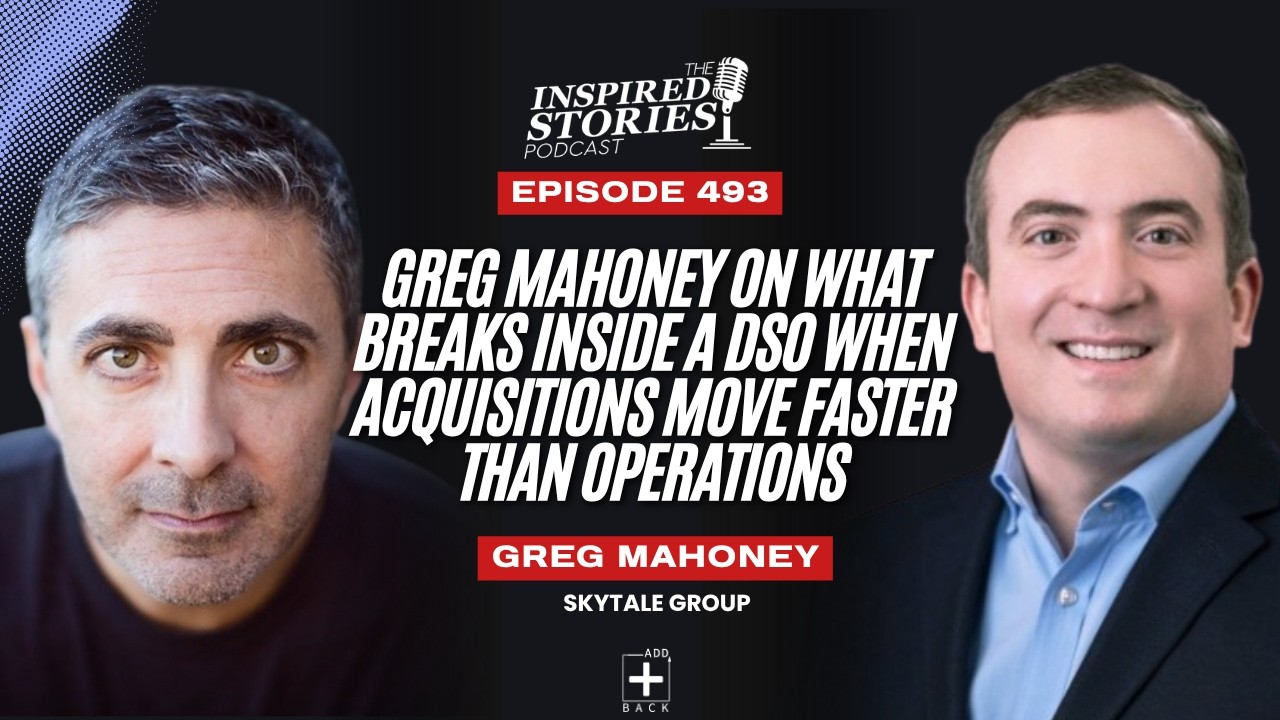
Greg Mahoney is Associate Director of Management Consulting at Skytale Group, a Dallas-based firm helping dental support organizations and multi-site healthcare platforms grow profitably, prepare for M&A, and exit with positive outcomes. He came to that work through a decade of building his father's single-location dental practice from $1 million to $7.5 million in revenue, discovering along the way that he had accidentally built something too profitable for any associate to buy — which sent him inside some of the country's largest PE-backed dental platforms before he landed on the consulting side.
✨ Key Insights You'll Learn:
Growing up in a dental family and planning to become a dentist before organic chemistry redirected the path
Discovering a natural strength in economics, accounting, and finance after his GPA transformed with the switch
Early career in corporate finance at a startup, then product management at Heraeus Kulzer dental manufacturing
Joining his father's $1M practice with a mandate to build everything except the dentistry
Adding TMJ, sleep apnea, and implant service lines as standalone practices within the practice
Growing from $1M to $7.5M in two and a half years through internal marketing and specialty cross-referral
Realizing the practice was too profitable for associate buyout and choosing private equity as the exit path
Joining Elite Dental Partners post-acquisition, scaling from 66 to 114 locations while building support infrastructure
The shift from buy-and-hold DSO arbitrage to same-store growth as the new operating imperative
Joining Skytale Group to serve founder-led healthcare practices across dental, aesthetics, dermatology, and beyond
🌟 Greg's Key Mentors:
His Father (Dr. Mahoney): Lifelong role model who handed Greg the business mandate and whose example continues to shape how Greg works with founder-led practices
Elite Dental Partners Leadership: Gave Greg the opportunity to go from single-practice operator to multi-location infrastructure builder across 114 locations
Skytale Group Team: A meritocracy where the best idea wins, giving Greg the environment to apply operator experience to consulting without politics
Founder-Led Practice Owners He Has Served: Consistently reinforce why the emotional investment of a founder creates different problems and different opportunities than PE-backed groups
His Wife: Grounded him when he was still considering dental school mid-MBA with a newborn at home, and redirected him toward the path that fit
👉 Don't miss Greg's account of the moment he realized the practice he built was too profitable for anyone to buy, how a failed organic chemistry class shaped a career in dental operations, and why he believes today is the golden age of dentistry for operators.
Listen to the full episode here
Transcript
Anthony Codispoti (00:00)
Welcome to another edition of the inspired stories podcast where leaders share their experiences so we can learn from their successes and be inspired by how they've overcome adversity. As you listen today, let one idea shape what you do next. My name is Anthony Cotaspoti and today's guest built a single location dental practice to seven and a half million dollars.
The problem was he built it so well that no associate could afford to buy it. The specialties he created were too profitable, too tied to one dentist's hands, and the only real exit was private equity. What came next sent him inside of some of the country's largest PE-backed dental platforms, scaling operations from 66 to 114 locations. Before he landed on the other side as the advisor,
that founder-led operators actually trust. His name is Greg Mahoney. He is Associate Director of Management Consulting at SkyTail Group, a Dallas-based firm that helps dental support organizations and multi-site healthcare platforms grow profitably, prepare for &A, and exit with positive financial outcomes. He has been in the operator's seat and run the numbers from the inside, which is a big differentiator versus many other consultants.
But before we get into all that good stuff, today's episode is brought to you by my company, Ad Back Benefits Agency. And you'll want to hear this because it's hurting almost every business owner you know. Health insurance costs go up every single year and businesses are furious about it. They're paying more, claims are getting denied, employees are opting out because they can't afford it, and it hurts turnover and morale. It's one of the most maddening problems in running a business and everyone just accepts it.
but you don't have to anymore. Now there's a program that gives your employees unlimited access to doctors, therapists, and prescriptions with no co-pays or deductibles to meet. But here's the part that really shocks most people. Unlike every other employee benefit out there, our program increases your net profits. We recently helped a client add $900 per employee per year to their bottom line. Results vary, but gains like that can change how a business is valued.
Be the hero advisor that introduces this to your clients today, addbackbenefits.com. All right, back to our guest today, the Associate Director of Management Consulting of SkyTale Group, Greg Mahoney. Thanks for making the time to share your story today.
Greg Mahoney (02:36)
Anthony, it's wonderful to be here. Thanks for having me on today.
Anthony Codispoti (02:39)
So Greg, you grew up in a dental family, fully expecting
to become a dentist. And at some point in college, that plan came apart. What happened and how did you eventually figure out where you were gonna go and what you were good at?
Greg Mahoney (02:49)
Thank
You know, everybody goes through a school and they're trying to find themselves, what they're good at, where their interests lie. And through my journey towards a pre dental set of classes and skills, I realized that my strengths were not in biology and chemistry, but rather in economics, accounting, finance and management. And so I decided, Hey, I think it's time to make this diversion.
And maybe some of that was hit with a ⁓ C in organic chemistry and thinking, no, now I've got to take organic chemistry too and this isn't going to go well. And I looked at it as like, hey, I got weeded out by the weed out course. Maybe I need to rethink this a little bit. ⁓ it became something where I've always been interested in business. And it was always something like, hey, if I'm going to be an entrepreneur and I was going to be a dentist,
I should be darn good at running a business too. And that's not always the case as we see out there today with medical professionals going out into the marketplace. We're like, great, they're great with patients, but are they great at running a business? Some are fantastic and some not so much, but there are resources for that today. And so I thought, hey, let's move on. Let's see where this goes. And I never thought that I would see dentistry again. And somehow I'm back in it today.
Anthony Codispoti (04:23)
So you bumped up against chemistry, organic chemistry, like, OK, this isn't my thing. You get weeded out by the weed out course. But you did discover that you were strong in these other areas, management, finance, business, et cetera. How did you discover that? Did you just start taking some college courses? Did you have some work experience in those areas? What led you to that realization?
Greg Mahoney (04:49)
I started taking, I had some econ and accounting courses and so I pushed further into those. And what I realized is that my GPA skyrocketed once I changed that and my interests were there, my skills and abilities were there. And so, wow, okay, I think I can really excel in these areas. Let's keep pushing these things. And that love for looking at the logic in math.
and looking at finance and seeing these pieces as the foundational aspects for how a business operates. And so I always looked at this as, if I can understand all of the intricate parts that make the business function, let's start there and see where things go. And that is what led me to even some of my first roles right out of undergrad, both as an intern and immediately following graduation. ⁓
to working inside a startup firm as a controller and a finance manager and leveraging some of those abilities there.
Anthony Codispoti (05:54)
Okay, so after you spent some years in finance and accounting, moving through Chicago and then into a role at Horais Kulzer, a dental materials manufacturing company based in South Bend, you found yourself right back in the dental industry, not quite in the same format. But tell us about the work that you were doing there.
Greg Mahoney (06:18)
My first role there was as a financial analyst and I worked on the, with the accounting and finance team, but I always found myself drawn to the special projects that are, that our marketing team had and the ability to work with them on analytics and what moves would be best for next moves for our product lines. And one day they had an opening for a
product manager and so I chatted with the chief marketing officer at the time like, hey, what do you think about me joining the team here? And I'm well, you we would love some of that analytical horsepower here. And I was looking for an opportunity to move more towards the operations pieces. And so it really was a fantastic match at the time. This is everything that I've always wanted to do. I've learned the back end of the business. I'm starting to be able to apply it.
to operations, at least inside a manufacturing and sales type of organization. Let's see where this goes and see how my career can unfold itself.
Anthony Codispoti (07:25)
And what was the product vertical that you were managing?
Greg Mahoney (07:29)
So I was responsible for the U.S. domestically produced products that were all manufactured in South Bend, Indiana and still are today. And then their sale globally, working with the sales teams across the U.S. as well as our purchasing partners in other countries around the world in order to sell those products.
Anthony Codispoti (07:52)
Okay. And then at some point, your father came to you with a pretty different kind of offer while you were still there. What did he say? What was your first reaction?
Greg Mahoney (08:02)
So he came to me and said, Greg, why don't you consider coming and helping me run my business? for it being his dental practice, ⁓ it being a single location dental practice, he just brought on a new associate. It was doing about a million dollars a year. And I thought, well, I'm not sure that coming and joining you and taking the spot of
Anthony Codispoti (08:10)
is dental practice.
Greg Mahoney (08:28)
the office manager who recently left, had been there for 23 years, I'm not sure if that's right, the same career path that I was looking for. I'm enjoying what I'm working on now, being on the corporate side, moving into the entrepreneurial space, into a dental practice. I feel like that might be limiting to where I can grow. And he said, Greg, I want you to come to the practice and I want you to grow it. He said, I would like to come to work.
do dentistry and go home. And I want you to build everything else, build the teams around us, build these pieces that patients are going to love and make our practice a bigger piece of the overall community. And that's exactly what we did. And it was an interesting undertaking because you're looking at a practice and general dentistry practices around us were all about the same size. Everything was relatively similar.
And so we started looking at how can we differentiate ourselves in our community and really grow this practice more.
Anthony Codispoti (09:33)
And what were the answers to that? Add more associates, more hygienists?
Greg Mahoney (09:37)
You know,
yeah, you can always look at like, okay, it's going to take more employees and our process was let's look at what our market needs. What are the needs of the patients around us? And we realized that there weren't very many options for implants and prosthetics near us. And there was no one really offering
sleep apnea and TMJ services ⁓ or fixing TMD at that kind of level. And so we thought, well, what opportunities can we leverage in order to be able to add these products to the business, these services? And it was a fantastic addition because not only did we say, you can come here and already get all of these specific niche services, we were kind of a super
dental practice before where, you know, if you came in there, we wouldn't need to refer you out for a root canal or other specialty services. We were doing nearly all of those things inside. And this allowed us to expand that service offering and keep more of our patients in-house and provide services that no one else really was around us. The key part was around focusing on what can we do in order to grow these pieces? Because yes,
Every general dentistry practice, they had commercials or billboards and it was, hey, come to our dental practice. We do all of these things. But instead we focused on creating marketing plans and having each product line have its own budget and almost as its own ⁓ practice within a practice. And that's what allowed us treating each one almost as its own business. Say, well, if this is going to succeed, what does it need? And so there was
a large engine of patients coming into the practice already that we were able to use internal marketing efforts to kind of cross patients across those pieces to be able to offer them those additional health benefits. But then applying the correct team members in the right places and building the systems between all of these functions allowed us to really step up the growth. What that allowed is that the TM and SleepPeace grew to about two and a half million
over the course of nearly 30 months, about two and a half years for us to be able to grow that section. The implant and prosthetic pieces, dentures, other partial pieces that could be supported by those implants, that grew significantly as well, where maybe there was one implant a month, then it was an implant a week, and then it was four implants a week.
and all of the other pieces that build upon those. And so it allowed us to have values in cases that were before maybe on the high end, three, $5,000 to now moving into those 80 to $120,000 treatment cases. And it took having partners in the financing world as well, because even some of your mainstream patient financing tools will not get
will not work with somebody on $117,000 treatment plan. And so we worked with banks specifically around us that believed in what we were doing and would help those patients to be able to get there. But as growing the general practice and the TMPs together, we got to seven and a half million in that two and a half years.
Anthony Codispoti (13:16)
Really incredible stuff several follow-up questions for you. You mentioned TMJ, which I've heard of though I still want you to explain and did I hear you say TMD?
Greg Mahoney (13:27)
So temporal mandibular joint, the joint here ⁓ in your jaw, ⁓ or the joint is replaced, the TMD would be a disorder, a disorder inside that joint. And so you find a lot of patients with chronic craniofacial pain. And the treatment modalities that we utilized and that the associate who was working in the practice, who we later sold that two and a half million dollar piece to,
is still functioning today and doing those same things. But the treatment process would allow over a 12 week period to be able to get that patient completely out of pain. Whereas traditional treatments would be a simple guard that somebody would wear during the daytime or a different one, possibly at night to help them alleviate that pain. But it was more of a bandaid than a corrective action. And so we were able to create a corrective
action to get them out of pain. And so a lot of dentists before were reluctant to treat temporal mandibular disorders because it locked them in, it married them to that patient forever. And chronic pain patients can be difficult. They're always in pain, their fuse is short, and it becomes difficult to work with. But also when you show and you have a track record of getting patients out of pain, then it attracts everyone.
who has that problem, because they're like, I need to be freed from this and start living my life again.
Anthony Codispoti (14:58)
What's the fix for it? It's not like a mouth guard. Is it a procedure? it, I don't know, meditation? How do you approach it?
Greg Mahoney (15:05)
So, you know, me being on the operational side, I don't know all of the clinical pieces in that regard. It is a mix of position pieces. There can be some injections and prolo therapy and other pieces where they're providing some injections into the jaw. There are a lot of different processes there. Not everybody needs all of those pieces, but there are changes in the position and
health-wise of that joint that can get there. I wish I could describe all of those pieces, but I would much rather leave that to somebody with a degree than ⁓ somebody on the business side.
Anthony Codispoti (15:45)
Fair enough.
can respect that. Give me an example of somebody who ends up being an 80 to $120,000 treatment case. What is going on in that case?
Greg Mahoney (15:55)
⁓
Those very large cases tend to be someone who came out of chemotherapy and in the process ⁓ there's a lot of chemical and pH changes inside the body. And this can create a little bit more of an acidic environment in the mouth and there can also be ⁓ bone loss in the jaw as well. And so if there was anything that was
somewhat compromised, it just amplifies those dental situations. And so where they may have lost a whole lot of teeth coming out of treatment. And so we were there to help those patients. We would partner with ⁓ cancer treatment firms around us in order to help their patients when situations like this arose. It wasn't every patient, but those specific ones, we were able to help. And we would work.
You know, if they had particular medical benefits, we would work with their medical insurance. ⁓ If we couldn't, then we would find out ways that we could do this. And we wanted that access to care to be there for everyone. And, know, if you've overcome something like that in your life, the last thing that you want is like, well, now I can't eat. ⁓ hold on a second. You know, let's let's get them past this. Let's figure out a way to make this affordable and do this because you can't let people suffer in essentially silence.
because they're like, well, there's some other thing that'll happen. There won't be anybody else there.
Anthony Codispoti (17:26)
You also mentioned that ⁓ sleep solutions were a big part of the growth. What does that look like in the dental world?
Greg Mahoney (17:27)
Thanks for listening.
So it is much more prevalent today ⁓ than it was a few years ago. But the solution of finding a way to help someone stop snoring and relieve sleep disorder breathing issues. snoring is kind of the alarm that allows somebody to understand, hey, there's an airway problem here.
You know, it's not always something that comes with excess weight on the body. Some people snore, you know, because of other many other reasons. However, most notably, we can see that trend coming with people who carry a little bit more weight on their bodies and their more their tendency to snore. Well, that sleep apnea can cause you to stop breathing in your sleep. And while you may not wake up, your body is
waking up almost as if you were fully awake. And so it doesn't allow you to get that restful sleep that you really need in order to be recharged in the morning. And so if you're finding even that, hey, you I slept for eight and a half hours last night or, know, I didn't wake up or think that I woke up and I just woke up when my alarm got off. every morning, I'm severely tired again or falling asleep at a stoplight or something like that. Hey, maybe it's the quality of the sleep that you're getting at night.
And so we wanted to help our existing patients as well as the rest of our community solve this problem. And it was a giant piece to the growth of the practice.
Anthony Codispoti (19:12)
Interesting. So you go from what was it 1 million in revenue to seven and a half million in revenue. And a big part of how you get started, you know, in terms of introducing these new services was to just market to the folks that were already coming in the door. What did that look like? Like, you know, are you sort of like sitting down and I don't know, is it sort of like McDonald's? Hey, you want fries with that kind of a upsell? Or how does it look inside of a dental practice?
Greg Mahoney (19:41)
You know, I'm working on a project with a client right now about how to launch this into their business. And so this is this is a fresh question for us. ⁓ The first piece is you have a lot of hygiene patients coming into the practice every day and you see their mouths there. And there are particular things that you will notice if you know to look for them, then you'll see them even without asking the patient any questions. You might say, hey,
I'm seeing scalloping on the tongue where the tongue is pressing against the teeth pretty hard. And so when they wake up in the morning, you see little indentations around the edge of their tongue. You might also see that their teeth are ground down much more. Over the course of about 90 years, it's expected to see about one millimeter of wear on teeth. And so if it's more than that, more than like a half a millimeter for someone that's middle-aged, you're like, uh-oh, something might be going on here.
But then just asking a few questions. Hey, you know, like I mentioned before, are you falling asleep during the day? Do you feel like you have to have a nap in the middle of the day or when you get home from work in order to be able to operate and have enough energy to get through dinner and getting the kids ready for bed? Or it might be, hey, you know, I'm just don't ever feel rested. I always feel tired. I'm having to rely on caffeine supplements throughout the day in order to get there.
And so with just a few of these questions, then you're able to kind of set up, Hey, there might be something here. Let's set you up with an exam where we'll go into a little bit more depth. And so for us, we had six dental hygiene chairs running five days a week. And so when you kind of calculate that as like eight patients for each one of those chairs, five days a week, there's a lot of patients coming in every day. And so we took that opportunity to screen our patients who
We had never treated for something like that before. And so it was a giant win for us. And that's one of the reasons why we were able to add revenue so quickly is because we added this new product line that had never really had a comparable solution before inside the practice and was not really spoken about inside our community. So adding this allowed us to ramp that revenue up pretty quickly and expand on there. One of the surprising pieces though, is that we thought sleep apnea will be the biggest
portion or contributing factor to that revenue. What we found was that there where we thought maybe it'd be like 80-20 sleep and then the TMJ craniofacial pain piece would be about 20%. What we found is that about 60 % of all of our patients more had chronic pain and jaw problems and we still had a lot of sleep patients but we just didn't expect that TMJ piece to be such a large section of the business.
Anthony Codispoti (22:34)
So you go from a million to seven and a half million. And when it came time to think about what was going to happen next with the business, the success that you built actually created a problem. Walk me through the moment where you realized you had made this so profitable that no associate could afford to buy in. And then how you discovered how you kind of come up with the idea that, private equity is going to be the answer.
Greg Mahoney (23:00)
So we sold the TMJ and sleep piece to the associate who was doing that and he moved it out of the practice. But the $5 million general and like implant piece of the business that we had left realized, hey, we've done a lot of work to this. There are systems and protocols here that we never had before. And even as we were growing the business, we had to be teaching our staff who were like, hey,
You know, as long as nothing changes, I'm going to be happy. Well, shoot, any business, when you go from a million dollars to three million to five million to seven, that business is reinventing itself as it goes. And there are changes along that way in technology, in process, shoot, it could even be on just the general management of how you administer HR. But for us, we realized, hey, we got to go back down to the provider level here to kind of see
what's going to happen next. And my father who running the practice started the practice. He was doing a lot of these larger implant and surgery cases and the associates were new in career. And so they just hadn't gotten to the point where they could invest a lot of time into learning those surgical procedures on the implant side. And so if they were to purchase the business, yes, while
you know, my father stayed around, there would be a piece where unless they were able to take on those procedures, they would be buying something that they weren't able to later see the value of because all of those profits, the contribution margins from implant and some of those larger prosthetic cases that they were able to do would really increase the sale value of the practice. And there's, hey, you know what, with this kind of mix,
and the load on Dr. Mahoney here doing these procedures, it just doesn't quite make sense. And so we really had to say, hey, what are some other strategic buyers out there in the market that we can look at? And it was important to us at the time to find somebody who could explain to us, how well can you take care of the practice after it transitions? What are your thoughts on clinical autonomy? And what
Purchasing allows you know, can I still buy the same? Implants that I'm buying today. Will you allow do I have to change everything and go with bargain basement? stuff so that it fits your P &L and The idea was let's find a partner who allow us to keep doing what we're doing because it's worked this far It's made the business so successful. Let's not change the integral pieces that make us they have gotten us to here today
Yes, systems have to change, but shoot, let's not cut corners on, know, don't know, impression materials or other pieces. And, you know, let's look at some of the bigger, the bigger savings areas before we get into some of this minutiae.
Anthony Codispoti (26:07)
So who's the partner that you found and explain what kind of organization this is? picture.
Greg Mahoney (26:13)
Sure. So, you know, as we were talking with other groups, ⁓ we started a conversation with elite dental partners. We had also spoken with a few other organizations as well at the time. But in looking at how they had described their ability to support the practice and what they saw as the future of the organization as affiliating with elite practices, with those
similar with track records to what we had built, but they will understand what brought us to here today. And if they're affiliating with practices like this across 13 or 15 states, they must have an idea of exactly where they're going, what needs to accomplished every day, and how to support those organizations.
Anthony Codispoti (27:05)
So explain to us what kind of organization Elite Dental Partners is, the category that they fall into.
Greg Mahoney (27:11)
So Elite Dental Partners is a dental support organization. They still manage practices today. ⁓ And they're there to provide the management support for dental practices. Their function is to provide education for providers, but then also for those practices take on the HR, the recruiting, the finance pieces ⁓ to
make sure that ordering happens. And so the idea is that providers who transact their practices with a DSO are able to go to work, do dentistry and go home. Very similar to what I was trying to build for my father. And at the time I had no idea that what I was trying to build was like a one location DSO in the family. we had, shoot, we had a little call center in the basement to get our phones from instead of being at the front desk.
off that because what shoot when a patient walks in the last thing that you want to see is like somebody like holding their finger up like hold on a second I'll get to you in a minute or whatever putting somebody on hold. The lifeblood of a practice is that you got to make the phone ring you got to get new patients to come in but you got to take care of them when they show up too and so we wanted to make sure that we took those responsibilities and separated them so that nothing was impeding our patient experience.
Anthony Codispoti (28:36)
So as part of this, you call it an acquisition. I when you become a part of a DSO, is it an acquisition? OK. So your father's practice gets acquired by elite dental partners. And you actually went to work for them on the inside, which makes a lot of sense. Like you said, you were building this one location DSO. You had accumulated a great deal of experience and skills. And you were really tasked with building the infrastructure for a platform.
Greg Mahoney (28:42)
This.
Anthony Codispoti (29:06)
that would end up growing them from 66 locations to 114. Talk to us about when you're inside of an organization like that and that acquisition engine is moving so fast, what are the things that you see that start to break? And you mentioned this before in your father's practice, as you went from one to two to four to seven and a half, there are things that are breaking along the way.
and you have to kind of reinvent yourself and reinvent that infrastructure. So I want to hear a bit more about the things inside of Elite Dental that were breaking that you then had to put back together in a new format, in a new way.
Greg Mahoney (29:43)
Yeah,
the, my experience in joining, and joining Elite Dental Partners is that I realized after transacting the practice, I was kind of at this crossroads of what do I want to do next? I had been consulting for some practices in a boutique manner that were around the country in my spare time before. And then I was like, I could do that. But then I thought, I don't know the DSO world very well.
And I think jumping in and getting involved will tell me like, Hey, do I want to follow this particular career path? And is there a difference that I can make? But the best investments that you can make are the ones that are in yourself. And I thought I need to learn more so that I know what I like and what I don't like and what I'm good at and what I'm not good at. But also are there, are there things that I can help other people with along the way?
And I thought, let's take on this opportunity and go work inside the DSO. I kind of resigned myself to the fact like, hey, maybe I won't. ⁓ And maybe this is where my path exits dentistry altogether. I had taken myself out of the transaction for my father's practice. So I had a salary with the business. I removed myself completely because I didn't want my salary to impact the valuation that they had.
⁓ based on their profits. So taking me out and kind of putting it back to the existing office, the manager of daily operations would be a better option for valuation and process. Now, when I joined Elite, the first stage was, please help us just keep your father's practice on the rails. It's a big acquisition for us. We want to make sure that it remains as successful.
So the first month and a half, it was very much like the job that I had before. But every conversation that came up that I heard about inside the organization, whether it was around technology or scaling or implementation, I raised my hand and asked, hey, can I get involved? I would love to just, even if it's just to sit in and listen, I want to learn. And that became a springboard by just showing my willingness to learn, to say, hey, you know what?
Let's ask Greg if he can take this on and take this on. like, hey, you did this in your father's practice. We need this across all of our practices. Will you help us design what we need to implement across all of these pieces? And so then I started getting involved more so on the development of the support tools and services that all of the practices needed. Now, Elite was purchasing a lot of practices quickly. And in the like,
2017, 18, like heading into the COVID era, the investment premise for ⁓ MSOs and DSOs was a little bit different than it is today. Before, it was buy at four times EBITDA or profitability, and then sell later at eight or 10 or 12 times EBITDA. And you'd have this arbitrage. But the idea was,
keep everything on the tracks, and by us pulling everything into one management company, the investors are able to leverage a gain based on that. Today, that is a little bit of a different story. Today, it requires much more focus on same store growth and implementation. Now, when I joined Elite, my thought was, I am joining a team of operators, people who are here every day
focused on what's the next thing. And there were some fantastic operators, but the investment premise of the organization was buy all of these pieces, gather them together and sell. And so it worked.
Anthony Codispoti (33:47)
without having
to make too many operational improvements. Got it.
Greg Mahoney (33:50)
That's
right. know, keep as keep investment as low as you can, especially because these transactions are typically highly levered. that private equity company has, you know, they might have they paid the sale price. However, you know, they put in 10 percent or, you know, some smaller percentage of what the total is, and then they're going to a bank for the rest. Today, interest rates are a little bit different. It forced the hand of DSOs moving forward. But my role.
was then to take up that charge of we need to build these support structures. And I had fantastic coworkers that were along with me on that ride. And it was amazing. I learned things. We were able to teach each other things along the way about different experiences, but it was amazingly rewarding to move between finance and accounting, marketing, field operations. And even for a short time, I led the IT department, which I don't have a background in IT, but it was a fantastic learning experience just around
Here's how management and leadership should work around, here's how we can, I'm not here to tell you how to solve more support tickets. I'm not here to tell you the best way to network an organization. My job is for all of these employees in this department to help them reach their own career goals and what that meant. Are there at bats that you'd like to have? Let me help you with that. Are there things that you're struggling with? Let me help you clear the path. And so that was a rewarding piece I got to.
do these support structure building pieces inside the organization. But I also got to get pushed. I got pushed even mice by myself, say, how can I become a better leader and manager inside it?
Anthony Codispoti (35:32)
Interesting. so just for my own clarification, as well as those listening, the old model had been, you know, just buy and hold, keep it on the rails, like you don't really need to invest and make too many improvements because and this is just general sort of, I don't know, M &A, like 101 philosophy that, you know, a $1 million business might be worth, you know, three or four X, but a $50 million business
in the same industry is worth, like you said, like 8X or something like that, just because you've got a bigger platform, risk is of spread out. And that was the reason why that philosophy used to exist. Okay.
Greg Mahoney (36:17)
Yes, you
were able to buy and there was a lot of value placed by the market on accumulating and ⁓ building a singular operating system that would support these practices. Whether it was dermatology, it's veterinary, it's dental, it's med spa, all of these other areas focused on that. And so what happened, money became a lot more expensive.
And so the leverage that organizations were able to provide wasn't the same. And the cost of that money was so high that it slowed acquisitions down quite considerably across health care and many other verticals for sure. ⁓ But what I think happened, and in my opinion, is that we entered the golden age of dentistry.
From an investor's perspective, pre-COVID was like, this is the golden age of dentistry because we can buy and we can sell and we can make all of this money in that process. From an operator's perspective, like myself, today is that day. Because now the focus of these large support organizations, whether it be dental, it be other healthcare verticals, it's all around how do I build same store growth? And
That's what I got to do in my early years of working with my father. And now all of a sudden that became and is now the focus of all of these organizations. We can't spend money on buying all of these practices at the same rate that we did. We have to spend less, but we need to hire the right people for the right duties. And so now there's a huge focus on strong operating culture, the investment and technology.
the rebuilding of workflows to implement technology and people together and decrease labor costs and all these other pieces that should have been primary tenants or pillars of organizations prior, but now are really pushing. And this is what makes those organizations so much stronger. And I think that the overall industry is going to benefit from this struggle that we have on the cost of funds, but overall.
we're going to come out much stronger in the end. This is the best part for me.
Anthony Codispoti (38:39)
Yeah, you're more in your zone now, you know, increasing these same store sales. Yeah.
So you had a great run at Elite. You spent a little bit of time at Elevate Dental Partners in Denver, which ultimately just wasn't the right fit for you. And a recruiter pointed you towards Skytail, the Skytail group that you're with now. What did you hear from them that was so attractive? Why did you want to go join the forces?
Greg Mahoney (39:04)
The Elevate Dental Partners Group in Colorado is a fantastic organization. I was there in the infancy and it was a weird time with the down coming of COVID and the only remote employee at the time. And so it was different. However, I love what those guys are doing today and I would model another DSO based on the relationships and the partnerships that they have.
So it may not have been the right fit at the time, but I still love what those guys are doing there and I wish them all the best. And I still keep in contact with them and it's lovely to see the success that they're seeing today. The Skytail approached me and said, hey, we need somebody who can function as essentially like a fractional COO, but somebody who has some of these CFO, controller, finance manager tendencies, but also knows dental operations.
Can you come and help us with that? I was like, well, what do you want to do? Like, don't know, you know, I'm not quite sure. said, we'd like you to be a management consultant and help founder led organizations in healthcare do the same thing. You know, a lot of our portfolio is dental, but we also work in other healthcare verticals. Can you join us? I was like, you know what? I loved working inside my family's practice, founder led organization.
And I think that this would be a fantastic opportunity to do something very similar. So I would love to join you. And what I found with the team is that it was a true meritocracy that, and still is, that the best idea wins inside the organization because we truly care about growing the company, but also helping our clients. And I think that that's really important. You don't want politics to get in the way of your growth, especially if you're,
hiring somebody to come and help you grow. You don't want anything like that. You want somebody who's coming in with fresh ideas who can speak about their experiences and help them leverage those into what your strategy should be moving forward. And I that's what I love about the team is that we're there to work with each other, to see each other succeed and push all of our clients to keep moving forward. Even when somebody comes to us and they're doing really well,
And they say, Hey, I want to, I want to continue to scale my organization. Somebody could look at their business and look at the KPIs or whatever and be like, well, it seems to be meeting or exceeding the industry benchmarks. Just keep doing what you're doing. And there's absolute truth to that. However, my philosophy is you can always be doing something better. Sure. Maybe we don't have to do major swings of the radio dial now to get you profitable.
to expand, but guess what? We can do all of these fine tunings along the way that really add up, especially as we're beginning to scale more quickly now. And so all of these changes allow us to stockpile cash into our war chest so that when we want to do the next acquisition or we want to build a fresh new office, we're relying less on bank capital than what we might otherwise need to or
you're able to take those and provide better incentives or more rich incentives for your team or for your associates and be able to bring them into the organization. so, know, cash is king for sure. But it's, you know, it's important to me how you accomplish some of these goals. Getting to the goal is important, but how you get to that goal is almost as equally.
Anthony Codispoti (42:49)
So I want you to kind of think about two different types of ⁓ acquisitions here. And let's just stay in the dental space to keep it clean. I know that you're doing ⁓ other medical outfits as well. But think about a dental group that maybe is performing below industry standards when they come into the fold. What are some of the bigger, use your term, radio dials that you will spin for them right out of the gate?
Greg Mahoney (42:57)
Thank
So the first piece that I'm gonna look at is like, are we collecting the money that we're expecting in? If we're not, then we gotta put severe efforts there. So overall, we're gonna look at first closing any of the leaks in the bucket. So that could be cash on collection. And so, it's like what processes have to be changed in order to support that to be able to close those holes? The next piece we're gonna look at is like, what does patient flow in case acceptance look
If we have decent patient flow, but we're only getting 50 % case acceptance, then we have a problem because your associates will start saying like, Hey, you know, I feel like we just need more patients. Like, yeah, well, if your case acceptance is 48 % or 57 % and we should be in the high eighties or low nineties, given our payer mix or, you know, even with some of our own personal goals. It's like you're letting the patient walk out.
without finding the solution. You've presented a solution to them. Why did they not say yes? And so we want to look there. And then the next piece we're gonna learn like, all right, what's our staffing look like? What does labor as a percent of total revenue? What should it be? Are we where we should be or not? And most of the time, this is inflated. Now, that doesn't mean that we need to remove headcount from the organization. It may mean, hey, let's fix some of these other leaks first.
and then reassess, are we right-sized for the level of patient volume that we have? If not, then maybe we need to make adjustments, but my philosophy is typically let's earn out of where we're at right now. We don't need to go in slashing everything in the organization. Let's become more efficient. Let's grow out of where we're at right now in order to succeed because you can only cut so much.
And so at that point it's like, but we can build systems to get us where we need to go. And so that becomes our primary focus in the beginning.
Anthony Codispoti (45:24)
Okay, so now put on the hat of a group that comes into the fold that is already operating at or above industry standards. They're doing a great job. What are some of the finer dials that you are going to tune in that case?
Greg Mahoney (45:26)
you
So now we're looking at how they leverage technology and labor inside their organization. We'll look at the tech stack and make sure that they're leveraging it appropriately. Are there additional things that we can adjust or add or remove from the organization at that point? We're not talking to people, we're thinking more around systems and processes at this point. And so then we're like, well, if we were to add another location, what's going to break?
If we were to add five locations, what's going to break? If we have more patient demand, what is going to break? And so there's a lot of like what if scenarios, but as soon as you find like, we're successful in getting new patients and case acceptance. Great. Okay. Well, let's start looking at your marketing budget and how effective that is. We've been really successful to what we understood relatively, but could that be more efficient?
And then if we end up bringing more patients in, what does that mean for our providers? Are they able to handle that type of utilization and capacity or not? Do we need to be structuring for more? Or does this mean now we need to add another facility or add onto an existing facility? And so all of these pieces we're starting to add up. What I find is that those groups that have four, five, six locations, they have gotten by doing
those individual practice things really well and just grouping a few of them together. It's fantastic. But to move from that five or six on the high end towards going to eight or 10 or 12, if that is your ultimate goal, that it takes rebuilding the centralized support structures early. And this means SOPs and training protocols. It means building out systems that all work together. And a philosophy that
If the next piece of technology that you're going to add, you don't think of it as we buy this thing off the shelf and plug it into the business. It's that once you, once you plug it in, you you're thinking, Hey, it's going to work. Well, now you have to rebuild all of the systems that are going to interact with that. And so it can be a pretty big organizational shift. You're changing duties and responsibilities and timing and how handoffs work. Those are the pieces that end up making the organization.
really efficient and our goals there are saying now you have something fantastic, now let's make it so that you can continue building on it. Instead of fixing stuff now, it's like, right, well, how do we springboard from here?
Anthony Codispoti (48:16)
So when somebody engages with you, Greg, do they typically see that things start getting better very quickly? Does it take a while to start noticing improvements, whether in operations or in the numbers? Or is there even a period where maybe things get worse before they get better because of the growing pains that take place?
Greg Mahoney (48:39)
think there's a mix here for sure. ⁓ There are always short, medium, and long-term goals that we're working on. But ⁓ what we're going to start with are, hey, these are the things that have big impact with a lesser amount of effort in the beginning. Let's knock some of these out to start contributing towards the organization early. Larger pieces where we need to be ⁓
hiring new employees or building out training protocols, those are going to take a little bit longer. And so we're going to start that process. But what we find is that we're able to hit the ground running quickly with most of our clients, whether they're mid-size, they're like 8, 10 locations. There's still enough opportunity there that we're able to show exemplary changes in the first 30 to 60 days.
Some of that might be on new processes around collecting for the work that you've already done. Or maybe it's solving a problem where, hey, we've been collecting dollars really well and we're collecting 99 % of our net production. However, it's costing us 7.5 % of our total revenue and we know that, hey, it should be costing us maybe less than three. And so then we're saying, well, here are the technologies we need to investigate and leverage.
And so this will allow us to decrease those costs instead of relying at throwing people at this particular problem. Let's repurpose those employees that we have towards something else more productive in the organization that's going to help us increase our revenue ⁓ and move them out of this ⁓ expense area of the business. And so it's a lot of fun to see that we can start, we can hit the ground running right away.
And it's not just like, we're doing these quick wins, you know, like an expanded office manager, but rather looking at like, how do these quick wins, these medium term projects and these long-term initiatives all fit together in order to build the strength of the organization.
Anthony Codispoti (50:51)
So Greg, we've talked about in this conversation anyways, we've focused all of our conversation on dental practices. But now with SkyTale, you guys do other types of medical outfits. Give voice to some of those.
Greg Mahoney (50:59)
Thank
We really try to be a fantastic resource to all healthcare verticals. Now, a lot of our focus is in dental and in the medical aesthetics, but a growing portion are in these other founder-led privately held areas. So for instance, dermatology, your traditional dermatology, not just ⁓ kind of on the aesthetic side or OB-GYN.
or urology, or physical therapy, all of these areas that you have owners who are in the healthcare space who are trying to grow and scale their organizations for themselves, for their employees, for their family's well-being, for their retirement, we get to be there for them. And I think that's one of the most rewarding pieces. Now, our organization will also work with private equity firms and those PE-backed
large support organizations. Those are projects that we do. And there are very similar projects to those founder led organizations. It's just that they're at a scale at that point where the solutions are a little bit more complicated. But guess what? They all have the same kinds of issues.
Anthony Codispoti (52:20)
And so when you're working with private equity, what does that engagement look like? What are you doing for them?
Greg Mahoney (52:26)
When we get brought in by private equity, it's oftentimes on the diligence section. And so that might be on revenue cycle diligence and looking at, are they collecting what they should? Are they billing what they should? Are there any ⁓ gaps here? Are there anything that if we change some processes, we can increase our collection rates just from a few tweaks? And so we're there to help in that process. Also on the operational side, we're there to look into the business.
What is the secret sauce that helped their previous acquisitions become stronger, better performing entities inside the organization? What is also dogging some of those others that may not be producing the same way? And so we'll be there to help shape, this is why these practices are doing well. These are why these are suffering. And here's a roadmap for how to fix it. But the other piece and probably most important piece
that anytime private equity firm is buying a larger healthcare platform, they're also thinking, how can I grow this into the future? today even, yes, it's on same store growth and the purity and success of operations, but they're also gonna look at how do we add to the organization, whether it's in de novo building out new locations or it's an acquisition. And so even some of our more recent clients saying, hey,
It might be 80 locations today, but we want to be 300 locations in five years. So their principle question is, how do we build the scalability into the organization so that we can do this effectively? Right now, when we buy a new office or affiliate or partner with a new practice, it takes these five people out of their current roles and sends them to that practice to help onboard them.
and then they come back. And so the feedback from the team is like, well, yeah, we're doing it now. We affiliate maybe a couple a month and we're doing well. I was like, yeah, but if you're going to scale that, who's going to do your job when you go to do all of those and you're trying to acquire two a week or even more? If you're saying you want to do 10 to 15 a month, that's a tough ask with the existing
team and we're not saying that you can't do it what we're saying is you're in valuable positions inside the organization and you and your job is only going to become more complicated and so here's how you can scale these efforts and it starts all the way from Supplying a letter of intent to that particular practice target to getting your HR and personnel teams involved and on boarding the practice and you know getting their data
and making sure that systems and processes and training protocols are all implemented into the system. How do you do that when you're doing much more than one or two in a month? And so that's where we find that we're really effective. Definitely other areas of the diligence process, but this piece of how do we grow this thing? They did great getting it to here today, but how do we take it to something that can be even better?
are bigger in the future to meet our investment goals. And so we're able to say, hey, from our experience, this is what works. This is what doesn't work. And here's how you implement that over the next 100 days.
Anthony Codispoti (56:02)
Greg, what is the hardest thing you've ever had to overcome personally and what did it teach you?
Greg Mahoney (56:10)
You know, think growing up forever, I have always looked up to my dad and he showed me like, hey, this is how you act responsibly. Here is what you should do when you're in this situation. Here's how you work hard. And he was always there to show me an example of what responsibility looked like, about what hard work looked like and the effort that you put in. And it was always instilled to me that
If you, as long as you put your heart into something, you put all of your effort into it, you're going to achieve whatever that goal is. And so for me, growing up, I was like, I'm going to be a dentist. It's going, that's what I'm going to do. I'm going to go work with my dad and I'm going to be a dentist and we're going to work together. And maybe eventually I'll take over the practice or something like that. And I think he would have loved that to be what transpired.
And when I was in school and I realized that science is not my thing, I was devastated. I didn't know what to do. And I thought, well, everything that I've always dreamed about doing is not going to be a reality anymore. And it hurt for a long time. There were even times later, even when I was working in my dad's practice and
getting my MBA from Notre Dame at the same time. I was like, you know, what if, is there an avenue where I could go back to dental school now? Maybe like I've learned how to learn and I could take on some of these things. And my wife looks at me and she's like, you are absolutely nuts. There is no way we have a new baby. You're in school now and you're thinking about going back to go to dental school? You're ludicrous. I was like, you're right.
but it was just this thing that was always in my head. And what I realized is that, you know, those dreams are lovely. They are there. But effort takes you most of the way and effort means so much. But for me, my abilities were not in that area. And practically speaking, artistically, I would have loved and maybe have been a fantastic dentist. But...
When it came to those very particular pieces around, know, shoot, physics and chemistry and bio, I just, it didn't matter how much effort I put in in those pieces. I just wasn't succeeding the way that I needed to so that I could go to dental school. And that really hurt. Now in the back of my mind, I always thought, there are, you I like the business world.
And so I replaced some of those classes with econ and pushed into economics. And that's where, you know, I found more accounting and finance. It's like, Oh, I'm actually pretty good at this. And I think that I like this as well, but it has always been in the back of my mind. Like, Oh, this is something that I tried out and I failed. And it was.
It was a belief that I thought like, well, you can do anything that you want. And for me, like I always want to even instill in my children today. If you want to do it and you work hard enough, you're going to get there. And I realized like, yes, but there still needs to be this alignment of skill and ability and effort and desire. And at the confluence of all of those things, you're going to find something that you're happy with. And for me, I had a few of those things lined up, but
It wasn't until my path started to shift a little bit that I was able to find out. And what has transpired is that I've been able to emerge from that. And I love the stuff that I do today. And I love the fact that I get to do it in the dental world and help others in the same way that I helped my family. But it was so challenging for me at the time. And it wasn't just after my sophomore year of college, like striking out with Organic Chemistry 1.
⁓ you know, it was that stayed with me for, you know, two decades and it's something that still is there. But in the same way, I realized you have to be passionate about something and where you can find the intersection of your skills, your abilities and your passion. Like that's what you need to run with. And fortunately I've been able to find.
Anthony Codispoti (1:00:45)
Do you think that that was such a difficult path and realization for you specifically because you looked up to your father so much and you wanted to follow in his footsteps in every way that you possibly could?
Greg Mahoney (1:01:02)
I'm sure that it is. I was even saddened when he retired. was like, well, now I don't know what to talk to you about because you were doing dentistry and stuff like that. And you're going to go do all of these cool things now that you're retired. And I have to go to work every day. We still talk on the phone almost every day. He's a little short on words sometimes. But you know it's there.
You know, I look back and I was like, all right, I like dentistry because he showed me that there was a fantastic path in dentistry. Am I still in because of him? Quite possibly. There are other things that I was exposed to from my dad that are there today, you know, whether it was fixing things and tinkering with things, whether it's small engines, my love for cars. You can see them in the background up here.
Whether they're race cars or vintage cars, I've always loved them. But, you know, there are things that my dad taught me that I'll never forget. And then I'll always tell my children too. And it was like, you do the right things for the right reasons and the good things come. Don't take shortcuts. you know, I've fortunately for me, I've had such a fantastic role model.
in my dad and I realized that not everybody has that. But there, you know, but I want to be able to be able to share stories like this because, you know, there are are ways there are people that who can be inspired by other stories. And it's exciting to share that with others because like, hey, I thought that this was the thing that I was going to do. And, you know, I look back like, did I think that because it was just
what was described to me as what could be success. And so I wanted to follow that maybe. And there were some struggles. When I had to fight against what that curve looked like, it really hurt at the time. But I have found happiness in these other areas. And so it keeps me in it today.
Anthony Codispoti (1:03:15)
Yeah, it's interesting. know, at heart, so many of us are still little kids that want to connect with or want the approval of our parents. ⁓ And, you know, credit to you hats off for, you know, being able to still stay in that arena. So you guys had all those connection points and things to talk about over the years, but do it in a way that really suits your skill set. And, you know, look at all the
practices and dentists and all their employees that you've been able to help as a result of that. I it's a really cool story.
Greg Mahoney (1:03:47)
No, you know, like for him, he just wanted to see me happy too and do something that I loved and that I was good at. It didn't have to be dentistry. So, you know, I never saw disappointment on him when I didn't become a dentist. It was internal to me. And that was the struggle. I'm just like, you know, why didn't he like try to push me harder in this area? I think he realized before I knew it that
I'm gonna find my way. And I felt lost for a while, but you you find that path and it ends up working out pretty well.
Anthony Codispoti (1:04:25)
You know, so from a leadership perspective, you know, what is important to you and why do you like working so much with these founder led businesses?
Greg Mahoney (1:04:37)
I love how a founder looks at their business like their baby. They want to take care of it because they have a bunch of pride in building it and putting it together. They've spent so much time and effort and money into creating this thing that is very successful and in times maybe not so much and they're struggling. But what I find is that there's such a tight connection from these
founder, you know, these founder doctors with their practices that carries into their employees, the way that they connect with them, the way that they think about providing for their employees' families with this organization that they have built, the way that they think about providing for the community and the patients that they serve, but also around what they're building for their own families. What are they able to do for their children that maybe
their parents were unable to provide for them. What is it that they're thinking about for their retirement? Or maybe it's even for their own grandchildren about what's going to happen and what the future holds. And there's this level of investment of emotion and personality that I absolutely love. And I think that's what keeps me in there. Yes, I like working with the private equity firms and big management companies. They have very similar problems.
But there's just something that adds a little bit more personality with those founders because they're doing it for all of these people. And, you know, I, that's what I love. Like I want to work with people. I want to show that, Hey, you can, if you focus on this piece and we build this the right way, it's going to keep on going. You know, this, this is not the intersection of skills, ability and effort here. This is a, Hey,
If we manage these particular pieces the right way and we build these systems, this will happen. And so I love being able to show that process. And when I look at it, like, I want those founders that I work with to remember that, hey, know, somebody cared about my business the same way that I do. They cared about what I was doing and what I wanted to do for my family and for my grandchildren, that they wanted to help.
facilitate those pieces that keep my employees valued in the organization and allow them to meet their own personal and financial and family goals as well. And if someone can do that and be a force for good, I want that to be me. I want that to be how I'm remembered by those owners because I think that that's what really matters at the end of the day. Does somebody care for you? Did somebody back you when things were hard?
or show you like, here's how you can push yourself even more, even though we're reach success today.
Anthony Codispoti (1:07:36)
Greg, I've just got one more question for you today. But before I ask it, I want to do three quick things for the audience. First of all, if you want to get in touch with Greg Mahoney and SkyTale Group, learn more about what they're doing. Go to SkyTaleGroup.com. The tail is T-A-L-E, SkyTaleGroup.com. And if you're enjoying the show today, please take a moment to subscribe wherever you're listening. It sends a signal that helps others discover our podcast as well. So thanks for taking a quick moment to do that right now.
And as a reminder to all business advisors out there, your clients are bleeding money on health insurance. Do them a favor so big they'll tell their friends about it. Show them how to give their employees access to therapists, doctors, and prescription medications that counterintuitively increases the company's net profits. Real gains that can change how a business is valued. Contact us today at addbackbenefits.com.
So last question for you, Greg. A year from today, what is one very specific thing that you hope to be celebrated?
Greg Mahoney (1:08:38)
You know, they're I mean, both personally and professionally, I think that some of those those can be different. I think specifically a year from now, I want to be celebrating that I've seen the growth in my kids that I know that they're that they're capable of. You know, with my oldest, who is fantastic with math and I have no idea how he got that. It must be from his mother. ⁓ I didn't figure out math. It didn't click for me until
I was out of college for some reason, but I get to help him with those things today. For my daughter to see that she continues her imagination around being a princess, but also the commander that she thinks that she is today, a six-year-old walking around the house that knows how to push her two older brothers around. And for my son, like my middle son, who thinks that...
You know, the world is a playground and it is that imagination can take you so far and interest in so many things, whether for him it's electrical circuits or, you know, next week it's axolotls or something like that that push those. But I want to be, I want to celebrate that a year from now that I've, that I can be a successful dad and husband that is able to pass these lessons on.
Anthony Codispoti (1:10:07)
I'm Greg Mahoney from SkyTale Group. I want to be the first to thank you for sharing both your time and your story with us today. I really appreciate you being here.
Greg Mahoney (1:10:16)
Thanks, Anthony, it was wonderful to be here today.
Anthony Codispoti (1:10:18)
Folks, that's a wrap on another episode of the Inspired Stories podcast. Thanks for learning with us. And if one thing stood out, put that into action today.
Connect with Greg Mahoney:
Website: Skytalegroup.com