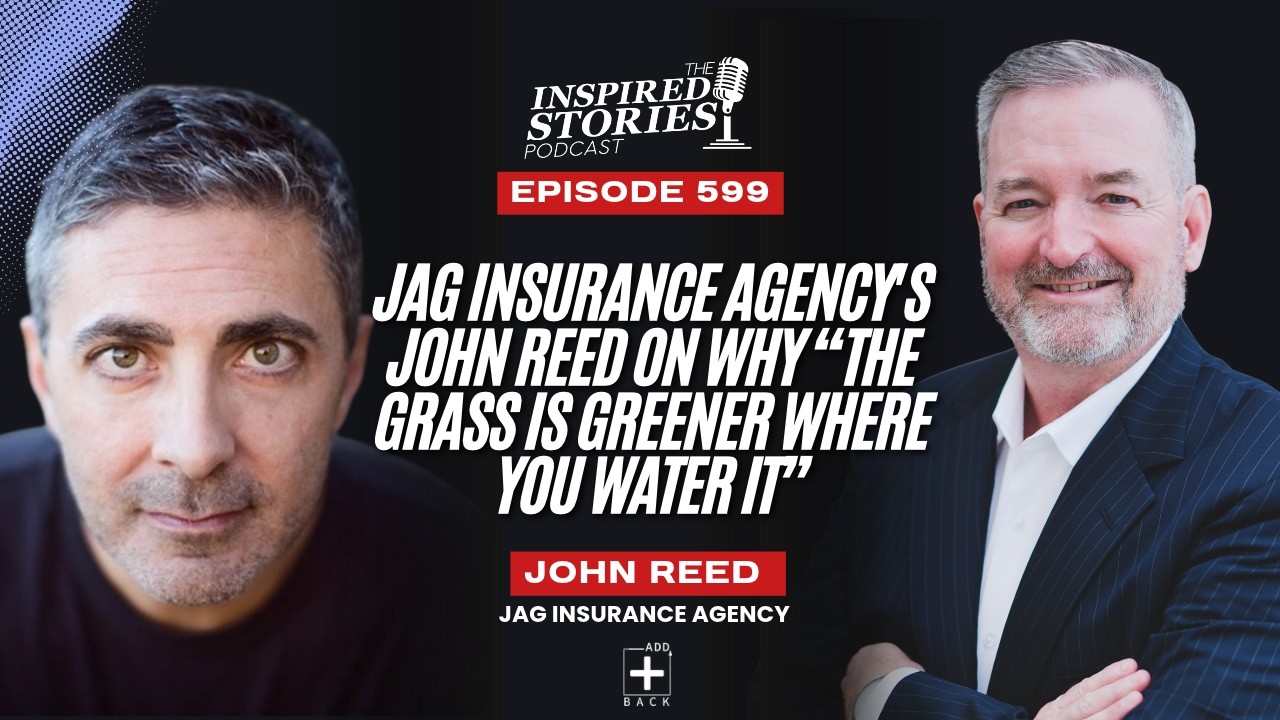
🎙️ Youngest Branch Manager in Company History: John Reed's Path to Founding JAG Insurance Agency
In this episode, John Reed, founding president and CEO of JAG Insurance Agency, shares a career that began as an 11-year-old newspaper carrier and stretched through the Marine Corps, two decades in newspaper and media publishing, and a September 11th newscast that finally pushed him into insurance for good. John opens up about quitting a six-figure executive job the same day his insurance license arrived, the $223,000 in debt he carried the day he left his prior company, and how a book his wife set on his desk helped him reinvent himself once more to build JAG.
✨ Key Insights You'll Learn:
Became the youngest branch manager in his newspaper company's history by age 15
Left insurance sales twice before committing full time, once after trying to serve “two masters”
Watched the September 11th attacks unfold live on a warehouse TV the morning after deciding to quit his media job
Quit his six-figure senior VP role the same day his insurance license came through in December
Turned an unwanted stack of leads in a distant, overlooked territory into his first major sales success
Built the second-fastest growing agency in his company's history within six months of relocating to Fresno
Watched his prior company convert independent agency owners into employees and cut his pay 40% in 2009
Was $223,000 in debt and sold personal belongings, including signed sports memorabilia, before founding JAG
Named JAG using his daughter's childhood idea, combining the initials of John, Ariel, and Gloria
Built JAG around exclusively representing A-rated carriers with genuine living benefits, rather than a broad carrier list
🌟 John's Key Mentors:
Nevin: The agency owner who first hired him, taught him his foundational sales philosophy, and later sold him the Upland agency for a fraction of its worth
His Wife, Gloria: His business partner and co-founder who supported multiple career reinventions and helped inspire the JAG name
His Daughter, Ariel: Invented the JAG name as a seven-year-old, later becoming one of its three founding initials
Zig Ziglar: A personal mentor John met and spent time with multiple times before Ziglar's passing, whose group even visited John's office
👉 Hear how a lifelong overachiever who quit a six-figure job the same day he got licensed rebuilt himself from $223,000 in debt to found an insurance agency built on trust and real living benefits.
Listen to the full episode here
Transcript
Anthony Codispoti (00:00)
Welcome to another edition of the Inspired Stories Podcast, where leaders share their experiences so we can learn from their successes and be inspired by how they've overcome adversity. As you listen today, let one idea shape what you do next. My name is Anthony Kotus Bodhi, and today's guest was a senior media executive who walked into a local insurance office looking for a career change.
The owner told him flatly that no executive would ever leave a job like that to sell insurance. Three months later, the day his insurance license came through, he gave notice anyway. Before that, he'd spent time in the U.S. Marine Corps and more than two decades in the newspaper and media industries, including six years running advertising for Auto Trader magazines in Southern California. Before september eleventh, two thousand one,
Pushed him to walk away from a senior vice president title altogether. He went on to spend 11 years building an independent insurance agency inside a national company. Then watched that company convert its independent owners into employees and cut his pay 40%. John Reed is the founding president and CEO of JAG Insurance Agency, an independent, non-captive insurance marketing organization based in Upland, California.
Which he co-founded with his wife and business partner, Gloria, in 2012. He holds the Chartered Advisor for Senior Living designation from the American College of Financial Services and was named the number one recruiter and number one producing agency in his regional group, six years running.
But before we get into all that good stuff, today's episode is brought to you by my company, Adback Benefits Agency. And you'll want to hear this because it's hurting almost every business you know.
Especially if you're in the insurance business, this could be something your clients want to know about. There's a program backed by Bain Capital Insurance that gives a company's employees unlimited access to doctors, therapists, and prescriptions. No copays, no deductibles. It works alongside whatever health coverage they already have, and it even covers part-timers who don't qualify for major medical. Here's the part that matters most. It's not a cost to your clients, it's a profit gain.
We recently helped one add $900 per employee per year to their bottom line. That's real budget freed up. Budget they can put toward the umbrella policy, the key person coverage, or the higher limits you've already been introducing to them. Results vary, but that's real money on the table, and you're the one who can hand it to them. See if your clients qualify at AddBackBenefits.com. All right, back to our guest today, the president and CEO of JAG Insurance Agency, John Reed.
Thanks for making the time to share your story today.
John W. Reed (02:51)
Thanks for the invite, Anthony. I I feel blessed. Thank you for for allowing me to be here today.
Anthony Codispoti (02:57)
Absolutely. Let's jump into it. So you started working at the age of 11, newspaper carrier, became the youngest branch manager in the newspaper company's history by 15. At 17, you joined the Marine Corps after high school instead of staying in publishing. You finished in the top five of your class in North Carolina. So there's a very early pattern of John Reed here overachieving. But you later found your way back to newspapers in nineteen eighty-four.
And started selling insurance part-time with A.L. Williams. Around 1990, you quit your newspaper job to become a full-time marketing director for a financial services and insurance marketing company that later became World Financial Group. Now that venture didn't work out, and you went back to publishing for another 10 years. But I want to talk a little bit about that venture that didn't work out because we learn a lot of things from the setbacks that we go through.
So talk to me about what happened and what you took from that experience.
John W. Reed (03:59)
Well, probably the biggest thing that I learned in that process is you really cannot serve two masters. I was I was being in the working in the the newspaper industry, I was successful in the newspaper industry, but I've always been an entrepreneur at heart and always wanted I I didn't want to be in having to work with s for somebody and and be beholden to
You know, answering to them what vacations I could take and so forth like that. So I've always been an entrepreneur. That's why I, you know, for my 11th birthday, yes, I asked for a newspaper rep for my birthday gift and I got it. I actually started on my birthday on April 5th, 1973. That is a true story.
Anthony Codispoti (04:39)
Okay, real quick, you asked for that as a birthday present?
John W. Reed (04:42)
Yes. And you had to be 11
Anthony Codispoti (04:44)
I didn't
John W. Reed (04:45)
back then.
Anthony Codispoti (04:47)
That's great. My for my birthday I want a job. Love it. All right.
John W. Reed (04:48)
Yeah.
Well, I wanted to be able to buy my own school clothes. I you know, my mom was working for Kmart at the time and anybody knows anything about Kmart Blue Light specials, you know. I got tired of the Kmart Blue Light Specials, so at an early age. So yeah. So that that's correct.
Anthony Codispoti (05:04)
I feel ya. So you can't you can't serve two masters. Let's go back to that. Okay.
John W. Reed (05:11)
So I tried, you know, for six years, had some great mentors there, but I I just failed. I just didn't really
I I couldn't put in the time. you know, and it's also very tough. I understand, especially in the beginning, if you're trying to do something part-time and you got a full-time job, it it's not easy. You have to work a little bit harder and give up a little bit of actually a lot of time with family and friends if you're gonna really, really build it. And I just think I I didn't necessarily put a hundred percent focus on that for those six years. I've as I as you and I talked in the beginning, I I failed at it miserably. I could speak.
I could get in front of a group of people and talk to 20, 30 people, but I I I just I it was the it was the serving the two masters issue. So when the opportunity came around to when the A Art sold the company and be able to go with a group that formed what is now WFG, I decided, you know, I'm gonna have to make the leap. I'm gonna have to be full time at it. I'm gonna have to focus a hundred percent at it, and I'm gonna that's just
only way I'm gonna be successful is I only serve one and and focus on one entity and building my career.
Anthony Codispoti (06:23)
And so you went back to publishing at this point. Am I understanding that? No. Okay.
John W. Reed (06:25)
Well, no, I I know I I quit publishing. I quit
I I quit the newspaper industry and went full time. And actually I was at the launch of what is now known as WFG in Georgia, and I think it was in nineteen ninety. And I spent a year and a half with them as we went through that cycle of being Alexander Inc. and then World Marketing Alliance. I don't think it became WFG until many years after I had left them. And
Anthony Codispoti (06:49)
And what was
the work that you were doing there then? Once you committed there, what were you doing?
John W. Reed (06:53)
So one of the things when the when WFG first launched, when it was Alexander Inc. and WMA, was about building an alliance. That's why it was called a world marketing alliance. So I was blessed to to have a a couple great mentors from from A.L. Williams, a gentleman that actually started with art back in the 70s was one of the original CEOs of WFG and is actually still very close and personal friend to me today.
He helped me. We actually kind of we flew around to a couple different entities in the country. My whole thing was about recruiting other organizations into WMA. So I would I would fly up to San Francisco and Arizona and spoke with a company out of Florida trying to recruit their their agents into and build this alliance called WMA at the time. And I spent a year and a half and making no money doing that, basically.
And at the end of a year and a half
Anthony Codispoti (07:47)
Making no and why
weren't you making money? Because you just like was your job to build your own book as well, or were you only
John W. Reed (07:54)
Yeah it was.
Yeah, it was. But you know, I I I know where my asset I c I can sell, that's not an issue. I've done over you know, millions personally, but I I think I I found out early on where my were
where my skill sets really are is in in training and helping others succeed. So when I made that leap, I made the decision that I am just going to completely focus on recruiting, training, and helping others be successful in the in the field. I really didn't focus a lot on personal sales. I wanted to help build an organization, I guess. And that was my philosophy. maybe a little misguided. I probably should have also worked on focusing on
you know, selling products and services. And then so and then about a year and a half into it, the the company philosophy, you know, took a change a little bit as to products they were gonna sell and so forth. And unfortunately at that time they were just products that I I couldn't believe in. So I and being a year and a half into it and almost broke completely basically just made the decision to go back into the publishing industry at that point.
And get a full time job. My wife has been extremely supportive through the whole process. But after a year and a half, you know, she's probably she didn't tell me, trust me, she didn't tell me, but I'm sure in the back of her mind she's like, Dude, you gotta bring money in. We need food on the table. So
Anthony Codispoti (09:21)
Yeah.
Time for a
paycheck again. So you're back into publishing
John W. Reed (09:24)
Time for a paycheck.
Anthony Codispoti (09:26)
and how long are you in publishing before you feel the pullback?
John W. Reed (09:30)
Ten y ten years.
Anthony Codispoti (09:32)
Okay.
John W. Reed (09:32)
so I I started back. I actually started at a local business publication here and then I was recruited to Auto Trader, where I started out as their circulation manager and shortly got promoted as their ad ad manager for Southern California and spent six years with them. and then briefly launched a publication here in Southern California with a partner. We both basically ended up
getting recruited to the organization that took over some of the assets of that company. He stayed with them. I didn't. And then was recruited back again to the company where I was an ad director before in between that publication and and auto trader and stayed there for another three years and then was recruited a ahead.
Anthony Codispoti (10:15)
Was this w sorry,
go ahead. Was it was this where you were September eleventh, two thousand one?
John W. Reed (10:21)
No,
so September 11th. So in and in just a year before September eleventh, I was recruited to one of the largest independent distributors of publishing products and and magazines and newspapers here in Southern California. And I I hated it. I I I just I I don't know. I there was something inside of me I I I needed something. I wanted to be the daddy monster on my daughter's playground. That that's a true story. I wanted to be yeah,
Anthony Codispoti (10:47)
The daddy munst what does this mean?
John W. Reed (10:50)
great.
Well, my daughter I I wanted to be the dad that could go to my daughter's school, preschool, kindergarten, whatever. She she was in preschool at the time, and go to lunch. And, you know, parent certain parents would come and help, you know, supervise the kids. I wanted to be the the guy that so all the kids viewed me as the daddy monster because I play this monster with these four and five-year-olds chasing them around. You know, I wanted to be the daddy monster, as they say on the on the playground. And
Anthony Codispoti (11:15)
You wanted flexibility.
John W. Reed (11:17)
Flexibility completely. The whole the whole reason I jumped back in in the industry was i it it it's it the money can be there, but it was never about the money. It was about the freedom the to be there for for my daughter. I was actually the Girl Scout cookie manager when she was in junior high school, you know, one of only one out of eighty people that was a male as a cookie manager for Girl Scouts. You know, that was that was what I wanted to do. And
And I really hate I hated my job. I was driving 45 minutes every morning. I was having to get up at 3 30 in the morning. I was I was missing, you know, going to lunch with my daughter. And and then I'm standing in the warehouse you know, as the drivers and and so forth are getting ready, and we had this big screen TV. And the day before, some announcements, I'm not gonna talk about the announcements, were made by the president of the company. And I went home the day before and told my wife, I
I I can't work for this company anymore. I I I the direction I I I I can't go home to my daughter at night and say daddy distributes these types of publications. You know, some people can, but I have a certain compass that I have to follow. And I said, I I I just I just went home that night and said, I I I I I can't do this. I just can't. And then the next morning we had this big screen TV in the warehouse and I thought they were all watching a movie.
That is a tr I'm standing there and going, guys, ladies, come on, we gotta, we gotta get I'm telling the managers, you gotta get your guys, gotta
get them out. We're running behind. They're all just standing there doing nothing, looking at the TV screen. And I said, and I made the comment, please stop watching the movie. We gotta get this stuff going. And one of them goes, Mr. Reed, that's not a movie. That's happening in real time. Like, what are you talking about? And sure enough, it was the planes going into the World Trade Center.
Anthony Codispoti (13:12)
Nine eleven, two thousand one.
John W. Reed (13:13)
9-11.
Yeah. And I went home that night and told my wife I'm quitting my job. Don't know what I'm gonna do, but I can promise you something. Every bill will be paid, there'll always be food on the table, your lifestyle won't change. I will find something that I believe in that'll take care of our family. And I made the decision
Anthony Codispoti (13:34)
So you made
John W. Reed (13:34)
that day to quit.
Anthony Codispoti (13:35)
you made the decision, made that announcement that day. When did you actually quit and when did you settle upon what was gonna come next?
John W. Reed (13:44)
Great question. So I started looking for I because I don't want to work for somebody. I started looking for business opportunities. I started looking for things. I had a very close friend that I met at the gym back in the 80s. He was a janitor. He owned a janitorial cup, very small. because of my positions at the one of the local newspapers here, pretty large newspaper, I was able to get him connected to the right. He ended up being the janitorial for a six-story building that had thousands of employees in it.
And so forth. So I'm like, if he can do that, I can do that. And I I I saw a Janny King franchise ad and started researching it. And then I saw this little ad that said, health insurance agents wanted. A health insurance product that allows you to go to any doctor, any hospital, anywhere. And I said, Okay, that's a little bit different twist on the insurance I was used to in the past. Let me go check it out. So I sent my resume.
No response. Sent my resume again. No response. Finally, I did some research and I found a local office that was about 15 miles from where I lived. And I called him and I spoke to the owner and I said, Great guy, by the way, Niven.
And I said, I I've been sitting my resume, why are you guys not talking to me? And he said, Nobody's ever gonna call you, John. You're a senior VP of a distribution company. And
Yeah, executive. Nobody's ever gonna believe you'd quit and come be an insurance agent. So but if you really want to come for an interview, come for an interview. So that's what happened. I went in for an interview. He did his presentation. I said, Well, if your product does what it says it does, I can get behind it 100% because at that time we were having some family medical issues. And I said, if your product does what it says it does, I will I will be one of your most successful agents. I truly believe that in my heart.
So I made the decision right then. And back then, it wasn't like today where you can do, you know, go online and get your license within a matter of a couple of weeks. Back then you had to physically sit in class. So I did three weekends in a row, Saturday and Sunday, and then I took the test and and passed. And I actually got my license on December twenty sixth, and I quit that day.
Anthony Codispoti (16:04)
Same day you got your license.
John W. Reed (16:06)
Same day I got my license. I walked in, said I'm quitting. And the president, exact words to me, were, you're quitting me to sell insurance. That was his reaction. That was his body language. I said, yes. He goes, let me get this straight. You're quitting me in this company to go sell insurance. I said, yes. He couldn't believe it because I was making six figures. It wasn't about the money at all. It was about, I wanted control of my life. I wanted control of my destiny. I wanted, I wanted to be able to be there for my
family and not have to ask somebody's permission. And I was willing to pay the price, the dues, so-called dues, to be able to make that happen. And and you know, I just I set a plan out and my wife basically said you have six months. We had she already went through this for a year and a half with me back in the early 90s. She said you have six and a half months. She wasn't she actually went back to work to make it happen for a little bit.
Within two months of of getting back in the insurance industry, she quit her job and then and then joined me and helped me.
it was going very well, actually. Actually within within two weeks. So what
Anthony Codispoti (17:11)
Because it was going so well? Just within two months. So tell me what those first two months looked like. What were you? That's phenomenal.
John W. Reed (17:21)
I so what happened was back then leads were different back then than they are today. So it was like my second day with the the
Well, first of all, I took thirty days when I quit. I gave thirty days notice. I those thirty days I started making appointments. So I had like twelve appointments my first week, which is, you know, I just worked it.
Anthony Codispoti (17:42)
And how were you making the appointments? What in what fashion were the leads coming into you? You just have an Okay.
John W. Reed (17:47)
I wasn't getting any leads at that time. I
was just, I was just telling people, hey, I got my insurance license. I'm gonna be selling amazing health insurance. You know, anybody that wants health insurance, have them reach out to me. And and by the first week I started, I had 12 appointments. individual. I wasn't selling the companies or anything like that.
Anthony Codispoti (18:01)
So this is individual policies, you're not selling to companies, okay? Yep.
John W. Reed (18:07)
So, like the second day I'm in the office, I walk by the office manager's.
Desk and behind her she has a credenza and the bottom doors open and there are stacks of leads. And I'm like, what do you what are you what are you doing with those leads? And she says, those are in, if you know anything about Southern California, she goes, those are in the Antelope Valley. Nobody wants to drive to the Antelope Valley. I'm like, I'll I'll drive to the Antelope Valley. I don't care, it's an hour and a half away. You know, hour and a half to two hours one way.
Anthony Codispoti (18:37)
They didn't want to go because it was far away
or because it wasn't the right target market? Like why were people turned off by it? Don't know.
John W. Reed (18:43)
I
I don't know. I I'm from Kansas, so I fit into Antelope Valley. I sit I fit into to Central California. I speak the language, you know, to a certain extent. So I'm like, I'll go there. So my wife and I set up a system where I would go up there two days a week. We would schedule anywhere from four to six appointments a day. And if somebody didn't show, because I was known as the no show king, I had more no shows than anybody, I never confirmed appointments. I went and knocked on door. It's different today.
And but if I had a no-show, I would go to the sit at the library and call my wife and and she would open up the leads and call a lead and try to schedule an appointment with me for in the next 15 or 20 minutes before I had my next next appointment. And l literally nobody
Anthony Codispoti (19:26)
Somebody else who is in that same area. She would try to schedule.
John W. Reed (19:30)
else was in that same area. There was no other agent work in that area at all.
Anthony Codispoti (19:34)
No, no,
but I mean she was calling somebody else who lived close by to where you were, try to get you an appointment
John W. Reed (19:37)
Yes. yes.
Anthony Codispoti (19:39)
so your trip there wasn't wasted.
John W. Reed (19:41)
Yeah, I mean we had access to abundance these were old leagues. These weren't necessarily somebody that called the day. I didn't care. I learned very early on, you know, from from Niven, who owned the agency at the time, he said, John, you know, let me give you two pieces of advice. first of all, at some point in somebody's lifetime, when are they gonna need health insurance? At some point in their lifetime. At some point in their lifetime, when somebody is everybody gonna need life insurance? Correct. He goes, Well then your job's just to catch them at the right time.
A lead is nothing more than a name or a number, whether it's a day old or a year old. It's just a matter of catching them at the right time. And then he also stated, because we were very limited on product of what we had. He goes, our and the products were great, in my opinion. And he said, look, the grass is greener on the other side only because they mow and fertilize the grass. Mow and fertilize your grass.
And I took that concept and and I just I ran with it and I built a system. I never worked more than 40 hours a week. There's a myth in our industry that you gotta work 70 hours a week. You gotta get no, you don't. You just gotta work smart. I never missed a dinner with one of my never missed a dinner with my family. I was the daddy monster on the playground. We went to Disneyland almost every Wednesday. We took off Wednesday afternoons, but yes, in return, I work Saturday mornings.
Or maybe a Sunday afternoon if my Kansas City Chiefs weren't playing. But but in return, I had dinner every night with my family. I was a daddy monster on my daughter's playground. I took my daughter to school every single day. Got up at 5:30 in the morning to take her to school as she got older until she got a car to high school. Those were things for me that was it was more important than making a ton of money. Or or, you know, you see all these people promoting, you know, drive the great car or
I was never into that. you know, I my car today is in 2017 Toyota Yaris. Gets 34 miles to a gallon and as many miles as I drive, I love it. You know, I had the Mercedes and hated it, especially the first time I went in to get it fixed.
Anthony Codispoti (21:45)
So you were pretty
successful right out of the gate because you were just willing to work.
John W. Reed (21:48)
Second time. Mm-hmm.
Anthony Codispoti (21:50)
Second time around, yeah. But within the first two weeks, you're saying it's already very successful. Within the first two months, your wife, who had gone back to work to help you guys make ends meet in the meantime, she she could quit her job because now
you had enough income
John W. Reed (22:06)
Definitely.
Anthony Codispoti (22:07)
coming in from this new insurance business that you'd start.
John W. Reed (22:11)
In fact, when I joined, I told Nevin, don't ever ask me to be in leadership. I don't want to be in leadership. I was 20 plus years in leadership. I want to just do it for myself. He bugged me every single day after the second week of working as agency to be a district manager. Finally, by the ninth week, he he he beat me down enough to be a district manager for him. And that's when I started recruiting and training other agents.
Anthony Codispoti (22:37)
okay. So you were really excited about the path you were on, but very quickly he wore you down and so you shifted into more of a leadership role again. And so now you're just responsible for training all the other agents.
John W. Reed (22:52)
Well, I still had to do personal sales. I had a minimum quota. Fact, it's funny, is the first week I got promoted. so the whole goal, there was this line, set 10, never blink, set 10, never blink. Meaning set 10 appointments per week and help at least one client per week, never blink. And as a leader, that was expected of you. It wasn't try it, it wasn't hopefully you do it, it was expected of you.
And my first week, it's the first time, my ninth week, I'm actually blanking a Friday meeting, our regional vice president was coming in to meet me and another person that got promoted. And we met early Friday morning and both of us had no sales for the week. That's the last time I had no no sales before I showed up for a meeting. actually, I had a sale by the time we met in the afternoon. She she said, Look, you you both better come back today, having helped one person.
You you we don't promote you so you can sit down and eat bon bonds and make overrides on everybody else. You will sell, you will recruit, you will train, and you will help others be successful. And the only way you're gonna be able to do that is you have to be a personal sales leader yourself. And we did that.
Anthony Codispoti (24:06)
So so how do you get
compensated on other people's deals? You get a percentage of that, or you just getting like a fixed like, I helped you today, so
John W. Reed (24:14)
It's a it's
an override. It's very common in the insurance industry. So like even now, we're an IMO, depending on the the product, insurance marketing organization, field marketing organization, or MGA, each insurance company has different levels. And then you have what is called, you know, street commissions basically, where you know the carriers say, Okay, this is the highest commission you can give somebody without production and recruiting requirements and stuff like that. The carriers typically set those. So all the agents got the street level basically,
commissions that were set by the carriers and then as the district managers we got an override paid by the carrier, a certain percentage, not off of the agent's percentage, but paid by the the carrier to us. So it didn't impact the the agents commissions basically is how it was. So yeah, I got a I even to this day, I mean that's just how our industry is set up, basically.
Anthony Codispoti (25:06)
Gotcha. Okay. So you're working in the insurance biz, you're finding some early success, you step into a leadership position, things are going really well, and then what unfolds? How do we how do we get to jazz?
John W. Reed (25:20)
Great question. So I'm from the Midwest and I I had an inkling to move back to Kansas, to Kansas City. And an operation, even though we were independent, we were captive. And even though we technically owned our our agency, you know, the agency owners owned their agency, they were it's it was a it you really didn't. It was a contract for lack of a better description. Like a fran I used to describe it like a franchise contract. You know, they could come in and take it if they wanted to, basically. Kind of like
other insurance things. So I heard that the Midwest operation was becoming available and I let the R V P know that I'd be very interested if that were to happen and and go there and take over that agency and make it into something
really big. And the R V P I I love to this love she's passed away, but just a a a great individual said I I appreciate that, but we wanna send you to Fresno, California.
And I'm like, well, where's Fresno, California? I truthfully had not heard of Fresno, California. So she's like, well, if you like Kansas, you're gonna like Fresno, California. She goes, We really need somebody. We think that's a great market, but nobody's been successful at it. Nobody's been able to do it. We've tried it several times. You may be just the right person. She said, Just you and Gloria go up there and take a look at Fresno. Well, I fell in love with it right away.
I'm I'm you know it's farm country. You got you know farmers, all different ethnicities, but tons of farmers. Yeah, you you got your big city, and then five minutes outside of the city, you're in farm country. It's like, you know, I'm in Kansas without being in Kansas. Took a little convincing of my wife because we lived in our two-story home for 16 years, and that's where our daughter had had grown up and was, you know, born. And but she agreed and
Under the under the agreement that if we go to Fresno and open up an agency for the company, we have first rights at any available agency that becomes available in Southern California, where all of her family is. And they agreed, they said, but it's going to be three to five years. We're okay, we we'll do a three to five year plan. So we went up to Fresno and originally started in a in a little executive suite.
Two months later, moved into a much bigger office. And within six months, we had built the second fastest growing agency in that company's history.
Anthony Codispoti (27:55)
What were you doing right?
John W. Reed (27:58)
I I it just comes down to it's a great question. So I the best example I can give is the gentleman that got promoted the same time as me. He could never figure out why my team always beat his team. And I said there's only one reason why. I answer the phone.
If you would call me at eight o'clock at night in front of a client, if you let me know you're going to be in front of a client and you call me at eight o'clock at night in front of the client, I will make myself available to take that phone call so I can help you answer your client's questions.
I think it just comes down, honestly, of being there for the people that haven't they've they've they've given you basically the opportunity to say, hey, I trust you, I believe in you.
Not to do it for them, but to be there to guide them and mentor them to help them be successful and to be honest with them. To be, you know, I'm I'm very honest. If you're I brought I brought my number one ad sales rep with me from the newspaper in the insurance industry, and he failed miserably. And he failed because most people don't have the discipline. They work for somebody, you're told to come in at eight, you leave at five.
Here's your quota. If you do it, you're good. Well, if you're self-employed and you don't have somebody calling you every morning telling you got to be there at eight and be there at five, there's some people that are great salespeople, but they need that major structure. And I'm very honest that if you are not self-disciplined, if you're not willing to wake up every day and look at your wife and kids and say, I'm doing this for you, then you're in the wrong industry. Any industry that you have to be self-employed and dependent upon yourself at.
So I'm very, very open about that. That you know, you don't have to work 40 hours. I've never worked more than 40 hours a week. You just gotta work smart. Have a plan. I used to have the Excel, you know, calendar out. Okay, this time is when I call, this time is when I'm in front of clients, this time is when I'm doing education. This, you know, I had it all set up. And yes, it was flexible if I had to change or whatever. But I think the difference is.
Anthony Codispoti (30:03)
You'd set up that sh
you would set up that structure for yourself that a lot of other people need the boss to do for them. Right. You would put the
John W. Reed (30:10)
Correct.
Anthony Codispoti (30:11)
like here's what I got to do, 10 meetings a week, et cetera, et cetera. Like make sure that I'm doing everything I need to do every day, make myself available for to the team members when they're in front of clients. Just this wasn't like brain surgery. It was just, it was discipline.
John W. Reed (30:25)
Correct.
And I think it's getting out of the nine to five mindset. We we've grown up as a s society to be in a nine to five mindset. Well, guess what? My weekend for the first ten years back in this industry was on Wednesday. Boy, it's great to go to Disneyland on Wednesday when nobody's there. It's great to go to the bank when nobody's there on Wednesday. It's great to go to the grocery store when guess what? Wednesday was Saturday to me and my family.
That was the difference. We just had to get out of the mindset that got to wait till Saturday to go do something. No, even to this day, we don't go out on Saturday and Sunday. Why? Because everybody else is out on Saturday. When we do road trips, we leave on Sunday and come back Thursday. Yeah. Because nobody else is out there.
That's the beauty of being self-employed. But you got to have the discipline. You got to be willing to do what you got to do.
Anthony Codispoti (31:20)
So you build up the agency, you end up selling it to one of your managers and bought back the original agency that you started at, right?
John W. Reed (31:28)
Yes, yes. So I got a call. I ended up at a dinner. We there was a big company event, and I ended up a day early at the event. I don't know how. And the regional for Southern California, the new regional for Southern California, had his team there and invited me to dinner with them. And we got along really great. In fact, today, I'll in fact I'll see him on Wednesday. He's retired. I'm taking him to lunch. We c I call in BFI, business best friends in insurance. We became super tight.
And he said he didn't know about my original deal of being able to come back in Southern California. And he said, Hey, I have an opening coming up in Orange County. Would you be interested in moving back down and taking it? I'm like, Yes, of course. That was my deal with the company. This was only 10 months after going to Fresno. And I get a
Anthony Codispoti (32:20)
That three to five year plan got accelerated.
John W. Reed (32:22)
got accelerated, right? So
The what was it? The f like a few days after the event, we come back and Niven, who owned Upland, called me up and said, you know, I'm 62. I got three more years to go before I can retire and be fully vested. I'm bored. I'm stuck. I can't move this agency. What if I sell you my agency for pennies on the dollar? Which he did. He literally gave it to me.
You really don't buy the because you don't buy the residuals or anything. Those continue can what you're really buying is the you know the furniture and stuff like that for the most part. and then future earnings of that agency. He said, I'll sell you this and let me take over Orange County and buy Orange County. I'm like, not a problem. I'm I'm good with that. So 10 months later, we moved back down.
And take over the upland operation at that time that was it was struggling, but understandable. Livin Nevin had struggled a little bit. He had a couple managers that, you know, were doing some things they shouldn't have been doing and so forth. And so when I came back and and took over, I just said, you know, this is what we're gonna do. We're gonna be the number one agency in our region. We're gonna we're gonna do things this way, we're gonna do it the right way.
I kind of took the same model I did at Auto Trader and I I increased our our manager, district manager from two to five. And I I I just it was about training and supporting and growing and yeah, so we went from to five managers, yeah. yes.
Anthony Codispoti (34:00)
You what did you do to the district manager? You say increase two to five? From two managers to five managers or okay. It's brought in more more leadership.
Okay.
John W. Reed (34:11)
Yeah, brought in more leadership. same thing in Fresno. As soon as I took over Fresno, we had eight agents that we had brought on board in the last in the first couple months before I actually physically moved up there. I immediately promoted two to manager's position. One of which I sold the agency to as well. you can't do it on your own. If you're gonna build an agency, you can't do it on your own. I couldn't have done it without my wife. That that's true, truthfully. The support and you know, if you don't have
You gotta have, you gotta first you gotta believe in it yourself. If you believe in it yourself, then you know, your partner, your spouse or or or whatever will believe can believe in you. But if if you dilly-dally about your confidence in yourself, you know, your partner's gonna dilly-dally your confidence in too. They know you better than anybody else.
Anthony Codispoti (35:00)
So you you came to Upland, take over the agency, you promote some folks into leadership roles, you put in a lot of the discipline and the structure that you found be successful other places, and how long did it take before you started to see results?
John W. Reed (35:16)
Pretty pretty quickly. we turned the agency around and
probably in just a few weeks or a couple months. In fact, we we broke on the first nationwide contest, we broke a half a million in premium in one week for the first time ever. And I think that was in the first two months I was there. we became we became the number one recruiting agency, the number one selling agency, number one persistency agency in our region.
persistency, I don't know if we were six years in a row, but definitely recruiting and sales, we were six years in a row before it became an employee type situation.
Anthony Codispoti (36:01)
And that's
where I wanted to go next, right? Because in 2009 they decided to stop operating as a network of independent agency owners and reinvent themselves as a national agency.
John W. Reed (36:12)
Correct.
Anthony Codispoti (36:13)
And they converted the they only kept some folks, but the ones that they kept, they converted into employees. And
John W. Reed (36:20)
Correct.
Anthony Codispoti (36:20)
your pay got cut by how much?
John W. Reed (36:23)
Forty percent.
Anthony Codispoti (36:25)
How how quickly
John W. Reed (36:26)
Yeah,
Anthony Codispoti (36:26)
before you said I'm out the door?
John W. Reed (36:30)
me I already knew. That's why I went back to I I I had already made the decision. It's funny. In two thousand and four the president of the company asked me at we were at event, asked me, John, if we ever made you employees, what would you do? I looked him right in the eye and I'd say I I'd tell you, F you, I'm quitting.
I was not gonna work for somebody. However, you know, if anybody remembers 2009, actually the economy had been going down since about 2007. I for 2009, I basically didn't eat. I mean, it went way down. I I wasn't even covering our monthly expenses that entire year, not even close. but you know, I'm I'm what's that?
Anthony Codispoti (37:11)
Nobody had money for health insurance.
Said nobody had money for health insurance.
John W. Reed (37:17)
No, no money for health insurance. You know, it it and then when you when you have a company that says, Hey, we're sunsetting the product, you can't sell it anymore, but we can't tell you what we're gonna do six months from now. You know, but hold on, you'll like it. Or nine months from now, you'll like it. But then and and nothing disparaging, you know, they the I I I'm
I I get it. They had to make the switch. A lot of the regional health carers, even though we were a two billion dollar strump company, a lot of them left the industry when they when the passage of the Affordable Care Act. I think the third largest national health company left the health insurance industry at the time too. So it's it wasn't uncommon. But at that at that point, you know, I had a decision to make. And that is, okay, economy's bad. I got somebody that's gonna guarantee me sixty percent of my income. I'm gonna help them.
launch and build this agency and in the meantime I'm going back to school and learn more other things about this industry so that eventually I I can leave. And that's what I did.
Anthony Codispoti (38:19)
And so is this when you went and got the chartered advisor for senior living designation? What does that allow you to do?
John W. Reed (38:23)
Yes.
Anthony Codispoti (38:24)
What is that designation?
John W. Reed (38:26)
Not much except it looks fancy next to my name on a business card. But the reason I did that is our origin our original thought was we're gonna get out of the under 65 health space. We were only gonna do it as a value added, which is we've still been in the space for 25 years basically. but I wanted to focus on the Medicare, the
You know, long-term care, the final expense, that type of product. I thought that was the the best direction at the time to go, particularly the final expense space. So I did in that two years, I did a lot of research on
how final expense carriers operate and and things of that nature as well. So by the time that it it's funny is I I got I got my designation degree on February first. Can't remember what day of the week that was, but the Friday of that week I get an email. I already knew by the way that I was going to be terminated. I knew back in October the year before. I was not they they
A lot of corp I one of the things I've learned about corporations, especially when you get a higher up, they have to become your family. Most people don't realize that, I wanna be an executive, I wanna be a C you know. But the reality of it is a lot of times you have to to to do that. And they don't want to hear the the
You know, the reality of what's on the ground. And I knew early on when they made the switch that I probably was not going to be a good fit. I because I'm very transparent and very honest. So I would let them know like they had a product that they put out and it took out the top two benefits out of the product and still kept it at the same price. And I told them we're gonna lose more than 50% of our clients in that product. And they were like, Well, nobody else in California is saying that. And I said, Well, maybe they don't know their market like I do. And at the end of the year, I was wrong.
We only lost 49% of the market. And every other agency in the in the in the state that had only projected a 3% loss had more than 50% loss. So who knows? But I knew that I wasn't going to be long-term with the company. And I was okay with that. I had already, you know, planned on leaving anyway. You know, they treated me right when I left
and you know we we left on good terms and that was that.
Anthony Codispoti (40:42)
So tell us how Jag
got started. And what does JAG stand for? J A G.
John W. Reed (40:47)
I'm glad you asked. This is actually my daughter, our daughter invented this name when she was seven years old. She's 30 now. We wanted to start a mortgage company on the side with my wife back in 2000. We were going to actually in 2007. It was going to be called JAG Financial Services that my daughter had came up with. Well, if you know anything about the real estate market, it actually started going down in 2007. So we decided not to do that, just to hold off.
So when when we decided to launch JAG, again it was my daughter and wife said, well, let's let's use this name. And so it's the initials of our family, J for John, A for Ariel, our daughter, and G for Gloria. In our original logo, we had our yellow lab.
We just changed this to look more corporate sent after the pandemic because we were really California-based. Now we're across the country. We have agents selling across the country. We have agents in other states and so forth that we work with. And so that's how we come up with the name. But it's a great way. So I I'm I'll go to to networking groups. Like if I'm in a Christian network, I'll go Jag doesn't stand for just an awesome God, even though he is one. Jag doesn't stand for just an awesome group, even though you are one.
And then sometimes like the one we just went to, Jack doesn't stand for just an awesome Gloria, even though she is one. I get a lot of mileage, my friend.
Anthony Codispoti (42:07)
You get a lot of mileage out of it. I love it. Okay,
so tell us what Jag is today. What do you do? Who do you do it for?
John W. Reed (42:16)
Great, great question. So we basically work with independent agents and agency owners across the country. Still about 80% of our agents are here based out of California. California is a unique market. It's still one of the only four or five ACA tax penalty states when it comes to health insurance programs. It's difficult to get approval for insurance products in the state of California for whatever reason. I don't mean that negatively. It just it is what it is. There's several states like that. We understand the California market very, very well.
and we understand our our products and the market very, very well. So we work with independent agents and agency owners to help them incorporate certain niche products within their portfolio to help them grow their business. One of the niches that we found when we launched JAG initially was working with P and C agencies and teaching them how to incorporate non-medical life insurance into their portfolio.
Being able to say after they sell somebody auto insurance or homeowners insurance, can I give you a free quote on life insurance where you don't have to take any medical exams and I can have a decision for you in about 10 minutes while you're here. And we just found that niche. And in fact, one of our biggest agencies when we launched was a P and C agency doing three to five million a year on the P and C side. And we taught them how to incorporate the non-med on the life side and
Unfortunately for us, they ended up selling their agency because they did so well a year and a half later. very happy for them to to do that and and since moved on. But that's kind of been our niche. We work with you know independent licensed health and life agents, non-captive, so they're kind there's no contract with JAG. We've been blessed. I we were able to when we launched JAG.
Give you a little backstory is I started calling carriers saying, I'm looking for a contract, but I need a recruiting contract. Almost all of them said, No, you have to start off as an agent. You know, we don't give recruiting contracts. And I happened to have somebody call me, or I maybe I call I called one of the carriers and they referred him to an me to an FMO who called me. His name was George. And
So George is trying to recruit me. And I said, George, I'm gonna be honest with you. I'm not looking for an agent contract. Look, I I've done over 60 million in new premium in the last eight years. I've done over a hundred million in premium. I don't say that to brag. I'm just telling you. I know, I know how to recruit, train, and help people be successful in the industry. I need a contract that allows me to do that. And then he paused and said, Well, then you're talking to the wrong person. I'm gonna have somebody call you.
And the president of a large FMO out of Texas called me after speaking with me, flew out and met with me and offered me a IMO contract from day one for for several of the products.
Anthony Codispoti (45:15)
And explain to our listeners
what that means.
John W. Reed (45:18)
So in in the insurance industry, I I know that you have your multi-level marketing. I'm not talking about the multi-level marketing side, but in the insurance industry, you have levels of responsibility. So you have the agent or broker, that's the street person. You may have what is called a GA, a general agency, BGA, big general agency. A GA is losing somebody's storefront, has two or three agents, somebody like that. A BGA is maybe somebody's got hundreds of agents, and then
Then you got what you call MGAs, IMOs. Those are typically huge organizations that have thousands of agents across the country and so forth. And then an FMO is typically your top tier. They control like certain FMOs actually control certain products that you have to go through them to get that carrier, if that make makes sense. They offered me an IMO contract, which is one level above MGA in most cases, or it equaled MGA, it depends on the on the carrier, from day one.
But they offered me a higher level IMO contract with production requirements. They said I had to do $1 million in the first year, otherwise they would demote me. I said, well, I don't want to be demoted. I'm not going to guarantee you a million dollars your first year. So give me the highest contract you can give me without me having to meet a million. So they bumped it down and gave me the one level. So I took a temper they offered me 10% higher than what I said I would agree to, because I didn't want the production required in my first year.
Well, we ended up by the end of the first year getting promoted. In fact, we've about two levels above that now.
And ended up being their fastest growing IMO for for two years in a row when we were under them for the for the two years we were with them.
Anthony Codispoti (46:59)
So you're good at selling, you're good at recruiting, you're good at training. Talk to me about what the recruiting and the training of new agents looks like. What's your system?
John W. Reed (47:07)
It's different today than what it was before the pandemic. I can tell you that. So before the pandemic in our age in our industry, we were basically face-to-face, kitchen to table. We used to call it belly-to-belly to give you an example. Well, the pandemic changed that. Before, most of the insurance carriers, they weren't virtual. They weren't electronic. It was still paper apps. It was still, you know, all that. That pandemic changed all that.
Not saying the pandemic was good, but I tell you what, it did make our industry change dramatically over that time. So I it's a lot easier now, I think, to get or reach out to licensed agents, but it's a lot more competitive and harder now because everybody has access to that exact same data now as well, or that that exact same recruiting list and so forth like that. I think the biggest difference with us is we have a saying, you will not fail here due to a lack of training.
Or a lack of support. So every every Friday we put out an agent newsletter with the upcoming webinars. Every Monday we send out a newsletter with just the webinars. I think this week we have like nine scheduled to give you an example. You can pick and choose which ones you want to be with. Some folks are with us on the health insurance side, some folks are with us on the life insurance side. Some of us, some folks are just with us on annuities. So or or all three.
you want to stay focused on. Then the second thing we do is that we do customized individualized training. So I will go personally to an agency owner and their agents and do customized training on their behalf. We act as the agency owner's trainer. So when we go there we're not I'm not here on behalf of JAG. I'm here on behalf of XYZ agency. I work for them. I'm their training man they and most of them actually this is our training manager.
So I I think the the thing that really sets us apart is just that. We don't do the rah-rah meetings. I don't have, you know, you know, every nine o'clock on Monday mornings you come here, we're gonna motivate you. I actually had an agent once say, Hey, can you call me on Mondays and just give me a motivational speech? And I'm like, Are you married? Yeah. Do you have kids? Yeah. That should be your motivation. I'm not gonna call and babysit you. Come on. You know?
Anthony Codispoti (49:32)
Okay.
John W. Reed (49:33)
So
I think that's really what sets us apart. Plus, we're pretty picky about who we work with. Now, now, before I would recruit non-licensed agents, you know, I would go through resumes and we would have our managers call and bring them in and we'd have 20, 30 people at a presentation. I don't do any of that in anymore. we do national webinars where we may introduce products, like tomorrow we have one that we're introducing a small group plan. if you're in that market, you join, you know.
things of that nature. And then I do, like I said, one-on-ones. If you need, they have the ability to schedule one-on-one with me. Our top life agent, I do one-on-ones with almost weekly. I still do every single one of her illustrations, even after 15 plus years being with us. Day one, she's been with us. So I think that's what really sets us apart.
Anthony Codispoti (50:24)
What are you looking for in an agent today? You say it used to be less selective. Today it's more you've got something very specific that you want.
John W. Reed (50:36)
Well, I I prefer that you be full-time in the industry. and that's just because of my experience. and and granted, my experience is not the same as everybody else, but I knew and learned you have to be either 100% all in or not in at all. if you want to be successful in this industry. Are there exceptions to those rules? Yes, there are exceptions to those rules, but they're rare exceptions.
If you look around the in our industry, the ones that are the successful ones, the ones that are the million dollar roundtables and things of that nature, they're full-time. They're, you know, this is their career, this is their chosen path, this is their business. And they made that decision. Now, some people don't have the ability to do that from day one from a financial standpoint, and that's okay. And I do work with some folks like that, but they have to be committed to to spend the time.
Even if it's just ten hours a week doing what you need to do to build your business, so in a short period of time you're able to go full time and take care of your family.
Family comes first, you know, business is third on the scale. God, family, and then business. And that's just how how we believe.
Anthony Codispoti (51:54)
So when insurance agents decide to work with you, clearly they've considered other options. Why
John W. Reed (51:59)
Many.
Anthony Codispoti (52:00)
wh why do they come with Jack? What what are you guys able to offer them that can't get somewhere else?
John W. Reed (52:05)
Again, I think it comes comes to the the personalized support and and the access to good contracts. We don't play games with commissions. We don't okay, if you we we don't we don't, you know, there's a lot of companies out there that start like just give you an example. let's say 90% first year commission on a a life product is street.
Just hypothetically. There's agency out there that start at 35 or 45 and things of that nature. And you got to do $10 billion to get to the next level and stuff. We don't play those games. everybody that comes to us, we give the highest commission level that the carriers allow without having to meet production requirements. Now, obviously, you have to sell one or two, whatever the requirement is to maintain your contract, but
We don't play games like that. We it's it's we it's street or above. And if you have agents or whatever, because of where we're now situated after 25 years in this industry, we're able to bring folks even in that are full time that maybe have a a staff or something above street because you got people helping you and you may need to pay them more or whatever like that. So we don't play, we don't we don't compete in the commissioned space for one, but we know that we pay street or above to start.
So we don't we don't have to play in that space if that make makes sense. but truthfully if somebody asks about commission in the first three questions I that they get interviewed with me, I I probably won't I probably won't partner with them. Commission can't be the the number one priority. Commission will come if you do the right thing. I learned that early on. Commission will come if you do the right thing.
Anthony Codispoti (53:42)
What
are the right questions for people to be asking you in an interview?
John W. Reed (53:47)
Same ones you just asked. Why should I partner with you? What makes you different than XYZ? I never disparage any other company because every other company has a unique, you know, may have a unique system or whatever. And you may fit with that company. We're not right for everybody. If you need your hand held, if you need a call every week to say, hey, what were your results this week? That's not us. We're not babysitters.
But if you need a great contract, great products, we only use A-rated carriers, A-rated products. We're we don't have every carrier in the book. We use two or three of the top carriers in the space. That's it. We have c people come to us all the time, you know. Hey, I got this huge client I want.
Can you get this carrier? No. Sorry. You know, you I'm sure you there's a lot of IMOs out there that say we have 60 carriers. We don't.
Anthony Codispoti (54:45)
Why do you keep it narrow?
John W. Reed (54:46)
We have
Anthony Codispoti (54:47)
What's the advantage there?
John W. Reed (54:49)
Great question as well. Again, Nevin, great mentor. Carl, great mentors. Ask yourself the question: do you want to be a jack of all trades or master of your craft? You cannot be a master of your craft if you're going to represent everybody and do everything for everybody. We don't do everything for everybody. I we partner with P and C agencies and commercial agents. We don't do that.
And they partner with us because they maybe they don't do life or health. You know, we partner with CPAs and so forth like that, because maybe they don't do annuities and things of that nature. So we don't have to. If somebody wants XYZ carrier, well, then go to that XYZ carrier. We we're not gonna pick up a carrier for one agent for one product. We are masters of our craft and and
To give you example, living benefits, life insurance. If it doesn't have living benefits on it, on the life insurance side, except for final expense, we're not going to represent it. We're we believe in that product. We're passionate about that product. Now there's a lot of carriers that used to be disparaging against that, but now they say they have living benefits because they have terminal illness on their product. To us, that's not living benefits, but
Anyway, so we're very niche on that. Same with health insurance. We have, you know, very we have a a couple, three, three or four off-exchange, under sixty five health insurance programs that are ACA compliant. They have to be ACA compliant. There's 150 plus plans out there that aren't ACA compliant. They even try to sell here in California, which is an ACA state, and and
You know, they call us. I get calls a couple of times a week. Hey, would you rep our product? No, it's not ACA compliant. I was on a interview yesterday with a company wanting us to represent their product. I'm like, First of all, you're not ACA compliant. Second of all, your network is the worst network that you use in the country. I'm not gonna do that to our clients or our agents.
So
Anthony Codispoti (56:53)
I'm so glad that you talked about some of the mentors who've been really helpful to you. It's a great way for people to learn. Another great way, though more painful typically, are these painful life experiences, these hard things. I'd be curious to hear about one of the hardest things you've had to overcome, John, and what going through that talk.
John W. Reed (57:15)
Probably the hardest thing that I have gone through, at least in the last 25 years, is when I parted ways with what is now known as health markets. I truly believe that that prior to it becoming health markets was going to be my future, my family's future. We were stock owners in the company. I believed in the products. I believed in the process. And I I I just thought that that was gonna be the
Be where I ended up for the rest of my life. unfortunately, God had a different plan. And so did Health Markets. And I knew that before I left. So that's why I laid the groundwork. But when I left, you know, I I before I launched Jag, before we launched Jag, I'm almost 50 years old. And I I don't know, I started having self-doubt. I started thinking, how
Do I gotta go back and get a a paycheck? Do I gotta give up the you know? And I just to throw you a a little wrench, the day I left health markets, I was two hundred and twenty three thousand dollars in debt.
So as I tell everybody, we literally lost everything except our house. Did not file bankruptcy. We negotiated andor paid back every single penny we owed. but it was difficult. And I had started having doubts. And I started, I'm like, is this right for me? This is the second time that I've gone through this industry and I've had to reinvent myself. I I would have to reinvent myself. Do I want to do that?
I was let go in actually February and we launched the Jag in the summer. So I spent two months, you know, and it probably in a depressive state and not knowing where I was gonna go or what I was gonna do for my family. Fortunately, you know. truthfully, I I I sold several. I had a diamond ring that I won. I sold that I pawned that. We would pa I had a whole bunch of
sports memorabilia that had been signed by like Roger Stallback and Randy White and Mike Garzoni, the the the captain of the 1980 Olympic hoppy hockey team. And you know, for for for a while there I had to sell that just to put food on the on the table. So I kind of lost direction and where I wanted and I just I didn't know. And and at that time, you know, the economy's struggling and it still even in 2012.
And I didn't know somebody was gonna hire somebody that's gonna be almost 50 years old. with no so-called college degree. I was not a a college person, even though I went to five different colleges. I was not a good I I hated school. I just it wasn't for me, even though I love learning and still do to this day. I just I don't like that, you know, format. Anyway, so I'm sitting one day, depressed, waddling in my own, trying to, you know.
Feeling bad for myself. And my wife sets a book on my desk. And if you haven't read this book, I encourage everybody to read it. It's only 94 pages. It's by Dr. Spencer Johnson. It's called Who Moved My Cheese?
And that book helped me a lot, along with my wife.
Anthony Codispoti (1:00:49)
Tell me about what was in the book.
John W. Reed (1:00:52)
Well, the book is a is a parable about two mice, actually about four mice, basically, or two mice and two small people, that they go to the same place and they eat their cheese every day and they're comfortable and they get lots of cheese and things are going well, they're eating good and so forth. But these other two small people, they go through the maze and they look other places and they're looking for other opportunities and other places deep. But these two pe these two mice, they stay in section, this one section to eat their cheese.
And they never leave, ever. Even when they run out of cheese, they didn't leave. They just stayed there waiting. Hopefully, more cheese will show up. Versus these other two small people, they went through all these different sections and they found more cheese and they were happy and successful in life and you know decided, you know, I gotta go a different direction and we'll find more cheese and so forth. And finally, one of the two mice decided.
I'm gonna go out and seek more cheese. And he, this mouse ended up finding this pot of gold of cheese because he looked or she looked. And he went back to this other mouse who hadn't moved, still waiting, dying of hunger, basically, saying, there's cheese up here. Still didn't want to go to do it. Stayed there. But the second the other mice said, no, I'm gonna change. I'm gonna go do that.
Well that kind of hit home to me is like, you know, I reinvented myself basically 13 years ago when I came back into the industry. I reinvented my, you know, I learned from my failures in the past. I learned I ran so I'm gonna reinvent myself. I got this chartered advisor. What does that mean? Well, it really didn't mean nothing, but it got me thinking about, okay, chartered advisor for senior living. Let's focus on senior products. Let's do something different. Let's be different.
And let's focus in areas that people aren't focused in. And one of the things I noticed was in the PNC market, a lot of the carriers at that time were taking away broker commissions and things of that nature. So PNCs were looking for an opportunity to add additional revenue streams. So after getting reading this book, after getting out of my depression and still getting the amazing support from my my spouse, that's
What made us basically John Sla launch Jag. I said, okay, we're gonna reinvent ourselves. We're gonna start over. we're gonna do it a hundred percent, and we're gonna structure it, you know, the the way we do it. And be and and truthfully, I was blessed or lucky to get an IMO contract from day one of a launch is very rare. But because I was able to prove my history to the carrier and the FMO, they granted me that. So to a certain extent, I was lucky to get that.
contract and that agreement. But we just took it from there and and and blew it up. So we were actually at the launch of one of the top carriers living benefits programs back in Nashville, Tennessee, because of that affiliation. And that's kind of how I got out of my depression and
Anthony Codispoti (1:04:03)
I yeah,
I'm so glad that you shared this story, John, because it's the kind of stuff that so many entrepreneurs have gone through go through.
And it's just the stuff that doesn't get talked about. So when other entrepreneurs, other business leaders go through it, it they they think that not only is the thing that they're going through really hard, but they think that something's wrong with them, that they're broken for reacting
John W. Reed (1:04:25)
Yes.
Anthony Codispoti (1:04:26)
in this way.
Like, why can't I pick myself back up? Why is this so hard? Why is this such a heavy weight for me to carry? And that's just human nature. And I think hearing stories like yours is really helpful because people see not only is it human nature, but you don't have to be stuck. You don't have to be that mouse in the corner of the maze waiting for cheese to show up. You can reinvent yourself. Now, as somebody who's done that reinvention several times himself.
I can tell you it seems like my memory tells me it was a lot easier when I was younger. Do you find that that is the case as well, or is that just a recency bias where maybe that's not actually the case?
John W. Reed (1:05:11)
You know what? I don't think it's actually the case. Okay? Colonel Sanders was 67 years old when he did Kentucky Fried Chicken. Ray Kroc was 52 when he went to work for the McDonald brothers, 54 when he took it over. Sickly. I think it really is a mindset. It really, you know, I if it I don't know if it comes through. I'm very energetic. Hmm.
I I really do love what we do. I really do. You have to be passionate about what you do. I love what we do. and as as corny as that may sound, I I tell that to people. I in fact, the people when it comes to life insurance, I say, look, you gotta wake up every day knowing that you make a difference in somebody's life when it matters the most. I know most people view life insurance as a want, not a need. I get it. And health insurance is a need.
And a one. You gotta have, you know. So I understand life insurance can be a little bit different, but understand you are making a difference in somebody's life when it matters the most. And I've delivered that death check. I've I've I've had to have those checks go out. And the difference does, it does make a difference. So I I think it doesn't matter what your age is. I I I have I have an 80-year-old as a broker that works with us, has been with us from day one.
I have a 73-year-old that has been 50 years in this industry, also a Marine Corvette, that wakes up every day passionate about these guys give me inspiration. It's like, man, I hope I'm when I'm 80, I'm that energetic to get up and do what you do. You know, the 80-year-old is still opening new offices, recruiting new people. I'm like,
Gosh, I hope I'm like you. You know, so I think age is just a a number. We can get into it. We can allow health issues to to you know to to interfere with us too somewhat, you know, get us in our mindset. That's gonna happen. It's happened to me. You know, as we get older, we get health issues to come up. But you know what? It doesn't it if you just wake up every day and my motivation, you know, even though my wife and I are empty nesters now, my motivation is I wanna, I wanna.
Make sure that the the the lifestyle that we have stays. And we're not huge on life. I mean, I I'm not a believer. You see all these ads, you know, the Lamborghini, they probably just rent and all this. You know what? You don't have to make a million bucks to have a great lifestyle. You really don't. You just, you know, have to have your priorities right.
Anthony Codispoti (1:07:50)
So as you think about the work that you're doing now, John, what is it that you most want to be remembered for?
John W. Reed (1:07:59)
that's a great question. And I saw that question when it was sent to me. probably just as the guy that didn't let you down. Because unfortunately that happens a lot in our industry. The guy I just wanna be remembered the guy that was there to help me when I needed it the most.
Anthony Codispoti (1:08:19)
There's a beauty and the simplicity of it. Before I ask my last question here, John, I want to do three quick things for the audience. First of all, if you're energized by John Reed and what he's saying, you want to learn more about what he does, go to his website, jag-insurance.com. It'll be in the show notes, but it's super easy to remember. Jag-insurance.com. And if you're enjoying the show today,
Please take a moment to subscribe wherever you're listening. It also sends a signal that helps others discover our podcast. So thank you for taking a quick moment to do that. And as a reminder to insurance brokers of all kinds, there is a program backed by Bain Capital Insurance that gives employers and their employees unlimited access to doctors, therapists, and prescriptions, no copays, no deductibles, part-timers qualify.
That's why they'll love it, and you'll both love it because it adds real dollars to a company's bottom line every month. Dollars they can put toward the coverage you're already presenting to them. AddBackBenefits.com. So, John, last question for you. A year from now, what is one very specific thing that you hope to be selling?
John W. Reed (1:09:32)
Sixty fifth birthday?
what do I wish?
I'm I'm happy with everything. I don't know what there
Anthony Codispoti (1:09:45)
A s a sixty fifth birthday is a really good thing to wish for.
John W. Reed (1:09:50)
you go, six sixty-fifth birthday. There you go. Yes, these white whiskers are sixty-four years old.
Anthony Codispoti (1:09:55)
I love it. John Reed from JAG Insurance.
I want to be the first to thank you for sharing both your time and your story
John W. Reed (1:10:00)
Thank you, sir.
Anthony Codispoti (1:10:01)
with us today. I appreciate you being here.
John W. Reed (1:10:03)
Thank you. Pleasure is mine.
Anthony Codispoti (1:10:05)
Hey folks, that's a wrap on another episode of the Inspired Stories Podcast. Thanks for learning with us. And if one thing stood out, put that into action today.
Connect with John Reed:
Website: jag-insurance.com