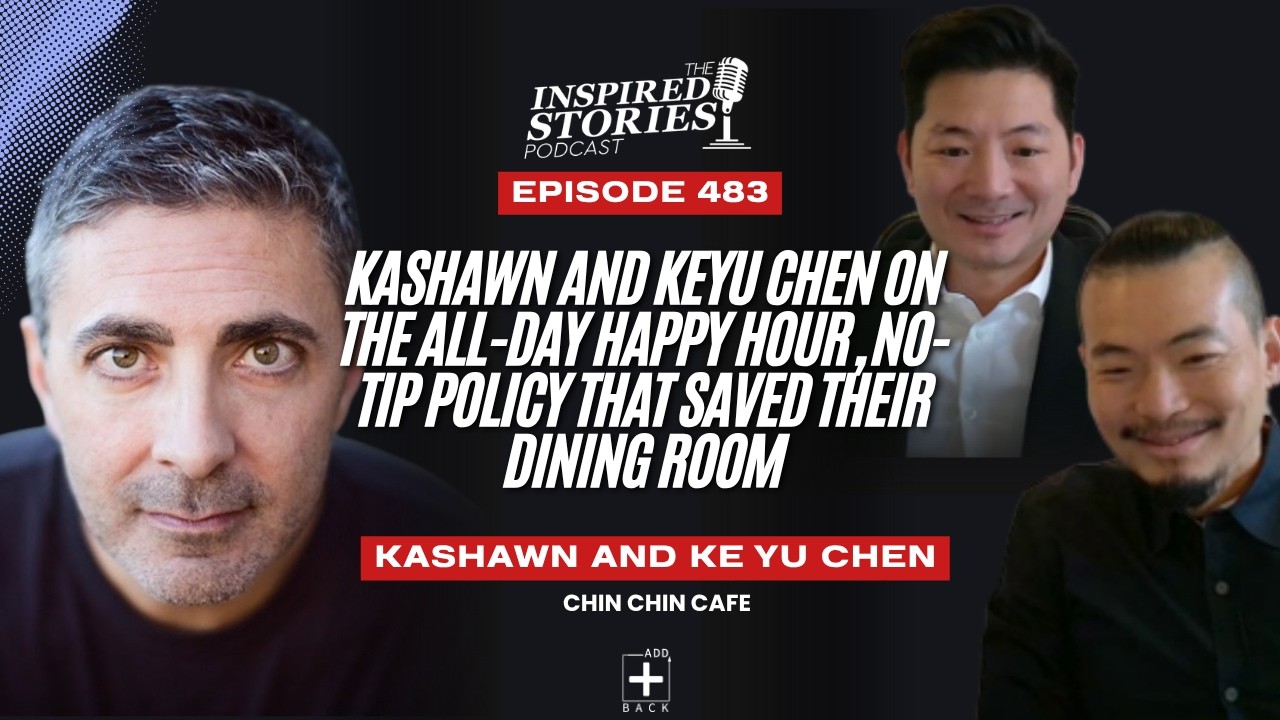
🎧 From Fuzhou to Fairfax: How Kashawn and Ke Yu Chen Built Chin Chin Cafe Into a 27-Year Community Institution
Brothers Kashawn and Ke Yu Chen immigrated from Fuzhou, China in 1995 with no English and no roadmap. Kashawn started washing dishes at 13 to buy a bicycle he never ended up buying. At 19, the brothers pooled their savings, borrowed from their parents, and purchased a run-down Asian restaurant in Ashburn, Virginia. What followed was 22 consecutive years of month-over-month growth, a no-tipping policy, an all-day happy hour, live sushi catering, cooking classes for high school students, and $8,000 in free food for 30 local schools during Teacher Appreciation Week. Two brothers, one kitchen, 27 years, and counting.
✨ Key Insights You’ll Learn:
Migrating from Fuzhou, China in 1995 and learning English through school, TV captions, and community interaction
Kashawn starting his first job at 13 as a dishwasher because he wanted a bike and his family couldn’t afford one
Purchasing Chin Chin Cafe at age 19 with borrowed money from their parents when the restaurant was in terrible condition
Going door to door with printed menu flyers to build awareness in the community from scratch
Ke Yu going back to college and then to Payway Asian Diner and Panera Bread to bring corporate systems back to Chin Chin
The COVID pivot: from full-service dining to fast casual with no tipping and all-day happy hour
Running 12 to 15 drivers simultaneously at peak, delivering to 36+ addresses at once
Launching a live sushi bar program for private events, country clubs, and golf clubs
Feeding 30 schools during Teacher Appreciation Week with $8,000 worth of free food — every year
Developing modern Chinese fusion cuisine: Peruvian chaufa fried rice, Coca-Cola chicken, honey sriracha dishes
🌟 Kashawn and Ke Yu’s Key Mentors:
Their Father (Chef and Immigrant): modeled the restaurant trade and sacrifice of starting over in a new country without speaking the language
The Chen Brothers’ Savings Habit: beginning with Kashawn’s first paycheck at 13, the discipline of saving a portion of everything they earned funded the business
Chef Lu (Executive Chef): 30-plus years of experience and the creative force behind Chin Chin’s fusion menu evolution
Payway Asian Diner and Panera Bread: gave Ke Yu the corporate systems, training structure, and operational consistency he brought back to Chin Chin
The Chin Chin Community: generations of returning customers and local schools, teams, and families who have made the restaurant a neighborhood institution
👉 Don’t miss this conversation about what it actually looks like to build something from nothing — and why the Chen brothers have never stopped growing.
Listen to the full episode here
Transcript
Anthony Codispoti (00:01)
Welcome to another edition of the inspired stories podcast where leaders share their experiences so we can learn from their successes and be inspired by how they've overcome adversity. My name is Anthony Cotus Bodie and today's guests have been feeding the same community for nearly three decades. And in all that time, they've maintained a strict no mandatory tipping policy. That choice alone reveals how they think about hospitality.
They took on a restaurant that most people would have let plateau and instead built something that shows up at school fundraisers, teaches teenagers how to cook, and gets called on to feed events ranging from 10 guests to thousands. Their names are Kashan and Kyu Chen, brothers and co-owners of Chin Chin Cafe, a fast casual restaurant in Ashburton, Virginia that has served the community since 1997. Before joining Kashan at Chin Chin,
Kiyu built his restaurant, Operations Chops, at Payway Asian Diner and as a general manager at Panera Bread, then came on as Operations Partner in 2013. Together, they've earned recognition from Fox 5, NBC, and ABC News, and were named best Asian kitchen and sushi bar in Loudoun County. Two brothers, one kitchen, 27 years. But before we get into all that good stuff,
Keyu Chen (01:05)
you
Anthony Codispoti (01:26)
Today's episode is brought to you by my company, Ad Back Benefits Agency. Listen, if you run a business, you're likely stuck in the cycle of rising insurance premiums. You're paying more, but your team is getting less. And many people can't afford coverage at all. So we do things differently. We provide your restaurant employees with unlimited access to doctors, therapists, and prescriptions that's always free for them to use. But here's the part that surprises most people.
Unlike every other employee benefit out there, our program puts more money into your company's bank account. As an example, we recently helped a client increase net profits by $900 per employee per year. Results vary, but the consultation is free. See if you qualify today at addbackbenefits.com. All right, back to our guest today, the co-owners of Chin Chin Cafe, brothers, Kushan and Kiyu. Thanks for making the time to share your story today.
Keyu Chen (02:00)
you
Thank you. Thank you for having us. We are happy to be here.
Anthony Codispoti (02:23)
All right, so speaking of being here, how did you guys get to be in the States? What's the story that brought you guys to America?
Keyu Chen (02:30)
Well, it started off with my father who came here in the early 90s and five, six years later, we all migrated here in 1995. So it was a struggle when we came here. We first arrived in New York City in Chinatown and a lot of the time my father would want us to be different away from Chinatown because if we stay in Chinatown, we're going to end up
speaking much more in Mandarin. So our father migrated us to Fairfax, Virginia. Our first city was in Reston. That's in Fairfax County and that was in 1995.
Anthony Codispoti (03:16)
And so where were you migrating from? Where did you live before?
Keyu Chen (03:19)
We were from Southeast Asia close to Taiwan, a region called Fujian and the city is Fuzhou.
Anthony Codispoti (03:28)
So the city of Fuzhou in the Fujian province of China. And you were just coming over because you wanted a different life, you wanted different opportunities.
Keyu Chen (03:38)
Learn of opportunity, that's what my father wanted.
Anthony Codispoti (03:41)
So you started out in New York City and it was difficult at first. What kind of work were your parents doing, or your father?
Keyu Chen (03:50)
My father was working in the restaurant. He's always been a chef, so he always cooked and he didn't speak English, so he works in the restaurant industry. It's not much opportunity for him when you don't speak English.
Anthony Codispoti (04:10)
And so how did both of you start to learn English and how old were you when you came over?
Keyu Chen (04:15)
I was around, then he was around 10, I was around 11, around that age. And we came here, we went to school, and that's how we learned English. I was in third grade.
Yeah, it's just step by steps and the fastest way of us learning English was interaction with people. That's in a fun way so it kind of, you remember the words when you start having fun with activity that you do and that was the quickest way to ever start learning English.
Anthony Codispoti (04:51)
My father came over from Italy when he was eight years old, didn't speak a word of English, and he tells a story that a big way that he learned English was watching the television shows. I don't know if that was an assist for you guys as well.
Keyu Chen (05:05)
Yeah, definitely. That's one part of it as well. We will always watch the television show with the caption on. Make sure we get to read all the words.
Anthony Codispoti (05:08)
Yeah.
That's a big help, for sure. So ⁓ it sounds like you guys grew up around the restaurant industry. Before Chin Chin Cafe, Kishan, were you strictly doing work in restaurants, or had you had other kind of ⁓ career work background?
Keyu Chen (05:35)
Yeah, when I was, I started working when I was 13 because I wanted to buy myself a bike and my family could not afford it. So I know if I want something, I have to go out and get it. So I know that I was 13 but I wanted to work. So somehow this restaurant allowed me to work. So I was doing a dishwasher. ever since when I'm 13, I always have a job. I never stop working.
So it all started off with, want to someday, you gotta go get it yourself. So work hard and get it yourself. Because my parents, they don't have money. They couldn't afford much stuff for us.
Anthony Codispoti (06:19)
And how about you, Key? When did you first start working?
Keyu Chen (06:21)
I've, well actually when he first had his dishwasher job and I tag along and of course I didn't get paid, but it was a fun experience and just more like hanging out with my brother, you know, because we knew the owner and I didn't have anything better to do. So I tag along with my brother and just be a small helper and watching him hustling. I was like, wow. So any day I can do to help it was a fun experience.
Watching him working and I did the same thing. I started pushing those dim sum cart when I was 15. I just started seeing people and seeing the operation and learning from my surroundings. was quite an experience.
Anthony Codispoti (07:14)
What do mean you were pushing the dim sum cards?
Keyu Chen (07:16)
So
we had this cuisine, this dim sum. So pretty much it's like appetizer. They will put it on a steamer and it will be on a stainless steel cart and you will go around and push around every table and ask if they wanted it. So have you been to one of those like Chinese dim sum place where they have this, you know, dim sum?
Appetizer on the plate and they will go around the cart and they will ask you if you wanted it. Yeah Yeah, you want you want to take a look at that. It's pretty cool So I started that as my first job pushing
Anthony Codispoti (07:51)
Now that's a new experience for me.
And so you're kind of learning some sales experience there, right? Going table to table and what were you saying to the people to get them enticed to try the dim sum?
Keyu Chen (08:03)
I'll show you.
First,
know, first look at the food. I will open up each, each dishes and I will present it to them and tell them how fresh, how good it is and see if they want to try. And for the most part, it works. just, you know, most part it works because a lot of the people eat with the eye and then on top of, on top of when we...
or present the food so that works for us, for me at least.
Anthony Codispoti (08:44)
And then Kiyo, you know, as you got older, you, you know, you worked in some of the big names. I think we mentioned a couple of them in the intro. You did doing restaurant operations at Payway Asian Diner, you know, a big national chain, also a general manager at Panera Bread before you would later join your brother at Chin Chin. What were some of the things you were learning in those early roles?
that would eventually become really helpful as you stepped into the Chin Chin Cafe.
Keyu Chen (09:14)
So starting at Payway, was in 2000, I it 2007. So I was 21 years old at that time and what was the biggest take that I actually could use to bring on was the system that they have in place, like everything they do, it had a structure.
Each of those structures was built on hundreds of stores of mistakes and they finalized a structure. So a lot I learned was the system that I was able to use today, consistencies, the ordering guides, and the training plan that I was able to use. If that makes sense.
Anthony Codispoti (10:11)
Yeah, sure. Sure. You know, sometimes the biggest lessons come from some of the ⁓ the bumpiest roads. Can you think of an early experience, whether it was at Payway or Panera, where, know, you kind of hit a rocky spot, but it really taught you something powerful, ⁓ valuable, a valuable lesson that you were able to, you know, carry with you into the work that you do today.
Keyu Chen (10:17)
Thank you.
I think a lot of time in life, at least for myself, is be patient. Because I remember when I was 21, I was going to be a general manager. And in my mind, I was like, OK, I want to accomplish that goal. But I didn't know that it actually takes time to mature up. I didn't understand that part. so slowly,
When I left Payway, I was a kitchen manager slash assistant manager. I was not a general manager at that time. And when I got to Panera Bread, I felt like, okay, my mind, I should just focus on, you know, be a good manager and be patient. And, you know, who knows six months later, I became the general manager because my boss will actually seize that.
He wants to do good quality work instead of advancement. since then, I never think about let the advancement stop me from doing what I want to do. Actually, I want to do what I want to do, and then advancement will come along with it. And I think the same thing with my current company right now is just provide good quality food, good quality service, and...
and then we will get all the rewards with it. Instead of thinking about the rewards, you will actually not get the rewards. That's what I feel as of now.
Anthony Codispoti (12:07)
Got it. This was a bit of a mind shift for you rather than focusing on the reward that you wanted, which at the time was career advancement. You're like, you know what? I'm going to take a deep breath. I'm going to be patient here and I'm just going to focus on doing the best job that I can. And you were creating a thought pattern for yourself that carries through to today at Chin Chin Cafe. Rather than thinking about, we want to sell so many units. We want to make so many dollars. It's like, just focus on
Keyu Chen (12:10)
Thank you.
Yeah.
Anthony Codispoti (12:34)
providing the best quality service, the best quality food that we can and the rest will take care of itself.
Keyu Chen (12:38)
Yeah,
that's right. That's how I feel.
Anthony Codispoti (12:41)
Yeah. And, ⁓ Kushan, so the Chin Chin Cafe opened in 1997. How did you first become a part of this restaurant? What was your role when you first arrived?
Keyu Chen (12:51)
It started, the changing cafe opened in 1997. So started at 2004, I purchased a business. That time I was age of, I was at age of 19. So it was a year.
Anthony Codispoti (13:08)
You purchased this cafe when you were the ripe old age of 19.
Keyu Chen (13:12)
Yes,
yes, that is correct. At the of 19, my brother-in-law, purchased the place. And we didn't have money. We had money, not much money. We didn't have enough money. Because throughout the six years of me working, remember I played the first thing I wanted was a bike. But after my first check, I never end up getting the bike. I end up just, somebody actually donated me a bike, so I didn't have to get a bike.
So all these years that my brother and I, we save money, we always save money. We don't spend everything we got. We always save a portion, spend a portion. So we have a goal, okay, we have to save this. So we always save, save. So at age of 19, we saw this opportunity of the restaurant, Chin Chin Cafe was on sale. So that's when we took the opportunity, borrowed money.
farm my parents, farm for attitude, and we purchased the business.
Anthony Codispoti (14:16)
And how much was the business at that time?
Keyu Chen (14:18)
I believe it's, I believe it was like 80, $90,000, something like that. It was under 100 grand. So it was around 80, 90 grand. the business, 2004, and that time when we purchased the business, the business was horrible. But we see opportunity in it. It was like what we do, what the business do in a year, back in days.
Anthony Codispoti (14:23)
Okay.
And this was in 2004.
Keyu Chen (14:48)
It's not even what we do in a month now. So yeah, so we grow, we grow slowly, slowly, like build it from nothing. Build it from nothing with only three staffs plus us. It was only a few staff.
Anthony Codispoti (15:08)
So were you familiar with the Chin Chin Cafe before the opportunity to purchase it came about? Were you ever customers there? Okay.
Keyu Chen (15:15)
No, no, we was
not customer. Before we purchasing, have to, we just stay nearby the restaurant, just observe the business, do, just drive around the community, the neighborhood, see what's this neighbor, what's around here, and just try to do what's the best we can to understand the market.
Anthony Codispoti (15:42)
And you said it was in terrible shape when you took it over.
Keyu Chen (15:44)
terrible shape. Some people
call it the chinchin food is good, it's like a hole in the wall. The restaurant was just terrible. It looks terrible, but the food is great.
Anthony Codispoti (15:54)
So what were you actually buying? You don't own the land or the building at that point, What were you actually purchasing? Were you just purchasing the lease?
Keyu Chen (16:00)
What is it?
Business.
Purchasing the business and the brand.
Anthony Codispoti (16:08)
Okay, but you didn't, ⁓ the land, the building itself, that wasn't part of it. You were taking over an existing lease.
Keyu Chen (16:12)
No, no, no, that wasn't on here. We just, yeah,
we're just taking over assisting business.
Anthony Codispoti (16:19)
And so what were some of the early changes that you made? Talk to me about the first couple of months. What were you doing?
Keyu Chen (16:24)
Well, first
thing we have to change is make money, save some money, and start changing the appearance of the business, the appearance of the stores. So it started off, it looks really, really bad, beat up type of restaurant. So we slowly work hard, save money, and improve the business. That's where all the money goes in the earlier stage, just improving our business, improving the appearance.
Anthony Codispoti (16:53)
And Kiu, what are you doing during this time?
Keyu Chen (16:55)
I was working with him and I was 18 at that time. At the same time, I just learning the business and see any area we can improve. In the early stage, like what he was saying was right. And we just think about how can we build out the business. we started looking at our competitors and knowing that our competitor had a lot more driver, had a lot more staff. So that gave us the...
courage, like, okay, we can also do as much business, we can also have as much staff. So throughout early time, would, my brother and I would go out early in the morning and we would get a stack of menu flyer and we would go door to door and we just manually pass out those flyer and we'll go to the offices, buildings and, you know, give out those flyer, get recognitions out there because a lot of time,
people didn't know we existed. Like Kishore was saying, the businesses was a run down business and the previous owner, they just buy a job and they just run the business and just get their own salary. But for us, we want to build a career versus a job. So to do that, we just had to slowly build out the business and first six months we saw a small improvement. So that gave us more.
to do more to our business, to increase our sales. And every month we'll see a slight increase in our revenue. And that was a huge encouragement for us.
Anthony Codispoti (18:37)
How much of an increase are you seeing in those first six months?
Keyu Chen (18:40)
Every year, every month, since we took over, every month, every year, it always goes up, it never stops. Until, of course, we hit a plateau afterwards, but in the beginning phase, we will continue to go up every month, 5%, 10%, 5%, 10%, every month, every year, consistency for many, many years.
Anthony Codispoti (19:00)
Like five percent, okay, five or 10 % each month in the beginning.
Keyu Chen (19:08)
So right now it's been 22 years for at least 15 years until COVID, that's when things start changing a little bit. So at that time, I know we know for us to advance even further, we have to learn different way. Instead of working hard always, we have to start thinking about, so that's when you have to go back to college. At that time.
For us to advance and do better in life, you cannot just work hard. Work hard is one thing, but at the same time, we wanna learn more experience, see what is going on in the world. So that's when you went back to college and then go out to look for another job, look for another job to understand what's going on in the market and how to continue to improve Chin-Chin at the same time. So during those time, we still work together. So he have a job.
and part time at Chen Chen. So we still get to get the meat, talk about how to make Chen Chen better. So it's always, always constantly improving, learning new things.
Anthony Codispoti (20:19)
It's quite a partnership that you guys have there. So how did you decide which one of you was gonna go back to school?
Keyu Chen (20:21)
Yes, it's out.
Well, because I was always the harder work, so I decided, okay, I stay, and he might do better in school, so okay, he goes to school, I just hold down chin-chin. But during those times, we was doing good by hard working, but it only can get you somewhere. It only can get you so much by just doing hard work. You have to continue to learn in this world. I'm still learning, I still want to learn. If not, we will stay. If you don't learn, if you don't continue to...
Understand new things new changes in the world you only gonna stay in certain place
Anthony Codispoti (21:02)
Q, what's a big thing that you learned by going to school that you were able to bring into the business?
Keyu Chen (21:07)
Quite honestly, we wanted a new experience. Yes, I was sent off to go to college and I feel like a lot of stuff we learned at school was just the foundation of understanding of the basics of the industry. I was in hotel restaurant management, so I would learn about the cruise ship industry, hotel industry, restaurant industry. So it teach you.
the basis of understanding what's in the hospitality industry. So that was a big take on it and just understanding the basis of foundation of the industry. that degree was able to give me what's the key to open the door to go to the corporate world. So that's what got me to PAYWAY, I would say so.
Anthony Codispoti (22:04)
And so how far into this adventure were you guys before you felt like, not that you were done, because like you just said, like you're always changing, you're always learning, you're always growing, but where you were like, okay, like we're in a much better position here. Like the place is cleaned up, the menu is better, we've got a better reputation. How long did that take to get that foundation in place?
Keyu Chen (22:26)
Whoa, that took a long time. Started in 2004, pretty much never start. We never stop, we never stop. So 2004, we all we know just work hard. 2005, you went to college. So he graduated 2007. He started working outside Chin-Chin. So we never stop. It took, I guess it took until...
until can you come back, that's when we, when can you come back in 2013, maybe? That's when we, that's when we, we expand the restaurant. ⁓ Same location, so we had an opportunity, but before that we did a few times remodeling to improve the restaurant. So during that time, we had two options, either open new business or,
Anthony Codispoti (23:10)
the same location.
Keyu Chen (23:25)
or expand Chin Chin. So at that time, the next door used to be a dry clean. So, ⁓ used to be a nail salon. Used to be a nail salon. So we purchased the nail salon and expand the business. That's when we add sushi bar.
Anthony Codispoti (23:45)
So let's talk about present day Chin Chin Cafe for somebody who's never been before. What's the customer experience like when they walk in the door?
Keyu Chen (23:55)
When customers walk to the door, we want them to feel welcome in a clean environment and feel when they ordering, it will be an easy process. as you mentioned, our restaurant is no tipping policy, meaning that the customer will place the order at the front, very much like a pay way, Panera Bread, and customer will choose a seat as they like and we'll bring the food to them.
Now the food will speak for itself, the quantity, the qualities. And once the customer is done, they are more than welcome to leave at any time. We will have two gold boxes for them. And that way customers can enjoy in a nice clean environment place.
Anthony Codispoti (24:44)
What's behind the no tipping policy? Why is that so important to you guys?
Keyu Chen (24:48)
I want the customer feel less obligation. I want the customer feel that in our restaurant you can still, you still can dine in at a nice place with the same quality food as a service restaurant ⁓ and the value. So it'd be less cost for the customers. And that's, it does in our experience. And at the same time, it's an easier operation for us as well. Less staff to handle.
and that's outtake on the fast casserole. We call it the fast casserole restaurant. It all started on COVID. So before COVID, after 2013, we expand the restaurant, make it bigger, open up the sushi bar with a food bar. So that time, it was a full service restaurant until the whole COVID started.
whole COVID saw where everybody went shut down. So we had to shut down the dining room. So after the COVID, after we shut down, after the COVID, we reopened up the dining room, but we decided to change the concept to fast casual restaurant. So that time, after the change, the dinner time, we don't get too much dining. We don't get too much dining. And we always been knowing as a lot of, do a lot of...
carry out business, that's our route. So we always carry out delivery, take out food. So that was the route. So dining, even drink, our peak drink, before COVID, the restaurant you come in, we have about maybe 50 seats, so about 15 tables. So you come in, the restaurant looks like, okay, you have 50 guests. The restaurant come in, you look busy.
If 50 guests, our food house looks busy, 15 tables. But we have over 12 to 15 drivers at the peak during that time. So each driver take three deliveries. You will be like 36 deliveries out at once. So how many times you have to turn the dining room to match that?
So it takes time, okay, the dining room can always look busy, but it could never ever catch ⁓ up with the takeout business. after, yeah, pre-COVID. So after COVID, okay, I mean, there's something better than nothing. So we happy, we're not complaining. I'm just give you the, see the difference between the business in takeout business and our dining business at that time.
Anthony Codispoti (27:20)
And this is pre-COVID that you're describing.
Keyu Chen (27:38)
So now after COVID, our dining room shut down, so we have decided, okay, we're gonna change our concept to a fast casual restaurant where customer come in, no more table service. So that's when we decided to change. So after the change, the dining room often look empty. ⁓ even take out business is still good, but one appearing we don't want customer to see is when they come in, your dining room empty, you guys look slow.
So we have to change it up. We have to change, okay, we have to change a way, in a way where customer come in, in a way where we have people there where we don't look slow. So we have to change our style. So that's when the no tipping policy comes. It's like, okay. So okay, that way we attract customer come. So we do another thing to attract customer come in where they feel at least now we get some.
at nighttime versus like, okay, whole night when we don't have tables set, we get like 10 to 20 guests a night. So now we doubled it up. Now we could get up to 50 guests a night. Well, you can come in, you look okay. You don't look too slow. So we also do set like another thing we do for our dining, we create us a menu. It's called the happy hour. Most restaurant do happy hours only during happy hour, like one or a few hours.
So for our happy hours, we decide, you know what? We're gonna do happy hour all day. Where customer can come in all day. So we have a selected menu, great deal. The beer is $2.50 all day long. The wine's $3 all day long. Appetizers, selected appetizers, 50 % all day long. So those are the things that we do and you don't have to tip. Those are the things that we do to get some traffic for the dining where customer come in like, okay.
Anthony Codispoti (29:34)
Got it. Okay.
Keyu Chen (29:34)
not empty.
We want a list. We don't got make money there. We don't got make money on those items, we want customer come in like, okay, ChinChinGa. I'm at the right place. I'm at the right place to be. It's the vibe, it's the environment versus like, you have an empty dining room, they come in like, I'm at the wrong place. Yeah, what's wrong with that?
Anthony Codispoti (29:47)
You want it to look busy, right? So there's no.
Yeah, what's wrong? Why doesn't anybody else eat here? Yeah.
So after COVID, you guys were making some changes because, you the style of business had changed. I restaurant, you know, I think the landscape has forever changed for restaurants post COVID. And so you guys turn it into this fast casual concept, ⁓ you know, take out the table service, and not as many people are there. So like, okay, what can we do to fill the dining room back up so that this looks like the happening place again?
And so you do a couple of really creative things here. You take away the tipping. Hey, don't worry about tipping. The price is the price on the menu. That's all you've got to pay. And you take happy hour from an hour to two hours to the entire day. And so now people know, hey, this is a place where I can go and get a really reasonable drink while I sit down and have my meal. So that helps to fill the dining room back up, which just continues to support.
Keyu Chen (30:51)
Yeah.
Anthony Codispoti (30:53)
that carry outside of the business, it sounds like is the much bigger part of
Keyu Chen (30:57)
Yes, yeah, yes. And one other thing we do was we set out, we set out, we in Ashburn, so that's our primary delivery area. And the next to us is a town called Stirling. To drive to Ashburn, about a little bit, like 15 minute, so we don't usually deliver to Stirling, so we did an advertise, set out directly to Stirling.
for the buy one get one free dining only is during evening time. Only in Stirling, so in Ashburn we never promote, okay, dining, come dining with us. I'm okay, I'm happy they do carry out. I'd rather they do carry out versus dining. If I want to dining, I want to attract some way like from Stirling. So that's another thing we did is the marketing plan that we did was buy one get one free for dining only on a. ⁓
only sent out to a different area. That's also helped us attract new...
Anthony Codispoti (32:00)
You
prefer the people that are real close to you to do the carryout because you can accommodate a lot more of those folks. You can do a lot more carryout business than if they came and filled up the dining room. Interesting. And you do all of your own deliveries still?
Keyu Chen (32:09)
Yes, yes, it's turning them around much faster.
Yes, we do have a third party driver as well, Uber E, Door Dash, and Grubhub.
Anthony Codispoti (32:24)
But are folks placing orders directly with you as well and you've got your own delivery drivers still too?
Keyu Chen (32:30)
Yeah, they order directly from us. Online order, they can order online, they can phone in the order, they can walk in. So half we do our own delivery and the other half we have the third party does the delivery for us. So it's whatever the customer choose. They use the apps for third party or they can order through us.
Anthony Codispoti (32:33)
Okay, got it.
Talk to me about the menu. What kind of food do we find on the menu?
Keyu Chen (33:00)
We have Chinese, 70 % of our menu items are Chinese, Americanized Chinese food. And then we have Thai cuisine. Thai cuisine share a lot of similarity in terms of the cooking technique, ingredients with the Chinese. And we also have sushi bar in our restaurants. And now we have...
our chef, who have over 30 years experience, he's developing a new cuisine, which is the fusion cuisine. So we will use Chinese with different country, such as Peruvian, and we will combine different type of cuisine together. We call it the modern Chinese cuisine.
Anthony Codispoti (33:53)
Give me an example of what it's like to mix
Chinese with Peruvian food.
Keyu Chen (33:59)
The Chinese, using is a fusion cuisine we really like because we were able to use different type of ingredients. for this month, we actually did a Chinese Peruvian fried rice, which is our entree of the month. So we really like it because we want to let our audience know that.
We're not just Chinese, but we can also provide different type of cuisine and we get a lot of good feedback on it. So we want to involve from just traditional Chinese, ⁓ traditional Americanized Chinese cuisine, but also do different type of cuisine with it as well.
Anthony Codispoti (34:43)
So what does
that look like? Like what are the Peruvian elements that are coming in? What are the Chinese elements coming in? Describe a dish for me.
Keyu Chen (34:50)
So actually he did the, yeah, the Peruvian food in Peru, Chinese food has always been very, very popular. So there's a cuisine called chi fa. Chi fa is in there, what that means is Chinese food. But when you translate chi fa directly to Chinese, it's called eat rice. And then there's a dish called chow fa.
in Peru and what that means is directly, what that means means fried rice. So you translate chow pho to Chinese is directly meaning fried rice. So Chef Lu and I, we came up, came up this dish called chow pho, Peruvian style. So what is Peruvian Chinese food is they're using local Peruvian ingredient infused with the.
with the Chinese ingredients. So what we got on the dish was a mix a little bit different is what we use is cumin seed, cumin seed on fried rice with ⁓ some butter on the fried rice and infuse it with the traditional Chinese cooking ingredients like soy sauce, oyster sauce, and salt. And also another thing that...
There's a dish, very popular dish in Peru, in Chifa cuisine. It's called, most restaurant you go, you might still seen it, it's called Lomo Santado. So what that is, it's a Chinese sauce, they use their ingredients like they have, you add French fries to the cuisine, you add cilantro, even Chinese have cilantro, but.
You add like the French fries, the tomatoes, some of the local favorite, what they like to be in that stir fry with the steak by using Chinese sauce.
Anthony Codispoti (36:58)
So what's the most popular item on the whole menu?
Keyu Chen (37:02)
We started off as a traditional, Americanized, traditional Chinese food. So what has always been popular when people come back is always like Jiro So Chicken, beef with broccoli, fried rice, lo mein, those are the popular items, sweet sour chicken, Kung Pao chicken. So now our fusion dish that our chef create.
has been doing a lot, ⁓ has been getting great response and is doing good. And that's what keep us, this is the new stage where we are is creating fusion dishes where it's also popular, like we're using honey sriracha chicken, Coca-Cola chicken, like different name you can tell like, okay, that's not your picture. Yeah, yeah, so these, it's a sauce you made with Coca-Cola, like soy braised Coca-Cola.
Anthony Codispoti (37:52)
Coca Cola chicken? What's that?
Keyu Chen (38:00)
So it's a sauce you make with sauce of Coca-Cola. Coca-Cola is like sweet, it's more like using substitute sugar with Coca-Cola. So have that little bit hint of Coca-Cola taste. You don't actually taste the Coke, but it has a little bit hints of it.
Anthony Codispoti (38:18)
So what's the difference between regular Chinese and Americanized Chinese?
Keyu Chen (38:26)
American night, the flavor mainly in American night Chinese food is a lot of sweetness. It's a lot of sweetness and it's been passing down for generations since, for generations. It's made the difference. The American night Chinese food is made in USA. It's only, you will not find those type of items in China. Of course, not all. For example, there's Kung Pao chicken, but in China Kung Pao chicken is made in.
Anthony Codispoti (38:26)
How would you describe the flavor differences?
Keyu Chen (38:54)
totally different leaves. It's less sweet, it also has peanut, has a lot of pepper, spicy pepper, and dried pepper in it. So every region in China makes things a little bit differently as well too. So fire rice, thing, we have fire rice, every region has their own fire rice, all different. I would say the main difference is sweetness. It's more sweeter in American-like Chinese cuisine.
Anthony Codispoti (39:22)
Tell me about the catering side of the business. What do you do this for? How big of a part of the business is this?
Keyu Chen (39:28)
We generate about 10,000 a week in catering and most of the catering clients are ITs. We are surrounded by lots of IT. A lot of the hotel, not hotel, I'm sorry, the hospitals, we get a lot of the hospital ITs catering and also communities. We do private sushi events. We will go to...
We will go to a client's house and we will set up sushi bars and we'll do a live sushi there. So that's also be part of it. Also going to country club, golf club. They love the live sushi experience with chef there. It brings a different experience to them. That's what makes us different. When we offer live sushi around in my market, I don't think much company can offer that on a Friday night or Saturday night when you able to have.
two chef to go out to do an event. So that's what makes us a little advantage on our end doing a live sushi. We do a lot of, we do some banquet, we do all type of catering from the office, from the home, from everyday catering to fancy catering. So however you like the catering, can pretty much do it at all. we've done banquets, weddings, live sushi event, live kitchens outside, cooking outside. So anything that.
we can do and we also do like, I wouldn't call that a catering, but we also bring, we also do outdoor events, like setting up an outdoor kitchen to do an event on the festival, stuff like that. We do whatever we can do to generate extra sales.
Anthony Codispoti (41:14)
The live sushi sounds fun. you're obviously you're packing up all the raw fish, you're taking it there, all the different sort of accoutrements that go with that. And you get your chefs sort of putting on the show there in front of everybody, cutting everything up, making the rolls.
Keyu Chen (41:26)
Yeah,
pretty much we bring a whole sushi bar in front of customer. It's a great experience when they get chef in front of you. And sometimes we do omokase where we leave it to the chef. So our chef also do that. Just leave it there, let the chef do it. We bring the whole sushi bar to your house or to our office or to a lot of time we do it at the country club as well too. So we do it at a lot of different locations.
So.
Anthony Codispoti (41:55)
You guys teach food classes at local high schools and also offer free cooking lessons at the restaurant. What was the idea here?
Keyu Chen (42:05)
We want to be more involved with the communities and we want to show support that Chin Chin is here to stay. We want them to see us and whenever we have opportunity when people approach to us, don't want to say no to it. And we was offered to teach at school because the teacher, she's a cooking teacher at the school, also a customer of ours.
So they came to us and hey, would you guys be interested in doing a cooking class? So, of course. ⁓ That's how it started. It got my invitation. It's a passion. I never got the chance to watch people bring any restaurant owner while I was in school to go to your class and start teaching. Especially, they probably already know as much of the students.
for them to see us, it must be a good excitement. So we don't say no to it. And we also got offer if we want to teach at the restaurant and we do that as well. Yeah, it's all started off as we get the offer and we do, if we have time and we do it and this is our path.
Anthony Codispoti (43:27)
Is it actually the two of you that go out?
Keyu Chen (43:30)
The chef, the chef, you and I, yes, three people. And we go out to the school, demonstrate how to cook fried rice, something easy what they can do at home. Nothing, nothing like, nothing too technical. Something they can, they did in class, they can do it at home, come over for the rest of the year. Yeah.
Anthony Codispoti (43:41)
that's fine.
Give them an easy win. Yeah, that's great. And
I you guys have been giving back to the community for decades in other ways. Tell me about some of those other efforts.
Keyu Chen (43:57)
Yeah, we do a lot of fundraising, donation, sponsoring sports team, basketball, football. Now it's the swim season, now summer's arriving, so we sponsor five swim teams. So whenever anyone come to ask, I always do what I can to help. I want to be able to give back to the community, because without our community,
feel like we would not be where I am, where I am, so I always believe in, okay, I'm give what I can. So always, I never turned them down, like fundraising. Now we just saw most business offer 20 % on the fundraising sale, so I say, okay, this one I'm gonna offer 25%, increase the donation, even though, okay, I don't make money on this fundraising event, but at least I get recognition.
they at least come support and they will come back and support Chin Chin because we supporting them. So that's, whenever we get a lot started off, they walk in, we'd be part of the discount card, the school fundraising card where they have multiple business that is part of the ⁓ discount card. So we wanna be on that as well. they just got bring in the school sell those card, the school sell those card to raise money.
So on those discount card has many restaurants, has many restaurants that they can use. They can go every restaurant that is listed in the discount card, they can get 10%, whatever percentage. So we do that as well, sponsoring the team, fundraising, so we do, well, I do what I can to help our community and give back to our community. And last week, well, Teacher Appreciation Week is coming up. So even during Teacher Appreciation Week.
We have over 30 schools, from elementary school, middle school, and high school. So every school, we gave out free lunch for every school to the main office. So for 30 schools, so the cost for us was like almost $8,000 on the sales. But of course, with the food costs and the labor costs, it's not that much, but we gave out over $8,000 worth of food.
and I think in one, in a week and a half. So that's the most recent thing we did, which is last week, gave back to our community.
Anthony Codispoti (46:31)
That's a lot of giving back. I mean, that's just one example.
Keyu Chen (46:33)
We do that every year. Yeah, we
do that every year. We do that every year and they are appreciated and we appreciate just to let them know we appreciate your support. Giving out free food to the school, just go in, surprise them. They don't even know it's coming.
Anthony Codispoti (46:48)
Yeah, that's tremendous.
Yeah, how generous of you guys. Was there a moment early on when you guys were first starting out where you weren't sure if the business was going to make it?
Keyu Chen (46:58)
⁓ yeah, that's during the beginning stage. During the beginning stage when we started, I wanna say we never thought we're never gonna make it, but that's the time that, okay, we know if we want to be better, we got to learn more, we have to get some better experience. That's when can you have, can you went to college, that's when he go get some more experience so we can continue to grow. So during that time, I think,
If I say anything has to be in beginning of our journey that we felt like, we didn't buy a business, we bought a job. So that's when slowly like, okay, slowly we try to get out of that job and we try to build a career. So to do that, we have to learn some more experience. So I think...
I have to say it's in the beginning of our stage. That's the part that it was the hardest. And then as we go, was pretty, I want to say smooth, but of course we're going up and down all the time. We're going through a lot of difficulty, but never to a point that we feel like we're never gonna make it. During COVID, it's another stage, but at least we know we're gonna stick together. We can go through this together.
It never felt like, okay, we couldn't make it. But in the beginning, it was the toughest. Because what we did in the years, it's not even what we do in a month now. So that is crazy. But again, the value, the inflation changes too, of course. We're talking about 2004, that's 22 years ago.
Anthony Codispoti (48:33)
Yeah.
So, Key, I'd be interested to hear from you, ⁓ because your brother was just talking about how you guys were able to get from the point of, we just bought ourselves a job here to now you're running a business. What do you think were some of the big operational levers that you had to pull to make that transition?
Keyu Chen (49:17)
My take is the consistencies. A lot of stuff we do, want to be consistent with what we do. Such as, most of us, okay, let cut it out right here, excuse me. I just feel like we just got to continue to do what we do and serving good food, fast turnaround time on our delivery, and always have good executions and good service.
That's what got us where we are today.
Anthony Codispoti (49:50)
There's probably, you know, some big changes that needed to be made in terms of being able to let go of certain things, I would imagine. Something I hear from a lot of business owners where they felt like they had to have their hands on every single thing that was going on. And now as you start to, you know, hire really good people, you can start to delegate a lot of those things. Is that kind of played out for you guys as well?
Keyu Chen (50:12)
Yeah, I remember like our menu was so large, we would carry a lot of menu items in our food and that was really hard for us. We had scallops, we had ducks. We have a lot of items that were just not selling well and we would dedicate so much attention to it and instead dedicate so much attention to it, I'd rather dedicate those attention to the food that we serve. And that was some of the stuff that we let go that made it.
huge impact ⁓ in our time that we can focus on what is really selling and that actually make the operation a lot easier. A lot easier and easier to train, easier to hire people and that way the full of the quality continue to taste good.
Anthony Codispoti (51:04)
Simplifying the menu was a big deal. Less ⁓ ingredients that you guys have to have on hand, less items that you have to train your staff to learn how to make. Just really streamline the operations.
Keyu Chen (51:05)
simplified.
Yeah, that's all these changes come
after COVID. So pre-COVID, when we have the full service, when we have the dining room open, so we want to be able to provide a little bit better menu. Well, at that time, at least we thought it was better menu. So after COVID, that's when things start changing on menu on a huge part. So we have to drop a lot of...
to simplify the menu to make the whole operation easier and training easier and there's a lot of challenges going throughout the way is working with people, finding the right team and that's not that's always one of the challenges finding great people building a team is always a challenge.
And of course we cannot do it without a team. The team is all about team and we are blessed to have our team. It's just without a team, just me and Kyu, we just can't do it. You need a team, you need to be able to build a great team. And that's what we all try to do. That still continues to be the biggest challenge is learning to work with people and holding on to the team, the people we have.
in order to continue to do what we do. So we're able to dedicate a lot of those tests to them. And that's how Kashan and I can have those free time to sit here and to join the show with you. Yeah, so another challenge, like the challenge we go through with staffing is we are end of the day, we are independent restaurant, independent owners versus some people, they'd rather go look for a job in a bigger company.
They feel like there's more career opportunity advancement. for independent restaurant and business out there, I think it's the hardest challenge to build a team.
Anthony Codispoti (53:27)
Yeah, I could see that. What are some things that you guys have found that help you to recruit and then hold on to good folks once you've got them?
Keyu Chen (53:35)
treat the people good, pay them well. Yeah, I think for us, have a lot of time we have to pay a little bit more than some of the corporate places for cashiers. Like I think some surrounding here, they pay around 13, 14, but we will pay 16, 17, just a little bit more on that end. So have the leverage. And what he said is treat people good, because a lot of those employees, they will help you.
bring referral in to the restaurant. so it started a lot of things. It's referral like you mentioned. If you treat them good, of mouth. Treat them right. They will bring people for you as well. So we're blessed with that,
Anthony Codispoti (54:25)
I want to
hear this answer from each of you separately. You first, because Sean, what's the hardest thing that you've ever had to overcome personally? What did going through that teach you?
Keyu Chen (54:36)
⁓ Pressure. That's a pressure. Learn how to work under pressure. Learn how to work with people. I think that's one of the things. Learn how to overcome the pressures.
Anthony Codispoti (54:51)
Is there a specific example
of how that pressure came up where you had to kind of in a crisis moment you had to learn how to deal with it?
Keyu Chen (54:59)
Well, that's when the pressure comes when you have nobody to come work with you end of the day, you have to do everything yourself. That means if I have to do, if I have to answer the phone, if I have to cook, I got to do everything and not all employees are good. they sometimes, sometimes they, I know I don't like them, but I can't do anything. And I have to suck it up. And that's the part that is sometimes it's that, okay, they do.
I can't do anything. have to wait for my opportunity. If you want to fire them, you better know how to fire them the right way. Don't just go fire people. Some people who don't like you can't just do it. You can't do nothing yet until you have, we got to have a plan.
Anthony Codispoti (55:44)
there's a process that you need to have in place, you got to do it the right way. So doesn't blow back on you. And you get you have to have your ducks in a row so that you've got somebody to fill in their spot. I assume that's what you're talking
Keyu Chen (55:50)
Yeah,
yeah, what else is we're gonna go through a lot deeper stress, deeper pressure, just okay, learn, just wait for the opportunity. They don't know we don't like them. The employees sometimes they don't know. Like we know, like we talk about who's good, who's not good, who's on time, who's not on time. So employees are all like, they might think my boss is cool.
They, my boss is cool, I always come late, they don't care. You know, that's never the case. We always lose honor.
Anthony Codispoti (56:26)
that
anybody listening, they care. Your boss cares if you're if you're late. Yeah.
Keyu Chen (56:29)
Yeah, yeah, we know people know every
manager out there they know who's late who's not late
Anthony Codispoti (56:36)
And how about you, Kiyu? Something in your life that was really hard to get through and what that taught you?
Keyu Chen (56:43)
I just think I want to constantly want to learn constantly want to build the sales and I think this is my everyday challenge and just constantly want to learn and build sales looking for new ideas and look for new ways to make our employees job easier with a better training guide, a better machinery.
Every day my mind is focused on improving in those aspects. How we can build cells, how we can make the job more effective, so they can produce more with less effort. So I believe this is continually to carry on now and to the future, if that makes sense.
Anthony Codispoti (57:38)
So as the owners of Chin Chin Cafe, what do you guys most want to be remembered for?
Keyu Chen (57:45)
our food, our food and our effort that we put into the business. And also seeing, seeing, I see kids as a kid, eating chin chin growing up. And now they bring their kids. Now they have their kids to bring up. I see them grow up and now they have kids and they still come to chin chin. That one bring joy to my story. And that's what makes me happy.
I've seen customer coming back, back and back returning after 20, 30 years, they still coming to Chin-Chin and that's what make me happy. seeing the, and for sure it's the food, that's what I want customer to remember for it, is the food and the service, the food alone speaks for itself.
Anthony Codispoti (58:41)
I've just got one more question for you today, guys. But before I ask it, I want to do three quick things for the audience. First of all, anybody who wants to learn more about the brothers here, Kiyu and Kashan and what they're doing, Chin Chin Cafe, go to their website. It's chin-chincafe.com. Chin-chincafe.com. So Chin Chin Cafe, but with a dash between the two chins. Chin-chincafe.com. And if you're enjoying the show today, please take a moment to subscribe wherever you're listening.
Keyu Chen (58:42)
Yeah.
Anthony Codispoti (59:10)
It also sends a signal that helps others discover our podcast. So thank you for taking a quick moment to do that right now. And as a reminder, if you want to get more restaurant employees access to therapists, doctors, and prescription meds that as paradoxical as it seems actually increases your company's net profits, reach out to us at addbackbenefits.com. So last question for you guys, a year from now, what is one very specific thing that you hope to be selling?
Keyu Chen (59:41)
Well, I think what is what the celebration is business. We are doing better, making customer happy. Those are the things that make me want to celebrate is continue to do better and to see results. As for me, I always like to compare year over year sales. So every day I look at how we're doing today versus last year's in terms of.
amount of ticket we get and the sales. Whenever we have an increase in sales, I like to celebrate it and bring that joy to my brother and tell him we're doing better. And of course, I always have good staff so we can do less. Well, we want to do less, we will focus on more of the other side, how to do more sales. That's why I always tell my employees, know, I always say thank you to them.
thank them, do what they do so I can do what I want to do. And I was telling them without them, I won't be here. Just every day I have to remind myself that and that the employees sees it, that they are appreciated. They're not just employees, they're part of the business. And they're the reason that make that happen. So if I can continue to keep those employees, I will continue to celebrate. Because training is not easy.
Yeah.
Anthony Codispoti (1:01:10)
There's a cost to that turnover. Well, because Sean and Q Chen from Chin Chin Cafe, I want to be the first to thank you for sharing both your time and your stories with us today. I really appreciate you guys being here.
Keyu Chen (1:01:21)
Thank you so much for giving us the chance to have this talk with you. Yeah, thank you. I'm happy to be here, happy to share the story. Thank you for giving me the opportunity to do this. It's a great experience.
Anthony Codispoti (1:01:39)
It's been a shared pleasure,
gentlemen. Folks, that's a wrap on another episode of the Inspired Stories podcast. Thanks for learning with us. And if one thing stood out, put that into action today.
Connect with Kashawn and Ke Yu Chen:
Website: chin-chincafe.com