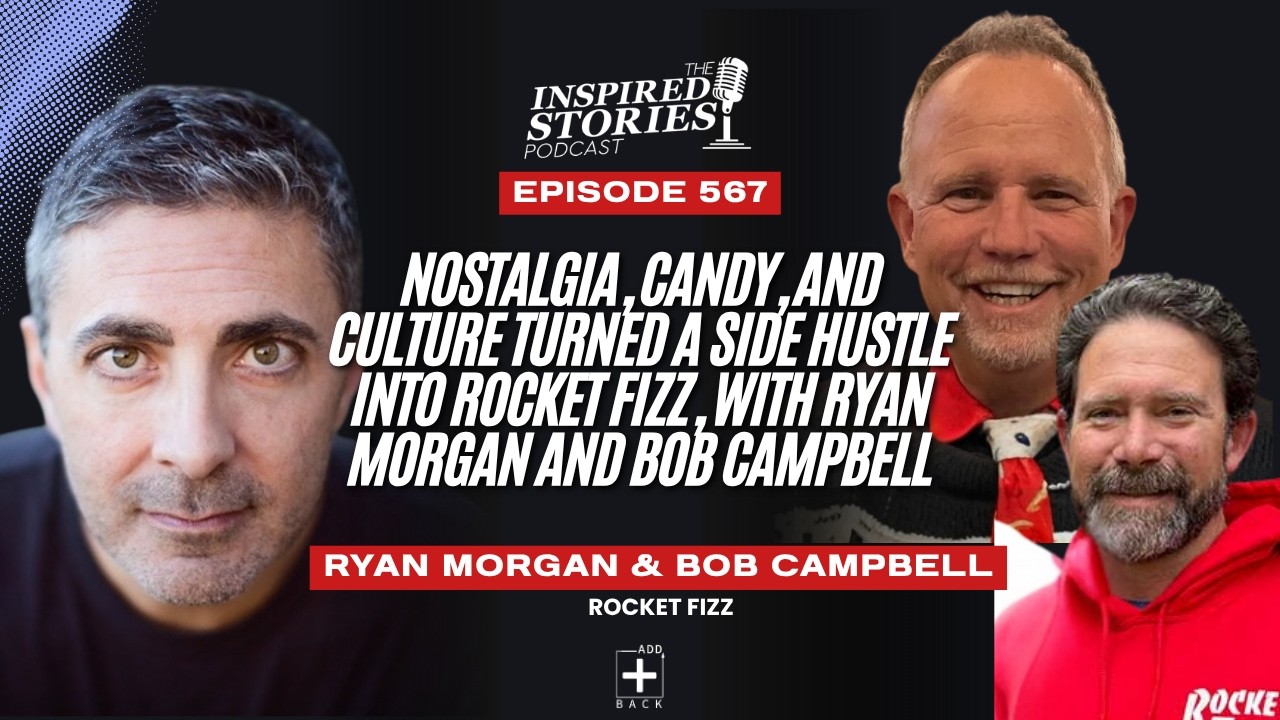
🎙️ From a Pizza Shop Soda Fridge to a 105-Store Franchise: Rocket Fizz's Journey with Ryan Morgan and Bob Campbell
In this episode, Ryan Morgan, co-founder of Rocket Fizz Soda Pop and Candy Shop, and Bob Campbell, the company's VP of franchise development, share how a nostalgic soda side-hustle inside a pizza restaurant survived a lost house, a vanished contractor, and a two-year construction nightmare to become a 105-location franchise. Ryan and Bob open up about the grind behind the first store, why they built the brand around every demographic instead of one, and how decades of franchise experience now make starting a Rocket Fizz far easier than the path Ryan lived through.
✨ Key Insights You'll Learn:
Ryan first sold soda out of a pizza restaurant near Cal State Fullerton in 1999
Built a soda distribution business that nearly collapsed during the 2005-2006 downturn
Lost his house while keeping the company's trucks and inventory running
Watched a contractor vanish with roughly $100,000 meant for the first store's buildout
Enlisted childhood friends to hand-build the first Rocket Fizz using salvaged wood
Opened with an unfinished, hand-painted storefront and no sign on the building
Began manufacturing its own soda in 2011, starting with a bacon-flavored soda
Now produces about 180 proprietary soda SKUs and roughly a million pounds of taffy a year
Bob Campbell joined full-time in 2022 after decades building Jim Boree's global franchise system
Now operates 105 fully franchised locations, with international expansion as a next goal
🌟 Key Mentors:
Rob (Business Partner): Suggested turning the soda distribution business into a retail concept and provided the original building
Steve Corey (Garvey Nut and Candy): Longtime candy supplier and mentor who helped shape Rocket Fizz's product mix
Friends Turned Construction Crew: Showed up to hand-build the first store when a contractor disappeared with the budget
Rich Shane (CEO): Recruited Bob Campbell into Rocket Fizz after years of friendship and informal consulting
👉 Hear how a nostalgic soda side hustle survived a lost house and a vanished contractor to become a nationwide candy and soda franchise.
Listen to the full episode here
Transcript
Anthony Codispoti (00:00)
Welcome to another edition of the Inspired Stories Podcast, where leaders share their experiences so we can learn from their successes and be inspired by how they've overcome adversity. As you listen today, let one idea shape what you do next. My name is Anthony Codus Bodhi, and today's guest turned an inside joke about a candy aisle into one of the fastest growing specialty franchise concepts in the country. One of them helped build it from the very first store.
The other spent decades building franchise systems everywhere from children's play centers to dog businesses before a phone call brought him back to soda and candy full time. Before the Rocket Fizz location ever opened, two friends set out to bring back soda and candy brands that had vanished from grocery shelves. On a completely different track, a family health crisis pulled one of them away from a franchise empire spanning 20 countries and
And set off a detour that eventually looped back to the same store. Ryan Morgan co-founded Rocket Fizz Soda Pop and Candy Shop in 1999, a retail concept built around hundreds of nostalgic soda and candy varieties found nowhere else. Bob Campbell is the company's vice president of franchise development, bringing decades of franchise experience from companies like Jim Boree, a children's play and retail brand, where he served as president of the play programs division.
Overseeing 520 locations in 20 countries before joining RocketFizz full time in 2022. But before we get into all that good stuff, today's episode is brought to you by my company, Adback Benefits Agency. And you'll want to hear this because it's hurting almost every business you know. See, health insurance costs go up every single year, and retailers are furious about it. They're paying more, but claims are getting denied. Their employees are opting out because they can't afford it.
And it hurts turnover and morale. It's one of the most maddening problems in running a business, and everyone just seems to accept it. But you don't have to anymore. Now there's a program from Bain Capital Insurance that gives employees unlimited access to doctors, therapists, and prescriptions with no co-pays or deductibles to meet. It works for your part-timers, and here's the part that really shocks most people. Our product actually increases your net profits. We recently helped a client add.
Add $900 per employee per year to their bottom line. Results vary, but imagine what could be done with the extra cash flow. Get your free consultation today at Adbackbenefits.com. All right, back to our guest today, the co-founder of Rocket Fizz, Ryan Morgan, and the VP of franchise development, Bob Campbell. Hey guys, thanks for making the time to share your
Bob Campbell (02:41)
There you go.
Anthony Codispoti (02:42)
stories today.
Ryan Morgan (02:43)
Thank you, Anthony.
Bob Campbell (02:43)
How are you, then?
Anthony Codispoti (02:45)
So
Ryan, take me back. where did the idea for Rocket Fizz come from? Why are you such a candy and soda nerd?
Ryan Morgan (02:54)
Yeah, so I'm kinda I'm a real entrepreneur. Some people call me a serial entrepreneur. Started at a young age, but I'm not gonna go as far back as childhood. But you mentioned nineteen ninety-nine and nineteen ninety-nine was the first year I got into soda because I owned a pizza restaurant. I owned a pizza restaurant in Fullerton and it was doing all right. And a friend of mine came in who was selling soda. he became a friend, he wasn't a friend at the time.
He kept nagging me to sell some energy drinks that were a new thing at the time. And I had a hundred beers in this in this pizza restaurant. It was next to Cal State Fullerton. So it was a it was a cool place to go to. And I wouldn't give him any space. And I was like, you know, I'm not doing soda in this place. And anyway, he had ten sodas to sell and I made space for him after a bunch of you know, arguing back and forth, and he bought a lot of pizza, you know, coming in trying to see if I'd sell soda.
And it turned out the soda was selling faster than my pizza after a few months. So I had
Anthony Codispoti (03:55)
Ha ha ha ha.
Ryan Morgan (03:56)
turned it, I had turned 10 10 skews on the shelf into anything I could find. I started pushing the beer out as long as I kept this old theme to the the to the soda. So I I was focusing on bringing brands from the east coast to the west coast, and one notable brand was Nehigh.
You know, that was on mash and and this is, you know, this is nineteen ninety-nine, so that was still relevant at the time. But Nehigh, I was selling pallets of that out of my pizza restaurant. And then lucky for me, the city decided to redevelop the whole downtown, tore out all my parking and access to my pizza place. So I had to pull pull up stakes and decide, hey, what what am I gonna do?
So while this construction was happening, I started to get pallets of soda and just go to the the fairgrounds and the Orange County fairgrounds and just see if I could sling it there. Yeah.
Anthony Codispoti (04:50)
What was so special
about the soda? I mean, you mentioned knee high and there's like
Ryan Morgan (04:53)
Yeah.
Anthony Codispoti (04:54)
a a nostalgic element because it was mentioned many times in this very popular sitcom back in the
Ryan Morgan (05:00)
What?
Anthony Codispoti (05:00)
what, eighties? Yeah.
Ryan Morgan (05:02)
Yeah. No, it's actually like late seventies, I think, and then into the eighties.
Anthony Codispoti (05:04)
Seventies. Okay.
Ryan Morgan (05:06)
But so so I you know, I I wasn't a soda guy. I I just saw this stuff happening and I was like, why is this happening? So I gotta figure that out. But the reality is back then anything from the East Coast wasn't on the West Coast and vice versa. So there was an interesting opportunity at the time. That's not the case today.
But at that time, if you could get soda from the East Coast here, it was a total novelty and people would show up to get it. So I I learned that business and got really deep into it you know, from that restaurant. And then of course at the fairgrounds it was going like crazy. so long story short, well, I'll I'll lengthen it too. How about that? But so I I started a soda distribution company in Reno.
So the reason I did that in Reno is because I owned a painting company too at the time when I owned this restaurant. So I had multiple businesses and multiple staffs going on, and I got a contract to do a housing development up here in Reno for the painting. So I'm like, okay, well, I'm gonna keep this soda thing going and I'm gonna bring it up there, and I'll do all Lake Tahoe and I'll do all the ski resorts and all the stuff up here. So anyway, I met my my co founder partner.
He lived up in Incline Village and he knew me through a couple mutual friends and he was looking to get into a business. so he saw me doing the soda thing and he's like, Hey, can I take a ride with you one day and and you know, drop off some sodas? So I had a big box truck and I I invited him on this this two hour drive north to North California.
And in that drive, he's like, So you're just dropping off this soda and you know, and and it's I'm like, I can't get enough of this soda. Like, I'm dropping off as much as I can possibly buy and get it going. He's like, you know, we should do a retail store with this soda stuff. And I was like, Yeah, I don't know if that's gonna work, man, because you know, you get in the retail and then we're we have to sell a lot of soda out of there, and I don't know. So we ham hopped for a couple of years. I actually lost contact with him and I ended up starting another
business in a tourist town in in northern Nevada called Virginia City. And I and I had a I turned it into a soda museum because it was his it was a historical town. And I it was 600 bucks a month for rent and and it was an easy thing for me to do. So all the broken cases I would get, I would clean off the bottles and I would shelve them at this small little retail place. And it ended up working enough to to have some sort of proof of concept. And and then
Rob came up to that shop and he's like, hey man, let's do this in one of my buildings because he owns some buildings in Southern Cal. so I I still didn't I didn't want to go do that. I didn't want to partner on that. And times got a little bit hard. You know, the economy kind of started to drop off in 2005 and six. And I got to a point with the distribution that I customers weren't paying me.
my vehicles were falling apart. it was it was shipping went crazy. So I didn't keep up with my pricing and I was having some real struggles. Like you know, I I got to the point where, you know, I lost my house because I was trying to make sure the company could
Anthony Codispoti (08:17)
Well.
Ryan Morgan (08:17)
still roll. I'm sorry, did you have a question?
Anthony Codispoti (08:20)
No, I just that that hits me, you know.
Ryan Morgan (08:23)
Yeah.
Anthony Codispoti (08:23)
entrepreneurs, we we go through the up and down cycles.
Ryan Morgan (08:26)
Yeah.
Anthony Codispoti (08:27)
folks have bankruptcies, they have different things, and in this case losing
Ryan Morgan (08:30)
Yeah.
Anthony Codispoti (08:31)
your house, it's a big deal.
Ryan Morgan (08:32)
Yeah, so but you know, I didn't at no point did I think the challenge wasn't worth overcoming. So losing my house was actually something that happened that I was almost unaware of. I I just was keeping my companies going, keeping what I could moving, knowing that that, you know, if I tried hard enough there'd be light at the end of the tunnel. Good.
Anthony Codispoti (08:53)
And
and and so the light at the end of the tunnel, was that specifically in the soda business where you thought it would come, or just the combination of all the different things that you were doing?
Ryan Morgan (09:01)
So so the interesting part about the soda thing, so I wasn't getting paid on the on the painting. you know, everybody was defaulting, you know, losing their properties. So the work I was doing wasn't getting paid. So Rob shows I still have a warehouse with a lot of soda in it that that I had to pay for, you know, that was part of the reason that I lost the house and and all that stuff. he's like, Hey, let's let's do that retail thing we're talking about. And I was like, Yeah, why not? You know, let's let's get this thing going, right? And
So I had been in the business for about five, six years. I had a lot of contacts. I had a lot of momentum, you know, with with the industries, because I was pretty much one of the only guys on the West Coast doing this stuff. So I told Rob, I said, you know, I know what I did over at the Virginia City, let's let's do something like that, but we gotta really blow people's socks off. We have to make something so entertaining that they wanna come in for something other than the soda. So
So I decided to work with Rob. lucky for him, he had a bunch of vacancies because it was a downturn and and he couldn't get this this building that his family had had for a hundred years, you know, filled up. So we picked a spot in the building. And it took two years to get it open. So we struggled really hard. I mean, I I at one point I had to start leasing trucks because mine were all destroyed, you know, they had gone too long, I couldn't maintain them. I was borrowing my parents' cars.
to to do this distribution company. And it took about a year and a half for us to build the first store, which which was actually a good thing that I went through that hell because later on becoming a franchisor, I understand the I understood the pain of a of a long term protracted opening. So then you know we we got the store open and what's funny is
Anthony Codispoti (10:49)
And sorry, Ryan, at this point, who
are you still distributing to?
Ryan Morgan (10:53)
I maintained the best customers that I had that were paying me on the spot. So so what I did was I sorry, I I'll I'll digress on that one. So I kept the company going by by cutting loose any long term credit customers and then I just kept the ones that were paying me on time, you know, that that would pay me up ahead. So good.
Anthony Codispoti (11:14)
These convenience
stores, grocery stores, pizza shops.
Ryan Morgan (11:18)
know what's funny is the the convenience stores were my those were my lifesavers at the end. They kept the company going 'cause most convenience stores will just pay you on the spot. It was the grocery stores that were really, you know, they're taking me out on like a net one twenty. So that means whatever cash I had out, you know, to buy a new product was gone for like half a year and then I'd have to struggle to get it back. so so anyway, I was maintaining those customers, getting this store going in Southern Cal.
Still living in Reno. And we start building this shop and what I I saved the right there's the I don't know if you can see that, but that's
the original sign that
Anthony Codispoti (11:56)
Yep, rocket fizz.
Ryan Morgan (11:57)
I taped to the window. It's not even the logo, it's not even spelled right. But it was it was
Bob Campbell (12:01)
Yeah.
Ryan Morgan (12:02)
stuck it was stuck on the window while we were constructing this thing, waiting for permits for for almost two years. So we get going on the construction. The construction company we were working with decided to
Take our money and bail out. So this
Anthony Codispoti (12:20)
my gosh.
Ryan Morgan (12:20)
this is the best part. So at my worst, like when I had no cash left at all, not even like I'm living at my parents' house with my wife and son. You know, we're we we had literally we're at rock bottom. And this guy takes off with what we had left building this this space and just vaporizes. He goes to Mexico or something, 100 and something grand, and and it took a lot to get to that. But
It it caused me to develop a construction crew. So I called up all my friends that I knew did any trade and I said, Hey, I need everybody to to just show up and help me out. Let's just get through this thing. So so about five friends show up. They're like, What are you trying to do here? Right. That I had grown up with, you know, as as a kid. I hadn't seen them in years. That one guy was in construction, one guy was in masonry, you know, one was a a a carpenter. So we threw this store up with like used wood and like anything we could do.
based on whatever plan, you know, that we had paid for. And we got this thing open after two years. And I was, I was, since I owned a painting company, I was the one painting the storefront and doing all that stuff. And I remember the day that we opened, because it's it was like magic. I I can't I can't explain it, but we didn't have a sign on the building. I had that paper sign right there that's all messed up. You know,
weather beaten and I was painting the front door. My sister luckily lived in that town where that building was at and she's like, I'll help you out. And she was loading shelves. And while I was painting the front door, people were stepping over me to get in to buy
Anthony Codispoti (13:52)
Mm-hmm.
Ryan Morgan (13:52)
whatever I had in there. So so I don't know if the word was out that this guy was on his heels, you know, needed help. I said a few prayers that week, you know, that's that please bring the the money in here because this this is, you know, this is bad. But
So people start walking over me. Yeah, go ahead.
Anthony Codispoti (14:10)
Yeah, so I I just I wanna pause for
a second and let everybody sort of have this sink in. Cause there there's a lot of entrepreneurs listen to this or folks that you know think that that's something that they want to do. And so many times we hit a roadblock and we're like, it's not meant to be. You know, I I I guess I'm meant for a different path. Like here it is listening to Ryan's story, is this roadblock after roadblock after roadblock, like loses his house. Yeah, just years
Ryan Morgan (14:34)
Years. Yeah.
Anthony Codispoti (14:36)
of like grinding, but he believed in the idea. And so
I guess the moral of the story here is like, you know, if if it's something you're passionate about, if you if you think there's a market for this, like don't let these setbacks deter you. There's a path forward. And and you just got creative and and you scrimped and you saved and you you found
Ryan Morgan (14:55)
Yeah.
Anthony Codispoti (14:56)
folks that were willing to throw in their time. Okay, so you you guys open, you're painting, people stepping over you, because you you're
Ryan Morgan (15:01)
Yeah. Yeah.
Anthony Codispoti (15:03)
on to something here.
Ryan Morgan (15:04)
So so our decor inside, and the best best theory I had on how to make our decor was with used wood. So we're like, okay, we'll give this a backyard feel inside, right? Because that's all the material we had. So we're like, okay, what would you build as a fort as a kid in your backyard at grandma's house, right? So
When we did the first decor, that was our theory because that was all we had to work with. It had to be super rough because we just didn't have time and we didn't have the money to buy more material. So so anyway, people start walking over me and I had to stop what I was doing. The door was half painted, and that store was full of people. And Rob, my my business partner, he was pretty big into like music stuff. So he made this like back when the iPod was, you know, you'd fill that, you know, 300.
songs full until it was out of storage. So he built what he thought was the funnest, most fun found soundtrack he could think of. And we plugged that into a stereo that was just like a hap, you know, like something you would carry to the it it had to been like an 80s stereo. It wasn't like plumbed into the building.
Bob Campbell (16:10)
Yeah.
Ryan Morgan (16:11)
So he he's playing this this stereo once people start going in, he goes, I just said, dude, we got to get some cash re register money going so we can charge people. We didn't have a credit card machine. But the store filled up
Word got out that week and and we were open. That door didn't get painted for a month. It was like half painted. We didn't have a sign on the building. And anyway, but but it it worked, yeah.
Anthony Codispoti (16:35)
And and when you opened at that time, it was it more than the soda? Had the candy become a part of the concept by then?
Ryan Morgan (16:42)
So the candy, the candy was an afterthought. It wasn't even a primary. So we had a friend that was in the clothing industry that kind of helped us out with some knickknack stuff. I know it sounds weird, but but back back in the in the early two thousands, the Toy Mart in LA was still super popular. And like every place got their stuff from the Toy Mart. It was just i you could go down there with a box truck filled up with an eclectic group of stuff.
And just just go to business. So what we did was we filled a box truck up with any toys we thought would be interesting. We had the soda, and and that's how we we opened it. So it was toys and like novelty stuff and soda. And then I realized I couldn't keep up with the toys. I needed more stuff for the store. And I got introduced to another guy that I was selling soda for. I wasn't aware that that he was even the owner of the brand. I just got introduced from the from my friend from Fullerton.
And he ended up being one of the biggest distributors of candy in LA. So, so I go meet him. he's he's passed away. He was one of my he was my biggest business mentor, actually. And he's like, Yeah, man, he's like, let's get this thing going. And so he's like showing me all the stuff I should be getting. And so we load up the candy, we got all the toys, and and we had the soda, so we started to
package all of that together to create the the final concept, I guess you could say. And back then there weren't there weren't distributors that would distribute to your business. Like it was by the palette you had to go pick up. So we ended up getting another box truck and that would just go to LA and back and pick up candy and toys for at least a year. And so
Anthony Codispoti (18:31)
But candy
you can get and soda you can get at your grocery store where you're already stopping to get a whole bunch of stuff.
Ryan Morgan (18:37)
Yeah, not the stuff he had and not the stuff I had. So he was the right guy. The company was called Garvey Nut and Candy. And he was he was actually real he was best friends with David Klein. That guy was the the guy who started Jelly Belly. So David Klein started the distribution company and then sold it to this this guy named Steve Corey that was talking about for a dollar, and then he turned it into the biggest like candy distributor on the West Coast.
But he saw the the potential in our brand and what we were doing, so he really pulled the strings to try and make us happen. So he was he was a great supplier that ended up causing it to be a candy a candy destination. So
Anthony Codispoti (19:20)
So if he's distributing this candy, clearly he was distributing it to other stores as well. Right? You guys just in LA.
Ryan Morgan (19:25)
Just in LA. Just in LA. So
we weren't in LA. LA's a huge market. You can make a big company in that place over, you know, if you if you're really doing it. But he had a he had trucks in LA, but we were out in Camarillo. That was where the first store was open, Camarillo, California. So it about 50 miles out. but you know, the industry's completely changed since then. So you so once once we got going, we were the distributor to all the original stores. So
I was distributing to any store that we opened. and then, you know, same thing happened with the candy. I'd go pick up the candy, package it with the soda, and drop it off at the stores. So it was really, really a gorilla, you know, kind of distribution network in the beginning. but there's there's a there's probably a couple fun things in there that I'm not remembering right now. But there is just a
Anthony Codispoti (20:17)
So
Ryan Morgan (20:17)
it was so much going on that I can't explain, but I wasn't sleeping.
They were first three years we were in business, I had three days off and most of those days were almost twenty four hours. I'd watch suns come up a lot, you know, to to to get that going.
Anthony Codispoti (20:32)
So the draw here is you've got this interesting and fun combination of toys, candy, and soda that are hard to find in other places. And so you're
Ryan Morgan (20:42)
Right. And that's what we
still strive to do today. That that's that's our core that's what we do. Yes. Yes.
Anthony Codispoti (20:46)
It's still those three categories of products. Toys, sodas,
candies that you're not really finding other places. A lot of them are nostalgic. They're like these old time candy brands, soda brands that people would know.
Ryan Morgan (20:59)
They're old time the trend now though, things have changed, you know, every ten years things start to change. international is a big part of our business now. So we get a lot of Asian candies. We're actually one of the pri we may be the largest like, you know, franchise with with you know imported candies that that I'm even aware of. So so we do a lot of stuff from from Asia. We import directly from Japan quite a bit.
Yeah, so so that that category has now worked its way into our system and it's a big part of it.
Anthony Codispoti (21:34)
It's interesting. I'm on your website, which is RocketFizz with two Z dot com for folks, rocketfizz.com.
Ryan Morgan (21:40)
Right.
Anthony Codispoti (21:41)
And you just took me a stroll down memory lane here. Candy cigarettes, bottle caps, lemon heads. Like I remember all of these as the kid growing up in the eighties, and I haven't seen
Ryan Morgan (21:50)
Yeah. yeah.
Anthony Codispoti (21:53)
them for years.
Ryan Morgan (21:54)
Right. Yeah, they're they're just, you know, mass market doesn't really pick up on that stuff because it's not that easy to get. but those those old brands get harder and harder to get now because the the companies change hands so much now. You know, the the original owners have gone away, kids have picked up, big companies have bought out. so
So that it's harder and harder for like necro wafers to stay on the market, because they they keep getting interrupted with production. So that that's a big reason those nostalgic stuff are still, you know, difficult to find. yeah, good.
Anthony Codispoti (22:28)
So yeah, I'm look I'm looking I see some of these international candies, international sodas too. It's fun. So who's your typical customer? Is it, you know, a guy like me, forties or fifties, where it's like, lemon heads, I haven't seen these forever? Or is it like little kids with the sweet tooth or
Ryan Morgan (22:47)
So so what what Rob and I did, which was very interesting in this industry, it we decided that we would take a perspective. well well let me let me explain a little bit more. So sorry. So so I have a lot of friends, you know, in business. Business people talk and then they end up hanging out with each other because they're we're not we're few and far between. So anytime I meet a guy with a business, he usually becomes a friend. We help each other out. That's the that's the best way to do business, is make friends.
help each other out and then you get long-term people that you can depend on if you need to do business with them at some point. but there was a few people in the in the clothing industry that we knew and they said to really pay attention to who your average demographic was. So in the early two thousands POS systems weren't really they weren't in every business. You know you still had the the the registers you had to type into.
And later on I had pallets of these old t cash registers once we switched to POS. But what the data would show you on your your credit card state, you know, your credit card data and then from marketing research is that your customer is a 35-year-old female. Well, they're the ones hitting the register at the time. So they if they had the kids, they were hitting the register. So to focus on what the 35-year-old female wanted didn't make sense because it misses the kid.
It misses me, you know, the dad who who who generally wasn't the one, you know, hitting the paying for the stuff. So so we Rob and I decided to take a leap and we're like, okay, let's just focus on every single demographic, everybody. And what we'll do is we'll tailor it down, and it and this has taken years and we're still doing it today. You're tailoring your your inventory to to hit everybody that comes in. So everybody has a reason to walk in the door.
So so when you're asking who the customer is, I can confidently tell you it's everyone. Like I I I can hit, you know, a five year old all the way to a ninety year old. It's it's right. So yeah.
Anthony Codispoti (24:54)
I mean, who doesn't like candy? Who who doesn't have a sweet tooth, right? Some of these fun little toys, right?
Ryan Morgan (25:00)
It the hard part
Bob Campbell (25:00)
Thanks. Yeah.
Ryan Morgan (25:01)
is maintaining a massive inventory because we have access to twenty five to thirty thousand products and each store can carry about about five thousand in stock. You know, so so there you even as an individual.
Anthony Codispoti (25:11)
Five thousand different skews
at one time.
Ryan Morgan (25:14)
That's what
it any individual rocket fizz store you're gonna see around five thousand. That's kind of our average. So
Anthony Codispoti (25:20)
Wow.
Ryan Morgan (25:20)
so the the owners, you know, when you when you end up owning a store, you gotta pay attention and we train people how to do it. You gotta pay attention to what's moving, and then and then by doing that, you're already identifying the demographic that's buying. So that that's kind of the the route we took, because not every street's the same, you know, across
the country.
Anthony Codispoti (25:39)
So
this might be a good time to finally bring Bob Campbell into the conversation. Bob, you got
Ryan Morgan (25:43)
Yeah. Sorry, Bob.
Anthony Codispoti (25:45)
there's great foundation, lots of years of experience in franchise e development, franchise or work. we mentioned in the intro the years that you worked with Jim Baree and building, you know, their platform there. How did you get connected with Ryan and Rocket Fizz? How'd that come to be?
Bob Campbell (26:05)
yeah, that was kind of interesting. So I g I worked after I'd left Jim Buree, I I forg I went when I was with Jimbury it went public. Got to know some people on you know, up in Palo Alto, the investment banker types, and one of them introduced me to a company that I ended up doing some work with and one of the people there was
Rich Shane, our CEO, is one of his best friends. And Rich had just come into the company a few years earlier and suggested that that or Peter, his friend, had suggested that I meet with Rich and help him out on the franchise business because Rich didn't come to the business with a background in franchising. And so we met for lunch a couple of times, hit it off, and that's ultimately how it started. And then some years down the road, I did some consulting for the company, got to meet meet Ryan.
And said, these guys are great, man. I'd love to work with these guys. But by that time I'd started my own business up near Sacramento and basically said, I'd love to work with you guys, but I it just doesn't work out right now. And then I
Anthony Codispoti (27:16)
What was that business?
Bob Campbell (27:17)
then I ultimately moved down to South Carolina. I had I had a list of people that I wanted to call and let them know I left California.
And I called Rich and said, Hey Rich, I'm I'm down in South Carolina now. We can't have lunch anymore. And he said, Well, what are you gonna do? And I had some things lined up in the pet
Ryan Morgan (27:37)
Yeah.
Bob Campbell (27:38)
business already, but he goes, Well, you're gonna are you gonna you know keep your hands in franchising? I never really left franchising, but are you gonna you know consider doing that for your career still? And I said, Well, I don't know, you know, I'm not sure. he goes, Well, if you were, what would you want to do? And I said, Well, I really enjoyed.
my years at Jim Boree selling franchises. That was probably
some of the it w it's a challenge but it's also rewarding putting people in business. You know, there's a lot of moving parts. You got the financing, the real estate, the marketing, the operational support, training, the whole bit. It's all you're involved in all of the pieces. And so I said probably that. And next thing you know, I came on board. So and Ryan he called Ryan and Ryan cried for half an hour and then and then and then he
Ryan Morgan (28:28)
No
Bob Campbell (28:30)
he acquiesced.
And said, All right, bring them on. So that's pretty much it.
Ryan Morgan (28:35)
So the I'm
gonna I'm gonna go back to what I said earlier about associations. So so Bob he was one of those friends that that owned businesses that you talk to. He knew what he was doing with franchise, and I was super excited to talk talk to you, Bob. You remember that. I was I was pumped. So yeah
Bob Campbell (28:52)
Yeah, yeah. I will tell I I will tell
you, Anthony, you know, your takeaway on on Ryan's story was a little different than mine. My takeaway on Ryan's story and all the trials and tribulations is, man, that is why you buy a franchise. That you don't want to go through all of that. That learning
Ryan Morgan (29:10)
Yeah. Yes. Yeah, yeah.
Bob Campbell (29:14)
curve is already in place. We've got it.
Ryan Morgan (29:16)
Yeah.
Bob Campbell (29:16)
Ryan's lived it. So have others after him. You know, we rely on our
our senior franchise owners as well to impart wisdom and it pays off for sure. But yeah, we've we've made it easy. Much easier than as Ryan described, let's put it that way.
Ryan Morgan (29:31)
Yeah. Yeah. Yeah. I'll I'll digress on that one too. What did
you have,
Anthony?
Anthony Codispoti (29:36)
So d
tell tell us what it looks like today. How many locations corporate owned versus franchise Ease?
Bob Campbell (29:42)
Got
about 105 locations that are all all franchised. Company made the decision about four or five years ago to divest of the the ones we had left. Jimberry did the same thing. You know, sometimes you're in it helps to be in the business. you know, we have a dispersed corporate system, so
We're not a headquarters based thing in Jim Baree's existence. We liked owning ones in the Bay Area because then we could bring people up from the stores and have come work at headquarters, whether it was training, operations, or so forth. That really doesn't lend itself to this. So decided to to just focus on franchising. It's kind of a but no, it's an
Ryan Morgan (30:21)
Yeah. So Bob sor sorry, I didn't mean to cut you off.
Anthony Codispoti (30:25)
Go ahead, R go ahead, Ryan.
Bob Campbell (30:26)
evolution that a lot of franchise companies go through.
Ryan Morgan (30:27)
Yeah.
Bob Campbell (30:28)
Yeah.
Ryan Morgan (30:29)
So kind of this is kind of an interesting thing. So remember how I was telling you about, you know, people stepping over me, going to the store. So that that first construction project, like Bob was saying, we went through hell to try and make it easier for the franchise. We spent three hundred and fifty thousand dollars in two years. Okay, now now it takes us what, thirty days to get one open once we get a location. And
Bob Campbell (30:52)
Yeah.
Ryan Morgan (30:52)
it's between a hundred and fifty and two hundred is where we're at.
go from two years and cut off almost half the money because of that crappy learning curve that we're talking about.
Anthony Codispoti (31:02)
Okay, so think back to that crappy learning curve. What was
one of the biggest cost saver levers that you were able to pull?
Ryan Morgan (31:09)
So the biggest cost saver lever is understanding understanding how to get the product how to get the product queued up because this is retail, it's not like a restaurant. A restaurant you just you call your supplier, they show up the next day. You got to queue up your opening setup and and have that ready to go and have it show up as soon as the construction crew pulls out. So that when we first started, I had that component down.
And then once once we had enough shelving in, we were open, like I was kind of explaining. That that's a hard thing to do in retail. so so you know, you know, going back to the beginning, I'll let you know why I was so excited to meet Bob. So we didn't start off as a franchise. We were just gonna open stores. And then the downturn happened and everybody was losing their jobs, getting paid out as they left. They kept knocking on the door asking us to build them a store.
So we started building stores not just for us but for other people. And we didn't do it with the franchise system in place. And I didn't know how to set it up, had no no no experience in it. And then the you know, the y you have to be a franchise or a licensed franchise or to be able to sell a store to people. So once we became that
The original stores that we sold on like a licensing agreement, we had to turn them into franchises and everybody was happy enough to do that. but Bob ha we could call him whenever he was a I I don't I I wanted to hire you as soon as we could, but I'm like, this guy's not someone that's just gonna work for some newbie like us, you know. And
Bob Campbell (32:48)
Ha ha ha.
Ryan Morgan (32:49)
but but he was a great guy and he he had all the information on how how we could, you know, put together our franchise and
That brought us up to speed way faster than normal two when we became a franchise or
Anthony Codispoti (33:01)
Okay, so tell us about what the franchise opportunity looks like today.
Bob Campbell (33:05)
Well,
you know, th I like to think of it as our our system is simple and sweet. We basically the business itself is very straightforward. Ryan's worked it. So your responsibilities as a franchise owner are order your inventory, maintain your inventory, merchandise your store well, keep it clean and keep these customers coming through the door that are already happy to be in the store. Just keep them happy.
And and it's it's
It's wash, rinse, repeat. There's nothing really more difficult than that. We have an owner now who has 19 locations in multiple 20. Yeah, I just opened, or he's
Ryan Morgan (33:44)
He just opened twenty this week.
Bob Campbell (33:47)
opening his 20th this week, or but you know, it can be done. and then we have the mom and pop that just want to are very happy, you know, they're one store and it works well for them as well. So our average location does just about a
Half a million dollars. We have a lot of million dollar locations in the organization as well. We're located in regional malls, heavy downtown areas, we're in ski resorts, we're in Vale, Breckenridge, Lake Tahoe, at Heavenly. You know, we can survive in multiple times types of environments and do well.
Anthony Codispoti (34:27)
starting capital requirements, what's that look like?
Bob Campbell (34:30)
About a hundred well, in the F D D we say the range is about a hundred and twenty five to two hundred and seventy thousand dollars. What I'll tell people
Anthony Codispoti (34:38)
Be reasonable.
Bob Campbell (34:38)
is probably ninety percent, ninety to ninety-five percent or between the one hundred sixty-five, one ninety-five range.
by the time you're you're and that's a turnkey situation where your inventory's in the store, your POS system set up, your all your legal work's done and paid for, all your construction work is done and paid for. So really a turnkey investment at that.
Anthony Codispoti (35:02)
And it sounds like the kind of a place that doesn't need a ton of staffing. I mean, you mentioned some their owner operators, you know, they're
Bob Campbell (35:10)
Owner
operators, two or three people part-time generally gets you going pretty well. yeah, it works out it works out well. That's actually one of the pluses as well,
Ryan Morgan (35:19)
Yeah.
Bob Campbell (35:20)
is we have a lot of people, particularly over the last couple of years, you know, one of our primary drivers of leads is LinkedIn. We do a marketing program through LinkedIn, and there's a lot of people transitioning both out of jobs, out of industries right now, or that are in intense industries right now, and they're kind of you know, at the
wit's end and we give them an opportunity where they can be in business but still attend their kids' softball soccer games you know you have a part-timer working in the store at two o'clock you can go go see your kids game that's that's a huge value to a lot of people and you know if you want to take a little more seriously open two or three stores we definitely make that opportunity available for you
Anthony Codispoti (36:07)
so speaking of kids, Ryan, tell us about your son and how he ties into the business.
Ryan Morgan (36:14)
So I got a son and daughter. daughter's fifteen now, he's nineteen. And so he he's grown up in this business. He's even got a soda that we made for him at the original store. once we when we got into manufacturing, he was one of the first sodas we made because we're like, hey, he could be a poster child to be in a soda. So it's called Tyler Sasparilla. So growing up, he he he's been, you know, he's been in the business with us for a while and
I gave him the option, you know, coming out of high school, hey, you wanna do you wanna do Rocket Fizz stuff or do you wanna you wanna go to college? You know, he's like, I want to do the Rocket Fizz stuff, let's stay in the business. And but he wanted to be independent, so he wanted to do his own store instead of working with the the program. So what's what's funny is he's got his own store now. I actually sold him our s my store that I owned. I owned one store and I was a franchisee of myself, I'll put it that way. So it wasn't it wasn't a corporate owned store.
But I sold it to him this year and that's our training facility right now is my son's store. So he's he's actually a pretty integral part to our system and he'll he'll become an independent contractor with us, but he he he's not gonna work for dad, I guess we'll we'll put it that way, which is fair enough. I I can be a tough guy to work with, so
Bob Campbell (37:31)
Yeah.
Anthony Codispoti (37:32)
manufacturing. You got into the manufacturing side of things, so you're not just distributing other people's products. Talk about how this transition
happened.
Ryan Morgan (37:38)
Yeah.
So in two thousand and eleven, we realized, you know, since we're opening a lot of stores, we created our own volume and we're like, Well, why rely on these other on everybody else for product? We need to start making our own stuff. So we partnered with a bottling plant in Southern California in two thousand eleven and then we we started making our own concepts and they're one of the first concepts we made was bacon soda.
There was a bacon craze back in back around that time. And and that one, the bacon soda alone kind of broke the the expected market of soda. So when people walk in, they'd be like, What is that? You know, that's unbelievable. And it's still one of our best sellers, but but we make we have a hundred and eighty different SKUs now. And now we have a canning line, so we make cans and bottles. so so we've been manufacturing our own products now for you know since two thousand eleven.
And then we got into manufacturing taffy. So we have our own unique taffy in our stores. so when you go to our shelves, it's Rocket Fizz Taffy. we have a really great partner in Daytona Beach that we've been working with since 2012 on that. So yeah, we manufacture about a million pounds of you know taffy a year, and you know, I want to say about you know a hundred truckloads of
you know, of soda in the air, sometimes it's hundred and fifty, you know, so so we do pretty good amount of soda now.
Anthony Codispoti (39:08)
Would it ever make sense for you guys to acquire some of these old candy brands that you've been carrying? Like you said, it's your volume, like you're probably a big chunk of some of their business.
Ryan Morgan (39:20)
We want to be the guy making the new stuff. The guys making the new stuff. We we that old stuff's there and it's popular and it and a lot of people are fighting for that stuff. It's not cheap to get an old brand. but you know, if if we we've always looked at RocketFizz as being an innovator in the market, you know, anything we can make that doesn't exist that people are interested in, that's what we do. So that that's the lane that we're gonna stay in. So we're not gonna end up getting into the
the candy industry with old brands. Even though that might that might be great, it's just not it's not something we wanna do. We wanna create the new and and make something interesting and and my gosh, what this is crazy. You know, s something like that on the shelf.
Anthony Codispoti (40:03)
So who comes up
with those new ideas?
Ryan Morgan (40:05)
Well, yeah, so so it's me and that way I can take all of the blame when things go wrong. So so what I'll do is I'll put together stuff and the ideas are are kind of collaborative, but then ultimately, you know, I I have to make the flavor and then and then I have to put together the the packaging. But so so it's a group effort based on, you know, whatever concept we think we're going at and then I'm the guinea pig for the creation of the flavors and
And stuff like that and in the final run. So
Bob Campbell (40:37)
Tell
about tell about one of your new flavor waters.
Ryan Morgan (40:41)
Well, so Rich, my CEO, he my partner, he's my business partner, he's the CEO, I'm the CEO of the company right now. And he's he's he's still on the fence on that one. I don't even know if I'm gonna talk Yeah, 'cause you know what, it grossed out a lot of so we
Bob Campbell (40:54)
Is he? that's a shame. Come on.
Ryan Morgan (40:58)
we we started this canning line and we thought, Okay, let's do cans of water, right? Well, water's boring, so I'm like, why don't we make toilet water? So
So Rich is like, I don't know about that, man. I was like, well I'll tell you what, let I'll make some fake labels, I'll make some labels and I'll put on the shelf at my son's store and we'll see how they go, right? So I made a a poo water, and this is embarrassing to talk about. It's not I don't know if it's gonna come out. And we did a a pea water and a toilet water. So we we made this like like truck stop toilet on the main part of the lab label, and it just says toilet water, right? And so we're we're that's our latest like brain.
Anthony Codispoti (41:39)
I is it flavored at
all? What is it flavored like?
Ryan Morgan (41:41)
It's flavored, yeah, a little bit. Like a hit.
Bob Campbell (41:43)
Ha ha ha.
Ryan Morgan (41:44)
Well, that's the surprise, right? So yeah, it's it's not on
Anthony Codispoti (41:47)
I mean, is it designed to taste
like it toilet water would taste or i it's okay.
Ryan Morgan (41:52)
No, no. All of our
flavors are delicious. But you gotta take that that's that you gotta take that leap of faith, you know, that you're
Anthony Codispoti (41:58)
So I could see
a product like that being like p everybody would buy it the first time they saw it. Like, I've got
Ryan Morgan (42:04)
I we yeah.
Anthony Codispoti (42:06)
somebody I'm gonna give that to as a gag gift as a birthday present, right? Just for like the the kind of fun factor.
Ryan Morgan (42:09)
Right. Yeah. Yeah, so that that you're right.
That's what it is.
Bob Campbell (42:15)
I I
would I would
Anthony Codispoti (42:15)
But
Bob Campbell (42:16)
add I would add that the whole store is kind of designed that way with a tongue in cheek attitude
Ryan Morgan (42:20)
Yeah. Yeah.
Bob Campbell (42:21)
and approach. The posters we carry, the tins we carry on the wall, everything all all the gag gifts we do, throwback gag gifts, you know, the finger locks and all that type of stuff. Everything is intended to be tongue in cheek.
Ryan Morgan (42:38)
Yeah.
Anthony Codispoti (42:39)
So the new product development is really new flavors, new flavors of sodas, new flavors of taffy, it sounds like is kind of your big
Ryan Morgan (42:48)
Taffy
Taffy's all about flavors. So like we'll we'll come up with like a a chili lime or a s'mores or a jalapeno. You we'll we'll do interesting stuff, but that's kind of straightforward. But on the labels, you you know, we're trying to entertain people. So so the label comes first and the flavor second with the with the sodas. That's how we do that. Yeah. And it's Bob, since you brought
Anthony Codispoti (43:10)
Okay. Okay. So
Bob Campbell (43:12)
Bye, huh. Bye.
Ryan Morgan (43:13)
this up, now I think we're gonna have to make it. So
Bob Campbell (43:16)
My
my vote by the way was Chernobyl water, but apparently that didn't make the cut.
Ryan Morgan (43:19)
Easy. E can't give it all up.
Anthony Codispoti (43:23)
Okay, so what's what's the worst idea that you've come up with that you actually tried to sell and it flops?
Ryan Morgan (43:32)
so we came out with a line of hot pepper sodas. Like h like it was jalapeno, habanero and all that. We thought that would be pretty cool. That didn't sell so well. So
Anthony Codispoti (43:42)
Mm.
Ryan Morgan (43:42)
I'd say in the last like five, ten years that that was the biggest letdown. But we actually had peop you know, that that category is pretty you know, pretty active at our stores. Anything hot, you know, is popular. But I guess it didn't really translate into the sodas. So yeah, that that was one that didn't work too well.
Anthony Codispoti (43:59)
What was an idea you had that sounded good in your head and then when you went to taste test it you were like, boy, no.
Ryan Morgan (44:06)
So I'm not a huge sour fan, but people are really big into sour stuff. so we've got we did a we did a licensed deal with toxic waste. that's a really, really, really popular you know, candy brand. And they sold what really well, but that that flavor was just it's almost my daughter says it's spicy. It's spicy, you know. So when she was younger, she took it was just so sour in her mouth that she said it was so spicy, Dad.
You know, but that one I I I wasn't too keen on the flavor, but but it sells very well 'cause there's a big market for sour.
Anthony Codispoti (44:42)
So what's the future of Rocket Fizz look like? What's coming? You guys obviously you're expanding more franchisee locations. What else?
Ryan Morgan (44:51)
What do you what do you want to do, Bob?
Bob Campbell (44:51)
I think I think ultimately
I mean coming from my seat a definitely international expansion. I was fortunate enough at Jim Bure to do a lot of international development. I think it's a natural, I just it it involves a lot of a lot of moving parts. On the services side, it was much easier than it will be on the product side. There'll be different different candies, different, you know, inventory requirements, what's
You know, what's a what's a popular French candy from their youth? You know, we don't know that answer. So it'll be very important in who we choose as our partners there to have a have a grasp, perhaps even be in the candy business already, you know, and and really being thoughtful about the right steps in doing international development. And it also requires a certain amount of
build up in staffing to support it because it takes it can take a lot of energy. Even one country, depending can can be a drain on resources for the the quote home team. So yeah it's
Anthony Codispoti (45:58)
So you
think moving into some of these international markets requires finding a local partner that knows that space really well?
Bob Campbell (46:06)
Without
a doubt. Without a doubt. Yeah. I mean it's really the best way to do it. You you know, at Jimboree we on the on the I was on the executive committee, so I was involved in all the all the decisions regarding the retail stores as well. And you know, we went to we went to England and we did our own stores and didn't really turn out very well. Just, you know, the whole idea of construction in England versus construction in the United States was foreign to us. So the store construction costs were
you know, outrageous, tough to tough to earn back the money to maintain it. so, you know, there's just things you you you learn over time that you you ask the right questions up front, ask a lot of questions and the right questions up front to make the the soft landing a little easier. Yeah.
Anthony Codispoti (46:54)
No.
Before we wrap up, I'm gonna do three quick things for the audience and then one more question for each of you guys. If you want to get in touch with Ryan, Bob, we can also find out about the franchising opportunities on the website, rocket fizz with two z dot com.
Bob Campbell (47:10)
And Rocketfizfranchising.com as well. We have a specific site set up for the franchise-related information.
Anthony Codispoti (47:17)
Great, rocketfizz.com for the candy and sodium aficionados and for the franchisee opportunities, RocketFizfranchising.com.
Bob Campbell (47:26)
Correct. Perfect.
Anthony Codispoti (47:27)
And if you're enjoying the show today, please take just a moment and subscribe wherever you're listening. See, it sends a signal that helps others discover our podcast. So thanks for taking a quick moment to do that. And as a reminder, you finally can get your retail employees access to therapists' doctors prescription meds that
Counterintuitively actually increases. It increases your company's net profits starting in the very first month. No copays, no deductibles, a lot of part-timers qualify. So learn more about how to have happier employees and a stronger bottom line with this Bain Capital Insurance product at adbackbenefits.com. All right. Ryan, first for you and then Bob, same question. A year from now, what is one very specific thing that you hope to be celebrating?
Ryan Morgan (48:16)
so you know the the the tough thing for me to answer is because I I'd I I wanna do everything we could possibly do. So hitting milestones, you know, I feel like it needs to be bigger and bigger. So, you know, I would love to be at a hundred and twenty stores in the next year. You know, that that's kind of my my short term. And then I really wanna start getting into packaged candy like like candy bars and and that kind of set. We we haven't been in that yet.
Anthony Codispoti (48:43)
From a manufacturing standpoint.
Ryan Morgan (48:45)
Yeah, from manufacturing. So we're working on that right now. So so our breadth of products that we we make unique will start increasing further past what we have now. So so that's that's exciting to me. that's probably gonna start happening in the next twelve months. So
Anthony Codispoti (49:01)
And how about you, Bob, a year from now, what's one very specific thing that you hope to be celebrating?
Bob Campbell (49:05)
Well, blow away Ryan's number of a hundred and twenty for one. We're probab
Ryan Morgan (49:09)
I I want it yes.
Bob Campbell (49:11)
we're probably you know, if I count all the ones we've we've sold in the pipeline that we're gonna be opening our here over the next three or
Ryan Morgan (49:18)
Yeah.
Bob Campbell (49:19)
four months, we'll probably be close as it is. But sorry my golden my Labrador retriever here needs some attention. But the I guess for me it it is just seeing
Seeing development in the northeast, frankly. We you know, at Jamboree we were everywhere, right? We had stores all over New York, New Jersey, Massachusetts, Connecticut. We have zero stores in those four markets right now.
Although we next week we actually just received this week a signed franchise agreement from northern New Jersey. So our first New Jersey location will be opening hopefully relatively soon. and you know the the general rule in franchising is when you open in a new region, that's when you start spreading in that region. So looking forward to that that happening. So expansion within the Northeast region is probably my biggest because once it comes, it'll come fast.
Anthony Codispoti (50:19)
Love it. Ryan Morgan, Bob Campbell from Rocket Fizz, thanks for being here. I wanna be the first to thank you for sharing both your time and your story with us today.
Bob Campbell (50:28)
But thank you.
Ryan Morgan (50:29)
Thanks, Anthony. Appreciate but
Bob Campbell (50:30)
Take care.
Anthony Codispoti (50:31)
Hey folks,
that's a wrap on another episode of the Inspired Stories Podcast. Thanks for learning with us. And if one thing stood out, put that into action today.
Connect with Rocket Fizz:
Website: rocketfizz.com
Franchising Website: rocketfizzfranchising.com