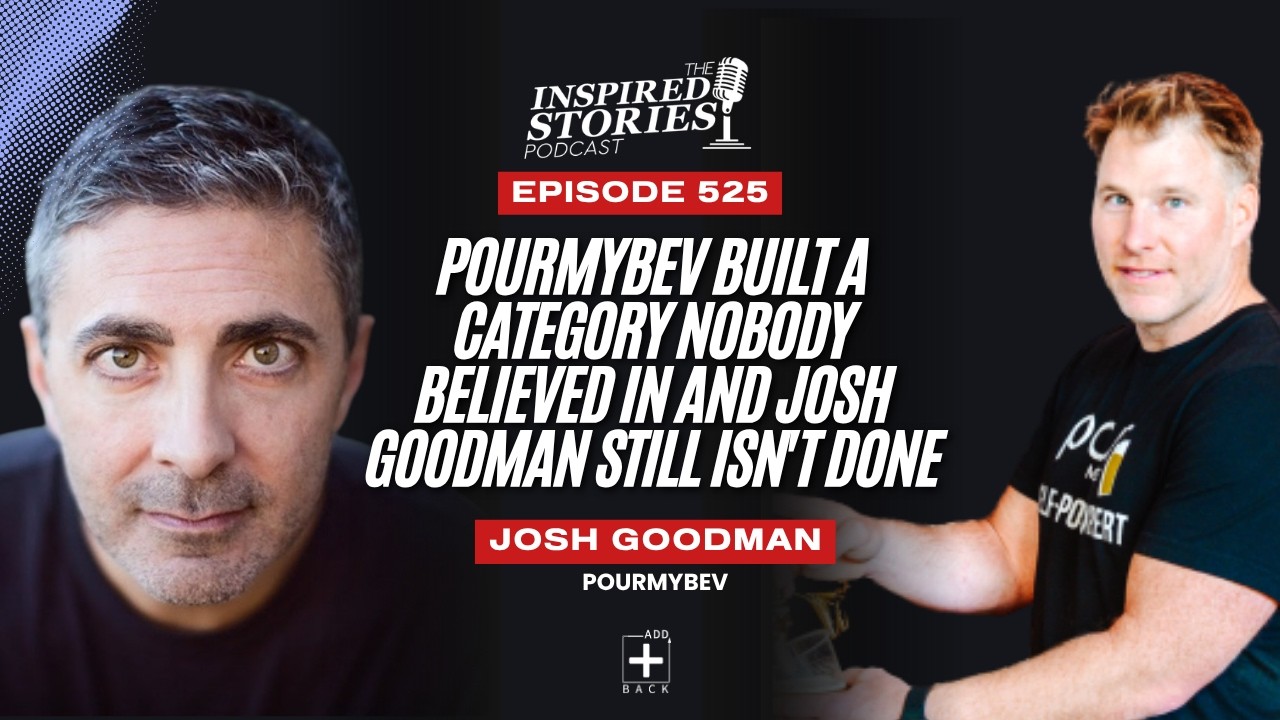
🎤 From a Crowded Baltimore Bar to 12,000 Taps Worldwide: Josh Goodman’s Pour My Bev Story
Josh Goodman, founder and CEO of PourMyBev, had an idea in a crowded Baltimore bar in 2009 that nobody asked for and nobody could explain. Fifteen years, two failed partnerships, a near-shutdown in 2014, and a COVID-delayed wire transfer later, Coca-Cola came calling. Today his company operates across 23 countries with over 12,000 taps installed — all built on the premise that waiting for a drink is a problem worth solving.
✨ Key Insights You’ll Learn:
Cutco knife sales as the foundation for every sales skill he still uses
IT staffing commissions stolen by corporate politics and what that unlocked
The Baltimore bar moment that sparked the self-pour concept
Two failed technology partnerships and a near-total company collapse in 2014
$100K wire transfer to Austrian engineers as the turning point
Rebuilding trust with burned customers by installing the new product for free
Toast integration that eliminated the line problem he accidentally created
Coca-Cola Euro Pacific Partners investing in exchange for a Burger King Spain rollout
Pour Insights analytics platform now fed into AI for real-time operator intelligence
Country clubs as the next high-growth vertical through property management integrations
🌟 Josh’s Key Mentors:
His Cutco district manager: taught him the full architecture of consultative selling before he knew what it was
Herman Rettle (Reddle Austria): second-generation engineering visionary who built the product that actually worked and became a long-term manufacturing partner
Branded Hospitality (Michael Schatzberg and Jimmy Frischling): first institutional investors who opened the Coca-Cola door
Sports and middle school adversity: hardened his pain tolerance and wired him to treat setbacks as redirection rather than rejection
👉 Don’t miss this conversation about why category creation is harder and slower than anyone warns you, what it actually looks like to nearly lose a company and build it back, and how a $45,000 install can outperform a fully staffed bar.
Listen to the full episode here
Transcript
Anthony Codispoti (00:00)
Welcome to another edition of the Inspired Stories Podcast, where leaders share their experiences so we can learn from their successes and be inspired. Well, let's start that over. Welcome to another edition of the Inspired Stories Podcast, where leaders share their experiences so we can learn from their successes and be inspired by how they've overcome adversity. As you listen today, let one idea shape what you do next.
My name is Anthony Codisbodi, and today's guest went from IT staffing to building a beverage technology company that was deep in debt as a solo operation in 2014. But a decade later, Coca-Cola came knocking with a partnership that changed everything, which started as a single idea about letting customers pour their own drinks, turned into a global operation spanning 23 countries with over 7,000 taps installed.
And 133 million ounces poured in 2024 alone. The path from near collapse to category dominance was anything but straightforward. His name is Josh Goodman, and he's the founder and CEO of Pour My Bev, formerly known as Pour My Beer. His company provides the hardware and software behind self-pour beverage systems used in restaurants, hotels, and entertainment venues worldwide.
Forbes named him a CEO to watch, and he's an Amazon number one best selling author. Today, Pour My Bev opens an average of 10 new locations every month with a team of fewer than 50 people. So this is a story about building something from nothing, nearly losing it, and then resurrecting it all over again. But before we get into all that good stuff, today's episode is brought to you by my company, Ad Back Benefits Agency.
And you'll want to hear this because it's hurting almost every business you know. Health insurance costs go up every single year, and restaurants are furious about it. They're paying more, claims are getting denied, employees are opting out because they can't afford it, and it hurts turnover and morale. It's one of the most maddening problems in running a business, and everyone just accepts it. But you don't have to anymore. Now there's a program that gives employees unlimited access to doctors, therapists, and prescriptions.
With no copays or deductibles to meet. And here's the part that really shocks most people. Our product actually increases your net profits. We recently helped a client add $900 per employee per year to their bottom line. Results vary, but gains like that change how a business is valued. Get your free consultation today at adbackbenefits.com. All right, back to our guest today, the CEO and founder of Pour MyBev, Josh Goodman. Thanks for making the time to share your story today.
Josh Goodman (02:50)
Yeah, happy to be here, Anthony.
Anthony Codispoti (02:52)
So Josh, take me back before Pour My Beer, Pour My Bev even existed. You were working in IT staffing. What was that world like for you and what planted the seed that maybe you were meant to build something on your own?
Josh Goodman (03:08)
Yeah, so I think a lot of people that go to college, they they they they think they're gonna go to college and figure out what what they're gonna do for the rest of their life. You know, at least that's that's kind of what was ingrained in me. And towards the end of my college career, I still didn't really know what I wanted to do. I thought I wanted to be a professional athlete. My my left knee decided otherwise when I tore my ACL, my senior year, but football. I ended
Anthony Codispoti (03:29)
What sport were you playing? Okay.
Josh Goodman (03:32)
up going to college, Shippensburg University on a football scholarship.
had a great experience there, but again, didn't really know what I wanted to do after college with if professional sports didn't work out. So that summer I sold knives going into my senior year, cuckoo knives. And that is I I I I referenced that because that's what kind of led me to the IT staffing world. I never really knew what I was good at other than sports, but learning the art of selling and essentially running a business as a 23-year-old was
It really sparked a lot of interest in me and I I leaned into that that idea of selling. I I never my my dad into carpet business, but I never understood how the business side of it worked. He just had me doing the grunt labor, like ripping up the the soiled carpet or the padding and and laying down tax strips. So that was my first experience selling something. And I I came back my senior year and I I told the dean of the college of business, I I want to take every course course I can on on business, marketing.
You know, this is this is what I want to do with my life. And he got me into this 400 level marketing class and I was able to, you know, talk to the teacher and she said, Would you mind presenting to the class on the first day of you know the the the semester? And I was like, sure. She was like, just tell them what you did the whole summer. And so that she she used that as kind of a platform to say, look, this is this is what you should be doing in college, learning how to to sell, you know. And so that summer I sold like twenty thousand dollars of knives. It was a great summer. I made money.
came back with a lot of confidence, but that's what ultimately led me into going down the path of like corporate, you know, sales because the foundation or the seed of selling started in college.
Anthony Codispoti (05:14)
It's so interesting that you mentioned Cutco. I've talked to so many people, privately or on this show, that got their start and sales from Cutco. tell us a little bit about, I don't know, the mechanics of the process that you learned there.
Josh Goodman (05:28)
Yeah, I mean, at the end of the day, people don't actively just sit at home wondering when it when can they buy knives. But wait, when I went into the interview process, the the manager clearly explained that you only show the product to qualified prospects. they you you as a salesperson get paid whether you make a sale or not. And the reason they say that is because they know that if you present the product in in the right way, where, you know, no different than any other business, you you establish credibility in the company.
You identify a general problem, identify a specific problem, identify a solution, and then give them a motivating factor for making that decision today. So what was what I loved about that process is there was no pressure. I would I would you know actually tell them, hey, look, I get paid whether you buy anything or not. So I just want to do a 25 minute presentation and and and check my box. And now I knew
Anthony Codispoti (06:20)
Takes the pressure off of them too.
Josh Goodman (06:22)
takes the pressure off them. And then for me as a salesperson.
I'm not going in there trying to sell them. I'm just having a conversation with them. And then I just make it seem like, this is something I have to do. This is something I have to do. But as the presentation went on, they were having fun. And then they were laughing at how terrible their knives were. And by the end of the, you know, that by the end of the 45 minutes or so, we've cut up a few things, leather, rope, a penny. And they and then I I present an option. do you want the the the medium or the large set? No, the large set's a thousand bucks.
So the medium set they would get was like seven hundred bucks. So I'd still walk out of there with a seven hundred dollar sale and depending on my commission structure, I was making anywhere from a hundred and fifty dollars to sometimes three hundred dollars, you know, based off of that sale.
Anthony Codispoti (07:10)
That's incredible. and so you were just going in having a conversation. It was low pressure on you, low pressure on them. You you sort of got the the stink out of the air right away by telling them I get paid either way. Like I just came here to talk to you. Let's have some fun.
Josh Goodman (07:24)
Yeah. And
and even setting the appointments up, so much of that has translated to, you know, the business I currently run where it's, hey, I'm in your neighborhood. Hey, you know, we're I'm meeting with, you know, Ben Johns and, you know, Mike Thompson. you know, I if I could squeeze you in at one o'clock, I'd get credit for it. I'm earning college internship credit. So it was it was a very natural conversation and they were if if they knew I was meeting with two other neighbors, it wasn't high pressure.
you know, and then they could even call that neighbor and say, Hey, is Josh Goodman coming by? You know, yeah, he's a friend of our our son's, he played football with them, whatever. You know, so there was that familiarity of the of the introduction as well. So yeah, I mean I I always like to preface that because you know that was where it all started is learning and not just learning the the sales psychology and process, but learning advanced techniques. So I you know.
Cutco and Vector is actually taught at Purdue at Purdue University and several other universities because it's such an effective sales process. and it it translates to business. I mean, building rapport, identifying a problem, features and benefits, asking for the sale, you know, actually putting something in front of them that that they can make a decision on, like the yes at the yes, yes close, you know, all these little tactics that you can add on to your base foundation of sales knowledge.
but it all translates into business knowledge because as you know, you you can't run a business if you can't create revenue. So the
Anthony Codispoti (08:50)
Yeah. Selling as a part
in any business. Yeah.
Josh Goodman (08:54)
So that was, you know, I without getting dark, towards the end of my my time with Cutco, I was a district manager in Lana, Maryland. And you know, without going too far down this rabbit hole, Lana, Maryland is not the nicest area. and this gentleman was trying to recruit people from my team to work for his company doing prepaid legal, which is kind of a scam. and one of our team members confronted them and said, you know, leave us alone. We don't want to do your scam.
Prepaid legal. he pulled, you know, ironically, a knife out on them and chased them into our building where we had our sales meeting. And I, you know, I picked up a metal chair and I said, Look, if you're gonna, you know, if you're gonna threaten us with a knife, like I've got a chair and and I'm gonna have to beat you until you stop breathing if you're not gonna put the knife down. And sure enough, he, you know, his friend came in and one of my reps, who was from like, you know, near DC, he pulled out his knife and said, Hey, Josh, I got your back.
If he comes at you. And I was like, we don't want to have any any blood in the in the sales meeting. Like, let's let's just close this chapter. Needless to say, after things diffused, he broke into our place that night, stole everything, and you know, we could never prove it. And that was kind of what took the wind out of my sales with that chapter. And I was like, you know, I'm ready to go into the next thing, which what wasn't directly to IT staffing. I did corporate business to business sales for ATT and singular. So
This was the time when Blackberries first started hitting the market. And you know, I was I was going, you know, door to door in downtown Baltimore into those high-rise buildings and just trying to sell data plans and and and you know voice plans with ATT and singular. so that that I did that for a little bit, realized I wasn't really passionate about it. Actually, ironically, one of the guys I worked with ended up being on the the apprentice, one of the first apprentices.
Sherry's Jim. I can't remember his last name, but but it was an interesting world to live in. I think that's without sounding bitter, go ahead.
Anthony Codispoti (10:59)
Were were you still using some of the same sales principles that you had learned at Cutco?
Josh Goodman (11:04)
Absolutely. I mean, that translates to any, I think, sales organization. I would I would, you know, venture to say anyone that wants high quality salespeople find Cutco in the resume and find a level of success that they've achieved, you're not going to be unhappy with the quality of the the the people that that tend to rise above in that organization. what I felt at at the first corporate sales job I had though was I admired the salespeople in Cutco because they were we were all on the same level.
You know, there was an even playing field. you know, you may live in a wealthier area, so your customers can buy more, but ultimately you have the same tools, the same playbook to go out and sell. Whereas in in corporate sales, if you were gifted a large account, you didn't have to be a good salesperson to to do 300, 400% of quota. You just happen to have Sunrise Senior Living as your customer and they're gonna order, you know, 50 devices a month, whether you do anything or not. So
That's where I got a little jaded with the whole like corporate sales side of things because I realized it wasn't the best salesperson that was the most successful. It was the person that either played the political game the right way or just got handed a, you know, a gift account that was gonna just bear a lot of fruit.
Anthony Codispoti (12:18)
Okay, so 2009, you founded Pour My Beer. but everything you've told us up to this point, you don't really have a background in restaurant, beverage, hospitality. You were doing corporate sales. Where did the idea come from? Walk me through this.
Josh Goodman (12:37)
So I always say it started with a little bit of pain. I think I I had done well in the the IT staffing business. I built a good relationship with the CEO there. And I had brought a fairly large account to the to the table, Constellation Energy Group out of Baltimore. And that would have translated into at least $200,000 a year in commission for me. so as you can imagine, in my mid-20, mid to late 20s, that was that was a big number, a number I'd never seen before on my on in my earnings.
And without getting too deep into why it happened, the CEO decided to give that account to someone else because someone within Constellation Energy said that I didn't follow her her rules and that you know, in in in lieu of not losing the account, they just gave it to this other person in the office. And that's where I went into a pretty a pretty dark period where, you know, I was using the company credit card to to to expense golf with friends and and go on nice you know, nice dinners and
They they gave me a little bit of leeway because they knew that I got a pretty raw deal. But then eventually I was brought into the to the office of the CEO and he said, Look, we gotta part ways. And, you know, I said, Look, as long as I get paid what I'm owed from the current deals that I've got, I'll I'll I'll walk away cleanly. So they did, they paid me out for a few months. But that's where I started really doing some deeper thinking. Like, what do I really want to do? Like what problem do I wanna solve? What do I want to put my energy into? And so I
I read a book. It was like a hundred, a hundred great companies in the minds behind them. And that book's still available, I think, on Amazon, but it was it I have a short attention span, so it was great because it would give you like little five page chapters on all these different companies. And that just sparked that interest in me to to find a problem that I I wanted to solve. And I happened to
Anthony Codispoti (14:28)
So sorry,
sorry to interrupt you, Josh. You're in a good flow, but I want to go back to a couple of things and then let's get to sort of where the idea percolated from here. Cause it strikes me as you got dealt kind of a couple of raw deals, right? You're with Cutco, you get your office robbed, you know, everything's gone. there there's the the the deal with Constellation Energy that, you know, would have been $200,000 a year in commissions. They got yanked from you because
I don't know, somebody had a burr up their rear end. What was your mindset at the time? Did you feel like the universe was taking a dump on you? Did you feel like you were being dealt a raw deal? Or were you just like, hey, these are just hard things I I need to work through? I kind of want to understand the mindset.
Josh Goodman (15:15)
Yeah, well I think it all goes back to sports. you know, being being someone who grew up around sports and playing sports and as I said earlier, under under college scholarship for sports, you you learn to, I would say, have a different relationship with pain. you you view pain as as a path versus a a a a problem, I would say. and that I think is what translated into whenever these situations came up.
I never doubted that I could continue to move forward because I've always done that. I didn't know exactly, you know, where I was gonna be after these obstacles became, you know, apparent, but I knew I was gonna keep moving forward. And I I I will say I definitely felt like a victim. Like I definitely dealt with depression, dealt with you know, anxiety. What you know I I remember specifically saying to my wife, I'm like, you know, what you know.
I'm a loser. Like when I thought I, you know, I like to win. I I I I have a I always kind of joke, show me a good loser and I'll show you a loser, you know. So it I've always wanted to win. So get when you lose when you're when you're comparing yourself to your peers and you're seeing them achieve, you know, things in their professional career and you're like, I'm I'm not, you know, why can't I achieve that?
Because when you go down the entrepreneur path, you're taking a path that that there's no guarantees. There's no direct correlation to hard work equals outcome. You can work hard, but you also have to work smart and you also have to be willing to take the lumps. I think the safe path is is in a lot of ways the the corporate path where it's like, I'm gonna get an account, I'm gonna manage this account and you know, I'll retire in 30 years, whatever that, you know, kind of timeline is. So yeah, I would say my relationship with pain.
From an early age. And also I was I was heavily bullied in middle school. So maybe that hardened my my pain tolerance. you know, knowing that you were going to school and you were either gonna get smacked in the back of the head, told you were overweight, or joked on during lunchtime, you know, if depending on what you were eating. Like that I think hardened you in a lot of ways. so that's you know, maybe maybe all that did prepare me for some of the challenges that I faced professionally, but
Anthony Codispoti (17:36)
And so interesting. Just yesterday I was interviewing another guest who, entrepreneur, took his lumps and made a very similar comment. He says, I think the ones that are successful are the people who can tolerate the most pain and and overcome it and get back up. So you had been hardened going through middle school, you know, used to taking some lumps that weren't deserved. Now here it is in your professional life, the same thing's taking place. But like you said before, pain was opening the doors.
You didn't know where they were gonna go yet, but you found this book. Let's pick up the story there and how how this kind of sparked some ideas for you.
Josh Goodman (18:13)
Yeah, so I I started like exercising anything, the more you exercise your brain in thinking creatively, I think it it just leads to other things and and you see things that you wouldn't see otherwise. So the book questioned if you can find a problem there and you create a solution, you have a business. So the bigger problem that you can solve, the bigger the business and opportunity you can create. So it wasn't a a a first time, you know, I would say,
I would you know business plan that I did with the self-serve concept. The f one of the first problems I saw was, well, what if what if people could get their cars washed at night? You know, and I create a company and call it night washers. And then it's just now technology was not nearly as evolved as it is now, but you think mid you know 2008 or nine or whatever that time the frame that was, it didn't exist. So I I really didn't put a ton of energy into that business concept, but that was one that came up, and then another one was.
know my dad in a carpet business so what if we just what if I created this network of of carpets that carpet that could be sold at college move in dates. So I proved the thesis or I I was like I'm gonna go to University of Maryland, Shippensburg University where I went, and I got a deal with Longwood College and I bought two hundred carpets and I figured if I could move the two hundred carpets, then I would, you know, that that would prove this business model worked. Well what I didn't account for was monsoon style rain that took place
For the University of Maryland move in date, which I mean, they had I think 10,000 freshmen moving in. And I I should have been able to sell 200 carpets that day, but it was a torrential downpour. So that that washed that our idea off the table. And then I got stuck solving the problem of where do I put you know 200 carpets until I can sell them, which I was able to figure that out. So it it, you know, I I won't go down that path on this, this, this podcast, but it essentially
Anthony Codispoti (20:05)
Well real quick, tell us how
did you end up selling those carpets? 'Cause these are the curveballs that you've you've got to be able to to to handle.
Josh Goodman (20:11)
Yeah. So I
I I put a as soon as I realized I didn't have University of Maryland as an option, and I'd already sold I did sell about a hundred of them through Chippensburg and Longwood College. So I sold, you know, half of my total. But then I had a hundred that I had to store. So I put some in a storage unit that was like a hundred bucks a month. And then I I put about thirty of them on consignment at one carpet like place that sells carpets, and then I think I put another
20 at another place. So I had two different I had 50 of them tied up in consignment. So I would get checks. I was getting checks for about a year every time they'd sell through them. And then the ones that I sold out of the Craigslist post that that they were either in the storage unit or my garage. So that was I I lost 15 pounds in a matter of two weeks moving because carpets are heavy. And when you're taking them out of a truck and into storage units, it's it's it's it's some heavy, heavy lifting.
Anthony Codispoti (21:06)
I love the
creative thinking there. Okay, go ahead. So all these ideas are percolating. Where does pour my beer come into this?
Josh Goodman (21:13)
So we're at a bar in Baltimore. I lived in Baltimore or Ellicate City at the time, and I meet up with some friends. it's called Mother's Federal Hill Grill. And you know, we were going there before an Oils game, and it was packed. I mean, just slam packed. So we did find a table, and you know, they knew that I was kind of in this limbo of what am I gonna do next. And as we're sitting there for five minutes, 10 minutes, 15 minutes goes by and we're still without a beverage.
And one of us went up to the bar trying to get someone's attention. And finally the waitress comes by and takes our order. And as she's doing that, I'm thinking like, I'm looking at the other tables and everyone doesn't have a drink. It's not just us. So then I start doing the math. Well, we've been here 18 minutes. That's four beers that they didn't sell. And they probably would have sold maybe two each in that time frame. And then on top of that, it takes seven steps to get a beer at a bar.
So think about it. You walk in, you got to get seated. number two, you gotta get a waitress to take your order. Number three, the waitress has to put the order on the point of sales. Number four, the point of sales prints out a ticket behind the bar. Number five, the bartender makes it. Number six, the waitress the has to pick it up at the drink rail. Number seven, they deliver to your table. So that's seven steps. And I I looked at my friends, I'm like, the taps are right there. What if we could just pour our own beer? And they were like, Well, I'd I'd pay for that. I'd pay an extra dollar if I could just pour my own beer.
And that was where the idea kind of clicked. And I said, well, it's not just a problem for us, it's a problem for the owner. They're losing out on revenue because they have an inefficient process during, you know, peak times. So my original idea, I left the bar. I actually left my friends at the bar, went home, and I wrote a or it was a PDF or a PowerPoint on how self-poor beverages could work in a bar restaurant. Now you can just type it into GPT or, you know, Claude, and it's gonna be give you a whole business plan. But
Back then I I had hand-drawn sketches of how it would look. And my original idea was essentially like an ATM machine for for beer, because that's all I was focused on was beer. And it would be like you you swipe your your credit card, it allows you to dispense, and then you know you get charged what you poured. so that's where I would say the the idea started. the the steps from
Anthony Codispoti (23:33)
And then how did you
actually, yeah, bring it to reality?
Josh Goodman (23:36)
It's it's a wild I did write a book on it if for any of your listeners that want the longer version.
Anthony Codispoti (23:40)
What's the name of the book and
Josh Goodman (23:42)
Tap the Big Idea. It's I also did the audio book, which if anyone ever wants to feel immensely untalented, try to read an audio book of yourself. It's it's very humbling. so but yeah, tap the big idea, it's on Amazon. but the the the shorter version of of how we got from Baltimore to physical product was
A lot of people say don't share your ideas, the people will steal them. Well, I shared that idea of self-service beverages with anyone that that was in my circle. And I have friends that they'll tell me whether something's terrible or not. And enough of them said, actually that's not a bad idea. Like there should be a way to pour urine beverages. And you know, of course, there's pitchers of beer, there's bottles of wine, but there wasn't there's not a a a vehicle that allows you to pour directly from a keg. So then a friend of mine that that had, you know, heard me
kind of tell my story, sent me a link of a bar down in Atlanta that was doing beer taps at the table, which wasn't my vision, but I kind of looked at it as like a gateway drug to some degree of like this could be the gateway to where I want to get. And so I, you know, like any entrepreneur, I jumped on a plane and went to Atlanta and and met with the person that did the project, saw the project. It was fairly, I would say archaic, which I think any new product is going to be.
But it it just had a meter on the table so you could see how much you were pouring. And they charged you however much based off of the ounces. So if it was 50 cents an ounce and you drank 100 ounces, it's 50 bucks, right? So that was their and they used a little key, like a physical key to open or close the tables. So again, that was kind of the first step in the could self-serve beverages work? that person and company really
You know, they're still like a three-person company, but they've they've not really evolved. But that was what I did know at the time is the person that engineered that whole system was based in Ireland. And you know, as I get through kind of the how I got to where we are today, it actually went through Ireland. So after trying to work a deal out with that guy in Atlanta, just didn't l line up. We weren't we just didn't see it eye to eye on a lot of things. so I reached out to the company in Austria or not Austria, but Ireland.
Who had landed a deal with Diageo doing those beer tables. So they they were gonna put eight hundred beer tables into about two hundred pubs in Ireland.
Anthony Codispoti (26:06)
It's huge.
Josh Goodman (26:07)
Yeah. So I'm like, I'm gonna jump on this, you know, this train. This thing's moving fast, and I've got enough knowledge and I'd already gotten a few states to become to say that you know they would allow me to sell our product in those states, which
Anthony Codispoti (26:19)
you've got to get a like some sort of licensure approval in each state?
Josh Goodman (26:23)
So it's I liken it to going do you need permission to go fifty-four miles an hour in a fifty-five mile an hour, you know, speed zone? Technically, no, but if someone's gonna spend fifty or a hundred thousand dollars with our company, they're gonna wanna see that the liquor board's not gonna shut them down. So we meet all the requirements, but I did reach out to every state's liquor board that we do business with and get them to verify that we are operating within their their laws.
and a lot of that's become more complex, which I think creates a bit of a barrier for other companies trying to enter it, where we meet expectations of the amount being poured and the accuracy of it being poured and responsibility limits. And there's just a lot of variables that we've built into our software that that make that a I'd say a tougher nut for someone new coming in to crack.
Anthony Codispoti (27:14)
So we're gonna get into talking about how advanced your technology's become, but another part of your moat, if you will, is the compliance piece that you guys have got all figured out.
Josh Goodman (27:24)
Yeah, and we've got actual emails, letters from every state that we're doing business in to s to to give that peace of mind to our our customers as well. but the I guess the bridge from that Irish experiment to when Pour My Beer was was launched. so 2010, 11, and most of 2012, myself and and my business partner at the time, Declan Duggan, we were running a company called,
Anthony Codispoti (27:50)
This is the Irish guy.
Josh Goodman (27:51)
yeah, this well, this is the Irish company.
Anthony Codispoti (27:53)
Okay.
Josh Goodman (27:54)
But
the I so the Irish company's based in Waterford, Ireland. And I flew over there. I'd never been to Ireland, which, you know, this was kind of like I'd been through a lot in for over 2008 and 2009. And then we we found out I was we were gonna have a a child in 2009, which furze even more excitement into starting a business. so I flew to Ireland in in the December of 2009 under the idea that I would work out a deal with these Irish guys to represent them in the US.
And that that ended up leading to launching the US division of their business, where I had a small equity stake in that, but an insulting salary to to get things started. But you know, I was I was I was in it to win it. I I saw the opportunity. And it's funny because the the math used to determine what we would do in revenue was not that much different than a lot of entrepreneurial math. It's probably done at the early stages where you know they said, well, you know.
Ireland has 7 million people and we did 5 million euro in in business with Diaggio. America has 300 million people. So we're definitely going to do at least 150, 200 million right out the gate, you know? So there was that level of ignorance, I would say, that which is sad because I mean I was only 30 at the time, but the other guys were in their 40s. So you would think that they would have a little bit more. Like I if I saw those numbers today, I'd be like, there's that doesn't translate, dude. Like that's not that's that's not a
Anthony Codispoti (29:21)
That is a whole
lot of relationships, a whole lot of doors to go knock on. That is a whole lot of business to pick up. Yep.
Josh Goodman (29:25)
Yes. You
know, so year one, we did two hundred thousand with the with the Irish company. Year two, we did seven hundred thousand. Year three, we were on pace to do one point two. And this was just with beer taps on tables. So it was completely different than my original idea of self-service across the entire bar, but it it was a product and it was kind of proving out that there was something there. and then middle of the year, they I
We come to find out they're they're running out of runway. They don't have much money and they've they've essentially been selling a stolen goods for the last two years. So they'd asked me to shut down.
Anthony Codispoti (30:04)
What do you mean by that, selling you stolen goods?
Josh Goodman (30:07)
So remember the earlier in the conversation I said they sold eight hundred beer tables to Diageo to d to to put in two hundred locations. Well, they realized that the pro the product had some issues, so Diagio stopped deploying them.
And then Diaggio basically said, look, we'll sell you these back, you know, for you know, 10 cents on the dollar, which was the it was about half a million dollars. and the Irish guys said, Yeah, we'll we'll take them back, we'll sell them in the United States or something like that. So they took them back, but they never paid Diaggio for them, even though they were they were sending them to me in the United States. I had no idea, you know, what their arrangement was with the with Diaggio. But then Diaggio did a stock take and said, Wait a second, you owe us
You know, three hundred thousand euro, where's it at? And they realized they had no money in their bank account and they I don't know what they were doing with the money I was sending with sending to But then they let us know that they needed to restart the company under a new name. And that's when Declan and I said, Look, we're out, like we, you know, you've you've run this relationship, you know, pretty, pretty far down.
Anthony Codispoti (31:09)
But Declan
was somebody who was involved with the Irish company. No.
Josh Goodman (31:12)
So Declan
and I met in the United States. He worked for Diagio in the United States and he was you know, I was joking, he was my Irish brother, you know. So him and I were shoulder to shoulder selling, installing, building the business. And then he, you know, when things went south with the with the group in Waterford, Declan and I decided to decided to co found Pour My Beer. So that's how we started Pour My Beer in two thousand thirteen was the demise of that company.
Anthony Codispoti (31:37)
And so how did you guys
get from that older technology? And I'm sure there were lots of incremental steps to what to what you're doing now.
Josh Goodman (31:46)
Yeah. So the the foundation behind the self-poor beer tables was built by a company in Austria. So Philip Brady, who was my contact in Waterford, introduced me to Herman Rettle, the CEO of Rettle you know gastro systems and technologies out of Hallebrun, Austria. And in the interroom, when we parted ways with the group in in Ireland, we were buying through Philip because Philip had left that company as well. They they
They owed him a decent amount of money as well, and they didn't pay him. So essentially he parted ways with with the Irish company. And he became somewhat of a middleman for us working with the Austrian company. So we ended up just selling their products for most of 2013. At the same time, we we tried to partner with a US-based company that was doing self-poor. and we actually got it on Bar Rescue and that created some some traction. But ultimately, without going through 2013 and 14.
We learned that the US company that we were trying to work with just we weren't aligned, I would say, in a lot of ways. The technology was very poorly designed. Their their level of support on the technology was was less than acceptable. And just the uptime, like the the systems would I we we installed a system in Baltimore, and I'm not even kidding. I was there every every other day restarting the system and trying to get it to work, and it was
You know, they say what the de definition of insanity is doing the same thing over and over and expecting different results. So I just, you know, we we hit a I would say a breaking point in 2014 and it and Declan was like, I I can't continue to work without getting paid. And this other company is offering me equity and a nice, you know, kind of executive comp plan. And I was like, dude, go go take it. Like I'm I'm I I'm gonna figure this out. And so then I would
Anthony Codispoti (33:37)
So how did you
figure it out, Josh? How did you level up that engineering? Where'd you find this gem?
Josh Goodman (33:42)
So going directly to Reddle was the the key ingredient. So Reddle is, you know, they've been doing dispense technology for since early two thousands. And Herman is a second generation owner of the company and I would say a visionary in a lot of ways. And you know, for anyone that's not never been to Austria or worked with Austrian engineers, the level of care, thought, and I would say, pride that they have in engineering a great product is
It's unmatched. in this a good example is if we say that something's not working, it gets heated to the point where they're like, no, it's working. You just didn't do it right. Right. And and I've learned that, you know, they're they're usually right when it comes to how systems work. So so I went to them in 2014, kind of with we'd sold 30 of their systems, but they were passed through Philip. And
Philip and I are we're we're partners now. Like he's he supports us in in Ireland and and and England. But at the time he was leveraging his relationship with Reddle to make it so I have to always buy through him. And I said, look, I don't I don't want to keep doing this. I'm I want to work directly with Reddle. And so when I went to Reddle, he had set up a contract with him that said that if he bought 40, I think it was 40 or 50 systems in a year, it would auto-renew that he has the worldwide distribution rights for.
That product. And Herman saw that as obviously a barrier. Like, you know, I'm the one doing all the work, selling, installing, supporting. And Philip was just taking the orders and passing them to Herman. And ultimately, Herman agreed, like, we needed to build our own product and kind of sunset that current product and have a fully self-service system for bars, restaurants using RFID. And, you know, my my whole thesis was that it had to be so simple.
That a six year old could install it and support it. To to that point, I actually had my six year old son do the training videos.
Anthony Codispoti (35:42)
I love that. So you didn't have to nullify this agreement that was in place. You just decided there's got to be a better way. We're going to come up with a whole new system. And now I'll be your partner with this new system that we're building together. And so
Josh Goodman (35:55)
Yep.
Anthony Codispoti (35:56)
when was it that you know, the arc of the story here so far is hitting wall after wall after wall, right? Like, you know, people look at Pour My Bev today and, you know, what did we say? 7,000 taps? Is that right?
You know, like, our
Josh Goodman (36:12)
It's actually about twelve thousand now, yeah. That's
Anthony Codispoti (36:15)
our numbers are way out of date. So I mean, people look at this company and they're like, this is amazing. But what they don't hear, what they don't typically know is this backstory of all of these hardships, all of these missteps along the way. So when did this really start to turn? And you were like, We've got a system that's actually gonna do what your original vision was and it's starting to catch on.
Josh Goodman (36:38)
So in in I think it was November. So I met Herman, I want to say in September no, it was it was late August of twenty fourteen. And we came up with this idea that we were gonna launch our new product in two thousand two thousand and thirteen. So yeah, two thousand no, I'm sorry, in in two thousand fifteen. So two thousand fourteen is when I met with Herman in Austria. Two thousand fifteen is when we launched the product and
That was a tough period because I didn't have a product that I could sell, but I also needed his product to come to fruition so I could, you know, transition from selling in in a lot of ways a a terrible product with these other companies to one I could actually build a foundation with. So the the turning point was it was March of 2015. I had closed like at least three projects that were gonna require.
The system that that Herman and the Reddle team were building for me. Now they're they're really intelligent in being able to repurpose a lot of the existing hardware and software and code to to to provide this product. So the agreement was that I was going to wire transfer $100,000 to Austria, which as you can imagine, my wife was not too supportive of, considering the track record that had had kind of been built to to to that point. And but I, you I'd met Herman, I believed in him, and the agreement was pretty straightforward. It was
send a hundred thousand and then the first two hundred thousand dollars in orders will be deducted by fifty percent. So it's not like it was a hundred thousand just going poof into nowhere. It was actually going towards helping me get installations up and going and running. So the aha moment for me was March twelfth, twenty fifteen. I'm in Hallebrunn, Austria. I get to see the prototype for the first time actually working. He's got a screen with an RFID reader built into it. It looks beautiful. Like it's just
It's all custom engineered. And then he says, he explains to me how it works. He was like, you can have prepay cards or you can have bill pay cards. And then he sh puts the prepay card on the screen. It pops up, it says Herman $20. And then he blows through the little meter and he's and I see the meter going down. And then, you know, it hits its limit. And it says you've hit your responsibility limit. And I'm like, like the I can't even put into words the sense of like relief I had. It's
Anthony Codispoti (38:59)
Clouds had parted.
Josh Goodman (39:01)
The clouds parted, I saw the rainbows. It was and ironically I I love to ski and snowboard. So he said, I knew going into this that we were gonna do some skiing and snowboarding in the Western Austrian Alps. So after getting to see that and realize that I was gonna have a product to deliver and our customers could have like I had a business that I could it was it was like I could now see again the the clouds parted, I could see land, you know, I I was going towards something.
And that yeah, that was I've got some video from that time in my life and I you can tell that I'm very relieved, to say the least.
Anthony Codispoti (39:39)
And so you had been talking to bars and restaurants for years, selling them these inferior products. So you had relationships with folks. I did you go back to those same accounts to now sell this improved product?
Josh Goodman (39:54)
So one of our mantras at Pour My Bev is, you know, we may not get things right a hundred percent of the time, but we make things right a hundred percent of the time. And to that point, there was customers I had sold our competitors' product to because I didn't have my own product, and I felt terrible. Like they they'd they'd been through a lot of pain. And I knew I wasn't in a great position to just give away systems, but I also knew that the right customers deserved a better product. So
I actually went to some of our customers that had experienced a lot of pain and installed the new tech to prove out. And it also helped from marketing perspective, because then I could say, hey, talk to you know Anthony. He's had our competitor system and then he's got our new system in there. You know, he'll tell you which one's better. Right. So it was also a strategic play where I knew I could count on those customers to speak highly of me as a business person and also our technology.
Because we, you know, I did the right thing. You know, these were customers that had nothing but headaches with the current product that was in there. sadly, I had sold it to them, but it was not my hardware and software. Whereas this was something I owned, I created. Now, Herman and I were business or were and are business partners, so but it's it's my product. So Innovative Tap Solutions, our our core company, owns the hardware and software. Reddle manufactures it. So it's a you know, it's a
very healthy business relationship and you know it's worked out obviously for for the long term. But yeah, that was the getting getting some of those older customers to switch over wasn't a terribly difficult task. And then, you know, getting on bar rescue and getting s our our website dialed in on the in getting inbound leads was was a key component because we're selling a a product that that's sticky. I mean it goes it it the back then it was the whole
restaurant would have to be built around it. We did a a 60 tap project in Charlottesville, Virginia, and it was the entire interior was taps. So, you know, it's that's not something you just show up, install, and walk away. That's that's in the project planning. That's into the, you know, that's their whole business is built around our product.
Anthony Codispoti (42:10)
So give us the sound bite of who poor my bev is today, what you do and who you do it for.
Josh Goodman (42:18)
So the transition from Pour My Beer to Pour My Bev was largely based on we, you know, we were solving problems not just for beer, but beer, wine, cocktails, non-alcoholic. As you said earlier, Coca-Cola bought a chunk of our company. So, you know, we we are we're an access control company that can also provide that labor assistance, I would say, when you know, when you have high volume traffic.
And you want to maximize the amount of revenue you can create in that window, we're the go-to company, whether it's beer, wine, cocktails, coffee, anything. And more importantly, we connect to any system out there. We can connect to point of sale systems, property management systems, membership management systems. We're in Inspire Brands corporate headquarters, where all of their employees have access to two beverages a day starting from you know 4 p.m. to to eight p.m.
so we're, you know, we're in, you know, over 25 private country clubs where the members can pour anywhere on property and it automatically posts to their, to their membership account. So, you know, we're we're in some college campuses now where the student cards give them access to pouring kombucha, cold brew coffee. I mean, anywhere that you want to give people access to beverages, but not necessarily have to have a person age gating it or, you know,
you know, card gating it like we are that solution.
Anthony Codispoti (43:48)
Do you find that once your systems are in place, that people yeah, I get the peak times, right? And that was sort of where the original vision was. You guys were in this crowded bar, nobody's getting served. Man, if there was a self serve option, this would be a lot more efficient. But even just in during normal times, maybe not peak, do you find that people will pour more for themselves when they have the ability to do it rather than you know going through a server?
Josh Goodman (44:15)
100%. I mean the we just did a study. What's really cool with with our data is is we're feeding it now into Claude and different AI tools to have it tell us the trends it's seeing. And it created we we took a few of our our larger facilities and we had it analyze like what is the check size based off of the time that the person's there. So know this one location, Golden Mill in Colorado, they
They they have a very linear chart that shows that, you know, from from zero to thirty minutes, they're gonna they're gonna pour about $14 worth of beverage. Once they've crossed over that hour mark, they're gonna they're gonna start dipping into the the high 20s for what they're gonna spend. So, you know, there's a very clear map of get them have them stay there for over an hour and you're gonna see your your average revenue increase. But even anecdotally, when when someone's at one of our locations,
They have the option to go get a half a beer or or a half a cocktail. That does doesn't exist. Even if you take that and amplify it over 20,000 guests, you know, even a a third of a a beverage more adds up. So, you know, that that's something that we noticed pretty early on is that the average consumption is is more because you're you're not you're taking the barrier of access down. and you know, we've got a location in Virginia that's I think near the Nissan Pavilion, and they they regularly have
concerts there. So people come to Kraftworks, which is one of our locations. And he said he can manage a bar of 200 tabs with with a single employee. There's no other business that can manage 200 tabs with a single employee, you know, but we enable that. That's something that that we're very proud of.
Anthony Codispoti (46:00)
Talk to me a little bit more about the economics, if you can, Josh, like how the ROI looks. You know, I obviously every install is going to be a different price tag, but if you can pull out maybe a case study of here's what the install cost, here's how long it took them to get their investment back, here's what the economics look like going forward.
Josh Goodman (46:19)
Yeah. we've depending on the size of the space, that's you know, we're that's where we're gonna point you in the direction for with the size of the d dispense system you're gonna have. You know, we've got a location in Northern Virginia that has 18 taps, six screens. They're doing over a hundred and fifty thousand a month every month. and I don't s
Anthony Codispoti (46:37)
Just through your system.
Josh Goodman (46:38)
just through our system, yes. So and they're also a brewery, so they're brewing their own beer. So their cost of goods is significantly lower than someone buying it from a distributor. So, you know, that's that's you know
That's not the case study, but you know, I would say on average, let's say our our average project is gonna be about 30 taps. So that could be 10 screens or 15 screens, depending on their, you know, their preference.
Anthony Codispoti (47:00)
And a screen is used
for what? Activating your card or what what's the screen?
Josh Goodman (47:04)
Yeah, so the screen is your communication. So when you walk up to the screen and you scan your RFID wristband, QR code, or or a card, it's gonna say your name at the top, Anthony, and it's gonna say how much you know, it's gonna show you a little bar of how much you have access to before you get cut off, which is typically two drinks. So once you are interacting with it and you're pouring, it's no different than a gas one, but showing you what you're pouring as you're pouring it, and then once you've
close the handle, it closes the transaction, and then it shows you what you just got charged. So, you know, from a user experience, the the screen, you can have two or three products on a screen. that just really determines on what you like aesthetically or what your economic, you know, availability is. So let's say it's 10 screens, 30 taps, that's gonna be about 45,000, you know, from our our side that you're gonna spend with us.
You're gonna need a draft system. We also have our own in-house draft team, meaning like they can build out the dispensing side of things. So we always say you want to ballpark at you know 800 to 1000 a line. So let's just say it's on the north end of that, say it's 30,000. So now you're at 45,000 or 45 plus 30, 75,000. The only other additional cost would be a cooler. That's gonna be, you know, if you already have one, there's no cost. if you don't have one, probably around 20,000 for a cooler.
And then whatever the build-out cost for the facility is. So let's just say that's, you know, we're at 95, say another 20 on top of that. So 115, so total of 115,000 to implement a 30-tap system in any venue. You know, I don't say this to brag, but we have locations that are doing on average 100 and you know, 60, 200,000 a month through our system. So the ROI on it is fairly quick, especially when you consider that you can you can run it with.
between half or a third of the staff that you typically have. So, you know, if you're a good rule of thumb in the restaurant industry or hospitality is whatever your revenue is, your your labor is typically around 30% of that revenue. So let's just say it's 500 or it's five million, you're paying 1.5 million in labor, whereas with our customers, they're experiencing closer to like 10, 15% of revenue for labor. So
Anthony Codispoti (49:24)
That's huge.
Josh Goodman (49:25)
It's it's a quick ROI when it's properly implemented, but it you know, like anything else, it's not just installing it, it's it's having the right systems and the right people to run it.
Anthony Codispoti (49:35)
'Cause you guys tie into like the point of sale systems and credit card processing. Talk to me about that.
Josh Goodman (49:41)
Yeah, so I grew up in Richmond, Virginia. and for anyone that's ever been down there, it's it I I can't say I grew up in Richmond, I'm in the suburbs of Richmond and we did a project down there called the circuit and it had I think fifty taps and they a bunch of video games and you could walk in and and you know, drink and play games. I mean it was it was like an adult you know superstore. Anyways, for their grand opening, I invited a bunch of friends down there because I was like, This is great, they're gonna be
They're gonna be killing it. It's my one of my first big projects in my hometown. And we went there and the line was atrocious. It was around the block. And so I, you know, I know the owner. So I walked right to the front, met with Robert. I was like, hey, what's what's up with these lines? I started the company to to prevent lines, and this is the the the opposite. And he said, Well, we're using toast and we have to open a tab in your system and then open a tab in toast. And that's just it's a it's a bumpy process.
And you know, I left that night with you know, I was like, man, like I thought I solved the problem. I thought I solved the no waiting problem, but I just put the waiting in the front versus in the transactions area. So needless to say, I went back to the drawing board and I I I I had to contact Toast and figure out how we could get integrated with them. I hired a developer to to work with us specifically on integration. And you know, I want to say about seven months later.
we had it fully integrated where you could check in with toast and connect our system to it within 15 seconds. So the lines were eliminated at at the circuit and really any other customer we had because we were able to connect those that process. And you know, that was the first of many integrations that we have. And you know we're we're always looking for partners that that want to help grow the the concept within their portfolio of customers. But I mean that
That proved that you don't a need to I wanted to replicate the Uber experience. So, you know, everyone talks about Uber just kind of like it's commonplace, but one of the most beautiful parts of it is you don't have to pull your wallet out. And you don't have to, you know, when you get out of the car, you're a rock star. You just walk out like you were Mick Jagger, you know, showing up to a concert. So that's the same experience we want to give people with self-poor is when you're ready to go, I don't want you to have to wait in a line to check out.
Drop your card or wristband in a bucket and, you know, get out of there.
Anthony Codispoti (52:09)
Okay, so walk me through what the customer experience looks like then. I walk in and I still engage with somebody that works there initially to get I give them my credit card and they tie that to another card that I'll actually use to make the purchases.
Josh Goodman (52:25)
Yep. So they're verifying your age upon check-in and then they're attaching a card to your tab. And they can attach, you know, 50 cards to your tab. So a lot of our customers are doing you know, office parties, happy hours, whatever. They can put 30 or 40 wristbands or cards on a on a singular tab. And now anything that they pour, it's access control. So if anyone walks up to any one of the tabs, they can't pour from it unless they engage with the RFID.
And what the RFID is doing is it we know that that specific alphanumeric number is attached to a specific tab. And so once it it it sees that this is Anthony's tab, it's going to show your your tab up on the screen, and then you're going to allow it a pour, and then it's going to post the transaction back to your to your tab. So it's all automated in this and it's it's instant, it's milliseconds that it takes place. So from a guest experience,
It's seamless. They open a tab, you know, we always say from door to pour within 60 seconds. So you can walk in the door, get your tab open, and you're pouring within 60 seconds. And then, you know, any transaction you have after that is automatically getting posted to that same tab. And then when you're done for the night, you have the option of closing it out manually with somebody, or just walking out the door and dropping it, and you get a a little you know, a text of what your your spend was at the end of the night.
Anthony Codispoti (53:48)
That's really slick. So talk to me about how the Coca-Cola partnership came about.
Josh Goodman (53:54)
So the first investors that we had come in were a group out of New York City. So it's called Branded Hospitality. And it was interesting. I in my book I talk about how not to raise capital. It's because I really didn't go out seeking investors or investments. I don't know, I've always believed that you can sell your way through through needing capital. so we did a project in New York City and it was in the Upper East Side, and the owners
Michael Schatzberg and Jimmy Frischling, they said, Hey, we love your product, we love your company. would you be interested in in a large check to become an investor in your company? And I said, sure, let's let's talk about what that looks like. So we we went through all the the conversations. Turns out I was the first investment they were ever gonna make in their new fund. So we always joked that I was their first, but that was 2018. that went really well.
Anthony Codispoti (54:49)
You were both inexperienced
in this field then. Yeah.
Josh Goodman (54:53)
Yeah, that was it was yeah, I wrote it I wrote about it little bit more in detail in in the book, but yeah, it was a great guys, super connected. They earned 30 restaurants in the city, just insanely connected. So within six months of them and making their investment, they asked if I might be interested in Coca-Cola investing in our company. And I said, that's a random, you know, question, but sure, yeah. I mean, I love Coca-Cola, like that's a great brand. We're in the beverage world. And so
I would happen to be in Austria at the time and it wasn't Coca-Cola Atlanta, it was Coca-Cola Euro Pacific Partners. So for anyone that doesn't know how the bottling business works, Coca-Cola sells syrup and they do marketing. so the bottling companies are the ones that are actually making the Coca-Cola products, distributing them. I mean, they're they're they're huge businesses. So Coca-Cola or CCEP based in Madrid, they they were just launching a
venture division and specifically focusing on guest experience data and and and we checked all the boxes that that they were looking to invest in. So when branded presented their portfolio of companies, which at the time was like 10, they said we want to talk to Pour My Beer if as long as they can do soda, which we could, which our name definitely didn't say that, but you know, it's it I'm glad they looked through the name.
And then I happened to be in Austria and I and I asked Matthias, one of the partners, to meet me at the Reddle headquarters. And we met there. We we they sho we showed them how the soda systems worked. And the meetings went well. We had we had you know nice little lunch, and then they proposed an investment in 2020. we were right at the finish line in in the end of February of 2020, and to the point where they had even talked.
their CFO had talked to our our banker in America and the wire was going to be getting set up and then boom, another little adversity kick. The the COVID-19 had different plans on their investment. So their all their funds got frozen. We didn't end up getting the deal done in March like we anticipated. but, you know, thankfully things recovered, you know, from a sales perspective in June, July, and they came back to the table in September and and
And invested at the same valuation.
Anthony Codispoti (57:17)
So were you at all nervous about showing how your system worked to Coca Cola? Because I don't know, I guess the the skeptic in me, the worry wort, would be like, Well, what's stopping these guys from just taking the idea and running with it? They've got way deeper pockets than I do.
Josh Goodman (57:34)
Yeah, so they what I didn't realize at the time when they were looking to invest in us is they they sell syrup. So they want syrup contracts. And I don't know the exact number, but I know that they were working on a renegotiation with Burger King and they did not want to lose to Pepsi on the Burger King deal. so to retain them as a customer throughout all of Spain, they they baked us into the deal. So they they they were gonna give every Burger King an upgraded
self-poor kind of adaptation because what was happening in a lot of these more urban Burger Kings is people were just stealing soda. So it was great for Pep for Coke because they were selling more syrup, but it was not great for Burger King because they were just, you know, giving away free beverages to anyone that had a a a cup. So by putting our system as a barrier and connecting it to anything sold. So when you
Would buy a Whopper combo, you'd get a QR code that allowed you to pour two drinks over the next two hours through the system. So that was their their idea. It worked. You know, they secured the deal with Burger King. They they got preferred pricing from us. So we're in over 400 Burger Kings in Spain now because of that deal. and it it it was a win-win. So, you know, again, they I believe they probably secured a $50 to $60 million syrup contract.
with Burger King and we were, you know, part of the reason that took place because we were the the giveaway.
Anthony Codispoti (59:07)
Has that partnership opened up the door to do other deals with Coca-Cola around the world, or is it just in Spain?
Josh Goodman (59:15)
It it's been mainly in Spain. We've had conversations in other parts of the world. I mean like any large company, their initiatives change, their their their focus changes you know, sometimes quarterly. So we were definitely a hot priority in in twenty, you know, two, I'd say twenty-one, twenty-two. not not as much. you know, people got reassigned to different to different initiatives and you know, we've we're d we are doing some
Satellite projects as well. Like we're doing some in France. We're we're talking to some groups in Australia. America's a different beast because there's just so middle so many different bottlers in America. So it's like you have to go and get to know every single bottler to some degree. So I still feel like there's a lot of opportunity there in the United States. It's just not something we've been focusing a ton of energy on.
Anthony Codispoti (1:00:07)
You build a product called Pour Insights, which gives operators real time analytics on what's being poured in their facilities. What's the most interesting thing an operator has discovered from that data that has affected or changed how they run their business?
Josh Goodman (1:00:24)
So we've we've actually set up some alerts that that notify them when certain areas are being abused. So like we have a cleaning function to our system. And if it recognizes an un an unusual amount of cleaning that's taking place, especially during business hours, then the the leadership's notified of this and that allows them to prevent theft, which anyone that's run a run a business in hospitality knows that theft is is one of the you know big
Eaters away of of margin. so I think that's been helpful. Also, one of the insights that we provide is what's the most repo product, meaning that so when someone tries two to three, you know, more than two ounces of something and then they go back and have more than two ounces, we we target that as like a a product that that people like. the next layer on that is what typey what type of people like it. So, you know, I I guess giving them insight into what what are the higher
Not just volume movers, but what are the most re-retasted products? Because most of our locations, whether they have 20, 40, or 50 taps, it's a different tap room every day. So it's not the same 30 products that you are going to experience every time you go there. essentially you're walking into a new experience every single day because keg's turnover. and and I think that's also one of the beauties of it is for people that enjoy tasting a lot of different products.
And finding things they like. This is the optimal way to do that. and then we're giving the owners the ability to to track over the period of a year, two years, what are the products that are hot the higher movers, which ones are the ones that are the the heavy tasters. and then also with cocktails, like, you know, does it sell more on this tap versus that tap? You know, so even placement, kind of like within a grocery store, the same science that's being applied to
where things are placed on shelving in grocery stores, we're trying to apply that same mentality to where how do you set up your tap wall? And the next layer of that is is someone who maybe is intimidated by how many taps there are. Could they answer three quick questions using AI to determine what they would probably like? And then that's where that's where we're trying to take this this industry is is learn more about the the person using it and
predict what they're gonna like versus, you know, letting them have a you know, taste a peanut butter and jelly sandwich beer that they don't even like peanut butter and jelly. And now they're now they're like, this was terrible, right?
Anthony Codispoti (1:03:03)
That's fascinating. I mean, you guys are a tech company, data company, consumer insights. W where else is this going? What's what's on the frontier?
Josh Goodman (1:03:15)
Yeah, it's funny. It I'm a f fan of vivid vision. I don't know if Cameron Harold, if you've your audience is familiar with that one, but you know, I think having you write a vivid vision of where you want to be in three years and then you just keep changing it the whole time because you you're you're not that your vision changes, but similar to like a an airplane going from the east coast to the west coast, you just gotta kinda course correct. where I see it going is it's taken longer than I expected.
for for it to be ad adopted by as many people as it has. Like while I'm while I'm grateful for all six hundred and thirty active customers we have in the United States and the customers we have in the 23 countries, I mean it still amazes me that we're doing projects in South America and Costa Rica and, you know, a lot of the continents that I've never not actually even been on. But it I don't feel that we've we've achieved the level of
Say broad success in the United States that I anticipated. And that I always say it's it's you know delayed, not denied. So while we're not there yet, I do still fully believe that it's just a matter of of the right verticals kind of having it catch fire, you know. So while we're not in in every stadium in America today, I could see us in the next three to four years being the absolute norm in any stadium you know, that you enter.
where you're you're you're getting your beer, wine, cocktails, coffee, kombucha, every airport, every, you know, every opportunity where there's an inefficiency in place, we become the the no-brainer implementation tool. and it's not to replace bars, replace people, it's to to evolve, you know, the same, the same way that most people don't have to stop at a toll booth and pay someone money to get through the toll booth.
That's that's an improvement. That's evolution. And you know, we we're as we're still in the early stages, but I believe it'll get to that point where the idea of handing a person money at a toll booth is, I would say, pretty foreign today. but five years ago there were still people waiting in lines to pay someone at a toll booth.
Anthony Codispoti (1:05:31)
Yeah. You know, and I hear you say we're not where we want to be yet. I'll offer up that I think that's a good thing. and I I see you smiling as an entrepreneur, like you know, even when we get to a goal that we set, then we move that goalpost again, right? And so I think if you were to ever get there, you'd be bored, you'd be done. Like it it would be time for you to retire. So
That that carrot is just it's sort of dangling out in front of you, you're gonna keep chasing it. That's that's just something I'll offer
Josh Goodman (1:06:04)
Yeah, no. Well you coming from you that means a lot 'cause you've you've you've achieved some pretty pretty awesome goals already.
Anthony Codispoti (1:06:12)
Josh, I've just got one more question for you today. But before I ask it, I want to do three quick things for our audience. First of all, get in touch with Josh. What they're doing is really cool. They're all over the world. They can do installs just about anywhere. Poormybev.com. Poormybev.com. It'll be in the show notes, but that's easy enough to remember. And if you're enjoying the show today, please take a moment to subscribe wherever you're listening. It also sends a signal that helps others discover our podcast. So thanks for taking a quick moment to do that right.
And as a reminder, you can finally get your restaurant employees access to therapists, doctors, and prescription meds that counterintuitively actually increases your company's net profits. No co-pays, no deductibles, and net profit increases that change how your business is valued. Plus, you can keep your broker. You want happier employers and a stronger bottom line? Reach out to us at backbenefits.com. Okay, Josh, the last question for you a year from now, what is one very specific thing that you hope to be celebrating?
Josh Goodman (1:07:14)
a year from now I I would say that we've we've landed our one hundredth country club. So
Anthony Codispoti (1:07:22)
This is an area you're
particularly excited about growing then are the country clubs.
Josh Goodman (1:07:26)
Yeah, I mean I I like I love golf. I I I love being just working with some of the country clubs we're already working with. And yeah, I mean I think that that's something that I'm excited about continuing to grow. I mean, amongst the other verticals, you know, hotels and traditional tap rooms. But I think the country club space is is really perfect for what we do and and it it didn't we didn't have the integrations that we have today five years ago.
So this would not have been a conversation I think we could have had five years ago because of how we've engineered our integrations with the property management systems that exist in the country club space. So yeah, I say hopefully we're having a bottle of champagne and some you know, an a hundred a hundredth country club.
Anthony Codispoti (1:08:13)
Looking forward to that. Josh Goodman from Pour My Bev. I want to be the first to thank you for sharing both your time and your story with us today. I really appreciate you being here.
Josh Goodman (1:08:22)
Thank you, Anthony. Thank you, your audience too.
Anthony Codispoti (1:08:24)
Folks, that's a wrap on another episode of the Inspired Stories Podcast. Thanks for learning with us. And if one thing stood out, put that into action today.
Connect with Josh Goodman:
Website: pourmybev.com