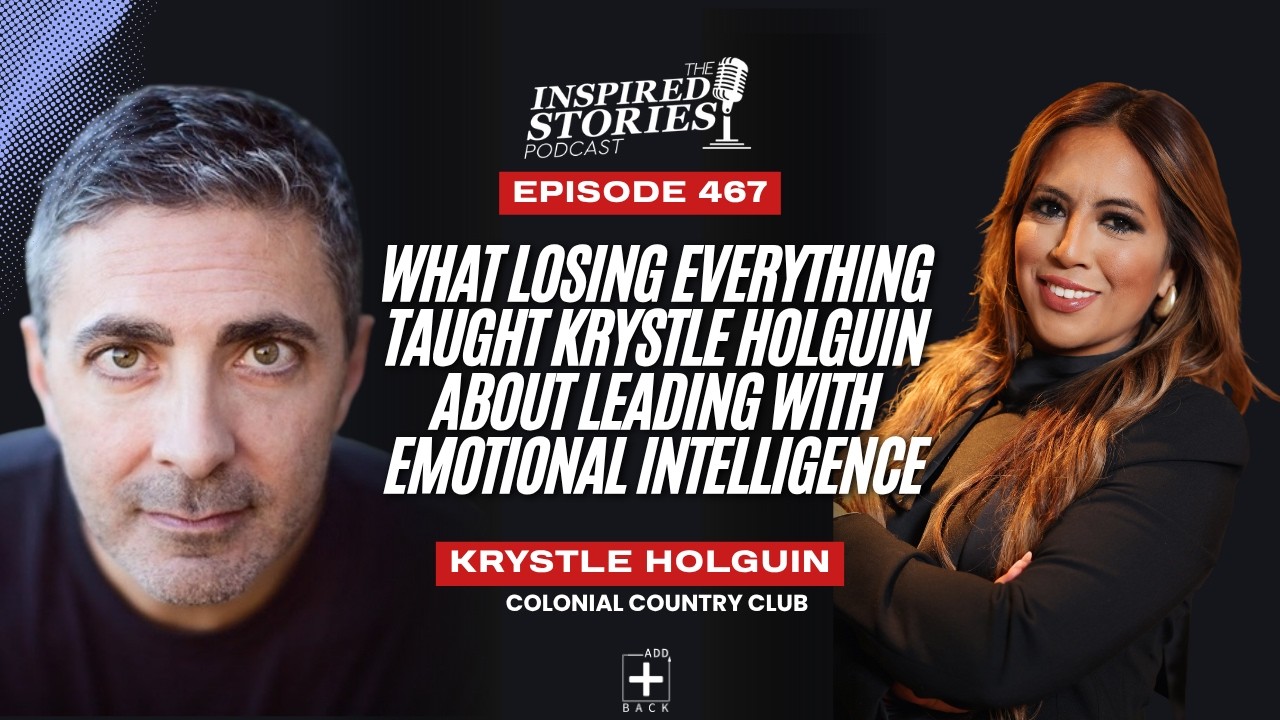
Krystle Holguin: From HR Clerk at 15 to People Strategy Director at Colonial Country Club
Krystle Holguin, Director of Human Resources at Colonial Country Club in Fort Worth, Texas, shares her journey from a part-time high school clerk job she took for extra spending money to leading the people strategy behind one of America’s most storied private clubs — including a $120 million renovation and the annual Charles Schwab Challenge PGA Tour event.
Key Insights You’ll Learn:
Starting in HR at 15 with no career vision — and spending nearly a decade there
Three years in teaching, a failed certification, and what rejection taught her about redirection
Following a partner across Texas, getting laid off during COVID, and choosing to start over
Building an HR department solo with no staff and no employees coming to work
Implementing a new HRIS system over heavy internal resistance — and winning with data
The “hire character, train skill” philosophy and how it changed her interview approach
Launching Colonial’s in-house university: skill classes, wellness, and professional development
Managing HR for a $120M renovation and a PGA Tour event broadcast in 200+ countries
Why emotional intelligence is the most underrated trait in senior leadership
Building an engagement committee that actually executes instead of just meeting
Krystle’s Key Mentors:
High School Business Teacher: Connected her to the school district clerk role that started it all
Teaching Students: Showed her the power of genuine connection that carried into HR leadership
Difficult Bosses: Toughened her emotional intelligence in ways she didn’t appreciate until later
COVID-Era Staff: Forced her to become the expert by being the only one with answers
Colonial Leadership Team: Gave her the support and space to build the vision she had been carrying for years
Don’t miss this conversation about what real HR leadership looks like, why the scenic career route can be the best preparation, and how one leader is turning a century-old club into a place where employees genuinely want to show up.
Listen to the full episode here
Transcript
Anthony Codispoti (00:01)
Welcome to another edition of the inspired stories podcast where leaders share their experiences so we can learn from their successes and be inspired by how they've overcome adversity. As you listen today, let one idea shape what you do next. My name is Anthony Cotaspodi and today's guest started her career at 15 years old in HR, not because she had a vision for her future, but because she wanted money for nice clothes. She had
No idea that entry level clerk job in a school district HR office would set the foundation for everything that followed. She took a detour into teaching, followed someone else's career across the state, got laid off during a pandemic, and had to make a choice about whose future she was going to prioritize. What came after that moment changed the direction of her entire career. She is Crystal Olgain.
Krystle (00:36)
you
Anthony Codispoti (00:57)
Director of Human Resources at Colonial Country Club in Fort Worth, Texas. Colonial is one of the most storied private clubs in America, founded in 1936, home to the Charles Schwab Challenge PGA Tour event, and currently midway through a $120 million renovation. And Crystal leads the people strategy behind all of it. There's something in her story for anyone who ever took the scenic route to figuring out where they belong.
Krystle (01:25)
So,
Anthony Codispoti (01:27)
But before we get into that good stuff, today's episode is brought to you by my company, Ad Back Benefits Agency. Listen, if you run a business, you're likely stuck in the cycle of rising insurance premiums. You're paying more, but your team is getting less. And many people can't afford coverage at all. So we do things differently. We provide your country club employees with unlimited access to doctors, therapists, and prescriptions that's always free for them to use.
And here's the part that surprises most people. Unlike every other employee benefit out there, our program puts more money into your company's bank account. As an example, we recently helped a client increase net profits by $900 per employee per year. Results vary, but gains like that can change how a business is valued. And the consultation is free. See if you qualify today at addbackbenefits.com.
All right, back to our guest today, the HR director of Colonial Country Club, Crystal Olkein. Thank you for making the time to share your story today.
Krystle (02:31)
Thank you for having me. Hello everyone.
Anthony Codispoti (02:33)
So, Crystal,
how close did I get on the pronunciation of your last name?
Krystle (02:38)
I think you were pretty accurate, pretty spot on.
Anthony Codispoti (02:41)
Pretty close,
okay, go ahead, thank you. I got a little coaching ahead of time that was helpful. So take me back to that first job we just referenced in the intro. You were 15, ⁓ working in the HR office of a school district with 60 HR employees and about 60 schools. What kind of work were you doing there?
Krystle (03:00)
So ⁓ I actually took a business class in high school and you know when you finish your senior credits early you have the opportunity to take a business class where they help you find a job. So my business teacher you know had a lot of partnerships with ⁓ different local entities and I took a business class and had an interview alongside you know competed with some
other classmates and I ended up getting the job as a part-time clerk for the school district. And if you think of internship or a clerk that does a little bit of everything, ⁓ I was helping set up for board meetings, I was making copies, anything admin related I was doing, but didn't realize the areas that I worked in, how important the office was and how large it was.
the scale of HR and what it did for the entire district. I mean, they have over 60,000 students and many, many schools. So didn't realize the impact of what I was doing, but it was more administrative duties.
Anthony Codispoti (04:13)
And so that was initially, but as I understand it, you spent nearly a decade in that school district HR office and you're rotating through different functions. Was there a moment in that work where you felt like, ⁓ okay, I kind of get this and I feel like I've got a real skill for it too.
Krystle (04:32)
No, not at all. Actually, I was just going through I think I saw it more as an office role ⁓ admin and trying to get me throughout high school and ⁓ eventually throughout college. And I think I was kind of in a rut like what do I do? I'm going to school. It took me longer to finish my bachelor's degree. Going to school and figuring out what I wanted to do with my life. But never did it cross my mind that HR was that path.
Anthony Codispoti (04:34)
No.
Krystle (05:01)
And initially I told you, because I was working for a school district, I think a lot of us students that had that partnership with the schools, we went into teaching just because we were surrounded by educators and we were ambitious to, like you said, make more money and have an impact. And naturally we took that route to go into teaching. So that's what I did.
Anthony Codispoti (05:27)
And so how long were you in teaching?
Krystle (05:30)
⁓ I did that for about three years ⁓ before I went back into HR.
Anthony Codispoti (05:38)
So you were a teacher for three years, you'd gone to school for it. You were surrounded by teachers that just sort of seemed like a natural good place to be. But three years in, you decide this isn't for you. What was it that told you that and pulled you back into HR?
Krystle (05:56)
Well, if I'm being honest, ⁓ one of the biggest struggles I had was passing the teaching certification. So it was more like a probationary period. And I really struggled with, ⁓ I naturally struggle with test taking. So I struggled with ⁓ passing that test, which is what created so much frustration because I love teaching and I felt like I was really good at it.
and able to connect with students. I still hear from some of the students to this day, but the impact that I made throughout their lives and the ability to connect, I love so much, but it was that factor of I couldn't pass the teaching test. That was the biggest obstacle that I had to overcome and really never was able to pass. I mean, I think I was off by a couple of points every time I took it.
Anthony Codispoti (06:51)
That had to be really frustrating.
Krystle (06:54)
so frustrating and it was emotionally draining as well because being a first year teacher is really, really tough. know, a lot of people their first year, they have a lot of meltdowns, you know, that it's really tough adjusting with the parents. And I was also ⁓ teaching high school students. you know, having to deal with behavioral issues, but it took an emotional toll on me and truly I felt like a huge failure. ⁓
not being able to pass this test because I knew people that were teachers that didn't really care about students and yet they passed the test and that made them be able to stay. But me that I genuinely cared about the students, I just couldn't pass the test and eventually it made me have to leave teaching.
Anthony Codispoti (07:44)
⁓ What did you do to get through that hard time? Was there somebody you went to for support? Were there things that you were finding solace in?
Krystle (07:54)
Well, I'm very spiritual, so ⁓ religious belief and just praying, you know. And one thing that I do consistently to this day is I listen to a lot of podcasts and sermons, you know, every morning when I'm getting ready, that's what I do. So I try to change my mindset. And I heard this one that I'll never forget. And it was rejection is redirection. So even though, you know, the path to teaching
was something that I felt like I was really good at and I wanted to do. I had to understand that things were happening for a reason. And like I said, through prayers and just starting to gain and build my confidence back, then I was able to kind of see it as an opportunity to go through a different path. And essentially, ⁓
I thought about, what experience do I have? What have I done? And HR, you know, is kind of the route that I was like, well, I've been in HR for all these years, so maybe I do that temporarily before I figure out what I want to do when I grow up.
Anthony Codispoti (09:09)
So you were still in the process of figuring out what you wanted to be when you grew up, but ⁓ HR was something that you had a lot of familiarity with. You were looking to get back to something to kind of boost your confidence, looking for a new job. So talk to me about the transition that brought you to Dallas and ultimately back into HR, because you've described a period where you were prioritizing somebody else's career over your own.
Krystle (09:37)
Right. So I'm originally born and raised in El Paso, Texas. And there is when I met my one of my partners that I was dating and he essentially got a job in Austin, which is kind of what made us move commute to Austin. And we lived there for a year. And, you know, eventually he got a job in Dallas. So we came to Dallas. That's kind of how we landed here.
But it was really about you know, this is someone that I thought I was gonna spend the rest of my life with so, you I knew it was gonna be an investment for him But eventually when it didn't work out, I kind of had to start over and prioritize myself ⁓ And kind of build myself back up ⁓ coming back to Dallas ⁓ after I got laid off with the gay lord Sorry, I don't know if I can see
After I got laid off from my current place, then I moved back to El Paso ⁓ because I lost my job. I my partner of I would say back then it was like seven years we broke up and then I really had no I was staying with him. So no, no place to stay. So kind of went back to El Paso to regroup and figure out, hey, what am I going to do?
And that's essentially when ⁓ COVID hit ⁓ and I got a job six weeks after ⁓ COVID hit and I got laid off. So I ended up moving back to Dallas ⁓ and started.
Anthony Codispoti (11:19)
So
wait, you got a job, six weeks later COVID hits, so then you get laid off and now you're looking what to do next.
Krystle (11:26)
No, I got
laid off, moved back to El Paso, and then in six weeks from when I moved back to El Paso, I get the job. Yeah. Everyone was doing a hiring freeze and everyone was laying off their employees. I was, you know, testament of it. And then I, you know, I prayed about it and I was like, God, if you want me to stay in El Paso, find me a job here. If you want me to be in Dallas, if that's where I belong.
Anthony Codispoti (11:36)
Okay.
Yeah.
Krystle (11:54)
then find me one there and six weeks later I landed a job after being laid off and started with another club with no employees.
Anthony Codispoti (12:05)
No employees.
Krystle (12:06)
They were all at home because of COVID. They were not laid off, but they were at home.
Anthony Codispoti (12:12)
So why were they hiring, and what were you coming in as, like HR director? HR manager, why were they hiring an HR manager during COVID? The clubs probably shut down, they've got no employees, well, no employees that are coming to work. What was their thinking?
Krystle (12:17)
It's our manager.
Well, because if you consider it, there has to be someone there when they eventually bring the staff back to be able to operate what was happening. And no one really knew the effects of COVID and that it was going to last as long as it lasted. I don't think that crossed the mind. HR is really the bulk of, you know, I can tell you, I felt like I was a
a doctor after that whole COVID, just because of, you know, so many quick decisions that we had to make as a leadership team. But I think it was the right decision. And then when they came back, it gave me time to kind of build my ⁓ relationship, build relationships with the staff.
Anthony Codispoti (13:19)
So were you basically creating the HR department from scratch? Like had one existed prior to this?
Krystle (13:26)
Yes, two had existed. My predecessor was there for maybe two years and then the one before that had been there 20 years.
Anthony Codispoti (13:38)
Okay, so HR had existed in this environment before. They brought somebody new in. And what was it aside from dealing with all the COVID shenanigans, which we can't brush aside, that was significant, but what was it that you were doing to try to update the HR functions there?
Krystle (13:43)
Yes.
Well, the whole reason behind why I took that job was it was a one person HR team. And I had worked every time I worked in HR, there was a large team, you know, in the school district, there was probably over 60 people in HR and several different departments. And then in my next role, there was about 12 of us. So I really wanted to
be get stronger in the areas where I wasn't so confident. So it kind of forced me to do that. So to be honest with you, I was just trying to stay afloat and figure out, hey, I need to become the expert in the areas that I'm not confident in if I want to evolve and move up in my career. And it really forced me to do that because everyone was coming to me with all the questions and I it's not like I had someone to like I had to figure it out. You have
these employees asking you for answers and you have no choice, you have to figure it out. So ⁓ I think that initially it was more of HR is a liaison versus HR is a partnership, very similar to where I'm at currently. ⁓ And I think what was nice was I was able to develop ⁓ all of these programs and
you know, all of these initiatives and I had the support of my leader to do that.
Anthony Codispoti (15:30)
So the part of your story I want to pause and draw a little bit of attention to here, Crystal, is ⁓ it seems like there's a tendency in you, or at least something that came about during COVID, to put yourself into these very uncomfortable situations to force yourself to grow. Was that something that was there before inside of you, or did that come about out of necessity given the circumstances that you were kind of thrust into?
Krystle (15:58)
It was kind of survival, fight or flight mode. You know, and I tie these all back to my personal relationships, like partners that I was in, because a lot of my dependency was on them and the relationship and, you know, the hope that there's a future there. And I in that in that path, I neglected myself and my growth and my opportunity to.
get better, a lot of the obstacles I faced was really, you know, I really didn't have a choice. There were times where I was just like, well, I got to figure it out, you know, and looking back when you're going through it, you're like, my gosh, this is awful. How will I ever overcome it? But looking back, it's like, ⁓ was that prepared me to be stronger and to be able to do the current role that I'm in.
So it's funny how life has a way of, you know, it all works out in the end.
Anthony Codispoti (17:01)
Say more about this idea of HR as a partnership. Where did this philosophy come from?
Krystle (17:09)
So I think old school HR has always been very different from what it is now. It's really evolved and it's more of employee advocacy. It's employee involvement, things like engagement committees, things like new initiatives that you have, universities that you build within your club or within your entity.
But I think before HR, to me, know, growing up being 15, it felt more transactional where you went there if you needed to print a pay statement or if you had a problem with your pay, it seemed very transactional and not so much genuine and people just didn't overall seem very happy. And now looking at HR that
becoming a leader that, you know, with the two individuals that worked under me, that was the number one thing. Hey, our role is to support the employees. Like we work for them. We are here to advocate for them, to assist them with what they need, to listen to them, to help them. And I think that's evolved over time and what you see it now, how you see it now.
Anthony Codispoti (18:31)
Okay, so you got to cut your teeth in leadership here. You got to bust through a lot of the uncomfortable unknowns, right? You have to take these things on yourself, developing this idea of HR as a partnership, the philosophy there. And at some point, you're leading a team, there are over 300 employees at the peak, but then you decide that you're ready for something else.
What was behind the decision to go to Colonial?
Krystle (19:04)
So at the previous club I was at, think being a one person team, there's only so much you can do with the time that you have as one person. And there were a lot, I had a vision and I had a ⁓ of ideas that I wanted to see come to fruition. And it was just merely impossible to do it alone.
So I knew if I wanted to really see my vision come to light and have all these initiatives go through that I would need some help. And I knew that at Colonial that they, ⁓ I would have a coordinator position. So I would get some admin help there. What really, ⁓ real reason I wanted to move was to relocate because
⁓ I plan to move to Fort Worth. But as far as a professional decision, it was because I was going to have some help and I was going to be able to initiate all these new initiatives and kind of see that come to life. And when I first started at Colonial, I immediately saw the need for more. ⁓ The coordinator we had, I shared it with the director of ops and ⁓
just the amount of traffic that we were coming through, all the new initiatives, just a lot of changes that were happening. I put in a business case to add a HR generalist. If you're in HR, you know the most time consuming is recruiting because even if you're hiring for one role, it can be very time consuming. So the HR generalist role was gonna be recruiting and training.
So I got that, you know, I was told no several times, but I didn't give up. And I was able to share the data of how it was gonna help us and ⁓ they approved it. So now we have HR generalists and HR coordinator whom I don't share with the director of ops any longer, and then myself. So having this team, we've been able to kick off all these new initiatives that are benefiting the staff.
and really benefiting the membership because if the staff feels like they're supported and they're taken care of and they're valued then in hand the membership they'll take better care of the membership so it kind of all works out the way it's
Anthony Codispoti (21:47)
take care
of your employees and the employees take care of the customers. So what was behind the vision? What was it that you wanted to do where you needed this extra staff so that you had the time and resources to pull it?
Krystle (21:50)
Yes.
as far as like what the process entailed or.
Anthony Codispoti (22:07)
What was it you wanted to do? You said you had these ideas for new initiatives, there was this vision. What was it that you wanted to introduce that wasn't there already?
Krystle (22:17)
I think one of the biggest issues you see and I have seen working in HR is a culture not being where it needs to be. And I think a lot of employees are misunderstood. I would build relationships with staff and they would come share with me these ideas of what they wanted to do or their frustrations. And they only felt
comfortable sharing them with me because I built that relationship with them. So there was a lot of their frustrations that they didn't feel comfortable vocalizing. And on the other hand, they had a lot of talents that I felt like other people could benefit from. So which is the reason behind our university that we created. The university...
is, you know, it could be the most basic level skill that you learn to something just really fun. ⁓ Our first course was Canva 101 and then we did a email building class. And, you know, the amount of knowledge that we have within our staff that I feel like we don't always take the opportunity to share that can actually help them, whether it's in their day to day life or
you know, professionally, if they're figuring out what they want to do in their career path, ⁓ I think it's neglected because we don't do these types of initiatives. So that was really why I knew I wanted to do something, but I wanted the leadership and members to see it through the lens of the employee because I knew they had so much to offer. And an engagement committee is a good way for them to vocalize their frustrations and
also share what they really enjoy and what we're doing right. ⁓ And that was kind of the idea behind that.
Anthony Codispoti (24:20)
So this in-house university that you've set up, the idea is basically just to give your employees a way to learn new skills and to be able to advance themselves, advance their careers. But it sounds like maybe you might risk them advancing their careers out of Colonial and being ready for a role somewhere else. Is that a risk that is worth taking?
Krystle (24:49)
I think it is because we know that we don't have a career path that we can offer to every single person. Not everyone wants to work in the club industry, but in hospitality, the skills that you learn here, you can utilize whether you're becoming a doctor, a lawyer, an astronaut, mean, whatever it is that you take, we want them to learn hospitality.
they're going to advance and move up in their career and they leave and they take that with them and they share with other people the value that they learn at Colonial, then I think that's priceless. Then I think it all works out and we bring more people in because they share the vision that we have.
Anthony Codispoti (25:39)
I like that. So how long has this in-house university been in place?
Krystle (25:44)
We actually just, it's been probably a year in the making, but we just kicked it off a couple of weeks ago and we've done two classes. We're doing two a month and we're really allowing all of the leaders to, sorry, one second. We're allowing all of the leaders who are experts in their field to take ownership in volunteering and
teaching staff about their craft.
Anthony Codispoti (26:17)
And so this is brand spanking new, just a couple of weeks in. Any feedback yet from the staff?
Krystle (26:19)
It's right. Yes. Very exciting.
yeah, our classes have been smaller than we thought, but we're also getting ready for a huge tournament that's coming in the next couple of weeks. But the feedback that we've got is they're very grateful for the opportunity and you're already seeing them use what they learned at work. Like for example, ⁓
We have a fitness attendant and she creates signs for the membership every month based off what the, if there's a holiday or anything. She took the Canva 101 class and probably two days later she came into my office and she's like, look at the flyer I made with what I learned on Canva. That was such a great class and I can't wait to use those skills.
throughout the year and thank you so much. And it was just that little moment of like, wow, you know, what the vision coming to life, you know, and then we have, you know, some people that are not great at grammar or reading and writing and we we've given them tools of hey, use chat GPT use this platform. And they're coming to my office and like, look, I used it and you know, I'm very proud of
my work, you know, so already you're seeing it pay off. But the beauty of the university is it's not just skill set. There's also fun in there. We wanted to take consideration into consideration the mental aspect and the physical aspect of it as well. So we do like, for example, we have a class coming up, Pickleball 101, you know, these
These employees don't have the opportunity to use the facilities at the club. And this is a way for them to learn how to play pickleball if they had an interest in it and use the facilities and be trained, basically get a free lesson from the experts what they would be paying probably over $100 for. it's not all we're doing at Breathworks, we're doing yoga.
It's not all skills that they can learn in professional development. It's also fun and health and wellness related as well. So it's really exciting.
Anthony Codispoti (29:04)
And all these courses, they're taught by other employees at the club, the leaders.
Krystle (29:09)
The leaders.
So all of the leaders in their respective field, we give them kind of our idea of, you know, we know what their area of expertise is. So we assign them a class and then they'll take that. Eventually, I want to grow it because I do think we have a lot of staff that have hidden talents. And I would like to eventually allow staff to train other staff.
on some of their areas of expertise, but for now it's leaders voluntarily investing their time in the staff. And it's been awesome to see all the support from leadership.
Anthony Codispoti (29:53)
That's great. ⁓ Quite a culture that you guys have built there where these busy leadership folks are willing to set aside their time and help to educate ⁓ other employees at the club on fun stuff, but also professional development things. And I want to talk about a big tournament that's coming up, but first I want to take a step back and talk to me about the tech stack that you found when you first stepped into Colonial.
Krystle (30:08)
Right.
Anthony Codispoti (30:21)
how you've evolved that over time.
Krystle (30:24)
About, I'm sorry, what was that?
Anthony Codispoti (30:26)
the tech stack, the technology that you found there at Colonial.
Krystle (30:30)
There was no technology. So I would say we did have a HR system that was primarily used for payroll purposes. But as far as on the employee side, the employee access and ability to really take ownership of
Krystle (30:56)
They really didn't have that onus. So when I came in, we did not have a HR system right away. We had paper applications. We had some tied to the website where an employee can put their information, go to our website, put their information and upload a resume. But what we were doing in the HR department was every
week we were basically sending Excel spreadsheets to the managers and basically saying, here are your candidates that applied. You need to call them. And ⁓ that was pretty much the process. It was very a lot of manual labor. ⁓ Our payroll clerk was going every Friday, she would, because we pay weekly every Friday, she would walk around.
and pass out pay statements. And I'll never forget, she's like, it takes me like three to four hours to pass these out. And she was doing it every Friday. So I wanted to figure out, hey, there's a better way for us to utilize our time and her skill, especially in the rest of us. So implemented a new HRIS system, 2024, beginning of 2025, sorry. And
It was a beast, but it awesome and it was worth it.
Anthony Codispoti (32:28)
Was it, you know, cause there's an implementation process that, you know, that happens before you kind of flip the switch and go live. Once you got to that point and flip the switch on that new HRIS system, was it just like everything changed? Everybody's got all this time back or is there still bit of an adjustment period as people got used to it?
Krystle (32:49)
Well, I would say the initial convincing of not just staff, not just leadership, but also staff. mean, I got a lot of pushback, if I'm being honest, lots of pushback. You know, we have a certain demographic and they're not going to be able to do this. But I felt confident in this specific HRS system because I already had experience with it.
and I experienced it with a similar demographic. So I think that's kind of what gave me the confidence to do that. And it all ties into your experience. I don't know that I would push so hard for it if I didn't feel confident in it working for my previous club. But it was basically convincing them and selling them on, hey, this is gonna be better for everyone.
And one, the implementation was, I would say, the hardest part because you're transferring paper data to a system and some payroll data from one system to an X, but also the inclusivity of everything was in one place. You were not before you were going to 10 different websites for one for background check, one for drug screen, one for this, one for that.
And now everything was centrally located. And I think you got some pushback for sure and hesitation. But now I think for the most part, everyone sees the value.
Anthony Codispoti (34:28)
I'm curious about that transition though. How did you get those naysayers on board? Like did some of them leave? Because ultimately they just weren't buying into it or did you just kind of wear them down over time? What was your strategy?
Krystle (34:44)
Well, I'm very persistent, which I don't give up. But I think it was not just my word because I'm this person coming in new. So my word didn't really have a lot of value yet. But I think just backing it up with data, I'm very data driven. being able to allow, and we did lose some people along the way. mean, naturally it happens, but being able to get into the systems.
and actually show them, this is what we can do. This is how much time we're saving that we could be doing something else productive. And these are the proven results of how it can work. So I think my word had little value because they didn't know me that well, but it was more so being able to physically show them and data, of course, proves that as well.
Anthony Codispoti (35:43)
to talk about your motto, higher character, trained skill. Tell me more about
Krystle (35:49)
So we feel that ⁓ if a person does not have the skill set to do the job, but some experience, then we are more than willing to take someone that's a little more green than someone that has all the experience, but is terrible with people, that is not empathetic, that is not a team player, that has a terrible attitude to cancer.
we would rather take the risk and slowly train the person coming in because you can't teach someone to be kind. You can't teach someone to not be arrogant and, you know, just have a terrible attitude. So we at Colonial feel if you have some experience or sometimes even none, but you are willing to learn and you're coachable and have the right attitude and values.
then we want you to work with us versus I've seen it time and time again. You see people that come through an interview and they ace it out of the park. They're amazing and you're excited and then they're terrible when it comes. And then I've seen people that are very timid in an interview and they're the hardest workers that you'll ever meet. So I like to give people an opportunity and a chance.
and when they show that they really want it, ⁓ then we take a chance on them and it usually works out.
Anthony Codispoti (37:25)
It was going to be my follow-up question for you because, as somebody who's hired hundreds of people in my life, ⁓ I know that that interview process can be deceiving. I've had some folks where I'm like, they're amazing. They're just going to hit the ground running and boy, it doesn't work out. And then the opposite as well. They just, you know, they're nervous. They don't present well that first time around, but man, do they fit in great. Have you found?
I mean, it sounds like you're more about, hey, let's give them a chance. Let's see what they're like on the job. And that'll really be the test. But have you come up with any techniques or questions that you used during that interview process that you found helpful in maybe creating a little bit of a better filter to know if this is somebody who's going to fit for you?
Krystle (38:16)
I would say a lot is instinct. Trust your instinct, trust your gut. And not everybody has that. But I think ⁓ if you really change the type of questions that you're asking and give more questions that are tied to their values and their morals and share examples of what you've done to do the right thing,
those type of questions, then you can quickly see kind of their mindset and if they're in it just for the pay or for other reasons. But I think I completely changed the way that I interview and it also ties into resumes. Some people have terrible resumes and they're amazing candidates. And you know, that's something that I tell my generalists, I'm like,
call every single person that you can call. Give everyone an opportunity, get them on the phone and see if they could possibly be a great fit. Because we need entry level to executive level, it just depends. But when I see people that really show that they want it and they're desperate, those are the people that I want to give a chance to. So if you come into the club and you ⁓ give us your resume, you automatically get an interview.
We're not gonna tell you, hey, you gotta make an appointment. We're gonna say, hey, thank you for stopping by and we connect you with the manager. And hopefully it works out because it shows that you're taking that extra step. You really want the job and you really wanna work here. And that's who we want to work here is people that really wanna work at Colonial. Because we know it's a special place.
Anthony Codispoti (40:05)
Chris, you said that you've completely changed how you run an interview. What did you mean by that? What have you changed?
Krystle (40:13)
just the type of things that I look for. So, higher character training skill came way later on in my career. I was looking for, well, they have all of this experience and having this experience is gonna help this role tremendously. But then I started to see the ones that did have more experience weren't always necessarily the best because of their attitude or.
You know, they felt entitled or that you owed them something. ⁓ And you saw the ones that were more humble. They were able to produce much better because they were coachable. They weren't stuck in their ways, you know. And from then I started to completely change the type of questions I was asking for. I was asking to candidates that came in. And like I
Anthony Codispoti (41:08)
That makes sense. Yeah.
Krystle (41:10)
It's not everyone has it, but I think a lot of it is intuition and God and you I can know within two minutes. If I want to move this person forward.
Anthony Codispoti (41:22)
What is it that you're looking for in that two minutes?
Krystle (41:25)
The simplest, most basic things, smile, energy, confidence, ⁓ nonverbal. ⁓ Are you polite? Did you greet the receptionist that came that you ⁓ that walked you to the interview? Like the simplest things are what make a world of a difference. And you'll see that that truly gives you the best candidate. Those that have that can.
I would say that can master the basics.
Anthony Codispoti (42:00)
So I want to talk about the big tournament that's coming up. You talked about you launched the in-house university, very excited about. Maybe didn't get quite the turnout you were hoping for, but that's because people are busy, they're working, they're a little bit distracted by this big tournament. Tell us, what is it?
Krystle (42:03)
Yeah.
Right.
So that are you saying what is the tournament overall?
Anthony Codispoti (42:22)
Yeah, is it is this the Charles Schwab
Krystle (42:25)
Yeah,
challenge. ⁓ We are the lot. The this tournament has been around for really long time. This tournament is ⁓ broadcast in over 200 countries. We it's pretty much all hands on deck. So
We don't only hire for the tournament, but we also, after the tournament, have, we open the pool, so pool season. So it's a very busy season for us, but we bring in, do a lot of donating to local community, bring in millions of dollars to the Fort Worth community. And one thing that is really awesome is we donate a couple homes to widows of veterans.
So I think people know about the tournament because it's been around for so long, but I don't think a lot of people know ⁓ the investment that it gives to the Fort Worth community and also how much they donate and give back, which is really great.
Anthony Codispoti (43:32)
And so these homes that are donated, is that locally in the Fort Worth area?
Krystle (43:37)
Yes,
Anthony Codispoti (43:39)
That's tremendous. And, know, in the lead up to this big tournament, sounds like you guys are having to add a lot of staff, temporary staff that, ⁓ you know, can help with all the extra work that's required. How, how do you handle that sort of that big burst of extra staff and then, you know, sort of the drop off that happens afterwards?
Krystle (44:01)
Well, when you hire on staff that are gonna work one week, essentially, it's hard to instill your values and tie that into the mission and help them understand that. But because we're going through a renovation, one of our buildings is closed, so we're not having to hire as many. Last year, I think we hired a lot more, but we're not having to hire as many. But we get ahead of it.
We have a tournament team that is working all year long to get ready for this one week. And that team is probably, I think there's about eight to 10 on their team and they have over a thousand volunteers that help them with these tournaments. So it's a lot of preparation. And then on the HR side, we try to get ahead of it.
So we host an on-site job fair, which we hosted ⁓ last Monday, had almost 100 people attend. So we make sure that we get ahead of it so that our staff isn't overwhelmed. But we're not having to hire as many this year because of our renovation. Did I tell you about our renovation? No?
Anthony Codispoti (45:14)
We haven't had a chance to talk about that. Yeah,
it's a perfect time. What are you guys up to? $120 million investment here.
Krystle (45:21)
Yeah, so it's been going on since I started and I believe completion should be early 2027 or mid 2027, but it essentially began in phases. So phase one was the golf course over 25 million ⁓ to redo the golf course. And, you know, I could talk agronomy, but I'm not the expert in that area.
But I know it's a very specialized type of course and how they maintain it. We have a grounds crew of over 40 ⁓ employees that work probably seven days a week. So it takes a lot to maintain, but that was phase one. And then phase two, we built a whole new clubhouse with three high-end restaurants. And that just opened in December.
Awesome restaurants. What the nice thing if you go to clubs a lot of clubs It's kind of like you're going to your grandma's house the furniture the the environment but these Restaurants we we hired someone that specialized in restaurants. So they're very high-end restaurants that tie into the traditional ⁓
aspect of what Colonial truly is. So you'll see photos of Marvin Leonard, who's our founder, and you know, just players that have played the course throughout the years. But really nice restaurants that we have been so excited about. ⁓ And then phase three will be ⁓ our old clubhouse, we're renovating it to be an event space. And that will open hopefully ⁓ mid 2027.
and that will be more for banquets and events ⁓ that we host and we'll build a fitness and spa, we'll offer spa services as well.
Anthony Codispoti (47:25)
Well, that's a lot of very exciting things going on. And on the HR side of things, you've just launched this in-house university that you're really excited about. And there's lots of work to be done there, more courses, get people more involved. Are there other HR-related projects that you either have in the works or have in mind that you would like to implement at some point in the future?
Krystle (47:48)
Well, I think our engagement committee, when we first started it, we kind of let anybody join. And it was great, but I think there was a lot of pre-planning, but not enough execution. we're trying to, we've completely revamped it and turned it around where it's a much smaller group that hopefully is more productive and effective. And we also wanted to tie in professional development in there.
So the opportunity for them to sit in on some of our board meetings or our committee meetings to really learn the value of what their voice is gonna bring to the overall employee experience and then later tie into the member experience. That's one that we're really excited about. And then the second part is we've really tried to build partnerships with local universities.
to really spread awareness of what hospitality is and what a career in hospitality can potentially be. So myself, our HR coordinator and our executive director of F &B, we actually just visited a local university and shared with students, you know, just a little bit of our story and our career path and what opportunities.
they can have, you know, because you have students that are just like, I don't know what I want to do. I don't have any direction. So that's the hope with this initiative is just to continue to spread awareness and create partnerships for students, whether it's at the local high school or university level.
Anthony Codispoti (49:33)
Crystal, what's one of the hardest things that you've ever had to overcome personally, and what did that teach you?
Krystle (49:41)
⁓ I would say similar to the story I showed earlier, you know, when it rains it pours and you know, when you lose everything and you have to start over, you don't realize, you know, the blessing and disguise that's happening. But I think the hardest part was having to leave teaching and something that I was so passionate about and I felt like I was really, really good at. And now that I look back, I
I see how much teaching and HR really go hand in hand because there's that professional development side. There's that learning aspect of giving trainings very similar to teaching. There's building those personal relationships, same as students, same as staff. So ⁓ it was really hard for me back then, but I wouldn't change it for anything because I think it really helped me.
If I didn't go through that, I don't know if I would be strong in my current role. My mind would be a lot more weak-minded because HR is an emotional turmoil. I mean, if you're not strong mentally, it can really get to you.
Anthony Codispoti (50:59)
Tell me why.
Krystle (51:00)
Just because I think a lot of people CHR is the principal's office and that's not really what it is. Like I said, I wanted more employees to understand we are here for the employees. We're here to advocate for them. Sure, we have to discipline here and there, but we don't make any decisions. If a manager comes to me and says, hey, this employee is,
did X, Y, and Z and they're a terrible employee. All we do is counsel and we advise them of the risks, but we don't make any decisions. Our job is not to make decisions. Our job is to advise, is to counsel, is to hopefully steer them in the right direction so they're doing the right thing, but we don't make decisions. And I think if we fire someone, it's always like, OHR fired me.
but it's definitely not the case.
Anthony Codispoti (52:02)
Got it. ⁓ Yeah, it's interesting here you talk about, in my head, I think of it one door closes another one opens. I think the phrase you used earlier is rejection is redirection. If you hadn't spent those three years in teaching, you wouldn't have been as ready for what came next and maybe is equipped to handle some of those emotional challenges that come about in the HR leadership role.
And I want you to say more about what it's like to have kind of worked your way into this position of leadership where, you know, in earlier positions, maybe you had some, you know, support, had some peers. Now you're, you know, at the top of your department. And sometimes it can get a little bit lonely there.
Krystle (52:55)
Right. ⁓ I think what one thing that comes to mind is emotional intelligence. And if you don't have that emotional intelligence, like, to be honest with you, I was much more sensitive before. If somebody hurt my feelings, I cried. I cried alone, but ⁓ I cried actual tears and I was very, very hurt. And I took it personal and
The more I moved up in my career and had some really bad bosses that were really tough on me, which I didn't understand now, understand there was value there. ⁓ But the more I move up, I see a lot of leaders that don't have that emotional intelligence and they take everything personal. They think the employees ought to get them, but until they figure out it's not personal, it's not about them.
then they really struggle. I mean, you'd be surprised the amount of leaders at the highest level that struggle with that emotional intelligence. And I think that's why I would say I'm good at my job is because I know everyone has a story, know, hurt people, hurt people. And I realized that it's not always about you. It's more about them.
So I think that helped me kind of move up in my career and it really has helped me in my current role because you see it all the time, just the lack of emotional intelligence.
Anthony Codispoti (54:33)
Crystal, I've just got one more question for you today. But before I ask it, I want to do three quick things for the audience. First of all, to learn more about what Crystal and the Colonial team are doing, visit their website, colonialfw.com. They're in Fort Worth, Texas, so colonialfw.com. And if you're enjoying the show today, please take a moment to subscribe wherever you're listening. It also sends a signal that helps others discover our podcast.
Thank you for taking a quick moment to do that right now. And as a reminder, you can get your country club employees access to therapists, doctors, and prescription meds that counter intuitively actually increases your company's net profits. Real gains that can change how a business is valued. Contact us today at addbackbenefits.com. So last question for you, Crystal. A year from now, what is one very specific thing that you hope to be celebrating?
Krystle (55:31)
⁓ I think the growth within my personal team, we have a lot of initiatives that we're ⁓ trying to see through fruition and we've gotten pushback and there's been a cultural shift. But I think if we remain strong as a unit that ⁓ we are going to be able to see our efforts ⁓ see through and appreciated.
So I think the growth within my team and our leadership team is really something that in a year I hope to grow.
Anthony Codispoti (56:09)
That's terrific. Crystal Oguin from Colonial in Fort Worth, Texas, the Colonial Country Club. I want to be the first to thank you for sharing both your time and your story with us today. I really appreciate you being here.
Krystle (56:23)
Thank you. Thank you for having me.
Anthony Codispoti (56:25)
Folks, that's a wrap on another episode of the Inspired Stories podcast. Thanks for learning with us. And if one thing stood out, put that into action today.
Connect with Krystle Holguin:
Website: colonialfw.com