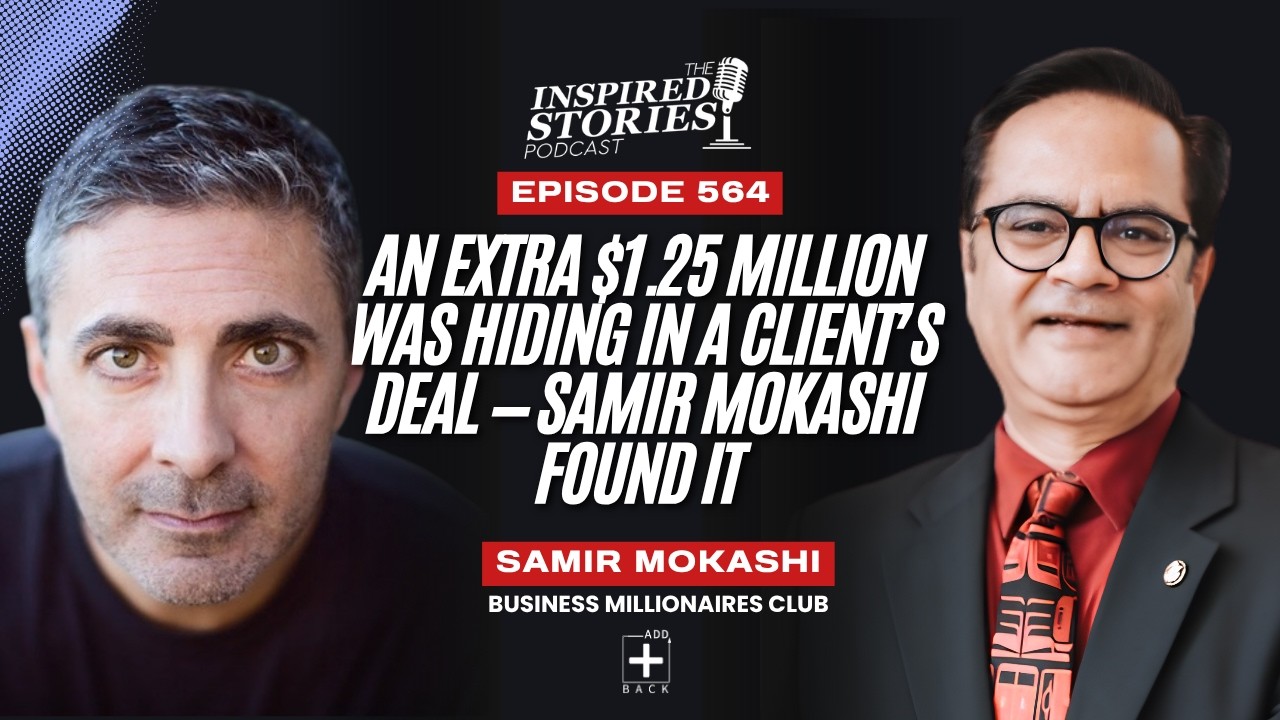
🎙️ From Bombay to Business Millionaires Club: Samir Mokashi's Journey Building and Selling Code Unlimited
In this episode, Samir Mokashi, founder of Business Millionaires Club, shares how he built a building-code consulting firm with his wife, grew it onto the Inc. 5000 list, and sold it in 2022, only to face the unexpected challenge of rebuilding his identity from scratch. Samir opens up about being underestimated as an immigrant entrepreneur, the marriage rules that protected his 50-50 business partnership, and how he now helps other founders prepare their companies for a premium exit.
✨ Key Insights You'll Learn:
Trained as an architect in Bombay before studying daylighting design at the University of Oregon
Sold nonprofit memberships door-to-door before landing his first architecture job
Became a specialist in building codes for semiconductor fabrication plants
Co-founded Code Unlimited with his wife under a strict 50-50 partnership
Set firm rules separating business talk from family life at home
Broke his own expertise into delegable skill sets to scale beyond himself
Took Code Unlimited onto the Inc. 5000 list before selling in 2022
Felt an unexpected identity void after a successful exit, calling it “starting over”
Negotiated a $1.25 million increase for a client by reframing the buyer's real motivation
Wrote “The Millionaire Exit,” focused on culture as the foundation of a strong sale
🌟 Samir's Key Mentors:
His Father: A respected chemical engineer whose encouragement to travel shaped his path abroad
Asawari Mokashi (Wife & Business Partner): Insisted on equal partnership and set the boundaries that protected their family
The Architect Who Hired Him During the Recession: Gave him his entry into semiconductor facility work at IDC
Everyday Customers From His Door-to-Door Sales Days: Taught him how to earn trust and close quickly
👉 Hear how an immigrant architect turned being underestimated into a superpower, built and sold a multimillion-dollar consulting firm, and is now helping other founders exit on their own terms.
Listen to the full episode here
Transcript
Anthony Codispoti (00:01)
Welcome to another edition of the Inspired Stories Podcast, where leaders share their experiences so we can learn from their successes and be inspired by how they've overcome adversity. As you listen today, let one idea shape what you do next. My name is Anthony Kotus Bodi, and today's guest trained as an architect in India, moved to Oregon to study, and later became one of the go-to experts on building codes for semiconductor fabrication plants.
Then he co-founded a consulting firm with his wife, grew it onto the Inc. 5000 list, and sold it to a global company in 2022. Then he took everything he learned about building, scaling, and selling a business and turned it into a playbook for other founders. His name is Samir Mokashi. He's the founder and principal consultant of Business Millionaires Club, a consultancy that helps entrepreneurs prepare their companies for six, seven, and eight-figure exits.
He holds the SEPA designation, has more than 30 years of experience across architecture, regulatory consulting, and business strategy, and is the author of The Millionaire Exit. But before we get into all that good stuff, today's episode is brought to you by my company, AddBack Benefits Agency. And you'll want to hear this because it's hurting almost every business owner you know. See, health insurance costs go up every single year, and businesses are furious about it. They're paying more.
Claims are getting denied. Employees are opting out because they can't afford it, and it hurts turnover and morale. It's one of the most maddening problems in running a business, and everyone just seems to accept it. But you don't have to anymore. Now there's a program from Bain Capital Insurance that gives your employees unlimited access to doctors, therapists, and prescriptions with no co-pays or deductibles to meet. And here's the part that really shocks most people.
Unlike every other employee benefit out there, our program increases your net profits. We recently helped a client add, add $900 per employee per year to their bottom line. Results vary, but gains like that change how a business is valued. You can be the hero advisor that introduces this to your clients today. They'll be so happy they refer their friends to you. At backbenefits.com. Okay, back to our guest today, the founder of Business Millionaire Club.
Samir Makashi, thanks for making the time to share your story today.
Samir Mokashi (02:30)
Thank you for having me here. I'm looking forward to it.
Anthony Codispoti (02:33)
Samir, take me back to growing up in India and studying architecture at the University of Bombay. What drew you into that field in the first place?
Samir Mokashi (02:42)
So, as a young person growing up in India, I was very good at math and science and drawing. And we had an aptitude test in our school, and that gave me equal opportunity for engineering and architecture. And my dad was a chemical engineer. So of course I wanted to be an engineer. But I as I figured out what engineers do in India at that time, architects were more creative. And I always
like to work with my hands. I would make little motorboats, little other activities, just do with my things that I built that were mechanically inclined but worked, but were also creative. And that what drew me to architecture. I like to be creative. I didn't want to be a maintenance engineer somewhere.
Anthony Codispoti (03:26)
Got it. Okay. So you you go to school, you think you're gonna be an engineer, you end up pivoting into architecture because that felt like a more creative field for you. You get your degree, and then talk to me about the decision to leave India and go to the University of Oregon for your master's degree. What was the thought process there?
Samir Mokashi (03:43)
So initially it was an idea, it was one fabulous idea. I was looking to practice my architecture in India, and India was a growing country, still is at that time, and very good for our architecture profession. But my dad had traveled quite a bit for business. His his firm was a consulting firm in engineering and they were a lot of business in the US and Europe. And he said going to another country will open up your eyes. So that was something in the back of my mind that, yeah.
And at the same time, I after my degree, I felt that I knew a lot about architecture, but I still needed to grow more. And the University of Oregon at that time had a daylighting program. And you experience architecture because of the light reflecting from the surfaces. Our vision perceives the space because of the reflected light and how we see that through our eyes. And so I said that I need to understand how light affects architecture. It's a very kind of
Daylighting it was a new upcoming field at that time. So I came to University of Art again for daylighting study with the intent of going back after a study and then ended up staying here. And that's how the story unfolded.
Anthony Codispoti (04:54)
Explain to me more about this daylighting area of study. What what do you mean exactly? Like the the reflection of the light affects how we judge those surfaces.
Samir Mokashi (05:04)
So whether you have side windows, whether you have skylights, whether you have a light shelf, all of those individual, whether you put the window in the middle of the room or at the edge of the room or complete glass across the entire spectrum of the room. Right. So so when you're inside, your eyes adjust to the lights wherever you go. When you're inside and dark, your eyes adjust to it. When you go outside and it's bright, your eyes adjust to it. So our perception of glare is relative to our surroundings.
So I actually developed a thesis and and a scale to when the same lumen level or the absolute light level inside and outside would have very different perception. Inside that room, we need very little light. And the same light outside would be dark and you need very bright light. So your perception of whether you are in a well-lit space or not is actually dependent on how dark the corners of the rooms are.
Anthony Codispoti (06:01)
It's relational. Hm. Okay.
Samir Mokashi (06:02)
Yes. So your eye
looks at the broader surrounding area and based on that determines if it's well lit, uniformly lit or or glare. And so how do you use that and the design the components so each surface of the building can either either reflect, reflect or or diffuse the light coming in. And you use that as a way to create beautiful spaces where you can do functions.
Anthony Codispoti (06:31)
And when you're talking about the spaces, are you talking about are the the surfaces, are you talking about both internal and external surfaces of the building?
Samir Mokashi (06:38)
Correct.
When you look out of the window, you see the external surfaces and that has the potential to be glare. Your internal surfaces create the dark contrast that results in gray. So if you light up your walls, if you have a like lights on your wall that are that are create going to illuminate the wall, it will reduce the gray from the window. You don't need light more light on your desk, you need more light on your walls to actually not see glare. It's very counterintuitive.
Anthony Codispoti (07:09)
That's fascinating. So you came here, thought you were just gonna study at the University of Oregon for a while, but you end up making it home, a home, a new home for you. Think back to that transition from India to Oregon. Were there any culture shocks for you? What do you remember about that?
Samir Mokashi (07:28)
So I grew up in Bombay, most of my life. And I came to Eugene. Eugene is a university town. At that time, 100,000 population. Bombay was a multi-million population, very dense. It's like New York, but denser. When I came to the University of Oregon and Eugene, I thought I'd come to a village. And and literally I was walking through the neighborhoods and there was nobody on the streets. And I was like, this must be the
Coast towns that I've read about. And and I'm not used, yes. Yeah.
Anthony Codispoti (07:59)
A ghost town that it completely deserted.
Samir Mokashi (08:02)
I had not been in a residential area where there was no people on the street. In Bombay in the middle, in midnight, there's people on the street, some activity happening, somebody selling something, somebody buying something, because people are traveling, traveling to distant places and coming late at night. That whole concept of what a neighborhood is was so foreign to me. And when I visualized that in Yuchi. So that was a culture shock.
The second culture shock was was language. I spoke English very well. So everybody assumed I understood the the cultural language as well. And that's not true. So I didn't
Anthony Codispoti (08:41)
Like the slang terms.
Samir Mokashi (08:42)
Yeah, no, it's just the experience. Which movies you went to, which things you went, and
slight differences. So I will give you an example. It's it's it's not safe for kids, but it's good to talk about. One of the times I was in my
office and I came in and there was everybody s was talking very animatedly about something and I came in. What happened? there was a big accident and everybody was rubber necking. I know what rubber
Anthony Codispoti (09:09)
Ha ha ha.
Samir Mokashi (09:09)
meant. I knew what necking meant. I had no idea what rubbernecking was. And I was like, shit, I don't want to ask anything now. Rubberneck is literally turning your head and looking at it. And and that's the difference. English is my
my my car common language with the cultural language. Totally different.
Anthony Codispoti (09:29)
Yeah. How about the
way in which you were perceived in India versus when you first came to the States? The way people looked at you.
Samir Mokashi (09:38)
Glad
you asked. That was a big transition. In India, I grew up privileged. Just by being Mr. Mokashi's son, I could walk in and doors open for me. When I came here, I didn't know anybody or anything. In in Bombay, where we lived, we had a large family around here. So nobody took advantage of me.
When I came to Eugene, it was wide open. I was open to scams. I'm open to people putting me down, doing all kinds of things. Right? People underestimated me quite a lot as I progressed through my career. That was new. So so I learned to change that, to turn that to my advantage. When people underestimate you, this is life. You can't change.
what everybody else does, right? You can change how you react to it. So I recognize that as a asset if I use it well, because people underestimate me. They can they will like it more if I outperform, right? So my my performance level dropped. Even in University of Oregon, it was very wide school, right? So I soon realized if I screw up, it's that Indian kid who screwed up. If I did well, it's that Indian kid who did well.
So it was my choice to determine how I respond to it. And that was a big deal, big lesson learned.
Anthony Codispoti (11:17)
So in India, doors open for you. Your father's highly respected, at least in big part because of the position that he held. He was, you know, a highly respected engineer. You come to the States, nobody knows you. you're an immigrant. and some people, you know, back then, even today, they look down their nose at you, right?
Samir Mokashi (11:39)
So that never bothered me. I never had ego. It it it doesn't matter how people see me. It matters how I see myself. And that has been very useful. Even when people insult me, I look at it and say, I do I need to take it personally? Most of the time, no, they're coming from their perspective, and I'm okay. They walk away. I don't pick a fight, I will finish a fight.
But I don't pick a fight and I don't hold grudges if it doesn't need to be. Right? So those are kind of things that I learned along the way. But but even in business setup, those things happen. As the owner of the business, I would take people out for lunches and dinners, and the waiter would invariably bring the final bill to somebody sitting next to me who's a white guy. And they would say, no, he's the owner, right? So it was kind of a a funny humor to me.
not a personal reaction. It's just how the rest of the world I exist is in setup. And I can't change that. I can only change my response to it.
Anthony Codispoti (12:48)
What helped you develop that new mentality towards this? Right? Cause it's one thing to look back and say, yeah, it was kind of bumpy, but here I am today, it's all okay. But I mean, this is a beer a very big shift in how people approach you, talk to you, look at you, think about you. Was it, you know, I don't know, was there a mentor? Was there a coach? Was there somebody you leaned on that sort of explained to you, hey, you just kind of need to shape your thinking a little bit differently? Or did you just
Kinda school hard knocks figured out on your own.
Samir Mokashi (13:21)
of hard knocks. I I have I'm a very analytical person. I look at everything and assess everything. I have continuously looked at myself, even as a young person, and said, where I can improve. I don't put a benchmark at look at who is successful. I just benchmark against where I'm today and do it. And it's just natural personality for me. So that helped me quite a bit analyzing it and looking at it from that perspective. I think in in now I have a word for it.
The immigrant entrepreneur. I I use that term internally to me. The immigrant entrepreneur to me is anybody who realizes that it's no safety net and your back is to the wall and you cannot break through the wall. You can go around it, you can climb it, you can you can different take a different path, but don't butt your head against walls that don't break.
Anthony Codispoti (14:15)
I like that. Don't butt your head against walls that don't break. okay, so before we get to your entrepreneurial journey, explain to me how it is that you end up becoming a specialist in building codes specifically for semiconductor fabrication plants. Cause this is a pretty specific niche.
Samir Mokashi (14:35)
Yeah, actually in my underground architecture in India, I my thesis, final thesis was a semiconductor manufacturing plan. At that time, India was poised to have semiconductors come to India. Eventually it knit didn't work out that way, but that was the things. As I explained earlier, I was very good in math and science. So I knew a lot about engineering, even though I did not end up going to engineering school.
My dad being an engineer, he knew other engineers. So I was able to get some information about what it takes to build a Semakanker factory. So that was my access to information that was one of the factors. Designing as an architect, I always got more attracted to problem solving. I always like to solve architecture. I saw architecture as a problem solving process of taking a plot, a program, and filling in.
the infrastructure around it. And so that attracted to me. And so I when other students gravitate towards a gallery or or or a museum or something like that, which were more, they had no programming point, you can make me pretty, I always went towards things which are more stringent functional requirements and how you can create beautiful architecture from there. I always looked at beautiful cars and said, if you can have a beautiful car, you can have a beautiful factory. So that was my thinking behind that.
Got it done successful. I came to the US, got out of the University of Oregon in the middle of the recession. Nobody was hiring. So I started working for a nonprofit, going door to door selling memberships because I needed some money to pay rent. And I had to use my credit for student education for learning. I had done focused on energy conservation in in the University of Oregon. So it all tied together and went there. That was my
Biggest learning experience. Until then, I had met with only professionals, educationers, only a small spectrum of the US. This is where I actually saw everyday people. And man, it was an experience.
Anthony Codispoti (16:38)
What kind of memberships were you selling?
Samir Mokashi (16:40)
So it was like the like the environmental companies, like environmental firm nonprofits like Oxford, you get them to say, hey, pay $35 and become a member of this group.
So you go door to door with a clipboard, you knock on the door, and you say, Hi, I am with Citizens Utility Board. And I'm here to tell you a little bit why we are solving your problems today and see if you're interested. That is the sphere.
Anthony Codispoti (17:05)
That
sounds like a really hard sell.
Samir Mokashi (17:07)
It is, but it also taught me about selling. It
Anthony Codispoti (17:11)
What did you learn?
Samir Mokashi (17:13)
it it taught me that to get to the selling, you you have to get to the hook right away. You have to get them to listen to you right away. You can't keep talking and talking and talking and never close. So that was very important. The other thing that that happened to me that I would have people with with with
all kinds of clothing and and and and long hair and yuppies and and and others who are going out that way, people would give them cash. Nobody gave me cash. Everybody gave me check. So I realized that because of the color of my skin, I had a trust issue that I need to build. So that was something that remained back of my mind is is people don't trust me because I walk in. So they will trust me for what I'm
going to do next, what I bring to the table. That's when I got to working in the middle of the recession and and I was going through this program and I was look going interviews, I realized that in the interview I would I would not say, hey, I'm looking for a job. I would say, can I talk to John? He said, what's this about? this is regarding a response an email that that that came to me. So I would I would learn how to get past the gatekeepers. So so some of those things I
Cultivated as part of that learning helped me later on. During as I went to door to room, I ran and knocked the door on the architect. And he looked at me and said, You didn't your master's. Why are you doing this? I said, I'm looking for a job. It's middle of the recession. Nobody's hiring. He said, Come to my office. I went to his office, showed my portfolio. He saw the semiconductor factory. I said, Do you know about IDC? I said, No, what's IDC? IDC was a large semiconductor company, architectural engineering firm.
And and and they did semiconductor factories and nothing else, and they were going gangbusters because in the middle of the recession, Intel was building because they got lower, cheaper labor and cheaper materials. And so I interviewed there, long story short, I got a job there. And once I learned there, I was on on an immigrant visa. I needed to get the green card because I realized now that if I become a US citizen, I have access to India, but if I go back to India, I don't have access to any other country.
So to be really global, I needed a US passport that allowed me access to India and every other country. So that was my motivation for becoming a citizen. And then once once I got there, I realized that I I I could be fired any day. I needed to build value for myself. And along the way I realized that I can read code books like a novel when all others see just garbled information.
And that was my superpower, right? And and in that company.
Anthony Codispoti (20:05)
Sorry, re sorry,
sorry, Samir, repeat what your superpower is?
Samir Mokashi (20:09)
So regulations are written in a very convoluted language. I can read them and read it like a novel and it makes complete sense to me. I can read a regulation, tell you what to do, and I was thinking, I don't know what to make of this.
Anthony Codispoti (20:27)
You can take the complex,
Samir Mokashi (20:27)
So that if
Anthony Codispoti (20:28)
make it simple for your clients to be able to understand.
Samir Mokashi (20:32)
Yes.
Anthony Codispoti (20:33)
Here's the eight steps that you guys have to do to make sure that you're
Samir Mokashi (20:37)
Exactly. So I have that ability to look at chaos and see patterns. See openings. See pathways. So even so I could go to them and say, okay, here's the big challenge. I will take care of everything else. Here's what you need to do in hub. And they'll say, I'll do it, no problem. Thank you so much. I don't want to deal with the rest of the stuff. As long as you got it covered, I'm good.
Anthony Codispoti (21:06)
And so give me an example,
Samir Mokashi (21:06)
So that
Anthony Codispoti (21:07)
give me an example of something that you would actually do for a client. Like help help us wrap our heads around what a client looked like for you and the the service you would provide.
Samir Mokashi (21:18)
So a lot of times people come to us and and and a lot of times they've already had architects who know regulations, right? So they've dealt with the local city and they've explained to them how they're complying with the code. And the city said, no, you're non-compliant. So that's how they would come to us. Various different things and and things like that, right? So there would be so
Anthony Codispoti (21:43)
not compliant because their sign was too
big or their smokestack wasn't filtering the right particles or
Samir Mokashi (21:50)
No bigger
problems than that. So let's let's take an example. We an oil company come to us and the jurisdiction denied their permit because there are too many hazardous materials in their warehouse. So we asked them for a list of all the chemicals, quantities of chemicals, reclassified the chemicals and said, Half your chemicals are benign. And they didn't know that. We had the knowledge to share that. Then we said
Your your other 25% are moderately hazardous. As long as you split it in this and fit some in this room and some in that room, you're good. If you put everything in one room, you have a problem. You create two rooms, you're good. That's no problem. I can build a wall. Now you need to make sure there is enough drains in the system. So if the printers go off, the hazardous materials don't go outside your your facility. So you're currently your drains are not sized appropriately. So we need to put a kank outside where we can
drain the excess water. I can do that. I don't have to big make make bigger drains. No, just put it in a tank. We'll tell you how the tank to design.
And we go back to the city? perfect. All done. Okay. Another
Anthony Codispoti (22:59)
Got it. Take the complex, make
it simple. You knew how to interpret the building codes and make it accessible with a simple checklist for your clients to do. And so you end up becoming the building codes expert, right? This is how people know you. You're the go to guy for this. At what point did you start to get the itch to go out and do something on your own?
Samir Mokashi (23:20)
So I had the entrepreneurial spirit even in India. In my third year architecture, I got my first client, my my friend's father, who wanted to build a vacation house. So I was always doing by the time I graduated from my undergrad, I had a house being built and we were looking at a three person partnership to build it and start it. But then I decided to come here. So always knew that business for me. When I joined architecture, I realized that as an employee in architecture, I'm not going to make much money.
Architecture is not a very financially lucrative field. It's it's a passion profession, right? So I realized that that I walk into doors to clients, present proposals, clients accept it, but my value inside my company was not appreciated. So I said, I'm gonna give it a shot and and and on my own present the value. So when I did this, I started decided that I will do a business and
After we got the green card, I said, if I don't do it now, I will regulate it forever. And that's how we decided to do the business. And knowing that architecture is a very competitive field and being an immigrant, no money, no contacts, code consulting was my mind. I always make my entrepr enterprises focused and narrow. So I go into blue oceans. That's my target.
Anthony Codispoti (24:46)
What does that mean code consulting, like building codes?
Samir Mokashi (24:49)
Yes, building curds, fire curds in accessibility. So what kind of whether you need a fire-aided wall or not wall, how build big a building can you build or not build? how do you need a ramp or do you need stairs? Do you do you do you can how many activities can you have in a commercial? Can you do a storage and a manufacturing in an of administrative office in the same building? And how big can each be? There are regulations that regulate all of these aspects and it gets very complex when you have complex structures.
Whether you have a church, whether you have a jail, whether you have a hotel, all of them are very differ different regulations because the risk of each of these activities is what the code takes into consideration.
Anthony Codispoti (25:30)
And so what were you doing? The same kind of services that you were providing when you were employed?
Samir Mokashi (25:35)
Correct. But now focused just on consulting. I had become the I was also designing as an architect in there. So now I'm purely focused on consulting to provide other architects the answers to their problems. And simple it was a simple premise. Most architects hate hate codes because they believed it dampens their creativity. And I believe that that I could use words creatively when I was previously using lines creatively, right? You you draw lines on paper.
to to make buildings, I use words on paper to make arguments to the jurisdiction about why this path is better. I read words, condense them into the right structure, sentence structure, and jurisdiction approves.
Anthony Codispoti (26:16)
Interesting. So you started this business with your wife. What's her name?
Samir Mokashi (26:21)
A sawari.
Anthony Codispoti (26:22)
Asawari. tell me what that was like and specifically how did you guys split up the ownership structure? I think there's
an interesting story to be told
Samir Mokashi (26:30)
Yeah, when we started
Anthony Codispoti (26:31)
there.
Samir Mokashi (26:32)
yeah, when we started the firm, I had by that time had enough clients and contacts and and knew that work would come. But we didn't know how much work would come, but enough work would come. And there was enough work that we anticipated that I needed somebody to work with me. Partnerships are tough in business. The just if your partnership does not work, it ends up in divorce, right? So
That's why I didn't want to bring in a partner outside. I didn't know. So my wife at that time, because I was we would at that time she had stopped work to take care of the children and was ready to get back into the the her her work, her profession. She's a PhD biochemist. And so she was looking for it as well. So she would look start looking for a job and I would start a company. And we said, why don't we do it together? Well.
A lot of device people advised us, don't do it, you will end up in a divorce. And we looked at that and we decided to that we our mortgage was strong enough that we can handle it. But we also took some steps. One of the things is we had a partnership where 50-50 partners. People advised us do 49-51, don't do 50-50. And I I insisted on it and and
We both agreed to it that by being 50-50 partners, there is no dominant partner. And I was coming in as a dominant partner on the technical side and the knowledge of the industry and things like that. So by being a 50-50 partner, I now had to convince her to go along with my thinking. Right. So that helped us ensure that her ideas, her views, her all the things that she brings to the business get equal weightage because otherwise we'll be just wearing on blinders.
Anthony Codispoti (28:22)
So the advice that you got was forty-nine fifty-one, because equal partnerships, it's just tough to make it work. What do you do when there's, you know, you need a tiebreaker? But you had the foresight to say, hey, I recognize that as the person with the industry knowledge. I'm already coming in as quote unquote the dominant partner. I've I've got the the industry knowledge. And I don't want to impose
My viewpoints all the time on my partner, on my wife. And so symbolically and otherwise, you say, I'm going to make this a 50-50 split. And so that tells both me and her that, hey, this has to be a collaboration. Like I can't just force my will upon her and the company. We've got to work together on this. And it mostly
Samir Mokashi (29:12)
Yes.
Anthony Codispoti (29:13)
worked out pretty well, or I'm going to guess there's some bumpy spots in the road.
Samir Mokashi (29:17)
Of course there were bumpy spots in the road, right? So one of the things is personality-wise, I would think business 24-7. And to her, family, children, all of those are important. She was joining business because of me, not because she wanted to be an entrepreneur. So she set some ground rules. She said, before nine o'clock in the morning, no business talk. After six o'clock in the evening, no business talk. In between nine and six, you want to talk business?
We're not talking in the kitchen. We're going to our office and talk there. Those simple, rigid rules clearly separated business and family life for us. Because the point of the business to have a great family life, not to substitute family life with a business. She had that clarity of the vision that she brought. And
Anthony Codispoti (30:07)
All right.
Samir Mokashi (30:08)
that was very important.
Anthony Codispoti (30:10)
Yeah, very smart. so you end up growing this pretty quickly. In twenty twenty you made the Inc. five thousand list. Obviously, you were good at what you did. You had some clients that you were kind of bringing with you from the start, but what's the bridge there? What got you from, okay, I know my stuff, I've got some clients to start with, gives us a good foundation to that kind of rapid growth.
Samir Mokashi (30:33)
So biggest hurdle everybody faces in a service industry that I faced also, everybody said, okay, now you have to find a mini Samir. And I was like, yay, that makes perfect sense. Except there are no mini Samires. They don't exist. Right? So then every entrepreneur just keeps working longer and longer hours because there's nobody to replace them. So what I figured out is let's break down Samir into skill sets.
So I broke myself down into all the different skill sets that I have that are important to the business and started finding a backup for each of the skill sets. So I didn't find a mini Samir. I find people I can delegate individual skills to. And then I found people who are actually better than me in some skill areas. And that actually expanded the business.
So that was the key, not to look for you, but look for others who complement you and some others who have similar experiences who can take over what you're doing. So you can be freed to do something else. So that was very important one concept. And the other concept we did is we realized that being a small firm, we cannot get the the top experts to come to us because they're saying, they're looking at a job and said.
What is what is what is the longevity longevity of this job, right? So we had a few experts and we had to generate more work. So we broke down the thinking analytical expertise and writing the report and communicating and managing the projects as three different categories of staffing. And we hired technical writers who would write reports after the analyst has done their analysis and recommendations. Because after the problem is solved, they're bored.
But the technical writers, to them, writing a complex equation and in a simple communication, that was a challenge to them. They enjoyed it, they loved it. Right? And the project managers managed because the technical experts manage their technical thing, but they don't manage the clients, they don't manage projects. We needed project managers as well. And they loved doing it because it was a complex project, complex solution. When they go to a party and say, we solved this. You see this building? That building was possible because we figured out how to do this.
So so it created an environment that was very, very complimentary.
Anthony Codispoti (32:54)
So at some point you decide to sell the business. This is your first exit, am I right? Talk talk to me about
Samir Mokashi (32:58)
Yes.
Anthony Codispoti (32:59)
that process, how this unfolds.
Samir Mokashi (33:01)
So that was a surprise. We I always had an intention that I will build a multiple businesses. It might be a group of businesses and I'll sell them over time, but I had no idea how to do it. Because and it's it's a common problem I I I find with my clients as well. They know how to sell their product or their services, but they don't know how to sell their business and how to present the value of the business. So I actually accidentally ended up in the seminar, somebody talking about how to sell businesses.
And and at that time I started learning that just like a stock, business values can go up or down. And and and so you can't just say in two years I'll sell it and you'll get the value you want. You have to find an up market and sell in an up market. So then I realized that we were in an up market at that time. And and also COVID had had happen.
COVID post-COVID, there was a lot of challenges, finding people, keeping people, all of those things were becoming very. And so before that, we were going organically very fast. After COVID, organic growth was not very feasible. I looked at all different scenarios and I couldn't make it work. I needed a cash inflow. I needed somebody to come in and do it. And I talked to other firms about partnering with me. Nobody wanted to do it. People are so scared that they will lose what they have, small firms mindset.
So I said I'll go sell it to a big firm. That was the process. And looking back, I did well, quite well, in fact, financially. But I felt that the broker that was helping me was there just for the deal. And they didn't quite understand my mindset, my mentality, what I'm looking for, or even negotiate hard enough for me.
And that's where I said I need to do this for the small business. The big businesses have brokers where the deal is big enough that they want to do this and get all that done. They have the system worked out, but the small guys don't have anybody like that. So that's where I decided to like post-selling. This is what I will do. This is the business millennial club. We help small businesses understand their weaknesses, understand their pain points, understand their their bottlenecks, help overcome that, give them.
the real vision of how an outsider is going to value your firm and build that value, build premium value. So when you exit, you get what you've worked hard for. Right. And I also work with individuals to say, what next? It's a big hole after you sell the company. So figuring that out. And then suddenly you have all this money and you think, shit, what if the money runs out? Right? So there's a lot of the shit that happened along the way.
Anthony Codispoti (35:47)
So not just
so you're helping them prep the business for sale, you're helping them sell the business, and then once they've got this pile of cash afterwards, you're helping them come up with strategies for how to hold on to that or make good use of it.
Samir Mokashi (36:01)
And I'm not the expert and in I'm not a CPA, I'm not a lawyer, I'm not gonna do all of this. I I I don't find the right people around them or work with the team they already have. But what I bring is the analysis strategy and and and and perspective. That's the biggest thing I bring. And and I bring street cred.
You know, when when
Anthony Codispoti (36:22)
Pen there done that.
Samir Mokashi (36:23)
you are the entrepreneur, you think you better the know better than everybody else. Right? I I've been guilty of that as well. So we don't listen to everybody. They listen to me because I drink street career. And when they tell me, I've got this all figured out, I can ask them the right questions, say, see, I told you, you don't have to figure it out. I didn't either. No shame in not knowing this. Let's make sure we get the right people or right strategy together so we don't
pay consequences of not knowing it today. We will be ready by the time we get out. That's what I bring.
Anthony Codispoti (36:56)
So
describe for me what your ideal client looks like industry, geography, size of clients.
Samir Mokashi (37:04)
So ideal client is architectural engineering professional firms, because that's something that I know very, very intimately. Ideal location is the Pacific Northwest, because I know this region and this is underserved today. So less competition. So there's more competition if you go down south in California or east or southwest, right? So Pacific Northwest, Oregon, Washington, Idaho is the region I'm looking at. Architectural engineering professional firms.
And revenues between 1 million to 10 million. It's a big range. So 1 million guys, I don't make a lot of money off, but these are the guys who really need the help and I want to help them. And five to ten is really where it it is a fair return on my time and investment. So I work with individual firms and typically it's anywhere from from from five to twenty five employees.
firm who I work with, I've worked with the seller side and rather than the buyer side, but I would help a buyer connect with the seller as well because all my core unlimited clients are now in at the in the same range looking to exit their businesses. Right. So that's a book of of contacts that I can leverage. But these are the people that I'm looking for to help and overcome.
Anthony Codispoti (38:23)
So I'm kind of connecting some dots here. Tell tell me if I'm connecting dots that actually exist or if I'm making this up. Because I see this, you know, when you left India, you were from a highly respected family. People knew who you were. You doors opened for you. You came to America and none of that existed. You had to start over lower than where you were before. And over time you developed this expertise.
And people come to you, they know you, they respect you, they appreciate your superpower being able to take these complex regulations and turn them into simple checklists, you know, to accomplish what they needed from a compliance standpoint on building codes. Now you sell that business, you do very well, you don't have to work anymore, but you enjoy the process. Now you're working walking into a whole new set of rooms where you don't have that.
reputation, that experien you know, where people say, you know, here comes Samir the the building codes guy. He he'll tell us what to do. Like, is there some set of like some sense of like having to hit that reset button all over again?
Samir Mokashi (39:35)
That was a surprise to me. I thought after running a business successfully, I would have more influence directly than I have today. And and so, but I'm I knew I'm starting over. At at I I knew that this was second or third chapter in my life, right? So I knew that I'm starting over, but I I did not expect this. But this is a disappointment that happened when last time too, when I left the company I was work working, IDC and started my business.
I thought I would get at least some work from IDC as a consultant. And they shut me out completely. No work, absolutely. I was left high and dry. So that experience prepared me. And now I'm starting all over again. I'm doing good. I've got two clients in India. I've got two clients in the Pacific Northwest. I took one client through an exit and and got them. They they they they they got an offer of 3.25, and I got 1.25 more for it.
So they did really, really well. And the way I negotiated that for them is they were looking at their firm value. I said, no, don't look at your firm value. The firm that is buying you does not have the electrical engineering component. By getting this, their multiplier goes significantly higher. They're going to make multiple times your price just by buying you. So they will give you better price.
And they were scared. I said what if the client box trust me, you can blame me and throw me under the bus if you want to, but I will get you a better price than I did.
Anthony Codispoti (41:06)
And so you had an idea that the value was beyond just the tri traditional multiple times their revenue.
Samir Mokashi (41:12)
Yes.
Anthony Codispoti (41:13)
You're like, no, no, no, no. I I see what these guys are doing. They're positioning themselves for an exit later on. And you're gonna give them a whole new set of capabilities that's gonna allow them to get a higher multiple so they can afford to pay a lot more. And it worked
out. Okay.
Samir Mokashi (41:27)
Yes. Yes.
Anthony Codispoti (41:29)
What are some other little tricks of the trade like that that you can, whether it's in during that exit negotiation?
Or maybe in the prep work to getting a company ready that may be, I don't know, seem a little counterintuitive to folks.
Samir Mokashi (41:45)
For example, I'm working with a firm now, a small firm, a specialty firm, and it's it's it's two partners working together, a man and woman, they're they're they're life partners as well, but not married, right? So so it's kind of a legally it's a little bit different situation. And so I'm helping them realize that the the dominant partner, the man.
Is the technical expert. The woman partner, we want to position her as a business manager. And then when the buyer comes, say the business manager salary that we're paying today will be part of your profits because your firm's business manager can take over. We have set up systems so that the business management becomes very simple and somebody with in your back office team can take over.
And that way we free up more of the revenue into Ebitav, right? And make that multiple much better. So some of the things. Then the other things I'm telling him is that you need to transition your decision making to the next level because otherwise you are going to make your business a high-risk business when you walk away. So let's de-risk the business by getting your junior staff to get more responsibility.
And the junior staff are actually responding very well because I'm coaching the the owners that no no no no no don't micromanage. You have to let go. You have built enough systems and enough credibility that it will not go bad. Trust me, and I'm here right there next to you. I've done this. That kind of system, having somebody there telling you it won't fail.
Anthony Codispoti (43:35)
Yeah, there's something called the quality of earnings reports that gets done, right? So they they're trying to a buyer is trying to identify where the risks in the business are. And if it's too dependent upon the owner, that's gonna lower the valuation. It's gonna lower the quality of that those earnings. and so I've heard and I wonder if you recommend a similar test where people will tell the owner, go take a four week vacation.
And let's see how the bit you're you're nodding your head and you're laughing. Let let's what's your perspective
Samir Mokashi (44:05)
Yes.
Anthony Codispoti (44:06)
on that?
Samir Mokashi (44:07)
Exactly. It's your business when you sell if you can take a one month vacation and you don't have to make phone calls in between.
Anthony Codispoti (44:15)
And that's a good indication that you you've built that infrastructure that you've delegated
Samir Mokashi (44:19)
Beast.
Anthony Codispoti (44:20)
enough to the point where this business can survive without you, which is what a prospective buyer really wants to see, right?
Yeah.
Samir Mokashi (44:27)
Yeah. And
one other thing which is not just tied directly to the valuation, but to the growth of the business is business development strategies. How do you market? Right. The typically the owner is the moneymaker, the rainmaker, right? And and teaching others to do that is a different skill. So I work with owners quite a bit to create a more systematic marketing.
Like one of the things is why is all every proposal coming from the owner's email? Have your individual manager send the proposal. Have your manager follow up with a successful project. Let them start understanding what the client values that they provided. Right. Let them make follow-ups on simple calls. And the owner then is freed up to make strategic alliances, build new businesses, bring in the bigger businesses and things like that, right?
So that part, just teaching people how to sell is is also very important, very hard. Owners instinctively do it, they have a hard time teaching it to somebody else.
Anthony Codispoti (45:34)
Hmm. I want to talk about your book for a second called The Millionaire Exit, and you subtitled it, Walk Away Wealthy by Building a Great Culture and Making an Impact. Now, most exit planning books or articles are focusing on financials and deal structure. Why did you lead with culture in your subtitles?
Samir Mokashi (46:02)
Looking at it did not business as an investment strategy. It was something that they passionately believed in. It's their baby. Right? So to them, giving that to a good home is important. Okay. So that's part of it. And part of it is as a small business, you're not going to compete with the big businesses on resources. You're going to compete on culture. And there are
A group of certain sections of the employee market who will come to your company because they like your values, not because they like your business model. So to attract talent that will be loyal to you, you need to have the right culture. To feel a sense of satisfaction beyond the numbers that you're building this place for others to thrive, you need a culture. To be able to execute ideas.
Successfully, you need the right culture. Right? So all of that comes down to that one word culture. And then a lot of these people I talked to said, I'll make you a multimillionaire. I'm not sure. I'm okay with getting a few million, but I want to make sure that the company survives long enough after I'm gone. So there's a lot of the emotional attachments to this. I needed to transform that into a more business entrepreneurial structure.
So it doesn't become a liability, but it becomes a strength.
Anthony Codispoti (47:37)
Where can we find your book? Is it on Amazon? Okay.
Samir Mokashi (47:39)
It's on Amazon.
Anthony Codispoti (47:42)
Millionaire exam. We'll find it and link it in the show notes for folks. I'm curious,
Samir Mokashi (47:45)
Yes.
Anthony Codispoti (47:46)
Samir, how are you using AI in your work?
Samir Mokashi (47:50)
So I'm learning to use AI. I I have I'm in right now, AI is in a very early stage. I don't know or we don't know what AI is going to become. Just like when early computers, early internet came. Everybody thought it's like the six blind men figuring out the elephant, right? So we are in a very early stage of understanding AI. We're going to hit a patch where it's going to be really, really bad. I remember
Networks crashing all the time, work getting lost all the time, and and not knowing how to solve it, software suddenly going kaput that you went from one perfect to Microsoft Word to something else. We'll go through all of that in AI as well. Okay. So it's an evolutionary process. But the thing I'm taking from AI in terms of where I use AI is I'm using AI to augment my wisdom. So one of the things I learned is if I work with
One AI software on my machine and keep asking this questions that I ask, it is getting a better understanding of me and how I think and giving me kind of a a mirror to check against, an echo to understand what I'm doing, things like that. So I'm using it more to work on me than work on others right now. I'm using it to make graphics more polished and things like that. Like a small firm right now. I don't have a graphics person that I had with Code Unlimited. So I I use that to develop it.
I test market questions. I said, okay, I see this. How do you see that? And then I ask copilot, I ask ChatGPT, I ask Gemini the same question. And they'll give me three different answers. And I take that as advisors giving me advice and I make decisions.
Anthony Codispoti (49:33)
So you said something about how you think AI is gonna get a lot worse just based on what you've seen in the tech field in the past. Say a little bit more about that. I'm not sure I followed the logic. In what ways do you see AI getting worse before it gets better?
Samir Mokashi (49:49)
So I just came across a CBS 60 minute interview with the guy who was the founder of AI. And and he was saying, we don't control AI. What do you mean? You wrote the software was the interview as no, we wrote the software for it to learn. We didn't write the software to teach it. So it's like being in the early stages of the evolutionary process where the
The cells were created, but there was nobody wrote how that will turn into what it would be. It created dinosaurs, it created humans, it created all the wild animals, fish, trees, everything, right? We didn't know what it will become.
That's what I mean that what it will create. It will not create just everybody being happy. It will create the heroes and it will create the evils as well. So it will create much stronger fraudulent corruption, all of that, and we will all pay a price, right?
it just as it solves solutions. It's that's a thing I get very frustrated with. There's always the silver bullet theory. You know, everybody goes going solar and the world will be a better place. Everybody will getting EV cards and the world will be a better place. The world is a lot more complex than one silver bullet solution. And right now, AI is the world's savior. Everything else is just may, right? Well, all that may is part of what our structure and stability is all about.
Anthony Codispoti (51:30)
You made an interesting comparison. You talked about how cells first developed and they gave us dinosaurs and they gave us people and they gave us plants and all these different things. And, you know, couldn't predict at the time the first cell was created what was going to unfold. Do you see AI as another life form?
Samir Mokashi (51:51)
No I don't. No, I don't.
There is I I didn't I come from a Hindu culture which has a very deeper understanding of the cosmos and the philosophy and and even the perception of God is about a presence, not necessarily a a person, right? So so that sense of soul that that that reincarnation of soul is there. There's something to that in the in the universe, and and if you call that life, then maybe AI will be part of it.
But life as we know it today, as human beings, no, I don't see AI as as being equal to life. It's a tool. It will remain a tool. It will be a very powerful tool. It will overwhelm those with weak discipline or intellect, right? But if you look back at society, the very few have always exploited the
very many masses, right? It's it's revolutions happen, come and go, and it's always the poor farmer who pays the price. Modern context it changes, but who the poor farmer is, but the the the the trend continues, right? It's maybe the billionaires making the money and everybody else is just plugging along, right?
Anthony Codispoti (53:18)
Mm.
Samir Mokashi (53:19)
Whatever. That's just how the world works and that will continue to be.
You have to have haves and have nots to have a balance in this world. The the presumption that we will have a civilization of everybody being middle class or upper middle class, no poor, is a fallacy. It cannot exist. Right?
Anthony Codispoti (53:42)
You saying it cannot exist because it has not existed?
Samir Mokashi (53:46)
Correct. And there is no, if you pull it down, there's no,
Anthony Codispoti (53:47)
Because we've not seen an example of that being the case.
Samir Mokashi (53:50)
yeah. So if you pull down all the rationale, if there's nobody doing the work that needs to be done for a cheap price, it doesn't work. And no matter how you do, there's always going to be grades of of of of bottom 10% and top 10% and the middle 80%. No matter how you change, they're always going to be great. It's not going to be everybody equal.
So that's just the nature of how things work in my my personal opinion.
Anthony Codispoti (54:23)
As you think about the work that you're doing now, Samir, what is it that you would most like to be remembered for?
Samir Mokashi (54:31)
That I made a difference and I made something that they were going to do better and showed them a way of reaching their goal that they were not seeing. I want to help people. That's the thing. I want to make other people get the value that they built, but don't know how to.
Anthony Codispoti (54:53)
Just one more question for you today, Samir. But before I ask it, I want to do three quick things for the audience. First of all, what is the single best way for people to get in touch with you?
Samir Mokashi (55:03)
So best way to connect with me is to connect with me on LinkedIn. Samir Mokashi at the Business Miller Club. I'm very active on LinkedIn. And that's the best way to get to me. And and you can set up a kind with me, to talk to me or just go to my website, all of that you can do from LinkedIn.
Anthony Codispoti (55:21)
we'll include a link to that in our show notes for folks. But you can go to look for him just right now, Samir Makashi, and you'll find him on LinkedIn. and who are the folks that should contact you?
Samir Mokashi (55:34)
The people who are already having a business and and looking to are stuck in neutral, though are the people and the people who are looking to exit but don't have the time to plan it and don't know what their value is, all of that stuff. So people who are looking to exit in two to five years, people who are stuck in the middle and and don't know how to overcome through the get out of the bottleneck, those are the people that I can help the most right now. I also help young entrepreneurs. I don't charge them for that.
I I do it because I want to help people find ways to do better. And they can also reach me out. I find time. And and I always can say no. So people are my God, I don't want to talk to Samir, he's so busy, I don't want to take his time. I got here by being able to say no. So as the worst that can happen is I don't have time or I only ten minutes.
Anthony Codispoti (56:22)
And the best people that should contact you are the owners of professional services firms, architecture, engineering, et cetera.
Samir Mokashi (56:29)
Yes.
Anthony Codispoti (56:29)
Okay, great. okay, a couple other things for the audience. If you're enjoying the show today, please take a moment to subscribe wherever you're listening. It also sends a signal that helps others discover our podcast. So I appreciate you taking a quick moment to do that right now. And as a reminder, all business advisors out there, your clients are currently bleeding money on health insurance.
Do them a favor so big they'll tell their friends about it. Show them how to give their employees access to therapists, doctors, and prescription medications that counterintuitively increases it, increases the company's net profits. These are real gains that can change how a business is valued. So learn more about how this product from Bain Capital Insurance can help you at backbenefits.com. Okay, last question for you, Samir. A year from now, what is one very specific thing that you hope to be celebrating?
Samir Mokashi (57:21)
So a year from now, I would like to have taken two businesses through their exit and and getting them more than what they're asking prices. And and that would be my goal from here till next year.
Anthony Codispoti (57:38)
Love it. Samir Makashi from Business Millionaires Club. I want to be the first to thank you for sharing both your time and your story with us today. I really appreciate you being here.
Samir Mokashi (57:48)
Thank you for having me. It's been wonderful talking with you. Very insightful questions and I I look forward to seeing it online and engaging with you in the future.
Anthony Codispoti (57:58)
Hey folks, that's a wrap on another episode of the Inspired Stories Podcast. Thanks for learning with us. And if one thing stood out, put that into action today.
Connect with Samir Mokashi:
LinkedIn: Samir Mokashi, Business Millionaires Club