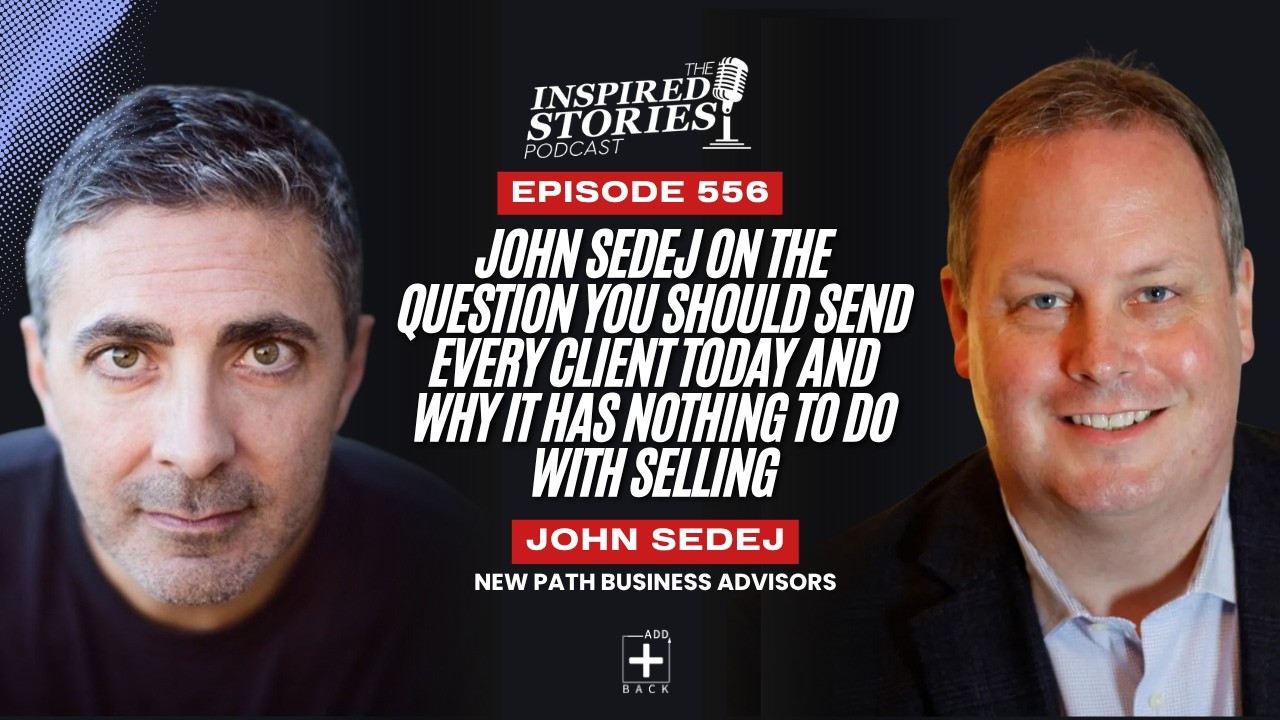
John Sedej, founder and chief solutions officer of New Path Business Advisors, earned four promotions in his first seven months at Enterprise Rent-A-Car, became national salesperson of the year, and turned a money-losing region to seven figures in net profit in under two years. Then he walked away. What followed was a decade of building companies including a mortgage business and a real estate portfolio that collapsed under him in 2008, leaving him more in debt than he had ever imagined. He paid everyone back anyway and built his consulting practice on every lesson those losses taught him.
✨ Key Insights You’ll Learn:
Growing up around servant leaders and John Maxwell-level communicators through his parents’ business
Four promotions in seven months at Enterprise and the candid conversation with Andy Taylor about leaving
Why he defines a business differently from a company and why most owners have the wrong one
How he turned a money-losing Enterprise region profitable by right-sizing the team and redefining good clients
The real estate collapse, bad partners, and the seven years it took to pay everyone back without going bankrupt
Why he calls himself a recovering image-aholic and what losing everything revealed about identity
The lead better, live better framework and how it puts people development before business tactics
The one question to send every client today that generates referrals without spending on marketing
Why peer-to-peer mastermind groups are filling the relationship gap he sees across business today
The F5 Foundation: faith, family, freedom, finances, and fun in that order
🌟 John’s Key Mentors:
John’s Father: Taught him to look at his boss’s boss’s lifestyle before pursuing the next promotion, and that experience is slow and expensive if it’s always your own
Andy Taylor (Enterprise Owner): The moment of mutual respect when John told him directly he planned to leave and own something of his own
Terry Levine (Coach and Co-Author): Walk-the-talk entrepreneur who built and sold multiple businesses and whose values-first marketing approach earned John’s trust
John Maxwell and Zig Ziglar: Influences he was exposed to from a young age through his parents’ leadership development business
👉 Don’t miss this conversation about what it actually costs to own your mistakes instead of hiding from them, why most business owners have built something that runs them instead of the other way around, and the one question that can unlock more referrals than any marketing campaign you’ve ever run.
Listen to the full episode here
Transcript
Anthony Codispoti (00:00)
Welcome to another edition of the inspired stories podcast where leaders share their experiences so we can learn from their successes and be inspired by how they've overcome adversity. As you listen today, let one idea shape what you do next. My name is Anthony Cotaspodi and today's guest built his career the hard way, earning it one promotion, one region and one hard lesson at a time. He started at enterprise rent a car.
earned four promotions in his first seven months and was recruited by a new VP with a bold vision. Build the most successful fleet management group in the country. John bought in and together they did exactly that. He became national salesperson of the year, helped lead one of the top groups in the nation and capped it all by taking a money losing region to seven figures in net profit in under two years.
by every external measure he had made it. So he walked away.
What followed was a season of building, including a marketing and leadership development business through LDI Business Inc, a partnership in McGlone Mortgage, and a real estate portfolio through LDI Holding.
multiple ventures, overlapping timelines, and lot of lessons about what he was really after. That clarity eventually led him here. His name is John Sade. He is the founder and chief solutions officer of New Path Business Advisors, a firm he launched in 2009 that helps business owners and senior leaders solve the problems that are quietly costing them revenue, time, and peace of mind.
With more than 25 years of experience working with thousands of leaders across for-profit and non-for-profit organizations, John built his practice around a simple but uncomfortable truth. Most owners have built a business that runs them, not the other way around. His proprietary lead better, live better framework and idea process exist to change that, helping owners move from operator mode
to building a business that actually works for them and their life. But before we get into all that good stuff, today's episode is brought to you by my company, Ad Back Benefits Agency. And you'll want to hear this because it's hurting almost every business owner you know. Health insurance costs go up every single year, and businesses are furious about it. They're paying more, claims are getting denied, employees are opting out because they can't afford it, and it hurts turnover and morale.
It's
one of the most maddening problems in running a business and everyone just accepts it. But you don't have to anymore. Now there's a program that gives your employees unlimited access to doctors, therapists, and prescriptions with no co-pays or deductibles to meet. And here's the part that really shocks most people. Unlike every other employee benefit out there, our program increases your net profits.
We recently helped a client add $900 per employee per year to their bottom line. Results vary, but gains like that change how a business is valued. Be the hero advisor that introduces this to your clients today. Addbackbenefits.com. All right, back to our guest today, CEO and chief strategist of New Path Business Advisors, John Sude. Thanks for making the time today.
John Sedej (03:28)
Well, looking forward to our conversation.
Anthony Codispoti (03:30)
So John, you grew up in Illinois, came out of Michigan State with a marketing degree, and then started your career at Enterprise Rent-A-Car.
Tell us about what it was like to go from college right into that kind of a role. What were you doing? Tell us about that work.
John Sedej (03:48)
Sure. You know, it was it's important or you know, I was an athlete in college. I played soccer at Michigan State, and Enterprise, I believe even still today, was a very large recruiter of college athletes because they will work ya. It was an incredibly entrepreneurial company. I still have some friends that are still there today, many, many years later, after I've left. And I actually had interned there the summer before my senior year. And while there
I had a particular manager who was the super successful guy. Come to find out he was also creative with some of his accounting. But for a summer internship, it was fantastic. We had a lot of fun. Let's put it that way. However, when I was there, I would hear things, hey, hey, rookie, hey, rookie, look at this guy. Look at he's a rock star. She's a rock star. Look at one of those guys that would like show you his paycheck, what you could make. It's not exactly how I rolled. However
It allowed me to say, man, there's this and coming from an entrepreneurial family, it was interesting to me. So when I started hearing about some of these people and say this might be a place I might want to work, I call them up, say, Hi, I'm a hey, my name is John Seday. You don't know me. I'm an intern over at the Liberty Vaux branch. You know, so and so says you're a rock star, whoever that might be. I'd love he says also might be a great place to work. Could I buy you lunch? You know, let me know when you're free. I'd love to buy a lunch or grab a time after work.
Anthony Codispoti (05:14)
So sorry, you were already working at Enterprise, but so who was it you were calling asking for a job?
John Sedej (05:20)
Well, I was an intern. This is a summer internship. And he was telling me he was trying
Anthony Codispoti (05:24)
So you were calling a corporate office.
John Sedej (05:25)
Yeah. And I was selling very well. You know, I was hitting sales goals as an intern. Actually, I was outperforming a lot of the people that work there. And so I said, Well, why do you do an internship? Not only to get experience, yet I started learning that hey, this is a company where you could do pretty well in the first few years. So, but yet someone else's definition of success and lifestyle isn't necessarily what's aligns with mine. So
Because no one else is doing it, I'd call these people up and they say, Who is this? You're you're an intern? What? And I'd go out to lunch with them and I'd ask them questions. And then the next thing I know, I hear about there's these sales award dinners that all the employees are going to. I'm like, How do you get there? She says, Well, you gotta sell this. Well, one thing leads to another, I was able to perform. So I'm an intern here with all these other full-time employees. And it was right place, right time, where the president of Chicago.
was one of the original members of Enterprise. He joined from what I understand when there's only three or four total locations. I also found out he had a son that was at Enterprise around the or at Michigan State around the same time I was. So now I'm an intern at a sales award dinner and I find out they're present like, who is this guy? And I got to know him. Yet the whole process was if you want my dad used to teach me when I was growing up in corporations, he said, listen, work hard, get whoopbeat and cheated, perform well.
And then eventually own something. That was kind of my philosophy, father's philosophy in life. And he says, while you're going well, because we weren't anti-employer by any means. He said, But think about lifestyle. And I was very fortunate to be raised around a lifestyle first business model that my parents modeled. And so he says, You're not promo you're not shooting for the next job. You're looking for your boss's boss's job. Says, now look at that person's lifestyle and how they how they look at the world, what their life is like.
If you enjoy it and it looks good, keep going. If not, bail. My dad was very direct.
Anthony Codispoti (07:20)
I want to ask, do you have siblings?
John Sedej (07:22)
Yeah, I have two older sisters.
Anthony Codispoti (07:23)
Did he parent and coach them the same way?
John Sedej (07:29)
Yes, no. I mean, d does any parent parent their child the same way and Yeah.
Anthony Codispoti (07:32)
And I guess here's the
core of my question is, like, did they parent you that way because they saw the potential in you? Or would they have parented a, I hate to say it, but like an average kid the same way?
John Sedej (07:46)
Yeah, you know, I we had high standards and the one thing that we were very fortunate was is that we had parents that held I like to say as Gen X, we we understood what it was like to work hard and you didn't get a trophy for showing up and you know, if you fell and it got bloody, rub some dirt on it, get up, y you know, and just get going again. We'll deal with it later. Yet at the same time we're socially emotionally aware and technically literate, so
On a completely side note, I said I wish there was more Gen X in leadership around the world, because I think we're the bridge to what should be going on out there. But a lot of people we kinda got skipped over sometimes, but that's another conversation. Specifically Yeah, go ahead.
Anthony Codispoti (08:24)
So what do you think, sorry, go ahead with your answer there, John.
John Sedej (08:27)
Yeah, so I was very fortunate that I was raised around servant leaders in my life. The nature of my parents' business, I was raised around some of the best communicators, some of the best leaders in the world, the John Maxwell, the Zig Zigglers. I
I was fortunate to meet a number of these people fairly young in life. And so those principles of when I say servant leadership, not just leadership, but really walk-the-talk servant leaders, I saw that model because of the business that my father was in, my mother was in. it exposed me to things and principles that quite frankly, even today, are rare. And it allowed me to have a major leg up mentally.
Coming into the situation, especially when I ended up in the fleet services and fleet management division of enterprise, where I was calling on owners of companies, small and large. And here I am, 22, 23 years old, calling on these people. And the advantage of having a deep voice is they think I'm about 45 when I walk in and they see some 22-year-old kid walk in. yet I realized very early, and was modeled for me. So it was modeled for my sisters. My older sister has an incredibly successful company of her own. My other sister, Marcia, also has her own.
She's has her own companies as well. We're very entrepreneurial because what's very important to us and and and to this day is the foundation of Newpath, I call it the F5 Foundation, which is faith, family, freedom, finances, and fund.
Anthony Codispoti (09:55)
In that order.
John Sedej (09:56)
It wasn't always. So I think maybe with a little bit of age, a little bit of gray hair and a few life experiences, you start to reprioritize things in life. or or better yet, you aligned your actions and words a little bit better as I've gotten older. so that answers that.
Anthony Codispoti (10:13)
So John, aside from the deep voice, why do you think you found so much success early on in sales?
John Sedej (10:20)
'Cause I had I I had a dedication, I worked hard. I I I worked smart as best I could in my twenties, you know. had a lot of knowledge but l very little experience. But ever since you know, since my twenties, I've listened to thousands of CDs and tapes and and now podcasts, read hundreds and hundreds of books, I've been to hundreds, if not thousands, of meetings around people that have been where I'm at and beyond, because what's one good idea worth?
And experiences, you know, you'll hear me reference my dad a lot, especially this season. He he was a a a really a focal point for a lot of principles that I learned. And he said, experience is great. It's just painful, expensive, and slow if it's your own. He says, So you might want to kind of invest in the other people's experience to speed up the process. And and I've modeled that, you know, still to this day. I've invested, you know, not only are we a coach or consultant of companies, I have my own I invest in every year.
Anthony Codispoti (11:18)
What does that mean to invest in other people's experiences?
John Sedej (11:23)
Well, can mean different things. For me, it could be buying someone's book. It could be listening to a podcast. It could be exting time and money. Now, there's no shortage of people that call themselves an expert. I think we both can appreciate that. I don't think until I started doing this business full time, how easy and how low of a bar it was to call yourself a coach or strategist or advisor or
Consultant or you insert insert the name, right? And yet the people that have the emotional intelligence and and empathy to connect with somebody versus just sympathy, because that sympathy is comes from lack of experience. When you have empathy, you're like, I know what it's like, Anthony. You know, I've sat in that chair. I know what it's like when you're building that up. When you hire that first key person, that you finally get to a point where you need to start putting some levels to your organization. And you're gonna hire you
You you're gonna hire what you can afford, or you wanna hire what you really want. Okay, what you really want's gonna cost you a lot more. And in some cases, depending where you're starting from, that person you may have to pay them more than you paid yourself last year. And you hope that they're gonna work out. And you hope their experience coming in is going to add value, bring their experience, their client base, their knowledge to expand it. Sometimes that does. Sometimes it comes along with an ego. And we all know that sometimes your ego is not your amigo and
And that can also kill a culture pretty fast too with a wrong, wrong hire sometimes. I've Anthony, I have nothing original. I'll throw
Anthony Codispoti (12:57)
Is that a John Sude original? Sometimes your ego is not your amigo.
John Sedej (13:02)
that out there right now. It's it's kind of like when my dad for years, you know, he he he went to church as a kid and didn't kind of really didn't go much when we were growing up. And my mom took us and he ch he was a cheaster, you know, Christmas and Easter. And then he started going back to church probably 25, 30 years ago.
And even though he'd been this big leadership trainer, he'd let you know, he used to have thousands of people at some of his conferences and different things. And then he starts reading the Bible, he starts joking, he says, Wait a minute, these guys are all stealing from here. They're not that bright. He says, Wait
Anthony Codispoti (13:31)
Hahaha
John Sedej (13:31)
a minute. So I thought that kind of so yeah, there's there who who has anything original? It's just maybe it's it's delivered in a way that sounds original or it it's a unique spin on something.
Because as I've been studying history and you study leadership f whether it be biblical till now, we've gone from riding Mustangs to driving but human beings kind of do the same thing all the time. It's kind of a circle of life. And once you understand, yeah.
Anthony Codispoti (13:58)
There are definite patterns to human behavior.
John Sedej (14:02)
absolutely. Absolutely.
Anthony Codispoti (14:03)
So I want to give a shout out because you became national salesperson of the year while you were with, I think it was the fleet management group at enterprise,
John Sedej (14:11)
Yep, yep.
Anthony Codispoti (14:12)
right? You're building one of the most successful groups and regions in the country. Your last promotion actually brought you to a region that was losing money, right? And we called this out in the intro. Within two years, you've grown it to seven figures in net profit.
Walk us through a little bit of what was going on when you first walked in. What was broken? What was your read on what you could fix? How did you do it?
John Sedej (14:37)
Yeah. It was around ninety-nine two thousand when that happened. And if you remember, that was a little there's a little mini economic downturn then. And that was shortly after really the internet hadn't been around that long and there's a lot of dot bombs. You remember that phrase that came out for a while? Well, in that division, the niche and the niche of that business was if an organization had say ten fifteen to maybe a hundred, hundred and fifty vehicles, enterprise fleet management goes in and said, Let us outsource that to us. We have the economy to scale, the knowledge.
Will help you operate that fleet at a more efficient manner. It wasn't just buying and selling or leasing vehicles to them. It was also looking at their maintenance. The entire cost, the operating cost of running a fleet. And it just so happened a lot of those companies, probably because of how us salespeople, when we were coming up, you're driving around and you'd see you have your dictaphone. I know I'm aging myself a little bit, you have your dictaphone, or that would be a voice to voice app now for everybody else, and you'd say,
ABC plumbing, truck 27, phone number, such and such. Well, you're hoping they have at least 27 vehicles is is the thing. And so you call them, you try to find out, try to get in the door. And as a salesperson coming up, this all leads to your question. we were making lending decisions. So now we loaned the Taylor family money. If they were in a finance or lease a vehicle, we had to review their financial statements. We had understand their business. The sales process was actually a six to nine month on average process.
You know, your product wasn't your product. The product was a service. You made your money on certain things. Yet it was a very much a relationship-based sales process, and especially for retention. And then when you're loaning a vehicle, let's say you have a company that has 50 vehicles, let's say they're doing, I don't know, nine, 10 million a year, or even five million a year that with that mump number of vehicles, you know, those vehicles are one of their largest, if not the largest, assets running around the road.
And every time a vehicle is down, it costs them money. So we had to learn soft dollar benefits, hard dollar benefits, all these other things. But yet somebody says, Hey, sounds great. We want to work with you. And we want 10 trucks. Okay, well, 10 vans, lettered out, bin packages, everything in there might be you want four hundred thousand dollars, five hundred thousand dollars. You showed eighty-four thousand in profit last year. There's a disconnect.
So you had to learn about cross-corporate guarantees. So there was so much you had to learn. And so when you
Anthony Codispoti (17:01)
You're not just a salesman, you're like a little bit of a finance guy too.
John Sedej (17:04)
did. And really, I've been more often than not. It's funny because I I hated finance and accounting in college. And yet I've I've been in finance or accounting and and and with a sales and marketing side to it my entire career. And you know, because numbers tell a story. So you had to learn how to read between the lines. You had to bridge the gap between what somebody says, what the numbers say.
What the real story is risk mitigation, cause especially when I got on the management side, if they don't pay, John don't get paid.
Anthony Codispoti (17:34)
Yeah.
John Sedej (17:35)
You switch from sales on commissions, very slow, very low com salary to mainly profit. So that's why I went to enterprise. It was my lowest paying offer out of college, hands down, wasn't even close. I had one almost twice as much. Yet
Anthony Codispoti (17:50)
So when you
got into this one territory though, John, that was losing money, were they not following these processes?
John Sedej (17:57)
Well, it's not that they weren't following it. Part of it was is that it was a combination of reasons. again, great experience at the time, which led me to what I'm doing today in some respects. Part of it was the economy downturned. And we all know sometimes companies have, you know, they don't have enough margin. They're too leveraged. Sometimes it was due to they had too much of business with too few of clients. That client went away and now they can't pay bills, they have to choose who they have to pay.
Sometimes
it's due to unexpected things. I mean I I could think of one where, you know, the the risk as owners you deal with you have all these employees out there. Well, one of their employees after hours is out drinking, hit a decorated sergeant in the Chicago, you know, fire department. Killed him. And you know so
Anthony Codispoti (18:43)
So what was
it that you came in here and you were able to help turn around then? Was it just looking for farming new clients?
John Sedej (18:50)
It was a combination of first of all, it was right sizing the ship. In the first ninety to 120 days, I think fifteen to twenty companies went chapter eleven or bankrupt. So I and I remember saying, What is going on? 'Cause they were they were making so when I say they were losing money, it was probably in the first four or five months I was on the job. And even it was so short enough, even I couldn't have done that part. I remember calling my boss because my income dropped like 74, 75% overnight. And it was due because they were going bankrupt, we're having to repossess vehicles.
We're having cut basis and and I'm looking at everything that's falling around. I said, what is going on? So what I had to do is a combination of things. Some of it was you just had to lick your wounds, take the business, because like any other business, until the business was making money, a lot of us weren't making money. So we had to make it back. You didn't just all because they had a policy. If you think it's going to go into bad debt, or it is a bad debt, you have to
Claim it at 90 days. If you get it back later, great. So when I say it was cloak, and we had I had complete hiring and firing down to printer contracts. I had total PL responsibility. So how do we turn that around? Well, part of it was redefining who is a good client and who is not a good client, not just somebody that says yes. Sometimes, you know, what business are we really in? Looking at how the salespeople were selling, how are the account managers managing the account?
How efficiently or inefficient were we? Where were we wasting money? It was a combination you have to do massive cost cutting. I had to look at the entire team and say, who's in the right position, who's in the wrong position, who needs to get fired? I mean, there was a lot of turnover, there was a lot of uncertainty. Sometimes it was like, okay, I think this is right. Make a decision. Go now go make it right, but have some accountability pieces put in place. We had to set up, we had to set a whole new standard as to what is acceptable.
What is hard work? What is n I mean, there's a lot of things at the time. And it's something that just in my mid-20s when I took over this role, it was an amazing experience. Luckily, some of my good decisions outweighed some of my dumb ones. I mean, I think of one story. I'm trying to motivate the salespeople because we had seven A.M. Monday morning meetings. And I remember it was somewhere between Glengarry, Glenn Ross, Boiler Room and Dead
Dead Poets Society. I'm standing on the conference room table trying to get people motivated. It was the most ridiculous thing in hindsight. But in that moment, it seemed to be a motivating factor, at least in my head. Of course, I don't think it worked. And I'll and I ran into one of my employees years later, downtown Chicago, and we're walking, and he brought me up. I said, gosh, yeah, I forgot about that. He said, I don't know what you were doing there, man.
Anthony Codispoti (21:34)
Aren't you lucky
that was pre-smartphone days? Because otherwise there's a video of it somewhere.
John Sedej (21:40)
There that's a whole nother podcast,
Anthony. We could talk about that. I know I have no chance at a political career, but I dare guarantee there wouldn't have been when the phones were around sooner.
Anthony Codispoti (21:49)
So,
National Award, top-ranked
John Sedej (21:52)
Yeah.
Anthony Codispoti (21:52)
region, momentum inside this large national organization at Enterprise. Why do you choose to leave and want to start something on your own?
John Sedej (22:02)
there's always a lot of reasons to it. It was I knew I want I you know, I I took my job with enterprise knowing I wanted to leave it. Day one. That was
Anthony Codispoti (22:10)
That was part of the plan. That was the way you were brought up.
John Sedej (22:12)
always part of the plan. You know, there's politics, there's this, there's that. I had other opportunities to take, you know, understand a a company is really a it's again this makes me it sound like it's anti company 'cause it's not. But really to me a pyramid scheme was a company.
You get to a certain point to go any higher, somebody got has to die, retire, get fired, or quit, they go any higher. And you go beyond your own talents, then it's a you know, when you s when you get started, you have all sorts of training. The higher up you go, you have very little training. And you have a much smaller leash to making bad decisions. And your decisions carry a lot more weight. And on top of that, as you go higher, especially when you don't own it, you're training your future replacement.
I understood that. And I actually had this conversation with the owner of Enterprise at the time. We're at a national sales meeting and I had turned down this opportunity and he says, Where do you see yourself in ten or fifteen years with enterprise? And and mind you, at that point I'd worked hard to and produced and had a voice and was known for whatever that's worth, right? And I said to him quite directly, I said, I don't. Because you don't what? I said, I don't see myself with enterprise for 10 or 15 years. He goes, You
Well, where do you see yourself? I said, Well, I'm gonna own something. What are you gonna own? Not sure yet. It's worked pretty well for your family. Because
Anthony Codispoti (23:39)
Hahaha.
John Sedej (23:40)
you know, enterprise is still privately held. And
Anthony Codispoti (23:42)
Okay.
John Sedej (23:43)
he says, Yeah, I said, Well, listen, I I understand how this works. There's only two ways to get it, you know, to really have true freedom, you have to have economic freedom, financial freedom. You have to have some control over that. And
There's nothing wrong with this. I I understand this. I make you millions, you pay me thousands. I said, but this is a temporary relationship, whether you're gonna leave me or I'm gonna leave you, one or the other. I said, the only other option is just to marry into it. And I don't think I'm gonna marry your daughter, so that's not gonna be an option. I was a little more direct in my twenties and I probably have not some things to learn. and I said, However, he says, Is this happening anytime soon? I said, No immediate plans. I said, but what but understand, I said, Andy.
When the time comes, the house that you put me responsible f over will be in better shape, good foundation, better shape than when I leave it than when I left it. What else can you ask for?
And I said, but my goal in life is to build the Sede family foundation, not the Taylor's.
Anthony Codispoti (24:43)
Mm.
John Sedej (24:44)
And but you'll be better off when I said, Can you ask for anything else? And he looked at me, and this is a very pivotal moment, actually. I don't want to lose this. Here we are at this national sales meeting, and you know, you work your way up and I had just turned on a job offer to or a place to interview another to take over the the whole thing. And he says, You know what? I've never had in all the years someone in your position tell me their goal is to quit.
He says, but based on he says, I respect where you're coming from. And he shook my hand. That was pivotal. Now I said that to a couple other people and they said, You said what? And they're thinking careerist interruptus. You know,
Anthony Codispoti (25:22)
Yeah.
John Sedej (25:22)
you're not loyal, blah, blah, blah. So that was that was part of it.
Anthony Codispoti (25:26)
But you knew your audience,
you knew who you were talking to and he totally got it because he is the guy that you
John Sedej (25:29)
Yep. Good g Yep.
Anthony Codispoti (25:32)
wanted to be, that you were working towards.
John Sedej (25:35)
Yeah, and you know, the the family today is, you know, they owned multiple companies. Some of the most successful people in the world have multiple companies, multiple not just multiple streams of income, but multiple companies. And some and I stress the word companies, they're not businesses. There is a difference. Most people have
Anthony Codispoti (25:54)
Define the difference.
John Sedej (25:56)
a business. Well, most when I say business, I think of someone who owns a business frequently that business owns them.
Someone who owns a company has developed some degree of leadership development, systems, and processes that is not a hundred percent dependent upon them. So they're a C Yeah. Sure.
Anthony Codispoti (26:14)
Yeah. So let's start, let's start talking about that path to how
you get there yourself, John, because you leave enterprise and as we called out in the intro, you end up over the next several years in a handful of different businesses that you started. You were running LDI Business Inc., which partnered with Amway and Network 21 on marketing and leadership development. You were a partner at McGlone Mortgage and you were building a real estate investment
portfolio through LDI holdings. All these with some level of overlap. So talk us through this chapter of your life. What was going on? What were you learning about yourself? What were you building towards?
John Sedej (26:57)
Yeah,
when I left Enterprise, a friend of mine I had known, as I mentioned, my parents' company was actually ITI Business Group, International Time Investors. And better for lack of a better phrase, people like to throw this thing into a box called the Amway business. Whatever for depending on what different people have. But my dad's like, no, Amway's my supply company. And he built his company up starting in the 70s. He built it very successfully. And I was happened to be raised around people in that world that
Treated it like a business and knew what it was like. And I had a full-time mom and dad my entire life, which is very, very rare. Sucked as a teenager, I think, because I'm like, Will you get a job? You're always here. You know. Yet what I learned from the principles of free enterprise, compassion of capitalism, some of the things servant leadership, that's where I learned growing up. It was around me. And I saw my parents counsel and pour into thousands of people over the years.
Knowing that most people were not going to be very successful in this because you know what? That world, he says, listen, this is just a byproduct of what society's like. We're pulling from society, there's a reason. 10% employ the other 90. I'm not changing the rules, yet we want to provide an environment. And there's this is where again I try to teach this today. He said, Listen, if you are given the opportunity to lead others.
You have a responsibility beyond any fiduciary. You have a moral and ethical responsibility. And if they come into your life, which frequently is just for a season, now that season could be one conversation, could be a week, a month, could be 50 years. You don't know. But if you can make them better when they leave you, that's your job. So, like I said that to Andy Taylor when I was at Enterprise, it was very much I saw my parents model that my whole life.
says if they come into our world and they maybe save a little bit of money, they become a little healthier, they get some leadership development, makes them a better husband or wife or leader in their job and helps them know how to he says, then I've done my job. The leaders will rise up. Those that want to make a business out of it, I can't pick them because you don't know their why. Their why is buried deep. So getting into that when I left, I had known this guy from these conferences. I was going to these network 21 leadership development conferences because my dad used them for the leadership development tools, resources.
Our friends had started that and they built it. I think they were operating, they had 29 offices in 29 countries, you know, training in or 20 countries training in 29 languages, something like that. Hundreds and hundreds of thousands of individuals around the world. And we are friends with them. And he says, We're in the leadership search and development organization. We make money with products, but that's not the business we're in. So it it's the paradigm shift when you look at things. So
All right, here's the answer to the question. So, knowing that and going to these conferences, I got to know this other guy named Ken McLaurin. Ken, because Ken's parents were in Amway, so are my parents, we got to know each other. And it's fascinating. Those that were successful, that led by this high integrity standard, we just kind of bonded. And he had his brother had started this mortgage company a few years before on his own. He was the epitome, good and bad, of what an entrepreneur is. You know?
And Ken started working with him part time doing mortgages and he was making more money part time in his in that than he was in his job. He's talking to me, Hey man, you gotta come over here. We could really build something. And when I left Enterprise, I said I wasn't exactly sure what I was gonna do, but I knew I knew the time was to go and and I go up to Appleton, Wisconsin to meet Ken and Brian. Yeah.
Anthony Codispoti (30:34)
And real quick, John, so
you left without a plan of what was coming next? Okay, go ahead.
John Sedej (30:37)
Yeah. Yeah. Yeah.
there was without getting all the deta details
Anthony Codispoti (30:44)
There were some other things going on. Yeah, okay. Yeah.
John Sedej (30:45)
There's always stuff going on. You just get to a certain point like enough's enough, you know.
And so and I had offers from other companies, yet I truly did believe enterprise was the best in that industry. And even though I had very significant offers from other companies, and they would have gotten around non competes and all that. I just didn't want to do it. I wanted to own it. And I yet it was very, very different, humbling switch from wearing a suit and tie five, six days a week to going to Appleton where Brian worked in this little
Basement office. Ken worked out of his house. There's files over there. I walked in there. It was it was the Wild West. It was this 2002. the mortgage industry, if you had a pulse so you could get a mortgage, it was bonkers. It was absolutely bonkers. Coming from this conservative lending world. And I see how they're giving money out to people like anybody. It was nuts. And I said, Well, they're high integrity. And Ken says, What do you think? I said, Well, we can really build something. the funny part about that was.
Brian in his office, I walk into this basement and there it's it's a des it's like a tornado came through. There's files stacked up on the floor, there's boxes everywhere, and there's a reason I tell you this. And he's like, So I hear you're gonna help us build a company up and you're some big sales guy or something. I said, Well, something like that. And he says, Well, here's basically what you do. You look at the rate sheets, you call people, and there was leads coming in. They were we were the one of the first to do really online lending, figure that out before everyone else was doing it.
And we streamlined the process and so we knew it. We we took the application, we processed it ourselves, we under we worked with the underwriters, we gathered all we called. We did everything in the beginning. So we knew as well, if you called one my say myself or Ken or Brian or one of our other people over time, we knew the process. If you said something, we knew this is gonna be a roadblock in step eight. That was ended up being one of our strengths, especially as we were teaching people. So I went in there.
Anthony Codispoti (32:33)
So you had
some experience in sort of the financial aspect, you know, back
John Sedej (32:37)
sure.
Anthony Codispoti (32:37)
at, you know, when you were with
John Sedej (32:40)
With Enterprise Fleet, yeah.
Anthony Codispoti (32:41)
the fleet business. So you were stepping into something where it's sales and it's looking at people's financial background. It seems like these were kind of natural fits for experience that you already had.
John Sedej (32:52)
Well, what we did though, see, that is very much a transaction-oriented, it was rate driven and transaction-oriented. That's how most of the industry approached it. We took a consultative approach to a transaction-oriented business because, like everything else, we understood our moral ethical responsibility was greater than the fiduciary. And most people when you they don't even have to verify anything, you tell them, hey, you make $30,000 a year, but you can go buy a $400,000 home. Great. We're like, nope.
And we used to have the here's how we we absolutely did. We we were very
Anthony Codispoti (33:24)
you were trying to reign some of that in.
John Sedej (33:27)
much known as actually one of our taglines for years was we work for you, not the bank. We would do training things like just because you can qualify for a mortgage doesn't mean you're ready to own a home.
Anthony Codispoti (33:38)
So I want to make sure, John, that we leave enough time to talk about what you're doing today.
John Sedej (33:42)
Yeah. Sure.
Anthony Codispoti (33:44)
So can you help me weave the thread from what you were doing before to how the idea comes up for New Path
New Path Business Advisors, is today.
John Sedej (33:52)
Yeah. Yeah, New Path Business
Advisor. Yeah, it was originally called New Financial Path. So the mortgage business is going well. We're growing that up. Dodd Frank has passed the United States right around this right before that, about a year or two before that, a guy from church introduced me to real estate investing in these groups. And that was a that was a wild west, man. It was there's a phrase ever heard the phrase big hat, no cattle? There's a lot of those people in the room. And I and I had a little bit of hubris. I'm thinking, okay, well, I have better business.
Acumen. So I went and I started doing some private lending to some people for rehab projects. And I got into that was gonna be a secondary just, you know, side side business. I figured, okay, I'm in the mortgage business and real estate. Well, I can understand that. Very quickly I realized I didn't know I knew enough to be dangerous to myself. And like everything else I've done, I s sought out some people that were supposedly the gurus or the people and did the same thing. Hey, can I buy you a drink? Can we go to dinner? I'd like to pick your brain. I know enough and
So I started that, picked a couple of people to do some business with, scaled up very, very fast because that world was all about leverage. And then I I like to say there was about an 18 to 24 month period, I just like abandoned some of the principles that I grew up with that I had and and I got leveraged and I made bad decisions with partners. And on top of the industry collapsing, it was a combination of things.
And even though there was embezzlement and lying and different books and all sorts of stuff, I I didn't really start healing from it until I owned my own responsibility in that, because I allowed greed to just allow me not to check things. I mean, we had a very, very unique s agreement at McLaurin where it was we had a handshake. I mean, I wouldn't recommend that to anybody, you know, but that's what we had. Now I had contracts.
Six ways to Sunday in the real estate stuff, but when they're, you know, lying about things and and it was one of the best things that ever happened to me because when all that real estate stuff went down, it was right around the same time that they did the major financial change in the world under the Dodd Frank Act. Licensing, all this other stuff came through. Then all they started doing back criminal background checks. And I had found out I had a lot more properties in my name than I thought I had. And I had money that was owed to me, and all of a sudden.
person who's got this, he's disappeared, and all of a sudden, what do you mean there's money out here? What do you mean you can't pay me? And when it went down, there was more money owed, far, far more money owed than I had to my name. And my accountant lawyer told me I had to go bankrupt. And I chose not to. I said, Well, my name's on it. I gotta least try. And they thought I was nuts. And by the way, at the same time, we had started planted a new
location for my church and I had been trying to get this financial stewardship ministry started because I saw people in the mortgage business had unhealthy relationship with money. That's right around the same time. I was like, man, we gotta r I had already been teaching companies and financial literacy and budgeting and stuff like that through the mortgage business as a way to build a relationship with companies to become their preferred lending provider. We saw, hey, we talked about, hey, here's what's in it for you employer. When people are buying a house they can't afford.
Because the bank says they're gonna give them a loan, and then you don't give them a bonus over here, and they're completely leveraged. You've done everything right, you've trained them, you developed them, whatever, but their personal financial world got leveraged, and all of a sudden you didn't pay a bonus or there's not a cost of living increase. Now they jump ship for $400 a month, and you've got all this money laid out. Here's how this all starts to tie together. It was always about money is just a byproduct of what people put value to. Money doesn't make you happy. Now it can give you choices and give you make you comfortable.
Yet if your identity is tied to that, which unfortunately I found out for me at the time when I lost everything, that was the other big part. And I r realised that I had insecurities that were being I thought filled by third, you know, cultural trinkets, toys, cars, you know, watches, all that kind of stuff that the that world presents that when you have this you'll be happy, but that's not happy.
When you lose everything, Anthony, and you have to face yourself where you're every month you're running out of money before you run out of month. You got people threatening you, people I didn't even know existed. And I didn't have to take it on. I chose the hard path. It took set over seven years to get everybody paid back. However, not one property went into foreclosure. I never went bankrupt. I had four properties out of dozens that ended up having to be short sold, and that was it.
And it was the one of the best things that ever happened to me.
Anthony Codispoti (38:42)
Why?
John Sedej (38:43)
Because you you have to face yourself in the mirror and realize that what is truly valuable? Where my words and my actions really aligned on the inside. On the outside, it looked great. And that's why I came up with this phrase, and it's going to be an upcoming book. I'll have it done by 27. But it's I came myself, my name's John. I'm a recovering image a holic from my twenties.
And there's a lot of image of holics out there still today, if not even more so.
Anthony Codispoti (39:11)
But your downfall wasn't, from what I'm hearing, wasn't your ego. It was bad market conditions and bad business partners. Or am I missing part of the story?
John Sedej (39:20)
Yeah. Well, the part that you're missing
is that, you know, I didn't double check a lot of things. I didn't vet these guys very well. I had a lot of blind trust and then they were smart where some of these deals were, hey, I gave twenty five thousand dollars, I'll pay you back in thirty days, we'll pay it, you know, twenty eight back. Well, annualize that out. I started doing more of those. Well, sometimes, hey, why don't we just roll it on the next one, roll onto the next one? Well, I didn't know that was a scam. You you learned that. And all of a sudden you got a quarter of a million dollars out there. You got other things going on and
Now you've got other people that have invested in. You know I didn't do? I wasn't double checking the books. I trusted too much. And you know why I did that? Because I bought into man, I and I started backing off the mortgage stuff. And I got comf you know, I got a little cocky. I was like, this is easy. And when it went down, I was like, wait a minute. Now I look back at some of the decisions I made, and in hindsight, what the heck? I mean, I it
I never would have done that before, certainly after. But the power of greed and fast money, you have to you gotta unpack that. We have too much time, not enough time to talk about it, but there's a lot to that. Yeah, that was a motivator. What I see because the the pull of the culture, whatever that narrative you're surrounding yourself with, and if it's coming from a place of confidence or insecurity, insecurity can drive a lot of that. Because if you're if you're trying to fix an internal
feeling of lack with external successes or things that will always implode at some point. And for me, that implosion happened in my 30s that allowed me to right size my mindset, right size my value proposition, start aligning my words and actions with the I like like I say, you know, because you know faith is important to me, the the head, the heart and practical application, they finally started coming together because I didn't realize how they were disjointed or they were compartmentalized.
Anthony Codispoti (41:17)
So tell us present day, New Path business advisors, what do you guys do, who do you do it for, John?
John Sedej (41:23)
Yeah.
Basically when we work with successful seasoned companies, we've worked with a number of solopreneurs and bigger companies. Yet we found our niche as companies that have been five or ten years in business. They have an owner who's become successful. He or she has proven that their business, there's a market for their product or service, that they've made some money. yet they don't they're they're unclear where the next stage is going to be.
They're unclear, maybe they're 10 or 15, 20 years in, they're unclear on when that exit is going to be or how to get there. Yet if you ask them, they'll tell you, what's your exit plan? Well, I'm going to sell it someday or hire someone to run it. Or maybe it's a family member. Yet you probably know as I do, about one out of 13, one out of 14 companies ever actually do that. And the disconnect is that they what they went from.
Leaving a job when you I remember Robert Kiyosaki's book, Rich Dad, Poor Dad in the Cashflow Quadrant. I remember reading those. And that concept of moving from, you know, the left side of the quadrant to the right side, owning an asset versus of buying a job. And most small business owners bought a job and they're highly leveraged. And they're one or two bad decisions away from it all f collapsing down. And so where we do is we come alongside them having sat in that seat. What makes us so unique, myself and the people the you know.
I have different team members we bring in for different things. Most people, we we have a very large network of qualified, people first proven partners, whether it be on the legal, the financial, the HR, whatever it might be, we can bring those into a company. My personal time, where I like to invest in, is helping them rediscover and redefine their why. Why are you doing this? Okay, if I help you build your, you're telling me what you feel you should say. What if I what if we did help you double your business the next two to three years?
You almost can see their eyes go back in their head because in their mind they're thinking that's twice the problems, twice the stress. You know? Okay, well, sometimes it's better to scale the business back, improve profitability, help them get more free time, get them. They know what to do. We help them more often than not, really comes down to this. We help business owners take action faster by first helping them clarify where they want to go, when they want to do it.
why that's important to them because the why is what's going to drive them in the good and the bad times. And then we go back and we look at their business and say, okay, for what you have right now, will it ever get you there? Will it get you there in the process? And then we help them say yes to this, no to this, or not no to that, not now to that. Now that's very general answer because it's very specific to each company. And they already know eighty, eighty-five percent of what they need to do. They really do.
Anthony Codispoti (44:11)
You're as much a life coach as you are a business coach.
John Sedej (44:14)
Yep. Yeah, we can listen. I can still go in, we we review for for when we have one-on-one clients when we're working with those, we're getting their financial statements every month. We're looking at this, we're modeling out, we're putting all that stuff together. But if you don't know where you're going, you're gonna end up where you're headed. And if you don't know why this isn't, and if you're using other people's definition of what's both what you should be doing and what you feel you should feel like you want to do, there's the disconnect. It won't get there. And what will happen is
You'll start to, and you see this happen all the time. They have a business, they've proven that it works, they're making money. Say they're five, six, seven years in. It usually takes a little dip because they're like, they're just taking a breather, because they just mauled it for five years, right? But to get to that next level, you see a lot of companies stall before they get to 10 years, and that's usually where about where they hit about 10 years. A lot of times where they stay, give or take. Maybe
Because at that point, it's no longer how good you, it's really not how good you are as a leader. It's how good are you at hiring, how good are you at maintaining value, staying relevant, getting other people, bringing that's the leadership part put involved. The numbers, the the sales process, the marketing, yeah, we do all that alongside them. My main background is still marketing and sales. That's where I come through. Yet I have, I know the numbers. And shockingly, there are a lot of successful companies that don't.
They they manage their finances by a really a bank account.
Anthony Codispoti (45:41)
It seems to me like this, I'm going to call it a crisis of personality, a crisis of identity that you went through in your 30s, being on the verge of bankruptcy, this positioned you well for helping your clients now evaluate what's important.
John Sedej (45:57)
Yeah. Yeah, it's it's the joke. You'll hear me say a little colloquialism yet. I'm not only president of Hair Club for men, I'm also a client. I get it. And there's a lot of there are some good consultants out there. There are some good consulting companies. I will say that I'm probably a little jaded. I I think the vast majority that call themselves something like that are lacking in some respect.
It doesn't mean they don't have a decent product or decent knowledge, but they they tend to position themselves to be far more than they should be or could be to a company. And the challenge when I got into this industry was trying to differentiate ourselves from everybody else. And even when I hired my own coach, Terry Levine, you know, it was fine. I was looking for someone who has been successful over a long period of time through different seasons.
And is doing something today that's still in the trenches, not because they have to be, because they choose to be. And they're giving me advice based upon current events, not a history of what they did 20 years ago. That's a small list, Anthony. That's a very small list. And to have the ethical approach, the people first approach, along with the financial, because your bank account, I think money just makes you more of who you are.
Anthony Codispoti (47:15)
That's interesting.
John Sedej (47:17)
If you're a jackass without money, you're gonna be a big jack you're
gonna be a big jackass with it, you'll just lose it faster, it's been my experience.
Anthony Codispoti (47:22)
So as you were going through these really hard times, John, you hired a coach, you're putting your nose down. You're like, I'm not filing bankruptcy. I'm going to do the right thing. I'm going to make this work. What's helping you get through this from a mental and emotional standpoint?
John Sedej (47:38)
Faith was a big part of it.
I mentioned I wanna start that financial stewardship ministry for a year.
And after I decided, I made the decision, I'm going to try and pay this back. So I can at least say I tried, right? One week later, I got a phone call from a ministry's coordinator and says, hey, I think we're ready to start that financial stewardship ministry now. I said, I said, of course you are. I'm like, you got a sixth sense of humor, God. Thanks for that. and in the next five and a half years, I led that ministry. Hundreds of people came through it.
Yet I think it was perfect timing because not only am I teaching it, I'm learning a lot of the lessons at the same time. And the music was very different with me being in the trenches while teaching it. And it's the principles I always knew, but it was a combination of like we were both growing up together. I'm helping and learning and you know. it was a fascinating that's where new financial path launched during that season. It was I've always seen money as just a it's just a window.
to what do you put value on? And you realize when you understand the concept of stewardship, we don't own anything.
Just like I was, I was allowed to steward my position as a salesperson. I was allowed to steward this team. I was allowed to steward this region for a while. I've been allowed to steward and help out some of these companies I'm with. we don't take it lightly. We take it very, very seriously. We understand the trust, the the they're opening up everything. And you open that up. We don't take that lightly. And I can I can empathize with that. I understand that.
So
when it comes to why we do what we do and how we do it, I mean financial modelings, financial modeling, yes, we do all that, but we we blend the personal with the professional and the practical. Because if this isn't aligned, you know, speed of the leader, speed of the team. And when the leader gets better, everyone wins. So really, yes, you can tell I really focus on the leadership stuff.
Yet we have the ability and the team to come in and put the practical behind it. But you if you don't know where you're going, you may become quote unquote more successful. Yet I find you'll get distracted into what we call or I call frontage road opportunities. Where here's your main business, you're on the super highway, you're growing scale, and all of a sudden, ooh, kind of like me. Ooh, real estate investing. That sounds like a good idea.
So technically for a while I was making money, but what does every financial or every frontage road do? It veers off. And so now you're busy and your your focus is skewed. Or you're a landscape company. Hi, great. I'm gonna do landscape, you know, lawn care. Well, then we're gonna do landscape maintenance. We're gonna do landscape construction. Well, hey, we're doing that. Maybe we should get into other type it's construction. Let's do another construction company. And so they start quote unquote diversifying.
But what happens with all of that is, okay, what's the end goal here? 'Cause a business really should have two goals. You're gonna sell it or ideally, you sell it and make some money. You hire someone to run it and and keep some cash flow coming in, yet most just shut down.
Anthony Codispoti (51:06)
But so how do you balance this idea? Because you were talking about talking to the owner of enterprise and that family has multiple businesses, right? Multiple cash flow streams. They're doing it well. But I've been in that seat before as an entrepreneur where you get this shiny object syndrome and you call it the frontage road effect. When when is it the right time to diversify and when is it the right time to stay focused on what it is that you're doing here?
John Sedej (51:36)
I wish I could give a blanket answer that everyone could use, but there is no such thing really. Yeah.
Anthony Codispoti (51:38)
Yeah. I want to put it on a poster because
you would help millions of entrepreneurs around the world.
John Sedej (51:45)
Absolutely. you
know what it really comes down to? If we can help you say no or not now to things more frequently, that would be a good starting that is a good starting point for a lot of people.
Anthony Codispoti (51:57)
Actually, I would like to better understand what the engagement process looks like with you guys. You've got the lead better, live better framework, the proprietary framework that you have, the idea process. Talk us through that. Somebody works with you, they sit down. What does that engagement look like?
John Sedej (52:14)
we have different ways they can engage with us and we're we're revamping some things right now because we've noticed a a real need in the market right now that is less practical application and more people centric. You know, there's a relationship gap going on right now, there's a trust deficit in society going on right now, that we need to really address. And those we are finding are they are better addressed in some of our, for example, our peer-to-peer mastermind groups. Those
That's a place where business owners would come together in a trusted environment with other people who get it. And they can be, you know, they they want to be authentically transparent with other people because there's a lot of fake authenticity out there right now. There's a lack of transparency. I like to say you want to look for authentically transparent people. So we create an environment that we can help facilitate. Not always just it's not always us just providing the solutions, it's getting people together. And there are a lot of other mastermind groups yet.
And I've been part of some of them. So we have those. We have times where we'll come in and give a communication. It really comes down to the overarching thing, how can we help you build better relationships? Because the foundation of relationships is where where your success in business and life will stem from. And we talked about this, I think we first met. There is we're in a unique time right now. There are six living adult generations at one time. We've never had that before.
And if you think of the communication challenges that's pr producing, the there's a huge opportunity as we see it. Most people see it as a major issue. And it is. Yet boy, what can we get a builder who's 80 years old to talk to someone who's 22? What if you get someone who's from someone who's say 64 wants to sell their company? What can they learn from a 28-year-old? They can both learn. Sometimes we facilitate business sizes.
Together. Sometimes we facilitate groups that are more stage of life or stage of business together. I really enjoy those. They're not huge moneymakers, to be real fair. They're not huge moneymakers for us, yet they create an ROI that we bring to the that we think is huge. And that ROI is ripples of impact. And that's what we really drive. And
Sometimes we when we do it when I I sometimes come out and do keynotes, I really enjoy that. There's there's a need for it, I think, right now, where you can have compassion yet be direct. Let's not sugarcoat stuff, but do it respectfully. Those are good. But and the one on one, we're just very selective with that. Because our one on one, when we take somebody on, we guarantee results. Which is near
Anthony Codispoti (55:01)
You guarantee them
John Sedej (55:03)
we guarantee them.
Anthony Codispoti (55:04)
say more about that.
John Sedej (55:05)
Yeah. Let's say for example you're you know, your company right now, and I'm just gonna make up a number. I I just for anyone listening, I have no idea what his numbers are, so I'm making these up. So let's say you're doing four million dollars, five million dollars a year, ten million dollars a year, whatever it is, and you say, I really want to grow my company by an extra two to three million dollars over the next eighteen to twenty-four months. Well, we have a pro proprietary process we call a business breakthrough review, and we've done this with hundreds and hundreds of companies. And
I even wrote a book about it one time where it was like it was originally fifty minute business breakthroughs. And when I was originally speaking with only companies under a million dollars, which I love that, but it was you'll go broke doing that unfortunately.
When we would do these reviews, we'll we send out information in advance, we get some financial information. We you know if we want an NDA, we can do those. And we really we look at their business, we ask you a series of questions in an hour. And we identify, there's like twelve main strategies I can look at, but I usually find there's three or four is all I can ever get through in one of these conversations. And I stop it at fifty minutes or an hour. And when I ask you a question, Anthony, if we were to do this, blah, blah, blah, blah.
What do you think that could do to your business? my gosh, I could probably see a 10% increase. Great. Let's say one or two. We like to lowball it for can you know for credibility. And they're your numbers. We're not saying the number. We're asking you to say it to us. And we identify a few things. And then when we add that up, and it it works with C it can work with newer businesses, but I really prefer it with seasoned businesses because you have some history, you have some predictability to degree.
But on an average, even with companies that were doing under $2 million a year, we were averaging over $200,000 to $300,000 in additional revenue with their conservative numbers. If I use theirs, it would it would look ridiculous, honestly. And then so when we would do these reviews for people, many times we met them when I used to do breakfast meetings, I bring business owners together for breakfast. That's how I built the company initially. It wasn't through online marketing campaigns, it wasn't through big
It was going out and finding organizations where I thought my clients might be hanging out. I find out if it's an organ let's say it is a business event, I'd find out who runs it. How can I help you? What's the goal you're trying to get to? What's the big opportunity you're trying to achieve? What's the biggest obstacle you're trying to do? I don't know if I can help, but maybe somebody I know will. And I would make introductions. and then once I've helped them for a while, and inherently most of them will say, Hey, well, how can I help you? And they would make an introduction.
Those introductions would come to one of my breakfast meetings. I used to hold these in this business club in Sears Tower. And I would hold them at 7 45 or 8 o'clock in the morning. And if you're a business owner and you show up on the 67th floor in the Sears Tower at 8 o'clock in the morning, you're looking for something because between parking, security, and everything else in this downtown, you're dealing with rush hour, you want to be there. So I would get 10 of those people together and we would discuss things. We'd uncover some opportunities that facilitate conversations. I would talk maybe one or two strategies they could implement that.
Day, not a history lesson, but what you can walk out of here with and implement. But I'm the biggest value was I'm making strategic connections. It took me a while to build that up. And most of it came through. Then at the end, my offer was again, by the way, I didn't charge anything for this. I would, I would pay for all this. And then I'd say, Hey, if you'd like to have a business review, we do this. I uncover, we help you make an extra $300, $500, million dollars, depending on where they're coming from. And they're like, Wow. So there was no close, it was a question. It says,
Would you like help implementing that? So when we came to our when we let's say whatever our investment would be for them to work with them one on one, when we said we can probably help you generate a minimum of 200% annualized ROI in your business, it was pretty easy to do. Now, are there caveats in there if you do nothing? Yes. You know, I can be the greatest trainer in the world, but if you don't show up for training and you eat McDonald's after every one of our sessions, well, you're not going to lose a lot of weight.
Anthony Codispoti (59:14)
So John, I'm curious. A lot of people listening, think they get an idea of where you're coming from. But it's a little like big picture, right? What we've been talking about up to this point. What are some real like roll up my sleeves? Like today, I want a tactic that I can get into my business and start implementing right now. Do you have any examples that you can share with us?
John Sedej (59:35)
Sure.
There's a few key ones. That's a good question. So one of them would be is do you know where your business is actually coming from?
Anthony Codispoti (59:44)
What do mean by that?
John Sedej (59:46)
Well, a lot of times companies spend a lot of time trying to get new business. And yet they don't and and they maybe implement a digital marketing strategy, a lead gener of some sort of lead generation strategy. They're spraying and praying a lot of times. So they're they're kind of hoping we're gonna send it out there. They're not exact they're not targeted because their messaging is pretty generic as well. So we all know the more laser focused you are in your messaging.
And then you're tar you'll be able to be able to scale faster. Your conversion ratio will go up on your leads to actual closed clients. The retention of those clients tend to be better because you're speaking their jargon, you understand where they're coming from. So there's sales conversion from a qualified prospect, not just a lead. And that's the thing. A lot of times we help people re do a paradigm shift of you're not looking for leads, you're looking for qualified prospects that want your product or service. We help them first of all define.
What is that? Where do you bring the most value to your clients? Have you ever asked them? And we help them identify that. Sometimes when we're when we're say, for example, looking at a marketing strategy, we'll have us have them send out if they have a CRM system and if they're actually using it, we will say, send out a question to all your clients. Say if there is if there is one result and only one result we could help you generate in the next year, what would it be?
Anthony Codispoti (1:01:12)
I love that. I think that's like the that's something you can do right now. People listening,
John Sedej (1:01:16)
Absolutely.
Anthony Codispoti (1:01:17)
you've got your client list, you've got folks that you work with. Repeat the question, what's the question for them to ask?
John Sedej (1:01:22)
If there was one result and only only one result you want to generate in your business next year and we could help you with it, what would it be?
Anthony Codispoti (1:01:31)
I love that. Go ahead, follow up.
John Sedej (1:01:32)
Now, here's the interesting thing about that.
Anthony Codispoti (1:01:35)
What do do with that answer?
John Sedej (1:01:37)
It ha men most of those answers are gonna have nothing to do with your product or service.
If there because naturally, you you notice I did not say specifically that what is the, you know, if there's one result and only one result you want to generate in your business in the next year, maybe even leave yourself out of it. If there's one result and only one result you could generate in your business in the next year, what would it be? Now we ask that as a consulting company. It helps me because again, you tend to sometimes, hey, we can help this company, this company, we can do this and this and this and your s a confused mind doesn't buy.
You need to identify the primary issue. There's a problem they have they don't want, or solution they want, they don't have. And your messaging, your marketing, your product or service needs to speak and solve that. We help you identify what that is. Sometimes you don't even know what that is.
Anthony Codispoti (1:02:32)
Hang on, John, let's redo this.
John Sedej (1:02:34)
Okay.
Anthony Codispoti (1:02:35)
So, um, cause I think the gold was in, that email that you're going to send to the client, right?
John Sedej (1:02:41)
Yep, okay.
Anthony Codispoti (1:02:42)
Ask the question. So let me ask the brass tack, you know, what, can somebody do today? Sort of a thing, and then go right into that.
John Sedej (1:02:49)
I'm gonna and I'm gonna reframe
it under like a a way to build a stronger relationship but generate more referrals. Maybe I'll focus on that.
Anthony Codispoti (1:02:57)
Okay. Okay, so John, I think, you know, from this interview, this discussion today, people have an idea of where you're coming from, where your values are, what it is that you're trying to help people do. But it's all like big picture stuff. For those folks listening, who are like, man, I need something I can do today. What is one thing they can roll up their sleeves and do today that's going to help their business?
John Sedej (1:03:24)
There's one thing you can do is look at
To generate more business, you have to understand where the business that you're getting today is actually coming from and what value you are providing. Or another way to phrase it, what solution you're providing them they didn't have, or solving a problem that they had they didn't want, and you're solving it. Right now, you most companies think they know what that is, but they're kind of guessing. So what we will do is help you sit down and say, send a question out to your clients. And
There's two ways you can handle this. One would be for lead generation where you ask a question, it's a very generic question, and this is what you can use to generate new referrals and build better relations with your client. And that question is, Hey Anthony, if there was one result and only one result you you could generate in your business next year, what would it be?
And you're gonna give me an answer. That answer may or may not be something that my company can solve. However, what that's providing is an opportunity for me to say, hey, Antha needs help with marketing or HR or some specific thing. Now, as a company, I probably have a client or a connection or someone who does that. Now, what I can do is say, hey,
I clarify, okay, this is the one result you're looking for. What do you need to what are you looking for? So who would be a good would that be this? Who is the right fit for you? Who would be a great introduction? So, and then I'm thinking, hey, I work with this guy, you know, I work with this woman. Hey, Lisa does that. So Lisa, so now I introduce Lisa to you. Lisa, now we teach how to do this to actually make sure that it's being done, it's being followed up on everyone's doing and
You get the relational equity from it.
Anthony Codispoti (1:05:29)
was gonna say I'm, yeah, you're valuing me because I went out of my way to make that helpful introduction for you that didn't benefit me or my business in any way. So it
John Sedej (1:05:38)
Correct.
Anthony Codispoti (1:05:38)
puts me in a new light.
John Sedej (1:05:40)
Absolutely. Because you're actually doing what you say you're doing. You're trying to be a trusted advisor and a trusted partner with this company, yet everything you ever talk to them about only has to do with you.
So I'm
Anthony Codispoti (1:05:53)
And so
is this something that I might also ask of my existing customers? Cause you're talking about that as sort of like lead gen using it in that way. okay.
John Sedej (1:06:01)
I would start it with your customers. Start it with
your customers. Because when's the last time you pick up the phone and have a truly non-agenda-based conversation about your product or service, really just to learn about them, what it is they're dealing with, what it they're trying to. There's an opportunity they're trying to capitalize on or some obstacle they're trying overcome. And if we don't know what it is, we're missing probably the best.
Opportunity you have to build retention, a referral-based relationship is to find out what it is and then make an introduction. If you can. If you can.
Anthony Codispoti (1:06:38)
I that.
John Sedej (1:06:40)
That alone can help many companies generate millions of dollars in business without spending a penny more on marketing or advertising. Actually, you could cut back on a lot of your outgoing marketing, stay with your existing c client base, because a company that that says yes to you once is 74% likely to say yes to you again.
And when there's an unexpected, inevitable problem that happens with every one of our clients, well well, to some degree, we have problems with clients. That is a relationship-building tactic that is genuine, that builds a bridge, and that will give you the benefit of the doubt that when that inevitable thing happens once in a while, they're not gonna fire you. They're not gonna work you over when you have to raise prices, when things have to because they know you're bringing more value to them beyond just, hey,
I'm gonna help them solve this related problem. Man, Anthony introduced me to Lisa, and Lisa introduced me to this. And that if you are known, I think of like Bob Berg's book, The Go Giver, you Go Giver Tour that he did. It's that concept. Be known as the connector. I I don't like being known sometimes as a great salesperson, because the societal an analogy of that is you're a teller. No, great salespeople are asking questions, they solve problems.
And if you realize as an owner and you can get your team to engulf this philosophy of help them solve their problems, what's in it for them, knowing that the majority of the time that question, if you really listen to the answer, is not going to be you, but you can be the bridge to the connector to that, I will tell you, you will start seeing referrals come in. You'll start getting introductions. You want to get a third-party review on your Google page, do this. They'll be more inclined to give you a positive review.
So the next time someone is looking at you beyond this referral, they they're gonna look you up. Now they're looking at your third party reviews. You've got third party reviews. Do you see what I'm saying? Do you see how one simple act can snowball into lots of other opportunities? You can get we've gotten employees from this. We've got because the relationship was strong, simply by asking one question.
Anthony Codispoti (1:08:44)
And repeat the question. Here's the one thing everybody can go do for their business right now today. Send this email to your client.
John Sedej (1:08:53)
If there was one result and only one result you could generate in your business in the next year, what would it be?
Anthony Codispoti (1:09:01)
Love it. Mic drop.
So John, who should call you? Who should reach out to New Path
Business
John Sedej (1:09:05)
Yep.
Anthony Codispoti (1:09:05)
Advisors? What's a fit?
John Sedej (1:09:06)
Yeah. Our our ideal client is someone who is they they're viewed and might even say to themselves they're successful. They've been in business five or ten or more years. They have a professional services company. You've got anywhere you could have as little as, you know, ten or fifteen employees. You could have as many as say a hundred to two hundred. When you start going over two hundred, quite frankly, we run into bigger consulting firms and there's a perception we can usually outperform them yet.
We're dealing with this. We're finding the small to medium-sized business is our niche. and you're just feeling you're not a hundred percent clear on where you're going, where you can, where you want to be in five years, two to five years, you'd like to exit, you're not exactly sure how to get there. Or you've hit a you've hit a wall where you're, again, you're successful, but you don't feel it. And you know to get you have to do something different.
Today, Anthony, these are people a lot of times, how are they navigating AI? What is their relationship with that? We're we're very much involved talking with people on both sides of that. we are focusing on the I have people that I'm partnering with that are very technically literate and on in the in the train that we're starting to we're still feeling out some partnerships. We're trying some out right now that are AI because we all know that changes about every 14 seconds. yeah, we're focusing on the people portion behind AI.
Because if AI is done effectively, it'll buy back time that you should then reinvesting into relationships internally and externally. So we're finding there's a people that if you want to get back to building a company and building a life that you really feel is valuable, that's the right person for us. If you feel you don't have enough free time, and it's not just about money, it's about margin.
If you want more margin in your business, that could be time and money, we are very, very good at helping you identify what that is that is quite frankly sometimes viewed as so simple. That's one of the things they have a hard time with it.
Anthony Codispoti (1:11:13)
As you think about the work that you're doing now, John, what do you most want to be remembered for?
John Sedej (1:11:21)
We helped people that's a great question. I would say
He helped my life improve.
Anthony Codispoti (1:11:36)
simple or profound. like it. One more question for you today, John. But before I ask it, I want to do three quick things for the audience. First of all, to get in touch with John Sude. By the way, his last name is spelled S-E-D-E-J. In case you want to go find him, you want to look him up, read about him, S-E-D-E-J. But an even easier way to get to him is his website address, which is really easy to spell. It's newfinancialpath.com. We'll have it in the show notes.
Three easy words, newfinancialpath.com. One more time, newfinancialpath.com.
John Sedej (1:12:12)
And
and just so I will throw in there, if they put new path business advisors, which is the legal company name, they can it'll redirect them there too as well. So if you Google our name and find it, you'll find it that way as well.
Anthony Codispoti (1:12:23)
Great. Multiple ways to get to Rome. Also, if you're enjoying the show today, please take a moment to subscribe wherever you're listening. It also sends a signal that helps others discover our podcast. So thanks for taking a quick moment to do that right now. And as a reminder to all business advisors out there, your clients are bleeding money on health insurance. Do them a favor so big they'll tell their friends about it. Show them how to give their employees access to therapists, doctors.
and prescription medications that counter intuitively actually will increase their company's net profits. Real gains that can change how a business is valued. Addbackbenefits.com. Okay, so last question for you, John. A year from now, what is one very specific thing that you hope to be selling?
John Sedej (1:13:07)
Personally,
as you know, I have a father right now who's been battling stage four cancer. And when we developed our business, any business I've owned, and is one of the things I try to help other people, we we we focus on lifestyle first business ownership.
Which has allowed me the time I've had to spend a lot of time with my father in last four months. And it's been it's been a blessing in a lot of ways too. It's not it's not fun, but it's been a blessing. My goal is that my dad is here and we're able to still have time together. And at the end of the day, we find new ways to create an impact and and if I can do that for some other people, 'cause you're gonna run out of time, you're gonna run out of money, you're gonna run out of friends at some point in your life, God willing, not all the same time. So develop a lifestyle. If I
I've done it, I wanna do that, but I wanna be with my dad in a year from now, man.
Anthony Codispoti (1:14:00)
I love that. That's one of the best
goals I've heard. John Sade from New Path Business Advisors. I want to be the first to thank you for sharing both your time and your story with us today. I really appreciate you being here.
John Sedej (1:14:10)
I appreciate the opportunity.
Anthony Codispoti (1:14:12)
Folks,
that's a wrap on another episode of the Inspired Stories podcast. Thanks for learning with us. And if one thing stood out, put that into action today.
Connect with John Sedej:
Website: newfinancialpath.com
Also searchable as: New Path Business Advisors