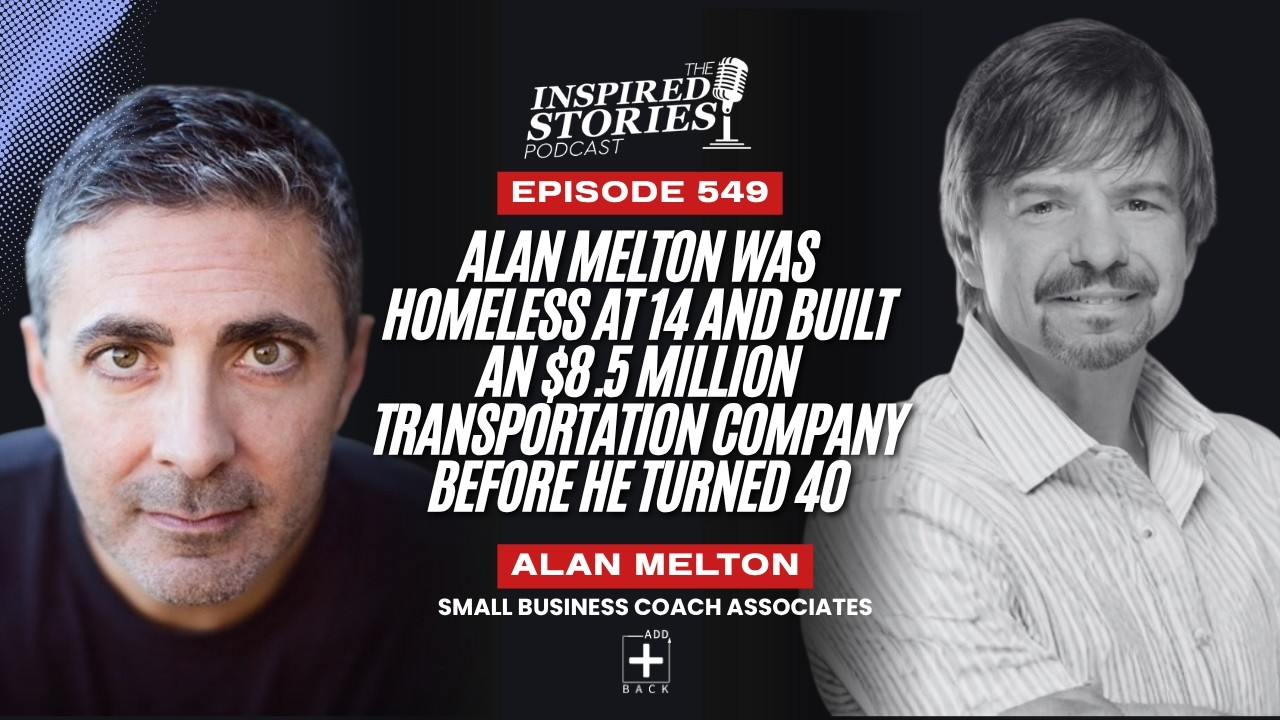
🎙️ From Homeless at 14 to Inc. 500: Alan Melton's Journey Through Business, Coaching, and the Seven Stages to Freedom
Alan Melton, founder and CEO of Small Business Coach Associates, grew up in Charlotte with significant childhood trauma, found himself without a home at 14, sat in a park at midnight when a stranger shared his faith, got taken in by two families who introduced him to Norman Vincent Peale and Dale Carnegie, had a vision on a Greyhound bus to Florida, and built that vision into an $8.5 million transportation company with 130 employees that landed on the Inc. 500 and was sold two months before 9/11 wiped out the industry. What he learned from building and selling that company became the foundation of a coaching practice that has since helped 1,100 small business owners grow their profits while working fewer hours.
✨ Key Insights You'll Learn:
Growing up without structure, finding faith through a stranger at a park, and being taken in by two families who changed everything
The vision on a Greyhound bus to Tallahassee at 14 that became a literal ten-year plan
Building East Coast Auto Rental from a sold car and a bank loan to the official carrier of the Jacksonville Jaguars
Going through the Sterling Quality Award process modeled on Malcolm Baldrige — and how it transformed a mom-and-pop into a sellable company
Selling the business two months before 9/11 — with a million-dollar employee incentive pool paid out first
The seven stages to business freedom: startup, chaos, break-even, burnout, delegation, systems, and freedom
Growing to 24,000 monthly organic website visits and then pivoting to LLM-focused content strategy
The remodeling company that went from $4.4 million to $10 million in two years by fixing a free Google asset
The private security company client who grew from $3 to $9 million in 10 months while working a full-time police job 1,200 miles away
The scorecard: 36 coaching modules that teach mastery one bite-sized chunk at a time
🌟 Alan's Key Mentors:
The Stranger at the Park: The man who stopped to talk to a homeless 14-year-old and shared his faith — the first pivot point in Alan's life
First Foster Family: Took him in, gave him stability, and connected him to a church community that felt nothing like his family experience
Second Foster Family: Introduced him to personal development, The Power of Positive Thinking, and How to Win Friends and Influence People
The Transportation Industry Consultant: Found in an industry publication, helped Alan separate his business PLs, and modeled the very coaching approach Alan now uses with his own clients
👉 Don't miss this conversation about what it actually takes to get out of the owner's trap, why the most important lesson Alan learned as a coach was to stop feeding clients with a fire hose, and how a teenager with no home and no plan used a bus ride and a vision to build one of the most unusual second acts in small business coaching.
Listen to the full episode here
Transcript
Anthony Codispoti (00:00)
Welcome to another edition of the Inspired Stories Podcast, where leaders share their experiences so we can learn from their successes and be inspired by how they've overcome adversity. As you listen today, let one idea shape what you do next. My name is Anthony Codus Bodi, and today's guest built a transportation company to $8.5 million in revenue and 130 employees.
Landed on the Inc. 500 list, won the SBA Small Business Person of the Year Award, and then sold it all to start coaching other founders on how to do the same thing. That exit became the beginning of a second act that has now lasted more than two decades. Along the way, he developed a proprietary system that has helped 1,100 small business owners grow their profits while actually working fewer hours. His name is Alan Melton.
He's the founder and CEO of Small Business Coach Associates, a management consulting firm based in Greer, South Carolina. His clients have generated more than $367 million in combined profit growth. And in 2026, he was ranked the number one small business coach in the country by LifeCoach magazine. He's also the managing director at Empire Business Brokers, where they do exit planning, consulting, business valuations, and more.
But before we get into all that good stuff, today's episode is brought to you by my company, Ad Back Benefits Agency. And you'll want to hear this because it's hurting almost every business owner you know. See, health insurance costs go up every single year, and businesses are furious about it. They're paying more, claims are getting denied, employees are opting out because they can't afford it, and it hurts turnover and morale. It's one of the most maddening problems in running a business, and everyone just accepts it.
But you don't have to anymore. Now there's a program that gives your employees unlimited access to doctors, therapists, and prescriptions with no co-pays or deductibles to meet. And here's the part that really shocks most people. Unlike every other employee benefit out there, our program increases your net profits. We recently helped a client add $900 per employee per year to their bottom line. Results vary, but gains like that change how a business is valued.
You can be the hero advisor that introduces this to your clients today. They'll be so happy they refer their friends to you. Addbackbenefits.com. All right, back to our guest today, the founder of Small Business Coach Associates, Alan Melton. Thanks for making the time to share your story today.
Alan Melton (02:37)
Thank you, Anthony. Glad to be here.
Anthony Codispoti (02:40)
So Alan, take me back before the transportation company, before the coaching, before all this kind of got rolling. What were you doing early in your career and what pulled you towards entrepreneurship?
Alan Melton (02:52)
Yeah, great question. So early, very early in my life, I experienced some childhood trauma. I won't go into the details about it, but I'll just say that it left me in a state of I'll say numbness. it's probably the best way I could describe it. I developed a force field that that helped keep
you know, abuse coming in was able to you know deal with the you know trauma in my childhood. the good news is it wasn't constant in the daytime. I had little to no structure. And so I was able to have many adventures during that during the daytime up into my teenage years. as I reached the age of about 14, the
the trauma got even more abusive and as a result of that i ended up without a place to live and i had i was up sitting up at a park in the middle of the night and this guy s comes by and you know stop strikes up a conversation with me and he begins to share about his faith and i
really was moved by his description, you know, his testimony and things that had happened in his life. And from there I remembered that I had a friend that lived by nearby me who was a member of a a church. I I knew he went to church and I
Told him about this experience that I had. And he said, You ought to come play on our church baseball team. And I said, Well, that sounds interesting. And to play on the church baseball team, you had to go to church one Sunday a month and be part of this Christian boys' club, I'll I'll call it. And I found that the people there at church were completely different than the family experience that I had. And
One of those families took me in and raised me for a period of time, and then a second family
Took me in and they were into personal development and business success. And they recommended two books to me. One was The Power of Positive Thinking by Norman Vincent Peel. And the second book was How to Win Friends and Influence People by Dale Carnegie. And I'll say that those two books, along with my faith, laid the foundation for my future.
What happened soon after that experience, before I became an adult, I I was running away and I was sitting on a Greyhound bus. I I talked a buddy into joining me. And this was going to be a really great adventure. And but as I was sitting there on the bus, I had this for lack of w better words.
dream or vision of what my future could look like. We were headed to Florida. So that that kind of helped you know develop the vision. But I I pictured myself living in Florida, married, having my own business and you know being being happy there. And about 11 years later,
That dream was fulfilled, and that that's where I founded that first company, East Coast Auto Rental. And but prior to that time leading up to it, I had an opportunity to enter a manager trainee program with a company called 84 Lumber Company. And they were highly structured, I'll say that.
I'd liked them somewhat to the military in that the structure, the uniforms, the atmosphere, the the training, all of that was really what I needed as a you know undisciplined young man. and I was able to rapidly advance and I was soon serving as manager of the largest store in the South.
And soon thereafter I founded co-founded East Coast Auto Rental. And that was in 1983 at
Anthony Codispoti (07:30)
Okay.
Alan Melton (07:31)
26 years of age.
Anthony Codispoti (07:33)
wow, we just covered a lot of ground there very quickly. I appreciate you opening up about that. So pretty rough start to things. you got I'll call it lucky in a lot of ways that despite this really rough start in your life, there were people who took you under their wing, right? mentors to you, they were, you know, taking you into their homes, they were opening up to you in
revealing to you their faith, the ideas about personal development that I think became a strong foundation for you. are those folks that you're still in touch with today?
Alan Melton (08:14)
Yes, one lady passed away just about two years ago, but the second the husband passed away, but but the the lady is still living. And so yes, I I stayed close in touch with her.
Anthony Codispoti (08:31)
Yeah. wow.
Probably lots of gratitude for what they were able to do for you at that time in your life. And s
Alan Melton (08:37)
That's true. That's true.
Anthony Codispoti (08:39)
and so you were taking a bus from where to where? The Greyhound bus where the
Alan Melton (08:43)
Yeah.
Anthony Codispoti (08:43)
vision happened, the dream?
Alan Melton (08:45)
Yeah, at that time I lived in Charlotte, North Carolina. And we were headed on a bus to Tallahassee, which was as far as we could go on the money we had. And it was in the wintertime.
Anthony Codispoti (08:58)
And and and what was
the plan once you got there? Who knew? Just
Alan Melton (09:01)
We
we had no plan really. you know, we arrived there in the middle of the night. It was in the winter time. And actually we didn't last too long before we were picked up by the police and shipped back to shipped to Atlanta, where his mother, my friend's mother, met us and then I talked him into running away again.
So we we were loose there in Atlanta for about two weeks.
Anthony Codispoti (09:36)
What is it like
Alan Melton (09:37)
zero.
Anthony Codispoti (09:37)
having that kind of instability so young later in life? Cause I could see it going one of two directions, like you continue to feel sort of unsupported, unstable, unsafe, or maybe it goes the other direction where it's like you've sort of been up against the worst of it and survived, and so nothing bothers you.
Alan Melton (10:04)
I think that's true. Yeah, I I do believe that I it kind of shaped me into being more stoic, which you know is a blessing and a curse. but at the same time, I recently was listening to a podcast and I heard someone say that I didn't have the best father, but he was the best father for me. And
The idea was that, you know, having a father like that helped me to understand what I did not want to be. And so that really was kind of the flip side of it. Also, it it did, and you know, having that lack of an earthly father, it caused me to depend more on my heavenly father and you know, to grow and you know, just have faith that.
that he was gonna you know guide me along the way.
Anthony Codispoti (11:06)
You know, in all the conversations
that I've had, it struck me that some of the most powerful lessons in our lives come from one, really hard experiences, two, really powerful mentors, three, what I'm gonna call really powerful anti-mentors. They're sort of this living example of the things that I don't want to become. And it sounds like you were the early beneficiary of all three of those in in spades.
Alan Melton (11:32)
Yeah.
Yeah, well said.
Anthony Codispoti (11:35)
No. Okay, so tell me how y you got started with East Coast Auto. Where did the idea come from? What were you doing?
Alan Melton (11:44)
Yeah, so I was working for a car rental company, manager for a car rental company, and had a a friend who was a sales rep with the same company. And one afternoon we sat down and talked about all the things that we didn't like about the company that we were with, and started to discuss the possibility of opening our own business.
He lived in Jacksonville Beach, Florida. And we began to seriously consider it. I presented it, the idea to my wife, and we decided to move forward with that. We sold a car to develop some capital and approached a bank and a little bit of a funny story.
was you know we're sitting down with the banker and and I bought this nice suit at a local mall and got it you know deep discount but it was a nice suit and so at the when we went back to find out his decision he said look I I know your partner but I don't know know you but
judging by the suit that you're wearing, in a few months you're gonna be driving a Lamborghini and you'll run the business run run your that's out of business. So that's you know now looking back that was funny but a bit of a surprise.
Anthony Codispoti (13:20)
That that suit was
one of the best investments you ever made, huh?
Alan Melton (13:23)
Yeah, yeah, I guess it was. And but what we did was his father, you know, believed in him and and me enough to to give us a shot. So he put up the collateral on the loan so we're able to you know get a small business loan so we could buy a few vehicles and then approach the
local car dealership and convince them to lease some vehicles to us.
Anthony Codispoti (13:55)
And then how did you find your first customers?
Alan Melton (13:58)
First customers came from that dealership and we were doing the company we left was doing insurance replacements. So when a car is in an accident, they need a rental car to replace it. And so we called on, you know, local body shops, also hotels in the area, in the beaches area, and you know, began to develop some client referrals coming through those hotels and and body shops.
Anthony Codispoti (14:27)
And I'm curious, was there a specific inflection point along the way where the business went from just, you know, kind of surviving, kind of growing steadily to really scaling, or was it just a very gradual growth process?
Alan Melton (14:42)
Yeah, it was it was gradual during the early days, although we were launching other businesses. And you know what would happen is when we have all the cars rented out, there really wasn't much to do.
And so we began to brainstorm other things that, you know, other ways to generate income while the cars were were out. And we came up with the idea of actually hotels had a need where if we were gonna rent a car, they would we would go and pick up the hotel guest and bring them to our office, or we would deliver the car to the hotel.
And soon the hotels had guests who were arriving at the airport, which was about a 45 mile trip from the beaches area where we where our office was based. And so we began to make the trip. And that led eventually to ground transportation. We began to have clients who requested the the vehicle
without a rental vehicle, kind of a you know transportation, a chauffeured vehicle without a rental car. And so we met that demand with
actually with personal vehicles, we had kind of a variety of vehicles in the early days. There was a grandma had a 64 Pontiac Tempo Tempest. And you know, we had a couple of cars that we owned. And so we would use sometimes rental cars when they were available and other times our personal vehicles to make it happen.
Anthony Codispoti (16:30)
And you were shuttling people
from the airport to the hotel and back or wherever they
Alan Melton (16:34)
That's right.
Anthony Codispoti (16:35)
wanted to go in town.
Alan Melton (16:36)
That's right. It's mainly just airport transfers.
Anthony Codispoti (16:39)
Okay. And it's a similar business. It's a little bit different, but not too dissimilar. Did you have to hire a bunch of additional staff or you know, were there other investments that you had to make to grow in that direction?
Alan Melton (16:51)
Yeah, we we started to we actually started a third business along the way as well, an auto leasing business, and then a fourth, which was a a detail shop. And so they were all kind of in the automotive automotive realm. And we did begin to onboard employees so they could handle with you know car cleaning and transportation and other aspects.
in the business, but we were working when once we started the airport operation, we were 24 seven because planes come in in the middle of the night. And so my partner and I shared 12 days on taking the calls overnight and then two days off.
Anthony Codispoti (17:40)
Wow. Now one of the the third business you talked about was auto leasing. And so that's interesting because you started out leasing your cars from a dealership to get your rental business started. So how did you what did it practically look like to move into the leasing space? Now where are you getting your vehicles from?
Alan Melton (17:59)
Well, we had a a gentleman who approached us, was actually a friend of my partner who had experience in that business. And we developed a relationship with a company in South Florida. they were at that time they were named Walden Lease, Walden Leasing, and they looked at our financials and you know, felt like we could, you know, qualify for them.
And so they provide the the leasing cars for us and then we sub lease those to clients.
Anthony Codispoti (18:37)
And then were you also
leasing the cars from them that you were using for the rental business at that point? And how
Alan Melton (18:43)
That's right.
Anthony Codispoti (18:44)
much did that save you versus going to the dealership, if you remember?
Alan Melton (18:50)
I can't I can't recall what that was. Yeah, yeah, no.
Anthony Codispoti (18:51)
Gotta be some percentage points, right? More cost
effective. It's been years. That's all right.
Alan Melton (18:57)
Yeah.
Anthony Codispoti (18:58)
okay, so 130 employees, eight and a half million in revenue. Was what was the inflection point? What where was it where it really started to kick into high gear? Was it when you started to open these other businesses that the revenue really started to increase quickly?
Alan Melton (19:16)
Yeah. We talk about the owner's trap, which is this period of time where, you know, emith Michael Gerber talks about the fact that you found a business, you you think you own it, but pretty soon the business owns you. And that was where we entered. the business owned me working long hours to the point where I had a health crisis at that was about seven years in. And
I just realized that I wasn't gonna be able to be Superman anymore and was gonna have to, you know, develop a more balanced lifestyle. And simultaneously I found a consultant who was a consultant to the transportation industry.
One of the issues that we had was that we had, you know, four businesses and we didn't really have separate PLs for each one. And so we were in the fog in terms of which businesses were profitable, which were not. And the the reason I brought him in was the transportation business was growing more rapidly. We won several resorts. The first was
Marionna Sawgrass, where they have the players championship every year, and they wanted a combination of rental cars, and then we began to provide transportation for them. In any case, the the consultant, I found him in an industry publication, and he helped us do a bit of a
I'll call it an analysis on where we could, you know, find some savings. initially didn't help us separate the businesses financially, but it brought some clarity in terms of how we could add some money to our bottom line. Soon thereafter we engaged him to help us develop a plan. And he did he did a lot of things with us that we do with our clients today, like time management and things like that.
that helped us to we're we're scaling, we were winning you know resort accounts soon thereafter one the Ritz-Carlton Amelia Island, which became a two million dollar account, and we were we were scaling pretty fast at that point.
Anthony Codispoti (21:49)
So you're going through
this quick growth period. in the midst of it, you find yourself rather than owning the business, having the business own you, right? You were overworked, you had this health crisis. So you bring in this consultant who's starting to show you things that are going to be a foundation for a lot of the lessons that you start to share with your clients years later when you become a coach. what was the point that you decided to actually sell the business? You're like, okay, this is enough, time for something new.
Alan Melton (22:20)
Yeah, I will say this that with the help of that coach, I was able to get myself into what we now call the freedom stage. But basically I was working 40 hours a week. our first child arrived soon after we engaged him and I was able to spend, you know, lots of time with my children through that time. So I did
kind of give up all that control that I've had prior to that health crisis and learned how to delegate, learn how to, you know, trust my team, learn how to develop systems and ways that we could run the business without us personally doing everything. And I'm sorry, you asked about when we sold it.
Anthony Codispoti (23:16)
Now, actually I'm
I'm really glad that you shift to diversion because that's really helpful in laying the groundwork for, you know, what it is that you're gonna be able to help clients with as you move forward into a new business. I have to imagine as you went through that, it it had to feel really empowering, right? Before this coach, you know, helped to open your eyes to new ways to do things, you probably felt like you were just like on that hamster wheel and there was just no getting off of it.
Alan Melton (23:46)
Those are exactly the words that I use. and that's where I see my clients now, most of them that we we serve are on that hamster wheel in that owner's trap. And that's why my work is so rewarding is helping is having liv lived through that, I've got all the scars, right? And having lived through all of that, I can from experience teach them as a mentor and you know as a coach.
Anthony Codispoti (24:14)
Mm-hmm.
And so what was the point where you decided to sell the business?
Alan Melton (24:19)
In our business, our industry was, and by the way, we closed down car rental leasing and the the detail shop at the same time that we won the Ritz-Carlton. And at that time, you know, we were in you know several million in sales. And so our industry began to go through consolidation.
And as well as our business was doing, we were still higher highly leveraged. You know, we had Von Hoo motor coaches, which were, you know, three, four, five hundred thousand dollar pieces of equipment. you know, we had, you know, limousines, we had vans, we had kind of the full array of of vehicles, quite a quite a large fleet. we were
the official carrier for the Jacksonville Jaguars, you know, won a lot of corporate work in the area. But I'll say even though I wasn't working that hard, there was a stress of the high debt to service that, to service those vehicles, you know, 130 employees and and so forth, in that sense that, you know, that industry could be volatile.
And as it turned out, my instinct was right because we we sold the business, had a about a two-year management period of time. And we in anyway, I kind of lost my track, but our industry was going through consolidation and we had pretty high visibility in our industry. I became president of our industry association.
And you know, so the large publicly held companies, you know, knew who I was and who learned about our business and the awards that we were winning along the way. And but we sold the business and then and had two years. We had an incentive program for our employees because I felt so passionate about personal development.
And the difference that it made in my life. And I wanted them to experience that as well. You know, anybody, I I did it right. And so anybody can do that if you will focus on developing yourself, as Jim Rohn said, a formal education will get you a job, but personal development will get you a fortune. And so I wanted that for my employees. And so we created a million-dollar.
pool. It was an earnout that the business basically promised they would double the sale if we could increase our profits by a million dollars over the next two years. And we created that pool, but created a certification program around it for our employees that they had to get certified to get a share of the pool. And so we paid them a million dollars and two months later, 911
hit and and the sales went from eight point five to three million overnight.
Anthony Codispoti (27:44)
brutal. What happened to the company going forward?
Alan Melton (27:48)
Well, it's publicly held company. And so our, you know, the j jobs of many of our employees were protected. And but actually this publicly held company then took it to about 300,000 over the next, you know, say they went from eight and a half million to 300,000 in about five years.
Anthony Codispoti (28:12)
Okay, so that's more than just the effects of nine eleven. What was going on where they drove this into the
Alan Melton (28:18)
Yeah, I think that the company was, you know, executive transportation, but they didn't really understand the resort niche. and you know, customers are highly demanding. Say a Ritz-Carlton, if you've ever stayed at a Ritz, they have you know very high standards. And I think the the company just could not adapt. You didn't have the relationships that that we had developed with you know local management team and
you know didn't quite have the passion or the even the the knowledge and and i will say this this isn't prideful but i'll say sophistication because in our one story that i didn't tell was that we got involved in the sterling quality award process and which is modeled after malcolm baldridge national quality award and
That process really transformed us from a mop pop to a mid-sized company and helped us prepare the business for sale. The Ritz-Carlton had won that award. Some of their locations had won the award. And I was impressed with how they wanted to do more than just make money. They they wanted to make a positive impact on the community, on their employees. And that resonated with me. So we
followed in their footsteps, you might say. And we became the recipients of that award. And that award really prepared me for coaching.
Anthony Codispoti (29:54)
So that award, the Malcolm Baldridge work that you did, so taught you a lot. Can you pull out one key lesson that you learned?
Alan Melton (30:04)
I think probably, you know, systems, you know, KPIs and systems, but really the you know, there was there's seven criteria, which you know begin with vision, values, emission, kind of leadership. And there was you know, process development, there's HR, KPIs, you know, financial improvement, you know, there's several.
really it was kind of those seven criteria, which don't have anything to do with our ste seven stages, by the way. But I'll just say that that the holistic view of business that's presented through that process was transforming for me. It took me three real three years to really grasp it and to develop a, you know, a company that
A a team of examiners could come in. They they came in for a week and spent a week just determining how well we had deployed the processes and and their system before we became the recipients, but we were named along with a a regional hospital as the recipient. But that really changed me, helped me to see things kind of in the way of systems and
it really greatly informs me is today what I do as a coach.
Anthony Codispoti (31:31)
So talk to us about how Small Business Coach Associates got off the ground, founded in two thousand two. What did you do? What was the vision?
Alan Melton (31:39)
Yeah, yeah, great question. So I had read the emyth and and of course we had just gone through the Sterling process, which you know, there was really a lot in common that the principles of the EMyth, but I didn't, you know, from what I understood about the emyth, I felt like there needed to be more meat on the bones and felt like the practical experience that I had could benefit business owners.
in in a in a more you know real way. So we founded Small Business Coach in 2002 and two years later founded Empire. I want to jump into the kind of the next topic, but two years later founded Empire Business Brokers.
Anthony Codispoti (32:29)
Okay, so talk to us about the early days, what Small Business Coach Associates was supposed to do, how that led into also forming empire brokers and what that does kind of paint the picture for us. Let's see the landscape.
Alan Melton (32:43)
Okay. And need to kind of bring in the third the third piece and that was family. that was a strong, you know, I rarely make a decision without having multiple reasons for doing that. And I I did do some travel, even though I was working typically 40 hour weeks and was home a lot with my family.
as with these industry associations as president, I did do a lot of traveling and I felt like when we sold the business, I wanted to focus on my family. That time my daughter, I believe, was 10, son was six, and I wanted to be personally involved and we decided to homeschool our children and wanted to be, you know, an important part of that that aspect.
So now now you got three three pieces. You've got small business coach, empire, and family. And you know, with with small business coach, we initially started with people that you know we had high visibility in our community and started with clients that we were focused there. But I really wanted to take work with small business owners to, you know, coach them.
I didn't initially develop the seven stages to business freedom that that came a few years later, but my focus was just teaching the basic fundamentals, like you know, creating a plan and then more important, deploying the plan and you know, applying all those big business ideas on a small business scale.
Anthony Codispoti (34:33)
So how did you get your first
client with small business coach?
Alan Melton (34:37)
Initially we started serving people that I just knew in the community and
The first client was a guy who owned a motorcycle shop. I believe the name was Michael Cycles. And you know, he was aware of, you know, kind of our success. And I think he contacted me. There were some others. There was a physical therapist, a company who owned a promotions company.
but it was the Michael Cycles that that was first.
Anthony Codispoti (35:17)
And did it just
grow organically from there? Did you guys find that you needed to do a lot of marketing to get the word out? How did things unfold?
Alan Melton (35:28)
We did. and also, you know, again, two years later when we started Empire, that became kind of a second marketing leg you on the stool you might call it, in that you know, a lot of people don't think about brokering and valuations and you know, buying and selling in the same vein as they do coaching, but
In my opinion, there's a they're a pretty close cousin. if you look at exit planning and you know value building, which actually all of those things are part of our offerings with Small Business Coach. You know, we fold all those ideas from brokering. I'm presently not doing brokering now, but we do exit planning, business valuations, and
And then helping business owners to understand building value in their business through coaching or exit planning, however you want to talk it, talk about it.
Anthony Codispoti (36:33)
So y
you're not doing brokering yourself, but are you still affiliated with Empire Brokers?
Alan Melton (36:39)
No, actually Empire business brokers used to be a licensee network. And I'll say 15 years ago when the owner walked away. I'm I'm not sure if he sold it or went belly up, but it was no longer in operation. There are still a few empire people who used to be part of Empire that are now operating as independent operators.
Anthony Codispoti (37:08)
Gotcha. Okay. So you've mentioned the seven stages to business freedom a couple of times. Walk us through how you came up with those and what they are.
Alan Melton (37:19)
Sure. Yep. So the seven stages are periods of time that I see in common that business owners typically go through. It starts with the startup stage, and that's where you know you've taken the leap of faith. You're you're kind of in that dream phase before that, but you move into the startup stage where you've actually jumped into business and you
Now it's all about marketing and creating a plan and developing differentiating, differentiation between you and your competition. And so if you're really good in that stage, if you're good at finding clients and onboarding them, many businesses will move from there into what we call the chaos stage.
A lot of business owners are kind of like me, ready, fire, aim, right? And so they have enough confidence in themselves that they can start a business, but they may not know.
all the pieces of the puzzle that's going to require to to be successful and eventually to scale. So they may be good at bringing on clients, but they may not be so good with systems and managing things. So many businesses will fall into the chaos stage, which you're typically still paying the business, you know, you're losing money. And in that stage, you're looking at developing some rudimentary processes.
which can move you upward into what we call the break-even stage. Breakeven means just that, that you're no longer losing money any longer and you're starting to develop some balance. You've now kind of gone through that ugly chaos stage and you're you have some balance. At that point you're not necessarily making good money, but you're working typically on pricing and
If you stay in the lower stages for a long period of time, you'll fall down into what we call the burnout stage. So now you've been working in the business, kind of like my story, you know, working too many hours, not making near enough money. And at some point could be a health crisis like me, or other time when you just realize I don't have time with my family. I'm having
problems with my wife and not enough time with my children. And in that burnout stage, you're just, you're, you're tired. You know, business is hard. It can just beat you down. And in that stage, you're going to do one of two things. You're either going to quit, go back to your, you know, former job, corporate job, or you're going to get some help. And really those lower stages is where many of our clients will will find us.
Anthony Codispoti (40:21)
And how do they find you today?
Alan Melton (40:24)
In several ways. One is we've been I became an expert a a few years ago on SEO and we were able to grow our business pretty dramatically. at that time, I think we had about a hundred visits a month and was able to take it to about twenty-four thousand.
organic visits a month. That was after I experienced a lot of disappointments from digital marketing companies, including the probably what we might consider the top digital marketer on the planet. He opened up a kind of a small business division and I was like most business owners didn't know anything about SEO.
And but soon I found that I was getting zero domain authority backlinks to my website, which didn't help us to really grow. Long story short, we I decided to learn SEO and that helped us to grow. And there still are some ghost some remnants of SEO that are working today.
secondly, we about a year ago decided to position ourselves so that we could get traffic from the LLMs. And we're doing that, you know, getting some traffic from the LLMs social media and
That's one of the reasons why I'm here today is LLMs, you know, like that social that when you're appearing nationally on podcasts and so forth. We also have started our own podcast last week and which is called Beyond the Owner's Trap. And so we're looking to invite business owners to join.
that podcast to kind of go through the process and learn their experiences and and their journeys. We're doing some outbound marketing. Actually have a podcast manager that is helping me with that and will help you know to bring on not only our own clients who have it's been a really successful year for a lot of our clients.
but also bring on you know new business owners who are going through that owner's trap.
Anthony Codispoti (43:18)
So I wanna get back to what happens in stages five, six, seven, right? You talked us through the first four,
Alan Melton (43:22)
Yeah.
Anthony Codispoti (43:23)
but before we get there, I wanna learn a little bit more about how it is that you were able to level up in terms of SEO and digital marketing. You went to try to learn from or hire one of the top people in the space. Wasn't working. So where did you go? What was the the learning resource for you?
Alan Melton (43:42)
Well, I can't I began I continued to follow him on social media, so I I did continue to learn from him. And you know, we tried some other companies like his that helped us some, you know, in terms of blogging and
We had several different companies that we used and Yeah,
Anthony Codispoti (44:07)
You kind of learn from lots of different folks along the way.
Alan Melton (44:10)
yeah, it's kind of my style is, you know, personal development. I'm always finding some kind of way to to learn things. And so I just did went through the hard knocks, you know, earned the scars and and was able to learn how to.
how to get that traffic. So I I still believe in personal development. That's basically my approach now is that I'll learn something or find a service that works really well for me. And once I can endorse it, then I'll refer my clients to to those organizations or I'll teach them myself like with SEO. Now is part of what we do.
We'll train our clients on how to do that.
Anthony Codispoti (44:59)
And you said you made the comment that there's still some remnants of that SEO that's working for you today. So I'm gonna guess by that comment that the traffic that SEO is driving to you has dropped off because a lot of folks are using the L L Ms now, which is part of what has fueled you to go in that direction as well. Is that right?
Alan Melton (45:18)
That's exactly right.
Anthony Codispoti (45:21)
All right, so let's get back to 'cause you took us through the four first four stages, which man, that sounds like the rough part of the business. So t talk to us about when it starts to get better in five, six, and seven.
Alan Melton (45:32)
Yeah, so in five, that's where business owners do learn to let go. they may have been on that hamster wheel, they may have gone through that those tough times, but they've now hired a coach or they've done their own personal development online, but they've come to a conclusion that they will need to delegate. And
Once they've done that, you know, it it's actually harder first before it gets easier, you know, because with delegation, you've got to train them and you've got to find the right person for the job. And so it I I won't
I won't tell you, and for those of you that are business owners, I'm not going to tell you that it gets easier immediately. delegation's hard, you know, because you do have to create the training, you have to create the system, you know, before you hand it off. But what happens is you progressively do that, if you'll just do one of those a week, you know, by month three, you've got a different life.
Anthony Codispoti (46:48)
Do one of what a week.
Alan Melton (46:50)
Delegate. Delegate one of your tabs. Yeah.
Anthony Codispoti (46:52)
Take one task each week.
Alan Melton (46:54)
Yeah.
Anthony Codispoti (46:56)
And how do you coach people to do that? Like what is the actual structural thing? If I'm gonna sit down and pick one task this week, what does it look like for me to put that into a system in Delhi?
Alan Melton (47:09)
Yeah, we have a a time mastery system that we use that where we identify things that, you know, clients, you know, give them energy, you know, because we really want them at the end of the day to be as excited as they are, even though they've they may have had a long day, but they're excited for the wins that they've had and they've been doing things that they love to do. And so
We have a bit of a call it an analysis that we take them through that identifies where they're spending their time and then whether the level of that is that CEO level work or is it manager level work or admin level work? And then what gives them energy, you know, what and what drains their energy. And so kind of a combination of all helps us in
I have this one of my zones of genius is helping business owners to understand their zone of genius, which helps them to step into things that help the business to scale.
Anthony Codispoti (48:18)
You have a scorecard that you like to use with your clients. Tell us about this.
Alan Melton (48:24)
Yeah, yeah, it's a 36-point scorecard and it basically takes them through most of the areas that that we used that we learned through the sterling process, but we've also combined some of the areas from our Empire Business Broker process because I see really businesses as pretty holistic. You know.
It it's true that you can get results in a short period of time and you know, maybe go through six months and see amazing results, but what's the end look like? You know, Stephen Covey you know said, begin with the end in mind. You know, many executives climb the ladder of success only to realize it's leaning on the wrong wall. And so I really want
clients to really think holistically about their business, where they are, where they want to end up, and you know, what not only what amount of money the business is journ is generating and income for them, but what's the future value going to be of the business. So really thinking day one about what your exit plan is is a pretty good idea.
Anthony Codispoti (49:48)
So give us an idea of some of the other things that you actually do for clients that are working with you. You mentioned one very specifically. You teach them things that you know, like SEO and some of the work that you're doing now to get, you know, the AE or the yeah, that's I think that's what they call it now, the AEO, right? For the the for the L L Ms to to appear
Alan Melton (50:06)
Yeah. Yeah.
Anthony Codispoti (50:07)
there. But what are some of the other things that you teach folks?
Alan Melton (50:10)
Yeah, AEO and GEO, but during that we've got them organized by stage and we've got seven or eight that are focused just on marketing, different aspects of marketing and differentiation, branding, so on and so forth. And then we have
Things that focus in on like cash gap, which your cash gap plan, your financial and improvement plan. We have budgeting. Also, as you move into where you're starting to onboard employees, psychometric profiling, where you're hiring the right personality type that's gonna love the job that you're giving to them. Also
employee retention and and employee hiring process we have you know a number of other hr related modules we have you know processes we call it our systems and process improvement plan we have
Then of course exit planning modules. We have growing your business value, customer concentration. So that's that's a few of them.
Anthony Codispoti (51:42)
So give me an idea of the ideal client fit for you. What kind of industry are they in? What size are they? Are there any geographies that you prefer?
Alan Melton (51:56)
Yeah, yeah. It's US based clients. And I'll say for the most part, they are local business local service-based business owners. And so when I say local, it could be a trade, HVAC, electrical plumbing, remodeler, so on and so forth. but we also have a a niche where we're providing
Coaching for consultants. We have a mining consultant, safety consultants, a gun crime reduction consultant, private security company, and some of those that are nationwide. By the way, I didn't mention that really probably my proudest achievement is that this year four of our clients.
made the ink 5000 and so you know they're rapidly rapidly growing businesses and then a fifth was named this south carolina woman business of the year so it's been a great year in terms of seeing our clients you know grow rapidly gain success escape the owner's trap and and then receive public recognition for it
Anthony Codispoti (53:20)
That's awesome.
And what size company is a good fit for you?
Alan Melton (53:26)
We will serve a c you know, probably the ones that were making the most impact or the quickest impact is companies that are between one million and twelve million a year. but we do get good results with companies as little as 500,000, ideally with you know.
some employees. So if you're a half million dollar company with you know a few employees, then you're you're going to get good results.
Anthony Codispoti (53:59)
So walk us through
what an engagement looks like. I meet with you guys, I say, hey, this looks good, let's get started. What happens on day one?
Alan Melton (54:08)
Day day one, actually day minus one, we send them a an onboarding questionnaire that also helps us develop and populate a strategic plan. And what we do during that first month is we double it up on the amount of time that we spend with them because you know we're laying a solid foundation and that
helps us to really have a solid plan in place. We're basically doing coaching and and planning during that first month. The scorecard we use to identify areas to focus on first. And so you know we're kind of plug and playing those areas where they'll give themselves a low score on so that you know we can focus in on those.
but really what informs us is what they are looking for, what what's their priority. If they're looking for growth, then we're gonna look at a combination of three things. One is marketing. If if there is a bottleneck related to marketing, we're gonna shore that up. Secondly, if it's systems, we'll deploy systems, kind of help them develop.
rhythms in their business and systematic way of of running their business. And then finally, if the bottleneck is finding good employees and retaining good employees, it's all about culture building.
Anthony Codispoti (55:45)
In your experience, Alan, do most employers, do most business owners know what their problem is when they come to you? Or are there things that you will typically unearth that they didn't even realize was causing them issues?
Alan Melton (56:02)
I'll say it's a combination of both. And you know, you have business owners that are more self-aware than others. I mean, I was probably one of those that I didn't know. I I didn't know anything, you know, when I hired a coach. I mean, I knew how to how to hustle, I knew how to manage, knew how to work hard. But if you're looking at business owners, it it can de you know vary based on their background and
their upbringing, but it can be a combination of both. That's a really good question.
Anthony Codispoti (56:37)
What are some things
that typically are very common for you to discover that the business owners had missed?
Alan Melton (56:45)
Well, for one thing, vision. Many business owners really don't have clarity of where they want to be, say in one year or five years. secondly, if they're in a partnership, sometimes they could be having
you know, challenges in their partnership. And it actually I went through that experience myself. I my partner saw black, I saw white. And so there's headbutting and that coach we hired helped us to resolve those issues and get get in our roles. But it can be you know things like marketing tactics. they may be
naturally good at attracting business owners, but not necessarily good with you know they may be not knowledgeable about certain marketing tactics. Many are not good with guerrilla marketing tactics. And just as an example, we have a remodeler, some remodelers been working with for about two years.
They they've grown from 4.4 and they're on track to do 10 million this year over two years. But they were spending a lot of money on Google Ads, but not really focused very much on their Google business profile. And we were able to help them to equal the amount of leads they were getting from their Google business profile, which is free as they are from their ads.
Anthony Codispoti (58:29)
Okay, so give us a little bit of a taste. What were some things that you did to help them with that Google Business profile?
Alan Melton (58:36)
Well, just the the you know, social proof, you know, getting reviews, also optimizing it so that it
Yeah, I'll say this that most businesses, big or small, don't understand Google business profile. And I'll say that is especially true with digital marketers, that it's either that or they just they know and they're they're not doing it. And so it's just doing the doing the
Anthony Codispoti (59:15)
So you guys know
the changes that need to be made so that Google sees that, thinks that you're an authority, thinks that you're somebody who should be shown above your competitors. You guys know all those little dials to turn. No.
Alan Melton (59:28)
That's right.
Anthony Codispoti (59:30)
So you've coached over 1,100 founders, been doing this for more than 20 years. I would imagine that during that time, your own philosophy on what makes a business successful has probably evolved.
Is there something that you believed strongly in the early part of your coaching career that you've now changed your mind about?
Alan Melton (59:54)
Well, I will say this as a coach, I had a tendency during the early days to feed with a fire hose. And so this was just my ignorance as as a business coach. I wanted to tell them everything as soon as possible. And I didn't realize the reputation that it takes and and you know the the readiness.
that a business owner needs to be to learn. And just the common facts about learning. You know, we only retain about 10% of what we learn, whether it's in a webinar or you know talking with a person or in a class. And so therefore it takes repetition to impart knowledge. And that was really part of that 36
coaching modules that relate to the scorecard was learning how to deliver bite-sized chunks.
Anthony Codispoti (1:00:58)
So do you find
that the typical client engagement is ongoing because they just continue to get results from you? Or is it I don't know, a six, twelve, eighteen, twenty-four month process where most companies are able to get from you what they need?
Alan Melton (1:01:15)
Yeah, the average engagement is about 24 months, but I do have several clients that have been with me, got one that's been with me for over nine years, one eight years, one seven years, several in the four to five year point. So we do tend to have some clients that, you know, they're loyal and they they're still getting results now after a longer period of time.
Anthony Codispoti (1:01:42)
So typical engagement
is twenty four months. And so you're trying to spread out that sort of those thirty six points to address kind of piecemeal as they go along. You don't want them drinking from the fire hose right up front.
Alan Melton (1:01:57)
Yeah, I'm okay with feeding from the fire hose. It's just I'd I've come to know that it's not it's not the best way to learn. It's not the most effective. And so we do have coaching packages that you know, some that are lower.
time investments on my part and the client, and then some that are greater where you know they can scale faster with some of the larger coaching packages. But the modules do break it down into kind of mastery of one task at a time. And actually one module can take months to really deploy and and you know impart the the full
knowledge of how that goes, but I don't I don't hold back. I I tend to give as much as they can absorb.
Anthony Codispoti (1:02:55)
Give them the fire hose
right up front and then be there to support them and reiterate, you know, that repetition that you were talking about.
Alan Melton (1:03:02)
That's right.
Anthony Codispoti (1:03:03)
Yeah. So I know founder freedom is something that's really important to you and imparting upon your clients, certainly based on what you've been through yourself. Like you don't want people stuck in those first four stages. And you report a 30% average reduction in owner work hours for your clients.
So to get to that point, obviously you've got to convince the business owner, the operator to let go, to delegate. And while that always sounds really nice and easy and clean on paper, it can be really hard for somebody who this is their baby, they've built from the ground up to start letting go of some things. How do you coach owners, operators through?
Alan Melton (1:03:49)
Yeah, great, great point. You know, because some business owners do have a tendency to micromanage, only they can do it best. And I'll just say that, you know, as a business is scaling, or you know, if there's a bottleneck there, it likely is the the business owner.
And so I tend to be straight with them. I I listen to them, I understand their stories. Sometimes we'll I recently was working with my my client with the private security company, and he was hesitant to let go a billing that he's been doing for a long time. but on the flip side, his business has grown from three to nine million dollars over.
10 months. And so he's being and believe it or not, he is a full-time police officer. And so he he's running this business on the side. but he was struggling about doing the ability, actually billing and also troubleshooting when a client has a problem. He wants to be that guy.
And so as we were talking through it, what we decided to do was to split it up into two different tasks and said, look, why don't you let the billing go? And since the troubleshooting, you having face-to-face time and you solving that problem for the customer yourself, since that's really a differentiator for you and you love to do it. I mean, you're a cop, you you love solving problems, you know, keep that peace.
let's let the billing go. And so it it's sometimes just kind of drilling down into the topic, you know, discussing it in detail, you know, me asking a lot of questions until we can come up with something that's workable.
Anthony Codispoti (1:05:58)
The part of that story that blew
my mind is he's gone from three million to nine million in ten months and he still maintains a full time job outside of that company. Is there at some point where he's gonna say, Hey, I think this is the real deal? I'm gonna put all my efforts there.
Alan Melton (1:06:15)
And one more thing, it's 1200 miles away.
Anthony Codispoti (1:06:20)
He lives twelve hundred miles away from the business.
Alan Melton (1:06:23)
He does. Yeah.
Anthony Codispoti (1:06:24)
Okay.
Alan Melton (1:06:25)
so well, there are some things that work in his favor. One is that his he actually works at a school and half of his time is at a desk and the other half he's got another partner and they kind of, you know, swap out.
So he does have some desk time and during the desk time he can he can run the company from there. So
Anthony Codispoti (1:06:50)
Okay. Wow.
Alan Melton (1:06:52)
he's he's got his life pretty well, you know, structured so that he can do it all. And you know, he loves doing police work. He he was actually a
previous CEO of a $30 million company. And he told his wife, hey, look, I I I I want to be a I want to be a cop. And she said, well, how are you going to take care of us? And he said, you let me figure that out. but I I'll do both. I'm going to make sure you have a a good, comfortable life and and I'm going to be a cop.
Anthony Codispoti (1:07:31)
Alan, as you think about the work that you're doing now, what is it that you most want to be remembering?
Alan Melton (1:07:40)
I think probably, you know, personal development, the the the power of personal development and and faith, you know, that's been very integral to my life. But you know, that idea that no matter who you are, no matter what your background is, no matter how disadvantaged you may be, it doesn't matter. all that really matters is
Whether you're willing to get personal development. And in today's time, we have so many things that are at our fingertips. It's like a big buffet that's available to every person on the planet, certainly in the United States, anyway. And if you, no matter what your station of life is, no matter what your past, no matter what your disability is.
that if you will begin to develop yourself, listen to podcasts, you know, YouTubes, read books, audio books, all the many arrays of options that we have in in our life today, you can be at a point and not too long, not too many years down the road, you can be living a life that you never would have dreamed.
Anthony Codispoti (1:09:02)
Well Alan, I've just got one more question for you today, but before I ask it, I want to do three quick things for our audience. First of all, if you want to get in touch with Alan Melton from Small Business Coach, their website is really easy to remember, smallbusinesscoach.org. Smallbusinesscoach.org. It will be in the show notes if you miss it, but no reason you can't remember this one. Smallbusinesscoach.org. And if you're enjoying the show,
Please take a moment to subscribe wherever you're listening. See, it also sends a signal that helps others discover our podcast. So thank you for taking a quick moment to do that right now. And as a reminder to all business advisors out there, your clients are bleeding money on health insurance. Do them a favor so big they'll tell their friends about it. Show them how to give their employees access to therapists, doctors, and prescriptions that counterintuitively.
increases the company's net profits, real gains that can change how a business is valued. Contact us today, adbackbenefits.com. So Alan, last question for you. A year from now, what is one very specific thing that you hope to be celebrating?
Alan Melton (1:10:17)
I would like to celebrate our existing clients now winning the Inc. five thousand a second year. You know, they've got a repeat in their growth, and to have some new clients on the list.
Anthony Codispoti (1:10:31)
I think that's
Alan Melton (1:10:32)
And and by
the way, one one other thing that I I didn't make earlier, one other point, is that I see us all about kingdom building. And what I mean by that is that you know, through business coaching, and for those of you that are consultants, you have the ability to impact not only business owners, but their employees and the communities that they support. And with your clients, your clients are likely passionate about some.
cause, you know, children starving in Africa, you know, battered women, you know, whatever things that they're passionate about, you can encourage them. And if you help them to make more money and have more resources and have more time, they can spend more time with their family, spend more time changing the community and making the world a better place. And so that's really my long game is not only
been able to help people develop personally, but also helping them to make an impact on the world.
Anthony Codispoti (1:11:37)
So it's not just about acquiring wealth for wealth's sake or for material possessions. It's so that it's freeing you up to give you both the time and the financial capability to go and be able to make an impact.
Alan Melton (1:11:51)
Absolutely.
Anthony Codispoti (1:11:53)
Alan Melton from Small Business Coach. I want to be the first to thank you for sharing both your time and your story with us today. I really appreciate you being here.
Alan Melton (1:12:02)
Great. Thank you, Anthony.
Anthony Codispoti (1:12:04)
Folks, that's a wrap on another episode of the Inspired Stories Podcast. Thanks for learning with us. And if one thing stood out, put that into action today.
Connect with Alan Melton:
Website: smallbusinesscoach.org