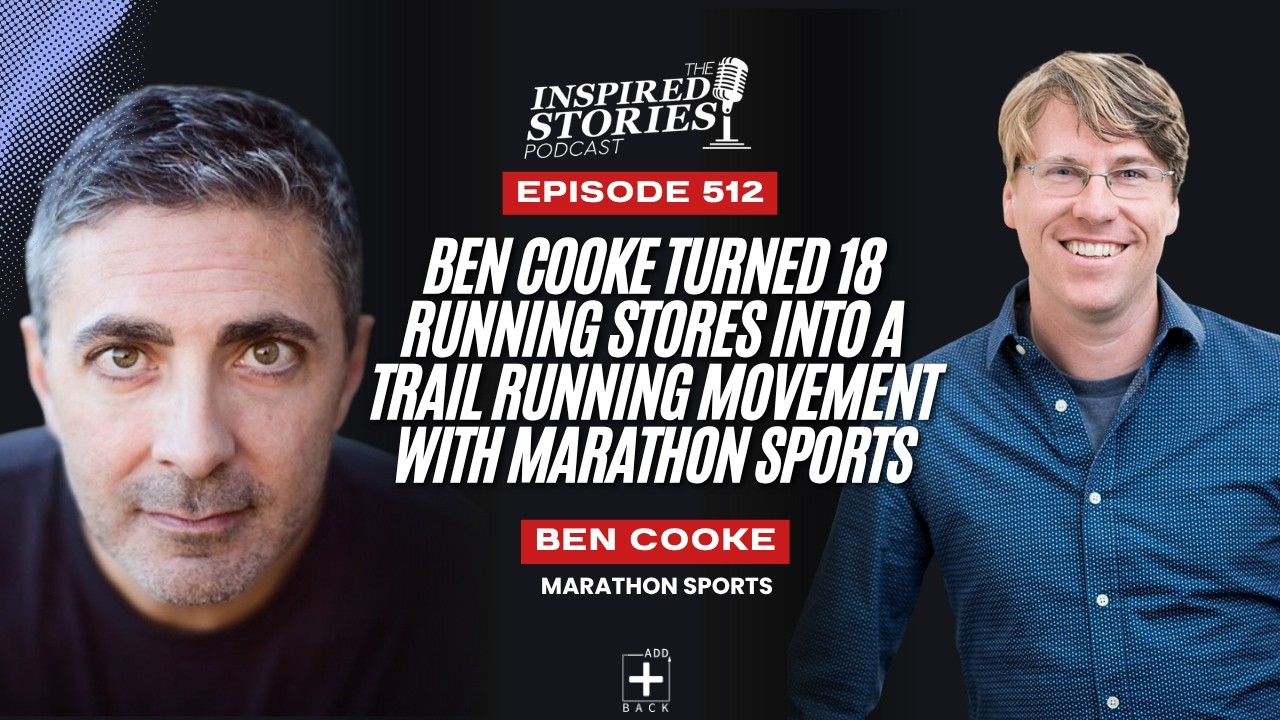
🎤 From All-American Runner to Running Retail’s Most Restless Builder: Ben Cooke at Marathon Sports
Ben Cooke, President of Marathon Sports, has spent 25 years building things inside companies he didn’t own — then lost everything trying to build something that was truly his. Along the way he helped create Fleet Feet’s corporate retail arm, launched their e-commerce platform, built an On Running program that became 8% of On’s global business, and is now turning a 30-location New England specialty retailer into a trail running brand with global ambitions.
✨ Key Insights You’ll Learn:
Competitive athletics as the foundation for a business career driven by daily PRs
Running Princeton Running Company as a de facto entrepreneur for 11 years under a Koch Industries executive
Selling to Finish Line and stepping into a national roll-up role without M&A experience
Transitioning from owned retail to franchising and why the cultures require entirely different instincts
Building Fleet Feet’s e-commerce, Amazon business, and distribution center from scratch
The On Running partnership that took them from zero to hundreds of thousands of pairs
Acquiring Marathon Sports in 2022 and growing from 18 to 32 locations in four years
Trail running as a flywheel — races, field trips, and dirt camps building the customer of tomorrow
Why win-win-win is the only deal structure worth pursuing
Losing everything on two outdoor stores in Colorado and what the failure actually taught him
🌟 Ben’s Key Mentors:
Princeton Running Company founder: modeled entrepreneurial decision-making at the local level, inspired by Koch Industries’ market-based management philosophy — without ever naming it
Fleet Feet leadership: gave him room to innovate across every department and scale concepts from zero
Podcasts (Founders, Acquired): a daily MBA on the commute, replacing incidental mentorship with intentional learning from the best business minds in history
His own failures: the Colorado outdoor stores taught him that systems and teams — not individual toughness — are what allow entrepreneurs to flourish
👉 Don’t miss this conversation about building something from inside someone else’s company, the specific deal structure that turned On Running into a powerhouse, and what it feels like to lose everything you put in and still say you’d do it again.
Listen to the full episode here
Transcript
Anthony Codispoti (00:00)
Welcome to another edition of the Inspired Stories podcast, where leaders share their experiences so we can learn from their successes and be inspired by how they've overcome adversity. As you listen today, let one idea shape what you do next.
My name is Anthony Codus Bodi, and today's guest spent more than eight years running every function of a 17-store running retail operation, stores, events, screen printing, and e-commerce at a very young age. That early chapter set the foundation for everything that followed, including nearly a decade at Fleetfeet, the nation's largest specialty-running retail franchise network. Moving from franchise operations to leading business development.
Ben Cooke (00:34)
Really?
Anthony Codispoti (00:44)
Before a new opportunity pulled him north. His name is Ben Cook. He's the president of Marathon Sports, a premier specialty running retailer with 30 locations across New England and two more set to open in the coming months. Founded in Cambridge in 1975, Marathon Sports has been a fixture of the regional running community for 50 years. Since Ben joined in 2022, he has launched a trail running initiative.
Acquired race properties, including 603 Trail Races, and the Cranmore Mountain Race, and open a trail hub in North Conway, New Hampshire, with the goal of making New England a genuine global destination for trail running. But before we get into all that good stuff, today's episode is brought to you by my company, AdBack Benefits Agency. And you'll want to hear this because it's hurting almost every business you know. Health insurance costs go up every single year.
And retailers are furious about it. They're paying more, claims are getting denied, employees are opting out because they can't afford it, and it hurts turnover and morale. It's one of the most maddening problems in running a business, and everyone just accepts it. But you don't have to anymore. Now there's a program that gives employees unlimited access to doctors, therapists, and prescriptions with no co pays or deductibles to meet. And you don't change your broker.
But here's the part that really shocks most people. Our product actually increases your net profits. We recently helped a client add $900 per employee per year to their bottom line. Results vary, but gains like that can change how a business is valued. Get your free consultation today at adbackbenefits.com. All right, back to our guest today, the president of Marathon Sports, Ben Cook. Thanks for making the time to share your story today.
Ben Cooke (02:34)
Wonderful. Thanks for having me.
Anthony Codispoti (02:36)
So, Ben, you started your career at Metro Run and Walk, a specialty running retailer back in 2002. Tell us what was the job and what were you learning about the industry and yourself in that first year and a half?
Ben Cooke (02:52)
Well, I started like a lot of people in the industry. I had been a high school runner, I had been a collegiate runner, had some success, was sponsored by ASICs, and needed really to kind of have practice on Tuesdays and Thursdays. And so what job could I have to do that? It made sense to kind of apply at a specialty running store. I was a runner, they were serving runners. I thought, hey, you know, I'll be excellent at this. And what I what I learned almost immediately, I was a sales associate.
primarily responsible for just helping one-on-one with with customers was this element of like competitiveness. There were sales numbers, I could see what the the sales were the year before on that exact same day. And so all that energy I had as a competitive athlete, I was like, my goodness, I can PR every single day at business. Like this isn't like I don't have to train the whole season just to kind of like hit a running PR.
We can I can PR every day. So I mean basic retail, I mean it's helping people, it was it was product knowledge, but the system that specialty running uses j it just was a lot of fun. and it it leveraged a lot of the things that I was interested in and it allowed me to kind of just deploy all of that in in an experience. And and you can grow a business that way. That was the funnest part of it. You could see, wow, just doing these kind of customer service knowledge.
being helpful, being knowledgeable, and being enthusiastic, you can grow a business. Wow.
Anthony Codispoti (04:22)
That's pretty cool. You know, I talked to a lot of former athletes on the show and that competitive drive that I don't know, maybe just maybe it was always there, you know, and that's what got you into sports, or maybe it evolved because you were in sports. but those people tend to see a lot of success once they get into the business world, once they get into a career path, because yeah, you just you always want to better yourself.
Like you said, you don't have to wait the whole season to get to your next personal record. In this case, you could, you know, you could try to best what they were doing in that in particular day the you know, the year before. W you said that you were y a high school and collegiate runner. Where did you do your collegiate athletics?
Ben Cooke (05:06)
At James Madison University and you know what was a I had success that we were top 10 in the country in D1. I was a multi-time All-American and then was fortunate to get a small sponsorship with ASICs afterwards. So I had a a lot of good things going for me. My coach had moved to Georgetown University and I wanted to continue to train under him. And so that's why I moved to the Washington, DC market in the first place and needed that job. And so
Yeah, I mean it's i i it turned into the job actually replaced the athletics. like the dopamine hit from the success of business was greater than the dopamine hit of of winning on the track. And so I just moved into facilitating running for others versus for me. And a lot of the mistakes, you know, when you hire people like me often is they just want to talk to the customer about how great they are, you know, what they're doing, you know, how many miles they ran last week and what their PRs were. And if somebody says like
Do you run marathons? You're like, yeah, blah, blah, blah, blah. But in this world, the customer really doesn't care about that. They just care about themselves. And, you know, it was fun to kind of make that switch. And when they say, Yeah, I'm just trying to run sub four hours, and you were genuinely enthusiastic about it, and you forgot that you know, you weren't going to tell them what you did this week or what you did this morning. you're gonna focus on them, and that's a winning formula. But it's, you know, it's that dopamine hit of pro.
Progress and growth that I, you know, that's what I always hope, either with my kids or my employees, that they find that, that they find that kind of mission orientation where the job isn't about what somebody said about them, like, hey, great job. It's like they're getting self-rewarded and getting their own dopamine hits from progress.
Anthony Codispoti (06:55)
And so is that part of your management and your business coaching style?
Ben Cooke (07:01)
It is. it's a it's a journey in progress for sure. you know, there's like trials and tribulations. And I think that probably I fall into a trap that many do, that when you see the world through your own eyes and you look at other people, you you kind of prescribe what's common sense or obvious to you and project it onto them. And that's not always the best strategy because everybody learns differently, everybody is motivated differently, and a lot of times people come from other jobs where
Maybe that wasn't the culture that wasn't even possible. And so when you kind of offer it up to them, when you kind of give them some of that, they don't always react to it well or they don't believe it, or it has to kind of grow on them. But I think ultimately it's it's the most rewarding because you're just gonna when you're operating in an environment like that, you can express like your fullest sense of of of who you are and the talents that you have within you. And I think that's
harnessing that is the is the job of business is to kind of bring out the best in people and extract like all they have to offer to the world beyond them. And if you're in the right role and you're in the right company, I think the the the A players can really flourish in that environment.
Anthony Codispoti (08:16)
What about the people that aren't the A players, but maybe still still good role players? Do they just that's not the right fit for you, or how how do you think about those folks?
Ben Cooke (08:27)
That's a great question. I struggle with them because it's just I don't know another way of just like like pushing and just going back to the track analogy, and I'll probably do that a lot because I work in the running industry. I've been able to be around a passion of mine, a what a play, you know, almost w a sport, a play, but I get to turn it into work. And so, you know, I never I never finished a race, not once, even my best races ever, be being an all American.
whatever, and felt, okay, I'm done. That was great enough. Like everything is like has to be better. Man, I wish I I would have made one or two adjustments and I would have had this other outcome. And so you when you're in that headspace, it's a it's a tough place to be because you're always like dissatisfied to some extent. And if you then create an entire work culture around that, it's definitely not for everybody who just wants to chill and hang around the water cooler and just
just hang out. Like you wanna get around a group of people. And I always I do say this another analogy back to running is like people who want to run the same pace with you. Right. And if there's a some people who want to run real slow and other people don't want to run a little bit of an uncomfortable pace that's kind of pushing the boundaries, then they're probably gonna struggle in that environment. And I guess I probably am okay with that. You know, I I I I want I want people who are just trying to
thrive and be their best. And, you know, the reality though is when you look again through your eyes at other people, when you're 25 years old, when you're 35 years old, you can't possibly imagine, frankly, what somebody who's 45 or 55 is experience or feeling, and probably somewhat vice versa. Because at 25, the world isn't ahead of you and everything c is up. And at 55, you know, you may have lost parents, friends, dealing with health issues.
Things that, you know, often not that that never happens to younger people, but it is just like less statistically likely. And so it's been a journey for me as a leader trying to to walk in others' shoes and look through out through others' eyes, but still not lose focus of kind of the business principles and dynamics that got you there.
Anthony Codispoti (10:45)
Have you had any helpful mentors along the way, or maybe even, you know, books or courses that have helped you in this development?
Ben Cooke (10:54)
And I'm not just saying this because this is a podcast episode, but that has been revolutionary. I I drive probably fifty-five minutes to work. We have stores from Vermont to Maine to Connecticut. and and even in Boston traffic, you're an hour from anywhere, no matter how close you are. Podcasts in the car are like a MBA every day. Absolutely love it. Consume them like crazy. sometimes just
push that, you 15-second rewind button to hear that point again and again. and so mentors, I mean, I've had a lot of different people who influence me in different ways. But I think it was always like incidental or accidental. Like they they weren't trying to be a mentor. They just were being themselves and and they had some great things to offer. I think the podcast and the kind of
focus that those bring allow like a new form of mentorship that I can kind of surf as well as really really kind of like hear some of the brightest the brightest, greatest minds in business that ever lived. And and so that's honestly, I would say over the last four years, I have just been a a a rabid podcast consumer. And that's my mentorship kind of podcast.
Anthony Codispoti (12:16)
give me top two podcasts that you listen to.
Ben Cooke (12:19)
You know, I love founders, acquired, you know, those are probably two that just share the business stories and kind of go deep into kind of people from history or experiences that you just don't dig into enough, like how how Trader Joe's got started and the trials and tribulations. So so similar to this, you know, where we're talking business, it's just I get to kind of be in this peer group of the best of the best that ever were. And so
those are those are two that I would just leap to mind, but I I I consume a lot. They could be about e-commerce, they could be about really any any subject that that are some are really granular and some are more kind of broad.
Anthony Codispoti (13:00)
So let's work through
a little bit of your career progression here. You went from Metro Run and Walk, which we just talked about, to Princeton Running Company, where you were a general manager for eight years. This was a specialty running retailer that grew to 17 stores, picked up additional services like event management, screen printing, and e-commerce during the time that you were GM there. Walk us through one or two of the most
pivotable moments of that growth while you were there.
Ben Cooke (13:32)
Well, we were owned by a a gentleman who had a side hustle, which was his main job. He worked for Coke Industries and and sold pet coke in India and China. And so at one point he was a hundred days in India of the year. So to run a eighteen store retail brand, he he just wasn't physically there. And so he needed so I for all intents and purposes, once I became the GM
was running the company culturally, strategically. I'd opened the stores, I I created the e-commerce site, and it forced me to be an entrepreneur. So he was an entrepreneur, like you know, had he had started these stores as kind of a side hustle, but I had to be the entrepreneur, con constantly creating the newness, the freshness, the evolution of the brand. And so and and frankly, that's been a role that I've done in in in every every job. And so I I think the the the first pivotal moment was just
Because of his absence and because Koch Industries have has a philosophy that you know, the Koch brothers wrote many books, but you know, market-based management, one of the tenants was high decision rights at the local level. And he kind of lived that to the hill. He never talked about it. In fact, I didn't even really understand the philosophy and where he worked until I dug in on my own. He never once said a word about it. But when I
Looked back, I could tell that the way he operated the running stores was influenced by where he worked at his day job. And so you know, that created an entire environment where we were were the only specialty retailer that was opening doors in Miami, Austin, New York City, Boston. I was based in Washington, D.C. So most of these things, including Marathon Sports, where we are today, are kind of regional. They make sense because of like where they were. But
That one was different because we just kind of picked hot cities and we had such confidence and arrogance of athletes. And and he was an Olympic trials qualifier in the marathon at 39 years old. He'd tell me stories of to get miles in, he'd be in dangerous places. He'd do 18 miles on a hundred meter stretch of beach on the ri on the place where he was staying, back and forth, back and forth. Like I mean, just endless. And so that just shows kind of level of discipline and intensity that he had that kind of matched where I was.
but we got to a point at 18 doors where he was like musing, well, this is getting bigger and harder. I think even Coke had done an investigation on him, being like, Hey, are you actually a good employee? Like you have this whole other thing going on. And they they did the investigation. He came back as like, wow, no, he's a dedicated Koch employee. But they're like, Well, you're you're out of your mind. and and qualifying for the Olympic trials in the marathon at 39. and so we were like, Well,
What happens next? Like, do we go public? Like, do we do we sell off the pieces? Like, what are our options here? Around that time, Finish Line started poking around. They had observed a lids roll-up where they had seen, I think Foot Locker had bought lids, but lids had rolled up all these mom and pop like baseball cap retailers in malls. And I think they thought, hey, this will
This will be a similar opportunity. We these these kind of like backwoods locals running these running stores, they don't know retail, like they don't know how to deal with the big brands. Like we're gonna roll this up. And so they kind of poked around a couple different organizations, but we were a natural fit because we had 18 locations all around the city, like good bases. And if they wanted to begin to a national roll-up, we offered like a great opportunity. And so in 2011, what
what made my career shift into this new role or this new company was that we sold. and I had a a micro tiny stake. I'm talking fractional, but that was kind of like sweat equity to some extent. But we were both supposed to come over. He was supposed to leave his job at Coke and come over as kind of the president of this new formed organization. And I was coming over as VP of a
Anthony Codispoti (17:43)
This was all
supposed to be under the finish line umbrella.
Ben Cooke (17:45)
yeah. So so but he didn't come at the very last second. He kind of had a dispute with them and never and decided not to come. So we sold the company, I roll up, and now I'm reporting to Glenn Lyon, the CEO of Finish Line and a publicly traded company. I had no business at my level and level of business that this company was doing to be a direct report of the CEO. but it also it felt like a little bit of a pet project.
But the challenge that I had is you know, that first year where you go from independent business, kind of like owned and operated by runners, forerunners, entrepreneurs, like you come up with a good idea yesterday, go for it, into a publicly traded company. That was a hard transition. In fact, most of the employees didn't sign up to work at Finish Line. They wanted to work at their local sh it felt like bad to be working there. but we actually had incredible sales success. We were up, you know, for the first
On the day that left, I think we were up like close to twenty percent, same store comp, which is you know, the same store year over year. So it's a really healthy measure of how a retail business is doing. But the area that I wasn't equipped to lead on was was they was acquiring and rolling up. Like I I had never done MA in my whole life. You know, I was
Anthony Codispoti (19:04)
That's what I was gonna ask you, Ben, because
I mean you seem like a confident guy you and you were building confidence as you're going through your career as a young man. And then you you you threw in, I had no business being in this role. And so was it specifically because they wanted you in charge of finding the other companies and leading those roll ups?
Ben Cooke (19:24)
Yeah, and I yeah, I'm a I'm a great self starter and a great s teacher and learner. but you know, I also I wouldn't say overf over brimming with confidence was one of my greatest attributes over my life. And that's probably one of those things that's held me back a little bit. I mean, I'm kind of one of those things that as a runner where you you become a good runner once you have the results on the track and that's where you get your confidence from. But I didn't like start thinking I was the greatest runner before I ran those times. So I'm
I usually need to prove it to myself. So when you get into an environment like that where you're supposed to roll up all an entire nationwide of stores and you've never done one, that wasn't my cup of tea to be like, yeah, I'm the I'm the best in the world to do this job for you guys. and then that what they did, ca you know, it's it's a I I I've been called like the four scump of the specialty running industry because I show up wherever it's hot.
You know, like the biggest, like all these different moments along the on the way. And I think I have a I think I have a role in actually creating why they are hot. But nonetheless, they got the Gart brothers involved. And so the Gart brothers, they their grandfather started Gart Sports. That had they were the stronger organization and it merged with Sports Authority, but they like the Sports Authority name better. And so they kind of merged this kind of entity.
That was Gart Sports started by their grandfather into Sports Authority and became what Sports Authority was. they had kind of once the family had gotten out of that business, Vail properties had gotten them involved in running all of their retail. And they had recently separated from Vail. And so finish line was like, wow, okay, these guys can roll up. They cause they had rolled up all these properties for on these ski resorts for Vail, all these different little ski or outdoor shops.
They got the GART brothers to do that. So the GART slid in somewhere in the middle of my experience with the finish lineslash running specialty group. And that ended up becoming Jackrabbit. but you know, I think that was a little bit tougher. I think the GARTs had they had their own vision. Like they they considered themselves experts at retail, like grew grew up in that family. They
coming out of Vale and they had just had a separation, they had an internal team that was adjusting to the culture of the new leadership over there. So they could pluck a few people back, buyers or marketers or different things. And, you know, I think they kind of thought similar to finish line, hey, we're just gonna we're gonna roll this thing up. Like we're we're we're we're better than these guys. We we can, we can do this. But and so that actually
Anthony Codispoti (22:10)
Did that kind of push you to the side?
Ben Cooke (22:13)
It it didn't push me to the side, but I felt like it probably would have. And around that time, Fleet Feet started calling me. Right. So it's like I kinda went from one kind of hot thing to the next. and and you know, and so yeah, I that was really hard because I'm a really loyal guy. I'm a builder. And I had felt like I had built that company for the last eleven and a half years.
Anthony Codispoti (22:34)
Yeah, but now you're at a point where you're like, I I don't feel like I fit here, right? This MA role, this isn't a good fit for me. Now there's this other group coming in that, you know, th this is the thing that they do. You got another opportunity. Fleet feet calls at the time, I think, they're the nation's largest specialty running retail franchise. Is that right?
Ben Cooke (22:53)
Yeah, absolutely. And if they were but they were a totally different organization. I was used to owned retail. And franchising is is vastly different because you have customers that are end users of the products. And then the franchisees are customers because they're they're hardworking people who have invested a fair amount of money to start a business. They they were maybe the and into generally they were not high school kid or like college kids or anything. You had to have a enough capital.
To buy the franchise to basically fund the first year without making much money, if any. And so they were a lot of like ex corporate people who were in their 40s or 50s, who were kind of like done with that world and and liked running, liked health and fitness, wanted to do something different. And so, you know, but at the same time, they're investing their money. They've they maybe put their house up or or they've, you know, rip like delayed retirement or they've gone from a safe environment to something more risky.
And so they're your customer too. And so that was a little bit of a of a learning curve for me. I entered Fleet Feet as the VP of franchise operations and retail, but was also charged with a lot of kind of creation again or or
Anthony Codispoti (24:08)
Creation of
Ben Cooke (24:10)
All kinds of things. Like over my time there, again, I was you know, instead of the the entrepreneur, I was like, you know, creating within the company, I created our e-commerce site. There was no e-commerce site before. I I basically planted all of the seeds for becoming a retailer because it was almost 100% franchise. They have they had a really interesting concept called the development company. And the concept there was they were going to take underfunded store managers, give them
a a purchase price at the beginning of five years, let them operate the business. They were called operating partners. And at the end of the five years, if they've grown that business, they could buy it at the original pre-five year price, right? So all the equity they gained, they could go to a bank and say, hey, you know, I've, you know, the business started a million dollars, now it's at 1.5 million, it's throwing off this kind of EBITDA. So I now I'm fundable even though I don't have a huge net worth or I don't have a lot of capital.
the business itself is cash flowing enough that it can make the payments and do this. So that was their concept. Yeah. Because they were franchising and that was their passion. I came along from a different perspective, right? I like to be a little bit more in control. there was, you know, sometimes when you're in that environment and you're really primarily trying to serve franchisees, you do things that you wouldn't do, don't make good business sense, but they kind of like
Anthony Codispoti (25:13)
That is an interesting model. Yeah.
Ben Cooke (25:37)
They feel right because you're like the person wants you to do them, like, hey, I am having a sidewalk sale this week and I'm a little short staff. Like, can you fly to Indiana? Yeah, yeah, I can. but you know, I don't I don't know if that's like the best use of my skills and abilities at at the company as a whole to kind of do that. But when I got there, the culture wasn't fully that way, but it was a lot that way. And we'd end up like when I was starting the e commerce site,
There was a there was another guy who was kind of like doing it on behalf of other people because running e-commerce is very difficult, particularly for mom and pops. And even the tools that Shopify has now weren't weren't happening back then. I'd already done it once at at the running company. And so I had some experience doing it. but I was asked to kind of go meet with this guy and he was gonna run our e-commerce site. Here we are, the largest specialty network.
Anthony Codispoti (26:32)
Somebody outside
the company, you were gonna okay. How how many locations are we talking about at this point? Give us a sense of scale.
Ben Cooke (26:36)
Yeah, so it did not make sense whatsoever.
Fleet Feet probably had
a hundred and thirty locations, right? And and it in the big and was already in terms of locations by far the biggest in the country. And so to kind of outsource your e-commerce to what was, you know, kind of a competitor literally made no sense to me whatsoever, particularly as you like think out where the brand's going.
Anthony Codispoti (26:43)
Interesting.
Wait, this
was a competitor? This wasn't like a hey, this is what I do, like I'm an e commerce advisor. No. Consultant? No.
Ben Cooke (27:07)
No. So I mean I
really went out to this guy and I went to his warehouse and he had the best of intentions and probably he needed us. I think to for this to really work, he needed the scale that Fleet Feet offered. But his entire warehouse where he was planning on shipping the shoes was, you know, the size of a big store. Like it was not like a a operation like like a 3PL that it just figures something out. Th this was really just a guy that he was also an entrepreneur saying, They don't do that thing. I hear they're looking around to do it. And so
You know, but I had to fly out there at the request of some franchisees because they knew the guy and were friendly with them. And it just felt like they weren't being heard if I didn't make this trip and do this thing. But every bone, every kind of molecule in my body was like, no, no, no, no, this is not the way to go. But sure enough, I found myself on a plane and touring his warehouse, you know, in in several states over.
knowing it wasn't the right move. And so I struggled with that a little bit. I mean, there are some incredible things about franchising and franchisees. I mean, they're passionate, they're brilliant, they're putting everything on the line. But it is, you know, there's a lot of when you have all of those kind of people in the room and they're all independent business owners, you spend a lot of time trying to crowd and get people going in the right direction. And it and it's not assumed necessarily.
because their primary focus is on their family and on kind of their employees and the business their LLC that they've created in that market. So I I kind of set about
Anthony Codispoti (28:36)
Sounds like a
sorry to interrupt. Sounds like a herding cats kind of situation there. Yeah.
Ben Cooke (28:41)
Yeah, that's a negative kind of take on I don't
want I wanna say that 'cause these are really smart, brilliant, capable people, but it it it probably wasn't the best use of my skill as as a kind of innovator, as a as kind of like an entrepreneur, but like in in on with a hat on of of instead of a company. And so
Anthony Codispoti (28:59)
But still you were there
ten years. I mean, there was something that kept you there for a while.
Ben Cooke (29:03)
I was building building but so I built the e-commerce site, I built an Amazon business, I built a distribution center buying teams, we began to own retail. And so now Fleet Feed is about has about close to I think somewhere in the neighborhood of hundred corporate owned stores. And I kind of started that train, but I was innovating on any number of things. I mean apps, we built an app for loyalty and innovated around that. I
built some programs with like on running in their early days in 2016 where you know their head sales rep said we were eight percent of their global business and we went from zero to you know hundreds of thousands of pairs of ons. And this was a you know everybody knows on running now. I mean they see them around the airports and this and that. But in 2016 they'd only been around for roughly six years. And they were, you know, from they were Swiss, they were not there the running industry with Nike and
Adidas and I mean Puma, these are big brands who've been around for a long time. And there's not a lot of new entrants if you think about it. And so this company was kind of this upstart, and our franchisees were a little bit distrustful. And I was like, hey, you know, you know, if we build this program, it can be innovative and it can really move the needle. And I think that's like one of the business principles in that scenario. and that's this is what I love doing. If I could like say if I could do one thing over and over again, it'd be these kinds of environments.
Where it's win, win, win, win. And and so what that looks like is on needed distribution. So the win for them was getting product into all these specialty stores and advancing their company much more rapidly than they would going door to door to door to door, one by one, but cause each franchisee bought differently, right? That's that's a lot of work. and then the franchisee one, because we built a program.
had very favorable terms, like better terms than they got from any other vendor that I orchestrated. And so the franchise was like, sure, I'll carry that product. These terms make a ton of sense. And so I'll carry five of these new of this new shoe from this new brand. The customer wins because all of a sudden they're introduced to this new product that this new brand that they never encountered before. And then we as the franchise or one, because in the franchisees eyes, we were doing great work for them.
Right. So if you can create environments where you have all parties winning, not one person losing and one person winning, that's where I think business gets really magical. And that that process, I mean, again, you can take a brand from zero to hundreds of thousands of pairs. That was a catalyst in on's trajectory for sure.
Anthony Codispoti (31:39)
So how did the transition from Fleet Feet to Marathon come about?
Ben Cooke (31:44)
So back to that NMNA stuff that I was so terrible at. Turns out I wasn't bad at it. Exactly. And so, you know, I am I'm a principles guy, you know, and I would say like I remember the guy who owned the running Princeton running company when we were selling to the finish line. I said to him, Yeah, I'm I'm a I'm a kind of person. I operate at like 500,000 feet from a scale perspective, but also one foot.
Anthony Codispoti (31:49)
You just didn't have any experience yet, huh?
Ben Cooke (32:13)
Like I like to know down to the nuances about what's going on. And I even to this past weekend, I you know, I I lived that that life. And he's like, Don't, don't say that. The guy, like Glenn Lyon at Finish Line, he wants only people that operate at 500,000 feet that that you know that who are working on the business, not in it. Like, and and you hear that advice all the time. And I think it's actually wrong. Like, I think like the best scenario is when
strategy comes from one foot, but it could be scaled to 500,000 feet. But if you live up in the clouds and you have no idea what's going on at the front line, you have no idea, you know, how the consumer is changing around you, you're you're look asking for it, in my opinion. And so to operate in both worlds, you know, and I think like the the greatest entrepreneur of our time is living proof of that. You know, Elon can run some of the biggest companies that ever live, but he can also be on the the
the the factory line examining like why is two bolts needed in this thing versus one. It's taking too much time. You know, like so this person can operate one foot, like what a bolt, all the way up to like you know, getting, you know, satellites in space.
Anthony Codispoti (33:27)
So you don't think this is an either or, you think it's an and. You have to be able to work in the business and on the business. Zoom in, zoom out.
Ben Cooke (33:33)
Absolutely. And it's hard.
Absolutely. But I think like if there's one skill that I think has helped me the most is that ability. And I would encourage people, because you I think that's one of those things you get bad advice all the time. Like, and we used to say it to franchisees, work on the business, not in the business. It was like almost like, you silly operator, you know, working on the like with the customer. Like you you gotta go back in the back room, disappear, let your staff do that work. And it's like, no.
You know, it you gotta know what makes your business tick and you've gotta be working on it continually because
Anthony Codispoti (34:09)
So so how was it that you came to be a part of Marathon then? What was the the the actual transition?
Ben Cooke (34:13)
So
Being at Fleet Feed, it had grown. We had gone from probably a hundred million and roughly a hundred stores when I started to about a half billion in revenue. And, you know, we had many, many more stores. Because of that, we had built additional teams, different roles. A lot of the things I had created and invented, like entire departments, like that now had 25 people in one department. They had none when I started. And I was like,
you know, calling up the the buyer of a retail store saying, Hey, can you buy actually for these other five stores? We're gonna pilot this thing and eventually that grew into something much bigger. Well I think you you know, once it gets to a certain size, you know
But just say big company vibes can can can creep in. And I just felt like, hey, I'm not, again, this may not be my absolute best use, is kind of like managing teams and going to lots of meetings and kind of like playing house in big company. You know, I wanted to get have be hands dirty, boots on the ground, like innovating, and I needed feedback loops that were much closer than
Five layers down.
Anthony Codispoti (35:32)
You
wanted to be working more in the business again.
Ben Cooke (35:37)
Working in the business so I can work on it. I think again, if I'm cut off from working in the business, I can't work on it. I don't have enough feedback loops. I don't have enough information to make great strategy. And so I said, hey, I will volunteer to go out. So Fleet Feet started in Sacramento. It was their original store. and it was it was a cu it had been a franchise and and a legendary franchisees couple had owned it. They had retired and so they sold it to the corporation. It was struggling.
They didn't have a good leader out there. And so I said, Hey, I will move from North Carolina where we're Fleet Feet's headquartered. And I will go out there and I'll operate this store and these and these two others that were kind of associated with it. And and the CEO of Fleet Feet was like, Hey, well, if you're gonna do that, you gotta do something else than that. I mean, like, how about you run business development? And so I was like, All right, that's the one thing I haven't really done at Fleet Feet. I've done
practically every other department almost other than finance and HR reported to me and the whole company. And so I was like, all right, that and this is the one that I'm not going to do HR or finance, but I'll I'll I'll run business development and I'll go out there and turn this thing around. And so it was a it was a brilliant move. I can remember a franchisee that was pretty influential just looked at me and he's like, Do you think this is good for your career? And I was like, probably not. But you know what? it's like I probably am done here, you know, at this moment in time.
You know, because I need to kind of like I need to change a pace, I need to be refreshed, and I need to get back to what the dopamine that motivates me, which is building and growing things and not sitting in meetings. And so, and anybody who really's been around me, you know, knows that about me. And so so I move out to California with my family. This is this is like either late 2019 or very early 2020. And I was late 2019, I think. And you know.
get to work on that and and you know it was a lot of fun. I mean it one like what was a struggling business two years later was 10% of the EBITDA of the entire company, of the entire fleet week fleet network. You know, and so I had a lot of like instant success. There was a lot of validation that happened during that time COVID occurred, of course, right. And
Anthony Codispoti (37:56)
Sorry, what
what was the area that you grew to ten percent?
Ben Cooke (38:00)
Just just the the EBITDA, the the outcome of the business. The it had a a number of
Anthony Codispoti (38:03)
it wasn't
like you were focusing on a particular slice of the business. It was just overall driving business growth.
Ben Cooke (38:10)
Well, sorry. So I was out there operating what was a franchise. So it was the it was the original location of Fleet Feet. And so I was like back to a three store three I went from like whatever hundreds of stores that I was overseeing, like either through franchise or through retail to three. Right. So that was the the career suicide that the franchisee was like, I I you sh what are you going on here? but
Anthony Codispoti (38:34)
Now I get it.
Ben Cooke (38:35)
I those were high volume stores. I made them very, very profitable relatively quickly and turned innovations in different things while I was out there. And again, that validation of success started to kind of be much more present. I you know, I've always like frankly loved mowing yards because you can just turn around, you can see this brilliant clean cut. I mean, it's like there's nothing better than that. and and if you can s do that at scale, like running a big business, then you can have incredible outcomes.
Anthony Codispoti (38:55)
need to see the progress. Yeah.
Ben Cooke (39:05)
But so I'm out there, I'm asked to do business development, and I start to turn over some different rocks, you know, and some of them are traditional, like buying retail stores, which I did, and I was decently, I could assess them pretty well. I had no problem meeting with the owners and convincing them. or they, you know, honestly, they didn't need convincing if you found the right people because they were ready, right? And so you kind of read the tea leaves and you understand what's going on. But I was like, well, I'm not satisfied with that.
So I had I I basically at the end of the day, if you the big rocks that I uncovered, there were three. I could have brought that bought this product company that was based out of Germany. So like not a not a retailer, but like a brand that made a widget, right? That was in our space. And I I knew that if we bought this company, that I could I could expand it immediately. And I also had contacts globally where they weren't doing business like in Australia and I had form relationships with other retailers. So I thought, okay, we could
We could take this much bigger than it is today. And because we're we have scale, we could force value into this company. Two, there was like this electronic company that measured data, did reporting, and it became like a clearinghouse of data and information for the entire industry. Could have bought that. And third was a Northeast regional retailer named Marathon Sports. And so the board.
that that we have was like, yeah, I don't know about operating in Germany. I was prepared to move there. yeah, but like labor laws and tax and we don't really know. That feels we would we've never been in a we've never owned a product that we we've been the distributors and brand builders of that product. I don't know. I mean it's great, but but not for us probably. Yeah. The technology company, same thing. They're like, well, I mean, there's a lot of data here, the vulnerability, is this our core expertise? Like, cause I would have taken that same
Anthony Codispoti (40:54)
Felt like a big reach, yeah.
Ben Cooke (41:05)
data company that worked in our industry and tried to bring it to optometrists where they're selling Oakley's and Nike, because you know, vendors need information, retailers need information. There's a lot, there's a lot of like it's not a centralized kind of business concept in in the nation. And so this same kind of concept could have worked in a lot of different industries, the outdoor industry, anything where there was kind of a lot of
Anthony Codispoti (41:31)
But you guys ultimately settled on marathon sports, obviously.
Yeah.
Ben Cooke (41:35)
Yeah,
and that felt familiar. And then so I moved from California that moment and left the job essentially at Feet Feed in in business development and became president of Marathon Sports with that being my sole focus.
Anthony Codispoti (41:47)
So give us present day. who is marathon sports? What do you do and who do you do it for?
Ben Cooke (41:54)
So Marathon Sports is a New England retailer, specialty running retailer, which sells running equipment, the the biggest brands that anyone knows, Nike On, Hoka, all those apparel, accessories. We acquired 18 stores. It is it's 30 as you mentioned, and now we're opening two more. So this year we'll open five. and so we've had pretty amazing growth in four years. We went from 18 to 32.
from a percentage growth standpoint, that's that's meaningful. We've probably like five or six X'd the e-commerce business that existed four years ago and stabilized an Amazon business and then kind of launched a whole bunch of new businesses, like the trail running business that you referenced earlier. And so ultimately marathon sports, who it serves, is enthusiasts who are health conscious.
With the running orientation. I mean, it's we're a running brand, no doubt. And that's where we start. Our vision is to be the most influential running brand. And our mission is to be the trusted guide to run culture for for folks. And so we want to introduce people to aspects of running that they didn't know existed. Because it you know again, we feel like if we're not just a person who sells widgets, that you can buy commodity widgets that you can buy in many places, but
We're somebody who likes to changes your life. We you think of us when you think of how your life changed, that we we have a lot more stickiness and we have a lot more emotional connection with our consumer if we do that. So Marathon Sports, New England based, 32 locations, focused in a niche that is around health, wellness, fitness, but we're quickly moving beyond being a retailer into being a brand, being a standalone brand that does brand-like activity.
And I think that's kind of where I'm having a lot of fun with it. I I'm pretty good at retail. I've done it for a long time, twenty five years doing kind of a similar thing. But how are you
Anthony Codispoti (44:00)
But how are you guys doing
retail differently than your competitors?
Ben Cooke (44:04)
Well, you know, I think what seems boring and kind of everyday to us is is still pretty exceptional for consumers. We have a net promoter score of ninety-three percent. and so with consumers. And so we have without a whole lot of money in in invested in marketing, we thirty-three percent of our customers
Anthony Codispoti (44:22)
With consumers or with employees? Okay.
Ben Cooke (44:34)
Well, between 29 and 33% are new every month. And that's through word of mouth advertising primarily and community-based marketing. Pediatrists referring clients, gym personal trainers sending people, high school teams working with us. And so through word of mouth basically marketing, you're growing, you know, new customer base at around about that rate. Now we have a little bit of a leaky bucket on the other side, admittedly, or else we'd just be up like, you know, 20% every every year. but
You know, what we found is if you pick like little towns, I'm we opened in Montpelier, Vermont as ten thousand people. So what used to be your brown store family footwear that served the community, we found that frankly a running store can do that because elderly people who have stability issues or bunions or various other things, our product works wonderful because you're gonna get individualized one on one attention.
Anthony Codispoti (45:28)
So these are not just athletes that you guys are catering to.
Ben Cooke (45:30)
Absolutely
not. And if it was, we'd we would have gone out of business long ago. And so we're really serving the entire community with the right shape and function of footwear for their specific needs. And all of our folks who work the sales floor, that is what they do every second of the day is one-on-one attention with each person that walks through the door. So if you start comparing us in that environment to big box retail or to any mall store practically that you go to or a 7-Eleven.
Well, yeah. I mean, it's just lights out service. I mean, you're getting like a it was like it's like if you go to like a average restaurant where you're paying the same price for a hamburger, but you have a waiter that's just for you the entire time. Like they don't leave. They don't go to another table. They're they're just focused on you. Like that's what we kind of deliver. And I mean, sometimes when it's crazy, there might be a little bit of juggling, but really it's it's that's kind of the vibe. And people are like, wow, this is incredible.
Anthony Codispoti (46:27)
So here's what I want to understand more. you know, it it's clear from hearing your story, Ben, that you you like to create, you like to innovate, you like to push and be on the edge. and maybe there's precedence for this, but you know, one of your first big moves there was to launch the the trail running initiative and acquire some different race properties.
Where did those ideas come from? Was there a model for this? Why did you think that this would help to build the core business? Or was it just another revenue stream on its own?
Ben Cooke (46:59)
Well that particular we have multiple things like this and and I could talk about a few of them, but that particular inspiration came last fall, last August. I was invited to go out to this race called UTMB in Chamonix. And it it's a hundred plus mile I mean there's a series of events, but the main one, UTMB, is is a hundred plus miles through the the the French Alps and
just stunning landscapes. I mean, incredibly hard, right? I mean, and people are out there for multiple days. I mean, through all kinds of conditions, and but the energy of that just blew me away. So I said, you know what? Marathon Sports and I have a responsibility to bring this type of energy to the Northeast. It doesn't exist. We this is America. We have a great population center in New England. We have the White Mountains. We have the Berkshires. And this type of, I mean, I'm not gonna recreate Shamanis.
anywhere nearby. I don't have that ability. But but in terms of creating like as much energy around this sport, trail running, that who else should do it? Who else has stores throughout New England? Who else has capital? Who else has passion for this? It's our responsibility. So we're not just retailers. We're a brand facilitating experiences of running. And this is just an extension. It's a it's a flywheel. It's it's where, you know, you're not just selling
And scraping a couple users off when you sell your running shoes. You want to create more runners. You want to create the actual customer you're going to end up serving. And the more of them that exist, particularly that relate their journey with you, then the sticker you are. And so it is just a giant flywheel. It's labor-intensive. It's hard to replicate. It takes like a very multi-talented employee who can kind of task shift in their heads from one thing to the next. But
At the same time, like hard things are fun and they also are, you know, can be more durable if you can figure it out.
Anthony Codispoti (48:59)
It kind of reminds me. I live in Columbus, Ohio. And so in my lifetime here, I've seen two different things where first back in late 90s, I think it was, we introduced a professional soccer team. Soccer wasn't a super popular sport here at the time. and then, I don't know, roughly around the same time introduced a professional hockey team. Hockey was definitely not a a sport here. And what you saw about the time that the teams were coming to town is a big investment in youth sports around these.
And they're building, you know, more soccer fields, which are easy to set up. And more importantly, for the hockey, you know, like more hockey arenas for you know kids to learn how to skate and play. And here we are 25 some years later, and now they're both very popular sports. The stadiums and the arenas are full on a regular basis. and it feels like that's a bit of what you guys are doing. You're playing more the long game here, like let's get
more people interested in this activity. And the thesis is that should just naturally flow people into the stores. Is that kind of the thought process?
Ben Cooke (50:08)
It is. And but it it also probably originated from the dawn of specialty running as these were always community based. E even like Yvonne Shenard, who started you know, Patagonia and Black Diamond, I mean, he was making climbing equipment for his friends, right? So all these things start somewhere and they're communities. And they're rock climbers and outdoor enthusiasts that, you know, led to some of the bigger brands in the outdoor industry. Same with running brands and running stores. I mean, they all have general all businesses almost have humble origins, right? And
And and so they're they've got to start somewhere and form these communities. We just never left that. Like specialty running is great. I mean, because you know, if you if you if you if you're trying to drive somewhere on a weekend, you're like, darn it, what the heck are all these people running down my street? They're the cops are blocking off my street. It's like, it's a marathon, it's the Columbus marathon, it's like it's shutting down the city. But it's you know, it it's there there's tribes of people who wanna do these things and
And and running is accessible. Like, you know, it's hard to do hockey because you have to get on the ice, you got to have the equipment, you got to get other people to play with you. Running, you can step out your door. And so running is kind of if if you have feet, which most people do, like the there's a product there. It's n there's it's pretty democratic. Like you don't have to be a body shape or a height. Anyone can go out and try and do it. So we're in a really healthy, wide like spectrum sport that we're operating in. We just do it at the very edges. I think Dick's
Sports does a great job with their house of sport. They're trying to do all these experiences like you just described, you know, they're vesting in youth soccer and things like that. We're just on the outer edges in the in the fringes of a particular sport. And so we just have to be trail running is is a fringe of a fringe. And so we have to be kind of embracing these new waves. And again, you know, it's intimidating to think about if you're not have never done that, is like getting your car, finding where a trail is going to be.
running on said trail, not knowing what equipment you need, and not feeling very confident. And so we've created this thing called field trips in addition to the to the trail races that we acquired. and we're actually taking people in buses and providing lunch and demo equipment and guided runs and sweepers just in case someone gets a little slow or twist an ankle, whatever. and so and we've just started this and and 75% of the people who did it have never run on a trail before. And that's like a huge success.
It actually cost us money to do this. It it was not we didn't make money, but that's okay.
Anthony Codispoti (52:35)
That was actually going to be my next question is how do you think about the ROI on activities like this? Do you think that the specific thing like, you know, taking over a race, that should, you know, ROI, it's it should have its own return on investment. Do you look at it as, well, that's just one way to measure it? And we should also measure like how do we see same storic growth sales, or do you
Ben Cooke (52:45)
Over.
Anthony Codispoti (53:03)
Not think about it in that way at all. And it's more like this is the right thing to do. It's community building. We just assume that it's going to raise the tides.
Ben Cooke (53:13)
Great question. It goes back to that win-win-win statement. It doesn't necessarily have to have an ROI day one, but it does need to have an ROI. Because when times get tough and in business cycles they inevitably do, things get cut. And if things are operated as charities or as goodwill, they don't they don't have staying power. And so you want to have the event or the the standalone thing have ROI. You want it to have the flywheel effect where it
you build an audience and let you like we put on a road a road race, not a trail race, two weekends ago. We had three thousand people in it. And so we do a packet pickup at our store, getting three thousand people who are doing the activity and they're surrounded by the product that that's associated, your sales are gonna be good. Our vendors, it gives them a place to plug in. So the Brooks of the world, the Nikes of the world, et cetera, high low. it allows them to kind of have
Access to consumers. So again, you create these win-win-wins through these, but they do do need to stand. I mean, they can have a a maturation process and come into the money, but they can't permanently be a lost leader. I I I don't we don't really have lost leaders. Not not at Marathon Sports. We're just too it's too raw, it's too entrepreneurial, it's too like you can't survive if you have too many things going on.
Anthony Codispoti (54:31)
Yeah. I'm curious because you've talked in this conversation about, you know, different stops you've had along the way, the work that you've done in e-commerce, the work that you've done with, you know, in the Amazon platform. it's, you know, Marathon is up and coming, it's growing, but still a small specialty retailer in the Northeast. How do you think about trying to compete against the big guys when it comes to e-commerce?
Ben Cooke (55:01)
It's very tough. you know, because I mean it's capital intensive. It is if you're if your entire game is basically paying for marketing, then you're outgunned just from payment just the the amount of capital you have available is going to determine some of that. I think there's a couple things, right? I mean, we're not
selling a random brand, like we're selling some of the the best and well most well known brands in the world and we have access to any brand that we want. Anyone will sell to us that exists because of our reputation, because of the access to the consumer we get. So we have great brands. we don't have an unlimited budget to to spend on Google and Meta and things, but but also we're entrepreneurs and we're crafty and we're nimble. We fulfill from stores,
We have our our legacy, our heritage. And so we've had been having pretty good growth. I mean, I I don't, you know, I think we're gonna I I think we could have a hundred million dollar e-commerce business. Like we're we're on our way, you know, we're probably about a fifth of that. but you know, I I I think it's gonna be not simply by paying Meta and Google more. We're gonna have to do more innovative things. And so this, if you go to a website now, you see the trail race opportunity.
There are some other US mountain championships. You can qualify for the worlds at our at events that we own. You can in Scholastic, we pay basically people to cover the sport. There's there's kids interviewing a middle schooler who just crosses the finish line. We're paying that person. We have websites dedicated to them. We do rankings and meet coverage and social media coverage. And we produce uniforms. We produce spike nights and team nights and pizza nights, and we're at the races.
Now we're building races in Scholastic. And so when you have a website that has all the products, but then it has parts of it that are about s high school track and field that are covering it in ways that no one else is doing in the world. and then you have trail running, same thing that you're having US mountain championships where we have this thing called dirt camp, which is you can go experience three days of kind of luxury trail running with elite athletes and ice paths and yoga in the morning and cold plunges and
Paddleboarding and things, all of these things are hosted in the same place. So yeah, it's a if it's a boring e-commerce site that's selling commoditized products, yeah. I mean, you're dead in the water most likely, unless you're just gonna spend your way or who can make the least amount of margin and still survive. But our our model is like, yeah, we're gonna we have to keep the lights on, we have to sell a widget. We're not gonna just sell experiences at this point. It's just not enough scale. But the if the experiences can reinforce the brand identity.
Then when someone thinks I need a new pair of running shoes or I'm feeling my knees feeling a little s achy, where do I where in my mind do I go? Do I go to an individual vendor site like on running or or Hoka? Or do I think, no, no, no, they're gonna have what they have, but but these other people who kind of surf the best of the best and who are gonna be knowledgeable and help me, they're gonna be where I'm gonna go. That that's the belief, right? That's the hope that if that comes to fruition, then we'll be okay.
Anthony Codispoti (58:20)
I'm gonna switch gears on you, Ben. I'm curious to hear about the hardest thing that you've had to overcome personally and what going through that taught you.
Ben Cooke (58:29)
All right. So I talked about being an entrepr intrapreneur in these companies, but I've always fancied myself an entrepreneur. And so during COVID, I I was I and during my business development, I talked to some outdoor stores and I said, Hey, should Fleet Feet or this parent company buy the outdoor and try and do an outdoor what it's done in specialty running? And the decision was was no.
But then my brother, I was telling my brother about this. He was like, that would be so cool. So then he and I went and bought two outdoor stores in Colorado while I was operating Marathon Sports. he moved out there to operate them. And so a couple of things broke in the wrong direction. One, small business loans are variable interest rates, and it went from eight percent to twelve percent. So I was paying $120,000 in interest a year. So what you know, and and that went up by 50%, right? So like ouch. Like two.
post-COVID, we had a really good initial run, but then a lot of people had already purchased paddleboards and bikes. And basically, once you could go back to Europe and go back to your normal life, like being outdoors and having all the outdoor stuff, there was certainly a reduction in consumer demand. And I I thought the other way around. I thought that, my goodness, people are gonna go camping because they had to during COVID and they're gonna go on paddle boards and they're gonna fall in love.
With all this stuff that they didn't know they were doing, and they're gonna put those phones down and they're gonna stop going to Disneyland and this is this is make it a comeback. I was wrong. So and then you know, some of the other things is that, you know, because of inflation, labor costs in these mountain towns went from like you could pay somebody like 18 bucks an hour to like $24 an hour overnight. And so just the the whole financial model, the we actually grew the business. I mean, it was doing multi-millions of dollars. And you think if I told anyone,
Or if I've encountered someone and they're like, yeah, I just own this other thing. I have my day job and I have this other thing that's like doing millions of dollars that you'd think they're wildly successful. Nope. it was very, very tight. I never took a penny out and I put all the money in. And my brother was kind of the operator. And so it got like as business started to like decline a little bit, and not even by a lot, but our margin for error was zero. And so the other thing is because the final straw.
Was this a 10,000-person mountain town in Colorado? REI opens up in it. And so the very thing that I thought, we have a moat. No one in their right mind. I we shouldn't even have this store here. It's so small. But then they rolled in. And so they were much bigger and b and better capitalized. And I had this vision that I was going to beat the REI, that that maybe I was going to form this new concept that was going to roll across the country, be like more like a specialty-running version of outdoor. And so
Between the interest rate, between the increased cost, between our need to have more inventory to keep compete with REI and a new competitor, the writing was not good on the wall. And I'm and I as a runner and as a business person, one, I thought I was exceptional at retail, and two, I thought I was tougher than anyone else as a distance runner that I had ever met. It turns out like this tested my resolve. Like I
cannot imagine. I mean, it was it was the level of stress became not mental but physical. Like I would I would go to sleep and my my feet would go numb. Like I don't I have no explanation of why, but I mean they would like they're iced to the touch. Like, you know, and just I think my body was like stressed and it was like consolidating like blood flow to my heart, basically. my brother's house was on the line. I had two houses on the line and it was just like holy cow like not I
I could take a beating, but I didn't want him to lose everything he ever had. You're right. 'Cause I I had kind of I thought I was kinda like he worked in a steel mill and so I thought I was saving him kind of, right? That he was gonna get out of this dangerous job, was grimy and dirty, and he was gonna ha enter the world that I had fallen in love with, that I'd always loved, and we were gonna have it together and we were gonna have this amazing thing and he was gonna have all this success and I was gonna help facilitate it. Well, that was the dream and then the nightmare occurred somewhere along the way. And and it wasn't a nightmare. I mean, you know, we we
What ended up happening is for all of the reasons I said, and the incredible stress that was on him and I, we s we sold to a marathon sports like person in the outdoor industry that had 18 stores across multiple states. I took a huge haircut. I lost every bit of capital that I put into it. But we we basically paid off our SBA loan. We paid off the owner who we bought it from and that had owner financed 10%. We paid off all of our vendors.
And everyone walked away. my brother walked away less the opportunity cost had he kept his other job. And I walked away several hundred thousand dollars poorer. But at the end of the day, like I guess the thing is it taught me is like I wasn't as resilient as tough as I thought I was, frankly, when the when the rubber met the road. Like I'd do it again, and I don't regret it, though it was my wife would hate for me for saying this, but I mean, it was a thrill, but it was like it was it had every
High and low you can possibly imagine. But I did learn like I wasn't as tough, I wasn't as smart as I thought I was. Like, you know, teams matter, structures around you matter, and the individual is really important, but they can sometimes like overestimate their individual contribution and not the structures and teams around them and the underlying systems that allow them to flourish. I've been, I've been able to be an
An entrepreneur because of the systems around me, not just because I just did it by myself, right? There was capital, there was teams, there was support, there was distribution. And so, you know, I I wouldn't say that I'm not going to do something again like this. I need to, I need to kind of like lick my wounds and get back up again. But it's like, it's part of who I am and my self-identity is I'm I'm an entrepreneur, I take risks. And I didn't simply want to operate in businesses for other people and never have said that.
I put everything on the line. in this case it did not break the way that I would have envisioned it, but yeah.
Anthony Codispoti (1:04:50)
You had a perfect storm of things that went against you. And
to your credit, you know, you're able to sit here and, you know, with not too much distance between the event, you've got a lot of appreciation for some of the painful lessons that you learned and appreciation for, you know, s the the tools, the people, the infrastructure, those systems that have been in place that, you know, have given you the opportunity to bring your skills to the forefront.
Ben Cooke (1:05:00)
yeah.
Anthony Codispoti (1:05:17)
you know, help help the organizations that you work with now, Marathon Sports, be successful. So yeah, for sure. Ben, d just one more question for you today, actually. But before I ask it, three quick things I want to do for the audience. First of all, if you want to get in touch with Ben and what they're doing, just go to their website, marathonsports.com. we'll have it in the show notes, but super easy to remember, marathonsports dot com.
Ben Cooke (1:05:22)
Yeah, it was a learning curve.
Anthony Codispoti (1:05:45)
And if you're enjoying our show today, please take a moment to subscribe wherever you're listening. It also sends a signal that helps others discover our podcast. So thank you for taking a quick moment to do that right now. And as a reminder, you can finally get your retail employees access to therapists, doctors, and prescription medications that counterintuitively actually increases your company's net profits. No co-pays, no deductibles, and you can keep your broker.
Plus net profit increases that change how a business is valued. Would you like happier employees and a stronger bottom line? Contact us today at adbackbenefits.com. So, last question for you, Ben Cook. A year from now, what is one very specific thing that you hope to be celebrating?
Ben Cooke (1:06:30)
I think I want to capture some of that magic I saw in Shamini last August and bring it to New England. I think if I can even get 10% of that, I'll be thrilled. I'll be doing something for other aspiring athletes and building a sport that's pretty limited at this moment in New England. And I can play a big role in that. So that would that would be a stunning success if we can if we can have some of the biggest races and and people start to look at New England and say, all right, that's a trail destination.
and if we had a a role in building that, that would be a thrill.
Anthony Codispoti (1:07:05)
Ben Cook from Marathon Sports. I want to be the first to thank you for sharing both your time and your story with us today. I really appreciate you being here.
Ben Cooke (1:07:11)
Thank you for having me. It was fun.
Anthony Codispoti (1:07:13)
Folks, that's a wrap on another episode of the Inspired Stories Podcast. Thanks for learning with us. And if one thing stood out, put that into action today.
Connect with Ben Cooke:
Website: marathonsports.com