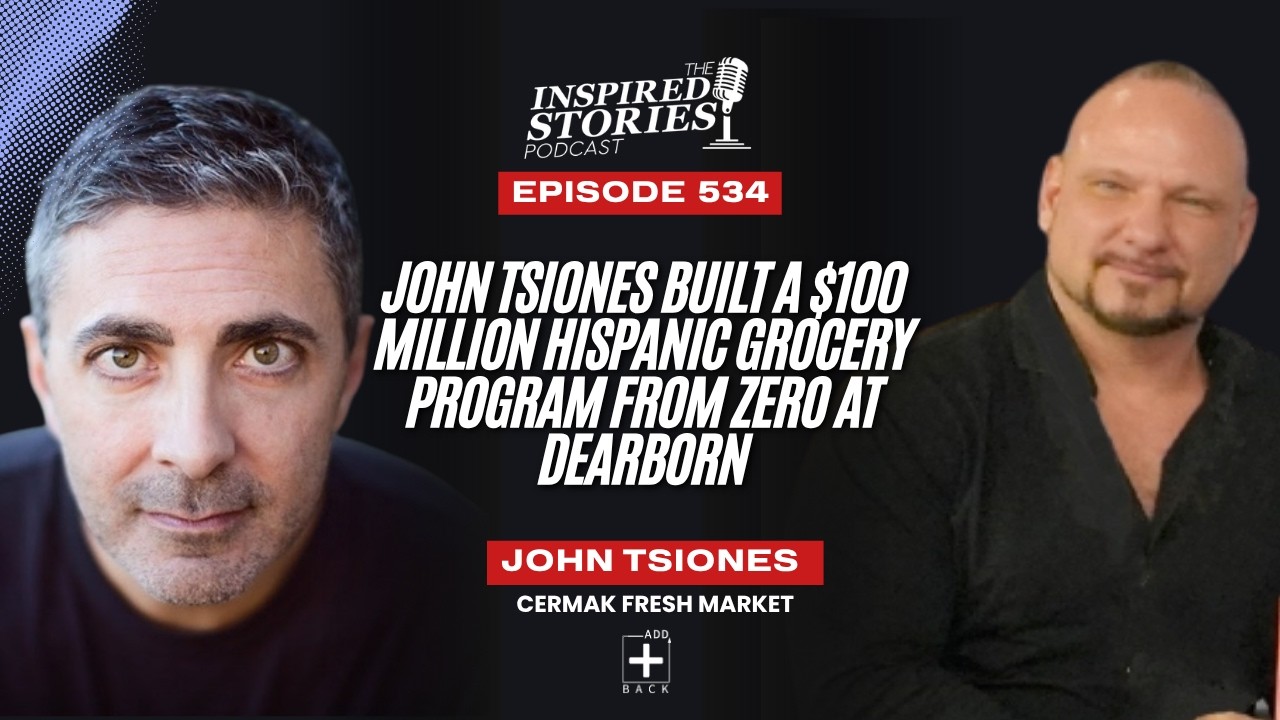
🎙️ From Getting Fired at 16 to Running Purchasing for the Midwest’s Leading Hispanic Supermarket Chain
John Tsiones, Director of Purchasing at Cermak Fresh Market, spent 30 years building one of the most specialized careers in Hispanic grocery — from growing a zero-dollar Hispanic program to nearly $100 million at Dearborn wholesale, to 11 years at Fiesta Market, to transforming a 15-store chain of independent-minded locations into a unified regional powerhouse with double-digit growth. His story is one of relentless curiosity, gut-driven buying, and a refusal to get comfortable.
✨ Key Insights You’ll Learn:
Built Hispanic grocery program from $0 to nearly $100M at Dearborn wholesale
11 years at Fiesta Market overseeing all grocery categories plus radio marketing
Joined Cermak with a written 3-month, 6-month, and 1-year presentation in hand
Centralized pricing across 15 stores previously operating as independents
TPR shelf talkers drove immediate, measurable sales lift at Cermak
Double-digit growth achieved in year one of his tenure
Vendor open-buy policy every Tuesday and Wednesday — anyone can walk in
DoorDash and UberEats agreements added to close distribution gaps
Party for Life nonprofit raised nearly $1M total for St. Jude, $100K+ per gala
Two personal losses — father at 17, mother after 10-year cancer battle — shaped his work-through-it ethos
🌟 John’s Key Mentors:
Costa (Owner, Fiesta Market): Taught that vendors have to win too — everyone makes money or nobody does
Adolfo Vega (Owner, Labo Dega): Modeled aggressive, eyes-open leadership and relentless anti-complacency
His Mother: Instilled the work ethic and toughness that carried him through every hardship
Maribel (Buyer, Cermak): Trusted partner who runs the open-buy program alongside him
Bob (Owner, Cermak): Gave him full authority to execute the vision and backed him through it
👉 Don’t miss this candid conversation about what it takes to build something category-defining, why being all in beats being cheapest every time, and how a 30-year career in Hispanic grocery is, in John’s words, just getting started.
Listen to the full episode here
Transcript
Anthony Codispoti (00:01)
Welcome to another edition of the Inspired Stories podcast, where leaders share their experiences so we can learn from their successes and be inspired by how they've overcome adversity. As you listen today, let one idea shape what you do next. My name is Anthony Cotaspodi, and today's guest spent years building expertise in Hispanic and international grocery.
before landing at a family-owned chain that started as a 2,500 square foot neighborhood market on a Chicago street corner. That tiny store has since grown into a 17 location regional powerhouse. And the man now running purchasing for the whole operation took a winding road to get there, moving through wholesale, independent markets, and more than a few hard lessons about what communities actually want on their shelves.
John Tienes is the director of purchasing at CIRMAC Fresh Market, the Midwest's leading Hispanic-focused supermarket chain with locations across Illinois and Wisconsin. He oversees sourcing and merchandising for a customer base that is roughly 75 % Hispanic. Now, outside of work, he co-founded Party for Life, a nonprofit that has raised over $100,000 for St. Jude Children's Research Hospital.
John T (01:17)
let me correct you. 100,000 hours each gala. We're we're almost a million dollars in total. yeah.
Anthony Codispoti (01:24)
That's fantastic. That's a worthy update. Thank you.
Now, before we get into all that good stuff today, our episode is brought to you by my company, Adback Benefits Agency. Because if you run a business, you are likely stuck in the cycle of rising insurance premiums. You're paying more, but your team is getting less and many people, can't afford coverage at all. We do things differently. We provide your grocery store employees with unlimited access to doctors, therapists and prescriptions. That's always free for them to use.
Here's the part that surprises most people. Unlike every other employee benefit out there, our program puts more money into your company's bank account. As an example, we recently helped a client increase their net profits by $900 per employee per year. Results vary, but gains like that can change how a business is valued and the consultation is free. See if you qualify today at addbackbenefits.com. All right, back to our guest today, the director of purchasing at Sir Mac Fresh Market, John, thanks for making the time to share your story today.
John T (02:25)
Thanks for having me, appreciate it.
Anthony Codispoti (02:27)
So John, before we get into CIRMAC and everything that you're building now, take me back to your first real job in the grocery world. What got you pulled into this industry?
John T (02:35)
Well, first job I got fired in three months, so wasn't...
Anthony Codispoti (02:40)
What did you
do there? Tell us that story.
John T (02:43)
stock boy in a grocery store and it was actually called store. So a very interesting name. Didn't kind of learn some lessons of I said to myself, I never want to get fired again and haven't been fired. I think I was kind of like destined to business. My, my grandpa owned his
Anthony Codispoti (03:08)
Hey,
sorry, real quick, John, I think you're changing back and forth between audio sources. Do you still have those headphones out?
John T (03:16)
Yeah, let me get rid of them. I mean, sorry about that.
Anthony Codispoti (03:20)
That's all right. You're about to throw on us lots of words of wisdom, and I want to make sure that everybody can pick up every syllable. right. Sounded good.
John T (03:29)
How's that? Is that better? Awesome.
So my grandpa has his own produce company. I had no intention of being in this business. I wanted to be a radio DJ, to be honest. But as fate would have it, here I am. But yeah, I got fired from that, went to school, just a couple years of school, and then just jumped back into it.
I worked for a company called Regency Wholesale. They were bought out by Dearborn and they service like C stores and they did like merchandising in stores. And from there, Dearborn bought us out. When I joined Dearborn, they didn't have a Hispanic program. I was going around the stores and saw, I guess I'm jumping into a little bit of everything here, but when
saw some stores and like we don't have these items that these customers are requesting. So went back, brought some items back and then we.
Anthony Codispoti (04:35)
And at that point, they already had a Hispanic focus to some degree.
John T (04:39)
The stores did not, we didn't.
So the stores were buying from Label Dega, Banner, some other local wholesalers. There was probably 20 wholesalers at the time. We just, we were a big American wholesaler. We just didn't have Hispanic products. So I was there for, like I said, 15 years, helped develop the program from zero dollars. We ended up being about a hundred million dollar operation in just Hispanic groceries. So.
Anthony Codispoti (05:05)
Wow.
And how did you even get started with that program?
John T (05:09)
It was
honestly, as I always, when my sayings is better be lucky than good, just started procuring items, know, found what works, seemed to work in the stores, kind of copy what the competition was doing a little bit. And then, you know, we had a lot of buying power. We, the company had been in business for 50 years, so they, they were well established. So they had the resources to bring in a lot of products and we tried a lot of things.
failed a lot of things, but at the end, we grew to nearly about a hundred million dollar portion of the business. Just Hispanic part.
Anthony Codispoti (05:47)
just in the Hispanic line of products.
John T (05:49)
I I think their last year before they went out of business, they were about almost 600 million. So it was not the biggest part of the business, but it was the only profitable part of business when I left the company.
Anthony Codispoti (06:03)
interesting. Why is that? Because it's higher margin?
John T (06:06)
Hire, well, no, because they also were selling cigarettes. And so cigarettes for the gas station, C stores, small grocery stores, and it's not very profitable. I mean, you're making 30 to 80 cents a carton on cigarettes and big risk because if someone doesn't pay you and you're only making X amount of profit, it just doesn't work. know, so,
Anthony Codispoti (06:31)
Gotcha.
John T (06:32)
so I had
kind of saw that that was the future of the company. And that's where, you know, where it was. And then I got bored. You know, I was, you know, so many years doing it and it just...
Anthony Codispoti (06:48)
Before we get to the part of you being bored though, John, I want
to better understand how you build out this product line. it mostly like you said, you guys tried things, some things work, some didn't, or were the stores themselves actually coming to you and saying, Hey, can you guys get this or can you get that? Were they giving you specific products they wanted?
John T (07:05)
Part two, yeah, so the customers are always gonna tell you what they want, right? So now I'm taking my sales hat, not the buying hat, but the sales hat says, hey, what do you need? What are some of the things that your customers need? So we started testing out things, saying, okay, now we need this line tostadas or this line of juices, this line of beans, or again, your customers are always gonna dictate.
what you need, right? So we kind of like, you know, it was trial and error and some people didn't want to sell to us. They were trying to sell us through the established players in the market. So it took some time to make believers some of the vendors, but we did. we became, I mean, people still talk about Dearborn and it's been what, 20 years since they've been out of business. So almost 20 years.
So yeah, it was a very interesting time. I'll tell you that. It was fun, really fun.
Anthony Codispoti (08:12)
Okay, so at some point you get bored and
John T (08:14)
Yeah
Anthony Codispoti (08:15)
that's the point where you decide you're moving on you go to Fiesta Market.
John T (08:18)
Correct. So Fiesta was my customer. He was one of our biggest customers. And he's like, John, can you help me find a buyer? so then I started looking at the stores and I'm like, well, I saw a big opportunity. thought they were missing out on a lot of merchandising opportunities, a lot of pricing opportunities. And so I said, well, I found them. It's me.
Anthony Codispoti (08:47)
You
went out and recruited yourself.
John T (08:48)
I regret myself. So
he created a position for me. They never had a buyer before. And I went on 11 years with them.
Anthony Codispoti (08:59)
And were you focused specifically on the Hispanic part of the business or were you doing broader groups?
John T (09:04)
So Noah, was
doing, well, specifically I was in charge of all categories, mean, grocery, dairy, deli, everything except for meat and produce. Also I was responsible for all the marketing. So I would, you know, radio negotiations for doing remotes and doing some radio campaigns and some, you know, we had rewards programs. So it was a lot of different things.
You know, so again, spend 11 years there, incredible boss, his name is Costa. He really taught me a lot about purchasing and, not so much about the strategies, but it was more like, you know, sometimes you got to let, the vendors win, right? Because if you don't let them win, they're not going to be in business tomorrow. Right. So it's not always give me price, price, price. Sometimes you, you gotta do a few favors because in the long run you want.
everybody has to make money, right? And that was, that was a saying like everybody has to make money. They make money, you make money, you're going to win some, they're going to win some. And so it really was, it was really fun, you know, and it was hard leaving him to be honest. Like he has a personal friend to this day, he's a personal friend. I still stay in contact. I still, we still, I give him ideas, you know, I feel like I'm still working there. So he's a great guy.
Got bored again. I got bored again. so yeah, we, it was 11 years we the idea was we were going to open more locations and we didn't. And so I just thought my skill set wasn't allowing me to grow. So then my, my big. Yeah.
Anthony Codispoti (10:54)
And this is something that's important to you. This is part
of, I think, the pattern we see with you getting bored is you've sort of figured it out. There's not a new challenge there, so you have to go seek it somewhere else.
John T (11:05)
Correct.
Correct. And it's nothing against anybody. But then Label Dega called and they were like my supplier. So that was a tough decision because now this is your supplier and they're taking your buyer. Right. So it was very difficult. We had a great relationship. The owner of that company, Adolfo Vega and this company, Fiesta Es Costa.
And, but we were able to work it out where I left in, I left in extremely good terms and went to LaboDega. And unfortunately, when I started LaboDega, was March, 2020, right? Yeah. Right at the beginning of the pandemic. So everything that I like to do. So as a, as a buyer, I'm a program buyer, right? I like to come up with, you know, ways of, you know, marking products and,
And I started in two weeks into the job, you know, we're shutting everything down. And so then it was just buy, buy, buy, buy, right? So you really, there was no thought process behind anything. It was not like, let me negotiate this. There's no negotiation. Just give me product, you know? And I mean, I never had the ability to stay home when a lot of people were staying home through pandemic. It was...
you know, this was, we're in a grocery business and we work. So I was going, I was going out to stores and you know, some people were freaking out. I really wasn't so nervous, but there were a lot of people that were a little uncomfortable going out to stores. And I was very comfortable with it. And, but we couldn't really grow business. couldn't like look for new, new customers. You couldn't really look for.
Anthony Codispoti (12:56)
You're just
trying to maintain at this point, right?
John T (12:58)
Correct,
correct. it was a hectic time in my career. But that kind of settled down. then we went from there to, well, I've been there three years and then Cermak called. So they had a buyer that decided to do his own business. And so I'm very friendly with the owners of Cermak.
Anthony Codispoti (13:26)
How did you know the owners from before?
John T (13:29)
just from being in the industry, from the Fiesta days to the level Dega days to even down to the Dearborn days, because they were my customer. So, Bob, who was the owner called me. He's like, Hey, I want to talk to you. And I knew what he wanted to talk to you about. And, it was literally a day that I heard within two days of hearing the news. he said, Hey, can you get together? And then,
I said, took you so long?
Anthony Codispoti (14:01)
so this is something you've kind of been thinking about already on your own.
John T (14:04)
not exactly thinking about, but I knew that I was the perfect fit for the company in my mind. You know, maybe other people have other ideas. but no, it was, it was a perfect fit. I told them, I didn't want to be just a buyer. want to, I want to enact some changes based on things I knew about the company. Cause I obviously I knew the company very well and I knew the stores very well. but I said, I wanted to, to change the mindset. I want to change.
you know, cause they were 17, they weren't 17 stores at time. They were 15 stores, but there were 15 stores that were working like 15 independent stores, not a chain of 15 stores. Right. So.
Anthony Codispoti (14:45)
Okay, so what were some of the changes you wanted to bring in?
John T (14:47)
Well, the changes were that I wanted to make sure that we use our buying power, right? The stores were making all the decisions. So each individual store were making their own decisions. They were making their own pricing. And I'm like, no, no, no, no, no, we have to change that. So I didn't even want to accept the position unless they were gonna, you know, give me the authority to do the things I wanna do. My second job, you know, I did two interviews. One was will you come? And...
The second one is I said, well, we had to talk about the financial part of it. and that was not a problem. In fact, I just took whatever I was making. I thought with the day guy didn't care about the money. I, wanted this challenge so bad. Even though I really liked what I was doing, Labradaga. So it was like, it was very, it was a tough, tough decision in a way because I want to go back a little bit and talk about Adolfo Vega. He was, he's taught me a lot in this business. And what I mean by a lot is it's
the way he goes about business, he's not afraid to, I mean, he'll take a risk of anything. The only thing that he does, he doesn't have a lot of patience, you that's the only, the one thing he wants results right away. And then one of his, we know one of the saying is, is opening your F and I's, you know, and he doesn't mean like in a derogatory way, some people would take it that way, but he means it in a way that look around, see what's going on, see, see what's around you and understand the business, you know, and
So he taught me, like, listen, be aggressive. Don't be afraid to take chances. so Adolfo taught me so much. And it was like a really hard decision to leave him because no one's worked well with him, to be honest. He had
Anthony Codispoti (16:31)
you
John T (16:33)
gone through so many people, but he told me he's like, they're lazy people, that's why. And so he would call me seven in the morning, hey, where you at?
He didn't care where I was at. He just wanted to make sure I was working. So then I started calling. We did.
Anthony Codispoti (16:50)
So, so you guys meshed pretty well. Not everybody
meshed with him and he was a mentor to you in a lot of ways. You learned a lot.
John T (16:55)
Demisa mentor, right? Cause don't
forget, I mean, he was my supplier. So I spent a lot of time with him before I worked for him. And so I really liked his, his way. And he's a lot different to work for than to be his friend, you know, we're back to being friends again. And so we, you know, obviously we still talk and he's, he's really one of the, the Godfathers of his business, you know, as far as Hispanic grocery business. So distribution.
Nobody does it like him. I mean, he's amazing, honestly.
Anthony Codispoti (17:29)
And so when Bob came to you and said, hey, we want you over here at CIRMAC.
John T (17:31)
Yep. Yep.
Anthony Codispoti (17:35)
And you said, okay, I'm interested in this, this is a big challenge, but
John T (17:39)
Mm-hmm.
Anthony Codispoti (17:39)
there's certain things that have to change. And
John T (17:41)
Mm-hmm.
Anthony Codispoti (17:42)
the big one that you mentioned to me was the purchasing has to be centralized now and the pricing has to be centralized now. I'm
John T (17:46)
Mm-hmm. Yep. Mm-hmm.
Anthony Codispoti (17:49)
curious how a group got to the size that they were by not centralizing those things.
Did they have like separate owners or they just give a lot of autonomy to the individual general managers or?
John T (18:02)
So they give autonomy and also there is a six store, yeah, six stores owned by the founder's son, Mike, Mike Busce. And he's a great guy too, by the way. And yeah, again, they had different philosophies, but they've always, they kind of ran it like an independent. They just grew so fast. I shouldn't say they grew fast, but they grew in such a way that why change is working, right?
And it worked for him. But, you know, I thought, well, well, there's
Anthony Codispoti (18:37)
There's a better way.
John T (18:38)
a different way. I say different way, maybe the way is better. Maybe it doesn't work, you know, but at the end, second interview with Bob, I gave him a three month goal, six months and a one year. So I gave him a presentation basically in my job interview. And I'm like, this is what we need to do. This is where I think we will go. And this is what will happen.
And then I did a little time capsule like a year afterwards and I'm like, hey Bob, we did everything. So these were all my goals. And with the exception of one or two little minor things that didn't happen, we achieved them all within the first year here. So.
Anthony Codispoti (19:14)
What were some of those other big accomplishments that you laid out that you were able to check off the list?
John T (19:18)
Well, we want to break down all the categories for the items. wanted to make sure that the pricing was centralized, that we had all the stores on the same page. We want to fix a flyer. We want to make sure that we fix all the, again, the vendors that were unnecessary in the store. So there was a lot of overlap. So we had vendors that would go in on Sunday to place orders and they were much higher priced than our preferred vendor.
I also renegotiate all the pricing with unfortunate LaboDega because I worked there so I knew all the strategy. So, and Banner and we kind of worked through some of that. Sign to supply, Grim with Unify. We just did a lot of things very quickly within that first year. And then we start seeing the results of taking over the pricing. So we centralized all the pricing in the office.
And then we got TPRs, we never had TPRs in the store. TPR
Anthony Codispoti (20:24)
What's a TPR?
John T (20:25)
temporary price reduction. So vendors will offer you say a discount if you wanna lower your price. And what they would typically do in the organization is they would just change the shelf price. So the customer didn't realize they were getting a deal, right? So I implemented or had us implement, we decided as a team to put like those little
red and yellow stickers that you see, shelf talkers basically. And what.
Anthony Codispoti (20:55)
to
draw somebody's attention into, this is a lower price.
John T (20:57)
Correct,
correct. And then we saw it. mean, it was so immediate that it was like the numbers just are growing, growing, growing. And it's all price perception, right? The customer, if they believe it's a deal, it's a deal, right? And we're not misleading anybody. just saying that there's always, I always preach price perception in the store. And so you want to be priced right on the right items, right? And some items you necessarily, the customers don't
care so much for. So it's not as important, but the staple items that they are important to the customers, you got to be priced right. So I've always made sure that I'm checking the price, make sure we're right, make sure we're in the game on everything. And I think it's been very effective. And we also have the warehouse, and we have 150,000 square foot warehouse. We have to make sure we have the right items in the warehouse. And then we
trial and error, know, this item works, this one doesn't. Okay, don't fall in love with it. You know, sometimes as a buyer, you fall in love with items because you bought it, right? And that's been my weakness in the past. And I, I've overcome that. I'm like, you know what? Just because I brought it doesn't mean that, you know, you can't force it to work, right? So sometimes you just gotta, you gotta cut your losses.
Anthony Codispoti (22:17)
So John, are there any metrics that you can recall from that first year
John T (22:21)
Mm-hmm.
Anthony Codispoti (22:21)
that were good indicators that your strategies were working?
John T (22:26)
Well, the numbers, the numbers showed, you know, so we, you
Anthony Codispoti (22:29)
What can you tell us about the numbers?
John T (22:31)
know, again, I don't usually talk like dollars, but we'll say we had double digit growth, you know,
Anthony Codispoti (22:38)
Wow.
John T (22:38)
and so we, it was great. It was great. And.
Anthony Codispoti (22:41)
Double digit growth in the grocery space is huge.
John T (22:43)
Yeah,
yeah. And I think we got better and some of our competition got worse at the same time. And I'm not gonna name names, but you know, some people got worse at what they did. as I told Bob, I said, it's just because they're doing worse doesn't mean that's why we're doing better. We're doing better because we're doing better, right? We would have done better, but we just did a little, a little better, a lot better because someone wasn't doing a good job, you know?
Anthony Codispoti (23:11)
So when you started there, John, you had this 12 month plan with
John T (23:12)
Hey, hey,
Anthony Codispoti (23:14)
these quarterly benchmarks of sort of check in points. You met most of those goals, aside
John T (23:21)
Okay.
Anthony Codispoti (23:21)
from a couple of small things. In the time since then, more recently, what are some other advancements that you've been able to introduce?
John T (23:29)
Well, now we revamped the website. So I found a marketing company and they did an amazing job. They've revamped the website. They're taking over our social media. It's been one of our weaknesses. I signed a contract with DoorDash. We signed some agreements with UberEats. So we're recognizing that there are some missing opportunities that we never really thought about. We have to do better at some other areas.
Um, and we, will be in and that's thing is like, I'm constantly every year I'm, I'm saying new goals, right. And, and like I said, we're talking about Adolfo back that don't get complacent, you know, he's like, don't, don't accept, know, you're doing good. Don't accept it. You know, when I, when I joined Labo de Vega, we, the first year we went up 20%, right? Second year went up 18%. But he's like, don't, don't get comfortable. So he would never tell me I'm doing a good job, but he would tell everybody else.
that I'm doing a good job. the end would get back to me.
Anthony Codispoti (24:31)
He told you indirectly, huh?
John T (24:32)
Indirectly,
but he didn't want me to know.
Anthony Codispoti (24:35)
So
as I'm hearing about all these things that you've got your fingers in it, Matt, you're doing a lot more than purchasing. Like director
John T (24:41)
Yes.
Anthony Codispoti (24:42)
of purchasing doesn't seem like the right title.
John T (24:44)
No, no, I mean, we'll have to discuss one day a different title, but right now it's fine. But, you know, I'm in marketing as well. I'm in procurement, obviously, merchandising. It's a whole array of things. And again, I report directly to the ownership. So, and they've been so supportive. I mean, at the end, if it doesn't work, they're going to tell me. And there's been decide, you know,
Difficult discussions like, I don't agree with that, John, but I'm gonna support you. But I think the good thing I did, one of the best things I did when I joined the company is I got the store manager to get her once a month. We do a monthly meeting, right? So once a month we meet in the corporate office, all the store managers come, I tell them these are our points of interest, these are things that we're working on, these are things that.
we're doing and then I do a round table, kind of learned from being in sales is I remember in sales meetings we would go around the table, say, hey, anybody have any questions, anybody having concerns? So I kind of implement that into what we're doing now. And it's worked really well because people look forward to meetings. Some people are quiet, but now they start talking more. So, and then sometimes they bring vendors in meetings. So the whole point is better communication, right? So.
And if you're not communicating with your stores, with your personnel, with your team, it's never gonna work, right? So you have to have really good communication skills. And sometimes it's not great for me because there's a language barrier. I'm not fluent in Spanish and a lot of them aren't fluent in English. are managers. sometimes that can be a challenge, but it works. I find a way to communicate. So I just keep talking and then they eventually listen.
Anthony Codispoti (26:40)
Maybe they just want you to stop talking. So they just nod their head. So
John T (26:42)
Kind of yeah. Kind of yeah, so.
Anthony Codispoti (26:45)
for someone who's never been inside a CIRMAC Fresh Market, paint the picture. What's the customer experience like?
John T (26:51)
I mean, it's an incredible, honestly, not because I work here. It's an incredible experience. I mean, the stores are immaculate. The produce is, first of all, stacked to ceiling, fresh meat. Meat is the good quality meat is as good as you're going to find. And, you know, I'm not saying we're having prime meat, but we have, I bring, I bring the meat home. I bring the produce home. So again, and I'm a very picky shopper. I shop at Whole Foods too.
So, and someone once called us that. They called us the Whole Foods of Hispanic Market. So the stores are super not, super clean, super organized. And I think when people walk in, they're like, wow, this is nice, but it's not overwhelmingly nice. It's not where when you walk in, you don't feel comfortable, right? So it's a very, we have great customer service, know, customers ask for something, we find it, you know, and if we don't have it, we'll get it, you know? So.
And I think one of the things that we're going to talk about at some point is, when you walk in the store, what do you see? mean, we're all in on Hispanic, right? So if you want to buy something Hispanic, we have it, right? If you're Mexican, pretty much anything you need for a meal, you're going to have here, right? So I always believe if you're going to be in, be all in. Don't be half in, half out, right? So we have everything you need if you're Mexican. We have everything you need if you're South American. If you're Central American, we...
we have it all because you know what I call is kind of the category killer in Hispanic, right? So we, people, they come to our stores to see what we have so they can bring it to their stores. I know that my friends are my competitors because I was in wholesale. So these are all my friends. So they'll text me sometimes. I have good relationship with my competitors by the way. And they'll say, hey, where'd you get this from? And I'll tell them, I don't care. I'm like, here, I got it from this place or that place.
It's okay. Again, when people shop our stores, they're very happy with what we're fair priced and we have everything you need. Are we the cheapest? I mean, if you're cheapest, that means you're doing something wrong. That means that you're trying to like chase customers, right? And I see that when I look at some of the flyers in my competition is that they...
they focus on the price, they don't focus on the customer experience. And
Anthony Codispoti (29:15)
Yeah.
John T (29:15)
it's not just an experience, it's more of, know, do they have what I want? You know, sometimes people put something in the fire and they don't have it. So, you know, we're very big on in stock position. We wanna make sure that we always have what the customer needs.
Anthony Codispoti (29:32)
So is most of the competition from other regional groups like yourself or any of the big national change trying to get into this space?
John T (29:41)
You know, it's more regional to be honest, but there are, obviously you have to keep an eye on the big guys, right? And so, you know, I'll bring up Walmart. I have no problem bringing them up. I mean, if you try to out Walmart, Walmart, you're out, you're done. You can't try to do that. What you wanna do though, you don't wanna be embarrassing, right? So you don't want that price spread between what they have and what you have.
to be so great that you really look silly. So I do watch them. I don't focus on them. I don't focus on my competition to be honest. I kind of focus on what we do, right? And we make sure we do everything really well. And then, you know, if you, from time to time, you're gonna check out what the competition is doing, but at the end, you have to really focus on your core business and how are you gonna grow your business and how you, what are you doing right? What are you doing wrong? You know, and.
And that's really what we focus on.
Anthony Codispoti (30:41)
So I think if I got my notes right here, and the time that you've been with Stramac, you guys have added two new locations, is that right?
John T (30:49)
We've had two new locations, yep. And we have one opening in May and then we're gonna have another one I think end of next year, early here after.
Anthony Codispoti (30:58)
And these are all in Chicago. Yep.
John T (31:01)
Shuttle area, yep, yep.
Anthony Codispoti (31:04)
Okay. And there's, do you guys, you know, have sort of long-term growth plans to go even further?
John T (31:10)
I think we had, well, I know we have long-term growth plans, first of all. I wouldn't be here if it wasn't, if there weren't and I'll get bored otherwise. So, no, we have great,
Anthony Codispoti (31:19)
And they don't want you to leave now.
John T (31:22)
we have, obviously I'm a lifer, I think. I feel like I'm a lifer here. So, I mean, this is a, such a great company to work for, great people, great employees. Everything's awesome. Be honest, I never been happier and I've been happy other jobs, but I've never been happier here. mean, but
To your point, are we growing? Yes. I think if you know somebody that looks like that, let me know. Because we are interested in anything growing.
Anthony Codispoti (31:48)
Is that
typically how the growth happens? You take over an existing location.
John T (31:51)
No, we
haven't done that really, but I think that's the way you're to get to the next level, right? mean, to open the stores that we open, they're very nice, you know, but sometimes it's nice to take over something and then build even, make it even better, right? So we're actively searching. It's something I mean, I was out and I won't say where, but I was in
in a different area than Chicago. I called the boss, I'm like, hey, I see a spot here. we're active research team. Yeah, we're the active research team.
Anthony Codispoti (32:30)
Potentially, yeah.
And so what kind of special challenges do you run into when opening up a brand new location from a purchasing and merchandising standpoint?
John T (32:40)
Well, it's challenging in a way, in our old ways that we used to do business is, know, we open the store and everybody just does a lot of grunt works, throws everything up on the shelf, and then they change their mind and then they move it here, they move it there. So what we did when we opened the first store, since I, when I joined, is we took a blueprint and then we started.
putting, okay, this needs to go here, this needs to go there. And then we start moving it, and then we move it, and we move it until we get it right. And then once we're ready to merchandise the store, boom, we're ready to roll. So you have to be very, very meticulous in the way you organize things before you're ready to really go balls out on the store. you have to understand the demographics of your store, right? You know that before you open the store, but you have to understand
specific demographics of the store. So you have the right items for the right customers. And then, and you have to be willing to make those changes, right? So what I mean by that is you open a store and then a few months into it, like, okay, you we thought it was going to be this way, but it's a different way, right? So now you have to make some changes and you can't be, you know, wait, you can't wait, right? So sometimes you have to like, you have to roll with it. And then sometimes you have to be patient. you have to, every situation is a little different.
but you have to be nimble, right? And be able to make those changes quickly.
Anthony Codispoti (34:10)
Let's shift gears a bit, John. I want to talk about another part of your life outside of the grocery business. We've mentioned this in the intro. You co-founded Party for Life. What is that?
John T (34:19)
Yep.
Party for Life is a nonprofit that 100 % of the proceeds go to, well, St. Jude Children's Hospital. So that's who we've chosen to be our charity that we will work with. And started out, I'll tell you a little backstory. I used to own GNC stores. It was a side hustle.
and they had fundraiser for St. Jude. You give a dollar at the register and you just ask for that. And then they had this contest. can you, what store out of 5,000 stores could win? I'm a goal-oriented guy. So let's see, how can we raise more money? So first we started giving discounts to customers. And then I was taking that discount and giving it St. Jude. And then we started.
doing very well and we were top in the company. And then I'm like, well, why don't we do galas? So I have a lot of friends, especially from the grocery business that are very charitable. Why not do a, we do a little party. That's how it started, it's called Party for Life. So we started doing parties and first party was like 40 people. We raised like, I don't know, $5,000. And then they just become.
It came bigger and bigger and bigger. And the last gala we had 300 people. We raised over 100,000. Each gala raises about 100,000. This next one, I believe, will raise about 150. It's growing more and more. And I even said to somebody, I go, if I want to stop, can't. Because people are going get mad at me if I stop doing it. Yeah,
Anthony Codispoti (36:07)
It's got its own momentum, huh?
John T (36:08)
for sure.
You know, it's a whole team. It's, you know, again, I'm, just a guy that's asked everybody and muscles, everybody for the money. So it's, it's, it's really, uh, the, people behind the scenes are the ones that are doing all the hard work. And, uh, but yeah, it's, it's been amazing. It's, it's, it's become really an industry event. So I even have, again, I have competitors who are friends and they support because the charity is, it's an incredible charity, right? I mean, who wouldn't want to help.
of kids, you know, so.
Anthony Codispoti (36:42)
So where can folks go to learn more about this?
John T (36:45)
The Chicago party for life.com is the website and you can Google it. You can see the photos from different events that we've done over the years. I think it's the 12th or 13th year we've done it. but yeah, it's tremendous. And I still haven't gone to Memphis to the hospital, but I've been invited. So I just have to make the time to do that.
But I will, I will. This year, it's my bucket list, so I have to do it.
Anthony Codispoti (37:16)
stuff. John, personally speaking, what's the hardest thing you've ever had to overcome?
John T (37:21)
Well, you know, my dad passed away when I was 17. And so I didn't really have a chance to, it was not traditional situation. So I couldn't go to four years of college. know, I was two years of college and boom, I'm right off working. So although my tenacity gets me where I'm at, the...
The was I didn't have the four year degree that a lot of people had, right? And I didn't have the educational background that maybe my star went higher faster, right? And not saying I'm a star, but I'm just saying, again, it just took me longer, right? But once I got my reputation where it was, it was great. But that was a huge challenge for me. And I think mental health wise,
that those months or the month that my father passed, still wanes on me. So I do kind of, I will say I kind of go into a little bit of a shell, but you know what life goes on, right? And you have to kind of figure a way around it. but yeah, I would say that was the biggest challenge. That was challenging the family. And it, know, I had my mom, she had, you know, she had cancer for 10 years, just recently passed away. And that was a challenge because
At one point, you know, she needed care 24 seven. So me and my two brothers were always at the house for almost two years straight. So that was, you know, that was a personal challenge. And I really didn't tell anybody at work what was going on. And so I would just went about my business, right? So after work, boom, go to my mom, stay there till 10 o'clock at night, come home, come to work, boom, boom, boom, you know, seven days a week. So those were, I would say two personal challenges.
that definitely affected me, you know what, life goes on and you have to keep pushing.
Anthony Codispoti (39:25)
Are you comfortable saying more about these situations? I'm curious with your mother, why was that you kept her situation to yourself? Why, why didn't you talk to folks about?
John T (39:36)
You know, it's a good question. don't know. I, some people, they look for sympathy in life, right? And some people, they tell you stories just so you can, you know, give them, give them attention. Wasn't looking for that. You know, if someone talked about it, a few people knew, but if someone asked me about it, I would talk about it, but it wasn't something I was, I was dwelling on. And, and it really, it's not good to dwell on those kinds of things. Cause then it's always me and
at the end, you have to live your life too. So, but yeah, it's sometimes you have to hold those things back, you know.
Anthony Codispoti (40:14)
Where do think that mindset came from? Was it something that you developed when you were really young and your father passed?
John T (40:19)
Probably, I really hadn't thought about that way, but my mom was a really tough person, right? And she probably instilled a lot of the work ethic that I have. And so I think maybe from her, it's hard to say really, I don't know, I couldn't answer that question.
Anthony Codispoti (40:39)
You know, I'm curious, because when you talked about the path of you said, you know, hey, because of the life circumstances, I couldn't go to college, you know, get that four-year degree, and maybe that would have propelled me faster.
John T (40:50)
Mm-hmm.
Anthony Codispoti (40:50)
I wonder, though, if maybe that put a sense of grit and determination in you that wouldn't have been there otherwise. And maybe you're further along because of the hardship that you overcame.
John T (41:03)
Maybe, maybe I've been
way worse, knows? Maybe I've been partying and funktying at school and who knows? Yeah.
Anthony Codispoti (41:10)
This cut me up, I don't know. I don't know what
your life trajectory was like, but maybe this sort of forced you to grow up real fast.
John T (41:17)
You too, yeah.
Anthony Codispoti (41:18)
there a possibility of that being true? Yeah. Okay.
John T (41:20)
It's possibility. Yeah, I like parties. So.
Anthony Codispoti (41:24)
Even still. All right.
John T (41:25)
Why not?
Anthony Codispoti (41:27)
Yeah, I like it. So as you think about the role that you have now, John,
John T (41:31)
Mm-hmm.
Anthony Codispoti (41:33)
what do you want to most be remembered for in your work?
John T (41:35)
So I always say this is funny you ask that question, is I always want to create a legacy in this business, right? And what are you gonna be remembered for, right? So I would say, I call therapy Tuesdays. So I have open bias Tuesdays and Wednesdays in my office. I'm probably one of the few people that do that. And so people come in here, they tell me their whole life story, right? They tell me all the problems and then we do about five minutes of business. So.
but it builds relationships, right? And so I wanna build, I really personally wanna build a legacy in this business of being remembered as, know, that white guy that really knows a lot about Hispanic grocery. And I think I have that, but I still wanna keep learning. And to me, this journey is just starting, even though it's a 30 year journey, it's just starting. I mean, I'm learning more and more every day.
The things I knew before, long forgotten because things change, right? And if you stay in the same mindset, you're never gonna succeed. So you have to continue to change with the times. And we have, and I have, you know? So yeah, I do wanna create a legacy. I want people to remember me like they remember Adolfo from Labo Dega, you know, those guys.
Anthony Codispoti (42:55)
That open door policy you have that extends to who in the company.
John T (43:00)
So anybody, and I'm talking about vendors, it's a vendor open buy. So
Anthony Codispoti (43:04)
Okay, got it.
John T (43:05)
that's extended to anybody who wants to sell product, you can come in, try to sell me, you know, and I love it. So I hired a buyer two years ago, three years ago now, Maribel, and she requests appointments. And she's like, I know you like the open buy, go, yeah, I love it. And so I love when people, it's a new vendor or a local vendor or someone who's just getting started out.
And those, be honest, they have a lot easier chance with me than someone who's well established and trying to sell you something that they know you don't need. So yeah, we love the local vendors. We love the little companies, especially women-owned businesses. I don't know, I just have a soft spot for that. And they usually, I shouldn't be saying this on here because now they're gonna hear, no, my weakness is, but at the end,
I love the small businesses.
Anthony Codispoti (44:01)
Yeah. So you guys love to grow. You love to try new things. You love new challenges. Is AI fitting into your workflow at all these days?
John T (44:11)
So I tried AI for invoicing. There was a, I forgot the company's name. It didn't work out, but I do think there is a potential future for it. It's not there yet. don't think from what I've seen, I haven't seen anything that's really shown me that it's ready for us, right? Because I make a lot of decisions right here, right? The gut. it...
God gave you a gut for a reason, right? And you have to be able to use it. So you have to take data, because I'm big on data, but you got to take the data and you got to apply it to what is real, right? So AI doesn't have that. mean, you have to really, it's going to take some time. I guess my whole point is it's going to take a lot of time, but I think it will hit us when it hits us. It's going hit our industry pretty fast.
Anthony Codispoti (45:06)
So from what you've seen, not ready for the type of work that you're doing right now. Yep.
John T (45:10)
No, no, I mean,
I don't see it. It might be able to help us in rebuying that kind of thing, but that's about it as far as purchasing. I do think that it will hit us though. I do think that there's some great, I have some ideas for it. We just have to apply it to an AI platform.
Anthony Codispoti (45:34)
What's your favorite thing to do outside of work,
John T (45:37)
good question. I work out six days a week. So that's kind of my, my release before I come in here. So every morning I hit the gym around six o'clock. So that's, that's probably my, you know, like sports. I am probably a dog hoarder because I keep adopting dogs in abundance. I have four dogs at home. so yeah, between that and that's, those are my, that's my outside of work. mean,
I love animals. I love animals. Love kids and love old people. Everybody else. I don't like anybody else.
Anthony Codispoti (46:11)
Ha ha ha ha ha ha ha ha ha ha
Right. Well, John, I've just got one more question for you today. But before I ask, I want to do three quick things for the audience. First of all, anybody who wants to learn more about what they're doing there, Sir Mac Fresh Market dot com, C E R A K Fresh Market dot com. And we'll have that link in the show notes if you missed it. And if you're enjoying the show today, please take a moment to subscribe wherever you're listening. It also sends a signal that helps others discover our podcast. So thanks for taking a quick moment to do that right now.
And as a reminder, you can get your grocery store employees access to therapists, doctors, and prescription meds that counter-intuitively actually increases your company's net profits. Real gains that can change how businesses value. Contact us today at addbackbenefits.com. So last question for you, John, a year from now, what is one very specific thing that you hope to be celebrating?
John T (47:07)
Hmm, to celebrating, huh? I don't, you know what? I don't live in those kinds of moments where I, I mean, really, I just want to be, I want everybody to be happy that I know I want. I do like helping people and I want, I just want everybody happy to be honest. And that that's just.
off the record and it's on the record now. But I want people happy. I don't have a specific one year goal. I think just as professionally, just want the company to keep growing, to keep getting better, strategically to be where we are. Personally, just, my life is what I do here, right? I mean, it's a big part of who I am.
But there's more to it than that. mean, but again, I just, if we can raise money for kids, be good to animals. That's all I care about. and yeah, some old people.
Anthony Codispoti (48:11)
And be nice to old people and women.
All right, well, John Deon is from Sir Mac Brush Market. I want to be the first to thank you for sharing both your time and your story with us today. I really appreciate you being here.
John T (48:24)
Well,
thanks for having me. I appreciate it.
Anthony Codispoti (48:27)
Folks, that's a wrap on another episode of the Inspired Stories podcast. Thanks for learning with us. And if one thing stood out, put that into action today.
Connect with John Tsiones:
Website: cermakfreshmarket.com
Party for Life: chicagopartyforlife.com