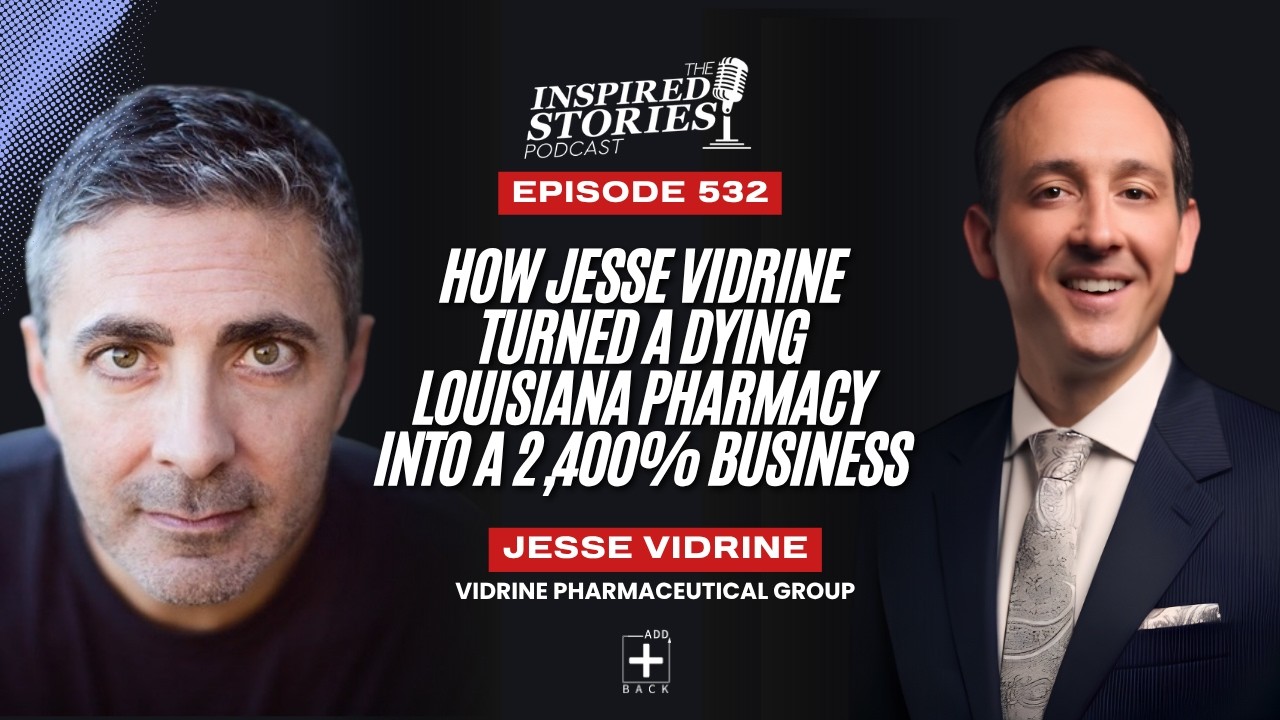
🎤 From 401k to 2,400% Growth: Jesse Vidrine’s Compounding Pharmacy Bet
Jesse Vidrine, President of Vidrine Pharmaceutical Group, cashed out his 401k, put up his father’s farmland as collateral, and bought a failing 99-year-old Louisiana pharmacy two months before COVID. What followed was 2,400% growth, the launch of a telehealth hormone therapy company, and the construction of a transparent pharmacy benefits management firm — all built on the premise that patients deserve better access to personalized medicine than Big Pharma is willing to give them.
✨ Key Insights You’ll Learn:
Financing a $1.6M acquisition with 401k savings and family farm collateral
How construction site scaling experience translated directly to pharmacy growth
Why retail pharmacy margins are designed to fail independent operators
503A compounding pharmacy rules, safety standards, and FDA legal framework
GLP-1 shortage as the catalyst that forced doctors to learn about compounding
Patients leaving their doctors for providers who would prescribe compounded medications
BHRT and why women in menopause have been systematically underserved for 35 years
IRVUE Telehealth’s saliva-testing and personalized hormone therapy model
PBM structure and how $462 billion flows through a system most employers don’t understand
TrustScripts as a transparent, pass-through pharmacy benefit alternative for self-funded employers
🌟 Jesse’s Key Mentors:
His parents: put up their farm as collateral without blinking, grounding Jesse’s confidence in the leap
His wife Kylie: lead pharmacist and clinical backbone who held the pharmacy together during COVID
Robert and Jerry Boudreaux: second-generation owners whose compounding legacy became the foundation Jesse didn’t know he was buying
Lake Charles industrial project leaders: modeled large-scale rapid scaling across multi-billion dollar construction sites
👉 Don’t miss this conversation about what compounding pharmacies actually do, why the GLP-1 shortage changed American healthcare faster than any policy ever could, and how one couple in Louisiana is building a vertically integrated functional medicine company from the ground up.
Listen to the full episode here
Transcript
Anthony Codispoti (00:00)
Welcome to another edition of the Inspired Stories Podcast, where leaders share their experiences so we can learn from their successes and be inspired by how they've overcome adversity. As you listen today, let one idea shape what you do next. My name is Anthony Cotus Bodhi, and today's guest spent nearly a decade working industrial job sites as a safety professional.
Before acquiring a pharmacy that had been serving his Louisiana community since 1923. That pivot from hard hats to white coats didn't happen overnight. He built experience across mortgage banking, industrial safety, and pharmacy benefits consulting, each chapter seemingly unrelated until they weren't. His name is Jesse Vadrine, and he is the president and owner of Vadrine Pharmaceutical Group, the parent company of Boudreaux's new drugstore.
A NABP inspected compounding pharmacy in Lake Charles, Louisiana, and also RVU Telehealth, a virtual care service he launched to bring clinical access to patients who can't easily get to a clinic. He also leads Trust Scripts, a pharmacy benefits consulting firm that delivers transparent, pass-through pricing for self-funded employers. His story is a reminder that the most unconventional paths.
Sometimes produce the most grounded leaders. But before we get into all that good stuff, today's episode is brought to you by my company, Ad Back Benefits Agency. And you'll want to hear this because it's hurting almost every business owner you know. Health insurance costs go up every single year, and retailers are furious about it. They're paying more, claims are getting denied, employees are opting out because they can't afford it, and it hurts turnover and morale.
It's one of the most maddening problems in running a business, and everyone just accepts it. But you don't have to anymore. Now there's a program that gives employees unlimited access to doctors, therapists, and prescriptions with no co-pays or deductibles to meet. And you don't change your broker. But here's the part that really shocks most people. Our product actually increases your net profits. We recently helped a client add $900 per employee per year to the bottom line.
Results vary, but gains like that change how a business is valued. Get your free consultation today at adbackbenefits.com. All right, back to our guest today, president of VPG, Jesse Vadrine. Thanks for making the time to share your story today.
Jesse Vidrine (02:33)
Anthony, thanks so much. pleasure.
Anthony Codispoti (02:37)
So, Jesse, you grew up in Lake Charles. You went to McNeese State University, where you studied finance, moved into mortgage banking right out of school, and spent several years in that kind of a role. Tell us about an experience there where you learned a powerful lesson, maybe from something good that happened, maybe from a tough challenge, and what it taught you that you continue to carry with you today.
Jesse Vidrine (03:01)
Anthony, it's funny. I worked for banks when I was in college and then I actually left in that kind of 2005, 2007 era and was doing mortgage banking for a private company. And then I went back to the banks after I graduated. And so I'll never forget it. I was working for a local bank. The vice president and I weren't seeing eye to eye. And I remember that
I got a text message that said, we need to talk. And this had been going on for months. And I said, no, we don't. Actually, it's funny enough. No, we don't need to talk. And I left. I left that day. And I remember walking out of that office. I was dating my now wife at the time. And I walked out and I said, I'll have a job in 30 minutes. And that 30 minutes turned into about eight months.
what it was was it made you self-reflect. It made you see what the industry was doing because at that time, know, look, if sometimes you have a tendency to kind of just put your head down and do your day to day and not really be dialed into what the whole industry is doing and understanding your internal, your, you know, your, your local or regional market. And so I think that was probably one of the biggest lessons that I learned, which is
you need to understand what's going on, not only in your industry, but in your regional market, right? Because I didn't, I was just a mortgage banker. I was a nobody, right? And the reason being, I was so focused on getting the next loan done that I wasn't picking my head up and looking around and learning. And I think that's one of the biggest lessons that I learned was, is that you really have to learn and pour yourself into whatever you're doing to be able to see the market as a whole.
Anthony Codispoti (04:57)
And remind me the timeline that you left. What year was that?
Jesse Vidrine (05:02)
I've had a really busy five years, so please forgive me if I get this date wrong. I think it was somewhere in that 2010 kind of area, that 2010 mark.
Anthony Codispoti (05:11)
Okay. So
it was after the big collapse. The the big financial crisis.
Jesse Vidrine (05:14)
Yes, I had
actually left the independent and went to the bank right before that. And so I was at the bank during that collapse, our market, it was impacted, but our bank wasn't. So it didn't have as big of
Anthony Codispoti (05:37)
Gotcha.
Jesse Vidrine (05:37)
an impact as it did on, say, maybe Wall Street.
Anthony Codispoti (05:41)
Okay. And I think we'll get into the tie-in in a bit about why it's so important for you to have that big picture view when we start talking about what you're doing now. But I want to just track a little bit of the path because from mortgages, you didn't go, you know, right into the pharmacy space. You were doing you know, industrial safety, you were working on major petrochemical sites in Louisiana. How did that change happen? Tell us about that work that you were doing there.
Jesse Vidrine (06:07)
Yeah,
you know, it's interesting, know, when you're newly married, right, and you got a baby on the way, as a leader of the household, you're going to do what you have to do. And so sometimes what that does is you find yourself in foreign places, places that you never envisioned yourself to be. And so at the time where you're taking these roles,
You know, you're kind of looking at yourself going, what am I doing here? It's all part of the story. And it all turns you into who you're ultimately going to become. And so at the time I didn't see it, but I got an incredible amount of value from working those jobs. So yeah, so I'd left the Morgan industry, couldn't find a job. My wife was supporting us.
And so at that time, really the boom of liquid natural gas in the state of Louisiana was taking off. I think there were four different projects all over $5 billion in our town, which is really hard to imagine. Lake Charles right now, in the port of Lake Charles, ships out more natural gas than any place on the planet. Yeah, so we are the leader in natural gas.
And so at one point, Sasol, which is a giant plastics and petrochemical company, they had the largest construction site anywhere in the world. It was right here in Lake Charles, right down the road. And so, you know, what I found myself was, is this is a way to, you know, drive money into my family, right? I'll do whatever it needs, whatever I need to do. And so naturally I get in at a pretty low level, right?
at one of these jobs, even with a finance degree on a construction site, finance degree is not really useful, right? For the most part, unless you're part of the parent company. so, you know, took a lot of different roles there, had a lot of long days, but naturally, I was gonna find a way to improve my life. I was gonna find a way naturally to improve my family's life. And so I leaned into safety, right? I thought safety was...
something that was really important to me, primarily because there had been a fatality like two months before I'd showed up on site. so that was a, you safety was what everybody was living and breathing and thinking about at these job sites. And so because of that, I naturally kind of moved that way and started getting educated, started taking classes, et cetera, et cetera, and started making my way up. And so that's how I kind of moved into that kind of that safety area of construction.
Anthony Codispoti (08:52)
And I'm gonna guess that that safety knowledge, that experience there is gonna come into play as you get into the Boudreaux opportunity here. So tell us how that came about. How did you get
Jesse Vidrine (09:05)
You know...
Anthony Codispoti (09:05)
involved in the pharmaceutical space here?
Jesse Vidrine (09:08)
Yeah, so it was really interesting. So this is all like right when COVID was happening, but you want to talk about like really paying dividends and not realizing what you were learning at the time and how it would pay dividends down the road. But when you think about a construction site, especially a big one, right? What it does, Anthony, is that it's all about scaling rapidly, either up or down.
You need to be scaling up and then ultimately scaling down really fast. That's what construction companies do, right? They grow, grow, grow as fast as they can all the way to the top and then they grow down until they're no longer there, right? And so I got to see all of these things on a massive scale, a multi-billion dollar scale, right? With, know, at one point I think there was 40,000 people on the job site, right? Just absolutely incredible scale. And I got to take that and I got to apply that to...
what we're doing today, which is scaling our own business. Now, it's certainly not to the scale of a multi-billion dollar project, but certainly it's big in its own right. And so I really was able to leverage that information and everything that I observed, how we get things done and apply it here.
Anthony Codispoti (10:22)
That's great. I mean, I I see how you're taking skills from areas that would be seemingly unrelated. But, you know,
Jesse Vidrine (10:29)
100%.
Anthony Codispoti (10:29)
like you said, when you when you kind of look in the rearview mirror, you can see how all of these things are leading a path to what you're doing today. So tell us how this opportunity first came about in 2020.
Jesse Vidrine (10:42)
So the project was winding down and so I got moved to another site. COVID was taking off and the month prior, which was January of 2020, my wife told me she was gonna take a new job. And so I was like, okay, that sounds good. And then...
Two days later, she had a new job, right? We had a newborn. She wanted to be closer to home. She was commuting back and forth to Texas from Lake Charles, which is about a 45-minute drive both ways, depending on traffic. And so said, okay, anyway, like a week later, she had a job and she was the PIC at this new store called Boudreaux's, which was this really old pharmacy that
Anthony Codispoti (11:25)
PIC is what?
Jesse Vidrine (11:27)
pharmacists in charge. So she was the lead pharmacist at this company. She was hired by the owner to really
take the company over. The company was doing very poorly. He was three hours away. so Kylie kind of took the company over and was trying to remake the pharmacy, trying to turn it profitable again. And so I think it's really important to maybe also understand a little bit of my background, which is, you know, I've had a lot of different jobs, but the only thing that I've ever really wanted to do was be in business. And that's really the only thing that I've ever wanted to do. I've always had this like romantic idea in my mind.
Being a business owner and being a business leader. Some people want to be doctors and lawyers I wanted to be a business guy and so While I was at the construction site Anthony I was working on other businesses because I knew that construction wasn't a long-term plan for me I was working on other businesses when I was working on night shifts and so Kindly comes to me at the beginning of February and says The owner just offered me to buy the pharmacy and I said yes, and she said
no. And I said, no, no, no, no, Like, we've got to this thing. This is going to change our lives. And, you know, if you understand who Kylie is, and even who I am, you know, Kylie and I both were raised by parents. And the idea is, you know, look, you graduate high school, you go to college, you get a degree. Once you get a degree, you go and work for a company and you work for that same company for 45 years. And you climb that corporate ladder and you do not leave. And that's your life. That's your work life. And
Kylie's father was incredibly successful in doing so and she saw her father do that. And so that's what she believed and that's what she knew and that's what she was supposed to do. It's a different model.
Anthony Codispoti (13:13)
This was a totally different model for her. She didn't understand.
Jesse Vidrine (13:17)
That's right. I saw my father do that, but I saw the other side of the coin. Certainly he was successful in his own right. However, it wasn't as pretty, right? And I remember thinking,
I'm not going to do that. And so what ultimately happened was
Anthony Codispoti (13:36)
So Jesse, what was it about
the what was it about the pharmacy opportunity that you're like you just jumped like right away? You're like, absolutely, let's do this.
Jesse Vidrine (13:45)
It's an opportunity to control your own destiny.
What better? What?
Anthony Codispoti (13:50)
But why specifically
pharmacy? Or could it have been anything that that came to you? Any could it have been vacuum cleaners? Okay.
Jesse Vidrine (13:55)
It wasn't going to be anything. Yeah,
it wasn't going to be anything. My wife is a pharmacist, right? I was a finance guy, but I had a lot of different experiences. And I knew between both of us how we complemented one another, her expertise in the pharmacy industry, and my ability to know and understand business and to sell.
I had confidence in herself. I knew with her expertise in pharmacy and my ability to run a company that we were going to be successful.
Anthony Codispoti (14:34)
And so tell us more specifically what kind of pharmacy this is. Is that like a CBS that I go to and I can, you know, get my my medications as well as a roll of toilet paper and a gallon of milk?
Jesse Vidrine (14:45)
That's right. Yeah, it's you know, that's kind of what it started off as when Kylie not bought the pharmacy. It was one of the oldest pharmacies in the entire state of Louisiana. They were like at the time we were like 99 years old. I think we're 104 now 105 something like that. But it was what they call a hybrid pharmacy. So you could go in and get your heart pressure medication, get your toilet paper, whatever else you need, vitamins, etc. pills in a bottle. We can do that. And we did that. But then the other thing was compound.
And so compounding is essentially taking bulk API or active pharmaceutical ingredient and making a personalized medication for somebody when there is not a commercially available drug. Okay. So if you've got an issue and they don't make a commercially available drug for your issue, then you go to a compounding pharmacy and they can make you basically a proprietary blend of a certain drug to help whatever, you know, whatever issue.
Anthony Codispoti (15:40)
But you're not making
up new drugs on the fly, are you? 'Cause like these things have gotta be approved and go through all of that.
Jesse Vidrine (15:48)
Yeah, no, certainly. So that's what I talk about. know, these conversations can get really detailed. They can get really nuanced. So we don't make FDA approved drugs, right? And the reason being, very simply, is because the biggest reason is because there are too many different formulations to justify a cost.
of putting a drug through FDA trials, which cost millions of dollars and takes years and years and years, right? However, the general public in the United States and other countries have been taking non-approved FDA drugs for, you know, since the beginning of time, right? And we still do today. And so I think that's probably where the biggest common misconception is, they go, that's not FDA approved, that's not safe. No, no, no, no, no, that's not true.
The difference is that what we're doing is we're making personalized medication, right, based off of a patient's needs, whereas drugs that are FDA approved, those are getting produced en masse for the general public, right? And so typically it'll be two to three different dosages of one drug, and they can run FDA clinical trials, phase one, two, and three, and they can go through that process where we're different, right? So we're making personalized medications. So there's no way that we would ever be able
for example, to run FDA clinical trials on progesterone and all of the different dosages that we have. It just wouldn't be possible. There's not enough money. It wouldn't justify the means.
Anthony Codispoti (17:23)
Okay, so walk
walk me through an example of a a customized compounded medication that you guys would make for somebody and explain to me why you know that it's safe and who comes up with the idea. Is it you or the doctor, or is it some kind of a joint communication there?
Jesse Vidrine (17:44)
Right, no, really good question. A couple of things to unpack there. So to understand this, to answer this question better, it's best for me to answer another question, which is you asked what kind of pharmacy we are. We are a 503A compounding facility, okay? So what that means is that we have a set of rules and regulations that we have to follow to be able to compound drugs in a safe way, right? So we have to follow all the FDA rules and regulations.
There's something called USP or United States Pharmacopeia 795, 797, and 800, which addresses sterile compounding, non-sterile compounding, and hazardous drug compounding. In addition to that, each state board of pharmacy that we're licensed in has a set of rules with respect to compounding and dispensing in pharmacy. So we don't get to follow one set of rules. We get to follow about 55 or 60.
So anytime you see these articles from Big Pharma that says compounding is not safe, you should immediately know that they're more interested in money than what's best for the patient. So to answer the other part of your question, what I would tell you is the way that this works is that we believe that the patient wins when there is a mutual relationship between the patient, the provider,
MD slash nurse practitioner slash DO and the pharmacist. Right? And so when you talk about how does a patient specific medication originate, it is very simple. The patient goes into the doctor's office and says, I have this need, I'm dealing with this issue. And the doctor can most of the time very quickly determine that there's not a commercially available drug.
for what that patient is experiencing. And so if we want to give that patient some relief or we want to help that patient live a better life, then the alternative for millions of people across the country is a compounded drug, right? And so that's when the doctor works with the pharmacist and says, hey, this patient has a brown spot.
and there are no dermatological products that are going to work for this patient, or maybe she's already tried them all and they were not effective, which occurs a lot, okay? And so then that's when we start with customized formulations of different drugs, right? So to kind of wrap this all up, how are we allowed to compound with different types of drugs? So 503A pharmacies have something called a box list. What this box list is, is a list of drugs
that we can or cannot compound with. Right? Okay. And so...
Anthony Codispoti (20:36)
All of these individual ingredients have been determined to be safe in their own right. And so you can mix and match them.
Jesse Vidrine (20:41)
by the FDA. The FDA,
that's correct. The FDA has reviewed every one of the drugs that we compound with. You heard me mention APIs. Those are active pharmaceutical ingredients. That's the actual drug itself. Okay? And so we buy these drugs in powder form, okay, from manufacturers. The same people that Big Pharma buys their drugs from, right? So when Big Pharma needs to make drugs, most of the time, they're not making the actual API.
They're just making the drug. So they have relationships with manufacturers just like we do. And we go to those manufacturers and say,
Anthony Codispoti (21:16)
So they get that
powder and they put it into their capsule or their time released tablet or whatever it is and then distribute it. Okay.
Jesse Vidrine (21:23)
That is correct. And we
do the exact same thing just in a different way. And when I say a different way, we're making things patient specific, whereas Big Pharma is making things for the masses. Right? So a good example of this, Anthony, is GLP-1s. Let's talk about GLP-1s. Everybody wants to talk about them. Okay. They're the biggest thing.
Anthony Codispoti (21:40)
Everybody's excited about GLP ones.
Jesse Vidrine (21:42)
Yeah. That's the only thing anybody ever wants to talk about. Outside of peptides, that's the only thing everybody wants to talk about. And so...
How we're able to legally compound GLP-1s is very simple. 503A pharmacies per the FDA are allowed to compound with commercially available drugs when the doctor deems it is necessary, right? And so very clearly and straightforward, when a doctor works with his patient,
and deems that this patient needs to help mitigate maybe major side effects of a commercially available drug for allergy purposes or other purposes, then they work with a compounding pharmacy to create a new formulation that better addresses those issues. And don't you think that's what we should have? Shouldn't the patient be over control?
and involved in what they're putting into their body rather than someone else determining what they get to put in their body.
Anthony Codispoti (22:57)
And so the way that you get around patents is that your formulation's a little bit different from what is
Jesse Vidrine (23:01)
come on Anthony, we gotta
be better than that. We're not getting around patents. You know, that's a misnomer. And the reason I say that is that you have to understand who we are and what we do versus and what we're legally allowed to do versus what other types of pharmacies are allowed to do, right? So 503A.
Anthony Codispoti (23:19)
So the patents don't apply
to you because of the the status that you have?
Jesse Vidrine (23:24)
So the type of pharmacy we are, which is a 503A compounding pharmacy, means that we are legally allowed to compound with commercially available products when the doctor deems necessary, right? The end, right? So I could go into detail on that if you'd like for me to, but the fact of the matter is, and I'll give you a really good example of this, the fact of the matter is is that
Just up until about two years ago when GLP once came onto the market, no one ever raised concern with compounding commercially available drugs. Now there's more money involved and this drug is very polarizing. And now all of a sudden people are like, wait a second, you're compounding with commercially available drugs. You're breaking patents. We've been able to compound with commercially available drugs for the last 75 years.
This is not new. And so a really good example of that is pediatric cardiology patients. So your little seven-year-old baby girl that just had open heart surgery, guess what? There's no commercially available product in her dosage that she needs to be able to heal her heart after surgery, after she had surgery. And so you know what they have to do? They have to come to compounding pharmacies where we can take a commercially available drug and put it down into a dose based off of her body and her weight and what she specifically needs.
That's just one example. There's a million different examples out there. And so this idea that we're somehow skirting around patents, that's what big pharma wants you to believe, right? That they're breaking the law. No, no, no, no, no. If you read the FDA and what they very clearly say, that's the reason that 503A compounding pharmacies exist in the first place, is to make sure that patients get access to
Anthony Codispoti (25:05)
So this has been going on f for
Jesse Vidrine (25:07)
drugs.
Anthony Codispoti (25:09)
this has been going on for decades. It's just come to the forefront now because these GLP ones are very popular, very in demand, and very profitable. And so yep, you've got big
Jesse Vidrine (25:19)
That's all.
Anthony Codispoti (25:19)
pharma making a lot of noise about it. Okay. All right. So
Jesse Vidrine (25:21)
That's right. They're upset.
I should give them a piece of advice. You should have more manufacturing ability. That's what you should have to keep up with demand of a product.
Anthony Codispoti (25:35)
Got it. Okay. So let's go back to the acquisition and then kind of work our way forward. We'll get into the GLP ones and the peptides and everything that you're doing kind of present day. But how did you guys finance that acquisition back in twenty twenty?
Jesse Vidrine (25:48)
man, what a good story, what a good question. So Kylie and I both cashed out our 401ks. I think we, at the time, now we were 35 at the time, I think we had together, I think we had about $125,000. So we cashed out both of our 401ks and we had $125,000 cash. That wasn't gonna get it done, okay? And we got really disappointed because we thought that this opportunity was gonna run through our fingers. And ultimately I went to my father.
My father owns a lot of property up in central Louisiana where I grew up about an hour north of Lake Charles little bitty town I grew up on a cattle farm and so I went to my dad and I said This is it. I need help and my my father being And I mean this in a good way a very simple man. I sat down at his table and I said
I need your help. And what I need is to be able to take some of your property and to use it for collateral to get the loan. And we're going to take out a $1.6 million loan. And.
My mom and dad looked at me without blinking an eye and said, okay.
you know, and that's how I worked.
Anthony Codispoti (27:12)
Do you think they believed
in you or they believed in the idea?
Jesse Vidrine (27:15)
No, they believed in me, 100%. They believed in me, they believed in Kylie. That's what they believed in. They knew us. And that's how I was raised. My mom and dad, certainly I failed at things throughout my life, but that never swayed the confidence that my parents had in me. And they said, here you go. And they gave us the collateral. And...
And we went from there and thankfully the bank doesn't hold the collateral anymore. yeah, so that's how it worked. So yeah, that's
how we got finance support.
Anthony Codispoti (27:51)
And so what what was the state
of the company when you came in? What was sort of your first big project that you had to undertake?
Jesse Vidrine (28:00)
yeah. mean, you know, the reason that we were able to buy this company is because it was failing, right? So the structure, right, at the core of what they did, that was good. But the company itself was failing, right? The company was barely turning a profit. And that's the reason we were able to buy it, right? Is because the company was failing and the current owner had too many other things going on to be able to pour himself into this company to be able to make it successful.
And so.
You know, at the core, when we bought the company, what did we need to do? We needed more volume, right? I think at the time, we were filling 30 prescriptions a day, maybe, right? And so we needed to be able to have more revenue coming in the door. And so what we did is we leaned on Kylie and her expertise in retail pharmacy, and that's what we went after immediately, right? We went after retail pharmacy. Well, boy, that...
that you get a real quick lesson in finance with going into retail pharmacy and trying to make a margin because the PBMs have effectively squeezed all of those margins out of independent pharmacy. And so that's what we did. That was the first big project. How do we increase volume, script volume, right? That was the question. And that's what we did. So that was the first big thing that we worked on.
Anthony Codispoti (29:29)
And how did you how
do you do that? How do you get more retail pharmacy business?
Jesse Vidrine (29:33)
You drive around town with a single state licensure and you talk to every doctor in town. You buy lunch for every doctor in town and you say, let me tell you how I'm going to give your patients a better experience. Let me tell you how I'm going to improve your staff's life by not having to sit on hold with CVS and Walgreens. You're going to get better customer service. You're going to be at quicker turnaround times. We're going to keep drugs and stocks specifically for you and specifically for your patients.
And then we ultimately, we did that and then we decided to go into long-term care and hospice. And that was a failed experiment. It worked for about
Anthony Codispoti (30:11)
Why?
Jesse Vidrine (30:12)
a year. I'm not interested in a lot of work and low margins, okay? You gotta have one of the two, either high margins and a lot of work or a small amount of work and high margins. So what it was was the exact opposite, right? Which was...
a lot of right, and paper thin margins, and it was around the clock. It was hospice medicine or long-term care medicine. When they need that medicine, they need it right now. And so it doesn't matter if it's Christmas morning, it doesn't matter if your baby hasn't slept in three weeks, you gotta get up, you gotta go get that medication filled, and you gotta get it delivered, right? And so...
That was just not really what we were envisioning. So it was very easy to move away from that when we were able to get a better picture of the margins and really the value there. And that's when we were able to really pivot, start analyzing the business closer after about a year and saying, retail medication's not the answer. Even in long-term care, hospice, that's not the answer. The answer is compound.
And so the great thing is, that what we didn't know when we bought this pharmacy is we were buying a pillar of the healthcare community, not only in our region, the whole state. You know, when you think about what Robert and Jerry Boudreaux did and what they built, what we learned is, is that the second generation owners of this company were titans in the compounding industry. And so we really leaned into that. And we said, we've got to go through, you know,
small volume but high margin products and that's
what we did.
Anthony Codispoti (32:04)
And so how did you
start to chase that part of the business? How did you grow that?
Jesse Vidrine (32:08)
Yeah. So again, very similar path. It required two things. It required Kylie being at the pharmacy every day, all day long, and making sure everything was absolutely perfect. Compounding is very complex. There's a lot of research that's involved with it, et cetera. And so that was one aspect of it. And the second aspect of it was me in my truck driving across the state of Louisiana. This is, this is, this is
2021, 2022, for two years, I drove across this state every day, all day long, talking to doctors, scheduling appointments, buying lunch, educating about compounded medications and the value that they could bring. so compounding was not really accepted at the time. Now, the last two and a half years have really changed things. But when you talk about the industry and what has changed, at least in the state of Louisiana,
there was only a couple of niche areas of medicine where compounding was really accepted. Because doctors, Anthony, are not educated about compounded medications when they go to med school. They're not educated on compounding. They're not.
Anthony Codispoti (33:29)
That's a great point. Yeah. I mean, I've been to a doctor,
you know, my entire life. I've never had somebody recommend a compounded med and maybe that's because I didn't have like an edge case. But yeah, it sounds like that was a big part of your job is educating doctors that this is an option.
Jesse Vidrine (33:45)
Yeah, that's exactly what it was. It was me educating. It was me trying to get into front of new LSU med school residents. This was me going to every orthopedic surgeon in town, every orthopedic clinic across the state, urology clinics, every area that we could provide patient specific medication that we were really good at, that there was truly a need. I was getting in front of them and I was driving across the state and that's how it really started.
But it's funny because GLP 1's changed all of
Anthony Codispoti (34:19)
Okay, so let's hear about that. Is this the moment where the business really starts to skyrocket? Is when GLP ones hit the scene?
Jesse Vidrine (34:26)
Yeah, mean, really, if anybody that you talk to that's in the compounding industry or that you listen to that does sterile compounding, and I would say that it's even bleeding over now with the recent changes from the FDA with the black box warning label, I would say it's even bleeding over into non-sterile compounding. But anybody that tells you over the last two and a half years they had just unbelievable explosive growth and it wasn't because of GLP-1s or GLP-1s wasn't a large factor, they're
they're most likely full of baloney. I mean, that's just the facts of what occurred. What occurred over the last two and a half years is unprecedented. And the reason that I say that is because I would say in the last two and a half years has been the biggest change in healthcare on a number of different levels than we have seen in decades. And what I mean by that is,
Three and a half years ago, compounding was legitimate, but it wasn't considered to be legitimate, right? Because doctors didn't believe in it for the most part. They had heard of it, they knew about it. Yes, it's here or there.
Anthony Codispoti (35:45)
They just didn't have any experience with it.
Jesse Vidrine (35:46)
There's no experience. And doctors would, you know, in their defense, okay, because I can be tough on them sometimes, in their defense,
You know, there's not a whole lot of time for education, right? There isn't. You know, you got these doctors, they're seeing 60 patients a day, right? They don't have time to go read and educate on something super crazy and complex, right? They're trying to keep their business running, right? They're trying to make sure that all their patients are getting seen in the hospital or whatever the case is. And so what happened over the last two and half years is patients in this country are really the ones that said,
healthcare is gonna change and we're gonna be the driving force. Because what happened to Anthony is GLP-1s started becoming popular and they were going into their regular family doctor and saying, hey doctor, I wanna get on a compounded GLP-1 because there's a shortage. And the doctor would go, in the past, they would go, a compounded medication? Drink some water, get some exercise, take a nap. Here's a prescription.
of an SSRI possibly, and that's it. And so they would get a no. And so in the past, the patient would go, okay, and they would believe their doctor. GLP-1s changed that because in 2022 and 2023 when the shortage occurred and all of this started happening, the patient would walk into the doctor's office and said, hey, doctor, I really wanna lose some weight. I really wanna get on a GLP-1. And at first,
because the doctors didn't know anything about compounded medications, so they didn't know that it was safe. They didn't understand anything about sterile compounding and the processes that we go through to ensure safety and efficacy and potency. They would say no. And in the past, like I said, the patient would go home and they would take that no. Not in 2022 and 2023. They said, okay, and they left.
Anthony Codispoti (37:48)
So
the patients became the driving force. They're the one telling their doctor,
Jesse Vidrine (37:50)
I don't know if it's him.
Anthony Codispoti (37:51)
No, I I need this. You're gonna make this you're gonna make this happen. And you guys were well
Jesse Vidrine (37:53)
That's right. That's right. They let.
Anthony Codispoti (37:56)
positioned at that point.
Jesse Vidrine (37:58)
But what happened was it was really interesting. And what happened was instead of listening and taking that note, they left and they said, okay. And they went down the street to a nurse practitioner's clinic who is more educated on compounded medications because they have to be, right? And the nurse practitioner said, yeah, come on in. Or there was a handful of doctors that were educated on compounded medications. Yeah, come on in. And so very quickly, and when I mean very quickly, I mean probably in less than six to eight months.
the overall community of physicians in this country learned about compounded medications from one way or another. Because what they saw was, is that their business model was about to collapse and they were about to lose all of their patients if they didn't get on board with compounded medications and to learn about it. And that's what happened.
Anthony Codispoti (38:49)
Specifically
because their patient would go somewhere else to a doctor who would prescribe a compounded GLP one. Okay.
Jesse Vidrine (38:53)
100%. That's right. And guess what happened?
That patient never went back. They never went back. Why am
Anthony Codispoti (38:59)
Now
Jesse Vidrine (38:59)
I going to go to a doctor that doesn't want to help me? Right?
Why?
Anthony Codispoti (39:02)
You you s
you said something about the nurse practitioners being the ones who early on were much more familiar with compounding medicines because they had to. Why is that? Why did they have to?
Jesse Vidrine (39:12)
Well, if you look at nurse,
yeah, sure. If you look at nurse practitioners, nurse practitioners, they're, you know, look, nurse practitioners are great. They're all across the country, right? They're everywhere. There's one on every corner, right? And so they've got a primary clinic or urgent care clinic. And so, you know, these nurse practitioners, they have the ability to prescribe. Therefore, at a certain degree, they are competing for patients against doctors, right? So they're competing against that patient load. And so,
Most of the time in the past, people didn't want to go to nurse practitioners. I want to go see a doctor, right? I don't want to see a nurse practitioner. And so nurse practitioners over the last 10 to 15 years, really longer than that, really over the last 20 years, nurse practitioners said, look, we're fighting for patients here against doctors. We've got to differentiate ourselves, right? And so what they did is, is nurse practitioners, just like any other industry and a group of people, they said, how do we find our area? And what they did is, is they realized that
BHRT, bioidentical hormone replacement therapy, and these other types of compounded medications provide real value and these patients are being drastically overlooked by the vast majority of providers in this country, right? And so because of that, nurse practitioners, to be able to keep their businesses going and to be able to fight for those patients said, no, no, no, we'll take all those niche patients. And so nurse practitioners naturally got educated on compounded.
applications, for the most part.
Anthony Codispoti (40:44)
Okay, tell us about our view telehealth, which recently got launched under the VPG umbrella. What's the gap that you're in patient care that you're trying to fill there?
Jesse Vidrine (40:54)
Hormones, I mean, that's what it is. Over the last 35 years, the biggest travesty, I would say, in the healthcare industry is the fact that primarily women have been ignored with respect to menopause. And it's terrible. I've had it affect me specifically with my mother. I watched my mother have a hysterectomy when I was about 15 years old and struggle.
with her hormones and the impacts that they had on her life and millions of other women across this country every day. And the doctors go, no, drink some water, take a nap. You're just gonna have to deal with it for the next 15 years when you get past menopause. Like literally, that's what they were told. Like truly, OB-GYNs across the country, that's what they were doing. And the reason being is because they weren't educated. They weren't educated on hormones. They weren't educated on menopause.
and they didn't believe in compounded medications. And so that's really, that was really the crux.
Anthony Codispoti (42:02)
So this is where the biggest
need is for RBU telehealth is in
Jesse Vidrine (42:07)
100%.
Anthony Codispoti (42:09)
giving women who are in menopause an option to get hormones because their traditional doctor is not of the belief that they're necessary or helpful.
Jesse Vidrine (42:21)
That's correct. And they're just not educated on them. And so our view was really born from how do we bring BHRT mainstream? How do we bring it to the masses?
Anthony Codispoti (42:32)
What is BHRT?
Jesse Vidrine (42:34)
Bioidentical hormone replacement therapy. So this comes in a lot of different forms. And basically what the process is, is a patient comes in, they're experiencing perimetopause or maybe they're in post-metapause.
and they need to get tested. They tell their doctor or their nurse practitioner, I'm really struggling. I've got night flashes and mood swings and my sexual drive has disappeared and I want to kill my husband, know, those types of things. And they're really struggling, right? They've got, you know, brain fog. And so once that happens, that patient gets tested, most likely, most of the time it should be saliva.
they get a saliva test and you can test for all of their different hormone levels. And I've seen this play out thousands of times at our pharmacy every day. And after that, then the doctor and the pharmacist work together based off of the compounds and the drugs that we have to be able to make a proprietary medication based off of those tests specifically for that patient. And there is no other way
to effectively treat BHRT outside of that. Because every woman is different and all of their hormone levels are all different. And men go through this as well. Men go through something called andrial pause. But this idea that, well, we can just give them some pellets or we can just give them a testosterone injection. Yeah, certainly that helps for some people. The fact of the matter is, that that only addresses one small issue, Anthony, of metapause, right?
The goal that we have at our view is very simple, is we want our patients to be balanced, right? We want those hormones to all be in balance. And the only way you do that is with personalized BHRT treatment.
Anthony Codispoti (44:26)
How many different hormones are you testing for in that saliva test? How many different ones can you put into your concoction there?
Jesse Vidrine (44:35)
Men have two types of hormones, okay, two predominant hormones, testosterone and estrogen. Women have about 12, okay? Yeah. And it is really, really challenging to get all of those into balance. And the reason being is because...
when you give someone medication, all of those things change, right? And so this is a typically a 30 to 60 day process where the patient gets on hormones and then they're constantly being consulted, constantly meaning basically once a week with their doctor and their compounding pharmacist to understand what's happening in their body. And so they can adjust those medications to dial in the medication absolutely perfectly.
So it's really addressing the overall issues for the patient.
Anthony Codispoti (45:33)
So walk me through what the customer experience is like. They can go to RVU Telehealth, they have a consultation, they're mailed a kit so that they can get the saliva sample. And from that, you guys test it and you say, okay, these four hormones are in a good place. These eight need adjusting somehow. We're gonna come up with this custom blend for you. And here you go.
And we're gonna talk once a week to see how you're feeling. Do we need to adjust anything? You're nodding your head. So do I have everything roughly accurate?
Jesse Vidrine (46:08)
Yeah,
you're right. That's exactly right. So essentially what they do is we certainly have to get them onto the website, make sure that they sign up. And once they sign up and join that membership, because I think that's one thing that's vastly different with hormones, is that this is not something that you're going to take for 30 days and then you're going to fix, and then you never have to take that medication again.
This is a medication that has to be taken for a long period of time. So we have memberships to ensure that those patients are really getting value to be able to talk to those providers, talk to those pharmacists consistently to really understand what's going on in their body. And for women and men who have really struggled for this over the years, they understand the value there, right? But once they get signed up on the membership, once they get a test kit, the results are shipped back.
We're analyzed, we have consultations, and then we get the patient their medication and then work with them over the next 60 days to really dial in their medication and their levels.
Anthony Codispoti (47:16)
Yeah. You know, and I think listeners may have heard a little bit of the the work that's going on there in the background, a little a little saw, a little nailing and hammering, because your business has just been going up and to the right on that growth curve, which is exciting. But you know, when you grow that quickly, a lot of things bend, maybe a couple of things break. Like you have to kind of reimagine yourself. Talk to us a little bit about some of those growing pains that are going.
Jesse Vidrine (47:45)
It is painful. is painful. know, processes that worked 90 days ago don't work anymore, right? You grow 2400 % like that. You have to throw everything out the window. And that's actually a really good thing because you have impossible deadlines and you're trying to scale a business and it makes you think differently. And I think that's what we've really tried to do here is try to
think differently about our problems. How long could we spend on us talking about the problems that we have faced? Logistics problems with shipping and cold chain storage shipping to ensuring the highest levels of compliance, building out QA, QC departments, all of these different things.
you know, for us, I think that truly our biggest issue is
getting the best people that we can find and the best, really the best professionals that we can find, right? Being in a smaller market, that's probably one of the biggest challenges. We're two hours from Houston and we're two hours from Baton Rouge on Interstate 10. And so we have a good sized town. We've got about 175, 200,000 people in our town. But that's been one of the the biggest issues that we've struggled with is getting really high quality professionals in the building, something that we've fought with.
amongst other things.
Anthony Codispoti (49:26)
Yeah. let's shift gears and tell me about the pharmacy benefits consulting company. What is this? trust scripts. What does it do? Who does it do it for?
Jesse Vidrine (49:36)
Yeah, TrustGrips.
Yeah, you know, it's funny. During the time that I was kind of explaining us going into retail medications, that's when I got a masterclass on PBMs and I gave myself the masterclass. Funny enough, right? So you go back to 2000, PBMs are starting to get a little bit more attention right now, right? Back in 2000,
For the most part, if you asked a normal person walking down the street, they had no clue what a PBM was, a pharmacy benefit manager. What they didn't know was that PBMs truly were steering the entire healthcare apparatus. And you'd go, well, how is that? Well, it's very simple. PBMs determine what medications are taken, right? And so it doesn't matter what a doctor
or a healthcare company, a clinic wants to write for, if it's not covered on insurance, the patient's not getting it for the most part, right? And so truly, they were the biggest driver behind healthcare outside of the insurance companies, right? And so it specifically affected me because we had this thought of, if we feel more prescriptions, that means we make more money. And it was actually the inverse.
Right? So the more prescriptions we filled, it was almost like the less money we made. And so the PBMs have a really good way of controlling independent pharmacy. So the most popular way, or one of the ways that they've been the most successful is because the PBMs own the two largest pharmacy companies in the US, they control reimbursement rates. Right?
So they control how much the pharmacy gets paid for filling a prescription, right? Back in 2020, it was about $12.50 per prescription. That was our cost to fill a drug. And I would not say many times, I would say almost always the PBM who dictated how much we got paid for filling a prescription because they were paying for it would pay us
Less than $2?
or we would lose money. So the vast majority of the time, we would lose money filling up prescriptions. And that was by design because they owned the pharmacies, so they wanted to make sure that all the patients were going to those pharmacies, right? And so I saw this and I called everybody I knew across the country that was in pharmacy. And at that time, there was not a lot of people, but I knew a fair amount of people.
And everybody would give me a little snippet of information. Well, they're not real good. I know they do this, right? And the next person I would talk to, well, they're not real good, but I know they do this. Have you heard that they do this too? And so I started putting the pieces all together. And then I had relationships in the insurance business and in finance. And so I started calling on those people and saying, hey, what...
What do these guys do? I can't find anything on the internet. Like they're ghosts. You go to their website and it's just a CVS Caremark logo. It doesn't tell you anything about what they do. And at the time, chat GBT and all the AI models, they weren't really available, right? And so literally you're just doing market research and trying to understand better what these PBMs are doing. And then you finally get the full picture or what you think is the full picture. And then ultimately,
what you do is you go, if you can't beat them, which is what I did, you got to join them, right? It's a really good business model. They provide absolutely nothing and they control the entire flow of money for, think $462 billion last year was the total revenue for the top 66 PBMs in the country. And so I was like, I need to start a PBM.
Like that's what it is. This retail pharmacy thing's not working. We're gonna go into compounding, but I need to start a PBM. There's too much meat on the bone there. So that's what I did.
Anthony Codispoti (53:53)
And so who are you going
to provide that service to?
Jesse Vidrine (53:57)
Self-funded employers, right? So when you look at organizations that have over a hundred employees, those people, if they're with Blue Cross Blue Shield or any of the UHC or any of the big insurance companies, they get to pick which insurance company they use. And then if you have over a hundred employees, what that means is you get to pick who your pharmacy benefit manager is. And so,
What I would say is most of the time, the insurance companies are presenting a menu of options between the two or three top PBMs. The issue there was in the past, they would present employers with a menu of three PBMs and hey, these are the top three and this is who we think you should go with. The problem was is the relationships with the PBMs and the insurance companies, those outcomes were already.
before they ever set foot into the employer's office. And the reason being is because they had all the data, right? And so there are relationships between Aon and, you know, HUB International and all these other major insurance brokers and the PBMs. And so I looked at those guys and I said, guy, I need to do that. That's a really good business model. You don't do anything and you get to control how much money you make. Fantastic. So I started Trust Scripts.
We built Trust Scripts out and so we've had some success.
Anthony Codispoti (55:25)
That's terrific. just got one more question
Jesse Vidrine (55:26)
Yeah.
Anthony Codispoti (55:28)
for you today, Jesse. But before I ask it, I want to do three quick things for the audience. Pardon me. First of all, if you want to learn more about what Jesse's doing, get in touch with their compounding pharmacy, go to their website, bndsrx.com. We'll have it in the show notes, but it's really easy. Just six letters, B N D S R X dot com. B N D S R X dot com.
And if you're enjoying the show today, please take a moment to subscribe wherever you're listening. It also sends a signal that helps others discover our show. So thanks for taking a quick moment to do that right now. And as a reminder, you can finally get your employees access to therapists, doctors, and prescription meds that counterintuitively actually increases your company's net profits. No co-pays, no deductibles, and net profit increases that change how a business is valued. And you can keep your broker too.
Would you like happier employees and a stronger bottom line? Contact us today at adbackbenefits.com. So last question for you, Jesse. What's the hardest thing you've ever had to overcome personally? And what did it teach you?
Jesse Vidrine (56:41)
just think that, gosh, the hardest thing I've had to overcome. COVID was really difficult for us. And there was a lot of things that came from that. Running a health care facility that was not allowed to close down. Really genuinely being scared for you and your family's safety during that time. And we had...
We had an issue that happened in the pharmacy at that time and that issue ultimately led to the possibility of us getting shut down. And it was awful. It was really bad.
My wife, we circled the wagons. We always knew that it was just gonna be her and I, and that's what we did. We didn't run away from one another. We didn't blame one another. We just pulled closer. We pulled tighter. And what that taught me was is that those tough times, they'll pass you, right? I really do believe
The difference between great business people and mediocre business people are the people that are willing to absorb or take more pain for a longer period of time. That's all it is. How much pain can you tolerate and for how long? And I would guess I would say for Kylie and I it was about a year and a half.
It was about a year and a half and then things started changing. And so even right now we have struggles, but they're nothing on the level of what we experienced back in 2022. So yeah, I would say.
You know, have faith, that's the other thing. Kylie and I are, stick very close to our faith and that's what gets us through a lot of these things.
Anthony Codispoti (58:55)
Thank you for sharing that, Jesse. well, yeah, you know, sometimes iron shop burns iron. Going through those hardships, sounds like it forged not only the business, but the relationship that you have with your wife, which is terrific. Well, Jesse Vadrine from Boudreaux's New Drug Store. I want to be the first to thank you for sharing both your time and your story with us today. Really appreciate you being here.
Jesse Vidrine (59:20)
Thank you, Anthony.
Anthony Codispoti (59:23)
Folks, that's a wrap on another episode of the Inspired Stories podcast. Thanks for learning with us. And if one thing stood out, put that into action today.
Connect with Jesse Vidrine:
Website: bndsrx.com