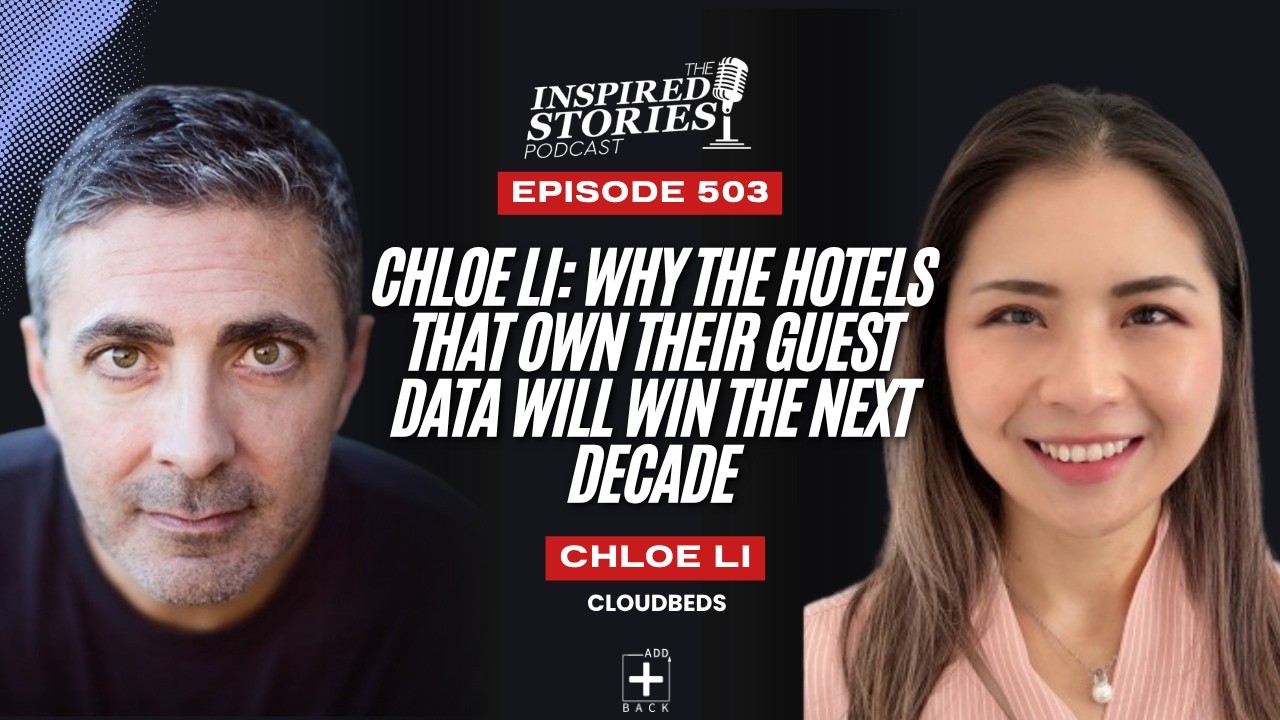
Chloe Li, Director of Finance at CloudBeds, left a career in investment banking after realizing she was telling founders how to grow revenue without truly knowing if any of it would work. She joined CloudBeds to build real value from the inside — and has since helped drive the company’s strategic shift upmarket while shaping its AI data infrastructure, payments strategy, and go-to-market analysis.
✨ Key Insights You’ll Learn:
From Sichuan province to New York City: Chloe’s path to Baruch College
First job at Ernst & Young: learning that teamwork beats individual effort
The “disagree but commit” principle from mentor Sarah at KeyBank
Investment banking exit: recognizing she wasn’t creating real value
CloudBeds as the ERP for hotels: one unified data layer across all functions
Strategic upmarket push: the analysis that drove a company-defining decision
AI integration: natural language queries against live BI data for leadership
Signals AI: CloudBeds’ property-facing business intelligence product
Agentic buying: why hotels must win guests through direct booking channels
Personal crisis and the support group that carried her through
🌟 Chloe’s Key Mentors:
Sarah (KeyBank Manager): Taught “disagree but commit” and how to channel assertiveness into team alignment
Kevin (VP of Finance, CloudBeds): The leader Chloe cold-reached; now her manager and sponsor
Friends and Family Network: Informal support group that held her through a career-ending dark period
CloudBeds Leadership Team: Collaborative decision-makers who trusted data-driven analysis on the upmarket pivot
👉 Don’t miss this conversation about what it really means to create value, why data quality determines AI quality, and how one bad season at work can rewrite what you believe about resilience.
Listen to the full episode here
Transcript
Anthony Codispoti (00:01)
Welcome to another edition of the inspired stories podcast where leaders share their experiences so we can learn from their successes and be inspired by how they've overcome adversity. As you listen today, let one idea shape what you do next. My name is Anthony Codaspode and today's guest is Chloe Lee, director of finance at CloudBeds. CloudBeds is a hospitality technology company that simplifies hotel operations across more than 150 countries.
They unite reservation management, revenue optimization, and front desk tasks into a single user-friendly platform. They have refined their AI enhanced services, enabling hotels and hostels to make data-driven decisions faster. They were recognized with the World Travel Awards and by Deloitte's Technology Fast 500. Prior to joining CloudBeds, Chloe worked at Ernst & Young, Berkshire Capital Services, and KeyBank Capital Markets.
But before we get into that good stuff, today's episode is brought to you by my company, Ad Back Benefits Agency. And you'll want to hear this because it's hurting almost every business you know. Health insurance costs go up every single year and the hospitality industry is furious about it. They're paying more, claims are getting denied, employees are opting out because they can't afford it, and it hurts turnover and morale.
It's one of the most maddening problems in running a business and everyone just accepts it. But you don't have to anymore. Now there's a program that gives employees unlimited access to doctors, therapists, and prescriptions with no co-pays or deductibles to meet. And here's the part that really shocks most people. Our product actually increases your net profits. We recently helped a client add $900 per employee per year to their bottom line.
Results vary, but gains like that can change how a business is valued. Get your free consultation today at addbackbenefits.com. All right, back to our guest today, the Director of Finance at CloudBeds, Chloe Lee. Thanks for making the time to share your story today.
Chloe Li (02:11)
Yeah, of course, happy to be here. Appreciate the opportunity.
Anthony Codispoti (02:15)
Yeah, so Chloe, tell us where you're from originally and how the door first opened for you to come to the US.
Chloe Li (02:22)
Yeah.
So China, yes, I'm from China and Sichuan province, where all the panda comes from. So that's good to remember. so then I got the opportunity to come to study and pursue the master degree in New York. That's when I moved to the US.
Anthony Codispoti (02:23)
And from where? are you from originally? What part of China?
Okay.
Chloe Li (02:50)
And then I was fortunate enough to find a job after that that sponsors H1B after the Baruch. And yeah, it's just been a ride.
Anthony Codispoti (03:04)
Okay, so you come to New York and where did you go to school?
Chloe Li (03:07)
Baruch College. Yeah, it's, no, it's, it's a, and the location is fantastic. It's on, it's right in the middle, 23rd and Lexington. Yeah, right. Downtown. Yes, right there. And they are well known for their accounting programs and also financial engineering programs. Big, ⁓ job, like great for job.
Anthony Codispoti (03:09)
Root College. Is that upstate? Where is that?
you're right down town. You're in Manhattan. Okay.
Chloe Li (03:35)
drought placement in New York City.
Anthony Codispoti (03:38)
Got it. Okay, so you come to the US to study right there in New York City, Baruch College. You get your masters there and were you working at the same time or did your first job in the States come after graduation?
Chloe Li (03:51)
come after graduation. That was Eun Seung Young.
Anthony Codispoti (03:54)
And where did you start?
Chloe Li (03:56)
So I started in real estate assurance. So it's basically doing auditing for real estate companies. And I had public and private clients. That was truly my first experience of going from a student and to perform well as an employee. Like it's different for, I was a
I was a straight A, almost like straight A students the whole time. And got 4.0 from Baruch as well. So I thought I would do well at work. I'm like, okay, it's just doing the same thing. But working environment is just different. Yes, like even if like I put in the efforts,
that I need, it's not ⁓ like doing the test, right? Going to school, doing the test, it's just me on my own. But perform well at a work environment, it's a teamwork. So I think that to me was a big change that I need to learn. I needed to learn how to leverage other people and how to work as a teammate.
to support and get to the goal.
Anthony Codispoti (05:28)
That's interesting. Yeah, when you're in school, it's all about you, right? How much time you study, how much effort you put in that, you know, reflects the output on the other side in a work environment. Most work environments anyway, your output depends on your ability to interact with your co-workers. Did you have somebody who mentored you on that in the early days, or was this just a lot of like painful lessons like
Chloe Li (05:46)
Yes.
Anthony Codispoti (05:57)
that didn't work out and then having to sort of regroup afterwards and study what went wrong.
Chloe Li (06:02)
Yeah, so I think it was a painful reflection and learning on my own. And I would say it's not until I'm at KeyBank and I had Sarah, Sarah was my manager at KeyBank and Sarah really helped me on that front. And I think that she
always tells me that disagree but commit. So that I remember that in every time because I am an assertive person and I have opinions and ideas and thoughts on things express my ideas and thoughts but I should commit. So disagree and commit has been
one of the key things I remember to do.
Anthony Codispoti (07:03)
And so if I'm understanding you correctly, that phrase, disagree, but commit means essentially you can have different ideas from your coworkers, but once a decision is made that this is the path that we're moving forward with, even if it's not the path that you had in mind, you're part of the team, you commit to seeing that path through.
Chloe Li (07:23)
Yes, correct. I work 100 % to make sure that path is being followed.
Anthony Codispoti (07:31)
And tell us about the work that you were doing there at KeyBank.
Chloe Li (07:34)
Yeah, so at KeyBank, was covering, I was an investment banking analyst associate covering the technology companies, the consumer internet and software companies. So essentially help them to purchase or sell themselves, like going through mergers and acquisitions and all going through the initial public offerings, like going IPO public.
Anthony Codispoti (08:01)
Okay. So we're gonna get into this, but the work that you're doing now at cloud beds is very different. Tell us first how the door open to join cloud beds have that opportunity come
Chloe Li (08:15)
Yeah, so I want to maybe like take a step back. Just like when I was in, and maybe like talk about white tech and the white cloud beds. So at the very beginning, right, like I was, want to do finance, I want to make deals. And the first opportunity came to me was in the financial institutions sector. So the FIG.
And one deal struck me that there was an &A transaction involving a robo-advisor. It was trading at almost 10 times the multiple of a traditional wealth manager. And that was like my live-bob moment. I thought, hmm, that's where I need to be on the tech side, where the value is created. So I moved to the West Coast and spent four years in KeyBank.
And then, but then, you know, going through the day in day out work and I just had this unfortunate or uncomfortable realization that I'm not sitting across from the founders, the C suite and tell them that, if you can do this, grow your revenue by X percentage, life will be great. But the reality is I don't know how they can do that. Or if like any of our models make sense. So.
I, at the end of my investment banking time, I was like, okay, I can't do this anymore. I'm just fooling myself and I'm not really building value. Right. So, and I started looking for jobs and I reached out to the companies I am interested in. And Carbis was one of them. That it is in the subscription as a service, the SaaS world growing very fast.
had strong backers. So I reached out to Kevin, the finance leader at the time, and now he's also the VP of Finance and my manager. I just reached out to him directly and asked if he needs help because of my expertise in software, in SaaS, and all the metrics. And yeah, that's how it all began.
Anthony Codispoti (10:41)
Okay, so you were interested in SaaS because you saw that the multiples from your time in investment banking, the multiples in SaaS were much higher than in other businesses. Now that's where I want to be. But you felt like maybe you weren't adding a ton of value. You're kind of sitting across the table from these folks saying, hey, do X, Y, and Z, but you didn't really know if those were going to drive value. So you wanted to be more, I don't know, integrated. You want to be more inside. Is that the correct understanding?
So you start reaching out to companies that you were aware of in the SaaS space. CloudBeds was one of them. And they're like, yeah, we could use your help. OK, so here we are. Tell everybody, what does CloudBeds do and who does it do it for?
Chloe Li (11:24)
Yeah, so CloudBit is like the ERP for hotels. It's one platform with a unified data layer that connects operations, distribution, payments, CRM, revenue management, and guest experience. What makes CloudBit really unique is that every action, hotel has every action, a booking, a payment, a rate change, all flow through our
own what we own the one data model. So this is one single source of truth for the hoteliers. And at the same time, we also have an open marketplace with integrational partners. So this is not a world garden, but still, the truly our most valuable is that one data layer, the unified foundation, which is right for AI to tap.
And we are increasingly like the platform of choice for large groups and chains who want a modern alternative to those legacy systems. So essentially we help the hotel operators to operate the properties.
Anthony Codispoti (12:45)
Are these mostly independent hotels? Are you doing the chains? Are they big hotels, small hotels?
Chloe Li (12:51)
Yeah, we are, we grew, so our history, we grew from a more independent space, hostels, small mom and pop shops, and small hotels. Now we are getting into those larger groups and chains that's been a big push over the last two years, and we're making great progress.
Anthony Codispoti (13:19)
So what do the letters PMS stand for in your industry? And explain to me why CloudBeds is so much more than.
Chloe Li (13:27)
Yes, it is property management system. That is the core function of CloudBeds. But CloudBeds has other products that are connected to the PMS. That is distribution channel. have our own. These are all in-house. The distribution channel, the CloudBeds payments system, our revenue management, our guest experience, and our marketing services. These are all the services that we provide.
to the customers under the cloud-based umbrella.
Anthony Codispoti (14:02)
So let's take a step back. As you were moving from the investment banking world and coming into cloud beds, the SaaS environment that you were excited to get your fingers dirty in, how was that transition for you? Was it very natural? Were there some bumps along the road for you?
Chloe Li (14:18)
Yeah, there are definitely bumps. So the biggest I would say is the is sort of a culture shock that when you go to the floor of an investment bank, people are kind of similar. The analysts, associates, VPs, they look similar. But cloudbiz, we have employees in over 40 countries speaking 30 plus languages. That is insane. That think about
the diversity and the just how people communicate. And when I first joined CloudBiz, was, it was yeah, culture shock. Like going to a different country, living in a different country. And so I think that adjusting to this more dynamic and interesting, right? Sometimes I kind of challenging and to me that the environment. So for example, that
What I didn't know at the time was, so US kind of like, you know, we speak a little bit more directly, but in UK it is different. are, and they don't like that direct conversation as much as the US people do, which I didn't know. And I was talking to people the same way. And then I realized, ⁓
I need to adjust my tone and adjust my conversation, the flow of the conversation based on the audience of the where they are from and also what position they are in, right? Rather than in investment bank, in the investment banking world that I was just using the same type of tone or flow because
we were just all thinking, we're just all very similar. So that was like the biggest adjustment I had to do.
Anthony Codispoti (16:22)
But in working with, I think you said more than 30 countries, you're having conversations with lots of different cultures. Do you have some sort of a ⁓ grid or a cheat sheet that says, ⁓ here's the culture of the person I'm talking to today. Here are the things I need to make sure I do or don't do. Like, how do you keep it all straight?
Chloe Li (16:39)
Yeah, I think that it's more mindful of... So I think the interesting part is figuring this out that because there are people that I work with closely and it's how to at the very beginning build that trust and build that mutual understanding of how we want to communicate. So that is very important because people are also different.
So I think that instead of the cheat sheet, but rather to find what works for each individual, and especially the ones that I work closely with.
Anthony Codispoti (17:20)
You know, I spent a year studying in the UK when I was in college, and it was a great experience for me. And I learned so much, not only about ⁓ British culture while I was there, but it taught me more about what it meant to be American, because I had like a compare contrast point there. ⁓ Some funny stories that came out of that. And I'm curious whether we talk about you first coming to the US and maybe some funny lessons or, you know, ⁓
Chloe Li (17:34)
Yeah, your own culture.
Anthony Codispoti (17:49)
culture differences that occurred there, or later on as you're working at cloud beds and working with all these different cultures, you have an entertaining story to share with us about sort of those cultural differences that show up.
Chloe Li (18:01)
Yeah,
yeah. So, and I think that the, I feel like the culture, culture side is not as much as just how people live are very different because when I first moved to the US, it was New York, right? And I grew up in Chengdu and...
in Sichuan province and it's a huge city. And New York is a big city as well. So it was very natural for me to fit in. it's concrete jungles. Love that. Just what I was used to. And some of my other classmates from college, they went to other places in the US and they all told me that, you know, New York, the rest of the...
US is US, but New York is New York. So they're not the same. I didn't believe that. And I couldn't even kind of like start to begin to understand what that means until I moved to the West Coast. Until I moved to the West Coast and now I am in Portland, Oregon. And I have a better understanding of that. It's just the...
speed, the lifestyle and what people cares about and the environment that you living, it is so different. Yeah.
Anthony Codispoti (19:36)
Yeah. So Chloe, your role spans finance strategy and go to market. Can you share a specific project where you were combining all three of those areas to help drive growth there at CloudBeds?
Chloe Li (19:50)
Yeah, yeah. I think that because we what we have to do, right, is ⁓ really. So one of the things is to say we have been taking on this journey of going up market and there were some other paths that we could have taken. For example, whether we want to get into
short term rental property management, right? So still PMS, but it's not hotels, but short term rental. That's a different tech stack. And so, and other options that we can take. So which one is better? And then also why they have been, right? Because you are building, going upstream means building, means requires investments. So does that make sense?
Why do we believe that going upstream would work for us? So all these required analysis ⁓ at that time before we really committed to this path that we need to go upstream. So, and that was when I was heavily involved in the analysis, understanding
the growth retention churn analytics of different customer segments, and then doing the return analysis of different investments. Eventually, think with the data that we provided in the leadership collectively decided we need to go upstream. And that has been...
To be honest, that has been like one of the best decisions that I think, at least like my time at CalBest that we have made.
Anthony Codispoti (21:54)
So was that a decision that you were supportive of or did you disagree with that one and then got on board with it anyways?
Chloe Li (22:00)
⁓ think that I was one of the... Definitely I was one of the strong supporters of that because the data was... So if you look at the financial data, it speaks pretty loud on that front. But there are other considerations, right? So like the investments and where our route was in the change, it's an organizational change. So when you think about the...
For CloudBiz, when our customers, for example, when our customers were like, and to simplify it, like 20-room properties versus 100-room properties, the whole customer-facing org, from sales to onboarding to support, the whole thing we need to change. It's totally different skill set and expertise.
when you sell 20-room property versus a 100-room property, that's they're thinking. Not the interface, but the skill set. It's not the software layer, it's the... It's like when you talk... So, for example, when you talk to a 20-room property in Thailand versus a 100-room property owner in New York, how you talk to that property is very different.
Anthony Codispoti (23:02)
The interface needs to be that different.
Their needs are different, is that what you're saying?
Chloe Li (23:30)
Sophistication. Yeah, I would say it's a sophistication. Yes, there needs as well, but also the sophistication of the conversation. Rather than solving day-to-day problems, we need to think about more strategic, about how we are achieving the goals, their goals with the software.
Anthony Codispoti (23:54)
So tell me, who is your ideal client then? Describe them for us.
Chloe Li (23:58)
Yeah,
yeah. So right now our ideal customers are 40 plus room properties and chain or independent hotels with the limited amount of outlets. So when I say outlets, it's like hotels, it's like ⁓ the restaurants and conference rooms or golf courses, right?
we can support some of them, not all of them, so limited amount of outlets and hotels. So hotels are our ⁓ sweet spot.
Anthony Codispoti (24:43)
Okay. I want to talk a bit about AI and how cloud beds is approaching that. Tell me how you guys are incorporating that first, just on the finance side and kind of your part of the
Chloe Li (24:56)
Yeah, yeah, absolutely. we are, and we can maybe talk about tech stack because the challenge is the AI, if like say like we build our system from ground up, right? Then we can use AI to probably build it. But the information is in
existing systems. So then it's really like how AI works with the existing systems. That is very important. So we have a, we use the BI tool and then we use the BI tool and then we also have the ERP. We have the ERP tool as well. And so exploring how AI can integrate with them.
Not the ERP yet, but for example, on the BI side, because they recently, Anthropic and the BI tool, they are integrated. So we're able to just use the BI, the user-cord interface. And Sigma. yes. So BI tool is the business information system that we use to visualize our data. And our data.
Anthony Codispoti (26:10)
Tell us what the BI tool is.
And this is business information. That's what BI is.
Chloe Li (26:24)
Amazon, Snowflake, that's where our data sits. So the BI tool is for visualizing the data. And then Anthropic is able to connect to the BI tool directly and we can query, we can just ask questions. And we're building out the ability for the leadership to interact with the BI tool just from Anthropic.
And then they can ask questions on what is AR, how is the growth and what that all looks like instead of us pushing the data. they can, when they, we, in addition to us pushing the data to them, they can also just like, if they have any questions, they can just ask kind of like, yes, exactly.
Anthony Codispoti (27:10)
just like in regular English, you don't need a finance degree. Like, okay,
give me an example of a couple of questions that somebody might ask on the finance side for from one of your clients, what would they ask?
Chloe Li (27:21)
Yeah, so I think that one is from the finance side that you can from I guess like depends on the use case right for the leaderships are interested in knowing how we are doing so they can ask what's our growth which regions were in the fastest which is the trend of say in EMEA how is EMEA trend doing how is the payments doing in EMEA so that
natural language to just ask and get the information from the BI tool is very powerful. So that is ⁓ one. And then that's like the first we are working on is for leadership. And of course we will be expanding that to the other teams that we are working with. Also, we are working with our business intelligence team that function.
to truly, want to, because for that, we want to build that on top of a snowflake where all our data sits. So the first step is to clean the data. I don't know that how, you know, how people are familiar, how much people are familiar with AI application in enterprise environment that does.
usable, how clean the data is, how usable the data is really determines the quality of the AI output because at end of the day, it's always garbage in, garbage out. we are like the right now, the focus is making sure that we have that foundational data layer that AI can tap into. And we're building both at the same time, clean the data.
and release or get AI access to portion of the clean data. And eventually, goal is for all the information that we have in one layer, one place, and then the AI can intelligently grab the correct information when people ask those questions.
Anthony Codispoti (29:40)
Is any of what you're describing here, Chloe, the new AI enhanced signals that you've introduced?
Chloe Li (29:47)
Got you. So that is for our internal cloud-based internal operations, because that is where, from a finance perspective, what we focus on is to provide information for the business to make decisions to operate. And then the signals AI is for our properties, the hotels. So that is separate. Think about web building.
our internal Signals AI for cloudbets to use. And the Signals AI is the product that our hotel's properties they use for their business intelligence, their own properties business intelligence. what I think that what differentiates cloudbets from other competitors is that from day one, we have decided to build the most important tech stack, the data, the business intelligence.
and the PMS distribution or these functions in-house. The customers can choose whether they want to use all of the text to act as fine. But we have the capability to host all the data in one place. In the AI period, data is king. And your own data, the property's own data is so important.
for the properties to understand their operations. So ⁓ that is the advantage we have, and that's where we build and we rolled out the Signos AI.
Anthony Codispoti (31:24)
So is there then the ability for hotels to have some sort of baseline comparison to what, how they're performing compared to others in the industry because they share this platform?
Chloe Li (31:36)
Yes, yes, for sure. So for our revenue analytics product, we enrich. So we have our own proprietary data because of all the properties. have 20,000 plus properties that use our CloudBase product. So that is valuable information for our customers to tap into. And we also enrich it with other information.
say events, what events are happening in your city. so that type of information to really help the hoteliers have a fuller view of the operations.
Anthony Codispoti (32:22)
So it's clear in talking with you, as well as in many other conversations I've had, that technology in the hospitality space is evolving very quickly. I'm curious if there's any trends that you're seeing that you think hoteliers need to be ready for.
Chloe Li (32:40)
Yeah, yeah. So I think that maybe like I have like two top of my mind. The first one is the agentic buying situation, right? That an open AI and I believe open AI and both open AI and Anthropic have tested with different say booking.com and ⁓ different providers. ⁓
just booking directly from ⁓ their system. instead of going to a guest, instead of going to booking, can just book directly in chat jbt, for example. And that is growing very fast. So the trend is whether, I think that from hoteliers perspective is whether they should still go, right? Like when you think about hoteliers, their distribution.
that they have their own booking engine, they have their own website. And then also they distribute through OTAs and travel agencies and some other ones. But what makes the most money and build loyalty is always their own website from their own booking engine. So yeah, because exactly.
Anthony Codispoti (34:04)
they don't pay any commissions on it.
Chloe Li (34:08)
So, and they control the guests. They know who they are, right? That they can, if the website is good enough, they know like all the analytics and then they can also do retargeting and add CRM guest marketing campaigns on those customers so it can bring them back. That's very powerful when you own your own guests. So, and then...
how that would look like in this new agentic, when agents are purchasing the services, are purchasing host health stays, how this should look like, right? Like Booking and Expedia, they are working with these companies closely to develop how that agentic buying should look like. And we want to represent our properties.
our guests, properties, our customers to work with OpenAI, Anthropec as well, Google, OpenAI, Anthropec and Google, that their website can be as discoverable as going through booking.com. so that, and we want to be the preferred channel, the direct website and the booking engine would be the preferred channel than the booking.com. So how can we help our
properties to achieve that, right? So that is what we're thinking about and is really like winning the guests from the store party providers.
Anthony Codispoti (35:47)
So what you're describing is I might go to Claude and say, hey, I'm looking to spend a weekend in Portland. I'm looking for a hotel that's downtown, has a pool for my kids, and is walking distance to the market, something like that. And then that you want to make sure that your guests, your customers' properties are showing up in the results that the AI recommends.
Chloe Li (36:12)
Yes,
not just that, but also it's their direct booking link instead of a booking.com or Expedia booking link.
Anthony Codispoti (36:21)
Got it. Okay. You said that this area, this agentic buying is growing very quickly. Do you have any numbers? Do you have any data that says, you know, X number of searches, X percent is in that space right now?
Chloe Li (36:36)
Yeah, I don't have like exact numbers of say like the whole space, but I think that and the merchants, merchants being that the hotels are really exploring and then also booking and Expedia, they are also working on that as well. I think that from one of my conversations recently at a conference,
And they were saying that maybe like lower single digit from the traffic comes from the agents. then, but then I also, you know, it just varies by, it varies by the adoption by merchants. And, ⁓ and I heard another status, airline in South America, they have over 10 % of the purchases are from agents. So I think it varies by region and varies by merchants. But
I, from my understanding is that it's always evolving so fast. And, you know, like we are just like learning and preparing ourself and preparing our properties, our customers for this. and yeah, yeah, I know. And then the other thing I want to bring up is payments, global payments, because I also manage, a core member of our
Anthony Codispoti (37:45)
Early days, exciting stuff.
Chloe Li (37:59)
payment strategy team. And then I also manage the payments risk team. the payments and when you think about payments is very important for hotels, right? Especially that from, if like they want to go, want to put more focus on their own distribution channels, their booking engine, their website, then accepting payments from
guests all over the world, then the product solution needs to support that. So that is what we have built at CloudBit. That's a CloudBit payment system. operate in, I say, 20 plus countries, and we accept payments worldwide. So it's very valuable for the hoteliers to compete in the modern world.
Anthony Codispoti (38:56)
Now, Chloe, in your day-to-day, do you interact much with your customers or is it more with your internal team members?
Chloe Li (39:03)
Yeah, I interact more with the internal team members.
Anthony Codispoti (39:07)
⁓ Looking ahead, what most excites you about the path that CloudBeds is taking?
Chloe Li (39:16)
Yeah, so I think that when you think about all the challenges, right, that the hotels, hotelists face and also that how I think the thing that excites me the most is how we can help the hotelists make more money, make more money and then really focus on what they are good at, know, delighting the guests, solving the guests and being
the hosts that all guests love. That's what they are good at. then, then how can we, so then when we think about that, it's like one angle is, okay, then how can we remove all those boring work that they need to think about, right? Like for example, like, ⁓ is my data correct? Is that, how much revenue did I make? And, ⁓
Am I short of staff? And then how can I get more guests? Those cloud beds is solving and has solved some of them. It is in the process of solving a lot of them for the hoteliers. So that's on the operations side. But then also is when you think about make more money, this whole thing of the other distribution channels, OTAs.
the booking and expedient of the world and travel agencies and all those, they charge a lot. How can we help the guests to discover the hotels really through just the natural path, right? Going through the, whether it's the agents like Cloud, chat, JBT or Google or search, however they discover, but they always see our customers, our properties.
website first and book directly with the website so that our customers can make the most money.
Anthony Codispoti (41:21)
So it sounds like you want to be a lot more involved in SEO, search engine optimization, as well as, I think they're calling it AEO, sort of the AI version of that engine optimization. Am I understanding that correctly?
Chloe Li (41:35)
Yes, we definitely there. We have our marketing products, digital marketing services products, DMS. that is a fully integrated product and it has great user experience. It's just in our whole platform. So we're definitely there. I think that it is how to further help our properties to discover the value of those
the DMS suite. So how to help them to discover the value and utilize it. And then also there are steps that the properties can take as well, Like as simple as make sure that the Google business profile is up to date. So those simple steps that they can take on their own to make them more discoverable as well. So I would say this is a
two-way journey. So we have to work together, work with our guests. And on one hand, we want to improve our capability, and on another hand, we want to enable our properties, our customers further.
Anthony Codispoti (42:54)
It makes a lot of sense. Chloe, what is one of the hardest things that you've ever had to overcome personally and what did that teach you?
Chloe Li (43:02)
Yeah, yeah, absolutely. So I think that, you know, life is not always as smooth as you'd like. And also I think this reminds me of like what happened at one of my jobs at my audio stage that during like almost like six months I had a...
some personal issues and I was really in a dark space. It was just like, I was not able to focus on work. And at that time I didn't understand why I couldn't because I was, like I said, like I was doing like straight A students or through and I saw that if I just forced myself to focus, I would be able to do it. I wasn't, I wasn't. And it was so bad that I was let go.
from that company. I think I was fortunate enough that I had a strong support group around me. When I shared what I was going through, they took me in and they really warmed me up. I was also fortunate to find another job.
after. ⁓ But this whole experience taught me that work is not the whole thing. There are other things outside of work in life that I have to balance. I learned how to balance what is happening outside of work with work demands and then also the important
The very important is the support group that I was able to gather and I still have around me that when I, and I know that when I am down, I have someone to turn to. I can always get the strength and the support from my friends.
Anthony Codispoti (45:21)
And so that support group, was that that network, was that already in place or was that something you kind of pulled together as you were going through this really difficult time?
Chloe Li (45:33)
Yeah, so I think that I was, it wasn't formally, right? Formally it wasn't there, but I think that just as I was going through that, I reached out to friends, family members, and I was just able to, and I don't even know, I don't think they knew they were my support group. I just used them, but they were all kind enough to listen to me.
Some give suggestions, some just listen and I was able to, I appreciate all the time they spent with me, just hearing me out. So then I was lucky, right? Because some people may not be able to have that many friends or family members at the time when they need them. So I do, one of my advice is,
definitely identify those people in your life. That when things are doing well, that you're like, ⁓ yeah, I don't need them. But you want to know that anytime things could take a turn and you need people who can stand behind you, next to you and just help you through some tough periods.
Anthony Codispoti (47:00)
Yeah, yeah, I'm glad that you shared this story, Chloe. I appreciate that because it highlights something I think really important that took me a long time to understand. But I hear over and over again, in conversations that I have the importance of safe human connection. ⁓ When times are good, it's great. And when times are rough, when you hit that rough patch, and that's really what you need, it's the best medicine, in my opinion, that we have for getting through those moments.
Chloe Li (47:28)
Yeah, I absolutely agree. And even like I think that from just throughout cloud beds and throughout my ⁓ career that someone, someone or a group of people that can understand you can understand me and help me to think through problems and reason it with me and talk with me. So big or small.
that is so valuable.
Anthony Codispoti (48:00)
Yeah. What do you think your superpower is, Chloe?
Chloe Li (48:05)
Yeah, I think my superpower is I'm just, ⁓ I'm like always want to grow and I'm always just want to grow and curious as you can see, like, right? Like I, like my, how I change, why I changed my career is because, I was interested in tech. It does value. And then it's like, I'm not creating enough value. And let me go to
a company, SaaS company, really to grow that and contribute to grow that value. So I think my superpower is I don't set boundaries for myself and say like, ⁓ this is what I can do and this is what I cannot do. And I'm eager to grow. And maybe like another small example is, so at CalVest, was doing, I started with strategic finance.
And that's like more closer or more aligned with what I did in investment banking on the metrics like ARR retention, those metrics side. And then I was promoted to FP &A to cover financial planning and analysis. the core, the corporate finance side. And right after I was promoted, the only analyst and
had to go on leave. And it was such a scramble for me to figuring out our ERP, our system, and how to use our FP &A planning tool. But I made it work. And I would say that my coworkers or the leadership team didn't notice any gaps. ⁓ The support and ⁓ the advice that
I provided to the team. Yeah, really like, I think that I'm very excited to see what more problems and challenges that life throw at me. I feel like whatever it is, I can do it.
Anthony Codispoti (50:20)
You can do it and you can learn from it. I think that's, great to get to a point in life where you're actually excited about the challenges, the problems that you may encounter because you realize that those are God, the universe's way of delivering you tremendous learning experiences.
Chloe Li (50:22)
Yeah.
and then wind it out and it again? Yes, yes,
absolutely.
Anthony Codispoti (50:41)
What's your favorite thing to do outside of work, Chloe?
Chloe Li (50:43)
Yeah, so the favorite things I like to do outside of work is we... So the funny thing is, I was in New York, right? And then I moved to Portland. When I first moved to Portland, I thought that I didn't think that I would stay. The job gave me the opportunity to move to San Francisco after a year.
And I thought I would take that. But then I fell in love with Portland because of all the outdoor activities and just like the atmosphere of Portland. that kind of ties to what I like to do outside of work is I bike a lot. Portland is extremely bike friendly. And then I also travel a lot. And Carbass is a remote.
only company, right, gives me the opportunity to travel. And last year I did some crazy travels. I went to Turkey for a month and went to Southeast Asia and then China for like almost two months. And so that was, I'm very grateful for the flexibility that Carbaz provides. Yeah, I think that's what I enjoy doing outside of work.
Anthony Codispoti (52:10)
Chloe, I've just got one more question for you today. But before I ask it, I want to do three quick things for the audience. First of all, if you'd like to learn more about what CloudBeds does, go to cloudbeds.com. Website couldn't be any easier. CloudBeds.com will also include a link to Chloe Lee's LinkedIn profile in the show notes. But you can find her by searching Chloe Lee, L-I, CloudBeds, LinkedIn.
Also, if you're enjoying the show today, a quick comment or review on your favorite podcast app goes a long way towards helping others discover our show. So thank you for taking a quick moment to do that right now. And as a reminder, if you want to get more employees access to doctors, therapists and prescription meds that as counterintuitive as it seems actually increases your company's net profits, reach out to us at addbackbenefits.com.
Okay, Chloe, so last question for you. A year from now, what is one very specific thing that you hope to be selling?
Chloe Li (53:11)
Yeah, I really I hope to celebrate for CloudBeds that we have the we have delivered the product that a lot of our customers are asking because this is it's a journey, right? It's a journey to go upmarket. The needs are different. The technology needs are different. They are more in more into accurate
numbers and accounting integration, group functions, there are a lot more needs that they require to function, to operate as a big property. So a year from now, the biggest thing would be we have successfully delivered the requirements that our customers are happy and enjoy using them.
Anthony Codispoti (54:06)
Love it. Chloe Lee from CloudBeds, want to be the first to thank you for sharing both your time and your story with us today. I really appreciate you being here.
Chloe Li (54:14)
Awesome, thank you so much, Anthony.
Anthony Codispoti (54:17)
Folks, that's a wrap on another episode of the Inspired Stories podcast. Thanks for learning with us. And if one thing stood out, put that into action today.