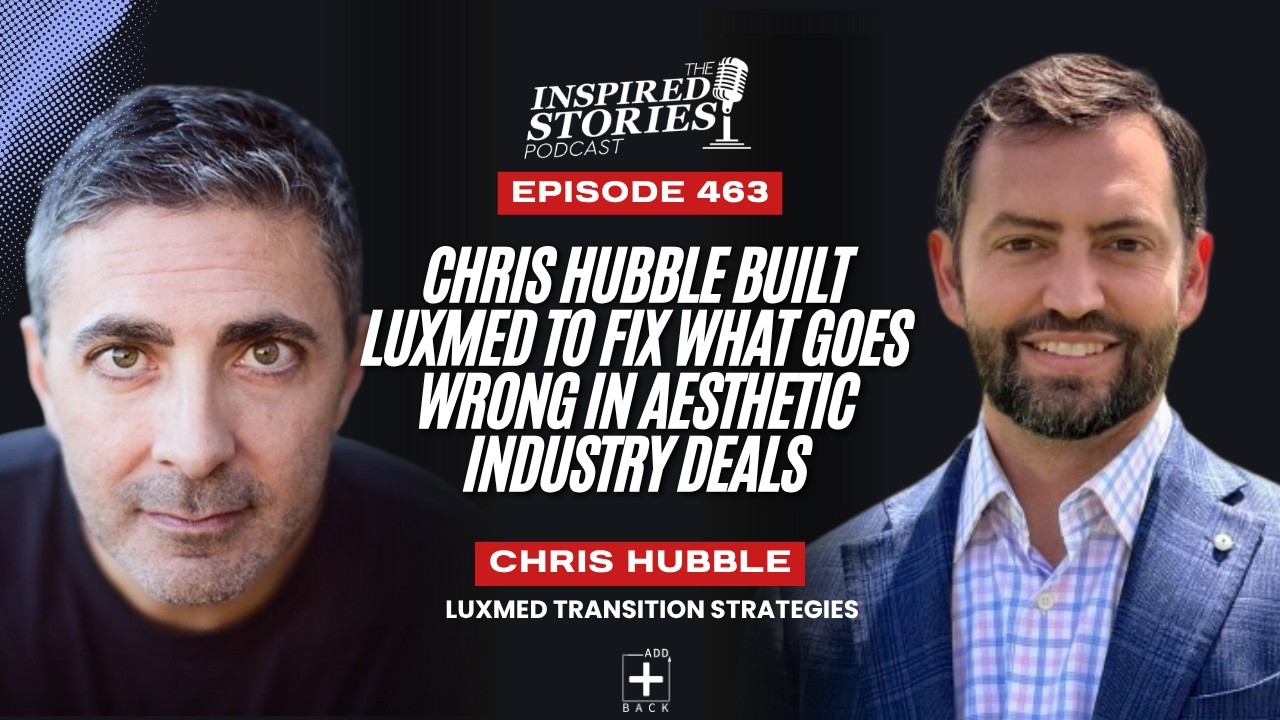
Chris Hubble is the founder and M&A advisor behind LuxMed Transition Strategies, a boutique sell-side brokerage helping med spa, dermatology, and plastic surgery owners navigate sales, acquisitions, and medical support organization partnerships. His path ran through a decade in orthopedic sales, revenue cycle management overseeing 900 physicians, co-founding a dental support organization, and two open-heart surgeries before he spotted the consolidation wave beginning to move through the aesthetic industry and decided to get there first.
✨ Key Insights You'll Learn:
Born with a bicuspid aortic valve, depression in college from restricting activity, surgery senior year at SMU
Ten-hour surgery, seven hours off the heart, six-month recovery with 35 pounds lost
Second valve failure 18 months ago at a conference in Scottsdale, followed by surgery in December 2024
Orthopedic sales as the bridge from Enterprise Rent-A-Car to the operating room
MedSynergies: overseeing 900+ physicians and $200M+ in revenue across hospital-owned practice groups
Co-founding Eagle Dental Management in 2020, acquiring practices before a misaligned investor partnership ended it
Spotting the aesthetic consolidation wave at 7-8% consolidated, far earlier than dental or veterinary
Month-to-month contracts and success-fee-only model: paid when the client is paid
Competitive bid process: six to eight buyers presented so sellers choose alignment, not just highest offer
Why enterprise value is fixed but EBITDA multiples can be manipulated by sophisticated buyers
🌟 Chris's Key Mentors:
His Surgeon (Houston and Austin): Operated on Chris twice, set up future valve replacement through the groin, and told him he was a ticking time bomb who got lucky
His Therapist at SMU: Named the depression for what it was and gave Chris permission to prioritize his own health over his grades
Kyle (Owner, Professional Transition Strategies): Parent company founder whose alignment with Chris made LuxMed possible and whose dental M&A model Chris adapted for aesthetics
Eagle Dental Management Partners and Investors: Taught Chris through a difficult misalignment experience exactly why partner selection is the highest-stakes decision in any business
Sellers He Has Advised: Each transaction has sharpened his consultative approach and reinforced his commitment to timing over commission
👉 Don't miss Chris's account of being told he could have collapsed on a basketball floor and died, how he rebuilt after two open-heart surgeries and a failed business partnership, and why he now tells clients to walk away from deals more often than he closes them.
Listen to the full episode here
Transcript
Anthony Codispoti (00:02)
Welcome to another edition of the Inspired Stories podcast, where leaders share their experiences so we can learn from their successes and be inspired by how they've overcome adversity. As you listen today, let one idea shape what you do next. My name is Anthony Codaspodi, and today's guests spent nearly two decades learning how healthcare businesses actually work from the inside out. Orthopedic sales, revenue cycle management, and overseeing more than 900
physicians. All before he bet on a niche most advisors hadn't yet discovered. He co-founded a dental support organization, navigated the grind of building something from scratch, and then made one more pivot that led him somewhere unexpected. And it's producing results that are turning heads in a fast-moving industry. Chris Hubbell is the founder and ⁓ &A advisor behind LuxMed transition strategies.
A boutique brokerage that helps med spa, dermatology, and plastic surgery practice owners navigate sales, acquisitions, and medical support organization partnerships. He's been featured in Authority Magazine and Metaesthetics Magazine and spoke at the 2025 Aesthetic Show. He holds an MBA from Southern Methodist University. But before we get into all that good stuff, today's episode is brought to you by my company, Ad Back Benefits Agency.
Listen, if you run a business, you're likely stuck in the cycle of rising insurance premiums. You're paying more, but your team is getting less, and many people can't afford coverage at all. We do things differently. We offer a solution that provides your employees with unlimited access to doctors, therapists, and prescriptions that's always free for them to use. Here's the part that surprises most people, though.
Unlike every other employee benefit out there, our program puts more money into your company's bank account. As an example, we recently helped a client increase net profits by $900 per employee per year. Results vary, but gains like that can change how a business is valued. And the consultation is free. Imagine being the advisor that delivers incredible value by introducing this to your clients. See if they qualify today at addbackbenefits.com.
All right, back to our guest today, founder and CEO of Luxmed Transaction. Let's edit that. See, we can do that, Chris.
Chris (02:32)
Bye.
Anthony Codispoti (02:34)
Now back to our guest today, the founder and CEO of LuxMed Transition Strategies, Chris Hubbell. Thanks for making the time to share your story today.
Chris (02:42)
Yeah, absolutely. Thanks for having me. You read that bio and sometimes I have to pinch myself because it seems like a lot of stuff in a short window. ⁓
Anthony Codispoti (02:51)
And something tells me there's indicators of a lot more good stuff to come, but we'll get there. So let's start in, you know, early in your career, orthopedic sales, before you eventually ended up in this intersection of aesthetics and &A that we'll talk about. But what drew you into the medical sales in the first place?
Chris (02:57)
Absolutely.
Yeah. So, you know, it's always funny to think about my career path and where I started after school and where I've ended up. So right after school, I was thinking, what am I going to do with my life? I have no idea. I actually went and worked for Enterprise Rent-A-Car and I was a management trainee. I've worked all the way up to being a branch manager. was managing a couple of hundred cars here in the DFW area.
And I was like, I was running a business, quote unquote, kind of running a business. We've got paid off the bottom line, which was great. But I was like, what really do I want to do? And I had always thought back to, you know, college. was born with a heart condition and I ended up having surgery my senior year at SMU for undergrad. And ever since then, I was like, man, I really, I wish I had gone back and been a doctor.
really was fascinated with the industry. And I said, look, I would love to, you know, since I'm not going to go back and be a doctor, I've kind of passed that boat. already graduated, et cetera. And said, you know, what's another great way to kind of get my foot in the door in the healthcare space and in the surgery space. And it was orthopedic sales. And so that's really what kind of drove me to say, okay, I'm going to go try to get into this industry and do sales. mean, I, I was good at talking and I was good at,
speaking and running, know, managing people, et cetera. But I was like, I really want to be in the OR. So that's really ultimately was having surgery.
Anthony Codispoti (04:46)
Are you comfortable saying more about the heart condition, how it was discovered, the process of going through the surgery and the recovery?
Chris (04:53)
Yeah, absolutely. ⁓ You know, it's so I had was born with it I'll try to keep this story short. ⁓ But I was born with a high heart, excuse me, it was born with a bicuspid aortic valve and a heart murmur. So I'd always seen a cardiologist my whole life. And then I went four years ⁓ through high school without seeing my cardiologist. And so was a freshman at SMU and I went saw him and he was like, look, you're non aortic valve.
non coronary sinus is double the size it should be and you need to have surgery immediately. And that was in like February. And he was like, you need to have surgery this summer. So I started to kind of freak out and went out and got, you know, tons of different opinions. ⁓ and actually got to meet Dr. Cooley. He was one of the very first surgeons to do it, open heart surgery, ⁓ which was very cool. ⁓ and so
went around and had different opinions and ultimately landed on that I could wait. However, one of the restrictions that I had was, now keep in mind I'm in college, was you can't get your heart rate above 100. So if you go up a flight of stairs, your heart rate's 110, 115, right? And so eventually as I was going through SMU, it kind of led, and I don't know if I've ever really told this publicly on a forum like this, but really went into kind of a state of depression. And so grades started dropping.
And I went and finally saw a therapist and the therapist was like, well, no wonder you don't care about your grades. You're worried about dying every day. And I had never really thought about it that way. So ultimately I went to my parents senior year and said, look, I just want to have the surgery. Like, don't, I don't, it just needs to be off my back. Like I can't keep thinking about this. So when I had the surgery, my senior year ⁓ and my surgeon ⁓ who was down in Houston at the time.
He basically said I was a ticking time bomb that the way that my valve was constructed Was I could have been that kid on the basketball floor that had an aneurysm and just peeled over died ⁓ So it was really at the end of the day kind of a blessing that I had it ⁓ And you know, they they did the surgery. It was a 10-hour surgery off my heart for like seven hours and
Anthony Codispoti (07:13)
What does that phrase mean?
Off your heart.
Chris (07:16)
So they actually take you off your heart, stop your heart from beating, and they put you on a bypass machine, an oxygen lung bypass machine, and they circulate the blood through the machine so they can operate on your heart while it's not beating. Yeah, so, yeah, off my heart for seven hours and on the bypass machine, and then multi-month recovery. ultimately still, so I took a semester off, but still graduated in four years, if you will.
Anthony Codispoti (07:29)
while.
Chris (07:46)
but just took four and a half because of the semester off from surgery.
Anthony Codispoti (07:50)
Wow. ⁓ Yeah, no wonder you say that again.
Chris (07:51)
So it got me really intrigued.
Got me really intrigued into surgical.
Anthony Codispoti (07:57)
Yeah, like
you said, no wonder you were depressed, right? You were worried about dying every day. You were having to restrict your physical, you know, exertion, which is really good for everything in the body and the brain, right? ⁓ And so you finally you decide you're getting the surgery, you're seeing your year, you get it done. Tell us about the recovery process. You come out and what's life like?
Chris (08:09)
healthy.
Um, so for the first three months, um, you are really for the first call two months, you can't lift anything over five pounds because I mean, they've, split your sternum open. So they need that bone to heal. Um, and you can't ride in the front seat. You can't really ride in a car because they don't want the airbag accidentally going off. The seatbelt is dangerous. Um, and so you're really kind of just tied to a chair. And so this was now 20, almost 20 years ago, 21 years ago.
And so the physical therapy just wasn't at the level that it is now. And so it was a lot of just sitting around the house and being more depressed because I couldn't get out and do things. but the, the whole recovery probably took six months. lost about 35 pounds, ⁓ through that process. ⁓ just because, you know, you just weren't hungry, whatever it was. ⁓ and so, but ultimately you just, every day you just stack one day on top of it.
And then eventually you kind of get to the other side and say, okay, wow, now I'm starting to feel better. And you're out, you know, being active and doing things again. And just kind of keeping that mentality of stack one day, one good day on top of another.
Anthony Codispoti (09:35)
Is that kind of what the timeline was? It was about a year before you could start to feel that dark cloud lift for you.
Chris (09:41)
Yeah, I would say it was was so I took off in February and then I got back to school in this second semester. Excuse me, the first semester of that year. So it was a good eight, nine months before I was really like, OK. And even then, you know, you're always I'm still very keenly aware of my heartbeat. ⁓ And so you're always it's always there in the back of your mind. ⁓
you know, even to this day. And I would say that, yeah, it was probably seven, eight months before I was really like comfortable and even maybe even a year before I was really comfortable doing other like full throttle things.
Anthony Codispoti (10:25)
Is
there still a risk for you today?
Chris (10:28)
Well, funny you asked that question. actually just had surgery again, a year and a half ago. So about 18 months ago. So the valve that was replaced was a human cadaver valve. And eventually that valve failed. And it actually failed while I was at a conference in Phoenix and had surgery. Now I knew it was going to fail. I just didn't know when. And ultimately it, I call it a pop. The flaps gave out.
And I was stood up from lunch at a meeting in Scottsdale for Luxmed. And I was like, what was that? And went home, sat on my couch. You could hear my heartbeat. My wife could hear my heartbeat. My Apple watch with the decibel monitor could hear my heartbeat. and I eventually went into the, my cardiologist and he was like, yeah, you're gonna have to have surgery again. The valve failed. And so found.
My old surgeon from 20 years ago, who was a pediatric surgeon, world renowned, and he introduced me to his new partner who does adults in Austin. They had moved to Austin and ended up there right after Thanksgiving on December 3rd of 24 and had surgery again. So.
Anthony Codispoti (11:43)
what has
changed in the technologies in between those surgeries. Okay. So it's still quite a recovery process for you then.
Chris (11:47)
Oddly enough, not a ton. ⁓
Yeah, so I mean,
they still cracked me open. They took me and put me on the heart lung bypass machine. The difference this time though is they have now set me up. My surgeon has set me up to where if I need it again and eventually I will, they can actually go through the groin and replace your aortic valve through your groin. Based on the way that he put certain implants in, it's going to allow for a much less complicated surgery, hopefully in 20, 30 years from now.
⁓ but yeah, they'll go through a calf, ⁓ in the cath lab and it's, you know, instead of a three to six month recovery timeframe, it's a one to three week recovery time. Yeah. But I will say it really has changed. mean, physical therapy was much more ingrained. had to go three days a week. ⁓ all of that. So yeah.
Anthony Codispoti (12:32)
Wow, what a difference.
How does this affect the way you move throughout the day currently? Is this something that weighs over you?
Chris (12:52)
Yeah, I mean, now it's been 18 months since this last most recent surgery. ⁓ There are still times where I'm like, constantly cognizant of my heartbeat, my heart rate, and those types of things. You know, ⁓ again, I can feel it, I can hear it. ⁓ And it's just it's always there. It's getting less and less as the days go by. ⁓ So there are certain things. But as my surgeon has told me, he's like, that is just
something mentally, like you are physically fully strong and fully healed. And so there is nothing that you can't do. ⁓ And so, but it is definitely there. It is always subconsciously and sometimes it creeps, creeps up into my conscious ⁓ of, my heartbeat and just the way it feels and how either fast it's going ⁓ or, you know, just how loud it is sometimes.
Anthony Codispoti (13:48)
Are there things you found that help you from the mental standpoint of all of this?
Chris (13:53)
Yeah, I think it's just kind of the acceptance of it ⁓ is where I've taken it. And I wear I mean, my thing is, is I will start to like feel my heartbeat, either a beat faster or what I call beat harder. And it's one of those things where I'm like, okay, this isn't normal. But then I can look on my Apple Watch. This is not a plug for Apple by any chance by any means, but I'll look on my Apple Watch.
And I'll do either the EKG or I'll do, ⁓ look at my heart rate and be like, okay, that's normal. And then I can just kind of go on about my day. ⁓ so I think mentally just accepting that it's there, ⁓ and really then putting my head down into focusing on other things, ⁓ kind of helps me forget about.
Anthony Codispoti (14:40)
So now we've got a foundation for understanding the inspiration for getting into medical sales. Let's talk about MedSynergies for a moment. This is a company that helps health systems and physician groups optimize their operations. And you were overseeing a market of more than 900 physicians and supporting over $200 million in revenue. What did operating at that scale teach you about what it takes to operate a business, any business successfully?
Chris (14:43)
Yes.
Yeah.
Yeah, I think the biggest thing that I look at from that experience with Med Synergy, so Med Synergy is an MSO, kind of what we're doing today in the aesthetic space, but on a very much larger scale for hospital-owned physician groups. these doctors have sold to the hospital, and then they're now employed, essentially, they're employed by the hospital, they're managing everything that they're doing from the MSO perspective.
Anthony Codispoti (15:37)
So let's
just pause for a second and explain more about what an MSO is. This is new to me, probably new to a lot of our listeners.
Chris (15:39)
Yeah.
Yeah.
So an MSO is just kind of a simple term for a medical support organization. In other words, if you're a provider and you say, I'm going to run and I'm going to own this office, but I'm tired of all the administrative burdens I can join or sell to an MSO. And they're going to provide support down to my practice, whether that's marketing, IT, HR, accounting, all of these things. And it's going to allow me more or less to go back to being what
was trained to do and that's take care of my patients. So I don't have to think about all these business functions. And so normally you will sell your business to an MSO and you become a part of a larger group. ⁓ And so the MSO for MedSynergies, we did it on a large scale, like I said, across large healthcare systems, ⁓ probably ones that you could easily name. And they looked to us to come out and talk to them about their revenue, talk to them about their marketing.
what their KPIs are, we ⁓ had a whole HR team, we had a whole accounting and bookkeeping team, CFO type work. So we really just kind of did everything for them. ⁓ And that was really there to support that. And so I would say the client that I worked with out of Nebraska, the biggest thing was alignment. ⁓ And I would say, and I never really thought about
Yeah, obviously aligning has to happen. But when you get to that scale, if you don't have majority alignment on whatever direction you're going to go, it can get ugly really quick. And there's a lot of in-fighting or a lot of competition. And it's not really everybody's promoting the group. You're promoting yourself individually or you're promoting somebody else, but you're not promoting the growth of everything.
use the term, know, rising tides lifts all boats. And if you don't have that alignment, even at the leadership executive level, which sometimes we didn't. And so we had to figure out, okay, how do we get everybody realigned ⁓ back into whatever our objective was?
Anthony Codispoti (17:59)
Okay, and I want to understand this a little bit more. And I don't know if you can pull out a specific example without mentioning any names, because I think that would be helpful. Like, how does, you know, one person get going off to the right, somebody else is going to the left in ways that are only supporting themselves, but not supporting the greater whole.
Chris (18:17)
Yeah, I would say the biggest is if they're wanting to, I'm trying to think of it like a simple example. So if you have one doctor that just wants to do as many procedures as possible, like that's his only objective. But we have other associates that we're trying to get ramped up. If you don't have alignment to say, Hey, let's give some of these procedures to the younger docs.
Well, then the younger docs never really get the experience that they need. ⁓ and so we're then having to have a conversation with the older doc to say, Hey, you know, you need to, we're going to keep getting you busy, but we need you to start feeding the younger docs. and one of the funny things was that even from like an alignment standpoint, we had one doctor that was like, look, I can diagnose a patient. was a cardiologist, oddly enough.
Um, he could diagnose a patient very quickly. Like he's like, could check their vitals, you know, do one, run one test and tell you what's wrong with them. The young guys are going to run 15 to 20 tests and they come to me to ask what is wrong with them. His view was I'm going to get paid less because I'm only running one test because of the way our healthcare system works. So he's going to run one test. He's going to diagnose the patient.
These guys are going to get paid four times as much as I do because they're running 15 tests. So his argument was, how do you pay me more because I'm going to actually save you more money from an expense standpoint? I was like, unfortunately, that's just not how the healthcare system works. But, but it's good. And now we have moved to, ⁓ outcome based healthcare, or there is a shift to more outcome health based care. 20 years ago, that didn't really exist. That wasn't a conversation.
Anthony Codispoti (19:57)
But it should.
Chris (20:11)
⁓ It was, hey, I could do all of these procedures. I can build all these codes. So you had a lot of doctors over billing and we would have to come and say, hey, you don't need to do this. So you get a lot of misalignment from that standpoint or the senior leadership who are not providers are pushing a business objective and the doctors are pushing a clinical objective and those who don't always marry up either. Right. And so I think that's where there has to be some sort of middle ground is
Anthony Codispoti (20:32)
Got it. Okay.
Chris (20:40)
You need clinical autonomy, but you also still need to have a profitable business. Otherwise you don't have clinical autonomy because you don't have a business. So there's kind of that fine line between the two.
Anthony Codispoti (20:51)
Got it. That was really helpful. I wrapped my head around that. So now let's talk about Eagle Dental Management. So this is a DSO, a dental support organization that you co-founded. So same kind of way you guys are buying up ⁓ dental groups and allowing those dentists to do what they got into business to do, be dentists, right? Not to do the marketing and the back office, bookkeeping and accounting and all that. So
Why did you start this? What was the opportunity that you saw at the time?
Chris (21:24)
Yeah. So I, when I left med synergies, we were acquired by a very large organization that was trying to merge the acute model and the ambulatory model together. So the hospital model and then the physician practice model together, they run very differently. Um, and I saw kind of the writing on the wall and I was like, look, I don't want to be an employee of number 20,222. Um, I like to be a part of smaller organizations and.
to maybe go build something. And so I actually went and worked for a dental group ⁓ right before COVID and they had 10 locations. ⁓ They were primarily Medicaid and we had two owner operators that were not aligned in any way. They, one wanted to take the freeway and get to from point A to Z as quickly as possible. The other one wanted to meander through the countryside.
check things out, stop for gas, all of that. And so you had, I came on as the chief operating officer to say, hey, let's figure out how to align you two together. Again, it comes back to alignment. How do we align you guys together so that, we're both pulling on the same rope? We know we both want the same objective, but how you get there is the question. And in reality, I was like, this is happening across so many different dental practices. I DSOs existed.
⁓ but they didn't really exist in the specialty space. We've got a lot of general dentists that had sold to groups, et cetera, but he didn't have it on the specialty world. And I looked at him and, and it was kind of a blessing. If you can call COVID a blessing, but you know, I got hired with them in July of 19 and ended up getting laid off because of COVID in March. And I really just said, Hey, I think there's a lot of opportunity here.
that if I go raise some funds, I can start acquiring and help groups like this that need support to get from point A to point Z, but they're tired or they're burned out or they just, they've taken it as far as they can and they just need additional support.
Anthony Codispoti (23:41)
At this point, had you had any experience in raising capital? All right.
Chris (23:44)
zero. And
I founded the company in August of 2020. And I said, let's go figure out how to raise some capital.
Anthony Codispoti (23:54)
when I can't be face to face with a lot of people.
Chris (23:56)
Yeah, everything we did was on zoom. ⁓ You know, I've got some connections here and in the Texas area. So kind of started with friends and family, and ultimately landed on a partner that I had no idea who they were. I had raised some friends and family money, you know, pretty, pretty insignificant amount really. And we had one group come to us and said, Hey, we want to give you $10 million. And but we want all the friends and family to go away. We only want to be the only ones on the
And ⁓ I said, okay, that's not a problem. ⁓ So we ended up creating a partnership between the two of us. ⁓ I had a partner at the time and yeah, so was kind of off to the races from there. We acquired our first dental practice in oral surgery practice in El Paso, ⁓ December of 2020.
Anthony Codispoti (24:48)
Did you feel like you were well positioned to be successful right out of the gate because of your experience with MSOs before?
Chris (24:56)
Yes, I think having that knowledge of the way that they operate, the way that they function was super helpful. I think that there was a lot of learning on the job at the same time. ⁓ I've never capital raised, never written operating agreements, especially on top of that doing a revised and reinstated operating agreement. So there were all of these different things that I was kind of just going through. ⁓ But from a knowledge standpoint, I think
knowing that, I've done this in orthopedic sales, I've done this in, ⁓ you know, with MedSynergies and I've managed clients and I've managed large organizations, you know, taking all of that experience, learning what I did in the dental space. That group was great. just, unfortunately, I think we would have gotten there had COVID not gotten in the way. Because I think ultimately they did ⁓ get aligned. But, you know, I think having all of that experience to package all that together.
And you say, Hey, now I'm going to go do my own thing. You know, obviously there's a little bit of learning on the job, but for the most part, felt pretty confident. I was also at that time getting my MBA from SMU. So it really helped that I could take what I was going through in real life and go to my professors and say, Hey, I need to raise capital. need to create, you know, some sort of SIM. I need to.
Anthony Codispoti (26:07)
boy.
Chris (26:20)
you know, market this thing, how do I do it? And then I would be able to apply what I was learning at SMU to building Eagle Dental Management.
Anthony Codispoti (26:29)
So you operated that for nearly four years. How did it perform during that time?
Chris (26:35)
So we were on a really good track. ⁓ And I think this is one of the reasons that I wanted to get into the sell side where I ultimately landed. ⁓ When you partner with somebody, you have to have alignment. And if you don't have alignment with your partner, then it can get really ugly really quick. And ultimately what happened was we were with a family office and dad was the
family and believed in what we were doing and we were acquiring. We were moving along in a steady pace. ⁓ Those practices, yeah, they had challenges, but every practice does. As my old partner used to say, if you've seen one dental practice, you've seen one dental practice. So there's not, you can't apply everything to every single practice. So you're going to run into hurdles. for the most part, they were super successful. They were all very profitable. But then dad decided to retire.
shifted to daughter. And daughter did not believe in being in this space. They were more of a manufacturing family office. That's what they had invested in previously. And they just said, Hey, you know, we don't really believe in this. And ultimately, they gave me the money. And so we added part ways. ⁓ And they're actually now now that I've left, they've decided just to wind the whole thing down. And so really, I think it was a really good
learning curve because I tell this to all my sellers now is like when you decide who your partner is, you're getting married and it is easier to get divorced in a personal relationship than it is in business. And once you decide to partner with somebody, you know, it becomes a very challenging thing to overcome. And so your goals and your founder mindset has to align with what they think things should be.
⁓ so I guess the, so far the, the, the moral of my whole life has been alignment.
Anthony Codispoti (28:40)
I have heard you say that word. Too bad it's not a drinking game. We'd both be on the floor right now. Alignment is super important. Yes. We may have that word somewhere in the title. We'll see. So, okay, then in August of 2024, you launch your current business, Luxmed. Tell us the inspiration here. What were you seeing at the time?
Chris (28:44)
right?
Yeah.
Yeah.
So what we saw in the dental space was a massive rise in consolidation. You have a very fragmented industry, a lot of individual owners. You see this in HVAC, you see this in construction, you see this in a lot of different spaces, but you have a lot of, you have a very fragmented industry. You have owners that maybe aren't the most business savvy folks.
⁓ And they got into it and all of a sudden they've grown something from one location to five locations and they're like, I never expected to be here. And so you have private equity where they're coming in, saying, Hey, we can consolidate this. We can apply what our knowledge is, which is running a business, gaining economies of scale, having better negotiating. And that really has worked very well in dental. happened in vet. It happened in.
medical, just like what Med Synergies was doing with hospitals. ⁓ And so you kind of see it just move from place to place. And when I left Eagle, I said, hey, this is now happening in the aesthetic space. And there is a lot of opportunity to educate because it's so new. There's a lot of opportunity to educate these sellers so they don't make the same mistakes that have happened in dental, that have happened in medical, that have happened to me. So
being able to educate them. So I went over and found ⁓ the owner of my parent company, Professional Transition Strategies, and said, hey, Kyle, I bought some practices from you guys. We've played a lot of golf. I love what y'all are doing in the dental space. ⁓ Let's go do this in the aesthetic space. And the alignment there was just immediate. I mean, we had been now friends for two years.
because we had bought some practices from them. And I knew that if I joined a group like that or got partnered with a group like that, that we would be very aligned and that we would be able to achieve really great things. And so far we've been in it now about 18 months ⁓ and it has been amazing. The alignment is there. We're starting to really gain a lot of traction in the industry. And I feel like we're really helping a lot of sellers. ⁓
get educated on what it means to go to market, when is the right time, what does it mean to have a partner, ⁓ and then really helping them ultimately, my fiduciary responsibility is to them and that's to help maximize their value.
Anthony Codispoti (31:34)
So just to be clear, you haven't formed a new service organization. You have formed an &A firm, a brokerage firm that is helping these aesthetics, these Med Spa entities get ready to sell to a third party, a private equity firm.
Chris (31:52)
Yeah. Yeah. Some people would say maybe I flipped to the dark side. I don't know. you know, so yeah, strictly cell side M &A. So we don't acquire any practices. We go out and work with those founder owners of a med spa, dermatology, plastic surgery or wellness clinic and help them. We go through evaluation process with them. All of our evaluations are free.
And so really what we want to be able to do is help them, guide them in making a data-driven decision versus an emotional decision. And I think a lot of owners will see dollar signs and they quickly make an emotional decision that, Hey, this is a lot of money. Well, is it? I don't know. Should it be more? Should it be less? Unless you have a non-biased third party looking at it, then you just don't know. And so our goal.
is to really support them through that entire process.
Anthony Codispoti (32:52)
So most of the groups that are buying, the buyers that you're working with, are they like a traditional private equity firm? Is anybody doing the service organization model in the med space?
Chris (33:07)
Yes, so the PE firms are traditional PE firms, but they have formed an MSO. So the MSO has its own brand, its own name, and it's backed by whatever private equity firm or whatever ⁓ office. And then there are some that are independent that are just, you know, you know, a group of individuals that have some money that have pulled some money together, or they're starting out with like an SBA loan, something.
Anthony Codispoti (33:12)
⁓ okay.
Got it.
Chris (33:34)
but they're all more or less forming an MSO ⁓ to be able to provide those services down to their partners and their practice partners. And a lot of the MSO, MSA, all of that, it's a legal thing. ⁓ It's a legality thing because of the corporate practice of medicine and the corporate practice of dentistry. So only a doctor can own the revenue generated from a patient. So private equity firm, except for with the exception of like two or three states.
You know, I cannot own a practice in Texas because I am not a doctor. I am not a nurse practitioner. And so if I were to go buy something, I would have to form an MSO and then have an agreement with the doctor at that professional entity. So there's a lot of legality that goes into it. It's super complicated, but ⁓ that's where that MSO comes in.
Anthony Codispoti (34:19)
⁓ interesting. Okay. Yeah.
So most private equity deals that I'm familiar with, most private equity groups, they've got an exit timeline in mind, right? They've got investors that want to return on their capital. And so they're acquiring, they're bolting on, they're making this bigger so that they can increase that multiple and ultimately sell it to somebody else. Is that the same approach in these managed service organizations or?
Do they want to hold longer because I don't know, there's more of that recurring revenue stream because they're charging a service fee. What's the thought process?
Chris (34:58)
Yeah, so I would say very similar. Every private equity group and investor has a different investment thesis. So some want to buy and hold for 10, 15, 20 years. I would say the majority of them follow that typical private equity timeline of three to five years. That PE timeline has been extended a little longer than normal because of COVID and the cost of capital from 2020. And so those exits aren't happening.
as fast as historically, but I would say, yeah, so what they're gonna wanna do is what they're allowing these sellers to do is, hey, we're gonna buy 100 % of your business, but we're going to allow you to roll a percentage of it into the holding company. And that holding company, when we go to exit as a private equity firm or as an MSO, you're gonna get a return on that. Because now instead of having called a million dollars in EBITDA, our platform has
our platform has, call it 30 million in EBITDA. So we're going to get a much larger multiple, a much larger return, and then we're going to pass that down to all of our partners that have sold and have equity within the holding company. it's really, yeah, second buy to the Apple equity arbitrage. There's a lot of different names for it, ⁓ but that's really where you start to see kind of quote unquote generational wealth created is in that second, third, fourth.
Anthony Codispoti (36:09)
get a second bite at the apple, so to speak.
because those multiples are so much higher once they're able to combine multiple entities together.
Chris (36:30)
Yep.
You're getting economies of scale. You're all on the same tech stack potentially. So there's a lot of individual things that create an increased amount of value. It's not necessarily always just how many doors you have, but it's how integrated everybody is together. You have one set of P &Ls. Obviously each one is broken out at a practice level, but you have a consolidated set of P &Ls. You have a consolidated balance sheet.
⁓ And you're also going to be able to leverage and get better leverage when you have a bigger entity so you can go out and borrow money at a much bigger clip or even potentially a cheaper clip because you know, you're a bigger group.
Anthony Codispoti (37:14)
⁓ Just in case there's anybody who's unclear that's listening, what is Med Spa? What's under that umbrella?
Chris (37:19)
Yeah, that's a really good question. the way we so med spas in relatively new industry, I mean, there have been quote unquote med spas around for call it 10 or 15 years. ⁓ But the way that I in the way that med spas have traditionally moved is a medical spa versus just a spa. So if you think spa, you're thinking ⁓ massages, maybe some facials, ⁓ maybe get my nails done. But then you kind of move into the next category, which would be
And so that's where you're, you're talking about, ⁓ Botox, you're talking about fillers. You're talking about, ⁓ even when you get into the wellness longevity side of you're talking about peptides, hormone replacement therapy, you're talking about weight loss drugs. So all of that is kind of encapsulated within the med spa world. You also still have some of those quote unquote, spa services of facials, micro needling, dermaplaning.
those types of things, ⁓ all under one umbrella, but who's providing those services are either MDs, nurse practitioners, PAs or RNs versus a spa where you just kind of have anybody that is maybe a licensed massage therapist, but anybody can go get a license, right? So you just, it's one more tier, if not a couple more tiers above what would be considered just kind of a standard spa.
Anthony Codispoti (38:46)
So you find a MedSpot owner that's interested in selling. ⁓ Where are they in terms of their timeline, their thought process? When do you like to first engage with
Chris (38:57)
Yeah, I think everybody's a little bit different in where they are in their life cycle of owning a business and operating a business. And for me, the ideal person is somebody that when you're looking at like a growth chart, right? If you're at the very beginning of that growth chart, probably now is not the time to even think about it. But I do talk about keeping the end in mind, like what is your ultimate goal? Because that's going to help drive your decisions as you're progressing through your life cycle.
business. But like for me, if you're call it three years in, maybe you're in your 30s, 40s, whatever it is, ⁓ understanding your value is always important. Again, I've always preached, you know, make decisions based off of data and not based off of motion. And if you can just have one more quiver to say, Hey, I'm on the right path, then I think that's super important. ⁓ I would say then, you know,
So somewhere on that growth curve where they're moving from growth into consistent collections, and they're starting to see kind of a relatively steadiness hamiling growing three to 5 % versus this big hockey stick where you go from 20 % year over year. Cause private equity really likes to see somewhere on that curve line where you're going from growth to consistent collections. And then they can come in and help take you kind of even on the next plane going up and from a growth perspective.
So our average seller is like 45 years old. It's not somebody that's looking to retire. If you're on that back end of that life cycle of your business and you're wanting to say, our collections are declining, I'm looking to walk away, it's typically not the right time to sell. You should have thought about it three to five years before that. So, and then for us, one of the reasons we talk about that a lot is a lot of these groups, what they're buying is,
your practice, your brand, your goodwill. ⁓ And that goodwill needs to stick around. So they want the provider, the owner to stick around for three to five years post-transaction. Because they want to ensure that what they bought continues, that legacy continues on into the future. If it's one of those, I just want to wipe my hands and retire and walk away, that makes it much harder to ensure that that brand is successful ⁓ into the future.
Anthony Codispoti (41:19)
So I don't have experience with what a med spy is, what it kind of looks like. Maybe that's just like a typical guy thing, maybe not. But ⁓ I'm imagining that these practices are generally fairly small, handful of employees, I don't know, maybe million to three million in sales. Am I in the right ballpark? Am I sort of picturing this?
Chris (41:40)
Yeah, since the industry is so new, specifically around like the med spa world, obviously when you get into plastic and derm, that's been there for a very long time. So you have kind of this legacy med spas. There are multiple locations, maybe there are five, 10, 15 locations, and they're doing, you know, 10, 15, 20 million in revenue. A lot of those have been consolidated already and been picked up by private equity. Then you have
this young post-COVID group that says, hey, I was an RN, I was an NP, I worked in the ICU, I worked in labor and delivery, and I want to open a med spa. And they say, okay, they go open a med spa on the back of a salon as a one room, and they start doing injectables and those types of things. And ⁓ those are the ones that are kind of that one to three million, but the industry is growing. And so you really do have
all the way from babies that have just like, I'm going to start a med spa all the way up to, you know, the bigger players that are truly doing 10 or 15 million. I mean, a single injector by themselves can do north of a million dollars in revenue. So they can be very profitable and they can generate a lot of revenue. I mean, I've got one group that does close to $10 million out of 1700 square feet. So
Anthony Codispoti (42:52)
Okay.
Chris (43:06)
you know, and it just varies on what type of services that they provide. ⁓ but, know, I wouldn't. So if you think of medical spa, it's going to be usually on like a retail corner. They want to be retail oriented versus up in a professional building. Most of the time, ⁓ they want it to be really comfortable, ⁓ really nice to walk into. get a really great client slash patient experience. ⁓ and they're taking care of.
The shift has really happened to be, we're taking care of your external beauty, which was kind of that zoom COVID thing where, I've got to get rid of all these wrinkles or whatever it is, you know, because I'm going to be on zooms all the time now to it shifted to, now we're going to take care of the external beauty, but we also want to make you feel great inside. And that's where a lot of like exosomes, peptides, hormone replacement therapy, weight loss drugs have come into play and med spas are incorporating.
all of that now into their practice.
Anthony Codispoti (44:08)
huge opportunities there. Lots of people in the the glp ones, the peptides are everybody's talking about them. Yeah, lots of opportunities.
Chris (44:09)
Yeah.
Yeah, and it is
really, it's a fun industry to be in because something new is coming out every single day. ⁓ And there's new studies coming out. And look, ultimately, you've got some people that operate in the gray area. ⁓ And you've got some that, you know, hey, if it's not on label use by the FDA, then we're not going to do it. But there are some that are saying, Hey, we're going to push forward with some off label use stuff. And that's kind of like everybody's individual prerogative.
So it is, everybody refers to the, the aesthetic space. It's kind of the wild, wild west. And people are still trying to figure it out. And eventually I think they will get there and it'll be much more like dermatology, plastic surgery, those types of things. Because even plastic surgery, mean, I mean, you have, you know, all sorts of different augmentations. You've got facial plastic surgeon, breast and body plastic surgeons. ⁓ You've got all sorts of different.
cosmetic surgeons and there's just a lot of opportunity within all of those four walls to grow something great and amazing. And ultimately you're helping, you know, a ton of, ton of people and a ton of patients out.
Anthony Codispoti (45:30)
So when a client comes to you, are you spending any time with them, I don't know, retooling their operations or that kind of a thing, or are you just like, hey, let me get, let me take all that you have here currently today, package it up, and I'll go and start shopping this.
Chris (45:48)
So that's a really good question. So every group comes to us at a different stage. So they may come in and say, hey, I just want to get evaluation done. I need you to point out the holes or the areas of opportunity that I can focus on to when I'm ready to go to market to maximize my value. And so whether that's, hey, you know, let's increase marketing or your cost of goods are too high. Like, how can we negotiate better or let's clean up the P and L so that it's less personal stuff.
and we can really clean a lot of that up so it's super organized because if it's clean, it's organized and it's legible, then that provides a lot of value, right? Because private equity doesn't like risk in general and so they avoid risk. So if they don't understand something, then they're going to assume that it's risk. And so we'll point out different areas of opportunity and then say, hey, either work with our referral partners, whether they're fractional CFOs, consultants, marketing firms, whoever, and then let's
talk about it again in a year, because our goal is to take you to market when the time is right for you, not because I want to commission. And I take a very consultative approach. Our group takes a very consultative approach that it has to be right for you. Otherwise you get put in a bad position and then you're going to call me you're going to be upset because you've done something and you can't undo it. And so for me, again, it comes back to all of the experience that I've had that
you you have to be aligned with that partner and the timing has to be right. And I want to be there for when that time is right. Now, when I do get those groups that say, I've done all of this. I've worked with a consultant. I've cleaned up my books. I've managed my expenses really well, and I am ready to go to market. So we'll do evaluation for them, understand what we would expect to get on the open market. And we do a competitive bid process. So we take it out to all of our different buyers and say,
and even try to find additional buyers and try to bring six, seven, eight different groups to the table so that you can, as an owner, as a seller, say, have conversations with each one of them, because they're all going to be a little bit different. They're all going to have different values. They're going to all have different opinions on the way things are structured, what your life looks like afterwards. And you may come to me and say, I'm selling to group A. And then once I put you in front of five or six different people, you're like, my gosh, I didn't think about selling to group C. I A, didn't know they exist.
but I love their philosophy around X, Y, and Z. And so I'm actually going to go with group C. And it's not always going to be, I would say something like 60 % of the time, our sellers don't always go with whatever the highest bid is. It's going to be the group they align with the most because they've got to live with them and be married to them for the next five.
Anthony Codispoti (48:32)
Right,
most of the time they're not just walking out the back door. They're sticking around for at least a few years. Yeah.
Chris (48:35)
like,
and so what I tell like those groups that are ready to go to market and are like, well, I don't want to pay a broker. Like, what's the point of a broker? My view is, is coming from the buy side and owning you go dental, you're at fundamental odds with the person across the table from them. They want to buy you for the least amount of money they think you're willing to accept. And you want to sell for the most amount of money you think someone's willing to spend.
Well, they do 15 to 20 transactions potentially every year. You might sell one or two businesses in a lifetime. I can assure you they have different levers that they can pull that make you feel like you're getting a great deal, but they're going back to their partners to say, Hey, we got this one on a really good deal. They missed an ad back. They missed this conversation, you know, and we were able to get this at a bargain, ⁓ because they came direct to us. And that's where as a broker, we come into play.
to put you on equal footing with the buyers so that you are maximizing your value.
Anthony Codispoti (49:37)
you understand all those secret levers that they might try to pull. And so whatever your commission rate is, you're going to more than make up for that in terms of the total dollars in pocket for your client.
Chris (49:44)
I'm Aaron Woodland. Yes.
Well, hope would be multiple times over. ⁓ and you know, for me, a lot of people, I get the, Hey, you know, somebody offered me 10 X. Okay. On what number? Because enterprise value means more than whatever the multiple is. Cause I can go and say, Hey, you got a 10 X based on this EBITDA, but I'm going back and telling my limited partners, my LPs that, I bought this for a seven X.
because of the way that you either structure EBITDA, the way that you calculate add backs, whatever it may be, there's a way to finagle multiples. There's no way to finagle enterprise value. This is the physical.
Anthony Codispoti (50:30)
So add backs, I understand, right? Like here was an expense that maybe the new owner doesn't have to incur. So we're going to add that back into the valuation. ⁓ Tell me how there's multiple ways to structure EBITDA though.
Chris (50:47)
So yes, so when you look at EBITDA earnings before interest, taxes, depreciation, amortization, so we'll do all of those add backs, but if you don't do add backs right, then your EBITDA is gonna potentially be lower, right? And if you don't know what is considered or should be an add back, that EBITDA number is gonna potentially change. And it's also based on like an adjusted EBITDA of how much we're gonna pay the provider.
So, cause what they're essentially buying on is free cashflow for the next X amount of years, right? That's what they're really wanting to know. And if I say, I'm going to give you a 10 X and then all of a sudden we go back and we do evaluation and oh, by the way, I now as a buyer, I have to pay you. Well, now you're now the amount of free cashflow has decreased dramatically. And therefore that 10 X I told you, I'm actually going to retrade you. And you know, I've got to buy you for less.
but I'm still happy to give you a 10. I'm just going to tweak the numbers to where you still get a 10 X. So there's all these different little ploys that you can put out there to make them still get, I give anybody a 10 X multiple, but, exactly. And so I think like I was talking to a buyer that is in the, a completely different industry guy that I used to work with, but he's consolidating.
Anthony Codispoti (51:58)
at a 10x on what? What are you multiplying it by? Yeah.
Chris (52:13)
different vertical of medical practices and I went to lunch with him and he was like, yeah, I was working with this buyer. They were doing two million in EBITDA and he goes they missed this $300,000 ad back because what I wasn't gonna tell them because if you take 300,000 times 10, it's $3 million. So, I mean all of a sudden, I mean, it's like they take everything times it by whatever that number is. It adds up very
Anthony Codispoti (52:43)
Yeah, absolutely. I've got a number here in front of me that I'm not sure is correct. So fact check me here. You guys, LuxMed offers a 30 day listing agreement instead of the typical one year contract. That's a really big departure from, in my experience, how most brokers operate. And it would seem like it puts you guys at a significant amount of risk because that's a short
window of time and which to find a buyer, my experience deals don't happen that fast.
Chris (53:18)
They don't, they absolutely do not. My wife thinks I'm crazy because we offer month to month contracts. But my view is that if you're signing a 12 month
they may put you further down on the list because they've got X number of groups that they're already working with. So priority level potentially is going to drop. For me, I need to provide value to you immediately and consistently. And if I can't do that, then why are we in a relationship? And I think it can help drive a lot of trust that, you know, I'm going to take you to market immediately. And if we're not aligned,
then I wanna be able to exit. If we're not aligned, you should be able to exit. And a lot of these other groups also have penalties. Hey, if you sign a listing agreement and you don't transact, you owe me X thousands of dollars because of all this work that I've put into it. ⁓ We don't operate that way either. We charge solely on what we call a success fee. So we get paid when you get paid. If you don't get paid, then we don't get paid. And again, it comes back to...
finding a transaction at the right time, not just because I want to get a commission. ⁓ And I've even told sellers, don't take the deal, because I'll compare it to doing nothing. And if you can outperform the deal by doing nothing, then I'm going to tell you, don't take the deal. You need to be able to outperform what you're doing with a partner to make it worthwhile. ⁓ Otherwise, you're not selling either at the right time or you're on the wrong part of the growth curve, whatever it is.
or because of whatever your service lines are, there's just not that many buyers out there for it. And so they're discounting you like weight loss, GLP weight loss ⁓ is a big one, right? If you're compounding GLPs and not going to the two big players, then you're gonna get a major discount on your multiple, on your enterprise value because of that, because private equity associates it as risk. So I may say, hey, don't take the deal right now.
go back, spend the next year converting all those patients from compounded to either direct to the two main manufacturers or convert all those patients to peptides and hormone replacement therapy. And then when we go back to market in 12 months, you're gonna actually get full credit for that. Instead of a zero X, you're gonna get a seven or a two X, you're gonna get a seven. So those are times where I look at them and say, hey, this is not the right time.
Now, if your objective is I'm so burned out, I don't care, then yeah, let's take the deal. But if you still want to maximize that value and you're willing to put in the work for the next 12 months, then let's go back to market and then I can get you a much better outcome. So we have all types of those kind of strategy conversations with our sellers.
Anthony Codispoti (56:12)
Well, and we're going to bring up your favorite word again. There's that alignment, making sure that you are aligned with your clients goals. ⁓ And your wife might be right. You might be crazy with that 30 day model, but it does create that alignment and that incentive for you to, you know, make the best deal happen for the client in this short a period of time.
Chris (56:20)
Yeah.
Yeah, and sometimes, look, I think the pressure of signing a 12-month contract can be stressful too. And this, we try to reduce as much stress as we can because it is not a, it is a long, complicated journey trying to sell a business. ⁓ The roller coaster of emotions. Sometimes I tell myself, I'm not really a broker, I'm more of a therapist. And because when you are thinking about selling,
There are so many things that you have to consider that you are not really ever considered in your life. And then you're like, what am I doing? I have regrets, you know? And so trying to reduce a lot of that emotional, the emotional roller coaster, and I think a month to month agreement just kind of helps. Hey, look, this is, there's no, like, we're not, we're committing, but we're not like, let's go see what it looks like and let's test the market. That doesn't mean you have to sell. I'm not going to.
Anthony Codispoti (57:30)
But you guys could end up
putting in a whole bunch of work that you never get compensated for.
Chris (57:34)
It's
happened. It's absolutely happened. But then again, we weren't aligned. And it's either, we weren't aligned and they fired us or we fired them. Or I had one that left me because her friend said, sold with this other broker and I want you to sell with them too, because I'm going to get a referral permission. So I would say 99 % of the time,
Once they sign on with us, we get them to a transaction ⁓ and don't leave us. There's still that 1 % look that are going to do what they're going to do. ⁓ And I'm operating in good faith that they're going to continue to want to work with us. ⁓ And we've had it where, you know, we were like, look, we can't get you the transaction you want. You need to go talk to this person. And they've said, no, we want you to be our representative, even if it's going to take a
And again, it just comes out in the battle line.
Anthony Codispoti (58:35)
Chris, I've just got one more question for you today, but before I ask it, I wanna do three quick things for our audience. First of all, if you wanna get in touch with Chris Hubbell, you can find their website at luxmedtransition.com, L-U-X, medtransition.com, luxmedtransit, luxmedtransition.com, there it is.
Chris (58:56)
And no,
a lot of people think there's an E after med. No, after E.
Anthony Codispoti (59:03)
After the X, yeah. So there's, it's just LUX, LUXMedTransition.com. And if you're enjoying our show today, please take a moment to subscribe wherever you're listening. It also sends a signal that helps others discover our podcast. So thank you for taking a quick moment to do that right now. And as a reminder, you can be the advisor that delivers a huge value add by showing your clients how to give their employees access to therapists, doctors, and prescription meds that counter-intuitively increases their net profit.
Real gains that can change how a business is valued. Contact us today at addbackbenefits.com. So last question for you, Chris. A year from now, what is one very specific thing that you hope to be celebrated?
Chris (59:48)
That's a really good question. I I think both there's two, two fronts of it professionally. And then obviously personally, think professionally in 12 months from now, I look, I want to look at this and say, we've been at this now two years will have been three years and that we've really helped a lot right out of the gate sellers be educated in what they're doing.
and that they're looking to a trusted advisor versus allowing buyers to dictate their value. ⁓ So I would say that and just kind of to be known in this space as the non pushy broker that is going to try to just push you into deal. That's just not who we want to be known for. We want to be known for more of that consultative approach.
⁓ And really being our true fiduciary responsibility is to the seller. ⁓ You know, even to the extent where there's a lot of brokers and advisors out there that will invest alongside you with whatever deal that you move to. To me, that creates somewhat of a conflict of interest because now if I'm an investor alongside you, then on future deals, maybe I don't push you toward the best deal. I'm to push you toward the deal that, you know, I'm invested in. That's going to help my portfolio.
So we don't do any investment alongside. ⁓ And so that would probably be from a professional standpoint. From a personal standpoint, I've got three kids. Got a 12 year old, a 10 year old and a two year old. ⁓ And really just being able to then also focus on as much as getting something ramped up professionally, being able to be there with my kids and my wife and being able to support them and give them everything that they want.
think is something that I want to be able to achieve. whether that's next year or 10 years from now, I think we're all trying to achieve it every year, but, ⁓ not having another surgery.
Anthony Codispoti (1:01:57)
I love all of those. Chris Hubble from LuxMed Transition Strategies. I want to be the first to thank you for sharing both your time and your story with us today. I really appreciate you being here.
Chris (1:02:08)
Yeah, really appreciate the time. was, had a great time.
Anthony Codispoti (1:02:11)
Folks, that's a wrap on another episode of the Inspired Stories podcast. Thanks for learning with us. And if one thing stood out, put that into action today.
Connect with Chris Hubble:
Website: luxmedtransition.com