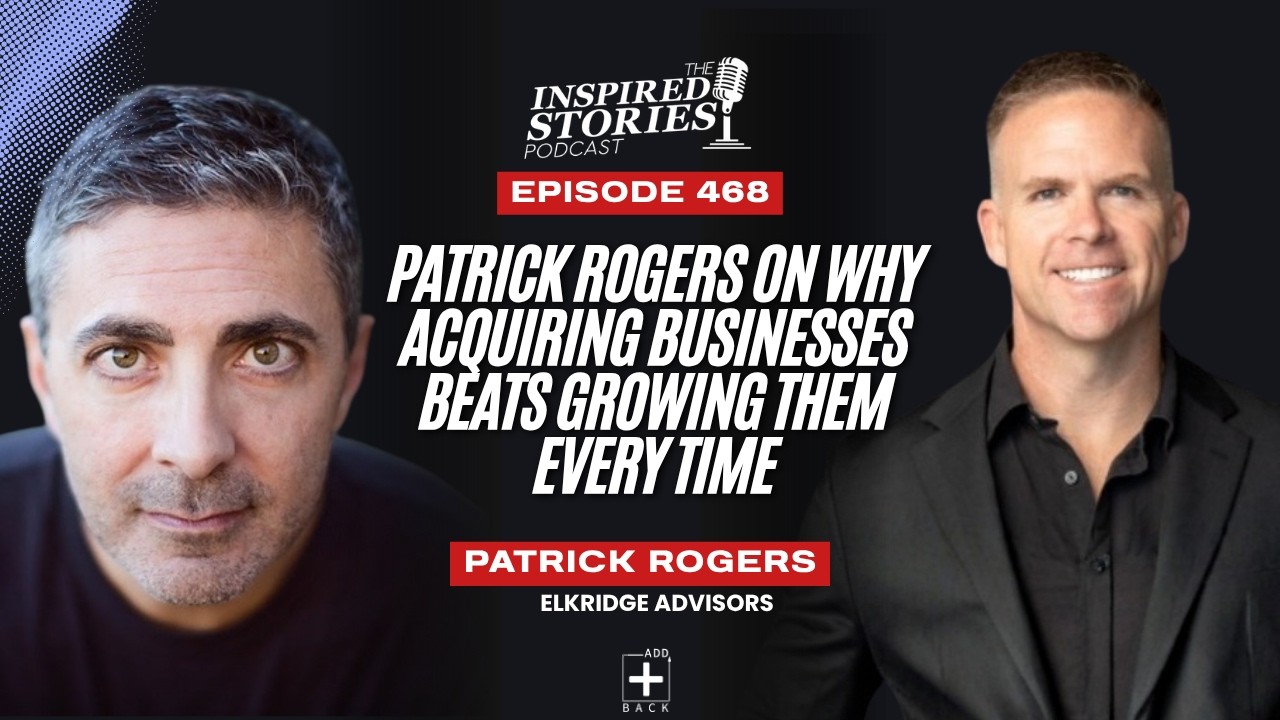
🎙️ From Nuclear Reactors to Acquisition Arbitrage: Patrick Rogers’ Path to Elkridge Advisors
Patrick Rogers, managing partner of Elkridge Advisors, ran nuclear reactors in the Navy, spent 13 years in chemical sales management, built a property management company from a real estate crash, coached CEOs for 17 years, and then watched his M&A mentor reveal a complete absence of character at exactly the wrong moment. What came next — three months of meditation, a complete reinvention, and a business model nobody else is running — is the real story. His goal: create 1,000 deca millionaires by acquiring businesses at 5% down and selling them at double the multiple.
✨ Key Insights You’ll Learn:
The SBA hack that gets buyers into deals at 5% down instead of 10%
Acquisition arbitrage: buying five companies at 4x and selling the combined entity at 8x
How to structure a seller standby note that makes the 5% down possible
Why the SBA Business Expansion Program can get qualified buyers in at zero down
Elkridge’s 60-day observation protocol before any changes are made post-acquisition
Employee-driven strategy sessions — letting the team determine the direction
How Patrick spotted the organic growth ceiling and pivoted to acquisitions
The mentor betrayal that cost $1M and launched Elkridge Advisors
How three months of meditation and manifestation produced a business model that didn’t exist
The 25-company close goal for the coming year
🌟 Patrick’s Key Mentors:
Dave Lofts (District Manager, Nalco Water): Taught Patrick that modeling the best is the fastest path to becoming the best
Wendy Patton (Real Estate Investor): Introduced Patrick to creative deal structures that planted the acquisition mindset
His M&A Mentor (Unnamed): A cautionary lesson in vetting character before trust — and whose betrayal led directly to Elkridge
Robert (Co-Founder, Elkridge): Found through meditation and a year of silence — brought the business operating system that doubled Elkridge’s value proposition
His Own Subconscious: Three months of deep meditation that produced the Elkridge concept and the conviction to build it
👉 Don’t miss this wide-ranging conversation about deal structure, people-driven acquisition strategy, and why the most important business decision Patrick ever made was choosing to sit still.
Listen to the full episode here
Transcript
Anthony Codispoti (00:01)
Welcome to another edition of the inspired stories podcast where leaders share their experiences so we can learn from their successes and be inspired by how they've overcome adversity. As you listen today, let one idea shape what you do next. My name is Anthony Codaspoti and today's guest set a goal to help 1000 business owners sell their companies on their own terms. That number is not a marketing line. It's a personal mission rooted in a belief.
He has carried since before he knew where it would take him, that wealth creates options and options create freedom. He did not arrive at investment making in a straight line. He moved through engineering, industrial sales, real estate and business coaching before finding the work he was really built for. Each chapter taught him something the next one needed. His name is Patrick Rogers. He is the managing partner at Elk Ridge Advisors.
a Newport Beach based M &A and investment banking firm that has generated over $500 million in value for its clients. Patrick holds the Certified Exit Planning Advisor designation, has guided more than $250 million in completed transactions, and he hosts the high performance CEO podcast. Elkridge works with owners of seven, eight and nine figure companies who are ready to grow, partner or exit. But before we get into all that good stuff,
Today's episode is brought to you by my company, Ad Back Benefits Agency. Listen, if you run a business, you're likely stuck in the cycle of rising insurance premiums. You're paying more, but your team is getting less. And many people can't afford coverage at all. We do things differently. We offer solution that provides your employees with unlimited access to doctors, therapists, and prescriptions that's always free for them to use. But here's the part that surprises most people.
Unlike every other employee benefit out there, our program puts more money into your company's bank account. As an example, we recently helped the client increase net profits by $900 per employee per year. Results vary, but gains like that can change how a business is valued. And the consultation is free. Imagine being the advisor that delivers incredible value by introducing this to your clients. See if they qualify today at addbackbenefits.com.
Alright, back to our guest today, the managing partner of Elk Ridge Advisors, Patrick Rogers. Thanks for making the time to share your story today.
Patrick Rogers (02:30)
Yeah, you bet Anthony great to be here. Thanks for having me.
Anthony Codispoti (02:33)
All right, so Patrick, you studied engineering physics at RPI, a pretty serious technical degree, but at some point you decided that wasn't the path for you. What was that actual turning?
Patrick Rogers (02:47)
You know, ⁓ Anthony, I got out of the Navy. ran nuclear reactors for them, got out of the Navy and took a position with a nationwide chemical sales company as in sales. And that was kind of my first introduction away from doing something technical. And, ⁓ the goal was, I always knew that was meant for something more than just a paycheck, right? So it started looking into sales, sales management and that growth strategy.
uh, with a corporate corporate kind of career path. And I started realizing that, you know, as I rose through the ranks 10 years later, I'm district manager running, you know, California and Oregon for my company that even with that, you know, you're making a salary of a great salary of 150,000 plus a bonus, you know, and maybe make, you know, commission sales 200,000 with that, you know, incrementally you put in
Maybe you put in 70 hour weeks to get that. Well, next year, if you put in 80, 90 hour weeks, you're not going to get much better than that. And so I quickly realized that even, you know, 10 years from then, the best I was probably going to do is 300,000 in a similar role or in that structure. And I just knew that there's another way. If I'm going to create real wealth, it's going to be through entrepreneurship. And that's what really started my entrepreneurial journey.
Anthony Codispoti (04:11)
So before we get to where you kind of cross that threshold into entrepreneurism, take us back to Nalco Water. I think that was the group you were referring to where you're kind of working your way up. You're managing a team of sales and service reps. You were there for 13 years, kind of a pretty decent run at a company. What did that environment teach you about yourself that you don't think you could have learned anywhere else?
Patrick Rogers (04:21)
Yep. Yep. Yeah.
Mm-hmm.
You know, Anthony, good question that number one, Nalco company was the best experience I've had in civilian, any, any leadership environment. had an amazing manager, the very top down positive environment. So it allowed me to, to flourish in really whatever I wanted to do with, with, the confines of that company. But what I, what I learned there is if you want to be amazingly successful at something,
find somebody else who is already amazingly successful at it and model them. And just literally that's what I did with my, old manager, Dave Lofts did. I would just follow him around. He would come down to my territory and we'd go on sales calls. And I still remember those sales calls to this day. ⁓ sitting there just observing him for the first couple of months, taking literally word for word notes on everything he did. I wrote down every answer.
to every question that was ever there. And I basically took that computer program, rehearsed, rehearsed, rehearsed, rehearsed, created my own scripts and plug that into my mind. So now I became a mini Dave. ⁓ It's kind of funny even that you actually even picked up some of the, you know, NLP, some of the ways he would talk and answer questions. I definitely brought that up. But ⁓ so for me, that was
You know, if you want to have success in something, find somebody who is wildly successful at it, observe what they do and make it, obviously make it your own over time, but do what they're doing. Just do what they're doing as a foundation and then you can grow from.
Anthony Codispoti (06:17)
What was one of those NLP's you remember that he did? Neuro-linguistic programming.
Patrick Rogers (06:21)
Yeah, my gosh.
⁓ So many. But ⁓ one of the main ones was really mirroring the kind of the tone, the inflection, the tonality of the speed of talk of the person that you're meeting with. if you're meeting with somebody who is who kind of talks like this, and they're just super excited, and there's a whole there's so much more into personality discussions on this, right, we could dive into. if they're talking like this and excited, and you're sitting back
here like this, because that's just normally how you are, then it makes them feel uncomfortable, right? So it's, it's, a course called versatile salesperson we went through and that's the really hinges on NLP science that you really want to try to mirror them because people that people trust people that are like themselves.
Anthony Codispoti (07:12)
they'll be more comfortable and if they're more comfortable with you, they like and trust you. So is it while you were at NowCo that you started running the real estate and property management business?
Patrick Rogers (07:16)
Absolutely. Yeah.
Yeah, back in 2008, 2009, we actually got into that because again, it was just looking for the way to jump out, right? And so one of the things was doing was a Wendy Patton. She's a real estate investor. She had these sandwich lease option deals. And so I would go out there. I would meet with people who had homes for rent. I'd meet with them and I would tell them, Hey, listen, you know, you could rent it out for this, or you could give me a lease option to buy it. And
I will give you 150 more per month for rent. We'll get a lease option for this amount. And then I would turn around and find someone to basically do a no finance option on their home for an additional $150 a month cashflow and an additional $20,000 over the lease option. And so I'd plug people in there. Was doing that from like 2005 to 2006. And so we had a whole bunch of these properties, right? I thought this was my direction. Oh, this is how I'm going to get rich.
wealthy and then, uh, you know, the crash, the real estate market crash of 2007, 2008. So now we had all these properties and all of the, not one of them actually executed their, their option because the real estate market tanked. So they got in at a lease option, let's say 200,000 bucks, but now that that property is worth 180,000, of course they're not going to execute it. So we had 30 property owners now that came to us and so what do I do now?
I said, well, we can manage it for you, but in order to do that legally, we have to have a license. So we went out and got a property management license and overnight we had a property management.
Anthony Codispoti (09:00)
So from lemons, you made lemonade. Because this felt like at the moment, the thing that was going to shut you down, right? And you're like, well, this door closed, a window opened, and here we are onto a business.
Patrick Rogers (09:04)
seems to be the story of my whole life.
Yeah, exactly. Yeah, how do we pivot?
So at that time, I started, we started new foundations with my ex wife, Shelly Rogers. And yeah, it was mostly she did a lot of the work in that I did a lot of the backend stuff because I was still working a nine to five and you know, we were building that business again, with the goal of getting me out of the nine to five and be able to make the jump.
Anthony Codispoti (09:33)
Okay, so tell us a little bit about the kind of consulting that you were providing there at Rogers.
Patrick Rogers (09:39)
for ⁓ the consulting for who?
Anthony Codispoti (09:42)
You were running, did I understand that correctly? You were running Roger's Consulting Group?
Patrick Rogers (09:47)
So, yeah, what ended up happening there is with the property management, we grew the property management company over the next two, three years, did very, very well to the point that we gave a talk at the National Association of Residential Property Managers on what we were doing, the growth strategy, which was a lot of search engine optimization, which was new at that time. And I ended up having like 25 of those business owners.
reach out to me and say, Hey, will you do this for us now? So that actually spawned right into literally overnight was almost making more from coaching and consulting other people on how to do what we did, uh, compared to the actual property management itself. So, uh, that's what spawned me into that. And that's started the 17 year stretch or whatever it is in, in coaching and consulting business owners on organically growing their company. It went from property management and then it went to all, you know,
agnostic.
Anthony Codispoti (10:46)
And is it still in existence today? Still going on? No.
Patrick Rogers (10:49)
Well,
inside of Elkridge, really what that did is that was 17 years of experience, raw experience, being in the trenches with CEOs and business owners on growing their companies and of all types of businesses, manufacturing, landscape, pool maintenance, know, HVAC. And so it was a phenomenal growing curve for me because it forced me to read every book in existence, learn from every course, every mentor possible so that I could adequately coach and consult my clients on how to grow.
And so for what we do in Elkridge, we, right, we acquire companies and then we grow and scale them. So it taught me all the foundations that I needed to know in other companies. Yeah, exactly. So now we don't do it. We don't do consulting unless it's a company that we have equity in, right? So unless we're a minority equity stake or majority, then, you know, that's where we want to focus our time. And that's really what kind of transitioned me away from consulting is
Anthony Codispoti (11:30)
for that growth and scaling part.
Patrick Rogers (11:46)
is I like just to just an example, I'd start working with a client and you know, maybe they're at like 1.5 million in revenue. We get done working with them three, four years later. And, you know, they're at what 810 million and then they're off and running and I'm not making consulting fee anymore because they're all set. They got a good management team. They don't really need me anymore. They they do but they think they don't.
Anthony Codispoti (12:10)
So
this is interesting. So you go to give a talk at this industry event, and you end up with 25 clients that set you on this path. Did you have any idea that that was going to happen or likely to happen? You were just getting up there to, I don't know, provide a service. Just, hey, let me be helpful here. OK. And then from there,
Patrick Rogers (12:17)
Yes.
Yep. Yep. Exactly. Yep. Exactly.
Anthony Codispoti (12:34)
⁓ You're like, hey, I've been doing such a good job for my clients ⁓ that in a few years, they don't need me anymore. I've got the foundation in place for them. Okay. So how did you actually bridge from there into, now I want to start buying my own businesses.
Patrick Rogers (12:51)
You bet. one of my clients, uh, 2019, well, okay, let me back up 2015. I actually attended a webinar on buying your own businesses and I was always attracted to real estate, like buying, buying the company, like doing the lease option things. We did some buys and flips too. So there's always, has been this innate desire for me to see the gold in someone else's trash.
Right? Someone, one man's treasures, one man's trash is another man's treasure. So I've always had a knack and some kind of just an innate desire to take something that is broken and fix it. And it works in business and real estate, but it does not work in relationships, by the way, a little side note there. So, you know, we're all learning. And so I attended this webinar and I was like, okay, that's, that's what I want to do. Ultimately that's, you know, this is to me, this is the pinnacle of business is being able to come in.
buy a business, grow and scale it yourself, sell it for more down later, you know, whatever. So, so there's that. And then the other is that one of my clients came to me and I had worked with him.
I had worked with him. Don't know why that came through. I had worked with him. We started out at 600,000 and then grew his business to 4.5 million over, you know, three, four years. And he came to me and said, Hey, I got a buddy of mine who wants to sell his business and he's going to sell it to me. you know, you have friends in the industry and he, I think he was taking home
want to say he was taking home like 400K. He acquired his friend's business, which was bigger than his. And overnight, I saw somebody go who we had worked three years on getting his business up to 400K per year, which is really good, right? 400, 500K. And within six months, he took that to 1.2 million by acquiring another company. So when I sat back and looked at that, I said, okay, it's good. Organic growth is good.
But if you want true wealth acquisitions, then, so then we started looking, okay, why don't we do this every year then? We just, you know, why do it just once we do this every year and then, you know, you, you really accumulate true wealth. And so that's really what sent me on the path here. And from, from there I found an, started reading every book I, I'm, know, nuclear engineer, I dork, you know, geek out on this stuff. And so I started reading every book on mergers and acquisitions. I couldn't consume enough.
I was thirsty for the knowledge and in that I read a few books from a certain gentleman and reached out to him and then mentored under him. What I was really good at at the time was B2B marketing. And so I was really good at going out there and finding clients, finding people to bring into the firm to who are looking to buy businesses. So I did that, focused on that, brought in lots of business and in return we would share the profits and he would mentor me on mergers and acquisitions. So I did that for a number of years.
Anthony Codispoti (15:52)
So for you, kind of the big unlock was, holy cow, I had this friend that helped to get him to $400,000 in annual, I don't know, either revenue or profit or whatever it was, you'd you'd grow profit. Okay, great. And so, you know, you would help him with this growth. And then he makes this acquisition. And like that, he's at 1.2. And you're like, this is the ultimate growth multiplier, right? We can acquire somebody else's business that's already
you know, has that extra cash flow and boom.
Patrick Rogers (16:27)
And on top of that, we're in a very interesting time right now, a very phenomenal time for acquiring businesses because the baby boomers are retiring. there used to be generational hand downs. They used to give the keys to their kids or grandkids and less than half of them don't want it. So now there's a surplus of businesses that are out there that we can go and acquire. it's here for another three to five years or so until
you know, all the baby boomer businesses will be transitioned. And in response to that, organizations like the Small Business Administration have recognized that and they've created new programs so that people can get in for as little as 5 % of the transaction value. So what that means is if you acquire a company for like one of our deals right now, we're picking it up for like 7.3 million and the cash inlay is going to be, you know, less than 400,000.
for a return on investment of probably 600,000. We can dive into financials, but so they're gonna get a year one cash on cash return of 125%. So where else can you do that in America?
Anthony Codispoti (17:42)
That's phenomenal. hadn't heard that you can, I thought SBA minimum was 10 % down.
Patrick Rogers (17:49)
It is. But if you structure the deal correctly and you know what you're doing, you can get in for as little as 5%. In fact, none of our deals have ever been 10%. They've always been 5%. There's a little bit extra there for like working capital and such, but but yeah, 5%. So if you know what you're doing, if you know how to structure it correctly, then yes, you can get in for 5%. So you know,
Anthony Codispoti (17:52)
What's the shortcut?
Patrick Rogers (18:14)
Yeah, nowhere in real estate crypto anywhere, you're to get a one year cash on cash return of 100%. Our deals range from 50 % return on investment on that's on the low end, Anthony. That's 50%. That's a low end. That's our which is already phenomenal. So 50 % to we've had deals like one right now where it'll be up to 200 % if we end up getting
Anthony Codispoti (18:29)
It's a phenomenal return.
Wow. Okay, so you're kind of dancing around it. Do you want to share what the hack is the shortcut to get to that 5 % on the SBA down payment? Nope. This is
Patrick Rogers (18:50)
No, I'm just kidding. You know, absolutely. Yeah.
So ⁓ yeah, so the hack really is getting the seller to agree. So SBA wants 10 % equity injection. What they don't say is it's got to be 10 % that needs to come from capital injection from the buyer. It just needs to be a total of 10 % post acquisition, liquidity or equity. So what how that works is if the seller
agrees to put 5 % of the transaction value on a 10 year standby note. It accumulates interest all of that, but there's no payments for 10 years, then you only have to put in 5%.
Now, let me blow your mind even more. you have 5 % is good. What if you could do it for 0 %? That's even better. So there's ways to structure the deal for that to happen as well. If you already own a plumbing company and you're going to acquire another plumbing company, good chances you can get it for zero. There's a there's one called the SBA business expansion program loan and you can literally get it for zero. If
You can prove that you own and operate a business in the same industry and you have healthy business results, healthy margins, then you can get it for zero.
Anthony Codispoti (20:19)
Wow. So in that first example, we're talking about how to get it at 5%. The seller is going to carry a 10 year note. Yes.
Patrick Rogers (20:28)
Standby. Yep, exactly. No payments.
Anthony Codispoti (20:30)
⁓ and
no payments for 10 years, why would a seller want to do that? I you're talking about a baby boomer there, you know, later on in life, you know, they, they want these funds to enjoy in their golden years. Why are they gonna say, okay, yeah, I'll kick the can not take a payment for 10 years.
Patrick Rogers (20:48)
Business acquisition is all about finding out just like anything else in sales, we are finding out what's important to the seller.
99.9 % of the time, if it's a baby boomer, what's important to them is the legacy of their company and their employee safety. So we are coming in and we're gaining their trust. We're showing them that we're going to come in where people driven organization, our priority is to preserve your legacy and to ensure the safety of your employees. when we talk about all the things that we're going to be doing,
they get very excited about it because we know what we're doing. We know how to scale companies very, very effectively. And so when that happens, a little 5 % thing that they're going to put on the back burner for 10 years is not a big deal, especially when we tell them that typically speaking, I think it's 80 % of SBA loans get refinanced within two to three years anyways. So we're going to cash you out when we refinance to make our next acquisition with this particular investor.
Anthony Codispoti (21:55)
So they're not actually sitting
and waiting for that for 10 years.
Patrick Rogers (21:58)
No, no, just, yeah.
Anthony Codispoti (22:01)
Very interesting, clever stuff. So as I understand it, your team, the Elkridge team is made up of people who describe themselves as self-made entrepreneurs, folks like yourself. So walk us through specifically what does Elkridge Advisors do and who is it built to serve?
Patrick Rogers (22:20)
Yeah. So Elkridge advisors, what we specifically do is we acquire companies for our investors. We grow and scale those businesses and sell it for a significant profit over the original investment. So an example of that might be we buy a five, 10, $15 million company over the next three, five, seven years, we're growing and scaling that organically. And we're also acquiring other companies that tuck into that fold.
for maximum enterprise value. In that vein, we are looking for as much as we can off market deals or deals through investment bankers that are solid. But when we look for off market deals, we run across sellers of businesses. And so what we do on that end is we help those sellers prepare for exit. Sometimes they want to sell right now they're like, Hey, you know, I would
I don't want to wait to get a higher value, but one of the first things we do is we come in with the sellers of a business and we perform an audit. So we're understanding where are you now? And this isn't just a very, you know, this isn't something you're going to go to a broker and get. We're doing a very complex, detailed audit that looks into every facet of their organization, sales, marketing, leadership, operations.
systems, owner dependence, everything that's going to determine the value of the company now and compared to what it could be financial bookkeeping, all that. And so we prepare this audit for them and then we sit down with them and we share with the seller of the company. Here's what you could get for your business right now. And here's why. And we again, we go through every facet of the organization, every department explain exactly how business valuations are
calculated and so why they're here. And then we prepare for them. Here's what you could get if you had a little bit more runway. If you were to do these things and kind of walk them through X, Y, Z, here's the gaps to you X, know, whatever the value is, a higher value for your company. Mr. Seller, Mr. Mr. Seller, we have investors that can buy your company right now at this price.
And here's how that what that would look like, you know, from a high level or the range and or we can work with you one on one together to help you achieve that higher value, get a higher exit, but it's going to take work. It's going to take a period of time. And here are some of the top things that would need to be done that we would that we would do together over the next year or two to get you to that exitable value.
And then we would help you shop for the right investor. have, you know, well over 30 investors all throughout the U S and so that would be the next step is to help them either a consultively make a decision on selling now or B putting in some more work energy and effort. And I can get instead of 10 million for my company, I could sell it for 20 million is the juice.
Anthony Codispoti (25:27)
What do you typically find
most folks want to do? Which path do they choose?
Patrick Rogers (25:31)
Most want to sell now. Most want to sell now. The ones that are that's if they're over 70 years old, they just they don't have it in them. Even 65. They're like, you know, and quite frankly, it probably wouldn't be the right candidate for us. If they're a baby boomer, typically speaking, they just go ahead and sell now. Most of the time, they're independently wealthy already. They just want to know that they're aligning with somebody who's going to take care of their baby.
Anthony Codispoti (25:59)
Okay. And so you see, you've got 30 investors kind of around the country. So these are folks that you take these opportunities to. And are they the new owner? Are you the owner? you the operator? Kind of what's the relationship between everybody here?
Patrick Rogers (26:16)
Yeah, great question. And by the way, just to kind of build on your last your last question, folks that are under 65 as a general rule were those are the ones that are going to maintain equity, some equity in the company, maybe 20 30%. We acquire the rest. And then we work together. They they're the ones that have more energy. They're more open to it. And then we can help them. You know, we help them take millions off chips off the table now. And then they have 20 % equity.
Well, then that 20 % equity doubles and triples as well. they sometimes they get the second bite of the apple that's just as good as the first one a few years down the road. So how do we structure it? It depends. If it is a smaller company, 5 million and under, typically speaking, equity, enterprise value, we're going to do a small business administration loan. And our partner will have the full ownership of that. And then we have
we just partake in the profits. If it's a larger deal, if we're talking 10 million typically and above, we'll actually be on the cap table with them.
Anthony Codispoti (27:27)
So in that first scenario where it's smaller, five million and under, and you're taking part in the profits, you don't have an equity stake, but you have some sort of an agreement that says, hey, we get X percent each year in exchange for the value that we've brought, the work that we've done.
Patrick Rogers (27:44)
Basically, yes, it's a type of agreement that allows us to enjoy the benefits of equity without actually having equity.
Anthony Codispoti (27:51)
and the risks that come with it, right?
Patrick Rogers (27:54)
Correct. In those circumstances. Yep.
Anthony Codispoti (27:56)
Yeah.
Okay, so what does the engagement typically look like with a client from that first conversation to getting the deal closed? Take us through the process.
Patrick Rogers (28:08)
Yeah, so with the seller of a business. Yeah. So we have, ⁓ we have a number of folks on our team. So one of the first one is the first conversation with someone who raises their hand, you know, from an email and says, Hey, I want to sell gets on with one of our team members, Andy and Andy goes through with them a very high level kind of a screening, if you will, 20 questions. And if out of the result of that,
They are, they meet our criteria. We then move them on to the next step, which is meeting with our head of mergers and acquisitions and actually my daughter, Alyssa, she's working in the firm with us. And so then Alyssa and Jack meet with them and we have a little bit more of a deep, deeper dive, right? We, okay, they met some of the initial screening. We go into a deeper dive. What could this potentially look like?
We explain to them our overall processes and really map out kind of what I walked through earlier in the podcast that we're going to go. The next step is for us to really audit your company for lack of better terms, take a deep dive into the financials. You're going to work with one of our team members. We're going to go through, spend a couple hours and answer a lot of questions as we go through every facet of your organization and really just explaining that kind of process during this call.
And then share with them that at the end of that process, we're going to come to you. It takes a couple of weeks to get this done. We're going to come to you with a very, very thorough report on the current status of your company, the current value of the company, what a transaction would and could look like now. And then if we were to work together, if you decided not to sell, we would work with you in a consultative manner, help you get the business value to where you need it to be.
likely partner with them on an equity stake to help them achieve that. And then, so that kind of walks through that process. And then from there, they're setting up the next call. We're getting a NDA in place to protect so they feel protected. We're both protected that we're sharing, you know, not sharing secrets that are going to get out there. We collect their financials from there. We're meeting with them hopefully two, three days later, and we're going through the entire business. We're starting the audit process.
So once that meeting happens, so now we're into the third meeting, we get all the information from the business owner. We then takes us about a week to process everything, create the overall ⁓ audit, strategic value, you know, mapping session. We then get back together with them, review everything, and we walk through some of the options, what that could look like.
Anthony Codispoti (30:45)
And so post transaction, Patrick, are you guys involved in the operations of the company?
Patrick Rogers (30:52)
Yes, completely. So yeah.
Anthony Codispoti (30:54)
Okay, that was the part
I wanted to make sure that I was clear on.
Patrick Rogers (30:58)
Yes. Yes. So both my partner, Robert entries, we both have 15, 20 plus years of experience in doing exactly that. Me, I coached in consultant CEOs. So I would meet this with the CEOs generally once a week or their management team once a week. And we would go through everything together. And then we, at the end of the call, they would have a clear plan of action for what they're going to do for the next week. Why Robert is an amazing partner for me is
Coaching and consulting, it's good as long as your client does what they agree they're going to do at the end of the week. Well, we both know as an entrepreneur, it doesn't always happen like that. And so what Robert did is he created a business and system that instead of just coaches them, it actually does the heavy lifting of, of most of that work. And so he's created a platform and environment that does that. So
I actually had Robert on my podcast four or five years ago where he was explaining what he did. And over that time I started referring him a lot of clients and they just, they were like, wow, this is, this guy's amazing. And so when it came time to develop the Elkridge advisors concept, it just made a lot of sense to not stop after the acquisition because most people that are investors and looking for this, they want to escape. want to escape from the 95.
or they want to build their wealth, but they don't want to run the company themselves. They don't want to be coached on how to run the company. Right. So the, was just a, just a great pairing of the two for an offer.
Anthony Codispoti (32:35)
So
tell me more about this platform and how he's able to take that heavy lift away from the entrepreneurs on actually executing on these to-dos.
Patrick Rogers (32:44)
Yeah, sure. the when I say platform, yes, we do have a platform. We have an in-house ERP system, if you will, that Roberts developed over the years. So he has a whole offering that we come in. It's a business operating system. But what I'm really referring to is the methodology on how you grow and scale a company. Most companies, Anthony, they are just operationally running.
There's nothing necessarily in place to create an owner mentality amongst the employees and really be a people-driven organization. So when we come into our organization, we're creating something where every employee is excited to be there. Every employee has an ownership mentality. The direction of the company is not determined by a few couple of people at the top. We implement methodologies, accountability.
strategic planning sessions that incorporates all employees. when the day is done, the employees of these companies are just passionate about what they're doing because they're the ones that determine the direction of company and what are the changes going to be and then they're actually implementing it. So it's when you start implementing this business operating system that takes a new paradigm. It's not just operationally doing the thing that the company does. It's also
How do we become a continuous improvement organization fueled by people who feel like they own the company themselves? And when you can hit that, you're winning all around.
Anthony Codispoti (34:22)
What is this term acquisition arbitrage?
Patrick Rogers (34:27)
Acquisition arbitrage. So that's a little bit of a twist on the standard term called multiple arbitrage. So we kind of coined that inside of Elkridge and acquisitions arbitrage. What it really is is
Let's see a good example. If I go out and I buy five HVAC companies and I spend $5 million for each one throughout the US, if I then take those HVAC companies and I put them under one umbrella, I have some common SOPs, some common management in place, maybe common branding, you don't have to do that. But now I've between my down payments and my loans,
I've got $25 million, right? Five businesses times five, there's 25.
The when you do that, the market value of those businesses is not $25 million anymore. The market value of that business is now somewhere probably residing between 40 and $50 million. And the reason is, is you're now attracting a new level of buyer. You're attracting what are called private equity companies, strategic buyer in the HVAC space. So private equity companies will gladly
pay you twice as much for that same EBITDA that was, let's say the profits were a million for one business, you put five of them together, you have $5 million, they will gladly pay you double for that same profit.
Anthony Codispoti (36:02)
So this is well known in the industry, right? There's different thresholds here where the multiple goes up. And for an outsider, that can just seem like a magic threshold. What's actually the reason? What's the mechanism that's going on behind the scenes for why private equity at a certain threshold is willing to pay double what other folks are?
Patrick Rogers (36:05)
Yes.
Yeah. So the companies that are small, so small companies, small EBITDA is generally correlated with a business that has not gone through the growth stages to help it be stable and reliable. So it's a much higher risk to those private equity companies to acquire this company. It's all about risk and reward. So if they have to come in and acquire a company where it's a $5 million company,
a million dollars of profit or EBITDA, but the business is run out of the business owner's head. A huge risk, massive risk. They're not going to touch it with a 10 foot pole. But now you take that same company, you partner with other money and you put in standardized operating procedures. You have a management team in place. You have a proven methodology for growing and scaling. You're off to the races. All the financial, the bookkeeping is all solid. It's all
buttoned up for them, they're going to pay you double for it because it's much, much less risk. And that's something that they can grab onto. They can then come in and very easily implement their processes, their systems, their methodologies. Whereas if they have to come in and take a business that's all, you know, in a business owners, there's a high level of owner dependence is the term. So difficult for them to come in because now they have to fix everything just to get it to a baseline so that they can grow it.
It's just not a game that they want to play and rightfully so because they make no money after that acquisition because you have to fix everything. You have to spend all this time fixing the business before you can start growing it. Well, we're going to do that for them.
Anthony Codispoti (38:05)
So tell us a little bit more about what that process looks like. Because on the surface, it's like, ⁓ you spend $5 million on five different companies. It's $25 million. And hey, we're just going to slap the same logo on everything and then turn it around the next year and sell it for double. But clearly, that's not the case. There's a lot more elbow grease into it.
Patrick Rogers (38:25)
There's a lot of elbow grease. So when we come in, one of the first things that we're doing is we're observing. So we spend 60 days just observing what's going on. We're interviewing every employee for where they are now, where they want to be personally and professionally. We're interviewing them, determining where they think their department and the company is right now and then where they think it could be. And that is amazing data.
We're starting, we're going to measure the culture. We're going to measure operations, financial. We have AI software in house that we're going to put in on top of everything that's going to measure all of this information. And then after 60 days now, we've done all of these surveys. We've interviewed every employee. We now know all the financial data. We know some of the KPIs baseline, benchmark. We now have the first annual meeting and during that meeting,
We are bringing everybody from the company in and we're having brainstorming strategy sessions, open brainstorming strategy sessions on how do we fix this? We're taking all the data that we've already gotten and we're now creating a plan that's developed from the employees of the company. Again, this isn't us coming in and saying, this is what you need to do. And the reason this is important, even if we know what they need to do, which we typically do or to a certain degree,
there were always surprised first of all that went because people on the ground they know what needs to happen in that company and when you give them a voice when you give them an outlet and then you actually follow up on that and do the things that they want to do and allow them to even have the ownership on making those changes overnight we are changing the culture in those companies and so so that's that's the process so through that process one of the things that everybody always comes to is well we don't have any
You know, this person's overstepping this person and we do it different than this. Johnny's in the same role as Jane, but they do it differently. One of the things that everybody comes to is we need to have SOPs in place. We need to have a standardized way of doing it so everybody does it the same. And so now this isn't us coming in and saying you need to do this. This is them saying we need to do this. And when you have that in an organization, you have, they're driving it exactly.
Anthony Codispoti (40:40)
when they're driving those changes.
Patrick Rogers (40:44)
And so now we're off to the races on becoming a continuous improvement company because they're bought in on it and they love the idea of it. They they're implementing the changes they want to see to then feel like it's home for them. We do that across on every single business that we incorporate.
Anthony Codispoti (41:00)
So I'm curious what a realistic timeline is for that integration to take place. And obviously it's hugely dependent because it's not like you're acquiring all five companies at the same time. You start with one, you find another one, another one, and so you're sort of bolting these on as you go. But I don't know, give us some sense of how long does it take once you've got them to have them fully integrated and you're ready to repackage and put them back to market?
Patrick Rogers (41:30)
Generally speaking, most of the businesses that we acquire do not have a structure for growth in place. Why is that? Because they're baby boomer owned and they're, you know, hey, they've been getting most of their business from referrals. So they're growing at 5 % per year, maybe gaining some customers, losing some customers, maybe being pretty flat. So the first thing we do is we take six to 18 months to prepare the business structurally for growth. It could
take as little as six depending on the team and excitement and just to where things are now it could take as much as 18 months. Once that is in place and it can support growth and structure, we then implement a new sales and marketing program targeting the right clients for the business. Then really everything so now we prepare the business for infinite growth, you know, or we have a plan in place and then we turn on the floodgates of clients.
And so typically speaking, just by preparing it for structure, assuming we don't grow the business at all, that increases the value typically double, typically speaking. Then we go and we turn on the floodgates of clients. so then three, five years out, we're bringing a ton of clients. Along the way,
We're also doing what's called tuck in acquisitions or bolt on acquisitions depending on the industry. a tuck in acquisition, you bought your first one was a $5 million plumbing company. Once we have that in place, we're then going to go out and start acquiring smaller companies as well and getting fantastic multiples on those. So let's say it's a plumbing company, million dollars of sellers discretionary earnings or EBITDA. The multiple was a four, let's just say. So we paid 4 million for it.
We're now, we now have a platform. We prepare it for structure. Once it's ready to grow to infinity, we then start gobbling up all the other plumbing companies in the vicinity that this company can service. But we're paying a multiple of maybe two for those small companies and immediately overnight, as soon as that business closes and it falls into the fold of our platform company, this is the whole acquisition arbitrage, multiple arbitrage. If it was doing, let's just say it's doing 500,000, no.
let's say it's doing 100,000 of profit, we paid 200,000 for it. But as soon as it goes into our business, it's worth 400,000. So we made $200,000 overnight just by bringing those clients into our business and our system in our fold. So now we go out and we do that as many times as possible. And that is a multiple arbitrage or acquisitions arbitrage consolidation theory.
Anthony Codispoti (44:15)
Fascinating. So Patrick, you've got a stated goal to help 1000 business owners sell on their own terms. It's a big number audacious number, where's it come from?
Patrick Rogers (44:27)
Well, really the goal itself is our goal in Elk Ridge Advisors is to create 1000 Deca millionaires.
Anthony Codispoti (44:34)
⁓ okay.
Patrick Rogers (44:36)
That could come from business owners selling or it could come from our acquisitions, but it's going to, it's going to always happen. We're always going to be even one investor with one portfolio is going to be always buying and selling. So, so that's our goal. And what, what it really comes from is Robert and I both, we know that our purpose on this earth is much higher, a higher calling than just making a lot of money. So our goal is to align and create as many.
Decca millionaires as possible because it only with good people though with good people that we align with on our values because we know that good people with wealthy good people do great things on this earth.
Anthony Codispoti (45:18)
So 1,000 deca millionaires, meaning $10 million or more, it's significant. ⁓ And so as you look at the different parts of the equation to make that happen, there's investors, there's sellers, there's you guys with the operational expertise in the middle. What do you need more of to get to that goal?
Patrick Rogers (45:42)
Great question. We need more good businesses. We need more businesses to acquire. We're actively looking for folks who are, you know, hey, they've put in their 20, 30 years and they're ready to take some chips off the table, ready to cash in on some of that hard work they've done. So our goal is to align with those business owners and really we're industry agnostic. We can work with any industry. just, Robert and I both and our team have had experience in any industry.
And so we're looking for those folks who are ready to take enjoy some of the benefits of the hard work that they've put in for 10, 20, 30 years and, and sell their companies.
Anthony Codispoti (46:24)
So industry, sorry, you got something else you wanna say, Patrick? So industry agnostic, ⁓ certain revenue thresholds or geographies that you guys wanna focus on.
Patrick Rogers (46:27)
No, no, no, was it.
Really, no. Anywhere in the US, we have clients all throughout the US, to be honest with you, really. So, ⁓ far as revenue thresholds, really, under $3 million a year is a little bit tougher, right? Because that's typically that area where between $2 to $3 million, where everything is still inside the owner's head. And so, it just makes it a little bit more tougher. But we're definitely willing to...
look at it, there are some business owners that got it earlier on and are not actually running the business every day. Right. And so if the seller of the business is actively involved in the business right now, we probably really actively involved, it would probably be very tough to come in and acquire that business, but we'd be more than happy to meet with them, go through our audit process together. In fact, we're doing this right now with someone.
and we're chart and charter out a path for them to sell their company and to be able to get what they actually deserve for it. And so in those cases, while they're not ready for us to acquire, we'll still work with them, probably partner with them in some form or fashion on equity cap table side of things, put the plan in place for them to get there and then help them get there and get what they should be getting for the company instead of selling it for nothing or worst off.
What ends up happening Anthony is these business owners that are sub 2 million, sub 2.5 million, their business is just not ready for sale. It's very tough to sell something where it's all you. It's a very hard find to find somebody else that wants to come in and do exactly what you're doing. Most people want to buy a business, not a job. And so that's what we walk them through is how do we transform what you're doing now, which is you're basically have a high
paying job and transition that to something that's going to make you a lot of money. And one of the biggest things is owner dependence, creating those business systems, getting that business so you can scale and grow without you.
Anthony Codispoti (48:48)
Is there a max size in terms of revenue that probably outside your comfort zone?
Patrick Rogers (48:54)
Probably above 30, 40 million. We can work with any size business. Our M &A team will help them sell or buy, but for our investors, probably we're looking 30, 40 million to actually have Elk Ridge acquire. Now on the sell side advisory, we're actually working on deals right now that are
well over $100 million. So we're helping or excuse me, buy side advisory. So we're helping some investors acquire those larger companies we're looking right now in the defense and semiconductor industry. but that's a whole different. That's a bit of a different ballgame, right? We're not we're not going to be on the cap table for that. We're just helping those investors find and acquire these large, larger companies.
Anthony Codispoti (49:45)
So you're not part of that going forward. So this is like a different part of the business than what we've been exploring up to this
Patrick Rogers (49:49)
Different part of the business, exactly
right. So we'll help them. We'll put together the investment thesis and the mandate, and then we go out there and locate the companies in the defense or semiconductor industry that they're interested in. Their current mandate is $50 million to $1 billion. And so we'll find those opportunities. We'll then prepare. Obviously, there's a lot of work that goes into that, but we have a number of team members in our network and with our organization that have experience.
Anthony Codispoti (50:16)
Does your background in being a nuclear engineer come in handy in sort of this defense work or just more your &A experience that's helpful?
Patrick Rogers (50:26)
Well, it's
more &A really, because you need to make sure that you're aligning with somebody that really knows what they're doing. Some of our investors are over in the Middle East. And so you start getting into some cross border issues. There's CFI US issues. So there's just a whole nother level of knowledge there.
Anthony Codispoti (50:46)
Tell me about a deal that looked like it was going to close and then started coming apart, you know, because this these things happen and it boy it's like a gut punch. What do you do? How do you work through that?
Patrick Rogers (51:00)
I've had a lot of deals fall apart. ⁓ You know, which one shall I pick? The deals don't fall apart in the honeymoon phase. The honeymoon phase is just getting to the LOI and then for a week or two after. Where the deal falls apart is in after that, when we start looking at the actual acquisition, what ends up happening more times than not is
We'll go in, we'll look at a deal, we'll have an LOI for an agreed upon term and price. And then what ends up happening many times is when we dig in, everything isn't as rosy as it seems. So we might do the financial due diligence. And what they told us, what they believed the EBITDA and even what was on the P &Ls says, let's say it's got a million dollars of EBITDA. When we really get in and look at it, wow, there's some funny numbers in.
there. There's some things that they were doing on taxes. And so the actually but those 750, 800,000. Well, doesn't seem like that would be that significant of a change, but it changes the price of that value significantly. So you'd multiply that difference. So let's say it's $250,000 less multiply that times your multiple of four, that's a million dollars less that you're going to be able to pay for that company. So that's where things really start falling apart is after
the LOI, we're doing financial due diligence. Typically, it's not the operational due diligence that has us fall apart because we already have a pretty good idea. But once we get into the books and so now it's it's a renegotiation game because what they thought in their mind, they were already like, OK, we're getting, you know, whatever, 10 million for the business.
they're already picturing what life's going to be like with that 10 million. So they're saying they've already got it spent before they've gotten it. So there's an emotional attachment to that exit value. And so we try to preclude this ahead of time by being upfront and setting expectations that, you know, this is what's going to happen typically. You know, these are the numbers that you believe when we get into it. So I didn't used to do this in my earlier days. And so they already know that when we come back to them, it's probably going to be a bit less. And here's why.
But we walk them through it and we explain. I think the key to all of this is transparency, Anthony. Setting proper expectations and transparency as to why the price is where it is. The more we can do that, the more it makes sense.
Anthony Codispoti (53:36)
Patrick, walk us through one of the hardest things that you've had to overcome personally.
Patrick Rogers (53:42)
Hmm.
Yeah, well, one of the hardest things I had to overcome. So I have a number of things. There's so many, I've got so many battle wounds. One that comes to mind specifically was with my previous &A mentor. So with my previous &A mentor, it was a, it was a good relationship until things started getting really serious. And by that, I mean, I started bringing in companies that were large.
companies with $20 million of EBITDA and the transaction value is going to be, you know, 150 million. Up to that point, we were working much smaller deals, deals that were, you know, three, four or 500,000 EBITDA. So transaction value was anywhere from 7.5 to 20 million. That was the most of our deals. And I started doing some campaigns. I won't go into too much detail and started bringing in some big companies. And
What ended up happening was after I brought in those companies. So I stood to make about 1.5 million closing one deal.
So after I started bringing in these big companies, my mentor at the time started being very squirrely about the deal structure, who's going to get what, how much of it was going to be shared by who. And to the point where my 1.5 million ended up being like 500,000 when it closes, it's actually still going on right now. So
This was tough for me. So I had to make a decision. I had to make a real hard decision because I was in a place where I could make a lot of money with him, continue to learn. But I obviously had aligned with somebody who's who is not of character of ethical value. And so I made the decision to not go any further with him. But I didn't know what I was going to do from there. I had no idea.
Anthony Codispoti (55:49)
you jumped ship without a new plan.
Patrick Rogers (55:51)
I exactly. And this wasn't that long ago. This was two years ago. Now. It's still fresh. So so I had just moved down to Southern California with with my daughter to kind of help her on her way. And I did not have a new source of income. I had enough to keep by you know, I've done you know, I had six months a year, you know, all that whatever. I've done done well for myself, but I didn't know where I was going.
Anthony Codispoti (55:58)
This is still fresh.
Patrick Rogers (56:21)
And it was very, very stressful. I had just exited a three year relationship at the time or two and a half year relationship. And so there was a lot of loss in this in in in one period of time, right? A lot of changes. I just moved to Southern California, broke up with, you know, the last relationship didn't work out. And then this thing, which I thought was my career, is crumbling in front of me. And so I was searching for answers.
how do I find the direction of where I want to go? And I've been on a spiritual journey for a long time and I have known about meditation and known about manifesting, but I had not actively done it to any effective degree. And I literally spent the next three months ingrained in meditation, ingrained in learning what is this manifestation thing? How do I become rerouted with myself because
When you're going through stress, stress of relationships, stress of life, you've got all this stuff. There's a lot of mud on your windshield. There's a lot of stress there and it's very hard for you to see and it's very hard for you to allow your your body and your subconscious mind to determine what you need to do. Interestingly enough, right? I think most people you really can't argue that less than 5 % of our activity or what determines our actions is our actual conscious
frontal prefrontal cortex, whatever it's called, always frontal lobe. But most, yeah, most of it is 95 % of it is your subconscious, which was printed a long time ago. And it's ⁓ it determines how you're going to respond in life. So I went started going down this road and learning this and spent a lot of time in meditation, manifestation, understanding re reconnecting to myself. And that's when
Anthony Codispoti (57:52)
prefrontal cortex.
Patrick Rogers (58:15)
this concept of Elkridge Advisors really came about is when you reconnect with your subconscious to source, the universe starts really doing things for you, acting on your behalf in your sleep during day, things come to you that would not have otherwise come to you. And that's how, you know, I really started down this path of this concept of creating this because no one else is doing this business model. This doesn't exist.
Anthony Codispoti (58:42)
I think that's why it took me a minute to sort of gather my thoughts around what was happening and wait, are you guys involved operationally? So come back to the manifestation, explain that in a bit more detail. What does that look like? What does that mean? How does it work?
Patrick Rogers (58:59)
So not to go too woo woo woo with everybody, but we all have beliefs about what's real, what's existence, what's God, what's the universe. And what I believe and have been led to believe is that there's infinite
Anthony Codispoti (59:04)
We're already in. We're already in.
Patrick Rogers (59:21)
realities in existence at any given time. And it's your decision on whether you're going to tap into a reality that is ho hum and normal, or you're going to tap into a reality that is exactly what you want in life, achieving abundance and achieving all of your dreams and goals. And so when you when you start to believe that you start to realize that how you tap into the reality of that you want to create
Is there a thoughts drive our actions and thoughts drive our emotions, emotions drive goals, know, actions, all of it's kind of in one thing. And so there's a way to tap into that and actually reprogram your subconscious. So when you get into meditation, when you bring yourself into a theta brainwave, it's actually the same thing as hypnosis. You're just conducting self hypnosis. You're doing it through meditation.
And during that timeframe, when you're in theta, when you're in that meditative mode, you're communicating with your subconscious, you're able to actually reprogram your subconscious from all those limiting beliefs. You know, how many kids that when you grew up, did your parents say money, money doesn't grow on trees, right? I would probably say at least half if not more. And so those are all things that end up holding you back as you go throughout life. And you may not know that
until you may not even recognize that. So all these limiting beliefs, all these lenses are there that prevent you from becoming one with the source, one with the universe and abundance, because that they're all they all really go hand in hand. And when you connect to your subconscious, when you start feeding your subconscious, new programming in the meditative state, you're able to achieve that. And one of the most important things with manifestation is
If you, when you get into that meditative state, you believe that you already have and already are whoever it is you want to be. You put yourself in the emotion of that place and that person and the universe has no other choice but to deliver to you that exact thing, because that is the reality that you're building.
Anthony Codispoti (1:01:42)
And this is what helped you get from that low point to now where you are at Elkridge Advisors going up and to the right with this completely new concept that nobody else is doing.
Patrick Rogers (1:01:52)
Yep. And it's not like I thought of it, to be honest with you. What ended up happening is I opened I know that I opened myself up to the universe. And things started coming to me. Information was started coming to me. Literally, I know, again, this is again, this is super who stuff like I get chills even now thinking about it. But for a month straight, I started seeing 1111 everywhere. When I was when I was actually carving out this and things were coming to me.
1111 was everywhere. And if you're not aware, that's one of the angel numbers and it tells you that you're on the right path. Keep doing what you're doing. And one of the things actually, it's an interesting story.
A little bit of a sidebar, Anthony is building on this six months after into building Elkridge Advisors. I hadn't created the full company as it is now. I just had the mergers and acquisitions side of thing combined with coaching. So I was just going to coach them.
started getting a lot of momentum, a lot of clients, and I started getting stressed out. And I literally was like, don't know what I'm going to do. I don't know how I'm going to handle all of this. So I went to bed that night, meditated, prayed on it. And that morning, Robert, who I had not talked to in a year, messaged me. He said, Hey, man, just wanted to connect, see how things are going. Well, we connected.
And I shared with him, you know, what's going on and what we're doing. And what he specializes again is is implementing business systems. So at first I was just hiring his company to come in and systematize my company for growth. So I know how to it's very interesting when you it's very easy to coach somebody else on how to do it. But when it comes to your own organization and your own, you it's a different story. So I hired Robert to come in and infrastructure eyes.
Elkridge advisors. And when he started doing that over the next few weeks, we started meeting and started meeting and he started realizing what's in front of me and what I have the potential here. He's like, dude, ⁓ there's a whole nother side of this that I think I think we should partner because you bring me in, I'll be able to actually grow in the scale of the company for these people. And now you've just doubled your value proposition, double the amount that your firm will be our firm will be able to make if we partnered, right. And
Yeah, I just it was just off to the races after that. Yeah.
Anthony Codispoti (1:04:27)
fun stuff.
Patrick, I've just got one more question for you today. But before I ask it, I want to do three quick things for the audience. First of all, to get in touch with Patrick or the business Elkridge advisors calm, real easy. It'll be in the show notes, but elk Ridge advisors calm. And you can find Patrick Rogers Elkridge advisors on LinkedIn. And we'll have the link to that the show notes as well. And if you're enjoying the show today, please take a moment to subscribe wherever you're listening.
It also sends a signal that helps others discover our podcast. So thanks for taking a quick moment to do that right now. And as a reminder, you can be the hero advisor that helps clients give their employees access to therapists, doctors, and prescriptions while paradoxically increasing your net profits. Real gains that can change how businesses value. Contact us today at adbackbenefits.com. So last question for you, Patrick, a year from now, what is one very specific thing you hope to be celebrated?
Patrick Rogers (1:05:27)
Hmm.
We hope to celebrate. We have a goal to get 25 businesses across the finish line this year. Yeah. Simple and direct, easy. If we can do that, we're doing fantastic.
Anthony Codispoti (1:05:36)
Love it. Simple direct.
Patrick Rogers from Elk Ridge Advisors. I want to be the first to thank you for sharing both your time and your story with us today. I really appreciate you being here.
Patrick Rogers (1:05:52)
Anthony, thanks for having me, man. This was lot of fun.
Anthony Codispoti (1:05:54)
Folks, that's a wrap on another episode of the Inspired Stories podcast. Thanks for learning with us today. And if one thing stood out, put that into action right now.
Connect with Patrick Rogers:
Website: elkridgeadvisors.com
LinkedIn: Patrick Rogers — Elkridge Advisors