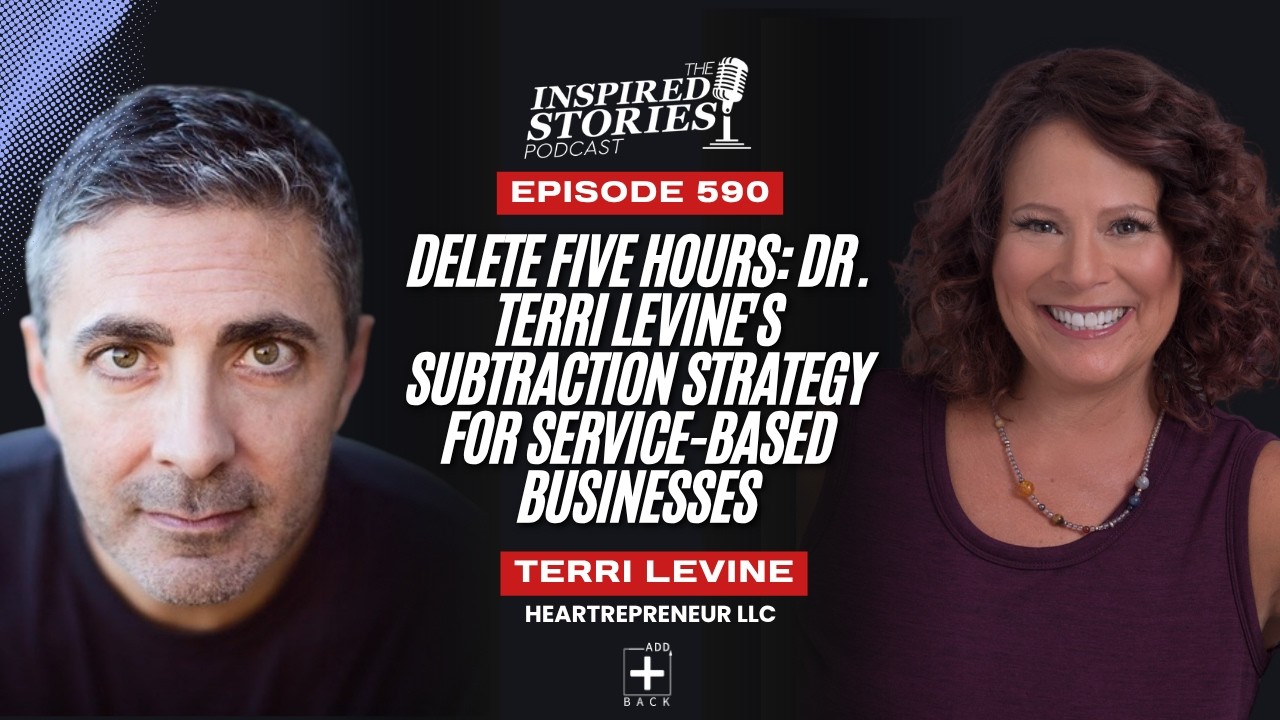
🎙️ Live Well, Earn Well: Dr. Terri Levine's Heartrepreneur Journey From Speech Pathology to Coaching
In this episode, Dr. Terri Levine, founder and Chief Heart-repreneur of Heartrepreneur LLC, shares how a career that began in speech pathology led through a corporate healthcare CEO role, a devastating neurological disease diagnosis, and the sudden loss of her mother and closest friend within a week of each other, before she built a coaching empire around relationship-first selling. Terri opens up about the disease that nearly ended her life, the publisher who threw her manuscript on the floor and demanded she reinvent her business, and the reverse tithing philosophy that now shapes every financial decision she makes.
✨ Key Insights You'll Learn:
Opened her own speech pathology clinic and discovered she loved marketing more than clinical work
Studied under Zig Ziglar early in her career and adopted his help-first sales philosophy
Rose to CEO of a national healthcare company before walking away within months of losing her mother and a close friend
Was later diagnosed with RSD, a severe neurological pain disease, and spent time in a wheelchair before relearning to walk
Signed her first five coaching clients within a week and thirty clients within thirty days of launching her practice
Rebranded her company to Heartrepreneur after a publisher rejected her manuscript and pushed her to redefine her message
Has written 41 books and built and sold seven companies across 19 different industries
Built a “one community, one offer, one video” system that generates leads in as little as 20 minutes a day
Practices reverse tithing, giving 90% of company profits to her RSD foundation for children
Now works roughly 20 hours a month while stepping back from public speaking and moving into ghostwriting
🌟 Terri's Key Mentors:
Zig Ziglar: Taught her a help-first sales philosophy that reshaped how she approaches every client relationship
Her Publisher of Eleven Years: Rejected her manuscript and pushed her to create the Heartrepreneur brand and message
A Stranger on a Plane: A chance conversation about life coaching set her entire career pivot into motion
Her Husband: A financial advisor whose investment strategy turned her business proceeds into lasting family wealth
👉 Hear how a speech pathologist turned corporate CEO survived one of the most painful diseases known to medicine and built a coaching empire around giving first and living in the moment.
Listen to the full episode here
Transcript
Anthony Codispoti (00:00)
Welcome to another edition of the Inspired Stories Podcast, where leaders share their experiences so we can learn from their successes and be inspired by how they've overcome adversity. As you listen today, let one idea shape what you do next. My name is Anthony Codus Fodi, and today's guest practices something called reverse tithing, a business philosophy most entrepreneurs have never heard of, and it now shapes every financial decision she makes. She has authored more than 40 books.
Built and sold multiple multimillion dollar companies and worked with more than 7,000 business owners. She started her career as a speech language pathologist before running her own clinic and moving through several ventures on her way to the CEO seat at a national healthcare company. In 1996, within months of losing her mother and one of her closest friends, she walked away from that role and built a coaching company out of her home office.
Terry Levine is the founder and chief heartrepreneur of Heartrepreneur LLC in North Wales, Pennsylvania, where she coaches the coaches, consultants, and service providers using her live well, earn well, life design method. She also runs the Terry Levine Foundation for Children with RSD. And clients who implement her system report a 100% success rate with one client doubling her income in six months.
While cutting her work hours by 20%. But before we get into all that good stuff, today's episode is brought to you by my company, Ad Back Benefits Agency. And you'll want to hear this because it's hurting almost every business owner you know. See, health insurance costs go up every single year, and businesses are furious about it. They're paying more, claims are getting denied, employees are opting out because they can't afford it, and it hurts turnover and morale. It's one of the most maddening problems in running a business.
And everyone just seems to accept it. But you don't have to anymore. Now there's a program from Bain Capital Insurance that gives your employees unlimited access to doctors, therapists, and prescriptions with no co-pays or deductibles to meet. And here's the part that really surprises most people. Unlike every other employee benefit out there, our program increases your net profits. We recently helped a client add, add $900 per employee per year to their bottom line.
Results vary, but gains like that change how a business is valued. You can be the hero advisor that introduces this to your clients today, and they'll be so happy they refer their friends to you. At backbenefits.com. All right, back to our guest today, the founder and business strategist of Heartrepreneur, Terry Levine. Thanks for making the time to share your story today.
Dr. Terri Levine (02:46)
I'm glad to be here. Thanks for having me, Anthony.
Anthony Codispoti (02:48)
It's actually Doctor Terry Levine. What is the doctor in?
Dr. Terri Levine (02:52)
Clinical psychology organizational behavior.
Anthony Codispoti (02:55)
Okay. And did that come before or after the speech pathology? Okay.
Dr. Terri Levine (02:59)
Way after it came along
with the coaching and consulting.
Anthony Codispoti (03:03)
My wife is a speech pathologist, so I feel a little bit of a connection there. Yeah. She
Dr. Terri Levine (03:07)
Yeah, how about that?
Anthony Codispoti (03:09)
she works in a low-income school district here in Columbus, Ohio with preschool age kids. So she has got a a heart of gold and different skill set than I do, and I thank the the world every day that there's folks like that.
Dr. Terri Levine (03:22)
Easily.
Anthony Codispoti (03:23)
So you started your career as a speech language pathologist, opened up your own speech clinic, and then
I wonder if there was some point along the way to getting your degree, practicing, and then opening up your own clinic, did you realize you actually enjoyed the business aspect of it more than the actual clinician side of things?
Dr. Terri Levine (03:46)
So I didn't know what I didn't know. I didn't know that speech language pathologists it up until that time had never had a private practice. And I just thought I'm gonna have a private practice and I'm just gonna treat patients. I didn't know a thing about business sales or marketing. My husband and I though relocated to the Midwest where we knew absolutely no one. We're from the East Coast. it was very clicky, small town.
And I have to have doctors make referrals. So I had to learn how to market. And it was not easy. I almost failed. Took about a month to finally convince a doctor to refer. And then I realized that if I wasn't marketing the clinic, I would have no patients to treat. So I learned everything I could about sales, business, and marketing and realized I was much better at that than I was as a speech language pathologist. So I replaced myself and had another speech pathologist come in and then an OT occupational therapist.
therapist than a PT. However, that's where I really learned that my forte is business sales and marketing.
Anthony Codispoti (04:49)
Okay, so but how did you learn to begin with, right? You went to school to become a speech pathologist. You didn't go to school for the business side of things, the sales and the marketing. Were you just picking up books? were you finding mentors, coaches?
Dr. Terri Levine (05:03)
So
part of it is teaching myself because I had no idea what to do. And so I just tried marketing. Look, I'll do this, I'll put out flyers, I'll go on the radio, I'll get interviews, I'll go offer to speak. So a lot of it was just me from desperation trying some things. And then I hired and took out a small business loan to do this, Zig Ziggler, because I really needed to understand sales and communication and mindset. And then after that, I read.
Tons of sales books, went to tons of sales training, and then I didn't like any of it, threw it all in the garbage and just started doing it in a more heartfelt way. Didn't feel right to me, it felt manufactured.
Anthony Codispoti (05:45)
Was there something along the way that was helpful to you though? Like was the Zig Ziggler thing like a big eye opener?
Dr. Terri Levine (05:51)
Zig Ziggler.
Yeah, I'm glad you asked that. Zig Ziggler really was the most helpful because Zig was all about just go help enough other people. Just go help enough other people. and so I stopped focusing on
I need money or I need sales. I need this. And just became more of an advocate helping people. So I, you know, I went to Montessori schools in the area and I'm like, I just want to screen your kids and explain to the parents about what ages children normally do stuff. And as I started to be helpful, people started hiring me. And that stayed my literally my mantra in all of my career.
Anthony Codispoti (06:27)
interesting. So you're going into these schools, you're not charging for these evaluations, which everybody else does. Just I want to be helpful. And from that doors start opening for you. People are like, yeah, okay, I can see my child needs help and you're the person that's here and being kind and helpful. I'm gonna hire you.
Dr. Terri Levine (06:45)
Exactly. And then I did the same thing with the VA. I just went and did some volunteer work there. And then they started to send us some of their head injured patients because that's a key area that I always worked in. So it just came from let me just go out in the world and talk to people and just extend my hand and say I'm here to help.
Anthony Codispoti (07:05)
It's a novel idea. Well, and
Dr. Terri Levine (07:07)
Nowadays it appears to be
Anthony Codispoti (07:10)
we'll get into it more because we're going to get to the point where you do start your own firm. But before you got to that point, you moved through a handful of different ventures and you eventually stepped into a CEO seat at a national health care company. This is back in 1996. And within months, double tragedy. you lost your mother, and then days later, one of your closest friends.
Walk me through what that time period was like, the losses, the the emotional journey we you were on, and then ultimately the moment that you decided to step away from that executive.
Dr. Terri Levine (07:46)
so I was just, you know, moving along in life. I had sold many different companies, and I really don't know why, other than ego, I decided to be CEO of someone else's company instead of my own. And so I took this job, CEO of National Healthcare Company.
I knew from day one I didn't fit. I'm not employable. I'm an entrepreneur. So I wasn't happy from day one. My mother gets sick with emphysema, and my mother is dying, and my girl girlfriend Marnie, at the age of 40 is dying of breast cancer, and they died within a week of each other.
It was one of the most it's still I can feel it's one of the most difficult times that I went through and I I probably didn't even recognize the fact I was massively depressed. And I realized that the company just really cared about when is Terry coming back to work.
And at that point, Marnie had said three days before she died, I couldn't go see her when she was on hospice. I was with my mom. Three days before she died, she said, Terry, don't make your life about work. They're gonna stand up at my funeral and talk about work. Make your life important. And I just knew I had to quit this job and I had to do something else.
Anthony Codispoti (09:01)
So Marnie is passing this message along. She's saying that at her funeral they're gonna stand up and talk about the work that she did because she wa she made her life about work.
Dr. Terri Levine (09:09)
Completely her whole and and she was right. I mean at her funeral it was one person after another and no one was talking about her personal attributes and it just like my heart was hurting and I thought that's exactly what's happening.
Anthony Codispoti (09:24)
Wow. How did you get through that time? I mean, these
Dr. Terri Levine (09:27)
Mm.
Anthony Codispoti (09:27)
are two people that you would typically have gone to for your difficult moments.
Dr. Terri Levine (09:31)
Yeah, my mom was literally my best friend. We were so, so close. so for two years I went into a shell. I didn't talk very much. I didn't want to do anything social. I barely picked up calls from friends or family.
And as I say, I recognize now I was in depression. I should have had therapy or help. And I just went internal and did all this internal silent grieving. And it was really close to the end of the second year when I was driving, paying absolutely no attention, just bumped the car in front of me. Just I don't know, wasn't even thinking. And the person got out of the car and I was expecting them to scream and yell at me and didn't. Took one look at me and said, Are you okay? And I just burst into tears and I said, My mother died.
But they probably thought my mother died five minutes ago. And then I realized I need to talk to someone about this. And that's when I got help.
Anthony Codispoti (10:26)
Mm professional. You went to see h a counselor or therapist, yeah.
Dr. Terri Levine (10:29)
Yeah, I
I had so many of them in my life. I just knew a lot of medical and healthcare people being a speech path. And I went to somebody that I knew and trusted and she said, I've been waiting for you for two years.
Anthony Codispoti (10:41)
So this incident happened two years, the the bumping of the car. That was
Dr. Terri Levine (10:45)
Two years after. Yeah.
Anthony Codispoti (10:48)
and then can you describe what the road to recovery, if that's the right term for it, look like for you?
Dr. Terri Levine (10:55)
It was actually so quick, it's unbelievable. And I tell people like this might might not be you because this isn't normally how things happen. I was so open and curious and so ready to like move mentally to a different place that after two sessions, one where I just cried, I I must have just cried for an hour. I don't even think I spoke. It was the first time I let it out.
And the second one where I just started thinking of all the positive aspects of my mom and Marnie, embracing those. And I was good. I did hire a life coach at that time also. And that was actually even more helpful.
Anthony Codispoti (11:31)
Wow, so you just had a lot of this bottled up emotion from the last two years. You had one session where it all came out, the second session you turned to gratitude and this was a a a big switch for you. Okay.
Dr. Terri Levine (11:43)
Was
a true transformation and a very big release.
Anthony Codispoti (11:47)
Wow.
When did you have the idea to start your own consulting company, your own coaching company?
Dr. Terri Levine (11:54)
So this is just the craziest story. So I hired a coach. I just didn't know that she was a coach. My therapist said you might want to also hire this person. And she didn't call herself a coach. So I always thought she was a therapist. I really don't remember what she called herself. And we started working on lots of deep things. And she said, I recommend you go to a Mind Body Spirit conference. Just get away, just go in a new environment.
So I get on the plane, which is I love the universe and the synchronicity. I sit next to a woman and I say, are you going on business or pleasure? She said, Business. She said, I'm going to conference, I'm a coach. And this is, you know, well over 30 years ago. And I go, What's sport? And she goes, No, no, no, no,
Anthony Codispoti (12:38)
Yeah.
Dr. Terri Levine (12:39)
no. She says, I'm a life coach. And I go, What the heck is that? As soon as I got off the plane.
I knew that this is what I was supposed to be doing. I'm like, that's what I'm supposed to be doing. So we go to the Mind Body Spirit Convention. And the first person that I meet is Cheryl Richardson, who was one of the big name coaches way in the beginning of coaching. I start talking to her and she said, well, I have a session. Come. And in that session, I said, I literally had to go sign up and join a coach training program. I knew this was what I was supposed to be doing.
Anthony Codispoti (13:12)
What was it about the conversation first on the plane that was like, yeah, this is what I was born to do?
Dr. Terri Levine (13:18)
She started talking about working with people who are already successful and helping them on their path to have a better quality life. I went into speech pathology because I wanted to help people communicate better. However, working with
Down syndrome, autistic, severely head injured. Most of my patients did not get better. I was not working on simple correct an R or an S. I worked on serious diagnosis, CP. I had kids die, I had older patients pass away, dementia. It was very depressing field. So the thought of I could still help people, and it could be in a real positive way, that lit me up.
Anthony Codispoti (13:58)
So there's about a two year gap then that happens between you leaving the healthcare company and you starting your coaching?
Dr. Terri Levine (14:04)
I stayed in the healthcare company. They still kept me as CEO and then they accommodated me. I started to work more from home. I started doing less travel. They let me bring on other directors that were kind of working with me. So I stayed on with them trying to make these accommodations. And then one day I said, I'm still not doing what I want. So it took me about two years to actually walk out the door.
Anthony Codispoti (14:29)
Okay. Okay. So you go to this coaching conference, you're like, this is what I'm meant to do. I you sign up for coaching training. And then how long before you actually get your first client?
Dr. Terri Levine (14:41)
So I'm an overachiever. So they said you need to go get a client. So I went, okay.
So I called five people that I know and I'm like, I'm doing this thing called coaching. What? Sport sport team, right? No, no, no. Let me just tell you about it. And I'd love to do a session with you. And if it was valuable and you decide you want to pay me something, great. If not, I don't care. Right. That's the be helpful same mentality. and so I just within a week I had five people and within 30 days I had 30 paying clients. Yeah. Yeah.
And I tell people
Anthony Codispoti (15:14)
So wait you
Dr. Terri Levine (15:15)
it might not be re replicatable if that's what happened.
Anthony Codispoti (15:19)
Your results may vary. So you called
five people and was it all five of those that that were like, okay, let's do this. Let's give it a shot.
Dr. Terri Levine (15:25)
So
four of them hired me. The fifth one, my cousin, said, You know, I don't need your help, but I think he was big name in General Electric. I think General Electric might. And I got my first gigantic corporate contract with that phone call.
Anthony Codispoti (15:45)
And so what do these early coaching sessions look like? Especially like when you sit down and do the free ones. Yeah y
Dr. Terri Levine (15:49)
gosh.
Anthony Codispoti (15:51)
it feels a little clunky to look back right now, yeah.
Dr. Terri Levine (15:54)
Gosh,
but so I didn't really know anything, and I had coach training notes. They were I wish I had a photo of this. They covered the floor of my office and I walked around with my, you know, back then landline with a headset, looking at the different questions. here's a good question. And then I realized I had no idea what people were saying. So I had to throw everything away. So the first calls, I talked way too much. I wasn't listening enough. By the end of doing this for a month, I loved the call.
It was just natural. Let me listen, let me care. If I can help, let me extend my hand. And if I can't, let me see if they know somebody that I could help. And it became really easy.
Anthony Codispoti (16:35)
Why? What why was it easy? Like where was the the the transition?
Dr. Terri Levine (16:38)
Mm-hmm.
Anthony Codispoti (16:39)
Like you were talking too much, but then you started to like did the words just come to you? Like the advice that you wanted to give them was just top of mind? I I want to understand how you sharpened your sword.
Dr. Terri Levine (16:49)
Yeah.
I shifted away from a sales conversation completely. And I went to
I am t deeply tuned in. It's a skill that I have where I can listen to people. I could hear underneath their words. I could feel their pain. I've always been like this since I was a young child. People always came to me for these kinds of things. So I said, forget sales, just really focus and tune in. and so I didn't have any set script, I didn't have any set agenda, and I had no outcome.
Anthony Codispoti (17:22)
At some point you renamed the company Heartrepreneur after writing about doing business heart to heart. What was happening inside the business or in the world that made a name change feel necessary to you?
Dr. Terri Levine (17:34)
So I have to give one of my publishers complete credit for this. So my company was called Comprehensive Coaching. The Coach Training School was Comprehensive Coaching Use for University. And I'm writing my third or fourth book with this publisher. And I was writing a book for him that was all about how to get the most ROI out of business. So at new I take a train from Philly to New York.
hand him the manuscript and he's done my other books and he's known me for eleven years. He throws the manuscript on the floor and he said, I don't want this book. And I'm like, that's the book you contracted me for. He said, no, I know you. I want a book about the way you do business as a heart entrepreneur. And I go, what? He goes, Hart entrepreneur. And he said, you figure it out. And he left the room. And I'm sitting in New York, my manuscript on the floor, my publisher gone.
I'm like, what just happened? So I took the train back to Philly and I was like initially like this is awful. And then all of a sudden I had this like download. teach people to do business the way I do, heart to heart, heartrepreneur. By the time I got home, I'd already called my attorney from the tr train, said we have to trademark this. A friend of mine was creating the branding, the logo, and boom, there it happened.
Anthony Codispoti (18:54)
So how many books had you written up to that point?
Dr. Terri Levine (18:57)
So I think I'd written about ten or eleven at that point.
Anthony Codispoti (19:00)
And all of these are related around business coaching.
Dr. Terri Levine (19:04)
Most of the books initially were business sales and marketing. I've done a children's book. I've done a book about forgiveness, which is my autobiography, and then I also did create your ideal body, which is how to lose weight without these crazy methods everyone's using. So those were the only exceptions.
Anthony Codispoti (19:24)
Interesting. So, you know, there's a lot of entrepreneurs who will write a book and it's, you know, a bit of a marketing exercise, right? It's like, I wrote the book on X and and it helps to get speaking engagements and you know, close clients and that kind of a thing. But you know, what what we talking about, 40 books now? Okay.
Dr. Terri Levine (19:41)
Forty one.
Anthony Codispoti (19:44)
So what keeps you going on the publishing circuit? What why the motivation? What what's behind it for you?
Dr. Terri Levine (19:50)
So I've always been a writer. From the time I was, I think, seven years old, I started writing poetry and started journaling. And when I was seven years old, I we lived in New York and I wrote an article. My teacher encouraged me and I wrote an article and it was printed in the local paper. And I remember my teacher saying, You're an author, you're going to be an author. And I was always writing. I anytime you would see me, you know, on a picnic or at a lake or a beach, I had a journal and I was writing. So writing comes
naturally to me. It is the easiest way that I have to communicate. And I wanted to share a message and I wanted to share it universally in many languages. And so I turned to writing books. It was less a marketing thing and more a sharing the message.
Anthony Codispoti (20:38)
Okay, so let's talk about the message. The publisher throws out this new word, heartrepreneur, throws your manuscript on the floor, makes you start from scratch, but then something clicks. So what is the message? What does this mean doing business hard talk?
Dr. Terri Levine (20:51)
So it means, and for me it's a whole disruption of the entire industry of selling. It means to build relationships with people. So I wouldn't drop into your DM and say, hey, I looked at your profile. Let's have a coffee chat. That's like asking somebody out that you've never, hey, I never talked to you. I just saw you walking on the street. You want to go out with me? It just logically it makes no sense to me. Yet I see that every day. I see people just sitting and hiding day and night.
behind their computers or in their office and not building relationships. So what it means to me is being able to get out in front of people, talk to people and create a relationship with them for that purpose solely. Once you create a relationship, we'll see where it goes.
Anthony Codispoti (21:41)
Just for the sole purpose of I want to get to know you better, not I've got some hidden agenda. Yeah.
Dr. Terri Levine (21:43)
That's fine. Yeah. I got something to pitch you. No, not at all.
Anthony Codispoti (21:49)
And so, okay, talk to me. Like, how does somebody do this in the modern day? Right. LinkedIn makes it so easy to reach out to folks. And it makes it equally easy to ignore those folks that reach out to you. Right. And like you said, it feels totally awkward for somebody to send this direct message that, hey, we've never met before, but your profile is interesting. Can
You carve out some time from your busy day for us to meet. So what's a much better approach?
Dr. Terri Levine (22:15)
So the approach that I use and the approach that I teach and definitely works is that you build one community, and that is where you nurture and build relationships. You build one public-facing offer that's called your one solution because the confused mind doesn't buy, and then you build one video that describes your offer. And all you do
Is do the right kinds of posts, and I teach that in my book, The Conversion Equation. These are the right kinds of posts, so you don't get no one responding. And on those posts, you'll get a call to action of people raising their hands, dropping a heart, sending you a message, saying a key word, and then they have given you permission to engage in a conversation with them. And I still don't go over and go, Anthony, I saw you commented on my post. Here's what I have to offer. I go over and say,
You know, I saw you commented on my post what made you interested in learning how to do business heart to heart. I start a real conversation and I use a lot of voice notes.
Anthony Codispoti (23:21)
So are you doing this yourself or you've got an assistant that helps to manage this process?
Dr. Terri Levine (23:24)
So I create
all the posts myself because I know how to do them and how to do them correctly using what I teach, which is reverse marketing. So my posts get the hand raises. From the hand raises, I used to use chatbots, I don't anymore. I actually go in and I build the relationship. I am not going to hide behind AI.
Anthony Codispoti (23:51)
Wow. Okay, so you started using a chatbot. Why? And then what made you stop?
Dr. Terri Levine (23:56)
So, you know, initially I thought, that could save a heck of a lot of time. And when I saw what the chat bot was doing, I thought, No, it's just destroying relationships. It people know it's a chat bot. I know when things are chat bots. So how am I building a relationship with someone? I'm not.
So I got rid of the chat bot and I just started kind of my own message flow, like, if you said the word one system, it means you're interested in my system. So, hey Anthony, you said one system. Tell me a little bit about your system and what's going on now, which would be a normal question that I would ask if you were standing right here. I'm not gonna say the same thing to the next person and the next person, and literally.
Doing this takes me 20 minutes a day and typically brings in a minimum in my company of 3,500 a day for my clients, typically a minimum at start of at least a thousand a day.
Anthony Codispoti (24:47)
Walk me through that translation. Twenty minutes a day leads to thirty five hundred. Did you say a day or a week? I'm sorry.
Dr. Terri Levine (24:54)
A day.
Anthony Codispoti (24:55)
And how how is that? How how does that
Dr. Terri Levine (24:57)
Okay.
Anthony Codispoti (24:58)
translate over? Because they're buying one of your coaching programs, are they ordering some books?
Dr. Terri Levine (25:02)
They're buying the one offer
because that's all people know that you have is one public facing offer. So I had a conversation with someone that started yesterday and we completed this morning. They were on a Facebook live that I did in my community and they messaged me after the live and said, I want to implement all of this. I'm not sure how to do it alone. Is that something you could help with? So I messaged back and I said, Tell me a little bit about yourself and your business. And they did, and I said, I think I can help you. Would it be okay?
If I dropped a video here. That's the one video. In that one video, it's very clear. You have these are the qualifications you have to meet. This is the amount you would have to meet. If it's something for you, I'm happy to chat with you for a couple minutes. And if it's not, no hard feelings. They came back to me, they said, I'm really, really interested. I said we could either have a chat or if you're ready to roll, I can drop a link. No, I just want to buy. There's a link, person buys.
That's very simple.
Anthony Codispoti (26:01)
And the people that are buying from you are other coaches, consultants, advisors.
Dr. Terri Levine (26:05)
So it's not just coaches
and consultants. I work with any service providers in a transformational space, not a widget. You can be brick and mortar. You have to be willing to do some things online though. And you have to have a service that actually makes a difference in someone's life. Naturopath, integrative medicine, yoga, meditation.
Anthony Codispoti (26:26)
Why is that part of the requirement?
Dr. Terri Levine (26:29)
That's who I choose to work with. Those are my those are my people. Yeah. Those are the people I
Anthony Codispoti (26:31)
Okay. That's that's what gets you going.
Dr. Terri Levine (26:35)
usually hang out with in my life. So yeah.
Anthony Codispoti (26:37)
Okay.
Nice. You use the term reverse marketing. What does that mean? Is that what part of what you were just describing to us, or is that something
else?
Dr. Terri Levine (26:44)
I'll go
just a little bit deeper on it. I won't give the whole thing away.
Anthony Codispoti (26:47)
Okay.
Dr. Terri Levine (26:48)
So when I started following all the sales trainers back when, the second business that I established before I sold that one, that was an art business. And I went to an art show. My husband was not there. I went by myself and I memorized every single line in sales and every single objection.
And I will never forget this. This couple looked at a painting, it was $125. And I could tell they didn't want to buy it. I overcame every objection. They would say, blah, blah, blah. that's no problem. Blah, blah, blah, blah, blah. They'd say blah blah blah. that's no problem. You know, just ridiculous amount of times they bought. And I went home and I literally threw up when I got in the house. My husband said, did you eat something bad? I'm like, no, I just sold these people something they didn't want. That's when I gathered up all the sales materials. Bye-bye.
Anthony Codispoti (27:40)
Okay.
Dr. Terri Levine (27:41)
So I came up with reverse marketing, which is I will educate you and inform you on something. And then if you want some help, I'll give you a call to action of how to get that help. So if you think about this, I was doing this when I was going to a Montessori school, for example. I would go and I my program is called Teach Your Child to Talk. So if your child was behind it all, I gave you huge value. Then I would say,
If this resonates with you and if you think your child should be evaluated, something that I'm willing to do, just come talk to me and we'll schedule an evaluation. And people just started running to me. And then that's reverse marketing. It's give people some education, give them an explanation. And what most people don't do is they just don't leave a call to action so people don't act.
Anthony Codispoti (28:35)
Mm, interesting. So rather than being aggressive and trying to push your message onto somebody, it's it's just this idea of what you started this conversation with, being helpful and
Dr. Terri Levine (28:44)
That's it.
Anthony Codispoti (28:45)
and then giving them a call to action.
Dr. Terri Levine (28:46)
Yep. And I my posts on social media are really the same. They follow they follow the formula in the book, The Conversion Equation. And I always tell people, I didn't realize that that book was has become like a plug and play. Because I wrote that book over two years to many, many of my super successful clients, and their actual words are in there and their stories. And you can go, they said this, but I'm not this. I can put my tag in there and they said that, I can say this.
It became a formulaic kind of blueprint.
Anthony Codispoti (29:17)
it's fun. And that the name of that book is The Conversion Equation. Folks can find it on your website or on Amazon. Where okay.
Dr. Terri Levine (29:20)
Correct. Amazon. Easiest
is usually Amazon or any bookstore.
Anthony Codispoti (29:26)
Great. okay. Tell us, Terry, about the live well, earn well method. If you've got a coach who's stuck at a certain income level, working too many hours, what changes when they work with you?
Dr. Terri Levine (29:39)
So live well, earn well, that whole name came from me talking to so many people that they were so busy running their business, they let their life go in the background. Well, Marnie and my mother taught me to live in the moment for the moment. I don't have goals, I don't have a bucket list. I live in this moment right here with you.
I don't know if I'm going to be here in the next moment. So I say yes to everything that's juicy and fun and delicious. And I say no to everything else. So I really started to see that coaches, in particular, consultants, any service provider, was just all over the place. They were taking advice like from everyone. I have six offers, I have five lead magnets, I'm on every platform. They had all these tactics and they were failing. And so I said, okay.
We're gonna teach you to live well and earn well. First, we're gonna create your life by design, not by default. We're gonna create a life plan, not a business plan, a life plan. Then we're gonna put your business inside your life, not the other way around. And then when they take follow my program with the one offer, one community, one video, confusion goes way down, income goes way up, hours go down because it only takes 20 minutes a day.
And I always tell people this is not a growth strategy, Anthony. It's a subtraction strategy. You're doing a ton of stuff. You don't need to do it.
Anthony Codispoti (31:04)
Well, okay, walk us through a case study. I think we referenced this in the intro. One of your clients, Barbara, she doubled her income in six months by cutting her hours by twenty percent. So was she one of these people that was doing all this online marketing that was just a waste of time not getting her anything? And so the way that you saved her time was stop doing all of that, do this very simple thing here that's only gonna take you twenty minutes a day.
Dr. Terri Levine (31:29)
Yeah, so part of what Barbara was doing was online. my God, if I've opened up anything, post after post after post. I mean, I knew what she ate for breakfast. It was unbelievable, right? Not value post, just all this. And then she would do these coffees in person with anyone. She'd go to a networking group. next week let's meet someday she was meeting 10, 12 people for coffee. I'm like, what are you doing? So we stopped the coffee chats. We stopped this random posting.
And we stopped everything else that didn't lead to real conversations. She was in all these networking groups and yet didn't really, really have conversations. Then we took her menu of offers down to one. And so we stopped worrying about feeding the algorithm and had her start talking to actual prospects who were raising their hand. So she didn't work harder. She stopped working on the wrong things. And I always tell people, that's the whole thing. It really is that simple.
Working on the right things. her numbers, she has given me a new testimonial, have gone up. Her income has gone up 366% since she has worked with me. Two years. Yeah, she's an implementer,
Anthony Codispoti (32:41)
And what time period is that? Wow. And
Dr. Terri Levine (32:46)
so I always tell people it's her, it's not me. She implements. Yeah, she ran with it. Absolutely.
Anthony Codispoti (32:48)
Yeah, you gave her the framework and and she went and did the work.
can we pull from another client case study? Give us a another example.
Dr. Terri Levine (32:57)
Yeah, so I've got another one that's definitely here on my mind. so this client, her name is Sarah, she was posting all over social media say what I'm gonna call sales posts. Does anybody want to have a Reiki session? Click here and schedule it. I mean, it was just there was no value in anything. She was having zero conversations.
so first we dialed down her offer, which was completely different. Her offer was five hundred dollars. We priced it at twenty five hundred. People weren't buying because it was too low, was perceived low value.
She was also taught at some coach training school to give away sessions. So her whole calendar was full of just talking to people for free. And she never would even ask them to be a buyer. So we stopped any free sessions. We started deep dive discovery breakthrough sessions that people paid, I think it was $500 for.
And at the end of the session, if they got no value, she always said she'd refund their money. That never happened. And those people started to become clients. What she is doing now is I helped her build up that company. She has a community of 150,000 women. She has a radio show. She has written three books. She has a television show. And I helped get her a contract with
It was a bread company's name I don't remember, and Johnson and Johnson. She's doing really well. And
Anthony Codispoti (34:29)
Okay. That's a pretty good outcome.
Dr. Terri Levine (34:32)
one more thing. She wanted to imitate my lifestyle. She said, I know you live in Mexico in the winter. So after a couple of years of working with me, I think three years, her family also bought a home in Puerto Rico and now they spend their winters there.
Anthony Codispoti (34:46)
About that. my gosh. I mean, how are these ideas coming to you? I mean, you've been in the game a while now, right? You've had the chance to try a whole bunch of things yourself. You've been able to see what works and doesn't work for the clients. But like, are all of these ideas just sort of percolating up from your own brain? Are there other sources of information that you ingest? Like,
Dr. Terri Levine (35:12)
So I'm an avid learner. I'm always open and curious. So currently I have eight coaches. I have health coach, a strength coach, a relationship coach, a nutrition coach, a business coach whose name I'm not allowed to even mention. he's very, very famous. He only takes one client a year and it's a ridiculous amount of money.
Although his ideas create millions in my business, so we have them. So I'm all bought into coaching. I get tons of ideas and input. And some of my coaches are very, very young because I like new ideas as well. I'm also an avid reader and a podcast listener. So I'll take my ideas, I'll take other people's ideas, then I'll decide and I'll implement something. And always tell my clients first, let me do it first.
Learn from me to earn from me. I will go experiment on myself. And I've tried a few things. I'm like, gang, I told you about that. Didn't work. We're not doing it. When something works, I teach it the next week.
Anthony Codispoti (36:12)
Hmm. How do you know? How does someone know? How does a listener know if they're a good candidate for a coach? I've I'm very receptive to learning. I've hired a few coaches in my life, good, smart people. Looking back, I don't know that I got a whole lot of value. I don't know if it was me. I don't know if it was them. I don't know. Talk us through this thought process.
Dr. Terri Levine (36:35)
So what I say to people, number one, is you have to resonate with that coach and their style. I am very loving and I'm very kind, and at the same time, I can be right to the point because I speak truth. So I tell people that and I say, talk to me for a few minutes and see if you like my style. And if you don't, you know, I'm cool with you finding someone else. The other thing that's really important is whatever they're saying they're going to do for you or with you.
It's very important that you decide that that is the outcome you want. Right. So I hire a strength coach and the guy that I work with, we probably talked for 90 minutes before he said yes to me. And I'm like, I just want to pay you. He wanted to make sure I was committed to these four workouts a week, to lifting maximum amount of weights, to eating in a different way, to checking in with him every day and all these other things. So you really listen to that coach and say, Am I willing to do those things?
So if you're willing to do them and you like their style and they have the outcome you want, then you should hire them. My husband, who I love very much, he's a financial advisor. He's not coachable. I don't try to coach him, I don't send him coaching things. He's done business 30-something years this way. He's not open and curious. So you have to know yourself as well.
Anthony Codispoti (37:53)
So should my expectation of a coach be somebody who's going to give me direction, give me things to do? I feel like a lot of the interactions that I had were just sort of conversations with a smart person.
Dr. Terri Levine (38:05)
Really glad you brought that up. So I don't actually call myself a coach. I call myself a business strategist. A business strategist has an arsenal. I have a huge toolkit. I've been in business 50-something years. I have a toolkit that I bring. I have worked now with over 8,000 clients in 19 different industries, and I sold seven of my own companies in completely different industries.
So I will tell people: coaching is a skill set that I might bring in. Coaching is not giving you advice. Coaching is asking you powerful questions, making powerful requests, observations, holding a big goal for you, helping create momentum. 99% of what I do is business strategy, advising. In the world of coaching, not supposed to give advice, right?
Let me just tell you, I hired my first business coach when I first started in this industry. And I hired him because I was getting this giant contract with GE, right? So I I didn't know how to write that up. And I hired him and I said, okay, need help writing up this contract. And he said, You know the answers. I said, no, if I never wrote a contract like this, if I knew it, I wouldn't be here. The answer is within you. I fired him. And then I realized I didn't need a coach. I needed a consultant.
Anthony Codispoti (39:24)
Okay. And so you call yourself a consultant.
Dr. Terri Levine (39:27)
A consultant, a strategist, and I will tell you that consultants and strategists make way more money than coaches.
Anthony Codispoti (39:38)
'Cause they're actually providing the advice, it's more than just the difference in the name. Yeah.
Dr. Terri Levine (39:41)
It's it's
they get results. you know, coach just asking you questions and not helping you really see what to do, it doesn't mean you're gonna get there. It's a lovely conversation. You know, you could go pay a therapist or go do some free coaching sessions because people still offer them and all the coaching you ever need.
Anthony Codispoti (40:02)
So give us I don't know, some low hanging fruit for a listener. I'm stuck. I want to make some progress. What's I don't know? One
Dr. Terri Levine (40:12)
So kiviston.
Anthony Codispoti (40:13)
yeah, so something that's digestible, bite size.
Dr. Terri Levine (40:15)
Yeah.
This is gonna be really easy. Open your calendar and I want you to seriously take a look at five to ten hours in the last few weeks that either have produced zero revenue, but you're doing it anyway, posting, creating lead magnets, scrolling, going on networking calls, blogging, podcast, whatever just brought you nothing, zero revenue, and or zero joy. Like I did the thing, I just wasn't happy.
And then your action item, I always give people action items, is to delete five of them this week. I didn't say delegate, I'll say the word again, delete. And I promise you, no one's going to notice you're going to buy back hours in your life one hour at a time. You can do this. It's an early one.
Anthony Codispoti (41:06)
But everybody
everybody tells me I should be posting on social media every day. I gotta build the community.
Dr. Terri Levine (41:12)
Nope. So what you do want to do on social media is have a community. Twenty minutes a day I spend in my community, except a Facebook Live, that's 30. And I actually, and I'm just to be really transparent, I'm not the one posting on LinkedIn. I'm not the one posting on Instagram. I'm not the one posting on my Facebook business page or my threads. I'm not the one doing YouTube videos. I have a team that does that for very, very little money and they're good at it, and it just keeps the algorithm fed.
I post on my personal page following the conversion equations. That's a hint. You can see exactly how I do it. And that's all I do. So it's 20 minutes a day social media. I use Newsfeed Eradicator. I don't see the newsfeed. I don't scroll. I don't see ads. I don't make purchases. 20 minutes a day. And you do not need to post every single day. If you want your personal page, it's three to five times a week.
Anthony Codispoti (42:06)
Newsfeed eradicator.
Dr. Terri Levine (42:07)
Yeah, it's my favorite little tool. It's a Google Chrome extension and you'll never see the new speed again.
Anthony Codispoti (42:13)
So what comes up then?
Dr. Terri Levine (42:15)
What comes up is your own page. Yep, you don't need
Anthony Codispoti (42:18)
That's it. You can't
Dr. Terri Levine (42:19)
a newsfeed. I don't want to I really could care less that my cousin got a kitten or it grandma, happy heavenly birthday to grandma who's 140 today. I I mean I have no need for that in my life. And I also don't want to see political arguments and conspiracy theories. I am living in the moment for the moment. This is my last
Anthony Codispoti (42:37)
Love this.
Dr. Terri Levine (42:37)
minute on life. I don't want to be stuck behind a phone.
Anthony Codispoti (42:41)
Love this. Love it. Okay. Tell me what reverse tithing is and how it changed the way you make business decisions.
Dr. Terri Levine (42:48)
You asked this. so been very, very blessed. So I sold seven companies. My husband is a really great financial advisor. So all the money that I made from companies, I go here, Mark. And he invested it, and my money and his money became wealth, a true legacy, a really crazy family dynasty. And so I said to him, you know, we've always given, we've always given from what's left over.
I would like to reverse it. I would like us to give first 90% of our income because we don't actually need it. We both could have retired in our early 30s. I really just want to give first. And I asked, could we live off 10%? And he said 100%. So I changed everything in my thinking and in his thinking. I think it's been about 15 years now.
And you know what? Things are very different because I know exactly who's profiting, who I'm serving, which are the children in the RSD foundation. So I don't underprice and I don't you know, have any issues about price because when someone invests with me, 90% of what they're paying me for is going to my foundation.
Anthony Codispoti (43:59)
Wow,
that's incredible. Let's talk about the foundation, the Terry LeBine Foundation for Children with RSD. Why this cause? Why did you put your name on this? Why is this important?
Dr. Terri Levine (44:11)
so this is about 30 years ago, I believe. I was at the gym with my trainer and we both heard this horrific noise, sound like a gunshot. And he's like, What's that? I'm like, I don't know. And the next thing he said, my god, and came running. I was standing on one foot and didn't even realize it. So I had torn my Achilles and got to the hospital and they kept me in the waiting area for three hours and I went into shock. And
they came and they said, you tore your Achilles, blah, blah, blah. And I w they gave me, apparently gave me morphine, which I didn't know. And there was a nurse and I grabbed her arm and I said, I need something for pain. And I remember she looked at the doctor and said, We just gave her morphine twice.
So I had this abnormal pain. And long story short, after 19 doctors traveling around the world, I was diagnosed with reflex sympathetic dystrophy. It is the most painful disease on the planet, according to the McGill pain scale. So RSD is here, a brain tumor is here, and if you had an amputation, it's here. There's no comparison. It's often called the disease of fire burning or hell.
Anthony Codispoti (45:25)
What is it exactly? What takes place inside the body?
Dr. Terri Levine (45:26)
Yeah. Describe
it. So your nerve endings don't recover from an injury and they trigger, and they trigger so that you feel burning. So you feel like someone took all the blood out of your veins, filled you up with lighter fluid, and then lit a match to you. And I have a very, very high pain tolerance and I have a very strong emotional and mental mindset.
I could not tolerate the pain. I would literally be screaming in bed for 10, 12 hours a day until I might pass out and sleep for an hour to wake up and start screaming all over again. I couldn't wear clothes, clothes burned. I couldn't let my cat in the room because she'd move her tail, it would move the air, the air would burn. It's a horrible disease, and most families cannot afford the treatment because it's experimental. And
A lot of doctors will tell the families of these kids that their pain is in their head. So I put my name on this foundation because they needed somebody who would raise funds to get them help. They needed somebody with a voice. They needed somebody who believed that they matter. And it is the number one suicide disease. So they need someone who's there to help.
Anthony Codispoti (46:42)
And how old were you when you got your diagnosis?
Dr. Terri Levine (46:45)
so it's in my thirties.
Anthony Codispoti (46:48)
Is it unusual for it to just trigger like all of a sudden become
Dr. Terri Levine (46:51)
Good question.
Yeah. RST comes from an orthopedic injury at any age. One of the kids that we have helped get treatment, she literally bumped her knee getting into a s a desk at school and it started. They only know on autopsy that we have about five hundred percent more.
pain sensors in our brain than other people do, but they don't know if it's chicken or egg. Is that were they predisposed to this or did this happen due to RSD? It never goes away. there are treatments, most of them are experimental, many are not successful. So we spend time, money, and energy serving these children and their families and would give our income there.
Anthony Codispoti (47:35)
Is do you still suffer from this kind of pain?
Dr. Terri Levine (47:38)
Yeah, so I tell people all the time and people go, you look so good. I'm like, Yeah, no, don't say that to someone with RSD because they don't want to hear that. I have the same pain that I had when I was really in the worst shape that I was ever in. It's just that one day I decided I was gonna figure out a way to live again.
And so I started using the power of my mind, a lot of meditation, a lot of breath work. stood up for the first time using the power of my mind and telling the nurse I'm I want to stand, and said, she said, You'll fall. And I stood for five seconds and I went, Well, that was five seconds, and then seven seconds, and then fifteen, and it took a year till I got out of a wheelchair and started to walk again. And I'm in the gym every day. I go on hikes, I do everything. am I in the same pain? Yes. I just choose.
to not focus on it and to live in this moment, not thinking about that moment.
Anthony Codispoti (48:33)
I don't even know the next question to ask because I'm just incredulous, like how is that even possible? This level of pain that you're describing some sound like something I've never experienced. You know.
Dr. Terri Levine (48:43)
Yeah, and
and hopefully never will. This is an orphan disease with very little research and it it affects millions of people in the United States and all over the world.
Anthony Codispoti (48:53)
But how do you disconnect from that level of pain? I get what you're saying. I breathe, I meditate, I I I make this decision, but
Dr. Terri Levine (49:01)
I can give you an actual because this happened this morning. I was walking up the stairs to my office and I have a lot of RSD in my left knee. And I I could really feel it as I was walking. Now normally I would have been like, I'm in so much pain. Right before I I learned how to control it. Now I'm like, I see you knee. I gotcha. We're gonna have a great day. I have things to do. I've got a lot to do. Come on, we can walk. I literally, and I'm saying it silently, walking up the stairs.
Didn't just go into my office. I went into my gym, which is by my office. I laid down on the mat. I put in a five-minute breath work. And then I did a seven minute meditation. Then I wrote in my journal all the things I didn't want to experience. I burnt it, came into my office, and here we are.
Anthony Codispoti (49:48)
Wow. And so help me understand what's actually going on like at a molecular level. Is it a a virus or a bacteria or
Dr. Terri Levine (49:57)
None of that's
considered a neurological disease. The brain has been affected. It cannot shut down the sensations of pain. If somebody touches my knee, I I will usually let out a scream because I still have that much fire. So it's in many areas of my body. So I'm very careful. You know, I'm doing a retreat. I just came back from one that I gave in May, and I kind of give people a warning in advance. I love hugs.
Just do me a favor and ask me before you hug me. Approach me and say, Is this a day where I can hug you? And I'll tell you yes or no.
Anthony Codispoti (50:33)
Okay.
Dr. Terri Levine (50:34)
Yeah.
Anthony Codispoti (50:34)
And how do people learn more about your foundation? Is there a website?
Dr. Terri Levine (50:38)
It's
website. It's the Terry Levine Foundation for Children with R S D. The Terry Levine Foundation for Children with R S D.
Anthony Codispoti (50:48)
What is the URL? that's that's a that's a really long URL. And that's dot com. Okay.
Dr. Terri Levine (50:50)
That's it. The Terry. Yeah. The Yeah. no.
That is dot org, the Terry Olivine Foundation for Children with RSD.org.org.
Anthony Codispoti (51:01)
Okay.
Okay. We'll find it. We'll make sure it's in the show notes for folks. That's incredible.
Dr. Terri Levine (51:05)
Yeah. Yeah.
Anthony Codispoti (51:08)
so you've set a goal of helping a thousand people who each go on to influence a thousand others. It's quite a goal. Is this measurable? I do you have any sense of where you are on this spectrum?
Dr. Terri Levine (51:23)
Yeah, I do. And I was thinking about like the reason I came up with this. I was laying at the beach one day and I looked up at the sun and I thought, the sun spreads its rays and then one of its rays is here and one is here and one is here. I'm spreading rays. I wonder if the rays I'm spreading are getting respread by my clients or my community.
And I stopped counting, you know, followers a long, long time ago. I just look at the ripples. So the honest answer is I'll probably never know the real number. And it's actually not the point because if I'm doing it right, the number would outlive a spreadsheet, so to speak. so I know that I've about 10,000 people in my Heartpreneur community. So I know that we're accomplishing this, and I see the great work my clients are doing. So I know it's happening.
Anthony Codispoti (52:14)
that's great. I love that. How are you using AI in your work, Terry?
Dr. Terri Levine (52:19)
I thought this might come up. Okay, so I'm going to be very controversial here. I'm not an AI person. I use AI for one thing and it's a research. It gives me back hours of research and then I will tell you up front, I check everything that it gives me because it doesn't always give me the right information. So I don't use AI for anything else. I do business heart to heart.
That means I care about building relationships. I do not want to see your social media posts that's an AI image of you. I want to see you. And so as soon as I see those people, I just unfriend them or block them. I have no interest. I don't want you to send me an AI video or an AI webinar. I don't want you to send me a lead magnet that's a bunch of junk that AI wrote. I don't want a a book that's AI. I returned a book to Amazon the other day and said this is AI generated and got my money back.
It's very important to me that we do not let AI replace our creativity, replace our thoughts, and replace our voice. AI has no emotion, not at all. And 80% of AI is coming from what AI is searching: Reddit, Wikipedia, not for me.
So I know I have clients that love AI and they embrace it. And okay, my clients who embrace my method and do heart to heart are crushing it. And I'm doing really well. And people that are coming on with me are hiring me and saying, I knew the first message you sent me and messenger was real and not AI. That's why I'm talking to you.
Anthony Codispoti (53:51)
Mm. And I don't disagree, but the genie's kind of out of the bottle.
Dr. Terri Levine (53:57)
yes and no. I mean you've got we have school districts now fighting it. we have people leaving a lot of platforms that are forcing AI, like Google. I you know, I use DuckDuckGo because I was able to opt out of AI. the younger generation is fighting against AI. They hate it. They got out of all the speeches at commencement that are AI. They don't like big tech. They're not using a lot of the platforms now. So
It's gonna be interesting. I'll tell you one other thing, you know, being that I'm a clinical psychologist and I was a speech path, very interested in the brain. When you stop using the creativity areas of your brain and you stop thinking, you get gray matter there. Gray matter means that area is gone. Basically, it's Darwinism. It says, you don't need that anymore, and it fades. It is the first way of getting Alzheimer's and dementia. So I'm not interested in letting anyone think for me.
Anthony Codispoti (54:52)
Yeah.
Dr. Terri Levine (54:53)
appreciate that I have a human brain. I thank the creator every day and I intend to use my brain. And part of life for me is developing juicy, delicious relationships and not hiding. So that's just me.
Anthony Codispoti (55:06)
I love that. You know, and this is a little bit of a tangent, but it it supports what you're talking about. They did a study years ago of London taxicab drivers in their brains. And it's a really hard position to get because you have to memorize in order to pass the test, you have to memorize the I don't know how many hundreds or thousands of streets there are in central London. And they're not, it's not a grid. They're like these crazy crisscross patterns. And so they study these folks and their brains, there's a part of their brain.
That's responsible for that sort of navigation part. And they can measure it, they can weigh it, they can scan it. It's bigger than it is in other people. And like now I'm at the other end of the spectrum, right? I may drive across town to some place I've been to 50 times before and I'm still gonna put it in my GPS. I don't know. I wanna know how long it takes me to get there. I wanna know if there's any traffic jams along the way. But boy, if something were to happen to my GPS, am I gonna be lost? I just
That's a part of my brain I don't use anymore. And and I think what you're talking about with AI is this is even more pervasive, right? It's not just
Dr. Terri Levine (56:11)
Very much.
Anthony Codispoti (56:11)
this one task of like navigating your way around. It is everything and all the thinking that.
Dr. Terri Levine (56:19)
Yeah. It it's a very scary thing. I mean, even the people who developed AI, they're saying it was somet they developed something horrible. That is what they're saying. They're saying it's going to stop human thought. it's very scary. And and I have clients that turned some things into me recently and I'm like, What what prompt did you use? And they're like, How did you know? I'm like, I read the first line.
It's so formulaic. It so takes away your emotion and your true voice. I want to do business in this way, Anthony, with authenticity, with integrity, and with transparency. So yeah, it's not gonna be something for me.
Anthony Codispoti (56:56)
What's the future of Hartrepreneur look like? Any fun new projects you're working on, things coming around the corner?
Dr. Terri Levine (57:03)
How'd you ask that? Somebody asked me that. It's funny the other day. No, I know but most people say yes. I have something that's working and that's making a huge difference for clients. So I'm staying in that vein. I'm not writing books anymore. I'm ghostwriting for other people, which I'm absolutely loving. It's been very interesting.
And I'm doing my final retreat in September. And then after that, I'm not really that interested in speaking many places other than I still speak on cruise ships because I I like to cruise. That's about it. I'm just at a point where I only need to work 20 hours a month. The company's does millions a year, which means I can do the tithing that I need. So no, want to live in the moment for the moment because there's not going to be that many moments in all of our lives.
Anthony Codispoti (57:49)
I love that. Why the final retreat? Why is now the time for that?
Dr. Terri Levine (57:53)
Very good question. behind the scenes, and I've done 30 something of them. It's about six months of work behind the scenes. And then after the retreat, there's more. And I realize that I am not focused in the way I choose to be focused. I'm split, like working with clients, doing my day-to-day. I got this retreat stuff to do. And I just realized, you know, this taking a lot of time away. And I want to be at home, sleeping in my own bed.
I don't really want to travel unless I'm traveling with my husband and we're on a vacation. So it's just a different stage of my life. And I've got clients that are amazing retreat leaders. So at this last retreat, I'm positioning them in their retreats.
Anthony Codispoti (58:36)
That's nice. Passing the torch, so to speak.
Dr. Terri Levine (58:38)
Absolutely.
Anthony Codispoti (58:40)
And sounds like you're doing something similar on the writing side. So no longer books under your name. Why? Why go the ghostwriting?
Dr. Terri Levine (58:48)
so it takes a lot of work to write a book. And it the writing of the book for me comes easy, like super easy. I could sit here and probably write a book in 30 days. Marketing of books is a big deal. And I've done books with, you know, major publishers like Simon and Schuster and Wiley. They don't market. They don't market at all. Like people think they market. No, they can look at your books in bookstores and libraries. You gotta sell. and I just am distracted if I'm marketing a book.
And I'm not focused on my clients. However, I'm really intrigued with new authors. Or I'm writing a book right now. The guy was in the mafia. I'm writing the most amazing true story. I'm so I'm learning as I'm you know writing about somebody else and their story and write writing two fiction books and one nonfiction, and I'm just having fun because I'm in I write every day no matter what, so may as well get paid for it.
Anthony Codispoti (59:40)
You get fo you get to focus on the part that you love the most, which is just the writing and not the before, not the after stuff that goes with it. Yeah.
Dr. Terri Levine (59:43)
Absolutely. No marketing.
Anthony Codispoti (59:48)
That's nice. So as you think about the work that you're doing, Terry, what is it that you most want to be remembered for?
Dr. Terri Levine (59:58)
I want to be most remembered for building a business around your life and not the other way around.
I want to also be remembered for being kind and generous, even when it was at a time that many wouldn't have been kind or generous.
Anthony Codispoti (1:00:23)
Is there a win that you're very proud of that most people that know you aren't aware of?
Dr. Terri Levine (1:00:29)
Probably gonna sound like a crazy one. the clients and the students that I told to quit. When I owned a coach training school, even though it's good money people wanted to invest, I would say there's a naturalness of coaches. I can teach you the skills that there's naturalness, you don't have it. Do something else. And I've had several clients, at least five that I can think of, maybe more.
Yep, about six, that I told them you're not built to be an entrepreneur. And I really recommend that you can do this as a hobby. Don't build a business and I won't take your money. Words are
Anthony Codispoti (1:01:07)
Wow.
Dr. Terri Levine (1:01:07)
wins.
Anthony Codispoti (1:01:09)
There's the heart to heart, the transparency, the yeah, everything that you stand for. Before I ask my last question, Terry, I want to do three quick things for the audience. First of all, I want to give them more ways to find out about you. We've got two different websites that I'm going to hand out here. The spelling's very similar. One's just the plural of the other, heartrepreneur.com and heartrepreneurs.com.
And for those folks who might struggle with the spelling, it's just the word heart r-e-p R E N E U R dot com. And it'll be in the show notes, so you don't have to memorize that. But hearttrepreneur.com and heartrepreneurs.com. What's the difference between the sites? What will they find in each place?
Dr. Terri Levine (1:01:50)
Partrepreneur is my website. It tells you who I am, who I work with, gives you some free resources, life design. Partrepreneurs.com is my community of about 10,000 people, very active. I give free training, free coaching, free consulting in that community. And a lot of people do business together in the community.
Anthony Codispoti (1:02:12)
I love that. All right. Well, for those folks who are enjoying the show today, please take a moment to subscribe wherever you're listening. It also sends a signal that helps others discover our podcast. So thank you for taking a quick moment to do that. And as a reminder to all business advisors out there, your clients are bleeding money on health insurance. Do them a favor so big they'll tell their friends about it. Show them how to give their employees access to therapists, doctors, and prescription medications that counterintuitively
increases it increases the company's net profits. These are real gains that can change how a business is valued. Learn more about this product from Bain Capital Insurance at adbackbenefits.com. So Terry, last question for you. A year from now, what's one very specific thing that you hope to be celebrating?
Dr. Terri Levine (1:03:02)
vacation time with my husband absolutely unplugged from business, just the two of us deeply reconnecting in Japan.
Anthony Codispoti (1:03:14)
Specifically in Japan.
Dr. Terri Levine (1:03:16)
Yeah, we already planned the trip, yeah.
Anthony Codispoti (1:03:18)
Okay, all over certain cities.
Dr. Terri Levine (1:03:21)
yeah, so he has the whole agenda. It's three weeks. We've been planning it for two years and we just decided, I think two weeks ago we booked it.
Anthony Codispoti (1:03:30)
Fun stuff. All right. Dr. Terry Levine from Heart Repreneur. I want to be the first to thank you for sharing both your time and your story with us today. I appreciate you being here.
Dr. Terri Levine (1:03:38)
It's been a joy. Thank you for having me, Anthony.
Anthony Codispoti (1:03:41)
Hey folks, that's a wrap on another episode of the Inspired Stories Podcast. Thanks for learning with us. And if one thing stood out, put that into action today.
Connect with Dr. Terri Levine:
Website: heartrepreneur.com
Community: heartrepreneurs.com
Website: www.heartrepreneur.com
Social Media: https://www.linkedin.com/in/terrilevine, https://www.facebook.com/MentorTerriLevine/, https://www.instagram.com/mentorterrilevine/?hl=en, https://www.threads.com/@mentorterrilevine; https://www.youtube.com/channel/UCK_YmLGv_bCDJ45CoupRmhA