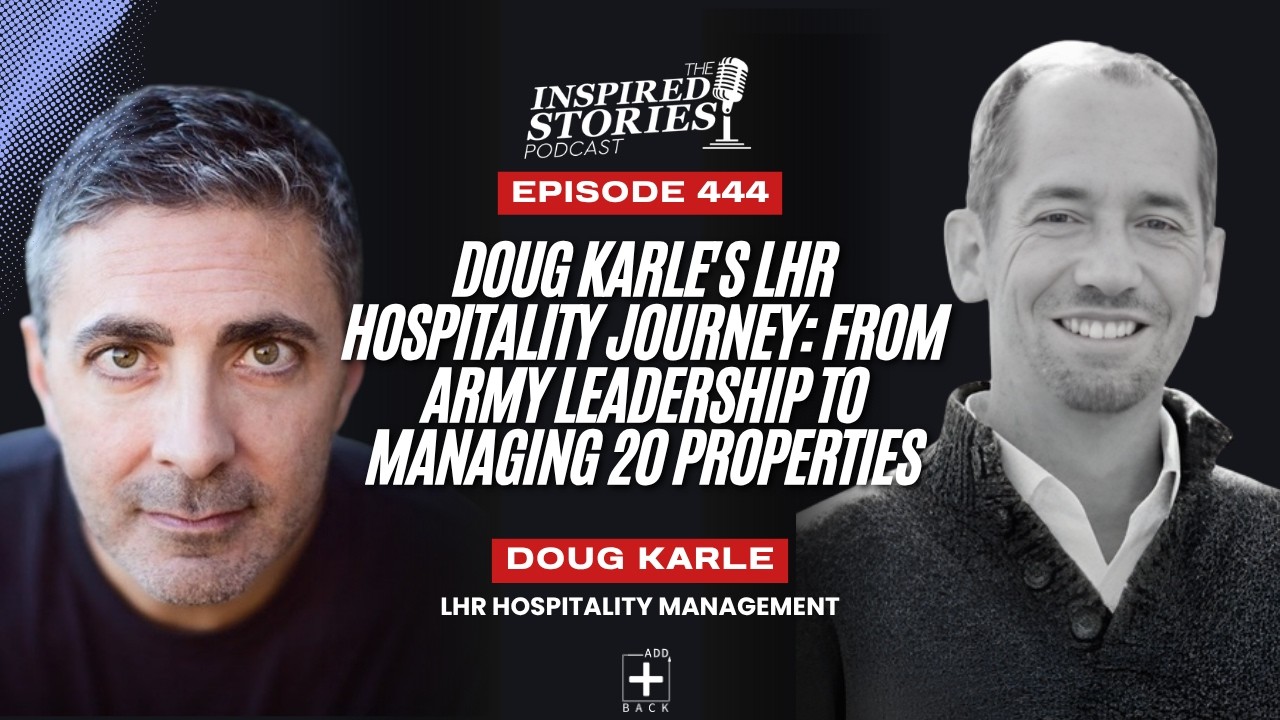
🎙️ From Night Auditor to Hotel COO: Doug Karle's 30-Property Journey with LHR Hospitality
Doug Karle, COO and partner at LHR Hospitality Management, spent two decades turning complicated, underperforming hotels into market leaders across the Midwest. From his accidental start as a night auditor after the Army to managing a portfolio of branded and independent properties worth over $350 million, Doug shares the operational instincts, leadership lessons, and personal reckoning with a rare genetic cancer syndrome that shaped the way he runs his business and his life.
✨ Key Insights You'll Learn:
Starting as a night auditor and van driver after the Army and never looking back
The best advice his business partner ever gave him: you're not as important as you think you are
Taking over a North Dakota hotel during the Bakken oil boom with no labor and rates set too low
Raising room rates $10 at a time until the staff started raising them on their own
Why bad hiring runs feel like a streak and how fear and desire make them worse
Building culture as the only reliable retention tool in labor-scarce markets
Technology and guest experience: why Hilton's phone key freed staff to actually serve guests
Eight strokes in July 2014 that led to a VHL diagnosis shared with his son
Becoming president of the National VHL Alliance and lobbying Congress for NIH funding
Why calmness in complex situations is his most important leadership trait today
🌟 Doug's Key Mentors:
JD Detveller (High School Teacher and Coach): First mentor who showed Doug that someone could have an impact on everyone around them
Sergeant Bill McCutcheon (Army): Was harder on Doug than anyone else in the squad because he saw something in him; taught fortitude without apology
Ken Golder (Hospitality Leader): Assigned books like Seven Habits, focused entirely on leadership development and people
Jerry Troian (Real Estate Developer): Taught Doug the fundamentals of business in simple, relentless terms; the Dread Pirate Robert of mentors
Doug Roady (Business Partner): Brought together the people side and the business side; taught Doug to step back and work on the business, not in it
👉 Don't miss this conversation about what three decades in hospitality, a rare cancer diagnosis, and a good business partner can teach you about staying calm when everything is on fire.
Transcript
Anthony Codispoti: Welcome to another edition of the Inspired Stories podcast, where leaders share their experiences so we can learn from their successes and be inspired by how they've overcome adversity. Let one idea from today shape what you do next. My name is Anthony Codispoti and today's guest is Doug Carr.
Doug Karle: Yeah. Alright.
Anthony Codispoti: Doug is the founder, president, and CEO of LHR Hospitality Management, a Minnesota-based company that partners with hotel owners to improve operations, boost revenue, and create memorable guest experiences. LHR manages a diverse mix of branded and independent hotels, resorts, and entertainment venues across the Midwest. Their mission is simple, increase value for owners. while caring for employees and guests alike. Over the past two decades, Doug has developed, managed, or repositioned more than 30 properties representing over $350 million in asset value. He's also overseen more than $100 million in renovations, turning underperforming hotels into market leaders. Before launching LHR, he held key roles with IHG and Hilton-branded properties. sharpening his skills in both operations and finance. Outside of work, he mentors young hospitality professionals and serves on several industry boards. But before we get into all that good stuff, today's episode is brought to you by my company, AddBack Benefits Agency. Listen, if you run a business, you are likely stuck in the cycle of rising insurance premiums. You're paying more, but your team is getting less. And many people can't afford coverage at all. We do things differently. We offer a solution that provides your hospitality employees with unlimited access to doctors, therapists, and prescriptions that is always free for them to use. But here's where you really need to pay attention. Unlike every other employee benefit out there, our program puts more money into your company's bank account. As an example, we recently helped a client increase net profits by $900 per employee per year. Results vary, but the consultation is free. So see if you qualify today at addbackbenefits.com. All right, back to our guest, partner and founder at LHRHospitality, Doug Karle. Thanks for making the time to share your story today.
Doug Karle: Yeah, yeah, I'm really happy to be here. One correction though. So I'm partner in LHR Hospitality and it's funny we were having this conversation myself, Doug and another management company because we're in the process of a merger and we were sitting there and we were talking about job titles and all three of us had the same opinion, which is I don't care. You be the CEO, you be, you know, chief development, you be and so. So yeah, for LHR, serve as the, well, obviously as a partner, but then also as the chief operating officer.
Anthony Codispoti: All right, I appreciate that correction. And I love that it's so fluid like that. I've had business partnerships like that myself before where we go into a meeting and they're like, all right, which title is gonna suit us best today? And just sort of pick.
Doug Karle: Well, and you know, I'll bring this up because I worked for a real estate developer in another lifetime and great company, very successful. And so it was me and four other, so this has been 30 years ago, probably three other key individuals. including the founder and owner of that company and all of us, we didn't have job titles on our business cards.
Anthony Codispoti: And somehow the business still went on, huh? Yeah. So let's go back to early days. How did you first get your start in hospitality?
Doug Karle: Exactly. I was the accidental traveler. Accidental traveler. I served in the army. I got out the army and I got my first job as a night auditor and a van driver at a hotel. And so that was the former Hampton Inn in Richfield, Minnesota. It's now Four Points. And so from there I moved to the MC Suites in downtown Minneapolis. and you know apparently was doing good kept getting promoted and you know all while going to college at the same time and you know I just it just stuck with me and I loved it.
Anthony Codispoti: What did you love about it so much?
Doug Karle: What I loved is, you know, for the guest experience, you know, we're here to serve other people and you know, it's how we do that and you know, our ability to do that. And for me, was just, it was easy. And you know what, if you were a crabby guest who probably got yelled at by their boss, their wife, you know, threatened to leave them. The dog is sick, you know what I mean? People come in in that environment and they, our job is just, we have one job to make their day better than what it was. And that is an easy thing to do for me.
Anthony Codispoti: And I love that you take that approach because there's probably a lot of folks who are like, I just need to get them a room key and get them to the elevator. But you take it a whole step further, which is how can I make their day better? And what's a way that you might do that in a very brief check-in kind of experience?
Doug Karle: I'm trying to use humor if possible and that generally works. Sometimes it is just the process of they want to get their key and they want to get through the room and they don't want to talk to me for that long. So being able to read the guest is an important item as well where you got to know how far you can push them. And I've made bad jokes before that have backfired on me. And boy, this is,
Anthony Codispoti: we got to hear an example.
Doug Karle: remarkably embarrassing. And back when I was a GM, I would have fired myself for it. But I, this is back when he had pay-per-view movies in the rooms and, you know, pre, you know, internet like, you know, stuff. And so this father comes down and it's just him. And, He he says to me he goes like to check out and like what's the total and I said well I said I gave him the amount and I said there's some pay-per-view movies on there which there weren't that that was the joke and that that joke back he did not like me. But that's the risk you take with jokes.
Anthony Codispoti: I'm gonna guess you didn't make that joke again, or did you not learn from that mistake? Okay, well, you learn. You learn as we go. And I wanna spend most of our time talking about LHR, but before we get there, can you pick somebody from your past, sort of coming up through the ranks and your different hospitality experiences, somebody who had a really formative impact on your.
Doug Karle: I never made that joke again. Actually, I've been probably one of the luckiest people I know in terms of mentors. And this goes back to even high school. know, JD Detveller was my social studies and history teacher in high school, and he was also my cross-country ski coach. He had an impact on anyone that he was around. You know, when I was in the Army, I had Sergeant Bill McCutcheon, who he was harder on me than anyone else in the squad. And I complained about it one day and he explained to me why he's that hard on me. And it's because you can do it, they can't. so I, know, my boots were, you know, spit polished and my uniform was pressed and all that good stuff. Then moving on from there, Ken Golder.
Anthony Codispoti: Sorry, before we move on, as you think back to that, do you think that gave you some level of confidence to push yourself more hearing him say that?
Doug Karle: Yeah, definitely did. It did. again, mentors are everywhere and they're usually kind of a pain in the butt because what they're trying to teach you is something that you didn't know before. And so, you know, for Sergeant McCutcheon, that was about fortitude and don't care if you don't like it, you're gonna do it. But he also had good leadership qualities. beyond that, that made it palatable to be able to take that level of expectation. Ken Golder, he was the guy that taught me about people. And he was the guy that would, you know, we would get assigned reading Seven Habits of Highly Effective People or you know whatever the literature was for the next six months. And so he was all about leadership and he was all about organization. And then after that was a real estate developer, Jerry Troian. And Jerry taught me about business and in a very, very simple, simple way. And And you know, he, he was on me all the time. And I describe it like the scene from you've seen the movie The Princess Bride.
Anthony Codispoti: love it. One of my favorites.
Doug Karle: Yeah, and so it's the Dread Pirate Robert story where, you know, when Wesley's explaining it to, I forget the character's name, but Buttercup, thank you. Princess Buttercup. And so anyway, was working for Jerry every day was like working for the Dread Pirate Robert. You know, good job, Doug. Great, you know, great thing. I'll most likely kill you in the morning.
Anthony Codispoti: Buttercup, Princess Buttercup.
Doug Karle: almost like they fire you in the morning. so, but here's the funniest part about that is, know, for the time that I was with him, I learned more. In fact, at one point I had gone and asked him for a raise. He was indignant and he goes, he said, raise. He goes, you know what? All you guys around here should be paying me to work here. And he was probably right. And so the... learned more about business from him. In fact, we're still, he went from an employer to an employer mentor to a mentor to a mentor and a friend. And I still, you know, grab coffee with him and talk about life and everything else. And that was a valuable, valuable relationship. And then the final one is, you know, with my current business partner. He is kind of the blend of the people side and the business side where you know, he's been able to to bring it all together and You know what there's a Yeah, it's just a it's been I've been remarkably lucky one to Identify even after the fact but to identify or at least gravitate towards people that are willing to show me something different and not be just, you know, the same kid I was when I was 18.
Anthony Codispoti: So your current partner that you just mentioned, what is his or her name?
Doug Karle: Doug Roady.
Anthony Codispoti: Doug Rode. So Doug has this unusual blend of both the people and the business side, which can be tricky, right? Sometimes it feels like those can be in conflict. Business side, very numbers driven. We've got to make a return for our investors here. And then at the same time, we've got to find a way to take care of our employees and have good programs for them. What was something specific, something interesting, different? taught you on how to connect those two worlds.
Doug Karle: he's taught me a lot and, You know, it's that's a tough thing to answer because it's it's a constant observational process of of identifying things. I. I can answer what's the best advice he ever gave me. And this is true in larger organizations or organizations where you have 100 or 500 or more people working for you or a thousand. I had a part of me that was a, I'll fix your problem or I'll be here to walk you through the problem. When we talk about leadership development, the best piece of advice, and this actually applies to the business side as well, which is 20 years ago, he goes, Doug, you got to realize one thing. You're not as important as you think you are. And the intent on it is simple, which is, you know what? There's a reason that we have. regional managers or GMs or sales managers or things like that. We can provide the tools, but ultimately they've got to get their piece of the job done. so, and I really bought into that where, you know what? I should be working on my business, not in my business.
Anthony Codispoti: And so what did that shift look like for you?
Doug Karle: The shift looked like me spending less time trying to deal with someone else's fire that they can fix themselves. And it also less time being inside, you know, the four walls of an office or a property or things like that. There's numerous things that are more important in developing your business than just the operation of the business. I mean, you've got to be a good operator, but in order to have those connections and to grow your network and to again develop additional revenue opportunities, you can't do it sitting at a desk.
Anthony Codispoti: Yep. Amen to that. Okay, so let's get into LHR. What was the motivation behind starting this?
Doug Karle: Well, LHR, you could almost consider an accidental traveler as well. So Doug Rode, he worked at the Palmer House. That was his first hotel job out of college. And then from there, he moved to Sunstone to Rochester, ran a portfolio of hotels there. And he just decided he wanted to buy a place in Northwestern Wisconsin, the Lodger Crooked Lake. And so when he, when he did that, his intent was to stay with Sunstone. And then after about eight months, he decided that he was just going to go all in and build LHR. The LHR by the way, we used to be Lodge Hotels and Resorts up until about 15 years ago. And then we rebranded. And so it started with. one small hotel in northwestern Wisconsin, and I think that's 60 rooms there. And from there, developed the Lodge at Brainerd Lakes. That was a project from the ground up. I think for Doug, and I think for a lot of business owners, there's this weird balance between not ego, but confidence that we can do it better. and the ability then to actually execute on that. And so I went to two hotels, then we started doing third party management contracts. So that's where some other owner comes to us and says, you run your hotel for me? so it's just kind of grown from there. We typically flex between six to 16 hotels, restaurants, convention space. We love full service. We love complicated hotels. But yeah, was a natural organic growth that I think was just ingrained. And I tell my kids this, I've got a soon to be 17 year old son and a 19 year old daughter is, if I had to do it over again and I had to change something, I would have been an electrician. because I know someday I would have owned my own company and had electricians and doing the whole thing. it, you know, sometimes there's the vision of what somebody wants to do. And sometimes you wake up and you're already living the vision that you didn't expect.
Anthony Codispoti: So were you involved from the very first hotel?
Doug Karle: No, I was, I was four years behind. So no, well, let's just, sorry. Sorry. Let me, let me go back. Yeah. So Doug bought the lodge at crooked Lake on his own. Then they had just, he had just finished building it and getting it open. And then I came on right after that. And so I think your next question was to be, well, how did you become partner?
Anthony Codispoti: Okay, so how did the opportunity for you to join? How did you get involved? Yeah.
Doug Karle: For me, I went there to get my first GM job and he hired me. And then from there, and this is the important part, you got to take care of your people. You've got to do the right things within a credible framework to run your business. But in order to go from, a guy that's just running one hotel to multiple. In my case, was, I had the opportunity to invest in another hotel that we were buying. And so I invested and became a partner in that. And then from there, I ended up landing a 10-year contract on a group of hotels. So the value of the contract at that time was, you know, I think $7 million. And so that's $7 million of cashflow that I brought to the company. And so that's kind of the evolution of all that.
Anthony Codispoti: So, okay, present day, what do you guys do?
Doug Karle: Everything as a company.
Anthony Codispoti: So we're talking hotels, we're talking restaurants, we're talking full service resorts.
Doug Karle: Hotels, resorts, restaurants is our primary thing. Individually, I've had rental properties for 20 years that my wife and I own and operate. My business partner also has some rental properties. Well, actually, it's one rental property with 12 units or something like that in a town in Wisconsin. But the funny story or the funny thing about that, and that goes back to a little bit of the fear that we experience each time we do something new. mean, being fearful is a good thing. So when we sold our first house, or pardon me, when we bought our second house, we didn't sell the first house. We kept it as a rental. And I remember distinctly, Not sleeping a wink that night and I didn't know crap about rental housing. I mean, I kind of thought I did, I really didn't. And I remember laying there not sleeping that night going, what did I just do? And what did I convince Shanna to do? Cause you know, she was like, all right, well, if you want to do it, do it. But yeah, that was, think another leap towards that entrepreneurial spirit.
Anthony Codispoti: So you made a comment that was interesting, being fearful is a good thing. And that's a little counterintuitive to me because for me, and most of the people that I've come across, fear is the biggest limiter for them. They're afraid of what bad thing could happen and it holds them back from trying something. So tell me what you meant by that.
Doug Karle: Hmm? No, yeah, no, that's a good distinction that you point out because it is ignoring the fear. People would say overcoming the fear, it's ignoring the fear. It's making the fear a thing that could happen, but it's not something that's gonna consume you. And so, yeah, it's not overcoming fear. For me, at least, it was ignoring fear.
Anthony Codispoti: Ignoring fear, having the fear exists, but moving forward anyways. And do you have a strategy for ignoring it, like how you put it in a bottle so it's not tearing you up inside?
Doug Karle: Yeah. Well, you know what? Have you ever been sued before?
Anthony Codispoti: Thankfully, no.
Doug Karle: Well, I'll put it this way. know, lawsuits are designed to put fear into the person that's being sued. And lawyers are really good at like, you read the demand letter and you're like, I didn't realize I was this big of a piece of crap. And, or such a poor operator or such a poor owner, whatever it may be. And so, you know, the idea is we know who we are. We know, we think we know what we're capable of. And so when those doubting thoughts come up, you have to recognize them. This is a doubting thought. Is this reality? And if it is reality, well, then you better pump the brakes. If it's not reality, or at least you're pretty confident it's not reality, then you proceed forward and you don't let the fear consume you.
Anthony Codispoti: I mean, do you have some kind of a magic switch that you flip that allows you to move from one state to the other?
Doug Karle: It's the awareness at this point. The awareness of the thoughts.
Anthony Codispoti: You've just done it so many times.
Doug Karle: Yeah, but you know what? Let me ask you this. You're married.
Anthony Codispoti: I am.
Doug Karle: And you probably asked the question on will you marry me? And so at some point with butterflies in our stomach and things like that, you just have to say screw it. I gotta do it. Does that end?
Anthony Codispoti: I kind of knew what the answer was going to be because she'd been pressuring me for a while. So maybe I was a bad example in that case.
Doug Karle: Yeah, no, and so, you know, it's just, again, no.
Anthony Codispoti: Well, let me sorry, sorry to interrupt Doug, maybe it helps if I ask it from a little bit of a different perspective. You're a father. I'm also a father. My kids are a little bit younger. They're 11 and they're nine. Two boys. And fear is the thing that holds them back from trying something new. My oldest son loves playing sports, but he doesn't like playing with kids he doesn't know. So if his friends aren't on the team, he's not going to do it. My youngest son has a fear of the dark. He doesn't want to go into a room by himself. And he
Doug Karle: Yeah. That's a reasonable fear.
Anthony Codispoti: reasonable fears. But I say you can I try to tell them you can have a fear and do the thing anyways. It is perfectly normal to be afraid, but you can still move forward with the thing. And I'm having a hard time putting that into language that they understand. And so I guess part of why I'm sort of drilling on this point here selfishly is I want a better way to explain that to my kids.
Doug Karle: So here would be the best example. And I like to read a lot and I like to learn about different things. so if you know about a thing called exposure therapy and it's almost like for all of us, whether we need exposure therapy or not, it's a useful technique in being able to get to the next thing. So it's the... bless you. It's the being exposed to it is gonna give you a different viewpoint on it. And let's take your son who's afraid of the dark. You know what? I mean, this might be child abuse. Don't take me at my work. But it's all right, we're gonna go into the room. I'm gonna go in with you for two minutes and I'm gonna turn the lights off. And then it's four minutes and then it's 10 minutes. And maybe this is over the course of a week or two weeks. And you know what, for, it's funny, my son, he's never intimated it as well as your son has, but he really just wants to be on teams with his buddies. And part of that, I don't think is necessarily a fear. It's just a desire. I mean, he's got a great group of friends. Why do I want to meet somebody else?
Anthony Codispoti: Who needs more friends?
Doug Karle: But in business, there is that exposure therapy where, again, if you're worried about it and you've weighed all the options and you've got a gut on it, so to speak, you just do it and see what happens.
Anthony Codispoti: I think you're spot on there. And I, you know, I can personally attest to that. So many things in my personal life, my business career, you know, I'm on, this is probably close to my 400th interview. The first 15, 20, 50 of these, man, I got really nervous about what am I going to, you know, how's this going to go? What questions, you know, what if I, you know, what if I mess up in the intro, you know, all these things, you just do it over and over and over again, that repetition, it builds a thicker skin. and you realize that what's the worst that can happen? Like, I'm still here, I'm still alive, I still have food to eat, there's a roof over my head, you know? And so, I agree, think that exposure therapy is kind of a good way to sum
Doug Karle: Yeah, well, they can eat you and they can't kill you.
Anthony Codispoti: I love that. Okay, so let's talk more about LHR. So how many properties do you guys own? How many do other people own that you manage?
Doug Karle: Right now we're lopsided on, own more of the properties than we manage. through the merger with this friendly competitor that we've had for a long time, we'll be at 20 properties and then possibly 21 by mid February.
Anthony Codispoti: sorry, 20 that you manage your own or total.
Doug Karle: Total of 20 and then you know of that it's going to be seven that are owned the rest are third-party managed.
Anthony Codispoti: Okay, do you have a preference? You like one model versus the other?
Doug Karle: Yeah, I mean, it's easier to operate something that you've got an equity stake in. And the best way to describe that is we can make a $100,000 decision in five minutes on a property that we own. And because we've been living and breathing it, we all kind of are on the same page. And for a third party management property, that could be months. You know, you're going through different levels of approval, explaining the story. Sometimes we've got one hotel owner that he is an MD, but he actually grew up in hotels. He knows the hotel industry as well as anyone. He's an expert in it. so, you know, in that unique scenario, we can have a very quick discussion on a hundred thousand dollar question and it's answered. And, but if you take someone that was a commercial real estate, non hotel related, it took me a year to get this person to understand that the difference between a cruel accounting and cash basis accounting. Cause you know, if you, you own a bunch of office buildings, you don't think like, you don't think about a cruel accounting at all.
Anthony Codispoti: And you got to give them a basic tax lesson. That's not even you know, a lesson in hotel management. That's just
Doug Karle: Yeah, it's a good point. But you know what? I guess that's the other part that I like. Or one of the things I do like about it is I do like being able to communicate in a way and effectively enough to be able to explain these things. another example would be we built a double tree. It was a new build hotel. near the University of Minnesota, it's Hilton Garden Inn now. But the principle on that, like he wanted to know, he wanted to find out like how do hotels operate? How do we do this? How do we do that? And which that was a great owner to deal with because his curiosity is just infectious.
Anthony Codispoti: So when you guys are looking for a property that you want to own, you want to be the investors in, what are the characteristics that you're looking for?
Doug Karle: See, that's the problem. There's nothing that is, we're not gonna say we're looking in a city with a hotel within five miles of a Big Ten college or anything like that. Every deal is different. There's a court ordered receivership that we're for a bank on a property and it's a 20 room property in the middle of nowhere. But there's some demand drivers around there that make it work. And, you know, I'm looking at that going, that would be an interesting property. That would be like a great property to have. And it'll cash flow, it'll do everything. It's going to, you know, deliver the returns. You could then look at, know, we get the broker listings and emails like all the time from all the major groups. But there's properties that we've looked at near Disney, things like that. And so it's this economic cycle thing as well that plays into what it is that you're looking for. I can tell you if I was just having this conversation this morning about the liquor consumption of young adults and even adults. has decreased significantly. And so, when you're talking about your margins on food and beverage, the liquor is where you make the margins, the food, not so much. And so you could have a 35, 40 % cost of goods depending on what your mix is in terms of the menu, but on the liquor side, 17%. And so, yeah, there's a lot of factors, but we don't hone in on too much except for, and this is something that him and I joke about a lot, is like, if you bring us like the most complicated, screwed up thing to deal with, we're just like attracted to it and we want to dig into it and figure it out.
Anthony Codispoti: Give me an example of a really complicated screwed up thing that you guys took over and how you turned it around.
Doug Karle: Well, this, yeah, it was during the Bakken oil boom. It was the first hotel that we managed out in the Bakken. So this is North Dakota. And, you know, it was a 140 room Ramada charging 78 bucks a night, 79 maybe, and was running 93 % occupancy. And... So that I take that back. It was a day's hotel, which if you didn't know this days in it was the limited surface or service version of days. Pardon me, days hotel was the full service version of days in. And so anyway, so, you know, we got there and so you got you've got no labor because everyone who can is working in the oil fields.
Anthony Codispoti: Okay.
Doug Karle: You've got rates that were way, way too low. You've got no contracts with the oil companies on a long-term basis of, know, we'll lease out half the hotel to you guys for the next year. And by the way, the rate on it's gonna be 149. Because all these oil companies wanted at the time was they had people coming three hours away to get to an oil field. to do their work, to drive three hours back. So six hours a day was being eaten up. So it was nothing for them to identify that. We didn't know it at the time. That's something I learned very quickly on how we can capitalize revenue. We had a restaurant and bar in there that kind of did good. And then we had meeting space that did subpar. And so as we're going through all these different machinations, It was a quick rough game plan of, okay, we need to raise rates. So how do we do that? Because every desk clerk judges the rates by their own pocketbook. So, you know what? They're not gonna be on board with raising rates by $50. And so there was a leadership component of this of being able to convince the GM and convinced the desk staff that, okay, we're gonna raise rates by 10 bucks, $10. That's it. We're not gonna go any further. Let's see what the pushback is. And so then that $10 turns out there was no pushback. Then it's like, all right, let's try another 10. And this is like week after week after week.
Anthony Codispoti: So you do $10 increase one week, $10 increase the next week. Like these are very quick incremental changes. Okay, go ahead.
Doug Karle: Yep. And so again, there's no pushback. by the time we got to 109, we weren't the ones managing the rate increases. They were the ones saying, I think we can raise it 20 bucks. And so that was an exercise in leadership for certain, because we could have gone and said, raise the rates to 149. And we would have had a revolt in a labor-scarce market. And so that complexity was taken care of. In terms of, you know, labor force, again, we were extremely lucky by the fact that we inherited a GM who was well respected by our team and who could retain employees. It was just this gap that we had to fill. And so at that time, 2009, and Nowadays, it doesn't sound like a lot. 2009, essentially rural North Dakota, McDonald's was starting at 15 to 16 an hour. And so we weren't gonna go that high. And so the next complexity dealt with how do we get the people? How do we pay them appropriately? And then how do we retain them? And retaining people is through culture. That's the only thing.
Anthony Codispoti: Okay, wow.
Doug Karle: that will keep an employee there. And so, when you're going through these variations and you're trying to build an extended team, because we were short staff, when you're trying to build this extended team, the best place you can be is when you have your employees coming to you and not complaining, not gossiping, not... drama, but hey, you know what? I saw this, this happened, this isn't getting done. so when the employees start determining who should stay working there, and that's a great place to be. again, there's a lot of trust that goes into it, but the employees are gonna know who needs to get weeded out in the first two weeks better than the manager.
Anthony Codispoti: So I want to explore this particular labor situation a bit more because I understand some elements of what you're talking about. When there's a big oil boom, everybody wants to work for the oil companies because that's where the big money is. So you've got that problem to deal with, Anybody who's local, like how do you get them to work for much less for you? But now you're also talking about the McDonald's in the area was offering more than you guys. So somebody who maybe doesn't want to go and
Doug Karle: Vvvvv
Anthony Codispoti: do whatever the oil work is because it's harder, it's dirtier, it's more dangerous. Maybe they want to go to McDonald's instead of your place because they're paying more per hour. So how are you pulling people not only from the oil fields, but also from McDonald's into your place when you guys are paying less?
Doug Karle: We're not pulling them, we weren't pulling them from the oil fields. We had some that would burn out on the oil fields and they'd be a great maintenance worker, things like that for whatever reason. But really what you're trying to do is the people that don't wanna work in the fields, the thing was, I can get a dollar more or two dollars more an hour working at the sporting goods store than working here. And so what you're trying to do is create that environment. You're creating that environment where people enjoy coming to work. They enjoy what they do. They're service oriented. They want to serve people. you're coming earlier about the person that just like, here's your key, rooms that way. Those aren't the people that we want. And we've operated in towns as small as 300. And we have long since drawn the conclusion there are good people that wanna work in hotels, restaurants, resorts in every single market. It just sometimes takes a little bit longer.
Anthony Codispoti: What do mean takes a little bit it takes a little bit longer for them to realize that that's the place that they want to work
Doug Karle: No, it just, takes us a little bit longer to identify the talent, the identify the person, get them on board and things like that. And, you know, when you go through a, you know, a bad hire cycle, every leader does it. I saw Jack Welch speak, I don't know, at a hotel conference 10 years ago, 15 years ago, and he was talking about the difficulty in hiring. And he goes, he says, at the beginning of my career, He goes, I was successful 25 % of the time. I screwed it up 75 % of the time. He goes, by the time I was mid-career, I was successful 50 % of the time. He goes, by the end of my career, I got it up to 75%. And you know what, but it's, know what, everyone gets on bad runs and they need some support on the hiring. I've done it before where it's like, hey, you know, can you sit in with me on these interviews? Cause I... I don't know what I'm projecting, but it ain't working. And so.
Anthony Codispoti: What tips have you picked up along the way that you can share with the audience?
Doug Karle: About hiring or Just authenticity people can sniff out BS Really easy and so if you know if you're living to the core values of the company and You're reflecting it in that interaction You know, it's It comes out it just comes out and you know, there's I don't know if you've Read anything about micro expressions?
Anthony Codispoti: I have, but please go on.
Doug Karle: So with the micro expressions, mean, it's fascinating. And the gentleman, Paul Eckert, he was kind of the father of micro expressions. then his protege is now writing on it as well. And so, you know, I've read about this stuff since the mid nineties and it is amazing what we accidentally tell people. in our response in a micro expression. And with the micro expressions lasting what? 1 30 second of a second or whatever. It's something where our conscious mind. Yeah, yeah, our conscious mind doesn't pick it up, but it's it is it's it's available in their subconscious and vice versa. My subconscious on on on what they're doing. And so, you know it.
Anthony Codispoti: Almost imperceptible. Yeah.
Doug Karle: where the disconnect comes in in how we communicate very much is a micro expression. So let's say I was having trouble with Shanna and I just was in a bad mood that day or whenever it was. That would have come out in micro expressions. it's like when I'm sitting and talking to somebody, I need to be in that moment and I need to be authentic. And anything short of that, there's a big tell there.
Anthony Codispoti: Hmm. I like that. Your true self is going to show up. you know, talking a lot about culture here, and I know that one of your guiding principles really highlights entering every day with gratitude and humility and celebrating successes together. I wonder if you can think of a specific story of how those principles showed up.
Doug Karle: It starts with the individual and you know for me it is remarkably funny because I've been really focusing on the starting each day with gratitude because there was a short period of time where I was starting to feel a little bit resentful about things and but if everyone can actually have gratitude, we've all got something to be grateful for, even in the crappiest of times. And so when we're talking about that in the hotel environment, and I can tell you, I mean, there's been times where, you know, it's a 20 hour day and there's, you know, all this stuff going on, there's chaos and everything, everything's going wrong. When I talk to people that I've went through that with before with me, it is we don't ever talk about the good times. We don't talk about like, hey, remember when everything worked, everything was great. this is no, we always talk about we talk about those times that were so challenging. And so the ability as an organization to be able to get into those weeds together and know that everything's going to be all right, then that Again, it comes out, it yields a positive outcome. And so you're looking for a specific example. And I'll go back to when I was a front office manager. And this goes back to hiring as well. And so this is, was front office manager. I had my assistant front office manager. I had two front desk supervisors and I was on a bad hiring run. And so I went to them and you know, Like we gotta figure out how to do group interviews because I'm screwing something up here And it it took us three months to get a team hired To fulfill it. So it was just down to us and we were covering a front desk and a 200 room hotel for 24 hours a day and So there was there wasn't and you know its location. There was an event center nearby
Anthony Codispoti: Wow.
Doug Karle: right across the street actually. And so, you know, we'd go, you know, from normal 60 % occupancy to sold out Friday, sold out Saturday, you know, 50%. So it was a very busy hotel. And, you know, for them in hindsight, looking back, and I'm still friends with them today, they are just grateful people. And so, you know what? mean, we made it through that and we made it through with a smile on our face and some good humor.
Anthony Codispoti: You know, it's so interesting, because you said this a couple of times now, you talk about bad hiring is like a streak, almost like, I don't know, like a hitter in baseball, they get the yips and you know, they go through a slump. Say more about that. Because I mean, I've certainly done my fair share of hiring, but not on a regular basis like you have. What is the what does the slump feel like? Like, and what gets you out of
Doug Karle: It feels horrible because it's like it's because it's not only I failed but I failed and now I got to cover the shifts and it it's You get worn down to a point that And and I think this is for anything in any leadership position. You're either gonna figure it out or you're gonna get out and You know for me You know, thankfully I've been able to figure it out and I've had good people around me that, and I'm not talking about leaders above me. I'm talking about the scenario where it took us three months to get a good team. It wouldn't have happened without them guaranteed. so yeah, it feels horrible. And I'm going to introduce an abs. Well, it's not an abstract concept, but it goes to one of my mentors and Jerry. And so he'd be, he'd be like, just all over me. And he'd always end with those conversations with, be worried when the coach stops yelling at you. But he also had a phrase that's relevant to this part of the discussion, which is you gotta get beyond fear and desire. So you gotta get beyond the fear of hiring the wrong person and the desire to hire the wrong person. And so, It's a little bit zen-like to a certain extent where you just can't be afraid and you can't be covetous when you're in that situation.
Anthony Codispoti: So when you find yourself in a slump like that, is there something that helps snap you out of it? Is it just sort of that realization of unplugging from the fear?
Doug Karle: No. I think that the fear and the desire is the biggest part of it because that probably led, you know, the previous, you know, that's what led to the slump was I hired the wrong person because I wanted the shift filled and I didn't want to work, you know, 70 hours this week. And and so that fear of the 70 hour week was leading to more 70 hour weeks.
Anthony Codispoti: Got it. Okay, that makes a lot more sense now. Talk present day to near future. What are some new initiatives that you guys are working on that you're excited about? Whether it's innovations and processes, technology, guest experiences, what are some things you're excited about?
Doug Karle: Yes, to all of them. so, but here's how it comes together is we have independent properties, we have branded properties, Marriott Hilton, know, IHG. And so the technology portion, to a certain extent, we are beholden to the brand and what they are going to invest in on their systems. And the brands have gotten a lot better at it. And I'm not going to rank who I think is best or worst, but You know, you take the Hilton app. Well, starting in 2016 is when you could use your phone as your room key, bypass the front desk. And so Hilton was really a leader on that. so technology, I think, goes hand in hand with guest service. And the reason is that I don't need somebody to be standing there typing on a computer to check somebody in. I want them to be talking about all the great things there are to do. And there's the show over here, you know, that you guys can see and we can get you tickets. That is true service. You you look at like the Four Seasons. The Four Seasons is by far the leader in guest satisfaction on so many levels. mean, they were keeping notes on guests. back in the 60s and 70s of, know, here's their favorite beer, here's their favorite liquor, they like these restaurants, this and that. And so they were doing it all manually back then. really customized each guest experience. I think the opportunity to increase the level of service and hospitality increases with all the advancements in technology that come. And you know what? We should know our guests. you know what? Even though I might be the desk clerk that checked them in, I should be using the notes function to just say, you know what? His wife's married. This is his birthday, blah, blah. You know, whatever it is. And I think that that's the greatest opportunity is that service. The technology supports it. And, we've got a, an automated, hallway back where it's just a robot. goes up and down. Okay. Yeah. A commercial Roomba. I love the thing. I think it's the greatest thing ever. And, my business partner hates it. It's the worst thing ever.
Anthony Codispoti: Like a Roomba kind of a thing. Okay.
Doug Karle: And so we have this constant friction on whether it's a good thing or bad thing. I'm convinced he's going to push it down some stairs someday. But there are differing views on technology, but we can all agree that wrote tasks that we have to do should not be a part of our daily functions. I was just going through and I was pulling up P &Ls as income statements this morning. And so, you know, pulling up 20 income statements is a process by itself. And so, you know, I'm sitting there thinking, I'm like, why do I have to click, click, click, wait three seconds, click, and then repeat the entire process? That could be my impatience, but wrote stuff does nothing to serve anybody.
Anthony Codispoti: So that's a great example of a rote service. So what are you gonna do about that?
Doug Karle: So that's a great question. I already reached out to the company that creates the software because I want that process automated. I want to be able to say run the sequence of events and just let it go, which realistically, you know, when bots were starting to become a thing, that automation process, and you could build a bot to do it. you know, frankly, I don't have the time to build a bot. I just need the bot. And so there is an automation in the process. know, we were talking about, internally, we were talking about, we use SharePoint as our kind of file server back of the house thing. And it was set up a number of years ago and it was set up wrong. And it's like, so, you know, we need to figure out how we're gonna do that. So someone's not going. seven folders deep to find something for an individual property and then having to do the same process on another property. And so it is that process automation, is huge. And thankfully we have all of our property management systems feed all the revenue numbers into the accounting system. so there's been numerous things that have been taken care of, but there's always gonna be more.
Anthony Codispoti: Yeah. You know, behind most success stories, Doug, there's usually a chapter that almost broke somebody. Can you share a serious challenge that you've gone through, personal or professional? How you got through it what you learned?
Doug Karle: Yeah, you know what, because I think it's a personal story, but I think it's so important. And it does apply to business as well. So July 2014, I had eight strokes. And so, you know what, I'm, and thankfully there was no latent deficiencies from it, except for, know, some tingling in my leg. And, although some people might argue my brain too, the, but the, so I had these eight strokes and, I ended up, you know, going to the ER. didn't know there were strokes at the time. I was actually putting my clothes back on to leave when the doctor came in and said, where are you going? And I said, I'm going home. I feel fine. He goes, no, you had eight strokes. You're not going anywhere. And so, That was a shock. And so, you know, I spend the next three months, you know, I'm still working. I'm still, you know, doing all my stuff, but I'm going from different appointments, from oncology, you know, to neurology, to endocrinology, and they're trying to figure out why did these strokes take place. So at the end of the three months, we get a call from the oncologist and he said, I had three biopsies done during that time as well. He goes, good news, you know what? You don't have cancer. And so, you know, come back and see us in six months. And so I asked him like, well, what about the strokes? Are we gonna talk about that? Something caused those. And I had these masses in my adrenal glands. And if no one's ever been through a medical scare, and this is true, in every facet of life, you have to be your own advocate. If you don't, you're going to get caught up in the system. So I go to my primary care and he's on his daughter was on a team with my daughter at the time. And I know Jeff very well. So I'm asking Jeff, I'm like, you know, someone's got to look at this and figure this out. And he goes, he goes, Doug, I'm not qualified. Like, all right. And and what should I do? And goes, well, go ask for a referral for mail. So I go, I get the referral and then it's about another month before I get down to Mayo. That's their next open appointment. And so during this month, and actually I had started at probably two months or a month and a half before that, I would do my nightly, what I called my walks of God, where it's like, You know, and, you know, God's to you, whoever it is to me, you know, so, you know, everyone's God is different. And so anyway, I during one of the walks with God, when I'm thinking about if I want, if I should go to Mayo, the biggest mistake I made was the amount of time to ask for the referral, because I, who am I to question a doctor? They're way smarter than me. So anyway, get the referral, get down to Mayo. a month later and then I find out I've got bilateral pheochromocytoma, which is essentially two tumors in my adrenal glands. So they scheduled the surgery for December 23rd, which in my brain, I'm like, okay, this is gonna be perfect. I'm gonna die over Christmas and that'll be a good memory for my kids. And so the entire time I'm just having to like get up, you know, do as much as I can. you know, be on point. And it wasn't pressure, was more like I wanted to do it because it was a relief from everything else that was going on. So anyway, long story short, I lived through the surgery. Shannon and I actually were arguing on the way down to the surgery and I'm like, I'm gonna die. I left a letter on the nightstand for you.
Anthony Codispoti: I
Doug Karle: And so we're arguing about if I'm gonna die or not. And so it turns out I was wrong. And so as most husbands are in most circumstances. anyway, come out here, find out what I've got is a genetic cancer syndrome called Von Hippel-Lindau. So now I got a whole new other set of things to do. so this genetic cancer syndrome, is basically benign or cancerous tumors can pop up in every major organ of my body at any given time, which I had given to my son as well. my daughter tested negative. So this is where, when you talk about failure, this wasn't a failure necessarily caused by me, but it felt the same, especially with my son.
Anthony Codispoti: in this.
Doug Karle: And so. you know, able to get refocused and go at it in a positive direction. just give me a second here. So anyway, I started getting involved in the VHL community, became, you know, state chapter chair, became president of the National VHL Alliance, started doing lobbying work and in Washington DC. And so through all of this shit, last March, my son and I were able to go together and do advocacy together. And so, you know, he's been to DC before, school trip, things like that. You know, we got to go sit in senators office offices, sit in representatives offices. you know, make our case and do something that most people never have the opportunity to do. So I could have done that route or I could have done the route of woe is me, this sucks. And I don't wanna do anything. you know what? That's never the right choice. And so... We always have to confront what's going on and we can't hide from it.
Anthony Codispoti: And so where does your health stand today?
Doug Karle: Well, so, funny thing you should ask. So VHL, my static, you know, I've got a couple of spinal hemangioblastomas, pancreas, kidneys have some stuff going on there, but it really has been static since 2014 with the exception of the hemangioblastomas. I've only had to have two surgeries. which I've got a good friend of mine. He was the director of quantitative research for a major, major bank. And he finally retired after 35 brain surgeries. And so, so, you know, it's, you know, the, I think the fundamental lesson is it's, it's not what happens, whether we cause it or not. It's not what happens. It definitely is how we deal with it. And we don't have to be, we don't have to be happy all the time. We don't have to be thrilled all the time. And you know, it's. It's okay to not be okay. And so with that, that's where the importance of relationships are and the importance of those long-term relationships. My dad used to talk about you never should have any more than three to five friends. Good friends is what he was talking about. And to a certain extent, I agree with that. I think you need to keep your circle small. But considering the circumstances of everything, I've got so many 2AM friends, I can't even believe it. But that wouldn't have happened had I not addressed things head on, had I not both professionally and personally, and cultivated those relationships over time. And I'm grateful for that.
Anthony Codispoti: Wow. And so what does it look like for you going forward? it like every six every six months? No, no, no, no, I'm glad that you did that sidebar because there's so many powerful lessons in there. You you started out the story with, you know, you got to take control of your own health, right? You're going to get lost in the system. You're going to have to be the one who pushes for this. And if you hadn't, you never would have discovered that you and then your son have this
Doug Karle: sorry, I missed the most...
Anthony Codispoti: rare condition. But you didn't stop there, right? You got involved with the different chapters, the local and the national one, you went and you lobbied for support in DC. Like you, you went to the place that most people wouldn't go. And there's something inside of you that drives you to do that. It showed up in that way. It shows up in your work too. Do you think it's something you were born with? Or do you think it's something that you acquired or developed along the
Doug Karle: That's a, that, is a great question because if you would have asked me when I was 16 or 18, I said, not a chance in the world. No way. I mean, I was a lazy, stupid teenager. think most teenage boys were, were wired like, so screwy, but no. And you know what? I never felt that way. And You know, frankly, you know, when we were talking about fear earlier, know, the confidence, I didn't probably have a lot of confidence either. And but again, other people did and saw something that I didn't see. And so I think without the right mentors, without the right leaders that you work with and frankly. Even somebody who I think is a crappy leader, there's probably still something I can pull from them that is positive. And so it, and I'm really sincere about that. But yeah, I think it's learned mostly. But you gotta be, either someone's gotta be taking you to the water to drink, or you gotta like, know, find the water yourself. And in this scenario, I was lucky early on where I had enough people that would lead me to the water. And now in relation to this VHL thing, yeah, was hot and ready to go. And so, and I think I've really felt that way since 2000 and say probably, probably.
Anthony Codispoti: Yeah.
Doug Karle: end of the late 90s and it's it's growing from there over time where yeah why shouldn't I be the chair of the national organization for the VHL lines? Yeah yeah and and again sorry go ahead I was gonna say I it's and this is where the humility comes in piece is you got to keep yourself humble and so the irony is at one yeah on one side it's like well who's gonna do a better job than me?
Anthony Codispoti: Why not me? Why not? Okay, so no, no, I want to hear your thought.
Doug Karle: And you know, on the other side is, well, you're going to suck at it. You shouldn't even try. And then somewhere between those two is appropriate humility where, where you can operate at a genuine level.
Anthony Codispoti: And so do you now have to go for like full body MRI scans twice a year?
Doug Karle: Yep, so and thank you for asking about that because I totally dropped that part of the question. But the so it's there's different protocols depending on the different age. And so the for me, I'll end up having a brain scan, spinal scan and abdomen scan this year. My son, he'll have a brain and I believe abdominal. And so we'll go through those in February. You know, one of the things that has been another blessing is because, you know, when he was diagnosed at five and four or five. And so, you know, the strategy was, OK, you know, we're going to piecemeal it out in small doses, getting closer to, you know, the full picture as he gets into junior high and high school, which it's worked out well. And so you know, the idea is to get him ready for when he turns 18, that he's going to do the scans on his own. I can force him now. I can't force him in another year, one month. And so, you know what? And also teaching him to be his own advocate as well through this process. And so to answer the question, it's essentially, this is the way life goes. We have to do it every year. including some blood tests, eye tests, things like that. And, you know, it's not going to be the thing that kills us, but it's the thing that we're going to have to live with. And I could talk more about some other stuff on it, but yeah, I don't want to take up too much time, but it is such a fascinating, so many fascinating people that I've met through this entire process and for my son as well. So. other patients, other patients' families, people like that.
Anthony Codispoti: What's your superpower, Doug?
Doug Karle: I didn't know I had one. I would say currently, because I think superpowers do change over time. And I would say currently, my superpower is calmness. If that can be a superpower, calmness in very complex situations. And, you know, it's been The past two months for me have been remarkably stressful, both from a professional standpoint, trying to bring together two companies from a personal standpoint with some of the rental properties. I was talking to Shannon about it two, three weeks ago. And I'm like, I don't know what's going on, I said, but I don't think I've ever been. this calm in the midst of such a storm. And so I would say just calmness.
Anthony Codispoti: I think that is a genuine superpower. you know, Doug, I've just got one more question for you today, but before I ask it, I want to do three quick things. First of all, anybody who wants to get in touch with Doug Karle, you can email him directly at dougk at lhrhospitality.com. Obviously their website is lhrhospitality.com and to get in touch with Doug directly, dougk at lhrhospitality.com. That'll be in the show notes. Also, if you're enjoying the show, a quick comment or review on your favorite podcast app goes a long way towards helping others discover our show. So thank you for taking a quick moment to do that right now. Finally, as a reminder, if you want to get more hospitality employees access to therapists, doctors, and prescription meds that as paradoxical as it seems, actually increases your company's net profits, reach out to us at addbackbenefits.com. So last question for you, Doug, a year from now, what is one very specific thing that you hope to be celebrating?
Doug Karle: you Yeah, well, does it have to be exactly a year?
Anthony Codispoti: Does not. There's flexibility here.
Doug Karle: No, the biggest thing personally is going to be the graduation of my son from high school and seeing him off onto his next stage. And you mentioned your kids earlier and we both heard this. We've heard it from so many people. Don't blink, it goes by too fast, which I think is a really negative way to look at it because I've the way I've looked at it, like every next stage has been 10 times cooler than the last one. And so, you know, my daughter, she's off to college. She was home on Christmas break and I just love the growth in her. And, you know, just from the first semester being down there, her opinions on different things and she's not soft spoken. She's the kindest person you ever going to meet, but she's not soft spoken. And so for my son. Same thing, just that is like the number one thing. And for me, I'll call it a revenue generating standpoint because we've got our primary businesses, we've got our ancillary things that we do. And so the rentals is one of those things. I wanna have those three, they're all contiguous to each other. I want those three sold. in about a year as my son is heading off to college, hopefully.
Anthony Codispoti: Love it. Doug Karle from LHR Hospitality. I want to be the first to thank you for sharing both your time and your story with us today. Appreciate you being here.
Doug Karle: Yeah, thank you, Anthony. really appreciate it.
Anthony Codispoti: Folks, that's a wrap on another episode of the Inspired Stories podcast. Thanks for learning with us today.