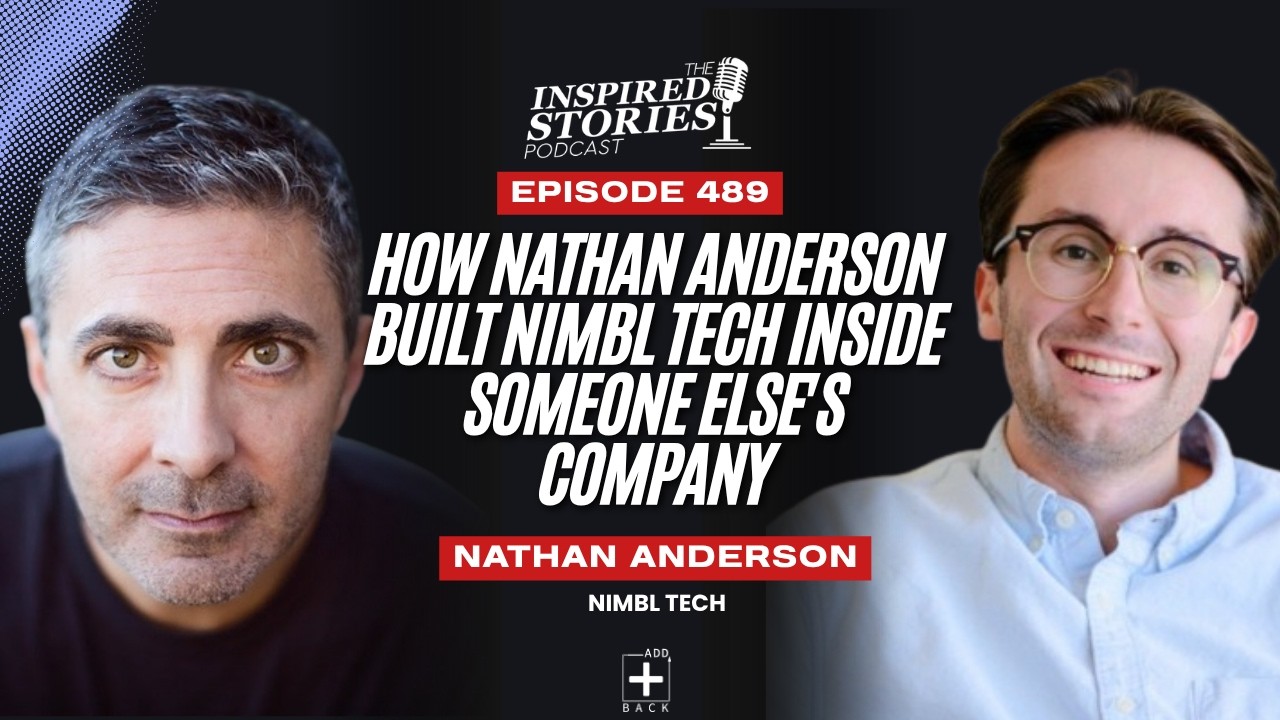
Nathan Anderson is the co-founder and head of operations at Nimbl Tech, a fractional IT firm in Lehi, Utah serving small remote accounting and financial services companies with device management, cybersecurity, and compliance. He built it from scratch inside Nimbl, the parent company where he serves as head of tech, after being turned down from a master's program and redirected by a CEO who offered to show him how to build a business instead.
✨ Key Insights You'll Learn:
Managing 1,500 employees to remote work overnight during COVID at the Missionary Training Center
Joining Nimbl part-time while finishing school, starting with basic IT and early automation
Recognizing a market gap when cloud accounting peers kept asking how Nimbl secured its remote team
CEO Dave Olson's offer: skip the MBA and build the company instead
Signing first client July 2024, reaching six figures by end of year one
Three core services: device management, access management, and data security compliance
FTC and IRS compliance documentation: written information security plans and incident response
Phishing emails as the most common real-world threat, not sophisticated outside attacks
AI safety for accounting firms: paid plans, SOC 2 certification, and the right privacy settings
15-minute help desk response time as a non-negotiable standard, not a marketing claim
🌟 Nathan's Key Mentors:
Dave Olson (CEO, Nimbl): Redirected Nathan from pursuing an MBA to building NimblTech, then backed him fully
Missionary Training Center Leadership: Gave Nathan his first large-scale tech transition experience during COVID
Cloud Accounting Community: Provided a collaborative peer network that surfaced the market need NimblTech was built to fill
His Parents: Offered faith-grounded perspective during his lowest point after the master's rejection
NimblTech Clients: Each new service line has come from a client request, shaping the firm's growth organically
👉 Don't miss Nathan's candid account of being rejected from the graduate program all his friends got into, the professor who confirmed he should have been admitted, and the moment a CEO's belief in him changed everything.
Listen to the full episode here
Transcript
Anthony Codispoti: Welcome to another edition of the inspired stories podcast where leaders share their experiences so we can learn from their successes and be inspired by how they've overcome adversity. As you listen today, let one idea shape what you do next. My name is Anthony Codispoti and today's guest built automation so clean that the company he worked for still runs on them four years later. He never set out to start his own company. He was already deep inside someone else's. fixing things nobody else wanted to fix. Then a gap became too obvious to ignore. What followed was a bet on a niche most tech founders walk right past. Small accounting firms managing remote teams across two countries with no real IT infrastructure underneath them. The company he built to fill that gap hit six figures in its very first year. Nathan Anderson is the co-founder and head of operations at Nimble Tech, a fractional IT firm in Lehigh, Utah, focused on device management, cybersecurity, and compliance for small remote teams. He also serves as head of tech at Nimble, the parent company, where he has spent five years rebuilding how the business runs from the inside out. This is a story about what happens when someone who is very good at solving other people's problems finally decides to build something of his own. But before we get into all that good stuff, today's episode is brought to you by my company, AddBack Benefits Agency. Listen, if you run a business, you're likely stuck in the cycle of rising insurance premiums. You're paying more, but your team is getting less, and many people can't afford coverage at all. So we do things differently. We offer solution that provides your employees with unlimited access to doctors, therapists, and prescriptions that's always free for them to access. But here's the part that surprises most people. Unlike every other employee benefit out there, our program puts more money into your company's bank account. As an example, we recently helped a client increase net profits by $900 per employee per year. Results vary, but gains like that can change how a business is valued. And the consultation is free. Imagine being the advisor that delivers incredible value by introducing this to your clients. See if they qualify today at addbackbenefits.com. Now back to our guest today, the founder of NimblTech, Nathan Anderson. Thanks for making the time to share your story today.
Nathan Anderson: Thank you for having me. It's nice to be here, Anthony.
Anthony Codispoti: So Nathan, before Nimble, you spent a year at the Missionary Training Center in Provo, Utah, helping move over 1,500 employees to remote work practically overnight during COVID. Tell us about the situation. Tell us about what you were doing there.
Nathan Anderson: Yeah, I'm sure for a lot of people, was just kind of a crazy time. Overnight, the world changed and working there, we had a lot of employees that we had to get into working online. so it was really busy. I remember the first day, I get this call from my boss in the morning and she says, hey, you're not coming into work today. And I was like, okay, what's going on? She said, well, it's this COVID thing and... You know, we'd heard about, but didn't really know what was at that point. And so I was like, okay. And didn't think much of it. I got a call the next day that said, okay, uh, you need to come into the office, but you need to wear a mask and we need to figure out kind what the game plan is. And so over the next, you know, three to four days, it was just kind of identifying, you know, making sure that all of our employees had computers that they could use and getting them, uh, set up our different systems that they could log into things. They weren't having issues. And that was kind of like the band-aid fix. And then over the next couple of weeks, it was running all these trainings of here's this new software platform you've never heard of called Zoom that all of a sudden is the most important company in the world. so was running all these trainings. Here's how you use Zoom. Here's how you're going to be able to continue to do your job in a remote environment.
Anthony Codispoti: And I'm curious, how were you delivering that training remotely when some people didn't have that foundation of even zoom at that point?
Nathan Anderson: Yeah, initially it was, oh, that's a great question. I believe that we did just send out like a little email and said, hey, here's this Zoom link. It's a video soft, it's like a video conferencing software. We just need you to like click on this link at 10 a.m. this day and everyone's gonna hop on and we're gonna have a quick little training. And I remembered that there were a lot of people that missed it. And so I believe we recorded it and then we sent it out afterwards.
Anthony Codispoti: Okay. What did managing that kind of large scale and sudden tech transition teach you about managing IT systems that maybe still shows up today in the things that you build and the way that you roll them out?
Nathan Anderson: So, yeah. well, I think it taught me two things. taught me first that, that I had a knack for technology. said, Hey, here's this thing, zoom. I've never used it before. I hopped in. I just felt like I could navigate it better than most. And the second thing was the importance of keeping it simple, focusing on the basics. lot of the times, especially tech people we get, you know, we get all in the weeds. You start talking with us about different security configurations and we geek out pretty quick. But at the end of the day, what most people need to hear is, you know, like what was in that email, hey, click on this link. It's gonna ask you to, you know, give permission for your camera and your microphone, make sure to do that. And that was kind of, I mean, that's really all people needed to know to get on the call. I think that's kind of the most important thing is keeping it simple, especially at large scale. There's always gonna be these questions, these exceptions. We just need to do something that's gonna work for, you know, at least 90 % of the people.
Anthony Codispoti: So tell us how the opportunity to join Nimble came about. Nimble spelled L-N-I-M-B-L.
Nathan Anderson: Yeah. So the opportunity to join Nimble happened kind of, it was about a year after that COVID transition. And it was an old connection of mine, Dave Olson. He just kind of heard that I was looking at making a change in direction. was at the time I was doing the COVID transition, I was working in HR and I was... looking to pursue more of a tech field. I just kind of changed my focus of study in school and I got a call from him and he said, Hey, we're looking to fill this IT role. We were looking to have it be full time. We need someone to come in and do, you know, in-house IT for us. Uh, you know, our company's grown and we need some help. Would you be willing to do it? I said, Hey, I'd love to do it. I'm still in school. I've got a little bit of time left. You okay if I do it part-time until I graduate. And he was okay with that and we made it work. And I came on part-time then just focusing on, in those days, it was just the very beginnings of automation at the firm, as well as just some basic IT support for the company.
Anthony Codispoti: And what is the core of the services that Nimble provides?
Nathan Anderson: Yeah, so Nimble provides now a variety of services. When I joined, it was really just an accounting and tax firm. And since then, it's grown, and now they're involved in offshore staffing as well in the Philippines and my service, IT.
Anthony Codispoti: Okay, so then how did the idea to spin up NimblTech come to fruition? How far into your role were you and how did the idea?
Nathan Anderson: Yeah, we were probably, I mean, I was probably in the role for a little over a year when I started to realize, was like, hey, like this is something really valuable. And it took, you know, over the course of that year, I ton of research, I'd learned a ton. I tell people I'm the nerd who reads the privacy policies on all the softwares. So I'd learned a lot and I knew I had something to offer. Hey, that's me. Hello, yep.
Anthony Codispoti: I didn't know that anybody did that anywhere. That's you. Okay. And you're not even a lawyer. I figured anybody who read it must be a lawyer. But okay, you get into different kinds of things. That's all right.
Nathan Anderson: Yes. I mean... I mean, hey, we all have our passions in life. Some people like golfing. I like reading privacy policies. I mean, hey, to each their own. Yeah, so was about a year in. I'd got all this knowledge, privacy policies, setting up computers, antivirus. What are all these things? How do they run? How do they all talk together? And I realized that that knowledge that I'd accumulated was something that we could offer to other companies. And we'd had interest. We'd had a lot of people over
Anthony Codispoti: Yeah. Okay. Amen.
Nathan Anderson: over the course of that year reaching out to us and say, hey, what are you guys doing for IT? Like, what's your solution? know, you're a, Nimble's a fully remote company. So, you know, we're spread across the world and people are like, how do you manage to keep that safe, secure? Like, what are you doing? And it was amidst those questions and the knowledge that I gained, I started to realize there could be something there. And go for
Anthony Codispoti: And so sorry to interrupt, Nathan, I just want to be clear. So Nimble itself, it's an accounting and tax firm, remote, right? People spread all over the world. So the companies that were coming to you were your peers slash competitors asking you questions. Okay. They weren't clients of yours in any way. just, they happened to know Nimble because you guys are in the same space and they were admiring what you guys were doing from afar.
Nathan Anderson: Yep. Yeah. Yeah, what's really cool about specifically the kind of the cloud accounting space is how collaborative it is. I've never had an experience of being, you know, blocked out by, you know, a competitor. Like I've reached out to him and I've asked him questions like, like, how'd you solve this problem? And they're all awesome. They all responded. So I've kind of taken it upon myself to do the same. I've had people reach out to me and they say, Hey, you know, you're doing security for all these companies. Like, like, how are you doing it? And I walk them through it. I'm like, look, it's not easy, but here's how you do it. And I just explained it to them. And, and actually most of the time when I do that, they ended up coming back to us about three months later. They're just like, yeah, you told us it was going be hard. was, we're back here. We'd like you to do it for us. I'm like, Hey, that's, that's great. But it's just a really collaborative space.
Anthony Codispoti: Yeah, why do you think it is so collaborative? What do you think is different about this industry?
Nathan Anderson: I think honestly, I think part of it is there is so much of a need for accountants, accounting firms, tax preparers, that it's, it's kind of hard to see really anyone is that big of competition. You know, there's, you know, as soon as you step away from the big four accounting firms, there's thousands of smaller accounting firms. And so the odds of you actually, you know, trying to compete over one client with another, with someone else in the space, it's so unlikely. And I think everyone's just so friendly and they're excited to meet up with people in person. Being in the cloud accounting space, a lot of us are working, you know, remote or hybrid. And so we don't have the opportunity to interact with, you know, people as much in person.
Anthony Codispoti: And so you sort of welcome this collaboration, right? You're sort of sometimes almost a little starved for the connection. So, so, okay. So, okay. I get this. So you guys are doing some great things with tech and with security, your peers in this space, they see this, they're coming to you. They're asking, you know, all these questions. You're being kind and helpful and guiding people through this, but it occurs to you that I could start charging for this. We could start charging for this. That take the conversation from there, Nathan.
Nathan Anderson: Yeah. Yeah. A little bit, Mm-hmm. Yeah, for sure. you know, it was amidst that realization that I, uh, my, my, CEO at the company, Dave Olson, uh, awesome, awesome leader. And, uh, I was, I was talking to him one day and I said, Hey, Dave, I'm thinking about going to get an MBA. And he said, well, why do you want to get an MBA? I was like, well, I want to learn how to run a business. He's like, well, Nathan, you've, you've shared with me before that you have this idea for. an IT or cybersecurity service. He said, you can absolutely go get your MBA. You're going to be wildly successful. He's like, or why don't you just build that company now with us? And that was the awesome kind of, it flipped my whole world out. I was thinking, you know, I might go and try and get this MBA. And instead it was him offering to show me how to build it. And so what ensued over the, it is, it is it. And the thing is it's been so
Anthony Codispoti: That's a different kind of MBA.
Nathan Anderson: cool as I've stepped into it, seen, you know, I studied business in school, had accounting classes, things like that. And I remember always looking over, you know, the P &L, the balance sheet. I'm just like, okay, I see this document, like I don't really understand where all this data is coming from, but cool. It's a different thing when it's a company you're running and you're looking at these numbers. You're just like, I know what every single one these is and why and how it affects me. So it's been a awesome educational opportunity, but really it's been an opportunity to build this very successful business, offering these IT services. so after he kind of flipped that back on me, I said, okay, Dave, if you're serious, he's like, yeah, I will build it within Nimble, build out a whole new company within Nimble. We'll call it Nimble Tech. And over the next six months was really dialing in and looking at. you know, what is that pricing? Where is our, where are our clients coming from? What are we actually offering? How do we sell it? Things like that. So we were, we spent about six months planning for the launch and then, and then it's just been exponential growth since then.
Anthony Codispoti: And so when did you actually launch?
Nathan Anderson: We launched in, I guess we signed our first client in, I believe it was July of 2024, was when we signed our first client. It was in January of 2024 that I had that conversation with Dave about, like, maybe I'm going to go back to school, maybe, and then he's like, or maybe not. And I didn't, and it's been a great opportunity.
Anthony Codispoti: So January, 2024, the conversation is first had July, you get your first paying client. And was that first client somebody that you had been providing free friendly advice to prior to that?
Nathan Anderson: No, it was just to kind of out of the blue referral. We'd had a conversation with someone where it's like, hey, yeah, we're kind of keeping it under the radar, but we are launching this IT service. We're just looking for a couple of trial clients. And this connection was just like, hey, I have this friend who just asked me about IT services. And so they were our very first client that came over to us and we got started with them. And it was just kind of a snowball effect from there. It was a small company that was bigger, bigger, all the way until December of that year when we signed our first huge client. And they're still with us today.
Anthony Codispoti: And define a huge client to me, either in terms of headcount or revenue.
Nathan Anderson: A huge client for us, for sure, a huge client for us is it's based on headcount. Anywhere of 60 plus people is what we define as a huge client for us. Just because around that size is when it does start to make sense to look in-house. You can still outsource your IT services, but it's around that number when it starts to make sense to look in-house.
Anthony Codispoti: Okay. so layout for specifically the services that NimblTech is providing to these cloud accounting companies.
Nathan Anderson: Sure. Yeah, we're providing kind of our bread and butter is what we call device management. So that's going to be all of your cybersecurity on your computer, making sure it's safe, protected, getting a little in the weeds here. It's stuff like antivirus, it's a VPN, it's DNS filtering, it's device tracking, being able to erase, to wipe the device remotely, as well as all of the ongoing IT support that. you need for that computer. know, cameras not working, sounds not working, anything like that. We're there to solve all of it. So that's device management. That's our bread and butter. That is what I think all of our clients have device management through us. Additionally, we have another service that is access management. that's as you grow, you're getting more clients, you're getting a lot more information. And there comes a point where you realize that all 15 people at your company don't need access to all hundred of your clients. And so we sit as kind of an admin on those systems and we kind of divvy out that access. say, John should have clients A, B and C and Susie should have access to clients D, and F. And we just make sure that there's no access creep that Susie's not getting access to everyone.
Anthony Codispoti: And you do that through your own proprietary platform that you've built or a third party tool that you help the client to manage.
Nathan Anderson: Yeah, it's more of a process that we have. We've developed an internal process. We sit in their account as an admin and our team goes in and we'll monitor access changes. We'll take a look at it. We'll grant them when needed as well as go in and do a periodic audit to make sure that nothing's been missed.
Anthony Codispoti: Okay, so we got the device management, we've got the what did you call it sort of the access management. Okay, what else is there?
Nathan Anderson: access management. The other big one is data security compliance. So that's like a big overarching thing, but most companies in the US have data security obligations that they are unaware of. We work predominantly with accounting firms and other financial service companies. And so a lot of them are regulated by the FTC and IRS. And so as part of that, we go through and we see, what documentation do you need to be compliant with the FTC? In most cases, that's what's called a written information security plan. So we'll fill that out for them. Same with the IRS to be compliant with that. Just yesterday, I was working on a disaster recovery plan for a client. We have incident response plans we help prepare. So all of that, we just help define all those policies at your company for. you know, worst case scenario, what happens if a tsunami hits your headquarters? What happens if there's an earthquake? What happens if there's a fire? What happens if you're the victim of a ransomware attack where someone comes in and takes over all of your systems, locks you out and steals your data? So those are the plans that we help put in place with our clients.
Anthony Codispoti: Does that require somebody with any kind of a law background?
Nathan Anderson: No, most of it is actually just, it's really just a documentation thing. It's going through and it's documenting. And because Anthony, I've shared that I am the privacy policy nerd that I am. I was the one who went through and read all the FTC and IRS, you know, documentation on this. And let me tell you, not a page turner. I'm a big reader. That was not a page turner. That was almost an entire summer of just like, okay, I'll read another three pages today. And by the end of that three pages, I was like, Okay, I need a 10 minute break. And I just like go and get fresh air and just like look at the sun. I'm like, okay, the world is still good. Okay, let's go back in. yeah, it's really dry. It's really dry. It's not easy to sift through it. It was clearly written by someone who has a law degree, very smart and has some technical knowledge. And so it's just like, I have the technical knowledge. So it's like parsing through what
Anthony Codispoti: It's just really dry, dry content.
Nathan Anderson: the legal jargon is and what they're actually trying to say. And they'd be like, that whole paragraph just said, please have antivirus. Okay, they couldn't have just put that in there? Okay.
Anthony Codispoti: Yeah. Hahaha. I do wonder if maybe we could shorten the length that it takes to get a law degree by a year or maybe two if part of that requirement wasn't learning how to write and speak in a whole new language, but I digress. Yeah.
Nathan Anderson: I think we could, I think we could. And you know, I just channeled my inner Harvey Specter from Suits. was like, I can do this, I can read all this. it was not a great summer, but the knowledge has been extremely useful since then.
Anthony Codispoti: Okay, so device management, access management, data security, privacy policy extremes, right? Okay.
Nathan Anderson: Yeah, those are. Yeah, those are like those are big three we also we've recently gotten involved in in automation and AI implementation for some of our clients So that really on the automation side. It just looks like you explain a problem to us We look at the feasibility of it. We build the solution for you and turn it back to you on on the Yeah Trying to think one What's fun one really fun one that I've built
Anthony Codispoti: Give me an example.
Nathan Anderson: was a client wanted a kind of an internal, what they called a service request portal. And so they wanted a location for all their employees to go internally to be able to have different changes. And these were like, hey, I need access to this client, or I need to update my HR information, or I need to set up this new client. It was just kind of an internal request form. building out that form and then building all the automation on the backend to make everything happen. So, you know, some of them, was like set up a new client. say I need to up a new client, I'd go in, I'd click new client setup and I type in the client's name and then I'd check the services they're having and then I'd click create and all the automation on the backend, it goes and it sets up like a mailbox for them in their mail server. It goes and it... sets up in Google Drive, it would set up their file folder structure. So like each client had kind of a template folder structure, it would go set all that up. It would set up a project in a sauna for the client. So those are some of the things that we build. as I mentioned at beginning, kind of the most important part about it is keeping it simple. So as soon as you start to get too much in the weeds, that's when you're going to build an automation that you're have problems with down the
Anthony Codispoti: Got it. So not just keeping it simple in terms of what the end user interfaces with, but also just keeping it simple in terms of how you're building the code behind the scenes. Cause that just becomes a lot easier to manage.
Nathan Anderson: Yeah, as someone who has spent a good amount of time reading other people's code, it's terrible. No one likes to do it. People only like to read their own code because like, I wrote this. I know how it works. Going in, trying to figure out someone else's thought process, you're like, what are they doing? And so the simpler it is, the easier it is for someone else to come in and pick up and to maintain over time.
Anthony Codispoti: Okay, so we talked about data automation, process automation. How about AI? What are you guys doing there?
Nathan Anderson: Yeah. AI is really interesting. AI has been the hot topic for a number of years now, and we have had a very cautiously optimistic approach to it. And we've been very careful along the way because of the security concerns. think most people are aware now of the risks of using AI, of uploading client data into it. And so where we operate and where we offer services is implementing AI and kind of how we did it at our firm. So we developed a training at Nimble and it was a training for our team to figure out how to use AI to walk them through practice scenarios of hey, here's how you craft a prompt here is how you Here's here's some use cases for how you can use AI to save time Here's some things to be aware of and so is walking people through You know a safe way of using it and how they could really save time a lot of people's approach right now is just Use AI and figure it out and ours was if we want our team to really use AI we need to show them how to do it You know, the more tech forward people, they're all gung ho about filling it out, about figuring it out. But some of the people who are less tech forward are going to be a little, a little hesitant to use it. So that's what we offer to our clients is just a training on how to use it, how to use it safely and making sure that they're whatever AI platform that they're using, that it is set up securely so that any models aren't training off their data or stealing their data.
Anthony Codispoti: So say more about that last part, because that's something in my own use cases where I'm like, I'd really like to get my AI tools perspective on this, but I don't want to put my data, I don't want to put this secure document into there. And so I hold back and I feel like I'm missing out on some piece of insight. So what's the way to accomplish that?
Nathan Anderson: Yeah, well, let me tell you about the privacy policy I read. Really what it comes down to is, and it varies from model to model. So most of what I'm speaking to here are things I've seen in chat, GPT, and Claude. So I'll just kind of give that preface. I believe the same settings exist in most AI tools that you can use. What it comes down to is,
Anthony Codispoti: Hahaha.
Nathan Anderson: If you are using a free version of any AI platform, it is taking your data and it is training their models on it. Now that's that, may be a little bit of a generalization, but for the most part, any data you are putting in, you know, open AI or Anthropic could be taking that data and then use it to train their models. And, know, the worst case scenario is someone very crafty could get AI to output that data you input. So that's the big concern. Now, the way around that is by using a paid version of ChatGPT or Anthropic, you are basically giving them money in exchange for their tool. then you have within your settings, you have to go and enable it. But there's usually a button that says, not train on my data or something like that. So what that means is that you can still access all of their models. You can access all of the knowledge they have, but they're not saving your data ever. It's not going to be used to train. It's not something that can be output. So there's a lot of stuff out there and it's really just looking through those settings, making sure nothing's going to be training on your data. And then you're good to use AI.
Anthony Codispoti: So let's say that you've got a client who does this. They go in, and whether it's chat GPT or Claude, it's a paid version. They've checked the correct box so that it's not training on their data. Then would you coach them? Would you encourage them to do this or not to do this to upload some client data in there and say, hey, help me with an analysis on this so that I can go back to the client with something insightful?
Nathan Anderson: Great question. So this is actually where kind of the privacy policy piece actually comes into play. Most of the big AI players are now what's called SOC 2 certified. So SOC 2 certification is a security standard that's sponsored by, I believe it's by the AICPA. So the same people that will certify financial records. they have developed this security certification that says, hey, basically you are treating this data securely and you are doing what you say. So how does that apply? If a company is SOC 2 certified, you can have reasonable assurance if you have checked a box that says, not train on my data, that they will not be training on your data. Now there's a lot of people out there who are still hesitant and they're just like, you know, like there's no way that open AI is not training on my data regardless, or there's no way Anthropic isn't doing this anyway. We have all the reasonable assurances as much as we have for trusting any financial documents that are audited. That's kind of what it comes down to. A SOC 2 audit is the same thing as having your financials audited, but just for your security controls. Yeah.
Anthony Codispoti: Got it. OK. You said something before I want to go back to. You know, one of the things that you help with is device management. So and you specifically mentioned the ability to be able to wipe a computer clean remotely. And that suggests to me that most of these companies, when they have a remote worker, they are the one providing that computer hardware, that computer, that laptop to them. It's not. or does it belong to the employee? Like they've come and they've provided their own laptop to start with. What's the situation you typically see?
Nathan Anderson: I'd say we typically see the situation where the company is providing the laptop. That being said, we do support a number of devices that are owned by the employee. And the agreement and understanding there is when we hop on a setup call with someone who has a device that they personally own, we just explain to them, we're just like, we have this tool that we can enable. It allows us to track and erase the device with anything on it. In the case where it's someone who personally owns the device, we would never lock them out of the device. We never remotely wipe their device. But we ask them if they are comfortable with us installing it on their computer in the unfortunate circumstance that the device gets stolen. So that's really what it's protecting against. There's occasions where when it's a company owned device, the company has provided the computer to the lab, the computer to the employee. where they will be letting the employee go and they're nervous about a reaction. They're nervous about them doing something malicious. And so they'll send us just a note and they'll say, hey, can you lock down this computer at this time today? We will be off boarding them today. And so we'll just be standing by. We know the call started at two o'clock. They said to shut off access at 2.15. So at 2.15, we shut down the computer. And so the employee can't do any additional harm or damage to. the firm should things go poorly. Yeah.
Anthony Codispoti: Okay. Not fun stuff, but stuff that comes up in every company and you want to be prepared for it. Especially, you know, when it's remote, it's not like you can send the security guard there to escort them out the door. So you're sort of like the remote security guard.
Nathan Anderson: Not fun stuff. Yeah. Yep. No. I mean, if you want, can fly there in person. Sorry, I can fly there in person. can try and look scary. I am not as much as I wish I was. I was not. I'm not.
Anthony Codispoti: Yeah. You look like a very intimidating guy, Nathan. Yeah. Yeah. So we talked about how you got that first client. It was just if I remember, it was kind of like, you know, just word of mouth, like sort of something that kind of came to you randomly. But then, you know, by the end of that first year, you're doing six figures. And you did mention that it was one really big client. How are you guys finding clients tell us, especially in that first six to 12 months, how you were finding them? you
Nathan Anderson: Yeah. Yeah.
Anthony Codispoti: Are you marketing? Is this all word of mouth? What's going on? Doing trade shows?
Nathan Anderson: Yeah, to be honest, I'd say most of it was word of mouth. And still today, I'd say the majority of our clients come through word of mouth. I'm happy that most of our clients are still here with us from the start, and they're very happy with the services we've provided. And so they're willing to tell their friends about what's going on. But we've also, I'll note that a big source for us has also been different trade shows. So going to accounting conferences and, you know, I presented a couple over the last couple of years. We've done a booth at one of them and we've just gone to others and just talked to people and we're finding that it works well for us. And it's a good source of finding people. I think... Kind of going back to what we were talking about, about collaboration within the cloud accounting community. I think that because most of us are remote or hybrid and we hardly ever see our clients or colleagues in person, I think that there is a lot of emphasis and focus on those trade shows. So going to them, it's a great opportunity. People go there to meet them, to meet other people. It's not a trade show where everyone's in bed at 8 PM sleeping. I don't know that I've been to bed before midnight, a night that I've been at a trade show and I'm always up the next morning at like 6 a.m. because someone's doing a morning hike or a morning run or they're just, you know, a group's going to get coffee, just something like that. It's they're very tiring weeks, but they are a ton of fun.
Anthony Codispoti: Those accountants know how to party, man.
Nathan Anderson: They really do. I remember a coworker showed me a video. We were at one. We were at a conference and she'd gotten a text from a friend. This was, sorry, first thing in the morning, we're at breakfast. This coworker shows me a text she got from a friend the night before. And it was them. And I guess someone had rented a bus and it was just filled with accountants, partying. The video was at like 3 a.m. And I was just like, I was like, dang, I went to bed too early. I missed out on all the fun.
Anthony Codispoti: Wow. Okay. Who would have known that CPAs got to let loose too, right?
Nathan Anderson: haha Yeah, mean, Anthony, you should come to one. I can show you how it counts as a party. Oh, even better. There we go.
Anthony Codispoti: Yeah. All right, I'm gonna take you up on that. We can read privacy policies first thing in the morning together. So what are the things you guys promise is a 15 minute response time? Am I understanding that correctly? Most startups wouldn't go there. Most established companies wouldn't go there. How are you able to actually deliver on that?
Nathan Anderson: Yeah, that is correct. That is a great question. It's a lot of work. It's a lot of coordination. But really what it comes down to is establishing an order of priorities for my team. So my team in the services we provide, we have an order of priority and there is no higher priority than responding to a help desk ticket. We really view, you know, Even though it's not usually our fault, we do view any issues on the computer as a failure on our end. We don't want you to have to spend all day contacting support and getting help on your computer. Everyone just wants a computer that's go work, that's go run. So if it's not working, it's not running, we want to get you up and running as fast as possible. You know, I've worked at a company where I submit an IT ticket and it's for something that's preventing me from work. And it's three hours later when they get back to me and no one likes that. So 15 minutes is what we can reasonably accomplish and gain those responses back. There was a lot of back and forth during those establishing months of is 15 minutes too short? Should we do 30? What does that say? I'm like, yeah, but 30 minutes, that's like kind of a while. We want to get back to people. We want to have them back up and working. And so our order of priorities is to first and foremost, it's respond to any help desk tickets. And then it is anything else you're working on.
Anthony Codispoti: Okay. The services that you're providing, we're talking about it in the context of accounting firms that are remote, right? Sort of the they're playing in the cloud space. do your services? Are those also appealing to more traditional firms that you know, folks are gathering in a physical office together?
Nathan Anderson: Yeah, have a couple of clients who are in physical offices and we're able to provide the same support for them. At the end of the day, what we're doing is we're securing your computer. So anything to do with your computer, making sure it's secure up and running, we're here to handle. The only challenge with an in-person company is when the printer stops working, there's not much we can do. So if you're on the other side of the country and your printer stops working, there's not much we can do on that end. So that's where our focus has always been on computers. We work with a couple of companies that are in office and we just told them upfront, we're like, hey, we know you have a printer. We can troubleshoot your printer to the extent we can on your computer, but we can't go and click through settings on your computer. We can't do anything or on your printer. Yeah, that's all stuff we can't do.
Anthony Codispoti: Clear the paper jam. Yeah. Right.
Nathan Anderson: And so for those who are willing to accept that, then we're a great option for them. And we're available with a 15 minute response time.
Anthony Codispoti: I think a lot of people would probably assume that the biggest cybersecurity risk for a small company is some kind of a outside, rather sophisticated attack. What's the actual threat that you spend most of your time stopping?
Nathan Anderson: Funny enough, it's phishing emails. So, you know, those pesky little emails that your corporate IT keeps sending you, trying to see if you're gonna click them in those tests, it's phishing emails. mean, if we got time, I have a couple of stories, Okay. Well, the first one was, this was, this is in 2022. 2022.
Anthony Codispoti: Let's hear them.
Nathan Anderson: there was, I mean, I'll just share this. It happened at Nimble. So this was before Nibble Tech was offering these services. But in 2022, there was an employee at Nimble who got a text from a number they didn't have. And it said, hey, you know, this is the CEO. As you know, I am traveling right now. I'm in the Philippines and my credit card stopped working. He's like, I need you to go and buy me like $500 of Visa gift cards. And I need you to text me the codes on the back so I can pay for this dinner that we're at right now. And this employee was just like, oh yeah, I don't have our CEO's number. That sounds right. I'm gonna go do it. Went out, bought, I think it was like $500. was maybe a thousand dollars worth of Visa gift cards. him to our, sent him to who he thought was the CEO. And then didn't really think anything of it. Probably a month goes by and he mentions to his boss, he's like, hey, so I sent our CEO like these visa gift cards, like when am I gonna get reimbursed for that? And his boss just knew immediately. He's just like, no. So it was just something like that, something small, someone didn't really think, didn't double check. And that was the result was, know, those visa gift cards. And fortunately it was only a loss of a thousand dollars. It could have been much, much worse. But then another.
Anthony Codispoti: That's a tremendous business model on the other side by the scammers.
Nathan Anderson: Right? Yeah. Yeah. I mean, I got I've got stories for days, but I'll tell you the one that that still keeps me up at night. So I did. This is your this is your warning. This was a little scary. A client of ours had on their website just a little AI chatbot. You'd like chat through it to like learn more about the company.
Anthony Codispoti: Tell us another story so people can keep their guards up.
Nathan Anderson: And if you were interested enough, they would give you a link to schedule a sales call with their sales team. So one day an employee comes in and they see, I have a sales call scheduled today. Cool. Someone scheduled it through the website. Great. I'm excited to hop on it. So they go to hop on the link and they're waiting. They're on the zoom call, waiting for the client. They're waiting for this lead to join and they don't join. All of sudden they get an email in from the person who scheduled the call and said, Hey, Your Zoom link isn't working for me. Do you mind sending a new one? So our client sent the new link. New link goes out, wait a couple minutes. No one gets on. The lead responds again in an email and says, hey, your link still isn't working. Why don't we just get on my link? Here you go. And paste in a link. Now, I am so grateful that our client had been trained to look out for some of those signs. So they went and before they clicked on the link, they just like had their cursor hover over it and they saw it was not a Zoom link. So someone was trying to fish them like that. And that is one of the more advanced, more skilled fishing attempts I've seen was that. So fortunately our client spotted it and you know, there was nothing to worry about. But in that moment, it would have been so easy just for them just to click the link, let's hop on the call, let's make the sale.
Anthony Codispoti: And so did you actually study the link? Do you have any idea what would have happened in that particular case if they had clicked on it?
Nathan Anderson: I don't know the extent of what would have happened. Likely what would have happened is it would popped open a window to have them log in probably to Zoom, maybe to Google, in which case they would have had to give over those login credentials and then someone could have gained access beyond that.
Anthony Codispoti: And so it sounds like the training that you were providing to your clients that they remembered was, hey, before you click on a link in an email, because you can make the link look like anything, right? It could say Zoom, could say CNN, ESPN, it can say anything, but what it actually links to behind the scenes, that's where the danger could come in. You're saying by hovering your cursor over top of that link, you can see where it would actually take you.
Nathan Anderson: Mm-hmm. Mm-hmm. Yep.
Anthony Codispoti: And if it's some goofy address that you don't recognize or trust, you know, stranger danger.
Nathan Anderson: yet. Yeah, I mean, I could do google.com and I could go in and change what it actually links to, to be some scam website. And so that was kind of the thing that they recognized was that something seemed off. And that's kind of the first tell. If something seems off, trust that feeling and just kind of make sure you do your checks before you move forward. So something seemed off and then they also felt that there was some sense of urgency in the situation. That's often how fishing evos come. They're looking to have an issue and they need it to be resolved quickly. Because if it's not resolved quickly, it gives you enough time to evaluate it and really think through it.
Anthony Codispoti: So for the cloud accounting firm that's listening right now, wondering if Nimble is a good fit for them, what does the onboarding process look like?
Nathan Anderson: It's pretty painless. I am very proud to say that. Most IT implementations are pretty hectic. you know, let's say today's Friday. Let's say you signed with us today. You'd get an email this afternoon that is welcoming you, a very typical welcome email, and it would want to set up an onboarding call. That onboarding call would probably be for Monday. Me and the client, we'd hop on on Monday and we'd talk through. We're like, hey, so you've signed with our services. Let's go through and let's create what we call your security policy. So this is the single document we're going to use for how we interact with your firm. You know, what are we doing on your computers? What are we not doing? What applications do you want installed on new computers? Should people be admins on their computers? You know, are you wanting to use a VPN? Do you want us to track those devices to be able to erase them? Do you want antivirus? Do you want to block certain websites? All of those things happen in about a 30 minute call. So... We try and keep it short and sweet and to the point. And with that information, we'll spend the rest of Monday setting up all your systems. Come Tuesday morning, we'll email your entire team and we'll say, Hey, we've been brought on to, you know, do these IT services for you. If you would please schedule a setup call with one of our technicians, that would be great. Assuming that your team is able to make time on Tuesday, we can have them all set up on Tuesday. Otherwise we'll expand the window as much as we need to. accommodate your team schedule.
Anthony Codispoti: So you're talking about in a matter of days, you can have a company up and running. Wow. And so you do need to meet with each of the individual employees, right? Because you got to get them trained, you got to get sort of their hardware, software all set up and, you know, explain to them how to use it.
Nathan Anderson: Matter days. Yeah, yeah, it takes about 20 to 30 minutes. So it's not a ton of time we need with each employee, but we do want to make sure that when we get on their device, they have a face to put with the name. They know how to reach us. They know how to use the tools that are being installed on their computer and that we're able to fix any issues that they may already have. So that typically takes 20 to 30 minutes and it's a lot of fun getting to meet everyone's teams. So.
Anthony Codispoti: So let's say, you know, I'm this 20 person accounting firm. I've got staff in Utah, staff in the Philippines, and I sign up. After that, you know, three, four, five day setup process, what am I noticing differently in my day to day?
Nathan Anderson: Ideally nothing, and I know that sounds funny to say, but what we don't want is we don't want you to be like, my computer is running more slowly or this is happening. What's going to happen is on the backend, we're going to prevent so many issues from ever hitting your computer. You know, the different software we have monitoring your computer. we go in there and we're taking a look at every detection that comes through, you know, sometimes the false positive, sometimes it is, you know, something that's just fine, but we're monitoring anything that could be flagged as potentially dangerous or malware. And we are quarantining it or removing it if it is malicious and trying to hurt your computer. know, for someone who is, I guess really the only thing you may experience is if you don't want your team watching Netflix on their work computer, then they can't go to Netflix anymore. So that's probably the only thing you would notice. And then as a company owner, At the end of each month, you just get a report from us. And it's six numbers we've identified that are useful for firm owners to see. We're not trying to bog you down with all these details. We'll show you the number of malware detections we've had. We'll show you the number of websites we've blocked in the month. We'll show you how many of your computers are fully up to date or fully patched. We'll show you how many of your computers were on the VPN in a given month. You know, and that's a good thing. We'll show you how many computers of yours we're currently supporting. So it's meant to be a high level kind of executive summary of what we're doing on your computers. And in any of those numbers, we're happy to drill down with you and show you all the corresponding information. But we also understand that if we gave you all of the information we have, you'd have no idea what to do with it. It would be thousands of rows of reports just like, doesn't make any sense. So we've gone through and we've combed through it all. We're just like, This is important for you to see. This is important for you to see. And this is important for you to see.
Anthony Codispoti: Why are you using the VPNs? Is this so that it's easier for somebody in the Philippines to access a resource that's hosted in the US, or is there some kind of a security thing?
Nathan Anderson: It's a little bit of both. So it is one of the benefits of using a VPN that you can appear that you're in another location. So for those working in the Philippines, it makes it easier for them to access certain sites if they're on a VPN. So that's more useful reason. From a security standpoint though, we're working with predominantly remote firms. So these are people who are working on the go often. I mean, I know I've worked before where I've been, you know, I'm in an airport and I'm working in the airport waiting for a flight. I am, you know, working at a coffee shop or I'm just working, you know, in the car on the road, you know, on a road trip. So what the VPN does is it makes sure that no matter where in the world you're working from, that that internet connection is secure and that it's private. The big one is airports. With airports, you've got Thousands of people passing through there every day, thousands or millions of people passing through there every day, and you are all on the same wifi network. So somebody who's very crafty can spy on what you're doing on your computer. There is that, there is the technical ability to do that. By using a VPN, what you're doing is you are encrypting all of the web traffic on your computer before it ever hits the router. So what that means is, you know, I'm on YouTube watching some YouTube video. You know, even if someone was spying on my computer, it would just look like gibberish to them because it's all been encrypted.
Anthony Codispoti: So I've got a Mac computer, I'm traveling through an airport, what's the VPN I should use?
Nathan Anderson: I'm a big fan of, it's called Harmony, S-A-S-E, or Perimeter 81 they just renamed. Big fan of them. They work very well. yeah, so that's what I use. Yeah, I'm actually on it right now. people who are nervous about slower internet connections, I've done this whole podcast on a VPN.
Anthony Codispoti: And I got to say, you've got one of the smoother connections that I've seen because it, you know, when I do these interviews, a lot of people have, you know, little glitches, things kind of slow down for a second. But yeah, this has been pretty flawless. So that's Harmony S A S E. We're just doing a little, you know, shout out a little promotion for that company. Where do you see NibbleTech going? Where are you guys growing into new industries? Are there additional services that you want to offer? Do you feel like you're
Nathan Anderson: Yeah. All for it. All for it, yeah.
Anthony Codispoti: still just drinking from a fire hose, kind of dealing with, you know, your original vision on this company. Where's your head at?
Nathan Anderson: I think we're growing into new industries. We're not drinking from a fire hose. We're comfortable. We have capacity to grow into and service the additional clients. The services we've outlined, each of the services that we've added on has come from a request from a client. So until there's another request that we feel that we could fulfill on for a wider audience, we probably won't add additional services. So we're really just looking to grow into additional industries. We started to dip our toe into some newer industries, just as word of mouth referrals happen. But we're looking to grow. know, I mean, kind of in the early days, I was brought on to Nimble to solve this IT insecurity problem. And for a long time, Anthony, I looked for a solution other than us doing it in-house. I looked, okay, is there someone out there that meets what our firm needs that could really fulfill on everything we need? And I couldn't find anyone. I found a lot of awesome IT firms, but no one that could do a couple key pieces that we were looking for. And I'll just tell you what those were. The biggest issue for us was when we were setting up a new employee, it was adding them to all of our different systems and getting them access to all the clients they'd be working on. All the IT firms in the world, they're happy to add an employee to a new software system because that's the easy part. Where NimblTech plays, we go in and we add them to Google Drive and then we share with them the client folders that they're going to need to do their work. So that was kind of the initial need. And we know that there are other solutions out there that offer that. We've spent a lot of time looking. So yeah. That was kind of a long-winded answer to your question, but there you go, Anthony.
Anthony Codispoti: What are some of the industries that you're either dipping your toe into the waters of or you are interested in pursuing you think would be a good fit?
Nathan Anderson: Yeah, we have dipped our toe into the waters of some private credit clients and we are in a more exploratory phase right now, I'd say with a couple of insurance clients as well as, I don't know how else to explain other than, like tech clients. So, yeah.
Anthony Codispoti: Okay. All right. Early days. So let's shift gears. Let's shift gears. Because I'd be curious to hear about one of the hardest things that you have had to overcome personally, Nathan, and what going through that taught you.
Nathan Anderson: Early days. Yeah. Yeah. You know, it hasn't been all sunshine and rainbows. I think probably one of the lowest points for me was right around the time I started at Nimble, actually. And this was the, so my background is in information systems. That's what I'd studied in school. And I was looking at getting a master's in information systems. I have a master's degree and I wanted to get a master's degree. had always been a goal of mine to get a master's degree. And, you know, I'd put in the work in school, I'd gotten good grades, and I applied to this master's program. And I was feeling, admittedly, was feeling very confident about my odds of getting in. And I got the answer back that I didn't get in. And like the initial hardship I felt from that was really tough, but it was over the next week hearing about all of my friends who all of them got in and it really hurt. was a hard thing to swallow. But what was, well, honestly kind of made it. a little bit worse actually was talking to a professor of mine who I was involved with with what I'm looking for in the school club. I was involved in a school club and I was talking to the professor advisor and he was asking me if I was excited for school in the fall, implying that I'd gotten into the master's that I was starting. And I was like, oh, I didn't get in. He said, really? I said, yeah. So he, on his phone in the middle of this, you know, meeting pulls up my application. He's looking over, he's like, Nathan, there's no reason you should have gotten in. He said, you were above average in all of these categories you should have gotten in. And I was like, so, so what? And he's just like, he's like, I don't know, man. That's just kind of how it is. And I was like, that is the dumbest answer I've ever heard. And that hurt and that kind of took me to, that took me lower. And then it was the realization that, you know, all of sudden graduation was coming up and I was trying to figure out what I was going to do. I was with Nimble at the time and I wasn't, you know, I was hoping to have a little more time in school before trying to decide if I wanted to stay with Nimble long-term or not. And it was just this feeling of like, nothing is going right, right now. like everything that could possibly be going wrong is, and this was in, you know, my mind and the world was not ending, but my world was falling apart. I had this big vision of what I was going to do. I was going to work for Nimble while in school. I was going to become a software developer after I would go into the industry and it become a software developer and it would all be sunshine and rainbows from there on out. And that's not what happened. It took me to a hard place where I wasn't really sure where I fit in. All of a sudden I had all these friends who were still in school together and it was weird. It was awkward seeing them. And it was weird and awkward for them whenever they talked about school because they knew that I wanted to be there and I wasn't there. And so that took me to kind of a, it was a hard thing to move on from. And... And it was one of those things where I really wasn't sure what my future was going to look like. But, you know, I just kind of put my head down. was like, well, I have this job. I guess I'll see where it goes. so I stuck with Nimble and, know, over, know, transparently I was thinking I was going to quit for those first, you months after I graduated. I was like, you know, I'm just going to quit. I'm going to go back to school. I don't know how I'm going to do it, but I'll. And so that was where that conversation with our CEO came from. It was me thinking, I want to go back to school. I want to get this education. I want to have this experience. And to me, I'd always equated having this graduate level education as being like, that would bring me success. And that was where I kind of had to have a mental shift was when our CEO kind of challenged me on it. said, Hey, you can go get an MBA, Nathan. You're going to be successful.
Anthony Codispoti: Huh.
Nathan Anderson: He's like, absolutely. He said, but I also think that you could be successful here. He said, rather than, rather than go get an MBA, why don't I just show you how to build a business? And that's kind of where it changed for me. And it was, it was honestly, it was his belief in me that pulled me out of it, that he honestly believed that I could do this and enough so that he was willing to work with me to do it. This wasn't just give me a Nathan go do this project. He It was a genuine ask, Nathan, do you want to do this? And when I did, he got behind me 100%. So I'd that is probably one of the hardest things I've had to kind of overcome was that dark place that that took me to of, you know, I'm not enough. And it just brought up all these things of I'm not good enough. I'll never succeed in life. And, you know, I think I'm a pretty happy, cheerful person. During those months I was not. I was... It did.
Anthony Codispoti: that really weighed you down. And it makes it makes a lot of sense. I mean, this is something you really wanted, right? You had attached your your future sense of self to this idea that you were going to, you know, be in this master's program in computer engineering with all your friends. You didn't get in as a mighty blow to the gut, then you find out all your friends got in even bigger blow. And then you find out that you should have gotten in You know, was no red flags on your files, so to speak. Like, what is going on? Like, why is the universe crapping on me right now? But I'm going to guess there's a part of you that now has an enormous sense of gratitude for that, because look at where you are. I mean, you got the masters, whether it's in computer engineering or an MBA, you got the masters that money can't buy. You got to go through the experience of
Nathan Anderson: Yeah.
Anthony Codispoti: building a business in a very non-traditional way where it didn't require you to risk your own capital.
Nathan Anderson: Yeah, no, it's something I'll forever be forever be grateful for. And it's weird to say that now, because I remember in the moment, know, my parents at the time, you know, I was talking with them and they had the ultimate expression of, you know, faith that there's like, no, it will all have been, you know, worth it. You may not realize why now, but in some future you'll realize that this was for your good. And I just kind of think that I'm like, sure, I bet I will. And I'm kind of, eating my words here. Not too many years later, I'm eating my words and like, you I think it was for my good and I, you know, I don't know where I'd be had I gotten in, but I don't think I'd be as happy as I am now.
Anthony Codispoti: Nathan, as you think about the work that you're doing now, what do you most want to be remembered for in this role?
Nathan Anderson: to be honest, I want to be remembered as the IT guy who cared. Like that's that, that may just kind of be a simple thing, but I, I've met a lot of people who work in IT and technology and, know, work on help desk stuff and they've all just, not all of them, but many of them have adopted just kind of a pessimistic attitude. There's like, something's broken. It's the user's fault. It's, you know, it's, user error. Why do I have to fix this? These people are so dumb. Like that is, I, I've gotten that sentiment from those I've worked with. And what I want to be remembered for is the guy who didn't do that. But the guy who hopped on the call and just cared, you know, Anthony, I hop on calls and a lot of the time they're not wrong. It is someone who they've just, they've misclicked, but it's just like, they, I, just have to remind myself like they like this wasn't intentional. They're reaching out because they need help. Regardless of where the fault lies there, I'm going to help them. So that's why I to be remembered for.
Anthony Codispoti: I want to take that piece of your recording there and replay that for everybody who works in tech support. Because as somebody who's on the other side of tech support needing that support, it drives me nuts when it is very clear that the assumption is that I'm some sort of a knucklehead who doesn't know how to double click. So thank you for the mindset and the approach that you take there.
Nathan Anderson: Ha Yeah. Yeah. Of course.
Anthony Codispoti: Just one more question for you today Nathan, but before I ask it I want to do three quick things for the audience First of all anybody who wants to get in touch with Nathan or with nimble go to their website right now Trust Nimble calm now nimble doesn't have an E on the end of it. So trust nimble NIMBL trust nimble calm and we'll have that in the show notes But easy enough trust nimble with no E and if you're enjoying the show today, please take a moment to subscribe wherever you're listening It also sends a signal that helps others discover our podcast. So thank you for taking a quick moment to do that right now. And as a reminder, you can be the advisor that delivers a huge value add by showing your clients how to give their employees access to therapists, doctors, and prescription meds that counterintuitively increases their net profits. Real gains that can change how a business is valued. Contact us today at addbackbenefits.com. Last question for you, Nathan. A year from now, what is one very specific thing that you hope to be sold?
Nathan Anderson: That's a great question. I think one year from now, hope that our, you know, I hope that, you I really do hope that NibbleTech has doubled in size. But more than that, I hope that we are, I really just hope that we are able to have protected, you know, I, to put a number to it, I hope that we can protect over a thousand computers in the next year from malware attacks. That's what I hope for. You know, it's, it's no good when malware gets on your computer, but I want to be celebrating the fact that we have successfully protected, you know, a thousand computers in the last year from malware attacks.
Anthony Codispoti: That's a noble goal. Nathan Anderson from NimblTech. I want to be the first to thank you for sharing both your time and your story with us today. I really appreciate you being here.
Nathan Anderson: Thank you, Anthony. It's been a pleasure to be here.
Anthony Codispoti: Folks, that's a wrap on another episode of the Inspired Stories podcast. Thanks for learning with us. And if one thing stood out, put that into action today.