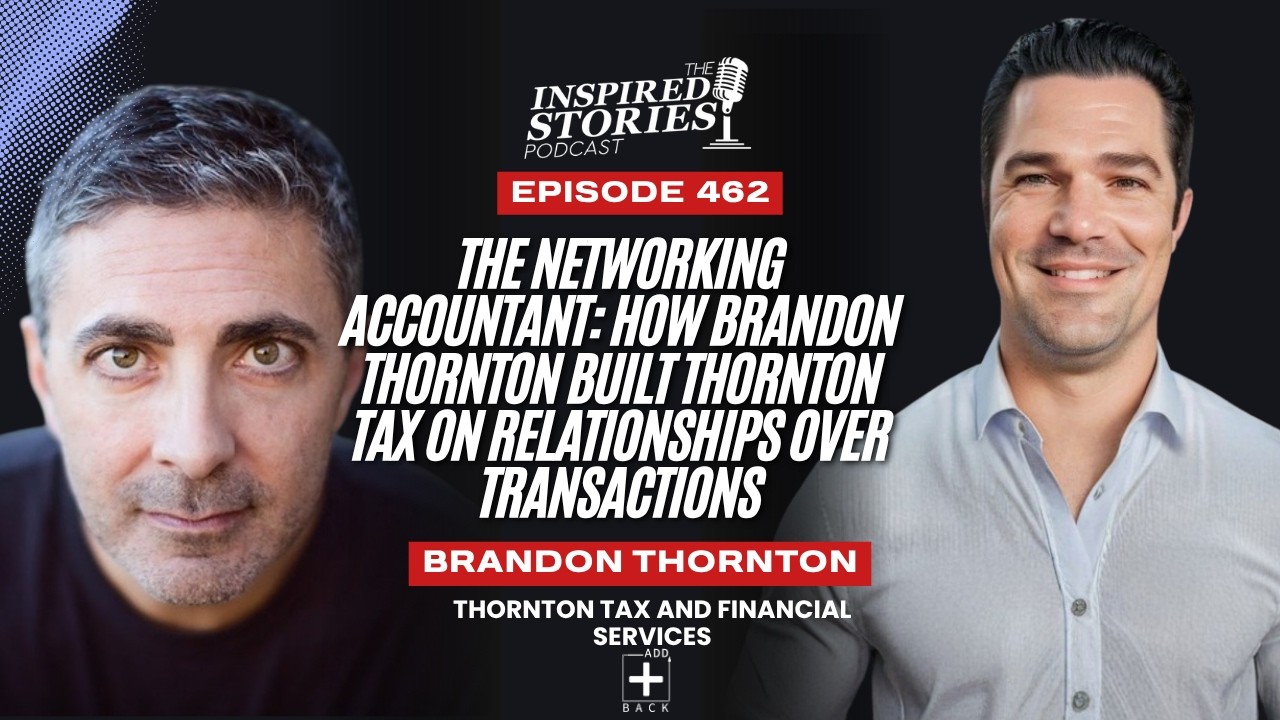
🎙️ From Kinesiology Degree to Strategic Tax Powerhouse: Brandon Thornton’s Journey at Thornton Tax and Financial Services
Brandon Thornton, owner and president of Thornton Tax and Financial Services in Hurst, Texas, studied kinesiology, worked as a personal trainer, spent five and a half years in oil and gas, came home to be a new dad, enrolled in fire academy, and stumbled into a 70-year-old family tax firm with five bookkeeping clients. Ten years later, the firm files 1,300 tax returns a year, carries 75–100 bookkeeping clients, has added strategic tax planning and virtual family office services, brought on two partners, and is targeting 25 acquisitions in five years. None of it was a straight line. All of it was deliberate.
✨ Key Insights You’ll Learn:
How five bookkeeping clients became 1,300 tax returns a year — through referral partners, not advertising
The million-dollar tax liability turned into a refund through a 6X strategy most clients never know exists
What virtual family office service is and why it’s no longer just for the ultra-wealthy
Why Brandon earned his enrolled agent credential and what it means for the firm’s continuity
The October 2025 partnership that added a Sandler sales coach and a fractional CMO — and grew revenues 20% in the slowest quarter
How AI is cutting 1040 prep time from 90 minutes to 25 minutes without sacrificing quality
Why the data entry clerk will be largely non-existent in five to ten years — and what smart firms are doing now
The Success Champions Networking group that led directly to his partners and a key staff member
The plan to acquire 25 accounting firms in five years while preserving the legacy of each one
The family compound goal driving everything — and why it requires a great internet connection more than anything else
🌟 Brandon’s Key Mentors:
His Mom (Founder, Thornton Tax): Spent 35 years building the firm on pen and paper — and made fun of Brandon for not being there to help sooner
His Oil and Gas Boss: The patient who became his employer and showed Brandon what an unexpected career pivot could look like
His Wife: First and most consistent source of support through every hard season — part therapist, part best friend
His Peer Review Group (Largest Independent Tax Strategy Group in the Country): Where every strategy gets stress-tested before it ever reaches a client
Success Champions Networking Community: The room where his partners and staff found him — and where intentional networking replaced card-throwing
👉 Don’t miss this conversation about tax strategies most business owners don’t know exist, why relationship-based acquisitions beat private equity roll-ups, and how a guy who studied kinesiology ended up being one of the more forward-thinking tax strategists in Texas.
Listen to the full episode here
Transcript
Anthony Codispoti: Welcome to another edition of the Inspired Stories podcast, where leaders share their experiences so we can learn from their successes and be inspired by how they've overcome adversity. As you listen today, let one idea shape what you do next. My name is Anthony Codispoti and today's guest inherited something most people never get to touch, a business that has been in his family since 1952. with clients now in their third and fourth generations of working with the same firm. That kind of continuity is rare and it comes with a weight that no MBA program prepares you for. Taking over a legacy business is not the same as building one. The expectations are baked in. The relationships are decades old and the pressure to honor what came before while still moving forward can pull you in two directions at once. Brandon Thornton is the owner, president, and strategic tax consultant at Thornton Tax and Financial Services in Hearst, As an enrolled agent, a credential held by fewer than 3 % of tax professionals, he is authorized to represent clients before the IRS in all 50 states. His firm serves small businesses and individuals across a wide range of industries, from architects to contractors to medical professionals. often functioning as their outsourced CFO. Some people build a legacy. Brandon stepped into one and learned how to make it his own. But before we get into all that good stuff, today's episode is brought to you by my company, AddBack Benefits Agency. Listen, if you run a business, you're likely stuck in the cycle of rising insurance premiums. You're paying more, but your team is getting less, and many people can't afford coverage at all. So we do things differently. We offer a solution that provides your employees with unlimited access to doctors, therapists, and prescriptions that's always free for them to use. Here's the part that surprises most people though. Unlike every other employee benefit out there, our program puts more money into your company's bank account. As an example, we recently helped a client increase net profits by $900 per employee per year. Results vary, but gains like that can change how a business is valued. and the consultation is free. Imagine being that advisor that becomes a hero by introducing this to your clients. See if they qualify today at addbackbenefits.com. All right, back to our guest today, partner of Thornton Tax and Financial Services, Brandon Thornton. Thanks for making the time to share your story today.
Brandon Thornton: Happy to be here, thank you for having me.
Anthony Codispoti: So before Thornton Tax and Financial Services, your degree was actually in kinesiology and health promotion. Help us connect the dots. How did you get from here to there?
Brandon Thornton: Yeah, it's a little bit of a different story from most that ended up in accounting for sure. was studying kinesiology and then got a minor in health promotion and psychology. And it was around the 2008 timeline. So it was when discretionary spending kind of took a little bit of a hit. So when I was working while I was in school, I was operating as a personal trainer, which, know, if you have the option to pay a personal trainer or pay your bills, then it's a pretty. Easy choice to make. So the the opportunities there were slowly starting to diminish. So I went into physical therapy work because it was backed by insurance and it would make sense to apply what I was learning in the same fashion that I was doing it as a personal trainer, but do it in another industry that was equally applicable. And then along the way I've met my first boss when I went into working actually in oil and gas was one of my patients. And then from there, y'all spent some time in oil and gas and we found out we were having our first daughter. And my brother was a lieutenant colonel in the air force and flew F-16s and was deployed numerous times and missed a lot of his girls lives. So given that I had a choice, I decided to come home. And when I came home, we also had two family friends that passed unexpectedly.
Anthony Codispoti: Okay.
Brandon Thornton: that had businesses that were also clients and friends that didn't have a plan. So we wanted to put something in place that would take care of the continuation of a business that at that point was 65 years old. And I enrolled in fire Academy because that's what I was going to do before I got an offer for oil and gas. I literally had to have a conversation with my first boss about, know, you can do this and have a 30 % chance of being hired, or you can show up on Monday and have a paycheck on Friday. So I was there on Monday and left five and a half years later. but came home and enrolled in fire academy. And then in the 15 weeks I was in fire academy, the portion of the business that was to take care of my wife and I went from five clients to 35. And then from there we just kind of put in some focus and grew it.
Anthony Codispoti: Wait, I want to understand this. You came back home because you're going to have your first child and you're going to work in the family business as well as be a fireman. Is that right?
Brandon Thornton: Yeah, because the initial thought was that they worked at that time before they changed scheduling around. It was every third day. So on the two days off or even one day of the three, then I spend it in the office working and work on getting my license and then make a decision about whether it was, it made sense to continue with that career or focus on accounting, but it was a position that would give me benefits, retirement. you know, and a workable schedule if I wanted to build a business.
Anthony Codispoti: And prior to stepping into that role, had your previous work prepared you for this or were you stepping into something that was completely foreign to you?
Brandon Thornton: I grew up with my mom and my dad are both accountants. between grandma and grandpa and my dad and my mom and my step mom, it was always around and I was always exposed to it. So I had a loose working knowledge of it. And then I did small sets of books in college just to kind of make extra money and help my mom out. so it wasn't completely alien. It was a completely different approach to go from being W2 to being now a business owner and trying to steer the ship as well as mend the sales. and it was a bit of a shift, but, my mom used to always make fun of me and say, where was I when she was doing this by herself for 35 years? And I told her I was swinging a hammer and building an appreciation for this type of work.
Anthony Codispoti: I love that. Yeah, my dad had some of us work at one of his manufacturing companies growing up for a very similar reason. Wanted us to stay in school, get a job, have this be a good motivation. And so, okay, so you come back, you're doing the FIRE Academy. The part of the business that you were gonna be working in had five clients and then very quickly went from five, did you say 35? What happened there?
Brandon Thornton: Just put the word out to the clients that we were already working with, that we were looking for additional clients, as well as went and was trying to be as specific as possible with who I connected with to try and get in front of more clients, which carried forward into my networking today. So I was focused on, you know, bankers, attorneys, estate planners, wealth advisors that worked with the clients that needed our services the most. And I wasn't direct competition for
Anthony Codispoti: So you went to referral partners and said, hey, here's what we're doing. Can we help any of the folks that you know? And that's how you guys grew very quickly from five to 35. And you realized, I don't have time to also be a fireman. Is that right?
Brandon Thornton: Well, gave us a choice at that point because I was coming out of a job that the industry in general is a high risk industry and dangerous. and to go back into another dangerous position, given that I had the opportunity at that point to decide if I wanted to, or I did not, I'd rather have the additional time with my family and focus on being exceptionally good at what I do in one industry. So decided to stick with the business. I still have an affinity for, for firefighting and appreciate everything that they do. But it just, it made more sense for me to focus on this track more than trying to split it.
Anthony Codispoti: And you said that the part of the business that you were focusing on went from five to 35. What were the different parts of the business and what was the one that you were focusing on at the time?
Brandon Thornton: Originally the part of the business that was to take care of my wife and I was a bug keeping portion and the tax, since I wasn't licensed at that time, took care of my mom. So she did all of the tax work. We did all of the bug keeping and other support work with her. And we just basically put a line down the middle. Well, over time, as I built more ability and then became licensed and things like that, then I took over that portion of the business as well. And it all rolled into supporting my wife and I and We went from, you know, when we started as ownership, we had probably five bookkeeping clients and we were probably filing 300 returns. Now we probably have any on any given month, we have between 75 and a hundred bookkeeping clients and we file about 1300 tax returns a year. So over the course of 10 years, we've kind of exponentially grown it. And then with the addition of the new service offerings, we have an advisory service and strategic tax planning. It's allowed for us to take another. big step forward into not only the value that we can provide, but what it can do for us as well.
Anthony Codispoti: Okay, so bookkeeping, tax services, these were there early on. Tell us more about some of the new advisory services that you guys have been
Brandon Thornton: Traditionally, what most people have come to expect from an accountant is the once a year drop off your paperwork, bad news, you owe the IRS kind of relationship. And what we focused on is trying to break that mold, remove the typical professional silos between your legal counsel, your wealth advisor, your accountant, your banker, and make it more of a team-based proactive model. I learned a lot about virtual family office service through some of the groups that I've worked with over time. And what has turned into is that a lot of the clients that think they're being underserved or that they know there's more options out there, but there's too much to sift through on their own without a certain level of knowledge that it is capable of being brought. down to a reasonable level and it's not just specifically reserved for the ultra elite. And it can bring tremendous value in addition to what your professionals are already doing. And when they want that all in one place or they want that as a compliment to people that they're already working with. And that's where we kind of show up and show them the difference that we can make. But it's the difference between, you know, someone being told that they need to make an S corp election or that they need to pay their kids through their business or right off their mileage or use the Augusta rule to specific strategies that are bent around what the client's overall long-term plan is and can usually carry a heavier influence of anywhere from a 2X to 10X or more multiple as a first year deduction or deferral.
Anthony Codispoti: Wow. Is it possible just to help us wrap our heads around what it is that you guys at Thornton Tax and Financial Services can do differently? Give us a specific example. Leave out the names, but walk us through what you were able to do for some.
Brandon Thornton: Absolutely. We had a client last year that had a really good year with their business and netted a large amount of income that was going to throw off over a million dollars in tax liability between self-employment and federal income tax. So that's over a million dollar check that they were going to have to write to the government because they didn't have any other options at that point. And we sat down and we looked through some strategy options and decided on one that was about a 6X multiple. And What they ended up doing is writing, you know, a $400,000 so check to the strategy, which actually purchased them an asset and is revenue generating for them. So it diversified them. It produced another income producing asset and they got a bonus depreciation deduction in the first year that wiped out the income and they actually got a refund.
Anthony Codispoti: Hang on a second. Let me see if I understood this because I think my brain misconnected things here. It sounds impossible. So they were going to have a million dollar tax liability. Right. You came in for four hundred thousand dollars. They acquire an asset of some kind. And because of the way that this all got tied together, they didn't owe that million dollar check to the different governments. And in fact, they got some money back that they had already paid.
Brandon Thornton: Correct. And that's, that's the part that a lot of people don't realize is available. And a lot of it's because the, there's a lot that's offered through private offering. So there's, initial entry points as far as what you have to have or how you have to qualify in order to get access to them initially. And then you have to find them. And what we've tried to do is put a collection of them. essentially together for the clients to sift through with us helping them to find what's the best use case for them. And part of that is done through direct partnership with people that are offering those. And then a lot of it comes from, I was invited to join the largest independent peer review group in the country that's specifically built around tax strategy. So you have to have a license in either as a CPA, an attorney, an enrolled agent or as a licensed tax preparer in order to be invited into it. And it is for no other purpose than to poke holes in every tax strategy we can get our hands on and the ones that make it through that are easy to understand, easy to implement, risk is mitigated, all the fun things that everybody likes to know about. We do all the due diligence on it upfront so that the only thing that's left at that point is to check the applicability of it for that specific client and make sure that it will work for them.
Anthony Codispoti: Are these tax strategies part of intellectual properties? Probably not the right word, but I'm curious how comfortable you are saying more about the details of just one of these things, one of these strategies.
Brandon Thornton: I mean, there's a number of ways that they work. There's ones that are leveraged either through leases or loans. And that's how you get the greater multiple because you're at risk. And then based on how the asset is structured or how it functions, then it throws you into qualification based on the IRS regs. There's ones that are specifically for charitable giving. There's ones that are for not only the types of assets that you have, but where they're held. and how your entities are structured so that the cash flow and tax flow is optimized from each of them. So, you know, you can have a business or several businesses and then slapping a management company over the top of it, or you can say, okay, well, this business owns this one and the main entity that goes, that owns the parent company actually feeds into a family management company that's owned by a trust. or a single member LLC, so there's tax advantages along the way as well as control over the tax flow or this cash flow.
Anthony Codispoti: Okay, and so this is one of many things that you guys are experts in. So I want to sort of cover a little bit of the ground sort of in between how you got from, you know, where you started to where you are. When you were coming into this family firm that been around for decades, was there a weight on your shoulders? Was there a like, I've got a reputation to live up to? or did you just feel naturally about stepping into this role?
Brandon Thornton: I think anytime you take over a business or start a business, there's always that imposter syndrome that creeps in for sure. for me, it was a lot of that. And then there was also a lot of, you know, in the interim, when I purchased the business until I got my license and built some ability there, there was the great concern of, well, can I do this if something were to happen unexpectedly? And it weighs on you. mean, it's, it's, Troublesome for sure. But as I've become more confident in my ability and built more knowledge and built a stronger team around me, those pressures seem to lighten up or at least be held up by a team rather than on one side of shoulders.
Anthony Codispoti: Anything you had to unlearn about yourself as you went into that role. or reprogram about yourself.
Brandon Thornton: I was always one that if I failed at something, because I always want to do everything I can do, exceptionally well, that failure happens in business whether you want it to or not. It's not always you. You can't focus on the losses. You need to just blow it off and move forward to the next one because if it didn't bankrupt you or kill you, you can go replace it tomorrow.
Anthony Codispoti: I like that. And I really appreciate you bringing up the imposter syndrome because this is something that I think most people listening would be surprised to hear the number of very high performers, very successful people that even with where they are today and the confidence that they mostly have in themselves and their work, still experience on a regular basis, right? To the contrary of evidence that says you've done it, you can do it again, there's still a part of your brain that's like,
Brandon Thornton: but for sure. I mean, it's, I grew up with my family owned businesses and being in accounting. And, you know, I also was, when I was independent as a young adult, I was also the one that was open in, you know, Christmas and birthday cards to pay bills. So, I mean, it's, I've been on both ends of it and, to go from that to where I am now is a pretty, pretty hard swing as far as where we went. and the direction we're going now. Because with the direction we're going now, I know that we're secure and stable and now growth is the main objective. So we're actually looking to acquire more and grow from there. So it's going to be really interesting to see what happens when we take on another one that I didn't have access to initially that somebody else's legacy or baby.
Anthony Codispoti: That'll be interesting. Let's come back to that. But I want to hear about the transition of when you took over the firm first. How did that take about?
Brandon Thornton: when I initially took over, my mom is very much a pen and paper person. So she was carrying around her workload for the week on a three by five note card and was taking her appointments and a reamed paper agenda. So the very first thing we did was modernize. so we set up business emails, websites, started using collaborative platforms for scheduling ways to track our clients. All kinds of fun little bits and pieces that went into it. And then over time we've just slowly built into building operating procedures, processes, adding additional platforms to it that have allowed us to better serve the clients at a greater degree and expedite delivery while also maintaining the quality of what we're doing. And now that we're focused on the direction that we're going with advisory service. Connecting the clients with. the best, not only tax preparation services that we can provide, but the best services that we can also find for them in other areas. So if they don't have a wealth advisor or they're not getting the service they need from them, having essentially a pool of them that based on what they're telling us and what they're looking for, we can draw from to put them in front of the right people. It's really opened up new opportunities for us for not only Being able to bring more value to our clients, but also to get exposure to other professionals and what else might be possible for the clients. And you know, it's also reciprocal. So it comes back to us in different ways, either through referral or whatever it ends up being from the partners that we work with.
Anthony Codispoti: Are you a natural networker? Because I'm seeing this pattern of it. How you first grew the bookkeeping side of the business coming in, going out to the referral partners. And now as you guys look forward on the advisory side of things, it's the same kind of, OK, let's go out and find the best in class partners to work with in different areas.
Brandon Thornton: Yes, I'm naturally social. And when I found a way, the way I describe it to people is that I found a way to monetize my ADHD is essentially the way it works for me. You know, my mom and my wife are very much introverts. I'm very much the extroverted one. So when they got invites to events or parties or anything like that, they would you know, go stay there allotted 15 to 20 minutes, thank their host and get out as quickly as they could and as quietly as they could. I'm the one that prefers to stay till the end and then ask where we're going afterwards. And, know, I usually come back with cards or clients or both. and it's just, it comes naturally to me cause I naturally want to bring value to those around me as well as provide them with the connections that make that value possible. even if it's not something where I'm directly going to benefit from it, would rather that somebody I've connected with know that I can put them in touch with the people that need they need when they need them. And the work will come back to me later.
Anthony Codispoti: Mm, I like that. So, 2022, you earned your enrolled agent credential. What's the reason that you did that? What changed for you once you had it?
Brandon Thornton: Well, number one, I could sign tax returns as a preparer, so they all moved over under me officially. But comparatively to a CPA license, we can practice in all 50 states. CPAs can as well, but they all have to register with each individual state board. So less oversight gives me the professional credential I need in order to represent and put the final piece of the continuity plan in place that at the very least, even if I had support to help me, I could still run the firm, sign the returns and do the work if it apart of the hinges here.
Anthony Codispoti: which doesn't sound like it's happening. We're gonna get back to the growth trajectory that you guys are on here in a second. But you mentioned something a little bit ago that I wanted to come back to, virtual family office service. Say more about that. What is that?
Brandon Thornton: Everyone's heard of the Zuckerbergs and the Musks and, JP Morgan, everything else where they don't pay tax. And that's what they compare themselves to. And typically it's because what they have is what's called a family office where if they need an attorney for something specialized for their family, they go hire the attorney and they work for the family. And over time they get a collection of specialists and professionals that work specifically for the family and that's called that's traditional family office. And in certain instances, that still makes sense. But in a lot of cases, it doesn't. And it seems unreachable by most. So what Virtual Family Office does is it creates a... modern virtual multifamily option where a collection of professionals or a specific company can provide an all-encompassing approach for the clients, but the barrier of entry comes way down because now they're doing it with multiple families that can all agree.
Anthony Codispoti: It's a shared service, right? I don't have to pay for that entire office and that staff myself.
Brandon Thornton: Yes, you're not. You're staffing the professionals, but you're working with them at a higher level than just the traditional, you know, set up my will or help me with my estate plan type attorney. You're working with somebody that as things change for you or you acquire new things or, or get into and out of businesses that it requires ongoing communication to be both proactive and preventative with. How those professionals are putting things in front of you, including tax. You know someone that's getting ready for a business exit. If they have a business consultant that's prepping them for the sale, then they're going to work on getting. The most that they can get for it for the client, but then beyond that their portions pretty much done and if they were working with a traditional accountant that isn't forward thinking, then. They wouldn't be prepped for the tax implications of it and an or would just be left with no other option just to pay the tax on it if you plan effective. negated or deferred.
Anthony Codispoti: What kind of a client is a good fit for Thornton Tax and Financial Services? Size, industry, geography, give us the rundown.
Brandon Thornton: For the strategic planning portion of it, then it's usually someone that's got a, I hate the term high net worth, but that's essentially what it is, is that their income's high enough to the point where they're in a higher tax bracket and are limited by either options or access to the strategies that would most benefit them. Most of the ones that we work with on strategy are also business owners because then it gives them an additional option of, you do it through your business or do you do it individually or both? But we're not a niched firm, so industry doesn't really prevent us from one client to the next. And if they feel like they're in a position where they want to look into strategy and it makes sense for them, then we sit down and initially look at it with them from a projection and application standpoint. And if it doesn't make sense, will be the first person to tell them that right now you're spending X dollars to save X dollars. And it doesn't make sense to do that when you could just do this piece that wouldn't require all of these extra, put all these extra requirements on you to participate in a strategy and essentially get you closer to where you want to be. And then for the ones that it does make sense for them, we can sit down and, and have the initial discussion, make sure that it's applicable for them. And then if they decide to move forward at that point, we start doing the fun part, which is playing with the numbers and running projection and giving options. So it becomes really interesting really quick.
Anthony Codispoti: It does sound fun. The other fun thing that's going on is October of 2025, just about six, seven months ago, you guys took on some partners. Walk us through that.
Brandon Thornton: It was the value over volume equation all over again, because, know, eventually when I initially started, I started in books and then I worked into more advanced books and then that's led into bigger questions about what they could learn from it from a projection and analytics standpoint, and then led into some Comptroller work and then some Fractional CFO work. And then when I got my tax license, it kind of started the process over again where I started fairly basic with the tax and then got into more complex tax situations and the question started to grow bigger and bigger, which is what initially led me into virtual family office service because I was looking for a way to facilitate those additional needs for the clients without just beating the street and, meeting, you know, 150 different wealth advisors and a hundred different attorneys and trying to find the right ones. was essentially practice built and intentional when I first got into the the company that I started that with. And then. When we reached a certain point, it was, we continue just to pump in more or do we focus on the value? And if I'm going to focus on the value, am I capable of doing that while also spinning all the plates and wearing all the hats? And in some cases, that's not the case. In my case, it wasn't. So I went and found people that were partnered, were willing to partner with me that I had a close connection with that. I understood the value of what they brought as well as what it would do together. And as we start looking at doing some of these acquisitions, it gives us the ability that instead of me coming in as a single individual with industry knowledge and experience to partner with somebody on a firm or to acquire it on my own, it gives me a team to work with that outside of what I do. One partner is a sales executive leader, coaching consultant, with Sandler and has been doing that for a long time. He's excellent and teaches people how to sell, to, how to build other leaders. And then the other partner is fractional CMO. So marketing, she's also done operational change management. She's managed large teams, multiple facilities. as we go into this model where we're potentially going to have multiple locations and additional team members and things like that, then she brings that experience to the table as well. And now that if we go harder with somebody to acquire a firm or we acquire it on our own, instead of me going in by myself, it's the team goes in and they have their strengths as far as how that will play into the plan. And I have mine and everybody works together that way. But If we go in with partners, also opens up a larger equity position opportunity for us because then we're not only just handling the traditional service and the accounting and the operations, we're also handling marketing, team development, growth, operational change management, operating procedure, all the fun bits and pieces that tend to be problematic.
Anthony Codispoti: Okay, so I've just connected the dots on all this. I thought you're bringing in somebody from sales and somebody from marketing just to help you bring in additional clients. All let's put some marketing campaigns in. Let's train some salespeople to go out and have to talk about our product. But now I get it. These are services that you want to offer to your client base because you go in and from a financial perspective and people outside of business maybe don't get this. finance people, they get operations really well, right? Because they get the operations and they can see how the numbers are affecting what's going on. And so a big part of pulling levers to help firms get to the growth that they want, sales, marketing, right? And so now you've got those expertise in-house that you can offer to your clients.
Brandon Thornton: We can do that. And then also from the standpoint that if we go into an acquisition and any of those areas are lacking because accountants as a whole are typically not social individuals. I hate to generalize like that, just, you know, I tend to think of myself as one of the exceptions. I've met others that are, but for the most part, they like the work. They like what they do, but they don't.
Anthony Codispoti: They don't want the spotlight.
Brandon Thornton: It'll market a lot. They do well that they do a lot of organic growth more so than marketing and cold outreach or any of that piece. And then they develop from within and by basically finding more of more professionals that are like them. And sometimes it takes coaching or consulting to kind of build people into stronger team members and be able to go into an acquisition or to partner with somebody to help them with their firm and bring those components in from one central team is much more valuable than trying to piecemeal it all together.
Anthony Codispoti: So your plan in 2026 and beyond is let's do some acquisitions. And what are you looking for?
Brandon Thornton: Right now we're focusing on accounting firms. So other accounting firms that have a good amount of business and individual tax, especially ones that may or may not already be offering strategic planning or strategy to their clients. But the idea would be that over time, as we acquire more and add it to what we're doing, my office was our initial case study. We didn't change the name. We didn't come through and lay waste to all the staff. We are still true to the legacy of what was built here. And we want to do that with additional firms. So somebody that spent 20, 25, 40 years building another firm and doesn't want to just hand it over to private equity or somebody who just wants it as an asset to be able to come in and tell them that we understand it. This is kind of the background that we came from. All we want to do is a, you know, a soft rebrand, rebuild the website a little bit, maybe change the logo and keep the name and then move forward from there. Then it makes it a lot easier conversation to have because we want to be true to what they've built for so long rather than coming in and make their firm fit our mold.
Anthony Codispoti: Is it important for these new acquisitions to be geographically close to you?
Brandon Thornton: The first few, yes. We're going to focus in kind of the North Texas area initially. And then from there, I mean, based on availability and the market, then we're going to start slowly reaching out further and further. But the plan for us is we want to do at least 25 in the next five years. And then we're going to keep pushing until we hit a pretty high valuation and then a pretty high top line revenue. about 150 million. So we're pushing hard and we understand that that'll come with its own challenges. But the idea being that we want to take what we've done to create a different space in the industry and increase the availability of it.
Anthony Codispoti: Okay. say more about the different space that you wanna create, right? Because there are other folks that, know, clearly accounting firms are acquiring other accounting firms, but what's different about your mom?
Brandon Thornton: It's not transactional. more relationship focused. You know, for us, we prefer to have relationships with our clients and I can tell when someone's walking in from the parking lot, who they are, then waiting for them to get in and hand us paperwork to figure out who we're talking to. You know, and not from the acquisition side, not treating it as something to be put into a portfolio so that it can be turned out for a markup later, like private equity tends to do. And that the plan for us is just to grow. We want to grow across the board. We're not going to focus on acquiring the clients or acquiring the contact list and then, you know, tell everybody that their last day is on Friday and move it over to something that we're already maintaining. We want to keep it going the way that it is. Keep the team. Keep the location if possible. If not, then find something that's relatively close to it. And you'll go from there, but the idea would be that we stay true to what it's been for so long for a lot of the people that have built it. And that's where the reality of the situation is that we're, coming up on a probably a 10 to 15 year span here where there's going to be a large number of the people that are practicing in the industry retiring or just aging out. And they're not going to want to just let it go. but they also don't want to turn something that they've built for the last 20 or more years over to somebody who's just thumping a checkbook and going to put it in a folder and add it to a portfolio to turn around and sell it to somebody else who doesn't want to run it true to their background.
Anthony Codispoti: What's the plan to fund these acquisitions, Brandon?
Brandon Thornton: We've looked at a number of different options. After the first probably two or three will probably be self-funded. But on the first two or three, we're either going to do it through funding partner, traditional lending or non-traditional lending. we've looked at pretty much everything across the board. looked at doing zero coupon bonds, preferred shares, convertible shares, traditional lending, investor lending, capital raise. We've done a lot of research on that front. We're prepared for whichever direction it needs us to go in order to make it happen. But after the idea being that with the difference that it's made here between October and now we took about a 20 % increase between the end of October through the end of December last year, which. Which.
Anthony Codispoti: 20 % increase in your revenues because you were able to offer these additional services.
Brandon Thornton: And because I wasn't trying to spin all the plates. So had people that I could trust and rely on step into certain roles in the office that allowed me to go out do what I was best at, which was the strategy and the development portion of it. And it led to a lot of growth for us that equated to about a 20 % bump in this, what should have been the slowest part of our year. And then between the beginning of January to the end of February, we had about 40 % of what we made all year last year already on the books.
Anthony Codispoti: Okay, so that kind of answers the question that's been rattling around in my brain. Is it weird when an accounting and tax firm goes to their clients and says, we can help you with sales and marketing too? Apparently the answer is no.
Brandon Thornton: Not really from the standpoint that, like you said earlier, the financial portion of it can tell you where the pain points are, but it can't give you the solutions. So to have someone that's capable of stepping in when you realize that your margins are good on the ones that you are selling, you just need to sell more. by the way, here's someone who can teach you how to sell better or help you find someone that's capable of selling this for you and train them. Then it brings that much more value to them because now we're not just pointing out all the red dots on the financials about where the problems are or where there's misalignment or they're overspending or it's not profitable for them and we're providing solutions as well.
Anthony Codispoti: Hmm. Wow, that's brilliant. You kind of touched on this, you know, lots of growth anticipated here in the next few years. And there's going to be pain points to that growth, right? You've seen it from your own clients, right? Different companies go through growth. The way that you did things before is, you know, not going to be, know, what gets you to the next level. You have to kind of reinvent yourself. And so I'm curious how you guys are thinking about the tech platform that you've got in place as you're making these acquisitions, first geographically close to you, but then later more dispersed, and how you can be able to centralize and sort of keep your arms wrapped around the inner workings of what's going on.
Brandon Thornton: we've gone the route of augmentation, not replacement. So giving the staff the ability to expedite delivery, work more efficiently through the systems that we use on both tax prep, bookkeeping, client communications, tracking, standard operating procedure stuff. so we've created a model where we've essentially cut out the fluff and took away the pieces that were not necessary or redundant and kind of built out a model to where we can either acquire new licenses and fold them into what we already have or acquire new versions of the software for each firm that we do and then retain access to each of them. But it gives us, my big thing is oversight. I don't want to have to come look over someone's shoulder just to figure out where they are in a project. I'd rather have it in a, if that's the case, then it needs to be in a system where as they're incrementally working through the pieces of it, that we can just look at the system and know where they are and give them, you know, not necessarily autonomy, but give them less micro managing and more focus on what they do best with the ability to just reach out and go across the hall for help. But for us, the tech stack is, we use ultra tech. So some firms still use Lysert. My dad still uses Lysert, which is an Intuit product, which has mixed emotions in the industry because Intuit loves to buy everything. But, you know, we've built into a model where on Essentially on 1040 work, we can streamline the process and we cut it down from about on average about an hour and a half per client to about 25 minutes. And same quality of product, same ability to provide completed work to a client, just vastly faster and more effective, which means that opens up the additional time to be there for staff development, additional new clients or strategic planning clients. So. It gives us rather than letting go of anything or having to churn clients out or anything like that, we can still take on new clients every day and not reach the same pain point because it's just a matter of leaning harder on the tools that are meant to help us work more efficiently than it is putting additional pressure on any one or multiple staff members.
Anthony Codispoti: How do you think about AI in your practice today?
Brandon Thornton: That's been a big focus for me for the last two or three years. And a lot of it was built around. finding solutions for the mundane repetitive process. And I think that's going to be the first thing that probably goes in our industry, which is in probably the next five to 10 years, the baseline data entry clerk will essentially be non-existent. Not to say that they can't still be utilized, but it means that you get to skill up your staff if you do it properly because then who was going to be doing data entry can now be trained to do a review. And the one that was doing a review can now do higher level service with additional clients for analytics or projection or profitability and become more of that trusted advisor consultant accountant than just the data entry. Here's your financial statement type relationship. So I can see it. scaling up everyone in the industry as long as they embrace it. The ones that fight it, think are going to walked over the top.
Anthony Codispoti: Is it too early to be thinking about leveling those folks up?
Brandon Thornton: Never. Even with where it sits right now where it's strong in some areas and still weak in others, it would be better to get in front of it comparatively to waiting for it to get until everyone's singing praises and then trying to figure it out.
Anthony Codispoti: So if someone's listening and they are that person that is concerned about being replaced, what should they do? What's their first step to leveling up?
Brandon Thornton: learn how to use it. I'm actually, oddly enough, I'm actually going through a platform called Corsiv right now that you can register for it. There's certain, there's modules that are industry specific. So there's AI and accounting, you know, how to use Gemini or Claude or chat GPT, or some of the others that are available and what it's strong with, what it's good at doing and where it has its strengths and where it has its weaknesses and what others are best at and then how to comparatively look at them and then also how to tie them together to make them all efficiently work together. And being able to do that is going to be a difference maker between being able to skill up because now you have the ability to not only create your own tools but your own workflows and expedite your own work that you instantly become more valuable.
Anthony Codispoti: Tell us about True Capital partners and Better Biz Advisors.
Brandon Thornton: True Capital Partners was a secondary pursuit for me when I initially got into family office service. I partnered with a wealth advisor that the big restriction on that is that you can't, if I'm not licensed in any series licenses, I can't partake in anything on that side of the strategy. Likewise, if he's not tax licensed, he can't partake in anything on the tax strategy or engagement side. So that just kind of brought the wall down for us because we were working heavily together at the time. It's still a secondary project for me, but not my main focus. And then better biz advisors is when I was doing the fractional CFO and controller work, I was being asked to do things that I didn't consider in the accounting realm. And it gave me a secondary platform to keep it out of the tax firm because it wasn't focused on tax or accounting and still help the clients with certain things like tech stack or systems or deployment or integrations, things like that, that were more, it was kind of a tech nerd side project for me essentially. And now oddly enough, that's with how I've repurposed it for other uses given that we've had our partnership now. It has its own use case now for me outside of that. But, yeah, I'm a giant tech nerd. So when it comes to FinTech or software or tools or something that can streamline workflow or process, not only my industry, but just in business in general, again, that's where I learned to, monetize my ADHD. Cause I can do a deep dive on it, learn it, catalog it in my mind. And then when it presents itself as an opportunity in the future, pull it out and present it to a client.
Anthony Codispoti: What are your favorite AI tools or platforms right now?
Brandon Thornton: I'm a big fan of Claude. We have G Suite through our office, so we do a lot with Jim and I. But as far as industry specific things, we're using platforms that are meant to speed up and automate the process. That was typically a lot of repetitive questions or is client specific. So we're using a platform for retrieval and delivery where instead of calling the accountant and saying, what forms do I need to provide you? Or what was on last year's tax return? It specifically asks by document type and company name, what was on last year's tax return to retrieve it. And then we have a secondary system that helps with speeding up the process on preparation by reading standardized documents. So any W2 1099, consolidation reports from your wealth firm, K-1s, things like that, it can read it and pre-populate it so that we jump from not having to do the key entry to doing more high level review and working on it with the client faster. And then on the delivery side, it literally walks them through the tax return, helps them make a payment to us, helps them make a payment to the government. They can set up reminders for their estimate payment vouchers. And it's all automated through a platform that otherwise they would be calling us and asking for those.
Anthony Codispoti: What's the reliability?
Brandon Thornton: We haven't had any problems with the reliability up to this point. They've got about a 99.9 % uptime from what we've seen and what they've told me when we initially investigated it.
Anthony Codispoti: And in terms of accuracy, no issues there.
Brandon Thornton: I mean, it's still, there's, it has its strengths and weaknesses. It can't read non-formal or non-traditional documents. So if somebody gives you an Excel spreadsheet with business income and expense, that's not from a set of books. So then it can't be just pulled directly in and wants you to clarify where it's supposed to go. And then just little bits and pieces. But other than that, it, it does about 85 to 90 % of what we want it to do. And that it does speed up the process because I mean, we put 60 returns into it on a Monday and by Thursday they were back to us.
Anthony Codispoti: Okay, that's impressive. And it's still early days. It's gonna get better and faster. Yeah.
Brandon Thornton: So, know, it's only going to improve. And that's the thing is that they're always adding additional modules or tools or abilities to it. And I'd rather start embracing it now knowing that it can still get 90 % of the way there and that we've got to finish off that last 10 % and then do all our quality checks and review. And with the anticipation that it'll be great, it'll grow into a greater use tool for us over time. But if it doesn't, then it's also the wild west right now, as far as AI is concerned. so who's to say there's not going to be a better tool tomorrow. Cause. Good. I was going to say, I listened to a, an AI specialist that I'm friends with present recently. And the way he put it was that when the everybody was riding around in horse and buggy and cars came out.
Anthony Codispoti: No, you know, go ahead, Brian.
Brandon Thornton: there were no mechanics. So there's not really any such thing as an AI expert right now because it changes so much so often. And there's so many new things every day that who knows what it's going to turn into.
Anthony Codispoti: Yeah. And I think the key lesson from what we were talking about here for those who are listening is if you're not already jumping in with two feet to become comfortable with the tools that exist, no time like the present. Today's the day that you jump in, roll up your sleeves, start learning it because you know, the refrain I keep hearing from a lot of really smart folks is that AI may or may not replace your role. but the person who understands AI is gonna be the person who replaces your role. Because you without the assistance of AI is gonna become a thing of the past pretty quickly.
Brandon Thornton: Well, that in our industry, industry specifically, it's, there's a lot of relationship factors there that AI might be capable of doing the work, but as far as the interpretation of what it can tell you and the decision-making process and your own personal aversions or preferences, it, it would take a lot to build something that was capable of understanding and incorporating all of those into it. So I don't know that that portion of the business was ever capable of being replaced because it's too personalized and too fluid.
Anthony Codispoti: That's a great point. like that. Brandon, what's one of the hardest things you've ever had to overcome personally and what did it teach you?
Brandon Thornton: For me, it was... It's probably, I would say there's probably two that are equally as difficult or that number one was coming home and starting over. And you know, I switched industries. I moved home. I was going to be a first time dad, first time business owner. I think the best thing that it ever taught me was patience. Because there is such thing as too big too fast. And The other would be knowing when to ask for help. My partnership would be a prime example of that is that the business was growing and we were being very successful, but it was also growing to the extent that it was either going to. take the time that I was trying to gain or start to have a turn in the wrong direction based on how focused I would have to be in so many different areas to make it work right. But even if it was a consultant, bringing someone in to help in certain areas would have been massively beneficial. I was just fortunate enough that I found people that wanted to partner with me to go forward with. the growth aspect of it and understood what I was trying to do and wanted to be a part of it. But don't be afraid to ask for help. It's the biggest part. Don't think that there's not someone out there that's gone through it just like you are right now and found a solution and are willing to share those solutions. You just have to find them.
Anthony Codispoti: How did you find them?
Brandon Thornton: me being me, I went through networking. So for me, was, you know, networking with other accounting professionals and talking with them about what are you doing when you run into this? You know, if you have a problem with this part of the workflow or how are you handling these types of objections or networking is a key component, especially if you do it right. If you're intentional with it and you're looking for those types of connections instead of just walking in the room and throwing cards at everybody. and hoping that they come do business with you, then if you network and it truly is networking where they want to know about you, want to know how they can help you, how they can bring value to you, as well as how they and their clients or customers could potentially work with you, that's true networking. So it's not sitting down at a table and handing around a stack of cards and telling everybody to call you.
Anthony Codispoti: out. I think actually that would be helpful to hear a little bit more about how you approach networking, right? Because you love going to these events. Your mom, nope, she's just going for the 15 minutes to check the box and say that she did her thing. So how do you approach it, right? Like you said, you're not sitting down at a table seeing how many cards you can just hand out. There aren't little bulletin boards where somebody is going to actually take it and call you if you didn't make a real connection with
Brandon Thornton: For me, it's number one, how many people are going to be there? And is it industry specific and focused in an area where I feel like what we do would bring value to them? I've done a lot with attorneys. I've done a lot with larger networking groups that focus with professionals and different groups, real estate or business brokers or ex strategy specialists where What I do acts as a compliment to what they do. So for me to get into a room full of a collection of a lot of the people that are working in that industry is massively beneficial for me. So it's a matter of just finding the right rooms to get into to be intentional with it to where I'm not going in there to sell them. I'm going in there to sell how I'm good at what I do and how it would benefit what they're already pursuing with their clients and be a compliment to what they're already doing. There's no competition that way. There's no threat. And it's all relationship based at that point. So it's just, they like me more than the other accountant they're already working with or am I providing something unique that the other client hasn't brought up? And I like to think that in most cases I'm unique enough that that is the case. But if it's not, then I want to meet the other accountant. I want to know the pieces that I don't have. So it gives another opportunity to get in front of another professional to learn more and grow more professionally and potentially add more into the box for us.
Anthony Codispoti: I really like that. So you go in with how can I provide value and I able to deliver something that somebody similar isn't already offering to you and wait, your accountant does what that I don't do? Okay, rather than feel scared or threatened, that is somebody I would love to talk to.
Brandon Thornton: Yeah, the biggest thing I tell people when I network with them is I don't believe in professional competition. I don't care who it is. I'm not competing with anybody. I'm trying to do the best I can for everybody I meet and work with. And if you approach it from that standpoint, then The opposition that you feel when you're networking with other professionals kind of fades away and everyone's an opportunity. A plumber can be an opportunity for a wealth advisor. It's a matter of where does the value lie for those two to work together.
Anthony Codispoti: Let's go back to the other challenge that you mentioned. Coming back home, starting all over again, becoming a business owner in a new field, becoming a dad for the first time. That is a whole lot of big life changes all at once. How were you working through that? Where did you go for support?
Brandon Thornton: Um, my wife is my best friend. So, you know, I got to go home and get my, my interim therapy sessions with her, um, for the longest time. Um, cause what also happened in the middle of all of it was COVID. So there was about a year and a half there where even if I wanted to network with people, all I could do is stare at them on a screen. Um, but I also, in that period of time, it was when our oldest was going to be going into education. And she's fortunate enough that she got a double dose of ADHD from me and her mom. So, telling a five year old with, you know, high level ADHD that she's going to sit still, wear a mask and not touch or talk to her friends all day was not going to work. so kept her home. And then at the end of it, we had our second daughter. So, you know, COVID ended and then we had a, an infant that was taking time. So when she got old enough, that's where I went out to be very specific with it. And I ended up joining a group that's specifically a B2B focused networking group that is very much what I was just talking about. It's intentional. It's a collection of other professionals that are looking for opportunities to bring value to each other as well as their clients and the other professionals clients. So it's more of a collaborative. collection of professionals that are always looking to give first. And that's where my happy place is. Because when I have a pain point or I have a, um, an operational deficiency somewhere, I'm probably friends with somebody who's really, really, really good at that. And I can just go say, Hey, let's go to lunch and I need to ask you a couple of questions and I can get the answers I'm looking for.
Anthony Codispoti: What's the name of that group? What's the name of that group, Brandon?
Brandon Thornton: Success Champions Networking. or SCN for short, but I joined in February of 24. By April, I was asked to start a group. And by June, we had started a group in South Lake called Coffee is for Closers that oddly enough is how I was initially introduced to my now partners, as well as one of our staff members here. So we've... recently made some changes to the group so that we can kind of spread out a little bit and increase our footprint because we had four people of the five on the leadership team that were all working in the same office every day after we did the partnership. So we're slowly kind of breaking up the band a little bit as far as that goes, but we're still in the same group in the same community. but it's been really fun. mean, it's national, so I've met people from all over the country that specialize in one area or another. And it's not, it's not restrictive like some places are where it's seat specific. So there can't be five accountants in the room unless all of them are in a grants that none of them do the same thing. But when you join, also get the opportunity to go guest in any of the groups that you want to go to as long as you have the time to do it for no additional fee or time they run. The well, it's all one hour virtually based once a week. So it makes it incredibly easy to get the net, get in, get the networking portion of it exactly. And then you can have a national group where you get, like we've got in the group that we run.
Anthony Codispoti: anywhere in the country. I don't have to drive across town and find parking.
Brandon Thornton: We have somebody in New York, we have somebody in Florida, we have people that are scattered all over Texas, that the ones that are more localized when we run in-person events, which are usually mixer events or dinners or things like that, then they can tend to make it. But we also have a national summit once a year where four or 500 of us will get together. And it's three full days of just pouring into each other with presenters and opportunities to learn. how to network better, how to sell better, how to grow better as a business professional, regardless of what industry you're in. So it's been my happy place for a long time.
Anthony Codispoti: I was going to say I can fully appreciate how it is your happy place. As you think about the work that you're doing, Brandon, what is it that you most want to be remembered for?
Brandon Thornton: value that we've brought to clients more so than the work we've done. The way I heard somebody put it recently was, I don't want to be remembered, I want to be unforgettable.
Anthony Codispoti: and you get to be unforgettable. Bye.
Brandon Thornton: And the only way to do that, the only way that you can be unforgettable as an accountant is to bring value.
Anthony Codispoti: Brandon, I've just got one more question for you today, but before I ask it, I want to do three quick things for the audience. First of all, to get in touch with Brandon Thornton, got a few options. Their website is thorntontfs.com. His email address is brandon at Thornton tfs.com and their phone number 8177 edit. Their phone number is 817-282-2411. 817-282-2411 and we'll have that in the show notes for everybody. Speaking of the show, if you're enjoying it today, please take a moment to subscribe wherever you're listening. It also sends a signal that helps others discover our podcast. So thank you for taking a quick moment to do that right now. And as a reminder, you can be the hero advisor that helps clients give their employees access to therapists, doctors and prescription meds that counter intuitively increases their net profits. Real gains that can change how a business is valued. Imagine being the hero advisor that introduces this to your clients. So contact us today at addbackbenefits.com. So last question, a year from now, Brandon, what is one very specific thing that you hope to be selling?
Brandon Thornton: whatever acquisition we're just completing. Because again, everything for me has always been family focused from the beginning. So the whole purpose of why my partners and I are doing acquisitions is that we want to build a family compound where everybody gets to go play and hang out and move. And all we need is a really good internet connection and we can do what we do from anywhere.
Anthony Codispoti: Family compound, say more about that. That sounds fun.
Brandon Thornton: The idea is to go buy acreage wherever we want to go and everybody gets to pick out their little plot and we have communal space and other than that we've just got plenty of room to run around and cause trouble without people bothering us or anything like that. So bring our families out, bring their families out and everybody just gets to do their thing.
Anthony Codispoti: Well, that does sound like a lot of fun. What's the timeline on that so we know when to schedule the follow-up interview?
Brandon Thornton: yeah. As soon as possible. I'll let you know for sure. It's one of those things where there won't, I won't come out and tell it, but there'll be signs. You'll start my social pages will just slowly transition to me in the woods, doing all kinds of fun things more and more. but yeah, that's the whole pursuit. We want to do that sooner rather than later. So as soon as we feel like it's in the realm of possibility, we're going to start, start going for it.
Anthony Codispoti: Okay. Love it. Brandon Thornton from Thornton Tax and Financial Services. I want to be the first to thank you for sharing both your time and your story with us today. And I really appreciate you being here.
Brandon Thornton: No problem, was a blast. Thank you again.
Anthony Codispoti: Folks, that's a wrap on another episode of the Inspired Stories podcast. Thanks for learning with us. And if one thing stood out, put that into action today.