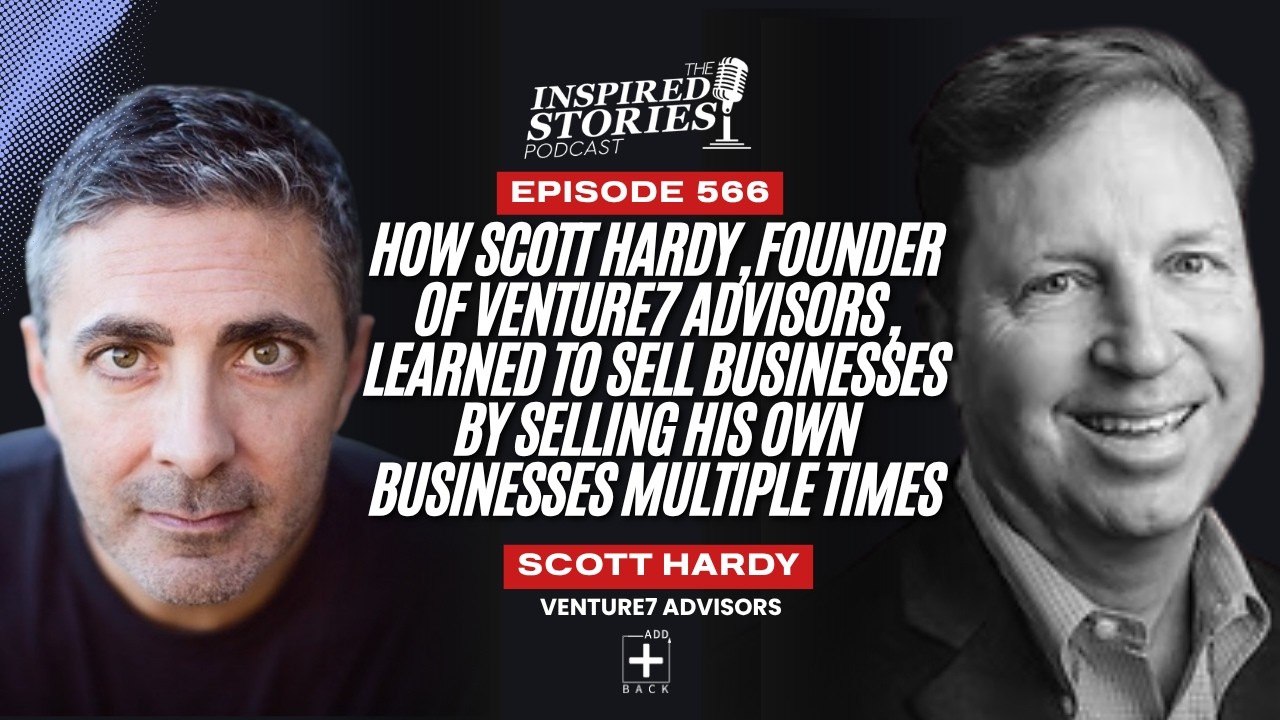
Scott Hardy, partner and M&A advisor at Venture Seven Advisors, built New England Overshoes from a half pair of prototypes and a borrowed purchase order in 1994, drove a station wagon full of fabric between factories in four states to make his first delivery to L.L. Bean, then sold the company, bought it back, sold it again to a private equity-backed acquirer that was absorbed by Honeywell, and built a second brand in tandem along the way. Three exits in four years taught him more about selling businesses than most advisors learn in a career.
✨ Key Insights You’ll Learn:
Building NEOS from a half pair of prototypes to L.L. Bean’s floor in one season
Driving fabric from Massachusetts to West Virginia and molds to Missouri to make the first delivery
Why the partner elevator moment changed how Scott thinks about co-founder relationships
Buying back your own company on seller-financing terms and running two brands simultaneously
How food processing and the Baffin Islands led to the Norcross Safety Products acquisition
Why Wolverine Worldwide put Ulu Boot in a drawer and how Scott bought it back years later
The five-year timeline every business owner should know before they think about selling
What “go slow to go fast” actually means in a sell-side M&A engagement
Why a deal dies a thousand times before it closes and how to stay in it
How AI is cutting a thousand-hour deal process down toward five hundred
🌟 Scott’s Key Mentors:
Teva Sales Rep (EMS Waiting Room): A chance encounter that opened the door to L.L. Bean and launched NEOS
Board of Advisors at NEOS: Pushed Scott to put the company back together after the partner collapse and stay the course
Occupational Therapist from Maple Leaf Foods: Proposed the food processing application that led directly to the Norcross acquisition
Wall Street Summer Internship: Taught Scott what he didn’t want — intangible work — and sent him toward product and entrepreneurship
👉 Don’t miss this conversation about what it actually takes to build something worth selling, why most owners aren’t ready for any stage of the exit process, and how a guy who drove a station wagon full of fabric across three states became one of the sharpest sell-side advisors in the northeast.
Listen to the full episode here
Transcript
Anthony Codispoti (00:00)
Welcome to another edition of the Inspired Stories Podcast, where leaders share their experiences so we can learn from their successes and be inspired by how they've overcome adversity. As you listen today, let one idea shape what you do next. My name is Anthony Cotis Bodhi, and today's guest sold his first company after five years of building it from scratch. Then, after a three-year transition, he bought it back, grew it.
And did it again while building a second one in tandem. After four years selling it again to private equity, and sold the second company just a year later. Three exits in four years, each to a strategic acquirer and private equity. All but the first he identified and pursued himself. He went on to earn utility patents, consult for a New York City invention company.
And eventually rebuild a footwear company he had already sold once because customers kept asking him to bring it back. Each chapter led somewhere unexpected. But looking back, the thread is hard to miss. His name is Scott Hardy. He is a partner and MA advisor at Venture Seven Advisors, a sell-side merger and acquisition firm based in Burlington, Vermont. They help mid-market business owners plan their exit.
Find the right buyer and capture full value. Scott also leads Linkia LLC, a venture studio he has run for over two decades. He is the rare advisor who has lived every stage of the journey he now guides others through. And this episode is for anyone who has ever wondered what it actually takes to build something worth selling. But before we get into all that good stuff, today's episode is brought to you by my company, Ad Back Benefits Agency.
And you'll want to hear this because it's hurting almost every business owner you know. Health insurance costs go up every single year, and businesses are furious about it. They're paying more, claims are getting denied, employees are opting out because they can't afford it, and it hurts turnover and morale. It's one of the most maddening problems in running a business, and everyone just accepts it. But you don't have to anymore. Now there's a program that gives your employees unlimited access to doctors, therapists, and prescriptions.
With no co-pays
SCOTT HARDY (02:20)
Yeah.
Anthony Codispoti (02:21)
or deductibles to meet. And here's the part that really shocks most people. Unlike every other employee benefit out there, our program increases your net profits. We recently helped a client add $900 per employee per year to their bottom line. Results vary, but gains like that change how a business is valued. Be the hero advisor that introduces this to your clients today. Add backbenefits.com. All right, back to our guest today. Partner, it's
Venture seven advisor Scott Hardy. Thanks for making the time to share your story today.
SCOTT HARDY (02:55)
Thank you, Anthony.
Anthony Codispoti (02:57)
So Scott, you
founded New England Overshoes, NEOS. Did you just call it NIOS? Is that sort of the shorthand? NIOS
SCOTT HARDY (03:03)
Neos, yeah, right.
Anthony Codispoti (03:05)
back in nineteen ninety four. First of all, can you explain for us what is an overshoe? And then what was the opportunity that you spotted back there in the mid nineties?
SCOTT HARDY (03:15)
So it was really an introduction of a friend of a friend who was a a bond trader in in Manhattan.
Living in the Upper East Side, two floors below one of my best friends. And he was trying to commute when the weather started to, you know, get snowy and slushy. And you know, how do you basically leave the Upper East Side and your wingtips to go down to Wall Street to work every day? and then say you wanted to stop at a bar or or somewhere, you know, some watering hole on the way back, and and what do you wear, you know, between for that commute? So he kind of questioned himself on saying
know, why isn't somebody made a better kind of overshoe kind of galosh thing like you know in yesteryear? So overshoes were something popular years ago before the advent of kind of rubber soles. So if you imagine wearing a leather sole in the salty environments, you know, they would just fall apart. And there was that's why there was cobblers at every corner.
but the need f for having something c covering over your shoe never really went away, still hasn't today. so basically we created a a modern version of the old galoshes, the old, you know, three, four buckle galoshes. we call it we tagged it as a performance overshoe, which was
Combining a mountaineering gator with a instep strap to keep the thing from not flopping around on your foot, and then a a lug sole like a hiking boot. So that all kind of came together. Actually we made our first one with a cobbler combining those three pieces.
Anthony Codispoti (04:55)
Can you explain those three pieces a bit more? 'cause it sounds like, you know, this idea of the overshoot, this has existed for a long time. You guys didn't come up with the idea, but you build a better mouse trap here.
SCOTT HARDY (05:02)
Right, right. Yeah,
which which generally was w was made out of vulcanized rubber, or or injection molded rubber. and what we wanted to do was use, you know, textile Gore-Tex, things like that, waterproof breathable materials if we could, to have a little more color fashion and and flexibility to the product.
Anthony Codispoti (05:27)
How did you get your first client?
SCOTT HARDY (05:30)
So it's interesting. We you know, just sort of networking. I knew nothing about footwear. Yeah, you know, I didn't know how to make a shoe. It's not a common, you know, scholastic aptitude, while there are schools for it was not something that I I learned. really it was kind of a
You know, I knew somebody who was on the board of Eastern Mountain Sports, which was I I I guess Eastern Eastern Mountain Sports still exists, but sort of much much lower capacity now, kinda like an R E I or L L mean. And while I was so he helped me get into a meeting to EMS. while I was in the waiting room I met either Teba or Tiva sports sandal
Sales rep and I showed him kind of what I was doing. He's like, that, you know, Ella Bean would be a a a real good outlet for that. And I said, Well, I don't know anyone at L Bean. He's like, Well, let me make a call or two. And you know, a few weeks later he made a call for me and I went up to Freeport, Maine, met met with Elbean and they were impressed and they basically gave me a purchase order on the spot.
And this was August, July, August of ninety four, and they said, you know, we want them, you know, October, November. And I had I had one half pair. You know, I I I was like, I don't have a factory, I don't you know, I said, Okay, I'll do it. So I in a very short period of time I had to raise money. Yeah, yeah. I
Anthony Codispoti (06:54)
They they wanted these in a couple of months. You didn't have a factor yet. How how on earth were you gonna deliver?
SCOTT HARDY (06:59)
I I I just just had to figure it out.
And that's so it entailed you know trying to find a factory that can make I talked to one in Connecticut, but the their costs were too high. so sort of last minute I found one in West Virginia which had pretty low labor rates and they were willing to take it on. And you know, it came down to the wire where we didn't have enough time to ship the fabric which was being made in Massachusetts down to the West Virginia plant. So I drove from Vermont in
my station wagon filled up as much material as I could from the Massachusetts plant to get started and went to West West Virginia West Virginia, spent three and a half weeks in West Virginia teaching learning and teaching this factory how to make the upper portion of this. At the same time the molds were being finished in another shop in Massachusetts. This was an old, you know, remnants of the shoe factories that, you know, y used to be
manufactured all throughout New England. And you know, the molds were being made and those were shipped to Missouri to a company that would injection mold them directly to the upper. So by the time I had enough uppers finished, the molds were shipped directly to Missouri. I stuffed my station wagon again with as many uppers that I could fit in and drove to Miss from West Virginia to Missouri and then started to manufacture the first ones. And you know, we we were late probably by a month or so, but
We did get to L L B before Christmas and we're on on the floor.
Anthony Codispoti (08:36)
And what was L
L Bean's disposition on this being a month late with this first order?
SCOTT HARDY (08:42)
I mean there wasn't gonna you know, it was a small small enough deal that it wasn't going to bump, you know, ruin their business by any means, but it could have ruined ours. But the hard thing was once you get closer to Christmas, everything is backlogged, so getting something from the DC into the onto the retail's floor wasn't like you're just gonna march through the front door and put on the wall, right? There's processes, receiving, tagging, ticketing, all that. But we did get it done. We got on on and we actually ended up having an in-store demo.
Mm and and sold, you know, I don't know, fifty pair of that you know, in one day through their s through their store.
Anthony Codispoti (09:19)
That's an incredible story. Anybody who's ever gone through the manufacturing process, you're turning something around on that tight of a timeline, were we talking about two or three months? Even when you've got a factory, that is a small window, but you were doing this for the
SCOTT HARDY (09:33)
Yeah, we we
Anthony Codispoti (09:33)
first time. You didn't have the factory, the molds were still being developed, and people hadn't been trained on how to do this. Like you pulled a rabbit out of it.
SCOTT HARDY (09:38)
Yeah. Ooh.
Yeah, we had no idea even how to make shoes. I mean we just you know although this wasn't a shoe, but it was, you know, certainly shoe-like construction. So the the end of the day was we lost probably ten dollars on every pair we made. And then we're like, well we can't stay in business very long doing that. So I took one of the molds and put in a Samsonite suit, you know, one of the hard sided Samsonite suitcases and headed off to China and spent three and a half weeks touring around trying to find a
a
factory that could fit the mold that we had just or all the molds that we had just made because we had to make them you know in all the different sizes small medium large or actually extra small to extra large and eventually found a factory that had a fact had that had a machine that could accept our molds and you know that was that was another whole journey too traveling around China in ninety five was was like the wild was like the wild west yeah
Anthony Codispoti (10:36)
It's lot different than it is today. Yeah. I want you to think back
to that time, those 12 years that you were building Neos. Obviously, a lot of hard times sort of getting this off the ground, a lot of struggles there. But once you get past that, what was the the toughest stretch for you guys? And how did you get through it?
SCOTT HARDY (10:59)
you know, it's always interesting, you know, I I founded it with this partner who lives like I said, two floors below my one of my best friends. and you know, I oftentimes partnerships can be like a marriage.
You know, and but the other thing too is you're there they're you're maybe both at the same place at the same time, but then life changes and you know, while you're you're meeting kind of in that cross crossover, you know, you end up actually going into you know, different directions. So over time,
I think we wanted different things and, you know, at the at the period a around that time, you know, three, four years into it, we started saying, Well, maybe, you know, do you want to be bought out? Do you want you want me to buy you out? Kind of, you know, or what or maybe we sell this and and go on our own, you know, go on our own way. So I think one of the hardest times was, you know, we were trying to we were actually at a trade show, we were approached by a company which was which was interesting, you know, for us and kind of serendipitous.
us in good timing. we went through a negotiation period with them and then the deal was that I was actually gonna go halftime and focus on product development and he was gonna go run the business with them and that was out of Massachusetts. So I didn't want you know I I was living in Vermont. He had moved from New York to Vermont and wasn't really that happy being in Vermont. So that was the deal and sort of at the last minute we
we took things took sort of a a a right hand turn and and he was working on an internet startup and they got wind of that and then that
it created enough of a kind of pause and and that in their ability or interest in hi in bringing him in and hiring and his dedication. So I remember riding up in the elevator to their office and I'm like, you know, let's we'll figure this out. Just just don't just don't sink this deal. And he says to me, watch me. Yeah, and I was like, Are you epic?
Anthony Codispoti (13:14)
What? He wanted to sabotage it.
SCOTT HARDY (13:18)
Well, he he he didn't want to work for I'm like, We'll figure it out. We gotta get through six months of this. And by that time we'd already leveraged the bank lines and you know, 'cause you think that this is gonna happen and and then our our board of advisors was like, You gotta put this thing back together no matter what. and I said, Okay. So they came back and they said, Well, if you would come down and run the business for us, we'll buy him out. So he's gone. I'm like, Wait a minute, I I want that deal, right?
Anthony Codispoti (13:45)
Yeah.
SCOTT HARDY (13:46)
But you know, it it all in all it ended up okay.
Anthony Codispoti (13:50)
So who was this company? Was this Norcross?
SCOTT HARDY (13:54)
No, this was it this was a licensee of Vibram Souls,
Anthony Codispoti (13:58)
Okay.
SCOTT HARDY (13:59)
called Quabog, Quabog Rubber, and they they were a they're in the heavily in the shoe repair business. So they supplied a lot of shoe repair companies. So that's why they saw the synergy between over shoes and thought they could distribute through through that channel.
Anthony Codispoti (14:17)
And at what point does Norcross safety products come into the picture?
SCOTT HARDY (14:21)
That comes in the second time we sold it.
Anthony Codispoti (14:24)
Okay. So the first time they're just buying out your partner, you maintain your equity, you
SCOTT HARDY (14:29)
I maintain
they they yes, they bought out my investors and my partner. So then I
Anthony Codispoti (14:34)
Okay.
SCOTT HARDY (14:35)
was a a shareholder with them.
Anthony Codispoti (14:37)
Okay. And so you maintain a majority stake, minority stake, you're minority. Okay. And
SCOTT HARDY (14:42)
Minority. Mm minority state, yeah.
Anthony Codispoti (14:46)
and and then so how does how does the Norcross safety products acquisition come about? You actually identified these guys?
SCOTT HARDY (14:53)
Well, what ended up happening was I transitioned the company for three years to Quaybog and they and I was I was about like, okay guys, you got this. I'm kinda bored, you know, I'm tired of commute. I ended up not moving down, I ended up commuting down in Massachusetts. So I was down there, you know, initially, you know, four nights a week and probably down to, you know, one night a week.
They ended up buying another company in the shoe repair business and they said to me, Instead of us buying you out, would you like to buy this back? And I said, I just spent three years of my life, like, you know, transitioning this company down here. So I'd say, not really. And they then then they said, Well, why don't you think about it? And I said, Okay, I'll think about it. And under these terms, which was basically I gave them a little bit, you know, a little bit up cl up front at closing, and I said, I'll pay you over time. I said, Okay. So it was actually when I bought it back, that's when I started.
started the second company, ran both of those and and then three years later sold that to Nordcross Safety Products. Just just just Neos. Yeah.
Anthony Codispoti (15:55)
Both of them or both of Jeez Neos. And what was the other company that you'd started?
SCOTT HARDY (16:01)
Ulu footwear? Ulu boot?
Which was we were trying to smooth out our cash flow s around seasonality, thinking that we'd come up with a footwear company so we could sell things year-round. The one boot that had done the best, which was was kind of a funny story. I had a prototype which was like a shearling like an Uggs. This is before Uggs kind of took off.
And we had a sales rep who was in Portland, Maine. He was he he was waiting for the store to open. He left this the bag, the sample bag by the door. Someone came by and stole the bag. And he's like, My bag got stolen. So he said, Okay, here you can have, you know, take our sample bag, though, you know, but somewhere in along the line, that prototype Shirling boot ended up in that sample bag. So his next presentation was the the buyer's like, I love this Shirling one, we want to buy that. And I'm Well, that's we're not ready.
for that. So anyway, we just compounded the problem because we were in a boot business selling kind of weather dependent footwear. And now the number one seller, which serendipitously came out you know earlier than we planned and ended up being a you know a a good good business for the for the for the brand, but it compounded our cash flow issues.
Anthony Codispoti (17:24)
I'll g I see part of the idea that you guys wanted to s part of the reason you wanted to w launch Ulu was so that you had something that wasn't just sold during bad weather times. You wanted the spring, the summer shoe. But the
SCOTT HARDY (17:34)
Correct. Correct. Yeah.
Anthony Codispoti (17:37)
the lineup that you showed, they they liked the boot. They liked the the cold
SCOTT HARDY (17:39)
Yeah.
Anthony Codispoti (17:40)
weather.
SCOTT HARDY (17:40)
And
then then then we started into actually industrial safety. in food processing. We had a because we were, you know, obviously you know, we had postal distal carriers wearing our product, but then also people like Expedition, they went up Everest, you know, base camp. We were sort of like you could wear a slipper and then wear with a Neos over top. but we had a guy who was an occupational therapist for Maple Leaf Foods and he was overwintering in the Baffin Islands.
If
you if you can imagine, he sailed he and his family sailed their sailboat into the ice lot, you know, on purpose and spent the winter in the Baffin Islands, you know, polar bears running around. But you know, he came back from that experience and said, you know, can you take your overshoe and make take out all the textile so we can wear it in a f in a food in a food plant for people who have problematic, you know, footwear issues. So they can wear instead of a rubber molded boot, they can wear their own shoes. This
opened the door for us and we said, okay, well it's the same conditions all day long every day in a food processing plant inside, so let's explore this. So that's how we got into North Cross Safety Products because we talked started talking to them about a distribution arrangement because it was a market that we didn't have and that's when they came and said, instead of distributing, maybe we'll just buy you. That's how the second sale came.
Anthony Codispoti (19:03)
And how did you how did you identify
the buyers for each of these companies?
SCOTT HARDY (19:07)
So the first one was a trade show, you know, the guys came by and they said, you know, looks interesting, nice to meet you, you know, we're
kind of curious about what's going on. the second one was, you know, again, a distribution arrangement. you know, one buyer, but they're they were private equity backed and they were doing head-to-toe safety and they were trying to build a portfolio. So it was a deal where you know we were part of a $450 million investment by the private equity and was sold to Honeywell for you know almost two almost two billion in 18 months.
Anthony Codispoti (19:43)
Okay. so you've got a couple of big exits here back to back. What was it like navigating that time? You got a lot going on.
SCOTT HARDY (19:52)
Yeah,
I mean it's always you know, you're y you also you know, I've had to run the company at the same time, but you know, it's it's
We sold to Norcross and then Norcross sold sold to Honeywell and I always say that, you know, when there's a transaction happening, there's corporate paralysis. Nobody knows who's no one knows if which bosses are gonna survive, who do they report to, and and
Anthony Codispoti (20:17)
Interesting.
SCOTT HARDY (20:18)
not and there's just no forward momentum. So it's it's it's hard. The other thing too is if a company is too small, it can't get absorbed. It's like you know, there's a reason children are born at nine months old.
Not at three months old. We just couldn't care for them. So if a business is too small or too little and being absorbed by a company that's too big, there there isn't the the ability to foster those smaller companies to to grow. I mean with with exception, there's definitely some examples in the footwear industry. Ug being one, Teva, you know, so Decker's brand has has had a track record of taking small innovative ideas and building you know billion dollars.
companies. Hoka is another brand that most people would recognize. You know, again, small startup or or even muckboot was one that Norcross safety products bought and just it it just exploded.
Anthony Codispoti (21:17)
And the problem with these really big companies trying to absorb these smaller companies is just what exactly? Like the smaller company doesn't have enough personnel infrastructure to kind of be able to survive or
SCOTT HARDY (21:28)
Some some
sometimes if you take the entrepreneur, I mean o out of the equation, there isn't somebody who just is always trying to problem solve, you know, because if someone I I I often say it's hard to take an employee and turn him into an entrepreneur. It's either you have that stomach or you don't. I'm not saying it's it's it's never, but it you know
If you're happy being an employee and going to work every day and collecting a paycheck and knowing that you can take, you know, time off you know, per the schedules, you know, that that's kind of a different mindset versus someone who w who's willing to take the risk and kind of work all the time and you know
Anthony Codispoti (22:14)
Entrepreneurs are built differently.
SCOTT HARDY (22:14)
takes take the wins and losses.
Anthony Codispoti (22:16)
Yeah.
SCOTT HARDY (22:16)
A little bit, yeah. I mean it's it's just and I've tried to sell companies to employees and it's just I'm like, this you know, the dog won't hunt, right?
Anthony Codispoti (22:26)
Mm. Yeah. Some are farmers, some are hunters. Yeah. So you repurchased the Ulu brand in two thousand fifteen. This is nearly a decade after you sold it, as I understand,
SCOTT HARDY (22:37)
Yeah,
so
Anthony Codispoti (22:38)
because customers are asking you to.
SCOTT HARDY (22:41)
Yeah, well we s we started to we wanted to buy another company to to build a a summer brand. So we looked at we talked to Chaco Sandals and we said, Hey, you know, we'd like to buy you guys. We didn't know that they were three times our size. they ended up saying, Well, why don't we buy you? So we said, Okay, well let's we'll do that. And then Chaco then this was sort of an O eight banking issue. Chaco had an issue with Wells Fargo pulling their line of credit and and they sort
they became sort of in in I think dire need of of additional capital and Wolverine Worldwide stepped in and and purchased the whole company. they got Ulu as a sort of gift with purchase and Wolverine with Jones Merrill, you know, they said, hey we sell more shirling marrels than Ulu in its entire line. I don't know, you know, let's just put this in a drawer. So a few years later I when I was looking at, you know, what else I wanted to do, I
I w I called Wolverine Worldwide, their MA department, and I said, you know, let's let's code launch this. Let's let's build this brand up again. And evolution, you know, after hearing a bunch of no's I you know, we rarely sell brands, but maybe would you want to buy this back? And I said, under these specific terms that I'll pay you a little bit up front and over time, which is when I sold Neos the second time, I I finally paid off Quebag, you know, so that that whole thing worked out pretty well.
Anthony Codispoti (24:09)
So in this process you're learning a lot about the and A cycle, yeah.
SCOTT HARDY (24:12)
and N. Yeah.
Yeah, and I and I and and you know, we had used somebody originally when we sold
Or no, when we were working with Norcross a a little bit before we worked with someone who had who had some you know, an MA consultant. But yeah, no, I I just realized I you know, as you know, you selling products, I said I kinda like selling businesses. I like starting businesses and I like selling them. I don't really like trying to figure out how many we're gonna sell this year and you know what our f we know what's our forecast. Well I understand that's important, but the exciting times
Anthony Codispoti (24:48)
So how
and why did you make the transition to selling other people's businesses? Where did the inspiration for that come from?
SCOTT HARDY (24:54)
Because it's hard to go to the grocery store with with equity, with sweat equity from a company. So I could help people start businesses, but it isn't till they're sold to where we really or they're they've grown to a certain point, which can take ten years before there's money flowing out of them. So at the closing table, you know, there that's when the checks get cut and disseminated. So that's how
Anthony Codispoti (25:22)
So yeah, cash flow thing. You you love the process of selling the business, but you can't wait ten years, you know, to be able to rely on that for your cash flow. So
SCOTT HARDY (25:29)
Right. Right.
Anthony Codispoti (25:32)
ten years ago you started Ventures Seven Advisors. So give us the big picture view. What do you do specifically and who do you do it for?
SCOTT HARDY (25:41)
Yeah, so we we saw the opportunity of kind of above a business broker, you know, which maybe some commercial real estate guys, you know, sell sell commercial real estate and decide, okay, we'll sell the business or convenience stores, gas stations, you know, smaller things. And then and then there's the investment bankers, guys, you know, you know, we're in Vermont, but you know, Boston and New York. They'll they'll come up for a hundred million dollar deal maybe, but some of these guys are moving down market, but we just saw the
There's
an opportunity for largely what I learned doing my own deals and sort of the five to fifty million dollar transaction phase. And we're we're currently doing one that's you know, stretching that higher now.
Anthony Codispoti (26:26)
Okay, so dollar size, industry, geography, paint us the right picture.
SCOTT HARDY (26:33)
So industry, I always said business is three things. Business is there's people. Doesn't you know, every business is people. or most business I'd say most too. financials, and it doesn't matter whether it's a nonprofit or a profit, you know, income statement, balance sheet, cash flow statement, they're all they're all the same. And then product, and the product can be tangible, intangible, and I actually like learning about all these different types of businesses. We sold a an art licensing company that basically was the middleman between the artist.
and you know called Bed Bath and Beyond w when they existed, you know, Target.
or or the Hobby Lobby the people who are doing making posters. So very intangible but transactional business too. a post and beam company that you know makes you know houses and wooden frames out of old old old world hand techniques. we've done some PC PC board industrial label printing companies. We've done outdoor companies
called turtle fur which makes neck warmers for primarily for skiing and winter sports you know so a whole runs a whole gamut and you know most of them probably are somewhat geography based you know new england based but we have had clients as far as Florida Seattle and Maine
Anthony Codispoti (28:00)
Okay. So you can do all over the country. You probably do
SCOTT HARDY (28:02)
Yeah.
Anthony Codispoti (28:03)
more in the northeast 'cause that's where you live, probably have more contacts there.
SCOTT HARDY (28:07)
We yeah, we we know. Well although I did sell during COVID I sold a company for a f for someone who I knew but, you know, we met once in the in the whole time and he lives in my town. So it's just
Anthony Codispoti (28:17)
Yeah.
SCOTT HARDY (28:18)
you know.
Anthony Codispoti (28:18)
So what does it look like when a business owner first comes to you? What is that engagement?
SCOTT HARDY (28:25)
So the most important thing is for us to understand their expectations. What are they looking to do? Timeline, what how much other they hope to get out of the company? Because let's say
They you know, let's say that w we think that the ideally we try to do a valuation first, which they pay for. They pay for a valuation that sets the benchmark. And and you know, sometimes they'll say, Hey, we wanna you know, that's just not that's not what we were hoping for. It's like, okay, well then here's some ideas, you know, tr you know maybe hold on to it, grow it. 'Cause some people I'll say most of the exits we've had, people are more looking to
get out to help their employees keep the legacy not necessarily need it for retirement. you know we've had one which said
You know, hey, I need X. And we said, Okay, well, keep growing it. You're gonna you know, we'll see you in three years. And that's what they did. Eventually we sold it. So, you know, it's about timing things. It's about also the profitability of the existing company and it's also the marketability of the company. 'Cause if there's a company that's doing a million dollars in sales and someone's pulling in a quarter million dollar salary a year, you're not gonna make that kind of return on the million dollar sale after you sell the company. So sometimes it's it's about looking at what do you not like doing?
What can you hire and what can you know how and maybe even keeping the company? So it's not always about the exits.
Anthony Codispoti (29:59)
I think that a lot of folks, a lot of business owners assume that the goal of an exit is to get the highest valuation that you can. But what are some other things that they should be considering?
SCOTT HARDY (30:11)
Well, what's what someone says they're willing to pay and what you're ending up transacting at ca sometimes are wildly different.
And you always have to be careful about someone who overpromises something that's unrealistic. because either they're playing games or they aren't looking at this thing. You know, that's why we s with with if you start with evaluation and the the seller, again, we focus on sell side engagements, so there's sometimes there's buy-side engagements that companies have. They'll have a buy-side advisor to try to help them find deals. But we work on, you know, with sellers trying to create a market for their company.
Anthony Codispoti (30:49)
What does that look
like creating a market for their company?
SCOTT HARDY (30:53)
So what and we lived through it, right? I mean we had people approach us at a trade show, very common, right? A bigger company, it's like a a bigger fish comes by and wants to gobble up the smaller fish and wants to do it on a on a on their terms. So now they're controlling every all aspects of the of the negotiation, the price, the timing, you know probably and more more than that if I think about it, but
By creating a market, you want to prepare all the information. So for our firm, we call it we we go slow to go fast. So we do a first a financial review and get evaluation. Then we'll do a f through that process is sort of a forensics. We want to find where the where the b bodies are buried, where the where is there any issue, where might a buyer come through due diligence to say, well, what is this? What does this mean? Because if they see a loose thread, they're gonna start pulling on that.
and they're going to assume there's more out there. So we want to make sure that all anything that could sort of trigger more questions in due diligence are taken out well ahead of even going to market.
So we build the the the book the the the sim confidential informational memorandum around all that data plus look at the historical you know where's the business been but then as entrepreneurs we look forward we look through the windshield and say where can this company go and what are the opportunities because we we you know as an entrepreneur you're always selling the dream and that's what we try to do
Anthony Codispoti (32:32)
So what are some of the most common things that you find when you are looking for the bodies as you put it, Scott?
SCOTT HARDY (32:43)
There is no common thing. I mean the financials are are kind of what what you're what you're scouring through and and trying to find irregularities.
Oftentimes it's harder to sell a smaller company because their financial reporting is not as solid as a larger company. So if you can think of like where someone's, you know
family member may be doing the accounting, you know, at night and doesn't have an accounting degree or doesn't understand, you know, bookkeeping and and it thinks are kind of a mess, versus a company that has a you know has a s you know, a full accounting staff and a s and a CFO. I mean that's a much easier thing because they are there to make sure that there aren't, you know, bodies buried.
Anthony Codispoti (33:43)
Hmm. I I am still curious to sort of pull at this th this idea of like common thread. So as you think about the owners who have ultimately had the best outcomes, are there some common threads there that you see? Whether it's what they were doing before the exit process began, what they did during the prep, what they did when they were right at the finish line.
SCOTT HARDY (34:10)
Well a few things.
We always prepare them for a roller coaster ride. You know, there's like you think it's this is this is amazing. There's a lot of highs and lows to it. the other thing is we always say don't wear your Hawaiian shirt to the to the closing table. Don't you know, don't think that, you know, because you just sold your business, you're done, right? I mean you want to give all indications that you are willing to stick s stay in as long as the buyer needs to help for a successful transaction or transition. So that
Yeah, because if someone feels like they're buying something and, you know, we'll never hear from the seller again, you know, that doesn't bode very well. So I'd say, you know, sta remaining engaged, being open minded to
all sorts of things that come along in you know in in negotiations, but it's also, you know, we're we're the intermediary, we're the we're we're the ones or I I of use the term we're like the referee, right? So we've got the FIFA going on here, the World Cup. You know, we're we're like the refs trying to keep the ball in play. And a lot of times we spend equal amount, if not more time with a buyer.
than the seller once we we do a lot of that preliminary work but then once we actually get s get and select the buyer as you s as we said you know creating a market so we want to try to get you know three to five different buyers competing for the business in the end part. Sometimes we're at you know 200 buyers looking at the deal.
And we'll whittle it down to the three, but really it's about you know choosing choosing that best buyer to close and and transition the company.
Anthony Codispoti (35:59)
When you're looking at such a wide number of potential buyers, 200 in this case, how do you begin that filtering process?
SCOTT HARDY (36:09)
somewhat of it's it's self selecting. Some of you know, say this is not for us. you know, as they dig dig through the through the data. but ultimately it comes down to we'll range you know, put in a A B C or one, two, three range. You know, th these are the higher bidders, these are the mid bidders, these are the low ballers. And generally the low ballers we don't you know, we say thank you, you know, we've got better offers. You obviously try to push everyone to try to get give us their best offer terms.
are you know we all often say a a deal is like a soundboard at a concert, right? There's so many different dials and and levers and ways to adjust a deal so it's not just about how much cash it close.
Anthony Codispoti (36:54)
What are some of the other dials and levers?
SCOTT HARDY (36:58)
sell seller equity.
you know, does is some is someone willing to keep some skin in the game for the l for the long run. what are indemnifications? What you know, do they want a stock sale and asset sales, so tax allocation? Do they want step up in in cost basis of their of the equipment, or are they willing to take book value so you're not, you know, paying ordinary income because there's a a big gain on assets that have been fully depreciated. There's you know, a lot of different
ways to deal with it.
Anthony Codispoti (37:32)
Any red flags that you're on alert for when you're evaluating buyers?
SCOTT HARDY (37:40)
Deals that are too good. Right? I mean it's I mean we we we try we try to vet
Anthony Codispoti (37:47)
And why? Because they they're probably
insincere with that offer.
SCOTT HARDY (37:51)
Well, right, or they don't know enough yet. I mean I always say a a deal dies a thousand times before it's done. I mean just and if it hasn't if it hasn't had a a problem yet, we just haven't gotten to that problem. so it's
Yeah, I don't know.
Anthony Codispoti (38:12)
Do you ever look at taking on a client and then say no, thank you because of what you've found in your own diligence?
SCOTT HARDY (38:22)
we will turn away clients sometimes based on a variety of different things. You know. Too small. you know, sometimes you come across people who who are not the best to deal with, right? I I I could add more color to that. But and sometimes it's just not worth it. Yeah. It's like I I don't I don't want to go through this pain.
Anthony Codispoti (38:50)
Yeah. What's the stage of the sales process that you feel like most owners are least prepared for?
SCOTT HARDY (38:59)
So
I think it's all of it. I mean it's just there's so many different steps to it. Some people hate buying cars, right? They they get their friend, their uncle or or or somebody else to help them buy a car 'cause they don't want to deal with that that transaction. some people or many people will use a a real estate agent to help with the house transaction 'cause there's lots of things and you're you only do it, you know, three or four or five times in your lifetime.
But most people sell a business once. And so the challenge is entrepreneurs have a you know can do attitude and like and and take charge. But sometimes it's like, Okay, I need you just you know
Go with us on this one, right? I mean, and that can be, you know, so it's an education process. And and oftentimes we can tell them every step of the way at day one, but we have to remind them, you know, okay, he this is when you should let your employees know, or we we'd recommend, you know, letting your employees know that you that you want to sell. You know, how do you how you ensure the smoothest possible transaction and and and transition?
Anthony Codispoti (40:13)
Scott, how long before somebody actually wants to have exited should they think about engaging with you?
SCOTT HARDY (40:22)
We say if you want to be out and free and playing golf or surfing the you know the waves of Maui in five years, you gotta start today.
Anthony Codispoti (40:32)
Five years, okay.
SCOTT HARDY (40:34)
Because if you think about if you back it up, you know, generally a transaction transition post close is is three years on the outside. You know, someone asking anything more of that is unrealistic.
a lot most of the time those numbers get cut in half so you can be at 18 months. But let's just say someone who has a contract for a full three years. It can take a year, generally it takes you know twelve to eighteen months from signing of contract to close. And then it's generally you know a a six months of prep work in advance as well. So you know you're very quickly at at five years. Assuming a a transaction you know assuming a transition period of three years.
Anthony Codispoti (41:16)
Okay.
So, you know, I heard you make the comment earlier, Scott, that you know, sometimes folks come to you, you do the valuation, they don't like the number. And so you're like, hey, here's some suggestions, here's things that you can do to get closer to that number. You know, come back when when you're there. So whether it's giving an advice in that situation or giving advice to somebody who's much closer and they're ready to engage with you in that process.
What are some of those growth levers that you suggest to them that can help to boost their eBa?
SCOTT HARDY (41:50)
buying another company. So instead of selling, buy. So if you buy something and then two years later then go on the market because you're able to take advantage of of of you know synergies. you know, so a a strategic acquisition.
Anthony Codispoti (42:09)
Yeah.
SCOTT HARDY (42:10)
I mean it's it's basically what private equity does today, right? I mean they they they try to buy like businesses, they roll them up, they package them just like North Cross safety products did, and sold it to Honeywell, head-to-toe safety.
Anthony Codispoti (42:25)
You know, I've seen, you know, some of the things that you posted. You describe yourself as somebody who sees white spaces, opportunities that other people often overlook. Can you give us a specific example of a white space that you found inside of a client's business that changed what they were worth or how they would go to market?
SCOTT HARDY (42:46)
I don't think I can give an example of a specific space, but it's like I can generally I mean the thing is like what we don't know is like we're all brought up through at least in this country through a standardized educational system. So it's hard to compare how what you're good at versus what I'm good at. Sometimes people get grades very easily, sometimes it it takes a lot of work to d get a good grade.
but so we come out of col come out of come out of school, which however far we go, to a
You just don't know what you're good at compared to the next person. And even like our offices are in a co working space. So if I was a a ten year old kid walking through this place, I would say everyone's doing the same thing. They're all in front of a computer, some of them are talking to the computer and people screens on the other side. And it's it's like there's no difference, but there's a huge difference between what people do. So it's
You know, I I I view myself as kind of like a business butcher. I can you know, as a butcher can look at a cow and say, Okay, I see I see tender lines here, I see, you know, this, this, this, this, I can you know, there this is where the fatty areas, I'm gonna avoid that. So I can kind of look through whether you know, in in relatively quick sense, you know, th that's that's I guess a gift that I've been given is is to understand a business relatively easy and and see where, you know, where are the shiny spots where and where where
Anthony Codispoti (44:17)
It it occurs to me, Scott, that another talent that you have is on the product development side, right? These some of these ideas that you've come up with, these patents that you've got in categories from backpacks to footwear accessories. Do you feel like that brings you a special vantage point when you are going into your MA work? That maybe somebody who is, you know, coming at this strictly from a financial advisory perspective.
point of view might not see.
SCOTT HARDY (44:49)
Probably, but again I don't know how they see the world through a financial lens. I mean I know that there's people who are very good at it, much better than I am, you know. But yeah, I I I just know I mean 'cause I've spent enough time in many as many factories and you know, throughout the US and Asia, that I can I I I kinda understand how machines work and and how things are put together generally.
Anthony Codispoti (45:17)
And so do you oftentimes come to your clients with suggestions on new product ideas, new product lines?
SCOTT HARDY (45:24)
Absolutely.
Absolutely. A lot of times it's just there's not enough time to invest, prove out, and capitalize on that, right? So you need a a a longer time horizon generally, you know, they wanna they wanna get to market and get the business sold. But sometimes we'll do it and we help, you know, companies who we've sold to. So
You know, we've we've been asked by buyer clients or by or by by buyers from our seller clients to help them close out you know, find other deals, bolt on more. It it goes a little bit against my methodology because I'm about a market creator. I want to get many b businesses to compete for that company. So if I'm now on the other side of it and saying, I'm now helping out on a buy-side deal and trying to get a deal
you know, in the back door. It it it goes against you
Anthony Codispoti (46:21)
You don't really have
the the opportunity to drive up the valuation in the same way that you would if you had competing. Yeah.
SCOTT HARDY (46:26)
Well you wouldn't. You want you wanna get you wanna get a discount, right? I mean
you want you know you want to that that's why that's why peop business owners are bombarded every day by, hey, you know, we've got a buyer's for your company, we can do this, we can do that for you.
Anthony Codispoti (46:39)
Yeah, no, that makes sense. What do you think the future of Venture Seven Advisors looks like? What what do you want to evolve into, do more of, do less of?
SCOTT HARDY (46:52)
you know, it's hard hard to say. You know, we wanna, you know, probably say small. you know, it's i there's an efficiency to that. but, you know
Who knows? Opportun be be opportunistic. So if there's if there's a bigger firm that we could plug into that can can take some of the mundane stuff that we do, we're also you know, we're working, you know, the AI has changed the whole landscape of kind of businesses j in general. You know, we have one company that we brought to market recently and you know we have utilized some AI tools. The
You know, one of the most shocking ones was when we took our teaser, which is, you know, this is the company, but no nothing about the names, nothing about geography, nothing about this. And I put you put that in there and it came back with like we're ninety-nine percent sure this is company X. And we're like, Okay.
This is the and you can do that really with any cu any, you know, the information's out there. I mean so many companies are marketed in a in a non confidential, you know, scrub teaser relationsh you know, relationship. But you know, the tools are out there to connect the dots.
Anthony Codispoti (48:12)
What are some other creative ways that you guys are using AI in your business?
SCOTT HARDY (48:17)
Well, we think we can you know, I I I think I told you we figure out about a thousand hours a deal, on average. I think we can cut it down to maybe half that if we use tools that w could simplify some of the processes and we're working on that too. I mean if we can do more deals and have less hours of actual of us managing that,
we can help we can do smaller deals and we can help people we can help more people per year.
Anthony Codispoti (48:49)
Can you give me an example of t s time reclamation that you guys are excited about in a particular area?
SCOTT HARDY (48:58)
Where we could I mean just a outbound marketing effort. I mean we you know, we y it takes a long a lot of work to to find out who the target audience is. You know, let's say, you know, y you own them the microphone that you have in your in your podcast. So let's say you own a micro microphone company. Well, who are all the companies that would want to b buy that company from you?
and how do you f you know and how do you find them. So I think that there's tools to to do that and then tools to market them, market to them, and tools to handle the the NDAs, all that you know, all that documentation, tools to simplify the SIM process, the you know launch of the SIM. And really it's it's about, you know, the negotiations I don't think can be done at least in my own my my experience.
know, that's where you need you need human to human contact to like, okay, let's negotiate that 'cause there's just there's such a nuance to it. Could could computers do it? Probably. I mean imagine, you know, actuaries are and you know, there's a lot of there's there's a lot more I don't know about it than than what I actually know about it.
Anthony Codispoti (50:12)
What is sim in this context?
SCOTT HARDY (50:14)
Confidential
informational memorandum. Which is basically the book, which is the the historic h historical and financial plus, you know what where where the company could go.
Anthony Codispoti (50:29)
How do clients find you or how do you find them?
SCOTT HARDY (50:33)
we do you know, wealth advisors actually have been a pretty pretty good referr source of referral. So people who are you know have let's say a a portfolio of assets, you know, sometimes you know their largest asset is a non liquid asset and obviously the wealth advisors benefit when they can charge a fee on on invest invested assets and they also help with retirement planning. So they come to us and say we have a
client that that you know would like to see about you know moving on. I mean we're all for you know family transition businesses, eSops we help people, we have you know different con contacts for esops. you know there's really interesting new businesses like what Patagonia has turned into which is basically a a trust owning the company.
and you know so there's lots of different ways to do ways to plan exits, but you know j generally we'd also do some speaking engagements to to industry trade groups.
And we're not really trying to sell anyone, we're just trying to educate people. And, you know, I've I I've had to learn it on my own over the past, you know, twenty some odd years. And we I've probably been involved now in I'd have to do the actual count, you know, probably over thirty transactions.
Anthony Codispoti (52:03)
Okay.
SCOTT HARDY (52:04)
We try to do about, you know, three to five a year.
Anthony Codispoti (52:08)
Okay. Scott, what's the hardest thing you've ever had to overcome personally? And what did it teach you?
SCOTT HARDY (52:17)
I think and I said that you know, the the that elevator ride, you know, realizing that here's a partner that I've been working with for a number of years and you know, and just to feel like he got screwed in that particular moment, was pretty tough because, you know, I I imagine, you know
people within marriages, know, the you know, it's like how can I how can someone who I slept next to for X number of years all of sudden become like an enemy? I'm not saying he was an enemy, but it definitely it it it took back, you know, and it probably made me not want to have another partner in a 50-50 kind of arrangement.
Anthony Codispoti (53:02)
Did you ever mend that relationship or it just kinda go by the wayside?
SCOTT HARDY (53:06)
Yeah, you know, he's tr he's
he he's tried a few times and it's just like I
mean, that was his choice back then. I it you know, I don't I don't I don't you know, I wish him I wish him well and but I don't you know
Anthony Codispoti (53:25)
Yeah, once bit and twice shy, I get it.
SCOTT HARDY (53:28)
just yeah, but I mean so I'm gonna I'm gonna go out and do something to make him feel better?
Anthony Codispoti (53:37)
What would I'm curious if it's been hard for you to move from the founder role to the advisor role? Are there things that you miss about what you did before?
SCOTT HARDY (53:51)
not really. I miss the creativity I think, you know, so certainly developing products, there's a such a creative element to that. that
There's creativity in s in structuring a deal and trying to find solutions. But, you know, it's it's it's fun to to deal with so you know, before I got into product and venture and all that, I spent a summer on Wall Street and I loved the pace and I like the f you know, the the area of finance. But the one part that I came away from was like it wasn't tangible. I couldn't tell you what I did each day. It was just some days were busier than others. And I I I enjoy, you know, taking a piece
a product from here, putting it over there, here over there, and or creating something from an idea to actual physical product. So you know I I'd I'd support one of my kids. I've got three daughters. I'd support any of them if they want to do a startup, but I I I don't know whether I have another startup in me. Although I plague by it, you know, on a on a daily basis, always sort of looking at like what as you said, you know, the white spaces, what what's missing, what what's needed in those
Anthony Codispoti (55:06)
Yeah, because you've still got another business that we haven't talked about yet, the Link Link Yeah. Your
SCOTT HARDY (55:13)
Linkia? Yeah,
so Linkia was the prior, and that's it's really kind of a mothballed, I think, at this point in
Anthony Codispoti (55:20)
Okay.
SCOTT HARDY (55:20)
time. Linkia is a is a starfish that's different than any other starfish where the leg breaks off. That's how it reproduces. So it's it's five legs and it and it becomes another starfish. And that was our business model of starting companies and and spinning them off. And we you know so we did that seven times and then
It just you know he
There there's a lot of risk, you know. You need to if you're gonna start a company, you gotta be all in. Like a hundred and ten percent in, and it's hard to be starting multiple companies because you're like, well wait a minute, that one's pretty good. Wait, maybe I'll do that. And like, you know, at least with whether I have an ADD brain or not, probably do. I've never been diagnosed, but you know, at least with you know multi managing multiple clients at a time, it actually it it works the way my brain works. So I I can think about multiple things at the same time.
Anthony Codispoti (56:15)
most entrepreneurs in my experience, present company included, yeah, they they've got a little bit of that ADHD brain.
SCOTT HARDY (56:22)
Yeah.
Anthony Codispoti (56:23)
So, Scott, as you think about your role there at Ventures 7, what do you most want to be remembered for in your
SCOTT HARDY (56:34)
think you know, we got I get a lot of gratitude with helping people. You know, I mean just you know, I I I it's it's it's funny because you spend so much time all hours of the night, especially as you as you narrow a deal down because you're you're you know going through legal documents trying to get people, you know, trying to chase chase leads and trying to get this thing closed. 'Cause oftentimes once we have a buyer lined up I say, Okay, give me the date because if you don't set the date you're never gonna hit there.
So you've gotta you know, so with that cre creates a lot of a lot of time that you work with these with these sellers and eventually they sell the business and they go, you know, to Cavo and they go to you know, the fjords of s of Norway or wherever they want to travel to because you know you've kind of you've released them from their day to day obligations and stressful life that they had. so there's a lot of reward to that.
You know, sometimes I'm like, yeah, I may maybe maybe I'm getting ready, you know, more ready for that than than not. But I I still just I enjoy the process and I enjoy helping people. And that's why it's hard for me to say no to smaller companies, because that intrinsic reward is still there. You know, you're talking about a business owner and a person who has the same goal as someone, whether it's fifty million or whether it's a million. They they want to be done.
Anthony Codispoti (58:00)
There's a lot of fulfillment that comes from helping people reach that goal. Yeah.
SCOTT HARDY (58:04)
Right.
Anthony Codispoti (58:05)
No.
SCOTT HARDY (58:05)
It's not always it's not always about the money.
Anthony Codispoti (58:08)
Scott, I've got just one more question for you today. But before I ask it, I want to do three quick things for the audience. First, if you want to get in touch with Scott Hardy, you can check out his website, venture sevenadvisors.com. And the seven is just the numeral. Don't spell it out. Venture sevenadvisors.com. It will be in the show notes in case you miss it, but very easy to remember, venture7advisors.com.
And if you're enjoying the show, please take a moment to subscribe wherever you're listening. It also sends a signal that helps others discover our podcast. So thank you for taking a quick moment to do that right now. And as a reminder to all business advisors out there, your clients are bleeding money on health insurance. Do them a favor so big they'll tell their friends about it. Show them how to give their employees access to therapists, doctors, and prescription medications that.
counterintuitively is actually going to increase the company's net profits, real gains that can change how a business is valued. Contact us today at adbackbenefits.com. So last question for you, Scott, a year from now, what is one very specific thing that you hope to be celebrating?
SCOTT HARDY (59:24)
a year from now,
I don't know. It's you know, I I I'm I always said I was gonna work until my last c coll kid graduates from college and that happened in May. and then I was gonna said I'm gonna work until I have my first grandchild, but my and my oldest is now engaged. So I feel like, you know, the the the gates are starting to narrow there. But
But this the nice thing about doing what I do is I can kind of do it from where anywhere I am. I mean I I my my middle daughter was in New Zealand and I was like, I'm gonna go to New Zealand, I'm gonna you know, I can work from New Zealand because it's you know, while it's eighteen hours different, it's it's six off from East Coast, you know, the opposite side. So you know
We'll see how long I you know continue to do it. But I I I certainly I enjoy every day and look forward to each challenge.
Anthony Codispoti (1:00:28)
Scott Hardy from Venture Seven Advisors. I want to be the first to thank you for sharing both your time and your story with us today. I really appreciate you being here.
SCOTT HARDY (1:00:36)
Thanks, thanks, Anthony. It's good.
Anthony Codispoti (1:00:39)
Folks, that's a wrap on another episode of the Inspired Stories Podcast. Thanks for learning with us. And if one thing stood out, put that into action today.
Connect with Scott Hardy:
Website: venture7advisors.com