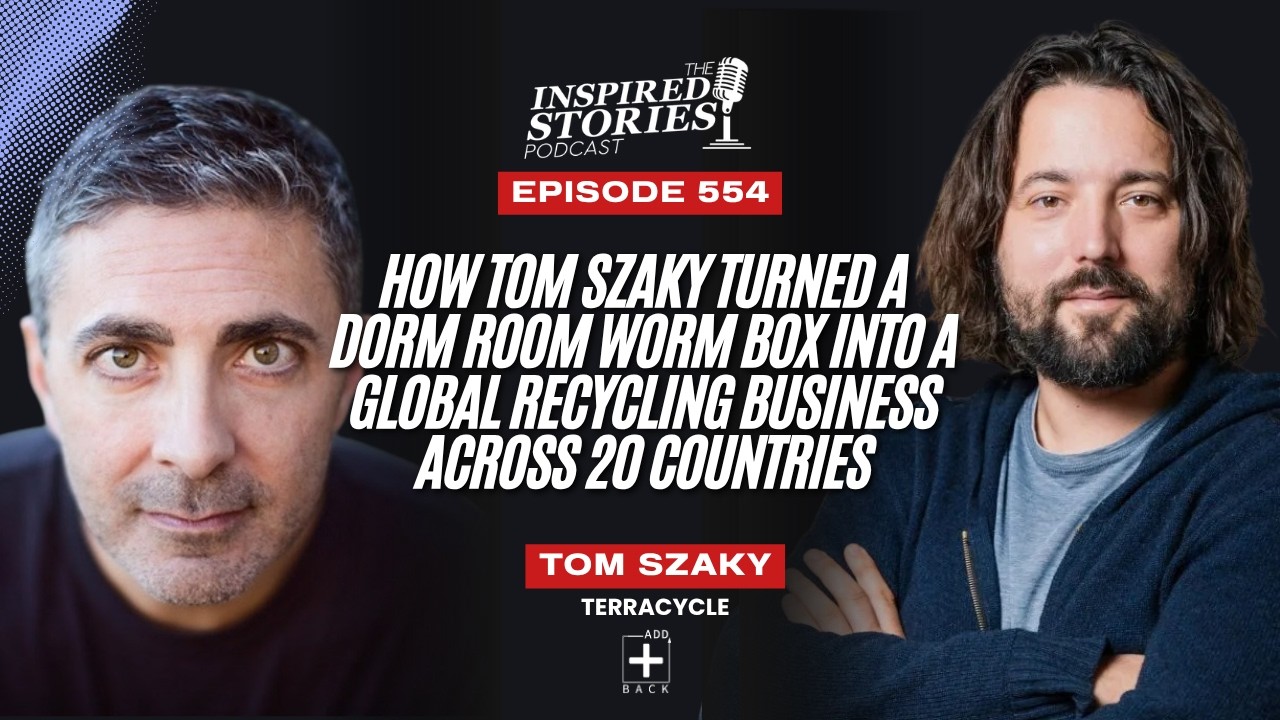
Tom Szaky, founder and CEO of TerraCycle, was born in Hungary under the USSR, escaped as a political refugee with his parents at age four, found his first television in someone’s Toronto trash, fell in love with entrepreneurship the moment he arrived in North America, and dropped out of Princeton after convincing Walmart to put worm poop fertilizer packaged in used soda bottles on its national shelves — without having a factory. Twenty-five years later, TerraCycle operates in more than 20 countries, has recycled hundreds of billions of objects, runs France’s largest reuse system, and is in the middle of a $75 million retail investor fundraise.
✨ Key Insights You’ll Learn:
Escaping communist Hungary at four and finding a color television on a Toronto curb — the image that shaped everything
Falling in love with entrepreneurship in Canada and starting a web design company at 14 with his first employee
Dropping out of Princeton to sell worm poop fertilizer packaged in used soda bottles — with Walmart as the first customer
Calling the Walmart buyer eight times a day for a month and what happened when they finally got the meeting
How TerraCycle fulfilled its first national purchase order with hairdryers, a cone funnel, and 30 friends from Princeton
Why aluminum cans get recycled and pens don’t — and what that reveals about the real economics of the waste system
Shifting the hero of the business from the product to the garbage — and shutting down the worm poop business overnight
Why TerraCycle exists: brands pay to fund collection programs because recycling is not about altruism, it is about economics
The $50 million lesson in reuse and why understanding how a consumer company moves as a chess piece changed everything
Loop: France’s largest reuse platform and the deposit-and-return model that could eliminate the concept of waste altogether
🌟 Tom’s Key Mentors:
His Parents (Both Physicians): Escaped communist Hungary as political refugees and rebuilt their careers from scratch — modeling the willingness to bet on yourself under any conditions
The Father of a High School Friend (Founded Live Nation): Showed Tom that starting from nothing and building something extraordinary was achievable by a real person, not just a magazine story
The Father of Another High School Friend (Founded Canada’s Largest Clothing Company): The second proof point that took the psychological barrier down entirely
His Princeton Dorm Community: Thirty friends who showed up to bottle worm poop through the night — the first example of Tom’s ability to make something so compelling that people want to be part of it
👉 Don’t miss this conversation about why the most important insight in building a mission-driven business is understanding how the other side actually moves, why recycling is not the root cause solution to waste, and what a color television on a Toronto curb has to do with one of the most ambitious environmental companies in the world.
Listen to the full episode here
Transcript
Anthony Codispoti (00:00)
Welcome to another edition of the Inspired Stories podcast, where leaders share their experiences so we can learn from their successes and be inspired by how they've overcome adversity.
As you listen today, let one idea shape what you do next. My name is Anthony Codisbodi, and today's guest dropped out of Princeton to sell worm poop and recycled soda bottles. That company, born in a college dorm room, has since grown into a global operation spanning more than 20 countries and engaging hundreds of millions of people in rethinking what we throw away. Which started as a plant food startup evolved through pivots, skeptics.
And an industry that wasn't exactly asking to be disrupted. Along the way, there were moments where the whole thing could have collapsed, and moments where the biggest consumer brands in the world came knocking. His name is Tom Zackey, and he's the founder and CEO of TerraCycle, the company whose mission is eliminating the idea of waste. He also created Loop, a reusable container platform that imagines how products are packaged and delivered in a new way.
Terracycle was named one of Time's most 100 influential companies, and Tom has co-chaired the World Economic Forum's Consumer Beyond Waste Working Group. See, this is a conversation about building something the world didn't know it needed and refusing to stop until it did. But before we get into all that good stuff, today's episode is brought to you by my company, Adback Benefits Agency. And you'll want to hear this because it's hurting almost every business owner you know.
See, health insurance costs go up every single year, and businesses are furious about it. They're paying more, claims are getting denied, employees are opting out because they can't afford it, and it hurts turnover and morale. It's one of the most maddening problems in running a business, and everyone just seems to accept it. But you don't have to anymore. Now there's a program that gives your employees unlimited access to doctors, therapists, and prescriptions with no co-pays or deductibles to meet.
And here's the part that really shocks most people. Unlike every other employee benefit out there, our program increases your net profits. We recently helped a client add $900 per employee per year to their bottom line. Now results vary, but gains like that change how a business is valued. You can be the hero advisor that introduces this to your clients today. Addbackbenefits.com. All right, back to our guest today, the founder and CEO of TerraCycle, Tom Zackey. Thanks for making the time to share your story today.
Tom Szaky (02:35)
Thanks for having me.
Anthony Codispoti (02:36)
So Tom, you were born in Hungary, came to the US as a kid. I'm curious what your family's relationship to waste and resources looked like growing
up. Was there anything about that early environment that maybe planted a seed for what you would eventually do?
Tom Szaky (02:50)
Yeah, absolutely. And I think for context, you know, Hungary's changed quite a bit over the past forty years. But I was born in the early eighties. And as folks may know, that was still the time of the USSR, where effectively Russia had annexed most of Eastern Europe after the Second World War. And long story short, Hungary, like its neighbors, was all effectively communist. And so the idea of entrepreneurship didn't exist whatsoever. And once I landed in North America, I came to the heartland of entrepreneurship and truly, you know, fell in love with
everything to do with you know with with building businesses and this also this sort of change came up in the relationship with waste you know back in hungary it was incredibly poor there was you know you couldn't afford things everything we you know always were reusing you know whatever sort of objects were out there and I remember this really like striking a chord in the idea of televisions because back in sort of communist Hungary you had to apply to the government to be given authority to get a TV, right?
And most people who applied would, you know, would would not receive it. We certainly did not. And my dad and I found our first TV while walking, you know, the streets in Toronto on Garbage Day. And people were throwing out television sets. We picked one up thinking, you know, we'd have to repair it, plugged it in, it worked, and it was even in color. And that was our first, you know, TV ever. and it was it it is what a what a contrast, you know, and that has stayed with me ever since.
Anthony Codispoti (04:16)
So from very meager means to now the thing that the government wouldn't approve you're finding is somebody else's trash here.
Tom Szaky (04:22)
That's right.
Anthony Codispoti (04:23)
And so how old were you when you came to the country? And and sorry, you came to Canada originally. Okay.
Tom Szaky (04:27)
Canada. That's right. That's
right. So I was born in eighty two. We left Hungary in eighty six, coincidentally when Chernobyl happened because that destabilized the borders and my parents really more my parents' story, because I'm four at the time, escaped as political refugees. And then we sort of hopped between European countries seeking asylum for the next three years, and then finally got asylum in Canada, which is where we ended up landing. That was our first sort of stop. And then to the US I came for college, so just a few years later.
Anthony Codispoti (04:57)
Okay. What kind of early work were your dad and or your mom doing when they got to Canada?
Tom Szaky (05:03)
So they're both physicians, you know, medical doctors. And so they continue to do that as they as they came to Canada. you know, my mom's a nephrologist and my dad is a bush doctor, meaning he goes to like remote areas of Canada, usually native reservations or like Mennonite Hutterite colonies, these sort of things where imagine like there is no doctor, he's the doc who shows up once a week to deal with, you know, whatever whatever may have come up during that past week.
Anthony Codispoti (05:27)
And was there any entrepreneurship signs from you before you got to college? You d I don't know, selling newspapers or bubblegum or any kind of
Tom Szaky (05:37)
Well, this is it.
Like the contrast of going to a like anti-entrepreneurial environment like Communist Hungary to Canada, which is very similar to the US. It's almost the same thing. I fell in love with entrepreneurship. It was unbelievable because to me it was you you you could work hard and you can you can create anything you want. I mean, it was phenomenal. So
Look, my first lemonade stand would, you know, would you know, should show up in the record books. I just love that. And then started my first company when I was fourteen years old. now back then this was like nineteen ninety-eight, seven. So the internet was just starting. So as a kid, you could run a you know, a company that made websites for real companies and so on. So we actually got some real clients in Canada and made, you know, websites for one of the biggest clothing companies in the country and so on. This was back in the day where that
could have happened. Today I think it'd be a bit more challenging to achieve the same thing. But but yeah, I just loved it. And at fourteen had my first employee, which was a thrill. you know, we had low five figures of revenue, which from one way to look at it is tiny, but for a fourteen year old is pretty amazing, you know. So yeah.
Anthony Codispoti (06:42)
did you have any role models? 'Cause like this wasn't a thing where you came from and then you came to Canada and it's a completely different mindset.
Tom Szaky (06:50)
What what I would say is, you know, this is credit to my parents. You know, they really believed in school and just trying to get me into the very best schools. And I had the privilege of going to a really amazing high school in in Toronto for middle school and high school. And there's a lot of privileged kids, you know, who would go there. And it was their parents to me who were the great inspirations. You know, the I had, you know, three best friends, and out of two of them, one one's father started as a taxi driver. Long story short,
founded a company later called Live Nation and created the biggest, you know, sort of breakthrough in in touring of concerts. And another one started what is now can or what at the time was Canada's largest clothing company. And both of these guys started at like absolutely nothing. And having, you know, it's one thing to like read about, you know, these entrepreneurial successes in magazines, but it's way more human to like actually know them and be like, yeah, you know, they don't have anything I don't have and I can like totally do that. You know, that to me like
open the barrier, if you will, or like took down the barrier. And then from there it was just, you know, what's the idea, hard work and so on, but it was very achievable. And I and I think that's so important is to feel like you can achieve it. You know, that is I think the first step of of having any chance.
Anthony Codispoti (08:03)
I love that you mentioned that because I think, you know, our own self-limiting thoughts are the biggest holdback, the biggest barrier that has to be overcome. People have an idea like, I couldn't possibly do that. You know, those guys out there, they've got something special. They were born with this. They, you know, Silver Spoon, they had the, you know, all these great I'm not I'm just not.
Tom Szaky (08:25)
No, I think that's exactly right. You I have a funny metaphor to that, where not to do with entrepreneurship, but in high school, we used to have this like fitness test. And the fitness test was how many laps of the track can you get done, like a 400-meter track in 12 minutes? I called it the 12-minute run. I might have my numbers slightly off, but like the school record had been either like six or seven for like the past hundred years. No one had beaten that number. And I was like, I could do this, right? So I trained, I trained, I trained.
And I beat that record by one extra lap. So it was either if the record was six, I did a seven, or if the record was seven, I did an eight. I can't quite remember. And I was like, my God, like build a statue of me in the school, blah, blah, blah. Right. I was like walking on the moon. I kid you not, it hadn't been broken in a hundred years. In two months later, it was broken by two other kids. And it was so funny because I talked to them and they were like, Yeah, the moment we knew it could be done, and that then it became almost, you know, standard, you know, like.
And I think that's so important in any of these things is is to enable your mind to say that things can occur. And that's I think half the battle.
Anthony Codispoti (09:31)
And your story makes me think of the most famous running example, the four minute mile barrier, right? For for decades, for well, forever basically. Nobody had run a sub four minute mile. Couldn't be done, wasn't possible. One guy does it, within weeks, a bunch more do it. Yeah.
Tom Szaky (09:46)
Right.
I exactly right. Exactly right. It's the exact same thing.
Anthony Codispoti (09:49)
Okay,
so let's fast forward because I want to get to the point you're at Princeton and you're cooking up this idea.
How I mean let's let's start at the you know, the very foundation of it. You're making worm poop, right? How does this come about?
Tom Szaky (10:01)
That's right. It it very nonlinearly, you know. I had started, and to be very fair, to my entrepreneurial journey. It was at the beginning in high school, more egocentric. I figured entrepreneurship was my ticket to fame and fortune, like my best chance, you know, but very self-fulfilling goals, right? And I get to Princeton and maybe it's that sort of moment where it's a great reset in your life. I've in reflecting I'm 44 now, on 44 years on the planet, I've never had this moment of truly
True freedom as I had between high school and university, you know, like where the slate is wiped clean, you can do anything, you know, you have true ability to reinvent. And I was thinking a lot about what I had seen as classical entrepreneurship being make a lot of money, then become, you know, a philanthropist and give it all away, right? That's sort of like the arc. And I was like, well, why can't you sort of do both at the very same time? Why can't business be a power for not just wealth, but
Societal benefit, environmental benefit, you know, like do all that at the very same time. So that concept was sort of lingering as I was thinking, you know, like what do I want to do? Because I certainly knew I wanted to be an entrepreneur. You, I just didn't know what the idea was at the time. And it wasn't worm poop that I fell in love with first. It was really the idea of of waste, you know. And my friends, they had been growing some plants in in Toronto that they ended up taking to Montreal to grow in their basement. These, you know, pot plants have become much more.
friendly from a legal point of view now, but back then, you know, not so much. And they couldn't make them work. And one day they started feeding organic waste to worms and feeding that worm poop to the plants. And the plants were doing really well. And I remember going up there, you know, fall break, freshman year, and the what really got me was beyond the plants going really well was wait a minute, they're using garbage and garbage has
this r these weird dynamics on it. It's the only material in the world, for example, that we're willing to pay to get rid of. And that was like the first light bulb. And from there, since I ever, you know, as I continued to think about garbage and now 25 years of doing so, it's filled with all these crazy anomalies, like you know, sort of academic anomalies like negative raw material value. and it's very purposeful to solve at the very same time. So it's become a an incredible
sort of mentally stimulating exercise to to work on. And that's how sort of the worm poop thing began.
Anthony Codispoti (12:27)
Did you prior to that realization, your friends trying
Tom Szaky (12:31)
Yeah. Yeah.
Anthony Codispoti (12:32)
to grow these plants and you know the worm poop help grow them, would you have considered yourself an environmentalist?
Tom Szaky (12:38)
You know, I would say, like, and especially growing up in Canada, which is very environmentally forward in all of its sort of thought, I would not have considered myself a hardcore environmentalist, but I had a deep love of nature. You know, we would do lots of camping and enjoy nature and you know, that was always central. But I wouldn't have called myself sort of like a like a you know, like like a hardcore environmentalist, you know, more something that is really has always been important to me. which is why this confluence of both sort of an exciting
academic business, you know, sort of thing to work on while it also does great for nature felt really, really comfortable.
Anthony Codispoti (13:14)
Mm. Okay, so you see your friends with the pot plants, the worm poop is helping. So that gives you the idea that maybe there's a business to this. And so what you get your
Tom Szaky (13:23)
Exactly right.
Anthony Codispoti (13:24)
own worms and you start feeding them stuff in your dorm room. T walk us through this.
Tom Szaky (13:28)
Yeah, effectively so. So I was, you know, like for the rest of the road trip, I kept thinking about, you know, sort of this the the weirdness of waste, and it kept showing me more weirdness, you know. For example, everything we one day possess becomes property of a garbage company, bar none, you know, 99% within the day we as always within the year of purchase. Yet for how big of a statement that is, it's also measurably, objectively, the least innovative industry, the waste industry per dollar of revenue. So there's and there's more and more, right?
So that started really grasping on that there's something
exciting to do in waste. And yes, so the first project per se became worm poop in a soda bottle. Actually, TerraCycle's first name was the Worm Project. Then when we sort of came up with Terracycle, that was Earth Cycle. The logo I actually drew as a worm. That's how the whole thing sort of started. And I ordered some some worms online, or sorry, it was a catalog at the time.
And in our fireplace and our Princeton dorm was a worm box eating the scraps, sort of proving that this can occur. And then from there, honestly, it's it's sort of the unfolding of any environment any sort of journey. It was whatever was the next problem we worked on. So we had to come up with a bigger way to convert organic waste, you know, to worm poop. Then how do we make it into a product? How do we sell, you know, all those inevitable questions that, you know, that cross your path as you start to make a product come?
Anthony Codispoti (14:48)
Okay, so you start packaging worm poop into recycled soda bottles, but who are you selling them to in the beginning?
Tom Szaky (14:55)
So
at the beginning, right, we we first had to figure out how to scale up, you this horn poop thing, which we did. You know, if we developed some large systems to convert basically all of the cafeteria waste, you know, that was generated on campus. Then it became how do we sell it? We had come up with a way to liquefy it so it could be sprayed as a fertilizer. And it has a lot of great benefits when it's sprayed onto the leaves. It's filled with all sorts of beneficial bacteria, you know, so on and so forth. We actually started packaging it in new soda bottles because we couldn't afford
new bottles. at the time it was very hard to raise capital. So we just went through people's recycling bins and took old Coke and Pepsi bottles, you know, bottled it in that. And you know, for me, I've always had an ambition to try to go big. So when we started thinking about who to sell to, it was how do we get this into Walmart, Home Depot, you know, like big, big places. And honestly, it was just a a bucket of persistence got us in front of, you know, the buyers in these locations and we were able to convince them. And yeah, our first distributors became
You know, the Walmart, Target, Home Depot, you know, these sort of big box retailers. That's that's how we, you know, sort of entered into the marketplace.
Anthony Codispoti (15:57)
Hang on, Tom, we have to have jumped over a whole bunch of stuff here. I don't think you started distributing in in the big boys like Walmart, et cetera, right? I mean there had to have
Tom Szaky (16:05)
No, our first
our first purchase order was Walmart.
Anthony Codispoti (16:09)
Get out.
Tom Szaky (16:09)
Yeah, yeah. Believe it or not, out of a dorm room, mind you. I didn't even have a factory. and you know, once we got the purchase order, we had to jump full speed and to get the whole thing produced. But, you know, with a lot of sort of duct tape we got it done.
Anthony Codispoti (16:23)
I mean, what was it that Walmart was thinking at the time like, yeah, let's put some worm poop on our on our
Tom Szaky (16:30)
You know?
Anthony Codispoti (16:30)
shelves here? 'Cause nobody was doing anything like this. I mean, this was completely
Tom Szaky (16:33)
No.
Anthony Codispoti (16:34)
radical.
Tom Szaky (16:35)
Look, just to put into context, twenty-five years ago, this was the beginning of what is sort of today the modern environmental movement. Organic had just started getting going. It certainly wasn't mainstream yet. You know, I think what convinced the buyer is we had this fierce passion, you know, for the for the idea. And what made the idea itself really stand out, it was the first product made and packaged entirely out of waste.
So the content was all organic waste, fed to worms and liquefied. But the package is what really put the cherry on the cake, which is the first bottle ever in the world to be packaged in used bottles. Like on the shelf, you would see an old Coke bottle, an old Pepsi bottle, new labels put on. It never been done like that. And it oozed, like really oozed purpose. Like every aspect of it was how do we be purposeful? So the packaging, it wasn't just packaging, it was not just used packaging, but it was collected by schools around the area. So in some cases, we had little tags on the bottle saying like,
Jane in grade two collected that bottle, or Billy in grade four, you know, like everything to like really make this as perfect of a social environmental product as possible. Right. And I think it was that pushing it to such an extreme that really, you know, got the folks excited, plus the insane amount of persistence we had. Like the way we got into Walmart is we called that buyer every hour on the hour for eight hours, you know, eight times a day for like a month in a row.
Then, you know, when he finally gave us the meeting probably to have a shut up, you know, we came down, he just saw I think he even told us they've never seen passion like this for a product before and why not give it a shot? I mean, we had one facing, but nationally at Walmart. Yeah.
Anthony Codispoti (18:10)
Wow. Okay,
so I want to talk a little bit about how you guys got ready for that order because even companies that have been in existence for a number of years and they've got production relatively well figured out, going into Walmart for the first time, if you are not super dialed in, can kill the business. And
Tom Szaky (18:27)
Yeah. Absolutely.
Anthony Codispoti (18:29)
here you guys are you don't have a production process that really nailed out and and you're you're relying on not machines, but
biological life forms to produce what it is that you need. Talk to me through how when you get this first purchase order that you guys are actually able to execute on this.
Tom Szaky (18:51)
Yeah, so you know, it was I I do now this was extreme. I still believe very much in the concept of sell it than build it, you know, as as much as possible. because it de-risks the the idea of build it and no one will buy it, right? This was maybe the most extreme where we had sold it and we didn't even have a facility. Now, you know, to be fair, what we had at the time was Rutgers has a big agricultural, you know, program, which is sort of the n, you know, the state school right beside Princeton, and they
gave us access to this building called the Eco Complex, which was their incubator set on a landfill. And ironically, because waste is so undesirable as a topic, it had been empty for years. So we had this like, you know, exciting building that was given to us for free because we were the first company, you know, to take advantage of the sort of waste innovation center. Now, between us, I think they probably built the eco complex as a way to justify the landfill. You know, it's sort of like when you build a building in Manhattan, you have to put a sculpture in front of it, this sort of, you know, dynamic. But
We had that and we had a lot of worm poop because we had been developing and you know creating the worm poop for a while before we were able to go out and start getting these purchase orders. It was really the bottling that we all had to do, and it was hand bottled. Like we, you know, collected through schools. It was like probably maybe a quarter million bottle order, a quarter million of these bottles. And it was me, my friends, you know, whoever we could like temp labor we could bring on running three shifts, and literally imagine you get the bottle, you have to razor blade off the label.
wash it out in some form of you know washing machine, then fill it with the worm poop and we cause we c and that was just like a funnel, you know, like pouring, you know, into a, you know, like it's like a tea. It's like a dark, dark tea
Anthony Codispoti (20:26)
And what's the consistency of it? Is it like dirt? It's like okay.
Tom Szaky (20:31)
in the end. But it would look like you know, dark Earl Grey type type tea. And you put that in with a funnel. And then the labeling, because you know, one's shaped as a Coke bottle, one as a Pepsi bottle, had a shrink sleeve label. So we couldn't afford a shrink machine. So what we did was put four hairdryers
Sort pointed into a cone, you would dip them, then it would sh you know seal the label on, put in a box. And look, at 20 years old, you can pull all nighters fiercely. And I was also very good at convincing all my friends to just hang out and help. You know, so we had me and like what I would call 30 interns, who all just happened to be my friends from Princeton, coming down and we would throw a party and bottle for days on days, and we fulfilled the order. And that money allowed us to then buy equipment, get
investment, you know, and then it started becoming easier. But there's something to be said for these. Like I love, and it's rarer and rarer as you get bigger, these big monumental moments, you know, where you maybe it's a monumental convince. You have to like leave that meeting with a yes or you're or it's over. Or you have to pull off an impossible production, which means you're not sleeping for five days straight. Those are really phenomenal moments. I I look back at, you know, really romantically after the fact, you know.
Anthony Codispoti (21:44)
Now, would you characterize this as a superpower, your ability to convince investors, your interns, your friends to help out?
Tom Szaky (21:51)
Yeah, for sure. For sure. I really do believe that everyone has, you know, unique superpowers. And for me, certainly one of them is getting people to rally around an idea I have. And a big part of that is not like I wouldn't go to you and be like, Do you want to work on this? Like, you know, really convince you. I would start working on it myself and have so much fun at it that that would you know, like a magnet bringing people in to want to help, right? I think the best way to convince is not actually overtly asking.
But making something so fun that it just gravitates people towards you.
Anthony Codispoti (22:24)
And so you guys fulfill this order, you got the product on the shelves of Walmart, which I'm still just blown away by. did it sell very well right out of the gate?
Tom Szaky (22:34)
No, no. Because it was lost on the shelf. I mean, when you have one facing and a row of chemical fertilizers, you know, it's it's lost. So we, you know, the next thing that
Anthony Codispoti (22:43)
And sorry, one facing
means you've got one bottle showing. And
Tom Szaky (22:46)
Yes, one bottle showing.
Anthony Codispoti (22:47)
and it and maybe there's some stock behind it, but you're not getting Okay. Got it. Okay. Uhhuh.
Tom Szaky (22:50)
yeah, yeah. There'd be like maybe six bottles, seven bottles behind it, but one facing in whatever
4,000 stores in an aisle that probably has a thousand different fertilizer facings, you know, on it. and so this is sort of the interesting part, you know. Like I've always talked to entrepreneurs who like, you know, can you walk me through all the stages? And like you learn these things as they come. The first issue was producing it. Then when we saw the sell-through and the buyer calls and he goes, not selling so well.
Then you suddenly realize, well, you have to go promote this. You got to go out there. So the next six months was literally all of our friends touring around America, standing in Walmarts, demoing the product. I mean, we we had a lot of fun. We got it to the point where if you were walking by, and I mean like anyone walking by, you know, on a Tuesday in sweatpants, you know, with their cart, we had a 50% chance of getting them to buy it. You know, like that's how good we got it. But it was literally going around America.
demoing and demoing and demoing, getting, you know, getting the product, you know, pushed off the shelf as best we could. And we couldn't afford promotion. We couldn't afford anything. So it had to be the in-person, you know, sitting in a store day in, day out.
Anthony Codispoti (23:56)
And what are they saying? What was the pitch?
Tom Szaky (23:59)
Well, you know, it was different for everyone, but you know, worm poop is a great catch. So, like we would, you know, if you're walking by, you'd be like, Can we talk to you about some poop? Can we show you our worm poop? You know, something to do with poop would get you to stop enough and intrinsically give us permission to start talking to you. And then when you heard the whole story, you know, you and like this was the key about the idea of it being purposeful is that even if you didn't like fertilizer or didn't need it, you still might buy it because the purpose was so strong.
You know, that you would maybe just buy it as a gift for somebody later on. And that like that worked, that moved the you know, not everyone has house plants that they need to take care of.
Anthony Codispoti (24:34)
Okay, so this in-person demoing, clearly you weren't hitting, what did you say, four thousand stores? But you were hitting enough of
Tom Szaky (24:40)
We probably hit half
of them to be fair. You know, we put like it was six months, put maybe, I don't know, five teams on the road, including myself. Yeah, we hit a really good number of them.
Anthony Codispoti (24:52)
And how are you funding this? Just from that that purchase order that you fulfilled? Yeah.
Tom Szaky (24:55)
Well, we had the purchase order, money come in.
And during this time, we were also always, I mean, always in the mode of raising capital, right? So at the beginning, our capital raises were just entering and winning business plan contests because we couldn't really figure out how to pitch normal investors. Then when we figured it out by honing our art at business plan contest, that translated to be able to raise capital from high net worth people, family offices, then later, you know, institutions. But
We'd also been raising capital throughout that plus whatever purchase order revenue came in is what sort of fueled everything.
Anthony Codispoti (25:27)
So you've got this guerrilla marketing campaign going in store. it starts to get some bottles moving, but was that enough? Like did that get the flywheel turning or
Tom Szaky (25:37)
It
started like it never like it just kept going a little smoother because once Walmart ordered within six months, Home Depot did, then Target, like these guys all follow each other very easily. Suddenly we were everywhere. That started getting some publicity. That started helping moving the product. That allowed us to launch more products, you know, like African Violet or Cactus Fertilizer. That enabled the facings, you know, and it starts everything starts compounding each other to make it progressively easier and easier, you know. So
Over gosh, if we zoom out, over the first five years it went from, you know, a few hundred thousand in revenue up to about five million, all in the worm poop game.
Anthony Codispoti (26:16)
And these different products that you're unveiling, what are you adding other things to the worm poop to make them better for certain plants?
Tom Szaky (26:23)
Sort of, you feed the worms different food. So think, you know, when you eat different food, you poop different poop, right? Like after Indian, it's slightly different in the toilet than, you know, say American food, the worms are the same, right? So to get the different blends for the right plants, you just fed different inputs to the worms. So I'm not gonna
Anthony Codispoti (26:38)
Like what? Give me an example of some different inputs.
Tom Szaky (26:41)
remember the exact blends, but I'll give you examples. I just may not remember, you know, what made tomato fertilizer versus African violet, but it would be things like the, you know, the amount of
say newspaper you add or fibers you're adding, you know, or it could be what type of you know, is it more coffee grounds or is it more you know, sort of food peelings, this sort of thing. And this idea actually of the of being so refined on the composition, we even by then hired in, you know, a full-time PhD scientist who was just doing formulations and then, you know, taking the different
Excrement of the worms, feeding it to different plants, seeing how they react. You know, at the eco-complex, we had these large experiments going of almost acres and acres of plants feeding them these different, you know, inputs. And this sort of became the fundamental issue in effect to being a consumer product company, because we realized that we had to make the product the hero. And by making the product the hero, you will
Put the very best inputs into that product. And even if our rule was it has to be technically garbage, we were picking the very best garbage out there. We weren't picking any form of waste. And this became progressively a bigger sort of philosophical issue. If our goal was to solve for waste, how do you do it when you're cherry-picking the very best
of the garbage that's out there?
Anthony Codispoti (28:02)
And was this kind of what evolved you guys into being less of a fertilizer company, more of a recycling company?
Tom Szaky (28:09)
Exactly right. Yeah. So five years in, imagine at this point, you know, we have a nice little five million dollar worm poop business. Nothing, you know, that's totally fine. But we had this issue of the sort of cherry picking the waste. And we were getting the more refined the product was becoming and better. Every iteration, the cherry picking became significantly more. Like our, you know, formulation team kept saying we need this type of organic waste, not that type. You know, we kept earlier on we were accepting it all, but our product wasn't as strong. And then as it became better and better, everything had to be more
Beautiful, like the packaging, you know, we were not allowing it was all used bottles, but we wouldn't allow any bottles with dents in it or that had been somehow squeezed because it would look a little extra funny on the shelf, which meant, you know, we were refining too much. And there was this huge tension because the product demanded that you make it the very best it could be. So you had to have that refinement, but then the mission kept saying, What that's not achieving the mission, and it created a a conundrum. So
You know, in that moment, we decided that what we want to be more than a fertilizer company is to, you know, really live up to our mission at and solve for the concept of waste. And we did one key thing. We shifted the hero of the business from being the product to the garbage. Our point was no, we gotta make sure we can take any form of waste. And the output, well, whatever is the output is the output, you know, like as long as it is technically turning into a new product.
That's the key, so we can shift the focus to solving for any form of waste. And it was a dramatic shift, you know. It it was really like a metamorphosis in the company, you know, a lot of people didn't agree with it. We probably changed half the organization from the board of directors to staff. And within a year, we shut down the worm poop business and really retune the company to, you know, what it is today, which is we'll solve for any form of waste.
Anthony Codispoti (30:01)
Was it a
hard switchover, or did you allow yourself to stay in the worm poop business while you kind of dipped your toe in the water of this larger recycling?
Tom Szaky (30:08)
Yes, yes. It's
one it's one of these things where we we let the worm poop wind down. It took, to be fair, maybe two years to like n no longer ship a bottle while the recycling business wound up. And what the cool part was, because we wanted it to be that if you just looked at the revenue, you would never notice a dip, that the revenue kept going up, because that's you know what investors demand, and there's a lot of virtue of that.
And we pulled that off, right? So if you just looked at total revenue, you would have seen the company grow from five to seven, nine, whatever million. But below the surface, we were like a caterpillar changing into a butterfly. But we were still sort of selling caterpillars while starting to sell butterflies, you know, to your question, right? Like it's sort of, you know, it it blended over in a way that you wouldn't notice it as a dip in the revenue.
Anthony Codispoti (30:54)
So tell me what the recycling concept was, because I put my recycling out at the curb and I don't know what my city does with it, but they take it away. So how are you guys gonna turn this into a profitable business?
Tom Szaky (31:07)
So there's two important questions there. I'll answer it in like the the academic of recycling and then what we had in the worm poop to even make this at all conducive. So maybe first on the academic, right? When we started thinking about making garbage the hero, the first question that came to us was what actually makes something recyclable? Because it's really misunderstood. You know, if well let me ask you, what why do you think here, here's an aluminum can. Why is this recyclable almost anywhere in the world? but
Here is a a Sharpie. This is not recyclable anywhere in the world. Why w how would you answer
Anthony Codispoti (31:42)
I would say two things. I would say that the can has one set of ingredients, whereas that or raw materials, that pen has multiple set of raw materials, and for the can there is a machine or a processor demand for what to do with its waste product.
Tom Szaky (32:00)
First, thank you for answering it that way, because that is the answer, that is the answer that I was hoping for. And that is what most people think. It's what we thought. Which tends to then lead that the reason that the aluminum can gets recycled and the pen doesn't is because there is the technology and so on available to recycle this and there isn't to recycle this. And maybe that this is multi- the this being the pen has multiple materials makes it harder than the aluminum can, which is one material.
Those are all true points, but it's not the actual reason. When we went into it, what we realized is that, and really, and this is important, I think, as if you're gonna really innovate on a system, what I've always noticed is that it's so important to dive in and understand why the system works that way and not just take it for granted. So in recycling, all recycling is an open system. What that means is that the company picking up your recycling has no legal obligation to recycle what it collects.
It could throw it all out in a landfill and you, as the customer, would have no legal recourse. So there's no law that says recycler, you must recycle what you pick up. As a result, they recycle what they can make money at. And so why the aluminum can gets recycled everywhere is that the value of this aluminum that they recover is more than the cost of collecting it and processing it. Why a pen, and in fact ninety five percent of objects are not recycled anywhere is only because it costs more to collect and process than the results are worth.
And the craziest part is this dynamic is getting worse. More things are behaving like the pen every year than the can, because the biggest mega trend in object design is cost reduction. Make everything cheaper tomorrow than today, which means we also remove whatever recoverable material could be gotten, you know, at the end of its life. It's why things see less recycling tomorrow or less repair, less, you know, any of that, any of that circular function. So we realize that the the real issue to solve for was money.
We need someone to want to fund pen recycling or coffee capsule recycling or plastic glove recycling because with that funding, we could cover that economic difference. You know, that would allow us to move from losing money, collecting and recycling pens to making money. And in the end, who would care about pen recycling? Well, certainly the pen companies. I mean, we today work with every one of them, collect and recycle 100 million pens a year. It could be the retailer, like a staples. You walk into not in the US but in Canada, a staple store, you'll see a terracycle bin.
Collecting and recycling pens. But it could even be the office that may use them. It could be, you know, any sort of endpoint as well that might have a lot of pen consumption, would be like an office building or maybe a school. And every waste stream has these sort of stakeholders. That was sort of the key unlock. On the worm poop side, what we had was this really crazy asset where we needed to source all these used soda bottles. And we couldn't source them from recycling centers, because in recycling centers you'd get them super damaged.
Trucks would be driven over them. They would just come in in a way that like they look janky on shelf at a Walmart later. So we went upstream to schools and says, Hey, schools, could you collect? We'll then pick it up from the school. And they would have, they all looked perfect. You know, they had no, no damage on them, could easily be cleaned and used for the worm poop. That collection model allowed us to be able to collect any other waste stream. Because as we started making other products, we launched, like for example, for planting pots, we launched a collection program for margarine.
tubs and those were perfect for planting planting pots. So we had this tool to collect waste in an incredibly pure way. And then once we unlocked the idea that it's a money challenge, we went out to brands and said, hey, Cliff Bar or Stonyfield Yogurt or, you know, these were sort of friends we knew at the time, Honest Tea, would you be willing to fund a collection program, Honest Tea for your juice pouches, or Stonyfield Yogurt for your yogurt cups or Cliff Bar for your energy bar wrappers? And those were the first few customers that joined our recycling platform.
Anthony Codispoti (35:46)
And so these brands are raising their hand and saying, yeah, I'll pay you money to somehow find our customers and collect their the garbage of our packaging and and then do what with it?
Tom Szaky (36:00)
So that's that's exactly the essence, right? and why they were interested in that is their customers were complaining that there's nothing I can do but throw this stuff in the garbage, right? That's why we also started with more eco-friendly brands, because we figured they'd have a you know a predisposition to care even more than the average brand, right? And because we were really good at making products out of garbage, we were very good at taking these things and turning them into new products, right?
The key shift as we shifted from making the product a hero to the garbage as the hero is instead of making a finished product, because we learned by making finished products that there's a lot of headache in making finished products. You have to really worry about pricing strategy, discount strategy, promotion, real product-to-market fit, all these things that we had learned by doing worm poop, that we we hedge that risk by going one layer upstream. So instead of like taking juice pouches and sewing them together into backpacks.
ourselves, because then we'd have to become experts in the backpack business. We found a really good backpack company and we said, hey, we'll provide you the juice pouches in a way that are ready to go, like sort of, you know, pre-clean them, get them ready for your sewing machines. But you, backpack company, do the final step of sewing them into backpacks and selling them to Walmart. And that is how it sort of began at that first phase. So we up moved our supply chain up a step where we, our output was effectively raw material.
And found great companies who were experts at these various domains that allowed us to just make just about anything from this waste.
Anthony Codispoti (37:27)
And so are you making revenue at both ends of that transaction? So you're getting paid to collect the juice boxes and then getting paid again to deliver those juice boxes to the backpack company?
Tom Szaky (37:37)
Yes, that's exactly right. But to be a little you know, fair, the way we charge, let's say, a honest tea, which is what who, you know, who would make who would give us the juice pouches, they were the juice pouch waste, is we charge them whatever it costs us to collect the waste, whatever it costs us to process it, get it ready for the backpack company, minus whatever the backpack company would pay us for those juice pouches. That became the economic equation. We would add margin to that.
And we did it that way because the money we got from the manufacturers was probably logarithmically less than what the rest of that system would cost, right? a good example is like today, if we do coffee capsule recycling and we spend, let's say, $10 to get a unit of coffee capsules and say $5 to process that unit, the value we're getting from the manufacturers to buy those outputs may be 20 cents, right? So that's how we then created that overall business equation, which is still
the cornerstone business equation of all of our recycling.
Anthony Codispoti (38:33)
Okay, now explain to me where you're actually collecting these materials in enough bulk to make it meaningful.
Tom Szaky (38:39)
Hmm. Yeah.
So there's a whole psychology of waste. And again, filled with unintuitive points, right? When we first think about waste, we think about our home. And our home is the one and only location in the world that has a hyper range of waste. Like it's incredibly massive. But you know, I have this like thing where I love looking in garbage cans when I go to different places. And what you find when you go out of the home is that it's very narrow what's in a garbage can. You go to a movie theater, it's only going to be popcorn, candy wrappers.
And maybe some bottles. You go to a tennis court. It's only going to be tennis balls, tennis ball packaging, and water bottles. And you'll notice this idea of hyper-segmented waste is true as you go into specialty locations, right? You go to an animal shelter, it's always pet food bags and maybe some accessories, and that's it, right? So these are the locations you target to start then creating collection for that waste stream. And each waste stream has these different target types. So today.
I mean, we collect everything from laboratory waste to plastic gloves, from cigarette butts to chewing gum, and it always works that way. Take cigarette butts, right? It's it's there's certain very high density smoking locations, which tend to be casinos and cruise ships. Those two, the per capita smoking is off the charts. So, like when a cruise ship, you know, disembarks, we will get pallets of cigarette butts from that cruise ship, pallets of them. or
Basically, you know, dense areas in cities where there are is a lot of nightlife. Other than that, it's very hard to collect a cigarette butt, right? And so each waste stream has this psychology around it on how do you find it. Like juice pouches, it's always in school lunches. And that's schools will generate three to four thousand of these every lunch. One school. Yeah.
Anthony Codispoti (40:24)
One school. Wow. Tell me what
you do with cigarette butts after you've collected them.
Tom Szaky (40:29)
Well, here, so for fun, pick three way streams. We'll cigarette butts first. So, in all cases, it's the economics, right? That's the issue, right? The cost of collecting a cigarette butt and processing it is well more than the value of the you know what comes off a cigarette butt in the end, which is ash tobacco paper, which gets composted and the filter, which is made into a polymer. So it's about getting someone to to fund it, right? So if you have funding for, say, cigarette butt recycling.
The process there, they come in and again they're very pure. People collect basically just that waste stream. So we have to sort out a little bit of contaminant, but not not much.
Anthony Codispoti (41:00)
It's not like you're getting somebody's household garbage that you've gotta go through one thing. Yeah, they've they've pre sorted this for you. All right, go ahead.
Tom Szaky (41:03)
No. No. Yeah. Now
we do have today and many years later programs where you can mix a lot together, but those get much more expensive because what's really happening is we're doing the sorting for you, right? So we do have these, they're very premium services, but you can send us your household waste. It's just gonna cost a lot more and we will sort it into like fifty fractions for you, right? If that's if you prefer not to do sorting yourself. But
Sorry, I digress back to cigarette butt. So they get sterilized through a form of radiation. Then from there we shred them. And the real technology breakthrough we created in cigarette butt recycling. This is really thanks to our RD team, is how to separate the filter paper from the filter. So that was sort of a neat little technology breakthrough. And that allowed us to separate the cigarettes into their two major constituents, the compostable bits, which is the ash tobacco paper, and that just goes to composting.
And the filter, which is made from cellulose acetate. It's the same plastic as what is making your eyeglass frame. Like the black part of your eyeglasses, which is a plastic, is cellulose acetate. So it's the exact same as a cigarette butt. And then from there, you can melt that and make that into new objects. ashtrays, railroad ties. You know, you wouldn't do it on any body contact like a spoon or eyeglass, because the the cigarette filter itself is there to absorb all these carcinogens.
So you to put it into appropriate environments because you're encapsulating a lot of the carcinogens, you're not fully removing them. So, you know, an ashtray is a perfect, you know, highly appropriate example of where you can what you can make from recycled cigarette butts.
Anthony Codispoti (42:35)
When you started having conversations with some of these big brands, and I get that you were going to the eco-friendly brands first, who are more
Tom Szaky (42:41)
Yes.
Anthony Codispoti (42:41)
likely to be philosophically aligned with what you're doing, but even still, these are for-profit companies, and you're asking them, pay me some money to take care of a problem that I don't know, really wasn't their problem. Were you running into some resistance?
Tom Szaky (42:58)
It's exactly.
yeah. And maybe this is one the birth one of my biggest lessons in call it social or purposeful capitalism, whatever word you want to do, right? eco entrepreneurship, social capitalism, purposeful capitalism, mission-driven capitalism, is in the purposeful businesses, we actually got a a false indicator because.
You know, through the warm poop days, I'd gotten to know like Gary, who started Stony Field, or Ben and Jerry, you know, from Ice Cream and these guys. Like it's a very small world. So you got to know each other. And I was the young kid, so they would be very helpful and sort of like mentor and you know, point in the right direction. So when I came to them with this idea of, hey, Seth, you run honesty and you make juice pouches that are not recyclable, I can set up a program to get them recycled. He's like, Great, here's fifty, hundred grand, go, you know? And he didn't need much else. But it was
It was almost a disservice. I mean, it was I'm super thankful, but the disservice was it wasn't a honest capitalist choice. And what I mean by that is when we took the same pitch to Capri Sun, which makes a thousand times more volume of juice pouches, but is, you know, owned by craft foods, hardcore, you know, sort of, you know, shareholders, public company, all this jazz. That suddenly brought us face to face with the biggest issue in sustainability, which is.
The entire sustainability movement, I think, could be summed up that it it's companies don't have to pay for their externalities. Or let's even be broader, stakeholders don't have to pay for their externality. Because the stakeholder could be an individual government, you know, company. But like if you and I, you know, started, I don't know, Anthony and Tom's toothpaste brand, we could, you know, put out toothpaste tubes that pollute the environment and have no responsibility to clean them up. Let's say we had to mine some, you know, special ingredient.
We could mine it and ruin some landscape and have no responsibility to deal with that. We don't to pay for all these externalities, right? And so it's very hard to then go to companies and saying, pay for these externalities, right? Their entire model is built up on not having to do so. And it gets sort of sinister because if you start paying, does that then make it easier for pressure to force you to pay elsewhere? Right. So the solution, you know, that came, and I remember hearing this, you know, in feedback from companies saying,
Look, our job is to sell more tomorrow than today. If you can show us how investing in recycling of our object will help us do that, then we're going to be really excited because we'd rather do things that are good than you know, than neutral. Like if we could put money into a recycling program versus a TV commercial, we'd certainly rather put in the recycling program if the results were the same as the TV commercial or better. And that became what we had to get really good at, you know, and the better we got.
The bigger the deals became, the longer they lasted. And today, yeah, we're quite strong at that, which is why we're, you know, all over the world working with every major brand out there. but we really honed it that if you're like a retailer like Staples and you're gonna run pen recycling, that's gonna drive more foot traffic to your store than the pen recycling costs.
Anthony Codispoti (46:02)
Okay, so I can see why Staples would say, Yeah, go ahead, set up some boxes in our store. Doesn't really cost us much, it's gonna bring more foot traffic in. But like a Capri Sun why are they gonna pay you money to help collect their pouches?
Tom Szaky (46:16)
Well, so and this was the unlock that we had to figure out, right? So what we first noticed is and every waste stream is different. So I'll give it to you for Capri Sun, but the answer on dirty diapers would be a totally different story, right? But in Capri Sun, it's really a lunch product, right? It is consumed on the go at school. Probably ninety percent of consumption is kids at well, today summer camp or in you know during the normal year at school. Schools also intrinsically, some of them.
Are really getting upset about all the garbage that's produced by school lunch. So you even have schools now that are like, you know, that have banned anything disposable coming into the school, right? so that's a threat, if you will. there's also, you know, I would say Capri Suns bought by moms almost always. And there's a higher caring for the environment through, you know, women, especially when women take care of another life form. It starts with plants than pets than than than children, right?
And what we found is that by engaging the school in collecting and recycling Capri Sun in that example, drove more market share conversion for the for moms out of, say, the competitive brand, maybe a Kool-Aid or something, into you know, Capri Sun than the cost of the program was worth. School
Anthony Codispoti (47:29)
Really.
Tom Szaky (47:29)
started loving the program, you know, they would even promote it. Like all that came together, and it's evidenced by Capri Sun used to change the back of its box every
90 days for whatever new promotion, you know, think like a promotion with a TV show or something along those lines. For five years straight, the entire message on the back of the box was just the Terracycle Recycling Program. They even made TV commercials promoting it. And it wasn't out of the goodness of their heart. It was to say, look, good people work in these companies. I don't really believe in like that the world is filled with fundamentally evil people. It's just the people who work in Capri Sun, their job and their good people is primarily to grow, you know, the business.
And if they're presented with two choices and one choice is better for the world than the other, they'll choose the better for the world option as long as the results are the same. And that was the entire essence of it. And it worked. And then other companies started copying.
Anthony Codispoti (48:21)
And so you've got examples of client after client where the PR value from what they're doing far exceeds the actual cost of them participating in the
Tom Szaky (48:31)
It could be PR, absolutely. But you know, it could be, for example, in many cases whatever it drove, yeah,
Anthony Codispoti (48:35)
Or just the the repeat the repeat purchase, yeah.
Tom Szaky (48:38)
consumer acquisition retention, right? That could be foot traffic to a store. It could be like we're the world's largest coffee capsule recycler now, and Nespresso was the first partner on this. And they found that by offering coffee capsule recycling, they were able to attract more consumers into their brand out of the comp competition and using different tools, you know, to communicate that and get that out there. And
By working with these large mega brands, you really get the PhD. You know, by learning by selling to Walmart, we got the PhD in how do you sell to retail? By starting to work with these large brands, they taught us exactly how to do this and it became highly replicable. And it worked in everything from, I mean, industrial adhesive at factories, you know, that use these programs all the way to pipette tip manufacturers at laboratories, you know, to
To air filter manufacturers who support data centers, you know, just to show you it's not just Capri Sunned schools.
Anthony Codispoti (49:32)
So to use that Capri Sun example again, what's to say what's to stop somebody with a Kool-Aid pouch from throwing it in there?
Tom Szaky (49:40)
Great question. So that's that was one of the early questions that we had to ask is are these programs brand agnostic, which means the Capri Sun program collects all brands, or is it brand specific? And we let the brands make that choice. We've always really believed that we should only do what we're good at, which is to provide the platform and let the drivers be able to control as many knobs and buttons in their in their system as absolutely possible. So we let the brands have the choice. And what we found is that big brands.
Tend to be agnostic, like the Colgate program collects for all brands of oral care waste because that is allows them to get someone to stop consuming the competition and go into their brand. Imagine you're a brand X toothpaste consumer, but you're recycling your toothpaste and your toothbrush through the Colgate program, there's a chance you're gonna switch. So it's worth it for a big brand to do it brand agnostic. That's also how Capri Sun did it.
But if you're a tiny brand, let's say it's again, you know, you and I just started a toothpaste startup tomorrow, we wouldn't have the budget to be able to say, let's make it brand agnostic. So you would we would just do a brand specific program. And that's where we let the owners of the brand decide, because they each have different goals. They're in different parts of their journey. And we need it to be a platform that works for everyone from the very biggest and most mature to a startup that might even be pre-revenue.
Anthony Codispoti (50:56)
What other parts of the ecosystem inside a terracycle exist that we haven't discussed here, Tom?
Tom Szaky (51:02)
Well, I think, you know how we had, and we talked a lot about the transition from worm poop to recycling. About 10 years ago, we had another similar sort of step back and reflect. And we asked ourselves, you know, is recycling the foundational solution to waste? Just like we asked 10 years before, is
making worm poop gonna really solve waste? And we realized that recycling is good. And I say this as you know, a now established recycling business.
But it's not solving the root cause of garbage. And you know, I've written some books on this. I believe the root cause of waste is disposability, which really came onto the scene in an aggressive way in the nineteen fifties. And when we started thinking about that, we landed on if we're gonna solve for disposability, we have to bring back the way the world was when everything was reused and repaired. You know, in the world where our milk came from the milkman, but we also darned our socks and cobbled our shoes, which was, I mind you, not that long ago.
And that is the transition that we've really been under over the past ten years. we're not necessarily transitioning out of recycling, but really thinking about how to establish reuse in as big a way as absolutely possible.
Anthony Codispoti (52:10)
So tell me more about Loop then. What does this mean? What are you guys actually doing?
Tom Szaky (52:14)
So in Loop, which is our brand for reuse, we first focused, you know, we said we're gonna take a crisp focus towards CPG or consumer packaged goods. Because if you look at, for example, Greenpeace's top 10 polluters, they're all CPG companies, you know, so packaged beverage, packaged food, you know, personal care, home care, that sort of thing. And so what Loop is is a platform for reuse where basically consumer product companies
can create reusable versions of their containers. We would review and approve that they're really reusable. Retailers can then sell those, you know, in store. And the way your experience would be is imagine you walk into a supermarket, you see hundreds of products on shelf, like your Heinz Ketchup, Pantene Shampoo, like brands you know, and they're all already filled in reusable vessels. You just pay a deposit when you access the vessel. And then when you're done, you return it in any store, use, dirty, doesn't matter, you know, you put it in one of our collection bins. It gets you the money back.
And then the packaging is sorted, stored, and cleaned, and then goes back to the manufacturer to be refilled, which effectively eliminates the concept of waste altogether because that package just goes around and around and around. No waste is produced. And ideally, one day at the end of its life, it's just recycled back into itself and then goes around and around and around. And that has been, you know, so far our biggest investment as a business so far. We put about $50 million into growing reuse.
It's been a very curvy road, but today, we run France's largest reuse system by far. You know, so you can walk into most French supermarkets and see exactly what I just described to you happening day to day.
Anthony Codispoti (53:48)
And so what are the most common things that get collected? I I know you said like food packaging, but can you be more
Tom Szaky (53:53)
Yeah, it's
Anthony Codispoti (53:54)
specific?
Tom Szaky (53:55)
absolutely it's everything between beverage. So in beverage think, you know, your coke, whiskey, wine, water, juice, to food. So everything in food, you know, from granola to chickpeas, baby food, you know, to gummy vitamins, all the way to home care. So like laundry detergent to personal care, like shampoo, everything which is stuff in a package, you know, even like sort of miscellaneous like
The salad bowl when you go put the salad at the supermarket or the tray that your fresh cut of meat might come on when you ask the butcher for a for a slice of steak or whatever it would be.
Anthony Codispoti (54:29)
It occurs to me that you guys are very much a a logistics company, right? Like to to be able to
Tom Szaky (54:35)
There's a lot of movement.
Anthony Codispoti (54:36)
collect, store, clean, transport this stuff, it's it's gotta be mind boggling.
Tom Szaky (54:41)
yeah, it's the
the level of movement is massive. And then there's also a lot of unique nuances because we might be transporting a regulated waste stream, like when we do cannabis package recycling or cigarette butts, those are highly regulated things. Or safety might be a concern when we're transporting dirty diapers, you know, for supply chain safety, you know, for the transport all the way to the process. So yeah, there is a lot of really heady logistics
Our our major functions are really in all of our models, whether it's recycling or reuse, it's it's got to be trans collected, transported. That's sort of one bucket. Then it's got to be sorted, which is sort of another bucket. And then third, it has to be processed. And the only difference between recycling and reuse is in recycling. The process tends to be like shredding, separating, you know, into raw materials, recovering the raw materials, that is. And in reuse, it tends to be cleaning.
Anthony Codispoti (55:30)
Fascinating. so you said you made it's probably the biggest investment that you've made in any of your product lines so far, about fifty million. And you're in the middle of a fundraise right now. I think you're doing seventy five million. Tell us about that. What who are you raising from? What
Tom Szaky (55:43)
That's yeah.
Anthony Codispoti (55:45)
are the funds going to? Where are you in the process?
Tom Szaky (55:48)
So for us, this is quite exciting. You know, in our we're 25 years old. I think the first 10 years, the type of fundraising we were doing is very your very classic startup, you know, go out and attract high net worth individuals, family offices, PE firms. That was our first 10 years. Then we stopped doing fundraising for the next call it 10 years, because we became profitable, you know, we didn't really need capital.
And now, as we're looking towards, you know, do we go public one day or do we maybe sell the company? We are, you know, there's a lot of pressure to try to grow as fast as possible. We're just under 100 million in revenue now. And so in the past five years, we started doing this type of fundraising that's very unique to the United States called reggae or regulation A fundraising, which allows us to take investment from the general public. So the minimum to invest in terracycles, $1,000. Now
As a way to the what regulation A does to give protection to investors is companies like Terracycle, if we do this, have to file with the SEC like a public company. The only difference is instead of quarterly filings, we file twice a year. That's the only difference. So since 2018, you can download all of our SEC filings on Edgar and see all the numbers. This is for the US division, which is a bit over half of our total enterprise. And you know
Five years ago we did this first crowdfunding just to give it a shot. And you know, we're very surprised we raised just under twenty million dollars. and that allowed us to start doing some acquisitions. so you know, so far we bought about four companies that really helps boost our regulated waste side of our business in in the US. And we hadn't done it then in a while, but last year we thought, hey, why don't we try this again?
We did a five million dollar raise in Q4 of last year, and it became the number what crowdfunding in the US last year. So we're like, hey, there's some appetite for this. And so this year we're on we launched a 75 million dollar raise and it is coming in brilliantly. And the nice thing is we interact with so many citizens out there who use our programs, and there's a lot of folks who might just want to invest a little bit of money. This gives them the chance to do so. You know, so folks can go to invest.terracycle.com and
Whether you invest or not, there's all this data there, you know, financials, everything can be downloaded. And I guess the only other thing I would say what makes me very proud of this is that because we, you know, are strong in our fundamentals, if you had invested in the company in 2018, you would have already gotten back, I think, over twenty five percent of your invested capital in dividends, which usually startups, you know, or like pre public companies don't do, which is which is quite exciting for us.
Anthony Codispoti (58:16)
Okay, so that is one of the advantages to somebody owning the stock is that they would be able to take part in the dividends. Does it
Tom Szaky (58:22)
That's right.
Anthony Codispoti (58:23)
also work in a similar way to a public market? Can somebody buy today and sell those shares to somebody else a year from now?
Tom Szaky (58:29)
It's excellent question. Yeah.
So if I compare the, you know, like what what you get, right? So you certainly get dividends and we are committed to dividending out always more than fifty percent and less than a hundred percent of our profits in the US company every year. And again, that means for dividends have been paid every year since eighteen. And had you invested back, then call it about twenty-five percent has been returned. That certainly is there.
The liquidity, there is some, but I don't want to say that it's even close to a public, you know, company. It's not like you can just sell your shares today. There are some marketplaces. I don't know them quite well, but there are some marketplaces where, as a private investor in one of these companies, you can say you want to sell your stock, but it is cumbersome. So I would say liquidity is constrained, but not zero. There are ways to sell, but it's it's it's it's a process. As a result, it's more like investing into a, you know,
pre liquid company where the hope is at some point in time it goes public or it's sold, and that's when you would get traditional liquidity.
Anthony Codispoti (59:28)
So that's a possibility for Terracycle down the road.
Tom Szaky (59:31)
It certainly is. I mean, we've this is not a family business. I have no intention to give Terracycle to my kids. And the expectation to all the investors who've invested throughout the past 25 years is that at some point the company will either go public or or sell and liquidity will be produced. I mean, that's the only way I'll make any money off my my equity, either. so you know, that's a hundred percent the case. And, you know, we're interested in what an IPO could look like, partly because, you know, we've seen that.
public market, there's a lot of folks that are very interested in pure sustainability companies. Like what's a famous example? Beyond meat when it went public, 88 million in revenue. That's about our our revenue size, 35 million in loss, though we're profitable as a comparison. And it held on to a 12 billion market cap, gosh, for at least a few years. today it's it's worth 1% of that, but that's also because it's never made money as a company, right? It's
Anthony Codispoti (1:00:22)
Yeah.
Tom Szaky (1:00:22)
it's had very, you know, and other companies in the pure environmental space,
Have had similar experiences where it shows that there's a lot of investors out there that are looking, not for a big company like Apple to now have a sustainability report, but a company that is only about environment and sustainability. And so there's a lot of interest in that. I think that's also why we're seeing such such success in retail investors investing into this this particular fundraising.
Anthony Codispoti (1:00:48)
And so the new funds that you're raising, you want to go specifically to grow the loops side of the business?
Tom Szaky (1:00:53)
No, it's actually not intended for loop because after fifty million dollars invested into loop, finally it's now, you know, on its own. Sort of the, you know, the kid has left the, you know, the the parents and it can self-finance, which we're super, super happy about. so it's primarily to boost growth in the US. And that's I would say about 75%. It's acquisitions. We want to bring in really high-quality recycling companies so they they can really flourish and grow under what we've created. And we've done that so far with four companies.
As well as organic investments, where we think about new strategies, new areas to invest, primarily in recycling in the United States.
Anthony Codispoti (1:01:29)
So when you're acquiring a recycling company, is this a smaller version of what you guys are doing, maybe in a particular product niche or geography?
Tom Szaky (1:01:37)
sort of, sort of. There's not really a terracycle out there. So it's hard to find like like competitors to to acquire. So the maybe I'll give you an example with the most recent one. the one we bought a month ago is called NLR, and they are the leading light bulb recycling company in Connecticut and a couple of neighboring states. Now, they only really offer light bulb recycling a little bit of e-waste. They're really high quality, profitable, you know, companies, so it stacks nicely into our financials. and they've been doing this for a while for 20 years, but they've struggled.
You know, to really grow, they just made a really great high-quality business in that area. So when we come in, the biggest twist we bring, beyond like you know, the obvious efficiencies through an acquisition, is suddenly when they go to, let's say, a auto repair shop to recycle light bulbs, they can say, Hey, we're now a part of Terracycle, we can recycle a hundred other waste streams you auto body shop may have, either through free programs like Exxon funding motor oil recycling.
All the way to paid programs, like maybe you want to pay us to recycle the windshield wiper waste that comes off the cars that you service. Suddenly the basket size grows and they become like us, but they enter because they are doing one or two things already and have this client base, and we can just explode, you know, the the total basket size. and then of course bring in normal efficiencies and have them become a part of our operational supply chain. Yeah.
Anthony Codispoti (1:02:56)
Very cool.
Tom, what's one of the hardest things you had to overcome personally? And what did going through that teach you?
Tom Szaky (1:03:02)
So for me, if I reflect on that question, one of the things, and you sort of touched on it earlier with you know, when you talked about the idea of how do you convince a traditional company to care about its externalities,
in the world of reuse, it's even more expressed because companies out there have all this pressure to make their product greener and better. There's all this pressure to become reusable, but in their soul, they just see incremental complexity and no new extra product sales. And
When we first, you know, would come to the company, we would come to it from the altruistic, hey, we can solve this waste issue. And what we realized through a huge amount of pain, you know, where it just we weren't landing, it wasn't working, we had to really empathize with how the chess piece moves. That's the best way I can articulate this lesson. Where a consumer product company as a chess piece truly moves in one way, which is it wants to make more money tomorrow at a higher profit tomorrow. That's the essence of how it moves. Everything else is just.
you know, facilitates that, right? And so what a consumer product company really wants to do, if it has invented shampoo, is to invent conditioner, or if it has made laundry detergent, invent fabric softener. That's how you sell more. And then to make that stuff cheaper tomorrow is how you make it more profitable. And you know, we this is one of the reasons we had to spend 50 million on lube is I sort of call this my $50 million lesson because we kept going in and saying, hey, we can make the package so much more exciting if it's reusable, because now it's an asset.
And we kept hitting our head against the wall because you know, what the consumer product company saw is yeah, people would buy the reusable, but they wouldn't buy two of that item. they would still only buy the one, just in a reusable form. And it kept not going anywhere. And the moment we really empathized with how you know the actor really authentically moves, we realized, well, if reuse is not going to get people to buy more, then we got to make it absolutely no incremental work. And instead of
Coming out with fancy versions of packages, which is how Loop began, we started looking for existing package forms like a wine bottle or a laundry detergent vessel that is already durable enough to be reused many times with no design change to it whatsoever. And that is what unlocked it to scale and not go bankrupt. And so to me, especially if you are
Trying to do mission related work, you know, whether as an entrepreneur like me, you know, out there trying to get companies to be, you know, to care more about certain topics, like for me, it would be waste, or even if you're internal at a company, the most, you know, important lesson I've learned has been really empathize with what makes that organization move and act, what it what it how does that chess piece move, in other words, what is it attracted to? Because it's always going to move in that direction. It's it's and that is its truth.
The challenge is when you bring it, let's say, you know, how do you be better or how do you take care of, you know, the problems you make, even if if if those are really big problems, it's not gonna change how it moves. and you're not gonna be able to get anything other than symbolic commitment unless you really lean in to match its its overall movement pattern. And that's right.
Anthony Codispoti (1:06:14)
You have to figure out how to swim with the stream rather than up against it.
Tom Szaky (1:06:18)
Yeah. And if not, it's it you're never gonna it's never gonna solve.
Never ever gonna solve.
Anthony Codispoti (1:06:24)
In the work that you're doing now, Tom, what is it that you most want to be remembered for?
Tom Szaky (1:06:31)
I want look, I believe that waste is an anomaly, that it it came up in the nineteen fifties, and it's a whole new thing. And I hope, I don't know if I'm gonna fully solve it, I doubt that, but I hope that I'm remembered to be at least a part of what allowed us as a society, as a species, to solve for waste.
Because it's only been with us for 75 years. I hope it's not with us that much longer. And I hope I was a part of, you know, its disappearance in some form.
Anthony Codispoti (1:07:00)
Tom, I've just got one more question for you today, but before I ask it, I want to do three quick things for the audience. First of all, anybody that wants to get in touch with Tom or TerraCycle, go to their website, terracycle.com, and that's with two R's, t-E-R-R-A-Cycle.com. And if you're interested in the investment opportunity, you heard him say it earlier, invest.terracycle.com. And we'll have that in the show notes in case you missed it. But one more time, invest.terracycle.com.
Also, if you're enjoying the show, please take a moment to subscribe wherever you're listening. See, it also sends a signal that helps others discover our podcast. So thank you for taking a quick moment to do that right now. And as a reminder to all businesses, you know, you're bleeding money on health insurance. Do yourself a favor so big that your employees will thank you for it. You can get your employees access to therapists, doctors, and prescription medications that counterintuitively increases the company's net profits.
Real gains that can change how business is valued. Contact us today at adbackbenefits.com. So last question for you, Tom. A year from now, what is one very specific thing that you hope to be celebrating?
Tom Szaky (1:08:10)
What I hope is that we well, from a business point of view that we've crossed a hundred million in in revenue, but from a a more purposeful point of view, in the next twelve months we will have hit our billionth cigarette butt collected and recycled.
Anthony Codispoti (1:08:23)
I love that. You know, I don't know if there's any way to make this happen, but the thing that drives me crazy is people driving in their car and they throw those
Tom Szaky (1:08:30)
Yeah.
Anthony Codispoti (1:08:31)
things out. Sometimes we're stopped at a light and I have to stop myself because I want to go and grab that and just hand it back to them and say, I'm sorry, sir, I think you dropped something here. I don't know if there's a an additional business line there for you guys, but I'm just gonna throw that out there as a pain point for me.
Tom Szaky (1:08:42)
I there might be, you know, we it is
a number one littered item on our roadways, you know. and so we do a lot of roadway cleanups to you know to get to that number. But hopefully one day that'll that'll shift.
Anthony Codispoti (1:08:54)
Love it. Hey, Tom Zackey Terra Cycle. I'm gonna the first to thank you for sharing both your time and your story with us today. I really appreciate you being here.
Tom Szaky (1:09:01)
Thanks for having me.
Anthony Codispoti (1:09:03)
Folks, that's a wrap on another episode of the Inspired Stories Podcast. Thanks for learning with us. And if one thing stood out, put that into action today.
Connect with Tom Szaky:
Website: terracycle.com
Investment: invest.terracycle.com