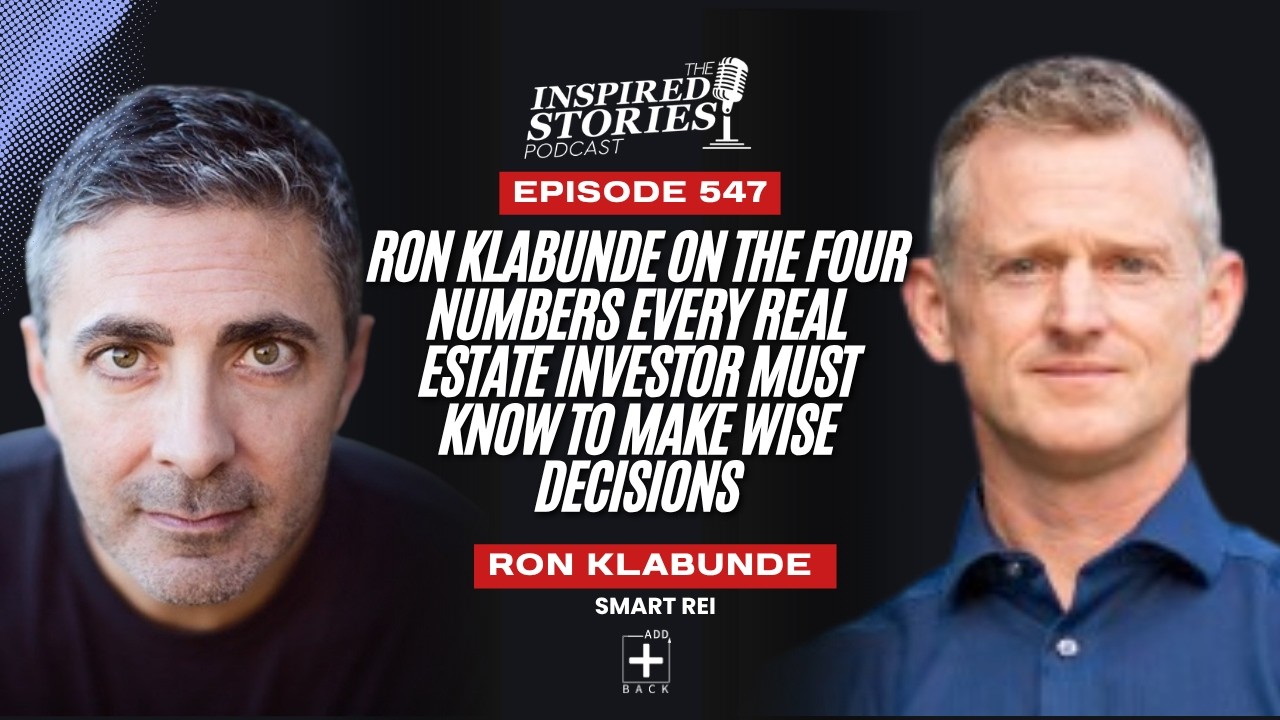
Ron Klabunde, founder of Smart REI, spent 18 years as a pastor, got fired at the height of a national speaking career he describes as the moment humility finally arrived, built a nonprofit that mobilized 76,000 volunteers across 29 states and fed 170,000 children, watched COVID wipe out 78 percent of the revenue in three weeks, stepped off salary to protect his 32-person team, and eventually found an entirely new vehicle for the same mission: helping real estate investors build a life worth protecting before they commit capital to a deal.
✨ Key Insights You’ll Learn:
Leading a high school Bible study at 15 and going directly into ministry after college
The arrogance that came with a national speaking platform at 25 and the church firing that stripped it all away
Why he structured the Replenish Foundation as non-faith-based to unlock corporate funding
The first event: 600 people, 40,000 meals, under two hours — and the 16,000 meals the school principal called to say nobody would eat
76,000 volunteers, 650 business partners including Microsoft and Volkswagen, 29 states — then COVID in three weeks
Coming off salary to save 32 jobs and the leadership principle behind that decision
The investor happy hour where he discovered his empty pond in real estate lending
The four numbers every investor must know: holding costs, rent-to-mortgage ratio, total wealth ROI, and cash flow
Why every spreadsheet is broken and why the Smart REI platform uses 23 interconnected calculators instead
The dream determines the deal — and the numbers protect the dream
🌟 Ron’s Key Mentors:
His Nonprofit Investor (Turned Connector): The woman who had funded Generosity Feeds and knew Ron’s character well enough to invite him into lending when he needed a new vehicle for his mission
JP (Real Estate Investor, 22,000 Units): The mentor who modeled how to use real estate wealth to genuinely serve tenants — free telehealth, tutoring, and financial coaching for every door at $15 a month
The COO of Replenish Foundation: The leader who held the organization together through COVID and carried the mission forward while Ron stepped aside
His Faith and Scripture: The anchor through every reinvention — from the church firing to COVID to the new chapter in lending
👉 Don’t miss this conversation about what it looks like to lose everything you’ve built and find the mission still intact, why 78 percent of your revenue disappearing in three weeks can still be the beginning of something, and a philosophy about money and real estate that has nothing to do with wealth and everything to do with the dream behind it.
Listen to the full episode here
Transcript
Anthony Codispoti: Welcome to another edition of the Inspired Stories Podcast, where leaders share their experiences and
Ron Klabunde: There we go. Yep. Yep. I l I love it, Anthony. I'm looking forward to it, man. Yep.
Anthony Codispoti: So we can learn from their successes and be inspired by how they've overcome adversity. As you listen today, let one idea shape what you do next. My name is Anthony Codispoti, and I want to pose a question to you. What if the biggest financial mistake you'll ever make isn't choosing the wrong investment, but asking the wrong questions before you invest? Today's guest believes most people don't fail because they lack opportunity. They fail because they commit money before they have clarity. For more than three decades, Ron Kloblunde has helped people build stronger lives. He spent 18 years as a pastor, led a national nonprofit that mobilized more than 70,000 volunteers across 29 states. And today, he helps real estate investors and the professionals who serve them make wiser financial decisions before committing capital. Ron is the founder of Smart REI, a platform built around a simple but powerful idea clarity before capital. He's also the author of The Smart Real Estate Investor, where he challenges much of the conventional wisdom surrounding investing by teaching that the goal isn't simply to build wealth, but to build a life worth protecting. Whether you own real estate or not, today's conversation isn't really about properties. It's about making better decisions. It's about learning how to think before emotion takes over. And it's about understanding why the numbers should always protect the dream and never replace it. But before we get into all that good stuff, today's episode is brought to you by my company, AddBack Benefits Agency. And you'll want to hear this because it's hurting almost every business owner you know. See, health insurance costs go up every single year, and businesses are furious about it. They're paying more, claims are getting denied, employees are opting out because they can't afford it, and it hurts turnover and morale. It's one of the most maddening problems in running a business, and everyone just seems to accept it. But you don't have to anymore. Now there's a program that gives your employees unlimited access to doctors, therapists, and prescriptions with no co-pays or deductibles to meet. And here's the part that really shocks most people. Unlike every other employee benefit out there, Our program increases your net profits. We recently helped a client add $900 per employee per year to their bottom line. Results vary, but gains like that change how a business is valued. You can be the hero advisor that introduces this to your clients today. They'll be so happy they refer their friends to you. addbackbenefits.com. All right, back to our guest today, founder and CEO of smartrei.us, Ron Klabunde. Thanks for making the time to share your story today.
Ron Klabunde: Anthony, it is great being with you, man. I have enjoyed our conversations leading up to today and almost immediately felt a friend in you. So that that's how I view this. It's it's two friends sharing a story that not only is sh is is transforming our lives, but has the ch opportunity to transform other people's lives as well.
Anthony Codispoti: And let's get into your story. It's been a mutual feeling of respect. We hit it off kind of right off the bat there. And so to kind of jump into your story, I know you went to college, right? And you went to college with the idea of becoming a minister. And so as soon as you graduated, that's the work that you pursued. Tell me what drew you to that.
Ron Klabunde: Yeah, when I was when I was in high school, is I actually started leading a high school Bible study. And I just have always had this desire to change and impact people's lives, to serve people. and so it just seemed very natural for me to go into full-time ministry. And and then I got into full-time ministry, and like most things in life, dreams are perfect. Reality is not. And so very quickly I learned the challenges of being a pastor and being in full time ministry, and again began wrestling with, as all of us do, the the the difference between that dream which was perfect and the reality that, like everyone in life, I was now learning through and struggling through as well.
Anthony Codispoti: Tell us the difference. What did the dream look like? What was the reality?
Ron Klabunde: Yeah, the the dream was this life of really working to help people thrive in all aspects of their life. That's why I went into ministry. And yet when I got into it, what I realized is that there's politics in it, and that because of my role in the church, I had to please about three different audiences from children to parents to elders. And they all had a different idea of what should happen, and they all had different expectations of me. And so it became this collision of ideas inside the institution. And then learning how to navigate the expectation and the ideas of three completely independent parties and dealing with even some of the backlash that comes through that. in the context of the relationships within an organization that is supposed to be about
Anthony Codispoti: Mm. Did you learn anything from those experiences that you're still able to carry forward with you today in terms of how you lead an approach?
Ron Klabunde: Every day of my life. So the answer is yes. What I began to learn was is I had to learn in that process how to become emotionally intelligent. And what I mean by that was to seek to understand before being understood. How to, how to, even though I felt I was right.
Anthony Codispoti: Okay, let's hear.
Ron Klabunde: To put myself in a place of humility to listen. Because it takes humility to be a listener. And then to take and understand where different people are coming from, and then finding common ground that unites us. And it doesn't matter what industry you're in, whether it's the church, whether it's a nonprofit, whether it's insurance like you, whether it's lending, what doesn't matter. Big business, construction doesn't matter. That's a that's a life skill that can take you anywhere as we begin to learn to listen and then assimilate ideas to unify people.
Anthony Codispoti: Very powerful. Yeah, I love that. Now, were you still in ministry when you started the Replenish Foundation, or was that something that came later?
Ron Klabunde: Yes, and that's that's a great question. So as I as I was spending I spent eighteen years in ministry and during that time, by age twenty five, I was a national keynote speaker as well on leadership development, traveling the US and Canada. So I was in full time ministry and I was doing national keynote speaking. And so as yep.
Anthony Codispoti: Let me put a pen in that for just for a second. What what was it you were being asked to speak about? Was it ministry? Was it God? Was it your faith?
Ron Klabunde: You know, it was I was training pastors around the country how to be better leaders. And I know that sounds odd, but I was doing that by age 25. Here a 25-year-old is teaching 45 and 55 and 60-year-olds in leadership development, right? but it was a season of my life that I soared. And let's just talk about what that did to my heart, because just a moment ago.
Anthony Codispoti: Very young.
Ron Klabunde: I talked about how I had to learn to be humble. It's really hard to be humble when you also have a national stage with thousands of people in front of you. And so there was this tension going on inside of me between the humility I needed to have in the church and the even the arrogance and pride that was growing in my own soul because of a stage that I had that had been offered to me far earlier than it's offered to most people.
Anthony Codispoti: Did you recognize that it was happening within you at the time?
Ron Klabunde: No, not until the church I was working at at the time fired me. And so when I was fired by a church, it kind of felt like being fired by God. And so that was a real wake-up call. And that was when I realized even though, and this is again part of all the lessons. Even though today I believe that the way I was doing ministry, because I was hitting it there was a there was a philosophical hit going on between the leadership and I at this particular church. Even though I still believe I was right, the way I handled it was right.
Anthony Codispoti: So what would you have changed? Yeah.
Ron Klabunde: And I think there's a lesson to be learned there. We can be right about something, but we can handle it the wrong way. And the reason I handled it the wrong way was because of arrogance. And had I handled it with humility, the outcome could have been radically different, right? So that was my wake-up call, was when I got fired and I had to begin to really examine my own soul. And I can tell you that it was that moment when humility set in.
Anthony Codispoti: 'Cause you're on a rocket ship at this point, you know, what you're describing, right? This young guy, twenty-five years old, you work for the ministry, but you're traveling around the world, around the country at least, and people are paying you because they want to hear your ideas. Young whipper snapper, educating these, you know, older ministers and how to lead. But now your core employer says, Well, no, you're not a good fit for us anymore. It strips you down bare pretty fast.
Ron Klabunde: Yep. Yep. Really fast. And I and it's all the fear of am I going to get hired again? I was working for a mega church at that time, a church of 3,000 people, you know, and then and then the questions and all the fear that set in of can I be hired again? Can I be hired by another mega church again? And and that happened, right? But that was part of my own journey. And then going back to your original question that kind of led us there is. you know what got me into the nonprofit sector? You you called it the replenish foundation. It's its popular, it's its popular name is Generosity Feeds. The organizational name is Replenish Foundation. And so the answer is yes. I was doing full-time church ministry when we launched the nonprofit. What we and the reason we launched the nonprofit. Was because I wanted to invite people to begin living God's love outside the context of a religious institution. I wanted to work with people, regardless of their faith, to begin living God's love. And I
Anthony Codispoti: Is that antithetical to what a church is typically sort of structured to do?
Ron Klabunde: Well, what I found was is I structured the nonprofit as a non-faith-based organization because of the idea in our country of the separation of church and state. So I knew that if I started a nonprofit that was faith-based, that I wouldn't be able to tap into corporate dollars to fund it. So I removed the label because fundamentally I don't believe that an organization can have faith. People have faith. Organizations do not. So why in the world would I let a label, a faith-based label on an organization, limit the resources that we could receive to do good work?
Anthony Codispoti: Makes sense. So where did the idea for this come from? Like what was it you were trying to do?
Ron Klabunde: So So, what I was trying to do was engage my entire community and create an environment where parents could serve with their children in a meaningful way and begin to teach their children the value of generosity and service in the context of community. And the very first event that we did, we had Over six hundred people show up to create forty thousand meals in less than two hours to feed local children living with food insecurity. And so the event lived it it was it was the embodiment of the values I just gave to you. We created a context that families could come together with the school system where it was hosted and with businesses that were funding it to meet the needs of other families in the community.
Anthony Codispoti: You don't usually get that kind of turnout for the first time on anything, right? There's wrinkles that you've got to iron out. Why do you think it struck such a chord in that very first turn?
Ron Klabunde: Because what we had learned in our community needs assessment is that families were looking for opportunities to serve with their children with nonprofits. But nonprofits for insurance purposes won't let children serve by and large. So what we did is we we removed all the insurance barriers to children showing up to serve so we could create the environment that parents were longing for, but we knew they were longing for it before we created it. Why? Because we asked. And then all of the all of the food that was created at the at the at the event, we gave to local nonprofits who were partnered with the after-school backpack programs to make sure that children who are on free and reduced lunch were being fed over the weekends. So now the school jumped in and we ran all of our marketing through the school because no organization in any community has more clout and a louder voice than the local school system because. Over 50% of any community trust their children to the school. So we knew that if we did all the marketing through the school, that we would also get the corporate sponsors because corporate sponsors want to partner with local schools because they know who has the voice and the influence. So we created a synergy where businesses could bring their employees to do team building and community service and fund it. People from around the community could come with their families and they could all serve together. And then we brought in other nonprofits that we gave all the food to and we promoted the other nonprofits, which is also unheard of in the nonprofit sector. Normally nonprofits are fighting for resources. We decided to give them away.
Anthony Codispoti: Fantastic concept. What hardships did you run into early on?
Ron Klabunde: the the very first one. So the meal, the meal that we were creating at the very first event was actually a meal that was designed for children coming off of malnutrition in third world countries. And we tried to modify the recipe for American children and the American palate, and we missed the mark. And so three weeks after the event, the principal, who's a good friend of mine, called me and said, Ron. You need to come pick up sixteen thousand meals that we can we can't give away. And we have parents telling us to never give them those meals again.
Anthony Codispoti: Wow.
Ron Klabunde: How do you like that out of the gate? That was a pain, it was a painful day. Like that was painful. It was it was a soy-based meal. So it was about a cup of soy with a vitamin packet in it and a little bit of flavoring. It wasn't enough. So when that happened, we gave all the food to an international food relief organization. They sent it overseas where it really belonged. And then
Anthony Codispoti: So what was it? What was the food that you were serving?
Ron Klabunde: We had a culinary chef on our team who developed a meal for children. We went through over a hundred rounds of product testing and we nailed the meat, the meal. Nailed it. The new meal was a is a it's a rice and beans mix. so it we were looking for a meal that would go cross-culturally, and rice and beans is a cross-cultural meal.
Anthony Codispoti: So what was the new mail?
Ron Klabunde: So, and then we had to get the sodium levels right because children in America who live with food insecurity have a different palate than you and I because they're living on preserved foods that are high in sodium. But we were trying to strike a balance between matching what their palate wanted so they'd eat it, but not putting in too much sodium. Otherwise, we're not doing their body good. So there it there was not science. But there was a lot of study that we did to get the right meal. And then the second event that we did, we went from Northern Virginia, where the first one was all the way to Eugene, Oregon, for the second event. And we had in Eugene, we had 200 people show up to create 20,000 meals in less than two hours. And when that event went off without a hitch, and we had the correct meal, when that event went up went off without a hitch, that's when I had my aha moment and I went, wow. We just started a national nonprofit that can be local to any community in America.
Anthony Codispoti: And so how did you think about growing it from there?
Ron Klabunde: from there I had a strong because of my keynote speaking, I had a strong network of pastors around the country. I started calling pastors and started telling them to bring us in. And so they would bring us in and they would pay us a minimum of ten thousand dollars to do the event. And then I would coach them how to invite businesses to fund it and invite the community to participate. And I invited them not to do it in the church building because that's a barrier. And I encourage them to partner with the local schools like we did. So even in that model, I was still training pastors how to go about partnering with the community on the community's terms, not on their own terms, which is what typically what churches do. They do ministry on their terms. And I was working to flip the script. And open to their eyes to the reality that it doesn't matter if you're a church or a business or a nonprofit, we need to be serving people on their terms, not our terms.
Anthony Codispoti: And I want to make sure I get the timeline correct. At what point were you dismissed from that first mega church?
Ron Klabunde: about eight, nine years before the start of the nonprofit. So let's call it a let's just call it a decade, right?
Anthony Codispoti: before. Okay, great. That that's well it's well in the rear view mirror, but the lessons are very front and center for you. You had a very yes, you had you had a different approach to the ministers that you were going and teaching now. So I'm sure they were even more receptive than they would have been if they were dealing with the Ron from ten years prior.
Ron Klabunde: You hear them coming out now, don't you? Yes. Yep. Yes. Yeah, that's correct. It's exactly right. Cause it was again, I had I had to I had to return to a place of humility.
Anthony Codispoti: And so this ends up growing substantially. I think we referenced in the end what seventy thousand volunteer packed meals, hundred and seventy thousand kids, twenty nine states. I mean, this thing was just taking off. Yeah.
Ron Klabunde: Massive. Yeah, we were yeah, we were we had 76,000 volunteers. We were partnered with 650 businesses, including Microsoft, Dunan Brad Street, Accenture, Lidos, Volkswagen. Those are some of the multi-billion dollar companies. And and and then COVID happened.
Anthony Codispoti: Tell me about that.
Ron Klabunde: And that was another painful moment, Anthony. when COVID happened, as you and everyone might remember, the government shut down large group events within three weeks of COVID hitting the news. And when that happened, we lost seventy-eight percent of our revenue in three weeks. And it was one of the most painful one of the most painful seasons of my life because I had poured my heart, my time, my own money, my energy, my passion, my dreams into this organization. And now we had to completely reinvent ourselves to make it through a very difficult season through COVID while continuing to feed children. As needs were going up and resources were going down. Because remember, we we there was a there's a food chain, there was a supply chain issue at that time too. We couldn't get couldn't get ships into the country. Right. So there are a lot of and there are a lot of factors that were going on. But in that, in that season, we had 32 team members when that happened. And I have a fundamental leadership principle that simply is this. This is what I believe. Every leader has a responsibility to sacrifice for the well-being of their followers. It is never the other way around. And so instead of laying my team off, I decided to come off staff, which freed up my income. I handed the organization over to our COO, retained my board seat, and knew that I would need to reinvent myself.
Anthony Codispoti: Mm-hmm.
Ron Klabunde: Again. Which brought me into a new chapter, but again, painful journey.
Anthony Codispoti: Very painful. Was the foundation able to reinvent itself in that time period during COVID?
Ron Klabunde: We did. Yeah. So what we learned to do is that we set up because we were a national nonprofit, we had access to Kellogg's, GM, all these food companies, massive food companies that typically won't partner directly with local food organizations, but because we were a national organization, not only could we get wholesale pricing. But we could dr we could drop ship their food anywhere in America for free. So we started setting up partnerships with our partners around the country to fund and we had free shipping. Relationship. Everything in life comes back to rel. It's not the fact that we were, I mean, not being a nonprofit helped. But the reality is they trusted us. Because it wasn't we never viewed, we never viewed.
Anthony Codispoti: How did you get the free shipping? How did you get that? Okay.
Ron Klabunde: Anything we did as a transaction. We viewed everything we did as a partnership. And so it we weren't going to businesses to ask for this. We weren't going to Cisco to ask for this. We were going to Cisco, our business partner, sharing in our mission. to create a resource with us that could meet local need of children across the country.
Anthony Codispoti: And so is it still up and running today, still providing meals?
Ron Klabunde: We we in the last year have begun to shut it down because our COO is time for him to move on. So and and here's here's the piece on that too. everything has a beginning and an end. Everything has a season. Let it turn, turn, turn. Right. So, and and I think that's the key in life is that if we realize that everything is a season.
Anthony Codispoti: Okay.
Ron Klabunde: Then we embrace it for what it is. And even when when seasons begin to close and they transition out, we celebrate the good that has happened and even the change that has happened in our own lives through the journey.
Anthony Codispoti: So let's talk about this season for you and this this rough patch is you've got to figure out how to redefine yourself because your identity had really been staked to this foundation and all the good work that you were doing. And then COVID hits this giant brick wall. You realize for this to have any chance of surviving, you have to come out of the organization. It can't support you in payroll anymore. And so now you're left without. role, without a job, without this big chunk of your identity, how did you figure out what was next?
Ron Klabunde: I began looking for jobs. And I had to go through a year process of realizing that even though the people I serve was going to change, my mission didn't have to. So if we go back to the beginning of the story in ministry, everything I've done in life, not perfectly, but my heart in it has always been to make a difference in other people's lives. It's why I went to ministry. It's why we started the nonprofit. All we were doing was scaling our impact in the transition. And so I had to realize that I wasn't. Looking for another job, I was looking for another vehicle to live my mission through.
Anthony Codispoti: Interesting. Yeah, because on the surface, is it you know, in the intro, it we've sort of given, you know, part of the story away, like now you're in mortgage lending. And that sounds like a completely different career to most people. But as you're describing it, it's this vehicle that allows you to do more of your same personal mission. So I'm curious, what did lending specifically allow you to see that you hadn't seen?
Ron Klabunde: Right. Yes. Yeah. So even so we're gonna get to that question, but let's ask the question. So how in the world do you go from church to nonprofit to lending? So remember a moment ago I said everything in life is based upon health on relationships. I believe it's based on healthy relationships, if we were to clarify that. And fortunately, one of our top financial investors in the nonprofit. was a good friend of mine and she knew my story, which I just shared. And she called me one day and she said, Ron, I know your story and I know your character and I know who you are. Have you ever thought about lending? I'm like, Nope. Why you asking? Right? And and she laid it out. And she laid it out beautifully and I went, you know what? Give me time. Let me think about it. And so Getting into lending was based on an invitation. It was that simple. Because someone just knew me. And I don't mean knew my name. I mean she really knew me, the what drives me, my core, right? And so she invited me into Lending. And when I got in, I began to analyze The industry overall, real estate overall, lending and finance overall. I began trying to understand the financial model behind it. Remember, I have just come out of a season where I've been sitting in C-suites of massive organizations. So I had a very unique lens to look at lending from and real estate from. And I'm also fortunate because I believe that it does, regardless of the season of life we're in. We all need wise mentors and advisors. And fortunately, I have a few, really good ones. And one of those mentors introduced me to all things, we sell homes for cash. You've seen the signs on the side of the road. We are, I'm sorry, we buy homes for cash. You've seen the signs on the side of the road that say we buy homes for cash, right? And he's began introducing me to what real estate investors are doing in buying homes and flipping homes and then holding homes and all of this. And it took me a while to understand because remember, I'm brand new to finance. It's a new world to me. But in about eight, about eight months later, I went to a happy hour that had over a hundred real estate investors at it. And I went to the organizer of the event because I got there early and he said, So what do you do? And I go, I I convert hard money loans to permanent loans fast. He looked me square in the eyes and he goes, fifty percent of this room needs to talk to you tonight. And there were no other lenders there. And that was my aha moment. That's when I went, yes, I found my empty pond that no one else is swimming in, or very few others are swimming in that I can be that I can grow in.
Anthony Codispoti: So let me ask you this, Ron, repeat what that little elevator pitch that you gave was and then explain it to folks.
Ron Klabunde: Yes. So what I said to him was I convert hard money loans to permanent loans fast. So let me share the need. When real estate investors are buying homes for cash, in most cases it's not their money. They're not buying it with their own cash. They're buying it with a private loan from an organization or an individual who is charging them 12 to 14% interest. For a loan that they're only allowed to have six, twelve, or eighteen months. And when the project is done, when they buy the home, they do the renovations to the home, they either have to sell the home or refinance out of that loan. And banks and credit unions won't refinance them. And most lenders in my space don't know how and don't have a desire to learn. Right? Say it again.
Anthony Codispoti: Why? Why is this a why is this a burden? Why is this a a b a hurdle? Why is this a hurdle? Why why why don't yeah, why don't they wanna refinance these loans?
Ron Klabunde: Why is this a hurdle? what I learned is people who are in the who have been in this industry for 15 to 30 years are just set in their ways. They're human. It's normal, right? We we all get in our own ruts and and it's ruts aren't bad, but they've been doing and the you're you're not gonna change, right? You're you have they're comfortable. That again, it's human nature, but I was coming in fresh and I didn't want to be I didn't want to be in an overfilled pond where everyone was trying to
Anthony Codispoti: Just you've got a certain way of doing things.
Ron Klabunde: work with the same realtors to give them referrals for people who are buying their next primary residence. That that's that's a that's a commoditized industry that everyone's fighting to get to the bottom on the rate and everything else. And when I'm working with real estate investors, I'm helping them grow their business. I'm helping them balance portfolios of properties so that I can increase their profitability.
Anthony Codispoti: So were there existing loan products that you were able to then offer these folks, or did you have to work with the banks to come up with something completely new?
Ron Klabunde: I had to work with my company to bring in loan products that I knew existed that we didn't yet have. And again, I am so grateful for the company I work for because we have humble leaders who listen to, yes, I'm seasoned, I'm a little older. they listened to me, even though I was only 12 months into the industry, and they brought me the products I was asking for, the loan products I was asking for. And and so I'm grateful. I'm absolutely grateful because it empowered me to start serving a whole new niche of people that we really weren't serving previously in in our in our company.
Anthony Codispoti: So the people that are a good fit for you are these folks that are buying properties with these high interest loans. They need the money fast, that that cash is easily accessible to them. Now you can take that higher interest loan and convert it into a more reasonable rate that they can then carry to turn.
Ron Klabunde: That they, yeah, and they carried a term, but we also construct that loan in a way that allows them the cash flow to meet their their dream. Right. So a lot of times, a lot of a lot of lenders will just look at a loan and they'll slap a loan on a real estate investor or a family. And that's not what I do. My first question to every real estate investor is where do you want your life to be three to five years from now? And let me give you an example. One person said t this to me. He said, Ron, every time my wife and I have a child, we buy a home as an investment property and I'm gonna hold it for eighteen years to fund their college. That's powerful. But that also defines the type of homes he's going to buy, and it defines the type of loans I need to put him in. And it defines how I need to structure that loan to achieve his goal, his vision, right? I might have another person that says to me, Ron, my goal is to retire and get out of corporate America in five years, but I want to have $20,000 of cash flow every month when I do that. I had that conversation yesterday. Well, that person is looking for a very different type of product than the first story I told you because the dream is so different. So here's here's what here's what I here's what I'm building with investors. Most investors start with the deal. Never start with the deal. The dream determines the deal. And then we analyze the deal, the numbers on the deal, and the numbers protect the dream.
Anthony Codispoti: Basically, you're looking at the end goal. Where is it that we want to get to? And then you're mapping what needs to happen to get from point A to point B.
Ron Klabunde: Yes. Yes. Yes. Because if when we do that well, when we do that well, they keep buying homes and keep growing their real estate business and they keep moving closer to the dream that they have. Let me give you a four example. There's a a gentleman who I met two years ago has become a good friend. When I met this gentleman, he was he owned he owned 23 properties and three of them were about to foreclose. It would have destroyed his dream and it would have destroyed his real estate business. And the hard money lender, I knew the hard money lender, the hard money lender introduced us and said, Ron, can you help prevent this guy from foreclosure? And I said, Absolutely. Within 30 days, we had him refinanced out of those three properties. So we saved him for for from foreclosure. And then what I did is I looked at the 23 properties and I began analyzing which ones are overperforming and need to be refinanced to get you some capital, which ones are underperforming and they need to be sold, or they're underperforming and you need to increase the rent. And so when we went through this, it should be, but that's not what typical lenders do. But I I believe that all of us have a responsibility to live and lead in our uniqueness, not according to the expectation of others. So we step beyond the expectation to serve people the way they need to be served.
Anthony Codispoti: Is that the role of a typical lender?
Ron Klabunde: Based on our own uniqueness and gifts. And that's what I did. And so, long story short, within 18 months, I had refinanced five more properties for him. He sold two more. And he had a real estate development fund of $300,000 of his own money. So that hard money, so his profitability just skyrocketed because now he's using his own money, not someone else's money. To get into properties and instead of hard money being a necessity, it became an accessory. And his profitability went up and he's closer today to his dream than he's ever been.
Anthony Codispoti: That's a really powerful little anecdote case study there. I love that. And I think, you know, we mentioned this in the intro. at some point you realize that most investors weren't failing because they lacked the opportunity. They were failing because they lacked clarity.
Ron Klabunde: Bingo. And and a lot of investors, what they do is they hope, they hope that a property's gonna work. They they run the numbers in their head or in a broken spreadsheet or whatever. And if they're listening, every spreadsheet is broken. So they run the numbers and then they hope it works. Hope is never a strategy. Never a strategy. So, what I do with them is I work them through the four numbers that every real estate investor must look at to determine if a property is going to work in alignment with their dream. And when we do that, the beauty is this: I help them gain clarity and confidence before they ever commit capital to a deal. And when that is done well, They keep buying, they keep holding, and they keep growing their wealth.
Anthony Codispoti: Okay, you've piqued my curiosity. What are these four magic numbers that you talked about?
Ron Klabunde: Yeah. So the one that that virtually every investor misses is this. What's the holding cost? It doesn't matter if if you're doing renovations on a home, there are holding costs. It doesn't matter if you have a tenant in a home and they're renting it, you have holding costs. Most investors miss the holding costs. That's the biggie. The second is is our rent to mortgage. Yeah.
Anthony Codispoti: Well hang hang on a second. It explain for us what h you mean by holding costs.
Ron Klabunde: So holding costs. So let's assume there's a tenant in a property, right? they very possibly have an eight, they're spending eight percent of the rent every month to a property management company, or they're managing them on their own, but typically it goes to a property management company. They fail to calculate the fact that out of 12 months, one month of those is it's gonna be vacant because there's turnover. And every time there's turnover, you have to do renovations and you lose time. So they're not saving money ahead of time for the fact that they're only going to be renting eleven months out of every year. They they they run their budget on 12, not 11. they So you've got, yeah, sorry, you got your you got your vacancy, you've got your you've got you've got your property management, and then other fees as well. They might be covering trash. So that maybe they're covering utilities. Most don't, but maybe they are, right? So there's always holding costs on a property, even if there's a tenant in it. And and the and maintenance reserves. Hardly anyone serves saves for maintenance reserve up. Murphy is always going to show up. So you better be taking ten percent out of every rent check and putting it in the bank so you can pay Murphy to go away.
Anthony Codispoti: Murphy's Law.
Ron Klabunde: S but again, hold it Absolutely, you have to.
Anthony Codispoti: So hold ten percent back everything that you're making for that maintenance reserve. You gotta factor in these holding costs. So this is the important first number that everybody seems to miss. What's what's number two?
Ron Klabunde: They miss it. So number two is your rent, your rent to mortgage ratio. And most investors I talk to, they say this, well, you know what? The rent is more than the mortgage. How much more? It well, it it's more. No, how much more? So well, here's where I put it. Okay. They can get a loan. they can actually get a loan where the the rent is less than the mortgage. Most renters are looking for at least even. I say that the the ratio has to be 1.4 or higher. Here's why. If you're investing all of your money, all of your time, all of your emotion,
Anthony Codispoti: How much more does it need to be?
Ron Klabunde: And you're taking time away from your family to do this, wouldn't you like to beat the stock market? So when I'm working with my investors, I'm always positioning them to beat the stock market on their returns.
Anthony Codispoti: So let me see if I understand you. So let's say that I've got a property that I can rent out for $1,000 a month, just to make the math easy. You're saying or I'm sorry, that my mortgage is a thousand dollars a month. You're saying that I need to be able to rent that out for fourteen hundred dollars a month, that forty percent increase. That's a good rule of thumb.
Ron Klabunde: Yes, minimum. Minimum. And and the invest y let's go back to the gentleman that that almost foreclosed on three properties. His portfolio today across the portfolio is at 1.62. He is gold, he is cash flowing, he can live on these properties. But it's because I didn't put him in the loans he wanted. I put him in the loans that I constructed the loans in a way that would serve his dream.
Anthony Codispoti: And so what does that actually look like for you behind the scenes? How are you constructing the loan? You're just putting him into the right product that sort of gives him the right term, the right interest rate.
Ron Klabunde: I'm actually constructing I'm actually yeah, I'm actually constructing the the the pro I'm number one, I'm finding the right product, but number two, I'm constructing the product on the loan to value and its prepayment penalty and its rate and its points. I'm constructing all of this in a way that is serving the dream. And so it if if if if a real estate investor says to me, you know what, I only plan to hold this house for two more years, but I I want to go ahead and but I have to get out of this hard money loan at 14%, I'm not gonna, I'm not gonna sell them points on a loan. Why would they spend, let's say, $4,000 to buy down an interest rate when the break even is four years in advance and they're gonna sell it in two? Most lenders would do that because they make more money if they do that. I won't do that. I'm gonna give them what serves their vision because if I give them what serves their vision, they keep more money in their pocket and we do more deals because I'm a trusted advisor, I'm not their lender.
Anthony Codispoti: Okay, so we're halfway through the the four numbers. What are the other two?
Ron Klabunde: Yep. Next one is your total wealth ROI. What most people don't realize is that there are multiple different types of ROI. And so we calculate a total wealth ROI, which does include the fact that someone is paying down the principal and we calculate in the appreciation of the property year after year. So we look at total wealth ROI. And then we also, the fourth number, let's just jump right into it, is what's the cash flow? Is it worth it? I was talking with a real estate investor yesterday. He and his wife make great money, over $200,000 a year. And the cash flow on this particular home was only $4,000 a year after all closing costs. I mean, after all holding costs. And I said, I said to this gentleman, I said, You and your wife make over $200,000 a year. Is it worth having this property emotionally and relationally? And time-wise to only bring in four thousand dollars a year above all costs. And he goes, no. And I said, You're right. Get rid of the house. And take that, take all the equity. He has over $150,000 of equity in it. Take all the equity out and go buy a home that's gonna produce a better return on investment. So those are the four numbers.
Anthony Codispoti: I love it. okay, I want to better understand a couple of things here. The the the book that you that you wrote, we referenced it in the intro, the Smart Real Estate Investor, and the overall platform, but basically by the same name, Smart REI. Tell us what is going on here, what the mission is, what people are getting from this. Paint the picture for us, right?
Ron Klabunde: Mm-hmm. Yep. What we're what we are doing is we have built and are building a community of real estate investors and their advisors. To work together to find clarity and confidence before committing capital. So, what I'm doing is I'm working with realtors who are on the platform and they invite their real estate investors into the platform with them. And then as their investors are running numbers on a property, the realtor is able to see that. There's transparency. So the realtor and the investor can jump on a call. And the realtor now becomes an advisor as well. And so what I'm helping realtors do is become more than someone who opens doors. I want them to be, and I'm training them to be people who open doors and then help guide their investors to best business practices and outcomes. And so, and same thing with lenders. I'm doing the same thing with other lenders. Yeah, I'm a lender. I don't I don't lend on all the loans of all the investors in the platform. I'm training other lenders as well how to become true advisors to help their investors make great business decisions. Because when the investor wins, everyone wins. The realtor wins, the lender wins, everyone wins.
Anthony Codispoti: So this isn't just about buying investment properties. This is it it sounds bigger than
Ron Klabunde: It is far this is about community and relationship of like minded people who who yes want to do good in business, but want to use business for good. Because the other piece Yeah. Go ahead.
Anthony Codispoti: Okay, where do I go to ch sorry to cut you off there, Ron. I where do I go to look at this? Where how do I check this out?
Ron Klabunde: So you go to smartrei dot us.
Anthony Codispoti: Okay, I'm on your site now. What do I do when I get here?
Ron Klabunde: Yep. When you when you go there, click in the upper right hand corner, it says start here or get started, whichever it is. And simply just sign in and it's free and you're part of the community. and then inside that platform, you'll be able to begin analyzing real estate opportunities, but you can also invite your rent your realtor to join the platform with you so that
Anthony Codispoti: Okay.
Ron Klabunde: You have a s a singular space where you can be looking at different deals together to ensure that you're making a great decision. Why? Because count wisdom is found in the counsel of many. None of us succeed in a vacuum. And so we're connecting, we're connecting. investors with wise advisors who are helping their businesses grow and then growing around a virtue of serving others.
Anthony Codispoti: And so is this some sort of like a a social platform once I'm accepted as a member inside?
Ron Klabunde: Once yeah, once you're inside the social side is is about to take flight where we're creating that online community where investors can come together and even share deals, right? Because there are wholesalers that are looking for an audience of buyers. but again, it's all based on integrity. In other words, I see someone not playing in the realm of integrity. I love you, but goodbye.
Anthony Codispoti: Okay. So that again is smartrei.us for folks. We'll have it in the show notes in case you missed it, but smartrei.us. Go check it out. It looks pretty cool. I see there's a great little calculator here on the homepage, too. So I can enter in purchase price, renovation costs, and this kind of gives me an idea of and are these each of the four numbers that no, these are not. I'm seeing what it calculates here. My cash flow, my rental income coverage, that ratio that you're talking about that should be at least one point four. yeah, this is super helpful. That's great.
Ron Klabunde: Mm-hmm. Mm-hmm. Yep. And that calculator on that landing page just gets a f gives a feel for what's on the backside. Right. The backside is incredibly robust. Like analyzing everything. The opener there just gives a feel for what it the experience will be.
Anthony Codispoti: Okay. That's just a taste. Okay, very cool. You know, something that I've heard you talk about before is how decisions should always be based on math and not emotion, which is really hard because we're human beings, we're emotional creatures. Can you give me an example of a time where you saw a decision get influenced too heavily on the emotional side and it steered things wrong?
Ron Klabunde: Absolutely. take the buddy. We'll just go right. Now let's let me give you another one. This lady that I'm talking about is 78 years old. And I told you I always begin with the dream. She has no children, but she has net nephews and nieces, and she wants to she wants to live leave a a legacy for them. And she wants to leave them an inheritance. She's been working her whole job as an or her whole life as an entrepreneur in different ways. And she decided to buy her first property about 350 miles from her home and two states over. And she partnered with someone who she thought she could trust. And she bought this home, didn't run the numbers. I mean, she ran she ran the numbers, but when our emotions take over, we're bound to change the numbers to get the outcomes we want. And then the person that was supposed to do the construction, she thought could be trusted and couldn't be trusted, and ended up taking her for a ride of over eighty thousand dollars over the course of the next eighteen months. And so the dream that she's had, I'm not saying it can't be recovered, but time's running short. That's what happens when we make emotional decisions. And so one of our mottos inside Smart REI is math over emotion. And it doesn't mean that there aren't any emotions at all. Right? We're human, as you said. But it means that we focus really, we focus on the math and we let we let the numbers be a piece that that guides us. But we need We need a platform. We need a pl spreadsheets are just broken. Right. And they don't calculate everything. And they don't calculate every scenario that could be thrown at them. Because they're they're they're they're they're one-dimensional. And so it's a matter of looking at this from a multidimensional standpoint, which includes not just the numbers, but yes, our emotions, and also listening to the people that we love most. And if we do that, we'll make great decisions. Nine times out of the time.
Anthony Codispoti: So what you think that woman could have done differently?
Ron Klabunde: I would have if if I had known her when she started in her journey, I would have coached her to buy local so that she could have she could actually see and touch the project instead of trusting other people to see and touch the project because that's where that's where the trust broke. That's where she got burned. So I would I would start local. Every every beginning real estate investor should always begin local. Because there's too much to learn. There are too many mistakes to be made in the process. Learn it when you can control it a little bit more closer to your chest. Once you've learned the lessons, then branch out. That was her first mistake. Go local. The second is I would I would have had her vet her construction person a whole lot tighter than she did. He had a title that she believed. He was a bishop. So he had a title he didn't have integrity. And so I d what's coming out in the book is how do you go about choosing great advisors and business partners? And that's that plays a lot out of her story. and then I would have encouraged her to move slower. The concept is this the tortoise wins. And that doesn't mean you stay a tortoise your entire life. It means as you're as in as investors get going in the process, go slow.
Anthony Codispoti: Gotta crawl before you can run.
Ron Klabunde: Learn the lessons with while keeping reserves in your pocket. Don't over leverage early. The tortoise went.
Anthony Codispoti: What's some other really good advice that you have for people looking for their first investment?
Ron Klabunde: Is much it's it depends on the storyline. for let let's say I'm working with someone who's young who's never owned a house before. I don't believe that single people should be buying single family homes unless they plan to rent out rooms. Everyone's you you gotta own a home, you gotta home. No, I don't believe everyone should own a home. Owning a home can be a really bad financial decision. So If you're in a season of life where you can house hack first and use your home to create revenue so you can start, you can utilize the revenue then to to learn and then begin growing a portfolio, do it that way. I I'm not coaching my kids to go buy their first home and live in it without having revenue on it, but never do that. That hurts them. Even though my daughter has, 25-year-old daughter has great income. I'm coaching her to go buy a house and then rent out two rooms. Get other people paying your mortgage. She's single. Why wouldn't you? So, so it again, if that was the storyline, that's how I'm going to coach. if if it's a young couple, right, they're married, probably don't want someone living in their home. Buy a house with an ADU, buy a duplex. Buy something where so you where you're living in part of it, because if you do that, you can buy a home for three to five percent down. You you buy it in the right place, live in it for 12, you can buy it with 0% down. So so again, it depends on the story, it depends on the dream. But it for those that are just getting into it, I'd go there. For someone who's more seasoned, get into multi-family. Like, don't try to manage, like my buddy is, 23 homes. Go buy one building with twenty-three units. Like consolidate it, because this is that's a matter again. So it depends on the season of life, it depends on the dream, which is going to shift how I coach.
Anthony Codispoti: You said something a minute ago that really struck me. Spreadsheets are broken, they are one dimensional. What do you mean by that?
Ron Klabunde: So when we're looking at when you're looking at any any investment property, there are multiple ways to construct it. Are you buying with hard money? Are you buying with HELOC? Are you buying with cash? Or are you buying on a permanent loan? Four ways to buy it. And then you have to ask a secondary question: what's the secondary source of funding? So if the hard money loan only covers an 80% loan to value, then where's the other 20% coming from? Well, it's either coming from a home equity line of credit or cash or maybe an investment fund. And so we have to because of all I just gave you three fourths, I just gave you twenty one variables. In thirty seconds, I gave you twenty one possible scenarios on how that loan could be constructed. And so you we have to be working in systems that are layered so that they can calculate on multiple factors, not just two factors.
Anthony Codispoti: So if it's not a spreadsheet, what does it look like then? What's the re what's the answer?
Ron Klabunde: yeah, our well, let's put it this way. I hate saying this, but there are twenty two calculators that are completely interfacing betwe behind the The platform that I've created.
Anthony Codispoti: Smart RAI dot us.
Ron Klabunde: twenty three calculators that talk to each other. And that's layered. That creates a three-dimensional construct because that's what real estate is. It's three-dimensional. It's not on a piece of paper. And so we have to create platform. I had to create a platform that allows for as many possible variables as possible. So we have 21 variables just in how are you constructing the loan? There's a whole nother set of variables. Is it a fix and flip? Is it a buy and hold? Is it a is it a buy permanent but with no renovations? Is it a refinance? We just added four more variables on top of our twenty one. We're now up to what ninety-six variables and I haven't we've only started. That's a that demands a three dimensional platform.
Anthony Codispoti: Can you help me wrap my head more around what you mean when you talk about a three-dimensional platform and how these calculators are all talking to each other?
Ron Klabunde: So so it it all has to do with if thens. If this then it goes here. If this it goes here. If so it's a massive if then s scenario. That you could that literally you you you you walk around. like I would have a really hard time drawing an if then of this magnitude on a flat piece of paper. Like because it's not just linear, it it's that it goes it goes deep and wide. There's two dimensions right there. Right. So it's and and the moment you You you turn it into a sphere, it There's too many, there, there are too many variables. And and so if we're to the point that if you're taking money, let's say you're taking 20% cash out of a mutual fund to help run fund a real estate deal, what was your money earning in the mutual fund? Because you need to be calculating the opportunity loss on that money in the mutual fund to understand, yes.
Anthony Codispoti: Got it. Okay. And this is something that your system does, it factors in.
Ron Klabunde: It calculates your opportunity loss in one world to to calculate your opportunity gain in another. There is there's no other platform doing this.
Anthony Codispoti: That's amazing. So as you look ahead over the next year, what is it that you're most excited to build?
Ron Klabunde: Community. Connecting people. It all goes back to when we are living in a place of healthy relationships. Life works. Business works. Marriage works. Families work. Most excited thing I'm the most the thing I'm most excited about is building this community of healthy. relationships where people can thrive in their real estate business, thrive in their finances, and s thrive in their relationships in their own home and with each other.
Anthony Codispoti: So by building this community, you're gonna be able to expand the reach of who you're able to help currently, right? Like right now, Ron is a little bit of a bottleneck, but this platform is gonna let you open this up to a lot more people. So if we look 20 years down the road and someone you've never met before has benefited because of your work, what is it that you hope has changed in their life?
Ron Klabunde: Yes. Correct. I hope that they look at me and they go, you know what? Before I got connected to the community, right? And the resources. I was stepping into deals with a little bit of fear and uncertainty. And what I've learned today is how to step into them with clarity and confidence. And In the process, I'm using X percentage of revenue to impact the lives of other people in my life. It goes back that last piece on generosity goes back to this. I have a good buddy who at the height of his real estate business owned over twenty thousand units simultaneously across the US. And he said this to me. He said, I have grown my business and my wealth on the backs of hard working Americans who are living paycheck to paycheck and still pay me their rent every month. I have a responsibility to take care of them. Beyond just giving them a good place to live. So you know what he does? For every tenant, every tenant he has, he offers free telehealth, free after school tutoring, and free financial coaching, along with a few other services. And it only costs him $15 a month per door.
Anthony Codispoti: Wow.
Ron Klabunde: This is when we take business. We when we do well in business, we can do well for our communities and for the people that we serve.
Anthony Codispoti: So you want there to be clarity, confidence, and from that clarity and confidence comes enough profitability that they're able to turn around and be generous with that money.
Ron Klabunde: Correct. Live their dream and also impact other people's lives.
Anthony Codispoti: I've just got one more question for you today, Ron, but before I ask it, I want to do three quick things for the audience. First of all, anybody who wants to get in touch with Ron, a couple of ways. One we've mentioned already now a couple of times, smartrei.us. You can go there and create a free profile right now. You'll see a cool calculator on the home screen there, but that's just a little taste of what you're going to get inside. Also, if you want to interface with Ron directly, do I have permission to give out your email address? Okay.
Ron Klabunde: yeah, that's fine. or LinkedIn. Either way, right? Yep.
Anthony Codispoti: Okay, so we'll have we'll have a link to your LinkedIn page, Ron Klabunde. And you can also email him Ron at RonClabundi.com. And his last name is spelled K-L-A-B-U-N-D-E. So K-L-A-B-U-N-D-E. It'll be in the show notes, but there you go, RonClabundi.com. And if you're enjoying the show today, please take a moment to subscribe wherever you're listening. See, it also sends a signal that helps others discover our podcast. So Thank you for taking a quick moment to do that right now. And as a reminder to all business advisors out there, your clients are bleeding money on health insurance. Do them a favor so big they'll tell their friends about it. Show them how to give their employees access to therapists, doctors, and prescription medications that counterintuitively actually increases the company's net profits. Real gains that can change how a business is valued. Contact us today at addbackbenefits.com. Okay, so last question for you today, Ron. After everything we've talked about today, if you could leave our audience with one sentence they would remember for the rest of their lives, what would it be?
Ron Klabunde: Mm. The dream determines the deal. The numbers protect the dream.
Anthony Codispoti: Mic drop. Love it. Ron Clundy, I want to be the first to thank you for sharing both your time and your story with us today. I really appreciate you being here.
Ron Klabunde: Great being here, Anthony. I've loved our conversation. I look forward to more.
Anthony Codispoti: Folks, that's a wrap on another episode of the Inspired Stories Podcast. Thanks for learning with us. And if one thing stood out, put that into action today.