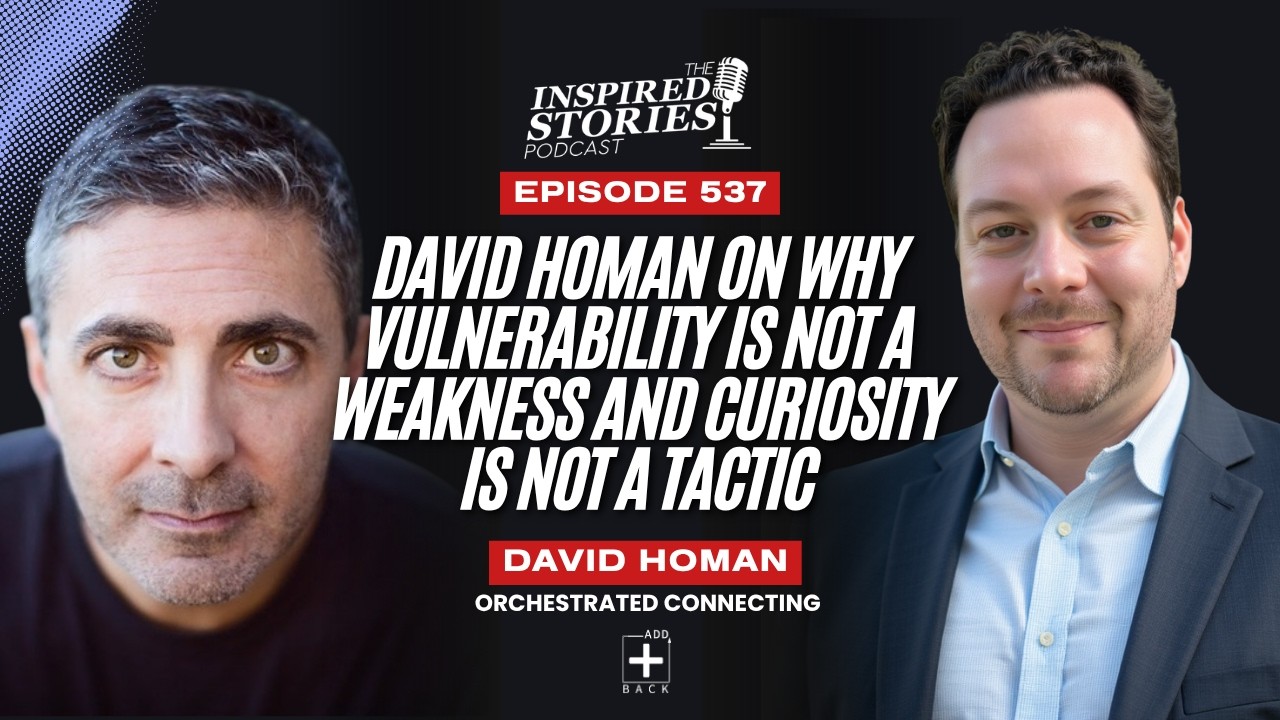
David Homan, founder and CEO of Orchestrated Connecting, was a classical composer with 225 works performed at Carnegie Hall when he found himself, at 26, running a multi-million dollar global arts nonprofit through a connection made at a Shabbat dinner. Then Bernie Madoff wiped out the endowment, a billionaire called to scream at him for losing money he never touched, and David had to rebuild an entire organization by throwing out everything he knew about fundraising and starting to simply ask people what they needed.
✨ Key Insights You’ll Learn:
Growing up in Gainesville with a theater professor father who never connected the dots between his famous students and his son’s career in New York
Meeting Vera Stern at a Shabbat dinner in 2003 and running AICF’s Carnegie Hall gala three weeks later
What Jewish geography is and why it stopped working the moment the endowment disappeared
The chain of introductions that ran from a Catholic friend in Ohio through Canada and Germany to a New York Times article to a $2.5 million gift from the Carnival Cruise Line family
Why 85% of David’s fundraising work was making connections for people who were never asked for anything
How Orchestrated Connecting works: 2,500 members across 47 countries, entry by recommendation only, and you have to ask for help to get in
SOAR Connect: the relationship intelligence platform that tracks recency, frequency, and duration to surface who you actually trust
The five principles of the USA Today bestseller Orchestrating Connection: curiosity, vulnerability, diversity, generosity, and gratitude
What happened at a conference in March when David shared that it was his first public speaking event since losing his father
The two years David spent writing letters to his father signed as Tim from the Best Western in Cherry Hill, New Jersey
🌟 David’s Key Mentors:
Doris (Adopted Jewish Grandmother, Florida): The lifelong family friend who introduced David to Abby, who introduced him to Vera Stern, who changed everything
Vera Stern (Widow of Isaac Stern, AICF): Took David under her wing at that first Shabbat dinner and gave him his first real platform
Bill Schwartz (AICF President): The second father figure who asked David to take over the entire organization at 26
Beth (Journalist Friend from Ohio): The Catholic friend with no connection to the arts who heard him out and started the chain that saved the foundation
His Father, Sid Homan (Professor, Showman): Princeton and Harvard trained, 29 books, brilliant and gullible in equal measure — and the reason David gets on a stage the way he does
👉 Don’t miss this conversation about what it costs to rebuild something from nothing when everyone is blaming you for losing it, why asking for help is the most underused strategy in any room of powerful people, and the two years David spent writing letters to his father as Tim from the Best Western in Cherry Hill, New Jersey.
Listen to the full episode here
Transcript
Anthony Codispoti (00:01)
Welcome to another edition of the Inspired Stories Podcast, where leaders share their experiences so we can learn from their successes and be inspired by how they've overcome adversity. As you listen today, let one idea shape what you do next. My name is Anthony Codespodi, and today's guest built one of the most trusted networks among family offices, philanthropists, and founders in the world. He says the whole thing started by accident.
After a financial collapse, nearly destroyed the organization he had spent years building. He was a classical composer running a global arts nonprofit when a Ponzi scheme wiped out the endowment overnight. What he did next, a chain of introductions that stretched across three countries, became the blueprint for everything that came after. David Holman is the founder and CEO of Orchestrated Connecting.
A private community of more than 2,500 family offices, founders, and impact investors. He also leads the advisory firm Orchestrated Opportunities, runs the relationship intelligence startup, SOAR Connect, and wrote the USA Today bestseller Orchestrating Connection. And before any of that, he composed more than 225 works that were performed at Carnegie Hall.
What stays with you about his story is how much of it was built simply by being honest about what he needed and generous with what he had. David is also going to share with us the one tool he leverages to connect with almost anyone. But before we get into all that good stuff, today's episode is brought to you by my company, Ad Back Benefits Agency. And you'll want to hear this because it's hurting almost every business owner you know.
Health insurance costs go up every single year, and businesses are furious about it. They're paying more, claims are getting denied, employees are opting out because they can't afford it, and it hurts turnover and morale. It's one of the most maddening problems in running a business, and everyone just seems to accept it. But you don't have to anymore. Now there's a program that gives your employees unlimited access to doctors, therapists, and prescription medications.
With no co-pays or deductibles to meet. But here's the part that really shocks most people. Unlike every other employee benefit out there, our program increases your net profits. We recently helped a client add $900 per employee per year to their bottom line. Results vary, but gains like that can change how a business is valued. You can be the hero advisor that introduces this to your clients today. They'll be so happy they refer their friends to you.
adbackbenefits.com. All right, back to our guest today, the CEO of Orchestrated Connecting, David Holman. Thanks for making the time to share your story today.
David Homan (02:58)
It's a pleasure, Anthony, and thanks for having me.
Anthony Codispoti (03:01)
So, David, you trained as a classical composer and actor. Then at 26, you found yourself running AICF, a global arts nonprofit, after you had met the widow of violinist Isaac Stern through a family friend. Walk me through how that one meeting actually led to you taking over as executive director, because this feels like a pretty big pivot in terms of your life trajectory.
David Homan (03:27)
It was a massive pivot and it actually took several years. But it goes back to a woman whose name was Doris that I called my adopted Jewish grandmother, where I grew up in Florida. Doris was my mother's best friend. Every weekend I would go over, I would play her be piano. She would feed me borscht, and anyone who knows me knows that I hate red beets, but I would have to eat it with her because how do you say no to an older old family friend who's feeding you?
And when I got to New York, Doris introduced me to her friend Abby. And Abby lived in this massive apartment complex where Seinfeld lived and obviously Isaac Stern and and Vera lived. And I started to go to Shabbat dinners. And 2003 I meet Vera. Vera takes Shining to Me at that point and she says, How would you like to come to my offices on Monday? We had met on a Friday night.
On
Monday I met her at eighty first in Central Park West, and we took the bus down to the offices of AICF, this multi-million dollar foundation. And she knew I ran events. I come from arts management and philanthropy from both my mother and my father. And I took over and I ran their gala at Carnegie Hall a few weeks later. I was competent, but I also was forthright. So I told them I'd love to do this for the same pay, but could you bring me in six months earlier?
They brought me in three. By the third year in, they had switched presidents. And that president who was a second father to me, the late Bill Schwartz, asked me to take over the entire organization. So at twenty-six, about to turn twenty-seven, I was suddenly in charge of a multi-million dollar philanthropy that was also raising millions each year. Seemed like a dream job. And then Bernie made off struck.
Anthony Codispoti (05:18)
Okay, before we get to Bernie, so I want to understand a little bit more of this path. So initially they invited you in to take over this one event, right? They wanted you to run this event. And so you ran it and it went well. And you're like, hey, I want to do it again, but I need a little bit more time. Can you bring me in six months earlier? And they say, we'll do three months. Okay. So you guys are getting to know each other. You're, you know, performing. You're, you know, proving your worth and your value. And and then at a still at a very young age, they invite you to become the executive director of the whole thing.
And so you spent over a decade, right? Nearly fourteen years leading the organization, raising over twenty
David Homan (05:55)
I did.
Anthony Codispoti (05:56)
five million dollars. What were you doing that led to this success? What was your approach?
David Homan (06:02)
So the approach pre-madoff was run a major gala, depend on my board, hope that the legacies, bequests, and big gifts keep coming in. And then at the end of 2008, everything dried up. The Ponzi scheme was also predicated on the housing bubble collapse. And so from twenty two thousand nine on, we had no endowment. We were in a clawback lawsuit related to the Ponzi scheme.
And I had to find all new donors. And what I had tried to do, which in this fundraising world of Jewish and Israeli fundraising is called simply Jewish geography, it didn't work for me. And so I threw the book out and I went to events that were focused on female founders and climate change and mental health and next gens and in philanthropy. And everywhere I went, I kept meeting people, they kept liking me, I kept helping them, they kept helping me.
And eventually, two years into this, I was responsible for eighty-five percent of the organization's fundraising. But none of it came from my board. It came through the network that I had built, which now I know was my connector community. But before that, I just thought I had a bunch of super connected friends in different circles who kept saying, You know, there's this woman in Ohio you should talk to, and then I meet a major philanthropist.
You
should meet my brother's friend's dog walker's dentist. And that person then gets me to somebody else who goes, You know what? Do you know the owner of such and such a company? Then I'm suddenly in some Fifth Avenue penthouse apartment with somebody going, How do you know my friend's dog walker? And then a large check comes. And this was not what I thought fundraising and networking needed to be. But the major point was every time somebody told me no, I'd go, Anthony, well.
I appreciate you telling me that this isn't the right philanthropy for you. What do you need? And I kept interacting with all these philanthropists and millionaires and billionaires and CEOs and then matchmaking their needs. 85% of my work was not the fundraising. It was making connections for people who were never asked for help. And then 85% of the philanthropy that came to my organization was equal, but not one-to-one. It wasn't transactional. It was all relational.
Anthony Codispoti (08:26)
So let me see if I understand this. So prior, call it pre-madoff, pre-Ponzi scheme scandal, the way that you were raising money for the organization was you're relying on your board and your board had connections and so they were bringing in their wealthy friends, yes? And and then also
David Homan (08:45)
Correct.
Anthony Codispoti (08:46)
the the annual gala, you know, big big fundraiser. Okay, then everything changes, right? Two thousand eight, two thousand nine, the great recession, the
Bernie Madoff scandal where, you know, your endowment was tied up. And so you start developing this new approach. And this approach is you're just asking people for help. but there was a term you threw out Jewish geography, and I think I understand what that means, but tell me in your words.
David Homan (09:17)
So Jewish geography and fundraising, it's the same as Catholic anything that is tribal, which means if you were Jewish and I are I'm I'm Jewish, then you're gonna help me or you're gonna help introduce me to somebody because we both care about things that are Jewish. And so this isn't specific to just Judaism and it's not really religious to be clear, it's just cultural. But in in most fundraising, it's tied to a faith, it's tied to a sense of community or some sort of identity.
And so Jewish geography was what you did within especially the the the well realms of New York and Palm Beach and Miami and all the other larger Jewish populations where you were introduced more and more to more Jewish people with a thought, Hey, you're Jewish, I'm Jewish, you'll help this cause. Turns out that's
Anthony Codispoti (10:05)
Got it. Okay.
David Homan (10:06)
that's not actually what works in a time of strife, because you're only being introduced to a person's small little circle, and most of those people told me no.
Anthony Codispoti (10:17)
Okay, so how did you stumble on this new approach? You're you're still having, you're going out, you're having these conversations, people are telling you no, but rather than just, you know, get up and sort of sulk out the door, you say, I appreciate the consideration. How can I help you? Where did the idea come from?
David Homan (10:36)
Desperation.
If if everyone's telling you no and you hear no a thousand times, even if professional fundraisers get that one or two yeses out of every a hundred, and that's the statistic for philanthropy for raising on startups for businesses, out of every hundred you maybe get two. I just had to figure out a way to just not have it be so humiliating and debilitating to talk to a hundred people or a thousand people end up with a handful.
And so if you're gonna take the time to meet me, have me come to your home, meet me for lunch, come to one of my events and actually get to know me, if you like me and I like you, then what if it wasn't one-to-one as a transaction? What if I turned it on its head? But that was my question. What if I just said, as I mentioned with the example for you? well, how can I help? And I found most people of means are constantly asked to give things to other people.
They are rarely asked for what they need as fellow human beings with desires and passions. And when you get enough asks thrown at you, and I have a really great memory because of my training in music and in theater, I would just simply remember them, take notes, call somebody up a month later and say, Hey, you know that film you're working on about Rosa Parks? I just met somebody who also cares about women and civil rights. Do you want to talk to them? And then you make the connection.
If you do that over and over, you've helped somebody with what they actually need. And then you get the thing you want, which is the story, where they call up their friend and they go, this curly-haired dude came into my apartment and then connected me with somebody who's now funding my niece's film on Rosa Parks. They'd go, well, what does he do? And they'd go, Well, he he runs a foundation that supports Israel and dance and theater and art. And they'd go, my mother was an artist. And then suddenly I'd have the warm intro.
From a completely antithetical, not useful intro I made for my full philanthropic needs, but I built relationship trust. I increased my reputational value. These were things I now know how to codify. Back then I was just currying favors and making intros and serving the role that's now celebrated more and more in our society, which is that of a connector.
Anthony Codispoti (12:52)
There's an interesting story that I'm hoping you'll share with us. a chain of introductions that started with the friend in Ohio, eventually reached to a two and a half million dollar donor, connected to the family behind the Carnival Cruise lines. Can you share the as much of the details of that story as you're able to? Because I think it really highlights the power of what it is that you're talking about.
David Homan (13:13)
Yes. So task at hand. Your organization used to have millions of dollars at a as a budget, and now you have a million seven in debt obligations to artists you can't fulfill because of the Ponzi scheme. Your bank account is empty, you're not sure you can have a job in three months, and somehow you have to fundraise to keep an organization alive. And so I did not go to all the usual sources. They when I did, they told me no.
So
one of my closest friends, my friend Beth, we went to theology camp at Emory University in 1996 when Atlanta had the summer Olympics. And she was a journalist, worked for the New York Times, Florida Times Union, many other places. And she I told her what was happening. And she heard me out. She called a friend. That friend got her to another friend. This went from the US to Canada to Germany back to
a journalist who worked for the Times named Dan who said I'd love to do an article on you. And Dan did a front page business financial part article on me and the organization. It was positive, it was raw, it was clear, and that was then passed on to another individual who needed to hear of it, part of the Carnival Cruise Lines family in Israel, who had the ask, which was we'd love to support more artists.
in Israel. They were gonna do it on their own. They hadn't heard of the foundation that I was currently honored and serving to run and running. And next thing I knew, there was an outreach from that family to us through the article and that chain of introductions, which eventually became a five year incredible partnership, increasing our endowment, resulting in a two and a half million dollar gift. My team in Israel were incredible, making that possible with the donors in Israel.
But it all started from a friend who's Catholic who grew up in near Ohio State, who's one of my oldest friends. Not Jewish, nothing to do with the arts, but we ended up with an extremely positive result a year and a half later.
Anthony Codispoti (15:28)
And so that conversation that you had with this friend in Ohio, were you specifically asking for help? Were you just explaining the situation? What like give me a give a little bit more context around that?
David Homan (15:39)
So so
yeah, so in this case my friend was and is a journalist. So she asked me a whole bunch of questions. There were certain things I could share, certain there was down an article on me that she was soliciting. She was simply doing what she did as a great journalist, which was ask a bunch of questions. And she came to the conclusion that this was a story worth telling of a small organization who had been involved with Bernie Madoff since the early nineties.
An organization that had the legacy of Isaac Stern and Sandy Weill and some of the biggest names in philanthropy tied to Carnegie Hall. And that this organization was going to die and a thousand artists were going lose their funding, all because of a Ponzi scheme that the world was blaming everyone for. People were blaming me. Everyone who wasn't invested with Madoff said they knew. Everyone who invested with Madoff said they couldn't figure it out. All there was was strife and blame and
Aggravation.
I literally had somebody call me up and scream at me for losing the foundation's money. And I took this person to hand. They are a billionaire, public billionaire who doesn't they don't like me anymore. And I said, Let me get this straight. I'm not going to mention the person's name. You're right. I am extremely sorry. At 13 years old, I convinced
this organization to invest all of their funds over seven years with Bernie Madoff so that six years later when I was hired by the foundation, I could then possibly lose my job, lose my apartment, and be out on the streets. I I'm I'm sorry. They obviously they had to think it through, right? How
Anthony Codispoti (17:23)
Yeah.
David Homan (17:23)
could this kid at thirteen who had never been to New York City convince a bunch of millionaires and billionaires on Wall Street on the board
That they should invest with somebody he's never heard of so that you're it people's emotions take the best of them, and everyone looks in every moment of strife of who to blame, not how to find a solution. So when I went to my network, I didn't go to just my donors. They were angry, they were upset, they were in the state of loss, or it wasn't because of Madoff, it was because we had a great recession. And my dear friend Beth.
Took an hour and heard me out and asked questions. And something I said sparked this chain that eventually got us a feature article in the Times. And that awareness with the intro that the article was written to the Arrisons gave us a lifeline that actually rebuilt the entire foundation because they weren't the they were the first, they weren't the last to make new commitments. I rebuilt the board to three times its size.
I quintupled the fundraising over the next two years because of it. And I did it because of a network of people who cared, but it wasn't their main thing. They cared about me, or they knew somebody who cared about it and was asking them, well, how do we support a softer side of Israel? How do we support artists who are collaborating with the world? And everyone said, there's this guy, David. I've known him. He helped my friends dog walker with something. You should you should talk to him. I had built up a value that wasn't a
You're my donor, I do something for you, you give me money. That was a a an old way at looking of what the currency of philanthropy should be.
Anthony Codispoti (19:07)
So in this new way, the new David approach, the post madoff approach, what do you think makes it ultimately successful? Is it like I'm wondering what the dynamics are that need to be present? Does part of it rely on the type of person that you're interacting with? Is it the dynamics of how that conversation flows? Like what can you teach us?
David Homan (19:31)
Yeah,
so I'll admit this. I knew none of why I did this well when I started, and there were many times I did not do it well to get to the point that I am. But what I've realized, and these were the founding principles of my book, is in every conversation I was perfectly fine being curious about the other person and vulnerable, and looking at in any situation, not whether I could meet them to get me a donation, but who they were.
In that moment, in that day, could I build up enough trust to say to them, hey, I'd love to help you, how can I? And then what I would do invariably is actually deliver the help that they needed, or if I could not, give them more than most people give. And and that is what my world was. It was approaching things with curiosity and vulnerability in as diverse a network as I could build. You don't go in just supporting black and brown founders to then meet Jewish philanthropists.
You don't support women in climate change or advocacy and mental health to meet somebody supporting tuba players in Gibataim. The thought that I had was, what if I could help you and you could never help me, but somebody that I can't help, you could help. And I just kept approaching this over and over in how I lived and how I met people. And so what worked was this idea that you do what you say you're gonna do.
You're generous without an expectation in return. And when somebody helps you, you honor that by actually calling them up to thank them. None of these things, Anthei, are novel. But when was the last time you went to a conference and somebody actually spent 10 minutes getting to know you? Or if you said something like, My father's ill, they share about the fact their father's ill. It's a human way that everyone throws out. And now in the world of family office and CEOs,
And business leaders and major philanthropists and impact at a global scale. I walk around telling people that my father passed last December. That my 12-year-old is acting like a teen before she's a teen. And it's really hard to have patience with her when she acts a lot like my ex-wife sometimes. There's all these things that like they're human, they're real. So I threw I threw out the book, I built a different one, and then I watched what happened.
And my network got bigger and stronger and tighter. Not just one concentric circle, but multiple circles. And that's when I launched Orchestrated Connecting, which was five years into building this theory. Because the people I met who were the most like me were all connectors or super connectors. And I realized they were the nodes making the most somebody getting me to somebody else, giving me the best intro. And I supported connectors till I built the largest private network.
of connectors on the planet, which is what I run currently and what everything else has now stemmed from.
Anthony Codispoti (22:28)
So orchestrated connecting, that's this community that you're talking about. More than twenty five hundred family offices, founders, impact, investors. And if I've got this correct, the only way in is to ask you directly for help. Am I understanding that correctly?
David Homan (22:44)
That's part two of it.
Anthony Codispoti (22:45)
Okay.
David Homan (22:46)
First one, either I meet you or you have to be recommended in as, and this is the exact terminology, an action-oriented, natural giver that I would leave my children with.
I don't care if you're a billionaire. I don't care if you're a CEO. A lot of my a lot of my network are just unassuming, absolutely normal people doing normal things, except for their grandfather founded Bollywood. Except for their best friend is working with Malala. It's not all about fame and fortune. It's about impact. So you have to be that type of human as a connector, a high integrity giver who's actually busy. And then to actually be in, you have to do the thing that no one else asks you to do, which is to ask for help.
Anthony Codispoti (23:33)
So walk me through like how somebody gets into this. Like just maybe take me through a specific example, a specific case study without mentioning any names.
David Homan (23:43)
Sure. So a new buddy of mine I spoke to this morning. I met him at an event three months ago, an event that had nothing to do with him or I, but we came because of a mutual friend who asked us to go. And he is a pioneer in the world of fine arts, and the main thing he does is sculpting. And there's a lot of people in this world who buy works sculpted from rock and there's no community for them, so he built that community.
thousands of rock sculptors on this planet. But there's actually a large demand for the materials, for the artists. This is not work that travels globally that easily. A lot of people look locally or they bring an artist in locally. This is completely anathetical to my day-and-day working in mental health and climate change. But this guy, he's a connector. He was recommended by a friend. We hit it off. We did a call and his network seemingly
Is all about arts and rocks. Except for in March when my startup, Store Connect, was looking for a new connection high up at Microsoft. He said, Hey, I I heard that, you know, from when we caught up, I heard this is what you need. one of my buddies, one of the C suites in this part of Microsoft, he texts the guy. The guy gets a message that adds to my cadre at Microsoft looking to give us a new grant, and suddenly we get $250,000.
In additional hosting grants from Microsoft from the random guy I met in an event introduced by a friend whose focus is in stone. And so a connector or a community builder has a diverse network. Some of it's not useful for them, some of it's extremely useful for somebody else. This guy helped me. I may never be able to be able, I mean twisting my words here, because it's a weird analogy. I may never be able to help him.
Perhaps
somebody listening to this podcast goes, you know what? My uncle is a famous stone sculptor, and he's always said there's no community for me. Suddenly that random person contacts you to contact me to support the building in Brooklyn of this new massive studio that will be profitable around stone sculpting. It's random until it happens, which is why you have to put the ask out there. And it it's this idea that the give and give is not one to one.
It's one to community and then community back to somebody else.
Anthony Codispoti (26:13)
And so what does it mean to be a member of Orchestrated Connecting? How do I connect with other members? How do I support other members? How do we interact with each other?
David Homan (26:23)
Primary, you show up at any of my fifty events around the US, my base is in New York, plus the UK and Canada, and expanding, and you meet people there, and that starts a ripple effect that results in outcomes. Books published, funding new friendships, business partners, or people warning you against somebody who's horrible that is not in the community, that then you don't go into business with or you know, inter you know, introduce on your podcast. And then as you ask for help.
I do the pattern recognition and I say, Anthony, based on your business, you should probably talk with my friend Chris. This is what he does in the health system. It seems like since you're working on lowering the margins, increasing actually the efficacy of healthcare within business, then one of my friends who he and his group are incredible consultants going into transform hospital systems. There's probably a parallel. Go meet Chris. And then you meet Chris, and then Chris introduces you to three other people and down the line.
Suddenly you have a new client thinking, wow, good thing I read my advertisement for my business on this podcast while David was being interviewed. He actually listened, and now he's gonna text his friend Chris, and I got more out of it than I thought. Like this is what happens when high integrity people put their asks out there. The tech system I'm building will do this at scale, but the system as now is about matching asks, getting the right people in front of each other.
And if you do that repeatedly, and I've done this over ten thousand times over the last eleven years, eventually it just not only works, but you learn who helps whom and what works. And that makes it more and more efficient even as the network is drawn.
Anthony Codispoti (28:05)
So tell us about the technology layer now, Soar Connect, because what you're talking about, the scale that you've been able to do, I'm gonna say non-digitally, you know, just sort of analog, like, you know, remembering all these connections in your brain, getting 2,500 people into this network, making connections over 10,000 times. I it's almost unbelievable that you were able to do that without a tech stack.
But now you're working on SORConnect, and I'm guessing this is going to help you scale this in a way that just wasn't even possible before.
David Homan (28:42)
I mean, it better or I'm gonna fall apart, not just financially, but I hurt my back this spring from all my travel getting ready for the launch and keynotes and everything else. so I'll tell you I'll tell you why I need it and I'll tell you why everyone else would want it, right? We spend our time finally looking at things that happened to us. We lose our job, we talk to 50 people, suddenly we're at a cafe and somebody who knew our friend from
kid drop off says, you should talk to Tony, and that's actually you, but you only go by Tony for that one person. And then suddenly you make an intro and that person who didn't know you gets the job they need. A startup who's trying to find investment gets invited to an event. They don't need anyone there, but as they're getting their car from the overly expensive valet from the event, whereas as as a founder is hard to stomach the 45 bucks of, there's a woman waiting there and
You're both waiting for your cars, you strike up a conversation, and three weeks later, they've introduced you to your lead investor. Like we everyone has these stories about an intro that changes their life. But we don't know how to make it happen, how to orchestrate it. So SOAR Connect was based on the premise that you log on to the system to ask for help or to see how you could help other people with the trusted relationships in your network.
And the only way to do this, and this is antithetical to all current technology out there, I won't name the competitors, they're after great things, but they have the opposite approach. I think your relationship should be private. It should only be yours. And all the data to figure out the right people that you need to engage with, should only be seen by you. So we built something that is like building your own castle with three levels of boats behind you. And in that,
Your emails, your WhatsApp, your LinkedIn, your iMessage, your calendar, all compose to become a full Rolodex with a CRM with a trust score to show the people that you are closest with, recency, frequency, duration. It's a very complex algorithm. So instead of thinking, who do you know? It shows who you trust and then it shows the relevance. The idea was you give everyone that toolkit. Here's your castle, Anthony, here's everyone you've ever interviewed on your podcast.
Here's everyone you've ever consulted with. Here's all your friends. Here's all the people you know in your family. You've emailed them. You've WhatsApp them. You've iMessaged. You've met them. So that's all one source. And now I say, hey, do you know anyone in Colorado focused on X? And the system looks at your network in Colorado, focused on X, except for, I don't know you're doing it. You have to agree to help me. And so the whole premise was the opposite. Give people autonomy over their data. Give them the willingness to help.
Gamify generosity and end up with a system that shortchanges the end result because it's built each node trust to trust to trust. So that's the quickest version of SOR. It's a full relationship intelligence platform meant to make our lives easier easier and bring into closer circles not just the ones we trust, but the people that our networks trust.
Anthony Codispoti (31:56)
Okay, so walk me through a specific example of how this could work. David, you want to meet somebody that is in my network. And so in this case, do you know that that person's in my network or
David Homan (32:10)
Never.
Anthony Codispoti (32:11)
never? Okay, so you don't necessarily know to come and ask me, or do you ask the platform and it puts it out there? And so I see a list of requests of what people are looking for.
David Homan (32:22)
So let's say you and I are in the same community. It could be podcasters who also work in health. And some of my work is actually in health and healthcare and health tech and med tech. So you and I form a group of 50 people, and we are regularly chatting or trying to support each other in business or getting each other podcast guests. And I make that ask to the group. I need to meet XYZ person who runs this company. And
The system knows that that CEO is somebody you've actually worked with to help save them. What was your stat? $900 per employee back into. So you have a direct relationship. You might be connected to LinkedIn, but it doesn't matter. You've agreed to be in a group with me. I made an ask. The system surfaced that ask to you, and you run it. So now you're looking at a private database of the top people, if they exist, that could help me. And I don't see that.
I don't even have to know you ran the ask. You're trying to help me. Let's see if you can first. And then that CEO, let's say his name is Tom. You ping Tom and you go, hey, here's this guy. Here's the podcast I did with him. This is his ask. Will you meet him? And if Todd if this guy, Tom, agrees, then you introduce us over email. It tracks it. It knows that my ask was answered by you. I meet the CEO. He ends up partnering with me in a project.
I rate you five points, which is the highest you can. Suddenly, your generosity score, your reputation score in the system is higher. The system learns that you can make an introduction to that person because the person you know took the intro to me. And now we've completed our transaction where you are increased in your generosity and reputation. I get the intro that I need, but the speed by which that happened was the system ran and ask, you clicked.
Tom, Tom said yes, and now an intro happened. This is what happens over months or years that can now happen over the span of how quickly you take my ask and how quickly Tom responds to you.
Anthony Codispoti (34:33)
So what's the state of SOR Connect today?
David Homan (34:36)
We are live in beta testing, getting ready for for a full product launch this fall. We're in the middle of finishing a bridge round and bringing on about two to three hundred early subscribers to give us revenue from my network. So we're gonna test SOAR fully with hundreds of people. And when ready, which will probably happen by mid to late fall, we're gonna go live to scale, first within my trusted network, and then from that.
into
my trusted networks, trusted networks as our launch plan.
Anthony Codispoti (35:09)
Is there a way for somebody they're listening right now, they're like, This is fascinating, I wanna get on a wait list, or does it not work that way 'cause David's gonna have to curate this thing.
David Homan (35:21)
You know, if somebody listened, you know, thirty, forty minutes into this podcast at this exact moment, then first I'd say thank you for listening this far into a podcast. And then I'd say, yes, like on our sourconnect.ai website, you can apply for beta testing. But since this is a network tech, when I invite you in, Anthony, you will then have the ability to invite anyone that you want in, but they need to be within your trusted network. So we're not playing to be exclusive.
We're simply saying if we're gonna w start from trust, then let us let the system work with you to only bring in your most trusted people. And that way it's not some cold call on LinkedIn or somebody that you befriended on Facebook 12 years ago and you haven't even logged in. It's only live data based on the fact you and I messaged each other about this podcast. We have multiple emails. We have a calendar entry. We will have a follow-up. This will be the beginning.
Of a relationship, and that's what SOR captures. So there's no spam, there's no invasiveness. Somebody could simply hear this, write you, or write me and say, I believe in this, I want to test it. And now we have an authentic connection, not not a frivolous one, because somebody just thinks, cool, new tech, I want to send my email over. It's it's about intention.
Anthony Codispoti (36:41)
Yeah, let's talk about that intention and the types of people that I don't know are good for the network. Cause I think in your experience, you found that around 30% of people are naturally curious back when you first meet them and and show an interest in them. But that number climbs to close to 90% inside your own network. And here's that tool that we referenced at the end of your intro that I I want people to hear about. What is it?
that you have found helps you connect with almost anyone on a much deeper level.
David Homan (37:18)
So
I walked into a room last week, and I appreciate that intro with helping me frame it. And I felt out of place. honestly, it wasn't the environment I wanted to be in. I was going to meet somebody to possibly invest in my startup. And everyone had been there for a while, but I had to show up later because I had to get my kids from camp. And I love my daughter. She's the type that's gonna bring you tea when your throat hurts. She's the type that's going to like say she loves this meal and make you feel warm in your heart.
And when she was nine, Eva announced that she was a pre tween. And I said, What does that mean? She goes, you know, I'm trouble before I'm trouble. And turns out to be completely true. She's precocious. And my God, trying to be a parent with a precocious tween that's a teen before she's a teen makes me think, okay, I'm gonna have nine years of this teenage behavior. And again, I love her, she's a sweetheart, but it's challenging.
So I walk into this event and there's a lot of stuffy people there. And then this one guy, prim and proper in a suit, walks over and he goes, You look like you're somewhere else. And I say, I am. I'm playing over and over in my head what I said to my daughter and how I should have handled it differently. And he goes, Come here. We walk over, actually near the non-alcoholic beer part of the reception, and I don't drink, and neither does he. So we bothered over loving athletic hazy IPAs.
And then he starts telling me about how he just he remembers what he told his seven-year-old yesterday. And the tone of voice was the tone that his dad had with him, and he hated his dad's tone, and then he realized he was his dad and was like, Well, and we went into this. Turns out he was the reason that room came together. But he saw me, he was curious to me, I was vulnerable back.
And I built a friendship way deeper than the people trying to network him with them because they just wanted to have a relationship. Well, what's it like building this company? What's it like having your son work with you? And he saw me and I was honest about the issue with my daughter, and we had a humane conversation. So the hack is not this idea of verbal diarrhea. I suddenly see every one of my problems, pick one, and now let's connect. It's that honed instinct that you have to have over thousands of conversations.
To see who's going to be receptive enough, and half the time you have to be curious to them first. The other time you have to be audacious enough to be vulnerable. And you filter in the people that you need, and you filter out all the people that will eventually give you red flags, waste your time, or it goes to you. Because this person I am certain I will keep in touch with. It has nothing to do with the fact they were the billionaire in the room in this case. It only has to do with the fact
Now we're active dads, very committed to raising strong daughters, and committed to not sounding in any way the way we wish we weren't talked to when we were kids.
Anthony Codispoti (40:27)
So I love this. and it makes me think of another story that I hope you'll share. talking about that that key component, that vulnerability, right? This is sort of the one of the big unlocks in your approach. So you're at a family office event, you're talking with a billionaire about work you've done with Ray Dalio, and somebody else shares something really vulnerable with you. And it really ch and your response to that really changed.
the dynamic of sort of this group conversation that was taking place. Can you walk us through that?
David Homan (41:02)
Yeah.
I'll be very careful to not name names in this one, because both people I was talking to were good people. Just one is somebody who should be in my tribe and the other one should not. And so one was, you know, I I did work for Ray Dalio for a little bit. my my kids did sack races with his grandkids, and I was hired to work with one of his sons and daughter in law to build a film company. And that was real work that I did.
And the model for which my advisory firm has been built and my approach, a lot of it came from learning directly working with Ring. So for that, I'm I'm grateful. But everyone wants to have a conversation about somebody they've never met because he's such a prominent, outspoken figure. And they're looking for juicy details or insights for which one, I don't actually have those, but more than that, it's not my place to share. I was hired from being a family friend, I am still friends with some of the family.
And where my help has been now is personal with them. And so in this situation, one of the people shares with me about losing a loved one. And the person who was more opportunistic about asking about Ray tries to shift the subject back. And I just audaciously say, You know, this is my first public speaking gig since I lost my father last December. And I am my dad when I get on a stage.
So I'm sitting there wondering if I can keep it together because this loss is still affecting me to this day and it it just sucks.
And the person who shared that with me and I shared back, we sat, we built a deep friendship. The other person, who's a great human being, fantastic woman in the world of venture and and Silicon Valley, just she just wasn't gonna be one of my people. And everyone else would have killed to just sit down with her and pick her brain and get her number. And I wrote her off because she didn't seem like somebody who was willing to be vulnerable with me, and the other one was.
And that friendship has now let that individual to join my community. And he's been supportive of some of my friends in ways that you could never even pay to get. And it's because I found people that he had the right kindred spirit with. And it's a he has multiple beautiful relationships from being vulnerable with me and me back to him.
Anthony Codispoti (43:32)
Do you think vulnerability has to be present for a true connection to take place? In your experience, are there other ways for this to happen?
David Homan (43:41)
So
let's think about the epidemic of loneliness. Because my answer is yes, it has to be. Is your life is your day going perfect today, or did something bad happen that's not worth mentioning on this podcast? Is is your week going to go the way that you needs? Are you dealing with an ailing relative, a sick kid, your friend had a car accident? Like there's this thing called life, and life doesn't go well for most people. It's how we pick ourselves up, how we deal with it.
And how we're supportive and generous that show what true grit is. I don't know a single person who has a beautiful life except for the way they portray it on Instagram or TikTok or other social media. And I've I've I've met so many parents since I've been vocal about being a very active dad who tell me that their kids sleep well and I just smile and I wait for them to come to me one day and be like, I was lying, I'm sorry.
My kid was up for eight hours last night. No parent on in the planet has had a kid sleep perfectly since they were born. No parent on the planet has been perfect to their kid in parenting. Majority of people on this planet have lost a loved one or both, or many. There's no one on this planet that has perfectly all living relatives sitting in all the money in the in the world that they have, being purposeful and everything going well. It doesn't exist.
So it's my really hopefully eloquent way to say we are all suffering from something, but the kindred spirit is not just what we're suffering from. It's what we're doing to fulfill a greater purpose, to be hopefully better people to ourselves and those that we love, and maybe to share that with people for which then the bond that gets built keeps things relational even when transaction happens, which is also absolutely necessary.
For this world to look.
Anthony Codispoti (45:35)
Let me ask you a personal question, David. I think part of the the value of getting vulnerable with somebody is that you move past the sort of superficial conversation. How's the weather? How are you doing? Fine, how are you? You know, you don't really get into any kind of depth. And I found myself starting a lot of conversations. I do a lot of Zoom, whether it's podcasts or sales calls or whatever it is. And
Oftentimes I like to start the conversation with a slightly deeper question of tell me something great that happened today, this week, over the weekend, et cetera. And it lets us get past the surface into something that's meaningful to them. And I feel that there's more of a bond that takes place there. Now, I'm hearing what you're saying about vulnerability really being that key. And it makes me think that.
I don't know. Should I be asking about something great that's happened or should I be asking about something tough that happened to them today? What's something you're struggling with? I don't know. I walk me through your thought process.
David Homan (46:41)
You know, so so well
let's dissect this, right? Like somebody has to think what's really great that's worth sharing. And if they say everything's great, they're gonna be superficial to you. If they say something great like, My son got an award in basketball, that shows they're a great active parent. If you have kids or your nephew just won a prize, it gives a commonality. Vulnerability is not just death and despair and loneliness. Vulnerability is just reality.
So great and bad, they're interchangeable. Life is in the in-between. So the examples I gave were more hard because that was relevant for the story that I gave. But I have many things in my life where people share with me what's going great, and then I learn what's exciting for them, what's purposeful, what's intentional. Getting past the surface is the goal. If everyone says, the World Cup was fantastic, I got to watch it, I'm sitting here going,
Yes, but I sent my kid out to outdoor basketball camp on Thursday in New York when the Canadian wildfires made our air toxic. And although he was actually indoors for most of that day, going to pick him him up and getting home made me wonder if I if I hurt my kid or I hurt myself. And the the person who I'm gonna want to connect with is gonna share something. At the same time, my kid came back from that day of camp with the trophy. So
What's great with that it's all relative. We have to get past superficial 'cause no one has control over the weather. Everyone lies about their day going well. And there's not a single person on this planet that doesn't want more from life than life is giving them. It's how they approach the answer to that question, great or hard. It's whether they're willing to do it that matters.
Anthony Codispoti (48:30)
I love that. You know, and as I'm thinking about the times that I've asked that question, just twice, not last week, but the week before, because I was on vacation. Twice the week before I asked that question and people took it a different direction. They're like, you know what? I don't have anything good to share. It's been a really hard week. And then they went into why. And so, you know, I'm just thinking if I need to reframe that question, but after talking it through with you, I I think
David Homan (48:54)
No.
Anthony Codispoti (48:54)
I think it's in the right place.
David Homan (48:56)
The fact you ask it is the most important thing. The fact that you have a demeanor, a rapport, a way of being that makes somebody think, Okay, I think I could actually give him the honest answer. That didn't that might have come naturally to you, but how much work have you had to do to be that type of p person receptive to be that type of listener?
To have the right tone where you mean it sincerely, and it's not a canned line.
Anthony Codispoti (49:26)
Like that. No, I like that a lot. I want to talk about your book now, Orchestrated Connection. This lays out five principles for building trust. Curiosity, right? We've talked about vulnerability, diversity, generosity, and gratitude. Walk us through how these principles intersect and give us an idea of what people will learn from the book.
David Homan (49:48)
Sure.
So if anyone's listened so far, we've gone into curiosity and vulnerability. So diversity, and I say this with full knowledge of where diversity is currently in the United States of this planet, but here's the thing you have to realize. If you surround yourself repeatedly with people who look like you and talk like you, you are limiting your circles. When you get yourself out of a circle into multiple other circles, you gain
far more. I do keynotes at a bunch of events featuring ex-NFL athletes. I was a fourth-tier jock growing up. I did not make it to the NFL and I never played football. But the relationships I've built from that network are not just other NFL stars or former athletes. I built relationships into multiple cities and and industries because of the trusted friends of those individuals. So the more you create a diverse network, this isn't just a course direct,
the stronger your network is as a whole.
When you have a wider network to work from with a bunch of people who are have built trust with you, even beginning trust, generosity is key. Anthony, when was the last time somebody just called you up and say, Hey, how can I help you?
Anthony Codispoti (51:10)
Not thinking of a moment right off the top of my head. I know it's happened, but yeah, I get your point.
David Homan (51:15)
But would it be nice if it happened every few hours, if not every day? Think of anyone listening. How rare is it that somebody asks that? And then take the inverse of that, right? Marketing with AI is trying to figure out the 35 to 36-year-old soccer mom in Ohio who's gonna buy this type of temperatic bed. And they're trying to sell you something and sell you something. In this approach, the person tells you, my back hurts. I've been taking my kid to soccer practice in my minivan.
Is i is I keep having to clean from eight kids who all smell horribly after a game and I don't know how to heal my back. And then you go, actually I healed my back through this. It might be a s a a tangential example, but the point is when you get people to ask for what they need, you learn what we all want, which is to know what other people need, either to help them or to benefit with them from it. So generosity is the easiest thing we can do, because if you actually deliver
help to somebody in a an authentic way, you build trust that stays. Not for me perhaps finding you the exact client through my friend Chris that makes this podcast worth your business sponsoring it. But what if that actually takes several years, but I've demonstrated the intention of generosity, then eventually it happens. What I expect on the other side, and this is the final principle, I expect the honor for you to come back and ex express that gratitude to me.
Yes, David, your contact, Chris, was a great contact. It wasn't him, but he got me to his friend Tony in Chicago. And then Anthony met Tony. And that guy, Tony, got me three people that now are forty percent of my business. Thank you. When was the last time, Anthony, you were thanked for helping somebody else?
Anthony Codispoti (53:07)
Is that a rhetorical question?
David Homan (53:07)
Everyone I asked this No, I it's to
you directly. I asked this of audiences in the hundreds. I am mostly met with silence by asking who was asked if you actually need help and who has thanked you for help you've been given.
Anthony Codispoti (53:27)
My kids. I helped my kids with dinner last night and and they thanked me
David Homan (53:31)
Okay.
Anthony Codispoti (53:31)
for that.
David Homan (53:32)
Well that's good. Hopefully it was a good dinner.
Anthony Codispoti (53:36)
they enjoyed it and it filled up their bellies and yeah. It it checked the box.
David Homan (53:40)
There we go.
Anthony Codispoti (53:41)
Yeah.
David Homan (53:42)
So in a crowd of three hundred people in London, I asked this question. This is a crowd of major philanthropists, family offices, CEOs, and the rest. Not a single person raised their hand when asked if they've been thanked for something they've done generously to somebody else. That is it's appalling, and it's the biggest opportunity.
Because if we live in a world of generosity and honor, we live in a virtuous cycle where more and more you're seen for being helpful, you're celebrated for being helpful, you know what people need, you match them what other people need, and eventually it comes back to you. This is what became my successful fundraising for the remaining years that I led that Israeli Arts Foundation. For the immense work I did to build a massive network in film and family office and impact.
with Ray Dalio and with my community, which is global in forty seven countries, with raising for my startup, with my book becoming a bestseller. None of that is accidental. It all came about because I'd embodied a spirit of generosity and honor and all I said was, if you want to be around me in my world, community or not, I need you to do the same.
Anthony Codispoti (55:01)
Were your parents like this? Did they raise you in a certain way that led to this?
David Homan (55:07)
Yes
and no. My parents raised me. I had an unbelievable parents. My mom is still living. but I had the parents everyone else wanted to hang out with, play board games with, come over for dinner. I would have parent friends call me up and say, We we drove through Gainesville on the way to Miami and we're staying with your parents for the night. And I wouldn't even know. So I I was blessed with really lucky with great parents, and I talked to them every day of my life. And
So I was raised in a world of philanthropy and nonprofits and helping people. My dad was a college professor. And my mom ran everything in our world. And my dad was the incredible showman. His name was Sid Homan. So we put it together and made him showman. But my dad was a horrible networker and connector. I like I was an aspiring actor and creative artist moving to New York. And he failed to think that Lynn Thigpin from Where in the World Is Carmen San Diego was his student.
Or Malcolm Getz from Carolina the City was his student and old friend. He had all these connections that could have been useful. He didn't even think my son needs introductions.
So I learned the hard way how to build a network coming from middle class beginnings, but I learned that spirit of generosity from my parents. But I learned how to do this from adversity, from being sick when I was twelve and nearly dying, and thinking I never fit in anywhere, which made me actually fit in everywhere. Having a panic attack when I was twenty two and then twenty six and thinking my world was gonna fall apart.
Until I realized the core root of what brought me that anxiety and how to overcome it. From going through a Ponzi scheme in a housing bubble recession where I was blamed left and right, not sure I'd have a job, to what I thought was going to be a stable new life, where I then since got divorced, found a new partnership, built a bunch of businesses, went out a limb, and in my mid to late 40s became a founder.
And an author and a keynote speaker. I didn't reinvent myself. I finally realized that all this adversity I'd learned from got me here. None of it was fun. None of it was positive. I don't have a rosy story about my career, but I have thousands of rosy stories about the impact that I've given to others, that they simply called me back up or sent me a note to say I'd like to honor you.
And I get this almost every day, is what keeps me going during harder times. Here's how you impacted me. Here's what happened. And that fuels me every single day. It's why I do this work.
Anthony Codispoti (57:55)
When people read the book, do they get to hear some of those stories, or is it more about a how to do all the things that we've been discussing today?
David Homan (58:05)
Book is a playbook. And my co-author, Noah Askin and I. Noah is a Harvard-trained business professor, data scientist, also musician. taught at NCI Paris, and then now tenured at UC Irvine. Noah was like the Malcolm Gladwell with all the data science to prove that my like missive drivel had like proof. So I'd go, it seems like three out of ten people I meet at a conference are curious to me. Then he did the research. He's like, that's right. Here's the professor who did this work on curiosity.
And I'd go, It seems like this, and it'd go, Huh. What you did by route actually is proven in the data science. And we put that all together. It's a playbook. It shares stories about my community, about over fifteen people in in our network and what they've done. It goes into the principles. It's ideally as raw and honest as we can. I'm perhaps a little more honest here and self deprecating, because this is a conversation, not something you put in print. But
And we wanted to lay it out there because we don't feel, Noah and I both, that the current world of what we're taught about networking actually works. I personally think a lot of it is gimmicky and salesy, trying to get you to just never eat alone or just take one behavior and do it right. Like it took me forever to say the five principles in aggregate. I would forget one of me like diversity, curiosity, grat gratitude on.
And then I would it because they're so hard to all do all the time until you make it part of your daily. And then what happens is doors unlock you didn't think could be unlocked. Reputations that you didn't know you built with people come back and make you get through hard times. And you stop you start seeing all the world of the takers and the fakers and the people who are taking advantage of you. Because if you act in an honorous, integrous way.
you're going to spot more easily with people looking to take advantage of you, which is what a huge amount of this world is built upon.
Anthony Codispoti (1:00:09)
How do you avoid that? How do you avoid that thinking about your philosophy of connection?
David Homan (1:00:16)
So it at the appendix of the book and on on the site orchestratingconnection.com, which is the book, there's a free, well, free for the moment. It's been free for a while, so it may stay that way. a free connector test. And what I've tried to do is I've tried to archetype all the people who are takers so er all of us can learn to watch out for them. So think about Anthony, that person that you met.
Say 10 years ago, you were at a conference in business, they're coming through your town, and they say, Hey, let's catch up. They don't really tell you why. You're busy between your kids and your podcasts and your work, but you're curious about it. So they asked you, so you say yes, you meet them downtown for coffee. The joke is these people usually know where to have the best coffee. And you sit for an hour at the end of the hour, you say goodbye, and you're like, Why the heck did I just spend an hour with this person? I don't know the point of it.
It was an hour for the meeting, half an hour each way. I wasted two hours of my day for the nebulous nomad, which is the type of taker who doesn't have anything a bone to or an axe to grind, but they take your time. Or, and this is the most favorite term for my kids, and this is the one for all the women listening. I'll say the name of the connector, the taker, and then everyone will probably guess, but the taker's name is the dick.
This is the person who meets you under the pretense of doing business but wants to get in your pants. I've not met a single woman at a conference who hasn't met this type of person, who isn't raising money for their fund or their business, who hasn't met somebody who slips them a check and their hotel key, who somehow thinks it's appropriate to come on to somebody else in this dickish way, and they get away with it because no one collectively can call him out.
Once you see the patterns, you get to see it coming. And once you start to see it coming, it becomes really fun, right, to meet it to meet somebody at a conference and to watch them name drop people left and right, talking about how connected they are and how many people they know. Then somebody says, well, David runs a celebrity theater foundation based on the playwright Arthur Miller. And they had Bradley Cooper MC of the gala two years ago. Then that person comes up to me, starts talking about all the celebrities they know and
Can I get them to Bradley? And I know that person is what I call a collector. They're going to collect all the people around them. They will never help me. And I don't even know Bradley Cooper well enough to do anything like make an intro, but they somehow think they're going to collect more and more of my alpha network to make them look good. And once you see it coming, you know how to avoid it, which is that you saw it coming. And by saying to them something like, My tween, blah, blah, blah. Or
I, I, I, here's what's great today for me. I'll take yours. That person would never answer that question. They'd say what's great about themselves, not what's great that's happening intentionally in their lives. We we live in a world where people think this is okay because we are excusing it and not calling it out. And once you set a higher standard, you see who rises with you, eventually that becomes what I would call now your intentional and purposeful community, not your network.
Not your family, but a series of people around you close and loose who know what you're after, what you stand for, and why you're doing it.
Anthony Codispoti (1:03:45)
David, what's the hardest thing you've had to overcome and what did it teach you?
David Homan (1:03:51)
You
know, I I went through that laundry list of the crap that's happened to me and divorce and a major Ponzi scheme and living through COVID and panic attacks and nearly dying. Those all suck. Losing my dad last December is killing me. I was asked to describe to people what it felt like.
And I said for anyone that's never lost a parent, it's like when you're running in a field and you you step in a hole instead of the hole being a few inches deep, it's like eight feet deep. I I thought I'd feel worse whenever I do lose my mom, but I am so much my father in the way I lead in this world and what I do and how I talk and everything. I'm not sure when I'm gonna get my feet back under me.
I'm scaling a startup that's hopefully gonna build millions of dollars worth of business. I wrote a best selling book that's giving me paid keynotes and a new speaking agent. And I have all this success and my back went out this April. I'm sure it's because of grief, along with stress. I am I am less of a patient dad than I've ever been. I I am worried about things at a different scale than I thought they would. I lost my temperament and my patience because I lost part of my soul.
And I don't know how people lead or keep doing what they're doing when somebody who's an anchor in their life goes away. Everyone I've talked to, that it doesn't go away. So my hardest thing is actually my raw and most recent one. Everything else I've overcome and worked through, I don't know when I'm gonna work through this. And part of me isn't sure I want to, but the train has to keep running. I I'm after something big to help.
thousands to hundreds of thousands to millions of people and I'm not gonna stop because my dad would be proud of me, was proud of me, is proud of me. But this has been the absolute hardest and it doesn't happen when you need it to. It just happens when it happens.
Anthony Codispoti (1:06:00)
Do you find that you are fighting the grief to any level?
David Homan (1:06:07)
Yeah, I mean, you know what would be great in our society? For everyone who loses a parent or a kid or a loved one that comes back from war, experiences trauma of a rape for anything that is horrible. It'd be great if we had a world that gave you enough space to take time for that grief. We can't even give women a more than a couple weeks for maternity leave in this country. We've never ever dealt with what we really need.
I needed my my world to give me the time I needed to heal. I couldn't take it.
And our society doesn't allow for that. If I wasn't executing and doing what I did, giving great keynotes, making my investors happy with the state of my startup, which is in a growth phase, if I wasn't running events that that had the same quality, people will find something else. We we do not live in a world that excuses grief and lets us overcome it. We live in a world that hides it and makes us think somebody's dad dies and you said, I'm sorry for your loss, that two weeks later.
You're ready for a business meeting.
Anthony Codispoti (1:07:19)
So a big part of it, it sounds like for you has been there hasn't been the time or the space to process that grief.
David Homan (1:07:26)
No, nor
do I know if I took it if I would be any better, but I've not had the time to take it. I've taken some, but there's no idea of what enough is. And either way, you know, I propose that the you know, the the story I told which was at this conference in in March. I was gonna feel the same way no matter when it happened, when I stood on a stage just like my father taught me to since I was two, and I was him taking hundreds of people.
And having them just live at every word that dropped out of my mouth. I was gonna be feeling his shadow over me the first time that happened, no well mo no longer, no matter how long I took. We just don't have a world that actually caters to what the real humanity of this world is. That's why being curious and being vulnerable and having an intentional purpose of community helps. Because one thing I have had.
I've, you know, I ran twenty-two events this spring across multiple cities and several countries. And almost ninety percent of the people at those events took me aside during a two to three hour event to express their sadness for the loss of my father. That is hundreds and hundreds of people whose priority was to make sure I'm okay. And if leadership isn't vulnerability and that doesn't give me a greater strength.
that I don't I don't know why why I do this work. But it gave them permission to share their stories and and live at a level that if we all did, we would stop hating each other as much and feeling as divided.
Anthony Codispoti (1:09:11)
Is there a specific memory about your father that brings you some comfort as you're going through this mourning process?
David Homan (1:09:20)
Yes, and it's it's a funny one. So give me a minute and a half and I'll share. So
Anthony Codispoti (1:09:27)
Of course.
David Homan (1:09:29)
my dad, Princeton, Harvard trained academic with twenty nine books to his name, was an idiot savant. And one day my mom flew up 'cause she loved road trips and she drives up for me to drive back down to Florida before the start of winter for Christmas, New Year's break.
And right when she gets in, a snowstorm hits. We get in the car, we can get down to Cherry Hill, New Jersey. That's as far as we could go. The snow's gonna pound up. So we just stop at a best western. And something propelled me to say to my dad, I leave I call him up and I'd leave him a message because he didn't answer the phone. Because he didn't know how to answer the home phone, he only knew how to call back. And I was like, Professor Homan, this is Tim from the Best Western in Cherry Hill, New Jersey.
I just want to let you know your family's in room three two and they've arrived safely.
Hang up. We wait for my dad to call. He doesn't call. The next morning we call him and we say, Hey, we're gonna get on the road. We're gonna probably not get all the way. We'll probably stop in like South Carolina this thing. My dad's like, okay, great. you know, and it was really nice l last night. Tim from the Best Western called and told me you guys arrived safely, and something snaps at me, and I go, I'm so glad you got that message. And for two years.
I, as Tim, because I took a lot of Best Western stationery from my hotel room, shared with my father that Tim got promoted. He was now a manager in Indianapolis. That Tim went through a divorce, but he met somebody new that he loves. That Tim started a side business. And I shared Tim's life, and my dad loved this man, just believed for two years that this random manager in New Cherry Hill, New Jersey, was suddenly confiding his life in him.
And one day I looked at my father and I said, Sid, I'm Tim. He's like, What, what, what, what do you what do you mean? You're Tim. And I was like, I I I am Tim. Have you not noticed that all these notes have come from my home address in New York? He's like, What? What? And he looks at the envelope. He's like, How did Tim get your address? And I was like,
Anthony Codispoti (1:11:44)
Yeah.
David Homan (1:11:45)
No, Sid, I I I am Tim. And he's like,
So Tim didn't get divorced and then he finally dawned on him, he goes, that was great, son. You had me.
And there's many other pranks, maybe stories for other days, but I live with a man who was so brilliant and so gullible, and when you had him fooled, he just sat there right with you, just knowing that like this was something that was gonna last for the ages.
Anthony Codispoti (1:12:16)
I love that. Thank you for sharing that. David, I've just got one more question for you today. But before I ask it, I want to do three quick things for the audience. first of all, if anybody wants to get in touch with David, learn more about what he's doing, he did mention their website, which is currently in beta, SOR S O A R, SOARConnect.ai. but also his personal website where you can find everything that he's doing, his book, his podcast that we didn't get a chance to talk about. Go to
DavidHoman.com. David H O A N, DavidHoman.com. We'll have it in the show notes, but it's easy to spell, easy to remember. DavidHoman.com. And if you're enjoying the show today, please take a moment to subscribe wherever you're listening. It also sends a signal that helps others discover our podcast. So thank you for taking a quick moment to do that right now. And as a reminder to all business advisors out there,
Your clients are bleeding money on health insurance. Do them a favor so big they'll tell their friends about it. Show them how to give their employees access to therapists, doctors, and prescription medications that counterintuitively increases the company's net profits, real gains that can change how a business is valued. Addbackbenefits.com. So, last question for you, David. As you think about the work that you're doing now, what is it that you most want to be remembered for?
David Homan (1:13:45)
When
my platform, SOR Connect, gets its scale, two things will happen. The most important one, some incredible entrepreneur in Rwanda, in Uganda, i in Paraguay, and some part of this world that isn't the cost celeb like the biggest countries is gonna gain access and eventually do something that's gonna change this world.
Because the problem is an access problem for most people. And I believe that we are limiting our world's potential by simply not having a technology that builds trust and access. And I'm gonna be extremely proud when that happens. It's not gonna be because of me, it's gonna be because of the system. And at the same time, I can't wait for that person who's the dick who hits on my friend Lisa and every other attractive female at a conference.
And I want I can't wait for the every conference to have a list of all the dicks who've been blocked because of my technology and can no longer attend regardless of their status or their network because they're predatory assholes and we should be done with them. And they could correct their behavior, they could really reform, but the most part they know exactly what they're doing and why. And if everything I've built works at scale, then people are protected.
And those that need the access to do better for this world than those that think they can right now and aren't end up with the access to achieve it. If I'm remembered for that, I'll be happy. If then somebody who runs Best Western decides to honor Tim and my father with a commemorative plaque, I'll be even happier.
Anthony Codispoti (1:15:33)
I love it. David Holman from Orchestrated Connecting. I want to be the first to thank you for sharing both your time and your story with us today. I really appreciate you being here.
David Homan (1:15:42)
Thank you. It's such a pleasure, Anthony. I really appreciate it.
Anthony Codispoti (1:15:45)
Folks, that's a wrap on another episode of the Inspired Stories Podcast. Thanks for learning with us. And if one thing stood out, put that into action today.
Connect with David Homan:
Website: davidhoman.com
Website: soarconnect.ai