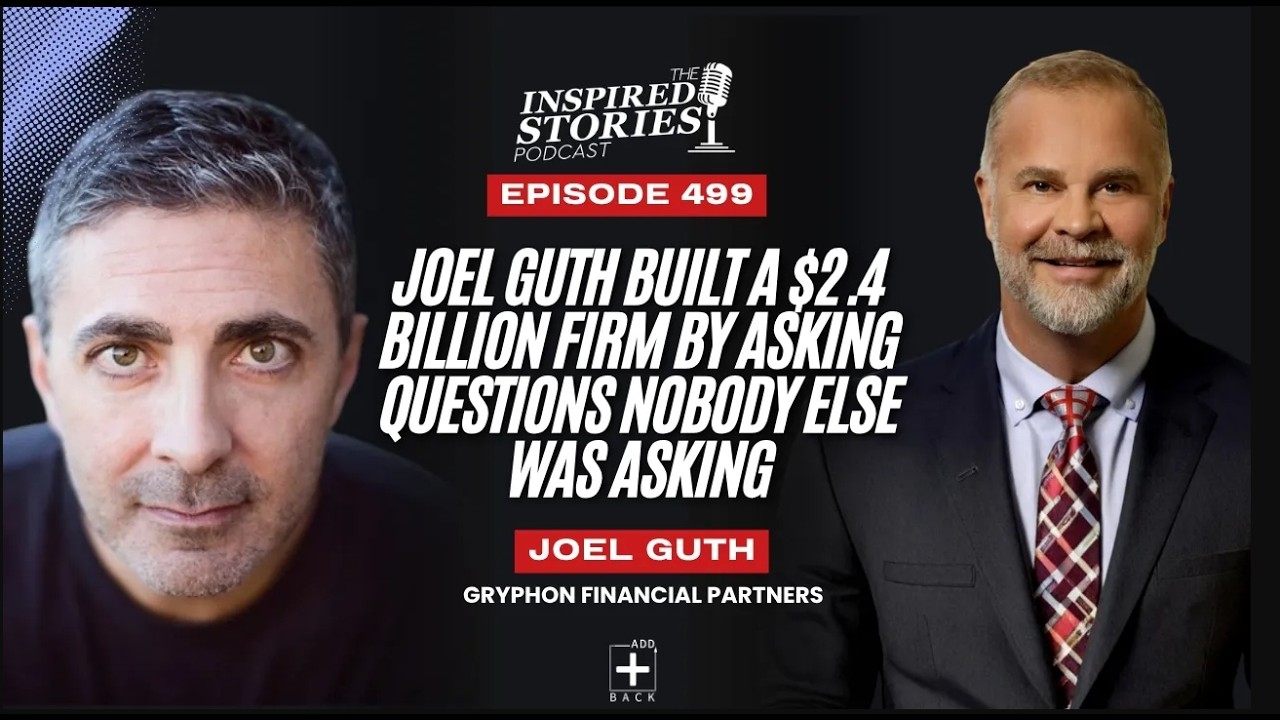
🎧 From Cold Calls to $2.4 Billion: Joel Guth’s Journey Building Gryphon Financial Partners
Joel Guth, CEO and founder of Gryphon Financial Partners, spent more than two decades at Merrill Lynch, Morgan Stanley, and Smith Barney before walking away to build something more aligned with how he believed wealthy families should be served. What he built — a firm that now oversees $2.4 billion in assets and has guided business owners through more than $2 billion in illiquid business transitions — started with a phone book, 65 calls a day, and a mentor who told him he was an idiot for quitting.
✨ Key Insights You’ll Learn:
Small-town Ohio upbringing shaped by an older brother who worked in a steel mill and put himself through medical school
Division I basketball at Toledo and Cornell; the pivot to finance after a knee injury
Starting at Merrill Lynch with no sales experience and surviving on scripts, cold calls, and persistence
Why he followed a woman from Mansfield to Columbus and how that shaped his entire career
The move to independence in 2014 and why he and partner Cathy Corey knew it was time
The 3:30 a.m. panic the night before Gryphon opened and what got him through it
The mythical origin of the Gryphon name and what it means to protect family treasure
Why he engages clients three to five years before an exit — not three weeks before
The Next Mountain framework: helping business owners figure out who they are after the sale
The soccer game that forced him to confront how his competitive drive was hurting his daughter
🌟 Joel’s Key Mentors:
His Oldest Brother: raised him more like a father; working in a steel mill while putting himself through medical school modeled what drive and sacrifice look like
Greg (Columbus Mentor): taught Joel the formula for sales, gave him scripts, and told him he was a fool to quit
Cathy Corey (Business Partner for 31 Years): rock-steady co-founder who handled every infrastructure crisis so Joel could focus on clients
Bill (Client Turned Mentor): helped them name the firm and gave them the confidence to leave Morgan Stanley
His Daughter and Wife: forced the hardest personal reckoning of his career — that his competitive drive had a dark side
👉 Don’t miss this candid conversation about building a firm that protects what families spend their lives creating — and why the work after the exit matters as much as the exit itself.
Listen to the full episode here
Transcript
Anthony Codispoti (00:04)
Welcome to another edition of the Inspired Stories Podcast, where leaders share their experiences so we can learn from their successes and be inspired by how they've overcome adversity. As you listen today, let one idea shape what you do next. My name is Anthony Kotuspodi, and today's guest spent more than two decades inside two of the largest financial institutions in the world before choosing to build something more aligned with the way he believes clients should be served.
With that experience, he saw an opportunity to create a more thoughtful, client-centered approach and decided to do something about it. His name is Joel Guth. He is the CEO and founder of Griffin Financial Partners, headquartered in Columbus, Ohio, a firm he launched in twenty fourteen that now oversees more than two point four billion dollars in client assets under management and has guided business owners through more than two billion.
billion dollars in illiquid business transitions. Barons has recognized him on its top 1200 financial advisors list every year eligible since 2009. Before Griffin, Joel spent decades at Merrill Lynch, Morgan Stanley, and Smith Barney learning the industry from the inside. He built a firm for the people who built something too. And this conversation is about what it takes to actually protect it.
But before we get into all that good stuff, today's episode is brought to you by my company, Ad Back Benefits Agency. Listen, if you run a business, you're likely stuck in the cycle of rising insurance premiums. You're paying more, but your team is getting less. And many people can't afford coverage at all. We do things differently. We offer a solution that provides your employees with unlimited access to doctors, therapists, and prescriptions that's always free for them to use. But here's what surprises most people.
Unlike every other employee benefit out there, our program puts more money into your company's bank account. As an example, we recently helped a client increase net profits by $900 per employee per year. Real gains that can change how a business is valued. Results vary, but the consultation is free. Imagine being the advisor that becomes a hero by introducing this to your clients. See if they qualify today at Adback Benefits dot com.
All right, back to our guest today, CEO, founder of Griffin Financial Partners, Joel Guth. Thanks for making the time to share your story today. thanks, Anthony. Appreciate the opportunity. So, Joel, before we get into some of the career stuff, ⁓ was there a moment growing up that shaped how you think about money, security, or what it meant to build something that lasts? I want to better understand your upbringing a little bit. I I don't know that there was a moment. You know, we grew up,
small town, you know, in no means, no ways did we grow up with money. there were six of us. So, you know, six kids, small town. You know, you can kind of picture Middle America, small town Ohio, life that that would would include. I I I don't think it was a moment. I think it was more of a relationship. ⁓ my oldest brother, who I've always been you know, really close to, he's ten years older than me. ⁓ always was more of a father than a big brother. but I but I just think being with him and seeing how hard he worked.
How he saved money, you know, ended up putting himself through medical school, becoming a very successful surgeon. I think it was just being around him all the time. He was a really strong influence on you. Yeah, just you know, he I mean, you know, at one point he was the smartest working steel worker in America, right? I mean, here's a guy who went to medical school. I don't remember seeing him study. It was I and I lived with him part time when he was going through school. It was just he was that brother. And I didn't know, you know, he's your big brother. You didn't know at the time. But ⁓
You know, here's a guy who was working in a steel mill, ends up going to school, putting himself through medical school, and and now is an incredibly successful surgeon. Okay. So he rubbed off on you, was a good role model for you growing up. you obviously must have done pretty well in school yourself because you ended up playing varsity basketball at Cornell while studying finance. Talk talk to us about that.
you know, he and I had something in common. Basketball kinda got us out of, you know, small town, helped us kind of see the world in a different place. But I I couldn't have gone to Cornell coming out of high school. So I originally I went to University of Toledo, played there for two years, hurt my knee, and that was kind of the the mo Cornell had talked to me coming out of high school, but my grades were I I didn't take school seriously. And it's in fact it's a funny story. ⁓ our assistant varsity basketball coach, his daughter lives
you know, four blocks from me, and I see her all the time now, her daughter and my son are same age. And I told her, When I went to Toledo, he was the impetus to make me start taking my grades seriously because he would crumble up my papers in English, throw at me and go, No one can be this dumb. No one can be that dumb. You gotta be better than this paper. So I remember telling him when I went to Toledo, I'm like, I'm gonna get straight A's. He's like, You're capable, you just don't have to work at it. And I remember being like, Okay, well, screw you. We'll see.
So did really, really well at school, Toledo, hurt my knee, kinda reevaluated life, called Cornell and said, Hey, can I still come? And they Yeah, we'd love to have. So I I kinda got there through a back door, as as my kids like to remind me, I couldn't have gotten there coming out. but had a great experience at a great, great institution. Did you end up playing ball at Cornell or you were out because of the knee injury? So I had to sit for a year, because that was back when you transferred, you had to sit from division one to division one. And then
Right when I would have been coming back, had another little knee injury. So I never really played, but was on the team for, you know, a year and a half. Okay. So not a great high school student. You had the smarts, you just didn't have the work ethic until somebody rubbed your nose in it and you're like, Well, I'll show you. Yeah. And you did, and you went and you showed them. And then coming out of Cornell, you started Merrill Lynch. You walked in day one. What was the job? What did you think it was gonna be? What did it actually end up being?
Honestly, I thought it was gonna be, you know, a Wall Street firm. They had clients. I studied finance at a great school. I'd walk in, I'd start to learn and work with clients and and it was a sales job. I mean, I walked in day one, they handed me a phone, a phone book, and said, Here, go find clients. ⁓ and so it was a complete different experience than what I thought. I didn't have parents that I could call and they were gonna help me.
So I just had to figure out how to make it work and figured out how to learn to sell. So was that something that came naturally to you? Did you have any sales experience growing up? Or was this like totally fish out of water? Totally fish out of water. never had sold anything. I mean, all I'm outgoing. I've got a big personality. I've always been, you know, somebody who liked to talk, laugh, joke, and was aggressive. So I think people today would say, I'm sure sales came naturally.
But I was just talking to one of our young guys that works with us. I said, you know, I remember when I finished the training program, which I think was, you know, maybe six weeks. I went on my first sales call, I was petrified. I had no idea what I was doing. I had one question to ask this guy. I still remember his name. I still remember the address in Mansfield. I asked him the question. He answered it the wrong way. I didn't know where to go from there. And I looked at him and said, Thank you for your time. I got up and left. I mean, and Anthony, it lasted ninety seconds at most, right?
So I I I had no clue what I was doing. and I laugh because as somebody who's done sales, we we we've been there, right? That uncomfortable moment. ⁓ you're petrified, you don't know what to say. ⁓ so how did you get over it? How did you rebound from that first tank of a sales job? I met a guy at Merrill Lynch down in Columbus, playing basketball, and we hit it off. He had a little rec team, and so I was kind of playing on the team, messing around with him and his buddies and
They were all guys that played in high school, but I played at a fairly high level college and I was healthy again. So I I could play. So he liked me. He was about eight years older. I called him. I said, Hey man, I I'm out of here. I don't want to do this. This is terrible. I don't know what I'm doing. ⁓ I'll still play on the team. I'll still hang out. Great to meet you. He's like, You're the dumbest guy in the world. Get down here. I will help you. But I you do everything I say exactly the way I say it. Don't deviate. Work the hours I tell you to work.
But get out here. You're you're an idiot. This is the best job in the world. You gotta come learn. So I d I did. I drove to Columbus and Greg sat with me and taught me and gave me scripts and gave me presentations and then he told me these are the hours you're gonna work and I'm gonna call you. And if you're not there, I'll never help you again. And so literally I just I did everything Greg told me, and that's how I made it. Wow. How'd you get so lucky to have a Greg in your life? You know
I don't know. I've always been fortunate to run into really good people. And then I think, you know, I think maybe my skill was to realize, man, this is somebody who's talented and a skill that I don't do great at, but I would shut up and listen and learn. ⁓ and and I've just been fortunate through my entire career to have just great mentors. So give us maybe one, maybe two takeaways from Greg. What did you learn about the job, about sales?
That you didn't know when you first got started, even after going through that six weeks training course. It's well, one was it's purely a numbers game. I mean, we had a call sheet, and every day you talked to 65 people. And he told me, he goes, I don't care. You don't leave until you have spoken to sixty-five people on the phone. Spoken to, not dialed. Right. ⁓ hundreds of dials, right? But if they if you picked up and I said, Hey, Anthony's Joel Guthr Arrill Lynch and you hung up, that counted. That was somebody I spoke to.
But every day we spoke to sixty-five people and we spoke to forty on Saturday morning because you know his line was people are home on Saturday morning, they pick up their phone. Business owners are in the office working hard, call them their secretary isn't there, they pick up. So the first thing was just the persistence of making the calls. And he said he goes, if you do it every day, day in, day out, the formula will work. You will get enough people who say yes, you can send them something, then you follow up, you'll have enough people who say you can meet, you'll have enough people that meet that close.
So I it was a formulaic system that that that worked. So I think that would be the first thing. And the second thing is, you know, most people think sell selling is about talking. It's really about asking great questions and then shutting up and listening. And and Greg taught me to ask really good questions. What are some of the best questions to ask for somebody in that position? You know, it it sounds simple and it's people struggle.
But things like, you know, what does money mean to you? You know, what's important to you about money? Why why are you doing this? What do you want money to do for you? Because if you can connect on a human level and somebody's willing to share their value system, you know, very few people I've ever met. I think one of the misconceptions about successful wealthy people is they do it for the money. They don't they don't do it for the money. People who do it for the money don't persist, they don't last, in my opinion. People who've accumulated wealth did it for some other reason.
Whether it was their family, their customers, they saw a need and they were passionate about solving a problem. And if you can just get them to talk about what matters to them, you know, money is just a tool to help you figure out how to get where you want to go, right? It's no different than a car, an airplane. It's you got a goal, money helps you get to the goal. ⁓ and it was questions like that. That the at the time, the industry wasn't asking. The industry was asking money questions.
And and we learned that if you could ask value questions, goal questions, and just let the money be something we're gonna use to reach the goal, you're gonna connect with people in a in a way that people weren't in our industry at the time. Interesting. Tell me about the transition then from Merrill Lynch to Morgan Stanley. It was incredibly strategic, like all young twenty four year old men, right? I met a girl. That was it.
I wanted to go from Mansfield to Columbus because I took her back to Mansfield and she's like, Nope, I'm not living there. And I fell in love and she said, I'm teaching at Upper Arlington. I'm gonna live in Columbus. I said, Well, then I'm living in Columbus. And ⁓ I think at the time she kind of looked at me and was like, You're crazy. What you know, psychotic, get away from me. Well, three kids later, 32 years later, I won. ⁓ so I I followed her. Meryl wouldn't let me move.
And so I started looking for jobs in in our industry that would let me come to Columbus. So there's that competitive ⁓ spirit coming out, maybe ⁓ in a subconscious way. W because you talk about your wife, I won, right? So there's that basketball guy, you're like there's a competitive spirit, there's that thread there. Trust me, if you met her, you would go, You're right, you did win. Like she I'm I'm I'm not gonna say she lost, but I certainly traded up. There's no doubt.
Good for you. We'll make sure that she hears this part of the interview. Funny anecdote, and this is so inappropriate in today's world, but but the guy at Merrill Lynch was just an old school manager. He came over to our table. So our second date was the Merrill Lynch Christmas party. We're twenty five years old. We're broke. They had an open bar at the time. I'm sitting with four other guys that are my age and their dates, so we're having fun. The guy came over, walked around, looked at each one of us, and goes,
You'll make it, you'll make it, you won't make it, you won't make it. So I'm the stupid one. I go, well, you know, Mr. Fle Florenzo, why, why? He goes, 'Cause if your wife or girlfriend isn't better looking than you, then you can't sell. Because if you can't sell yourself, you can't sell my product. He goes, You've got a chance to be really successful because you did well. And I I it just and he you know, it was it was a an inappropriate thing to say, but he was looking for guys who were gritty.
And who could figure out how to get something they probably weren't ready for, right? And I think that's when we start started at twenty five, nobody should have given me their money. No way. I didn't you know, I didn't know what I was doing. but you know, Greg protected me, protected the client, but but it was about grit. It was about figuring out a way to get it done. Okay, so what year did you start with Morgan Stanley? ⁓
lay the timeline here. So I left Merrill Lynch in ninety five, you know, like December of ninety five. So I started immediately with Morgan. Okay. Was the work experience much different there? No. Exact same. You know, I I I always tell people about our industry, it's like owning a McDonald's franchise, right? We all do the same thing. We're all working with the same set of products broadly, especially at the big warehouses, and especially back in in that time. But it was the same thing. Identical. Just bigger city, more people to attack and and that was it.
Now, was it from Morgan Stanley then that you had the idea to go and start Griffin, or was there something in between? So I've had a business partner for thirty one years and still do, Kathy Corey. She and I are, you know, more brother and sister than we are a business partner. ⁓ Kath and I grew up doing this together. We had a third partner, Jeff Lagouche, who left for a while, came back, works with us at Griffin now. You know, we
We took what we learned and what I learned from Greg and we made it ours and we put our own spin on it. But we work started working with business owners who were selling their companies and they just had this vast array of needs. And this is why you're at Morgan Stanley. Yeah. And so yeah. And we figured out, hey, we can we can do this, right? We can we can help them. They're going through time of stress and change and it's new. We can learn. As we learn, you know, Morgan.
Is a great firm. It really is. And we have nothing but great things to say. We had a great experience at Morgan Stanley. Great people, learned a ton. But you know, they've got a huge, they've got 14,000 advisors. Well, you can't offer a bus bespoke service when you have 14,000 advisors. You gotta, you gotta offer something that everybody can do, that they can manage, that they can handle from a compliance standpoint. So everybody's kind of working off the same menu.
And you can't do that when you're dealing with wealthy families. I and I'll give you Anthony an easy example that everybody resonates with. At Morgan, if they needed to borrow money, we had one source and that was Morgan Stanley. Well, you know, if you're borrowing five million dollars, you would go quote that to multiple banks, you'd get multiple bids, you'd find the best terms and the best price. And that's what our families wanted us to do. And Kath and I were smart enough to realize we were hitting that wall. And that's when we started going, we got to do this different. We we gotta get somewhere where we can be an advocate for our client.
You know, we're not an employee of the firm helping a client, but the firm is all driven to just how do I solve that person's problems? And that we learned that and then it took us a few years to kind of have the the courage, honestly, to do it, but also get our get our ducks in order in terms of a plan. So say more about that courage and the plan that needed to be in place before you could go off and start Griffin. Well, I mean, it w as we started, you know, it it was funny when you're in a in a big wirehouse and
I don't know if franchises are like this or not, but I've assume to a degree, you know, they give you so much of the infrastructure. You know, you have your own company. There's a lot that goes into running a business. There's a lot that goes in that nobody ever tells you is gonna have to happen, right? Your your company, benefits. We didn't know anything about benefits. We didn't know how to get benefits, we didn't know how price them. We just always took the benefits the firm gave us. We didn't know where to get computers or phones or, you know, anything. So as we started to explore it, we realized we don't know how to run a business.
Now we thought we did because they referred to our practice as a business, but but we didn't know anything about running a company. There was a lot of infrastructure they were providing you, which now you had to figure out yourself. You know, we and we didn't realize how much they were doing. We thought we were doing a lot more. So we had to figure we had to figure out how to build that, how to get it. And we actually went and rented it from somebody who had already built it. ⁓ but that took time. And then just the courage, right? I mean, we knew we'd have a b a legal fight with Morgan Stanley. ⁓
You know, if we didn't move our clients, cath doesn't come from money. Neither one of us had a safety net where it was we were okay. We had kids, young kids, we had mortgages. you know, it that's a big step to take 'cause we were making we were making very good money. And I'll never forget the night before we opened Griffin, you know, three thirty in the morning, I woke my wife up and I'm like, what in the heck am I doing? This is this and she's half asleep and she kinda's like, Honey, didn't you already sign a lease? I'm like, Yeah.
We can't stop. Like we've got to go. But w what this is stupid. Why did I take this risk? I mean, it it's it's scary to to do it. ⁓ we were forty two at the time when we left. So it wasn't, you know, we weren't young. We had we had real obligations and things that if we screwed up, we were in trouble. ⁓ and and and Kathy has just always been just a rock. I remember talking to her the day before and she's like, We got this. You know, you just we're we're fine.
Our clients love us. We add value. They're coming. I mean, she just at least in front of me, she never wavered. And but it was scary. ⁓ do you have you guys talked since, like the real heart to heart, to see did she wake up 3 30 that morning too and have the same feeling of panic or she was steady eddy? She was always Kathy's just Kathy is one of the toughest people I've ever met. And she just said she goes, We were thoughtful, we had a plan, all we had to do was work our plan, and I knew we would do it.
I mean she was just she was called. Now I don't want to pick at anything that's gonna get you in trouble, but is there more to say about the legal fight that took place there? ⁓ y you know, it it it is we expected it, we knew it, we weren't mad about it. You know, Morgan Stanley th they viewed him as their clients, we viewed him as our clients. ⁓ they viewed it as we were taking proprietary information, ⁓ which, you know, thankfully the courts
you know, in years have kind of ruled in the favor of I can take your name and phone number and then everything else, I've got to leave, which we did. So we did it clean, but we knew we were gonna have a fight, but it wasn't Morgan didn't do anything unfair. They didn't do anything egregious. You know, they protected their their business like I would today. So let's talk about Griffin. ⁓ it's an unusual spelling for most people who don't know the origin. G-R-Y-P-H-O-N. What's behind the name? What's the story? So we
We had a great mentor and and honestly, you know, we should have never been speaking to him because he was a client, but he became a great friend and mentor. And I remember going to him and saying, Bill, we want to leave Morgan. You should leave Morgan. I said, Okay, tell me more. He and so he starts helping me and he goes, Your clients are coming. What you're building is what people want. They may not know they want it, but they want it and you sh you need to go. And so he really, really helped. We hired a marketing firm.
You know, Anthony, I think we paid him twenty-five thousand at the time, which was a lot of money for us to spend just on getting a name. And all the names stunk. They were terrible. And Bill and I had gotten together for a drink and we start talking and he's he's like, What about Dragon? I'm like, no, Dragon's nobody nobody wants to be named. Like, who gives their money Dragon financial, Bill? That sounds like you're gonna take it, right? I he's like, you don't understand. And Bill, Bill's one of the brightest individuals I've ever met. You don't understand. Go research Dragon.
So then we had a phone call and he's like, I hear you. What about Griffin? I'm like, what in the hell is Griffin? And he said, he's like, I thought you were educated. You're an Ivy League guy. So he goes, just go read. So I read. I call Kath. I'm like, this is it. This is us. So I say, Griffin. She's like, What the hell's a griffin? And to every you if anybody who doesn't know, a griffin was a mythical creature that was a protector of family treasure. And people would put it in front of their house. It was half lion, half eagle.
And it was there to protect the family's treasure. And that just resonated with us. Cause one of the things we always said to people is, you know, when you sell your company, for most people, that's their life work, right? They've put 30, 40, 50 years into this. And they're going to do it one time. And even if you do it once, you're in such a small subset of people who've had the ability to grow a company worth multiple millions and sell it. We got to protect you. Goal number one is don't screw up. Make sure you're safe.
Make sure that your goals are safe, your family, your legacy is safe. And so it just resonated to us that we'd always told people our job is to protect you and make sure nothing ever harms you or your family. And so we we really loved it. ⁓ our team loved it. It was so funny. Friday night, email goes out, we've opened our own firm. We start making our calls. Eighty percent of the people, look, we love it. It's great. What the hell's a griffin? And why'd you pick such a stupid name? And then we would tell them and they would go.
No, you're right. That's awesome. That's you got. That's that's how we see you. And so it just it was it was by luck. And again, just just a great mentor who was willing to spend time with me. Yeah, you mentioned that your mentor was saying, your clients are gonna come with you. ⁓ and how did he put it? ⁓ people want what you're building. What what did he mean by that? What were you building that maybe they weren't gonna get by not coming with you? An unbiased platform to help people reach their goals.
You know, it and and look, there are phenomenal advisors at Merrill Lynch and Morgan Stanley. And I I am not telling people that if they're working with a client of Morgan Stanley, that or advisor, that advisor isn't working for their goals. He or she is. They're great people. But the fact of the matter is, the firm has an objective and a goal. Their their goal isn't because they have so many other business lines, and we've all read about the conflicts of interest, and Wall Street has paid fines over the conflicts of interest. They're real.
And I think people now have seen that they're real. And they want somebody who's a fiduciary whose only job is to work for them and solve their problems and who's legally willing to accept that responsibility. ⁓ now it's becoming much more mainstream, but you know, twelve years ago, there weren't a lot of firms that were fiduciaries that were independents and just that were fee only and saying, Look, our only job, Anthony, is to help you reach your goal. That's it. Because they were getting money from selling products.
They were getting kickbacks for selling certain products. They didn't have to disclose that. And I and I think we just learned people want transparency. Yeah. So tell us in plain English, Joel. What does Griffin Financial Partners do and who do you do it for? So when we started, we do the same thing. So I'll answer that per part first. So in a very simple way, if I was explaining it to, you know, my kids when they were young.
We help people articulate their goals and then figure out how they're going to reach those goals. And the money is a big part of that, right? But it's not just money. It's a lot of different things. But it's taking that here are the here are the resources you have. Here are your dreams and your goals, and designing a plan to get you from A to B. That's that's what we do. And investing money is obviously a part of that. We did it when we started primarily for families who sold privately held companies.
⁓ as we've grown, so when we started, it was you know five or six of us. Now we're thirty. And we've grown to the point where we work with doctors and lawyers and chief executive officers, C-suite executives. Kathy and Ice and Michael, who's our third partner now, most of our practice is around families who've sold businesses. But we have people at our firm that work with ⁓ just they only work with C-suite executives. We have people that work with pre-retirees. So now Griffin really works with anybody who has
you know, a an objective in terms of f a financial goal. What would be the minimum, I don't know, income or you know, liquid cash value? Like what what what what's sort of the fit for you? So i I would say our sweet spot is people who have five million dollars and up. But we don't we would never say we have a minimum because if a great client calls us and says, Look, I need you to help my cousin, we're gonna help, right? I mean, we're we we've as we've evolved
And and this is something we talk a lot about. Our our purpose is to make people's lives better. That's it. And if we can do that for our clients and our teammates and the families that we touch and our communities, then then we're gonna be we're gonna be really happy when we're time to be done here, right? And so when your job is to make people's lives better, if you're a great client of ours and you say call and say, Hey, my nephew's got fifty grand, but he needs help, we're gonna help. And and so I I would say our sweet spot is five million and up, but but we don't
You know, we've worked with entrepreneurs who we met who had nothing, but we just knew they were gonna be successful and ten years later, you know, they were worth forty million dollars. So it it really is more for us is can we help? If we get involved, are we gonna make these people's lives better and can we help? And so let's talk about that, you know, random example that you had there. Some, you know, entrepreneur just starting out, not worth anything, but you saw something there, you're like th this guy, this gal, they're going someplace.
And you know, years later they're worth forty million dollars. What are some of the things that you're doing in between in that that 10 year span from just starting to forty million dollars to help them get there? You know, when we started, I would say not a whole lot because we didn't know a whole lot. But now, having owned the business for 12 years, I think we can speak to them as business owner to business owner. So it's conversations on everything from financing, you know, how do you grow the company?
You know, we're big advocates to keep as much ownership as you can. So how do you bootstrap it versus going out and bringing in venture capital or or even private equity money too early? ⁓ how do you set your business plan? You know, what's your differentiator in the marketplace? How do you sell yourself? What what do you what problem are you solving? ⁓ we've helped interview candidates as they've grown and tried to hire, you know, Joel, will you just meet with this person to tell me what you think? You know me, do they fit me? Do they fit my value?
⁓ and then as they grow, you know, helping them handle the cash of the business, whether it's cash management, whether it's retirement plans. And then as they really mature, then helping them start thinking about, okay, well, what what are you going to do? How are you going to exit? When do you want to exit? What's that look like? What's important to you as you exit? and then and then the exit brings in a whole host of you know financial issues around estate planning and cash flow planning and obviously managing the liquidity.
So when you're working with a company that's heading towards an exit, what's the ideal timeline for you to start working with them before that exit takes place? You know, we we would say at least three years, but we would love five. ⁓ you know, because it's there's a lot that goes into preparing your business to sell. ⁓ whether you're looking at customer concentration.
You know, making sure everybody's got ironclad employment agreements. You know, there's a lot of work that goes into getting the business ready to sell. But there's also a lot of work getting the owner ready to sell. You know, passion, you know, you know this because I I know you, I know how passionate you are about what you do. Business owners are passionate people. Where's that passion gonna go when the business is gone? Because it doesn't stop. You know, I always joke type A people don't sit on the front porch after they sell their companies.
They've got a motor that keeps going and they got a mind that keeps going. So where are we going to take that in that energy? Where are we going to go put it so that we find our purpose? You know, we have a great client who said, he goes, you know, when I sold the company and he had 690 employees, he goes, I couldn't wait for the phone not to ring. He goes, that was the big thing. I kept thinking, the phone's not going to ring and I can relax. He goes, two months later, I'm like, can you believe the damn phone didn't ringing? I got nothing to do.
And so helping that owner prepare for that moment and what life after is gonna look like is that's a monumental task. And I think that's one of the things that differentiates us from our competitors. Look, all of our competitors can talk about money and talk about what you do and can invest money and you know, some do it better than others. we think we do it really, really well. But the piece we do the best is helping that family prepare for that moment. So you almost become like a life coach in those moments. I think
What is it that you're doing to help them get ready for that time? Really, it's the same thing you do with your business, right? It's mission, vision, values, how you're gonna I mean, even even to the minutiae of you're working 12 hour days. What are you gonna do on Monday when you got a free calendar? Let's just take a piece of paper. And it's funny, you you find out things. This was just a year ago. We're sitting with a couple, he goes, Well, you know what? I'm gonna take the kids to school every morning.
I've never done that. My wife's done it. I can't wait. I'm gonna drive him to school. I want that time alone. Cause she always tells me about that time alone in the car. And you'll see, as your kids age, one of the things my wife misses the most is our kids are older, our our youngest can drive. He drives himself. And she's like, I I hate it 'cause I had that time in the car, just me and him, and he would talk and he would die, right? So I want that time. And then I thought we'd go work out together. His wife looks at him and goes, No, we won't. I work out
With my friends and I love doing that. We work out, then we do this. He's like, Well, what am I gonna do? She's like, I don't know what you're gonna do, but for 30 years, you've gone to work. So you gotta find something to do. And then you know those moments are the aha moments for people that go, ⁓ I I'm not ready. I'm not, I don't have a plan. And, you know, type A driven people need a plan.
A hundred percent. And I've been through a couple of exits myself. And when I've got that next thing already ready, lined up, step into it, great. I'm in a good place. If there's that gap, it's like, what do I do with myself? Where do I fit in? Like, what's my purpose here? Yeah. And you know, people think again, back to well, business owners, it's all about the money. It never is about the money. It's about their people, it's about their customers, it's about a passion to solve a problem. And when that gets taken, who are you? What are what are you doing?
And and that's that's what we try to help them think through in that in those three to five years. Joel, I want to talk about this trademark concept that you have called next mountain. Tell me where the idea came from and what it does for a business owner. So it's it's it's exactly what we're talking about. And and we worked with a firm in Chicago to kind of dub what we did with a business owner, helping them prepare for the next stage in life. And he came up with the idea. It's like you're climbing the next mountain, right? They climbed the mountain of
Business, maybe it was their first business and maybe their only. But what's the next mountain that they're going to climb? Because they to you just said, right? When I have something to go after, I'm happy. When I don't, I'm struggling. So we got to help them think about what that next mountain is. And it it could be philanthropic. I mean, we've had clients give away tens of millions of dollars to fight causes like cancer, childhood diseases, and that's been that next mountain, right? And we have a client down in Cincinnati, and he's like, I just want to see.
Huge progress and cancer made before I die. And that's his mountain. And he drives. I mean, he is on it and he is driving, right? Flies around the country meeting doctors. He's active at UC at their cancer ⁓ hospital down there. Some of them it's another business. Some of them it's it's family. You know, business owners can work so much that they neglect their family, and it's I want to reconnect and I want to build these relationships. It's just helping them define what's next.
And then helping us think about the business plan to get there. What are our hurdles? How do we know we're successful? How are we going to spend our time? What resources do we have? It really is, it's like what they did with their business plan. Hmm. You guys have helped transition more than two billion dollars with a B, two billion dollars in illiquid business assets. Before I ask my my my real question here, can you explain what that means? Transitioning illiquid business assets? Yeah. So, you know, if you own a company.
⁓ you know, the the there may be money in the business used to run the business, but most business owners don't take a lot of money out of the company. They reinvest it in the business to grow and they can get a better return on their capital in their business than they can outside. So that's very illiquid. You know, you can't you can't take a handful of screws to Kroger and buy dinner, right? I mean you that's an illiquid asset that they own that's very valuable, but many times they're cash poor, asset rich, but it's assets you can't monetize today, like a stock.
So that transition from illiquidity to now I sell my company and I get that big check, that's the that's the transition from illiquid to liquid. Got it. And so over two billion dollars in these illiquid assets, how did you position Griffin to be at the table with so many large deals? You know, it really is around that planning and next mountain. And it's getting in early and talking to him about, you know, what are you going to do? What's next?
And it's they usually will respond with, Well, don't you want to talk about my money? Well, yeah, we do. We'll get there, but let's talk about what you want to do because that'll tell us what we're going to do with the money. And so it really has been our approach and how we sit down with them and start to get to know them and really just understand who and what they are. So that's the conversation that happens when you're at the table. How do you get to the table with folks that have businesses of that size, that capacity? Believe it or not, at the beginning it was just cold calling.
The sixty some calls a day, huh? We got in front of a couple business owners and we were lucky enough to work with them. We did a really good job. And now it is word of mouth because business owners tend to have friends who own a beta a bunch of your friends have their own company, right? We tend to hang out with people who are like us. So it's a lot of word of mouth. ⁓ we've gotten to know CPAs and attorneys really well who work with owners who are exiting, and we've been fortunate enough that they trust us and say, Hey, these guys do something different. Go see
So now it's it's really through our internal network, but initially it was just cold calling. And so I'm I'm hearing sort of the the breadth of services that you guys provide and sort of ch talking about it in terms of you know exit planning for somebody who's looking for a transition out of their business. You're getting that company ready to sell, you're getting the owner ready to sell, you're getting ready for what happens from the funds of the sale that are going to be coming in. Are you actually helping to broker the deal or that's
Outside the scope of what you do. No, what what we do in our role there is introduce them to people we know who do that full time and then help them evaluate who's a good fit for me and then and sometimes negotiate the fees because that's a that's a big fee. You know, on a on a good sized business, the transaction fee may be a million, two million dollars. ⁓ so helping them find the right banker, helping them negotiate with the banker, and then securing the deal and then staying with them.
through the deal. Cause it and and look, one of my dear friends owes an incredibly successful investment bank, great guy, high integrity. But you know, he gets paid when they sell. So once you engage him, he's got one goal, and that's to sell the business. Our goal is to make sure the business gets sold the right way to meet the goals that the family has, not sold to the highest bidder. Because many times it isn't the highest bidder that gets it. It's the right culture fit, it's the right fit for people, it's the right exit for the owner.
So our job is once they've got the banker to stay engaged through that process to make sure the deal fits, given the goals and values of the family. So you guys are what they call a family office. Yes. Okay. Explain what that term is. So it's a hard term to explain because it it means so many different things and there are so many firms that say they're a family office and they do it different. But in essence, it just is helping a wealthy family with all of the needs that surround having money, be it tax.
legal insurance, investment, and then a host of contier's things, right? ⁓ my son needs a career counselor. Do you know anybody? My son's getting ready to graduate from high school. I need a college counselor. Who do we know that's good? ⁓ I'm having a health issue, you know, who do we know? I I I tore my ACL skiing. I need a surgeon. So it there's a whole host of a giant referral partner. We are. We are and and what we tell everybody is anything that touches your life
Call us first. If we don't know somebody, we know somebody who knows somebody. ⁓ you know, so ⁓ we have a common friend, Bill, that you and I know, and Bill Bill knows everybody, right? So there have been times over the last couple years, I'll call Bill. Bill, who do you know that does this? ⁓ I got two guys that do that. ⁓ you know, so it really is just building a Rolodex and then being able so that those families have one person to call to solve anything that comes up for them and their family. So
I see where you guys are now. ⁓ we talked a little bit about, you know, the beginning, but I want to better understand what that first year at Griffin was like. Obviously you had a big client base that you you were able to bring with you, which was huge. But talk to me about some of those growing pains in the first year. Cause I I want the listeners to hear that, you know, not everything is sort of the hockey stick curve growth, you know, up and to the right. You know, some of it's kind of comical. It's it's things we didn't like the copier broke. Well
You don't go have you don't have anybody to complain to, like, hey, Bill, copier's broke. Anthony, what's going on with the phones? It's you, right? And so you're trying to move your client base, and now the copier's broke, and you got to figure out how to get somebody in to fix the copier. ⁓ so our growing pains, most of the our clients, thank God, trusted us, came with us, we transitioned our clients. You know, that was probably a six to nine month process of getting them set up because we use Fidelity and Schwab.
So getting them set up with all their new accounts and everything that needed done. I think the biggest growing pain for us was the the infrastructure. Just the internet's down. What do we do? Who do we call? ⁓ and and again, if Kath listens to this, she'll crack up because she'll be like, You didn't do any of that. I did all of that. And she did. You know, and and and the things that I tell my friends who want to do this is if you don't have a Kathy and a Jeannie and a Judy, don't go. Cause
I could focus on the clients and I could focus on moving them and our team fix everything that got broken along the way. ⁓ and and we would have completely failed if it hadn't been for that. You're the front guy, you're the face guy, you're the client relationship guy, and then you've got this great team of folks behind you that make that put that infrastructure in place, make sure when it breaks it gets fixed, make sure things are yes a smooth oiled machine. Yeah. Yeah.
And so, I mean, there are things that I now find out about, Anthony, that went on that they never even told me because they're like, we know you would have freaked out and panicked. We just sold it. And give me an example. One thing that they they just fixed and didn't tell the big guy. We hired this firm to kind of give us what I call business in a box, right? Like they gave us here you call here's who you call for technology. Here's who you call for wiring. You know, we had to wire our space. We didn't know what wiring our space meant, right?
Here's who you get furniture. Here's an architect to design all your offices. Well, we found out because we were getting our benefits from them. You'll get a kick out of this. We couldn't get our benefits from them. We had our own LLC. We were two separate businesses. We went a year with nobody really having health insurance, but we thought we did. And we were paying for it. So it god forbid, if somebody had had a problem, what would have happened? Because we should have been able to buy our insurance through this company. ⁓ and CAF figured it out.
Solved it and came in and told me when it was done. It's like, yeah, we were, we were hosed. ⁓ you know, so I mean, it's things like that that thank God it didn't disrupt us. Because if that had gone the other way, we we probably would have been done. What does the future of Griffin look like? Growth, ⁓ I don't know, geographies, different industries, new services. What are you guys thinking? ⁓ great question. And we just, you know, I think AI is.
I I don't know where AI is going. I'm not smart enough to tell anybody how AI is going to impact our industry or their industry. All I know is it's going to impact, right? It's coming. And we we will find out what that means. I'm not one that thinks we're going to have 30% unemployment and it's, you know, kind of apocalyptic and it's going to kill all the jobs, but it's going to impact us. And so I think we are going to pivot as a firm instead of thinking of ourselves as a wealth management firm.
You know, you use the phrase family office, and that's exactly right. We we want to be the firm that just solves your problems. And one of those problems is money. But there's a whole host of other things that we're gonna solve for those families. And and you we used to say we want to be your personal CFO. And I think that still is a piece of it. But now we just wanna be your partner in your life. And we want you to have one person to call, no matter what the issue is, and say, guys, I gotta figure this out.
Get back to me with resources, get back to me with me, best practices. Who is it? How do I solve it? Because I think the asset management fees are going to continue to compress as AI comes into our industry and can do so many things, the computing power and the the analytical power so rapidly. The piece AI I don't think is going to be able to fit fix or remove is that ability to think and solve that problem and know that, hey, if your son's a phenomenal point guard and he just tore his ACL.
The best surgeon is this guy in Atlanta and the best physical therapist is this woman in Dublin, Ohio, and that's going to get your son back playing basketball. You know, that's the thing that families are going to pay for that I think is going to be invaluable. And I don't I don't think we're thinking about that yet. And so we want to be ahead of the curve and become that firm that when you have a problem, you just call. I have Michael at Griffin and Michael just solves stuff.
Joel, in what way is Griffin using AI today, presently? So we're using it to, as much as we can, automate redundant tasks that our team does, right? Whether that's client onboarding, whether that's handling 1099s and K1s, but we're building tools with the help of a firm that we met called Teammate AI, who's phenomenal, that is just helping us build those tools to take those redundant tasks off our team. And our big goal is just to increase capacity that everybody can handle.
If we can use AI to take redundancy off and have our teammates, you know, front and center handling client issues instead of doing paperwork and and things like that, then I think we've we've added dramatic value from the AI. Let me switch gears on you, Joel. ⁓ I'd like to discuss the hardest thing that you've ever had to overcome personally and what going through that taught you. ⁓ geez, Anthony, I've screwed up so many times and done, and most of it's my own.
Stupidity, right? Like somebody asked me one time, how do you become a good problem solver? I said, Well, in my case, I created a lot of problems and I didn't have a safety net, so had to figure out how to get out of the problem, right? And it was a lot of at bats. ⁓ so I've had a lot. I I think I don't know if it's the most difficult, but maybe the most impactful, is my father was an incredibly driven, competitive guy. Grew up in southern Indiana, dirt poor on a farm.
you know, ⁓ just was competitive to a fault. And, you know, my buddies and I talk about this with our kids and and each other. You know, do you know many people that are really driven where the drive comes from a healthy place? There aren't many. The drive usually comes from some dark secret, some ghost you're chasing. You were poor as a kid. You don't ever want to be poor again. And, you know, ⁓
You know, the most famous is probably Mark Zuckerberg, got you know, kind of sh shunned by a girl and you know, created now what is now Facebook to kind of get back at her. You know, most driven people come at it from a really dark, bad place. And and I did. I was uber competitive, couldn't stand to lose. ⁓ even playing cards. I mean, if we're playing cards, I was cutthroat. And we had our first daughter, and you know, my wife just kept saying that that's not gonna work, right? Like you c we can't raise our kids the way we want to raise our kids.
With you taking every episode like it's, you know, life and death battle. They're gonna lose, they're gonna make mistakes, and it needs to be okay. And, you know, the way your dad did it with you isn't healthy. ⁓ and and I think that was, and and it really, you know, my daughter and my wife were the two who just and she was little, and I remember after a soccer game, I was kind of hard on her, and she broke down and she's like, Dad, this isn't how I want to have our relationship. And she was young.
And I remember coming out of that how young are we talking about? Eight, nine. Okay. And she's always she's graduating, ⁓ She gets her PhD this month.
So she's always been just an amazing, bright kid. And she just is like, Dad, this is miserable. I don't want to play sports. This is no fun. And I came out of the room and my wife looked at me and she's like, Something's gotta change. And I went down to the bedroom the basement, slept on the couch that night, came up in the morning and I'm like, You're right, is it's gonna change? And it's been, you know, she's twenty six now. So it's it's been a long battle. But I think I you know, I look at Griffin
And Bobby Knight, great basketball coach, not a great human being, but a great basketball coach, had a great quote about basketball. Basketball is a game of you versus your potential. It's not you versus your your opponent. And if you go out every game and play your best, you're a winner no matter what, right? And and I think we've tried hard as a family to kind of adopt that. And and I I view Griffin that way. And I was talking to my son the other night. I don't know where we rank in Columbus against our competitors.
And honestly, I finally hit a point. I don't care. What I want is that we are the best that we can be. Our team is the best that we can be. We're growing in the right way. And I I think that was probably the most impactful because it changed my view on how I parented. It made me a better husband. It made me a better father. And I don't we wouldn't be where Griffin is if I I'm still competitive and I hate to lose. And I always will hate to lose. And I don't ever want to lose that.
But I'm okay losing now, and I'm especially okay if I lost for the right reasons, right? And I think that that's made me a better leader to our team. Interesting. So I mean, what you're saying makes a lot of sense. And most of us have followed a similar pattern, right? We're raised a certain way, ⁓ without even realizing it. Like that's the value system that just becomes embedded in us. You know, there was a a way that your father was driven, there was a way that he parented you. And, you know, we
As best as we can, we're trying to take the best of, you know, what we got from our parents and say, I want to emulate that. And then maybe at the same time saying, Okay, here are the elements that I don't want to emulate. That, you know, my my my father's gonna be a good example of the way I don't want to do certain things. And for you, there was this seminal moment where, you know, there was this friction with you and your daughter and and your wife, you know, kind of this come to Jesus meeting and you're like, Yeah.
Something has to change. And you know, it it's funny. I don't resent it in my father because I think he did the best. I mean, he he grew up dirt poor on a farm in southern Indiana, lost his dad to a young age to a bar fight, got stabbed and killed in a bar fight, right? So he grew up really, really tough. He did it the best he could do. And I think you know, that's to piggyback on what you're saying, you know, that's our job, right? We take the good part, we try to do a little bit better, teach our kids a little bit different. And it was and and it was that
moment with my daughter that just I was taking the fun of sports away from her, which I didn't want because sports had meant so much to me. And then when we had our middle daughter, who's just a strong, tough young lady, and she just wouldn't tolerate it. Right. She was like, nope, this ain't gonna be the way we work. Like you and me are we're not gonna do this. And even to this day, you know, she'll stand there, look at me and go, ⁓ we're not, we're not having this conversation this way, Dad. Let's and so it's just it's amazing what your kids teach you. Yeah.
So having that realization, you know, with your eight-year-old daughter after the soccer game, like that's a big moment. That's a big deal. But then actually making changes in how you approach life, how you approach relationships, whether it be with your daughter or with your teammates at Griffin, that's that's the hard work there. What can you share with the audience about some of the things that you did along the way that helped you with that path? You know.
And I still say every day it is a s it's every day is a struggle and a battle, right? Because your natural tendencies are always gonna be there. ⁓ I don't know it's things that I did. It really is I've just had amazing people around me, right? ⁓ Kathy, Judy, Jeannie at work, Jeff, my wife, they kept me accountable. And even now, Kathy will come in and be like, Hey, that that's not your best moment. That's not who you are, right? Like you you'll go make that right. ⁓
And I think it's just for me it was having people around me that held me accountable. They knew what they knew what I wanted to do and they loved me enough to care. And then they made me do it.
Pretty fortunate guy to be surrounded with such a great group of people. Extreme. And from what I'm getting to know about you, ⁓ they're pretty lucky as well to have you in their lives. So as you think about the work that you're doing, what is it that you most want to be remembered for, Joel? You know, again, it's cheesy, man, but it's just I want people to know we made people's lives better, right? I want them to know they walked away better because they were with me.
What's your favorite thing to do outside of work, Joel? ⁓ spend time with my kids and wife. And we we do, you know, we love athletics. My son's a great basketball player. Following him around is is something we love doing. He's playing high level AAU, so we do that every weekend. But just spending time with a fan as with our family. Joel, I just got one more question for you today. But before I ask it, I want to do three quick things for the audience. First of all, if you want to get in touch with Joel Guth,
And their company Griffin, you can go to their website, griffinfp.com. And remember, Griffin is spelled G-R-Y-P-H-O-N. So Griffinfp.com. And we'll have that in the show notes if you've missed it. But one more time, Griffinfp.com. And if you're enjoying the show, please take a moment to subscribe wherever you're listening. It also sends a signal that helps others discover our podcast. So thank you for taking a quick moment to do that right now. And as a reminder,
You can be the hero advisor that helps clients give their employees access to therapists, doctors, and prescription meds while paradoxically increasing their net profits, real gains that can change how a business is valued. Contact us today at adbackbenefits.com. So last question for you, Joel. A year from now, what is one very specific thing that you hope to be celebrating?
boy, that's a tough one. ⁓ I'll give you two. ⁓ we have very specific goals on our business ⁓ that you know we are working hard. So I think the first thing would be hitting our revenue and our earnings goal at at the at Griffith. And then ⁓ personally it would be we're at a ⁓ transition point for all the kids. So one's finishing her PhD.
One's graduating college, going to Boston to grad school. Our son's gonna graduate high school and go to college. I think their launch.
They they enter the their launching is is your goal. They're they're entering the next phase of their life successfully. So as somebody who's been coaching clients for years on these big life transitions, you're about to go through a big one yourself, be a bit of an empty nester. What are you doing? What are you and your wife doing to mentally prepare for that? Yeah, great, great question. ⁓
Really the same thing we tell our clients to do, right? Now I'm gonna keep working, right? So we're gonna keep having the business, keep and working day to day. But I we have a a huge chunk of our time is spent with our son with basketball. And so it's you know, we're developing some silly interests, like my wife loves to play Mahjong, and so we're playing that with friends and building that kind of network out so that we have that to do. ⁓ we've both gotten much more active in our workouts and and focused on making sure we're staying healthy.
but it really is just looking at and we did, we looked at the hours we spend with him with basketball and saying, Okay, what are we gonna do? How are we gonna spend this time? And I think we've got our first year mapped out. And then I think we're gonna see, hey, what did we love, what did we hate, what went well, what didn't, ⁓ as to kind of how we approach the the the coming years after that. Joel Guth from Griffin Financial Partners, I want to be the first to thank you for sharing both your time and your story with us today.
I really appreciate you being here. Yeah, thanks. Really enjoyed. Folks, that's a wrap on another episode of the Inspired Stories Podcast. Thanks for learning with us. And if one thing stood out, put that into action today.
Connect with Joel Guth:
Website: Gryphonfp.com