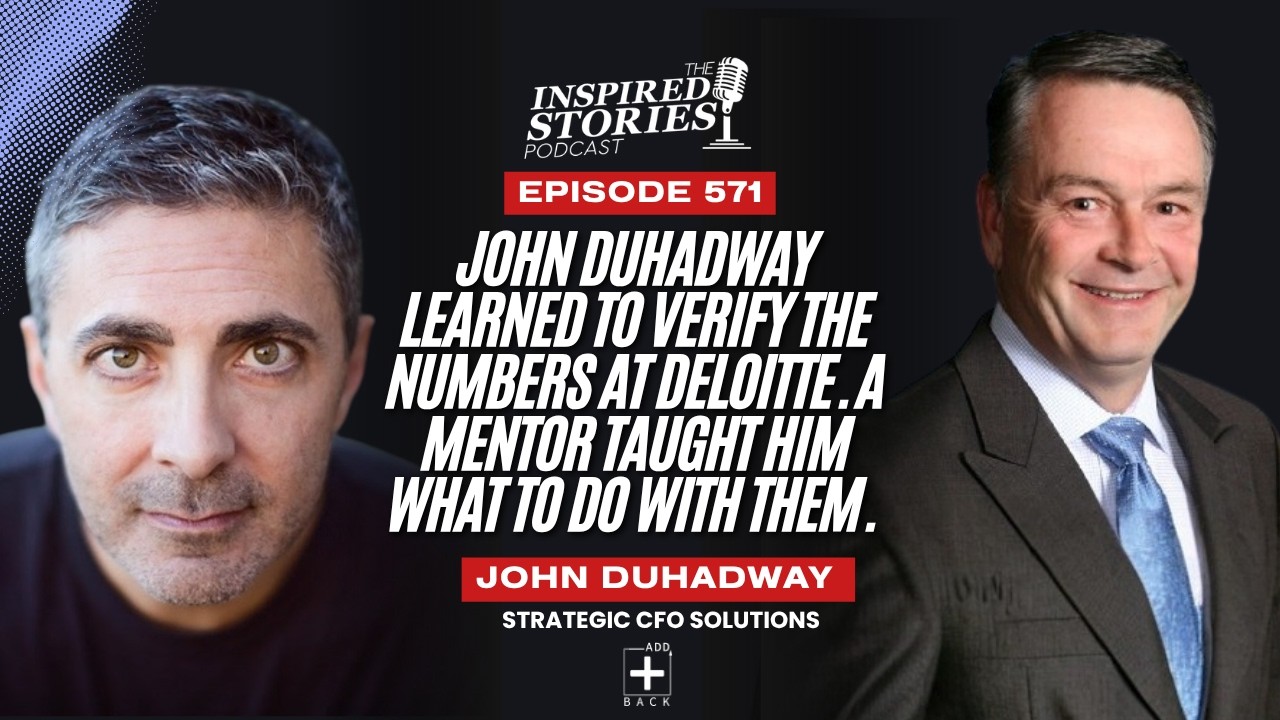
🎙️ From the 2008 Mortgage Collapse to Founder-Led Finance: John duHadway's Journey Building Strategic CFO Solutions
In this episode, John duHadway, founder and managing director of Strategic CFO Solutions, shares how serving as CFO inside a subprime mortgage lender during its 2007 collapse shaped the way he now guides founder-led companies through growth, capital raises, and exits. John opens up about the employees he couldn't forget, the mentor who taught him to simplify complex problems, and why he now dedicates part of his practice to pro bono work with startups.
✨ Key Insights You'll Learn:
Raised by a single mother, work ethic was instilled in him from childhood necessity
Spent 12 years at Deloitte before moving into executive finance leadership
Saw early warning signs of repurchase risk months before the 2008 mortgage crisis hit
Helped shut down a nearly 1,000-employee mortgage company overnight
Stayed on through bankruptcy proceedings to help secure priority payments for employees
Founded Strategic CFO Solutions somewhat by accident, through referrals rather than a plan
Now works exclusively with $10 to $50 million founder-led companies
Dedicates roughly 15% of his workload to pro bono work with startups and accelerators
Uses AI for research and brainstorming but keeps client data out of it for now
Has guided company exits ranging from $50 million to $500 million
🌟 John's Key Mentors:
His Mother: A single-parent school teacher whose work ethic shaped his resilience
Harold (Deloitte National Partner): Took him under his wing and taught him to simplify complex financial concepts
Bill Dallas (Co-Founder): Longtime business partner who shares his drive to keep working
His Professional Network: M&A attorneys, wealth managers, and CPA firms who refer clients based on trust, not transactions
👉 Hear how a CFO who lived through the mortgage industry's collapse now helps founder-led companies avoid the same blind spots before it's too late.
Listen to the full episode here
Transcript
Anthony Codispoti (00:01)
Welcome to another edition of the Inspired Stories Podcast, where leaders share their experiences so we can learn from their successes and be inspired by how they've overcome adversity. As you listen today, let one idea shape what you do next. My name is Anthony Codispoti and today's guest was the CFO inside one of the first some prime mortgage lenders to collapse, watching warning signs show up in the numbers months before most of the country understood what was happening to the housing market.
He spent 12 years in public accounting before moving into executive finance, leading the CFO function at four different companies over the next decade, including a stretch running finance for a company that generated sales leads for car dealerships instead of mortgages. That run ended with him staying on to help wind down a company that became a case study in what happens when growth outpaces financial discipline.
John Duhadway is the founder and managing director of Strategic CFO Solutions, where he works as a fractional and interim CFO for founder-led companies, generating $10 to $50 million in revenue. He also owns Duhadway LLC, his personal investment company, which gives him a stake on the investor side of deals he advises on. Over a 40-year career that began at Deloitte and included the executive management program at Kellogg.
He has guided company exits ranging from $50 million to $500 million. But before we get into all that good stuff, today's episode is brought to you by my company, Ad Back Benefits Agency. And you'll want to hear this because it's hurting almost every business owner you know. See, health insurance costs go up every single year, and businesses are furious about it. They're paying more, claims are getting denied, employees are opting out because they can't afford it, and it hurts turnover and morale.
It's
one of the most maddening problems in running a business, and everyone just seems to accept it. But you don't have to anymore. Now there's a program from Bain Capital Insurance that gives your employees unlimited access to doctors, therapists, and prescriptions with no copays or deductibles to meet. And here's the part that really shocks most people. Unlike every other employee benefit out there, our program increases your net profits. We recently helped a client add.
Add nine hundred dollars per employee per year to their bottom line. Results vary, but gains like that change how a business is valued. You can be the hero advisor that introduces this to your clients today. They'll be so happy they prefer their friends to you. Adbackbenefits.com. All right, back to our guest today, the founder of Strategic CFO Solutions, John DeHabway. Thanks for making the time to share your story today.
John duHadway (02:47)
Thanks, Anthony. Pleasure to be here.
Anthony Codispoti (02:49)
So I want to hear about two thousand six and Ownit Mortgage, but maybe before we get into that, let's hear a little bit about your background, how you were raised. Was there entrepreneurship? Was there finance in your background? I want to understand a little bit more about the DNA of John Duh.
John duHadway (03:06)
boy, okay. Well, it's not that glamorous, so I'll start out with that. I I I've been very, very fortunate in my life. my upbringing was not so fortunate. I was raised by a single parent mother. She was a public school teacher, and you know that childhood really taught me a lot because
I had to work from the earliest ages that I can remember, doing just odd jobs before I was actually legally able to work and continued working and worked all the way through college. So work ethic is something that has been instilled in me by my mother, and that's really something that really made me become very resilient through the ages. So I I dedicated to her. but it what what
What you see today is is not what you saw you know, gosh, sixty years ago, fifty years ago. So
Anthony Codispoti (04:12)
So times are tight, single mom, you're working out of necessity. Was that something you had to be pushed, nudged, coached into, or were you aware enough at the time to just kind of do it on your own?
John duHadway (04:27)
You know, being an only child, it was very transparent to me as to what was going on in our socioeconomical area here where I was raised. And it was out of necessity, making ends meet, having the ability to do things. you know, I was fortunate I was in an area, a geographical area that was not, you know, impoverished, but it was hard to keep up with the Joneses, let's just say that. So
I had to you know, work just to be able to, you know, it sounds silly, but like, you know, a dollar to go to the school dance was was a luxury. So for me to be able to hang out with my social circles when I was at that age was very, very challenging. And so I worked. And work to me was my way of getting out of it. And I thought that that was the way I was gonna go. had no aspirations of going to college. I saw work as the ticket to getting out.
And you know, we can get into a long story about it, but at at at about in high school, my junior year is about when I started to realize that I was gonna get left behind. And that's when I really started to apply myself, got into a community school for college and then transitioned my way into to to a four year degree.
Anthony Codispoti (05:48)
What was that point where you realized you were gonna get left behind? And what did you mean by getting left behind? Just like you wouldn't be able to as much as you were struggling to keep up with the Joneses, this was gonna become even harder without the education?
John duHadway (06:00)
Yeah, I I started to see that, yeah, while I was making money, it was not that I was gonna be living luxury. it was just that I was going to be able to afford a a live. And I started to see friends getting opportunities to go away to school. they were getting acceptance notices. And it going into my senior year as people started celebrating, I could see that
fast forwarding, I could see that people were gonna be leaving. They were leaving town and they were going and they were gonna, you know, study whatever they were studying. And I could s could start to see that there was a separation of us and them. And so I didn't want that to happen. I felt like I don't want to live with regret. And so I decided that I would try. my mom had always been encouraging me to go to school.
We couldn't afford it, but she encouraged me. She was obviously a school teacher, so she always was encouraging me to increase my higher education. So
Anthony Codispoti (07:11)
So
you've obviously gone on and found a great deal of success in your career. And we were talking before we started the interview. You're a parent, you have two kids, a boy and a girl, who probably grew up under very different circumstances than you did. I'm a parent too, so I asked this from a
John duHadway (07:28)
Yeah.
Anthony Codispoti (07:29)
personal point of being curious: like, do you worry that your kids won't develop that same sense of work ethic because they didn't have that?
Same fire in terms of the circumstances that they were born into.
John duHadway (07:45)
I do. but I also think that times have changed. They're their own personalities. I think, you know, the environment is what kind of molded me. If I wasn't in that environment, that probably wouldn't have molded me the same way. I mean I I kinda who knows, right? So I I try to be real with them. I try to keep them honest in that respect. I also d devote a lot to sports.
And that also was a a big driver for me with work ethic. and and I instill that. My son took that to a high degree. And so I think there's different ways that I've been able to instill that. and and so I I I do think they have work ethic. is it the same? I don't know, but the environment's changed a lot too. you know, gosh, with
you know, just technology advancing, and and and so forth. So it it's it's something in the back of my mind, Anthony, but yes, I I think they'll be they'll do fine.
Anthony Codispoti (08:53)
You know, and I think you're probably right. you know, my dad grew up, I would say, with some similar stories to you. and he's done very well for himself. And he's raised eight kids and we've,
John duHadway (09:06)
Well.
Anthony Codispoti (09:07)
you know, grew up under very different circumstances, but we've all gone on to be successful in our own right. but, you know, as a father, a little bit paranoid in in a healthy sort of way, I'm like, okay, how do I
John duHadway (09:18)
Sure.
Anthony Codispoti (09:18)
make sure that my kids continue to follow that same track? So I think that's something you can appreciate.
okay, I want to go back to what we, you know, we're talking about there in the intro. second half of 2006, Own It Mortgage Solutions is originating billions in loans. and obviously now we've got the the benefit of hindsight. We you know kind of what unfolded, but you know, what were you seeing early on in the numbers there internally that told you something's off here?
John duHadway (09:51)
Well, I th I think you know, I I I wanna kinda bring that back a little bit. you know, I I was not the town crier. I I can't say that I was the one that knew what was going on. it if you look back in history, it was historical moment, it was not great, but it was it was it was something that w I hopefully we we never see again in our our lives. But
It was a a bubble. And so what what I did see, I can vividly remember being on a panel being asked accounting questions. And the question that was asked was, you know, what are most companies missing at this point in time? This is probably six months to a year before the meltdown. And I had mentioned repurchase risk and and most people were looking at me like, what are you talking about? And so
I found that a lot of people weren't accounting for any repurchase risk, which is where you have to buy the loans back if they don't perform. I also recall I was being criticized by the auditors for being too conservative. they thought that I was booking too much in lost reserves. I I also asked them to put it in writing and they wouldn't. but it it it it was
Anthony Codispoti (11:14)
That's telling.
John duHadway (11:16)
it was a time where I
I was looking at it as it's a cyclical business. And there are times and that's what I told the auditors. I said, Well, you're evaluating it based on today. We haven't had any repurchases, but it it it's eventually gonna come back. I had n I'm not you know, I I I'm not a person who I wasn't a you know, person who could tell you that what was gonna happen. all I'm saying is that I felt that there was gonna be an ebb and flow.
And I had no idea the magnitude of what it was going to be. so what I began to see was we had sold the company to well, we sold a majority to I take that back, I'm sorry, not a majority of 20% to Merle Lynch for a hundred million dollars, and it was a five hundred million dollar valuation. So that was about a year prior, and so that was a great validation of
You know, you have an external, you know, high affluent buyer who's investing in your company, sort of validates that the model and the business was doing well. and then a year later, bankrupt. So it it it kind of tells you how quick things were moving and what was happening. you know, in today's world, I might have been able to predict it. And what I mean by that is the information back then.
We would sell loans and we had no idea of how they were performing because we weren't privy to the information. And so what ends up happening is it was this unrecorded liability that was sitting out there. And the market players, it wasn't a necessarily accounting issue, it was the market players all it was kind of like a game of musical chairs. Everybody was afraid that if their repurchases were if they pushed the repurchases to the originator.
They didn't want to implode them, but they also didn't want to be the last one in because then they wouldn't get paid. So it was this game of, you know, how much can each one take? And I think ours was because Merrill Lynch, we were selling a bunch to Merrill Lynch. they were kind of, as our my partner and CEO used to say, they were holding the anvil in their hand and threatening to drop it into the rowboat and put a hole in the hole in the hole. And that's kind of what happened.
So we were at the 11th hour. I remember working probably two all-nighters back to back, trying to negotiate to give the company tomorrow lynch, literally give it to them. And we thought we had a deal in principle. And the next morning when we were supposed to have wires flowing and and loans funding again, we didn't have them. And that was when we had to walk in. And I I just remember looking at employees and having to tell them that, and that's something I never want to have.
Do again.
Anthony Codispoti (14:18)
Wow. And how many employees were there at the time?
John duHadway (14:24)
just under a thousand. I think we were like eight fifty, something like that.
Anthony Codispoti (14:29)
And how does an announcement like that even take place?
John duHadway (14:33)
Well, we had a we were in the corporate office, which was out here in California. And so we walked in and told them and there was probably I would say probably about a hundred and fifty right there. And then we had calls with our regional vice presidents and advised them and then did basically conference calls with the rest of the company.
Anthony Codispoti (14:57)
What was the mood like in that one space there with a hundred and fifty employees? What was the immediate reaction?
John duHadway (15:04)
shock. again this was more of a
y you know, this was not a cumulative, you know, where you could see things that were just gradually happening. It was a very abrupt and just a lot of shock. I could see them processing it. some of the questions that they asked, I could just tell that they were, you know, still processing and and not quite understanding what was going on. And
And I have to tell you that that's probably one of the hardest things I had to deal with was it's these are not these are real people. These are not just names on a piece of paper. And that haunted me for years. And the reason it haunted me was I stayed on and worked through the bankruptcy with the trans with the trustee. And my purpose there was to try to get them paid.
Everything's obviously seized, so to speak, and priority payments would be for employees. And so it was an arduous process to get to that. It wasn't like you get that the next day, but I wanted some vindication for the employees, so I agreed to stay on and work through that. But the pain I had going through that was I had pieces of paper every day coming across my desk with names that
meant something to me. It it it was not just a name on a piece of paper.
Anthony Codispoti (16:44)
There was personal connection there. And so were you able to get the employees some money?
John duHadway (16:48)
We did. We did. the biggest asset the co the company had at that time when we shut down was we had a big tax refund. particularly with the shutting down. we were able to go back and and collect significant tax refund. And obviously the creditors, which were mostly the companies we had sold loans to, they were all lining up trying to, you know, get their repurchase requests paid.
But priority payments take place. So
Anthony Codispoti (17:22)
So how did you get through that time? You said you you carried that with you for years. Therapy, medication, support groups, like how
John duHadway (17:30)
Ha ha ha.
Anthony Codispoti (17:31)
how does one move through a a time like that?
John duHadway (17:35)
You know, a smart person probably would have had some therapy. I went back to my roots, which was my mom making me resilient. you know, everybody has to put their pants on one leg at a time, sun will rise in the morning and just go at it. so I don't think I would necessarily recommend it for everybody, but for me it was going and working and and and doing it.
it's it's kind of like a loss of a loved one. And that's what I I've told other people. you go through a range of emotions and you know, you go through the you have to you and you have to go through them. If you don't go through them, you can't get it past you. And so so I recognized that and went through that whole process and eventually I went to the trustee and said, you know, I think I got you far enough.
But for my own mental health and for me to move on, I've gotta put this behind me. So you know, do Hadway out.
Anthony Codispoti (18:43)
Mic drop.
John duHadway (18:45)
Ha ha.
Anthony Codispoti (18:46)
okay, so then at some point was this before or after that you went to work for Deloitte?
John duHadway (18:52)
This was after I started with Deloitte right out of college and worked
Anthony Codispoti (18:57)
Got it.
John duHadway (18:57)
there for about twelve years.
Anthony Codispoti (18:59)
Okay, so you leave own it, mental scars and tow. And is this the moment where you decide that you're gonna go out on your own, start strategic CFO solutions?
John duHadway (19:14)
yes and no. It wasn't it wasn't a cognitive thought of of doing that. It was more of people calling and asking me to help out or help out with a client or help out with a friend. And I did that. And it was part of me trying to find my way as to what I wanted to do next, and part of me wanted to get back in.
The corporate world. Part of me wanted to just retire, and part of me wasn't sure. So I tried retiring for about two weeks and found that it was not what it was. I was too young. I I it wasn't for me. I found that I missed the mental stimulation of just solving problems, building companies. And and it's funny, I talked to my co-founder, Bill Dallas about a month ago, and
was saying the same thing. and and he's he was laughing at me. He said, yeah, I don't think I'll stop working either. I I s I I just don't know why I would. I mean, I might reduce the intensity, but there's just a it's a game. you gotta be in the game. And and once you're out of it, it's it's like an athlete, you know, you you you still wanna be in the locker room. You still want to be hanging out and t chatting with the teammates.
So I didn't want to go into corporate and the reason I w didn't want to go into corporate back into the corporate world was again I didn't want I wanted to kind of control my intensity level and I have a I have a problem I have to self admit problem which is I can get too intense, I can get too involved and and and so that's
A long way of telling you that I I started kind of dipping my toe into it and then I said, you know what, this is probably the way I should do it, because now I'm going back to kind of what I do with Deloitte, except it's different. what's different about it is I'm my own person, I can make the decisions, I can accept a client, I can decline a client, I can tell a client that you know, I'm firing them. couldn't do that at Deloitte.
so there's a bit of independence there, a bit of refreshed view. And I'm also enjoying work with my clients. My clients value, you know, my experience, my perspective. and if they don't, that's okay. I don't need to have, you know, a thousand clients. I'm I'm a one-person band, and that's by design and it works for me.
Anthony Codispoti (21:58)
So
take us back to that time at Deloitte and you're most likely learning the very skills that are gonna become important to you when you go out on your own. Any mentors you wanna call out that were particularly helpful for you and just wrapping your head around the best way to approach consulting.
John duHadway (22:22)
Well, it was a tremendous opportunity and tremendous experience. it really taught me a lot. the rigor of of Big Four, particularly. you you you sit in a room and get meat thrown thrown under the door, and that's pretty much how you work. I had a mentor. when I was promoted to manager, I was assigned to a mortgage client, which is how I kind of got into the mortgage space. It was the firm's largest mortgage client.
And the partner that was on it was not from my practice office. He was a national partner and he was in charge of the whole national mortgage banking practice. And so his name was Harold. And Harold took a liking to me, took me under his wing, and he really opened up the door for me. I ended up rising and working within the national office at at Deloitte. I ended up becoming pretty well known in the industry at the time.
And that's really how I ended up getting involved in in the mortgage space when I, you know, left in ninety-seven to join a mortgage company back in California. So I was East Coast working back in the tri-state area and you know, he really taught me he he taught me a lot of things, but one of the things I vividly remember is he he was a Missouri farm boy.
And I would I was being anointed into at the time financial instruments were a big deal, like derivatives and the accounting for derivatives. And I was being anointed as a firm designated specialist and these they're very complex. And I remember talking to him and taking him through and like I'm telling him how how it works. And he says, Well, well, show me. Like like it it it and there's a reason they call it the show me state. And so he j his thing was show me.
Show me. And he was just a simplistic man, in that respect. And he's like, Well that John, that just doesn't make sense. And he would force me to go back and dumb it down and and lo and behold, he was always right. but it taught me to kind of not overcomplicate things to sometimes just look at it like simple, stupid kinda, you know, what does this really make sense? Yep. The analysis, yeah. Yep.
Anthony Codispoti (24:43)
Just simplify your explanations and give walk me through it. Yeah, give me a little case
study how this actually plays out. Yeah.
John duHadway (24:51)
And that
kind of works with me like today, like I work with founders and it's it's and business owners, and it's surprising how many cannot like take you through the economics of one product. Like, show me okay, you you serve coffee, great. How what what's the cost of that coffee? And they'll they'll give you a lot of different answers, but you know, it it it's amazing how many can't actually assemble all the different components and say, here's what my profitability per
per item is or per per unit.
Anthony Codispoti (25:24)
Well, obviously then your skills become extra useful to them. I I want to go back and sorry to bounce around on you, but you
John duHadway (25:30)
Sure.
Anthony Codispoti (25:31)
said something when we were talking about own it about how today you have folks have access to more information, which may have made predicting what was about to come a little bit easier. What has changed now versus that?
John duHadway (25:49)
I think the speed of the information, you know, has changed, but I I think people at that time we called them black poles, you know, you didn't know what was in it. And there's a lot of information, like the loan performance information. It only makes sense that if you're gonna make me responsible for how the loan performs, that you should be advising me.
How they're performing basically on a day-to-day basis. And with technology, I could see how that could be done. And then the counter to that would be: well, if you're not gonna, then there's gotta be a statute. Like you can't, you can't have this loan guarantee. You know, loans take it, it's a there's a gestation process, right? So a a loan can take a long time before you find out that it's not gonna perform, as opposed to
a restaurant serving a bad hamburger, you you kind of know immediately, like it's very quick to discern that there's a there's a problem. with the loans, they the intent of the repurchase provisions were originally so that when you would transfer a loan from one servicer to another, that if there was a disruption of the payment, that you could make the buyer buy it back or the seller buy it back.
And and that was, gosh, I transferred your loan, Anthony, from Chase to Wells, and you got confused and you didn't know where to send the payment to. And then we say, okay, well, we don't want to take that loan. We're going to send it back. That was kind of the intent. if you miss your first payment, it's usually, you know, the horse coming out of the gate stumbles. He's usually not gonna win the race. But what the the buyers were doing is they were taking that.
as a guarantee, a loan guarantee. So what they were doing is they were taking these loan purchases and saying, okay, seven years later when the loan doesn't when the loan goes bad, they were forcing people to buy the loans back. And the the idea was, well, you gave me a repurchase well, yeah, it was the intent of that provision. And I'm not gonna argue the legal side of it. I'm just saying what the intent was. The intent was it was for the transfer.
abruption. It wasn't an underwriting guarantee. You you did due diligence on the product. So that's what it
Anthony Codispoti (28:10)
in in the event
that something happens when that loan is first sold, then okay,
John duHadway (28:15)
Yeah.
Anthony Codispoti (28:15)
we can back out of this quickly, you know, sort of like a thirty day clause, except
John duHadway (28:17)
Yeah. Right.
Anthony Codispoti (28:19)
the the agreement didn't have the thirty day time limit. And so folks
John duHadway (28:22)
That's right.
Anthony Codispoti (28:23)
were, you know, leveraging this in a way that it wasn't intended to be used.
John duHadway (28:27)
That's right. And and it wasn't just us, it was everybody. And and so then you had this build-up of loans that had been done for a number of years. And then when they went bad, you know, the old saying, you know what runs downhill, right? So everything's just starts flowing backwards. And so it goes back to the guys that were originating the loans, and the guys that are originating loans are then looking, we we would we would have people go through to say, okay, well.
'Cause then you get into disputes. so when in the normal times you'd say, Okay, well, fine, if I'm obligated, I'll take that responsibility. I I withhold I I will stand behind my responsibility. But this wasn't an underwriting defect. This was you didn't the guy I have information here that shows that the bar was calling you trying to ask where to send a payment to, and you muffed that up. So that was a servicer issue. That wasn't an origination issue.
So you get into all that kind of stuff, but at the time when the whole crisis happened, it was it was like a onslaught. There was just a it they're backing the trucks up and just dumping dumping these repurchases on all the originators. And it was because everybody was looking around. Like I said, it was almost like a game of musical chairs. You you knew the music was gonna stop and you didn't want to be the one stuck without the chair. So you you you're just throwing it to everybody and everybody's doing it. So
Nobody a lot of the originators weren't built to withstand that.
Anthony Codispoti (29:58)
But today there's more visibility into what happens with these loans when they're resold.
John duHadway (30:04)
Well, I think more visibility in that people will share that performance and I s also there's more contractual restrictions. So it's like this the the contractual part of that is now that it's only for the first payment. It's not for in perpetuity. It's not for it's not a guarantee. so that's curtailed it as well.
Anthony Codispoti (30:28)
Okay, let's get back to strategic CFO solutions. What do you do and who do you do it for?
John duHadway (30:36)
So I work with founder-led companies, owner-led companies, typically ten to fifty million in revenue. I'm pretty much agnostic to industry. And I usually get a call prior to them needing a CFO. And it's usually
Cash issue, it's usually a fundamental, I don't understand. I'm I'm I'm running hard, but I'm making good time here. I don't know what's going on. what how's my what's my profitability look like? Or more strategically, I'm looking to bring in a partner, capital partner. So in all those cases, when I get involved, it's usually a growth company and it's usually with growth companies, it's usually a need for financing capital. so it's either
getting a bank loan, raising external capital through equity or debt, sometimes exiting. And so I get a lot of MA type transactions out of that as well.
Anthony Codispoti (31:40)
And you said when you first got started, it wasn't even really intentional. It was just folks
John duHadway (31:44)
Mm-hmm.
Anthony Codispoti (31:45)
that came knocking on your door. Were these former Deloitte clients? Were these just neighbors, like folks that you had just kinda gotten to know?
John duHadway (31:54)
It was mostly through the industry. So I would get an executive who went off to another company. I'd get an executive who went to a private equ private equity firm that was buying another comp another mortgage company. At the time it was more financial services oriented. that transitioned into a lot of fintech. I was doing a lot of fintech. And then I would get calls about other businesses. And so
But yes, it was usually through people that I had worked with in the industry, also CPA firms that I had worked with in different clients, different companies. they would have situations. And so this was before the term fractional CFO was actually in use. This was you know, again, we're talking what 2000, this was 2008, 2010, somewhere in that time frame where I was
Becoming active in that. And yeah, it was it was great. I I I looked at it as a learning opportunity for myself. I honestly really wanted to do work with pure entrepreneur startups. that's where I really love to work. The problem is, is they typically don't have capital to afford somebody like myself. So that necessitated migrating a little bit upstream. I still do a lot of work with startups.
But I do it kind of intentionally. I yeah, I you know, I I when I was doing it before, it was partly, you know, wanting to have compensation for doing the work and you don't want to get frustrated. So now what I do is I just say, okay, I I've got, you know, 15% of my workload is gonna be pro bono. And I'm okay with that. I'm good with that. And that gives me a good feeling that
that so I don't have a collection expectation on that work. And that allows me to work with entrepreneurs. And so I do a lot with accelerators and some of the startups through the universities. Columbia, Cal Lutheran out here has one Hub 101, tech stars, I'll I'll work with them in that capacity. And it's really an invigor it's really invigorating because you get to stay youthful in spirit.
'Cause you get to see what's going on.
Anthony Codispoti (34:22)
And so these kind of pro bono are they like strictly pro bono or are you taking maybe like a small equity stake?
John duHadway (34:29)
These are all pro bono, a hundred percent pro bono. I've had opportunities that have led from that after the fact, but it's there's no expectation. It's all just trying to give back, trying to help.
Anthony Codispoti (34:44)
Wow, that's incredible. And
John duHadway (34:45)
Yeah. So.
Anthony Codispoti (34:46)
so your clients today, not the pro bono stuff, but paying clients, are those all coming word of mouth? Are you doing any kind of marketing?
John duHadway (34:58)
My marketing is through my networking. it's all network. So I don't do much on social media. I don't do paid for leads or anything of that nature. It's always somebody making a referral, making an introduction. a lot of my work comes from MA attorneys, wealth management, CPA firms.
Those are probably my top three referral sources. you know, I'm very open and and one of the things I always try to help out with my network is to help them, not for the the opportunity. So consequently what I try to what I try to have my colleagues realize is that bring me into a situation to help you, not
as an opportunity to help me. And so that leads to a conversation. And then a lot of times I get in front of the client and I'll talk to them trying to help out. So you introduce me, I try to help you. And by way of having that conversation in front of the client, they want to engage me. So it's a little indirect, but it works for me.
Anthony Codispoti (36:18)
What's a good question you like to ask clients to see if they're ultimately a good fit for you?
John duHadway (36:26)
Whoa, that's there there's I don't know if there's one question, but I
I like to I like to try to gauge the BS. I'm I'm a very honest person and I'm a very direct person. So I can deal with a lot of different things, but what I can't deal with is when somebody's not honest about what the situations are. So I'll ask them questions about, you know.
where they see themselves going, like where where do they see the company going? Where where is it going to be two years from now? how are you gonna get there? you know, how much how much liquidity you have? That's usually a big one, I ask, you know, and so if they don't understand what liquidity is, that's usually a first sign. but then how are they measuring it? When was the last time you measured it? Well it's three weeks ago. Okay, well that that's probably a problem. some of those are
almost like client acceptance type questions, but a lot of it is more getting to what their DNA is. Like are they are they an honest person? You know, it's more my value kind of driven analysis.
Anthony Codispoti (37:41)
So for you it's not necessarily how big of a is the problem, it's more like can I trust them?
John duHadway (37:48)
Yeah, I think and and I also think it it has to be somebody who wants the help. Like I've had situations where they've hired me or they've hired a CFO and it's a check the box. Okay. I was told I have to have CFO check the box. Okay. That's done. now I'm not gonna deal with you anymore, right? Well, I don't that that's that's not the solution. The solution is you want to get better. It's you wouldn't go to your doctor and say, Okay, I I was told I have to go to the doctor. Okay, check
the box, I'm done, I'm not showing up anymore. You'd want to can consult with your doctor. You'd want to try to understand what you know what the problem is that you have and how do you how do you either mitigate it or or solve it. And so kind of the same thing with me. If if you are just trying to check the box that you have a CFO, that's not going to be a good recipe. If you are honest and you want to do an extreme makeover and you're ready for it and you're willing to go through the you know in investment, not just
monetarily, but you know, your time and your energy, then let's go.
Anthony Codispoti (38:52)
Tell me what an extreme makeover looks like from a financial perspective.
John duHadway (38:58)
for me, some of it's just breaking the person down in in not in a negative way, but like helping them understand the real reality that they have and building it up from there. So an example could be, you know, gee Anthony, what's what's your what's your liquidity look like? Well, I don't know. Well, how you know, taking you through like how are you able to make
Commitments, how do you how you you told me that two years from now you want to, you know, have X number of locations or what have you, whatever your goal is. How are you gonna do that if you don't know what your liquidity is? And then, you know, and then I've had I've had clients cry, break down, and it's just trying to get them to, you know, open up on, you know, okay.
I I don't know the answer. Okay, well then let's let's let's help you find how to get that. And so take them through, you know, it's it's kind of instilling the disciplines that they need to have. Like, okay, you you can't just blindly run the business and yeah, you have an accountant, but you you have to know your numbers. You have to know, you know, what what's your liquidity. And get them into that discipline of every day, okay, I want to have a report at the end and I can help them design reports, but
I can't force them to read it. So I need to get them into the discipline of, okay, what's your first action in the morning when you get up? It could be, I call it my 6 a.m. report. I got a 6 a.m. report that gives me a list of things that I need to deal with and what's going on. How that should be one of your critical things that you're looking at is your liquidity. anyway, I I I would try to instill a lot of those types of aspects into them.
Anthony Codispoti (40:52)
Walk us through, like, think about one client in your head. Leave out identifying personal information, company information,
John duHadway (40:59)
Okay.
Anthony Codispoti (40:59)
but walk us through the situation that they came to you with and talk us through some of the operational, the financial levers that you're able to help them pull and what the ultimate result looked like. I think sometimes these like specific case studies can really help folks appreciate the depth of what it is that you do.
John duHadway (41:17)
Mm-hmm.
let's see, I've got one currently knowledgeable person who was more on the analyst side and was more on the sales side. but acquired a business, bought it from a it's basically the old like a widow, so it's kind of the textbook story of of an older woman who
had inherited this small business and so he bought it. And you know it it's in financial. So it it it's a little bit more like it's in financial services. So it's a little bit more of what I've done in the past. But
He was purely looking pr at the at the PL. And so what I started to do was educate him more on the balance sheet. And what I mean by that is, you know, are your assets really assets? are your liabilities really liabilities? Like and and that sounds silly, but he's got a receivable from a related party. And I I said to him, I said, that's not a asset. It the bank's gonna
Yes, it's an asset on your balance sheet, but the bank's gonna say that's that's not a lot an allowable asset. because when they go to calculate your capital that's that that they can rely on for tangible what they would consider their tangible net worth, they're gonna back that asset out. And he didn't understand that. And so sure enough, they back that up.
Anthony Codispoti (42:55)
I don't I don't understand that, John. Why would they back
that out?
John duHadway (42:59)
Well, they're looking at the corporation and saying that what do they have in that corporation that they can attach to from an equity perspective? And you're saying you have an asset that's with a related party that's a receivable. Well, if the company goes down, the the likelihood of them collecting that receivable is gonna go down as well, right? Because it's not tangible. So they're gonna say
Anthony Codispoti (43:19)
'Cause when you say related
party, it's somebody inside the company or okay.
John duHadway (43:22)
Yeah, it was
an it was a it was a J it was a JV between this owner and actually a guy that financed the company. So the two of them had another entity that gave a note to that that gave money for a note t to the company. So so the question is Yeah,
Anthony Codispoti (43:42)
So push gums to shove, they're not gonna be able to collect on this. Yeah.
John duHadway (43:46)
exactly. So the bank's gonna disallow that. So okay, well, sure enough that comes through. And then we get into
you know, the banking matters and just y you know, I'm one of the things I I've learned early on was that what you communicate to the bank is it's it's a little bit like talking to your you know you're you're in a deposition because it's gonna be memorized and it's gonna come back to haunt you. you know, so when you're
when you put a lot of information in, it's only gonna hurt you because you know it it's it because later on those words are gonna be used. And so try to keep it succinct and try to keep it to the factual points. And so what I what I'm getting at is he would have a monthly certification. So he'd have to give a certification. And so he got into a bit of a
Too much information. And so I said, No. Here, here, and I'm not trying to hide anything. I'm just trying to make it more succinct. And I said, You need to standardize this. And I gave him a essential report that the bank said was acceptable. And it really just had the key metrics that he was the covenants that he's supposed to report on. So it would have his, you know, leverage ratio. It would have, did he have any this you know, there were statements that were part of
basically lifting out of the agreement all the covenants that he had to have each month. And it was a yes or no question. And then the ones that had metrics had the metrics. And then at the bottom it was basically are you in compliance? Yes or no. That streamlining, you know, was like earth shattering to him. So again, that what what I was doing there was trying to make it consistent, repeatable, something that the bank then looked at as credible, so that it wasn't, you know,
on months that end in, you know, why that we get this. So anyway, he he went through that. and then I started getting into the non-financial areas. So started questioning him on quality, like, you know, what's the quality of your loans? Well, how do we measure that? Well, okay, well, let's figure that out. Let's start tracking it. You know, one of the one of the things I always was told is, you know, what gets tracked gets measured. What gets measured gets done.
And so if you don't start tracking it, if you don't start measuring it, there's no way we're ever going to get these things accomplished. So we would start tracking asset quality. So long story here is now he has a repeatable package, very credible package. He's got a company that the bank is very happy with. But getting there was a bit of a rough road because his quality was changing, none unbeknownst to him. But
now that we're measuring it, he could start to see it. he could see the impacts of that erosion of the credit quality into what was allowable from a banking perspective and his banking base, his borrowing base on on what was being allowed to be borrowed against. And you know, he's happy, bank's happy, and so that's a good win for me.
Anthony Codispoti (47:06)
So
this was someone in the financial services space. And I think before you told us you're industry agnostic, but do you lean more heavily towards financial services?
John duHadway (47:16)
I don't. It's just a it's just a you know, sweet spot for me. It's it's a it's it's kinda w you know, it's it's how you started, so it's it's just always has a natural spot in your your world. I enjoy working outside of that the outside of financial services, to be honest. it you you can't you know, there is there is a thing that you can be too close to an industry because you you only see, you know.
Yeah, the saying, you know, er if you're you're if you're a hammer, everything's a nail, right? So you know, if if you're just stuck in one industry, you you're only looking at it one way. I do enjoy getting outside of the industry because I can bring things to those industries as well as learn things that are helpful in financial services. so it's it's a never ending you know, as far as learning. always learning on my end as well.
Anthony Codispoti (48:12)
When you're thinking about founder-led companies that are trying to do a capital raise or be acquired, what's a common expensive mistake that you see folks make?
John duHadway (48:24)
Well I would probably say the easy the easy answer there would be time, not getting somebody on board soon enough. founders and entrepreneurs, just by design, you know, they're they're people that take risks, they're people that are typically confident. And so I find a lot of times that they feel they can do it themselves, they feel that
you know, using outside advisors is a sign of weakness, not a sign of strength. they want to save the money. And in hindsight, I can show them, you know, I I try to show them ahead of time, but it's easy to show in hindsight, like, great, you saved a hundred thousand dollars in fees, but you lost, you know, a half of X on on your multiple and it took you longer and you got a deal that wasn't as good. So
Good for you. You saved a hundred grand. It was millions that you lost. So when I tell people that.
Anthony Codispoti (49:27)
And how do you show that
to them? Do you show that to them by pointing out other like case study client examples?
John duHadway (49:33)
Mm-hmm. Yeah.
So I'll I'll say, okay, what's what a hundred grand is a hundred grand. Great. That's yeah, that's a lot of money. Well, let's walk through that. So let's say, you know, i everybody gets fixated on multiples. So let's just say your industry, it's a five X multiple. Well, that doesn't mean you're five X. That's the average. So I could argue that you're three X, but that hundred grand, let's just say you go from
Whatever your number is, if you're four and the average is five and you go from four to four and a half, what's that half? It it's not just on the hundred grand, it's on all your EBITDA. So it far outweighs it just algebraically, I could show them how that far outweighs the hundred. And then on top of that, people get fixated on the multiple. It's like, okay, great, that's the price. That's not the cash. So what if I give you a DLA that has a lower multiple, but 90% cash and 10% in a
you know, hold back. And I got another one that's got a higher multiple, but it's 50% cash, 30% rollover, 20% holdback. Which which one's the better deal? and they don't they look at you like, well, my buddy at the country club told me that, you know, 5x was what he sold his company for. Well, it's a different industry, it's a different, it's, it's that that they're all different. Every company's different in value. And and
My job is to make sure that you get the best value. So a lot of that is just getting engaged early enough that we can make changes. we can't we can't do it like the night before. If we cram for the exam, it's noticeable. And the buyer is gonna see it. And if anything, it's it's not gonna help, but it might actually hurt you. But if we can get you into the habit of doing it a year ahead of time, not only is it gonna sell better.
You actually can perform better. And so I don't know. If I was a betting person, I'd go with the year in advanced.
Anthony Codispoti (51:39)
It's so interesting to me because I've talked to multiple people who share a very similar kind of story about well, my buddy at the country club said he got five X. And so that's my measuring stick. I need to make sure I'm getting at least five X so that I can go back into the clubhouse and
John duHadway (51:56)
And brag.
Anthony Codispoti (51:57)
and brag. Yeah.
John duHadway (51:58)
Yeah. Yeah. Ego is a is a is something that gets in the way of a lot of things.
Anthony Codispoti (52:04)
It
sure does. you were talking before about measuring liquidity. I'd like to hear a little bit more about that because that's a question that you'll you know ask a client as you're coming in. Well, what's your liquidity? Well, if they don't even know what that word means, that's a bigger red flag versus if they understand what it means, but maybe they're not measuring it quite correctly. So explain to us a proper way for a company to measure their liquidity.
John duHadway (52:30)
Well, I I like to first define it. What is your liquidity? most people start with cash. but then there could be things, particularly in the financing world, where you know, we would get lines of credit. So we would have what's called warehouse lines of credit. So for example, w at Own It, we were gosh, we I think when we our last year we were probably at about eight or nine billion in loans.
in that year, but we were on a billion dollar pace. so just for round numbers, just say it's a billion dollars a month. So that's a lot of liquidity that you need. And so yes, you do borrow for it, but you have to evaluate what your capacity is. So if I've got a billion dollar warehouse line and I have a billion dollars of loans to fund, there's not much room for error there, right? So
We would measure you know every day what what that capacity is and that would determine what our liquidity is. So I start with clients trying to get them to understand and define what their liquidity is, the the measurement. And then I ask them, well, what's that gonna be 90 days from today? And then a lot of times I'll get, you know, blank stares. And so my point is
I I don't want to make accountants out of my clients, but I do want them to understand that they have to have some ability to predict. And so one of my first tasks is we do a 13 rolling month cash forecast, liquidity forecast. I usually say cash just because that's what they understand. And so we'll take a bunch of assumptions and we will roll out, you know, what's your assumptions on how click how you're gonna collect your receivables, what's your assumptions on.
Timing payables. we know when your salaries and and and payroll gets paid, we know when your rent has to be paid. So we can schedule all that out and and develop a 13 month rolling average. That gives us an idea of what the curve looks like. And, you know, usually growth is, you know, growth is a problem too. It's not it it's just masked by, you know.
PR because it it's it's viewed positively, but it it's it still is a problem because it's sucking up cash typically. And so you could see it like if if if you've got a company that is growing top line but is lagging in collections and perhaps starting to have margin erosion, you you start to look out on a longer term basis, you can start to see how that starts to the ice cube starts to
kind of melt a little bit, you're not c you're not as that that incremental dollar of sales is not as profitable as the dollar that you're doing today. So that starts to be a little bit eye-opening. And so we do a lot of work in forecasting, but usually it starts with the liquidity cash forecast.
Anthony Codispoti (55:39)
And how often should they be looking at a refreshed version of that number?
John duHadway (55:44)
I like it daily, but I would say at least weekly. I think some of it depends on the business and how volatile it is. financial services would be daily. I mean we would have that morning report and evening report. but some other, you know, more stable businesses I'd say, you know, you probably get by with weekly. But I I would try to in today's world I I try to have them my clients I try to
I try to get them to think of daily for everything. Because the fact of the matter is we've, you know, we had month end closes because back in the day you got bank statements once a month in the mail, and it took 15 days to get the bank statement. So you couldn't do the bank recks and you know other than once a month. We have real-time information now. And so it it sounds very, you know, arduous to do it, but in reality is once you start doing it daily, it it's actually
more efficient because your problems get identified quicker, faster, and resolved versus waiting and then a month later trying to figure out, well, why did that happen 30 days ago? And so if we can get into a month, a daily close, we we can do that for liquidity. Why can't we do that for financials? Now certainly at the end of the month there might be some layering on of things like accruals, non-cash items, but cash wise, we should be able to close out every day and get a report.
Anthony Codispoti (57:13)
Which
should make the month end close a lot faster then. John,
John duHadway (57:16)
Correct. Correct.
Anthony Codispoti (57:17)
are you using AI at all in your work today?
John duHadway (57:22)
On my in my work, yes, I am. all my clients no, but I I am. I I remember when the internet was just I don't want to say the internet was started, but I remember at Deloitte we had senior partners when email was first kind of being used and they were having secretaries print out their emails and then sitting in meetings writing the responses on the piece of paper and handing the paper back to the secretary.
for the secretary to put the response in. And I thought that was so idiotic. And here I was a rising, you know, partner coming through the firm and I'm looking at these senior guys. I'm like, this is what I'm supporting. I never want to be that guy. So when AI came out, I I just jumped into it. And my way of getting into it was to use it personally. So I used it for stupid things, trip planning. I used it for you know, fitness logging.
Diet tracking, you know, golf scores, you know, all these different things. I just started to kind of use it just to get familiar with it. And then I've used it in my practice. So I use it for I'll use it for research. I'll use it for brainstorming. So I won't put the client information in, but I'll put in a circumstance like I got a situation here. This is what we're trying to achieve. How would you consider structuring it? So I think.
It's really useful. It's been useful for me. I'm not at the stage where I would put my client information in, but I do use it in a lot of my research and structuring, formatting.
Anthony Codispoti (58:58)
Sounds
like it's a great brainstorming partner for you.
John duHadway (59:01)
It is, especially as a solar soul practitioner, it's really helpful.
Anthony Codispoti (59:03)
Yeah.
Do you know peers, people who are in similar positions that are using it with their client information? Also kind of wondering if there is something that needs to happen before you would be comfortable using it with your client data.
John duHadway (59:23)
I do have a peer network. a lot of people think we are competitors, but we actually collaborate a lot and in some cases we'll bounce, you know, cases off of one another on a nondisclosed basis. But some of them are a little bit more sh open as far as sharing information in there. I think for me,
I I don't I don't I'm not gonna say never. I I'm I can see the day coming, but it's gonna be a joint, it'll have to be joint. I'm gonna have to have my clients on board with you know the use of the information. but I I can get ninety-five percent there with just no name basis and and and and and having it redacted information because it it it's really not dependent on the name and the person.
It's usually usually about this the structure. A lot of mine gets into structuring. you know, what's the best? I have one, I have a call later today. It's, you know, what's the best entity to do this?
they're gonna they're gonna acquire property and then they're gonna lease it to another entity of theirs to operate. And they've been talking to different people, but they haven't been talking to everybody in the same room. And so I'm that person, I'm the person that's the quarterback, and I'm trying to explain to them why it's not good for tax and why it's good for this and why it's not good for that. So it helps me in those kind of brainstorming situations. But yeah, I have seen people using it.
Anthony Codispoti (1:01:05)
But yeah, some of the finance folks that I know that are using it are actually putting real data into it and say, Help me with the analysis. You're just
John duHadway (1:01:13)
Mm-hmm.
Anthony Codispoti (1:01:14)
not there from a comfort perspective yet, or maybe that's a little bit less of the the day to day role that your clients expect from you.
John duHadway (1:01:22)
Yeah, I think it's a combination. I'm not quite comfortable. I I have used data. I'm not gonna say I've never used data, but it's it's it's a pure redacted file, like a list of loans with no loan identifier, just one through X, no property address, just the characteristics of the loans. I could see putting that in there and doing an analysis.
have one client that I'm advising on. it's a fund. And they did it. the the client actually did it. So you know in those situations I can see using it. But yeah I'm I'm I'm not the guy necessarily doing the analysis. I'm doing more the directing of the analysis. So I've got clients that are quite comfortable using it and I'll have their
And their analysts will do it, not me. So it's being
Anthony Codispoti (1:02:24)
Gotcha.
John duHadway (1:02:25)
done on the company's it's basically the company's doing it.
Anthony Codispoti (1:02:31)
John,
as you think about the work that you're doing now, what is it that you most want to be remembered for?
John duHadway (1:02:40)
Wow,
I think for me it's helping the little guy. I'm the David versus Goliath. I'm I'm helping David and helping them have access to
financial information knowledge expertise that isn't available or wasn't available to them prior and that I help to them and it's it's a lot like you know student pupil you know you you want your student to grow up and become something great and that would be pretty cool having you know I've I've had some successful companies that have worked with me but
if if somebody's given a memorial about me and they say that I was instrumental in helping them, then that that would be that would be pretty cool.
Anthony Codispoti (1:03:39)
like that. Just one more question for you today, John. But before
John duHadway (1:03:42)
Sure.
Anthony Codispoti (1:03:43)
I ask it, I want to do three quick things for the audience. First of all, anybody who wants to get in touch with John DeHagway, go to his website, stratcfos.com. StratCFOs.com. We'll have it in the show notes, but Strat C O C F O. Whoa, man, he's got my tongue
John duHadway (1:04:00)
Ha ha ha.
Anthony Codispoti (1:04:01)
tied there. One more time. StratCFOS.com.
Also, if you're enjoying the show today, please take a moment to subscribe wherever you're listening. It also sends a signal that helps others discover our show. So I appreciate you taking a quick moment to do that. And as a reminder to all business advisors out there, your clients are bleeding money on health insurance. Do them a favor so big they'll tell their friends about it. Show them how to give their employees access to therapists, doctors, and prescription meds that counterintuitively
Increases, it increases the company's net profits. See, these are real gains that can change how a business is valued. So learn more about this product from Bain Capital Insurance at adbackbenefits.com. Okay, John. So last question for you today. A year from now, what is one very specific thing that you hope to be celebrating?
John duHadway (1:04:59)
I hope another birthday. that'd be one.
That's a really interesting question, Anthony. what do I hope to be celebrating a year from now?
I've got a I've got a number of different things and I'm rattling around my head and I'm just trying to think which is best for your audience. But you know
Anthony Codispoti (1:05:28)
well give give us all of You're
you're allowed to celebrate more than one. I'll I'll open up the rules
on that.
John duHadway (1:05:36)
well obviously my kids are first and foremost, so I'm looking at some milestones that they have coming up and that'll be a lot of fun. I think for me for the business I I I I would really enjoy next year being able to look back and have some clients that have actually been able to go three sixty.
and and close the loop. I've had that in the past, but I haven't had it with this current book of business that I have. And that that would be a milestone to be able to you know, I've got eight active currently and if I had, you know, two or three of those that could actually close the loop, that would be a win for me.
Anthony Codispoti (1:06:27)
When you say close the loop, is that get to a liquidity event? An exit of some kind?
John duHadway (1:06:31)
Yeah, or
get to what we engaged. So we started out and the extreme makeover. So the unveiling of where the destination is. whether that was just getting their operations in order or if it was to actually execute a transaction, that would be pretty cool. you know, by way, I I I I never recommend a timing. I I always try to advise my clients, you know, you never know when the time's gonna be right.
And so the best way to be ready for the market, the market's gonna tell you when it's gonna be the best time. So you gotta be prepared. You can't wait till the market tells you. So a lot of my clients, I'm just advising them on, you know, even if you don't have it in anticipation of doing a transaction, let's just get prepared. And it's a lot easier if you're ninety five percent there just to kick the other five percent down the road and and do that later. But it's hard to do it the other way around where you got nine where you got five percent.
ready and have to do the ninety five percent down the road. So that's what we try to work on.
Anthony Codispoti (1:07:33)
Gotcha. John DuHadway from Strategic CFO Solutions. I want to be the first to thank you for sharing both your time and your story with us today. I appreciate you being here.
John duHadway (1:07:42)
Thank you very much, Anthony. It was a pleasure.
Anthony Codispoti (1:07:45)
Hey folks, that's a wrap on another episode of the Inspired Stories Podcast. Thanks for learning with us. And if one thing stood out, put that into action today.
Connect with John duHadway:
Website: stratcfos.com