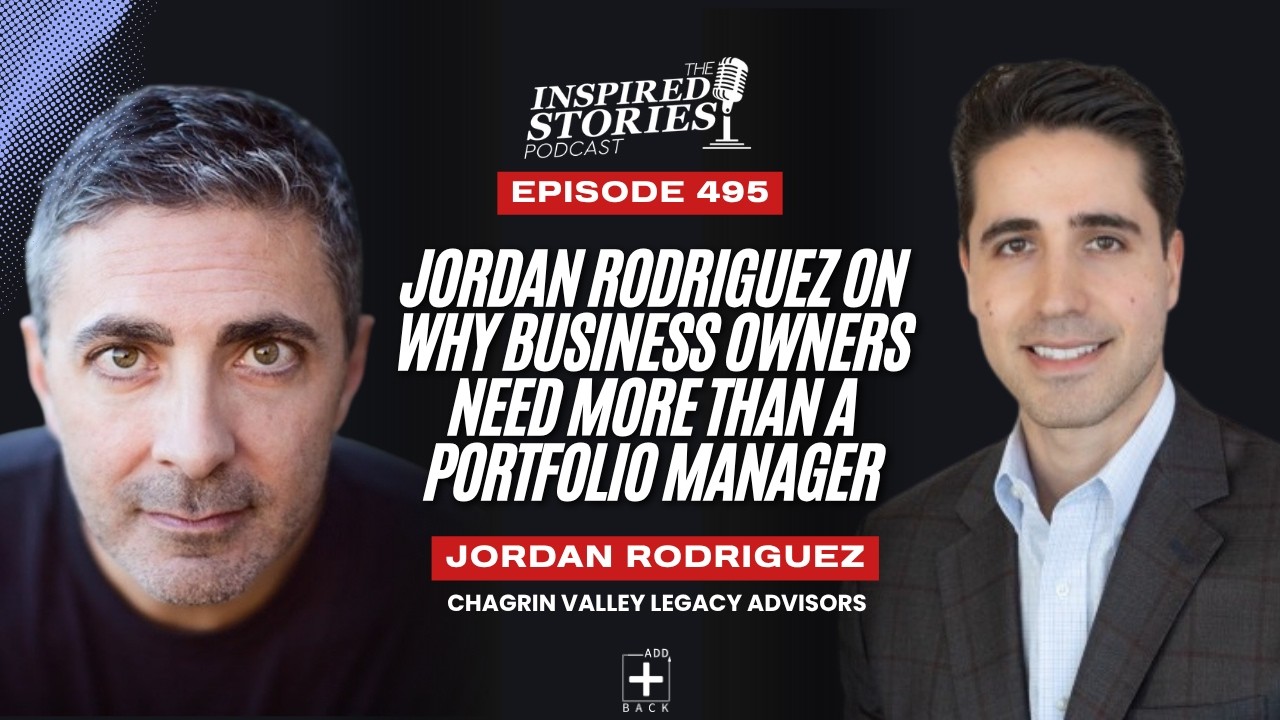
Jordan Rodriguez is the founder of Chagrin Valley Legacy Advisors in Beachwood, Ohio, a planning firm built for owners of closely held family businesses, multi-generational families, and high net worth early retirees. A certified financial planner and certified exit planning advisor, he spent nearly a decade at Warnock Spear Wealth Managers before leaving to build a practice specifically structured around the client types where he could deliver real depth, not a generalist service model dressed up to look specialized.
✨ Key Insights You'll Learn:
Starting career as a college intern at Warnock Wealth Management, doing data entry and back-office work
Early lessons at Northwestern Mutual and Wells Fargo on commission versus fee-only models and where incentives lead
The difference between wirehouse advisors and independent fiduciaries, and why that distinction matters to business owners
Spinning out Chagrin Valley Business Strategies as a separate entity to provide business valuations and consulting within a compliance constraint
Using Quist Insights software to give business owners a range of values, a gap analysis, and thirteen actionable drivers to close it
Why 75% of a business owner's wealth in an illiquid company requires a fundamentally different financial planning approach
Three client demographics: closely held family business owners, multi-generational families, and high net worth early retirees
The case for renaming exit planning, because the word exit scares off founders who aren't thinking about selling
Why second and third generation owners are often easier to advise than founders who treat the business as their identity
EOS Lite: using the VTO, quarterly rocks, and weekly scorecards without the full EOS complexity
🌟 Jordan's Key Mentors:
Warren Warnock (Managing Director, Warnock Wealth Management): Lifelong family friend who gave Jordan his first look at the industry through a high school shadow and then his first internship
Warnock Spear Team: A decade of shared growth that taught Jordan how to build client longevity, transition from wirehouse to independence, and think about fiduciary standards in every interaction
His Wife: His primary model of doing things the right way, and the person who first noticed the stress the departure took on him
Tax and Legal Professionals in His Network: The source of most introductions into his practice, because his model integrates them rather than working around them
Business Owner Clients: They taught Jordan what gap existed in the market by telling him they wanted their business integrated into their financial plan in ways standard advisory firms couldn't deliver
👉 Don't miss Jordan's account of leaving a decade-long professional partnership, why a $413,000 enterprise value number on a to-do item is the most motivating thing he can show a business owner, and his honest take on why exit planning needs a name change.
Listen to the full episode here
Transcript
Anthony Codispoti: Welcome to another edition of the inspired stories podcast where leaders share their experiences so we can learn from their successes and be inspired by how they've overcome adversity. My name is Anthony Codispoti and today's guest started his career as a college intern at a wealth management firm in Cleveland, Ohio. A decade later, he built two companies, earned national recognition before turning 30. and walked away from a model he had spent two years creating because it stopped matching what he was actually trying to build. The path between those points includes a stint at one of the largest financial institutions in the country, a leap in detect forward exit planning for small business owners, and an honest reckoning about what kind of if it, edit. The path between those points includes a stint at one of the largest financial institutions in the country, a leap into tech forward exit planning for small business owners, and an honest reckoning about what kind of advisory work creates lasting impact. He is Jordan Rodriguez, president of Chagrin Valley Legacy Advisors in Beachwood, Ohio, a planning firm built for business owners and high net worth families navigating financial lives that extend well beyond investment management. He is a certified financial planner and a certified exit planning advisor, and Crain's Cleveland named him to their 20 and their 20s list in 2021. This is a conversation about what it looks like to keep redefining what you were building until it finally matches what you set out to create. But before we get into all that good stuff, today's episode is brought to you by my company, AddBack Benefits Agency. And you'll want to hear this because it's hurting almost every business owner you know. Health insurance costs keep going up every year and businesses are furious about it. They're paying more, claims are getting denied, employees are opting out because they can't afford it, and it hurts turnover and morale. It's one of the most maddening problems in running a business and everyone just accepts it. But you don't have to anymore. Now there's a program that gives your employees unlimited access to doctors, therapists, and prescriptions with no copays or deductibles to meet. But here's the part that really shocks most people. Your net profits will actually increase. We recently helped a client add $900 per employee per year to their bottom line. Results vary, but gains like that change how a business is valued. Be the hero advisor that introduces this to your clients today. addbackbenefits.com. All right, back to our guest today, the founder of Chagrin Valley Business Strategies, Jordan Rodriguez. Thanks for making the time to share your story today.
Jordan Rodriguez: Thanks for having me. I appreciate the introduction. I think you covered it all. That's a wrap. Congratulations.
Anthony Codispoti: All right. Everybody can go home early today. So Jordan, you interned at the Wernick Wealth Management Group, a Cleveland area wealth advisory practice while you were still in college in Wisconsin. How did you end up there and what did you see in that environment? What kind of work were you doing?
Jordan Rodriguez: The managing director of that firm, Warren Wernick, he was a lifelong friend of my mom's. So growing up when we had financial questions, my mom worked in nonprofit, my dad worked in food service. So nobody was a finance adjacent necessarily. If we had a finance question, a money question, we would go and talk to Warren. It was a natural transition because in high school, Solon High School, we have this senior project where you shadow a local business for Approximately a month. I did my senior project with Warren and the team. So when I was in school Keeping in touch with him knowing that I wanted to take a career path that followed in financial footsteps It was a pretty natural transition to doing some projects for them on an internship basis while I was in, Wisconsin
Anthony Codispoti: So did you get the idea that you wanted to go this direction because of that shadow experience that you had or was it kind of already in your
Jordan Rodriguez: Yeah, it's hard to say chicken egg situation. I definitely used Warren as an example of success early on what success looked like. And it was something that intrigued me. some classes I took in high school and college really solidified that path forward for me, but I didn't know if it was going to be, you know, in a wealth management capacity, if I was going to be an analyst at a, an accounting firm or an investment bank in New York or Chicago, certain things fell into place that kind of steered that decision for me, but That's kind of the culmination of a bunch of different factors.
Anthony Codispoti: And so when you were there at Warnick the first time, this internship, what kind of work did they have you doing?
Jordan Rodriguez: Um, a lot of data entry, lot of the busy work, the plumbing, as I would call it, understanding how the sausage is made. And you've got to remember this was back in the 2000 teens, there weren't chat bot automations to be able to take PDFs and use OCR and enter them into databases. This was me, the intern. I was the chat bot. I was able to take a bunch of information, distill it into a useful format, put it somewhere else. Uh, but it was really just a function of. seeing what happens behind the scenes because you don't necessarily, when you're watching a movie, when you're watching Wall Street or when you're watching TV, you think it's this romanticized industry and you're just going out making deals, but there has to be a lot of grunt work that happens behind the scenes. And I get a healthy dose of that during that internship.
Anthony Codispoti: Okay, so it didn't scare you away from the industry. It kind of confirmed for you that this was the path that you wanted to head down. And then after graduation, you spent a few months at Northwestern Mutual, firm renowned for a very structured approach to training new advisors, before you eventually joined Wells Fargo full time. What did that early stretch right out of college teach you about the kind of advisor that you wanted to become?
Jordan Rodriguez: Wow, that's a great question. During that period, the combination of the Northwestern mutual experience and the Wells Fargo experience showed me that there are different, I'm sure you've heard the phrase, show me an incentive, I'll show you an outcome, really did a good job of illustrating to me the different career paths that existed within wealth management and how an advisor could be compensated by choosing one of those career paths. And what I mean by that is if you've, Ever worked with Northwestern Mutual, you know that a core component of their business model is to sell insurance or implement insurance solutions. There's a compensation structure that an advisor is paid on for implementing that insurance solution. It's not a good thing or a bad thing. It's just a thing. It's an observation. And on the flip side, if you look at a fee only advisor, as an example, somebody who only charges a percentage of basis points under management for a managed account. It's sort of the other end of the spectrum. So I got to see that commission models can work. got to see that fee-based models can work. got to see that a hybrid model that sort of implements both can work as well. But it really taught me that I wanted to lean away from the commission model is simply because of that incentive structure. If I'm financially incentivized to sell something and then, go out and sell something else to somebody else instead of maintaining and fostering sort of a mutual collaborative partnership. It was difficult for me to reconcile the financial benefits with the actual values that I wanted to instill into the career that I created.
Anthony Codispoti: And so I don't want to jump too far ahead into present day, but is that a philosophy that you have implemented in your business now? It's you're staying away from sort of commission based services and products, or can you not avoid those entirely?
Jordan Rodriguez: Well, at this current point in time, I am what's called fee only. So I cannot be compensated for commissionable products. So think insurance, think annuities, those sorts of things. I want to be clear though. It's not a right or wrong. Commissionable products have a time and place and they're an important part of an overall financial plan and strategy. But based on the clientele that I work with and the business model and the service model that I have, it just didn't fit. I would much rather avoid any potential conflict of interest that could arise rather by being compensated for commissionable products.
Anthony Codispoti: So you were at Wells Fargo for a couple of years before you decided to come back to Warnock. What was driving that decision?
Jordan Rodriguez: So a little bit different, our entire team, the Warnock Spear Wealth Managers team was with Wells Fargo. So we were with Wells Fargo from, for them it was 2010 to 2019. When I graduated college, I joined the team that was at Wells Fargo. I was with the team until 2019 and we all left. I can't necessarily speak for them. I didn't have a seat at the table when we decided to leave. But if you remember late 2000 teens, Wells Fargo was in the news for. some not great reasons. and we also wanted to kind of as a carry on from what I was just talking about, we wanted to really be able to do what was in the best interest for our clients in every capacity. And by being employees of a wire house firm, and, there are plenty of really good advisors and people who have positive experiences with Wells Fargo. It's not a Wells Fargo thing. It's just a structural thing by not being employees of a wire house firm and being independent. We were able to. sort of carry that fiduciary flag in every client interaction instead of just some of them.
Anthony Codispoti: Explain that term, wirehouse firm. What does that mean?
Jordan Rodriguez: So if you think of a big bank, Merrill Lynch and Morgan Stanley at Wells Fargo, those are considered the wirehouse firms of the wealth management industry. If you are an advisor who works for a wirehouse firm, you're technically an employee of that company. So my paychecks would be signed by Wells Fargo. As a result, when you have that corporate structure, whether you like it or not, sometimes you are beholden to things that come from the top down. And what I mean by that is if you're working for a large bank and your client has a lending need, let's call it. And you know, there's a local community bank down the street that offers a really, a good spread above, Sofer, but your bank, which might not offer as good a spread above Sofer also has a lending product. You are not allowed to recommend that client work with that credit union down the street or that financial institution down the street because you would be technically selling away. And that was the type of thing that we wanted to get away from.
Anthony Codispoti: Okay, now explain another industry term for us, SOFR.
Jordan Rodriguez: So for, I don't actually, um, uh, it's something is so it replaced the, it's basically an overnight lending rate. So if you are a huge financial institution that's working directly with one of the, um, you know, the federal reserve and there's an overnight lending mechanism whereby you're just replacing money within a 24 hour period, you basically have the best lending rate possible to the short end of the yield curve. So a bank will say, okay, we're going to give you so for plus 2%. Meaning we're going to give you the prime rate plus 2 % because you're obviously not the federal reserve. You're not JP Morgan. You're an individual. There's a little bit more risk involved by lending you this money. So we're going to charge you a little bit more for lending you that I'll get back to you with what SOFR actually stands for. but it's a prime lending rate. Exactly.
Anthony Codispoti: But it essentially means prime rate? OK. OK, so thanks for that clarification that you didn't leave the team. You stayed with the same team. Warnock was under the Wells Fargo umbrella. You guys left for a variety of reasons. Wells Fargo was in a bad place, going through a lot of negative press. And you guys wanted to be able to offer your clients the right things without having to be beholden to a specific provider. So you end up being there for close to nine years. Talk to me about how the arc of your career really evolved in the time that you were there.
Jordan Rodriguez: think it was the quintessential start from the bottom of the totem pole experience in a good way, kind of alluding back to the internship that I had way back when. I started with the grunt work, if you will. I was answering phones. I was sending out invitations for seminars or events that we were hosting, all while studying for my exams, passing my exams, getting integrated into some of the systems and processes that we had implemented. That kind of shifted when we left Wells Fargo. I was heavily involved in that transition. did evolve, didn't involve a lot of logistics, involve a lot of, creativity, lot of client facing communication. And I had started building my own business, my own book of clients, if you will, during the Wells Fargo days. But that's really that delineation where I stopped doing the grunt work and I really started being a full fledged client facing advisor in my own rights, building my own business and implementing my own business model and systems and processes. So I would say that that was the starting point, if you will, of what became, a really successful career with Murnik Spear. And we had a good run together that culminated roughly about a month and a half ago with my departure, but the arc started with a departure from Wells Fargo. I got to, I got to see how different business models, even in independent space can work well for some people and not work well for others. And I. really started trying to implement the business model that I thought was the best for my clients underneath that umbrella. And I realized eventually that no harm, no foul. just, wasn't able to do that in the way that I wanted to. And it did require me leaving Wernicke Spear to bring that to fruition.
Anthony Codispoti: Interesting. Before we get to that departure, which I think is based on what you said, there's going to be really important for us to talk about. You had been building Chagrin Valley Business Strategies as a complimentary platform on the side for a couple of years. What were you seeing there? What was the gap? What were you trying to accomplish?
Jordan Rodriguez: The clients that I brought the most value to were ones with complicated situations. And you're going to find a lot of complexity working in a private wealth capacity with owners of closely held family businesses. It's just a reality. There's a lot of decisions to be made that affect one another. There's a lot of professionals giving advice to that business owner that they need to be able to distill and implement. From my perspective, there's nothing less impactful. than sitting down in a review meeting with a business owner and talking about how their portfolio did relative to the S &P 500 when that is 10 % of their net worth. And when we're talking about long-term financial planning, long-term estate planning, tax planning, business planning, and we're looking at a discounting cashflow mechanism in this pie chart of their current asset allocation, and 75 % of it is this big red blob. that represents their closely held family business, most of their net worth. And we're just assigning sort of an arbitrary number to what it's worth. They could have an outdated valuation. They could just be using book value that their CPA provided them with. And we're also tacking on an arbitrary growth rate to how we expect the end. By the way, in all of these financial planning models, other, the categorization other usually has a 3 % rate of appreciation just to match inflation. So we're taking all these variables that are super, super, super important to long-term financial planning. Um, and we're just not being specific with them. not being precise with them. So I'm not the smartest person in the room. My clients started to tell me, Hey, I own a business and I want this to, I want this financial plan that we're working on to integrate my business. Um, and I had to go to the drawing board and understand how I could make that happen. And Sugar Valley business strategies, be honest with you. It was born out of necessity. I wanted to just integrate it under the umbrella of more experienced wealth managers. had a broker dealer relationship that essentially said, you can't do this under your securities license. You have to spin it out to a separate business unit. So we were doing an opinion of value, a range of values for this business owner, not an IRS compliant valuation, but an opinion of value with value drivers, value detractors, consulting on the business in a sort of. a branch of the firm that wasn't actually able to be a branch of the firm, if that makes sense.
Anthony Codispoti: It had to be its own separate entity for legal reasons. And you were doing valuations and other consulting to what? Teach them, show them how they could drive that valuation higher.
Jordan Rodriguez: Correct. yes, I think there were two primary purposes served the first, if we go back to the private wealth management side, we needed to be able to give them a working number for what that business was worth at any point in time. because again, if, if we're doing a discount and cashflow mechanism and we want to talk about their plans, 10, 20, 30 years down the road, we have to understand what that business is worth now and what it could potentially grow to, because it's a part of their financial plan. It's either going to be something that's providing them. income or they're going to sell it or transition it or do something with it at some point in time. So working number photo is worth was a super important component. But on top of that, if we can also add some value in growing their business, well, suddenly we're actually doing wealth management, right? When 75 % of your wealth is tied up in a business and we're able to advise on how that business can improve in value. We're finally actually carrying that water for the client. So opinion of value was step one, but step two was, we've got this working number. What are the steps that we can take to get from point A to point B?
Anthony Codispoti: What were some of those operational levers that you found you could pull?
Jordan Rodriguez: We worked with a company called Quist Insights out of Boulder, Colorado, believe, either Boulder or Denver, professional valuation company that had a really cool software model that they licensed to advisors like myself, where we were able to, I think it's roughly 80 questions in intake form to gather qualitative and quantitative information, pair that with three years of historical financial statements. And with that data, and real time private market. stats, private market multiples, provide that owner with a range of values for what their business could be worth if they were a best in class performer in their industry and also what the lower end of the range is. But most importantly to the owner where they fit in that range. My favorite part of that output and the outputs is big, you know, 50 page document and we go over it in bite sized pieces because nobody can do a 50 page document in one meeting. But My favorite part of the output was here's your, here's your range of values right now. The best in class performers in your industry have a range of values of whatever yours is plus some Delta. If you want to bridge that gap, here are 13 different items that you can address to get from point A to point B to close that gap. And associated with each one of those items was a dollar figure. I've never seen anything more motivating to a business owner when talking about increasing the value of their business. Then. If I address this thing, I just added $413,000 of enterprise value to my business. It's a really good way to speak their language because what we're not just talking about, the easy way out is to say, you've got to grow revenue, right? You've got to grow revenue 50 % and then suddenly you're going to be at the top range. Well, if we could just grow revenue 50 % and there are obviously ways that you can do that in a structured way. And, but if that's my insight to them, they're going to say, thanks Jordan, tell me something I didn't know.
Anthony Codispoti: Hahaha.
Jordan Rodriguez: If we can talk about things that we can implement within the business, focusing on systems and processes and anti-fragility that can happen without just going out and selling more. They love that. And they see a dollar figure associated with it. Sign me up.
Anthony Codispoti: Give us an example of one of those things.
Jordan Rodriguez: I'm going to give you the simplest example that nobody thinks matters, but I'll tell you matters every single time. If there isn't a written down and communicated mission and vision statement that the owner is drafting, working with their executive team to polish and then communicating to their executive team, I think it's a swing and a miss. Everybody thinks it's like a touchy feely sort of thing. Well, that's, that's what they teach you in business school, or that's something that you read about in books. There's no better way to keep your business aligned than by having a written document that everybody can hold you accountable to when you're making big decisions. While it's not a huge dollar value add, I think a lot of people are surprised when we're talking about a $30 million revenue business and just writing and communicating a mission and vision statement. If that can add an enterprise value of $250,000 to a $30 million business, who doesn't want an extra quarter million dollars to the evaluation, right?
Anthony Codispoti: So let's go back to why you left Wernick. You started to allude to it. were differences in philosophy. You realized what you wanted to do was a little bit different and would be better served doing this on your own. Talk us through those details as much as you can.
Jordan Rodriguez: you So here at Chagrin Valley Legacy Advisors, I work with three different client demographics. I work with the owners of closely held family businesses. I work with different members of multi-generational families. And I work with high and ultra high net worth early retirees. As you can imagine, there's some overlap between those three pillars, but those are the three demographics. At my previous firm, I worked with those three demographics plus 100 others. We were What's called a generalist firm, meaning we will work with anyone and everyone. and again, this isn't a good thing or a bad thing. It's just a different type of business model. But what I found is the clients, a, that I brought the most value to, but B that I enjoyed working with the most had the most complexity. And if I have those relationships plus a hundred others, maybe these are people I enjoy. but there's not a level of repetitiveness, repetitiveness in the different client experiences that I'm having. If this person needs advice on their 457 and 403B contributions, well, that doesn't really fall into the bucket of people that I normally work with. I'm probably going to spend several hours going on a goose chase talking to professionals, and I'm in my network and doing online research to understand how to answer that question for them. And I might not get that question again for 36 months. So that wasn't a scalable model for me. It is for some, but the way that I want to work with clients moving forward meant that I had to keep my client base relatively focused and refined instead of just working at a generalist firm.
Anthony Codispoti: It makes a lot of sense. You wanted to develop, you had been developing a certain niche and the questions that you get with folks over here, you can be prepared to have very detailed answers right at your fingertips. But if you've got to be prepared to answer questions from people all over the spectrum, it stretches you and your brain too thin, right?
Jordan Rodriguez: It really does. And if you're in my industry and you're listening, you know that there are a million publications out there that talk about how niching and refining your client demographic, your client focus, is a really positive thing to do long-term, but we also know that it's pretty scary, right? Because it means that you're going to say no to people who walk through the door and they might be qualified from a dollar perspective, but I certainly need them to meet some level of criteria when it comes to complexity. for me to work with them moving forward. that's a decision that I made that wasn't necessarily meshing with the pre-existing business model. And that's why I eventually departed.
Anthony Codispoti: So checking out your LinkedIn page here, Jordan, I see both Chagrin Valley Business Strategies and Chagrin Valley Legacy Advisors. Are these truly two separate entities? What's the relationship between them?
Jordan Rodriguez: Thank So technically speaking, Chagrin Valley business strategies no longer exists. That was that spin out that had to happen as a result of the compliance mandate at the former firm. I'm happy to announce that all those services still absolutely exist under the Chagrin Valley legacy advisors umbrella. So the best way to describe it is I'm doing everything I was before under one roof.
Anthony Codispoti: So break it down for us, plain English. What does Chagrin Valley Legacy Advisors do and who do you best do it for?
Jordan Rodriguez: I'm going to give you three different answers because there are those three different demographics that I mentioned earlier. Roughly 60 % of the core service model is going to be the same for those. And actually we've got show notes. So I'll send you a PDF after that actually illustrates what a client experiences when they work with Chagrin Valley. If we talk about the closely held family businesses. Something that you're probably not going to receive from working with a generalist wealth manager or maybe even your existing wealth manager is on an annual basis, getting that opinion of value, that range of values. What you're probably not going to get is a coordinated executive team meeting with you and the key people within your company to make sure that everybody is aligned on the same page. What you're probably not going to get are educational sessions with investment bankers and private equity firms that can talk about how to build value within your firm. So we built a business model that is specific to each one of those individual client demographics. And this is on top of all of the performance reviews and tax planning and estate planning that we're doing. So that dovetails into demographic number two, the multi-generational families, the part of their business model that differentiates from the first is we're gonna do a lot of estate mapping. A lot of the conversations that we have have to do with estate taxes and estate tax avoidance. I'm gifting legacy planning a family retreat is something that you're probably not getting with most advisors out there one of the most important things to multi-generational families is Making sure that the next generation is prepared to be a steward of the family wealth You can write whatever you want in a trust document. It might be legally sound and it might be executed Based on what you wrote, but if you're not properly communicating expectations and requirements and and rules if you will to the next generation, I'm not going to say that it's all for naught, but it's certainly not as effective as if you bridge that gap in an educational way. And then number three, the early, the high and ultra high net worth early retirees. I put the early here because early is really important. There are some unique tax planning opportunities. If you are a high earner, wealthy person who has several years before you're 65 and then several more years before you're 70 and then several more years before you're 73 to 75. Those are all sort of benchmarks for when certain things happen. And if you do other things right before you reach those benchmarks, you're going to put yourself in a much better, longer term situation from a tax standpoint. So again, a lot of overlap in those three demographics. I've got some people that fit all three criteria, some people that only fit one, but that's what the boots on the ground. feeling is. You're part of this repeatable service model. You know exactly the deliverables that you're going to receive in your inbox on a monthly or quarterly cadence. You know exactly the times of year that we're going to meet to discuss certain topics. And you also know that you're working with somebody who understands your situation and has a business model that's tailored to you instead of everybody.
Anthony Codispoti: And so your approach now is you're fee based, right? You don't do the commissions like we were talking about before. What's your approach to long term, short term consulting agreements? How do you think about?
Jordan Rodriguez: Long-term is sort of the MO now. I think of clients as partners. I'm going to get this number wrong, but I think it weren't experience. We prided ourselves on having a partner longevity or a client longevity of it was like 15 or 16 or 17 years, a really long time. And that's a great lesson that I learned from them that I want to carry into the future. I need to be an expert on you and your family. This is something I completely changed my opinion about from the beginning of my career to the end I would see this successful advisor down the street They're at a concert with their clients or playing golf with their clients or something And it was easy for me in my head to say that person doesn't know anything about tax planning They don't know anything about investments. They're just buying their clients They're whining and dining them and maybe in some instances that was true But now that I'm on the other side and I have really good client relationships. I fully understand that Yes, you need to have systems and processes in place to make sure that those technical aspects are taken care of. But your primary role is to understand exactly what your client's goals, needs, and motivations are moving forward. You need to understand what their family situation looks like. You need to understand what their career aspirations are. Because based on those things, your job is to translate them, reconcile them into a way that makes sense with that client's financial assets, and implement that into the plan. The short way of saying that is you don't know what you don't know. Well, you need to know what they don't know. If they're thinking about changing careers and there's some preparation they need to be doing from a financial standpoint to make that transition, you'd better be leading that conversation because they might not know that they need to make changes. So short term just doesn't really work. It falls in that commissionable model. Again, not a good or bad thing, but my. clients are best served knowing that I'm probably going to be here for the entirety of their lives, some of them, their kids lives, and trying to think I might be here for some of my clients' grandkids to be full-fledged adults in the head of their households. We'll see.
Anthony Codispoti: So what is your present day thought process and approach to relationship building? Do you do the golf outings and the fancy dinners? Or how do you think?
Jordan Rodriguez: Well, I love, I love golf. I've got the bug. Um, I started late in life, so I always tell people I'm playing catch up. So you can't fault me for that. I think the, the relationship building is super important. And I can't remember who told me this, but after COVID in 2020, when everybody started doing a bunch of zoom calls, um, a strategic partner of mine told me that he had kind of shifted gears and this was, you know, 2022. So COVID was long since over at that point, but a lot of people were still doing zoom calls. He had said that he was doing business, know, air quotes business over zoom and then relationship building in person. So he was meeting with somebody four times per year previously. Well, he's still going to meet with them four times per year. Two times might be via zoom to talk about whatever it is product that they need to talk about. But the other two times are going to be on the golf course or at lunch or over coffee or something like that. The relationship building is super important because going back to the original point of being an expert on you, I need my clients to trust that I have the technical expertise to be able to implement their financial plan. But I also need them to trust that I'm hearing them and listening to them and understanding that what they're telling me, even reading between the lines sometimes is a landing. And I'm able to take that information and I'm able to make that part of their long-term financial plan strategy.
Anthony Codispoti: How often do you get involved in exit planning, prepping the business owners' assets for some kind of a transition?
Jordan Rodriguez: always, I would say it's just a core part of the business model for the business owners. I'm going to have a hot take and the exit planning community is going to be mad at me for this one. they need to change the name. And what I mean by that is the exit planning Institute's a fantastic organization. one of the core readings that I think every business owner should put on their bookshelf is walk into destiny by the founder of the exit planning Institute. Chris Snyder. Exit planning leaves an owner with this, it's not a negative connotation, but it's a connotation that their eventual goal is to sell the business. And it conjures up detail, conjures up images of selling this business to a third party, whether that's a private equity firm, a competitor, just a strategic or financial buyer in general. When in reality, a lot of the transactions that I see are transitions to the next generation, management buyouts, ESOPs. stage buyouts to a third party. Yes, private equity is a huge player at the table. And there's absolutely instances where the best move for your situation is to sell your business to a private equity firm. But if you get over the idea that exit planning means you're selling your business and understand that it really just means right sizing your business for whatever comes next, I think that would be a lot more approachable to a lot more business owners. So I've taken the the SIPA designation off of my LinkedIn because I don't want clients to have that preconceived notion that I'm here to talk to them about selling their business. I've got clients who have businesses who, you know, they're in their thirties. They're probably not going to sell that business for 20 years, maybe even more. Maybe they never sell it. Maybe they do incorporate it into a portfolio of, you know, holding companies and transition it to the next generation. I don't care. I want whatever is best for them. So the exit planning. component of it, I'm in the weeds every day, when in reality, the exit planning is just good business planning.
Anthony Codispoti: So what should the name be then if it's not exit planning? Because I hear what you're saying, right? anything that's good, anything good operationally, financially to get your business ready for exit is just good for business in general. So those are things that any business should be doing. So what do we call it?
Jordan Rodriguez: Well, entrepreneurial operating systems already taken. think that would be, it's a really good parallel because there are a lot of similarities between the two. I'll talk to the marketing team at the exit planning Institute and see if they have any ideas. Cause I'm not the most creative when it comes to naming things. but you know, it really, the exit planning component of it while it's super important. And that's something that is important to a lot of people. I think it does sort of. It cuts you off from a large percentage of the population who want to have those business planning conversations, but don't necessarily want to have them in the context of, I'm selling this thing.
Anthony Codispoti: You mentioned EOS, entrepreneurial operating system, a really popular, I don't know what would you call it, like a platform, a direction, well, an operating system. Yeah, it's right. It's baked into the name. Is this something that you help clients implement?
Jordan Rodriguez: Operating system. Yeah. So I do what I do myself and what I help clients implement. And I'm going to tell you straight up. I am not an EOS implementer. I don't do, I don't run full EOS for myself. I do a version that I call EOS Lite. The VTO, the vision traction organizer, I think is a kind of talking about that mission and vision statement that we mentioned earlier. Every business owner should have a VTO and I'll, I'll link something in the show notes that talks about what the VTO is and how you can. build one. But the VTO, the quarterly rocks and then the weekly scorecards are the EOS lite versions that I implement myself and that I can help other business owners implement as well. And really the focus of that lite version is understanding what you want the long term plan to be and then breaking down in incremental steps how to get from point A to point B. And it's an oversimplification, but that's good. That's on purpose. I think one of the things that EOS Not that it doesn't do well, but a lot of people start with EOS and maybe they stop because it is super involved. It's super complex. It can be daunting. It can be hairy. And that's the focus. That's the whole point. In EOS Lite version that I implement for myself, it's not scary at all. It's not daunting. And I think if I can do it, anybody can do it.
Anthony Codispoti: For business owner that's listening right now, Jordan, and wondering whether the kind of work that you're describing is relevant to them and their situation, what's the entry point for working with you?
Jordan Rodriguez: If you are a business owner and you were working with a professional wealth manager and you call that wealth manager your investment person or your money guy or whatever it is, chances are that's not the best setup for you to have. This goes back to the original idea of it's not a good thing or a bad thing, but most wealth management firms out there are generalist practices. Everybody says they work with business owners because business owners generally have Larger portfolios and that's, that's great for an investment manager to manage. But if you're a business owner and you're serious about your wealth management relationship, you're already paying this person to manage your wealth. You should be plugged in with somebody who has a business model that's specifically catered to you. So it's really a pretty simple criteria. Those two questions. Do you have a professional wealth management relationship and does that person work specifically with you? Not just saying it. Can you tell that that business model is geared? toward you, the small and mid-sized business owner.
Anthony Codispoti: So business owner is one of the criteria. Is it a business of a certain size or age or industry?
Jordan Rodriguez: yeah, I always say the, it's gotta be profitable. the software that we utilize for the range of values works best with businesses generating at least $10 million in annual or recurring revenue. I think based on the things that we implement at chagrin Valley, I set a cap at roughly a hundred million dollars of annual recurring revenue, because at that point, a lot of times you're going to have more formal board structures. You're going to have. different systems and processes in place that we would recommend you put in place anyway. So our sweet spot is between 10 and $50 million, I would say, of annual recurring revenue. Bonus points for second or third or fourth or fifth generation, because the founding generation just comes with a lot of baggage. I'm sorry, guys. I'd say it to your face, but it just is. It's a different conversation that you're having with somebody who it's not necessarily their baby. They're a steward of this thing, but the mindset shifts when you inherited something or bought something where something was transitioned to you rather than being the founder who has to think about what the next step is.
Anthony Codispoti: And so the reason that you prefer to work with those second through future generations, is it because that the founding generation, the actual founder of the company is a lot more emotionally attached to what they've built and that clouds decision making?
Jordan Rodriguez: Yes. And I said it tongue in cheek, but it's absolutely true. think about it. It's a lot different if you've built something than if you inherited something, it doesn't mean that it's any less meaningful to you, but there's a different set of emotions that come with that. going through a transition, whether it's a transition to the next generation, a sale to a third party management buyout. You're going to have some level of due diligence, some level of underwriting, some level of accountants and attorneys in the room. And during that process, you're going to see some of the things that aren't so great with your business. That's a lot easier for you to internalize as a second or third or fourth generation owner. You've heard the saying that you can't call somebody's baby ugly. Well, when you're going through that process with a founder of a firm and suddenly you're telling them, Hey, you know, you're still doing. cash instead of accrual accounting. That's probably a bad example because they don't really care. But hey, you you're the person who sits on all these big key relationships. You haven't scaled this out to a sales team or anything like that. Well, as the business owner, this business exists because of you. You're the salesperson. You're the local celebrity who can go out there and make those deals. How dare you say that that's not the way that can maximize the value of this business. I'm the key to this business. And suddenly you can see how very quickly. the emotions become charged and you you think your business is worth $20 million when in reality it's worth 10 because there's no management team in place.
Anthony Codispoti: Yeah, there's a deep emotional connection. I can speak from experience and having founded and exited a number of businesses myself. And so do you do you have experience kind of getting to the selling table with a founding owner and then seeing some hesitations, maybe even trying to sabotage the deal consciously or subconsciously?
Jordan Rodriguez: Correct. Yeah. Yeah. I've seen, so I just want to say I've seen a lot of successful deals. So I don't want to say that founders, just by and large kibosh, every deal that comes across their, their desk, have seen some really successful ones, but I think something that I see in common with a lot of these deals is an expectation and inflated expectation. And you're going to hear a different version of that from everybody out there, but Whether it's stories that you hear at the country club or on social media or reading blogs or something, you're going to hear of the best case scenarios. You're going to hear that somebody in your industry sold for whatever multiple of EBITDA. You're going to hear that the person down the street who's a competitor of yours had their successful exit to this private equity roll-up aggregator. And they got eight times EBITDA on their HVAC company. A couple of things. First of all, it's completely different business from yours. I know it's in the same industry, but The systems and processes, the scale, the people could be dramatically different and you shouldn't anchor your expectations to that. But I think more relevantly is that eight times EBITDA number doesn't necessarily mean cash at close, right? So if somebody took a certain amount of dollars at close, and then there was a bunch of earnouts on the backend, they got them up to that ADACS EBITDA number, that's dramatically different. Their end all be all number might end up being four times. four and a half times when all is said and done, when they don't meet those unrealistic hurdles that the private equity firms laying out for them. So the unrealistic expectation comes from anchoring yourself to variables that aren't necessarily relevant to you. And I've seen that be super pervasive across not just any industry specifically, but more in the size of company that we're talking about. Those 10 to 20 to $30 million companies where there's not a ton of standardization. across systems and processes that mean you can just tack on a multiple.
Anthony Codispoti: So you're just very recently completely off on your own. Do you, were you able to like, did you have like a customer base already that you brought with you or that was kind of already operating under that umbrella because of the separate structures that you guys set up or are you having to start over from scratch?
Jordan Rodriguez: Yeah. So I brought the clients with me that fit the criteria that I laid out those three different buckets. if they fit those criteria and I was the person who started and fostered that relationship, I brought them with me. so what that means is I didn't bring anybody who was a client of the previous firm. didn't bring anybody with me who didn't fit those three criteria. I was very conservative when I made that list of people that. We're going to be good fits for me moving forward. So I brought those people with me between now and the end of the year. I'm probably going to add, I would say to clients maximum. My whole goal is to scale this in a way that leaves everybody with a really positive client experience. everybody, you know, you can say that till you're blue in the face, but I want to be super intentional about how I grow this firm because the people that I'm working with are unique in the sense that again, it's not a generalist model where If you've got whatever, I'll take you and I'll just hand you off to the administrative team to open those accounts and call center to service it, that sort of thing. I need to be very ingrained in these people's lives and get a lot of information from them, provide a lot of information to them. Until I found a way to scale that across a higher number of people, I'm just fine working at a slow pace.
Anthony Codispoti: What do you think it looks like for you to find those two maximum new clients this year? Are they word of mouth? Is there some marketing funnel that you're operating?
Jordan Rodriguez: Most of the introductions that I have come from, believe it or not, it's not existing clients. That's usually what you would expect in my industry. It's from professionals within the industry, tax professionals, legal bankers. I think people understand that I do things a bit differently and especially on the tax side, your tax professional is your most trusted advisor generally as a business owner, as a high net worth individual. My model integrates that tax professional into the service model so that they're constantly kept up to date with relevant information. They know that their clients are being taken care of by working with me, but it also doesn't hurt that their jobs are made a lot easier when they know exactly what documentation is going to come to them at tax time, exactly what decisions were made in the previous year that are going to need to be reflected on the next year's tax return, how the business tax return needs to be reconciled with the personal tax return. So when people see that I truly do work with business owners in a way that integrates those other professionals, suddenly it's not a risk to introduce them to a wealth manager anymore. You're not risking your credibility. You're actually being the person who can elevate their client's client experience. And I think that's what holds people back from introducing their clients to people in the wealth management industry is it's this for better or for worse. We've put ourselves in this bucket that we're slick salespeople and smooth talkers. I'm sure you can tell we're like an hour in. definitely not a smooth talker, but you know, it's a risk to your credibility. you sick some financial advisor on your clients, suddenly they're knocking down the door, trying to sell the mutual funds. It's a lot different if you can see how the business model works, because you have a client in common and you can actually see now what the deliverables are and that clients experience is significantly better. You now are armed and equipped with the information necessary to go to your other clients who fit that profile and say, Hey, I really think you should talk to Jordan. He's doing something different over there.
Anthony Codispoti: Jordan, I'd like to hear about the podcast that you host, the Price Discovery podcast. What topics are you covering? Do you have guests on there? Is it just you speaking? Walk us through what folks can expect.
Jordan Rodriguez: I did two seasons so far. The first one focused on the professional network surrounding business owners. So I had experts in philanthropy. had experts in tax, valuation, former CEOs of banks. It was a really enriching experience. And then focus two or season two, rather focused on business owners stories. So they were all business owners, meaning they were either former business owners who went through a transaction. current business owners, the next generation, what have you. It's me interviewing people. I like to think that it's semi-conversational, but it really is me wanting to put them in front of an audience and talk about what it's actually like being a business owner and working in that sphere. As you know, it's a lot of work, especially when you also have a day job. So I've got a great producer out of New York who handles a lot of the logistics of actually cutting and producing and doing all those things. But the research ahead of time, was surprised by. If you want to have, and I can tell, I mean, you're a professional at this, you do a really good job. You have to put a lot of work into making sure that this isn't going to be a, what's your favorite food sort of thing. you know, that's a dime a dozen. You can find that anywhere. It starts to be really relevant and valuable to the audience when you have conversations that aren't just a copy and paste.
Anthony Codispoti: A couple of things I want to point out there. At first, yes, let me also take my hat off to my producer. These shows wouldn't exist without folks in that role. And funny that you mentioned, you know, the research that goes into, you being able to, you know, have good questions kind of lined up. My son just recently went to the state house for a field trip. We're here in Columbus, Ohio, and got to meet the governor. and had an opportunity to ask questions. Well, my son's very shy. He didn't ask questions, but other kids in his class were asking the governor things like, what's your favorite color? What's your favorite food? It's like, I wish I would have known. Like I would have prepped you with a, you know, a better question to ask. So that's funny. What a shift. And just your podcast, Price Discovery Podcast, people can find it on all the typical platforms, Spotify, Apple, Amazon.
Jordan Rodriguez: Yeah. YouTube, yeah, all of it. On my website as well, yeah.
Anthony Codispoti: Great. And the website we're going to give out again here in a moment, it is chagrinvalleylegacy.com for folks who want that. I want to shift gears now, Jordan. What's the hardest thing you've ever had to overcome personally and what did it teach you?
Jordan Rodriguez: You got it. I'm interested to see how I would have answered this a couple of months ago, because truth be told, I've lived a very blessed life. So my wife and I have been together since high school. So I've never had a bad breakup until about a month and a half ago when my former firm and I decided to part ways. It made sense for everybody involved, but what... Why it was difficult for me was because I felt that I was doing everything the right way. And, my former partners didn't necessarily see it that way. And I was trying really hard to make them see from my perspective. Here's why this makes sense for me. here's why this is the right thing to do. Here's why I'm such a good upstanding guy. And I could see that they were just, they were not happy with me. They were really angry with me. And I tried to, I spent a lot of time just talking myself into, okay, you're doing the right thing. You're doing the right thing. And eventually like, knew that I was doing the right thing and I just needed to understand that they weren't going to see it that way. And that they were entitled to their feelings and their opinions. And it would have saved me a lot of stress and anxiety. And I'm not, I'm not a very stressor stressed person or anxious person. It's just not something that really is in my genetic makeup. but my wife would be the first one to tell you she's never seen me like that over the course of those few weeks because I started to question whether or not I was doing things the right way, whether or not I was being a good person. That's something that is very, very, important to me. I want to do things morally, ethically that align with my values. And I thought I was doing this this way, but by just not giving them the benefit of having their own Opinion and by trying to convince them. Hey, I'm this good guy who's doing this the right way I should have just let them be angry with me. I should have just let them Have their feelings that they were entitled to and I could have mine that I was entitled to and I think it would have made The transition a lot more amicable. So that was it really was the the most difficult thing I've gone through not only professionally But that was a lifelong personal relationship as well
Anthony Codispoti: Do you care to say more Jordan about the differences in opinion that you guys had on, they thought you weren't doing things the right way you thought that you did or would you rather leave it at
Jordan Rodriguez: The one thing I will say is from a business perspective, I think I mentioned this earlier, there wasn't a right or a wrong, right? It's if you want to do things, if you want to be everything for everyone, that's fantastic. If you want to work with a specific subset of people, that's fantastic as well. We, there were some tension that arose because those business models didn't necessarily reconcile. And I thought, again, this kind of goes to me doing things, matching other people's expectations. I would present numbers on a quarterly basis to show, Hey, here's what revenue growth looked like. Here's what assets under management growth looked like. And my numbers were always really, really good. but if nobody cared to actually look at those numbers, it was very easy to fall into the vibe of, well, you he brought in two clients last quarter. Well, yeah, they were two really successful business owners. were huge clients. Other person brings in 10 clients this year. Well, they fit into that generalist business model. we can look at the numbers until we're blue in the face and says, Jordan had a awesome quarter, like best quarter of his career sort of thing. But if you're in the business model where more bodies is a good thing and you're just, you're bringing in more people, it's easy to fall into the vibe of this person brought in a lot of clients and it's fantastic. This person didn't. And you can say whatever you want about revenue. think revenue is super important, but maybe that's not the metric that everybody likes to look at.
Anthony Codispoti: So big takeaway for you from this painful experience, jeopardizing lifelong relationships that you've had is, it's okay for people to have different sets of opinions. And when you realize that each of you are anchored in your own beliefs and you're not moving from that, moving on is a much easier path than trying to convince somebody to change their minds.
Jordan Rodriguez: I've got to keep you around more often. Yeah, you just took my word salad and made it nice and succinct. That's exactly how I would say it.
Anthony Codispoti: So Jordan, what do you most want to be remembered for in the work that you're doing now?
Jordan Rodriguez: Well, I know I just said that I was leaving behind trying to be this good guy that everybody does things right way, but that is the most critical, crucial component of my personal and professional life. When people look back, and I hope that I have a long and storied career and that there's some big grand retirement party and a bunch of people get up on stage and they say, they don't talk about how big the business is. They don't talk about... Revenue or assets under management. They talk about how I always did things the right way. And I, I think it's easy to do. I think it really is easy to do things the right way. If you set things up in a way that aren't going to incentivize you to not do things the wrong way, but even enter a territory where there's a financial gain or loss to be had by making a decision in either direction. Um, I think that gets you like 50 % of the way there. And the other 50 % is just be a good person. I have. a really good, I've got great examples around me of people who live life the right way, my wife being the primary example. So it's very easy for me to go home every day and say, my goodness, like here's what an angel looks like. Here's what I should act like every single day. And that's so important and grounding. But when people look back, I just, I don't care how they see my success or financial success or failure. I just want them to. to tell people that he treated everybody with respect. He was always an honest person. He never did anything that would cause you to question where his morals or ethics or integrity was.
Anthony Codispoti: Jordan, I just have one more question for you today. But before I ask it, I want to do three quick things for the audience. First of all, to get in touch with Jordan Rodriguez, we mentioned the website address before chagrinvalleylegacy.com. It'll be in the show notes. But if you can't wait to get to that chagrinvalleylegacy.com, you can go right now. And if you're enjoying the show, please take a moment to subscribe wherever you're listening. It also sends a signal that helps others discover our podcast. So thank you for taking a quick moment to do that right now. And as a reminder to all business advisors out there, your clients are bleeding money on health insurance. Do them a favor so big they'll tell their friends about it. Show them how to give their employees access to therapists, doctors, and prescription meds that counterintuitively increases the company's net profits. Real gains that can change how a business is valued. Contact us today at addbackbenefits.com. So last question for you, Jordan, a year from now, what is one very specific thing that you hope to be celebrated?
Jordan Rodriguez: I hope to be celebrating mother's day with my mom and my wife in a year. it's a little bit cheesy, but something that I've always done a good job of, but especially over the past month and a half is you've got to celebrate every day. don't wait for the big milestones. Don't put some aspirational dollar figure on paper and say, once I achieve that, I'm going to be happy. It's a fool's errand. If you've ever read Wanting by Luke Burgess, it's a great way to think about how you should be aspiring to different goals. I just want everybody to be happy and healthy and God willing, a year from now, everybody will be and we'll be doing the exact same thing that we are this weekend.
Anthony Codispoti: it for context folks for recording this right before Mother's Day weekend. So what a wonderful way to wrap up this interview, giving recognition and appreciation to the important women in our lives. love that. Yeah. Jordan Rodriguez from Chagrin Valley Legacy. I want to be the first to thank you for sharing both your time and your story with us today. Really appreciate you being here.
Jordan Rodriguez: Shout out to all the moms. Thanks so much, Anthony. You did a great job. This is a treat to be on because you have this knack for just really listening and understanding and the research that you did ahead of time speaks for itself. So you are a true professional.
Anthony Codispoti: I appreciate those kind words, Jordan. Folks, that's a wrap on another episode of the Inspired Stories podcast. Thanks for learning with us. And if one thing stood out, put that into action today.