
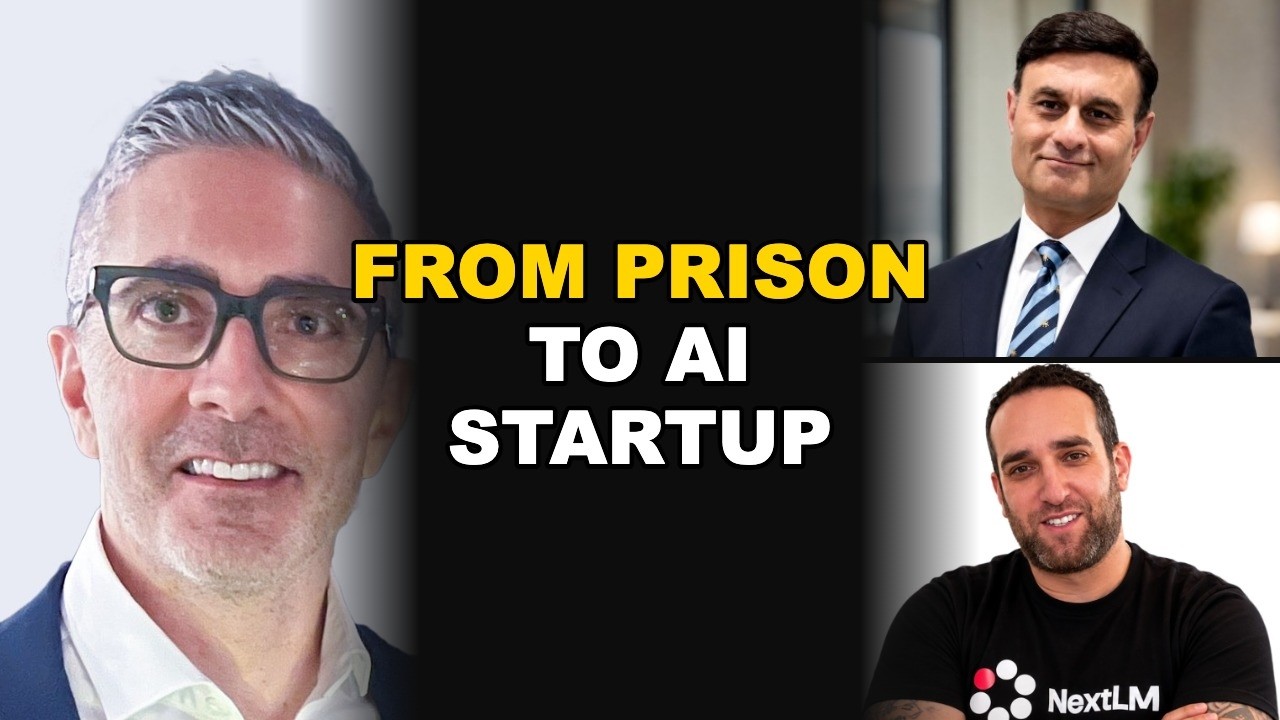
🎙️ A Prison Friendship Became NextLM for Chris Anzalone and Amer Ahmad
Chris Anzalone and Amer Ahmad met inside a federal prison in California, each serving a 15-year sentence for a different crime. Chris was a high school dropout turned stockbroker; Amer was a Harvard-trained investment banker who became Chicago's city comptroller. Today they co-found NextLM, an AI sales intelligence platform that crossed M in ARR within 87 days of launch.
✨ Key Insights You'll Learn:
Tying self-worth to money and status
The narratives we tell ourselves to justify wrongdoing
How power and ego eroded careful judgment
Running from a sentence and why it made things worse
Surviving the first night inside federal prison
A friendship forged on nightly laps around a prison track
Reading, classes and accountability as tools for change
Coming home with fresh eyes on technology
Why a fine-tuned open weight model beat frontier AI
Building partnerships with Google, NVIDIA and HP
🌟 Chris and Amer's Key Influences:
Each other: years of walks, books and honest conversations
Chris's father: the introduction to his first sales job
A stranger on a Key West drive: "You're too smart to be living this way"
Amer's immigrant parents: hard work and education
An NYU data scientist: builder of the model behind NextLM
👉 Hear how two men who lost everything found gratitude, purpose and a fast-growing AI company.
Listen to the full episode here
Transcript
Background Stories and Early Life
Anthony Codispoti (00:00)
Welcome to another edition of the Inspired Stories Podcast, where leaders share their experiences so we can learn from their successes and be inspired by how they've overcome adversity. As you listen today, let one idea shape what you do next.
My name is Anthony Codispoti, and today's guests met inside a federal prison in California, each serving a 15-year sentence for a different kind of crime. They credit their friendship there with keeping them alive. Today they run an AI company that Google and NVIDIA are actively promoting and that's growing very quickly. Chris Anzalone built a multi-million dollar Florida brokerage before the FBI caught up with him.
Amer Ahmad who I've known since middle school, was appointed Chicago's city comptroller by Mayor Ram Emanuel at the age of 37, then fled to Pakistan as his sentencing date approached. They served their time at the same federal prison, came home within months of each other, and built a company that just outbenchmarked ChatGPT, Claude, and Gemini.
On its own core task. They are the co-founders of NextLM, an AI sales intelligence platform that identifies buyers before they ever raise their hand, using a fine-tuned, open weight model instead of a frontier one. NextLM crossed a million dollars in annual recurring revenue with 87 days of its January launch. This is the first time they've told their stories together.
But before we get into all that good stuff, today's episode is brought to you by my company, AddBack Benefits Agency, and you'll want to hear this because it's hurting almost every business you know. See, health insurance costs go up every single year, and businesses are furious about it. They're paying more, claims are getting denied, employees are opting out because they can't afford it, and it hurts turnover and morale. It's one of the most maddening problems in running a business, and everyone just seems to accept it.
But you don't have to anymore. Now there's a program from Bain Capital Insurance that gives employees unlimited access to doctors, therapists, and prescriptions with no co-pays or deductibles to meet. It works for your part-timers. And here's the part that really shocks most people. Our product actually increases your net profits. We recently helped a client add, that's add $900 per employee per year to their bottom line.
Results vary, but imagine what could be done with the extra cash flow. Get your free consultation today at AddBackBenefits.com. Okay, back to our guest today, the co founders of Next LM, Chris Anzalone and Amer. Thanks for making the time to share your stories today.
Chris (02:50)
Thank you for having
Amer (02:50)
Thank you so much.
Chris (02:51)
us on.
Anthony Codispoti (02:53)
Okay, Chris, let's start with you. So I'm going to go back to when you were a kid. Your parents split up, you're pretty young, and you've said that split is where you first started tying your sense of self-worth to money. Your dad was doing pretty well financially. Your mom was making ends meet, and you notice the difference between that. At the same time, you're bored at school, right? You decide that you shouldn't have to show up if you could still just be there and ace the test.
Then freshman year something happens. You're grounded for something that was unrelated, and your mom told you not to go watch a fight at one of the schoolyards, but you went anyway. And this ended up being a pretty pivotal moment for you. What made you walk out that door in the moment, knowing what your mom had told you?
Chris (03:43)
So I mean it's a great question. Um, you know, I would say we were we were doing I think better than making ends meet. I just had a really stark contrast because at the time my father was doing so you know so well financially. making that decision, you know, I think I was at a point where I had determined that I was sort of the keeper of my own destiny, right? I could make decisions, I do what was in my best interest.
and wouldn't be confined. I also think that on a uh psychological level, I was a freshman in high school. I managed to get in with the you know, quote unquote cool kids. And having that kind of access and um, you know, being viewed as a freshman in in that light was important to me. Um that's something I carried with me for for many years in until prison, to be honest.
Anthony Codispoti (04:43)
What specifically was it that you carried with you, kind of wanting to be in the cool crowd?
Chris (04:47)
Yeah, I would say wanting to be in the the cool crowd, be sort of viewed as as you know, one of one of quote the guys. Um and that was in a lot of ways what led to some of the exorbitant spending as I got older um and had access to to all of this capital.
Anthony Codispoti (05:10)
So you walk out the door, you go to that fight anyways, that you wanted to be with the cool kids and watch and witness. And like you said, you you've kind of made the decision that you were your own person. You were going to make your own decisions, keeper of your own destiny. And I think it's about that same time you decide, I'm not going back to school.
Chris (05:31)
Yeah, it was it was right around the same time, between fourteen and fifteen, freshman year. And and and you nailed it. I was able to not go to class at all, show up, take a test, and still be in the, you know, top ten percent of the class, maybe. I don't think it's uh a testament to me being some genius. If anything, it's the the education system. Um but was able to to do really well and I couldn't I saw an unfairness with uh
Me being forced to go even though it wasn't necessary for me to learn the materials and still pass. I think I challenged the entire institution of school as opposed to just I want to go hang out with my friends. That was definitely a component, but I don't think that was all about.
Anthony Codispoti (06:16)
But you stopped going entirely. So what did you do for the next three years? What did your time look like?
Chris (06:22)
So I um spent time with those those cool kids. They were a couple of years older than me. Some of them had already left school. Some of them would show up for a class or two and you know, were effectively out of school. By the time I hit sixteen or so, they actually put me into like an alternative program that was for the bad kids. Um and it's interesting because I wasn't bad. I wasn't stealing or breaking the law or
doing drugs or you know anything like that. And by the time I had gotten there, I had had a bit of awakening of an awakening. And I looked around and said, what am I doing here? I'm not, I'm certainly not one of, you know, this is certainly not the group that I should should be in. So I dropped out of that as well. Um went to live with my father for a year and his wife at the time and my ha half brother and half sister. They were both very young. Um lived there for a year before being uh
brought back to my mom's house. So I got back at about 17. didn't do much. I DJ'd at some local some local bars and and college college bars, which again for a 17 year old kid, it was access. I was able to walk into a place I had no business being. And uh, you know, I remember the the older kids that were still in school asking me to get them in. And it was it was again like reinforcing this this self narrative.
Of who I am as a person and status and access. um By 18, you know, it's interesting. When I left school, my mom obviously freaked out. My dad would all always say, you know, I dropped out of college and I was fine. Don't worry about it. He'll figure it out. He's a smart kid. Which probably didn't help this person that I looked up to reinforcing the idea that I didn't need to be in school. um But by
eighteen
he said, All right, well it's time to to go out and get a job. And he made an introduction. Um and that was the first time I ever picked up the phone and tried to sell anything.
Entering the Workforce and Early Success
Anthony Codispoti (08:29)
So eighteen years old, your first job. This is kind of the end of the Wolf of Wall Street era. And a friend of your dad's gets you a job at a brokerage selling stock. And you turned out to be really good at it really fast. Tell us what you were selling and what it was like being that young, being good at getting people to say yes.
Chris (08:54)
Um, well, we were selling any penny stock that existed. I remember my first day and the uh the guy who trained me, he brought me into a room and a little cubicle. There was a phone, a notepad and a pen, and a stack of these cards and a list of information to fill out. And I said, Your job is to call every single one of these people and this is the pitch you're going to give them and you're going to try to get the information to fill this out.
And that's, you know, that's a good lead that you're generating for me as you know, your team leader. He goes, and I'll be back at the end of the day. And that was it. He walked out. I didn't know what a stock was. I knew nothing about nothing. Um, but I picked up the phone and started reading the pitch. And I'll never forget like the first time I sort of heard someone say, all right, cool. Yeah, please take down the information. Like that, that adrenaline rush was like nothing I had ever felt before in my entire life. It was the uh it was incredible.
And I ended up getting like three or four leads that first day. And Al, I'll never forget him for as long as I live. Um, I actually still see him on Facebook sometimes. He walks in and goes, So miserable, huh? I said, that was the coolest thing I have ever done. When can I come back and do it again? And um and that was it. That sort of started it. Um it was it was addicting at a level that I had never experienced before.
Anthony Codispoti (10:18)
And so in those early days, you weren't actually selling the stock. You were just generating the lead. You were sort of pre-vetting somebody, and then you would hand that lead on to your team leader who would call them back and close the sale.
Chris (10:31)
Yeah. Yeah. Um after that we had to study for the seven. I remember the past track book. Um, I think we got two hundred dollars or three hundred dollars a week is what we were paid until we passed the seven and could start opening accounts. And um they brought us into an office and had somebody come in just to teach the options part. We spent two days in a conference room and most of my day was, you know, half spent cold calling, half spent studying. But
Because the studying part came easy to me, I was able to really focus on the selling, which is what I love doing anyway. Um, passed the seven the first time and started making some some pretty serious money as a young kid.
Anthony Codispoti (11:14)
So how old were you when you passed the seven and started generating some real income?
Chris (11:19)
I was eighteen.
Anthony Codispoti (11:20)
Okay, this happened within that first year.
Chris (11:21)
I'd say by ninth by nineteen
by nineteen I started doing real well. But
Anthony Codispoti (11:26)
And what was the year?
Chris (11:28)
that was two thousand and one into two thousand and two.
Anthony Codispoti (11:32)
Okay. And give us an idea of the kind of money you were making at the time as an eighteen year old, nineteen year old.
Chris (11:37)
Um
Several hundred thousand a year?
Anthony Codispoti (11:42)
That's a substantial amount of money even today, let alone
Chris (11:45)
Yeah. Yeah.
Anthony Codispoti (11:46)
for, you know, 25 years ago, an 18 or 19 year old. So with the money came some partying, right?
Chris (11:56)
Yes, it did. Um you know, I I still had all the connections from when I was DJing and it was uh all that access was now accentuated with having some money and being able to walk into a nightclub and you know, pay two thousand dollars for a table as an eighteen or nineteen year old kid. Um, which reinforced the the sort of status narrative. And it's an interesting thing that I found about both having money and not having money.
But people treat you different when you have money for sure. Um, especially in the hospitality business. It's they they know who's handing out the hundred dollar bills as tips. But what I found really interesting about it, and I've thought about this a lot as I've gotten older, is it wasn't necessarily I mean, I think then it was the money. But now I think in life, the confidence that comes with success, um, while not always something you could visually pick up on.
I think people instinctually pick up on that. And you tend to be treated well by people, regardless of what you're wearing or what car you're driving. You just sort of exude that confidence and people tend to be a little bit nicer to you. Um back then it was just because I was a, you know, kid who had some cash. You know, I remember the joke is that I would spend money because I thought it was going to rot if I didn't. Um no I no thoughts of the future or planning. It was
Going
out the door as quick as it was coming in.
Anthony Codispoti (13:25)
So at the time you're selling these penny stocks, were they stocks that you believed in? Were you honest in the communications that you had with people on the phone?
Chris (13:36)
I mean, I was definitely taught to uh push the envelope on on what's true or what's not. I would say probably for the first year I was so naive that I didn't even really understand what the hustle was. I was just like, Look, they're going to pay us a bunch of the money to sell this to people. I see it go up. I w what I didn't yet fully understand was what the mechanics of the transactions were and how it inevitably b you know, the bottom fell out of it. Um but I don't think I didn't care. Um
And I think a a lot of that comes from, you know, this sense of tying my value to money and financial success. And I think by that point in my life, that had sort of topped everything. And I didn't have the moral capacity to
To draw the distinction. Or not that I didn't understand the distinction. I just ah the need to reinforce your own identity is so strong that you're willing to see past a lot of other things to continue to convince yourself of this narrative. It becomes to the point, it gets to the point, I think, where believing your own narrative is survival.
Anthony Codispoti (14:58)
And the narrative was you were cool, you were successful, you could sell, and so maybe some of these things that appeared morally hazy were okay to accept.
Chris (15:10)
Yeah, yeah, I think and I think that actually probably got worse as I got older and became more accustomed to it. Um, you know, it was it was an industry and especially at the time, I mean, everyone would actively say you're only as good as your last paycheck. You know, we would see uh you know, guys make fifteen thousand dollars on a Friday and come in borrowing money for gas on Monday. you know, I'll I'll never forget there was a there's a car dealership, they're still around.
There was a car dealership on Long Island that catered to all the brokers. They did month to month leasing because guys would go and lease a Ferrari and they'd pay a fortune and the next month they were flat broke. And we watched cars get repoed every day of guys who just didn't didn't have the cash. You know, the the end of the year was, you know, uh tax time. You know, we would go the Bloomberg terminals had Bloomberg marketplace. We were buying net jets cards, guys were selling their Porsches, everybody was needed cash.
to take care of the tax man. So it was like it was really industry, at least in my section of the industry, r pretty uh prolific. It was it was everywhere.
Anthony Codispoti (16:19)
Feast or famine, huh? Interesting. Um, and you said it got worse as time went on. And I would guess it's sort of like an incremental thing. Well, it's like, well, I'll do this thing that's just a little bit bad today, and that's okay. It doesn't seem like people got hurt too much. Um, so it just it gets a little bit easier as you go along to kind of keep turning that morality dial, if you will.
Chris (16:41)
Yeah, and y you know, you find ways to justify it. You find ways to to blame it on another person's greed. You know, no one ever invested in a crazy penny stock that wasn't greedy. And and that's a a convenient story to tell yourself, but it's not really the reality. I just spent, you know, the next ten years, fifteen years from there um convincing myself of uh you know, these sort of false narratives.
Both about who the people that were investing were and who I was as a person.
Anthony Codispoti (17:14)
So we talked about the partying, we talked about the money. Um, during this time, you end up having a daughter with one of the people that you worked with. And so at the age of twenty-three, you tried the suburban version of settling down. House, a dog, the family, the whole picture. How did that go? How did that fit you?
Chris (17:36)
Um, it was terrifying. I you know, for a long time I thought that that's what I was missing. I always I always, for as long as I can remember, hyper fixated on the divorce and my father and his new life and you know, the the the dichotomy between lifestyles. And I always thought I just need to replace my nuclear family. And my stepfather was great. You know, it's it's taken a long time for us to get back to a good place because I was, you know, such a jerk for so long.
But my stepfather was great, but I always felt the need for this like nuclear family. And I remember when she was she was a sales assistant and she got pregnant. And at the time I was like overjoyed. I'm like, this is everything. I get my family. I get what I missed in my childhood. We bought a house and you know, like I said, had the you know, white picket fence and the dog, and you know, and within a month or two, I
You know, after my daughter was born and my daughter's beautiful and smart and she turned out incredible despite me, I think, in a lot of ways. but yeah, it was it was terrifying. It was I felt claustrophobic. The market had also turned. Um, and we were coming into the crash, things were different. I spent some time prior to that. yeah, we were selling mortgages when rates dropped. Um, the market
stopped becoming the thing and everybody went out and started selling mortgages because it was the easiest thing in the world to sell. It was even easier than selling stock. Um, but the market turned. I wasn't making the money that I was used to making. And now I had, you know, a wife and a daughter and a dog and a mortgage and these different things. And it was terrifying. And my father had just gone through his second divorce. He had moved to South Florida. And as any, you know,
person in their mid to late 40s does when they get a divorce, he opened a nightclub. Um so he opened a nightclub in South Florida. And here I was this 23 year old kid and started, you know, my dad would say, Hey, come down for the weekend and you know, hang out at the club. And I'd go down and talk about status. It's now I have access to walk behind the bar and take what I want. And it's my dad's club. So I guess in a way it was my club.
And the weekends became weeks and it ultimately led to uh a divorce and me packing up and moving to South Florida.
Navigating Challenges and Moral Dilemmas
Anthony Codispoti (20:13)
And I understand during your time there, you're just kind of drifting for several months, not really a plan, not knowing what's next. And somebody confront of you, a friend said, Hey, Chris, you're too smart to be living this way. Tell me about that conversation.
Chris (20:28)
Yeah it's
Anthony Codispoti (20:30)
What did hearing that do to you?
Chris (20:31)
It was it's interesting, it was a stranger. It was just somebody that I had met. Um, I was bartending because my dad's like, You have to have some job. But bartending at your dad's club isn't really bartending, it's hanging out and getting paid for it. Um, and I I met this guy and we became sort of friendly and we ended up driving down to Key West and hanging out down in Key West for a couple of days. And on the drive back, he's like, Man, what are you doing with your life? Like you're you're, you know, just sort of
Getting by, you're you're you're too smart, there are too many opportunities. Go out and do something. And because our conversations would be about finance and politics and all these different things. And he said, Go out, go out and do something. So I decided I was going to to do something different. I went, bought a couple of suits, um, and I went out and started applying for jobs, got a couple of interviews.
And this was when the commodities business was coming up in South Florida. And I think I went on three interviews and got offered all three jobs. Because you know, there's there's sort of like this. Um there's something about New York and sales and sales people that I think is really unique. And we tend to be a little loud, a little aggressive, but we're really good at it. It's it's I don't I don't know if it's something in the water, but you know, the the sort of flashy New York broker, yeah.
Anthony Codispoti (21:56)
There's a directness that exists there, yeah.
Chris (21:59)
And I got offered all three jobs and I ended up picking one. And I remember picking it because the sales assistant was really good looking, which, you know, now I could admit it, you know, forty three years old, but um and I ended up starting to sell commodities, which again I walked in knowing nothing and um started doing very well very quickly.
Anthony Codispoti (22:22)
So let me walk through my understanding of the work that you were doing, and please jump in and correct me where I get this wrong. So you're selling commodity futures, and this is in 2008, uh there's a gold rush. People are, you know, the economy has dropped. So people are buying gold because there's security there. And at the time, then this idea of leveraged precious metals was a really hot product.
And for folks who don't understand, a futures contract is normally a promise to buy or sell something, in this case it was gold or silver, at a set price on a future day, right? And this is typically traded through regulated exchanges. What you were selling, though, instead was leveraged ownership stakes in physical precious metals. So a customer puts in a small amount of money and then the firm leverages it several times over, meaning
They essentially multiply the customer's buying power by borrowing against it in the same way that a bank tends to lend out far more than it actually holds in deposits. Am I good so far? Okay.
Chris (23:30)
You're good so far.
Anthony Codispoti (23:31)
So a portion of that money then gets sent to a separate clearing company, which is supposed to hold the actual physical gold, the physical silver that's backing it all.
Because this wasn't technically futures trading, it sat in an unregulated gray area. Were you kind of the only group that was doing this at the time?
Chris (23:54)
No, I mean South Florida was a hotbed of it. I started working at this firm. Um, and I remember within a couple within a couple of weeks, I started hearing like the rumors, like they don't really buy the gold, they just move the cash around. Um, and I met their head of research. And their head of research was this economist. He had all these accolades and had a radio show. and they really just didn't treat him well. I don't think they realized the value um
That he brought just in his credentials, they they just weren't the sharpest guys, I think. So I went to to Jeff and said, we should just go start our own firm. Like with your credentials, write up a business plan. Like we'll go raise the money. I still have the contacts. We'll go raise the money. We'll start a firm. And he did. And we went to FedEx and printed a bunch of private placement memorandums. Um and we went out at from my
condo in Fort Lauderdale and we raised one point two million and we opened up our firm. And the the goal was really to compete with the 50 or 75 other firms in South Florida. Um and we ended up, you know, when when word at the first company got around that we had opened a new firm, a bunch of guys jumped ship. So now we ended up with some some really great talent on the phone. uh We got a
gorgeous, gorgeous office um, because we were capitalized. And you know, what I think really helped was sort of two things. One, we really leaned into the fact that we had a real deal economist that was making these calls. And it wasn't just what, you know, somebody read in the Wall Street Journal. Um but separately, I think one of the things that set us apart was we actively talked about the need to regulate. Um I remember there was a a Palm Beach Post article
that was written and they called and asked us for a comment. Jeff got on the phone and gave up, you know, like a hour interview and he kept saying, like, this is crazy that we're not um that we're not being regulated by anybody. And I'll never forget the article came out and it said out of the forty-four precious metals firms in Palm Beach and Broward County, only two were willing to speak to us. And she quoted Jeff a bunch of times.
And now in this gray area industry, we were now the ones that sort of stood above. And I mean, I remember we took out billboards on I-95. So you have this questionable industry coming up, and we were treating it the way you would treat a regulated, you know, securities, you know, brokerage. And I think that in a lot of ways led to us scaling as quickly as we did.
Anthony Codispoti (26:52)
You were the guys with the sterling reputation in an industry that maybe didn't have the best reputation.
Chris (27:00)
Yeah. Yeah, no, that's absolutely right. And and we were the only ones that were sort of willing to talk about, you know, to talk about these things. I remember, you know, the interesting, the Department of Agriculture in Florida is who is responsible for regulating uh sales floors and phone rooms that aren't regulated by another industry. Fun fact, they carry guns. Um, but they showed up at our office and they came in with their jackets, and I'm like,
Reading the the the letters on the back and what the hell does that stand for? F L A G flag. Um but it was the Department of Agriculture and they they made us pay a fine for not being registered with them. So we registered and then we put that registration link in every single email that we sent out to everybody. Now when somebody looks us up, now we're a registered a registered firm.
Like it would
Anthony Codispoti (28:01)
And and behind
the scenes, Chris, were you guys doing things correctly? Were you actually acquiring precious metals or was it as you heard some of the other firms were doing where they were just kind of moving money around on the books?
Chris (28:13)
So we started out um a hundred percent above board. It was, you know, we have the relationship, they called them clear in firms. They were there were as many of them as there were brokerage firms. And everyone sort of claimed to have you know, they have their vault and it's insured by, you know, Lloyds of London or you know, whatever it was. Everyone had a story. We found the one that felt the most credible and that's where we started uh, you know, making the deposits.
Now, the one thing that we were doing that everybody was doing, but we were taking an initial investment amount, and then we were levering it up, you know, two, three times over. And then we were taking commission on the leveraged amount. So on a $10,000 investment that may be, you know, at 25% equity, you're levering it up to 40,000. And we were taking a you know 10, 15% commission on 40,000. So
you know, most of the cash ended up coming right out to the broker. That was how that industry operated. It wasn't we didn't create that. Um not that it makes it any better, but it was um it was sort of the way that all of the the other firms were operating. But we deposited the money, we bought, you know, gold and silver through this clearing firm. And I remember we had one client maybe five months in and he wanted to pull out a few hundred thousand
And we called up the clearing firm to get the wire and like the runaround started happening. And then it was, well, we filed a lawsuit against our clearing firm in whatever country. And we realized very quickly we weren't getting that money back. And now we were in this this interesting position. We either told all of our clients, return the capital that we did have. Um, you know, we were out like a million and a half, maybe, return whatever cash we were able to get or we did have.
Tell all of our clients and shut the business down. Or the alternative, which we thought the idea was a, you know, at the time was a good idea, was we will take our commission because it's so massive, and we can use that to pay down this money that's owed. So it was, you know, we have this other money coming in instead of sending it to the clearing firm, let's just send it to this guy. He'll get his cash and he'll be happy.
then we'll take our, you know, whatever percentage. And instead of taking that, we'll just put that back to pay down this million dollars that we owe. Um and what started as a solution to a problem became a lifestyle. It turned into, you know, my partner and and keep in mind, I was in my mid-20s, early to mid-20s, and you know, my partners were in their 50s. You know, I was the
I was one of the youngest ones there, but that doesn't absolve me of any responsibility. Um, but I definitely there definitely weren't weren't adults in the room for any of us. Um, and I remember Jeff was like, I need to move into a new house, I'm getting evicted, and I need to take $10,000. And my response should have been no. Um, if I was going to say yes, then I should have just said yes. But of course, with my
lack of moral clarity. Uh, I said, okay, well then I'm taking ten thousand dollars too. And I mean
Anthony Codispoti (31:44)
And where was the money going to come from?
Chris (31:47)
it was coming from new clients. We had we we had a phone room, so we had so much cash flowing in every day that we said, well we could just b essentially borrow from our clients. And because we make so much commission, it's easy for us to pay back. Um and that sort of turned into a lifestyle and that
small hole started to get bigger and bigger um until we were probably ten million under. and you know, like by that point, uh at first I thought it was like a small thing, but when you start talking ten million dollars, I'm like, this is this is probably a bigger deal. like the paranoia started to set in the uh
All kinds of shady characters started showing up. We had, you know, people show up who said they were some uh like mercenaries from South Africa that were trying to extort us for a bunch of money.
The Slippery Slope of Financial Misconduct
Anthony Codispoti (32:48)
Chris, we're at the part in the story where the the clearinghouse that was supposed to be holding your precious metals, it was clear that there was some shenanigans going on there. You had a client who wanted their funds.
They couldn't come up with them. So you guys are like, hey, we'll just pay that client from our commissions. And it seems like that just started this slippery slope where, okay, um, I need some money for my house. I'm going to remodel this thing. And so you guys find yourselves just quickly going into debt by taking money from these new clients that were coming in. So what had started out as a very legitimate above-board business now was like,
taking new money coming in, using it to fuel your lifestyles. And I want to get to the point where you're driving around one day and you feel like you're getting followed. Tell me about that experience.
Chris (33:45)
Yeah, so um
You know, we were we were in the hole pretty significantly. And there was definitely a level of paranoia, I think. Um but I had this distinct feeling that I was being followed. And I called my attorney. And, you know, by this point I kept a a defense attorney on retainer, um, just in case anything ever happened. And I called him
And he said, Don't say anything else on the phone. Come to my office at nine o'clock tomorrow morning. And I got to his office and he said, you know, this is so and so. We walk into the conference room. I think there's four of us in there. He says, This is so and so. He was with the FBI for 15 years. This gentleman is whoever. You know, he spent many years in, you know, the CIA and intelligence, and I can't remember what agency the third person was with.
And he said, they are now your counter surveillance team. and I remember, you know, it was it was scary, but at the same time, like a little thrilling. I kind of felt like I was in a movie. Um, they like gave me a walkie-talkie and they had a map on the table of Miami. And they said, We're going to have you drive the same path every day, or different paths every day, and we're going to set up a different
Checkpoints and we're going to watch the traffic and try to identify who's following you. First day, nothing, second day, nothing.
Third day, um driving down Biscayne Boulevard, and I noticed a car that I had seen since, you know, a while back. I'd made a stop in between and it was a red Mercedes, like an SL, an older one. I still remember I mean I remember like it was yesterday. And I picked up the little walkie-talkie thing and I told him that, you know, it was a red Mercedes. That's I think that's the car. It's been following me all day.
And they ended up they said, All right, just go go to your office. They ended up pulling up behind it. I guess the Mercedes took off. They followed it for a while and they got the license plate. The license plate came back to the Department of Justice, essentially, whichever, you know, through whatever way they validate that. Um and my attorney picked up the phone and called the uh United States attorney in the Southern District of Florida and said, Why are you file, you know, following my client?
And he said we have a open investigation into your client. If he'd like to, you know, come in and and talk with us, you know, we can can arrange that. So we went in.
Anthony Codispoti (36:28)
And that was a conversation you agreed to?
Chris (36:31)
Yeah, my attorney is like, look, go in, have a conversation with them, see what they have. They'll probably ask you some questions. I'll tell you what not to answer. And let's just sort of see where we are. Um and I remember we walked into the meeting.
And it was three people. It was the uh postmaster agent that represents the postal department. uh I guess wire and mail fraud falls under their purview. It was a special agent from the FBI, and it was the assistant US attorney. And the first words out of his mouth were to start.
You're going to prison for a very long time. And you know, it it's interesting at that at that point, I remember thinking like, Come on, like you're trying to scare me. Like I got a bunch of cash. I'm going to go pay a fine, like I'm going to get probation, worst case, like
Anthony Codispoti (37:34)
So you weren't taking this seriously
at the time.
Chris (37:37)
No, I wasn't. I I always thought until the very end that this was like, you know, white collar, slap on the wrist, pay somebody some money, you know, probation, god forbid you have to go spend, you know, a year at a camp. Even that was sort of terrifying. Um, but my attorney was we spoke after.
And he's like, you can cooperate against yourself. You can cooperate against everybody else. Um, and I sort of split the difference. I, you know, agreed to talk about my own behavior, what the firm was doing. Um, I didn't testify against anyone. They actually asked me specifically who I wouldn't talk about. Um and
You know, this is a like a high pressure situation. But at the end of the day, to me, you know, I I'm still in this mindset of like, okay, we're talking two years or three years, I'll do eight months. And and even that was hard to get my head around. Um, but I definitely didn't understand either the severity of what I had done or the severity of the consequences.
Anthony Codispoti (38:59)
Talk to me about the first part of that, not understanding the severity of what you had done. Because as you're explaining to me what went down here, it sounds like you were taking money from people that gave it to you to invest in these precious metals, and you were instead putting it in your own pockets. Did you feel like you were going to eventually fix this, or did you really not feel like what you were doing at the time was wrong?
Chris (39:25)
So in some interesting ways we thought we had fixed a lot of it. Um, you know, the the precious metals market lost some of its bluster. Um and I sort of went back to my like penny stock days. My
Father again introduced me to some guys that owned a real estate firm and they had a bunch of assets and they um they basically said, you know, you guys have this great operation at raising money and you have all of this stock because at the time we had taken our company to the bulletin boards. We could go in, you know, we could put these assets on your books, we'll do a stock transaction, and then we'll go sell the stock to raise money for us to do new real estate development.
And I'll never forget when we signed that deal. I called that same attorney. This was maybe a year prior to being followed. I called that same attorney and said, I think it's finally over. We did a deal. It was a stock deal. You know, we got a bunch of assets. The assets more than cover any money that we ever raised. Um, and I actually left the company. I took what stock I had, I opened up a, you know, a small
Not even a a shop. It was, you know, a small office with a couple of guys just to get me liquidity. And I stepped away from the business. ultimately those assets were tied up in other deals. They were encumbered. I had been like the second or third company that, you know, this group of people had done the essentially the same thing. Um, and those assets had no equity, no value.
Anthony Codispoti (41:04)
So how how was this deal supposed to get you out of trouble? Like how were you how were you funding the purchase of the assets? And then what was the plan? You were going to turn around and sell those assets to make up the cash that was missing from the company, from your from your clients' accounts?
Chris (41:19)
So so there
was a trend so there was a transition. When we when we you know had this big hole, it was, you know, how do we how do we fix the hole? And I was introduced to some guys that had a bulletin board stock. And what we essentially did was merge the two companies together, which gave us a bunch of stock that now traded over-the-counter. Um what's interesting is over the counter stock trades through regular brokerage accounts.
So now my phone guys were able to, you know, my my salespeople were able to pick up the phone and pitch stock. But nobody had to send us money. We weren't a broker dealer. We would say that. All they had to do is go buy it in their own account. Them buying it in their own account was creating liquidity because we had all of the stock that they were buying. Um so by that point, really, in my mind, our biggest crime.
Was that we had sold people stock that didn't have any real assets behind it. Um, so when I was introduced to these these real estate guys, you know, I thought I had found the perfect solution. We give them a bunch of stock. They could go sell that stock and generate cash for themselves to fund their activities. We had all of these assets moved onto our balance sheet. So now our investors are are backed by real assets. I thought it was a clean break. I thought it was, you know, I'd finally managed to solve all of it and can move on with my life.
Um and that definitely no.
Anthony Codispoti (42:43)
So that didn't work out, right? The
the feds kind of show up at your doorstep. Um, you end up cooperating uh just on your own contact, your own conduct. You're not naming anybody else. you walk the feds through the mechanics of what they hadn't fully understood about what you guys were doing, and in exchange you signed a plea deal for thirty-six months. You thought that was going to end up getting reduced to maybe eight months or so.
Chris (43:11)
Yeah, so the plea I don't remember the exact number on the plea, but essentially it worked out to about three years. I don't remember if it was three to five or five to seven, but my lawyer was basically like, After you take the drug program, which takes a year off, you'll get eighteen months in a halfway house, um, you'll get X number of days good time. I would serve like a year and a half. And I was freaking out about the year and a half. I'm like, how am I going to go away to a prison for a year and a half? Like I I
had no idea how I would ever manage any of that. Um, but I signed a plea agreement. And at that point, I'm like, well, this is, you know, my future. I'm going to prison. My attorney said we could probably stall you going in for, you know, six months, um, at you know, at best. And you'll go in, you'll do your time, and you'll home. So in my mind, I thought, you know, here's here's my life. And I was living in LA at the time and I had a
you know, fiance, I was in relationship and I went back to what I had known my entire life to make me feel better was buying things and reminding myself that I'm still this, you know, I still have this status. And that's exactly what I did. Um there was
Anthony Codispoti (44:28)
What did you buy?
Chris (44:29)
uh I bought
Amer (44:32)
Okay.
Chris (44:33)
a
Anthony Codispoti (44:33)
What what
did you buy that got you into trouble? Let's put it that way, Chris.
Chris (44:36)
Well, I
the I pled guilty and flew home that night. I'm sorry, I flew home on a red eye. Is it a red eye? I think I just got it in the morning. It might have been a late flight, but I before I went home to my house, I went to the car dealership and I bought a new car. Uh an expensive car. Um
Amer (44:58)
Well kind, Chris.
Chris (44:59)
I bought a Lamborghini.
Amer (45:02)
Yeah.
Anthony Codispoti (45:04)
Right after pleading guilty to what was actually the crime that you pled guilty to?
Chris (45:09)
One count of conspiracy to commit wire.
Anthony Codispoti (45:13)
Okay. And how does
Chris (45:14)
Um
Anthony Codispoti (45:14)
that Lamborghini end up biting you in the rear end?
Chris (45:18)
Well, there was the Lamborghini and then this was October, so December was Christmas time. So I bought uh my ex a G Wagon and sort of went on a spent bit of a spending spree. Um, you know, my attorney was like, You need to move into a smaller place. Probation's going to freak out when they see, you know, that you know, you live in this massive house with horses and cars and all these crazy things.
And I remember arguing with him. I'm like, I already pled guilty. I already said I'm going to prison. Like, we have a plea deal. I'm not going to make my time out miserable too. And a lot of it was just, you know, trying to like reinforce this narrative. Like I was taking this loss and I just w needed to like reaffirm to myself my own status. And it was through buying things and buying things from the people like, you know, buying things for the people that I cared about. And
In February, my attorney calls me and says, There's an emergency hearing on Friday. You have to fly here. I'm like, what do you mean an emergency hearing? I'm like, it's Valentine's weekend. My birthday's coming up. I'm like, I'm not flying to Miami for a hearing. Like, go, you go. And he goes, Chris, they're going to issue a warrant if you don't come. You have to be here for this hearing. I said, What's going on? He had no idea. So, talk about divine intervention.
I get on a plane, I'm flying there on a red eye to be there Friday morning for court at like three o'clock in the afternoon or two o'clock in the afternoon. And the flight has mechanical problems and lands at Tampa. Now I'm like a four-hour, five-hour car drive. Um, so I call my attorney and I'm like, look, I'm stuck in Tampa. Here's the flight. You could look it up yourself. Uh I could get in a car and drive, but there's no way I'm making court.
He ends up getting the judge on a call, conferencing the judge in. They want to keep the court open until seven o'clock at night to have the hearing. And I'll never forget, the judge says, if you he goes, I'll give you until Tuesday, because Monday was a holiday. He goes, I'll give you until Tuesday. If you run, I will never give you a break on anything. And I had no intention, like at that point I had no intention of running. Um
And I went and saw my grandmother on the way to Miami. That was the last time I ever saw my grandmother. Um and it was my birthday weekend and my ex who's awful, but um the one kind thing that she did was she flew my sister
to to Miami and my sister came down and I spent the last night before I went and went to this hearing with um with my my sister. My lawyer ultimately found out it was a motion to have my bond revoked. They said I wasn't um following the spirit of the plea agreement and that my behavior had shown a you know that just that I didn't take it seriously.
And they were basically withdrawing the plea on their end. They were not going to give me the, you know, time off for essentially, you know, cooperating about myself or taking responsibility and pleading guilty. There are all these different points they reduce. And they weren't going to give me any of that. So now I'm looking at like ten years. And
Anthony Codispoti (48:53)
So hang
on a second, Chris. So they're taking away their part of the plea deal, but your guilty plea is still in effect, right?
Chris (49:02)
And I asked my attorney if I can withdraw it and he like, Yeah, there's no way. They're never going to let you do that. So I go
Anthony Codispoti (49:07)
Okay. And so they're now they're
saying, Okay, we're not talking about thirty six months, we're talking about ten years.
Chris (49:14)
Yeah, because I asked my turn, I like, what now? He goes, Well, now you get the guidelines. You know, it could be seven to ten. Um, so I go into court and the judge basically says, you know, the specifics of his lifestyle don't really matter. He's already pled guilty. He's going to have to come in in the next couple of months anyway. So I'm just going to bring him in now. And I remember that first night feeling weirdly relieved that.
Like the looking over my shoulder was done and whatever was going to happen was going to happen now. Um I'm like a I'm an optimist, probably to a fault. So in my head, I'm like, yeah, it'll end up being seven, which would really be three, and you know, I could probably do three. and then my attorney came to see me about a week later and he had the probation rule.
Amer (50:06)
Yeah.
Chris (50:08)
And probation was recommending 17 and a half to twenty-two and a half years.
That
Anthony Codispoti (50:21)
So what
was the actual sentencing? How much time did they hand down?
Chris (50:25)
I ultimately ended up being sentenced to a hundred and eighty months, fifteen years.
Anthony Codispoti (50:29)
This is
fifteen years. Wow.
Chris (50:34)
Um probably the hardest day of my life. It was emotional. It was and I still thought in a lot of ways I could talk myself out of it. I remember I spoke to I spoke to the judge at my own sentencing. And I remember like practicing it, thinking like I I know the points I need to make. And you know, like the the irony of it is like I would never drink and drive.
When I was around friends who had drugs, I was I'm like, I'm never like I'm not holding anything and I don't even want to be in a car with it because I was always afraid to get in trouble. So in my mind, I had drawn this this line where what I was doing was like white collar, it's what Wall Street guys do all the time and they get away with it. That that's really different than if I was, you know, sticking up a gas station. Um, and I spent a lot of time trying to like rationalize it and moralize it.
Anthony Codispoti (51:30)
So we're going to talk more about the time in prison that you guys meet in there. Um, but I want to get to Amer's story first. And before we do that, I want to ask you something. Cause I I know you've had a lot of time, you know, a lot of time in prison. And I think there's this question of how much did that time change you? Right? You took money from people who believed what you told them.
And I'm curious if some of them are listening right now, is there anything you would want to say to those people?
Chris (52:05)
I mean
I think the first thing I would say is I'm sorry. You know, I didn't fully understand the impact that I had on people back then. Um, and I took advantage of people's trust and in a lot of ways kindness. And that has been something I've kept with me throughout all of these years. Um, you know, we've we've been fortunate in a lot of regards, paid a really heavy price.
But I don't think that will fully go away. And I don't know that I could ever make that right. So um I think I would would say I'm sorry.
Anthony Codispoti (52:48)
Amer, let's bring in your story now. So as I mentioned in the intro, you and I have known each other since junior high, more than knew each other. We were good friends, you know, particularly through high school. Kind of lost touch a bit after high school and college. But for college, for you meant the prestigious Harvard Business School, right? And then investment banking, a run through private equity before you got into government work.
Would you say that graduating from Harvard Business School made up a part of your identity and self-worth?
Amer (53:24)
Absolutely. You know, I um and you know, we do go way back. But, you know, if you recall I was a good student and, you know, went off to the Ivy League and whatnot and you know, came from this sort of really hardworking, educated immigrant family. And so I was, you know, I was doing our little small town really proud by, you know, going off and um and representing not only our town and our high school and whatnot, but also
You know, my family, you know, who who were you know, my parents are immigrants to this country. So it absolutely was a I I would say just not a small part, a very large part of who I was and and and my personality.
Anthony Codispoti (54:09)
Can you describe in what ways?
Amer (54:11)
You know, like having achieved that status, you know, Chris talked about status and um in a different way, you know, different kind of status. For me it was like I, you know, I you know, I'm this kid from a small town in Ohio, um, you know, in a first generation immigrant family that, you know, made it to and you got two Ivy League degrees. Um, and so I was like super proud of that. It um wore it on my sleeve.
I have a banner still even behind me. Right. Like it's not that, you know, it's something that I'm that I that was hard to do. Um, it was financially difficult for my parents to pay for college. It was um and they did it, but they did it without any sort of um c concern or problem or, you know, complaint. Um and it was like a big part of like who I became is like I, you know, as a s small town kid who made it big.
Anthony Codispoti (55:10)
So how did you end up getting from Wall Street into government work?
Amer (55:14)
So in two thousand, um I was living in after Harvard Business School, I moved to Chicago where I worked at um a investment banking firm there. And and in two thousand, at the end of two thousand six, um I had my first child. Um she was born prematurely, um really small, my micro creamy. Um, you know, twenty some weeks of gestation, you know, a couple pounds.
And so that was a really stressful time. It was my first child. and you know, during that time in the NICU and in the hospital, while she's sort of, you know, fighting for her life, I made a decision. I I can't do this investment banking thing anymore. I've done it for a long enough time. and too
Anthony Codispoti (56:00)
Which is too time intensive?
Amer (56:02)
entire I was I was always traveling and it was just like not fulfilling in in any kind of real way anymore.
Um, I had sort of seen everything that I needed to see in investment banking and I um so I had made a decision to to leave. Now, when you have a kid in the hospital and you have, you know, this like uncertain sort of fif you know, situation, I could have just like up and quit then, right? Um, so I took that rest of that year in two thousand seven to sort of extract myself. and at the beginning of two thousand eight I said I'm I'm leaving investment banking.
Um, I didn't know what I was going to do yet. Um, but I knew that I didn't want to be at investment banking anymore. Um and so I was obviously I'm I'm from Ohio, obviously. Um my wife at that time was uh from Ohio as well, from this Cincinnati area. And so the idea of like moving home to Ohio was like something that seemed like a good idea. Um
And so I started talking to people here. Um and you know, some folks introduced me to some political figures here in the state of Ohio. Um at that time was the governor.
Anthony Codispoti (57:21)
Who was governor at the time?
Amer (57:22)
Ted Strickland.
Anthony Codispoti (57:23)
Ted Strickland. Okay, so this is Democrats are in the state house. Uh
Amer (57:27)
Yeah.
Anthony Codispoti (57:28)
and you end up getting the job of Ohio's deputy treasurer.
Amer (57:33)
Deputy Treasurer and Chief Financial Officer of the State Treasury.
Anthony Codispoti (57:36)
Okay. And as I understand it, part of your role there was to oversee investments and banking relationships, including
Amer (57:44)
Mm-hmm.
Anthony Codispoti (57:45)
picking which financial firms got picked to handle the state's brokerage business. Yes?
Amer (57:51)
Yep. That's correct.
Anthony Codispoti (57:53)
So as a deputy treasurer, you steered a chunk of the state's brokerage business to a friend. Other firms got contracts too, but this friend got a lot of the contracts. How did that arrangement start?
Amer (58:08)
So there was a num so just to be clear about it, there's uh the contracts were, you know, uh who there was a pool of brokers that were approved brokers. So this friend um was one of our approved brokers. And then what actually what he got was um a disproportionate amount of the trades that we did in the state treasury. So there was a number of firms, I think thirteen firms that were approved. Um, but this
person that I knew, um, and who was my friend, got a disproportionate amount of the daily trading activity that we did on our trading desk, which was was bond activity, trading of US government bonds.
Anthony Codispoti (58:51)
And there's commissions for that them to make. Okay.
Amer (58:54)
Yeah,
so when we would buy a government bond he would make it commission and when we would sell a government bond, he would make a commission.
Anthony Codispoti (59:01)
So later on, the same friend makes a loan to a company that you and a lawyer friend in New York were invested in. And as I understand it, this loan is the thing that the feds would eventually take issue with.
Amer (59:15)
Right. So um this person who had who I knew was getting who had business with the state treasury um as a broker and was getting commissions, became a uh lender to a different company that I was involved in. and that is sort of the big red line.
Anthony Codispoti (59:40)
So at the time that this is happening, what did you how did you feel about what you were doing? How did you think about it?
Amer (59:49)
You know, I think uh it's interesting because when I go back to all those trades that we were making, you know, they were all like legitimate trades. Like, you know, we were buying and selling bonds every day um or every week for the state treasury, um, the holdings that we have, you know, that that that need to be sort of invested, cash that needs to be invested for the state of Ohio. Um and so they were in sort of normal course trades.
Um, you know, I guess what I was thinking was um I trust this guy, I know that he'll execute the trades. Um it's better that someone I know than not know execute the trades and make a commission than some random big bank. Um I I never thought that like giving him a disproportionate amount of the trades, it didn't feel bad at the time.
It felt like actually very safe and like almost like I was protecting myself because I knew he would execute the trays. I knew it would get done. I I knew that everything was g would be fine there.
Anthony Codispoti (1:01:00)
And how did it feel then accepting the loan?
Amer (1:01:03)
Yeah, that that I you know, I think back to that and I just don't even know how it happened. I you know, like
There's there's this company that I was involved in that needed money for capital. I was an investor in that company, and we needed more capital. And so I went to this guy I knew who, you know, was my friend, but was also getting state business at the time. And it was just a complete lack of foresight and judgment and thoughtfulness. Um, you know, you can't ask someone
who you're giving state business to to invest in a a private enterprise that you're also an investor in. It was just a complete um lack of judgment.
Anthony Codispoti (1:01:53)
So it wasn't something where you were like, Mm, I wonder if this is going to get me into trouble. I wonder if
Amer (1:01:58)
No,
I just for me it was a it was one of my friends. And so I was asking one of my friends, hey, do you want to invest this or do you want to, you know, lend this company some money? I'm an investor in it. And um I just didn't think through it. I didn't um I didn't understand the consequences of um asking him for that loan for the company.
Um and how that was so wildly inappropriate and and illegal.
Anthony Codispoti (1:02:35)
So it wasn't like this was part of the arrangement from the beginning. I'm going to give you these trades. At some point, you're going to do something for me.
Amer (1:02:42)
No, no, it was not. And it was like like I I mean I wasn't I wasn't getting the loan. It was the company that we were in that I was an investor in was getting the loan. Um and so um yeah, I got I had I had benefits from being an investor there, but it was actually really meant to sort of help the company. but the problem is is that by helping the company
I was helping myself, right? I mean, by it was securing my investment in the company by getting additional capital. And that part of it I just didn't it was so like um
It was so not thoughtful. Like I didn't think through all the steps and all the consequences and all of the connections and how going back to the same person who's my friend, which in and of itself, the fact that my friend was getting a disproportionate amount of trades, while maybe not illegal, was you know it unethical for sure. And then then like taking it one step further and saying, hey.
give a give a loan to this company that I'm you know that I'm an investor in. Like I mean it was just like it was so loosey goosey and just not who I am as like a person. I I'm a pretty O C D kind of guy, pretty detail oriented guy. And I think back to that time and I I don't know why I wasn't um deeply analyzing each one of these decisions.
When I think about it and I had all those years in in prison to think about it, I can only think about how power makes you gives you an ego and power corrupts, right? An absolute prior you know, that's that's saying, right? And um that I didn't I stopped being my really
detail-oriented, careful self and just was playing, you know, sort of very loosely with the rules or even disregarding them because I was this big bad deputy treasurer guy.
Anthony Codispoti (1:05:13)
So yeah, there's a recurring theme here, both with you and Chris, this sense of your identity, the sense of ego kind of getting in the way of decisions. And, you know, a couple years later, you end up leaving Ohio for an even bigger job. Uh, Rom Emanuel appointed you Comptroller of Chicago, essentially the city's chief accounting officer, yeah.
Amer (1:05:36)
Yeah, I mean it it was the revenue and finance department. So um all the accounting and finance and revenue for the city of Chicago came through the office.
Anthony Codispoti (1:05:44)
And you're still pretty young at this point, age 37, right?
Amer (1:05:46)
Yeah, yeah, so
Anthony Codispoti (1:05:49)
What you didn't know at this point was that back in Ohio, quietly, there was an investigation that had started. You know,
Amer (1:05:56)
That's correct.
Anthony Codispoti (1:05:57)
during the 2010 midterms, the state's political balance flipped from Democrat to Republican, and opposition researchers went digging. How did they find this?
Amer (1:06:12)
Well, I I mean, you know, the the part that was public information, all of those contracts are public, right? Like they ki they're not hidden. and so they found the the brokers that were approved brokers at the state of Ohio. Um the trades aren't hidden either. Those are also publicly um recorded. Um they saw that one broker was getting a disproportionate
number of those um trades and then it doesn't take a genius to figure it all out. You see who the broker is, ah you do a little bit of research about where that person lives and who that person is, and it doesn't take um a genius to figure out that, you know, that we grew up in the same area and what
Anthony Codispoti (1:07:04)
Pretty easy to connect the dots at that point. So how did you first find out that you were being investigated?
Amer (1:07:12)
Someone I was the comproller of the city of Chicago and someone that I knew had been contacted by the FBI to um come and do an interview with them about the um their knowledge about my activities at the the the state treasury.
Anthony Codispoti (1:07:32)
Somebody who worked at the state of Ohio with you. And so they notified you.
Amer (1:07:38)
Yeah, they let me know that it was happening.
Anthony Codispoti (1:07:40)
Mm. What do you remember thinking when you first heard that?
Amer (1:07:46)
I remember thinking, okay, that's interesting. I mean, at this point where, you know, a year passed it and they're probably looking into that brokerage contract to um to see if it was legal and um if I was a you know, that person was allowed to be a trader with the state of Ohio.
And I was pretty confident that all of that process was for sure. I was worried that, you know, sort of this prior relationship would come out and they'd be like, they were friends from before. Um and then I was certainly worried that it would impact my work in the city of Chicago because I had a high profile job there with a very high profile person as mayor.
Anthony Codispoti (1:08:41)
And so how did that eventually play out?
Amer (1:08:44)
Um, it played out like um many of these things often do. I got a t a letter from the Justice Department saying that I was the target of a federal investigation. that I should hire a counsel, um, and then make myself available to have a c um conversation with them if if um that was my counsel's recommendation.
Anthony Codispoti (1:09:06)
At this point does it start to get more real?
Amer (1:09:09)
Yeah, I mean when I got the target letter, I hired a lawyer. and I asked her, I said, What happens here? And she says ninety some percent of target letters turn into indictments.
Anthony Codispoti (1:09:24)
Wow, that seems like a really high percentage. So by that point, they've got a pretty good case built. They know what they're going to do. They know what they have.
Okay. And as I understand, you know, as the investigation goes on, they never there was never a single allegation of any wrongdoing tied to your time in Chicago, is that correct?
Amer (1:09:47)
Absolutely. There was never there was never any kind of discussion about whether this activity of, you know, political patronage or favoritism or kickbacks um extended to Chicago because it didn't.
Anthony Codispoti (1:10:05)
So do you feel like you were unfairly targeted in this? Like, I don't know, there's part of me that listens to this and it's like, well, nobody stole money, right? Um, one person got a disproportionate number of the trades, but I don't know, is this kind of how politics works? Like we scratch each other's backs kind of a thing?
Amer (1:10:27)
You know, I've gone around and around and around on this, as you can imagine, over the past decade or so. Um, at first it does feel like it's you're being targeted. Like what, this is what how contracts and government work is sort of what I would tell myself. Um there came a point, though, along the way where I
It it really hit me about what had happened. And and it has to do with like public service and the people we choose to be our representatives, whether they're appointed or elected. Um the expectation from the public is and should be that that person operates with.
Extreme discretion and cared and care and is a steward of their money that they've given to the government in taxes. And I didn't operate with that standard in the situation. And when I realized that, then it didn't feel targeted anymore.
it felt like what I did was wrong and it was illegal and I shouldn't have done it. Um it did take me I wouldn't say a long, long time, but it did take me a little while to get there. Um and once I got there, like now I feel it very viscerally. Like I f it I it hurts. Like I have always been a really like careful person.
And I wasn't careful about that. And in fact, I was the opposite of careful. I was you know, I was sort of wild about it. And um it's just not who I am. And um, you know, the public deserves more than
Anthony Codispoti (1:12:39)
What did it take for you to get to that point of looking back and now realizing and having a very visceral experience when you do that, man, this was wrong.
Amer (1:12:49)
You know it's funny, y you're you have when you're in prison you have a lot of time. And so uh amongst other things, we spent a lot of time reading books. And so in one of the books I had read is you know, there was like I mean we read everything, you know, self-help books and fiction and graphic novels and history and all kinds of stuff. And in one of the self-help books
It was sort of listed like cognitive distortions, like how we convince ourselves of you know, like how we distort things in our brain to convince us ourselves of different realities. And and it was and I and I was I was reading through this list of cognitive distortions and like they had a chapter on each one of them. I realized that I was like living in one of them, which is like everyone does this. Like
This is how politics operates. Right? Like why, why me? Like this is how our the American political system works. And that cognitive distortion of like this the rules don't apply to me because everyone else is breaking them is like when I read that chapter, I was like, oh man, this is this is written about me right now.
Anthony Codispoti (1:14:15)
So in d
Amer (1:14:16)
And it it
actually doesn't surprise me that like I learned like I finally dawned on me by reading a book. Right? Like anyone who knows me, like that makes sense, right? Like it took a book to like for me to like get to the place where I was it's like, man, this is about me.
Anthony Codispoti (1:14:33)
You're an academic, you you needed it in academic terms.
Amer (1:14:37)
Yeah, and it's weird because at that point I had gone through so many things. I was already in prison. I had gone through a whole like this whole thing. and you would think that along the way like it would have hit me, but it it it didn't. It did it took me a second to get there and and it was only through like understanding the way like my own thinking was that it got me there. Now, having said that, I do watch T V nowadays and look at, you know, politicians and what's happening in politics.
No one in particular, but like you do see what's going on in politics and you're like, I went to prison for that, you know? and it does kind of make it does sometimes take my breath away.
Anthony Codispoti (1:15:21)
Mm. I see that. So in December two thousand thirteen you plead guilty. Was there an actual plea deal worked out?
Plea Deal and the Decision to Flee
Amer (1:15:31)
Yeah. There was a plea deal to plead guilty to a charge, federal program bribery, and and I signed the plea deal.
Anthony Codispoti (1:15:43)
And that plea deal had had you figured out what your sentencing was yet? Like did you know how long? Okay.
Amer (1:15:46)
Not yet. No.
Anthony Codispoti (1:15:49)
So four months after the plea deal, you end up fleeing to Pakistan. This is the whole big thing that you were just kind of referencing, the whole thing that you went through, rather than stick around and face the the sentencing. What made you decide to run instead of facing the sentencing?
Amer (1:16:14)
You know, um, again, I've spent a lot of time thinking about
And when I think back to those days in April of 2014 that led up to it, I don't have like a clear recollection of them. Um, and as I've gone through therapy and, you know, sort of again understand understood like sort of what was going on in my mind, you know, I just was like I was not not living in like the reality of like what was happening to me. You know, like Chris said.
When you're going through this sort of thing, like this experience, it's hard to even imagine that you're going to go to prison. Right. Like it's hard to even imagine that like this isn't just going to wake up and one day someone's going to say, Okay, we'll just pay a fine and it's it's gone, right? Or we'll just give you a house arrest or we'll give you probation and all these things, right? Um, and so to be honest with you, Anthony, I don't remember
like the decisions leading up to that and I don't actually even remember the journey of getting there. Um I've read about it and other people have told me about it. Um
Anthony Codispoti (1:17:31)
Which is like an out of body, out of mind experience, like
Amer (1:17:35)
Yeah, it's so there was so
Anthony Codispoti (1:17:37)
Some sort of a fugue state.
Amer (1:17:38)
Yeah, perhaps, but like I think it's there was so much fear that like you're you're just operating on in some type of adrenaline s like thing and I found myself in a different country. Now having said that, I take full responsibility for having done that. Right. I'm not trying to say like I wasn't I didn't do it. I did do it. I obviously planned it.
And I obviously executed on that plan. And so I take responsibility for that. But like, if I'm being perfectly honest with you, like I don't remember a lot of the details. Like I, you know, I read about and other and my mother and other people have told me about how I did this and then I did this. And then I called here and I just said this and I ended up on a flight to this. And I and I don't remember those moments, to be honest with you.
Anthony Codispoti (1:18:30)
So let's kind of go through like big big strokes, like what happened here, right? You took some cash, you crossed the border into Mexico.
Amer (1:18:39)
Yep. I flew to San Diego from Chicago and then and then took a cab from San Diego to the border and walked across the border with this cash. Which sounds ridiculous. Like you have a suitcase full of cash going from America to Mexico. Like someone could have killed me if they would have known was in that suitcase. Right? Um, it sounds ridiculous, but that's what I did.
Anthony Codispoti (1:19:08)
And so you walk across the border, you're in Tijuana. From Tijuana, you find your way to Mexico City. Yeah. In Mexico City, you were trying to get your hands on some documents to show that you were a Pakistani citizen, because your plan is to fly back to Pakistan.
Amer (1:19:28)
Yes.
Anthony Codispoti (1:19:30)
The documents you got your hands on are not legitimate documents.
Amer (1:19:35)
Yes.
Anthony Codispoti (1:19:37)
You fly to Pakistan Lahore, correct?
Amer (1:19:40)
Yes.
Anthony Codispoti (1:19:42)
What was your plan once you got there? What was what was your thinking? What were you going to do?
Amer (1:19:49)
How does you live in Pakistan?
It's I know, I know. It sounds ridiculous. But you know what also sounded crazy? Was spending ten years in prison.
Anthony Codispoti (1:20:11)
So you're kinda backed into a corner. You feel like this caged animal.
Amer (1:20:14)
Yeah, and it's awful. It was the worst decision I could have possibly made at that time is to run. Like you know, I every now and again you read the news or whatnot, and you said, there's a fugitive. And I literally just have to do one of these. He's making it so much worse. I made it so much worse for myself by making that awful decision. Cause now I'm
Anthony Codispoti (1:20:38)
When you get
Amer (1:20:39)
in a third world country.
even though it's the country of my sort of national heritage and whatnot, um I'm arrested there because they knew I was coming.
Anthony Codispoti (1:20:53)
How did they know?
Amer (1:20:57)
I think there's someone in Cincinnati that you can ask that question about. Two.
Anthony Codispoti (1:21:01)
Okay.
So somebody alerts them that you're coming. So you get to Pakistan, you're arrested there, you go to prison in Pakistan. How for how long?
Amer (1:21:16)
so I was arrested there and then it sort of became this whole thing because in the United States, um, obviously I was gone and broke the terms of my um bond. Was I was on a recognizance bond, um, and then I wasn't supposed to leave the country and whatnot. And so
There's an arrest warrant for me in the United States, which then turned into an Interpol Red Warrant. Um, which was wherever this person is, wherever in the world, please arrest him and send him back to the United States.
Anthony Codispoti (1:21:56)
And so you
Amer (1:21:56)
Um, I ended up
spending seventeen months in in Pakistan.
Anthony Codispoti (1:22:02)
During this time, is the US trying to extradite you?
Amer (1:22:04)
Yes.
Anthony Codispoti (1:22:06)
Were you fighting that initially?
Amer (1:22:08)
Yes, because there's no extradition treaty between the United States and Pakistan. And um the attorney that I had hired at Pakistan said they won't send you back. Um if you want to stay here, then you can stay here. Um it will take some time and some legal wrangling. Um but eventually you'll be able to stay here if you wanted to do that. And so initially I
Thought, okay, maybe that's a good idea. I'll spend some time incarcerated in Pakistan. Um, and then I'll eventually get out and I'll be able to live. Um, it became clear to me after a certain amount of time though, that that wasn't like an option that I really had thought through, and I didn't really want to do that. Um, and I just wanted to come home.
Anthony Codispoti (1:23:01)
Did you not think that you were going to get released from the Pakistani prison?
Amer (1:23:06)
No, I thought I would eventually get released from
Anthony Codispoti (1:23:10)
Why did you want to come back home?
Amer (1:23:12)
Because I had made a terrible mistake by leaving. And I wanted to just like just turn the page on it, get back, admit what I needed to do, and start my sentence so that I could eventually have a life again.
Anthony Codispoti (1:23:31)
So you decide to stop fighting the extradition. You say, I will go back voluntarily. They put you in a plane, you fly commercial, what what happens?
Amer (1:23:42)
Um well I think that well there legally there a couple things had to happen. I had to withdraw all of like the like the petitions I had in Pakistan that were asserting my right to stay in Pakistan. So I had to do that. I had to go all the way to the Supreme Court of Pakistan to be to convince them to let me leave. Um so once all that was sort of arranged, then I had um my lawyer contact the American embassy.
And said that he's he wants to go back, and that he's willing to surrender um wherever you want him to. Um, and so they said that's fine. And so they took custody of me at the Islamabad airport um on the way back to America. They mean the f FBI.
Anthony Codispoti (1:24:36)
And do they put you on a US military plane? Do they put you on a no. Okay.
Amer (1:24:39)
No, no, I flew back commercial. With them.
Anthony Codispoti (1:24:43)
With them. So you get back and now you have to face sentencing. And of course, like you've said many times, your leaving made things so much worse. So your sentence got changed to what?
Amer (1:24:55)
Right. So I was already had been sentenced in absentia.
So I just had to come back and they just had to reassert jurisdiction over my case. Um and the sentence was already the sentence, fifteen years.
Anthony Codispoti (1:25:10)
Okay. Chris, you got to Terminal Island, where you both met in federal prison about six weeks before Amer did. So you did almost your whole sentence together. Let's start
Chris (1:25:27)
Yeah.
Anthony Codispoti (1:25:28)
with you, Chris. Walk me through your arrival at the prison. What's going through your mind? What are you experiencing? What are you seeing? Tell me about that first night.
You're face to face with the nightmare that you had been thinking about for a while.
Life in Prison Begins
Chris (1:25:44)
Yeah, you know, it's it's interesting. I I spent probably two months in Miami at the detention center. And, you know, it's it's awful as you could imagine. You're locked in a room a a large majority of the time. You get to get out from meals and stuff like that. And I remember thinking, like, I couldn't get my head around this being my life. You know, like it it's it's very hard to think about
that much time. I don't think the mind is really prepared. It's sort of like dying in a lot of ways, but you're still alive to feel it. Um it was the worst point I had ever been in my entire life. Um and you know, I I had a cellmate at the time and he kept telling me how, you know, this is as bad as it'll get.
When you get to a real prison, it's a big complex and there's things to do and you know, all of these these various things. And again, I think being being a bit of an optimist, I convinced myself I I'd go through moments where I'd convince myself that it would get better, um, when I got there. And it takes it takes some time to get from Florida to California. We I was in Oklahoma for a while. I was in
Victorville up in the the high desert, which is a horrible place. And I arrived at Terminal Island. Terminal Island is an old prison. It's one of the oldest in the country. Um and it's got you know rows of barbed wire everywhere. And I remember going through intake and walking out, and they brought us right to like our housing unit. And I was placed in a dorm at first. And you're in this big giant dorm room.
With these four rows of bunk beds, and people have their laundry hanging and everyone's sort of lounging around. And I remember walking in and it like took the air out of my lungs. I like almost fell back. And my immediate thought was, I cannot survive any extended period of time here. This is not better than the last place. This is hell on earth, and it cannot be any worse. Um and
Yeah, emotionally you're at this point where you need to outwardly show that you're not uncomfortable or that you're not afraid.
But inside it was terrifying. It was scary and lonely and depressing at a level that you can't can't ever really fully fathom.
Anthony Codispoti (1:28:39)
Chris, I'm going to ask you to do a couple of things. It's a little bit hard to hear you for maybe your next answer if you can get a little bit closer to the mic. Yeah. And your internet connection's a little bit in and out. I don't know if there's other apps running that maybe uh you can close down or um but
Chris (1:28:54)
Yeah, let me see about that. Maybe that'll help.
Anthony Codispoti (1:28:56)
I I I appreciate you sharing that. I can you know the the only the only notion I have of what prison is like is what I see in the movies. I and I don't know it how does that compare?
Chris (1:29:11)
I think it's worse in a lot of ways. It's dirtier for sure. Um it is it's the worst part of the movies, I think. Um
It's har it's hard to describe. It's um everything about it is awful. It's a bunch of men for varying crimes that are packed into a very small place for a very long period of time. And there is a sense of despair um the moment you walk in. And there is a um you just feel that you're in a bad place.
And it's interesting. I you know, I've I've been in a number of prisons throughout the the journey, and um there were definitely places that had a more of a feeling, I think, that really bad things happen here than Terminal Island. Um, but it was still a it's a hundred years of pain and suffering, right? Like the institution itself.
Conveys that in a way as if it were a living being. And you feel that, and you're meant to feel that.
So yeah, you're just sort of sort of thrown into it. And you're thrown into it at a point when you're still trying to get your head around what fifteen years looks like. I was thirty two. To me, I'm thinking I get out at forty seven, ah
At 47, I'll probably need a walker. I'll never have kids or get married again. My life is over. Uh, you know, that's social security is I'm sure right around then. Um,
Amer (1:30:59)
All right, all right.
Chris (1:31:01)
and I just couldn't like I felt like they had killed me. And I would never, you know, really get like my life was essentially over.
Anthony Codispoti (1:31:14)
Amir, what do you remember about your first night there? Walking in, seeing, hearing, feeling. Describe it for us.
Amer (1:31:24)
You know, I'll tell you. Chris just described this like the bunker like dorm thing. And I too
walked into that room with like rows and rows and rows of like bunk beds, like from here to like eternity.
And they had assigned me to a top bunk, like in the middle of like this long row. And I'm like.
There's no walls. There's people everywhere. And I was like
I mean despair doesn't even begin to capture it. It like the word despair is like a hundred degrees too light. It is this like deep
I mole.
Like notion that your life is over.
And that um
that your life is now like the like this. It was it was it's like the worst I I I mean to call it the worst feeling in the world isn't even the worst feeling in the universe. Like I mean it's the worst thing ever. Like you don't know how you're going to do it. Like how you're going to survive. Like I got up on the bunk and I remember thinking I'm going to die here.
I'm not going to survive. There's no chance that I'm going to be able to do this for as long as they have told me that I need to.
Anthony Codispoti (1:33:23)
I think part of what helped both of you get through this is the friendship that you eventually forged there. When did you guys meet? How did you first meet?
Chris (1:33:34)
So um
You know, I I knew I wanted to get an education while I was away. At this point, you know, I was still a high school dropout, essentially. and I went and talked to somebody I had met and he said, Hey, there's this new guy. He just got here. He like went to Harvard. He's looking at taking classes too. You should go and talk to him. And that's where I I went and sought him out.
and met him outside of education the first time. Um and he was a bit of a dick.
Amer (1:34:10)
Ha ha did you put that?
Chris (1:34:16)
I rem I remember thinking like, Wow Yeah,
Amer (1:34:18)
Says the guy with the Lamborghini.
Chris (1:34:20)
fair, fair.
Amer (1:34:23)
Okay. I mean, what the heck?
Chris (1:34:24)
I think I think we were
we were both uh very much getting adjusted. And um you know, we the friendship developed quickly. We um I think both found pretty fast that we were in a lot of ways different, in a lot of ways the same, but in in a lot of ways different than the majority of the people there. Um at least outwardly.
And I think we both found a safety in having someone that you could start to open up to. You could drop the guard a bit. Um, it didn't happen immediately, it took time. And we started walking these laps. There was a big track there. And we started one day just walking. And we didn't stop for many years. Um
And we had our routine and he would, you know, work at his job during the day and at dinner, dinner was over usually five, five o'clock, and until nine thirty at night, every single day, seven days a week, we walked around that track and we talked about everything for hours and hours and hours. and I we both ended up moving down to a to a different unit where um
It was like the place that you wanted to be. Um it was the on the south side of the prison. It was a little bit nicer. You had your own room. Uh there were two person rooms, but you like had a door, which is a really big thing there, being able to close your own door and open it. It didn't lock. So you could open and close your door. Um and I remember I tried I moved down there and I tried to get Amr to move down there. And I came up to his unit and the first thing he said
was, hey, you're not you're not supposed to be in here or something to that effect, because I wasn't supposed to be in his unit. Um we were both so terrified of getting in trouble for anything. And I said, you know, I have a my my bunkmate's leaving and, you know, do you want to move down and you know be my bunkmate? And he said no. I couldn't believe it. I said, this guy this guy says no.
Anthony Codispoti (1:36:40)
You had gotten comfortable
in the big bunk house, Amir?
Amer (1:36:44)
No, no, it's like it's fear. Right? It wasn't it's not that like I said no because I didn't want to be with Chris and out of the South Yard, which was a clearly a better place to live. It's like fear of like I okay, now I've been in this like room, this dorm p thing, bunker thing. Like I don't want to upset my bunkmate. I don't want to create an enemy in a place that
is scary. I don't like what if it's worse? Like it was just like all every decision there, every like moment there was like a fear of doing something wrong or making the wrong like bumping into somebody the wrong way and they're never going to kill you. Like I mean, like like it was fear. Like of course I would want it to move there. But like I couldn't say just yes off that like like that. And I mean many years later I could have said that because I developed the confidence and
And like I knew how to like operate, but like certainly in those few weeks at the beginning when Chris came up to the dorm where he was not supposed to be and said, Hey, do you want to move in? I was like, get away. Everyone just leave me alone.
Anthony Codispoti (1:37:58)
So talk to me about the the safety component of this. Were there safety incidents? Were there people that were getting harmed? Were there people getting murdered? What what are you witnessing? What are you aware of?
Chris (1:38:11)
Um,
I remember the first time I had sort of not directly saw but saw the results of violence. I wasn't there long and I was in the wreck building and the you know the alarms went off and you just started seeing officers all running from every direction. And I had never witnessed that before. And they were yelling at the loudspeaker for everybody to lay on the ground.
And I like, I have no idea what's going on. And they locked us into the rec room. And I was curious. I was, you know, looking out the window, trying to see what what had happened. And they brought a guy out on a stretcher. And um they had almost beaten him to death. He was in a coma for a while, and I think he eventually got out of it. And that was the first time that it really hit me that like I'm in a really dangerous place.
These people around us are, you know, they can say hello and, you know, give you a fist bump, but they will hurt you as quickly as they will look at you. And this is not a place that I could really let my guard down.
And that that was a very, very vivid memory that I kept with me the entire time I was away. I still still think about that. I don't think I'll ever really get that that out of my memory.
It was definitely a a place where um at any moment something could happen. There was like a tension that existed. Other times it was worse and those times that that tension was worse generally was because something was about to happen and often it did. Um yeah, it was not it was not a it was not a safe not a safe environment.
Anthony Codispoti (1:40:08)
And Amer, your decisions you're saying driven largely by fear in that time. You eventually decide to move down and become bunkmates with Chris though?
Building a Friendship in Adversity
Amer (1:40:19)
We never were bunkmates actually. Um I lived across the hall from him. Um, but we were in the same unit, yes. Eventually, like I you know, you like you get some confidence and you understand how the whole thing works. And so I did move down into the same housing unit that um Chris was at and then um and I was across the hall.
Anthony Codispoti (1:40:43)
Are there other coping mechanisms? Obviously, your friendship was something that you guys relied on a lot. Other coping mechanisms that helped you to get through this? I mean, this is just it sounds like the back, you know, the hair on the back of your neck is constantly standing up. You're always on guard. You never know what's going to happen. Like, how do you get through that on a day-to-day basis?
Amer (1:41:08)
You know, so we had a number of our own personal coping mechan mechanisms. Um one Chris has already talked about walking around that track. You know, walk, walk, walk, six laps makes a mile. And we would just walk and talk and walk and talk for hours and hours and hours. And sometimes the wal the talks would continue back into the housing unit and then we would stand in the hallway and talk.
And then the lights would go off and we're still talking. And uh
Like you like you and I think back to it, I think that it was like we were just escaping being there, right? Like in our own stories and our own conversations and our own whatever we were doing, like we did not want to have to like come back to our life there. And so we would like we created a world for ourselves in which we told each other every story and every aspect of, you know, our lives prior to uh
you know, being there and um and we talk we would talk about the future. Um we read thousands of books that we would share. Um so Chris would get books in and I would get books in and then I would read it and he would read it and then we would exchange and then we would talk about those for hours and hours. Um
You know, there's not a whole lot else you can do. We we would work out, um and and then we both took classes um as well, um, just to keep ourselves busy and to, you know, continue our educations.
Anthony Codispoti (1:42:53)
How are you guys, let's I don't know, a few years into your time inside, how how are you feeling about yourselves?
Chris (1:43:02)
I
mean for for me, um it probably took three years to
Get to a point where I was able to start to unpack how I had gotten there. Um, there was a tremendous amount of denial and like a refusal to take accountability. Um and, you know, I I I often say Amir was the single most influential person in my life. And I wholeheartedly be that. and he was somebody that I looked up to. And
Hearing um like his analysis of stories that he had heard made me start to think about them differently. Um and it was a lot of what led me to really, you know, lean into to taking classes and learning more
And in that journey I started to really understand how I had ended up there and who the person was that got me there.
And then you like I hit this this point where th that person has been destroyed in a lot of ways. And you get to build almost a clean slate for yourself. You're you know, you're
I mean for me I felt like more of a blank slate that could be sort of molded into uh the person I think I I was on the inside, the person that I wanted to become, somebody that I felt I could be proud of. And it took a really long time to get there, lot of tears, a lot of like real heart wrenching pain to accept the um the you know, the the worst parts of yourself. Um
But, you know, I I I know Amor hates when I say this, but prison was probably the single best thing that could have happened to me at that time. Um, you know, I'm in a place now where I get to build a company with my best friend every day. I have a incredible wife, I have a three-month-old son. and I don't think I ever would have found the
appreciation and the real happiness had I not gone through that and had I not spent all of those years I did with Amor.
Anthony Codispoti (1:45:54)
So would it be accurate to say that it was the combination of prison and amer that
Chris (1:45:59)
Yeah, absolutely.
Anthony Codispoti (1:46:00)
led to the the rebirth of Chris, if you will?
Chris (1:46:04)
Yeah, yeah. I mean I think I I don't know that I would have gotten there on my own. Not that I I wouldn't have hit a point where there would have been some reflection, but you know, like I in many ways Amir was the person that I had tried to convince myself that I was. Um, you know, successful, smart, educated. and that became
Amer (1:46:29)
Good looking.
Chris (1:46:31)
can't leave out good looking. I had that before though.
and it you know, like it it it was a motivation and it was a you know like somebody that I really looked up to and respected and somebody that I in a lot of ways wanted to prove something to. But not in a um not maybe not prove something to, but but wants the
the approval of and somebody that can 'cause it was hard it was hard to find that in there. Um and somebody that I really admired. And the combination of the two is is what eventually has gotten me to this point now where I wake up every day and life is great. I couldn't ask for more.
Anthony Codispoti (1:47:25)
Did you get released early?
Amer (1:47:28)
Um yeah, I did um like some programming and whatnot and so that I got out a number of years earlier.
Anthony Codispoti (1:47:37)
Um, you guys were inside for a long time. What does the freedom first feel like when you come out? Honor?
Amer (1:47:48)
You know, I think in this way I think Chris and I are really different. Like I I struggled when I came out. When I first came home, it was um I had a lot of like
Stuff. Um, you know, that violence that we that that Chris talked about and I had like some spatial things. Like I couldn't be in like really large spaces and I couldn't be in small spaces. Um food was like a thing, like I couldn't like you know, like you can one can imagine what we ate for all of those years. Um and then all of a sudden I'm back and I have
house and um real food and um these spaces and stuff it was um it was really hard. The first months um and I would say even seven eight months after I got out was I was I was struggling still. Um obviously it feels good, right? You're home. Um and you're free but
I like it dawned on me that like like the Amir that went in is not the Amir that came out.
Anthony Codispoti (1:49:14)
What's different about the two omirs?
Amer (1:49:23)
You know, like
When you've lost everything.
You've lost everything and you have to like be, you know, a fifty year old man and start everything over from scratch.
Um that humbles you in a way that like I don't know how to describe. You know, like I
Um I have so much gratitude for the life that I'm living. and the people that stuck with me and the company that I'm building with my brother. Um and I'm not sure that the Amir from before was grateful for anything. I think the Amir from before was like, Yeah, I'm really smart. I got this, I did this.
Everyone look at me. I am a hard worker and I'm super smart and look what I achieved. And that's not who I am anymore.
Anthony Codispoti (1:50:36)
There's more gratitude to you now.
Amer (1:50:38)
It is all gratitude twenty four seven.
Anthony Codispoti (1:50:42)
So I understand when you first came out, you were doing some traditional trauma therapy. I think you said you had a lot of stuff going on that wasn't super helpful for you. And then another high school friend eventually pushed you into trying something else that was very helpful. Tell me about that.
Amer (1:51:05)
Yeah, you know, I was um I was going to like a traditional therapist, C B you know, cognitive behavioral therapy to sort of work through the stuff, you know, sort of incarceration, trauma and post incar incarceration challenges. And it just I was still having these like spatial issues and food things and you know, post trauma like like nightmares and whatnot. And and one of
You know, our high school classmates, Anthony, um, said, Hey, you gotta try this EMDR. I move it, eye movement, rapid desensitization therapy. And um and he was insistent on it. he had gone through his own sort of PTSD situation and um he said, You gotta do it. And I was like, I'll try it, I'll try it. But um I never did. And then he's like, If you don't
I'm going to come kidnap you and take you myself. So you better do it. And so I set up a meeting and it would change my life. I tell you, like there's something about just the p neural pathways in the brain that um once you've been through a traumatic experience, you just need to re reform some of them. And this type of therapy and this technique helps you do that. And um
You know, there's zero percent chance that I could have had this conversation or listened to the conversation that Chris um has been having without sort of being a sort of sobbing mess a year and a half ago. No way.
Anthony Codispoti (1:52:49)
Super impactful then.
Amer (1:52:50)
And um the fact that I can do it and I can smiling and I can, you know, sure, it's emotional and so I'll get teary eyed, but that that's a different kind of thing. Like I'm not having that sort of
fight or flight trauma response like going through this or listening to, you know, the stories that you know that we're telling or telling, you know, going through.
Anthony Codispoti (1:53:13)
You Amara, I have to imagine that one of the hardest things for you to deal with is that you no longer have contact with your children. If they were to listen to this, what would you want them to know?
Amer (1:53:28)
Well, above everything, I want my children to know that their Baba loves them and that they I always will love them no matter what. Um and that I never stopped loving them and that I never stopped trying. And that I'll always be here. Um when they're ready um to talk to me or to interact with me, I'll be here for them. No matter when it is, um I will be here and that I will love them no matter what.
Anthony Codispoti (1:53:59)
Uh thank you.
Chris, you were also let out early. What was the circumstances for your release?
Clemency and New Beginnings
Chris (1:54:08)
I was let out on home confinement under the CARES Act towards the tail end of COVID. I spent um almost three years on home confinement. I lived with my grandmother. and then Amir called me one morning. Um and he was the one who told me that I had uh received clemency.
from President Biden.
Amer (1:54:39)
Actually let's tell the story the right way.
Chris (1:54:42)
So I woke up to Okay.
Amer (1:54:43)
So no no hold no, I'm going to tell I'm going to tell. So
I wake up in the morning and I turn on my phone and I'm like and it says President Biden issues X number of clemency orders for blah blah blah. And so I start reading the article. I'm like lying in my bed, I don't have my contacts, I don't have my glasses, I'm like read and I was like reading through it and I was like, Oh my god, I think these this list
of requirements Chris fits it. So I start calling him.
Call him once, nothing. Call him twice, nothing. Texted him, nothing. Start getting like anxious because now the list of people who have gotten clemency has been published by the Department of Justice. And sure as heck, there's Chris Sandalone. So now I know for certain that he's gotten clemency from President Biden. And called him nothing. Keep calling him nothing. Well, turns out I'm amongst the people that gets like
notified off into oblivion when he's sleeping. Right? And so then finally I like I'm like desperately like trying to reach him. And then and he's like, What is your problem? And so then I got to tell him that he got pr clemency from President Biden. I was I got to tell him that.
Anthony Codispoti (1:56:10)
Did you apply
for that, Chris? Like how how did this happen?
Chris (1:56:14)
No, you know, there was uh a number of us who were released under the CARES Act, and there was some some selection criteria. You had to have not been in any trouble when you were incarcerated, uh, had done some programming, you had a a health concern that could potentially make COVID worse. I was on medication that was suppressing my immune system. Um so a
number of us were sent home and by this point we had been home on you know on an ankle monitor for years. And, you know, for me, for instance, I had like another eight years on an ankle monitor or seven years on an ankle monitor left. Um, so and I was
Anthony Codispoti (1:56:57)
But you were already out of
prison.
Chris (1:56:59)
I was. I was. But I had an anchor monitor and I was doing multi day check-ins with the supervisor. They would call your house three times a day. Um, and you had to be the one to answer. One of the calls was, you know, between midnight and five AM. So I'd carry a phone with me. I took a shower, I'd keep the phone on the you know, on the the outside on the tile because they could call at any time. You know, I was I was fortunate that the people that supervised me
were um were kind they were good people um but the anxiety i remember when i first got out if i'd go two hours without hearing from them i'd call them i'd be like hey i i don't know maybe you maybe you called and didn't go through i just wanted to let you know i'm home you know my my case manager finally said like leave those people alone they'll call you if they need you if the phone doesn't ring it's fine um but
Yeah, so so there were people who had that obligation for fifteen years left, you know, twenty years left. And, you know, the pandemic was ending. Nobody really knew what our status was. And in one of uh President Biden's final acts, he granted clemency to those of us who had been released and had managed to stay out of trouble and rebuild new lives with our family over, you know, the the three or four years that we had been home.
Anthony Codispoti (1:58:23)
and now we're going to get into present day uh next LM. And the part that I I really want to understand is even before you guys spent time in prison, I don't think either one of you came from a a tech background. So I want to understand where two forgive me, ex-cons who have been away.
For years, through all kinds of technological advancements, get off thinking that they're going to build this cutting edge AI company. I mean, you were unplugged from the industry for a decade, and and like what were you guys seeing? How did you connect the dots? How did this idea come together?
Chris (1:59:05)
Well, we actually like we actually did it. Uh there was a bit of a journey to get here. I I came home on April fifth. It was a Tuesday. By Friday my resume was being sent out. I was so anxious to to get back into the world. I I needed it. I needed to be productive. and I also, you know, at that point.
reenrolled and at this point getting my master's degree. Um, but I one of the two jobs that I got hired for the following week, um, one was at a recruiting firm that was largely commission based. Um, and the other was for a go-to-market agency. I had never even heard the term go-to-market, but I remember meeting with the the gentleman who owned the company.
And he was showing me how he had this really cool tool and all of this data. And he'd type in someone's name or their job and it would show their mobile number and their email, all this information about them. And I uh I was floored because we never had that. We had a index card at best.
that had you know the guy's office number and the business and you had to sort of guess what his net worth was and then try to get through the the person who answered the phone and actually get him. So the idea of having mobile numbers, I was blown away. So he basically, the go-to-market agency, was calling potential buyers and setting up sales meetings on behalf of these big enterprises. So I helped him start building the company.
I realized relatively quickly that he had a massive opportunity, but was too focused. He was young. He, like I would have been at the time, was focused on the logos and the brands and not on the revenue. Um, so I quit. I had saved about I don't know, a couple of dollars. Not not much. It only been six or seven weeks between the two companies that I was working at, and I started a go to market agency.
And the goal was
Anthony Codispoti (2:01:22)
After six
or seven weeks, two months before you had never even heard the term, now you're starting your own firm, right? Just to put that into context. Okay.
Chris (2:01:30)
June 13th. I was
released from prison on April 5th. On June 13th, I started the company. Um, and it was it was still just picking up the phone. Um, you just had to pick up the phone and call a stranger and ask him to take a meeting with with somebody. And from the industry I had come from, it was it wasn't challenging. It was very, very different, but it wasn't challenging. Um, and that business scaled quickly. And I remember I was invited to a um
like this this networking event. And I especially at the time, I didn't want anything to do with networking events. I didn't like leaving my house. Um and I was invited to this networking event and it was a sales rep from one of these companies we were doing business with. And she goes, You should go, the CEO will be there. Maybe you'll get a chance to beat him. So I said, Okay, I'll go. So I go with an ankle monitor on my ankle. I've been home probably less than three months at this point.
And I'll never forget. I'm I'm standing at the bar. I can't drink because I'm on supervision. and I get there and one of the first people there. And I start talking to this guy and I look and his badge says, you know, whatever big enterprise company. And I said, very cool, you know, what do you do there? He goes, I'm their chief marketing officer. I like almost spit my club sort of out. Um
So another guy comes over, says hello to the gentleman I'm speaking to, introduces himself, same sort of story, and he goes, yeah, I'm the chief marketing officer global of this other Fortune 100 company. Turns out by sheer luck, I'm in a room of 25 people, maybe, and I'm the only one that is not vice president or better at like a global 2000 company.
A lot of for like Fortune 100 companies. And I walked out of that. And I remember I was, I had somebody doing our website. And they, you know, our website was like the typical, we get all these people on the phone for you and book meetings. And I walked out of that meeting, and I remember thinking like data.
Is what our differentiator is. We'll have the best data, and that's because it again, it was a crowded space. I'm like, we will lean into data and that's what will be our our differentiation. And I remember calling the person that was doing the website and said, rip everything down. Like we're starting over, it has to be about data. This is at like eight o'clock at night because I have a nine o'clock curfew and I gotta get back to Long Island. Um, but rip down the website. And we started to build our agency on the idea.
That uh data was central to finding the right people to reach out to. And I at the time was doing my uh master's in NYU, my MPA, and through the NYU network, I was introduced to a uh data scientist, and he
ended up joining the company and he built our first ever AI model. People weren't really calling them AI models back then and they were still, you know, like neural networks and deep learning models. And it was good. It started, it gave us a real edge in the market in identifying the right people, those in market prospects. And we started setting a lot of meetings. Um ultimately, you know, managing a lot of people is tough.
I had an opportunity to to get out of that business and this is, you know, a few years, uh, a few years down. And I took that opportunity, but I maintained ownership in that first ever model. And that model became the foundation of uh Next LM.
Anthony Codispoti (2:05:23)
And so what was the year that you were getting exposed to these large language models?
Chris (2:05:28)
Twenty twenty two.
Anthony Codispoti (2:05:29)
Was early. 'Cause w what did the the chat GPT, what is it, three or three point five that sort of like turned everybody's eyeballs on was in was it twenty two or twenty three? Okay. So this is
Chris (2:05:39)
That was in twenty two. That was twenty two. Yeah, we we
we started getting into it when like Jasper AI came out and that was the big, you know, like commercial use of Chat GPT. they're I don't even think they're around anymore. But I mean that was th it's interesting, like the AI was just a it wasn't even a component of what we were building at the time.
You know, it was a tool that we used, but it wasn't until Next LM and and later with the agency where we started seeing like these are the same models, they're just trained differently. Um, and I started focusing a lot of my own time on understanding the data, um, understanding the AI and the technology, learning, uh
The fundamentals, I think, more so than than writing the code, but really the fundamentals of how these things work. And um and ended up starting starting next LM.
Amer (2:06:47)
You know, I think
Anthony Codispoti (2:06:47)
So
Amer (2:06:48)
there's two there's two things that Chris said that I just want to sort of jump off on here is you know, it's and we do this. So he said that it was luck that he found himself in a room with all these like fortune whatever people. You know, VP and above people. And you know, the way I think about it is that it's not luck. It's like the universe writing its wrong. Like we suffered.
so much that the universe like put Chris into that room because and yeah, we sure we can call it luck, but it's also like for me, the way I think about it is that like the universe
needs to stay in balance, you know, keep everyone's sort of life in balance. And we had spent so much time sort of in this like awful despair in like the pits of hell. And so he finds himself in a room with all these people that is the universe's way of sort of pushing him back into a world where like life is in balance again. I think the second thing is that you
You know, like leaving that room and then coming out with like this concept of like data. Data is the future. That is also sort of indicative of like the men we became in in prison. Right? Like whatever it takes, we're going to deeply understand every problem that comes in front of us and we're going to tackle it with sheer hard work.
And determination and the will to succeed. And the fact that, like, you know, Chris came out and is in this room and says, Okay, I think I see with my clear lens of being away from this world, or never having been in part of that world, but like just being away from business for all these years, I see that data is the sort of the future he has spent like since that moment.
like every waking and sleeping moment thinking about data. And like and and I I think that has to do with having been in prison. Right? Like
We took shortcuts in our previous lives. And there are no shortcuts anymore. It is deep understanding and sheer hard work to understand like every aspect of a situation that um that has led to the sort of creation and now sort of momentum in this great company.
Anthony Codispoti (2:09:37)
So tell me in plain terms, what does Next LM do?
Understanding NextLM’s Technology
Chris (2:09:42)
Next
LM processes people's behavior across the internet and has a sophisticated model that identifies buying behavior. So for our users, you can put in what you sell or you know what your company does. And our model will go out there and find the people with the highest likelihood of being your buyer.
Anthony Codispoti (2:10:10)
And how does it do that? How does it know who's likely to be a buyer for my services?
Chris (2:10:16)
So it's it's behavior based. So the example that we often give is, you know, if someone visits Zillow, that in isolation doesn't mean much. My wife is on Zillow every day. I think Amr is on Zillow every other day. Um, not because we're buying anything, but there's I think a natural curiosity. Um
But that in isolation doesn't mean anything. But if you also see that same person is reading about the school districts in a specific area or looking at best restaurants for a you know a date night, now you start to get this bigger picture that indicates, well, something must be going on. In this case, it looks like they're preparing or have some interest in buying a home. Our AI model essentially does that millions and millions of times every second, looking at, you know.
multi-billion rows of of data.
Anthony Codispoti (2:11:10)
So let me see if I get this. Because you know, as you said in the press life, normally a sales rep would just get a list of company names, right? Maybe some contacts. And they have to guess who's actually in the market to buy right now. What NextLM does instead is it looks at what real people are searching and clicking across the internet now, present day.
And they try to identify those specific individuals who are already shopping for something like the product or the service that I offer, correct?
Chris (2:11:46)
Yeah, that's absolutely right.
Anthony Codispoti (2:11:48)
Okay. And so then how do I as a customer of Next LM engage? What is what is my user experience like? How does the pricing work? What what is it that I'm getting? Is it a list of names and phone numbers? Like ta take me through a little bit more of the customer experience.
Chris (2:12:06)
Yeah, I mean I could let Amer touch on the pricing. I usually do. Um but you you sign in for the first time, you put in your email address, and you meet Stuart. Stuart is our AI agent. Um
Fun fact, Stuart's personality is based on a combination of Amir and Amir's personality and mine. So Stuart can be a little witty, a little sarcastic sometimes. but most people generally enjoy enjoy engaging with Stuart. And Stuart will go and say, you know, I've done some research and I think these are the kinds of people we should target. You verify, yeah, this is this is you know who I who I want to target.
Stuart will go out and find a single prospect for you. We'll show you this is this person. Here are the things we've observed. These are the different factors that I've taken into account that tell me that this is a good buyer for you. you know, do you agree? And if you agree, uh Stuart will train an agent just for you. And that agent will go and find lots of other people just like that prospect. What's really interesting is as the technology has evolved.
Now we will look at are these prospects on the user's website? Are they commenting about the user's company on social media? Uh what other pieces of data can we can we learn about them in relation to the user? And all of that goes into our learning model. So each of our users gets their own tenant native AI model.
That's just theirs, that learns from all of these behaviors, as well as the outcomes. So who was a closed account? Who said, you know, not really the right time? And the model continues to refine over time. So the quality of the prospects and the likelihood of closing increases as time progresses.
Amer (2:14:01)
We're a traditional uh subscription subs subscription based model. Um it's a month to month subscription. Uh we have a number of tiers that you can um log into our website at nextlm.ai and see how many um prospects you might want per month. Um and you could buy an appropriate tier for your for your for yourself or for your team.
Anthony Codispoti (2:14:33)
So, one thing I want to explore here for a quick moment, because I want to get to the partnerships, and we're running a little bit close on time. So, one of the things that you guys have done is you're building your own AI model instead of just using something like we're all familiar with ChatGPT and Claude. So it's based on an open weight model from NVIDIA called Nematron. And that uses something called mixture of experts architecture.
Tell me what that means.
Chris (2:15:04)
Yeah, so in MOE model essentially, um, we'll take all of the knowledge that sits inside of the model, all of those parameters, and we'll segment a smaller section of it on the specific topic that you need. So if I'm a user and I need an answer on a specific thing, I don't need to go through 30 billion different parameters.
It will subset out the 1 billion that may be relevant to what I'm looking for. Fine-tuning means we were able to take our data and essentially train that model based upon the data that we've given it, which is historical closed deals, historical loss deals, and the various behaviors we observed before those before those transactions.
Anthony Codispoti (2:15:59)
So you guys actually ran a study where you compared your model against nine frontier models and published the results. Walk me through what you tested and what you found.
Chris (2:16:10)
Yeah, so essentially what we tested was a model's ability to look at a series of potential prospects and identify which ones ultimately closed or didn't. And the way that we look at that is we isolate the top 10% of rankings, the top decile, and then count how many actual closed deals are in that smaller segment of data.
So we ran a number of different analyses. Our model essentially uh we would feed a list of a thousand companies, a thousand individuals, um, along with the parameters of what we're selling, and then would take that top 10% and count it. We did the same thing on nine frontier flagship models.
We did it in two different ways. We did it in a single shot and eight shot, meaning a single shot, we give it all to the model in one shot. An eight shot means we have more of a conversational flow to make sure that the model fully understands what we're asking of it, um, to parse the data that way as well. We also ran more traditional machine learning models. Uh XG Boost is is one that a lot of businesses rely on. And what was important about that was
You know, some of these large enterprises, they have real technical talent. Um, and data analysts and machine learning engineers will often run regression analysis to try to understand this. I think what's important is our model does it without that technical person building that out. Our model's portable so we can apply it to many different industries, many different businesses, and the results tend to cluster around the same. Um
Now, what I often say is, you know, Savant, which is our model, Savant isn't going to be able to tell you the GDP of Detroit, at least probably not accurately. Um, whereas lots of frontier models can, I mean, what the frontier has done is is incredible. But we've been able to take these small focused models that are open weight, fine-tune them for the specific things that we need, and outperform these much larger models. And we do it for
orders of magnitude uh less in terms of cost. There's also a big safety portion to it. You know, enterprise teams and mid-market teams, and I think a lot of business owners don't want to send their customer data to Chat GPT or Claude. You know, there have been too many businesses that have been cannibalized. Um and I think that's a that's a real fear, especially for technology companies. With us, it's like I said, it's tenant native. So the model learns just on
that user's uh output it does exactly.
Anthony Codispoti (2:19:00)
sort of siloed off on my my use case,
my data, that what I'm looking for.
Chris (2:19:06)
Yeah, even we can't see it. We don't have access to see any of that information. It's entirely siloed. It sits on its own piece of the hardware that's exclusive, uh, just for that user, just for that tenancy.
Anthony Codispoti (2:19:18)
I understand there's three really key partnerships that have unfolded for you guys in just the less than year that you guys have been in business. You you know, we we mentioned in the intro, uh you guys crossed a million dollars in ARR within 87 days of launch. Clearly lots of interest in what you're doing. I think anybody who runs a business or marketing or sales development can listen to this and be like, my gosh, this is sounds like an amazing tool if it does what it says it does.
Are can we mention the three partnerships or is that permissible?
Amer (2:19:49)
Of course,
Anthony Codispoti (2:19:50)
So
Chris (2:19:50)
Yeah, absolutely.
Anthony Codispoti (2:19:51)
tell me first of all why NVIDIA cares about you guys and what you're doing.
Chris (2:19:57)
So NVIDIA, who's been a they've been a phenomenal partner. NVIDIA cares because they are big believers in open weight models. Um, you know, especially now there's this there's this big debate going on around regulation. And I'm of the opinion that regulation is largely to keep open weight models out, um, for the exact reason that we've demonstrated, right? You can beat out the frontier for pennies on the dollar. Um
And everybody knows NVIDIA for their hardware. Their hardware is incredible, but people aren't as familiar with their models and they build some really, really powerful models. Um, so I think they've taken an interest that not only have we been able to take experiments on their hardware and couple it with their software and get great results, but those results actually matter to businesses. They're actually their actual revenue producing uh
producing results. So I think I think that's why they they've been so so interested in in Next LM.
Anthony Codispoti (2:21:05)
Google. Why does Google want to promote your product?
Chris (2:21:09)
Google, Google is our first big partner. I um I received an email on a Tuesday that from somebody I had never heard of at Google that said, you know, we're we're interested in what NextLM has been doing. We'd love to invite you down to the office for lunch. And I thought it was like first I'm like, this can't be real. I went like checked the email to make sure it was real Google email. Um
When had an incredible lunch, met some great people, and that kicked that partnership off. I think there are a couple of different reasons. Our our platform is fully agentic, meaning all of our tools run in these big loops that run on their own, essentially set it and forget it. Um, and I think that's the direction we're going with AI, as does Google. Google has invested a tremendous amount of money. Um, we built our model in there.
A to A framework, their agent-to-agent framework. And they actually released NextLM, our agent, natively inside of Gemini Enterprise. So every Gemini Enterprise account in the world has the ability to uh access Nextlm directly through their existing, existing Google account, uh, which has opened up the doors to some really interesting things. You know, a a lot of big companies set a predefined commitment amount.
With these cloud providers. They'll say, you know, we're going to spend $500,000 this year or $5 million this year, and they'll get a discount based upon the amount that they commit. There are a lot of companies that don't use all of that commit, and you ultimately lose it if you don't find a way to spend it. Um, because of our relationship with Google, NextLM now can be purchased with your existing Google commit. So our enterprise.
Users get access to an unbelievable sales tool that's industry agnostic, and they can use already procured money, right? It's already sitting there, it's already gone through the budget process. Um our contracts are written on Google paper. They're Google contracts. Um that's been that's been an awesome, awesome relationship.
Anthony Codispoti (2:23:23)
Okay, the third one, real quick, 'cause I've got some other follow up questions for you. Tell me about the H P partnership. This one's newer.
Chris (2:23:29)
HP partnership
is the newest one. Um, actually, one of one of our our counterparts at NVIDIA actually made the introduction. they're they're really excited about hardware. And a lot of companies now are starting to rely on their own hardware and hosting these models themselves. And there's a big cost difference. Um, so our models can, of course, be deployed on HP hardware, um, giving people the the benefits of
being able to actually own their their AI rather than rent it. Um I've actually been uh been invited to give a keynote at the HP uh SMB summit that they're having in New York in December on the topic.
Anthony Codispoti (2:24:08)
So would it be
a combination of the NVIDIA and the HP hardware or is it sort of one or the other? I don't know how they play together or compete.
Chris (2:24:16)
So th it's interesting, all three of them have interrelated partnerships and they all tackle different parts of the tech stack. Um, you know, HP's HP essentially sells NVIDIA hardware that sits on HP chassis and HP does some things to to tune it, but they're NVIDIA GPUs, so there's a relationship there. NVIDIA and Google Cloud work very closely together.
same reason. I mean, they're they're customers of each other essentially. Um, so none of them are really competitive. They're all just solving for different parts of the tech stack, which has been great for us because it allows us to get support from, you know, some of the largest companies in the world.
Anthony Codispoti (2:25:00)
So, Amer, you've got an investment banking background. You guys are building something red hot in the right space at the right time. Are you interested in selling the company?
Reflections on Trust and Transformation
Amer (2:25:11)
So, you know, for us this is um this is what we do eighteen hours a day, every day. You know, we are um and you know, as as I've said and you can see from Chris's enthusiasm, this is this is what we live to do these days. Having said that, um, we are both students of the market. Um, and if the right deal came on, definitely we'd um we'd uh consider it.
You know, it's it's hard being um a startup. Um and I think we've we've been so lucky um to have one another and a great team and a great product and market fit that's allowed us to get some momentum. But um, you know, partnering with um a fund or a firm or a company um could really take this to the moon and um we'd be excited to do that.
Anthony Codispoti (2:26:08)
Amer, why did you guys want to do this interview?
Amer (2:26:13)
It's a great question. Um, you know, it took us a second to find our sea legs when we got out. Um, you know, besides like the the sort of emotional stuff, just like getting our confidence back, um, you know, like re-engaging with the world that is a totally different world than when we both left it.
You know, in so many different ways. Um, you know, creating relationships with and re-sort of developing relationships with people um from our past and new people in um in our in our nude lives, that took a lot of energy over the first year or two. Um and we find ourselves in the situation where we've done some of that work now and we look at
our lives and each other and and just smile about how far we've come um in such a short period of time. This whole journey from the beginning is a long period of time, but just the the sort of post-prison part of it is a short period of time. And I think now we finally have the confidence
And the ability and the self-esteem to be able to tell our story. Um, and it's a story that I think needs to be told. You know, y the you call your podcast inspired stories, and I don't want to be presumptuous and say that we have an inspirational story, but it's a story that I think needs to be told, that that you can experience the greatest heights.
whether it's Harvard or Lamborghinis, um, and then experience the worst imaginable lows. Uh being locked up and away from all of your loved ones in society. And then still find happiness and peace and contentment. Um and I think that's inspirational. I don't know if I am or Chris is, but I think that journey is for sure.
Anthony Codispoti (2:28:37)
Hmm, thank you for sharing that. Chris, why should people trust you guys now?
Chris (2:28:44)
I mean, I think that's that's such a great question. I've thought a lot about that. Um you know, in many ways, I think long stretches in prison are probably as close to the soul dying as is possible. Um, you're conscious and aware of the pain.
But you are deteriorating. And I I think back at the person that I was and the person that you know Amer has described over you know over many years, many, many conversations. Um and I don't think we even resemble the people that we were back then. Um and I think this podcast is a
great example. There was I mean for me I was all bravado. You would never I just I was incapable of um talking about anything or any introspection. Um
And I I know I could speak for both of us. Prison has changed us in ways that are hard to describe. Um and I think anyone who ever had a conversation with me prior to prison um and now will recognize the difference almost immediately. And you know, it's it's interesting. I don't fault people for
having that feeling. I think in a lot of ways there were people in my own family who
hesitant when I first came home, mainly because they had never met me. All they knew was the person that I was. And that that has taken time. But I feel confident you could ask any one of those people now and they'll probably stand behind the same thing that I said. Prison was um one of the best things that ever ever happened to me. So
I think we're just very, very different human beings.
Anthony Codispoti (2:31:14)
Chris Anzalone and Amar Ahmad from Next L dot AI. I want to be the first to thank you for sharing both your time and both of your stories today. I really appreciate you guys being here.
Amer (2:31:25)
Thanks for giving us the the
Chris (2:31:25)
Thank you so much, Anthony.
Amer (2:31:26)
time and and and space to tell a story, Anthony. Appreciate it, bro.
Anthony Codispoti (2:31:30)
Absolutely. Folks, that's a wrap on another episode of the Inspired Stories podcast. Thanks for learning with us. And if one thing stood out, put that into action today.


