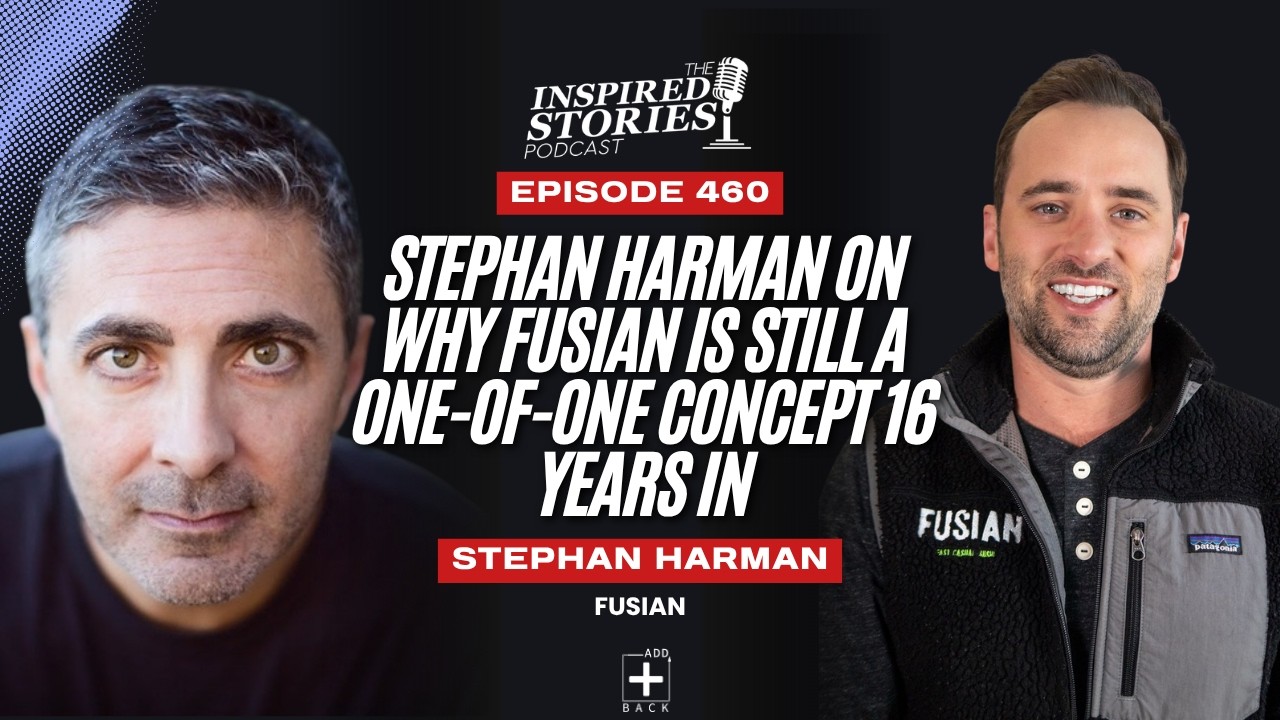
🎙️ From Sunday Sushi Parties to 7 Locations: Stephan Harman’s Bootstrap Build at FUSIAN
Stephan Harman, co-founder of FUSIAN, left the mountains of Aspen with no business plan, no restaurant experience, and a childhood friend who spotted an empty niche in downtown Cincinnati. What followed was 16 years of bootstrapped growth, continuous refinement, and a one-of-one fast casual sushi concept that still has no real competitor — and a goal of 100 restaurants in the next decade.
✨ Key Insights You’ll Learn:
Sunday sushi parties in Aspen that sparked the original concept
Opening first location in downtown Cincinnati with $130K and free rent for a year
Rice sheeter automation that made consistent fast casual sushi possible
Bootstrapped growth through IRAs, SBA loans, and landlord relationships
Six-month rice overhaul two weeks before recording — still perfecting the fundamentals
Kaizen philosophy driving 1% daily improvement across all seven locations
Bowls added after customer feedback — now a key dinner and hearty-eater vehicle
Delivery-optimized future prototype: smaller footprint, pickup window, fewer seats
Pace Line Restaurant Partners: COVID-era incubator supporting emerging food concepts
Father’s passing reframed the three-legged stool of family, business, and self
🌟 Stephan’s Key Mentors:
Taka (Sushi Equipment Manufacturer): Flew in the rice machine on day two and has been a partner ever since — attended the wedding, hosted a Japan tour
Costa (Angel Investor, Partner’s Father): First capital in the door and the voice of confidence when they needed the equipment
Kenichi Sushi Bar Staff (Aspen): Where Stephan and friends first learned sushi by watching and tasting
His Father: Whose passing reminded him to exhale, trust the team, and cherish the passing of time
His Co-Founders (Zach and real estate partner): Brought the vision together and showed up Monday morning ready to build
👉 Don’t miss this conversation about making something that doesn’t exist anywhere else, the cost of always going go-go-go, and why the most important thing at a sushi restaurant is still the rice.
Listen to the full episode here
Transcript
Anthony Codispoti: Welcome to another edition of the inspired stories podcast where leaders share their experiences so we can learn from their successes and be inspired by how they've overcome adversity. As you listen today, let one idea shape what you do next. My name is Anthony Codispoti and today's guest cried on a drive home from Aspen. He had spent two and a half years working at a hotel, making Sunday sushi parties with friends and realizing that the most expensive thing about a sushi roll was never the fish. It was the assumption that you needed a formally trained chef to make it worth eating. He left Colorado, not because he had a business plan, but because a childhood friend spotted an empty niche in downtown Cincinnati and told him to come back. What followed was 15 years of mistakes, momentum, and a growing conviction that sushi could be for everyone. Meet Stephan Harman. co-founder of Fusion, a fast casual sushi concept he started in 2010 that now runs seven locations across Ohio. He also co-founded Pace Line Restaurant Partners, an incubator nurturing the next generation of food concepts. And he has set his sights on 100 Fusion restaurants in the next decade, all without having ever taken outside money. 15 years in and he is still building the thing he almost talked himself out of. But before we get into all that good stuff, today's episode is brought to you by my company, AddBack Benefits Agency. Listen, if you run a business, you are likely stuck in the cycle of rising insurance premiums. You're paying more, but your team is getting less. And many people can't afford coverage at all. So we do things differently. We provide your QSR employees with unlimited access to doctors, therapists, and prescriptions that's always free for them to use. Here's the part that surprises most people. Unlike every other employee benefit out there, our program puts more money into your company's bank account. As an example, we recently helped a client increase net profits by $900 per employee per year. Results vary, but gains like that can change how a business is valued and the consultation is free. See if you qualify today at addbackbenefits.com. All right. Back to our guest today, the co-founder and CEO of Fusion, Stephan Harman. Thanks for making the time to share your story today.
Stephan Harman: Thanks for having me, I'm excited to be here.
Anthony Codispoti: All right, so Stephan, you graduated in 2008 with a degree in entrepreneurship at a time when those kinds of degrees weren't really a thing. When you got to that stage, did you have a specific idea in your head or were you just kind of trying to stay afloat and figure out, you know, one day at a time?
Stephan Harman: Yeah, know, think, you know, I graduated college in 2008, like you mentioned. 2008 was a weird time to try to get a job. You know, you had the financial crisis. Selling, you know, for another company didn't really seem like something that was particularly interesting to me. And, you know, I... I think I did what any person who didn't know what they wanted to do would do and moved out to Colorado to do a little bit of skiing, have a little bit of fun, work with my friends, learn a little bit about hospitality, and basically take a victory lap, if you will, from college and say, I didn't really have anything locally and I frankly was looking for a little bit of adventure. And that took me out to Colorado.
Anthony Codispoti: And so you had some friends out there, you liked to ski, and you found some work in, were you working in a hotel or a restaurant?
Stephan Harman: Yeah, so I worked at a hotel, you know, our mission at Fusion is connecting people through collaboration, culture, and cuisine. you know, interestingly enough, I think that predated Fusion, you know, my sister had a friend who she had met through some friends. And when I told her was, when I was interested in moving to Colorado, she said, need to talk to my friend. He could probably hook you up with a job. And I said, any job will do. And, uh, I became what was known as the Gantt Man, which was a resort in Aspen called the Gantt, which is a great place, but was kind of a legacy job. It's kind of a little bit of a fraternity, if you will. This resort was built in the 60s or 70s and the Gantt Man position was responsible for being a bellman, for guests, picking people up at the airport, taking them to the hotel, driving them around town. Every now and then you get a family that wants to go mountain biking or skiing together. And so kind of a mobile concierge, if you will, for our guests. And I think another neat thing about the hotel was it's a condo as well. So there were owners that would lease the, or out their condos. So you had this mix of transient guests and you had a mix of owners who would come and enjoy their property. You just got to meet some really cool people from all around the world and learn people's names, which I think is always so important.
Anthony Codispoti: And was this your first time cutting your teeth in hospitality?
Stephan Harman: Of sorts. I worked as a caddy in high school You know, worked in a bag room at a local country club and you know, I think that service is just one of those things that you know when done when done from the heart is It just gives you tremendous joy, you know making others happy and so you know whether it was college clubs or or Being a caddy and performing a service on the golf course. I think it I think it's always kind of been in my nature to you know, make other people's experiences more enjoyable.
Anthony Codispoti: So even from a young age when you were a caddy, it wasn't like you got out to Colorado and there was some powerful mentor that kind of showed you the ropes.
Stephan Harman: Yeah, no, was, I think, to be hospitable is probably to be genuine as well. And so I think that it kind of was something that just kind of lived within me. And I just take so much joy in meeting other people and learning their stories. So it really wasn't about a formal training or going to school for hospitality so much as, me a little bit about yourself and if you're interested, I'll tell you a little bit about me too.
Anthony Codispoti: I love that. Okay, so walk us back to how these Sunday sushi parties got started.
Stephan Harman: Yeah, so, you know, I was, I was 21 years old, in a resort town, there's, there's somewhat of a barter economy, you know, I'll give you a ride to the airport. If you hook me up for a dinner or, know, if you, if you could take my shift tomorrow so I can go skiing, that'd be great. you know, typically at the end of the season, there'd be raffles for hotel stays. If you, you know, brought you know, brought people in for a concierge dinner to learn about a new con, a new restaurant in town. But, you know, total, total barter economy. had a friend from, from New Zealand who owned a whitewater rafting company. And he'd be like, I got an extra spot if you want to come, just make sure you tell the guests at the Gann about it. and, we, so I think a lot of it was, you know, just kind of experiencing other people's, other people's kind of day job. Aspen's tiny little town, but At the time there were really four places to get sushi, which if you think about a small town, there's a lot. You could go to the grocery store. You could go to Nobu had a restaurant there, Matsuhisa. There was kind of the locals place, was Kenichi. And there was really getting dressed up, paying a lot of money to go to Matsuhisa or Kenichi or maybe Sacrifice. Yeah, very fancy restaurants. you might get a
Anthony Codispoti: because these were fancy restaurants at the time.
Stephan Harman: free drink from the bartender, might get a free edamame, but you're still going out with friends and it was kind of reserved for special occasions. I if it was your birthday, we'd get a group of friends together, rent a room, or you would go alone, right? And you'd sit at the bar and maybe learn a thing or two from the sushi chef. The other option was to go to the grocery store, which was good for on the go, but really you kind of compromised. you probably compromise a little bit of quality, but really also kind of the unknown of when was this made? What's in it? How long has it been here? And maybe not getting exactly what you'd like. And so we really, we would try to do Sunday dinners just as kind of friends. We were bunked up pretty tight in town. There's just not a whole lot of space. so sometimes it'd be spaghetti dinners. Sometimes it'd be make your own pizzas. but we went and got all this food from all these ingredients from, from the local grocery store. And there's a butcher shop as well, where we got, we got our fish from and we just started kind of making sushi, you know, and, and, and for no other reason than it was different, right? You know, it's easy to boil a pot of water and make pasta. you know, pizza feeds a feeds an army, but you know, there was, there's, there's some novelty about rolling your own sushi roll and trying to make it look nice. And I think that kind of caught on, you know, people like, you doing sushi this weekend? Like, yeah, sure. And then like it got into like, you know, why don't you just go make your own roll, you know? And then people would start making their rolls and who made the best roll? Who made the prettiest roll? Who, wanted cream cheese with their tuna? Who wanted avocado with their tuna? Who liked it spicy? Who liked it sweet? And so, you know, really everybody ended up making their own rolls and, we would just put them on a platter and, know, probably drink some wine or some beer and, and kind of let the Sunday sundown kind of come down and start our week out fresh. And so, you know, I think it was never an intention for us to take that and make a restaurant out of it. It was really just, you know, trying to feed as many people as we could on a budget. And so that was probably kind of the genesis to at least learning how to make sushi.
Anthony Codispoti: And so was there somebody in the group who already knew how to make sushi? Were you guys using YouTube videos? Or what were you doing?
Stephan Harman: Yeah, well, I I think we learned a lot from sitting at the bar at Kenichi. know, I think, you know, sometimes the chef would come up and he'd say, you know, what do want today? And you kind of have a conversation about it. And you surprised me, right? a kind of omakase style. And so I think that we had at least visual experience of like, you know, how it works. But yeah, it was probably a combination of maybe some early YouTube videos and some, and some... trial and probably more trial and error than anything. At its core, sushi is really about prep. It's slicing your fish, slicing your green onions, slicing avocado, finding fresh produce, which frankly is, I'd say the easy part. think that the hardest part about the whole sushi endeavor is making sushi rice consistently. at least at home, you can make two different pots of rice and they can turn out completely different, how much you season them, how much you mix them with sushi vinegar, even what kind of rice are you using. I mean, there's so many different varieties of rice. And so, you know, I think from a perfection standpoint, perfecting the rice, you know, was always the hardest part and continues to be the hardest part.
Anthony Codispoti: And what can you say about what you've figured out? Keep it stable.
Stephan Harman: You know, it's interesting. think we've really kind of gone full circle on this. First of all, you pay for it. It is always worth it to buy a premium rice. Frankly, rice cooks differently in the summer than it does in the winter, depending on the humidity in the air, depending on the temperature that the water comes out of the tap. Whether the crop was harvested this year or last year. You you can you can age rice like a like a wine So some you know, some chefs prefer, you know an older rice to a newer rice changes the moisture content that's in the rice Broken kernel or broken grains versus whole grains so, know, think what have I learned is is it always pays to to buy a premium rice because The milling process changes from from manufacturer to grower And you know, it's you know, even most recently we We just actually completely overhauled our rice process to become more consistent as we continue to scale. Through trial and error, I'd say it is about being a great rice, but also the Japanese philosophy of just perfection is in every single nuance of the process. so you have to be really disciplined on. how much you wash it, how much you soak it, how long you cook it for, how long you let it hold for, much rice vinegar do you mix with it. So it's about being precise.
Anthony Codispoti: So what's interesting to me is, we're skipping ahead, obviously, but you've been doing this 15 years or so. Do I have the timeline roughly right? Okay. And you're telling me that you just recently did an overhaul on your rice process. I mean, you guys have been learning, tweaking, learning, tweaking all along the way. And here you are 15 years in and something as foundational as the rice, you still found an opportunity to do not a tweak, but what you called an overhaul.
Stephan Harman: Yeah, know, it comes to consistency. So when you have seven restaurants operating as north as Toledo and as south as Cincinnati, and you know, it's so interesting, the water in Greene County is harder than the water in Cincinnati. you have things that you cannot control for. You know, if it's, if again, the water's coming out of the tap at a colder temperature, we have to take a temperature of the water. But ultimately, what it comes down to is, I wasn't happy with the consistency we were getting with from restaurant to restaurant. Our teams were doing the best they could to follow our standards as closely as possible. But inevitably, there were things about our rice that just were not creating consistency that we like. so we actually went out and found a Japanese chef to kind of look at our rice process and say, we got to be able to do this. coast to coast, we got to be able to do this consistently. And if there's one thing that's important, if there's one thing that's important, it's that our rice is perfect. Not having good rice is like an ice cream shop without a cone. You just can't serve it. And so we went through, we probably tried four or five different varieties of rice. We tried four or five different processes. We tried to standardize some more of kind of the critical control points of how long do we let it soak for, how much do we wash it, how vigorously do we wash it. And ultimately the outcome was like, I've been keeping a tally in my head as I think I'm 10, and we just did this two weeks ago. It took us six months to do something that was just seeing the light of day two weeks ago. I'm happy to report that I think I've eaten at the restaurant 10 times and I'm 10 for 10 on perfect rice.
Anthony Codispoti: All right.
Stephan Harman: You know, it's really about, it's really about, um, you know, one, our, one of our core values is Kaizen, right? Like our, our rice was never bad. It just wasn't good enough. And so Kaizen is this Japanese philosophy of, of continuous improvement. So if we can just get 1 % better on our rice, if we can get 1 % better, you know, on our, on our, on our process, then the outcome will become much better. And so we just felt that this was the right thing to do in order to, uh, you know, continue to create a consistent experience at all of our restaurants.
Anthony Codispoti: Okay, so let's back up, Stephan, because I want to see, I want to go walk through how you got from Colorado to Ohio and how this first location came about. We mentioned in the intro that you're doing this drive across the country and you break down into tiers. So walk us through why were you coming back? Why were you leaving Colorado?
Stephan Harman: Yeah. You know, was this interesting kind of paradigm shift. When I was a child, I was in Boy Scouts, I was in Eagle Scout. Kind of that Colorado life was in my DNA. My parents were super supportive. Go out, have fun. I actually have more family in Colorado than I do in Ohio. And so it just kind of was... I just felt home, you know, in the Colorado Rockies and whether it was Aspen or any town in Colorado, just that felt like home. And so, you know, I think that it was that moment in time where I'd been there for two years. I knew that I was not going to make a career out of being a bellman. I loved it, but you know, it was time to get a quote unquote real job. I didn't even know what that real job was. And I think that the opportunity was, you know, move home, you know, start a business and, you know, try it. And I think I was sad because I was leaving the most beautiful place in the world to go to a place that was so familiar. You know, I was leaving the active lifestyle that I knew that, you know, was so readily available. You know, I had made a whole new set of friends, you know, from... from all over the country that I wasn't gonna see every day. And I think that on the surface, I loved everything about my life. I really did. And I just had this realization that this chapter is probably over. Come out and visit, still love to go visit, still have friends there. But this chapter's over and I'm going on a different path than most of my other friends that chose to stay. And... You know, I think it was probably a little bit of, it was probably a lot of fear, a lot of uncertainty. Um, you know, I had never worked in a restaurant before in my life. You know, I, um, was, you know, it was going to have to hire people. I was going to have to, you know, probably fire people. I was going to have to, you know, figure out how this concept was even going to work. Uh, I was going to have to, you know, find, um, you know, find, uh, what my place was going to be in this, in this new endeavor. And I think at the time I probably felt like a step backwards. I had so much momentum doing what I was doing, but I had faith and trust that I was going to create something bigger and better that would hopefully afford me to come out there when I had my own family. so that was probably where the tears came in was mostly fear. Fear in a sense of closure.
Anthony Codispoti: So when you're coming back, you already have in mind what it is you're going to do when you get to Ohio. You're going to start this business. so we kind of laid the foundation for the idea came from these Sunday sushi parties. But how did you get from a Sunday sushi party to, I'm going to open a restaurant that does this. Help us with that bridge.
Stephan Harman: Yeah, so I mean, it really was this like, you you talk about connecting people through collaboration culture and cuisine, you know, one of one of my co-founders was was working as a commercial real estate agent in Cincinnati. And he kind of had this eureka moment that was like, you know, there's no sushi in downtown Cincinnati. And, you know, he he's like, you know, Cincinnati is downtown. Cincinnati is the most heavily populated area from the hours of nine to five in Ohio. You know, it's. People come downtown, they work at Procter & Gamble, they work at Kroger, work at these Fortune 500 companies. And he said, know, sushi doesn't really exist down here in a way that people can access it for lunch. He had met a chef and thought that maybe they could open an all-you-can-eat sushi buffet. You know, that did not sound like something that was scalable. It didn't sound like something was fresh. It did not sound like something was, you know, maybe... going to appeal to the next generation, if you will. Because if sushi has to be one thing, it's got to be fresh. And then we had to capitalize from basically 11 to 3, know, lunch hours. So really, he had found this location. It was 5,000 square feet. It was two floors. was a former, was a dilapidated former urban mall, downtown Cincinnati Mall, Tower Place Mall. this, this space had no business being a restaurant. had no infrastructure. It had a two story fountain, which we thought was pretty cool. But, but really, I mean, this, this place was, you know, I think you could put it all of our current restaurants inside this space. It was so cavernous. but you know, he had negotiated free rent for a year. And I think after that, it was like a thousand bucks a month. And so was like, it was very inexpensive for us to get started and really try this, this, this new concept out. my other co-founder, Zach was living in, in Columbus selling mortgages. He came down one morning and he said, this looks pretty cool. I want to be a part of it. And, you know, showed up on Monday and said, let's do this. And so really you had the three of us kind of arm in arm, you know, working towards, you know, working towards this vision of how do you make sushi in a fast casual environment? A place that you want to work that you could work, you know, that has great music playing, that has fresh food, something, a place you'd want to eat every day. And, you know, it really was kind of, you know, a combination of all three personalities coming together into the restaurant.
Anthony Codispoti: And so what did it look like in those first days when you opened up? What were you guys serving? What were you seeing in terms of foot traffic? Walk us through it.
Stephan Harman: Yeah, let's see. I gotta go so far back. The walls were basically painted by us. The sign on the front door was hung by us. We were called Soho Sushi at the time. We weren't even Fusion yet. I think the name was actually the last thing that we could figure out. But day one, we opened. I still have a picture somewhere of our first customer. and, you know, to no fanfare, we didn't do any marketing or anything. We just kind of opened and, we kind of let our, our hospitality bug take, you know, take hold, you know, learning people's names, learning what they liked about it, you know, talk about vulnerability, you know, like, you like our food? You know, I think people could clearly look at us and see that we weren't, you know, using our family heirloom recipes here. You know, we were really trying to make something that people really enjoyed. And so. You know, it became a feedback loop with our customers of if they like it or not. The first day, think, City Beat Magazine came in and wrote a story about us. They said, you know, we've never had hot sushi before. And we're like, no. Like, we're serving steaming hot rice. This is not going to go over well. But I remember the article said, the guys were so nice and so friendly that we're going to give them a month and come back. You know, after that day, after that article was published, we called our friend Taka, who was in California, he's a manufacturer of sushi equipment. And I said, you know, we said, how do we make this rice better? He's like, I told you you were going to need it. It's going to be $13,000. And I think we had $0 in the bank. Taka put the machine on a plane, flew in the next day. And from then on, You know, our rice was, was much better than it was day one. even, I said today, we're still perfecting it. but, you know, I think we knew it was working when we saw the, you know, the return customers, right? The people that came in maybe after not the great experience to see it, you know, our improvements. but you know, any restaurant you ever go to, you know, must survive on, on repeat business, unless you're in a hotel or unless you're in an airport or something, you know, we must survive on repeat business. so. It was really about making sure that we were creating an environment that was friendly, clean, and a place that people wanted to come back. And so all of that came from the feedback that we were getting from our customers.
Anthony Codispoti: So what was that piece of equipment that they flew out? What was it doing differently to the rice?
Stephan Harman: Yeah, so basically, you you know, in a world of automation, in a world of robotics and AI that you hear about today, you know, the Japanese have been so far ahead on some of these things, at least on the food service side. you know, the, as you started the podcast, you said, you know, you know, the, the, expense of sushi, what wasn't really in the, delusia. I think I lost you.
Anthony Codispoti: All right, let's try that again.
Stephan Harman: I lost ya.
Anthony Codispoti: You seem to have an unstable internet connection. Can you hear me, Stephan?
Stephan Harman: Can hear me? I can hear you, you're a little spotty. just, I took your advice and got hardwired in before this, so I'm just, I think, I don't know if it's on your end or my end. Can hear me?
Anthony Codispoti: Yeah, I can hear you. It is choppy. I'm going to open up Zoom and see if we've got any better luck there.
Stephan Harman: Hello? Sorry about that. I'm Yeah, cause I think I'm... think I'm... Looking alright.
Anthony Codispoti: Hey, I just came back. don't know. Yeah, maybe maybe we try Riverside again. But if it doesn't work, we'll switch back to, we'll switch over to Zoom. Okay.
Stephan Harman: All right, you sound great. You look great.
Anthony Codispoti: Yeah, hopefully that was just a little hiccup. Okay, so we'll start off with the the rice machine. Okay, back from technical difficulties, Stephan, what was the rice machine that they this guy flew out from California's $13,000 piece of equipment? What was it gonna allow you to do differently?
Stephan Harman: Mm-hmm. Yeah Yeah, as you said on the original or kind of on the intro to the podcast, you know, a lot of the expense of sushi historically here in the United States has been due to the labor, you know, bringing bringing in an expertise from overseas. We tried we did, you know, a trial run of I guess I have to back up a little bit. We did a trial run of trying to make sushi on the fly in a fast casual environment. laying the rice out by hand, cutting it by hand, and we just realized that we were never going to create the consistency and speed that we needed in order to really capitalize on that downtown Cincinnati lunch. So I had found a guy on the internet just through some, just through some, you know, research who, who owned a company here in the United States that was, that was automating some sushi, sushi robots. So they had what we call a rice sheeter, which would essentially print out a perfect square of rice with the perfect portion. Some people call it a printer, some people call it a sheeter, but basically it lays a sheet of rice down that's a perfect rectangle to fit on the nori or the soy wrap. Good question. So we cook the rice.
Anthony Codispoti: Not print. What do mean by print? So does this machine cook it? And then no.
Stephan Harman: This machine goes through a series of rollers. So think of like a dough sheet or something like that, you know, that a bakery might use. Basically, you put in your cooked rice, it goes through a series of rollers and lays out a perfectly portioned rice sheet, which is the basis of every sushi roll. And so we learned about that machine. And then the other, you know, I guess, technical pieces is,
Anthony Codispoti: Okay.
Stephan Harman: is cutting a sushi roll. So some sushi rolls are six pieces, some are eight pieces, ours are 10 pieces. And so we had to find a machine that would allow us to cut 10 perfectly sized pieces every time. This gentleman, Taka, who also had a machine that serviced this. In Japan, these are largely used for schools, hospitals, large format food facilities. But for us, we basically took it and said, we want to make a sushi restaurant using these. So he originally came out to show us these products. And he kind of winked and said, you you guys are going to want the rice machine. I'm just telling you now. And what's the rice machine? Rice machine perfectly mixes, call it 20 pounds of rice with sushi vinegar and cools it off in about five minutes. So. Traditionally, want a sushi roll to be right around 98 degrees body temperature. When it comes out of the rice cooker, it's 212 degrees because it's boiling. so I guess historically or traditionally, would see Japanese sushi chefs put rice in a big, large bamboo bowl and maybe have a fan that they're cooling the rice down, mixing the sushi vinegar with it. This automates that process. He kind of winked and said, you're going to want this. And we said, no, no, no, we'll figure it out. We'll use the fan. We'll use the bamboo dish. And he goes, OK, well, if you need me, call me. And the next day, we were like, we need you. And he came and he gave us, essentially, the machine off his back and said, I told you we were going to need it. And Take has just been a wonderful human being to us. was at my wedding. He's taken us on a tour of Japan for a couple of weeks and really kind of shown us. that what we're doing at Fusion might not be the most traditional thing, but in many ways it is a very Japanese thing to make it accessible and fun. so fast forward 16 years, we have, let's see, we have five, minimum five of his machines in all of our restaurants just to help with that consistency piece.
Anthony Codispoti: So let me see if I understand all this correctly. A big part of what has made sushi so expensive is because it's labor intensive and a big part of that labor has been this process of preparing the rice. And so now these machines that you have several of is one of the things that's allowed you to help make your sushi more accessible to folks.
Stephan Harman: Totally, totally. Yeah, and then it's, you know, when you take the ingredients of a sushi roll and just lay them out, you know, it's not that dissimilar to what you might have for dinner, you know? Like today we have sweet potatoes, we have cream cheese, we have chicken, we have tuna, we have roasted salmon, carrots, avocados. So, you know, most of the ingredients that go into sushi really aren't that, you know, obscure. So it was really about taking familiar ingredients, showcasing them in a fresh way and automating the pieces that typically take a lot of, I would say, experience. So we do all the prep in our restaurants to break whole ingredients down to sushi roll or we also serve bowls, portions. And then we utilize the technology to really help us standardize not only the consistency but also the efficiency you know it we can we can make this this this shooter that i'm talking about can can pump out a hundred and fifty she's in probably thirty minutes so you know it's a you know it in in this these aren't secrets right there these are right in front of you when you come into a restaurant you walk down the line you see these things frankly they're pretty cool talking point for for first time guests
Anthony Codispoti: So I want to go back to the fact that you guys were able to open this restaurant without any outside money. And I understand part of this, right, because you negotiated free rent for a year and then it's a thousand dollars a month after that. But even still, you've got to have a little bit in savings to be able to, you know, buy the fixtures, you know, get the equipment, buy the food. Where were you guys getting those funds?
Stephan Harman: Mm-hmm. Yeah, so we have an angel investor who was the father of my two partners, put up the original money to paint the walls, so to speak, and put the sign on the door. He was the guy that we called when we said, oh no, we need this piece of machinery. credit to him, was like, absolutely, you need that. That makes so much sense. And we're like, are you sure? But from there, it was... You know, it pretty rapidly, we felt like we were onto something. You know, we opened, I think, our second restaurant 18 months later. You know, we all had a little bit of savings, you know, from, you know, maybe call it high school birthday parties and high school jobs and, you know, maybe a little bit left over from Colorado. But we cashed out our IRAs, 401Ks. And we basically used it as a down payment for our second restaurant, which we were able to get the bank to listen to us. You know, but it's not always about the money to open another restaurant. Sometimes it's about getting the landlord to even listen to you, you know, being a 23 year old, you know, lead company with no credit, no runway. You sometimes it's about the landlord to, you know, believe in you and find you to be credit worthy. So, you know, I think that, you know, we've, we've, you know, spent 16 years, would say bootstrapping this, um, through, know, trial and error through, uh, you know, we've worked with the SBA, we've worked with landlords. Um, but, know, really the catalyst was, it was that first, first investment, you know, I think, I think we opened our first restaurant for like $130,000. Um, which, you know, I guess 16 years later sounds like nothing, but, know, I think, I think probably $50,000 of that was. the sushi machine. So, you know, we really, we really took a Midwest approach to this, you know, getting this restaurant off the ground. And I think that, you know, the best lessons are always the ones that are hardest learned. you know, it's, you know, we've, we've, we've made plenty of mistakes along the way. Um, you know, I don't know if, you know, the 23 year old me would have, you know, taken on investment and had a hundred by now, or, know, 16 years later, we're sitting here with seven really awesome restaurants. What is the best path? But I think that the path that we've chosen so far has really afforded us to really build this thing with a very solid foundation because we've been limited on the capital side.
Anthony Codispoti: You guys have just learned how to be incredibly efficient. And so where did that second location open up? First one was in downtown Cincinnati.
Stephan Harman: Yeah, my partners and I were from Dayton, Ohio. So was about 45 minutes up the road in Dayton. I had gone to the University of Dayton, which was about five minutes from our childhood home. And they had built a building, I don't know, maybe in 2006 maybe, and really didn't fill up. was right at the gateway of the university. We knew about the property. Again, one of my partners was a commercial real estate agent and so he You made a phone call and said yeah, you know, they've had a little bit of trouble easing the space It was again 2008, you know, there wasn't a whole lot of you know economic development in the area and We got what we felt was a good deal five minutes from our from our house and being 23 years old You know our friends were some of our friends were still in town. Our friends parents were still in town. We could really Advertise if you will or market our restaurant to our hometown community, which I think really was invaluable. We always said that we wanted critical and loyal customers, right? And so I think that going back home afforded us critical and loyal customers. Like if we had a bad day, if we had bad batch of rice, they weren't going to hold it over and come back. we had the relationship where can invite them back. And I think that you even take that theory of critical and loyal customers and you expand it out to Ohio. I think that the Midwestern approach is there is a lot of loyalty here and there is a lot of moderate personalities that allow you to fail your way upward. I think that second location certainly allowed us to trial and error a little bit more having two restaurants. then as we grew from there, we went and found our people who were critical and loyal that we didn't know.
Anthony Codispoti: Critical and loyal. And so were these the folks that helped to steer you? Because you guys started out with the roles and then at some point you added bowls in. How did that happen?
Stephan Harman: Mm-hmm. Yeah. You know, I think it was a logical kind of menu expansion. You know, one of the things that we noticed is when we first opened is that females loved us. You know, it was the perfect portion for the female appetite. You know, as we kind of realized that, know, as inevitably, you know, our customer base grew, We kind of got some feedback that maybe one roll wasn't quite filling enough and two rolls kind of puts you out of that price point. then we looked at our menu ingredients and we said, well, these can be served in a bowl. Poke was certainly kind of growing as a segment. You had other fast casual serving food in bowls. We basically said, people are craving our fresh ingredients. ingredients it doesn't necessarily have to be bite-sized sushi rolls it could be a salad it could be you know a rice and salad mixed you know base putting all the traditional flavor all kind of all the familiar flavors of fusion into a bowl kind of allowed us to kind of create a heartier you know meal option that helped with the dinner segment helped with you know the heartier eaters you know and as you kind of play that forward you know I think we probably did that ten years ago You play that forward, sushi still makes up the predominant mix of our sales. But it kind of gives you another dining occasion too. So you might not want to roll today. Maybe you're craving a bowl, but you might want to roll tomorrow. so it's really given us kind of another vehicle to serve customers appetite for lunch and dinner.
Anthony Codispoti: So I'm in Columbus, Ohio. I've actually had the pleasure, it's just a couple of miles from where I live, you're a Grandview, Ohio location. I've visited several times. And so I can tell listeners that those bowls, that's what I'm drawn to. And talk about hearty, I get typically two meals out of one of those things. So it's a great value and they're real tasty. And it's the kind of thing where you go down the line and write. You sort of choose your base, whether it's the rice or it's the salad or a combo of the two, and you choose your protein. And then there's all these other toppings, ingredients that you can mix into it.
Stephan Harman: Yep, that's exactly right. We say that we're Asian inspired, right? And so we have a roasted chicken that we roast in-house that I would say in its pure form is a pretty neutral flavor. But when you mix some of the sauces and dressings that we have with it, you kind of have an Asian-American fusion of flavors in a bowl. And we can kind of take advantage of some modern dietary preferences, whether it's gluten-free, watching your macros, eating whole foods. think that's really where we've been able to stand out is to serve ingredients that maybe you can't get everywhere else. Again, most of what we do is slicing and dicing, so these are mostly served in their raw form. We roast our asparagus and we roast our chicken. We put roasted sweet potatoes on the menu during the cooler months. But generally speaking, we call it eating with your eyes. So you walk down the line, you're like, I like that ingredient. I think that would go really well with my rice.
Anthony Codispoti: Yep, can vouch that's exactly what it feels like. And so you guys when you started this 15 or 16 years ago, you were an innovative concept, right? This kind of thing wasn't really being done anywhere. Now 16 years later, how many competitors are copying what you guys do and nipping at your heels?
Stephan Harman: You know, it's interesting. Sushi is more popular than it's ever been in the United States. know, have frequently, I mean, I have young kids, but frequently we have five-year-olds, six-year-olds coming in to eat sushi. You know, so sushi as a meal item has only grown in popularity. When I look across the kind of competitive set, of course, You you could probably throw any fast casual restaurant, regardless of cuisine, into the competitive set. You know, you could even throw grocery stores into the competitive set these days with, you know, Whole Foods is a restaurant, you know, in many ways. And so the unique thing that we do is, you know, custom sushi rolls, 10 pieces, meal size sushi rolls. We really haven't seen anybody doing it. I don't know if that makes us... Still innovative and and and pushing the envelope or just the only one who's who's really gone all in in it So yeah, I think that you know 16 years later. It's still think we're a one-of-one concept You know I think that as we look to to to the future. You we're we're so perfectly Set up for for delivery. You know our food travels. Well. It's not like a French fry which you know if you put it in a box and you put it in a bag and you put it in the car and it gets there 30 minutes later you It's no longer crispy hot French fry. Our product arrives nearly identical to how it left our restaurant. so as you look at the proliferation of delivery, if you look at the proliferation of online ordering, order ahead, curbside pickup, even pickup windows, which we have not gone there yet, but I think is a logical expansion to a future prototype. our food just travels so well and I think that we continue to in many ways make sushi more accessible to the masses. I've always said if you love sushi, you'll love us. If you don't like sushi, you'll love us. I mentioned the six year old eating sushi, we have a peanut butter and jelly roll. I think that's a good gateway into the world of sushi. Yeah, exactly. This was an idea of one of my partners.
Anthony Codispoti: peanut butter and jelly like inside of the rice? Is that? Yeah.
Stephan Harman: who's now wife went to summer camp and they would make peanut butter and sushi rolls where they'd take essentially, it's called a tortilla and put peanut butter and jelly, roll it up, cut it into little spirals and call it peanut butter and jelly sushi. Well, he said, what if we use a soy wrap white rice, which is a little bit sweet, put creamy peanut butter and jelly in it, roll it up and cut it. And if you close your eyes and eat a peanut butter and jelly roll, mean, it is... one part dessert and one part the familiar flavors of your childhood. And so, you know, it's a good conversation starter, but it's also great, you know, it's great for kids, it's great for adults who feel like kids.
Anthony Codispoti: Okay. that's fun. I wonder if I can get my kids to try that. We're gonna have to give it a shot. So I love this story up to this point, right? Seven restaurants, you guys, you know, didn't take outside money, you're doing this bootstrap and the whole thing. But now you've got a pretty audacious goal. You want 100 restaurants in 10 years. How are you going to do that? Are you going to start taking outside money? Are you going to franchise? What's the plan?
Stephan Harman: Yeah. Yeah, if I had that answer, the fully baked out plan would probably be there by now. But I think what it starts with is perfecting the model, right? So we talk about things about, we talk about ideas like perfecting our rice and making sure that our model is repeatable. Frankly, we've spent 15 years really trying to hone in on having the right players on the team, having the right leadership in the restaurants. you know, having a good expectation on financial returns of a restaurant, you know, with delivery, as I was just mentioning, like, you know, we don't need 12 restaurants in a market anymore because of, because people are so encouraged to, you know, to, get their food delivered. so, you know, it's really about, you know, you know, how do, how do we strategically position restaurants across a given market? and so, you know, a lot of, a lot of that goal. is predicated on us being able to show consistent returns and consistent operations. so I'd say over the last 18 to 24 months, we've just become really dialed on, you know, on kind of quote unquote the model. As we look to grow, you know, think that, you know, franchising is certainly, you know, a way to grow. You know, this, Much of the US economy has grown through franchising, from a small business standpoint. I would say my preferred franchisee would be someone who operates restaurants and understands how to operate restaurants. At the same time, think that finding outside capital that can share in the risk, but also share in the reward in helping identify future markets, leave our home state of Ohio. You know, I mentioned to you earlier, we're a little seasonal, you know, through the winter months here in Ohio. So, you know, what does it look like if we go someplace more temperate? What does it look like if we go into a city that looks and feels like say a Columbus, Ohio, but with, with, with, you know, a more consistent, you know, climate. I think it is probably the logical next phase. you know, ultimately I think if it works in Dayton, Ohio and it works in Columbus, Ohio, it could work anywhere. but, but.
Anthony Codispoti: mean, these are testing grounds for restaurants. Yep.
Stephan Harman: Absolutely. mean, we're in Toledo, in Cincinnati, we're in Columbus, we're in Dayton. You know, I think that you open one up in Nashville or Charlotte, and you're going to see a lot of the same type of people walking in the door and enjoying our food. you know, think the first step is to find a partner that would help us kind of continue to prototype, continue to build. So then we can have a little bit more of a cleaner package if we did choose to franchise from there. But ultimately, know, the biggest driver for growth for me is really about our team. know, growing the restaurant, you know, business can only happen at the speed in which your team, you know, can continue to grow. so much of kind of my purview on growth is having the right people on a team that can support the growth. And so, you know, I have, we have, have an amazing team. Our restaurant operators are awesome. Our team members are awesome. You know, if I never had to hire someone from the outside, that'd be amazing, but you know, creating, creating career paths for our team to grow, uh, is super motivating for me.
Anthony Codispoti: So say more about the team because tight labor market, right? Hard to find good folks, hard to hold on to them. How do you approach that from, you know, a hiring or retention standpoint?
Stephan Harman: Yeah, you know, one of my favorite questions as I'm going around the restaurants is why do you work here? You know, I mean, why, why do you, why do you work here? You can work anywhere, you know, you look across the street and there's a Panera bread, there's a Chipotle, there's a, know, any, any, you know, call it large restaurant operators typically right in our front yard or backyard. And I think what makes fusion so unique is, you know, we're not standing over friars all day. We're not sitting, we're not standing over, you know, know, large prep lines, cook lines, you know, it's a very clean environment. People like working with their friends. So I think that we have a, you know, a pretty good team dynamic on the restaurants. You know, it's a good question. would tell you that, you know, being a founder led company, being a small company, think, you know, we're able to, to, move pretty quickly and, and, and pivot, and pivot pretty quickly and give people maybe opportunities that they wouldn't find in other restaurants. And so, you know, we have 15 years in and all of our managers are saying, we're still getting, we're just getting started. And I'm like, yeah, that's exactly right. You know, we spent 15 years building the foundation of this thing. And, know, if you want to. you know, work on an opening team and we inevitably go to Charlotte or Nashville. you know, that that starts now. And so I think that the career path, you know, is kind of a big, big fish in a little pond, right? We're a small company that's growing and people see, you know, a career kind of honing their craft in a sushi restaurant. So, you know, I think that, you know, in many ways, you know, the restaurant business has this has this stigma that, you know, it's a high turnover industry. I really couldn't agree less. People don't really leave the industry. They just go to another restaurant job. So our focus is on just be becoming a great employer. So, you know, they, they find their home here at Fusion and not, you know, chasing the next shiny object.
Anthony Codispoti: Shifting gears on you now, Stephan, what's one of the hardest things you've ever had to overcome personally and what did it teach you?
Stephan Harman: Yeah, you know, I think that, you know, it's interesting. You have this three legged stool. Some people call it, you know, your family, your business and yourself. And, you know, I've loved the business for a long time. You know, I've loved the business longer than I've known my wife. I've loved the business longer than I've known my kids. But I don't love it more. I don't love it more. But, you know, When you have passion for something, it's sometimes hard to find that balance of the three-legged stool. You kick it out and the three-legged stool will inevitably fall. And I think that one of the hard lessons that I've had to live with even recently is just life happens. I lost my father two years ago. And that was an emotional time, obviously. And, you know, it was how do you give this the space that you really want it to have knowing that you also have, you know, a business to run and a family to take care of. you know, I think just finding that time, you know, some people call it a clarity break just to kind of exhale a little bit. You know, it's really, I think that so much of maybe the entrepreneurial mindset or just career mindset in general is go, go, go, right? It's just onto the next thing, onto the next thing, onto the next thing, but taking time in a moment just to appreciate life happening, celebrating some wins, serving the ones that you love, taking vacation. I just think finding that time to just kind of exhale, knowing that hard decisions are gonna come, hard moments are gonna come, people come into the business, people leave the business. people don't, people end up not being who you thought they were, you know, and you might have to, you know, separate, or, know, or, or just, you know, kind of being a giver, you know, can, can certainly, you know, certainly manifest, you know, I think different, different, you know, outcomes that, that maybe you're not always aware of. And so I think just balancing the entire, you know, kind of whole of life around. trying to run a business and have it be successful while taking moments to kind of appreciate along the way. Sometimes just being calm, you you kind of get in this mode that just, you know, it's go, go, go. And, you know, I think that anything is only worth doing if you can enjoy the journey. And so, you know, taking those moments in time just to stop, pause and say, you know, this is good.
Anthony Codispoti: So was the passing of your father kind of a catalyst for you to think more about taking the time to stop and breathe and enjoy all these other moments in life?
Stephan Harman: Yeah, mean, yeah, totally. You know, I also think it's a reminder that I am a father, right? And, you know, there's also being, you know, as present of a father as I can. But yeah, I mean, the passing of time is this thing that is kind of an enigma, but, you know, just enjoying it. And, you know, I think that, you know, I that just recognizing that. You know, there's a commencement speech that I love. It was at Kenyon University. It was called This is Water. And it's a story about this goldfish who's going through the water. And older goldfish passes these younger goldfish and says, hey, kids, how's the water? And the kids go, what is water? And I think that, you know, the The passing of my dad is recognizing that we're only here for a short amount of time. Give as much love as you can. Enjoy every moment that you can because it sounds trivial, but you just don't know how long it's going to last. so how do you take a moment to really, how do you take a moment to take a moment, but also trust the people that you've put in place to carry the sail if there's a moment in time where it's... you just don't want to or you can't or you're going to be away. And so I think that a lot of it has really put things into perspective of saying like, you have a team. We can rely on the team. You don't have to be there for everything. You don't have to meddle in things that aren't important when there may be more important things that don't even involve work happening in your life.
Anthony Codispoti: So in 2020, you co-founded Pace Line Restaurant Partners so that you could help to incubate new food concepts. You're still at a stage where you're focusing on growing your own brand. Why take on this extra weight?
Stephan Harman: Yeah. Yeah, I mean, think COVID, you know, was this moment for restaurants that was a little crazy, just to put it lightly. You you saw a lot of proliferation of, you know, people who, you know, basically just had to try to figure something out, right? So people got furloughed and they were like, you know, how can I make money during this time? You had restaurants vacating spaces. You had you had dining rooms that were essentially empty. And at the same time, there was this opportunity of like, do we, when everybody else is kind of like, you know, you know, turtling a little bit and kind of protecting, how do you take this moment to like, maybe be a little, you know, just be a little bold and say, you know what, we're just gonna go the opposite way. You know, and I think what really happened was, You know, we had a, restaurant in Columbus that, that is kind of bifurcated just by its very nature. It's an old gas station, a service station. So there's four garage bays that are kind of, you know, two garage bays point north and two of the garage bays point west. And so there's kind of this natural delineation between the space. And so we basically looked at half that space, which was our dining room, which sat empty during COVID and said, how do we... How do we turn this into a space that can continue to serve food, that can continue to serve, you know, maybe a completely different product. And during that time we had met a young man who was making pizza out of his home and had a list of miles along of people who wanted to try his pizza. And you know, I think he was making four to seven pizzas a night and just the math wouldn't ever really allow him to get through the entire list in a meaningful amount of time. And so for very little, I guess at the time for very little activity happening in that part of the restaurant, we said, well, if we put a pizza restaurant in there, then we can help this young man make pizza. We can help kind of be the backbone of the restaurant, whether it was. know, payroll or insurance or, you know, the online ordering, the delivery, you know, the food vendors, you know, we can kind of have.
Anthony Codispoti: you guys had all this infrastructure in place would be so helpful for him.
Stephan Harman: Exactly, so, you know, and I think there was a little bit of altruism there too. I mean, I didn't get into this business by myself, know, and someone took a risk on me and my partners and, you know, said, you know, you can do it. And so I think that that was probably part of it too, is how do we help others get into business knowing that we're not an expert at pizza, we're not an expert at other cuisines, we really just know sushi in this format really well. And so, you know, I think during COVID, it kind of gave people a test kitchen, a way to have a place to go, I think was so important during those times. You know, when, when, you know, kids were being educated from, from their computer at home and, you know, parents were probably trying to work in the other room, you know, on the zoom call. I think that, I think that the restaurant business was, was one of those businesses where at least you still had a place to go. And, you know, we opened, we opened a pizza restaurant in Clintonville. And we opened a chicken restaurant in Dayton, a fried chicken restaurant in Dayton. Both, know, we supported from an infrastructure standpoint, but really weren't, you know, our business plans. You know, they were young people who wanted to get into the restaurant business that we could help kind of support, you know, I would say during the interim of what was COVID. We've since, we're no longer in the pizza business and we still have the fried chicken restaurant in Dayton, which is You know, it's its own its own You know operational operational structure But you know ultimately it you know Pace line restaurant partners was was really founded for us to continue to you know, maybe use some of our Back-end support and help other other restaurants You know get get a start in the time where you know restaurants were restaurants were kind of in limbo.
Anthony Codispoti: Is this still in action today or, now that things have opened back up and we're kind of back to more normal, focusing more on fusion.
Stephan Harman: Yeah. Yeah, I would tell you that fusion is our core focus. Honeybee's Chicken in Dayton, it essentially shares a wall with our fusion at the University of Dayton. I will tell you, I think the chicken at Honeybee's is amazing. It's incredible. We brine it for 24 hours. We have a proprietary breading. We have a spicy breading. It's amazing. And it's familiar food to a lot of people. As we kind of look to the future, I think we're going to kind of use these two concepts as opportunistic as possible, knowing that fusion is really our catalyst for growth. think it's on the leading edge of restaurant concepts. If an opportunity for Honeybees presents itself, we'll certainly look at it. we think that fusion could be, from a growth standpoint, really checks a lot of boxes.
Anthony Codispoti: Yeah. Stephan, I've just got one more question for you today. But before I ask it, I want to do three quick things for the audience. First of all, go to their website, fusion.com FUSIAN, FUSIAN, fusion.com. And if you want to reach out to Stephan directly, you can find him, Stephan Harman, Fusion on LinkedIn. And Stephan is spelled with an A, S-T-E- S-T-E-P-H-A-N, S-T-E-P-H-A-N, Stephan Harman, Fusion on LinkedIn. And we'll have links to all that in the show notes for folks. And speaking of the show, if you're enjoying it today, a quick comment or review on your favorite podcast app goes a long way towards helping others discover our show. So I appreciate you taking a quick moment to do that right now. And as a reminder, you can get your QSR employees access to therapist doctors and prescription meds that... counter intuitively actually increases your company's net profits, real gains that can change how a business is valued. Contact us today at addbackbenefits.com. So last question for you, Stephan, a year from now, what is one very specific thing that you hope to be celebrated?
Stephan Harman: Hmm, one specific thing I hope to be celebrating. A year from today, what's today? Today is St. Patrick's Day. So I think that a year from now, I think we would have a second market identified for us to grow outside of Ohio and a plan to do so. You know, I think we have the team in place. We're ready to go. From a conceptual standpoint, it's kind of all the pieces of identifying the new market, looking at kind of a new prototype, so to speak. of what does a fusion of 2027 look like versus the fusions that exist today from a spatial standpoint, from a market standpoint, accessibility standpoint. I think that would be a huge win.
Anthony Codispoti: Can you say more about what it is that you're thinking of changing in the new template?
Stephan Harman: Yeah, I I think that we are so well set up for convenience, right? In a world of dining options, we really thrive on convenience. If I go back 15 years, we opened a restaurant that was 3,200 square feet. I think that we could open a restaurant in half that space. 15 years ago, we were 50 % dine-in, 50 % carry-out. So 100 % of the customers had to come into the restaurant to get their food. Now, you know, we're probably 15 to 20 % dine-in, 30 % carry-out, 30 % order ahead, and whatever remaining portion is delivery. And so, you we really have been able to, you know, find all these new kind of ways to interact with guests where they are. And so, You know, I think the fusion of the future is smaller. I think it's got fewer seats. I think it's got a pickup window. I think it's got, you know, optimized for online ordering. One of the things that we don't want to sacrifice is just that perception and the reality of how fresh our food is. And so we feel that if people can come into our restaurant, experience our team, experience our freshness for at least that first visit, they may transact with us online, delivery through a drive-through window, picking up on the way home from work. or do a soccer game. so I would say that creating more efficient spaces that allow us to efficiently produce, efficiently make our product, our food, while also creating an infrastructure for multiple sales channels would be the dream.
Anthony Codispoti: Makes a lot of sense, right? The way people are consuming at restaurants has changed radically since COVID, which is what you're alluding to with the percentage that's now takeout, delivery, et cetera.
Stephan Harman: Yeah, yeah, and I think that, you know, I think that when we inevitably get to a new a new a new market outside of Ohio, I think it'll be a very new experience for for for the people who've not been able to enjoy us yet. And so I still think that when people come enjoy our restaurant for the first time, it's it's a little bit of a eureka moment that I hope to share with people far and wide.
Anthony Codispoti: Fun stuff. Stephan Harman from Fusion. I wanna be the first to thank you for sharing both your time and your story with us today. I really appreciate you being here.
Stephan Harman: Thank you, thank you. I appreciate you having me. This was fun.
Anthony Codispoti: Folks, that's a wrap on another episode of the Inspired Stories podcast. Thanks for learning with us. And if one thing stood out, put that into action today.