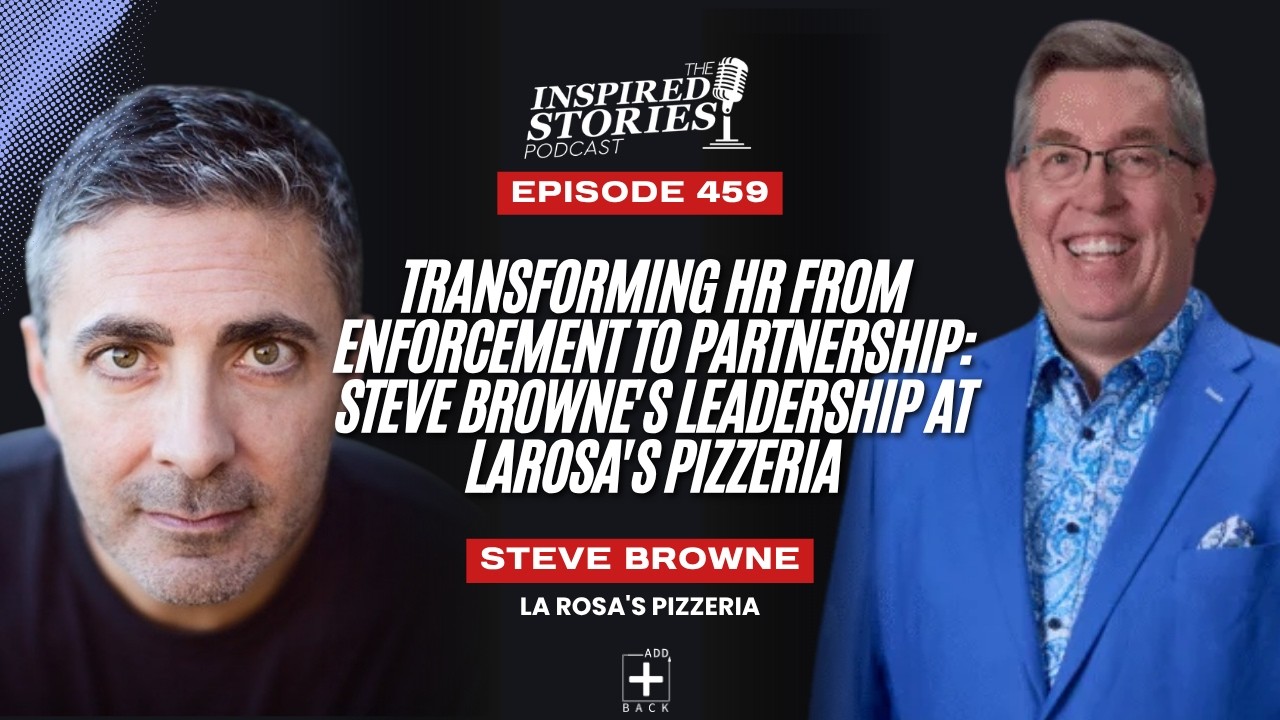
🎙️ From College Failure to Chief People Officer: Steve Browne's Journey Building People-First Culture at LaRosa's Pizzeria
In this inspiring episode, Steve Browne, Chief People Officer at LaRosa's Pizzeria and author of three influential HR books, shares his remarkable journey from nearly flunking out of engineering school to leading human resources for a beloved 71-year-old family-owned restaurant chain with 65 locations.
✨ Key Insights You'll Learn:
Career pivot from chemical engineering failure to communications degree after mother's life-changing question
Starting at Procter & Gamble: learning personnel work wasn't called HR yet in early 1980s
Cultural mismatch at Fortune 10: leaving corporate structure for entrepreneurial manufacturing startup
30-day employee name challenge: learn all 200 names or be fired on day 31
Foundation principle from first entrepreneur boss: "If you're not here for my people, I don't need you"
13 months unemployed in 1988-89 recession: girlfriend buying groceries, working as landscaper to survive
Joining LaRosa's after 19 years: friend recommended him while interviewing for same role herself
HR as "the black hole where everything goes to die" when he arrived in 2005
Three-month listening mandate: no ideas allowed, just observe and learn the business
Eliminating departments and hierarchies: creating "areas of work" with responsibility instead of bosses
Facilitating executive meetings with no agendas: five years of strategic progress through conversation
Office turnover at 1% with employees celebrating 20, 25, 30, 40, and 45-year anniversaries
HR Net newsletter: 15,000 subscribers globally receiving weekly resources and HR song parodies
HR Roundtable: 25 years running monthly gatherings averaging 100-500 people, welcoming those in transition
Three books published through SHRM: HR on Purpose sold 15,000+ copies versus industry average of 500
Networking as business skill: being a connector and giver, not just transactional job seeker
Church ministry: hosting over-50s group with 40+ people, teaching adults to play and have fun again
🌟 Steve's Key Mentors & Influences:
His Mother: Asked life-changing question about why he wasn't in a field with people, leading to communications degree and HR career path
First Entrepreneur Boss at Trans Ten Technologies: Gave 30-day name challenge, established foundation that "if you're not here for my people, I don't need you"
OSHA Inspector: Taught value of compliance as people protection rather than regulatory burden, turned six-figure fine into $3,000 through coaching
Kevin Burrell (Former COO at LaRosa's): Gave three-month listening mandate, allowed creative organizational restructuring, worked together closely for 15 years until his death in 2020
Sandy (Networking Friend): Recommended Steve for LaRosa's job while interviewing for it herself, demonstrating connector mindset
Malcolm Gladwell (Author, The Tipping Point): Helped Steve understand his natural connector personality through business literature
👉 Don't miss this powerful conversation about authentic leadership, eliminating hierarchies that separate people, treating unemployment with dignity and support, and why HR should be a people-oriented function that happens with department leaders, not just the HR office.
Listen to the full episode here
Transcript
Anthony Codispoti (00:01)
Welcome to another edition of the inspired stories podcast where leaders share their experiences So we can learn from their successes and be inspired by how they've overcome adversity My name is Anthony Cotus Bodie and today's guest is Steve Brown He serves as the chief people officer at La Rosa's Pizzeria a family-owned restaurant chain founded in 1954 and loved for its signature pizza
Also, they're inviting atmosphere and commitment to local communities. As a recognized HR thought leader, Steve brings more than 30 years of experience in hospitality, manufacturing, consumer products, and professional services. He is also the author of three influential HR books, HR On Purpose, HR Rising, and HR Unleashed. And he regularly speaks at national conferences.
sharing insights on nurturing positive workplace cultures. Under his leadership, LaRosa's has continued to grow and earn praise for its people-first approach, which has helped foster a devoted workforce and loyal customers. Now, before we get into all that good stuff, today's episode is brought to you by my company, Adback Benefits Agency, where we offer very specific and unique employee benefits that are both great for your team and fiscally optimized for your bottom line.
Imagine being able to give your restaurant employees free access to doctors, therapists, and prescription medications. It even works for part-timers too. And here's the fun part. The program will actually put more money into your employees' pockets and the companies too. One recent client was able to increase net profits by $900 per employee per year. Results vary for each company and some organizations may not be eligible.
To find out if your company qualifies, contact us today at addbackbenefits.com. All right, back to our guest today, the Chief People Officer at LaRosa, Steve Brown. Thanks for making the time to share your story today.
Steve Browne (02:04)
Hey Anthony, how are you today?
Anthony Codispoti (02:06)
Good to see you, Steve. So let's jump right in. What drew you into the field of HR? What was the attraction there for you?
Steve Browne (02:16)
I was failing out of college. I had started as an engineer and a chemical engineer and ⁓ I was really good at math and science in high school and I was failing. But when I went home, my mom pulled me aside, she's a wonderful person, and said, you know, why aren't you in a field with people? I said, what do mean? And she says, everything you do is with people. Don't you see it? And I went, no, I don't. And so...
Anthony Codispoti (02:18)
Ha ha ha.
Steve Browne (02:45)
I switched my major, went into communications and started as a recruiter.
40 years ago next year, which is staggering. ⁓ But I'm not one of those people who fell into HR. chose it. And I wanted to be in a field where I really could impact people and be around them. And it's been quite a journey since.
Anthony Codispoti (03:11)
So you went to school for communications. Did you know at that point that HR was going to be your path or was it kind of like a job fair and it was like, ⁓ here's some options and I choose that one.
Steve Browne (03:19)
⁓
I'm older than that Anthony. I sent letters ⁓ actually written typed letters on my typewriter to over 200 companies around the United States there was a book in the library said million dollar companies of this giant textbook looking thing and I picked out brands so I picked out all the brands you can think of and brands I knew ⁓ including Levi
⁓ Ringling Brothers because I thought that would be fun and Procter & Gamble and I got one interview at Procter & Gamble and got hired
Anthony Codispoti (03:59)
Wow. That worked out. And you were able to stay close to home because you're originally from Northwest, Ohio, Ada, Ohio. so Procter and Gamble based in Cincinnati, you're staying pretty close to home. Yeah. And so you started out as a recruiter for Procter and Gamble. And how did things unfold from there? What was your next big step forward?
Steve Browne (04:01)
Yeah.
Yeah.
Pretty close,
Mm-hmm.
I found out that I didn't fit the culture. And what's interesting when you talked about in my intro about having a people first culture, when I started in HR, A, it wasn't called HR even. It was personnel, industrial relations, labor relations, but we were the personnel office. And I didn't know what culture meant. We didn't talk about it. We talked about doing a job, filling roles. And I found out I didn't fit a corporate structure.
Anthony Codispoti (04:35)
was a call. Okay.
Steve Browne (04:53)
like Procter, it's a great company, great company, but I didn't fit. So I left and went into work for an entrepreneur. went from fortune 10 to startup and giant shock. And I went from office environment to a manufacturing plant. It was really a great step because I was swimming with sharks. I had to start.
Anthony Codispoti (05:06)
Big culture shock for you then.
Steve Browne (05:22)
an entire HR function by myself for a company of a little over 200 people without the internet, without, I mean, all the stuff that we just take for granted now, you know, when people get all excited now about AI, I'm like, manila folders, let's talk about that. But it was wonderful. And learning from an entrepreneur, you got your hands dirty quickly.
Anthony Codispoti (05:47)
So you're creating the HR department, the HR function in this company of 200 employees. When you were at Procter and Gamble, you started out as a recruiter. Did you move through other roles there? Because it seems like a big jump to go from recruiter to starting an HR department on your own.
Steve Browne (06:05)
Yeah, well, at the time, Procter had a career path of support and line. So you could start in a support role like recruiting, but then you move to a line function. So you could still do HR, but you had to move. You had to go out of Cincinnati. And my choice was Mahupanee, Pennsylvania for a paper company. I went, why? And I was young and ignorant. I'll just be honest. I was young. And I was like, why would I leave?
an office job to work in manufacturing, incredibly arrogant ⁓ and not well thought out. Turns out after I left Procter, I worked in manufacturing most of the rest of my career. It was really sad. I thought I was more in tune with people, but I didn't understand the value of people at all levels and at all industries. It was a misnomer.
Sorry a mistake of you know I have a college degree Okay Yeah, wow way to go you know
Anthony Codispoti (07:10)
All right, Mr. Fancy Pants.
So how did you start this department from scratch with the little experience that you had? Who did you go to for advice? Like you said, the internet wasn't a thing. It's not like you could Google ideas.
Steve Browne (07:27)
Old manuals, BLR, the Bureau of Labor Reports, it was a textbook, like an encyclopedia for HR. And it was just ⁓ volume after volume after volume of regulations and things like that. Most of it though was very grassroots and very hands on. A story I've told way too many times before. My boss, the founder of the company I went to work for,
said, hey, you have 30 days to learn every name of every person in the company. On the 31st day, we'll sit down. If you miss one name, I'll fire you. And I said, So I did dig my hands into the middle of folders and started reading all the files. And then I went out to the manufacturing plants. We had two nearby in Cincinnati. One was in South Carolina. In South Carolina, I got on the phone.
Anthony Codispoti (08:09)
Wow.
Steve Browne (08:26)
and was on the phone with the plant manager for hours trying to learn his people. The 31st day we sat down and he said, so who's Ken Mededa? And I said, Ken Mededa is the CFO and he sits upstairs and he's got a really weird New Jersey accent. He doesn't quite fit like us, but he's a really good guy and you really trust him. Okay, well who's Ron Schlemmer? Well, Ron Schlemmer is your plant manager. You hired him from college and just all of these stories.
And so he gave me these easy ones going again. He goes, OK, who's Carl Newton? I said, ⁓ Carl. Carl's the second shift brake shift operator. And Carl's kind of creepy because he finds mice in the plant and puts them in the machine and smashes them. He goes, what? I go, yep. But for an hour, we went over and over and over and over and over. And I didn't miss one. And he said, hey, do you know why you're here? And I said, no. He says, my people.
If you're not here for my people, I don't need you. Don't you ever forget that. And that foundation allowed me to take HR in a whole different direction. I was fortunate that he had such a different look as to what HR could be. So I could make it people first going in. And this was years and years and years before people even thought it was a popular thing to do.
Anthony Codispoti (09:46)
That's fabulous. And which company was that?
Steve Browne (09:50)
Trans 10 Technologies is no longer here. ⁓ Wild ride, I stayed with it. Ron, who I mentioned, Ron and I and Marvin and a few others, were the last 10 people with the company. But when he got to a point where he couldn't pay us, I had to move.
Anthony Codispoti (09:53)
Okay.
Times change. Time for a new challenge. How did the door at La Rosa's first open for you?
Steve Browne (10:14)
Yeah.
This is one of my favorite stories. I was not looking for a job. I had a great job at CDS Associates, was an engineering firm. I was a department of one, kind of had to count by the tail and I could do what I wanted. And I was very involved in the business. But a friend of mine who I've known just through networking, I had never met in person, but had met through a forum I run called the ATAR Net. And she...
heard about some other things, but we never had met in person. She says, hey, I just want to let you know this local company is looking for an HR person. And I said, who? And she says, LaRoses. said, no, that's not LaRoses doesn't have somebody. Donna works there. And she says, how do you know that? And I said, you got to know who works where. And she said, well, she's not here anymore. ⁓ OK. Well, she says, I really think you should check it out. So Kevin Burrell, the COO, sent me a note.
And he meowed and said, hey, I heard you had some people you could help me with. So I sent him some resumes and some friends and some people who are looking. I said, hey, by the way, I'm interested too. And he says, I was hoping you'd say that. Now here's why it's a great story. Sandy, the person who recommended me was interviewing for the job. And she said, I don't think I fit, but I think I know who does. And I had no idea that she did this.
And it turns out that she was the one who recommended me and she was the number one pick by the CEO at the time. And she didn't want to be in the role. And the only reason was she was a person who was a good office person. She didn't want to be in our pizzeria. She didn't want to be out in the field. And she was very up front about that. And I admired that. If you know who you are, you should stick to that. So one of the first questions I got being interviewed in a restaurant booth at one of our
stores was, so how do you feel about being the pizzerias? And my question was, do I have to have a desk? And they went, do it. I think we're good. My favorite part of the whole thing, though, is I went to Sandy's retirement a few years ago, and I brought her pizza.
Anthony Codispoti (12:27)
So like this fits.
Steve Browne (12:46)
say thank you.
very meaningful. know, it's wonderful to see what people or others focus.
Anthony Codispoti (12:57)
So Sandy went on to work somewhere else. Yeah. Okay. Yeah. And if she hadn't have taken herself out of the running for that role, which it sounds like the CEO wanted her and recommended you, you know, what have you been there? 19 years now? Sounds like you're having a good time. You love the role. Yeah. That door never would have opened. That's really cool. Yeah.
Steve Browne (13:01)
Yeah, she went to work for an accounting firm and it fit her perfectly.
Yeah, 19 years this month.
Anthony Codispoti (13:28)
Okay, so for people who haven't been to the Rosas, what is it like? What's the customer experience?
Steve Browne (13:36)
We're a destination. We have great food. I mean, incredible food, food that has tried and tested for 71 years. It's recipes, it's family recipes, legit family recipes from the LaRosa's family. Mr. LaRosa's Aunt Deanie, it's her sauce. You know, they started in a church basement at some fundraiser and they made the sauce and everything there. And a lot of those things have stayed with us.
But when you come to La Rosa's, it's an experience. Whether you get your food and take it home, but more often than not, people try us out at least a couple of times in the dining room and we get all kinds of family experiences. Anything from soccer teams, softball teams, funerals, proms, classroom unions, our main store across the street from where I have my office. There's a high school called Cincinnati Elder.
Anthony Codispoti (14:37)
Mm-hmm. Yep.
Steve Browne (14:37)
a well-known Catholic high
school. And I've been over there to see the class of 52 meet for lunch. You know, we have card clubs, they come every week and ladies, primarily ladies sit there for four to five hours to eat and play cards. You don't find that in a restaurant. You know, we also can take care of you and feed you and have you out the door and at your house and taking care of your family within moments.
So it's a really big gamut. It's a very wonderful culture.
Anthony Codispoti (15:11)
Is the family still involved in the business?
Steve Browne (15:14)
Yes, Mike LaRosa is the CEO and his father, Mr. LaRosa, buddy, LaRosa is his name, just turned 95. And he's around. He stopped by and said hi today. And then Mike's son, Nick, is in the business and he's the senior vice president of strategy. But yeah, we will probably always be a family company.
Anthony Codispoti (15:42)
how many locations today.
Steve Browne (15:44)
There are 65 locations. 10 of them are corporate and the rest are franchise.
Anthony Codispoti (15:49)
Okay. And where are the franchises today? What states can we find them in? is that too long to list?
Steve Browne (15:56)
no, no, we're very regional. We're primarily Southwestern Ohio down into Kentucky, as far far south as Dry Ridge, Kentucky, as far west as Batesville, Indiana, and as far east as Jackson, Ohio, and as far north as Centerville, Ohio. So we're right in the corner of the state. We like being a regional pizzeria. It's a good size for us. You know, we want to grow and we're working on growing and have a strategy around that.
but we want to do something where it's more of that destination approach.
Anthony Codispoti (16:30)
You think that's really what sets you guys apart from other pizza places?
Steve Browne (16:35)
I'll give you a great example. We know people see us at least once a month, if not more. We have an incredible loyalty program with our people, but our primary restaurant, which again is across the street, the next one's a mile and a half down the road. And the one next to that is three miles down the road. yeah, and so we're just all this little cluster, but people will be very loyal to their store.
Anthony Codispoti (16:56)
You guys are like Starbucks.
Mm.
Steve Browne (17:03)
So you'll ask somebody, so what's your store, Steve? And I go to Lakota. ⁓ Lakota. And people just know that there's an affiliation to who we are, which I think speaks well for our brand.
Anthony Codispoti (17:15)
And so in terms of food, I'm looking at your website here. It's not just pizza. There's a lot of other stuff here. What are some of the highlights for you?
Steve Browne (17:24)
⁓ well, primarily a pizza place, we have 40 menu items. You're going to make me sound like our marketing department. ⁓ Pasta's, hoagies, appetizers, wings, desserts. You can get it's an Italian restaurant that serves pizza salads. Our salads are really good. Favorite of the Jojo salad. It's a BLT salad. ⁓ Bacon, lettuce, tomato with creamy garlic dressing. My my children never ate salad.
Anthony Codispoti (17:39)
salads. Yeah.
Steve Browne (17:54)
till I worked at La Rosa's. Now, when they come home, first thing they get is a JoJo sale.
Anthony Codispoti (17:59)
Okay. It's that good, huh? I've got nine and 11 year old boys and yeah, they won't they won't touch the salad. Maybe I need to make a trip down to Cincinnati just to get them to cut their teeth. They do eat bacon. Yes. That'll be the lure. Okay, so the wings look good here too. Okay, so tell us about the growth plan here. So 10 corporate locations, 55 franchise.
Steve Browne (18:02)
It is that good. ⁓
Come see me, they'll be, no, he'd make it. ⁓
Anthony Codispoti (18:29)
Are you looking for more franchisees or do you have the of the partners that you want to grow with now?
Steve Browne (18:35)
I think it's a bit of both. ⁓ One of the things is atypical of La Rosa's versus other changes. We have generational franchisees just as we have a generational corporate structure. So many of our franchisees are third generation. So this is all they've known as families and have been with us decades. They're growing.
As younger people take over, they have a different mindset to some of their fathers who had owned it before. And they're looking to be restaurateurs, not that the others weren't. think the other guys were restaurateurs who were operators. Now we have people who are more business people who own restaurants. So we have a handful of people, though, that have come in later, and they are pure restaurateurs. We've looked at all kinds of different things of
Anthony Codispoti (19:18)
you
Steve Browne (19:32)
You gotta know who we are and be part of us. Not to change us, even La Rose's has that feel. And you'll know, I think it's easy to find people who want to invest, but it's not easy for people that wanna be a La Rose's franchisee.
Anthony Codispoti (19:49)
So what do you look for in those people? What's the personality traits?
Steve Browne (19:55)
People first, including the guests, we want people to have an incredible experience every time they work with us or every time they interact with us. And that has to be consistent across our chain. I don't think that makes us a lot different than restaurants, but you can have people go to almost any of our locations and have a great experience every time. And you don't know that they're affiliated. Outside, you see the brand, but you don't know whether it's a corporate store or a franchise store.
So if we can have that consistency with our food, with our hospitality, then you're in. So it's not a big ask, but it's a more well-rounded ask. We want to be efficient and profitable and all those good restaurant things. But to have that LaRosa's culture of hospitality first and people first is essential.
Anthony Codispoti (20:47)
You know, I think back to that, ⁓ that test one of your early employers gave you, right? Learn all 200 employees in the first 31 days or I'm going to fire you. That's extreme, but it really like put your head, like it framed for you like, like I really get it, right? Like I understand that this is truly people first. Whether that extreme or not, have you employed something similar when interviewing?
for any positions that you've filled since then.
Steve Browne (21:18)
Yeah, absolutely. It was interesting when I interviewed here. I had a six-step interview. I interviewed with the entire executive team. I didn't know that. I was just interviewing with people. And what I was looking for was, know, do you sounds good, but is it real? You know, because in an interview you can make the dance and go, Anthony, I get you excited about working here. You're like, woo, does it match what you're doing? But what was interesting is
I'm a big lava lamp person. I'm a big magic eight ball person. I've always been a toys person. And when I walked around the office, I saw people with lava lamps. I saw people with magic eight balls. I'm like, So here's some threads. So to answer your question, we ask questions about you and what you bring to the table. We don't want you to be like us. We want you to add value to us. But we grow from within. But when I started,
Gosh, I was like the fifth or sixth external person that had been hired. Most of them outside the company. no, outside the company period. The CEO who came in originally when I first was here started as a dishwasher.
Anthony Codispoti (22:22)
external, meaning outside the family and in sort of the leadership structure.
Steve Browne (22:35)
Mike and Mark LaRosa, even though they're family, started in the field at the front line. Nick LaRosa started in a pizzeria. So I was one of those rare ones who brought a skill into the company and didn't grow up in the pizzeria. So it was a bigger leap for me to make the transition versus others who we knew Anthony forever. I've known you since you were 16. There's a lot of familiarity in that. ⁓
We haven't had to hire much. It's really, we're very fortunate. In the office, it's about 1%.
Anthony Codispoti (23:09)
Not much turnover.
Wow, that's impressive.
Steve Browne (23:15)
You
know, and we have incredible tenure. We just celebrated, let's see, last week. I had a 20, a 25, a 30, a 40, and a five.
Anthony Codispoti (23:27)
Wow. That says a lot right there. So you've been there 19 years, right? You kind of, you know, move through the ranks a little bit, executive director of HR, VP of HR, now chief people officer. What's the, I don't know, from your perspective, the biggest challenge there inside that timeframe you've been there that you guys had to overcome?
Steve Browne (23:31)
wonder.
When I came here, HR was called the black hole. And I'm like, ⁓ And I'm like, why were we called the black hole? They go, well, because everything goes there to die. They went. OK, that didn't come up in the interview. What was really interesting is Kevin, my boss, did something I've never seen before or never experienced. He said.
Anthony Codispoti (23:59)
So right out of the gate, you had a big challenge.
Ha
Steve Browne (24:22)
I don't want you to give me any ideas for three months. And I go, what? He says, I want you to listen. That's it. Just listen, take notes. I want you to get out in the pizzerias. I want you to, you're an outside person. You don't know us. So learn us and get to know. And I'm a very, very extroverted person. I, you know, if I get a chance to talk, it's happening. And I have ideas all the time. In fact, Mike LaRosa,
keeps using a term he said at one of our one-on-one check-ins, says, Steve, you have a lot of ideas and I like some of them. And I'm like, yeah, okay, I'm in. But to be in a position where you had to be observant and quiet and keep to yourself, I was concerned that people were gonna think that I was distant, that I was aloof, that I was not any different than what they had seen.
Anthony Codispoti (24:58)
Ha ⁓
Steve Browne (25:21)
you know, that I wasn't engaging and there was a lot of damage and a lot of separation between functions in our company, ops, marketing, HR, the field. It was all disjointed. So I spent that first three months learning people, going out and meeting the 16 year old cook, you know, going out and meeting the 30 year general manager and
getting to the bakery and putting on a hair net and getting covered in flour. The challenge was trying to get people to understand that human resources can be people-oriented and should be people-oriented, but you can't tell people that. You have to be there with them. So, you know, to walk through the kitchen and not freak out or think that, you you're from the office. All of these barriers that we didn't mean to build, I had a chance to observe.
Anthony Codispoti (26:18)
Hmm.
Steve Browne (26:19)
And then, again, similar to my other boss, 91st day. He's like, so tell me what you saw. And so I drew a picture. And I drew an Excel spreadsheet, a bunch of lines going up and down with all the lines going to HR. But HR not going anywhere. And I said, here's what's interesting. Everybody comes to HR. We don't go out to anybody. I don't like that. Secondly,
They only come to HR when something's Bad position. He goes, well, what would you change? And I took the HR ⁓ line and put it over it. And I said, we should be in every department. Because the rule is, if there are people, there's HR. So let me try it. And he did. ⁓ But.
Anthony Codispoti (27:09)
What does that mean
to have HR in every department?
Steve Browne (27:12)
Every HR, every department has people. It's funny, HR doesn't do HR. People leaders do. So department heads do and supervisors do. That's where HR happens. Interactions and relationships between people. It's not the stuff I do. You know, we help get the compliance and that kind of stuff in line, make sure we don't break rules. But all of the behavioral side of what HR really is happens with people in departments or in the field. So.
I wanted to see our team get out and be among others and lead from there.
Anthony Codispoti (27:48)
So what did that look like in terms of like a practical implementation of this idea?
Steve Browne (27:54)
I, two to three days a week, I wasn't here in the office. And I went everywhere. I put thousands of miles on my car because I wanted to go and talk to you. If you had an issue in your store, I came to you. I came to you when you worked, not when I worked. If we had a people situation and it was a six o'clock night on a Saturday, that's where you go.
Anthony Codispoti (28:10)
Hmm.
Steve Browne (28:23)
And just to show that you're approachable and that you're accessible, turn the tide. Now you walk into pizzerias and people go, hey, Steve, how's it going? Not, it's HR or, it's corporate. It's, Steve. And just like I would be, hey, Jake, how are you? It's the same thing. It's that human connection. It's not a role connection.
Anthony Codispoti (28:47)
So the problem before, when it was a black hole, was that HR was just seen as like some sort of an enforcement arm and they're not really there to connect with you or to help you or support you or get to know you. They're just there to enforce the rules.
Steve Browne (29:00)
Right. The person before me brought structure. They took it from nothing to structure. But it was structure first and structure at all costs. And you get me a more permeable and bendable. Good HR isn't strict.
Anthony Codispoti (29:18)
Yeah, you've called HR or you like to look at HR as more of a true business partner, am I right? Yeah. What does that mean in practice at, know, bustling restaurant chain like La Rosa's?
Steve Browne (29:25)
Mm-hmm.
It's funny, if you listen to people talk, within four to five words of their sentence, they'll bring up someone's name. And yet we talk about, we're not getting something done in purchasing. You go, well, you know, we didn't get our cheese purchase and Steve. Gee, we're behind the deadline and Steve. I mean, it's people every time. So you're going to go, hey, how do we equip that person in that role?
so that they can perform. If they can perform, we thrive. A lot of HR people go, I want to measure and constrict and confine instead of saying, I want Anthony to be the best employee he can be. How do I equip him? It's just a different proactive look at what we do. We still do all the reactive stuff. So I still get all the dirt and the nasty things and the, you shouldn't have done that or you shouldn't have said that.
That's business. But that shouldn't be the focus. It should be the exception. But it takes a lot of work to turn that around where it truly is just an exception.
Anthony Codispoti (30:41)
So you had this big problem to fix when you first came in. What's another more recent initiative that you've brought into HR there? And I don't know, maybe the last four five years, or even the last year that you're pretty excited about.
Steve Browne (30:56)
yeah. I went really rogue and said, hey, we're eliminating departments. And people went, huh? What do mean? I don't think linearly, if that's the right word, linear fashion. I think works more of a continuum and it kind of ebbs and flows. And so when you put people in boxes, people will stay there. And when you put people in layers, people will stay there.
Organizations need to be able to move and shift and flow and be agile. So I found an old organizational chart that my boss had me draw because he knew I just had to get out of my head. goes, I don't think you like the way we're structured. And I said, OK. I said, no, it is what it is. He says, well, if you drew it, what would it be? He allowed me to be creative, which was very helpful. And I have an org chart that is all bubbles.
no lines whatsoever. And it shows how work happens. And when people says, well, who's my boss? And it's like, well, the person who's responsible for you is, and those semantics make a huge difference. If I'm responsible for you, I can lead you. If I'm responsible for you, I can shepherd you. If I'm responsible for you, I can correct you. But if I'm your boss, it's me down. Be quiet, do what I say. Instead of, I need to work with you and.
So it's all about approach. about June or so, we threw this out there and we talked about areas of work, which is another word for departments. It's just semantics. But when we talk about areas of work, we want to be a non-hierarchy organization. It's a people first place. Do people have roles? Yeah. Do people still have titles? Yeah. But we don't want people over people. We want people working with people.
People who are in larger roles have more responsibility.
Anthony Codispoti (32:58)
So was this more of a shift in vocabulary to affect people's mindset than it was like an actual change in, I don't know, business practices?
Steve Browne (33:15)
A little both. But yeah, it was more just let's come at it from this angle with these words. But I'll give you a great example. Kevin, who I've mentioned a few times, unfortunately passed away in 2020, had a heart attack. And he and I were closer. I've never had a boss this close. I was with him daily for 15 years. And it was a loss, huge loss for me and for the company. What I didn't know is I thought
His relationship with me was what he had with everybody and it was not. But he and I were so close and he felt so comfortable that I just assumed that's what he did with anybody else that worked with him, far from it. So we did a company reset. The family brought me in. So it was the three LaRoses that are here and me. And they said, we want to change things. We want to go in a different direction. How can you help us?
And we're to do this together. And it's not my model or about Steve Brown. It's how can we move forward as a company after this significant loss? Kevin had been with us for 47 years. So I said, well, let's try this. I'd like to do facilitated leadership at the executive meeting. And they go, what do mean? I said, I'd like to have an executive meeting with no agendas. Just get together and talk about the business.
I'll be the facilitator. Michael, I need you to participate, not lead. Because when you lead as the CEO, everybody is quiet. Because you're the top word. I said, but you have all the input and value and history, and you have direction and vision. We need that from you. Mark, we need this from you as the president. Nick, we need this from you. And we went around the room. Come and participate. I'll just be the person who pulls it together. I participate too.
⁓ But I have a flip chart. If I turn my camera, you'd see my three flip charts in here, old fashioned markers, the whole thing. And we set up things like we had a regular cadence of every two weeks, which we still do. We've been doing it for five straight years. Now they're one agenda ever. We're being more strategic than we've ever been. Because now we're sitting down and looking at the bigger issues that they cut me from a strategic vantage point upfront.
in moving it towards implementation and execution. But we're putting the implementation and execution with the people that do that well.
Anthony Codispoti (35:51)
So you don't have a formal agenda, but you just show up and you're like, hey, what do we talk about today, guys?
Steve Browne (35:54)
No.
I keep track in the back. You know, we would argue it. know where we're at. Yeah, we don't we don't go in with brainstorming. And what's interesting is I think we're becoming more mature as a business, not because of age, but because of approach. You know, if you've been Anthony, you've been in a session where it's like, hey, let's come up with ideas. We do brainstorming and dots and post-its and
Anthony Codispoti (36:02)
So you've got an idea of where you want to steer the conversation that day. Okay.
Steve Browne (36:27)
Then we prioritize, we go through all this stuff. And six months later, hey, let's brainstorm. It's mind numbing. So my thing is, why aren't we more intentional in a measured way on an ongoing basis? So we come in with templates. Like, hey, we're thinking about doing this in food. And there's a template, the food people bring it together. It's not, hey, let's come up with a new pizza. There's a lot of work that goes into all of these great things.
And then we pull people in as they're needed based on their talent and their strength. It's exciting. It's a great time to be here.
Anthony Codispoti (37:06)
Let's shift gears and talk about your three books. HR On Purpose, HR Rising, and most recently, HR Unleashed. And if I've got it correct, all of them end in two exclamation points. Why is that?
Steve Browne (37:20)
Yes, yes, I'm that person
way, way back when social media first started. I mean, I know you don't know me. I'm just an excitable guy all the time. It's not like a shtick. I'm like this constantly. So I put two exclamation points after things and people are like, this is not correct. And the grammatical, I'm like, I know, here's some more. Because too many people approach things from a very mundane
Anthony Codispoti (37:31)
Ha ha.
Steve Browne (37:50)
subtle, it's not to be over the top and in your face, but I want you to get geeked about what you do. So when I asked Shurm to help with the book, I said, unless you put two exclamation points on the cover, I'm not doing it. They go, but we want you to write a book. I said, I know. And I really appreciate that. But I won't ask for much, but it will be like this.
Anthony Codispoti (38:14)
So you were approached
to write these books.
Steve Browne (38:17)
I asked and I started it, but I talked to, I've been involved with SHRM, gosh, 25 years now. I'm sorry, the Society for Human Resource Management. So I've been a part of the National Association as a member and I worked my way from volunteer leader to being on the SHRM board at the national level. It's just something I believe in. It helps our industry incredibly. And they had a publishing home. So I said, Hey.
Anthony Codispoti (38:24)
Explain what sherm is.
Steve Browne (38:46)
since I was so active and kind of known, said, well, let's see what you got. And I put it together and they went, nice start. And then I had to write a lot more. ⁓ But it's been a great experience. I love having it out there.
Anthony Codispoti (39:03)
And so what was the message in that first book? Why did you need to write that?
Steve Browne (39:08)
I was tired of people trashing our profession. HR is the one profession that people go, you're an HR. Sorry. Sorry. You OK? You know, if you go, I'm in sales. They don't go, ooh, sales. Yikes. You know? But HR just gets bashed. And we do it to ourselves. So ⁓ I really felt this calling to say someone needs to show that I believe, or they believe in this industry and in people.
So HR on purpose is do it on purpose. Don't just, a lot of people in companies are afterthoughts. They're the silo on the side that you used when you're needed instead of being an integrated function. So I wanted to show how you could do HR on purpose more through stories and tells and advice. And the first book blew up. It exploded.
Anthony Codispoti (40:03)
to explain that more detail. What does that mean?
Steve Browne (40:06)
Matt, my publisher, said the average author, when they write a book, sells 500 copies in L.A., and that's good. Right now, I think HR on purpose has sold over 15,000, and that was not my intent. You know, like, hey, you know. But it hit a nerve, and I have been, I get stories of people who've read the book all over the world, literally all over the world.
And many people who said I was going to quit the profession until I read your book and I want to stay in. And I went, okay, well, that's pretty cool.
Anthony Codispoti (40:41)
Wow.
So give us
one big takeaway from that book that somebody would get. Like, let's tease our audience. Let's give them a reason to take a peek at it.
Steve Browne (40:55)
I think it's, that's hard to quantify. I'm a storyteller. I don't do well of, here's the model to follow. That's just silly, because it doesn't fit. Here's the five steps. I tell a story, trying to think, well, the 30 day story is in there. And how better to start a book to say, if your people don't matter, get out of HR.
Pretty simple.
Anthony Codispoti (41:24)
So
see if I'm wrapping my head around this. This is more a collection of stories, stories about how you approach HR that can be uplifting to people who have grown tired of the black hole that maybe HR has become for them and give them a new mental framework for how it could.
Steve Browne (41:29)
Yeah.
Yeah,
that's a great way to put it. It's not ⁓ prescriptive because I think if you have to look for a silver bullet from other people, I struggle with that. If you learn from something, we do something here at LaRosa's because we LaRosify things. So we'll hear a good idea and go, that's a good idea. We're going to LaRosify that thing. And so we make it our own.
And people go, boy, I wish I could do what you do at your place. You can't. So at your place, you have your culture, your people, your leadership, your approach. Take the concepts that are great business concepts and people's concepts and la rosify them. Make them fit what you do. I would like to see more people take accountability for who they are and what they do instead of being spoon fed of here's a formula. Gee, that didn't work. well.
We're constantly failing. We're constantly experimenting, innovating, and moving forward. It's a different way to look at
Anthony Codispoti (42:45)
Second book, H.R. Rising. Why did you write that one?
Steve Browne (42:49)
It was boring about leadership. It was like, hey, you can lead from wherever you're at. A lot of people don't let people lead unless they have a C in their name or a VP in their name. And honestly, those are just words on a title. I know tons of people who have senior titles that aren't leaders at all. And I think some people, especially HR, the majority of HR is departments of one. Companies are small. They don't have this giant HR staff.
So you still have to be able to lead. So instead of being passive in what you do in your practice, you know, take a leadership role and step forward for the organization.
Anthony Codispoti (43:29)
Okay, and then the last one, HR Unleashed. When did this one come out and what's it about?
Steve Browne (43:33)
It came out in 2023, and it was about how to truly be strategic. We've been talking about it as a profession for about 20 years. And it's a lot of strategy when I look at strategy, and it happened with us too. We say it's strategy, and it's basically implementation. It's not strategy. We start in the middle, because we're doers. You start in the middle and move it down.
Hey, look, we got this accomplished. Look at all the numbers we hit. Hey, we can get this revenue goal. Instead of saying, we want to be this, how does that look? And let's move it forward. So it's more about being strategic in what you do.
Anthony Codispoti (44:15)
Is this also like a collection of stories or is this a little bit more prescriptive? No, okay.
Steve Browne (44:18)
yeah, no
stories. You'll have to see them. You'll read them. know, people learn and remember stories. They just do.
Anthony Codispoti (44:29)
Yeah.
Yeah, you're right. I don't, you know, when I read something and it's like, here's the, the anagram or the what's the word I'm looking for the, you know, the, the three C's of something or, know, like I never remember that stuff. And I'll be honest when I get to that part, I usually skim over it, but if it's a story, if it's an anecdote, it's like, here was the real thing in real life. Here's how we got through it. Here's the other side of it that sticks in my head. Like I,
Steve Browne (44:42)
Right.
Yeah,
I think small doses of application inside a story fit. Large doses of application and instruction don't.
Anthony Codispoti (44:59)
Yeah.
No. ⁓ And if people want to read these books, are they available on Amazon? Okay. So Steve Brown, last name ends in E, B-R-O-W-N-E, Steve Brown, and ⁓ HR on purpose, HR rising and HR unleashed. So what is HR net?
Steve Browne (45:14)
Yeah, they're all on Amazon.
but again, old. Our HR chapter was full of people that had no resources and felt they had no time to get resources. So I started an old fashioned bulk email and it had 200 people on it. And I said, if you want to ask an HR question, you send it to me, I'll put it together and we'll just start this going. Well, then when things started picking up.
and internet became available and stuff. We started an internet message board. It's still an internet message board where people post questions on an old-fashioned message board. And I write a newsletter. ⁓ yeah, yeah. And I write a newsletter. And every week I write a newsletter in the newsletter. I say, here's what's on the site. Hey, Anthony, take this out. Here's some of new things on the site. I put a resource in there for you this week.
Anthony Codispoti (46:09)
It still exists in that format? my gosh, okay.
Steve Browne (46:27)
featured HR Examiner, which was a huge blog in the social media days. And it came back to life. It's a giant resource for people. It looks at HR tech and forward thinking things, especially on the tech side of things, AI, all kinds of fun stuff. Or I'll highlight other people's books, other authors, so that people know things. Because, and I mean this in the most loving way, HR people don't make the time to find resources, so I chose to put it in their lap.
⁓ And the other thing I do is I write a song every week that makes fun of HR.
Anthony Codispoti (47:03)
You write a song, are you a singer?
Steve Browne (47:05)
I sing, but I'm more of a lyricist. I'm like the weird Al of HR. ⁓ I hear a song, I can go, I can make that fit. Like this week, I wrote it last night as Kids in America by Kim Wild. It's a great song from the 80s. Do the lyrics and put it out there. And I also put something in there encouraging at the front just to kind of lift people up.
Anthony Codispoti (47:31)
So what are the chances you can belt out one of those for us right now? Okay, I had to try.
Steve Browne (47:35)
No, not very good. ⁓
But what's interesting is it started out as 200 people and now it's over 15,000 globally.
Anthony Codispoti (47:45)
Wow. Okay. And so for any folks in the HR field that are listening, they're like, I've not heard of this before. I want to check it out. How can they do that?
Steve Browne (47:54)
If they email me, and I know that's old fashioned, but I want your permission. I don't want to just add you. Too many people get subscribed to things that they don't want. I want you to want it. And if it's a value of you, for you, that's great. So if you put my email address in the show notes, I'm good. sure. Sure. It's sbrown, S-B-R-O-W-N-E at larosas, L-A-R-O-S-A-S dot com.
Anthony Codispoti (48:11)
I will. Can you go ahead and give it to folks though for those that are just listening?
Awesome. Okay, let's shift gears again, Steve. I would like to hear about a big, hairy, serious challenge you faced in your life. How you got through that, what you learned.
Steve Browne (48:42)
I would say the biggest challenge I had, both personally and professionally, was being unemployed. When I left Procter & Gamble, I thought I had the world by the tail. I would just find the next place. And I did not. And it was in 88, 89, one of the many, many recessions we've been through. And I was too big for my britches. I got to the point where my...
girlfriend at the time, my wife now of 36 years, had to buy me groceries because I couldn't afford groceries. And I joined a few friends of mine that I volunteered with and worked as a landscaper for people that lived in magnificent houses. And it was a humbling experience because I just needed to get a better view on valuing life, valuing work.
valuing others instead of just, you know, thinking it was going to be handed to me. Once I had been in transition, I was in transition for about 13 months. I never, ever forgot what that meant. So how that's translated, I have been running a roundtable, an HR roundtable here in Cincinnati since 2020, sorry, since 2000. For 25 years, I've been running a roundtable.
and people who are in transition are welcome to come because I want to be there to be a resource for those that have lost jobs. It's incredibly painful. ⁓ Too many people are identified by what they do and who they are in their role. I am not that person, but I respect that in people. ⁓
People make it way too trite, way too trite. ⁓ When you don't know where your next meal's coming from or if you can't make your bills. And I work with people like that daily. It just gives you a better appreciation of the value of people and valuing them for who they are and what they do instead of just expecting them to come to work. So I've been in transition a couple of times and it's the worst.
Anthony Codispoti (51:04)
What advice do you have for somebody who's listening right now that's in transition themselves? And they're like, yeah, it is the worst.
Steve Browne (51:13)
Something I wish somebody would have told me. You and I got connected through networking channels of all kinds of stuff and we haven't met, but we get to know each other. Too many people don't network just to have people in their corner. They network to get a job. And that's not good. My dad used to say, there are two types of people in the world, givers and takers. Takers?
get in the network, I need to network, they give me the 30 second elevator speech and the minute they find a job, you disappear. Networking is a business skill. It also can help you get a job. I want to know I have people in my corner. So the HR net, which has 15,000 people, the HR round table, we average 100 people a month and it goes up to 500 people a month to come. They need to know that you have a place to be.
a connected professional. Don't just do it to get a job. Do it to make sure that you're investing in other people's lives.
Anthony Codispoti (52:21)
is that look like from a practical standpoint? Right? Because I get like LinkedIn connection requests from people and it's clear they've got something to sell me and I respect that everybody's, you know, trying to make a living. But hey, can you know, I grab 20, 30 minutes of your time to talk about your SEO strategy. Like, what does it really look like to build those relationships to the point where like you put it, you've got people in your
Steve Browne (52:34)
Yes.
Okay.
I'll give you a good example. I was on another podcast from a gentleman and somehow something I connected and afterwards he says, hey, can I talk to you about my platform? I said, sure, man. That's great. So I give him the time because that one thing I can give people is my time. It's the one thing I have. It's the one thing I own. Everything else I don't. You got to rent. But my time is mine. So I said, sure, I'll talk to you. So I called him on my way home because I have a long commute.
And while we're talking, he's just jumping into his platform and he's all excited. And I said, Hey, sounds great. Probably won't use it. He goes, why? I said, I appreciate your passion. Here's what you don't understand. I'd like to get you connected, Gerald, to John Ferguson, to Sonny Courtney and John Baldino. These three people I know can help you. He's like, why would you do that? like, because you're looking for people to know.
in order to move things forward. I can be a connector and do that for you. Why would you do that? said, why wouldn't I do that? There's a great book by Malcolm Gladwell, The Tipping Point. OK. And I didn't know this. One of my former pastors read this. He was a business guy. It's great. He read business books. It's really cool. He said, I read this book and saw you and I'm a connector. And I am a crazy wild connector for no reason. I just can't help myself.
But I don't expect you to do it with me or for me. I expect me to be able to help you in any way I can. And I get requests weekly like you do, but I get requests of, hey, I heard you at a conference. I really want to talk to you because when you get past the surface level and you've dumped down just a little bit more, those are connections worth having. And it's harder. takes a little more time, but it's worth it.
Anthony Codispoti (54:45)
So for somebody who's listening right now and they're already in that position where they're in transition and they're like, what do I do now? Okay, I get it. The best time to have started to build my network and develop those relationships was a year, two years, five years, 10 years ago, but here I am. I didn't do that. What do I do now?
Steve Browne (55:04)
I would try and find a place where people gather. You never can beat in-person things. So there could be professional groups, there could be transition groups. But instead of going in there and going, hey, let me just vomit on you, all the stuff that I'm doing, because I'm so desperate. You have to know me as a person. Ask me what I do. Ask me where I live. Ask me if I can help. Can I help you? And have it be a little more reciprocating instead of one-sided.
Small bits, but the second part of it, which is critical is understand your capacity. If you come in like a shotgun and just go, ⁓ to 20 people, you aren't going to know anybody. If you're a two-person capacity person, dive in. If you're a 10-person capacity person, do that. But make those intentional connections and ask people for their time. If they don't give you their time, move on. You don't need to be connected to them anyway.
Anthony Codispoti (56:06)
If you had to recommend a book that's not yours to our listeners or a podcast perhaps, what would you point people towards? Something that's been helpful to you.
Steve Browne (56:18)
The Infinite Game by Simon Sinek. Best business book ever written. Blew my mind. I know Simon Sinek's all thought leader and cool and he's got a great accent and all that stuff. And his start with Y. Everybody's done it. We've done it. We still use it. But the Infinite Game talks about how work is infinite, but most of us make it finite. So when you look at strategic plan.
Anthony Codispoti (56:21)
Tell us more about it.
Steve Browne (56:47)
One year done three year done instead of saying work is always happening. It never stops It keeps going people keep changing He gives great examples of companies who've embraced this and it will change People look if I showed you my copy it just covered with post-it notes because it's that full The other one though that you can't miss is called orbiting the giant hairball by gordon mckenzie
Anthony Codispoti (57:17)
Haven't heard of this one.
Steve Browne (57:18)
Second
best book. Oh, fantastic. Someone gave it to me at the roundtable, said, hey, saw this book, thought of you. That's kind of fun. Gordon McKenzie used to work for Hallmark Cards and was fired for being too creative at a card company. Fantastic. But his whole premise in the book is everybody tried to take the hairballs of life and work because we all have them. You know, I'm a dad, I'm a husband, I'm a CPO.
Anthony Codispoti (57:33)
Hahaha
Steve Browne (57:47)
I'm involved in my church, I'm involved in civic things, you you name it. I write a blog, all this crazy stuff. Every part of your life's a hairball. Everybody you work with is a hairball too, and work is a hairball. His own point is we keep trying to straighten it out. Do we just get everything unraveled and in line? You can't. His whole thing is jump out, learn something new, go back and make the hairball better. So.
doing good work like you're hearing from other people, hearing their stories. That's getting out of my daily activity, learning something amazing, going back and making my hairball better. It's really a great book.
Anthony Codispoti (58:31)
That's cool. It's not often that my guests get so animated about the books that they're recommending that makes me want to go out and get them. So ⁓ thank you for adding to my reading list. So what's your superpower, Steve Brown?
Steve Browne (58:42)
Sure.
I don't know. I'm very approachable. I'm 100 % who I am every time you meet me. There's nothing you can't ask me and I go, oh, I'll tell you that. You know, I've never been a person where you have to earn something from me. I want to know about you now. I want to know what makes you tick. It's very interesting to me and I'll remember it. And I'll remember your name. That exercise that my boss gave me years ago.
I had been doing it for years. He didn't know that. I know thousands of people by name. When I see you, if you come to my roundtable, I'll know if you're new. ⁓ And if I don't know you, I'll make sure to introduce you. The next time I see you, chances are I'll know who you are. So I've always thought that names matter. You were given a name for a reason. instead of just being, hey, guy who does podcast person, you know?
or works for a benefits company, you've already talked about things that I know about you and we've never met. Yeah, you need to show that people matter. And I've always felt that.
Anthony Codispoti (59:58)
Steve, sometimes our mistakes become our greatest teachers. What's an early career moment that seemed like a setback at the time that actually propelled you forward?
Steve Browne (1:00:09)
We had OSHA come into our manufacturing plant and I didn't know what OSHA was. And I met the inspector, he's like, hi, I'm from OSHA. I'm like, neat.
He goes, where's your OSHA poster? I'm like, what's an OSHA poster? And he says, you're not kidding. I said, no, sir, I'm not. I'm not trying to be trite. I really don't know. And I was new. I didn't know. Nothing to know. And so he goes, we're going to find you. go, I bet you are, because we don't know what we're doing. And he says, OK. Well, he walked me through, coached me.
showed me where we were making errors, showed me the value of what safety practices meant. And then when I sat in front of the district person to get fined, the number was giant, six figures. And we were not, we were not an entrepreneur company. And I was like, okay, he goes, so tell me what you've stopped, you've taken to do remediation. I said, yes, sir. And I had Polaroids, honest to goodness, Polaroids and paper and fixed things. said, you know.
The inspector said this, we've done these three things. The inspector said this, we did these three things. He dropped it down to $3,000.
So I think you have to respect the good work that people do instead of getting upset about regulatory things, learn how to comply and do the right thing because you're protecting people. Quit thinking of do's and don'ts. Think of ways to take care of your people. A safe environment is what you need. Structured systems are what you need so people know how to do their jobs. We keep talking about what's wrong in companies.
instead of taking all the good stuff and making it work with us and for us.
Anthony Codispoti (1:01:56)
I really liked that story. And I heard from some of my other manufacturing guests that have had, you know, issues with OSHA or, you know, another agency. And they're like, you know, it was painful. It was embarrassing, but we didn't hide from it. We stepped up and we owned it and, we asked questions, help us do this better. And some of them have reported similar kinds of things to you where it's like they witnessed
that you truly want to do those good things and you're taking the right steps and they're more likely to work with you. It becomes much less adversarial and it becomes more of a partnership. And now they see that agency come on site. It's like, Hey, Jim, good to see you again. Let me show you what we're doing here. Same, same kind of thing you guys did, right? You took ownership of it.
Yeah, I like that. Okay, two questions I got left for you. What's your favorite thing to do outside of work?
Steve Browne (1:02:51)
All right.
⁓ music trivia. I'm a freak when it comes to music trivia. We have a local place down around the corner from my house. My best buddy's daughter owns it and we'll usually get my wife and my another couple and I and we'll go and we'll take on the whole bar. We'll usually come in first or second.
Anthony Codispoti (1:02:56)
Music trivia, very specific, okay.
of it. Okay. All right. Before I ask the last question, I'm gonna take care of three things here. First of all, anybody wants to get in touch with Steve, we've already said you can find all of his books on Amazon. Just search for Steve Brown with an E ⁓ and you're gonna find those three different HR books. You can also find him on LinkedIn and his email address once again, and we'll have it in the show notes is sbrown with an E S B R O W N E at la rosas.com.
And as a reminder, if you want to get more employees access to benefits that won't hurt them financially and carries a financial upside for the company, reach out to us at addbackbenefits.com. Finally, if you'll take just a moment to leave us a comment or review on your favorite podcast app, you'll hold a special place in my heart forever. Thanks so much. Okay. So last question for you, Steve, a year from now, you and I reconnect and you are super excited because you're celebrating something big. What's that big thing you hope to be celebrating one year from today?
Steve Browne (1:04:13)
helping our company go through succession. ⁓ We are going through the tenure is going to start changing because we have some people who will be making that next step in their career, either outside of the company or into different roles. So I over the next year, year and a half, we're going to be making some big shifts. It's gonna be pretty exciting.
Anthony Codispoti (1:04:32)
Okay, fun stuff. Steve Brown from La Rosa's, I want to be the first to thank you for sharing both your time and your story with us today. I really appreciate it.
Steve Browne (1:04:40)
Thanks, Anthony. It's been great. Love talking to you.
Anthony Codispoti (1:04:43)
Folks, that's a wrap on another episode of the Inspired Stories podcast. Thanks for learning with us today.
Connect with Steve Browne:
LinkedIn: Steve Browne
Email: sbrowne@larosas.com
Website: LaRosa's Pizzeria
Books on Amazon:
HR on Purpose!!
HR Rising!!
HR Unleashed!!
HR Net Newsletter: Email Steve to subscribe to weekly HR resources and insights